Red Hat Enterprise Virtualization 3.0 on
IBM System X – a Smarter Choice


                     Virtualization and cloud computing are compelling technologies that are driving the future of
                     computing. By transitioning workloads from physical servers to virtual machines, datacenter
                     consolidation significantly increases the utilization and agility of computing resources while
                     reducing operating costs with more efficient use of power and space. Capital cost savings in
                     server hardware is the most immediate benefit and can range from a reduction of 40-75%.
                     Datacenter operations also benefit from the improved on-going management of servers as well
                     as reduced requirements for space and power.

                     Virtual machines can be provisioned much more rapidly than physical servers. High availability
                     and rapid recovery can easily be built into the solution much more cheaply than with physical
                     servers (offering cost savings for ongoing business continuity). Through resource scheduling
                     and policy-driven workload balancing, optimization of the entire virtual infrastructure can be
                     more effectively maintained. At the same time, virtualization solutions must deliver enterprise-
                     level functionality and capabilities in terms of performance, scalability, security, and manage-
                     ability in order to be viable. Based on a long and successful collaboration, Red Hat and IBM are
                     poised to offer organizations unparalleled virtualization opportunities through the unique com-
                     bination of Red Hat Enterprise Virtualization 3.0 and IBM System x.

                     IBM and Red hat:
                     A Strong History of Innovation and Collaboration
                     It would be a challenge to find an organization with a longer and greater depth of virtualization
                     experience than IBM. With a history of virtualization innovation extending back into the 1960s,
                     IBM is in a unique position to add value to open virtualization solutions. As shown in Figure 1,
                     IBM and Red Hat have a strong and long-standing tradition of industry-leading collaboration
                     around Linux, and around virtualization technology in particular.


    www.redhat.com
Red Hat Enterprise Virtualization 3.0 on IBM System X


                                    This close collaboration enables IBM to leverage new capabilities of Red Hat Enterprise
                                    Virtualization 3.0 earlier with IBM System x hardware. In fact, IBM System x is specifically opti-
                                    mized for Red Hat Enterprise Linux and Red Hat Enterprise Virtualization. These systems have
                                    been shown to deliver dramatically better performance and scalability than alternative combi-
                                    nations. In particular, IBM’s eX5 server innovations provide breakthrough virtualization agility.
                                    MAX5 memory allows organizations to scale memory capacity up to five times that of non-eX5
                                    servers. Memory can now be scaled independently from CPUs to get more out of business-crit-
                                    ical, enterprise solutions such as business intelligence, enterprise resource planning, and data-
                                    bases. Input/output (I/O) capacity is also superior with four times the I/O ports of traditional
                                    systems equipped with 10 Gigabit Ethernet.


                                                                                     OVA and oVirt
                                                                                                rt
                                                                                                                       y
                                                                                                                     System x &
                                                                       KVM goes upstream                            Blade Center

                                                     Red Hat & IBM start KVM investment

                                               Intel adds x86 hardware virtualization
                                                                                                                  Power Systems
                                Virtualization on POWER

          Virtualization on IBM mainframes

                                                                                                                     Systems z
     1967           1997             2005 2006 2007 2008 2009 2010 2011
                                     2

   Figure 1. IBM has a long and unassailable record of innovation in virtualization technology, dating back into the 1960s.


                                    The collaboration between IBM and Red Hat brings the following advantages to enterprises:

                                      •  Lower total cost of ownership

                                      •  Enterprise-class performance, scalability, and security

                                      •  Technical leadership and business agility through the open source development community

                                      •  A lower-cost, more scalable and open cloud

                                      •  An ecosystem of virtualization management tools and ISV applications


             www.redhat.com                                                                                                              2
Red Hat Enterprise Virtualization 3.0 on IBM System X


                             Red Hat Enterprise Virtualization 3.0
                             As adoption of virtualization technology grows, it is following a now-familiar path. Once the only
                             option, early proprietary solutions are gradually giving way to open standards and open source
                             technologies. Just as open source Linux solutions such as Red Hat Enterprise Linux have rapidly
                             replaced proprietary UNIX systems, open source hypervisor technology now competes directly
                             with proprietary virtualization technologies. The payoff is predictable in terms of reduced costs
                             and eliminated vendor lock-in.

                             The introduction of Red Hat Enterprise Virtualization 3.0 in particular positions the open source
                             Kernel-based Virtual Machine (KVM) hypervisor as a strategic alternative. Unlike proprietary
                             virtualization technologies that restrict organizations to proprietary virtualization and cloud
                             stacks, Red Hat Enterprise Virtualization 3.0 offers a superior balance of enterprise virtualiza-
                             tion management features, performance, and scalability for Linux and Windows workloads at a
                             fraction of the cost. Because Red Hat Enterprise Virtualization is based on the open source KVM
                             hypervisor, it offers an open, interoperable solution from Red Hat, a trusted enterprise vendor,
                             without the lock-in of proprietary hypervisor solutions.

                             Red Hat Enterprise Virtualization 3.0 is a complete virtualization management solution for
                             server and desktop virtualization, and it is the first enterprise-ready, fully open source virtual-
                             ization platform. It is based on the powerful KVM hypervisor and the oVirt open source virtual-
                             ization management project.
                             Red Hat Enterprise Virtualization represents a true strategic virtualization alternative for orga-
                             nizations looking for better total cost of ownership (TCO), faster return on investment (ROI), and
                             accelerated ROI when compared to proprietary virtualization vendors.

                             An enterprise-ready offering ideal for large-scale virtualization and inter-
                             nal cloud deployments
                             Virtualization provides the foundation for a gradual transition to the cloud, and Red Hat’s KVM
                             hypervisor integrates virtualization directly into the Linux kernel. As a result, virtual environ-
                             ments now automatically inherit the advanced capabilities of Red Hat Enterprise Linux. This
                             approach has helped IBM and Red Hat rapidly deliver leadership in performance, scalability,
                             manageability, and security in virtualized environments. Development is greatly simplified, as
                             engineering teams no longer have to focus on bare-metal, virtualization, and cloud as three dis-
                             tinct operating environments.

                             Red Hat Enterprise Virtualization offers enterprises the ideal platform for large-scale virtual-
                             ization initiatives and internal/private cloud deployments. KVM has achieved record-setting
                             virtualization benchmark results as well as unmatched consolidation ratios. Red Hat Enterprise
                             Virtualization enables organizations to centrally and effectively manage their entire virtual envi-
                             ronment, including virtual datacenters, clusters, hosts, guest virtual servers, networking, and
                             storage. Red Hat Enterprise Virtualization is also fully featured, with high availability, live migra-
                             tion, policy-based workload balancing, image management, snapshots, and thin provisioning.

                             Red Hat Enterprise Virtualization for Servers includes the Red Hat Enterprise Virtualization
                             Manager, a feature-rich server-virtualization management system and the Red Hat Enterprise
                             Virtualization hypervisor, and supports server operating systems as virtual guests. Red Hat
                             Enterprise Virtualization for Desktops is available as an add-on, and provides support for desk-
                             top operating systems as virtual guests as well as support for desktop management functional-
                             ity. Red Hat Enterprise Virtualization has been engineered to support the most demanding IT
                             infrastructures, with guest operating system support for Red Hat Enterprise Linux guests (32-
                             bit and 64-bit) and for Microsoft Windows guests (32-bit and 64-bit), complete with paravirtual-
                             ized network and block drivers.


           www.redhat.com                                                                                                          3
Red Hat Enterprise Virtualization 3.0 on IBM System X


                             KVM’s open source momentum
                             Red Hat and IBM understand that the growth of an open virtualization ecosystem requires more
                             than just a hypervisor. Any solution must provide a feature-rich management platform, well-
                             defined APIs throughout the stack, an active and open development community, and third-party
                             products that extend the hypervisor. To satisfy this need, KVM and oVirt technologies are enjoy-
                             ing growing industry support through the Open Virtualization Alliance (OVA) and the oVirt com-
                             munity project.

                             The OVA is driven by leading virtualization, datacenter, and cloud solution providers that are
                             focused on driving awareness and adoption of KVM solutions. Fostering interoperability and a
                             thriving ecosystem of third-party solutions around KVM is a primary focus for the OVA, while
                             oVirt services the extended technical community around KVM management.

                             A distinct value advantage
                             Many proprietary virtualization solutions represent the profit centers for their respective own-
                             ers, resulting in significant expenses to customers in the form of license fees that only grow as
                             virtualization technology is scaled out. In contrast, Red Hat’s subscription model allows organi-
                             zations to deploy enterprise-grade virtualization technology at a fraction of the cost of propri-
                             etary competitors, while also avoiding vendor lock-in.

                             IBM System x for Breakthrough Virtualization agility
                             The long and deep collaboration between IBM and Red Hat means that the benefits of a joint
                             solution go well beyond those of typical open source distributions. Both companies use each
                             other’s technology extensively, with Red Hat running on IBM and IBM running on Red Hat. For
                             instance, the IBM SmartCloud Enterprise utilizes Red Hat Enterprise Linux with KVM on over
                             1,000 physical hosts, 6,000 virtual machines, across eight datacenters, all running on IBM
                             System x iDataPlex servers.

                             The benefits of a strong collaboration: IBM and focused KVM development
                             IBM has a large development effort dedicated to KVM and has been actively contributing key
                             KVM features since 2007. More than 60 IBM programmers work on KVM as a part of the com-
                             munity and collaborate with Red Hat in key areas such as engineering, performance, test, valida-
                             tion, support, and consulting. Beyond merely contributing to the community, IBM focuses on key
                             development priorities for Red Hat Enterprise Virtualization, including:

                               •  Performance and scalability through support for large memory and faster virtualized I/O
                                  with SR-IOV

                               •  Security and reliability, such as MAC-level security with SELinux and common criteria certifi-
                                  cation with EAL4+

                               •  Cloud optimization, including high density of virtual machines and automated provisioning
                                  and migration


           www.redhat.com                                                                                                        4
Red Hat Enterprise Virtualization 3.0 on IBM System X


                             IBM System x: X-Architecture® tuned for Red Hat Enterprise
                             Virtualization
                             Another result of IBM and Red Hat’s close partnership is that IBM System x is designed to run
                             Red Hat Enterprise Virtualization, offering better performance and scalability. For example,
                             unique IBM eX5 models have been tuned to deliver key characteristics and functionality that
                             can deliver virtualization advantages, including:

                               •  Optimized server performance through unmatched memory management

                               •  Dramatically faster I/O with greater storage density and improved reliability

                               •  Industry-leading scalability through pay-as-you-grow capability

                               •  Superior asset utilization and workload management

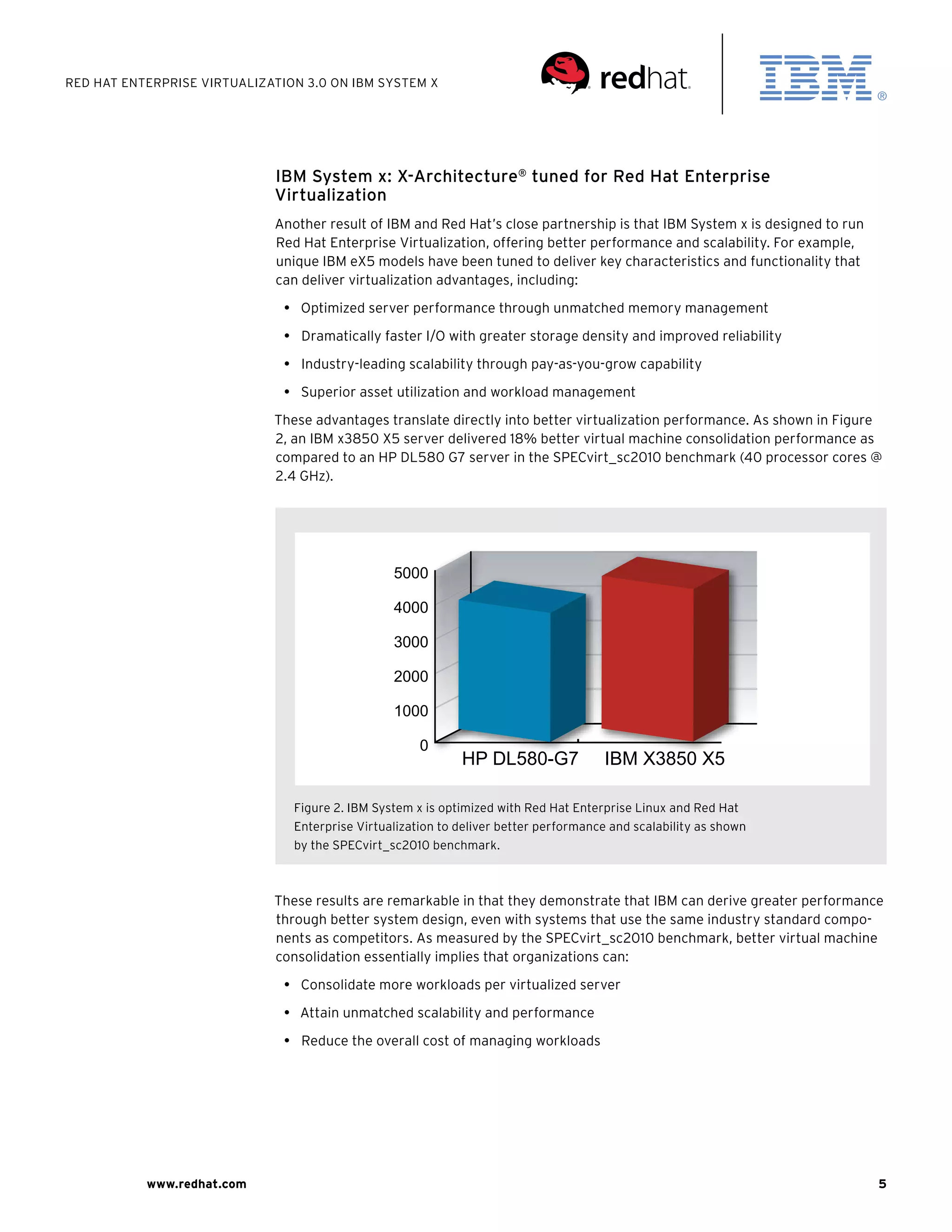
                             These advantages translate directly into better virtualization performance. As shown in Figure
                             2, an IBM x3850 X5 server delivered 18% better virtual machine consolidation performance as
                             compared to an HP DL580 G7 server in the SPECvirt_sc2010 benchmark (40 processor cores @
                             2.4 GHz).


                                                 5000

                                                 4000

                                                 3000

                                                 2000

                                                 1000

                                                      0
                                                             HP DL580-G7              IBM X3850 X5

                                Figure 2. IBM System x is optimized with Red Hat Enterprise Linux and Red Hat
                                Enterprise Virtualization to deliver better performance and scalability as shown
                                by the SPECvirt_sc2010 benchmark.


                             These results are remarkable in that they demonstrate that IBM can derive greater performance
                             through better system design, even with systems that use the same industry standard compo-
                             nents as competitors. As measured by the SPECvirt_sc2010 benchmark, better virtual machine
                             consolidation essentially implies that organizations can:

                               •  Consolidate more workloads per virtualized server

                               •  Attain unmatched scalability and performance

                               •  Reduce the overall cost of managing workloads


           www.redhat.com                                                                                                    5
Conclusion
                        Enterprise IT organizations are challenged to provide rapidly increasing IT capability while con-
                        taining or reducing total costs. The strong collaboration between IBM and Red Hat means that
                        organizations can deliver enterprise-ready virtualization solutions while realizing real benefits
                        in terms of value, performance, scalability, security, and manageability.

                        Red Hat Enterprise Virtualization 3.0 represents a strategic and cost-effective alternative to tra-
                        ditional virtualization solutions that lock organizations into proprietary virtualization and cloud
                        stacks. Deploying Red Hat Enterprise Virtualization 3.0 on IBM System x yields unparalleled vir-
                        tualization agility.

                        Disclosure
                        SPEC™, SPECvirt™, and SPECvirt_sc are trademarks or registered trademarks of the Standard
                        Performance Evaluation Corporation (SPEC). Competitive numbers shown reflect results pub-
                        lished on www.spec.org as of Jan. 1, 2012.

                        For more information
                        To learn more about how Red Hat and IBM can help optimize your IT infrastructure, contact your
                        local salesperson or visit redhat.com or IBM.com

                        For a free, fully supported, 60-day trial of Red Hat Enterprise Virtualization 3.0, visit:
                        redhat.com/promo/rhev3

                        For more information on Red Hat Enterprise Virtualization, visit:
                        redhat.com/rhev3

                        For more information on IBM System x and BladeCenter with Red Hat Enterprise Linux, visit:
                        www-03.ibm.com/systems/x/os/linux/rhel.html

                        For more information on the Open Virtualization Alliance (OVA), visit:
                        openvirtualizationalliance.org

                        For more information on the oVirt project, visit:
                        ovirt.org


SALES AND INQUIRIES     NORTH AMERICA                     EUROPE, MIDDLE EAST                         ASIA PACIFIC                       LATIN AMERICA
                        1–888–REDHAT1                     AND AFRICA                                  +65 6490 4200                      +54 11 4329 7300
                        www.redhat.com                    00800 7334 2835                             www.apac.redhat.com                www.latam.redhat.com
                                                          www.europe.redhat.com                       apac@redhat.com                    info-latam@redhat.com
                                                          europe@redhat.com


     www.redhat.com     Copyright © 2012 Red Hat, Inc. Red Hat, Red Hat Enterprise Linux, the Shadowman logo, JBoss, MetaMatrix, and RHCE are trademarks of
        #8854827_0212   Red Hat, Inc., registered in the U.S. and other countries. Linux® is the registered trademark of Linus Torvalds in the U.S. and other countries.
                                                                                                                                             XSS03097-USEN-00

Red Hat Enterprise Virtualization 3.0 on IBM System X – a Smarter Choice

  • 1.
    Red Hat EnterpriseVirtualization 3.0 on IBM System X – a Smarter Choice Virtualization and cloud computing are compelling technologies that are driving the future of computing. By transitioning workloads from physical servers to virtual machines, datacenter consolidation significantly increases the utilization and agility of computing resources while reducing operating costs with more efficient use of power and space. Capital cost savings in server hardware is the most immediate benefit and can range from a reduction of 40-75%. Datacenter operations also benefit from the improved on-going management of servers as well as reduced requirements for space and power. Virtual machines can be provisioned much more rapidly than physical servers. High availability and rapid recovery can easily be built into the solution much more cheaply than with physical servers (offering cost savings for ongoing business continuity). Through resource scheduling and policy-driven workload balancing, optimization of the entire virtual infrastructure can be more effectively maintained. At the same time, virtualization solutions must deliver enterprise- level functionality and capabilities in terms of performance, scalability, security, and manage- ability in order to be viable. Based on a long and successful collaboration, Red Hat and IBM are poised to offer organizations unparalleled virtualization opportunities through the unique com- bination of Red Hat Enterprise Virtualization 3.0 and IBM System x. IBM and Red hat: A Strong History of Innovation and Collaboration It would be a challenge to find an organization with a longer and greater depth of virtualization experience than IBM. With a history of virtualization innovation extending back into the 1960s, IBM is in a unique position to add value to open virtualization solutions. As shown in Figure 1, IBM and Red Hat have a strong and long-standing tradition of industry-leading collaboration around Linux, and around virtualization technology in particular. www.redhat.com
  • 2.
    Red Hat EnterpriseVirtualization 3.0 on IBM System X This close collaboration enables IBM to leverage new capabilities of Red Hat Enterprise Virtualization 3.0 earlier with IBM System x hardware. In fact, IBM System x is specifically opti- mized for Red Hat Enterprise Linux and Red Hat Enterprise Virtualization. These systems have been shown to deliver dramatically better performance and scalability than alternative combi- nations. In particular, IBM’s eX5 server innovations provide breakthrough virtualization agility. MAX5 memory allows organizations to scale memory capacity up to five times that of non-eX5 servers. Memory can now be scaled independently from CPUs to get more out of business-crit- ical, enterprise solutions such as business intelligence, enterprise resource planning, and data- bases. Input/output (I/O) capacity is also superior with four times the I/O ports of traditional systems equipped with 10 Gigabit Ethernet. OVA and oVirt rt y System x & KVM goes upstream Blade Center Red Hat & IBM start KVM investment Intel adds x86 hardware virtualization Power Systems Virtualization on POWER Virtualization on IBM mainframes Systems z 1967 1997 2005 2006 2007 2008 2009 2010 2011 2 Figure 1. IBM has a long and unassailable record of innovation in virtualization technology, dating back into the 1960s. The collaboration between IBM and Red Hat brings the following advantages to enterprises: •  Lower total cost of ownership •  Enterprise-class performance, scalability, and security •  Technical leadership and business agility through the open source development community •  A lower-cost, more scalable and open cloud •  An ecosystem of virtualization management tools and ISV applications www.redhat.com 2
  • 3.
    Red Hat EnterpriseVirtualization 3.0 on IBM System X Red Hat Enterprise Virtualization 3.0 As adoption of virtualization technology grows, it is following a now-familiar path. Once the only option, early proprietary solutions are gradually giving way to open standards and open source technologies. Just as open source Linux solutions such as Red Hat Enterprise Linux have rapidly replaced proprietary UNIX systems, open source hypervisor technology now competes directly with proprietary virtualization technologies. The payoff is predictable in terms of reduced costs and eliminated vendor lock-in. The introduction of Red Hat Enterprise Virtualization 3.0 in particular positions the open source Kernel-based Virtual Machine (KVM) hypervisor as a strategic alternative. Unlike proprietary virtualization technologies that restrict organizations to proprietary virtualization and cloud stacks, Red Hat Enterprise Virtualization 3.0 offers a superior balance of enterprise virtualiza- tion management features, performance, and scalability for Linux and Windows workloads at a fraction of the cost. Because Red Hat Enterprise Virtualization is based on the open source KVM hypervisor, it offers an open, interoperable solution from Red Hat, a trusted enterprise vendor, without the lock-in of proprietary hypervisor solutions. Red Hat Enterprise Virtualization 3.0 is a complete virtualization management solution for server and desktop virtualization, and it is the first enterprise-ready, fully open source virtual- ization platform. It is based on the powerful KVM hypervisor and the oVirt open source virtual- ization management project. Red Hat Enterprise Virtualization represents a true strategic virtualization alternative for orga- nizations looking for better total cost of ownership (TCO), faster return on investment (ROI), and accelerated ROI when compared to proprietary virtualization vendors. An enterprise-ready offering ideal for large-scale virtualization and inter- nal cloud deployments Virtualization provides the foundation for a gradual transition to the cloud, and Red Hat’s KVM hypervisor integrates virtualization directly into the Linux kernel. As a result, virtual environ- ments now automatically inherit the advanced capabilities of Red Hat Enterprise Linux. This approach has helped IBM and Red Hat rapidly deliver leadership in performance, scalability, manageability, and security in virtualized environments. Development is greatly simplified, as engineering teams no longer have to focus on bare-metal, virtualization, and cloud as three dis- tinct operating environments. Red Hat Enterprise Virtualization offers enterprises the ideal platform for large-scale virtual- ization initiatives and internal/private cloud deployments. KVM has achieved record-setting virtualization benchmark results as well as unmatched consolidation ratios. Red Hat Enterprise Virtualization enables organizations to centrally and effectively manage their entire virtual envi- ronment, including virtual datacenters, clusters, hosts, guest virtual servers, networking, and storage. Red Hat Enterprise Virtualization is also fully featured, with high availability, live migra- tion, policy-based workload balancing, image management, snapshots, and thin provisioning. Red Hat Enterprise Virtualization for Servers includes the Red Hat Enterprise Virtualization Manager, a feature-rich server-virtualization management system and the Red Hat Enterprise Virtualization hypervisor, and supports server operating systems as virtual guests. Red Hat Enterprise Virtualization for Desktops is available as an add-on, and provides support for desk- top operating systems as virtual guests as well as support for desktop management functional- ity. Red Hat Enterprise Virtualization has been engineered to support the most demanding IT infrastructures, with guest operating system support for Red Hat Enterprise Linux guests (32- bit and 64-bit) and for Microsoft Windows guests (32-bit and 64-bit), complete with paravirtual- ized network and block drivers. www.redhat.com 3
  • 4.
    Red Hat EnterpriseVirtualization 3.0 on IBM System X KVM’s open source momentum Red Hat and IBM understand that the growth of an open virtualization ecosystem requires more than just a hypervisor. Any solution must provide a feature-rich management platform, well- defined APIs throughout the stack, an active and open development community, and third-party products that extend the hypervisor. To satisfy this need, KVM and oVirt technologies are enjoy- ing growing industry support through the Open Virtualization Alliance (OVA) and the oVirt com- munity project. The OVA is driven by leading virtualization, datacenter, and cloud solution providers that are focused on driving awareness and adoption of KVM solutions. Fostering interoperability and a thriving ecosystem of third-party solutions around KVM is a primary focus for the OVA, while oVirt services the extended technical community around KVM management. A distinct value advantage Many proprietary virtualization solutions represent the profit centers for their respective own- ers, resulting in significant expenses to customers in the form of license fees that only grow as virtualization technology is scaled out. In contrast, Red Hat’s subscription model allows organi- zations to deploy enterprise-grade virtualization technology at a fraction of the cost of propri- etary competitors, while also avoiding vendor lock-in. IBM System x for Breakthrough Virtualization agility The long and deep collaboration between IBM and Red Hat means that the benefits of a joint solution go well beyond those of typical open source distributions. Both companies use each other’s technology extensively, with Red Hat running on IBM and IBM running on Red Hat. For instance, the IBM SmartCloud Enterprise utilizes Red Hat Enterprise Linux with KVM on over 1,000 physical hosts, 6,000 virtual machines, across eight datacenters, all running on IBM System x iDataPlex servers. The benefits of a strong collaboration: IBM and focused KVM development IBM has a large development effort dedicated to KVM and has been actively contributing key KVM features since 2007. More than 60 IBM programmers work on KVM as a part of the com- munity and collaborate with Red Hat in key areas such as engineering, performance, test, valida- tion, support, and consulting. Beyond merely contributing to the community, IBM focuses on key development priorities for Red Hat Enterprise Virtualization, including: •  Performance and scalability through support for large memory and faster virtualized I/O with SR-IOV •  Security and reliability, such as MAC-level security with SELinux and common criteria certifi- cation with EAL4+ •  Cloud optimization, including high density of virtual machines and automated provisioning and migration www.redhat.com 4
  • 5.
    Red Hat EnterpriseVirtualization 3.0 on IBM System X IBM System x: X-Architecture® tuned for Red Hat Enterprise Virtualization Another result of IBM and Red Hat’s close partnership is that IBM System x is designed to run Red Hat Enterprise Virtualization, offering better performance and scalability. For example, unique IBM eX5 models have been tuned to deliver key characteristics and functionality that can deliver virtualization advantages, including: •  Optimized server performance through unmatched memory management •  Dramatically faster I/O with greater storage density and improved reliability •  Industry-leading scalability through pay-as-you-grow capability •  Superior asset utilization and workload management These advantages translate directly into better virtualization performance. As shown in Figure 2, an IBM x3850 X5 server delivered 18% better virtual machine consolidation performance as compared to an HP DL580 G7 server in the SPECvirt_sc2010 benchmark (40 processor cores @ 2.4 GHz). 5000 4000 3000 2000 1000 0 HP DL580-G7 IBM X3850 X5 Figure 2. IBM System x is optimized with Red Hat Enterprise Linux and Red Hat Enterprise Virtualization to deliver better performance and scalability as shown by the SPECvirt_sc2010 benchmark. These results are remarkable in that they demonstrate that IBM can derive greater performance through better system design, even with systems that use the same industry standard compo- nents as competitors. As measured by the SPECvirt_sc2010 benchmark, better virtual machine consolidation essentially implies that organizations can: •  Consolidate more workloads per virtualized server •  Attain unmatched scalability and performance •  Reduce the overall cost of managing workloads www.redhat.com 5
  • 6.
    Conclusion Enterprise IT organizations are challenged to provide rapidly increasing IT capability while con- taining or reducing total costs. The strong collaboration between IBM and Red Hat means that organizations can deliver enterprise-ready virtualization solutions while realizing real benefits in terms of value, performance, scalability, security, and manageability. Red Hat Enterprise Virtualization 3.0 represents a strategic and cost-effective alternative to tra- ditional virtualization solutions that lock organizations into proprietary virtualization and cloud stacks. Deploying Red Hat Enterprise Virtualization 3.0 on IBM System x yields unparalleled vir- tualization agility. Disclosure SPEC™, SPECvirt™, and SPECvirt_sc are trademarks or registered trademarks of the Standard Performance Evaluation Corporation (SPEC). Competitive numbers shown reflect results pub- lished on www.spec.org as of Jan. 1, 2012. For more information To learn more about how Red Hat and IBM can help optimize your IT infrastructure, contact your local salesperson or visit redhat.com or IBM.com For a free, fully supported, 60-day trial of Red Hat Enterprise Virtualization 3.0, visit: redhat.com/promo/rhev3 For more information on Red Hat Enterprise Virtualization, visit: redhat.com/rhev3 For more information on IBM System x and BladeCenter with Red Hat Enterprise Linux, visit: www-03.ibm.com/systems/x/os/linux/rhel.html For more information on the Open Virtualization Alliance (OVA), visit: openvirtualizationalliance.org For more information on the oVirt project, visit: ovirt.org SALES AND INQUIRIES NORTH AMERICA  EUROPE, MIDDLE EAST   ASIA PACIFIC  LATIN AMERICA 1–888–REDHAT1 AND AFRICA +65 6490 4200 +54 11 4329 7300 www.redhat.com 00800 7334 2835 www.apac.redhat.com www.latam.redhat.com www.europe.redhat.com apac@redhat.com info-latam@redhat.com europe@redhat.com www.redhat.com Copyright © 2012 Red Hat, Inc. Red Hat, Red Hat Enterprise Linux, the Shadowman logo, JBoss, MetaMatrix, and RHCE are trademarks of #8854827_0212 Red Hat, Inc., registered in the U.S. and other countries. Linux® is the registered trademark of Linus Torvalds in the U.S. and other countries. XSS03097-USEN-00