Objectives:
You will be able to
…..explain how x rays produce images.
…..explain the dangers of and benefits
of getting x rays.
…..identify the types of joints in x rays.
What is an x ray?
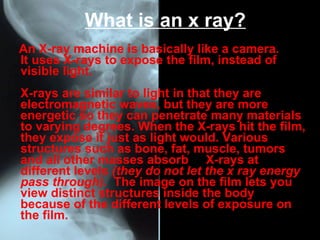
An X-ray machine is basically like a camera.
It uses X-rays to expose the film, instead of
visible light.
X-rays are similar to light in that they are
electromagnetic waves, but they are more
energetic so they can penetrate many materials
to varying degrees. When the X-rays hit the film,
they expose it just as light would. Various
structures such as bone, fat, muscle, tumors
and all other masses absorb X-rays at
different levels (they do not let the x ray energy
pass through). The image on the film lets you
view distinct structures inside the body
because of the different levels of exposure on
the film.
How were x rays discovered?
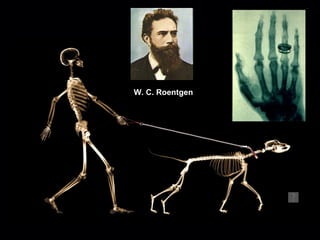
In late 1895, a German physicist, W. C. Roentgen was
working with tubes similar to our fluorescent light bulbs. He
evacuated the tube of all air, filled it with a special gas, and
passed a high electric voltage through it. When he did this,
the tube would produce a fluorescent glow. Roentgen
shielded the tube with heavy black paper, and found that a
green colored fluorescent light could be seen coming from a
screen setting a few feet away from the tube. He realized
that he had produced a previously unknown "invisible light,"
or ray, that was being emitted from the tube; a ray that was
capable of passing through the heavy paper covering the
tube. Through additional experiments, he also found that
the new ray would pass through most substances casting
shadows of solid objects on pieces of film. He named the
new ray X-ray, because in mathematics "X" is used to
indicated the unknown quantity.
In his discovery Roentgen found that the X-ray would pass
through the tissue of humans leaving the bones and metals
visible. One of Roentgen’s first experiments late in 1895
was a film of his wife Bertha's hand with a ring on her
finger.
W. C. Roentgen
Why is a lead shield/apron placed
on you when you get an x ray?
X-rays emit radiation which cause
mutations to healthy cells. X-rays are
only harmful if you are exposed to
them for a really LONG time. X-rays you
get at the doctors are okay because
you don’t get them everyday. X rays are
more beneficial than they are harmful
because they can detect problems that
can be detrimental to your health.
Let’s see how many bones/joints
you can identify from the
following xrays…..
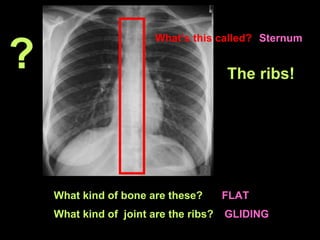
The ribs!
What kind of bone are these? FLAT
What kind of joint are the ribs? GLIDING
What’s this called? Sternum
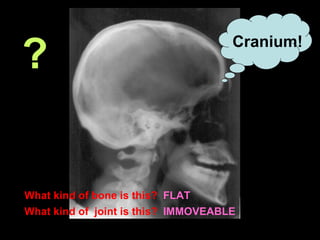
?
What kind of bone is this? FLAT
What kind of joint is this? IMMOVEABLE
?
Cranium!
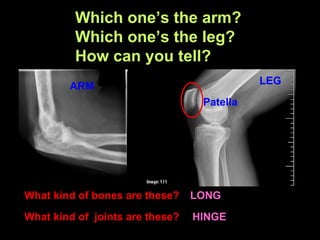
What kind of bones are these? LONG
What kind of joints are these? HINGE
Which one’s the arm?
Which one’s the leg?
How can you tell?
ARM LEG
Patella
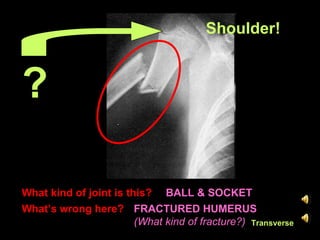
What kind of joint is this?
FRACTURED HUMERUS
(What kind of fracture?)
What’s wrong here?
BALL & SOCKET
?
Shoulder!
Transverse
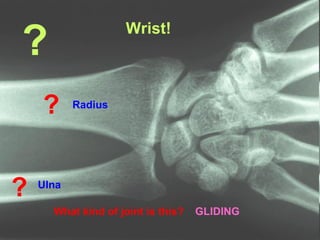
?
What kind of joint is this? GLIDING
Wrist!
?
?
Radius
Ulna
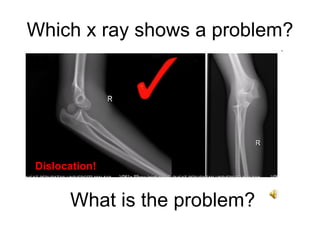
Which x ray shows a problem?
What is the problem?
Dislocation!

xraysppt-02.pdf

  • 1.
    Objectives: You will beable to …..explain how x rays produce images. …..explain the dangers of and benefits of getting x rays. …..identify the types of joints in x rays.
  • 2.
    What is anx ray? An X-ray machine is basically like a camera. It uses X-rays to expose the film, instead of visible light. X-rays are similar to light in that they are electromagnetic waves, but they are more energetic so they can penetrate many materials to varying degrees. When the X-rays hit the film, they expose it just as light would. Various structures such as bone, fat, muscle, tumors and all other masses absorb X-rays at different levels (they do not let the x ray energy pass through). The image on the film lets you view distinct structures inside the body because of the different levels of exposure on the film.
  • 3.
    How were xrays discovered? In late 1895, a German physicist, W. C. Roentgen was working with tubes similar to our fluorescent light bulbs. He evacuated the tube of all air, filled it with a special gas, and passed a high electric voltage through it. When he did this, the tube would produce a fluorescent glow. Roentgen shielded the tube with heavy black paper, and found that a green colored fluorescent light could be seen coming from a screen setting a few feet away from the tube. He realized that he had produced a previously unknown "invisible light," or ray, that was being emitted from the tube; a ray that was capable of passing through the heavy paper covering the tube. Through additional experiments, he also found that the new ray would pass through most substances casting shadows of solid objects on pieces of film. He named the new ray X-ray, because in mathematics "X" is used to indicated the unknown quantity. In his discovery Roentgen found that the X-ray would pass through the tissue of humans leaving the bones and metals visible. One of Roentgen’s first experiments late in 1895 was a film of his wife Bertha's hand with a ring on her finger.
  • 4.
  • 5.
    Why is alead shield/apron placed on you when you get an x ray? X-rays emit radiation which cause mutations to healthy cells. X-rays are only harmful if you are exposed to them for a really LONG time. X-rays you get at the doctors are okay because you don’t get them everyday. X rays are more beneficial than they are harmful because they can detect problems that can be detrimental to your health.
  • 7.
    Let’s see howmany bones/joints you can identify from the following xrays…..
  • 8.
    The ribs! What kindof bone are these? FLAT What kind of joint are the ribs? GLIDING What’s this called? Sternum ?
  • 9.
    What kind ofbone is this? FLAT What kind of joint is this? IMMOVEABLE ? Cranium!
  • 10.
    What kind ofbones are these? LONG What kind of joints are these? HINGE Which one’s the arm? Which one’s the leg? How can you tell? ARM LEG Patella
  • 11.
    What kind ofjoint is this? FRACTURED HUMERUS (What kind of fracture?) What’s wrong here? BALL & SOCKET ? Shoulder! Transverse
  • 12.
    ? What kind ofjoint is this? GLIDING Wrist! ? ? Radius Ulna
  • 13.
    Which x rayshows a problem? What is the problem? Dislocation!