US Filing 21 October 2009 Mike Willis, Chair, XBRL International Partner, PricewaterhouseCoopers [email_address]   001 813 340 0932
Discussion Topics SEC mandate  Overview of requirements  Key learnings and observations on initial XBRL submissions Key implementation considerations  Adoption alternatives Outsourcing and software Company-specific extensions Edgar Filer Manual compliance Corporate website posting Quality control process for XBRL, including validation What you should do next
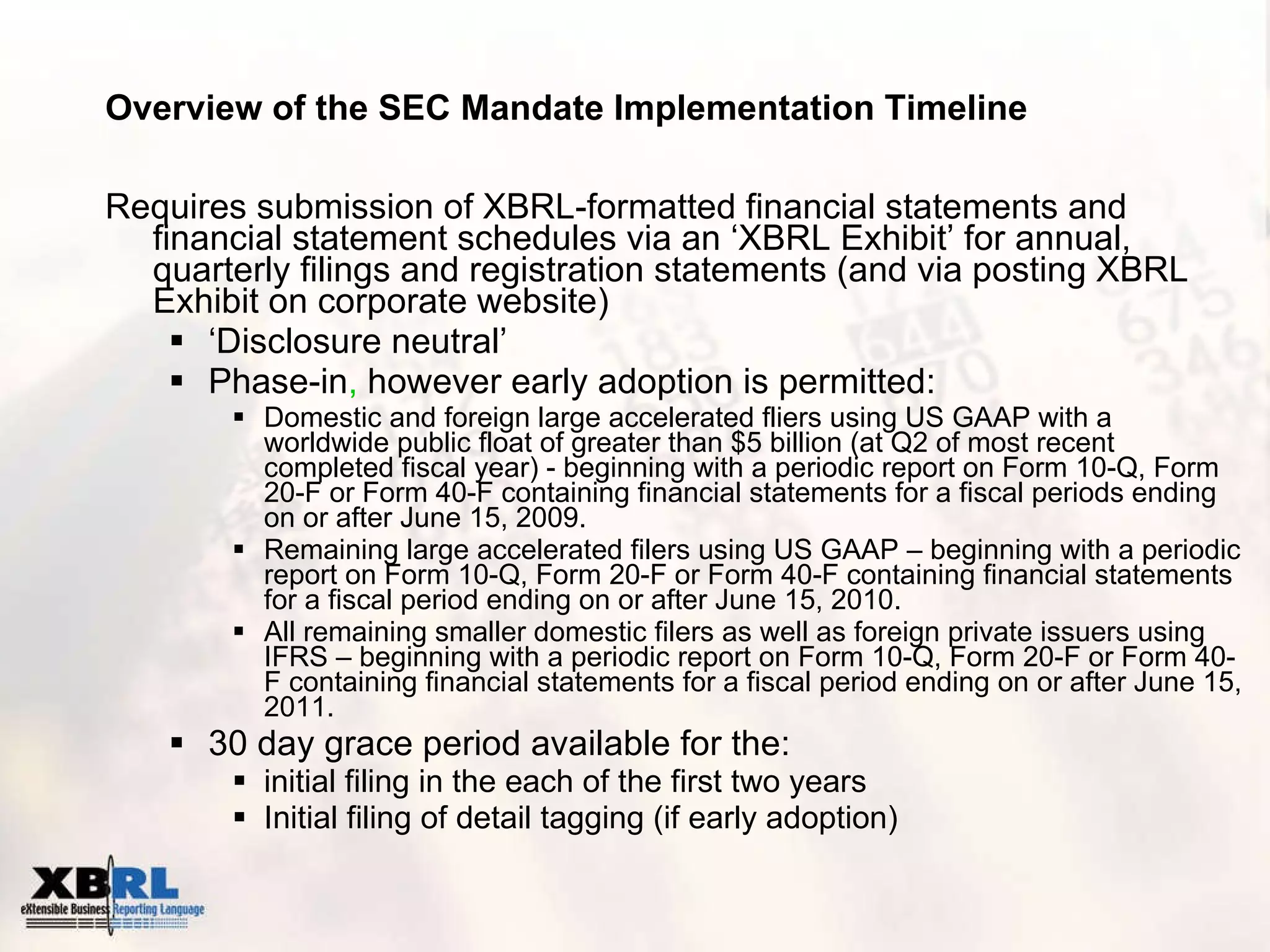
Overview of the SEC Mandate Implementation Timeline Requires submission of XBRL-formatted financial statements and financial statement schedules via an ‘XBRL Exhibit’ for annual, quarterly filings and registration statements (and via posting XBRL Exhibit on corporate website) ‘ Disclosure neutral’ Phase-in ,  however early adoption is permitted:  Domestic and foreign large accelerated fliers using US GAAP with a worldwide public float of greater than $5 billion (at Q2 of most recent completed fiscal year) - beginning with a periodic report on Form 10-Q, Form 20-F or Form 40-F containing financial statements for a fiscal periods ending on or after June 15, 2009. Remaining large accelerated filers using US GAAP – beginning with a periodic report on Form 10-Q, Form 20-F or Form 40-F containing financial statements for a fiscal period ending on or after June 15, 2010. All remaining smaller domestic filers as well as foreign private issuers using IFRS – beginning with a periodic report on Form 10-Q, Form 20-F or Form 40-F containing financial statements for a fiscal period ending on or after June 15, 2011. 30 day grace period available for the:  initial filing in the each of the first two years  Initial filing of detail tagging (if early adoption)
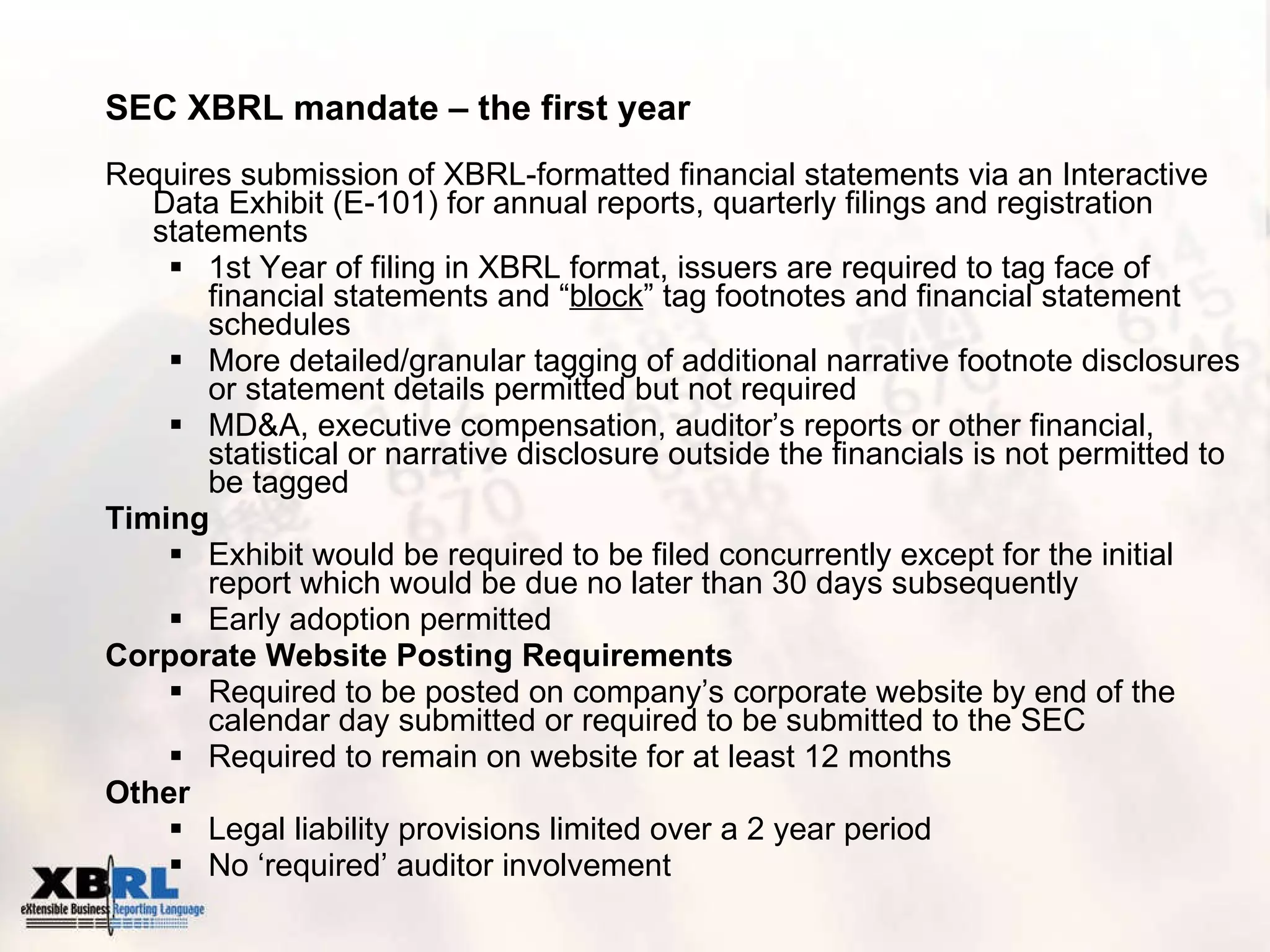
SEC XBRL mandate – the first year Requires submission of XBRL-formatted financial statements via an Interactive Data Exhibit (E-101) for annual reports, quarterly filings and registration statements  1st Year of filing in XBRL format, issuers are required to tag face of financial statements and “ block ” tag footnotes and financial statement schedules More detailed/granular tagging of additional narrative footnote disclosures or statement details permitted but not required MD&A, executive compensation, auditor’s reports or other financial, statistical or narrative disclosure outside the financials is not permitted to be tagged Timing Exhibit would be required to be filed concurrently except for the initial report which would be due no later than 30 days subsequently  Early adoption permitted Corporate Website Posting Requirements Required to be posted on company’s corporate website by end of the calendar day submitted or required to be submitted to the SEC Required to remain on website for at least 12 months Other Legal liability provisions limited over a 2 year period No ‘required’ auditor involvement
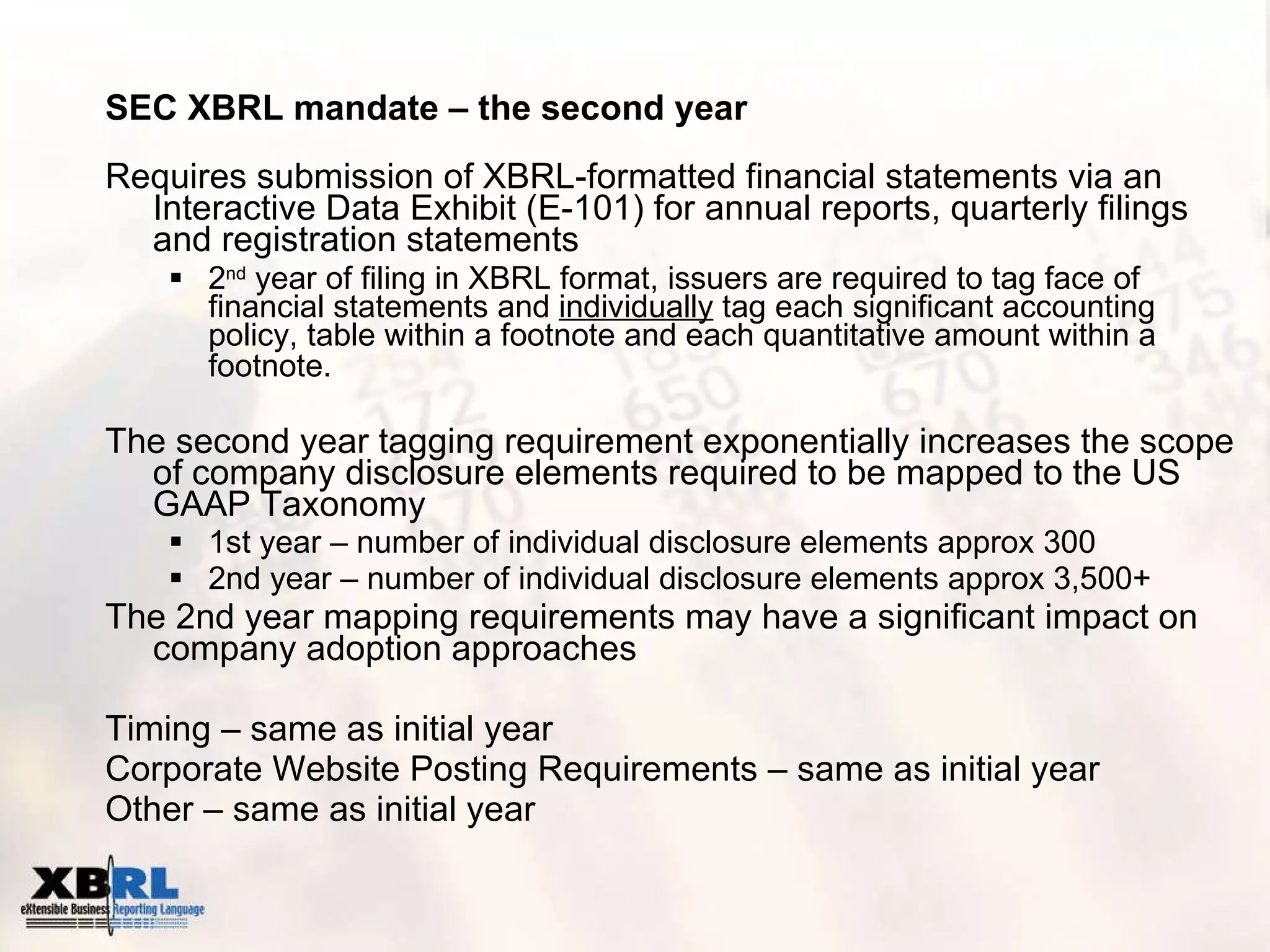
SEC XBRL mandate – the second year Requires submission of XBRL-formatted financial statements via an Interactive Data Exhibit (E-101) for annual reports, quarterly filings and registration statements  2 nd  year of filing in XBRL format, issuers are required to tag face of financial statements and  individually  tag each significant accounting policy, table within a footnote and each quantitative amount within a footnote.   The second year tagging requirement exponentially increases the scope of company disclosure elements required to be mapped to the US GAAP Taxonomy 1st year – number of individual disclosure elements approx 300 2nd year – number of individual disclosure elements approx 3,500+ The 2nd year mapping requirements may have a significant impact on company adoption approaches Timing – same as initial year Corporate Website Posting Requirements – same as initial year Other – same as initial year
Key learning's & observations on initial XBRL submissions Compliance with the Edgar Filer Manual 200+ fairly complex technical rules; some require financial reporting judgments some validation rules are included within the SEC filing processes Preparation and review processes and controls Start early and consider a ‘test’ run submission Knowledge of company fin statements more relevant than XBRL Adjust reporting timeline to accommodate XBRL submission process Focus early on company specific taxonomy extension(s)  Consider assessment of EDGAR Filer Manual rule compliance Internal reporting validation and analytical rules and controls Consider SEC test filing to assess ‘some’ validation rules Consider SEC Previewer to assess presentation views
Potential Adoption Alternatives Bolt-on via Outsourcing or Consultation Printers and other third party service providers provide outsourced solution for mapping the disclosure elements on the financial statements and note disclosures (in block text) to the US GAAP Taxonomy Bolt-on via Internal Process XBRL can be adopted by companies at the “highest” reporting level (i.e. consolidated) solely for purposes of complying with regulatory requirements.  However, potential XBRL process enhancement benefits for are not fully realized. Embedded Processes Enables automation of currently manual assembly and review processes Requires companies to assess information needs and provides an opportunity to eliminate inefficiencies in current compliance and reporting processes. Enables process enhancements that lead to more timely higher quality  data for decision making purposes Maximizes benefits of XBRL to preparers and internal users of financial and non-financial information.
Sample Vendors Bolt-on via Outsourcing or Consultation Printers – Bowne, Merrill, RR Donnelley, and others 1 . Third party service providers – BusinessWire, EDGARFilings, EDGAR-Online, and others 1 . Bolt-on via Internal Process Software vendors – Corefilings, Fujitsu, Rivet Software, UBMatrix and others 1 . Embedded Processes Software vendors – Clarity Software, Trintech, and others 1 . 1. More vendors listed on  http://www.xbrl.org/tools   and  http://xbrl.us/Learn/Pages/ToolsAndServices.aspx
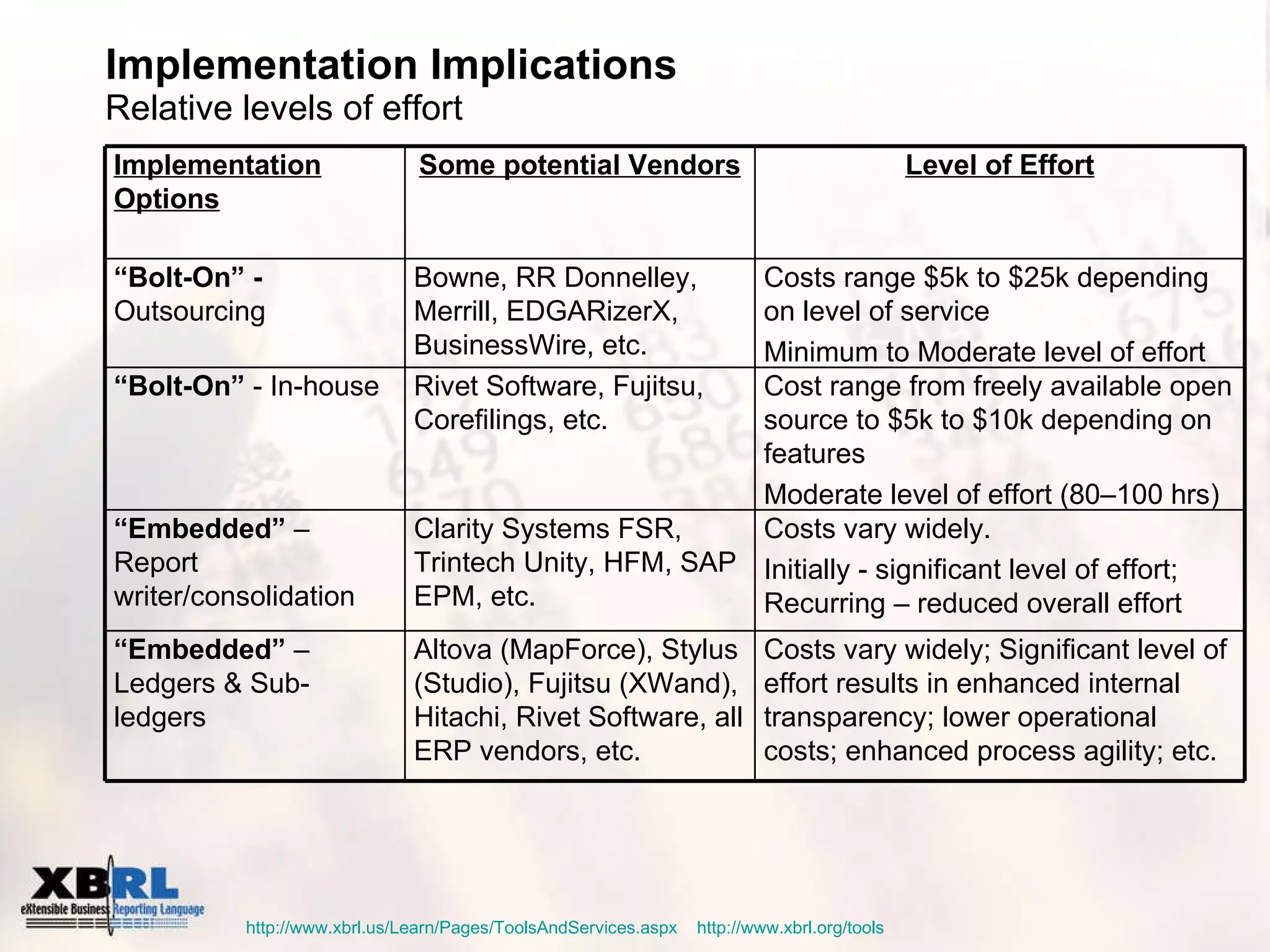
Implementation Implications Relative levels of effort http://www.xbrl.us/Learn/Pages/ToolsAndServices.aspx   http://www.xbrl.org/tools   Costs vary widely; Significant level of effort results in enhanced internal transparency; lower operational costs; enhanced process agility; etc. Altova (MapForce), Stylus (Studio), Fujitsu (XWand), Hitachi, Rivet Software, all ERP vendors, etc. “ Embedded”  – Ledgers & Sub-ledgers Cost range from freely available open source to $5k to $10k depending on features Moderate level of effort (80–100 hrs) Rivet Software, Fujitsu, Corefilings, etc. “ Bolt-On”  - In-house Costs vary widely. Initially - significant level of effort; Recurring – reduced overall effort Clarity Systems FSR, Trintech Unity, HFM, SAP EPM, etc. “ Embedded”  – Report writer/consolidation  Costs range $5k to $25k depending on level of service Minimum to Moderate level of effort Bowne, RR Donnelley, Merrill, EDGARizerX, BusinessWire, etc. “ Bolt-On” -  Outsourcing Level of Effort Some potential Vendors Implementation Options
Key Outsourcing Considerations Responsibility for Exhibit 101 CANNOT be delegated even if work is delegated to a third party.  Management is responsible for compliance w/ SEC rules & regs Control of processing – challenges of coordinating changes, turn-around time and exchanges of various draft versions  Financial reporting expertise and specific knowledge of company specific disclosures relevant to company-specific extensions XBRL expertise and instance document preparation experience Confidentiality of draft data during transmissions with vendor Quality control implications related to:  Validations assessments Compliance with EDGAR Filer Manual Service Level Agreements Issuer review and approval process Process implications, including detailed tagging in ‘Year 2’ Ownership of mapping IP and extension taxonomies
Key Software Considerations Capability and compliance with: XBRL Technical Specifications US GAAP & IFRS Taxonomies EDGAR Filer Manual User-friendly features  Mapping features / ease of use Facilitate company-specific extensions Import, view and manage multiple taxonomies Validate SEC public validation rules, EFM, and other ‘rules’ Preview the presentation Interoperable with existing report preparation software  (Office) Support, training resources, expertise and availability
Company-Specific Extensions Preparers have considerable flexibility in determining how financial information is reported under U.S. reporting standards – not only is XBRL not intended to change that, it is designed to support it. It is possible that a company may use a company-specific financial statement line item that is not included in the US GAAP Taxonomy. In this situation, the company would create an ‘extension’ in a new list of tags for company-specific elements.  In order to promote comparability across companies, the Final Rule limits element (versus label) extensions to circumstances where the appropriate financial statement element does not exist in the US GAAP Taxonomy. Wherever possible, preparers should change the label(s) for a preexisting financial statement element included in the US GAAP Taxonomy (where the company definition for a specific element is consistent with the US GAAP Taxonomy), instead of creating a new, customized, tag.  The EDGAR Filler Manual and the XBRL US GAAP Taxonomy Preparers Guide provide guidance around creating extensions.
Company-specific extensions (continued) Examples of company-specific extensions What a company identifies in its traditional format financial statements as “operating revenues” may be associated with an element that has “net revenues” as the US GAAP Taxonomy standard label. The Company might look at the relevant taxonomy elements and related definitions to select the most closely aligned element to use.  In this example, the alternative elements are 'gross revenues' and 'net revenues‘, and the company’s 'operating revenues' caption may be most closely related to ‘net revenues.’ In this situation, a company would use that element and provide labels that match the captions in a Company extension taxonomy. While the standard list of tags includes the financial statement element “gross profit”, it does not include “gross margin.” Both are generally used to mean “excess of revenues over the cost of revenues.”  A company using the caption “gross margin” in its income statement should use the tag corresponding to the financial statement element “gross profit” and then provide the label “gross margin” in a Company extension taxonomy.
Edgar Filer Manual Compliance - Key learnings and observations on initial XBRL submissions Key things not to miss Filers (and Filing Agents) may be missing changes between the Voluntary Filing Program and Final Rules defined in EDGAR Filer Manual (EFM) Submissions under the Final Rule should be made using Exhibit 10 1 , not Exhibit 100 (which was used for VFP filings) Filers need to exclude a ll  Reference linkbases, as well as links to other linkbases (from the standard taxonomies), from their submissions – prohibited by EFM Labels must match the traditional ASCII/HTML Disclosures in (parenthesis) should be separately tagged and placed in their own section for each financial statement Text blocks need to be XHTML Footnotes (text at the bottom of a page with a cross reference to facts on the page) must be included, and must be plain text due to SEC viewer limitations Numbers with parentheses on the printed page must be examined carefully to determine if they should be entered as negatives or using a negated label The representation of tables, stock classes and certain other information require a Definition linkbase The fulfillment of the requirement to post their interactive data on their IR sites appears to sometimes be incomplete Key takeaways The VFP is over, and management should ensure that EFM and public validation criteria are considered in work performed on their behalf by outsourcing partners and/or in XBRL software used by management. Many of these requirements can be addressed on an automated basis, while others require management judgment. Relevant 'validation checks' should be performed by management and outsourcing partners in advance of the planned submission date, based on the latest version of the EFM (Version 12 was released on July 28 and became effective August 4; Draft of Version 13 published on August 31).
Corporate Website Posting The interactive data exhibit is required to be posted on a company’s corporate website, if it maintains one, no later than the end of the calendar day on which it is submitted or required to submit the interactive data, whichever is earlier. Information required to be posted on the company's website will be required to remain on the website for at least 12 months. Under the SEC's Interpretative Release, Commission Guidance On The Use Of Company Web Sites, the SEC indicated that: ‘ The nature of online information is increasingly interactive, not static. The inability to print a particular browser screen or presentation, particularly one designed for interactive viewing and not for reading outside the electronic context, is not inherently detrimental to its readability. We do not think it is necessary that information appearing on company web sites satisfy a printer-friendly standard unless our rules explicitly require it. For example, our notice and access model requires that electronically posted proxy materials be presented in a format “convenient for both reading online and printing on paper.” Hence,  all other information on a company’s web site need not be made available in a format comparable to paper-based information .’
Corporate Website Posting (continued) Use of a hyperlink to the SEC website to satisfy the requirement of posting the interactive data on its own website is prohibited by the final rule. Many companies are providing a link to third-party services that host their SEC filings and often provide a viewer Under the SEC's Interpretative Release, Commission Guidance On The Use Of Company Web Sites, the SEC indicated that: (continued) 'We have proposed that companies that maintain web sites post on their web sites the same interactive data they file or furnish with certain Exchange Act reports and Securities Act registration statements.  We have not proposed, however, that registrants also provide interactive data viewers (or information on how to obtain viewers) on their web sites. Instead , we have determined to allow third parties to develop viewers, anticipating that these viewers will, over time, become more readily accessible at a little or no cost to investors.‘ Investor Relations related considerations Outsourcing solutions Consider Company IR RSS Feeds  Be aware of EDGAR RSS Feeds
Disclosure best practices General Web site posting requirement – leverage RSS to ‘go direct’  Use ‘Social Analytics’ to better understand 3 rd  party modeling needs Company specific extensions highlight what is unique  Other relevant information Specific Year 2 implications Granularity within note disclosures Tables Narratives Numeric elements embedded within narrative text  Highlight new FASB disclosures
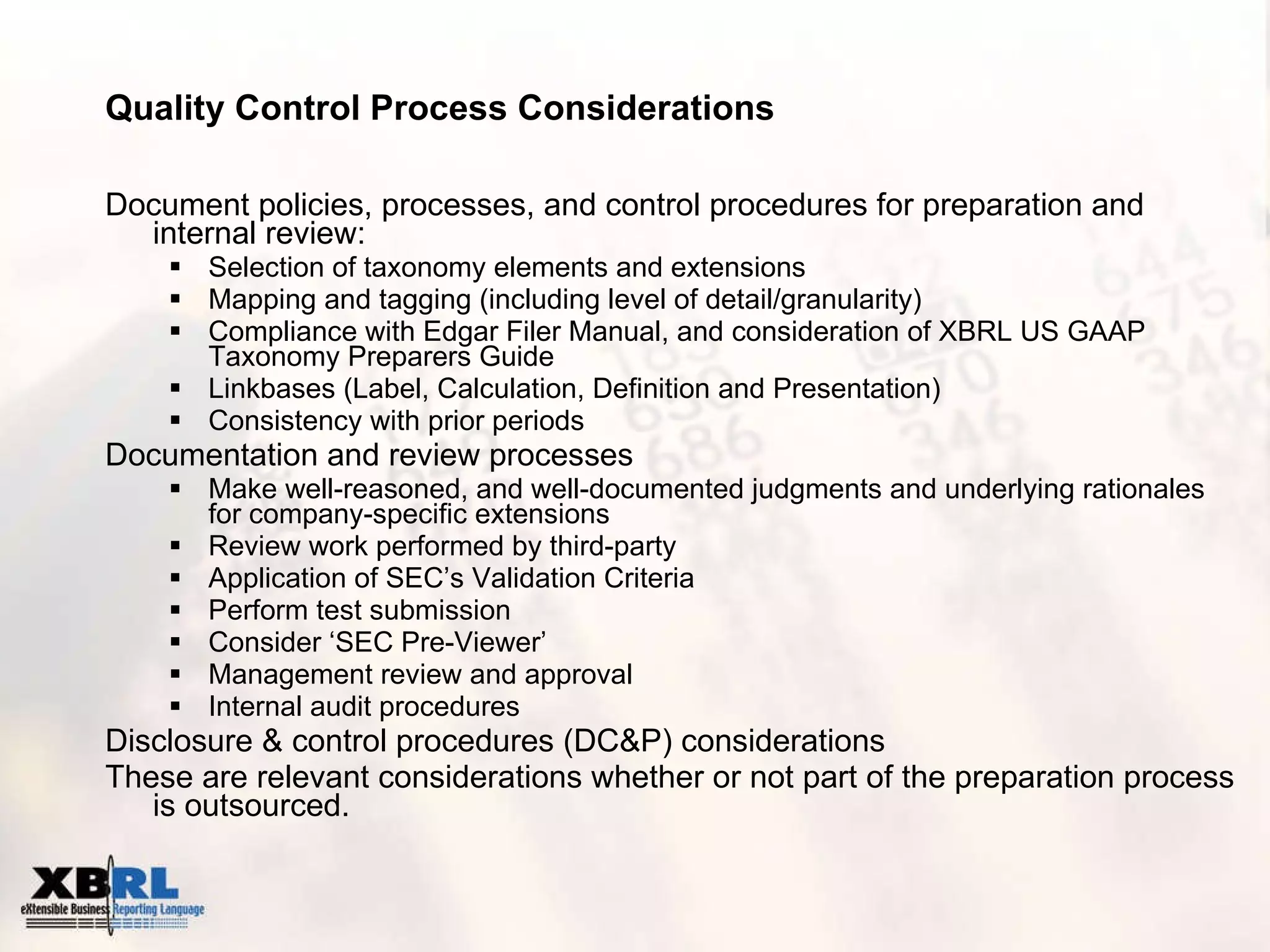
Quality Control Process Considerations Document policies, processes, and control procedures for preparation and internal review: Selection of taxonomy elements and extensions Mapping and tagging (including level of detail/granularity) Compliance with Edgar Filer Manual, and consideration of XBRL US GAAP Taxonomy Preparers Guide Linkbases (Label, Calculation, Definition and Presentation) Consistency with prior periods Documentation and review processes Make well-reasoned, and well-documented judgments and underlying rationales for company-specific extensions Review work performed by third-party Application of SEC’s Validation Criteria Perform test submission Consider ‘SEC Pre-Viewer’ Management review and approval Internal audit procedures Disclosure & control procedures (DC&P) considerations These are relevant considerations whether or not part of the preparation process is outsourced.
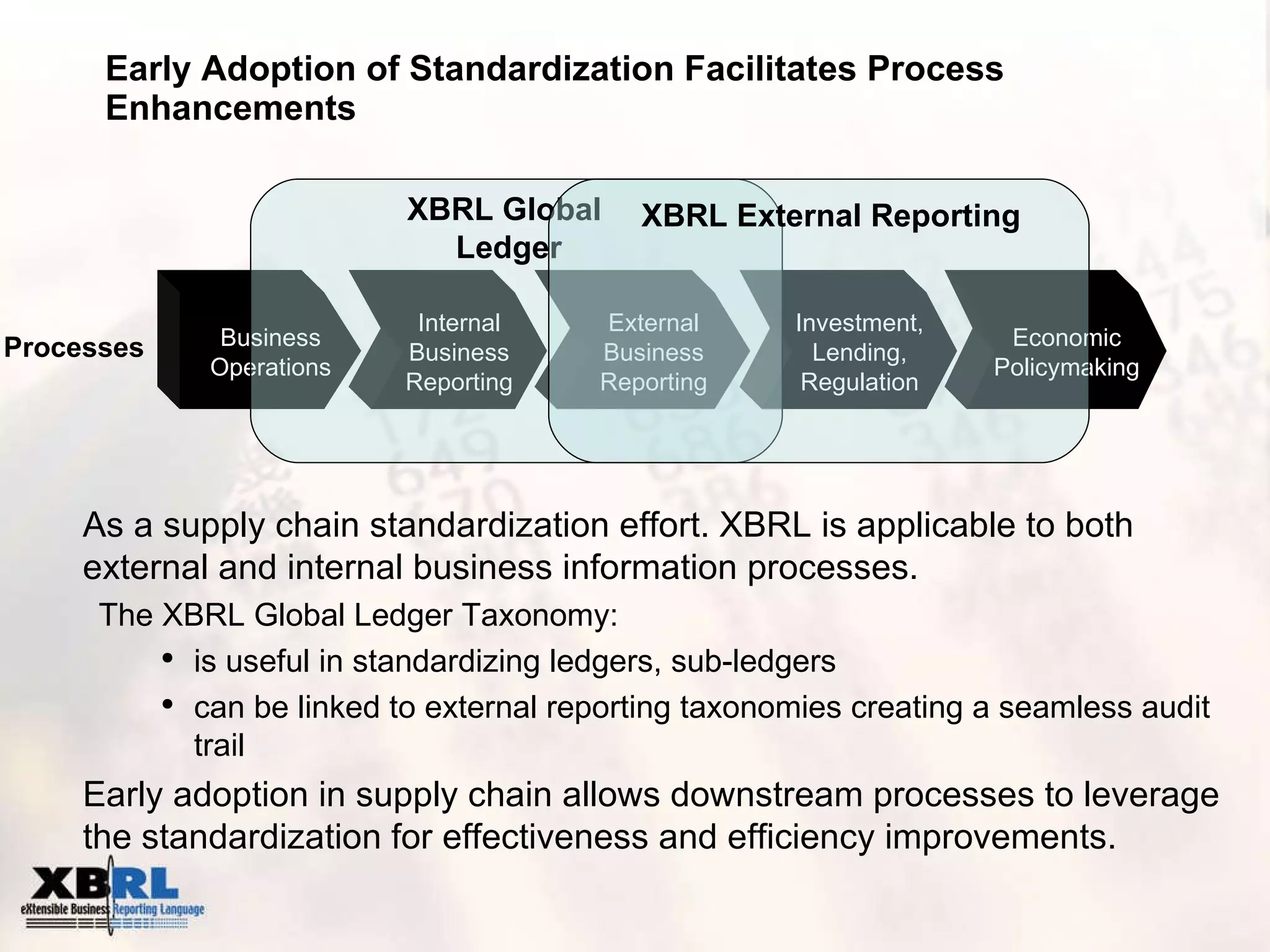
Early Adoption of Standardization Facilitates Process Enhancements As a supply chain standardization effort. XBRL is applicable to both external and internal business information processes. The XBRL Global Ledger Taxonomy: is useful in standardizing ledgers, sub-ledgers can be linked to external reporting taxonomies creating a seamless audit trail Early adoption in supply chain allows downstream processes to leverage the standardization for effectiveness and efficiency improvements. External Business Reporting Business Operations Internal Business Reporting Investment, Lending, Regulation Processes Economic Policymaking XBRL Global  Ledger XBRL External Reporting
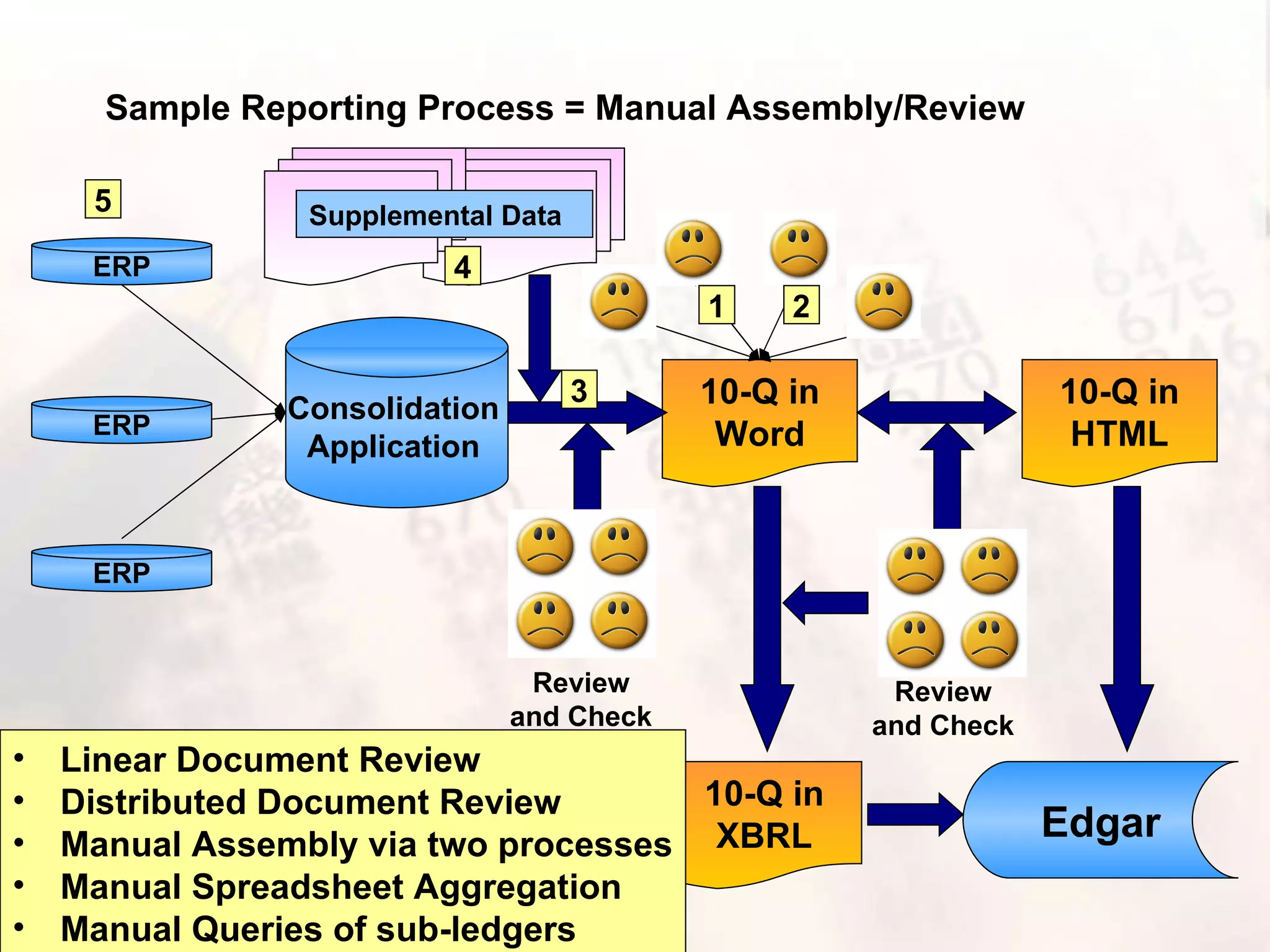
Sample Reporting Process = Manual Assembly/Review ERP 10-Q in Word Edgar Consolidation Application ERP ERP 10-Q in HTML 10-Q in XBRL Supplemental Data Review and Check Review and Check Linear Document Review Distributed Document Review Manual Assembly via two processes Manual Spreadsheet Aggregation Manual Queries of sub-ledgers 1 2 3 4 5
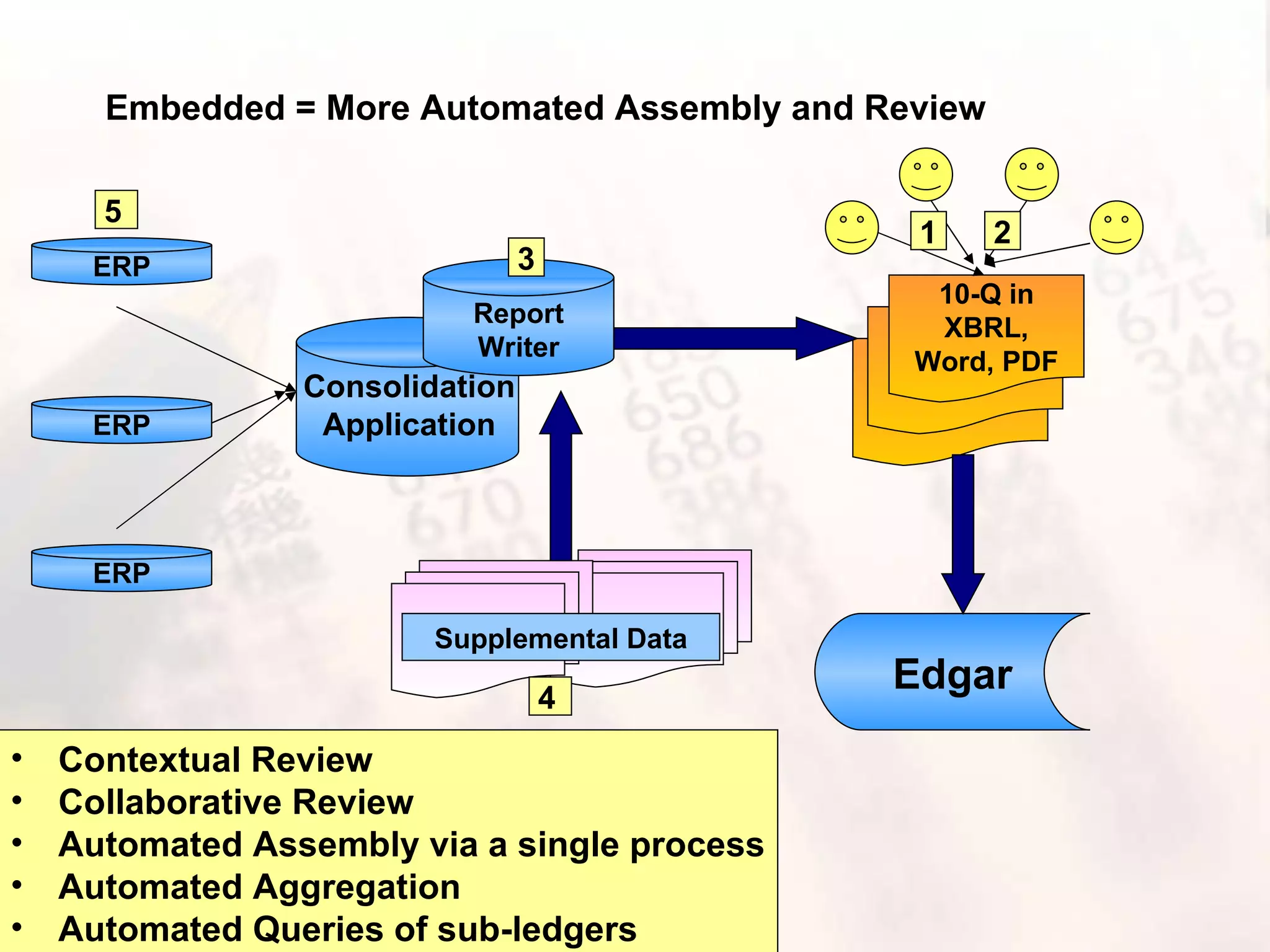
Embedded = More Automated Assembly and Review ERP Edgar ERP ERP Supplemental Data Report Writer 10-Q in XBRL, Word, PDF Contextual Review Collaborative Review Automated Assembly via a single process Automated Aggregation Automated Queries of sub-ledgers 1 2 3 4 5 Consolidation Application
What you should do next Get up-to-speed and stay current Establish internal team and train those resources Develop a plan   Consider the financial reporting process implications of concurrent submission and corporate website posting, in the context of the detailed tagging required in ‘Year 2’ Select software and/or outside service provider Preliminary ‘map’ financial statements to selected standard taxonomies Assess tagging of company's financial statements, including potential company-specific extensions  Design and establish preparation and review processes and internal controls Consider auditor involvement
What you should do next (continued) Other Review implementation plan with key internal stakeholders  Strongly recommend a ‘dry run’ prior to first required submission Review findings from early submissions for best practices and common pitfalls Consider potential questions you may receive from your audit committee What is management doing to prepare? What quality control processes is management putting in place?  What audit committee involvement is required? Will the Company voluntarily seek auditor involvement?
Appendix
SEC EDGAR Filer Manual Things to consider 1. Submissions under the Final Rule should be made using Exhibit 101 (EX-101), not Exhibit 100 (EX-100, which was used for VFP filings). 2. Company filings should not include links to the US GAAP standard taxonomy calculation, definition and presentation linkbases (which are not permitted per EFM 6.13.1, 6.15.1, and 6.17.1). Only company-specific linkbases are permitted. 3. Filers need to exclude  all  Reference linkbases, which are prohibited by EFM 6.18.1 and 6.19.1, from their XBRL submissions.  4. Extending the standard taxonomy for company-specific unique disclosure concepts needs to be carefully considered. Various EFM sections address this point, including: 6.8.4, 6.8.9, 6.8.10, and 6.8.23. Companies continue to confuse changing the labels of existing concepts with creating completely new concepts. 5. Labels must match the captions of the traditional ASCII/HTML document formats, including different labels for the same concepts based on their placement within the printed report, per EFM 6.11.1. 6. Disclosures embedded in the captions in (parenthesis) on the face of the financials - such as 'Accounts Receivable (net of allowance for bad debts of $2,000 and $3,000 for the years ended 12/31/08 and 12/31/07, respectively)' - should be separately tagged and placed in their own section for each financial statement, per EFM 6.6.14. 7. Narrative footnote disclosures and required schedules tagged as 'block text' with XBRL need to be formatted in XHTML, per EFM 6.6.16. 8. Footnotes (text at the bottom of a page with a cross reference to facts on the page) must be included, but must be plain text due to SEC viewer limitations, per EFM 6.6.39 and the  SEC  FAQs , Question 13.
SEC EDGAR Filer Manual Things to consider (continued) 9. Companies are choosing text boxes for Notes disclosures where the standard text box chosen is actually too narrow for the Note disclosure content. Companies should use a text box that is 'narrowest' and still works for the disclosure definition as outlined by guidance in EFM 6.6.26 and 6.8.23. 10. Numbers surrounded by parentheses (or other indications of being negative numbers) on the printed page must be examined carefully to determine if they should be entered as negatives or as positives using a negating label, per EFM 6.11.6. 11. The representation of tables (EFM 6.8.22), stock classes (EFM 6.6.10) and certain other information (e.g., EFM 6.6.6, EFM 6.6.11) requires a Definition linkbase. 12. Instance documents should not use the XBRL "scenario" structure because it is prohibited by EFM 6.5.4. However, there is a way to report different scenarios using the "segment" structure, as per EFM 6.6.11. 13. Companies should apply taxonomy elements that most closely reflect the labels reflected on the current paper based report documents. This is particularly relevant with disclosure of "Other" concepts (e.g., Other Income, Other Expenses) when the line items actually include immaterial amounts of concepts specified elsewhere in the taxonomy. 14. The fulfillment of the Final Rule requirement to post the interactive data files on the company web site is often incomplete. All files (not just the instance document) need to be included on the company web site - the same files provided to the SEC (no fewer allowed, no additional required). 15. The  SEC's  public validation criteria  reflect SEC staff’s current views on appropriate validation criteria for XBRL tagging to improve the consistency and quality of XBRL Exhibits and should be considered by filers.
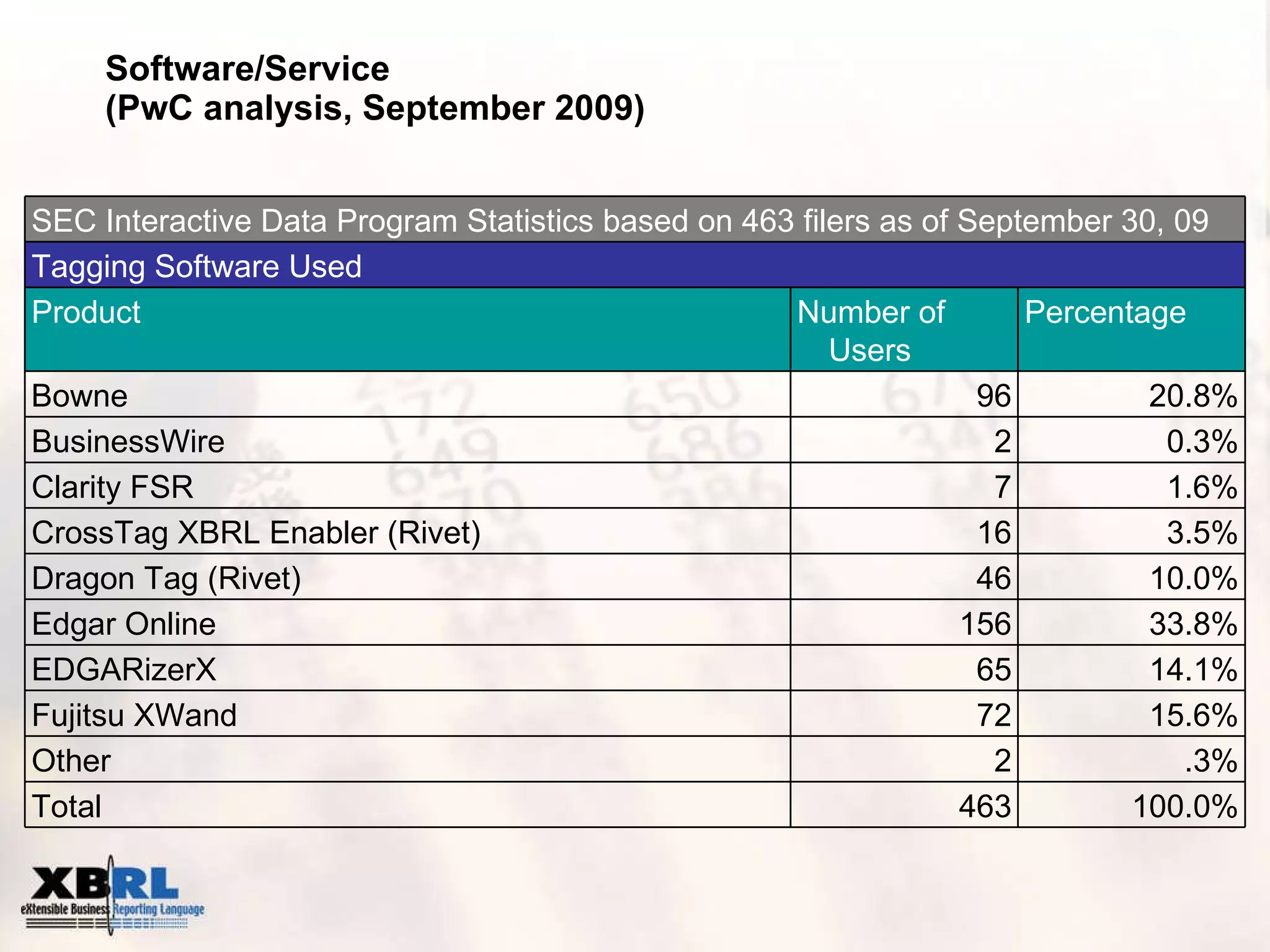
Software/Service (PwC analysis, September 2009) 100.0% 463 Total .3% 2 Other 15.6% 72 Fujitsu XWand 14.1% 65 EDGARizerX 33.8% 156 Edgar Online 10.0% 46 Dragon Tag (Rivet) 3.5% 16 CrossTag XBRL Enabler (Rivet) 1.6% 7 Clarity FSR 0.3% 2 BusinessWire 96 20.8% Number of Users Percentage Bowne Product Tagging Software Used SEC Interactive Data Program Statistics based on 463 filers as of September 30, 09
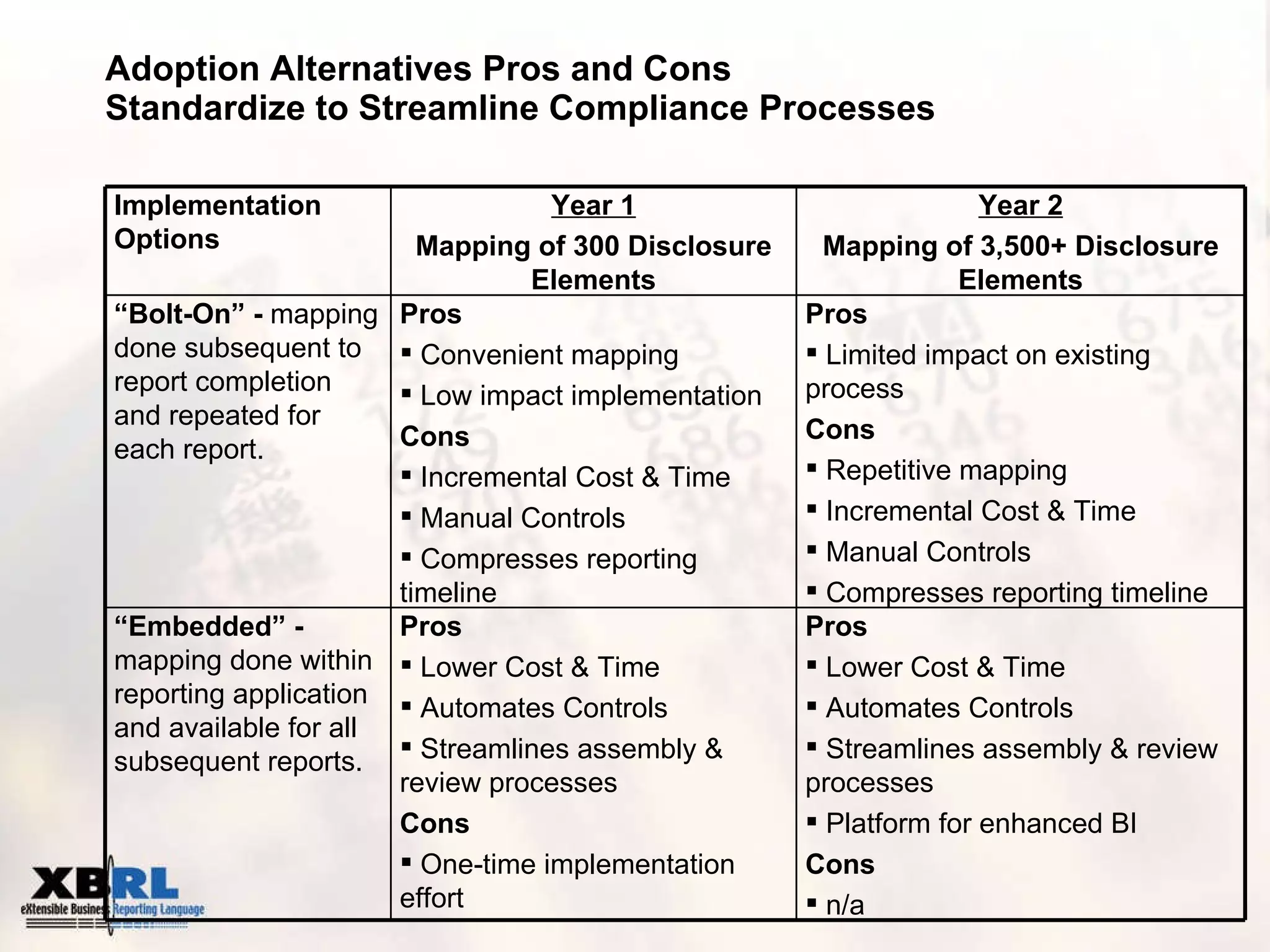
Adoption Alternatives Pros and Cons  Standardize to Streamline Compliance Processes Pros Lower Cost & Time Automates Controls Streamlines assembly & review processes  Platform for enhanced BI Cons   n/a Pros Lower Cost & Time Automates Controls Streamlines assembly & review processes Cons   One-time implementation effort “ Embedded” -  mapping done within reporting application and available for all subsequent reports. Pros Limited impact on existing process Cons   Repetitive mapping Incremental Cost & Time Manual Controls Compresses reporting timeline Pros Convenient mapping Low impact implementation Cons   Incremental Cost & Time Manual Controls Compresses reporting timeline “ Bolt-On” -  mapping done subsequent to report completion and repeated for each report.   Year 2 Mapping of 3,500+ Disclosure Elements Year 1 Mapping of 300 Disclosure Elements Implementation Options

XBRL US Filing Update 10212209

  • 1.
    US Filing 21October 2009 Mike Willis, Chair, XBRL International Partner, PricewaterhouseCoopers [email_address] 001 813 340 0932
  • 2.
    Discussion Topics SECmandate Overview of requirements Key learnings and observations on initial XBRL submissions Key implementation considerations Adoption alternatives Outsourcing and software Company-specific extensions Edgar Filer Manual compliance Corporate website posting Quality control process for XBRL, including validation What you should do next
  • 3.
    Overview of theSEC Mandate Implementation Timeline Requires submission of XBRL-formatted financial statements and financial statement schedules via an ‘XBRL Exhibit’ for annual, quarterly filings and registration statements (and via posting XBRL Exhibit on corporate website) ‘ Disclosure neutral’ Phase-in , however early adoption is permitted: Domestic and foreign large accelerated fliers using US GAAP with a worldwide public float of greater than $5 billion (at Q2 of most recent completed fiscal year) - beginning with a periodic report on Form 10-Q, Form 20-F or Form 40-F containing financial statements for a fiscal periods ending on or after June 15, 2009. Remaining large accelerated filers using US GAAP – beginning with a periodic report on Form 10-Q, Form 20-F or Form 40-F containing financial statements for a fiscal period ending on or after June 15, 2010. All remaining smaller domestic filers as well as foreign private issuers using IFRS – beginning with a periodic report on Form 10-Q, Form 20-F or Form 40-F containing financial statements for a fiscal period ending on or after June 15, 2011. 30 day grace period available for the: initial filing in the each of the first two years Initial filing of detail tagging (if early adoption)
  • 4.
    SEC XBRL mandate– the first year Requires submission of XBRL-formatted financial statements via an Interactive Data Exhibit (E-101) for annual reports, quarterly filings and registration statements 1st Year of filing in XBRL format, issuers are required to tag face of financial statements and “ block ” tag footnotes and financial statement schedules More detailed/granular tagging of additional narrative footnote disclosures or statement details permitted but not required MD&A, executive compensation, auditor’s reports or other financial, statistical or narrative disclosure outside the financials is not permitted to be tagged Timing Exhibit would be required to be filed concurrently except for the initial report which would be due no later than 30 days subsequently Early adoption permitted Corporate Website Posting Requirements Required to be posted on company’s corporate website by end of the calendar day submitted or required to be submitted to the SEC Required to remain on website for at least 12 months Other Legal liability provisions limited over a 2 year period No ‘required’ auditor involvement
  • 5.
    SEC XBRL mandate– the second year Requires submission of XBRL-formatted financial statements via an Interactive Data Exhibit (E-101) for annual reports, quarterly filings and registration statements 2 nd year of filing in XBRL format, issuers are required to tag face of financial statements and individually tag each significant accounting policy, table within a footnote and each quantitative amount within a footnote. The second year tagging requirement exponentially increases the scope of company disclosure elements required to be mapped to the US GAAP Taxonomy 1st year – number of individual disclosure elements approx 300 2nd year – number of individual disclosure elements approx 3,500+ The 2nd year mapping requirements may have a significant impact on company adoption approaches Timing – same as initial year Corporate Website Posting Requirements – same as initial year Other – same as initial year
  • 6.
    Key learning's &observations on initial XBRL submissions Compliance with the Edgar Filer Manual 200+ fairly complex technical rules; some require financial reporting judgments some validation rules are included within the SEC filing processes Preparation and review processes and controls Start early and consider a ‘test’ run submission Knowledge of company fin statements more relevant than XBRL Adjust reporting timeline to accommodate XBRL submission process Focus early on company specific taxonomy extension(s) Consider assessment of EDGAR Filer Manual rule compliance Internal reporting validation and analytical rules and controls Consider SEC test filing to assess ‘some’ validation rules Consider SEC Previewer to assess presentation views
  • 7.
    Potential Adoption AlternativesBolt-on via Outsourcing or Consultation Printers and other third party service providers provide outsourced solution for mapping the disclosure elements on the financial statements and note disclosures (in block text) to the US GAAP Taxonomy Bolt-on via Internal Process XBRL can be adopted by companies at the “highest” reporting level (i.e. consolidated) solely for purposes of complying with regulatory requirements. However, potential XBRL process enhancement benefits for are not fully realized. Embedded Processes Enables automation of currently manual assembly and review processes Requires companies to assess information needs and provides an opportunity to eliminate inefficiencies in current compliance and reporting processes. Enables process enhancements that lead to more timely higher quality data for decision making purposes Maximizes benefits of XBRL to preparers and internal users of financial and non-financial information.
  • 8.
    Sample Vendors Bolt-onvia Outsourcing or Consultation Printers – Bowne, Merrill, RR Donnelley, and others 1 . Third party service providers – BusinessWire, EDGARFilings, EDGAR-Online, and others 1 . Bolt-on via Internal Process Software vendors – Corefilings, Fujitsu, Rivet Software, UBMatrix and others 1 . Embedded Processes Software vendors – Clarity Software, Trintech, and others 1 . 1. More vendors listed on http://www.xbrl.org/tools and http://xbrl.us/Learn/Pages/ToolsAndServices.aspx
  • 9.
    Implementation Implications Relativelevels of effort http://www.xbrl.us/Learn/Pages/ToolsAndServices.aspx http://www.xbrl.org/tools Costs vary widely; Significant level of effort results in enhanced internal transparency; lower operational costs; enhanced process agility; etc. Altova (MapForce), Stylus (Studio), Fujitsu (XWand), Hitachi, Rivet Software, all ERP vendors, etc. “ Embedded” – Ledgers & Sub-ledgers Cost range from freely available open source to $5k to $10k depending on features Moderate level of effort (80–100 hrs) Rivet Software, Fujitsu, Corefilings, etc. “ Bolt-On” - In-house Costs vary widely. Initially - significant level of effort; Recurring – reduced overall effort Clarity Systems FSR, Trintech Unity, HFM, SAP EPM, etc. “ Embedded” – Report writer/consolidation Costs range $5k to $25k depending on level of service Minimum to Moderate level of effort Bowne, RR Donnelley, Merrill, EDGARizerX, BusinessWire, etc. “ Bolt-On” - Outsourcing Level of Effort Some potential Vendors Implementation Options
  • 10.
    Key Outsourcing ConsiderationsResponsibility for Exhibit 101 CANNOT be delegated even if work is delegated to a third party. Management is responsible for compliance w/ SEC rules & regs Control of processing – challenges of coordinating changes, turn-around time and exchanges of various draft versions Financial reporting expertise and specific knowledge of company specific disclosures relevant to company-specific extensions XBRL expertise and instance document preparation experience Confidentiality of draft data during transmissions with vendor Quality control implications related to: Validations assessments Compliance with EDGAR Filer Manual Service Level Agreements Issuer review and approval process Process implications, including detailed tagging in ‘Year 2’ Ownership of mapping IP and extension taxonomies
  • 11.
    Key Software ConsiderationsCapability and compliance with: XBRL Technical Specifications US GAAP & IFRS Taxonomies EDGAR Filer Manual User-friendly features Mapping features / ease of use Facilitate company-specific extensions Import, view and manage multiple taxonomies Validate SEC public validation rules, EFM, and other ‘rules’ Preview the presentation Interoperable with existing report preparation software (Office) Support, training resources, expertise and availability
  • 12.
    Company-Specific Extensions Preparershave considerable flexibility in determining how financial information is reported under U.S. reporting standards – not only is XBRL not intended to change that, it is designed to support it. It is possible that a company may use a company-specific financial statement line item that is not included in the US GAAP Taxonomy. In this situation, the company would create an ‘extension’ in a new list of tags for company-specific elements. In order to promote comparability across companies, the Final Rule limits element (versus label) extensions to circumstances where the appropriate financial statement element does not exist in the US GAAP Taxonomy. Wherever possible, preparers should change the label(s) for a preexisting financial statement element included in the US GAAP Taxonomy (where the company definition for a specific element is consistent with the US GAAP Taxonomy), instead of creating a new, customized, tag. The EDGAR Filler Manual and the XBRL US GAAP Taxonomy Preparers Guide provide guidance around creating extensions.
  • 13.
    Company-specific extensions (continued)Examples of company-specific extensions What a company identifies in its traditional format financial statements as “operating revenues” may be associated with an element that has “net revenues” as the US GAAP Taxonomy standard label. The Company might look at the relevant taxonomy elements and related definitions to select the most closely aligned element to use. In this example, the alternative elements are 'gross revenues' and 'net revenues‘, and the company’s 'operating revenues' caption may be most closely related to ‘net revenues.’ In this situation, a company would use that element and provide labels that match the captions in a Company extension taxonomy. While the standard list of tags includes the financial statement element “gross profit”, it does not include “gross margin.” Both are generally used to mean “excess of revenues over the cost of revenues.” A company using the caption “gross margin” in its income statement should use the tag corresponding to the financial statement element “gross profit” and then provide the label “gross margin” in a Company extension taxonomy.
  • 14.
    Edgar Filer ManualCompliance - Key learnings and observations on initial XBRL submissions Key things not to miss Filers (and Filing Agents) may be missing changes between the Voluntary Filing Program and Final Rules defined in EDGAR Filer Manual (EFM) Submissions under the Final Rule should be made using Exhibit 10 1 , not Exhibit 100 (which was used for VFP filings) Filers need to exclude a ll Reference linkbases, as well as links to other linkbases (from the standard taxonomies), from their submissions – prohibited by EFM Labels must match the traditional ASCII/HTML Disclosures in (parenthesis) should be separately tagged and placed in their own section for each financial statement Text blocks need to be XHTML Footnotes (text at the bottom of a page with a cross reference to facts on the page) must be included, and must be plain text due to SEC viewer limitations Numbers with parentheses on the printed page must be examined carefully to determine if they should be entered as negatives or using a negated label The representation of tables, stock classes and certain other information require a Definition linkbase The fulfillment of the requirement to post their interactive data on their IR sites appears to sometimes be incomplete Key takeaways The VFP is over, and management should ensure that EFM and public validation criteria are considered in work performed on their behalf by outsourcing partners and/or in XBRL software used by management. Many of these requirements can be addressed on an automated basis, while others require management judgment. Relevant 'validation checks' should be performed by management and outsourcing partners in advance of the planned submission date, based on the latest version of the EFM (Version 12 was released on July 28 and became effective August 4; Draft of Version 13 published on August 31).
  • 15.
    Corporate Website PostingThe interactive data exhibit is required to be posted on a company’s corporate website, if it maintains one, no later than the end of the calendar day on which it is submitted or required to submit the interactive data, whichever is earlier. Information required to be posted on the company's website will be required to remain on the website for at least 12 months. Under the SEC's Interpretative Release, Commission Guidance On The Use Of Company Web Sites, the SEC indicated that: ‘ The nature of online information is increasingly interactive, not static. The inability to print a particular browser screen or presentation, particularly one designed for interactive viewing and not for reading outside the electronic context, is not inherently detrimental to its readability. We do not think it is necessary that information appearing on company web sites satisfy a printer-friendly standard unless our rules explicitly require it. For example, our notice and access model requires that electronically posted proxy materials be presented in a format “convenient for both reading online and printing on paper.” Hence, all other information on a company’s web site need not be made available in a format comparable to paper-based information .’
  • 16.
    Corporate Website Posting(continued) Use of a hyperlink to the SEC website to satisfy the requirement of posting the interactive data on its own website is prohibited by the final rule. Many companies are providing a link to third-party services that host their SEC filings and often provide a viewer Under the SEC's Interpretative Release, Commission Guidance On The Use Of Company Web Sites, the SEC indicated that: (continued) 'We have proposed that companies that maintain web sites post on their web sites the same interactive data they file or furnish with certain Exchange Act reports and Securities Act registration statements. We have not proposed, however, that registrants also provide interactive data viewers (or information on how to obtain viewers) on their web sites. Instead , we have determined to allow third parties to develop viewers, anticipating that these viewers will, over time, become more readily accessible at a little or no cost to investors.‘ Investor Relations related considerations Outsourcing solutions Consider Company IR RSS Feeds Be aware of EDGAR RSS Feeds
  • 17.
    Disclosure best practicesGeneral Web site posting requirement – leverage RSS to ‘go direct’ Use ‘Social Analytics’ to better understand 3 rd party modeling needs Company specific extensions highlight what is unique Other relevant information Specific Year 2 implications Granularity within note disclosures Tables Narratives Numeric elements embedded within narrative text Highlight new FASB disclosures
  • 18.
    Quality Control ProcessConsiderations Document policies, processes, and control procedures for preparation and internal review: Selection of taxonomy elements and extensions Mapping and tagging (including level of detail/granularity) Compliance with Edgar Filer Manual, and consideration of XBRL US GAAP Taxonomy Preparers Guide Linkbases (Label, Calculation, Definition and Presentation) Consistency with prior periods Documentation and review processes Make well-reasoned, and well-documented judgments and underlying rationales for company-specific extensions Review work performed by third-party Application of SEC’s Validation Criteria Perform test submission Consider ‘SEC Pre-Viewer’ Management review and approval Internal audit procedures Disclosure & control procedures (DC&P) considerations These are relevant considerations whether or not part of the preparation process is outsourced.
  • 19.
    Early Adoption ofStandardization Facilitates Process Enhancements As a supply chain standardization effort. XBRL is applicable to both external and internal business information processes. The XBRL Global Ledger Taxonomy: is useful in standardizing ledgers, sub-ledgers can be linked to external reporting taxonomies creating a seamless audit trail Early adoption in supply chain allows downstream processes to leverage the standardization for effectiveness and efficiency improvements. External Business Reporting Business Operations Internal Business Reporting Investment, Lending, Regulation Processes Economic Policymaking XBRL Global Ledger XBRL External Reporting
  • 20.
    Sample Reporting Process= Manual Assembly/Review ERP 10-Q in Word Edgar Consolidation Application ERP ERP 10-Q in HTML 10-Q in XBRL Supplemental Data Review and Check Review and Check Linear Document Review Distributed Document Review Manual Assembly via two processes Manual Spreadsheet Aggregation Manual Queries of sub-ledgers 1 2 3 4 5
  • 21.
    Embedded = MoreAutomated Assembly and Review ERP Edgar ERP ERP Supplemental Data Report Writer 10-Q in XBRL, Word, PDF Contextual Review Collaborative Review Automated Assembly via a single process Automated Aggregation Automated Queries of sub-ledgers 1 2 3 4 5 Consolidation Application
  • 22.
    What you shoulddo next Get up-to-speed and stay current Establish internal team and train those resources Develop a plan Consider the financial reporting process implications of concurrent submission and corporate website posting, in the context of the detailed tagging required in ‘Year 2’ Select software and/or outside service provider Preliminary ‘map’ financial statements to selected standard taxonomies Assess tagging of company's financial statements, including potential company-specific extensions Design and establish preparation and review processes and internal controls Consider auditor involvement
  • 23.
    What you shoulddo next (continued) Other Review implementation plan with key internal stakeholders Strongly recommend a ‘dry run’ prior to first required submission Review findings from early submissions for best practices and common pitfalls Consider potential questions you may receive from your audit committee What is management doing to prepare? What quality control processes is management putting in place? What audit committee involvement is required? Will the Company voluntarily seek auditor involvement?
  • 24.
  • 25.
    SEC EDGAR FilerManual Things to consider 1. Submissions under the Final Rule should be made using Exhibit 101 (EX-101), not Exhibit 100 (EX-100, which was used for VFP filings). 2. Company filings should not include links to the US GAAP standard taxonomy calculation, definition and presentation linkbases (which are not permitted per EFM 6.13.1, 6.15.1, and 6.17.1). Only company-specific linkbases are permitted. 3. Filers need to exclude all Reference linkbases, which are prohibited by EFM 6.18.1 and 6.19.1, from their XBRL submissions. 4. Extending the standard taxonomy for company-specific unique disclosure concepts needs to be carefully considered. Various EFM sections address this point, including: 6.8.4, 6.8.9, 6.8.10, and 6.8.23. Companies continue to confuse changing the labels of existing concepts with creating completely new concepts. 5. Labels must match the captions of the traditional ASCII/HTML document formats, including different labels for the same concepts based on their placement within the printed report, per EFM 6.11.1. 6. Disclosures embedded in the captions in (parenthesis) on the face of the financials - such as 'Accounts Receivable (net of allowance for bad debts of $2,000 and $3,000 for the years ended 12/31/08 and 12/31/07, respectively)' - should be separately tagged and placed in their own section for each financial statement, per EFM 6.6.14. 7. Narrative footnote disclosures and required schedules tagged as 'block text' with XBRL need to be formatted in XHTML, per EFM 6.6.16. 8. Footnotes (text at the bottom of a page with a cross reference to facts on the page) must be included, but must be plain text due to SEC viewer limitations, per EFM 6.6.39 and the SEC FAQs , Question 13.
  • 26.
    SEC EDGAR FilerManual Things to consider (continued) 9. Companies are choosing text boxes for Notes disclosures where the standard text box chosen is actually too narrow for the Note disclosure content. Companies should use a text box that is 'narrowest' and still works for the disclosure definition as outlined by guidance in EFM 6.6.26 and 6.8.23. 10. Numbers surrounded by parentheses (or other indications of being negative numbers) on the printed page must be examined carefully to determine if they should be entered as negatives or as positives using a negating label, per EFM 6.11.6. 11. The representation of tables (EFM 6.8.22), stock classes (EFM 6.6.10) and certain other information (e.g., EFM 6.6.6, EFM 6.6.11) requires a Definition linkbase. 12. Instance documents should not use the XBRL "scenario" structure because it is prohibited by EFM 6.5.4. However, there is a way to report different scenarios using the "segment" structure, as per EFM 6.6.11. 13. Companies should apply taxonomy elements that most closely reflect the labels reflected on the current paper based report documents. This is particularly relevant with disclosure of "Other" concepts (e.g., Other Income, Other Expenses) when the line items actually include immaterial amounts of concepts specified elsewhere in the taxonomy. 14. The fulfillment of the Final Rule requirement to post the interactive data files on the company web site is often incomplete. All files (not just the instance document) need to be included on the company web site - the same files provided to the SEC (no fewer allowed, no additional required). 15. The SEC's public validation criteria reflect SEC staff’s current views on appropriate validation criteria for XBRL tagging to improve the consistency and quality of XBRL Exhibits and should be considered by filers.
  • 27.
    Software/Service (PwC analysis,September 2009) 100.0% 463 Total .3% 2 Other 15.6% 72 Fujitsu XWand 14.1% 65 EDGARizerX 33.8% 156 Edgar Online 10.0% 46 Dragon Tag (Rivet) 3.5% 16 CrossTag XBRL Enabler (Rivet) 1.6% 7 Clarity FSR 0.3% 2 BusinessWire 96 20.8% Number of Users Percentage Bowne Product Tagging Software Used SEC Interactive Data Program Statistics based on 463 filers as of September 30, 09
  • 28.
    Adoption Alternatives Prosand Cons Standardize to Streamline Compliance Processes Pros Lower Cost & Time Automates Controls Streamlines assembly & review processes Platform for enhanced BI Cons n/a Pros Lower Cost & Time Automates Controls Streamlines assembly & review processes Cons One-time implementation effort “ Embedded” - mapping done within reporting application and available for all subsequent reports. Pros Limited impact on existing process Cons Repetitive mapping Incremental Cost & Time Manual Controls Compresses reporting timeline Pros Convenient mapping Low impact implementation Cons Incremental Cost & Time Manual Controls Compresses reporting timeline “ Bolt-On” - mapping done subsequent to report completion and repeated for each report. Year 2 Mapping of 3,500+ Disclosure Elements Year 1 Mapping of 300 Disclosure Elements Implementation Options