EVOLUTION AND FEATURES OF
eXtensible Business Reorting Language
Osamah Almaamari
SECIOND SEMESTAR
2017/2018
What is XBRL?
• XBRL stands for eXtensible Business Reporting Language
• Language for the electronic communication of business
and financial data.
• Provides major benefits in the preparation, analysis and
communication of business information.
• Offers cost savings, greater efficiency and improved
accuracy and reliability to all those involved in
supplying or using financial data.
• Being put to practical use in a number of countries.
Who is it applicable for?
Following class of companies have to file the
Financial Statements in XBRL Form from the
year 2010-2011:
• All companies listed in India and their
subsidiaries, including overseas subsidiaries.
• All companies having a paid up capital of Rs.
5 Crore and above or a Turnover of Rs 100
crore or abover.
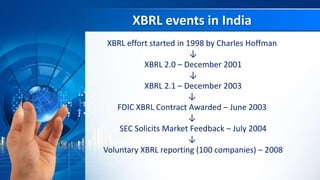
XBRL events in India
XBRL effort started in 1998 by Charles Hoffman
↓
XBRL 2.0 – December 2001
↓
XBRL 2.1 – December 2003
↓
FDIC XBRL Contract Awarded – June 2003
↓
SEC Solicits Market Feedback – July 2004
↓
Voluntary XBRL reporting (100 companies) – 2008
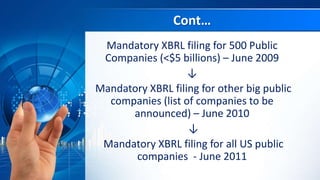
Cont…
Mandatory XBRL filing for 500 Public
Companies (<$5 billions) – June 2009
↓
Mandatory XBRL filing for other big public
companies (list of companies to be
announced) – June 2010
↓
Mandatory XBRL filing for all US public
companies - June 2011
Features
XBRL formatting can be done for financial and
non-financial data:
• Unique identifying tags are applied to
financial statements.
• Supplier data
• Customer application forms
• Project information
• Employee data
• Regulatory submissions
• Other management information systems data
Benefits
• Better business reporting and analysis.
• Cost saving and faster.
• More reliable and more accurate handling of
data.
• Improved analysis for better quality of
information and decision-making.
• Avoids time-consuming manual comparison and
re-entry of data.
• Internet Ready for transmission and direct use by
all stake holders.
• Improvement in the speed of collating and
analysing data.
Taxonomies
• General purpose taxonomy called
Commercial and Industrial Taxonomy
based on IFRS 2006 architecture.
• Banking Taxonomy, an extension to the
core Indian XBRLC&I Taxonomy.
• Taxonomies for NBFCs, Insurance &
Power Sectors – in process.
How does XBRL works?
• XBRL makes the data readable, with the help of two
documents – Taxonomy and Instance Document.
• Taxonomy defines the elements and their relationships
based on the regulatory requirements.
• Using the taxonomy prescribed by the regulators,
companies need to map their reports, and generate a
valid XBRL instance document.
• Mapping is a process for matching the concepts as
reported by the company to the corresponding element
in the taxonomy.
Xbrl
Xbrl
Xbrl
Xbrl
Xbrl
Xbrl
Xbrl
Xbrl
Xbrl

Xbrl

  • 1.
    EVOLUTION AND FEATURESOF eXtensible Business Reorting Language Osamah Almaamari SECIOND SEMESTAR 2017/2018
  • 2.
    What is XBRL? •XBRL stands for eXtensible Business Reporting Language • Language for the electronic communication of business and financial data. • Provides major benefits in the preparation, analysis and communication of business information. • Offers cost savings, greater efficiency and improved accuracy and reliability to all those involved in supplying or using financial data. • Being put to practical use in a number of countries.
  • 3.
    Who is itapplicable for? Following class of companies have to file the Financial Statements in XBRL Form from the year 2010-2011: • All companies listed in India and their subsidiaries, including overseas subsidiaries. • All companies having a paid up capital of Rs. 5 Crore and above or a Turnover of Rs 100 crore or abover.
  • 4.
    XBRL events inIndia XBRL effort started in 1998 by Charles Hoffman ↓ XBRL 2.0 – December 2001 ↓ XBRL 2.1 – December 2003 ↓ FDIC XBRL Contract Awarded – June 2003 ↓ SEC Solicits Market Feedback – July 2004 ↓ Voluntary XBRL reporting (100 companies) – 2008
  • 5.
    Cont… Mandatory XBRL filingfor 500 Public Companies (<$5 billions) – June 2009 ↓ Mandatory XBRL filing for other big public companies (list of companies to be announced) – June 2010 ↓ Mandatory XBRL filing for all US public companies - June 2011
  • 6.
    Features XBRL formatting canbe done for financial and non-financial data: • Unique identifying tags are applied to financial statements. • Supplier data • Customer application forms • Project information • Employee data • Regulatory submissions • Other management information systems data
  • 7.
    Benefits • Better businessreporting and analysis. • Cost saving and faster. • More reliable and more accurate handling of data. • Improved analysis for better quality of information and decision-making. • Avoids time-consuming manual comparison and re-entry of data. • Internet Ready for transmission and direct use by all stake holders. • Improvement in the speed of collating and analysing data.
  • 8.
    Taxonomies • General purposetaxonomy called Commercial and Industrial Taxonomy based on IFRS 2006 architecture. • Banking Taxonomy, an extension to the core Indian XBRLC&I Taxonomy. • Taxonomies for NBFCs, Insurance & Power Sectors – in process.
  • 9.
    How does XBRLworks? • XBRL makes the data readable, with the help of two documents – Taxonomy and Instance Document. • Taxonomy defines the elements and their relationships based on the regulatory requirements. • Using the taxonomy prescribed by the regulators, companies need to map their reports, and generate a valid XBRL instance document. • Mapping is a process for matching the concepts as reported by the company to the corresponding element in the taxonomy.