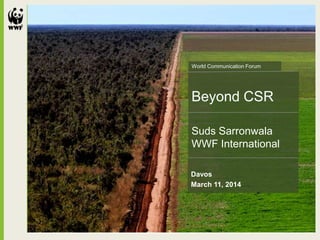
Beyond CSR
Suds Sarronwala
WWF International
Davos
March 11, 2014
World Communication Forum
Normal
The ‘New’ Normal
The ‘New’ Normal
Business Sustainability
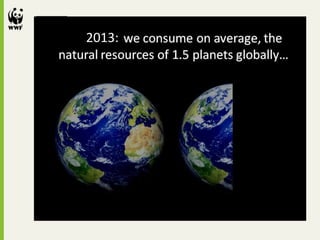
2013:
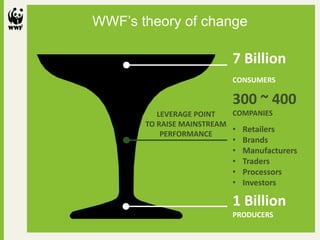
WWF’s theory of change
1 Billion
PRODUCERS
• Retailers
• Brands
• Manufacturers
• Traders
• Processors
• Investors
300 ~ 400
COMPANIES
7 Billion
CONSUMERS
LEVERAGE POINT
TO RAISE MAINSTREAM
PERFORMANCE
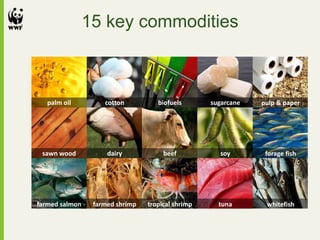
palm oil cotton biofuels pulp & papersugarcane
sawn wood dairy beef forage fishsoy
farmed salmon farmed shrimp tropical shrimp whitefishtuna
15 key commodities
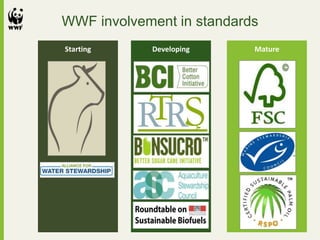
Starting MatureDeveloping
WWF involvement in standards
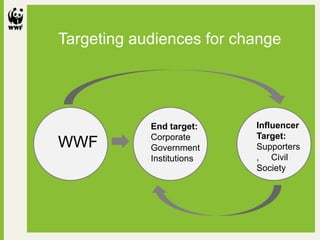
Targeting audiences for change
End target:
Corporate
Government
Institutions
Influencer
Target:
Supporters
, Civil
Society
WWF
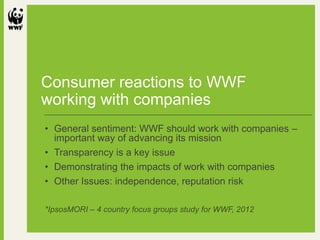
• General sentiment: WWF should work with companies –
important way of advancing its mission
• Transparency is a key issue
• Demonstrating the impacts of work with companies
• Other Issues: independence, reputation risk
*IpsosMORI – 4 country focus groups study for WWF, 2012
Consumer reactions to WWF
working with companies
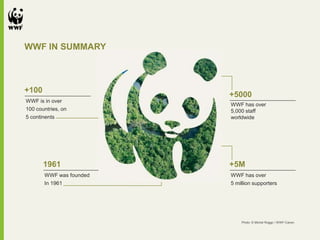
WWF IN SUMMARY
WWF is in over
100 countries, on
5 continents
+100
WWF was founded
In 1961
1961
WWF has over
5,000 staff
worldwide
+5000
WWF has over
5 million supporters
+5M
Photo: © Michel Roggo / WWF-Canon
panda.org
wwf.org
Thank you
© WWF. All photographs used in this presentation are copyright protected and courtesy of the WWF-Canon Global Photo Network and the respective photographers.
'Beyond CSR' - WWF@World Communication Forum, Davos

'Beyond CSR' - WWF@World Communication Forum, Davos

  • 1.
    Beyond CSR Suds Sarronwala WWFInternational Davos March 11, 2014 World Communication Forum
  • 2.
  • 3.
  • 4.
  • 5.
  • 6.
    WWF’s theory ofchange 1 Billion PRODUCERS • Retailers • Brands • Manufacturers • Traders • Processors • Investors 300 ~ 400 COMPANIES 7 Billion CONSUMERS LEVERAGE POINT TO RAISE MAINSTREAM PERFORMANCE
  • 7.
    palm oil cottonbiofuels pulp & papersugarcane sawn wood dairy beef forage fishsoy farmed salmon farmed shrimp tropical shrimp whitefishtuna 15 key commodities
  • 8.
  • 9.
    Targeting audiences forchange End target: Corporate Government Institutions Influencer Target: Supporters , Civil Society WWF
  • 10.
    • General sentiment:WWF should work with companies – important way of advancing its mission • Transparency is a key issue • Demonstrating the impacts of work with companies • Other Issues: independence, reputation risk *IpsosMORI – 4 country focus groups study for WWF, 2012 Consumer reactions to WWF working with companies
  • 11.
    WWF IN SUMMARY WWFis in over 100 countries, on 5 continents +100 WWF was founded In 1961 1961 WWF has over 5,000 staff worldwide +5000 WWF has over 5 million supporters +5M Photo: © Michel Roggo / WWF-Canon
  • 12.
    panda.org wwf.org Thank you © WWF.All photographs used in this presentation are copyright protected and courtesy of the WWF-Canon Global Photo Network and the respective photographers.

Editor's Notes

  • #2 Thanks for this opportunity...I wouldlike to talk about WWFsapproach to workingwithCorporates. It is not about CSR, It’s about transformation, about tippingmarkets. Worldwide.This is a stepprior to communicating about ethics and values. It’s about instilling a set of ethics and values into an organizationthatreflectstheirdesire to do good for the enviromentwithintheir businesses. Not justprovidefunds for environmentalreasons. It’s about impactingsupplychains, manufacturing and materialsourcingwith a view to the environment and sustainability.It iswell ‘beyond CSR’.
  • #3 Today, it is ‘normal’ for a country to have an Environment Minister (in fact it’s pretty inconceivable that a country would not have one). Or for a corporation to have a ‘CSR’ division (again, that would be rare indeed). Remember though, that this was not ‘normal’ in the sixties and the seventies. As the movement grew over the eighties and the nineties, both these phenomena became the ‘new normal’.
  • #4 We are in the quest to establish the next ‘new normal’ in business practice.
  • #5 That of establishing a ‘new normal’ of business sustainability. WWF has committed itself to working with the companies and sectors that can make a difference to conservation and help us livewithin the planet’s means. Importantly, business sustainability is not a one-way street in terms of it being a Conservation/NGO/WWF agenda. It’s a business agenda.Today you will hear from several companies and their representatives.Ask them and they will tell you that without a sustainable water supply, there can’t be a sustainable soft drinks business; without a sustainable forest program, there can’t be a sustainable furniture or paper product business, withour a sustainable fish supply there can’t be a thriving fisheries business....and so on.This is an issue that the pioneering business leaders have recognized is critical to their business. We are here to help in its adoption. And to help change entire sectors
  • #6 So here’s the nub of it.Through the Living Planet Report and World Overshoot day (that continues to occur earlier and earlier in the year!) we know that we use the natural resources of 1.5 planets a year – which means that we consume in a year what nature takes 1.5 years to replenish. Whichever way you look at it – financially, mathematically or logically, that is not a sustainable proposition – we are eating into the capital and no longer living off the interest!Business sustainability can help impact that – both in the developed countries and importantly get it right early on in the emerging countries that have massive and growing middle classes.We firmly believe there is no real prospect of sustainability being achieved without the active participation of the private sector.
  • #7 How best to do that? Do we try to change the consumption habits of 7 billion consumers? Work directly with 1.5 billion producers? As we study the make up of markets and sectors, key learnings emerge. For example:More than 75% of global soy trade is controlled by 4 companies5 companies produce 75% of all European consumer tissue products WWF research shows that by shifting 20 percent of demand, we can shift up to 50 percent of production. This can give us a real opportunity to shift a whole commodity market and reduce the impact from commodity production on key areas of global conservation importance. Thus, the linchpin of our strategy is to work with the biggest buyers of each commodity to shift their whole supply chain.
  • #8 WWF research revealed these 15 commodities to have the greatest impacts on the 35 places of global conservation priority. Taken together, these priority commodities include the five largest drivers of deforestation; the largest drivers of Land Use, Land Use Change and Forestry (LULUCF) emissions;the most significant fisheries, both from the perspective of aquatic biodiversity and with respect to providing a critical food source for the planet; and impact the greatest conservation challenges of our era: biodiversity, carbon and water. The challenge is to reduce the impacts of production. We need to produce ‘more with less’
  • #9 Using standards to achieve our conservation objectives is not new. WWF has achieved successes in transforming markets for certain products working through our thematic programmes. The FSC is a case in point, as is the MSC. WWF is also involved in an increasing number and range of standards and Multistakeholder Sustainability Initiatives (MSIs) and standards such as RTRS, RSPO, RSB, BCI, Bonsucro and ASC.This slide gives a quick indication of the relative status and maturity of the different roundtable & certification schemes that WWF supports in relation to WWF priority commodities. Mature schemesDeveloping schemesNewer schemes
  • #10 While we discuss the partners and the corporations, lets pause for a minute and look at a critical audience that plays a significant role in influencing the private sector – the consumer. Better known to us as a supporter or a member of civil society. Politicians listen to their voters, brands listen to their consumers and institutions pay heed to the voice of civil society. Hence, while the game changing decisions are likely made at the point of the end target, more often than not, the voice of the people helps make that happen. It is therefore imperative that we listen to and source this critical audience even when we are deciding on our work with corporations, the private sector. Consumerstoday are increasinglydemanding total transparencyfrom brands – theirsupplychain, theirmaterials, their packaging. Theywantcomplete ‘brand honesty’ In a few yearsthiswillbe the norm and corporations that have not adoptedthiswillsuffer as a result in terms of theircredibility and engagement.In 2012 we undertook a qualitative study through IpsosMORI in 4 countries to understand, amongst other things, what supporters thought of our work with corporations and what rules, if any, we should follow. I must state here that the role of NGOs with the private sector is not necessarily clear or understood by a significant part of the population. This definitely points to a communication issue that both, the NGO and the corporation need to work harder at.
  • #11 Interestingly, the very criteria that we seek from companies, our supporters seek of us. A strategic fit with the business, transparency, independence – these are all important factors in working with the private sector.We want to influence and we want to have long lasting impact with our corporate partnerships and are therefore mindful of the above.As weseek to bring about this transformation through the business practices of keysector leaders, I hopewe have been able to communicateeffectivcelythatthisis an effort ‘beyond CSR’Thank You