WSU Master Goats Presentation 10 28 07

Editor's Notes

  • #2 <number><Remember: slooooooowwww and be natural>I appreciate the opportunity to be here…<number>
  • #3 <Go slow><number>
  • #4 <…slowly…>Work in a variety of industries from organic seed growers and natural food to right here with IGFC<number>
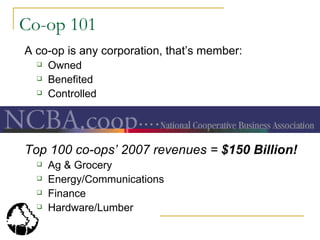
  • #5 <ehm, breath>A lot of common misconceptions about co-ops; #1 is that they’re “nonprofits” but they can operate in a not-for-profit manner.What does this mean: the equity owners of a co-op are the same people who:- democratically govern the business thru 1-member = 1-vote- are the beneficiaries of the services providedCo-ops = 40K co-ops in U.S.102 MM member = >1/3 of AmericansCo-ops are relevant and dynamic in today’s economy<number>
  • #6 <are you going slowly enough>Co-ops are defined by ownershipIn this collection of cooperative business’s logo’s, I see groups of people who had a need:- they could not meet individually and- which was unfulfilled by the traditional investor-owned private sector- wealth is not generated simply by “work” but thru ownership and the accumulation of assets<number>
  • #7 <S.L.O.W.>Because co-op businesses are:- comprised of the community- representative of the community- a part of the communityCo-ops: - Keep profits, ownership and control local- Are less vulnerable to take-over and closure by outside decision-makers; often stay long after others leave- Are trusted business partners; people like to deal with the producer<number>
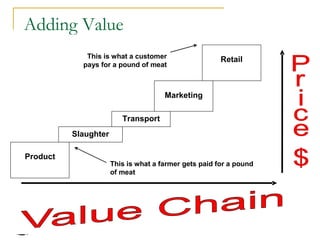
  • #8 Note how co-ops can leverage producers “up” the chain<number>
  • #9 The problem is… You actually have to do the work of the middlemenDon’t kill your car mechanic, unless you can do your own mechanical work.<number>
  • #10 Apologize for words<number>
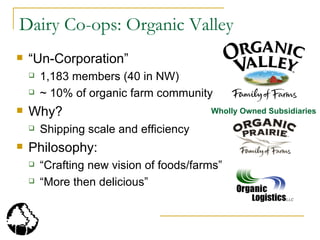
  • #11 - 1988 under the name CROPP (Coulee Region Organic Produce Pool)- 7 farms selling their produce expanded into distribution of fruits, veg and dairy- \"CROPP\" was adjusted to Cooperative Regions of Organic Producer PoolsThe Un-CorporationIn an era where corporations dominate all facets of business including government, global energy, ag and global food supply, Organic Valley serves small farmers and rural community health by combining two alternative business models - the family farm and the co-op. Our co-op was founded to nurture local communities by keeping farmers on the land, farming. We understood from the beginning that we would need to pool our product in a cooperative fashion to accomplish that goal.How it WorksFarmer members establish equity thru joining:- elect national Board national Board of Directors is elected- regional executive committees carry opinions to BoardIn addition to a member-determined pay-price and equity ownership in a leading national food brand, members receive numerous benefits including support in production, certification, farm planning, feed sourcing, veterinary consultation and more. Adding Value thru values!With the customer, building a new visionBuilding our base of loyal customers allows us to bring more farm families into the co-op, along with the land, water, and animals that they protect.<number>
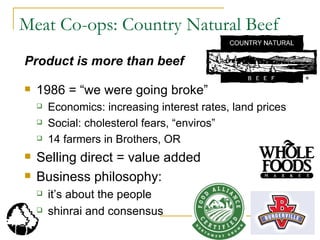
  • #12 It’s the smell of sage after a summer thunderstorm, the cool shade of a Ponderosa Pine forest. It’s the 80 year old weathered hands saddling a horse in the Blue Mountains, the future of a 6 year old in a one room school on the High Desert.It’s a trout in a beaver built pond, haystacks on an Aspen framed meadow.It’s the hardy quail running to join the cattle for a meal, the welcome ring of a dinner bell at dusk. Member Dick Bradbury:..we've realized that the people part of it is much more critical than the cows. The rancher-to-consumer connection is what gives us the uniqueness of our product. Also, the idea that the consumer feels they are dealing directly with the people who actually grow their food. Mary Bradbury:The people who eat the product need to be partnersDoc Hatfield, founder:Most of the ranchers are rural, conservative, Republican, heterosexual and religious. And most of the customers are urban, secular, Democratic, liberal, and you'd think they wouldn't mesh.Connie Hatfield on Berkeley, CA Customers:They have a lot of piercings, tattoos and colored hair and different things. But it's really interesting to mix our cultures and be able to stay on the land because we started to market our products.Adding value by selling more directly to consumers and thru connectingThereby ranchers could set their price to cover the cost of production, plus a reasonable return on investment, and a reasonable profit.<number>
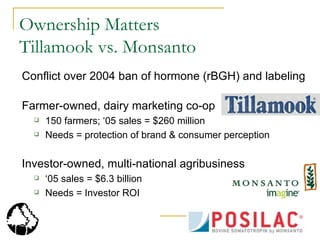
  • #13 <go slow and don’t get lost in the details>I like this case study because it demonstrates:1. how and why organizations behave in different ways based on a different set of motivations2. co-ops counterbalance the power (economic and political) of agribusiness while achieving individual farmers’ interests3. not everybody gets their way“This conflict is a result of differences in organizational philosophies, structure and power between different types of economic organizations.”- Thomas W. Gray, Ph.D. Rural Sociologist 2004 Board voted to ban the use of the growth hormone = conflict with Monsanto and within membershipMonsanto managers have a fiduciary responsibility to shareholders to do everything within the law to maximize profitCo-op managers have a similar responsibility but it is based on their ability to market the productThere in lies the conflict – it was public, letters and article were writtenMonsanto agreed with over 80 dissenting co-op members that co-op shouldn’t restrict “choices” or profitAfter the ban, 6,500 consumers called to comment and 98% supported the banRe-vote and ban upheld at a vote 87-43Co-op have both individual and collective benefits. Farmer gets market access and higher price.Tillamook is farmer-driven and consumer-drivenMonsanto is investor-drivenMembers neither left nor joined the co-op
  • #14 <number>
  • #15 <number><number>
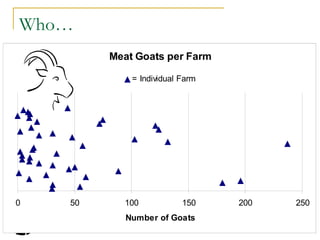
  • #16 Only found:- 7 farms over 100 head- 15 50 or more- average herd size = 29 goats<number>
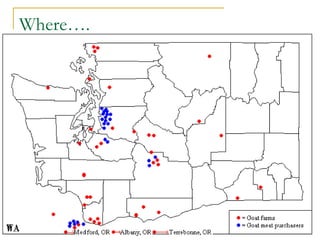
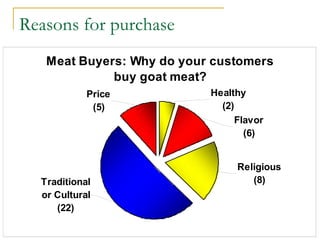
  • #17 Red = ruralBlue = urban ethnic markets- Halal (i.e. Muslim)- Hispanic- African/Caribbean
  • #18 <number><number>
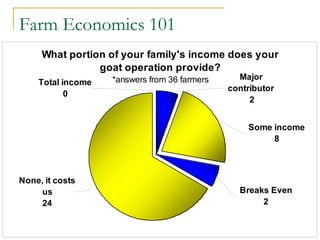
  • #19 This chart will probably surprise none of you; it would terrify your average businessman or banker…
  • #20 <number>
  • #21 <number>
  • #22 <number>