Essay Writing
Unit 2B – How to Structure an Essay: Writing Introductions and Conclusions
Learning Centre
INDEPENDENT LEARNING RESOURCES
INDEPENDENT LEARNING RESOURCES ESSAY MODULE
© Learning Centre, The University of Sydney Unit 2b. How to structure an essay:
This unit may be copied for individual student use Writing introductions and conclusions
1
This unit's place in the whole module:
Unit 1A How to be analytical:
What is analysis?
Unit 1B How to be analytical:
Setting up a taxonomy
Unit 2A How to structure an essay:
Developing an essay structure
Unit 2B How to structure an essay:
Writing introductions and conclusions
Unit 3A How to use evidence:
Developing an argument out of the evidence
Unit 3B How to use evidence:
Supporting your argument with the evidence
Unit 3C How to use evidence:
Avoiding plagiarism
Unit 4A How to develop an argument:
Being persuasive
Unit 4B How to develop an argument:
Being critical
INDEPENDENT LEARNING RESOURCES ESSAY MODULE
© Learning Centre, The University of Sydney Unit 2b. How to structure an essay:
This unit may be copied for individual student use Writing introductions and conclusions
2
UNIT 2B. How to structure an essay:
Writing introductions and conclusions
OBJECTIVES OF THIS UNIT
After you have finished this unit, we hope you will be able to:
• identify appropriate structural units which make up essay introductions and
conclusions
• recognize the relationship between the main body of the essay and its
introduction and conclusion
IDENTIFYING YOUR PROBLEMS WITH WRITING INTRODUCTIONS AND
CONCLUSIONS
If you have been having difficulty in writing introductions and conclusions, your marker may
have made a comment on your writing similar to these:
• "It's difficult to understand the overall structure of your essay."
• "This essay doesn't have an introduction, so it's difficult to get into."
• "Your conclusion is weak because it doesn't seem to draw together the things
you have written in the essay."
INTRODUCTION TO THIS UNIT
In the previous unit, you were looking at the overall structure of the essay. In this unit, you
will be looking at how the introduction and the conclusion are related to the whole essay.
Without a clear introduction, your reader will probably find it difficult to pick up what the
essay is about. The introduction is critical to making sure that your reader is clear about the
purpose of the essay; otherwise, their reading of your essay will probably be more hard work
than enjoyable. Although the conclusion is not quite so critical, if you do not come to an
ending which is appropriate for the essay, again your reader will not be happy.
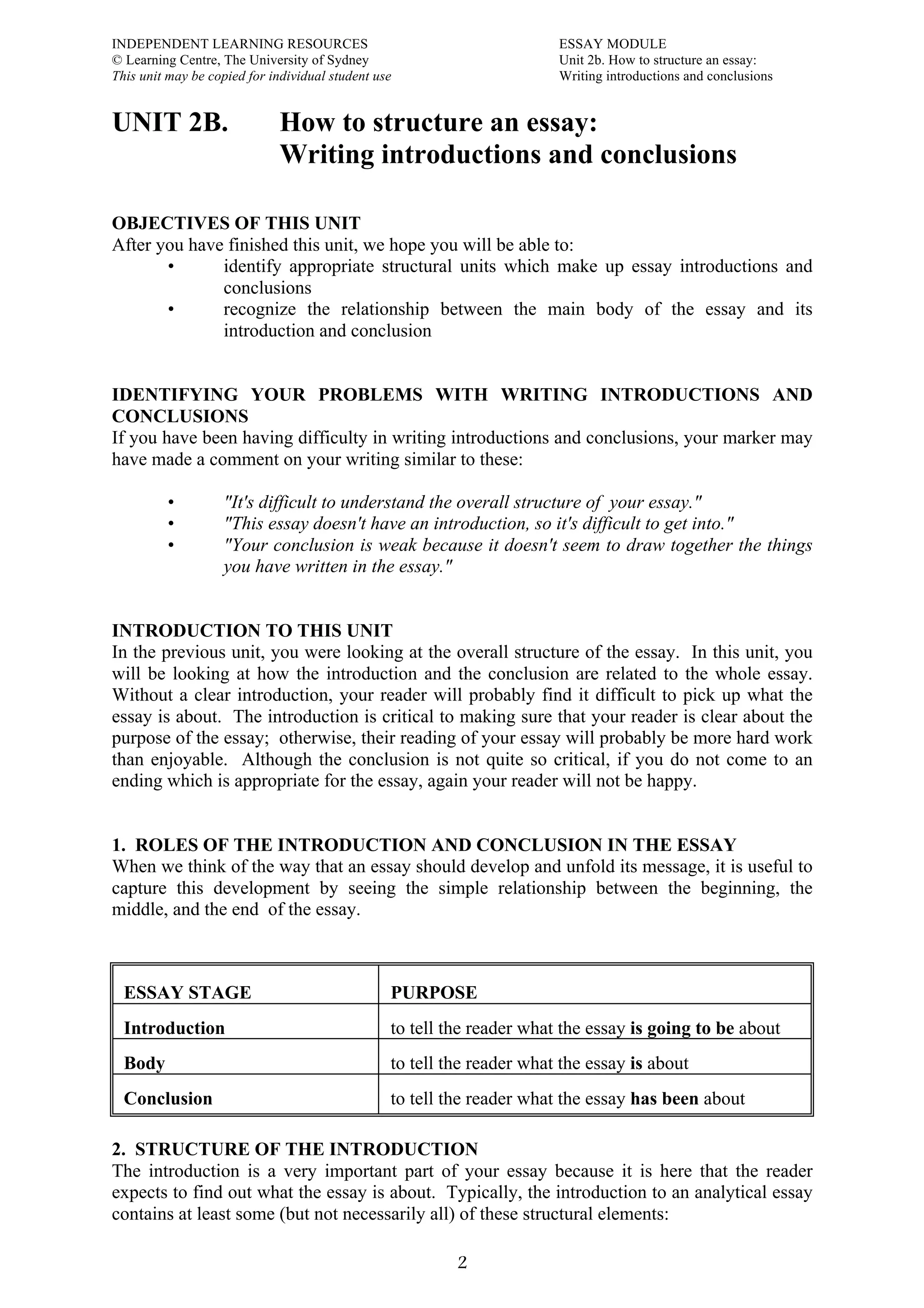
1. ROLES OF THE INTRODUCTION AND CONCLUSION IN THE ESSAY
When we think of the way that an essay should develop and unfold its message, it is useful to
capture this development by seeing the simple relationship between the beginning, the
middle, and the end of the essay.
ESSAY STAGE PURPOSE
Introduction to tell the reader what the essay is going to be about
Body to tell the reader what the essay is about
Conclusion to tell the reader what the essay has been about
2. STRUCTURE OF THE INTRODUCTION
The introduction is a very important part of your essay because it is here that the reader
expects to find out what the essay is about. Typically, the introduction to an analytical essay
contains at least some (but not necessarily all) of these structural elements:
INDEPENDENT LEARNING RESOURCES ESSAY MODULE
© Learning Centre, The University of Sydney Unit 2b. How to structure an essay:
This unit may be copied for individual student use Writing introductions and conclusions
3
Possible stages in the introduction
ORIENTATE TO TOPIC
To give a general background to the essay topic
STATE PURPOSE
To state the purpose of the essay
STATE THESIS/STATE PROPOSITION
To state the essay's main point
either "that X is so" or "whether X is so"
STATE OUTLINE
To state what stages the essay will develop through
STATE SCOPE
To state what the limits of the essay will be
Clearly, these stages of an introduction cannot be written until you have planned your essay
and you really know how you are going to structure it. A common problem for essay writers
new to university studies is that they labour over the introduction long before they really
know what they want to write. More experienced writers often leave their introduction till
last.
Exercise 1
Read the following introduction which has been divided up into its stages. Decide what is the
function of each stage, using the possible stages of an introduction listed above. Why do you
think there are only two stages?
Increased knowledge about pre-natal development has recently provided a
great deal of evidence to support the fact that "the mother's physical health
and the psychological stresses experienced by the mother can influence the
fetal environment and the development of the fetus."
(STAGE _____________________)
Throughout the essay it will be seen how such factors as nutrition, smoking,
fatigue, exposure to radiation, alcholic beverages, coffee, other drugs and
diseases of various types, and maternal emotional state influence the fetal
environment and the development of the fetus by affecting the mother's health
in general. It may be relevant to mention that the mother's genetic make-up
may also be influential on the development of the fetus. For example, the
mother's age, size, blood type, chromosomal make-up and other factors may
influence the development of the fetus as well.
(STAGE ________________________)
INDEPENDENT LEARNING RESOURCES ESSAY MODULE
© Learning Centre, The University of Sydney Unit 2b. How to structure an essay:
This unit may be copied for individual student use Writing introductions and conclusions
4
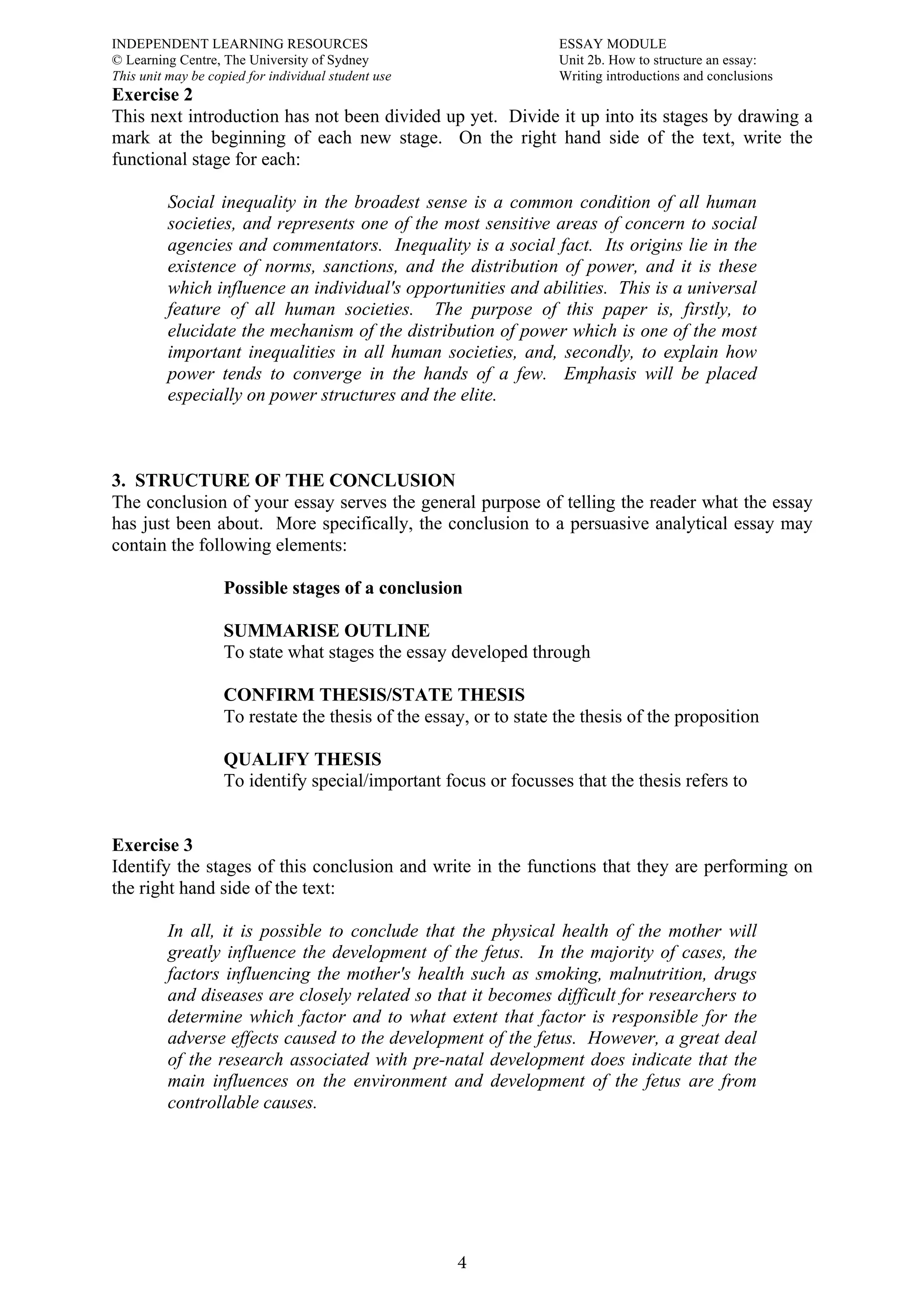
Exercise 2
This next introduction has not been divided up yet. Divide it up into its stages by drawing a
mark at the beginning of each new stage. On the right hand side of the text, write the
functional stage for each:
Social inequality in the broadest sense is a common condition of all human
societies, and represents one of the most sensitive areas of concern to social
agencies and commentators. Inequality is a social fact. Its origins lie in the
existence of norms, sanctions, and the distribution of power, and it is these
which influence an individual's opportunities and abilities. This is a universal
feature of all human societies. The purpose of this paper is, firstly, to
elucidate the mechanism of the distribution of power which is one of the most
important inequalities in all human societies, and, secondly, to explain how
power tends to converge in the hands of a few. Emphasis will be placed
especially on power structures and the elite.
3. STRUCTURE OF THE CONCLUSION
The conclusion of your essay serves the general purpose of telling the reader what the essay
has just been about. More specifically, the conclusion to a persuasive analytical essay may
contain the following elements:
Possible stages of a conclusion
SUMMARISE OUTLINE
To state what stages the essay developed through
CONFIRM THESIS/STATE THESIS
To restate the thesis of the essay, or to state the thesis of the proposition
QUALIFY THESIS
To identify special/important focus or focusses that the thesis refers to
Exercise 3
Identify the stages of this conclusion and write in the functions that they are performing on
the right hand side of the text:
In all, it is possible to conclude that the physical health of the mother will
greatly influence the development of the fetus. In the majority of cases, the
factors influencing the mother's health such as smoking, malnutrition, drugs
and diseases are closely related so that it becomes difficult for researchers to
determine which factor and to what extent that factor is responsible for the
adverse effects caused to the development of the fetus. However, a great deal
of the research associated with pre-natal development does indicate that the
main influences on the environment and development of the fetus are from
controllable causes.
INDEPENDENT LEARNING RESOURCES ESSAY MODULE
© Learning Centre, The University of Sydney Unit 2b. How to structure an essay:
This unit may be copied for individual student use Writing introductions and conclusions
5
4. CONNECTING THE BEGINNING, MIDDLE, AND END
Finally, it is interesting to see the relationship between the conclusion of an essay and all the
stages that make up the essay. In order to see that relationship more clearly, we will first of
all look at Prue's introduction to her essay about the effects of television violence on children.
Then we will analyse the relationship between this introduction, the stages in the body of the
essay, and the conclusion.
Exercise 4
Read Prue's introduction and label its stages. Does the introduction give us a good indication
of what the essay will be about?
As television has been labelled an "influential teacher" by many professionals,
the claim that "modern children spend more hours in front of television than
they spend at school" is definitely worth further investigation. If it is found
that the quality and content of the children's programs promote the
development of social and cognitive skills then these citations have no
relevance. Unfortunately however many studies show that children's
television is lacking and is even, in some instances, harmful. The devastating
effects of television violence on the development of the child's aggressive
nature is one of the main concerns when evaluating the effects of television on
children.
Exercise 5
Now read Prue's conclusion and label its stages. Is there a close relationship between the
introduction and the conclusion? Underline the words and phrases that indicate this
relationship.
Although many controls and regulations have been introduced to enhance the
quality of children's programs in Australia, violence and crime still seem to
filter through. The common finding across most age groups is that this
television violence and crime instigates aggressive behaviour. Therefore, the
claim that "modern children spend more hours in front of television than they
spend at school" is indeed cause for alarm. For the young pre-schooler, the
child with a high base level of aggression, and the unsupervised "latch-key"
child, the implications of television violence are quite serious.
INDEPENDENT LEARNING RESOURCES ESSAY MODULE
© Learning Centre, The University of Sydney Unit 2b. How to structure an essay:
This unit may be copied for individual student use Writing introductions and conclusions
6
ANSWER KEY
ESSAY MODULE
Unit 2B
How to structure an essay:
Writing introductions and conclusions
Exercise 1
Increased knowledge about pre-natal development has recently provided a great deal of
evidence to support the fact that "the mother's physical health and the psychological stresses
experienced by the mother can influence the fetal environment and the development of the
fetus." (STAGE: ORIENTATE TO TOPIC)
Throughout the essay it will be seen how such factors as nutrition, smoking, fatigue, exposure
to radiation, alcholic beverages, coffee, other drugs and diseases of various types, and
maternal emotional state influence the fetal environment and the development of the fetus by
affecting the mother's health in general. It may be relevant to mention that the mother's
genetic make-up may also be influential on the development of the fetus. For example, the
mother's age, size, blood type, chromosomal make-up and other factors may influence the
development of the fetus as well.
(STAGE: STATE OUTLINE/STATE PROPOSITION)
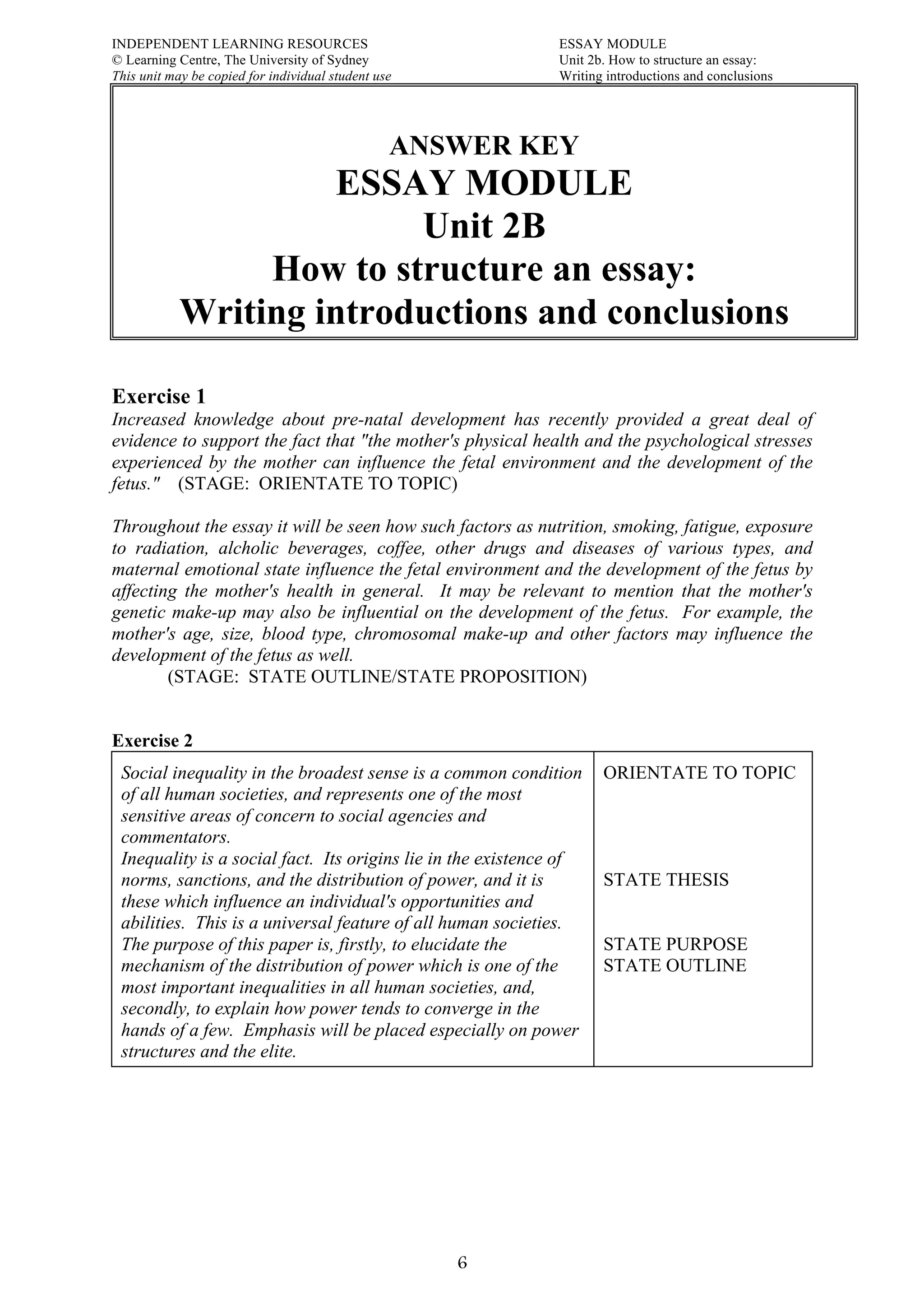
Exercise 2
Social inequality in the broadest sense is a common condition
of all human societies, and represents one of the most
sensitive areas of concern to social agencies and
commentators.
Inequality is a social fact. Its origins lie in the existence of
norms, sanctions, and the distribution of power, and it is
these which influence an individual's opportunities and
abilities. This is a universal feature of all human societies.
The purpose of this paper is, firstly, to elucidate the
mechanism of the distribution of power which is one of the
most important inequalities in all human societies, and,
secondly, to explain how power tends to converge in the
hands of a few. Emphasis will be placed especially on power
structures and the elite.
ORIENTATE TO TOPIC
STATE THESIS
STATE PURPOSE
STATE OUTLINE
INDEPENDENT LEARNING RESOURCES ESSAY MODULE
© Learning Centre, The University of Sydney Unit 2b. How to structure an essay:
This unit may be copied for individual student use Writing introductions and conclusions
7
Exercise 3
In all, it is possible to conclude that the physical health of the
mother will greatly influence the development of the fetus.
In the majority of cases, the factors influencing the mother's
health such as smoking, malnutrition, drugs and diseases are
closely related
so that it becomes difficult for researchers to determine which
factor and to what extent that factor is responsible for the
adverse effects caused to the development of the fetus.
However, a great deal of the research associated with pre-
natal development does indicate that the main influences on
the environment and development of the fetus are from
controllable causes.
CONFIRM THESIS
SUMMARISE OUTLINE
QUALIFY THESIS
CONFIRM THESIS
Exercise 4
As television has been labelled an "influential teacher" by
many professionals, the claim that "modern children spend
more hours in front of television than they spend at school"
is definitely worth further investigation.
If it is found that the quality and content of the children's
programs promote the development of social and cognitive
skills then these citations have no relevance.
Unfortunately however many studies show that children's
television is lacking and is even, in some instances, harmful.
The devastating effects of television violence on the
development of the child's aggressive nature is one of the
main concerns when evaluating the effects of television on
children.
ORIENTATE TO TOPIC
STATE PROPOSITION
STATE PURPOSE
STATE THESIS
STATE SCOPE
Exercise 5
Although many controls and regulations have been
introduced to enhance the quality of children's programs in
Australia, violence and crime still seem to filter through. The
common finding across most age groups is that this television
violence and crime instigates aggressive behaviour.
Therefore, the claim that "modern children spend more hours
in front of television than they spend at school" is indeed
cause for alarm. For the young pre-schooler, the child with a
high base level of aggression, and the unsupervised "latch-
key" child, the implications of television violence are quite
serious.
SUMMARISE OUTLINE
CONFIRM THESIS
QUALIFY THESIS

writing-introductions-and-conclusions.pdf

  • 1.
    Essay Writing Unit 2B– How to Structure an Essay: Writing Introductions and Conclusions Learning Centre INDEPENDENT LEARNING RESOURCES
  • 2.
    INDEPENDENT LEARNING RESOURCESESSAY MODULE © Learning Centre, The University of Sydney Unit 2b. How to structure an essay: This unit may be copied for individual student use Writing introductions and conclusions 1 This unit's place in the whole module: Unit 1A How to be analytical: What is analysis? Unit 1B How to be analytical: Setting up a taxonomy Unit 2A How to structure an essay: Developing an essay structure Unit 2B How to structure an essay: Writing introductions and conclusions Unit 3A How to use evidence: Developing an argument out of the evidence Unit 3B How to use evidence: Supporting your argument with the evidence Unit 3C How to use evidence: Avoiding plagiarism Unit 4A How to develop an argument: Being persuasive Unit 4B How to develop an argument: Being critical
  • 3.
    INDEPENDENT LEARNING RESOURCESESSAY MODULE © Learning Centre, The University of Sydney Unit 2b. How to structure an essay: This unit may be copied for individual student use Writing introductions and conclusions 2 UNIT 2B. How to structure an essay: Writing introductions and conclusions OBJECTIVES OF THIS UNIT After you have finished this unit, we hope you will be able to: • identify appropriate structural units which make up essay introductions and conclusions • recognize the relationship between the main body of the essay and its introduction and conclusion IDENTIFYING YOUR PROBLEMS WITH WRITING INTRODUCTIONS AND CONCLUSIONS If you have been having difficulty in writing introductions and conclusions, your marker may have made a comment on your writing similar to these: • "It's difficult to understand the overall structure of your essay." • "This essay doesn't have an introduction, so it's difficult to get into." • "Your conclusion is weak because it doesn't seem to draw together the things you have written in the essay." INTRODUCTION TO THIS UNIT In the previous unit, you were looking at the overall structure of the essay. In this unit, you will be looking at how the introduction and the conclusion are related to the whole essay. Without a clear introduction, your reader will probably find it difficult to pick up what the essay is about. The introduction is critical to making sure that your reader is clear about the purpose of the essay; otherwise, their reading of your essay will probably be more hard work than enjoyable. Although the conclusion is not quite so critical, if you do not come to an ending which is appropriate for the essay, again your reader will not be happy. 1. ROLES OF THE INTRODUCTION AND CONCLUSION IN THE ESSAY When we think of the way that an essay should develop and unfold its message, it is useful to capture this development by seeing the simple relationship between the beginning, the middle, and the end of the essay. ESSAY STAGE PURPOSE Introduction to tell the reader what the essay is going to be about Body to tell the reader what the essay is about Conclusion to tell the reader what the essay has been about 2. STRUCTURE OF THE INTRODUCTION The introduction is a very important part of your essay because it is here that the reader expects to find out what the essay is about. Typically, the introduction to an analytical essay contains at least some (but not necessarily all) of these structural elements:
  • 4.
    INDEPENDENT LEARNING RESOURCESESSAY MODULE © Learning Centre, The University of Sydney Unit 2b. How to structure an essay: This unit may be copied for individual student use Writing introductions and conclusions 3 Possible stages in the introduction ORIENTATE TO TOPIC To give a general background to the essay topic STATE PURPOSE To state the purpose of the essay STATE THESIS/STATE PROPOSITION To state the essay's main point either "that X is so" or "whether X is so" STATE OUTLINE To state what stages the essay will develop through STATE SCOPE To state what the limits of the essay will be Clearly, these stages of an introduction cannot be written until you have planned your essay and you really know how you are going to structure it. A common problem for essay writers new to university studies is that they labour over the introduction long before they really know what they want to write. More experienced writers often leave their introduction till last. Exercise 1 Read the following introduction which has been divided up into its stages. Decide what is the function of each stage, using the possible stages of an introduction listed above. Why do you think there are only two stages? Increased knowledge about pre-natal development has recently provided a great deal of evidence to support the fact that "the mother's physical health and the psychological stresses experienced by the mother can influence the fetal environment and the development of the fetus." (STAGE _____________________) Throughout the essay it will be seen how such factors as nutrition, smoking, fatigue, exposure to radiation, alcholic beverages, coffee, other drugs and diseases of various types, and maternal emotional state influence the fetal environment and the development of the fetus by affecting the mother's health in general. It may be relevant to mention that the mother's genetic make-up may also be influential on the development of the fetus. For example, the mother's age, size, blood type, chromosomal make-up and other factors may influence the development of the fetus as well. (STAGE ________________________)
  • 5.
    INDEPENDENT LEARNING RESOURCESESSAY MODULE © Learning Centre, The University of Sydney Unit 2b. How to structure an essay: This unit may be copied for individual student use Writing introductions and conclusions 4 Exercise 2 This next introduction has not been divided up yet. Divide it up into its stages by drawing a mark at the beginning of each new stage. On the right hand side of the text, write the functional stage for each: Social inequality in the broadest sense is a common condition of all human societies, and represents one of the most sensitive areas of concern to social agencies and commentators. Inequality is a social fact. Its origins lie in the existence of norms, sanctions, and the distribution of power, and it is these which influence an individual's opportunities and abilities. This is a universal feature of all human societies. The purpose of this paper is, firstly, to elucidate the mechanism of the distribution of power which is one of the most important inequalities in all human societies, and, secondly, to explain how power tends to converge in the hands of a few. Emphasis will be placed especially on power structures and the elite. 3. STRUCTURE OF THE CONCLUSION The conclusion of your essay serves the general purpose of telling the reader what the essay has just been about. More specifically, the conclusion to a persuasive analytical essay may contain the following elements: Possible stages of a conclusion SUMMARISE OUTLINE To state what stages the essay developed through CONFIRM THESIS/STATE THESIS To restate the thesis of the essay, or to state the thesis of the proposition QUALIFY THESIS To identify special/important focus or focusses that the thesis refers to Exercise 3 Identify the stages of this conclusion and write in the functions that they are performing on the right hand side of the text: In all, it is possible to conclude that the physical health of the mother will greatly influence the development of the fetus. In the majority of cases, the factors influencing the mother's health such as smoking, malnutrition, drugs and diseases are closely related so that it becomes difficult for researchers to determine which factor and to what extent that factor is responsible for the adverse effects caused to the development of the fetus. However, a great deal of the research associated with pre-natal development does indicate that the main influences on the environment and development of the fetus are from controllable causes.
  • 6.
    INDEPENDENT LEARNING RESOURCESESSAY MODULE © Learning Centre, The University of Sydney Unit 2b. How to structure an essay: This unit may be copied for individual student use Writing introductions and conclusions 5 4. CONNECTING THE BEGINNING, MIDDLE, AND END Finally, it is interesting to see the relationship between the conclusion of an essay and all the stages that make up the essay. In order to see that relationship more clearly, we will first of all look at Prue's introduction to her essay about the effects of television violence on children. Then we will analyse the relationship between this introduction, the stages in the body of the essay, and the conclusion. Exercise 4 Read Prue's introduction and label its stages. Does the introduction give us a good indication of what the essay will be about? As television has been labelled an "influential teacher" by many professionals, the claim that "modern children spend more hours in front of television than they spend at school" is definitely worth further investigation. If it is found that the quality and content of the children's programs promote the development of social and cognitive skills then these citations have no relevance. Unfortunately however many studies show that children's television is lacking and is even, in some instances, harmful. The devastating effects of television violence on the development of the child's aggressive nature is one of the main concerns when evaluating the effects of television on children. Exercise 5 Now read Prue's conclusion and label its stages. Is there a close relationship between the introduction and the conclusion? Underline the words and phrases that indicate this relationship. Although many controls and regulations have been introduced to enhance the quality of children's programs in Australia, violence and crime still seem to filter through. The common finding across most age groups is that this television violence and crime instigates aggressive behaviour. Therefore, the claim that "modern children spend more hours in front of television than they spend at school" is indeed cause for alarm. For the young pre-schooler, the child with a high base level of aggression, and the unsupervised "latch-key" child, the implications of television violence are quite serious.
  • 7.
    INDEPENDENT LEARNING RESOURCESESSAY MODULE © Learning Centre, The University of Sydney Unit 2b. How to structure an essay: This unit may be copied for individual student use Writing introductions and conclusions 6 ANSWER KEY ESSAY MODULE Unit 2B How to structure an essay: Writing introductions and conclusions Exercise 1 Increased knowledge about pre-natal development has recently provided a great deal of evidence to support the fact that "the mother's physical health and the psychological stresses experienced by the mother can influence the fetal environment and the development of the fetus." (STAGE: ORIENTATE TO TOPIC) Throughout the essay it will be seen how such factors as nutrition, smoking, fatigue, exposure to radiation, alcholic beverages, coffee, other drugs and diseases of various types, and maternal emotional state influence the fetal environment and the development of the fetus by affecting the mother's health in general. It may be relevant to mention that the mother's genetic make-up may also be influential on the development of the fetus. For example, the mother's age, size, blood type, chromosomal make-up and other factors may influence the development of the fetus as well. (STAGE: STATE OUTLINE/STATE PROPOSITION) Exercise 2 Social inequality in the broadest sense is a common condition of all human societies, and represents one of the most sensitive areas of concern to social agencies and commentators. Inequality is a social fact. Its origins lie in the existence of norms, sanctions, and the distribution of power, and it is these which influence an individual's opportunities and abilities. This is a universal feature of all human societies. The purpose of this paper is, firstly, to elucidate the mechanism of the distribution of power which is one of the most important inequalities in all human societies, and, secondly, to explain how power tends to converge in the hands of a few. Emphasis will be placed especially on power structures and the elite. ORIENTATE TO TOPIC STATE THESIS STATE PURPOSE STATE OUTLINE
  • 8.
    INDEPENDENT LEARNING RESOURCESESSAY MODULE © Learning Centre, The University of Sydney Unit 2b. How to structure an essay: This unit may be copied for individual student use Writing introductions and conclusions 7 Exercise 3 In all, it is possible to conclude that the physical health of the mother will greatly influence the development of the fetus. In the majority of cases, the factors influencing the mother's health such as smoking, malnutrition, drugs and diseases are closely related so that it becomes difficult for researchers to determine which factor and to what extent that factor is responsible for the adverse effects caused to the development of the fetus. However, a great deal of the research associated with pre- natal development does indicate that the main influences on the environment and development of the fetus are from controllable causes. CONFIRM THESIS SUMMARISE OUTLINE QUALIFY THESIS CONFIRM THESIS Exercise 4 As television has been labelled an "influential teacher" by many professionals, the claim that "modern children spend more hours in front of television than they spend at school" is definitely worth further investigation. If it is found that the quality and content of the children's programs promote the development of social and cognitive skills then these citations have no relevance. Unfortunately however many studies show that children's television is lacking and is even, in some instances, harmful. The devastating effects of television violence on the development of the child's aggressive nature is one of the main concerns when evaluating the effects of television on children. ORIENTATE TO TOPIC STATE PROPOSITION STATE PURPOSE STATE THESIS STATE SCOPE Exercise 5 Although many controls and regulations have been introduced to enhance the quality of children's programs in Australia, violence and crime still seem to filter through. The common finding across most age groups is that this television violence and crime instigates aggressive behaviour. Therefore, the claim that "modern children spend more hours in front of television than they spend at school" is indeed cause for alarm. For the young pre-schooler, the child with a high base level of aggression, and the unsupervised "latch- key" child, the implications of television violence are quite serious. SUMMARISE OUTLINE CONFIRM THESIS QUALIFY THESIS