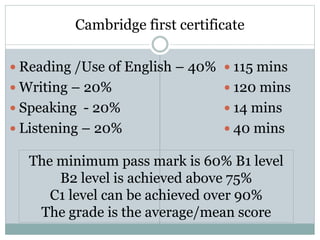
Cambridge first certificate
 Reading /Use of English – 40%
 Writing – 20%
 Speaking - 20%
 Listening – 20%
 115 mins
 120 mins
 14 mins
 40 mins
The minimum pass mark is 60% B1 level
B2 level is achieved above 75%
C1 level can be achieved over 90%
The grade is the average/mean score
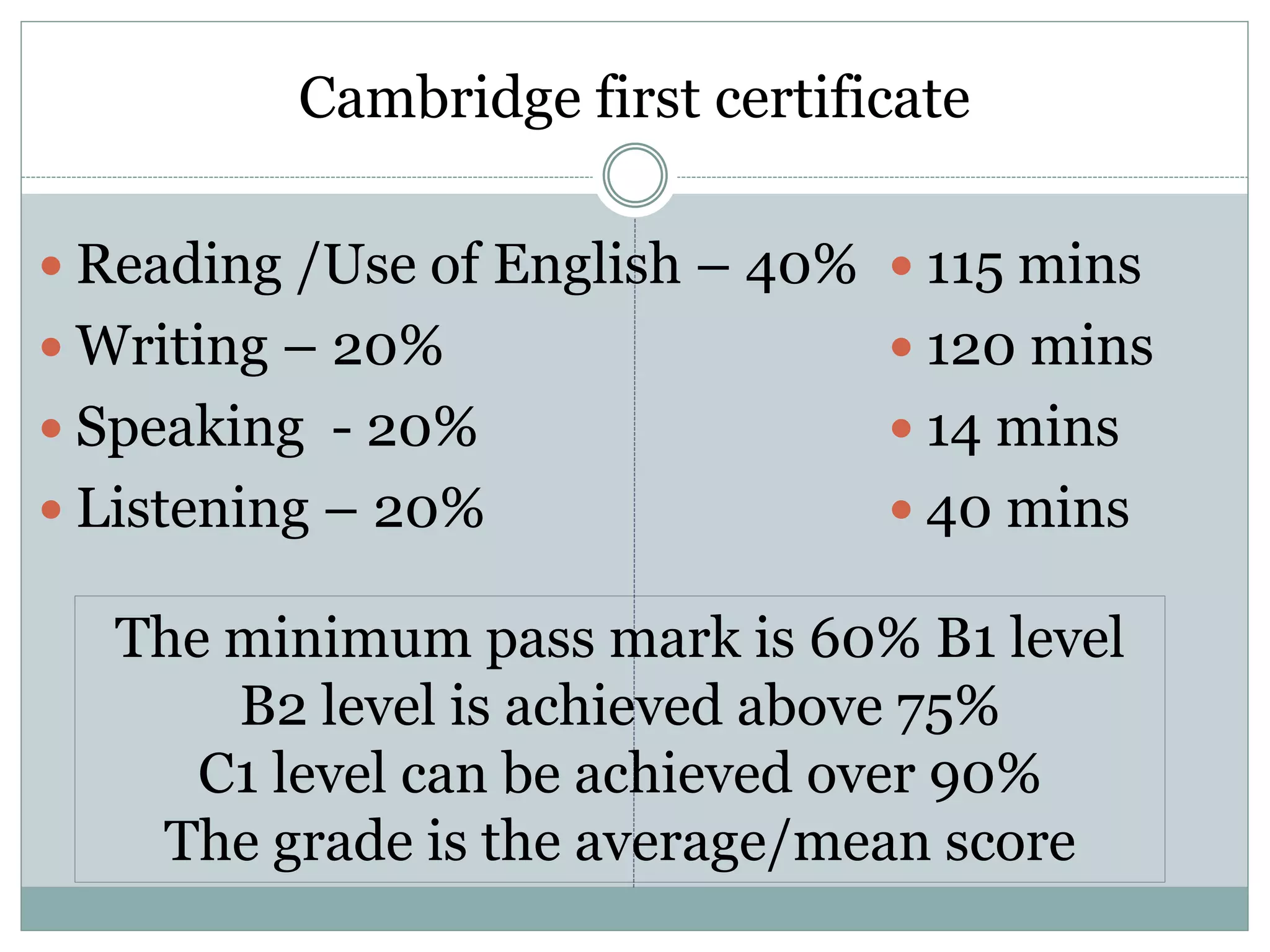
Reading/Use of English
 There are seven tasks
 Multiple choice
 Gap fill – choice
 Free cloze
 Word transformations
 Add the title or missing
text
Advice
 Read and understand all
the questions first.
 For the gap fill read
before and after the gap.
 Think carefully about the
grammar/language used.
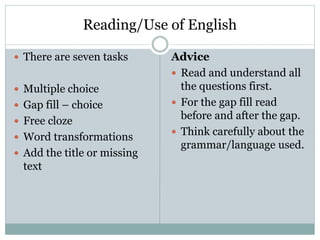
Listening
 4 activities. A mix of
individual speaking and
dialogues.
 Multiple choice
comprehension
questions
 Note taking
 Match the speaker and
sentence activities
Advice
 Read and understand the
questions first.
 You will get to listen to
everything twice, check
your answer the second
time.
 Be careful, sometimes
the answers seem
similar, compare them.
Speaking
 Pair work and individual, 3
or 4 tasks.
 General conversation with
examiner.
 Compare and contrast 2
photos.
 Plan or organise an
activity.
 Answer questions about the
above.
 Advice
 Relax
 Try to make the
conversation natural, like a
real conversation.
 When your compare and
contrast use appropriate
linking words.
 When speaking in pairs you
can ask questions to
confirm or make
suggestions.
Writing
 2 activities
 1 compulsory essay,
making arguments.
 A choice of email,
letter, report or review.
 Both formal and
informal writing can be
used.
 INTRODUCTION you have to
write an email or letter of
between 120 - 150 words. Part 1
is worth 50% of the writing exam.
you have around 40 minutes to
complete Part 1 (the total writing
exam length is 80 minutes).
 TYPICAL QUESTIONS Part 1 is
always about writing a reply.
more than 80% of the time, Part
1 is writing a reply to a letter or
email from a friend and is often
about planning a trip. For friends
we use informal English. less
than 20% of the time, Part 1 is
writing a formal reply to a formal
letter or email, often about
organising a trip for a school. an
example question:-
Essay writing
Two types – argumentative and
opinion
General Advice
 Read the question carefully,
underlining the points you
must deal with.
 Make a plan with the main
ideas for each paragraph.
 Think of vocabulary you want
to use and note it down.
 Write following your plan.
 Paragraph 1 / Introduction
 Present the topic of discussion and
express your opinion. You must
imagine that whoever reads your essay
has no idea what the topic is. You must
also show clearly that you’ll be
expressing one opinion, either in favour
or against.
 Paragraph 2
 Explain your first reason for your
opinion. Talk about possible
consequences and give examples or vice
versa.
 Paragraph 3
 Explain your second reason and maybe
a third one, but only if it is closely
related. Mention possible consequences
and give examples, or vice versa.
 Paragraph 4 / Conclusion
 Summarise your reasons and / or talk
about possible consequences if nothing
is done. You can also give a more
personal opinion and even finish your
essay with a rhetorical question.
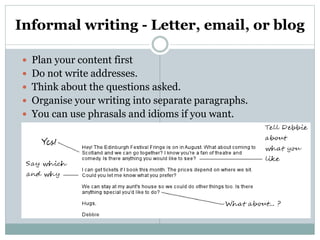
Informal writing - Letter, email, or blog
 Plan your content first
 Do not write addresses.
 Think about the questions asked.
 Organise your writing into separate paragraphs.
 You can use phrasals and idioms if you want.
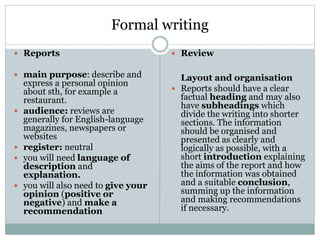
Formal writing
 Reports
 main purpose: describe and
express a personal opinion
about sth, for example a
restaurant.
 audience: reviews are
generally for English-language
magazines, newspapers or
websites
 register: neutral
 you will need language of
description and
explanation.
 you will also need to give your
opinion (positive or
negative) and make a
recommendation
 Review
Layout and organisation
 Reports should have a clear
factual heading and may also
have subheadings which
divide the writing into shorter
sections. The information
should be organised and
presented as clearly and
logically as possible, with a
short introduction explaining
the aims of the report and how
the information was obtained
and a suitable conclusion,
summing up the information
and making recommendations
if necessary.

first-certificate-introduction-classroom.ppt

  • 1.
    Cambridge first certificate Reading /Use of English – 40%  Writing – 20%  Speaking - 20%  Listening – 20%  115 mins  120 mins  14 mins  40 mins The minimum pass mark is 60% B1 level B2 level is achieved above 75% C1 level can be achieved over 90% The grade is the average/mean score
  • 2.
    Reading/Use of English There are seven tasks  Multiple choice  Gap fill – choice  Free cloze  Word transformations  Add the title or missing text Advice  Read and understand all the questions first.  For the gap fill read before and after the gap.  Think carefully about the grammar/language used.
  • 3.
    Listening  4 activities.A mix of individual speaking and dialogues.  Multiple choice comprehension questions  Note taking  Match the speaker and sentence activities Advice  Read and understand the questions first.  You will get to listen to everything twice, check your answer the second time.  Be careful, sometimes the answers seem similar, compare them.
  • 4.
    Speaking  Pair workand individual, 3 or 4 tasks.  General conversation with examiner.  Compare and contrast 2 photos.  Plan or organise an activity.  Answer questions about the above.  Advice  Relax  Try to make the conversation natural, like a real conversation.  When your compare and contrast use appropriate linking words.  When speaking in pairs you can ask questions to confirm or make suggestions.
  • 5.
    Writing  2 activities 1 compulsory essay, making arguments.  A choice of email, letter, report or review.  Both formal and informal writing can be used.  INTRODUCTION you have to write an email or letter of between 120 - 150 words. Part 1 is worth 50% of the writing exam. you have around 40 minutes to complete Part 1 (the total writing exam length is 80 minutes).  TYPICAL QUESTIONS Part 1 is always about writing a reply. more than 80% of the time, Part 1 is writing a reply to a letter or email from a friend and is often about planning a trip. For friends we use informal English. less than 20% of the time, Part 1 is writing a formal reply to a formal letter or email, often about organising a trip for a school. an example question:-
  • 6.
    Essay writing Two types– argumentative and opinion General Advice  Read the question carefully, underlining the points you must deal with.  Make a plan with the main ideas for each paragraph.  Think of vocabulary you want to use and note it down.  Write following your plan.  Paragraph 1 / Introduction  Present the topic of discussion and express your opinion. You must imagine that whoever reads your essay has no idea what the topic is. You must also show clearly that you’ll be expressing one opinion, either in favour or against.  Paragraph 2  Explain your first reason for your opinion. Talk about possible consequences and give examples or vice versa.  Paragraph 3  Explain your second reason and maybe a third one, but only if it is closely related. Mention possible consequences and give examples, or vice versa.  Paragraph 4 / Conclusion  Summarise your reasons and / or talk about possible consequences if nothing is done. You can also give a more personal opinion and even finish your essay with a rhetorical question.
  • 7.
    Informal writing -Letter, email, or blog  Plan your content first  Do not write addresses.  Think about the questions asked.  Organise your writing into separate paragraphs.  You can use phrasals and idioms if you want.
  • 8.
    Formal writing  Reports main purpose: describe and express a personal opinion about sth, for example a restaurant.  audience: reviews are generally for English-language magazines, newspapers or websites  register: neutral  you will need language of description and explanation.  you will also need to give your opinion (positive or negative) and make a recommendation  Review Layout and organisation  Reports should have a clear factual heading and may also have subheadings which divide the writing into shorter sections. The information should be organised and presented as clearly and logically as possible, with a short introduction explaining the aims of the report and how the information was obtained and a suitable conclusion, summing up the information and making recommendations if necessary.