WRITING EDITING PUBLISHING
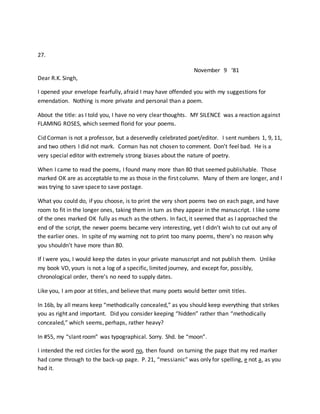
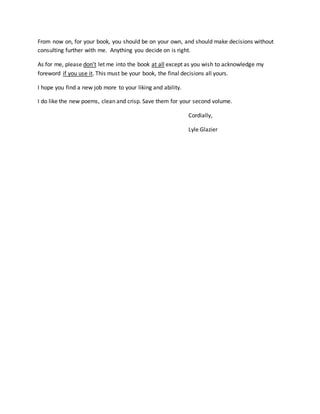
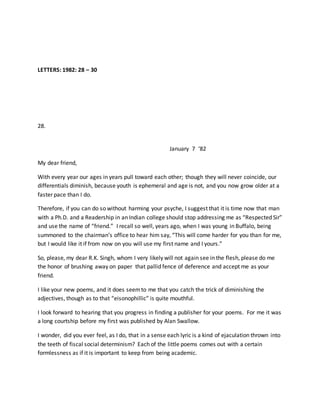
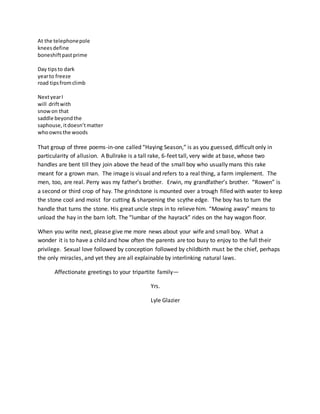
A MEMOIR
LETTERS FROM POET PROFESSOR
CRITIC AND EDITOR FRIENDS
LYLE GLAZIER, RUTH WILDES SCHULER,
SUMMER BREEZE, UNCLE RIVER, H.F. NOYES,
BILL WEST, KEVIN BAILEY, SAM CUCCHIARA,
PATRICIA PRIME, NORMAN SIMMS, LORNA
ANKER, ROSEMARY MENZIES, ANNEKE BUYS,
CARLO COPPOLA, JAMES SWAN, BRAJ B.
KACHRU, & OTHERS
--Ram Krishna Singh
PREFACE
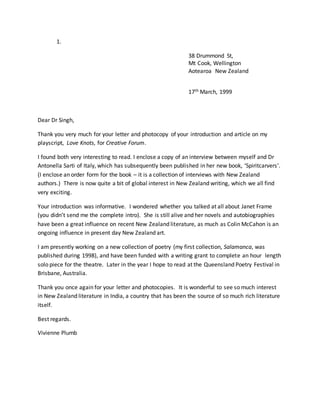
I kept in files almost every letter I received during the last fifty years, butat the
time of my retirement in December 2015, I realized mostof the letters had
become too dated and irrelevantto be preserved. I destroyed hundreds of them.
Some letters, however, appeared interesting and worth keeping for memories to
share—personal, professional, academic, and poetic—part interesting, part
casual. It’s memory of not I, who wrote, but others who wrote me: together they
could make up a ‘memoir’, providing the life experiences that might be of some
value in contrastto whatwe experience now, or what was otherwisedrab and
dull in my own life.
I sensed in them a nostalgic hangover, and a possibledocument of the past and
the new in the making, useful to literary historians, researchers, scholars,and
fellow poets and critics interested in my poetry and other writings of my
correspondents.
I also thoughtby publishing them, I can celebrate someof my contacts frompost
graduation onwards, revealtheir minds from the fringe, and communicate not
only my own passion and aspiration quietly but also offer a sortof creative self-
criticism.
The letters, handwritten or typed and airmailed, make my own echoes: my own
likes, dislikes, ambitions, interests, efforts, concerns, frustrations, anxieties,
discouragements, disappointments, dissatisfaction, restlessness, isolation, as
also thrills of successes and search for meaning and purposeof doing what I had
been doing in a mutually negating, intellectually sterile, and terribly restricted
environmentin places of work in Pulgaon (Maharastra), Lucknow (Uttar Pradesh),
New Delhi, and Dhanbad (Bihar/Jharkhand). I needed a lot of fresh air which was
missing. Thanks to the company of my poet, writer, editor, and academic
correspondents, I was saved fromturning negative.
They told something more than themselves; they provided a world view and in-
look to my writing and academic efforts besides shedding light on the ‘support’ I
received frompeople I personally never met. Interestingly, they took no time to
understand that I had not been in the right place, that I didn’t belong, that I
searched for my identity, that I needed change to survive.
They were sympathetic to me for my preferences to read and reflect on new/less
known poets and authors rather than the established ones; for my dissatisfaction
with the places I worked in; for my desire to accomplish or self-improve; for my
successfulhaiku, tanka, book reviews, and research articles. They were
enlightening and supportivein my literary, professional, and personal
endeavours.
They recorded some interesting episodes—personal, cultural, social, political, and
academic—justas they reflected on my poems vis-à-vis our experiences with
editors and publishers. They broughtout the limits they self-imposed while
reflecting their own passion, obsession, art, or creativity. Some wererestrained,
some explicit, someprofound, and some dark. They covered a lot of territory just
as they provided a perspectiveto what we shared with each other long beforethe
arrivalof the computer, internet, e-mail, e-zines, and e-journals.
Friends like Lyle Glazier, Uncle River, Norman Simms, Sam Cuchhiara, H.F. Noyes,
Kevin Bailey, Bill West, and Ruth Schuler sound significantfor their non-traditional
scrutiny of norms, certainties, and attitudes. Their discoursecentres round
general truth rather than moraltruth and seeks to project a human nature that is
timelessly universal. Others such as Patricia Prime, Vivienne Plumb, Lorna Anker,
Rosemary Menzies, Anneke Buys, Sam, Sid, and others are collaborativein
editing and publishing. As fellow-travellers, they negotiate the reality of
experiences with mutual respect. They may be taken to be as partof a process to
arriveat a shared view to bring about some kind of change. They talk freely and
frankly, and appear one despite differences, justas I seek to come to terms with
myself, discovering a pattern in the quilt of existence, threading different minds,
contexts, and experiences.
Readers can relate. They can piece together the various contexts and views to
make senseof time and events that are pastbut meaningful. They can relate to
plenty of insightfulcriticism in the letters of Lyle Glazier, Uncle River, H.F. Noyes,
Kevin Bailey, Norman Simms, and others. They can also find empathetic critical
supportfor my creativity in the letters of Sam, Pat, Sid, Bill, and Anneke. The
letters from other editors and academics, renowned in their own fields, underline
different views besides throwing light on my efforts in Indian Writing in English
and English Language Teaching, my chosen areas of writing, editing, and
publishing.
Itis through their eyes that I try to look back and recall what is forgotten in the
fastpace of time and technology. I try to re-discover myself, and indulge in my
own ‘surrogate’ community. I look back to events of the pastand the pastof my
correspondents to commemorate our cracks, struggles, and successes, and
appreciate what it was then, and what it is now. In factthey all seem to add to an
overview of myself in a small place wheresmallness of mind troubled me most.
13 August2016 --R.K. Singh
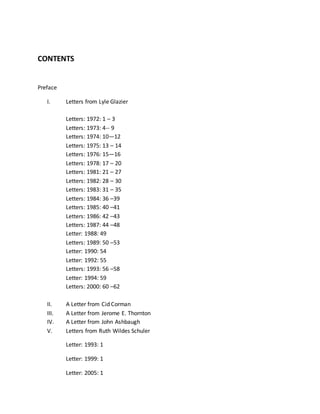
CONTENTS
Preface
I. Letters from Lyle Glazier
Letters: 1972: 1 – 3
Letters: 1973: 4-- 9
Letters: 1974: 10—12
Letters: 1975: 13 – 14
Letters: 1976: 15—16
Letters: 1978: 17 – 20
Letters: 1981: 21 – 27
Letters: 1982: 28 – 30
Letters: 1983: 31 – 35
Letters: 1984: 36 –39
Letters: 1985: 40 –41
Letters: 1986: 42 –43
Letters: 1987: 44 –48
Letter: 1988: 49
Letters: 1989: 50 –53
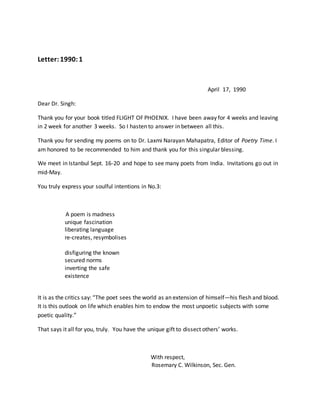
Letter: 1990: 54
Letter: 1992: 55
Letters: 1993: 56 –58
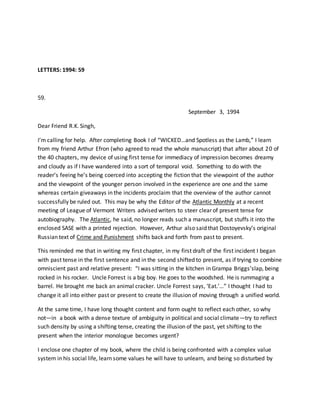
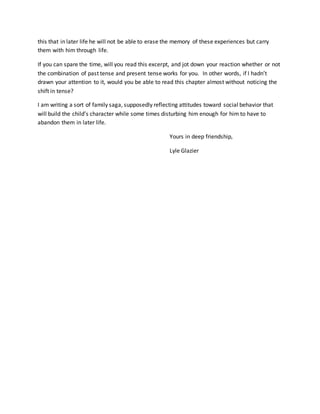
Letter: 1994: 59
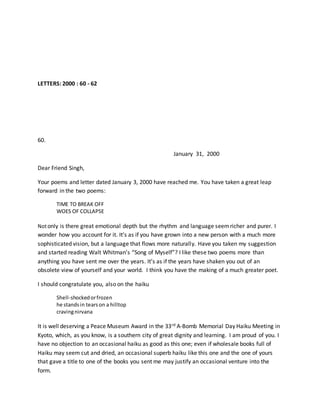
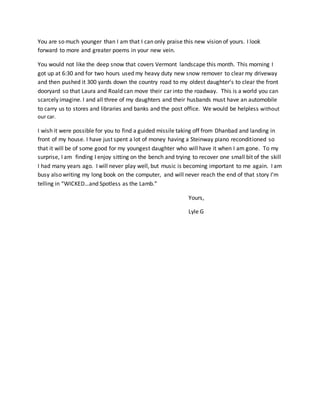
Letters: 2000: 60 –62
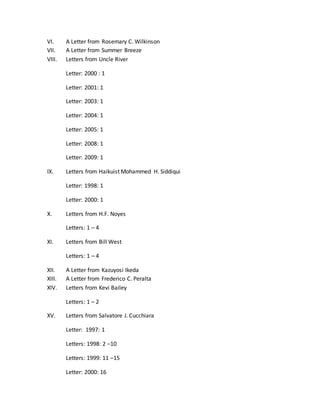
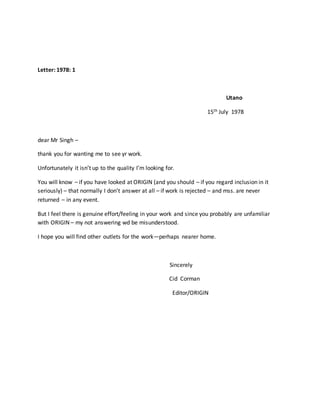
II. A Letter from Cid Corman
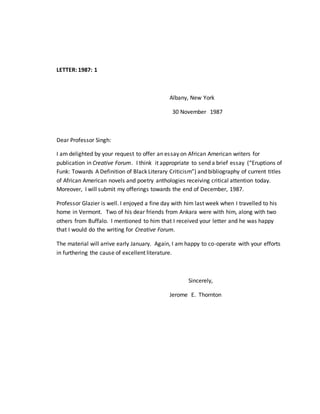
III. A Letter from Jerome E. Thornton
IV. A Letter from John Ashbaugh
V. Letters from Ruth Wildes Schuler
Letter: 1993: 1
Letter: 1999: 1
Letter: 2005: 1
VI. A Letter from Rosemary C. Wilkinson
VII. A Letter from Summer Breeze
VIII. Letters from Uncle River
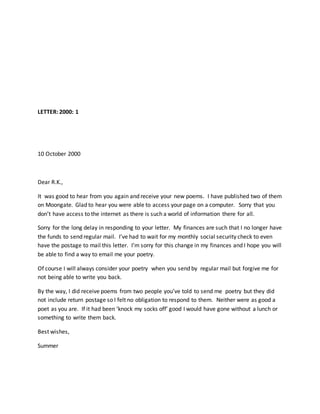
Letter: 2000 : 1
Letter: 2001: 1
Letter: 2003: 1
Letter: 2004: 1
Letter: 2005: 1
Letter: 2008: 1
Letter: 2009: 1
IX. Letters from Haikuist Mohammed H. Siddiqui
Letter: 1998: 1
Letter: 2000: 1
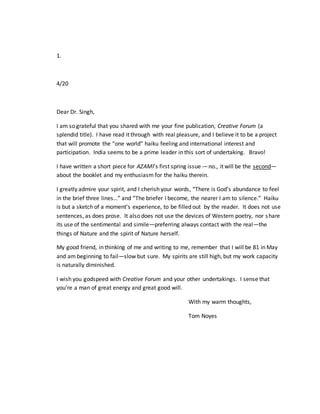
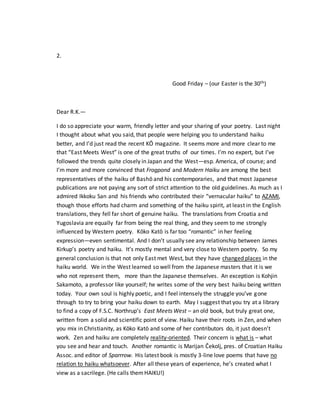
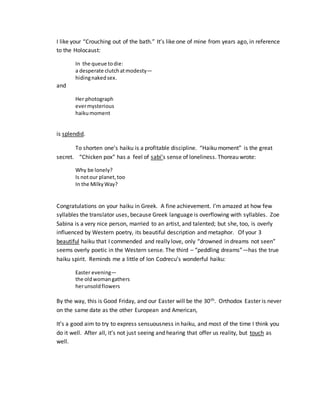
X. Letters from H.F. Noyes
Letters: 1 – 4
XI. Letters from Bill West
Letters: 1 – 4
XII. A Letter from Kazuyosi Ikeda
XIII. A Letter from Frederico C. Peralta
XIV. Letters from Kevi Bailey
Letters: 1 – 2
XV. Letters from Salvatore J. Cucchiara
Letter: 1997: 1
Letters: 1998: 2 –10
Letters: 1999: 11 –15
Letter: 2000: 16
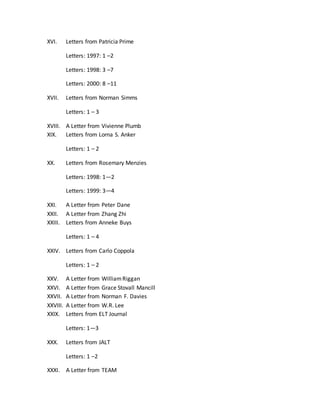
XVI. Letters from Patricia Prime
Letters: 1997: 1 –2
Letters: 1998: 3 –7
Letters: 2000: 8 –11
XVII. Letters from Norman Simms
Letters: 1 – 3
XVIII. A Letter from Vivienne Plumb
XIX. Letters from Lorna S. Anker
Letters: 1 – 2
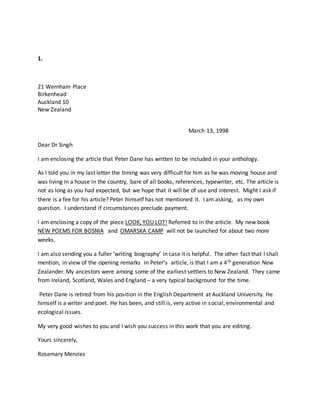
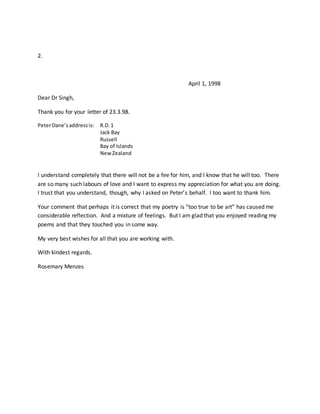
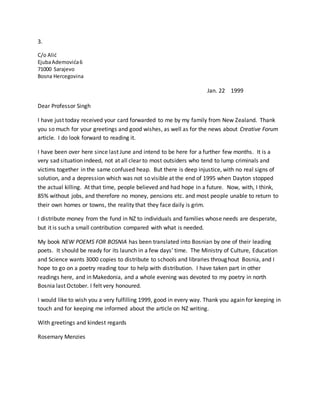
XX. Letters from Rosemary Menzies
Letters: 1998: 1—2
Letters: 1999: 3—4
XXI. A Letter from Peter Dane
XXII. A Letter from Zhang Zhi
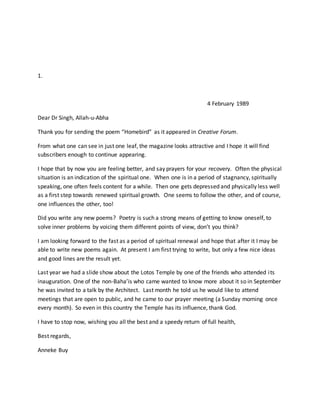
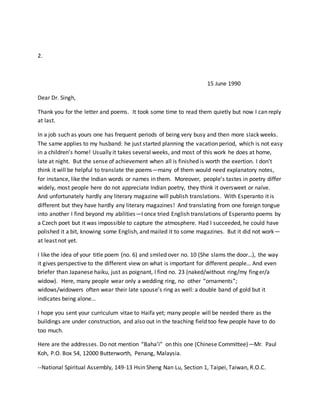
XXIII. Letters from Anneke Buys
Letters: 1 – 4
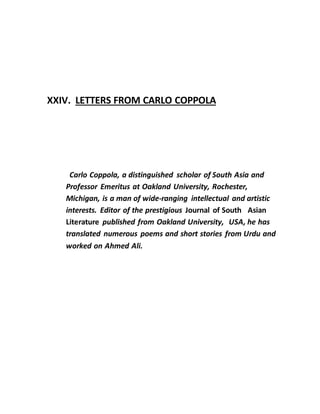
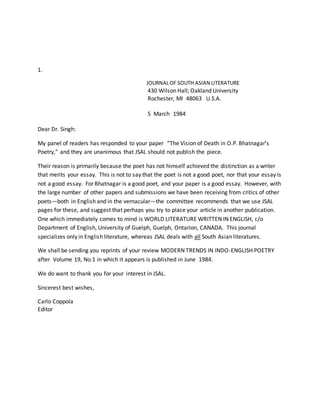
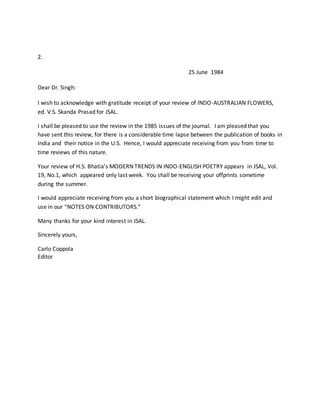
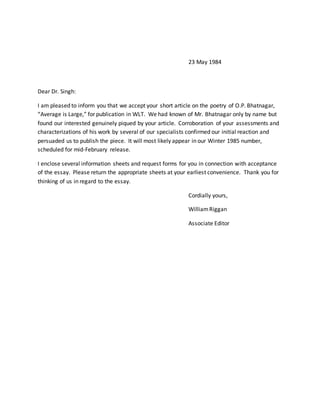
XXIV. Letters from Carlo Coppola
Letters: 1 – 2
XXV. A Letter from WilliamRiggan
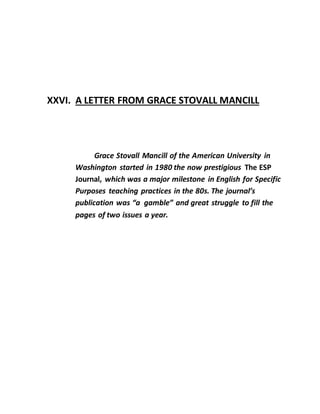
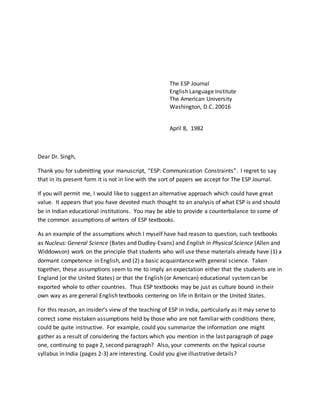
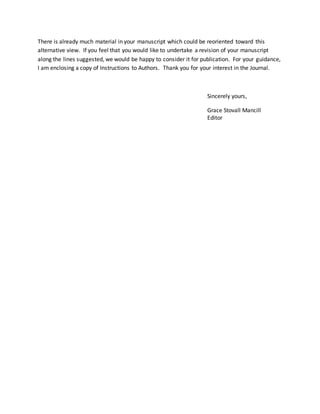
XXVI. A Letter from Grace Stovall Mancill
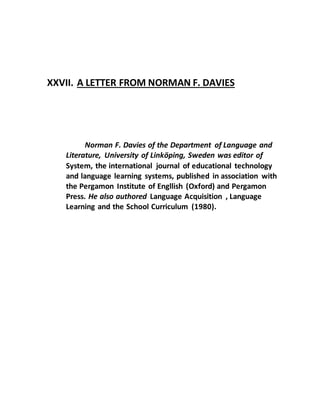
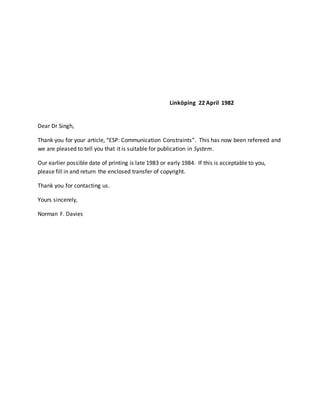
XXVII. A Letter from Norman F. Davies
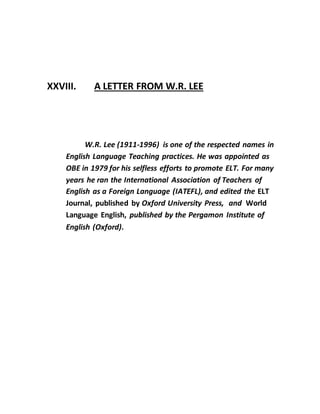
XXVIII. A Letter from W.R. Lee
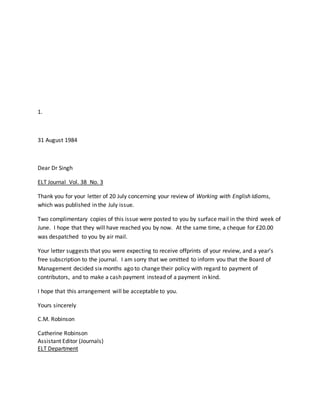
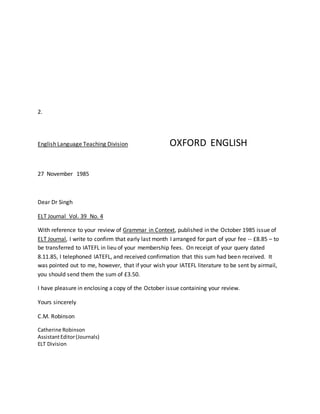
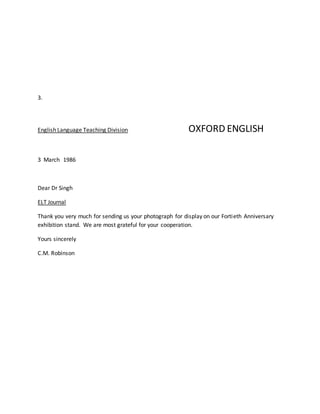
XXIX. Letters from ELT Journal
Letters: 1—3
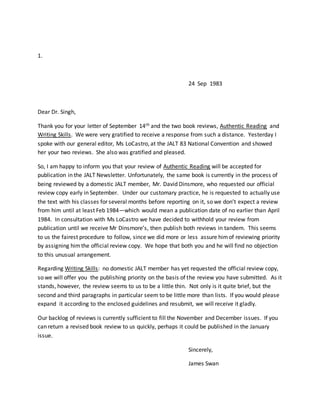
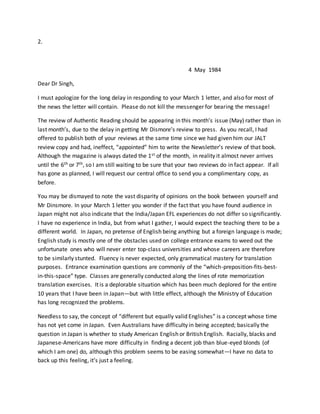
XXX. Letters from JALT
Letters: 1 –2
XXXI. A Letter from TEAM
XXXII. Letters from Braj B. Kachru
Letters: 1 –2
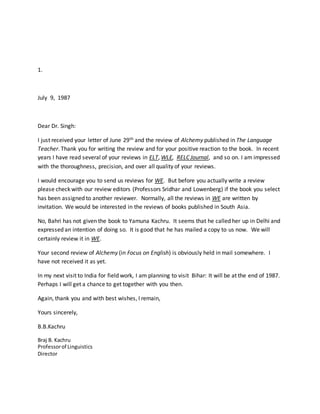
I. LETTERS FROM LYLE GLAZIER
Lyle Glazier (May 8, 1911 – October 21, 2004 ), who for years “roamed
the literary world from the fringes,” made his home in Bennington,
Vermont and worked and lived abroad in Turkey, North Yemen and
India. He had been in touch with me from 1970s till his death. I wrote
my M.A. thesis on his poetry and shared my own poems with him for
several years. In a way, Glazier’s response from time to time, as his
selected letters would bear out, shaped my poetic sensibility.
Lyle Glazier’s books of poems include Two Continents, The
Dervishes, Orchard Park and Istanbul, You Too, Voices of the Dead,
Azuba Nye, Recalls, Prefatory Lyrics, and Searching for Amy, while
Summer for Joey and Stills from a Moving Picture are his novels. Great
Day Coming and American Decadence and Rebirth are his works of
criticism. Besides being Professor of English and Professor Emeritus at
the State University of New York at Buffalo, he was also a social
activist, who strongly believed that the United States’ path toward
war in the Middle East was paved with a tragic lack of understanding
of the tribal mentality of the Arab world.
The letters provide a peep into history, politics, literature,
society, culture, and of course, personal exchanges -- our families,
profession, concerns--, and our growing, and perhaps, ending! These
also reveal Lyle Glazier's mind as a bisexual poet and writer just as
these help to gauze my own poetic growth from the early 70s to the
end of the 90s. Despite achievements to our credit, we both remain
unrecognized by the mainstream media and academia.
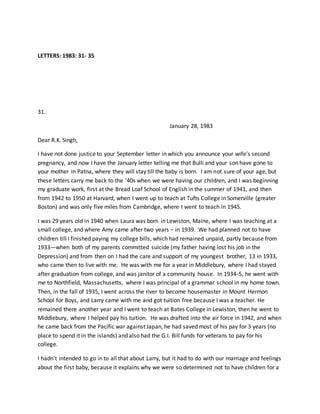
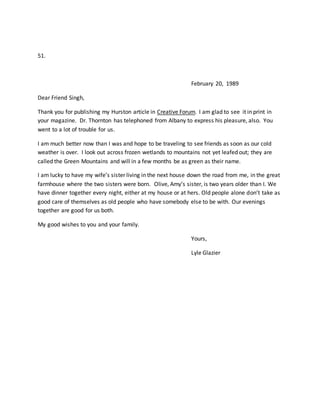
LETTERS: 1972: 1 - 3
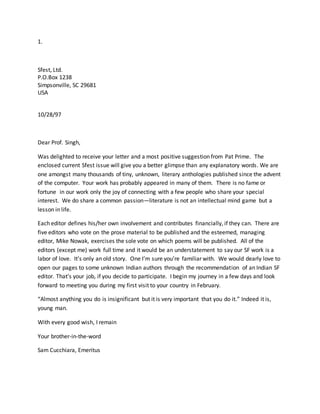
1.
May 19, 1972
Dear Mr Singh,
Like many writers, I am flattered to think someone is interested enough in my work to wish to
write about it; however, if you believe as I do that poems must speak for themselves—that
what is revealed in a poem should not be manipulated from outside—then a book of poems
must become its own witness. Like a composer of music, a poet is a creator; like a performer of
music, a reader is a re-creator. He may be helped through knowing biographical and social
background—for example, my poems seem to me to reflect quite clearly the context of
experience from a foothold within the United States. What I have written about my country and
the world is grounded in my life as an American, at home & abroad. Furthermore, I am a
teacher; the kind of poem I write reflects my reading, reflects my experimentations with
traditional verse forms (notably in Orchard Park) and my experimentation with trying to
discover a self-evolved esthetic, an organic form expressing my own tone of voice (Istambul &
VD particularly). But it is more complex than that, for every serious practitioner of traditional
forms tries to mould them into his own patterns—by controlling rhythms, language, images,
and symbols. The Dervishes, for example, imitates Emily Dickinson’s experiments with slant
rhyme and with off-beat rhythms; nevertheless, The Dervishes, I hope is my poem, not only in
ideas that would not have occurred to Emily Dickinson, but in elements of texture that are
uniquely mine. So, although a reader can be helped some through inside information about
biography & social background, he must really look into the poems themselves for the
important revelations. Especially, a poem that “works” must seem to the reader something he
himself might have a share in. Ankara and Banaras are not so different but what VD No. 40
should be able to bridge the miles. You and I are not so different but what VD 169 should be
able to remind us both of our deep longings. Even VD 117—although you have never been in
New England—might be able to communicate something to an Indian about encroachments on
the beauty of man’s natural environment. No. 142 may be more difficult for a youthful reader;
yet you are male, and comprehend I am sure what it might be for a much older man to realize
that a necessary surgery has deprived him of the power to eject sperm; how can he protect
himself from despair except to rationalize humourously, and try to make an advantage out of
his tragedy?
Some weeks ago I sent to you through Dr. Pandeya some reviews of my poems, some
comments of my own, as well as copies of the four books. I hope that by now you have received
these materials. An important new review of VD is about to appear in a magazine, and if I get it
in time, I will send you a copy.
I hardly know what to say about your desire to come here to read modern poetry. At Buffalo,
we have a great library of modern poetry and poetry criticism. Yet it is not easy even to be
admitted to our graduate school of English. For next year there were 500 applications for 20
places; one of those places went to a student at Banaras Hindu University. Even so,he must
somehow find the money to bring him here and support him after he arrives; he cannot get a
visa to come to the U.S. without proof of means of support.
My own connection with the university is being loosened, for I have chosen to retire early, and
beginning September 1, I will be Professor of English Emeritus. My wife and I have already sold
our home and are building a small new one in southwestern Vermont, near Bennington.
I will look forward eagerly to reading your manuscript, and I will try to help you in any way that
I can. I suppose that it is unhappily true that most Indian students of English or American
literature will have to content themselves with learning about that literature from Indian
teachers & books in Indian libraries, just as I had to study British literature under American
teachers and in American libraries.
If your advisors have faith in you, you should try to get a scholarship that will take you to
England or to the United States. I am sure that you have already thought about applying for a
Fulbright fellowship.
Please call on me for any help that seems to be within my province.
Cordially yours,
Lyle Glazier
Professor of English
I loved Banaras very much. It gives me great pleasure today to think that what I now write on
this page will, in a few days, be read by you, there. I wish I were again at the Hotel de Paris,
where you could come to see me.
LG
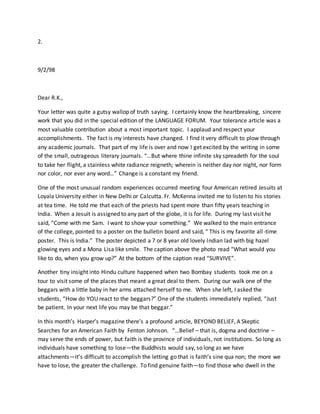
2.
November 8, 1972
Dear R.K. Singh,
The day I got your letter I wrote to Dr. P.S. Sastri at Nagpur and to Dr. Kamal Wood at Bombay,
sending also a shorter note to Mr. Ezekiel telling him I had written to Dr. Wood about you. I
think that Dr. Sastri would be your most likely sponsor, if he has time. He is not far from you, is
a poet himself, has some of my poems as well as a collection of my essays on American novels.
I like particularly your poem “The best poetry/that I can read/is a woman…” “A poet’s
simplicity…” is also very nice. You seem to master in those poems the different trick of writing
a rhythm that any reader can catch without going astray. That is the great difficulty with free
rhythm; no one else can quite catch what the poet had in his ear. Poems in a diary form—that
seems a good idea.
I am flattered to know that you circulated an article about my poems. Dr. Pandeya has just sent
a copy of his “Memoirs as a Form of Poetry: F.T. Prince and Lyle Glazier,” Prajna, Banaras Hindu
University Journal, Vol. XVII Part (I), October 1971.
A young teacher at Tirupathi is also writing on my poems, as well as an associate professor at
State University College, Buffalo.
When you speak of my poems as confessionals, yes. But the confession is sometimes wholly
subjective, sometimes a looking out at experience. Wordsworth’s “spontaneous overflow”
lends itself to both kinds of poem. You can—borrowing from Joyce—call them epiphanies; in
Dubliners there are subjective epiphanies (“Araby”) and objective epiphanies (Counterparts),
while in Ulysses, Stephen Dedalus is the subjective, and Poldy and Molly Bllom the objective. It
is possible to confess to revelations from within or revelations from without. Does that make
sense?
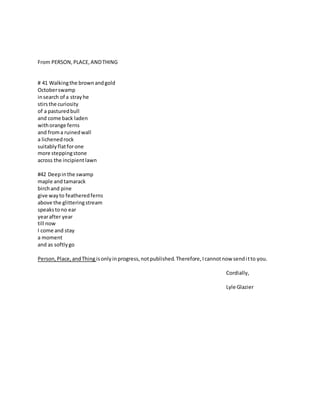
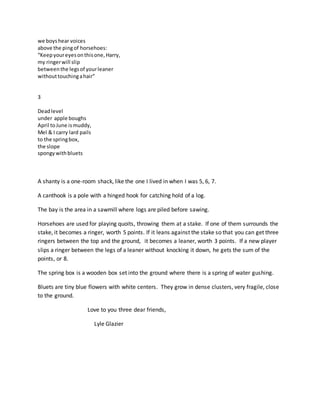
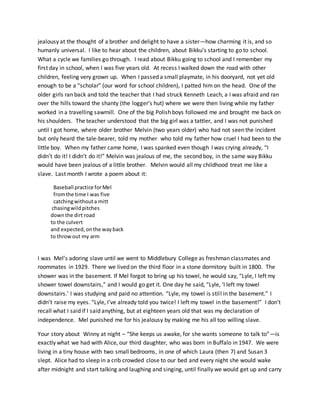
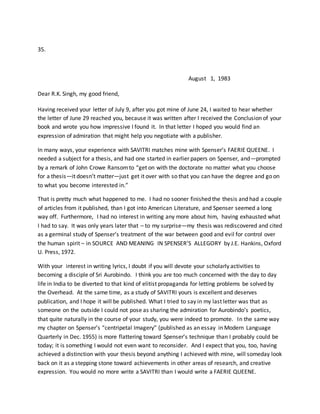
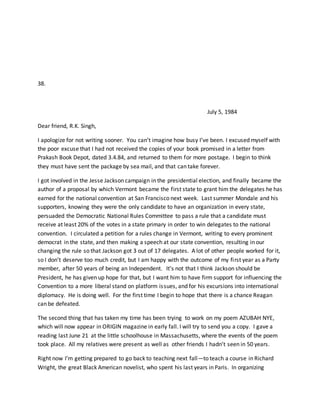
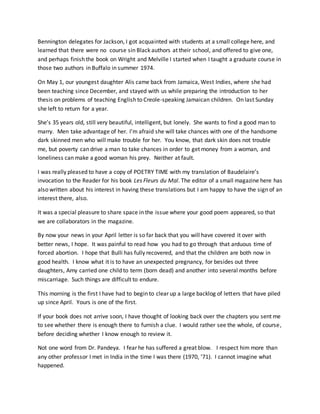
# Uganda’sAmin
slaughteringChristians
for a Moslem
Good is
RichardNixon
underneaththe skin
From PERSON,PLACE,ANDTHING
# 41 Walkingthe brownandgold
Octoberswamp
insearch of a strayhe
stirsthe curiosity
of a pasturedbull
and come back laden
withorange ferns
and froma ruinedwall
a lichenedrock
suitablyflatforone
more steppingstone
across the incipientlawn
#42 Deepinthe swamp
maple and tamarack
birchand pine
give wayto featheredferns
above the glitteringstream
speakstono ear
yearafter year
till now
I come and stay
a moment
and as softlygo
Person,Place,andThing isonlyinprogress,notpublished.Therefore,Icannotnow senditto you.
Cordially,
Lyle Glazier
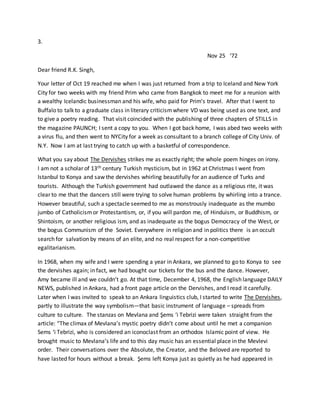
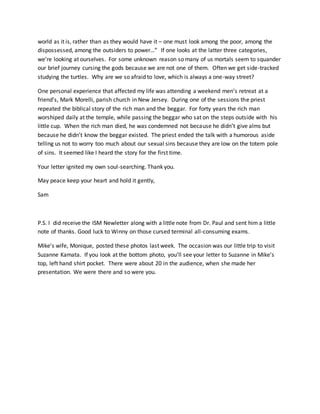
3.
Nov 25 ‘72
Dear friend R.K. Singh,
Your letter of Oct 19 reached me when I was just returned from a trip to Iceland and New York
City for two weeks with my friend Prim who came from Bangkok to meet me for a reunion with
a wealthy Icelandic businessman and his wife, who paid for Prim’s travel. After that I went to
Buffalo to talk to a graduate class in literary criticismwhere VD was being used as one text, and
to give a poetry reading. That visit coincided with the publishing of three chapters of STILLS in
the magazine PAUNCH; I sent a copy to you. When I got back home, I was abed two weeks with
a virus flu, and then went to NYCity for a week as consultant to a branch college of City Univ. of
N.Y. Now I am at last trying to catch up with a basketful of correspondence.
What you say about The Dervishes strikes me as exactly right; the whole poem hinges on irony.
I am not a scholar of 13th century Turkish mysticism, but in 1962 at Christmas I went from
Istanbul to Konya and saw the dervishes whirling beautifully for an audience of Turks and
tourists. Although the Turkish government had outlawed the dance as a religious rite, it was
clear to me that the dancers still were trying to solve human problems by whirling into a trance.
However beautiful, such a spectacle seemed to me as monstrously inadequate as the mumbo
jumbo of Catholicismor Protestantism, or, if you will pardon me, of Hinduism, or Buddhism, or
Shintoism, or another religious ism, and as inadequate as the bogus Democracy of the West, or
the bogus Communism of the Soviet. Everywhere in religion and in politics there is an occult
search for salvation by means of an elite, and no real respect for a non-competitive
egalitarianism.
In 1968, when my wife and I were spending a year in Ankara, we planned to go to Konya to see
the dervishes again; in fact, we had bought our tickets for the bus and the dance. However,
Amy became ill and we couldn’t go. At that time, December 4, 1968, the English language DAILY
NEWS, published in Ankara, had a front page article on the Dervishes, and I read it carefully.
Later when I was invited to speak to an Ankara linguistics club, I started to write The Dervishes,
partly to illustrate the way symbolism—that basic instrument of language – spreads from
culture to culture. The stanzas on Mevlana and Şems ‘i Tebrizi were taken straight from the
article: “The climax of Mevlana’s mystic poetry didn’t come about until he met a companion
Sems ‘i Tebrizi, who is considered an iconoclast from an orthodox Islamic point of view. He
brought music to Mevlana’s life and to this day music has an essential place in the Mevlevi
order. Their conversations over the Absolute, the Creator, and the Beloved are reported to
have lasted for hours without a break. Şems left Konya just as quietly as he had appeared in
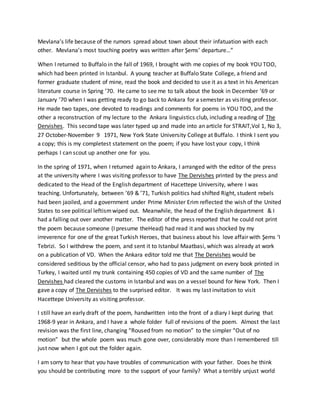
Mevlana’s life because of the rumors spread about town about their infatuation with each
other. Mevlana’s most touching poetry was written after Şems’ departure…”
When I returned to Buffalo in the fall of 1969, I brought with me copies of my book YOU TOO,
which had been printed in Istanbul. A young teacher at Buffalo State College, a friend and
former graduate student of mine, read the book and decided to use it as a text in his American
literature course in Spring ’70. He came to see me to talk about the book in December ’69 or
January ’70 when I was getting ready to go back to Ankara for a semester as visiting professor.
He made two tapes, one devoted to readings and comments for poems in YOU TOO, and the
other a reconstruction of my lecture to the Ankara linguistics club, including a reading of The
Dervishes. This second tape was later typed up and made into an article for STRAIT,Vol 1, No 3,
27 October-November 9 1971, New York State University College at Buffalo. I think I sent you
a copy; this is my completest statement on the poem; if you have lost your copy, I think
perhaps I can scout up another one for you.
In the spring of 1971, when I returned again to Ankara, I arranged with the editor of the press
at the university where I was visiting professor to have The Dervishes printed by the press and
dedicated to the Head of the English department of Hacettepe University, where I was
teaching. Unfortunately, between ’69 & ’71, Turkish politics had shifted Right, student rebels
had been jaoiled, and a government under Prime Minister Erim reflected the wish of the United
States to see political leftismwiped out. Meanwhile, the head of the English department & I
had a falling out over another matter. The editor of the press reported that he could not print
the poem because someone (I presume theHead) had read it and was shocked by my
irreverence for one of the great Turkish Heroes, that business about his love affair with Şems ‘I
Tebrizi. So I withdrew the poem, and sent it to Istanbul Maatbasi, which was already at work
on a publication of VD. When the Ankara editor told me that The Dervishes would be
considered seditious by the official censor, who had to pass judgment on every book printed in
Turkey, I waited until my trunk containing 450 copies of VD and the same number of The
Dervishes had cleared the customs in Istanbul and was on a vessel bound for New York. Then I
gave a copy of The Dervishes to the surprised editor. It was my last invitation to visit
Hacettepe University as visiting professor.
I still have an early draft of the poem, handwritten into the front of a diary I kept during that
1968-9 year in Ankara, and I have a whole folder full of revisions of the poem. Almost the last
revision was the first line, changing “Roused from no motion” to the simpler “Out of no
motion” but the whole poem was much gone over, considerably more than I remembered till
just now when I got out the folder again.
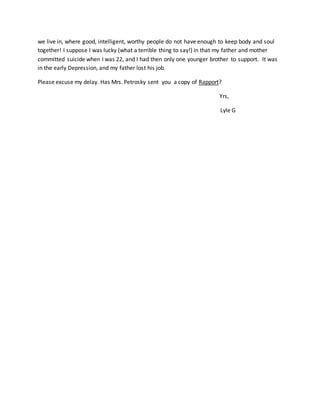
I am sorry to hear that you have troubles of communication with your father. Does he think
you should be contributing more to the support of your family? What a terribly unjust world
we live in, where good, intelligent, worthy people do not have enough to keep body and soul
together! I suppose I was lucky (what a terrible thing to say!) in that my father and mother
committed suicide when I was 22, and I had then only one younger brother to support. It was
in the early Depression, and my father lost his job.
Please excuse my delay. Has Mrs. Petrosky sent you a copy of Rapport?
Yrs,
Lyle G
LETTERS: 1973: 4 - 9
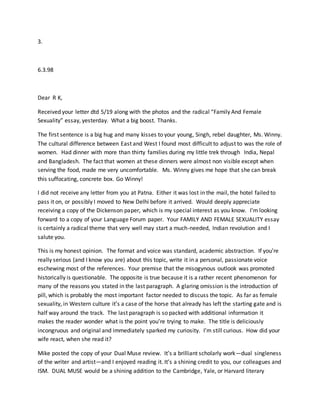
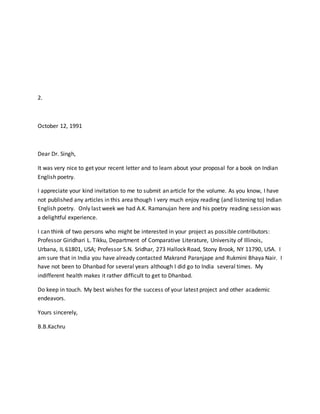
4.
January 4, 1973
Dear Friend Singh,
I write chiefly to send you the following excerpts from letters mentioning you:
From Dr Kamal Wood, Head, Department of English, University of Bombay –
It was nice hearing from you again and I have taken all this time to reply to you because I was
waiting for the young man, Mr. R.K. Singh, to write to me. He has not done so, nor did Mr.
S.M. Pandeya speak to me about him when he was in Bombay during October-November
participating in an all Indian Conference which we had organized. We discussed American,
English and Indian Poetry in English from 1940-1970…. Dr. Pandeya’s paper, as you may have
heard, dealt with your poems along with those of Updike and F.T. Prince. I shall indeed do
what I can for Mr. Singh but I am beginning to give up hope in his interest in the University of
Bombay…
From Dr. P.S. Sastri, Head, Department of English, University of Nagpur –
Your kind letters. Mr. Singh wrote to me also. Later Dr S.M. Pandeya of Varanasi spoke to
me about him. Surely I will take him and give him a subject. I think a study of confessional
poetry from 1930 to 1960 might be a good subject for him. This will really pose problems of
critical approach.
I trust that you may have found a new university post and one more to your pleasure. The one
at Pulgaon indeed seemed grim. But,then, I think that you, like me, may never find teaching
quite what you wish to do. I found most of my university work, except the months abroad, very
grim, so grim that I sometimes buckled. But, as a married man with three growing daughters, I
could not afford to cater to my whims. Never quite breaking into trade publication enough to
make a living that way, it was for me teach and pretend to like it.
Right now I am really enjoying myself. I can write what I please without other duties to impose
upon my time, and without fear of harming my professional status. This is important to me,
because the fiction I am writing hews close to actual experience. Without requiring strict
literal adherence to any man’s life, I am requiring strict accuracy in interpreting a part of
experience that has come into my vantage point of viewing. When the details are not pretty, I
still can find a kind of beauty in the accurate description of events. Like Goethe in his Dichtung
und Varheit (Truth and Poetry), I can hew to the spirit of a life-streamwithout being fenced in
by the need to record facts exactly in the order they occurred. Such is the advantage of fiction.
Yours,
Lyle Glazier
I am planning ahead, hoping to be in India in May 1974, a long time ahead; I hope to see you if I
come.
5.
May 23, 1973
Dear R.K. Singh,
When I wrote last, I was much aware of having delayed a reply to your letter, because I had
been working hard to get my novel done before June 25, when I return to Beffalo for 6 weeks to
teach in the summer session there. For that reason, I wrote so briefly.
As for my irritation at what you had said, I was irritated through a misunderstanding. I see that
now. In order to comprehend my feeling, you must have in mind that what no one in the
United States can endure, above all, is the thought of ownership of another human being—I
mean by this, the buying and purchasing of another human being. Your phrase “as if you
owned me” seemed to imply that you were puckishly telling me that I had behaved as if I had
purchased you. I think now that you meant, “as if I were one of your own”—meaning one of my
own sons, or one of my own brothers. In that sense I am delighted to “own” you.
I doubt if my letters to you have given me more pleasure than your have given me. It is
flattering for me to think that a young man like you is interested enough to keep writing to
someone so far away whom he has never seen. When I come to Varanasi next year, I am very
anxious to meet you. In hope that you will take me where you live. One of the disadvantages
of being an American in India is that I almost never had a chance to visit people at home—I do
not mean a ceremonial visit. I don’t wish to have your mother or sister or your wife spend
hours and more money than your family can afford to make me a large welcome. But I would
like to be able to walk into your house for a cup of tea, only a cup of tea. Then we could sit and
talk, and you could show me around the neighborhood. To see India only by seeing large,
luxurious hotels and the historical monuments is not to see India. I am more interested seeing
the people of today—my VD poem #192 is a very genuine expression of what I really feel. So,
please, when I come, you must come to see me at the Hotel de Paris, and I will come to see you
at K 27/5 Bhairo Bazar.
Of the recent poems you sent me, I like very much #191 and #198. They are absolutely right in
word and sentiment. So very good I myself do not write poems until I finish my novel. Then,
next fall, perhaps, I will go back to my poetry and my music. Since March 15, I have not
practiced the piano.
Affectionately, your friend,
Lyle Glazier
6.
June 8, 1973
My dear R.K. Singh,
Your sister’s remark that “Glazier is far above our status…” was kindly meant, but this is far
from the truth. My origins were at least as humble as yours. My father was a factory worker.
He was a high school graduate who never went to college; my mother did not go to high school.
When I finished high school, we were very poor. My older brother and I went to work in the
factory as common laborers. After a year I had saved enough to pay part of my expenses for
one year at college; by waiting on table in the freshman dining hall, I survived that year. During
the summer and for the next four summers I was a bell hop in a hotel; every school year I
worked in the freshman dining hall as chef’s helper, preparing fruit and vegetables for the
table, washing pots and pans, and helping to keep the kitchen clean. When I finished my fourth
year, I was $1000 in debt, a large amount at that time. It was during the 1930s, when the
economy in the United States was suffering from what we call the Great Depression. I could
not find a job teaching school, so I became the custodian of a Community House, where I
vacuumed rugs, waxed floors, polished woodwork, and was, in general, a kind of working
housekeeper. In October that year my father lost his job in the factory and committed suicide
the day he learned that he was fired; in the afternoon of the same day my mother walked out
through the shallow water of a river and let herself be carried away by the current; she was
dead when her body was recovered. My thirteen-year-old younger brother went to live with
me at the Community House, and for nearly 10 years I was his father-brother. I became a
teacher in an elementary school, then for two years in a boy’s high school, then I began to work
summers for an MA, and the year I got my degree, I found a job at a small college in Maine,
where I remained for five years, during that that time marrying and becoming a father. When
World War II broke out my wife and I moved to Boston, Massachusetts, to another college, and
I began to study part-time at Harvard. I became the assistant in the Shakespeare course at
Harvard, and began to study there full time; then I taught freshman English there for 21/2 years.
In 1947, now with a second child and my wife pregnant with a third, I moved to Buffalo as
assistant professor, and after three years, finally, at the age of 39 got my Ph.D. at Harvard in
1950. In 1961, I went abroad for the first time, as Fulbright Chairman of American Literature at
the University of Istanbul. During the past 10 years, I spent four years in Turkey, with increasing
excursions into India. Now I am retired and professor emeritus. During the years I have had
time to write the poems you have read, a book of essay and other essays, 7 novels, none of
which has been published. Writing has been my fulfillment. Also, I have a loving relationship
continuing with many students. Young people like you renew my life.
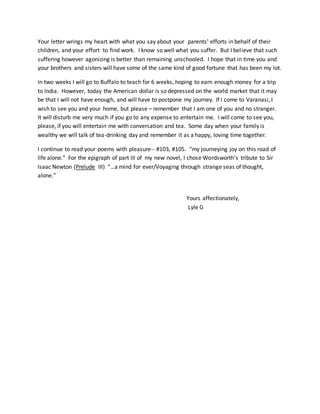
Your letter wrings my heart with what you say about your parents’ efforts in behalf of their
children, and your effort to find work. I know so well what you suffer. But I believe that such
suffering however agonizing is better than remaining unschooled. I hope that in time you and
your brothers and sisters will have some of the same kind of good fortune that has been my lot.
In two weeks I will go to Buffalo to teach for 6 weeks, hoping to earn enough money for a trip
to India. However, today the American dollar is so depressed on the world market that it may
be that I will not have enough, and will have to postpone my journey. If I come to Varanasi, I
wish to see you and your home, but please – remember that I am one of you and no stranger.
It will disturb me very much if you go to any expense to entertain me. I will come to see you,
please, if you will entertain me with conversation and tea. Some day when your family is
wealthy we will talk of tea-drinking day and remember it as a happy, loving time together.
I continue to read your poems with pleasure-- #103, #105. “my journeying joy on this road of
life alone.” For the epigraph of part III of my new novel, I chose Wordsworth’s tribute to Sir
Isaac Newton (Prelude III) “…a mind for ever/Voyaging through strange seas of thought,
alone.”
Yours affectionately,
Lyle G
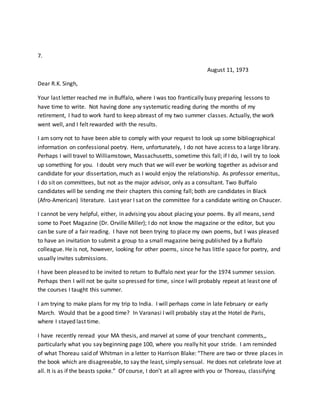
7.
August 11, 1973
Dear R.K. Singh,
Your last letter reached me in Buffalo, where I was too frantically busy preparing lessons to
have time to write. Not having done any systematic reading during the months of my
retirement, I had to work hard to keep abreast of my two summer classes. Actually, the work
went well, and I felt rewarded with the results.
I am sorry not to have been able to comply with your request to look up some bibliographical
information on confessional poetry. Here, unfortunately, I do not have access to a large library.
Perhaps I will travel to Williamstown, Massachusetts, sometime this fall; if I do, I will try to look
up something for you. I doubt very much that we will ever be working together as advisor and
candidate for your dissertation, much as I would enjoy the relationship. As professor emeritus,
I do sit on committees, but not as the major advisor, only as a consultant. Two Buffalo
candidates will be sending me their chapters this coming fall; both are candidates in Black
(Afro-American) literature. Last year I sat on the committee for a candidate writing on Chaucer.
I cannot be very helpful, either, in advising you about placing your poems. By all means, send
some to Poet Magazine (Dr. Orville Miller); I do not know the magazine or the editor, but you
can be sure of a fair reading. I have not been trying to place my own poems, but I was pleased
to have an invitation to submit a group to a small magazine being published by a Buffalo
colleague. He is not, however, looking for other poems, since he has little space for poetry, and
usually invites submissions.
I have been pleased to be invited to return to Buffalo next year for the 1974 summer session.
Perhaps then I will not be quite so pressed for time, since I will probably repeat at least one of
the courses I taught this summer.
I am trying to make plans for my trip to India. I will perhaps come in late February or early
March. Would that be a good time? In Varanasi I will probably stay at the Hotel de Paris,
where I stayed last time.
I have recently reread your MA thesis, and marvel at some of your trenchant comments,,
particularly what you say beginning page 100, where you really hit your stride. I am reminded
of what Thoreau said of Whitman in a letter to Harrison Blake: “There are two or three places in
the book which are disagreeable, to say the least, simply sensual. He does not celebrate love at
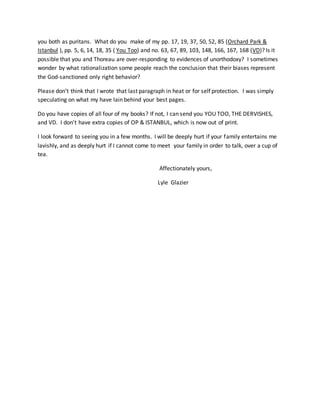
all. It is as if the beasts spoke.” Of course, I don’t at all agree with you or Thoreau, classifying
you both as puritans. What do you make of my pp. 17, 19, 37, 50, 52, 85 (Orchard Park &
Istanbul ), pp. 5, 6, 14, 18, 35 ( You Too) and no. 63, 67, 89, 103, 148, 166, 167, 168 (VD)? Is it
possible that you and Thoreau are over-responding to evidences of unorthodoxy? I sometimes
wonder by what rationalization some people reach the conclusion that their biases represent
the God-sanctioned only right behavior?
Please don’t think that I wrote that last paragraph in heat or for self protection. I was simply
speculating on what my have lain behind your best pages.
Do you have copies of all four of my books? If not, I can send you YOU TOO, THE DERVISHES,
and VD. I don’t have extra copies of OP & ISTANBUL, which is now out of print.
I look forward to seeing you in a few months. I will be deeply hurt if your family entertains me
lavishly, and as deeply hurt if I cannot come to meet your family in order to talk, over a cup of
tea.
Affectionately yours,
Lyle Glazier
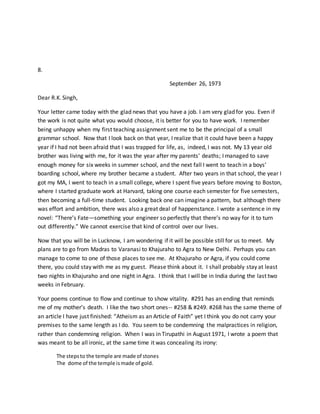
8.
September 26, 1973
Dear R.K. Singh,
Your letter came today with the glad news that you have a job. I am very glad for you. Even if
the work is not quite what you would choose, it is better for you to have work. I remember
being unhappy when my first teaching assignment sent me to be the principal of a small
grammar school. Now that I look back on that year, I realize that it could have been a happy
year if I had not been afraid that I was trapped for life, as, indeed, I was not. My 13 year old
brother was living with me, for it was the year after my parents’ deaths; I managed to save
enough money for six weeks in summer school, and the next fall I went to teach in a boys’
boarding school, where my brother became a student. After two years in that school, the year I
got my MA, I went to teach in a small college, where I spent five years before moving to Boston,
where I started graduate work at Harvard, taking one course each semester for five semesters,
then becoming a full-time student. Looking back one can imagine a pattern, but although there
was effort and ambition, there was also a great deal of happenstance. I wrote a sentence in my
novel: “There’s Fate—something your engineer so perfectly that there’s no way for it to turn
out differently.” We cannot exercise that kind of control over our lives.
Now that you will be in Lucknow, I am wondering if it will be possible still for us to meet. My
plans are to go from Madras to Varanasi to Khajuraho to Agra to New Delhi. Perhaps you can
manage to come to one of those places to see me. At Khajuraho or Agra, if you could come
there, you could stay with me as my guest. Please think about it. I shall probably stay at least
two nights in Khajuraho and one night in Agra. I think that I will be in India during the last two
weeks in February.
Your poems continue to flow and continue to show vitality. #291 has an ending that reminds
me of my mother’s death. I like the two short ones-- #258 & #249. #268 has the same theme of
an article I have just finished: “Atheism as an Article of Faith” yet I think you do not carry your
premises to the same length as I do. You seem to be condemning the malpractices in religion,
rather than condemning religion. When I was in Tirupathi in August 1971, I wrote a poem that
was meant to be all ironic, at the same time it was concealing its irony:
The stepsto the temple are made of stones
The dome of the temple ismade of gold.
It was meant to be a protest over the bloodstained footprints of pilgrims sacrificing their
pennies to religious zealots.
#303 I like very much. But it is #308 that moves me to the fullest comment. Granting the
subject (what Henry James called donné) the last stanza of this poem is excellent. The last line
of stanza 1 is too vague, I think, as if you shy away from naming persons—I would like better:
“the chastity of self, lover, or sweetheart.” The middle stanza troubles me, because your
Puritanism seems so grim. Although I am not a biologist, it offends me to have you speak of the
life-streamas “filth”; what is filthy about the liquid manufactured by the prostate gland as a
vehicle for conducting the sperm? Far from being filthy, I should think that this liquid emission
is one of the purest as well as precious creations of our bodies—perhaps in a physical way as
pure and precious as our poems. What can be shameful about such an abundant supply of the
life source, so abundant that it must be expressed, particularly when so little of it is needed for
the mechanical business of carrying on the race? Nature is very generous. Be glad of that, not
ripped apart by shame.
I am happy for your family that it turns out that your mother is not ill, as you once thought. I
hope that there will be good days for your family, for all of India, for the U.S., and for all
mankind.
Yrs.
Lyle G
9.
November 10, 1973
Dear Mr. Singh,
Your last letter gave me much to think about, particularly that stirring #310 in your poetry
series. Like you, I despair over the new democracy, which seems hardly more humane than the
old colonialism. What the nations of the world require is nearly impossible to achieve—since a
corrupt system can corrupt good leaders, we require a benevolent system; since corrupt
leaders can corrupt a benevolent system, we require benevolent leaders. What we require,
therefore, is nearly impossible—at the same time a benevolent systemand benevolent leaders.
Where and when on earth have men been fortunate enough to have both? Your poem makes
me think of all of this, with sadness more than with hope.
I am continuing to plan my journey. I think you must know that wherever I travel in India,
there will be old friends whom I wish to see, so that my time is not really free. I am glad that
you would like to see me. The question is where and when. I think it is particularly important
that no effort to come to see me should interfere with your work, for it seems to me very
important that you have a job. My plan now is to travel, probably by bus, from Varanasi to
Khajuraho, on Monday, February 25. Several possible opportunities for a visit with you occur to
me. Saturday or Sunday, February 23-4, except to be free at the Hotel de Paris in Varanasi.
That would be a good time for us to meet and talk. Or, if you wish and are free, you may wish
to travel with me to Khajuraho and help me on that difficult journey. I think that there is a
government house in Khajuraho where we could stay. Please think about this. On Wednesday,
Febrjuary 27, I will be going on to Agra to stay overnight, before flying to New Delhi on
Thursday, February 28.
Please do not think of me as a guru, by no means. I am an ordinary person who likes to write
poetry. Don’t embarrass me by overestimating me.
Yrs.
Lyle G.
LETTERS: 1974 : 10 – 12
10.
April 6, 1974
Dear R.K. Singh,
It is very good news that you have gone back to teaching, for I am sure you are a born teacher.
In New Delhi I felt that you were not at all happy in your work with the Press Bureau.
I am glad you like Black Boy. It is one of the books I will use next summer in my course in
Richard Wright and Herman Melville.
I have been trying to work out a way for you to submit some poems to an American magazine,
and keep running up against the problem of how you can have manuscripts returned, since you
do not have US postage. Why didn’t I think of this before? I am enclosing an airmail stamp. If
you wish you can submit two or three poems to RAPPORT, Patricia Petrosky, 95 Rand Street,
Buffalo, New York, USA 14216, and include a self-addressed stamped envelope, using this
stamp. Betternot include more than two (at the most) sheets of paper; otherwise the stamp will
not be enough. Although it is conventional to type only one poem on a page and to double
space, I am sure that Mrs. Petrosky will excuse you if you type two or three short poems on
one sheet, explaining to her the cost of postage. The magazine is respected, though not one of
the great ones. I submitted two poems there last week.
No words about STILLS (my novel) except that I’ve heard rumors that the editing for magazine
publication has been progressing. The NY literary agent sent back the manuscript unread, with
the printed notice that the agent is too busy to read unsolicited manuscripts. So you see how
difficult it is to win the attention of a good agent.
Yours,
Lyle Glazier
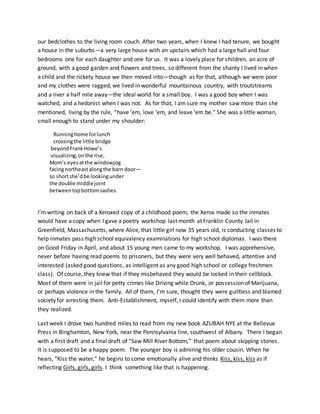
Feb 1, Tokyo to Bangkok JAL
On TV
the face of the slaughtered
Indonesianchild
ispure andinnocent
as if she were resting
inher father’sarms,
yetthe distantviewers,
suppliersof weapons,
do notcradle
the supple frail body
or kissthe petulant mouth,
theyare like the OldTestament
Jehovahwhotookthe firstborn
of Egyptfor hislawful fee,
and unlike the Hebrews
whoas beneficiaries
were bereavedinsharing
the commondoom of mankind
the Americanwatchers
see the youngface fade fromtheir channel
and do notmindgoingto dinner
hungry,infact, as hell
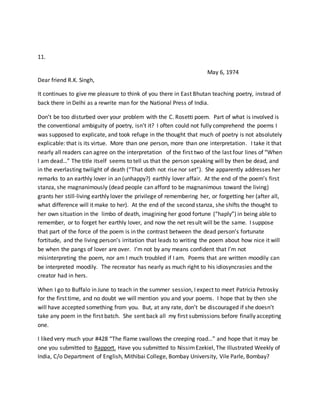
11.
May 6, 1974
Dear friend R.K. Singh,
It continues to give me pleasure to think of you there in East Bhutan teaching poetry, instead of
back there in Delhi as a rewrite man for the National Press of India.
Don’t be too disturbed over your problem with the C. Rosetti poem. Part of what is involved is
the conventional ambiguity of poetry, isn’t it? I often could not fully comprehend the poems I
was supposed to explicate, and took refuge in the thought that much of poetry is not absolutely
explicable: that is its virtue. More than one person, more than one interpretation. I take it that
nearly all readers can agree on the interpretation of the first two of the last four lines of “When
I am dead…” The title itself seems to tell us that the person speaking will by then be dead, and
in the everlasting twilight of death (“That doth not rise nor set”). She apparently addresses her
remarks to an earthly lover in an (unhappy?) earthly lover affair. At the end of the poem’s first
stanza, she magnanimously (dead people can afford to be magnanimous toward the living)
grants her still-living earthly lover the privilege of remembering her, or forgetting her (after all,
what difference will it make to her). At the end of the second stanza, she shifts the thought to
her own situation in the limbo of death, imagining her good fortune (“haply”) in being able to
remember, or to forget her earthly lover, and now the net result will be the same. I suppose
that part of the force of the poem is in the contrast between the dead person’s fortunate
fortitude, and the living person’s irritation that leads to writing the poem about how nice it will
be when the pangs of lover are over. I’m not by any means confident that I’m not
misinterpreting the poem, nor am I much troubled if I am. Poems that are written moodily can
be interpreted moodily. The recreator has nearly as much right to his idiosyncrasies and the
creator had in hers.
When I go to Buffalo in June to teach in the summer session, I expect to meet Patricia Petrosky
for the first time, and no doubt we will mention you and your poems. I hope that by then she
will have accepted something from you. But, at any rate, don’t be discouraged if she doesn’t
take any poem in the first batch. She sent back all my first submissions before finally accepting
one.
I liked very much your #428 “The flame swallows the creeping road…” and hope that it may be
one you submitted to Rapport. Have you submitted to NissimEzekiel, The Illustrated Weekly of
India, C/o Department of English, Mithibai College, Bombay University, Vile Parle, Bombay?
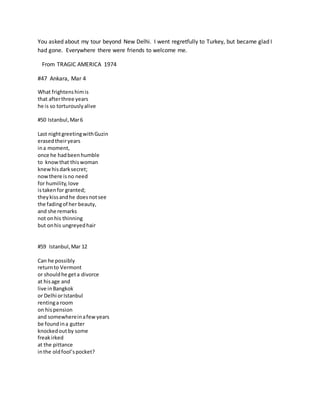
You asked about my tour beyond New Delhi. I went regretfully to Turkey, but became glad I
had gone. Everywhere there were friends to welcome me.
From TRAGIC AMERICA 1974
#47 Ankara, Mar 4
What frightenshimis
that afterthree years
he is so torturouslyalive
#50 Istanbul,Mar6
Last nightgreetingwithGuzin
erasedtheiryears
ina moment,
once he hadbeenhumble
to knowthat thiswoman
knewhisdarksecret;
nowthere isno need
for humility,love
istakenfor granted;
theykissandhe doesnotsee
the fadingof her beauty,
and she remarks
not onhis thinning
but onhis ungreyedhair
#59 Istanbul,Mar 12
Can he possibly
returnto Vermont
or shouldhe geta divorce
at hisage and
live inBangkok
or Delhi orIstanbul
rentinga room
on hispension
and somewhereinafewyears
be foundina gutter
knockedoutby some
freakirked
at the pittance
inthe oldfool’spocket?
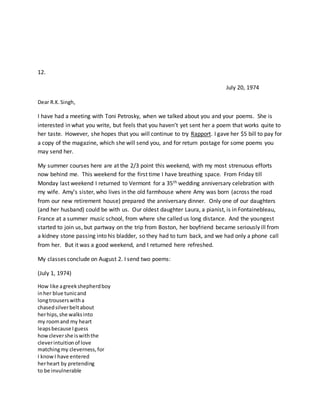
12.
July 20, 1974
Dear R.K.Singh,
I have had a meeting with Toni Petrosky, when we talked about you and your poems. She is
interested in what you write, but feels that you haven’t yet sent her a poem that works quite to
her taste. However, she hopes that you will continue to try Rapport. I gave her $5 bill to pay for
a copy of the magazine, which she will send you, and for return postage for some poems you
may send her.
My summer courses here are at the 2/3 point this weekend, with my most strenuous efforts
now behind me. This weekend for the first time I have breathing space. From Friday till
Monday last weekend I returned to Vermont for a 35th wedding anniversary celebration with
my wife. Amy’s sister, who lives in the old farmhouse where Amy was born (across the road
from our new retirement house) prepared the anniversary dinner. Only one of our daughters
(and her husband) could be with us. Our oldest daughter Laura, a pianist, is in Fontainebleau,
France at a summer music school, from where she called us long distance. And the youngest
started to join us, but partway on the trip from Boston, her boyfriend became seriously ill from
a kidney stone passing into his bladder, so they had to turn back, and we had only a phone call
from her. But it was a good weekend, and I returned here refreshed.
My classes conclude on August 2. I send two poems:
(July 1, 1974)
How like agreekshepherdboy
inher blue tunicand
longtrouserswitha
chasedsilverbeltabout
herhips,she walksinto
my roomand my heart
leapsbecause Iguess
howclevershe iswiththe
cleverintuitionof love
matchingmy cleverness,for
I knowI have entered
herheart by pretending
to be invulnerable
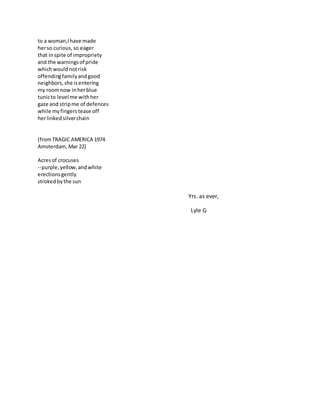
to a woman,Ihave made
herso curious,so eager
that inspite of impropriety
and the warningsof pride
whichwouldnotrisk
offendingfamilyandgood
neighbors,she isentering
my roomnow inherblue
tunicto level me withher
gaze and stripme of defences
while myfingerstease off
herlinkedsilverchain
(fromTRAGIC AMERICA 1974
Amsterdam,Mar 22)
Acresof crocuses
--purple,yellow,andwhite
erectionsgently
strokedbythe sun
Yrs. as ever,
Lyle G
LETTERS: 1975 : 13 – 14
13.
Jan 1 ‘75
Dear Mr. Singh:
I am glad to hear from you again, and particularly glad to have your report on the way your
Principal responded to PAUNCH/STILLS. It is typical that he should think that the novel is naïve
and weak because it does not draw a caricature of a homosexual so that he could recognize one
when he meets one on the street. I am extremely flattered by this response, because it
suggests that I suggested well in my objective to convey the impression that there is no
stereotype homosexual like the one your friend imagines, or if there is (I suppose that the
flagrant QUEEN is what he is thinking about, and such people do exist and are easily spotted).
But over and above that obvious type there is a whole range of persons who engage in sex with
their own gender. Many of them are respectable family men like Jim Gordon in my novel.
Many of them have distinguished careers. They dress conservatively, talk without a falsetto,
walk without a feminine gait and in all surface ways seementirely normal. If your friend can
learn that much from my book, he has learned a great deal, no matter how annoyed he may be
to have it pointed out to him. The differences between the great majority of such men and Jim
Gordon is that they never write a book exposing themselves. However, I am willing to guess
that even there in East Bhutan there are many decent respectable men, some unmarried,
others with wives and children, who enjoy a romp on a mattress with another man. They
would be no threat to your friend or to you.
I am much disappointed with Mrs. Petrosky that she should accept my $5 and not send you a
copy of RAPPORT or reply to your letters. I will write her. I have been holding off from doing
so, hoping that you will hear from her. I will ask her to send Rapport #7, which contains two of
my poems.
Please givemy good wishes to your family, and convey again my disappointment that I spent so
little time in Varanasi that I couldn’t come to see them.
I am quite busy now revising Book II of STILLS. I have one rejection which begins: “Your book is
an extraordinary piece of work, but I am afraid it is just plain not for us. I just don’t feel that it
is strong enough in its meaning to permit it to carry off the enormously explicit and erotic
sexual scenes. I am afraid it would be read for all the wrong reasons and the right ones would
be hidden…”
Thanks for #487 and #520. Good, good.
Yours,
Lyle Glazier
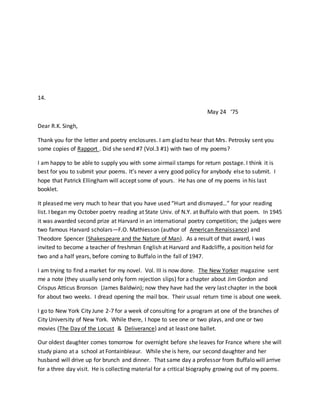
14.
May 24 ‘75
Dear R.K. Singh,
Thank you for the letter and poetry enclosures. I am glad to hear that Mrs. Petrosky sent you
some copies of Rapport . Did she send #7 (Vol.3 #1) with two of my poems?
I am happy to be able to supply you with some airmail stamps for return postage. I think it is
best for you to submit your poems. It’s never a very good policy for anybody else to submit. I
hope that Patrick Ellingham will accept some of yours. He has one of my poems in his last
booklet.
It pleased me very much to hear that you have used “Hurt and dismayed…” for your reading
list. I began my October poetry reading at State Univ. of N.Y. at Buffalo with that poem. In 1945
it was awarded second prize at Harvard in an international poetry competition; the judges were
two famous Harvard scholars—F.O. Mathiesson (author of American Renaissance) and
Theodore Spencer (Shakespeare and the Nature of Man). As a result of that award, I was
invited to become a teacher of freshman English at Harvard and Radcliffe, a position held for
two and a half years, before coming to Buffalo in the fall of 1947.
I am trying to find a market for my novel. Vol. III is now done. The New Yorker magazine sent
me a note (they usually send only form rejection slips) for a chapter about Jim Gordon and
Crispus Atticus Bronson (James Baldwin); now they have had the very last chapter in the book
for about two weeks. I dread opening the mail box. Their usual return time is about one week.
I go to New York City June 2-7 for a week of consulting for a program at one of the branches of
City University of New York. While there, I hope to see one or two plays, and one or two
movies (The Day of the Locust & Deliverance) and at least one ballet.
Our oldest daughter comes tomorrow for overnight before she leaves for France where she will
study piano at a school at Fontainbleaur. While she is here, our second daughter and her
husband will drive up for brunch and dinner. That same day a professor from Buffalo will arrive
for a three day visit. He is collecting material for a critical biography growing out of my poems.
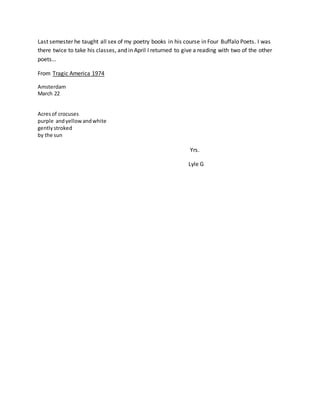
Last semester he taught all sex of my poetry books in his course in Four Buffalo Poets. I was
there twice to take his classes, and in April I returned to give a reading with two of the other
poets…
From Tragic America 1974
Amsterdam
March 22
Acresof crocuses
purple andyellowandwhite
gentlystroked
by the sun
Yrs.
Lyle G
LETTERS : 1976 : 15-16
15.
Feb 26 ‘76
Dear R.K. Singh,
I am not in the least indifferent to you, not changed a whit, glad as ever to have a letter, and
hope you received all mine, though I suppose there is some chance that a letter to you in East
Bhutan may not have been forwarded.
Your M.A. thesis lies here on a side table in my study. Only last Sunday, the wife of a faculty
member from the University of Massachusetts, pointed it out to her husband, when they were
here on an overnight visit.
Please tell me where Dhanbad is. I haven’t located it on a map, but I gather it is somewhere
about 100 miles from Gaya towards Calcutta. I’m really in the dark. I know you are much
nearer home in Banaras than you were in East Bhutan. I hope you will enjoy your work.
You ask for help in selecting a Contemporary American poet for your dissertation. I think at
once of WilliamCarlos Williams as your kind of poet, and I’ve asked my bookstore to order his
selected poems and in about two weeks when it comes, I’ll send the book on to you—
regretfully, perhaps, for I don’t have a copy myself. But your needs are prior to mine, for I’d be
keeping the book only for my pleasure, while you will combine pleasure and scholarship, if you
decide that Williams is to your taste.
Your other consideration—the Savitri—seems very good, but I have no knowledge of the epic
and obviously, therefore, no measure of its worth.
My new book of poems you ask me to send you has not yet been published, is slated for around
the end of April. I have had no final word from the novel, which still languishes at Viking Press
after having been there nine months.
My life is very quiet. Monday evenings I sing with a chorus that is preparing a new patriotic
chorale written for the Bicentennial by a Bennington composer, the director of the chorus. The
music is enharmonic, sort of Bartok, whose music I particularly enjoy.
All good wishes.
Yrs.
Lyle Glazier
16.
June 4 ‘76
Dear R.K. Singh,
How can I thank you for going to the trouble and the expense of sending me SAVITRI? It is an
extraordinary book, an extraordinary document in social history, even though there is no poetry
in it. I ask myself what kind of man encrusts himself with such a protective shell of illusion to
shield himself from everything that is visible in his teeming India. There is more poetry in any
one of your little lyrics than in that whole grandiose volume of make believe. To be sure, he
wears the mantle of mystic and protects himself again by claiming that anyone who doesn’t
vibrate in tune with his revelation is out of touch with the GREAT TRUTHS THE TIMELESS
TRUTHS OF ETERNITY. I found his letters fully as revealing as his cantos, and was not surprised
to come upon long passages venerating Milton. What he does not seem to comprehend is that
Milton ‘s vision, like Dante’s , pulses with human being. Satan, gargantuan vision, is all too
much a man, and behind the creation of Satan is Milton’s own Restoration England, which to
the poet, Protestant that he was, was Hell, in which he had to believe he had the power to
construct a new heaven and earth in the “own place” of his mind.
I doubt if you will agree with what I am saying. I suspect that it will seem to you another
instance of the remoteness of Occidentals from the Oriental Mind. However, since you send
me the book, in the context of trying to reach a decision on a subject for a dissertation, I can
only tell you that in my opinion you will be deluding yourself if you believe that you are writing
about a poem if you write about SAVITRI. All the other things you mention “the lengthiest epic
in English” an opportunity to “exploit the tools of archetypal/mythical contextual criticism”
may be there to some extent. But the rhythm is flattering, the imagery is cloud cuckooland,
and the language is that of an evangelist who does not dare look out at the world surrounding
him, so he pulls down that tawdry curtain of imagined absolutes.
If I seem to be hard on Sri Aurobindo, it is because I think you are too good a poet to be taken
in by his nonsense. He is a waste of time as a poet, and worse than that, unwittingly a social
commentator, he illustrates how a weakling can run away into the Heaven of mysticismand
ignore every social gangrenous sore that cries out for redemption.
Please forgive me.
Your good friend,
Lyle Glazier
LETTERS: 1978: 17 – 20
17.
April 22 ‘78
Dear R.K. Singh,
I wondered why I had no answer to my last letter to you, and now that I have your report of
recent activities, I can well comprehend why you have not had time for foreign
correspondence.
It is with the greatest happiness for you that I read of your marriage and of the baby in
progress. If getting a baby is fun, having a baby is even more fun—a great responsibility, too.
You speak in your letter of my “daughter”. Actually I have three daughters, all of them so
much loved that it would be impossible to single out one of them to be preferred for the one
you mention. I loved them from the time they were conceived. When they were small, I loved
helping care for them—feeding them with the bottle by night or day, changing their diapers,
washing their shitty bottom – I hope my language won’t seem objectionable to you, but babies
are real little animals as well as spiritual human beings. They require the kind of attentions any
other animal requires along with the special attention needed by human beings. Sometimes, I
feel that parents fail most when they ignore the animal nature of their children, who are
spiritual, but not pure spirit.
Your report on the progress of your research interests me too, even though, as you know, I am
not particularly inspired by Savitri . As I write this letter, however, I am looking at a small poetry
journal ORIGIN, fourth series, October 1977, and a second one ORIGIN, fourth series #2,
January 1978, edited by the American poet Cid Corman, living now in Kyoto, Japan, and the
little books printed, as I find on the inside back page, at Pondicherry 605002 by Sri Aurobindo
Ashram Press. Your news that you will visit Pondicherry makes another meaningful circle in the
many overlapping circles in my life.
I will be happy to read your 17 page paper on Sri Aurobindo’s poetics, but I would not be able
to help you find a magazine for it, I fear. I cannot find magazines to publish my own writing,
and at my age, I cannot take on the chore of trying to place someone else’s. Please understand
that this does not mean I have no interest in you. I continue to be interested in what you are
doing, thinking, writing, but at 67 years, swamped with my own unpublished writings, I feel
frustrated enough when one of my own poems, stories, or articles is rejected. I can give you
one possible address: Shantih: A Journal of International Writing and Art, C/o Brian Swann, The
Cooper Union (Liberal Arts), Cooper Square, New York, N.Y. 10003. I don’t know Mr. Swann nor
does he know me; I found this address in a current listing for writers. It will be best for you to
send your article direct to him.
You ask about your student’s situation here if he fails to have the $1500 required, whether he
will have any trouble from official sources if he has less? I really have no way of knowing. I do
know that today $1500 is a lot of money. It is,in fact, ½ of my retirement pension for a whole
year. Most Americans in my position have much larger pensions. Mine is small partly because
when I taught abroad in Turkey or India, my university did not pay into the pension fund for
me. I don’t complain about this, because my whole life was changed by my visits to Turkey and
India. Think of it, without those trips I would not have had the inspiration of your
acquaintance.
I am adding for your curious inspection a rejection just received from a national foundation that
gives grants to poets. (1627 poets applied.) I submitted 10 poems about my responses to travel.
Informing me that I was not one of the poets to receive a grant, the Director of the competition
wrote:
“Dear Lyle Glazier: One of the readers, Michael Palmer, made these comments on your work:
‘This is fine work, a succession of images from travel with the power, often, of summation.
Glazier’s art is as much in the selection of the scene as in the language, which is (almost)
transparent.”
May I express my loving good will to both you and your wife. And please don’t be offended by
this further comment. You wrote “…she is extremely nice and is rearing in her womb my seed.
Too early, but what to do?” I am reminded of 40 years ago, when my wife and I decided that
we would wait at least 5 years—until I could finish graduate school—before having a child.
Then almost immediately Amy became pregnant, and Laura was born within the first year. It
was difficult for us, but I’ve never had any real regrets. It does become important to take
precautions lest you have more children than you can well support. We managed to hold off
five years for the second, and another two years for the third.
With my warmest wishes to you both,
Lyle Glazier
18.
May 19 ‘78
My dear R.K. Singh,
It is a pleasure to have your letter from there in the heat of India. I loved the heat of India. It
was as if, when I was there, my vital center uncurled. Even in Madras, when it was 44 degrees
C, I luxuriated in the heat, but of course I kept out of the sun at mid day, except one noon when
I walked from the US Consulate on Mount Road to my Savera Hotel partway down Edward
Elliott Road, and that day I wilted even though Indian workmen and women were busy building
a new bed for the road.
You speak of working in the house when your wife is pregnant. I have always helped out with
such work. I can cook and dust and sweep, and during the years when our children were in
school, when Amy and I both worked, I came home to help with the sweeping and helped get
dinner at night. As each child was born, I pitched in and prepared bottles for feeding. When
the baby wet itself or dirtied itself, I changed the diapers. This (house husbandry) is much more
common in the States than in a European or Asiatic country, where the social custom still
makes it important for a male to protect his reputation for virility by never doing a woman’s
work. One of my brothers is like that. He prides himself on never having lifted a finger to help
with the dishes or washing or ironing. He believes that such an exclusion makes him a better
man. As for me, I always enjoyed taking care of the children, never minding if I washed a shitty
bottom, anointed it with fragrant oil, and covered it with a clean diaper. It was always a labor of
love.
This year when my wife has been crippled with arthritis, for several months I did nearly all the
housework. Now she begins to feel better so I can come down to my study to write. She talks
of selling this house, but I love it too much ever to leave it. I would like to die from this house.
Last month for a few hours we had a visitor from Madras, one of my students from my seminar
there in ’70. She has been in Kansas City for two years, earning a Master’s degree. She must
have done very well. Two of her papers were accepted for American journals, quite a record, I
think. But it was hard for her to be away from her husband and three children for two years.
She works at a Catholic College (Stella Maris) and the Church probably helped her get a
scholarship here. I felt homesick for India when she left.
Don’t fear that your creativity will dry up. I always have had such a fear, but the impulse keeps
coming back. The poems you sent me seemed fresh and clean cut, but in #801, if I were you, I
wouldn’t use the “poetic” word “swain”—not even lightly—because the rest of the poem is
very direct and immediate, and I can’t believe that the word really conveys a current impression
of Indian young men on the street.
5/26/78
Aftermidnight
across far meadows
a fragrance of apple trees
puncturesthe windlessair
leakingfromanoldorchard
thisyearover blown
Love to you both,
Lyle G.
19.
July 24 ‘78
Dear R.K. Singh,
Your last letter was filled with such contrasts. I am as deeply moved by what you said about
your great love for your wife, compelling you to take an early departure from Pondicherry. The
happiness of a young man in his wife and her for him can be matched only by the deep spiritual
sympathy between an old husband and wife who have lived and loved together many years. I
hope that you can have the added happiness of children. Amy and I knew what it was not to
bring a child to full term; in fact, we lost one child almost at the very end of a pregnancy. It is
sad to have this happen, but in due time we had three healthy daughters. Please tell your good
wife for me that I wish her good health and happy, healthy children.
Your news about Pondicherry and the deterioration of spiritual values in the Aurobindo
community was very depressing. As you know, I am not a great admirer of Savitri as a poem
but I have tried to believe it could be a great spiritual social document. Your account of the
rivalry or bad feeling at Pondicherry is a real blow. I cam believe that all this increases the
burden of your progress toward a doctorate.
What you said about your family troubles back home also depresses me. It is sad to see our
parents grow old and the family coherence break up. I never knew this to happen as you have,
because both my parents died the same day when I was 22, the fall of the year after I got my
bachelor’s degree. My youngest brother was thirteen and came to live with me, and for several
years, until he went into service in WW II, I was in loco parentis to him. We are still good
friends.
Please, in all your troubles, do not lose sight of your compensating gift for poetry. Let your
poems express your feelings. You have a talent that must not be allowed to shrivel up from
disuse.
I write on the back of a notice for my poetry reading next Sunday.
My love to you & your wife,
Lyle G
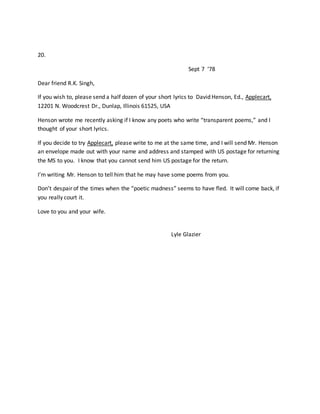
20.
Sept 7 ‘78
Dear friend R.K. Singh,
If you wish to, please send a half dozen of your short lyrics to David Henson, Ed., Applecart,
12201 N. Woodcrest Dr., Dunlap, Illinois 61525, USA
Henson wrote me recently asking if I know any poets who write “transparent poems,” and I
thought of your short lyrics.
If you decide to try Applecart, please write to me at the same time, and I will send Mr. Henson
an envelope made out with your name and address and stamped with US postage for returning
the MS to you. I know that you cannot send him US postage for the return.
I’m writing Mr. Henson to tell him that he may have some poems from you.
Don’t despair of the times when the “poetic madness” seems to have fled. It will come back, if
you really court it.
Love to you and your wife.
Lyle Glazier
LETTERS: 1981 : 21 – 27
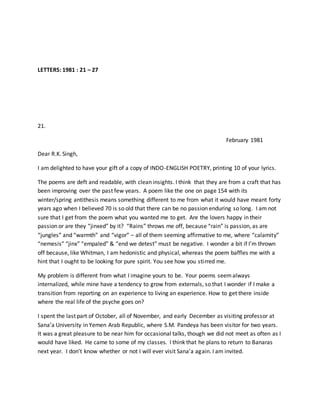
21.
February 1981
Dear R.K. Singh,
I am delighted to have your gift of a copy of INDO-ENGLISH POETRY, printing 10 of your lyrics.
The poems are deft and readable, with clean insights. I think that they are from a craft that has
been improving over the past few years. A poem like the one on page 154 with its
winter/spring antithesis means something different to me from what it would have meant forty
years ago when I believed 70 is so old that there can be no passion enduring so long. I am not
sure that I get from the poem what you wanted me to get. Are the lovers happy in their
passion or are they “jinxed” by it? “Rains” throws me off, because “rain” is passion, as are
“jungles” and “warmth” and “vigor” – all of them seeming affirmative to me, where “calamity”
“nemesis” “jinx” “empaled” & “end we detest” must be negative. I wonder a bit if I’m thrown
off because, like Whitman, I am hedonistic and physical, whereas the poem baffles me with a
hint that I ought to be looking for pure spirit. You see how you stirred me.
My problem is different from what I imagine yours to be. Your poems seemalways
internalized, while mine have a tendency to grow from externals, so that I wonder if I make a
transition from reporting on an experience to living an experience. How to get there inside
where the real life of the psyche goes on?
I spent the last part of October, all of November, and early December as visiting professor at
Sana’a University in Yemen Arab Republic, where S.M. Pandeya has been visitor for two years.
It was a great pleasure to be near him for occasional talks, though we did not meet as often as I
would have liked. He came to some of my classes. I think that he plans to return to Banaras
next year. I don’t know whether or not I will ever visit Sana’a again. I am invited.
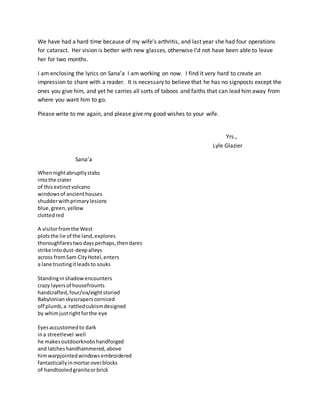
We have had a hard time because of my wife’s arthritis, and last year she had four operations
for cataract. Her vision is better with new glasses, otherwise I’d not have been able to leave
her for two months.
I am enclosing the lyrics on Sana’a I am working on now. I find it very hard to create an
impression to share with a reader. It is necessary to believe that he has no signposts except the
ones you give him, and yet he carries all sorts of taboos and faiths that can lead him away from
where you want him to go.
Please write to me again, and please give my good wishes to your wife.
Yrs.,
Lyle Glazier
Sana’a
Whennightabruptlystabs
intothe crater
of thisextinctvolcano
windowsof ancienthouses
shudderwithprimarylesions
blue,green,yellow
clottedred
A visitorfromthe West
plotsthe lie of the land,explores
thoroughfarestwodaysperhaps,thendares
strike intodust-deepalleys
across fromSam CityHotel,enters
a lane trustingitleadsto souks
Standinginshadowencounters
crazy layersof housefrounts
handcrafted,four/six/eightstoried
Babylonianskyscraperscorniced
off plumb,a rattledcubismdesigned
by whimjustrightforthe eye
Eyesaccustomedto dark
ina streetlevel well
he makesoutdoorknobshandforged
and latcheshandhammered,above
himwarpjointedwindowsembroidered
fantasticallyinmortaroverblocks
of handtooledgraniteorbrick
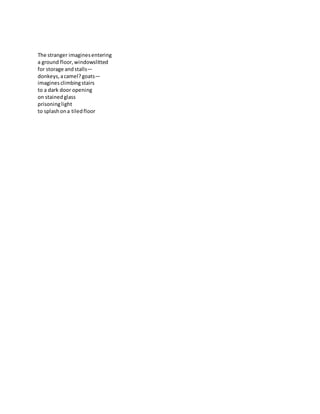
The stranger imaginesentering
a ground floor,windowslitted
for storage andstalls—
donkeys,acamel?goats—
imaginesclimbingstairs
to a dark door opening
on stainedglass
prisoninglight
to splashona tiledfloor
22.
March 12 ‘81
My dear R.K. Singh,
Your generous and detailed letter has many passages to fascinate me.
I am glad to know that I didn’t completely misinterpret your “complex of emotions,” in the
“anti-romantic” poem on page 154. What you say about the origin of the emotion in one of
those universal downsinkings of communication when a wife and a husband fall out of tune—
for a trifle, maybe—sharpens the edge of my understanding and rings true to my own married
experience. The ironic tear of emotions is particularly shattering when the attempt to
communicate is sexual. How small an incident can throw one or the other partner out of tune.
Maybe the baby cries for a change of diaper. Or the husband remembers an unhappy
experience with a student. How rare and wonderful—almost a miracle—when both partners
are perfectly in tune. During the honeymoon joy is possible, for then every discovery is new,
but after sex becomes a familiar routine, how can the miracle be sustained? Not every time,
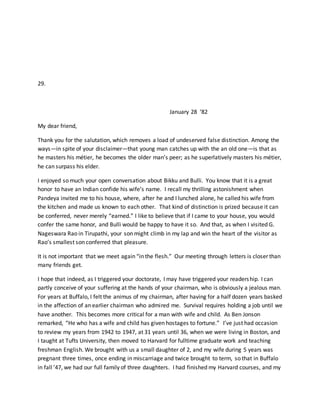
perhaps, but again and again, the wonder will be revived. But your poem, I think you are telling
me, is about one of those unhappy occasions in between the crests.
May I comment about #875. I like the first stanza very much for its simple naturalness. Would I
like it better if in the second line “by” were changed to “in”? Autumn, a season, cannot,
perhaps be personified now, as it once was personified by Keats. In the second stanza, I think
you stray far from poetic voice when you use the word “Jupiter.” Jupiter is not your god nor
mine, and we do an injustice to our deepest inspiration when we become allusive to a tradition
that is not ours. Perhaps if there were a cutting edge of intellectual comment, the allusion
would have power, but here aren’t you simply drawing on a cliché that has no force in your
world? For a similar reason, I cannot use Christian symbolism, except with an intellectual
comment, because I am not a Christian, but an agnostic.
The seasonconfers
throughsoftgrey clouds
a growingfreshnessonnakedtrees
Not good, but perhaps I make my point.
I like your including the paragraph about the fourth year of your marriage, and your wife’s
inquiry about me, and the gentle naughtiness of your one and a half year old son. You draw me
close. If I could afford it and had the power, and it weren’t so hard on my wife, I would always
like to have a child in the house, and indeed to discover the joy of having a son. I may have told
you that our three are all daughters, three beautiful girls living away from home. My wife
suffers pain from arthritis, but after four operations for cataract last year, she can now read
again, and after an operation on her hip, she can walk, but not easily nor far. She no longer
moves with the speed of light “right out straight” as she used to say.
Thank you for informing me about your having completed your dissertation six months ago. I
had no idea, and I am very happy for you, and wish you a favorable verdict. I recall my own
waiting from September till January in 1949-50, and how glad I was to have it over after my oral
examination in May. Please tell me whether you submitted it at Banaras Hindu University, and
who was your advisor. In Sana’a I renewed my friendship with Dr. S.M.Pandeya, whom I regard
as one of my best friends anywhere. We seemto share a common critical spirit. I remember
from 1971, when I was traveling around India lecturing for USIS, Pandeya reported to me that
somebody, some Indian scholar,had spoken witheringly about my pairing Henry James’s Daisy
Miller and Melville’s Billy Budd in one of my proposals for a lecture, but, Pandeya said, “I knew
at once you had in mind how both Daisy and Billy are victims of a corrupt Establishment.”
You speak of spirit of “dissatisfaction” in my series of Sana’a poems, and of course you are
right, but there was also vicarious joy in my envy of their pleasure in the beauty of stained
glass.
I do hope that your Ph.D. degree will lead to a happier location for you. I don’t know how old
you are. I am sure that financially and intellectually my situation in Buffalo was probably better
than yours—in the U.S. a Ph.D. is the terminal degree and therefore used to reward the
successful candidate, though now there are so many that doctors have trouble finding
positions. In my case, I had the good position, but I was psychically profoundly unsettled, and
my professional life became ruined—not wrecked because I was on tenure. I began writing
fiction and poetry (as well as literary criticism) to vent my need to rebel. It is only now, recently,
that I have the satisfaction near the end of my life to feel that I begin to fulfill my visions.
For the past three years I’ve been writing short fiction that has sometimes appeared in gay
magazines, and a major work of non fiction, a sexual autobiography, telling how married gays
are not uncommon but legion. The title of my new book comes from my recent discovery that
my family springs from the very first English settlers in New England, the ones who came on the
Mayflower to New Plimoth. WESTWARD FROM PLIMOTH has been at one of the great
publishing houses, being read by the vice president of Holt, Rinehart & Winston. When I
phoned the office last week, his secretary said, “Dick is reading your book now. He likes it very
much, but he is very busy and may not get to write to you at once.” Then she added, “Perhaps I
shouldn’t have said so much. I hope I haven’t been indiscreet.” I submitted the book the day
before I left for Sana’a – October 22—and still I wait. The same editor has had the MS of STILLS
FROM A MOVING PICTURE (my novel that you looked at) since 1976, holding it, hoping the time
will come ripe for a novel about a married homosexual. I trust that your wife will not be
revolted to learn this fact about me. I only begin to realize that I have been a good husband
and father and have nothing to be ashamed of. I begin to be more comfortable with myself. I
was not a threat to someone who did not seek me out.
Affectionate greetings to you both,
Lyle Glazier
23.
April 14 ‘81
My dear R.K. Singh,
It is hard to advise anybody, but I sympathize with your predicament there in Dhanbad. When I
was 30, at the outbreak of World War II (i.e. World War according to the Western view), I lost
my job at a small college in Maine, after being there 5 years. It was a blow, but turned out to
be good. I went from thereto Boston to teach at Tufts College, about 5 miles from Harvard
University. At Tufts I was a teacher of freshman English only. This meant that I had four classes,
each with 30 students, each of whom had to write at least one 500 word composition every
week. This meant that every week I read and corrected 60,000 words of student writing. I
taught summers as well as winters. At the end of two and a half years I got sick to my stomach
when I would pick up another pile of those papers.
Then I was offered as much money to be an assistant in the Harvard Shakespeare course, so I
left my job at Tufts, and went on to get my Ph.D. in 1950 when I was 39, and by then the father
of three daughters, and by then teaching in Buffalo, where my load was one class in American
literature, one in British poetry, and 7 more students preparing for comprehensive
examinations, and each of them meeting me once a week for a half hour. I thought I had
landed in heaven.
I don’t know what there is in this for you, except that sometimes no one can foresee a better
outcome. Not that I was ever a great success in the university. I rebelled too much against the
administration, never attended social functions, never became administratively ambitious.
My new book WESTWARD FROM PLIMOTH is an autobiography. I have tried to make it as frank
as my poems and my novel. I am afraid I may have been over optimistic when I last wrote you. I
have had no further word from the publisher, and begin to think I was hoodwinked, and that
my book isn’t being seriously considered. I called the office again, and this time got no news at
all. In June, if not before, I will travel to New York and bring my manuscript home, and try also
to bring STILLS FROM A MOVING PICTURE which the same editor has been holding now for five
years.
To return once more to your poem # 154, which I consider a most interesting poem, what you
say about “fear of sexual failure”—“self-generated”—takes me back to the words of my
psychiatrist when I was trying to come out candid about being gay: he said, “Sex is symbolic.”
For somebody like you it doesn’t help much, however, to be told that success or failure is a
product of your own illusions. Sensitive people become hypersensitive when they try to
comprehend themselves. Poetry helps—writing poetry—because no matter what the trauma,
there is some help in comprehending what it means to be human—and mortal, and your
Greeks believed, for to them only the gods were immortal.
When I saw Dr. Pandeya in Sana’a last October, we talked about you and about Savitri. I trust
his judgment so much that he strengthened my own somewhat guilty conscience over having
taken such a dislike to a poem to which you devoted so much time. But then, soon after writing
my thesis, I lost my devotion to Spencer’s The Faerie Queene.
I will gladly give you the address of the editor of Origin but I hardly encourage you to submit.
The man is extremely rigorous, and I never expected that he would print some of my poems. I
knew him frist in Boston in 1945, when I was teaching at Tufts from which he had just
graduated. He went on to the Black Mountain College, and then traveled in Italy and spent
many years in Kyoto and married a Japanese wife. Now he is back in Boston. His masthead
informs poets desiring to submit: “Unsolicited manuscripts will not be returned. The sender
must assume all risks. Response will occur within 24 hours may nof receipt or not at all.”
Cid was not in the least encouraging about my first submissions. As he says, he never sends
poems back, but he will let you know if he likes what he reads, and sometimes may accept
something.
If he doesn’t like what he reads, he may never reply, very hard on the poet. And right now is a
particularly bad time, because Cid and his Japanese wife have just opened an ice cream shop in
Boston, and after great effort and expense are working hard to make the shop a success.
I am sure that if I hadn’t befriended Cid when he was a young man, I would never have
persevered to the point where he accepted my twelve poems. Nobody could have been more
surprised than I.
Origin
CidCorman,Editor
87 DartmouthStreet
Boston,Massachusetts
USA 02116
I have started a new novel O MY SON, imagining a married homosexual who has a son who is
homosexual. I begin with an account of my experience in Madras with a massageman who
commercialized sensuality, nearly managing to sublimate sex even when merchandizing it.
There was no personal involvement with his client, only his marvelous hands. You no doubt
know about this, may have read about it in The Kama Sutra. Very curious, very different from
hustlers in parks in Istanbul, New Delhi, London, New York—all over the world, where the
hustler justifies his sexuality because he never engages in it without pay. The massageman also
is paid, but he is an artist, whose artistry justifies the payment.
What you say about your youngest brother makes me think of young artists all over the world,
who seem to know what they are doing, and when they are young succeed beyond the hopes
of older people looking on. How do they do it? What is their intuition?
O MY SON: “He was a solid young man, not massive, but with a solid trunk nearly hipless,
where the cloth of his dhoti hugged. Above the hips he was bare, having flung off his upper
garment. He was bare but not naked, for there was no sensual invitation in his having partly
disrobed. His manner was disengaged except for the skill of his hands. The trick was to seduce
the client into yielding to pure sensuality. To have offered his own body, to have thrust, to
have erected, to have pushed his own cock into play would have been to cheapen
professionalismwith the currency of commitment. Only by being absolute for merchandize
could Ganga sublimate commerce into spiritual consent. A ten-rupee note lay on the table, but
money was only symbolic….”
Cordially yours,
Lyle Glazier
24.
June 13 ‘81
Dear R.K. Singh,
I did get your letter of March 30 and recall replying to it, responding particularly to your
unhappiness there in your position and your anxiety over your thesis and desire for a new post,
as well as remarking on how remarkable it is that your brother has been able to launch himself
successfully so young.
I agree that it is time for you to publish a book, and I’ll gladly write an introduction, and try to
make editorial suggestions, but not quite (if you please) what you had in mind. I think it an
important part of creative expression to arrange the poems in an order, so I think you ought to
do that yourself—chronological order of creation, if you will, but you should make the decision.
Above all, I would say, don’t arrange the poems by common elements of content. Every poet—
Wordsworth, Whitman, to name two—who has tried to do that has failed. I would suggest
chronology from the time of writing. Also, for an 80-page book, I would suggest you curb your
sure-to-be greedy desire to crowd a great deal in. Limit yourself, rather, to only one poem to a
page, even if the poem is short. I haven’t always done that, but in VD I was trying to get in all
the poems written over a 4-month period of time. Your time span will be much broader. Give
each poem room to breathe.
This, I suggest. Select perhaps one hundred poems. Arrange them in the order you like. Then
send them to me, and I will select out the number you have room to print.
Find your own title for your book.
It will be a pleasure to read what you send, but don’t expect a miracle of editing like that of Ezra
Pound on THE WASTE LAND. In general, I would want to accept your vocabulary, your imagery,
your concepts, and only exercise a critical voice in selecting out the final 80 poems for your
collection.You ask for Dr. Pandeya’s address. By the time my letter reaches you, he will be back
in Banaras, and I assume you have that address.
I have no real influence in academia to exert pressure to help you find a new place. I know that
Sana’a, like most places in the Middle East requires a doctorate in hand, and in addition, Sana’a
specifies that the candidate have taught at least 5 years after having earned the degree. Believe
me, I know from my own early experience the drudgery of teaching English report writing.
The only thing I have to enclose is a short commemorative series for my uncle’s and aunt’s 50th
wedding anniversary.
Affectionate greetings to you and your wife,
Lyle Glazier
No word from my book sent 10/22/80
25.
July 10 ‘81
Dear R.K. Singh,
By now I hope you have my letter of June 13, in which I offer to help what I can to select and
arrange poems for a volume. I suggest that you make your own selection and organization of
100 poems and send them to me for my cutting the group to 80. In order to make your
communication easy, you should keep your own carbon list, so that I won’t have to send back
the poems but can make short comments that you will be able to refer to your copy.
Somebody did this for me when I was collecting VD, and I found it immensely helpful, even
though only a few poems were omitted.
Today I got your letter and bundle of enclosures for June 26. Everything interested me. The
abstract of your thesis makes much more sense of SAVITRI than I would ever have made by
myself, and I can see how hard you worked. The sociological implications still excite me more
than the poetic for that epic.
Before proceeding further, I must congratulate you for having your thesis accepted. The viva
voce I am surewill be a formality, for you will know more about the poem than any of your
examiners. Yet, you will be on your mettle, happily discovering as you go on in the hour, that
the climate is in your favor. I recall even now from 1950 how that realization dawned on me
somewhere along in the examination on my thesis for Spenser’s imagery.
I wish I could believe I would have success in placing the article on “The Mythical Construction
of Death…” but it would be foolish for me to engage to market your chapter, since I never know
how to market my own, and wait for the inevitable rejection with a growing intuition of doom.
I will, therefore, as you suggest, keep the copy in your file along with other papers. In my own
case, with my thesis, I managed to salvage two articles that appeared in journals, but the thesis
has lain on the shelf, quite dead from 1950 to 1971, when it was disinterred from the Harvard
library for a brief mention in J.E. Hankin’s SOURCE AND MEANING IN SPENSER’S ALLEGORY
(Oxford).
The three published articles all found my ear receptive. What you say about teaching poetry
mirrors what I have been saying for a long time. At Sana’a last November, at the first class I told
the students that we must find some way for them to be active—it was not important what I
did unless they were being active. Your analysis is more systematic and thorough than anything
I have tried. Is there a danger in systematization, as if a poem can be exhausted? Is there a
virtue in leaving analysis open—tempting the student always to come back to the poem? I like
to let the students take the initiative with a comment on one element—a word, an image, a
formal construction, an allusion to another poem—just anything that gives evidence that the
student’s mind is alert as he reads the poem. Then I pick up from there with my own
comments, usually first enlarging on what the students have said, and trying to reach the heart
of the poem without in any sense “finishing it off.” Do you see what I mean? But I did like your
essay, particularly the first paragraphs, which match my own experience both as to students
and many academics.
The article on technical institutions carried me back to 1942-45, when part of my teaching load
was one class for Engineers at Tufts University—a smitch of literature, and more than a smitch
of technical writing: a screw driver is a means of turning (the acting part), a means of applying
force to the turner (a handle) and a connector between the other two (a shank).
The acting part is made up of
A
B
C
The handle is made of…
The shank is made of …
Always accompanied with a diagram/drawing.
The problem of effective writing is omnipresent in all universities. The greatest problem is
probably that most teachers are not ready to read papers and give detailed comments.
I must not fail to mention how much I like your poem #895. I think it is nearly perfect.
Best wishes to you & your wife,
Lyle Glazier
The boy comesintoa clearing
stripsand sprawlsinthe sun
curvesfingers
cannot control
the freshening
the leap
the out-thrust
callshisdog
reachesunder
bothstreaming
the dog (hindlegsspread) continuing
a longtime squirting
on leaves
the boy watching
watchedbythe eye of the sun
triesto cram intoits sheath
the tough nutabove the shudder
failing,hidesintrees
the dog joinshim
theyrun ina team throughthe woods
26.
September 28 ‘81
Dear R.K. Singh,
I hope you will not be disturbed if I have cut words from your poems in the same way Cid
Corman, a superlative critic, cut words from some of mine. In fact, I sent him copies of five of
these poems to the University of Iowa, where he is spending six weeks as a critic for Paul
Engel’s seminar for poets from the Orient and Africa.
You can put the words back if you choose. I have especially cut out abstractions and adjectives
that seem to obscure your essential meaning.
My numbering does not conform to yours in the small book you sent me, but it does follow the
order of the poems, and I think you will have little trouble following along in your copy.
I am sorry that I don’t like your title, not at all, because it is slackly sentimental, but the poems
are tightly realistic like the bits of life you record.
I have decided to carry my copy to the library to make a Xerox in case something happens that
my letter does not reach you. In that case, I will send you another when I hear from you next
that you worry over not having heard from me.
My introduction should be very short, not to take attention from the poems. Something like
this, I think.
R.K. Singh writes with the directness of an overheard whisper, or a wind through trees, a
ripple in a stream, or a cry in the street after dark.
Yes, I think that that is about what I would like to say about the poems that have moved me
powerfully. Don’t be afraid to give a small poem its full force by publishing it alone on its page.
You can ignore all my notations if you choose. I am flattered that you invited me.
Yours,
Lyle Glazier
Would MY SILENCE do for a title?
See poem #3 (my numbering)
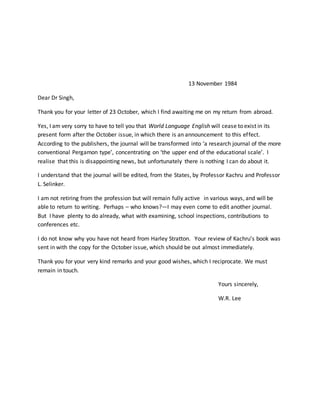
27.
November 9 ‘81
Dear R.K. Singh,
I opened your envelope fearfully, afraid I may have offended you with my suggestions for
emendation. Nothing is more private and personal than a poem.
About the title: as I told you, I have no very clear thoughts. MY SILENCE was a reaction against
FLAMING ROSES, which seemed florid for your poems.
Cid Corman is not a professor, but a deservedly celebrated poet/editor. I sent numbers 1, 9, 11,
and two others I did not mark. Corman has not chosen to comment. Don’t feel bad. He is a
very special editor with extremely strong biases about the nature of poetry.
When I came to read the poems, I found many more than 80 that seemed publishable. Those
marked OK are as acceptable to me as those in the first column. Many of them are longer, and I
was trying to save space to save postage.
What you could do, if you choose, is to print the very short poems two on each page, and have
room to fit in the longer ones, taking them in turn as they appear in the manuscript. I like some
of the ones marked OK fully as much as the others. In fact, it seemed that as I approached the
end of the script, the newer poems became very interesting, yet I didn’t wish to cut out any of
the earlier ones. In spite of my warning not to print too many poems, there’s no reason why
you shouldn’t have more than 80.
If I were you, I would keep the dates in your private manuscript and not publish them. Unlike
my book VD, yours is not a log of a specific, limited journey, and except for, possibly,
chronological order, there’s no need to supply dates.
Like you, I am poor at titles, and believe that many poets would better omit titles.
In 16b, by all means keep “methodically concealed,” as you should keep everything that strikes
you as right and important. Did you consider keeping “hidden” rather than “methodically
concealed,” which seems, perhaps, rather heavy?
In #55, my “slant room” was typographical. Sorry. Shd. be “moon”.
I intended the red circles for the word no, then found on turning the page that my red marker
had come through to the back-up page. P. 21, “messianic” was only for spelling, e not a, as you
had it.
From now on, for your book, you should be on your own, and should make decisions without
consulting further with me. Anything you decide on is right.
As for me, please don’t let me into the book at all except as you wish to acknowledge my
foreword if you use it. This must be your book, the final decisions all yours.
I hope you find a new job more to your liking and ability.
I do like the new poems, clean and crisp. Save them for your second volume.
Cordially,
Lyle Glazier
LETTERS: 1982: 28 – 30
28.
January 7 ‘82
My dear friend,
With every year our ages in years pull toward each other; though they will never coincide, our
differentials diminish, because youth is ephemeral and age is not, and you now grow older at a
faster pace than I do.
Therefore, if you can do so without harming your psyche, I suggest that it is time now that man
with a Ph.D. and a Readership in an Indian college should stop addressing me as “Respected Sir”
and use the name of “friend.” I recall so well, years ago, when I was young in Buffalo, being
summoned to the chairman’s office to hear him say, “This will come harder for you than for me,
but I would like it if from now on you will use my first name and I yours.”
So, please, my dear R.K. Singh, whom I very likely will not again see in the flesh, please do me
the honor of brushing away on paper that pallid fence of deference and accept me as your
friend.
I like your new poems, and it does seemto me that you catch the trick of diminishing the
adjectives, though as to that “eisonophillic” is quite mouthful.
I look forward to hearing that you progress in finding a publisher for your poems. For me it was
a long courtship before my first was published by Alan Swallow.
I wonder, did you ever feel, as I do, that in a sense each lyric is a kind of ejaculation thrown into
the teeth of fiscal social determinism? Each of the little poems comes out with a certain
formlessness as if it is important to keep from being academic.
At the telephonepole
kneesdefine
boneshiftpastprime
Day tipsto dark
yearto freeze
road tipsfromclimb
NextyearI
will driftwith
snowon that
saddle beyondthe
saphouse,itdoesn’tmatter
whoownsthe woods
That group of three poems-in-one called “Haying Season,” is as you guessed, difficult only in
particularity of allusion. A Bullrake is a tall rake, 6-feet tall, very wide at base, whose two
handles are bent till they join above the head of the small boy who usually mans this rake
meant for a grown man. The image is visual and refers to a real thing, a farm implement. The
men, too, are real. Perry was my father’s brother. Erwin, my grandfather’s brother. “Rowen” is
a second or third crop of hay. The grindstone is mounted over a trough filled with water to keep
the stone cool and moist for cutting & sharpening the scythe edge. The boy has to turn the
handle that turns the stone. His great uncle steps in to relieve him. “Mowing away” means to
unload the hay in the barn loft. The “lumbar of the hayrack” rides on the hay wagon floor.
When you write next, please give me more news about your wife and small boy. What a
wonder it is to have a child and how often the parents are too busy to enjoy to the full their
privilege. Sexual love followed by conception followed by childbirth must be the chief, perhaps
the only miracles, and yet they are all explainable by interlinking natural laws.
Affectionate greetings to your tripartite family—
Yrs.
Lyle Glazier
29.
January 28 ‘82
My dear friend,
Thank you for the salutation, which removes a load of undeserved false distinction. Among the
ways—in spite of your disclaimer—that young man catches up with the an old one—is that as
he masters his métier, he becomes the older man’s peer; as he superlatively masters his métier,
he can surpass his elder.
I enjoyed so much your open conversation about Bikku and Bulli. You know that it is a great
honor to have an Indian confide his wife’s name. I recall my thrilling astonishment when
Pandeya invited me to his house, where, after he and I lunched alone, he called his wife from
the kitchen and made us known to each other. That kind of distinction is prized because it can
be conferred, never merely “earned.” I like to believe that if I came to your house, you would
confer the same honor, and Bulli would be happy to have it so. And that, as when I visited G.
Nageswara Rao in Tirupathi, your son might climb in my lap and win the heart of the visitor as
Rao’s smallest son conferred that pleasure.
It is not important that we meet again “in the flesh.” Our meeting through letters is closer than
many friends get.
I hope that indeed, as I triggered your doctorate, I may have triggered your readership. I can
partly conceive of your suffering at the hands of your chairman, who is obviously a jealous man.
For years at Buffalo, I felt the animus of my chairman, after having for a half dozen years basked
in the affection of an earlier chairman who admired me. Survival requires holding a job until we
have another. This becomes more critical for a man with wife and child. As Ben Jonson
remarked, “He who has a wife and child has given hostages to fortune.” I’ve just had occasion
to review my years from 1942 to 1947, at 31 years until 36, when we were living in Boston, and
I taught at Tufts University, then moved to Harvard for fulltime graduate work and teaching
freshman English. We brought with us a small daughter of 2, and my wife during 5 years was
pregnant three times, once ending in miscarriage and twice brought to term, so that in Buffalo
in fall ’47, we had our full family of three daughters. I had finished my Harvard courses, and my
language examinations in Latin, French, and German, but I had not passed my oral examination
till May ’48, and didn’t begin to write my dissertation till early summer of ’49, getting my
degree in May ’50. Looking back now in fiction and poetry, I try to master those experiences.
I enclose a review of the poems of Genet, a result of considerable labor, because as I read the
two translations, I discovered that neither was getting near the full import of the French text, so
I had to make my own translation in order to make a judgment. I have read several other
reviews, all ecstatically praising the translators, and I wonder if any of the reviewers know
French.
Cordially to all,
Lyle Glazier
Thank you for explaining “eisonophillic,” for me an unknown word, and even more confiding
the intimate context, a context I comprehend from situations that were similar in their
difference.
30.
December 9, 1982
My dear Singh,
I haven’t heard from you in a long time and fear that you are in a blue mood, something that I
understand very well from my own frequent melancholia.
You have been an active presence here during the visits of some poet friends, who have
admired your book on my poems. What you said is very discerning.
I am trying to make a difficult decision. A young, and very intelligent scholar in Buffalo, has
been working for some time on what he calls a critical biography drawn from my poems. Next
year he intends to be on sabbatical for the whole year. The rather famous Poetry Room in the
library of the State University of Buffalo has agreed to accept my books and papers for their
archives, so that they will be where this young man—a good friend of the curator of the
collection—can have access to them.
In some ways I am glad about this, because it means that my writings will have a safe haven,
but I do fear I will miss them—and among them your cherished thesis—which has consoled me
many times when my spirits have been depressed. I have had your work prominently laid on a
small console at the door of my study, and many people notice it when they enter. Most of the
other books and papers have been set up on the third shelf of my bookcase, conveniently at my
elbow when I work at the typewriter. I can reach from my chair and pull out whatever book or
magazine or offprint I need.
But if they go to Buffalo, I will be lacking them. For example, yesterday I was preparing a group
of 10 poems to enter in a contest for a chapbook, and I could lean over to the shelf and find the
magazine that had published the poems.
On the other hand, at my age of 71, I must begin to think of a final resting place for these
papers. I may not have such a good chance again to place them in a library. They could
conceivably be burned someday to get them out of the way. At the Poetry Room they will be
cared for. I think I have made my decision. I have taken them down and stacked them ready for
putting into boxes. There are many more of them than I thought. Standing up on the shelf, they
make nearly a yard of occupied shelfspace. The most recent is a festschrift THE LAUREL
BOUGH, published at S.V. University in honor of the retiring chairman of the English
department, who has become Vice Chancellor. My contribution is the first passus of Langland’s
PIERS PLOWMAN translated. Dr. Sarma was a Milton scholar, and the Middle English PIERS
PLOWMAN has a passage on the fall of Lucifer and his legions. One line in it can be literally
translated “Nine days they fell,” as in PARADISE LOST VI, 871, so my translation could be a
tribute to the Milton scholar.
That book of essays was published in Tirupathi in August. Also just come is a review of James
Baldwin’s last novel JUST ABOVE MY HEAD, printed in the datalog of Giovanni’s Room
Bookstore. And there are my this years poems in ORIGIN and COUNTRY JOURNAL. If I send all
this stuff I may have no convenient copy of some of it.
You see the problem. When you receive an honor, it can turn into a hardship as well. So, when
you were invited to Birmingham, the invitation was an honor, but you were lonely without your
son and your wife, and the seminars or lectures turned out to be of small merit. In your letter
describing your visit to England, what seems to have given you most pleasure was your
stopover in Amsterdam. Even there, you were thinking, How much happier for me if my darling
Bulli were with me.
Please forgive me if I have already sent you copies of the three lyrics, my most recent
publications, in a magazine called THE COUNTRY JOURNAL, September, 1982, where the poetry
editor is famous—Donald Hall.
The Shanties (1916-1918)
1
Westwindowlookstothe river
beyondhouses
strungon the valleyroad
eastwindowlookstothe mountain
We hearthe drag of the saw
a longtime before
we see the dustcloud
A teamis unloadinginthe bay
Perrysnags logswitha canthook
Maurice issawing
PopbringsMayflowersinApril
swamppinksinJune
wildhoneysuckle inJuly
2
Schoolnightsearlytobed
fromthe upperbunk
we boyshear voices
above the pingof horsehoes:
“Keepyoureyesonthisone,Harry,
my ringerwill slip
betweenthe legsof yourleaner
withouttouchingahair”
3
Deadlevel
under apple boughs
April toJune ismuddy,
Mel & I carry lard pails
to the springbox,
the slope
spongywithbluets
A shanty is a one-room shack, like the one I lived in when I was 5, 6, 7.
A canthook is a pole with a hinged hook for catching hold of a log.
The bay is the area in a sawmill where logs are piled before sawing.
Horsehoes are used for playing quoits, throwing them at a stake. If one of them surrounds the
stake, it becomes a ringer, worth 5 points. If it leans against the stake so that you can get three
ringers between the top and the ground, it becomes a leaner, worth 3 points. If a new player
slips a ringer between the legs of a leaner without knocking it down, he gets the sum of the
points, or 8.
The spring box is a wooden box set into the ground where there is a spring of water gushing.
Bluets are tiny blue flowers with white centers. They grow in dense clusters, very fragile, close
to the ground.
Love to you three dear friends,
Lyle Glazier
LETTERS: 1983: 31- 35
31.
January 28, 1983
Dear R.K. Singh,
I have not done justice to your September letter in which you announce your wife’s second
pregnancy, and now I have the January letter telling me that Bulli and your son have gone to
your mother in Patna, where they will stay till the baby is born. I am not sure of your age, but
these letters carry me back to the ‘40s when we were having our children, and I was beginning
my graduate work, first at the Bread Loaf School of English in the summer of 1941, and then
from 1942 to 1950 at Harvard, when I went up to teach at Tufts College in Somerville (greater
Boston) and was only five miles from Cambridge, where I went to teach in 1945.
I was 29 years old in 1940 when Laura was born in Lewiston, Maine, where I was teaching at a
small college, and where Amy came after two years – in 1939. We had planned not to have
children till I finished paying my college bills, which had remained unpaid, partly because from
1933—when both of my parents committed suicide (my father having lost his job in the
Depression) and from then on I had the care and support of my youngest brother, 13 in 1933,
who came then to live with me. He was with me for a year in Middlebury, where I had stayed
after graduation from college, and was janitor of a community house. In 1934-5, he went with
me to Northfield, Massachusetts, where I was principal of a grammar school in my home town.
Then, in the fall of 1935, I went across the river to become housemaster in Mount Hermon
School for Boys, and Larry came with me and got tuition free because I was a teacher. He
remained there another year and I went to teach at Bates College in Lewiston, then he went to
Middlebury, where I helped pay his tuition. He was drafted into the air force in 1942, and when
he came back from the Pacific war against Japan, he had saved most of his pay for 3 years (no
place to spend it in the islands) and also had the G.I. Bill funds for veterans to pay for his
college.
I hadn’t intended to go in to all that about Larry, but it had to do with our marriage and feelings
about the first baby, because it explains why we were so determined not to have children for a
few years. But in spite of the advice of a pediatrician, Amy’s protection against pregnancy
didn’t work, and very soon after our marriage she was pregnant. She was very unhappy about
it, and tried by pounding herself to abort, but fetuses are hard to dislodge. I suppose I was
grudgingly glad to know I would become a father. By 1943-4, when Laura was 3/4 we were well
enough settled in Boston to decide consciously to have a second child and set out to have one.
Susan was born in April 1944. Three years later in Buffalo, where we had just moved from
Boston, and still 3 years before I got my degree, we had the third daughter Alice. I was 29, 33,
and 36 when our daughters were born, and 39 when I got my degree.
In one way we differed from you. Amy did not go from home to her mother’s for any of the
births, but remained always with me to the end. Even so, it was before the days of father
participation in childbirth, so I was firmly excluded from seeing the child born or having to do
with it till we got it home.
I had had a good deal of experience helping with babies at home, and taking care of small
cousins, so as soon as the baby came home, I helped with its care, able to do more because
Amy never had milk enough to feed the child, so it was put on formula from the start. I could
even get up for night feedings.
From all this you see why your last two letters about Bulli’s pregnancy were especially
interesting for me. Please, if you don’t mind, tell me in your next letter how old you are, and
how old you were when your son was born. And please, if you don’t mind, instead of writing
“my son,” always when writing to me, mention his name. I want to have you print his name on
my mind through your letters, and your wife’s name, and the name – in time—of the new baby.
They must not remain abstract.
I read your three new poems with interest (996, 991, 990). In 991, did it occur to you to say “is
within me”? That would be simpler and more direct, less “poetic” in the wrong sense of what
poetry ought to be. #990 is altogether perfect, very transparently simple and therefore
profound. One small thought: You could even leave out the word “through” in the second line.
Thismoment
visitsthe dark
alleysof mybody
as a guestsleeps
Beautiful, and the two lines about your son make exactly the right turn.
I work here in the basement study nearly every day and usually find something to work on. I
am still working on short stories, also working once more on the novel, this time having decided
to go back to the original six chapters that I had with me when we met in New Delhi in 1974.
This means that the five chapters set in between each of the other pairs can be revised as short
stories. One of my friends, a professional editor for scholarly criticism, has objected because,
he says that I have tried to combine two elements that won’t coalesce. In his field—Spanish
literature—there are domestic novels (about family life, of course) and picaresque novels
(rebellious and neurotic), and I made the mistake, he said, of trying to include both in one book.
He could show me how to make two novels, two successful novels—one domestic, one
picaresque-- out of my one failure. I tell him that the story of a married homosexual who truly
loves his wife and children, yet is driven by compulsive homosexuality, is exactly the
combination of domestic and picaresque, and I would rather fail with my ground than succeed
with his simplified texts. My hero engages in neurotic homosexuality, then returns home to
feed the baby and have sex with his wife. Nobody, I think, has yet published such a novel, yet
it doesn’t mean that there are no married homosexuals.
Yrs,
Lyle Glazier
32.
March 25 ‘83
Dear R.K. Singh,
When your letter came, I went to the typewriter to answer, but something interfered ( I’ve
forgotten what) and it is delayed far too long.
Your mother’s death makes me think how inevitable death is for all of us. I have been
anticipating mine without grief in the thought. It is merely an inevitable Passover – as I think of
it—from life as a human being to life as part of the larger world , no longer conscious of myself,
but in the great stream of nature. Perhaps I sent you my poem written when I thought about
my death:
Stopping in woods…
NextyearI
will driftwith
snowon that
saddle beyondthe
saphouse,itdoesn’tmatter
whoownsthe woods
A saphouse is a house for boiling down sap from maple trees to make maple syrup, the sweet
syrup North American Indians taught Europeans how to make. We have such a house in the
pasture and behind it a woods with a road winding through it, and along that road is a place
where Mayflowers grow in early spring. This is where Amy and I have instructed our family to
scatter our ashes after we have been cremated. There will be no burial rites, but if sometimes
later, the family wants to meet for a loving memorial service, we are happy to tell them now
that the thought pleases us.
The title of my poem comes from the title of a well known poem by Robert Frost, “Stopping by
Woods on a Snowy Evening:”
Whose woodsthere are I thinkIknow
hishouse isinthe village,though
He will notsee me stoppinghere
To watch hiswoodsfill upwithsnow…
Unfortunately I do not have a picture of myself to send Bulli at the moment, but perhaps I will
have one by the next letter.
By now I suppose you may have another son or daughter. I recall so well the strain of
childcarrying and childbirth when you are young and poor, as we were when Laura was born.
Amy had planned not to have a child till I was through graduate school. Then we had Laura the
first year, and Amy had to stop teaching in order to bear her. It was difficult for Amy, but as for
me I was happy in a way to have a baby. All fathers, perhaps, are glad to know they are fertile.
I think when you have the baby home with you, you will be happy to have (him/her). Babies
are so enchanting it they are well. They make us forget our anxieties for ourselves and transfer
the anxieties into love and planning and hoping for the happier life for the baby. Bikku will like
to have a young brother or sister, if he is not jealous. Even if he is, he will learn. Jealousy is
natural for the first child when the second comes. Please tell me whether Bikku is a formal
name or a nickname. It sounds loving and intimate.
I cannot suggest a name for you. Ours are so different from yours. Our youngest daughter
Alice, changed her name to Alis when were in Turkey in 1961-2, because that was the way Turks
spelled it, and with an accent on the second syllable, where the British/American accent is on
the first.
I like your two poems about the train moving until the thief steals the tracks, and now that will
it do? Also the one about the monkey with snakes in the lining of his coat.
I will copy you one of my recent ones:
Saw River Bottom
Bare underoveralls
my cousinandI
are skippingstones
inthe shallowsbeyondthe coalkiln.
“You have a better
arm, your muscle is
better.Letme feel
your muscle.”
“The trickis the stone,
finda flatone,
layit flat,itought
to kissthe water.”
Kiss,kiss,kiss.
“Let the stone kiss
the water.Lookit,
like this.”
“Like this?”
lipsparted.“Lookit.”
My flatstone isskipping,
skipping…
Affectionate greetings to you all.
Your friend
Lyle Glazier
33.
May 7 ‘83
Dear R.K. Singh,
If there is a book on revising a thesis for publication, I don’t know it. The most important hurdle
is to get a publisher to accept the script and to find somebody to pay the bill, and you have
achieved these goals. Congratulations. I never was able to change my Spenser thesis enough to
get it published, though two chapters did get published, revised. My revisions for those
chapters involved absorbing as many footnotes as possible into the text, and omitting some
others that would not be needed by a general reader. That is probably the chief change that
can be made—to adapt a scholarly book for a general audience. The bibliography at the end
can provide the scholarly look. I don’t think that you will need to make major changes. The
object should probably be to make the book more readable, less a compendium for scholars to
consult. Not having had your success in finding a publisher, I am not the one to advise you. A
short time ago I received from K.S. Misra his TWENTIETH CENTURY ENGLISH POETIC DRAMA,
Vikas, New Delhi, 1981. It is quite heavily footnoted, and I doubt if there were many changes
from thesis to book. If you are planning to omit one chapter, you are already making a major
change which may be sufficient to persuade your publisher that you have done your publishing
homework.
I have been reading about pirated publications in India—how some publishers reprint foreign
books changing only the name of the author. Does much of that go on? K.S. Misra asked me to
send him a script of my unpublished GREAT DAY COMING—on Black American experience in
books by both Black and White authors—and I sent the script two years ago, but have never
heard it has been published. My script was accepted by a reader at the Univ. of Massachusetts
Press but then turned down by a faculty committee as “controversial,” then at Yale University
Press, it was liked by the editor but turned down by a scholar, who felt it was publishable but
not at that time at Yale. Hacettepe University Press in Turkey would have published it in 1971,
but I never submitted it there.
So much for academese.
I loved your letter with all its talk about little Winny and Bikku and Bulli, and I like to have your
formal names, and your won nickname even if I never use them. The story about Bikku’s
jealousy at the thought of a brother and delight to have a sister—how charming it is, and so
humanly universal. I like to hear about the children, about Bikku’s starting to go to school.
What a cycle we families go through. I read about Bikku going to school and I remember my
first day in school, when I was five years old. At recess I walked down the road with other
children, feeling very grown up. When I passed a small playmate, in his dooryard, not yet old
enough to be a “scholar” (our word for school children), I patted him on the head. One of the
older girls ran back and told the teacher that I had struck Kenneth Leach, a I was afraid and ran
over the hills toward the shanty (the logger’s hut) where we were then living while my father
worked in a travelling sawmill. One of the big Polish boys followed me and brought me back on
his shoulders. The teacher understood that the big girl was a tattler, and I was not punished
until I got home, where older brother Melvin (two years older) who had not seen the incident
but only heard the tale-bearer, told my mother who told my father how cruel I had been to the
little boy. When my father came home, I was spanked even though I was crying already, “I
didn’t do it! I didn’t do it!” Melvin was jealous of me, the second boy, in the same way Bikku
would have been jealous of a little brother. Melvin would all my childhood treat me like a
slave. Last month I wrote a poem about it:
Baseball practice forMel
fromthe time I was five
catchingwithouta mitt
chasingwildpitches
downthe dirt road
to the culvert
and expected,onthe wayback
to throwout my arm
I was Mel’s adoring slave until we went to Middlebury College as freshman classmates and
roommates in 1929. There we lived on the third floor in a stone dormitory built in 1800. The
shower was in the basement. If Mel forgot to bring up his towel, he would say, “Lyle, I left my
shower towel downstairs,” and I would go get it. One day he said, “Lyle, ‘I left my towel
downstairs.’ I was studying and paid no attention. “Lyle, my towel is still in the basement.” I
didn’t raise my eyes. “Lyle, I’ve already told you twice! I left my towel in the basement!” I don’t
recall what I said if I said anything, but at eighteen years old that was my declaration of
independence. Mel punished me for his jealousy by making me his all too willing slave.
Your story about Winny at night – “She keeps us awake, for she wants someone to talk to”—is
exactly what we had with Alice, our third daughter, who was born in Buffalo in 1947. We were
living in a tiny house with two small bedrooms, in one of which Laura (then 7) and Susan 3
slept. Alice had to sleep in a crib crowded close to our bed and every night she would wake
after midnight and start talking and laughing and singing, until finally we would get up and carry
our bedclothes to the living room couch. After two years, when I knew I had tenure, we bought
a house in the suburbs—a very large house with an upstairs which had a large hall and four
bedrooms one for each daughter and one for us. It was a lovely place for children, an acre of
ground, with a good garden and flowers and trees, so different from the shanty I lived in when
a child and the rickety house we then moved into—though as for that, although we were poor
and my clothes were ragged, we lived in wonderful mountainous country, with troutstreams
and a river a half mile away—the ideal world for a small boy. I was a good boy when I was
watched, and a hedonist when I was not. As for that, I am sure my mother saw more than she
mentioned, living by the rule, “have ‘em, love ‘em, and leave ‘em be.” She was a little woman,
small enough to stand under my shoulder:
Runninghome forlunch
crossingthe little bridge
beyondFrankHowe’s
visualizing,onthe rise,
Mom’s eyesatthe windowjog
facingnortheastalongthe barn door—
so shortshe’dbe lookingunder
the double middlejoint
betweentopbottomsashes
I’m writing on back of a Xeroxed copy of a childhood poem, the Xerox made so the inmates
would have a copy when I gave a poetry workshop last month at Franklin County Jail in
Greenfield, Massachusetts, where Alice, that little girl now 35 years old, is conducting classes to
help inmates pass high school equivalency examinations for high school diplomas. I was there
on Good Friday in April, and about 15 young men came to my workshop. I was apprehensive,
never before having read poems to prisoners, but they were very well behaved, attentive and
interested (asked good questions, as intelligent as any good high school or college freshmen
class). Of course, they knew that if they misbehaved they would be locked in their cellblock.
Most of them were in jail for petty crimes like Driving while Drunk, or possession of Marijuana,
or perhaps violence in the family. All of them, I’m sure, thought they were guiltless and blamed
society for arresting them. Anti-Establishment, myself, I could identify with them more than
they realized.
Last week I drove two hundred miles to read from my new book AZUBAH NYE at the Bellevue
Press in Binghamton, New York, near the Pennsylvania line, southwest of Albany. There I began
with a first draft and a final draft of “Saw Mill River Bottom,” that poem about skipping stones.
It is supposed to be a happy poem. The younger boy is admiring his older cousin. When he
hears, “Kiss the water,” he begins to come emotionally alive and thinks Kiss, kiss, kiss as if
reflecting Girls, girls, girls. I think something like that is happening.
You ask me to send the full poem “Stopping in Woods…” You have it all. I enclose the poetry
postcard that was sent for an invitation to guests asked to come to my reading.
I was much interested to read how your wife went home to her mother to have the baby. So
different from here. When Laura was born in 1940, we were living in Lewiston, Maine, 300
miles from Amy’s home in Bennington, Vermont. Amy went to the hospital in Lewiston on a
hot day in mid July, and there Laura was born in late night July 31. I brought them home after
three days, and after a week Amy’s mother came for a visit. Susan was born on April 15, 1944
in the Boston Lying In Hospital, when I was teaching at Harvard, and Alice was born on October
31 in Buffalo in mid afternoon. A neighbor had come in to sit with Amy, and I had gone to my
afternoon class. Toward the end of the hour, the department secretary knocked on the door,
and whispered that I had a new daughter. I went to the blackboard and with chalk wrote in tiny
letters, too small for them to read, “I have just become a father.” Then I collected my books
and papers, and left, while behind me the students gathered to read my message.
If the children were born today, I would be welcome in the delivery room, invited to watch the
birth. But thirty years ago, I was not welcome. In Lewiston, in 1940, I was allowed to sit by
Amy’s bed while she tried to drop off to sleep. The nurse didn’t think a father had a right to be
there. She kept coming in to check on me. Amy had just said, “I think if only you would lie on
the edge of the bed and hold me, I could drop off to sleep,” when the nurse burst in like a
hornet and ordered me off the bed and out of the room, “And I don’t want to see your face
again till after the baby is born!” She thought I had designs on my wife.
Affectionate greetings to you all—you, my friend & Bulli, Bikku, & Winny
Lyle G
34.
June 29, 1983
My dear R.K. Singh:
I’m sorry I got off my letter of June 24 before reading your “SAVITRI: An Overview and a
Summing Up” as it appeared THE CALL BEYOND. Your Conclusion is so well written and such a
good summary of Aurobindo’s intentions and techniques (insofar as I comprehend them) that
you make me wonder why you need an occidental commentator to intrude with ill-digested
observations about a work, which, as you say, “has …brought to bear the whole course of Vedic
and Upanishadic mythology as well as the Eastern and Western classical learning… on the
appreciation of its dense spiritual texture.”
Do you really comprehend how good that is, and how nearly impossible for an American to do
justice to it?
I have felt all along from my reading that your chapters are both descriptive and informative,
and that an Indian publisher ought to be alert to the extraordinary merit of your thesis.
What you say about the plan of the epic, and its cogent execution is, in my opinion, just right,
and if what I am now saying can be of any service to you, by all means make use of this letter.
All along, my criticismof Savitri has had to do with its poetic texture of rhythm, imagery, and
language, where, I feel, Aurobindo fails to persuade me that he has mastered English idiom.
Along with his effects of grandeur, Milton (Aurobindo’s professed master) never forgotwhat he
said in his essay OF EDUCATION (written when he was 36) that poetry ought to be “simple,
sensuous, and passionate.” Those virtues are not SAVITRI’s; yet, accepting its dedication to the
OVERMIND (or OVERHEAD), no one, I think, could do fuller justice to the epic than you have.
Yours,
Lyle Glazier
ProfessorEmeritus(English)
State Universityof New Yorkat Buffalo
35.
August 1, 1983
Dear R.K. Singh, my good friend,
Having received your letter of July 9, after you got mine of June 24, I waited to hear whether
the letter of June 29 reached you, because it was written after I received the Conclusion of your
book and wrote you how impressive I found it. In that letter I hoped you would find an
expression of admiration that might help you negotiate with a publisher.
In many ways, your experience with SAVITRI matches mine with Spenser’s FAERIE QUEENE. I
needed a subject for a thesis, and had one started in earlier papers on Spenser, and—prompted
by a remark of John Crowe Ransomto “get on with the doctorate no matter what you choose
for a thesis—it doesn’t matter—just get it over with so that you can have the degree and go on
to what you become interested in.”
That is pretty much what happened to me. I had no sooner finished the thesis and had a couple
of articles from it published, than I got into American Literature, and Spenser seemed a long
way off. Furthermore, I had no interest in writing any more about him, having exhausted what
I had to say. It was only years later that – to my surprise—my thesis was rediscovered and cited
as a germinal study of Spenser’s treatment of the war between good and evil for control over
the human spirit – in SOURCE AND MEANING IN SPENSER’S ALLEGORY by J.E. Hankins, Oxford
U. Press, 1972.
With your interest in writing lyrics, I doubt if you will devote your scholarly activities to
becoming a disciple of Sri Aurobindo. I think you are too much concerned with the day to day
life in India to be diverted to that kind of elitist propaganda for letting problems be solved by
the Overhead. At the same time, as a study of SAVITRI yours is excellent and deserves
publication, and I hope it will be published. What I tried to say in my last letter was that as
someone on the outside I could not pose as sharing the admiration for Aurobindo’s poetics,
that quite naturally in the course of your study, you were indeed to promote. In the same way
my chapter on Spenser’s “centripetal Imagery” (published as an essay in Modern Language
Quarterly in Dec. 1955) is more flattering toward Spenser’s technique than I probably could be
today; it is something I would not even want to reconsider. And I expect that you, too, having
achieved a distinction with your thesis beyond anything I achieved with mine, will someday look
back on it as a stepping stone toward achievements in other areas of research, and creative
expression. You would no more write a SAVITRI than I would write a FAERIE QUEENE.
I am glad you included a lyric “woodening house”—which I think is a good sign, even though I
don’t think that this one is one your best, and I say that realizing how, if you are like me, it is
not easy to have some one say that the last poem you written is not your best. I go through
spells of weeks and months when I hardly write anything worth salvaging, jotting down finger
exercises, hoping they may be better than I think they are. It is part of the writing craft to turn
out such practice pieces. But you have done much better poems. The phrase “tenebrous void”
is poetic in the worst sense. It doesn’t sound like something you would say to your wife or your
friend, and poetry has to come from the real language of talk between people. I think there is a
poem behind “Woodening House” that doesn’t get written.
I doubt if you have suffered a great loss in not having Menke Katz for a sponsor. Partly because
I wished to do anything possible to support your relationship with him, I sent him – not a poem
as a submission, but my book TWO CONTINENTS, that I once sent you. In his note to me, he
suggested that we exchange publications, but I have not heard from him since, and assume that
he did not appreciate my kind of poetry. No more do I appreciate his rather grandiose pose of
being a seer or a Prophetic Voice. I would have liked very much to have seen his poems about
his childhood in Lithuania if he had sent me a copy.
Recess
Scholarsat NumberFourschoolhouse
streamingintothe road
scratchingthree linesingravel
for pompom pullaway
dartingto cheat the jailor
fakingtohelpa friend
bigboysare last onescaught
At noontime boysgulpsandwiches
linkhands,wheel inaline,
crack the whiponthe endman
for everthrownend
overend,girls
eat lunchwithMissDalton
At half pasttwelve
everybodyplayshideandseek
“anybodyhangingaroundmygoal will be It!”
Last minute activitybehindouthouses
underbrushpiles,onthe topstairs
of the fire escape
“Move over!”
“Findyour ownplace!”
“He’sin there witha girl!”
Miss Daltonringsthe handbell
“Gobble gobble infree!
Come on Frank,Elizabeth!
I knowwhere youare!”
Yours most cordially,
Lyle G
LETTERS: 1984: 36-39
36.
January 27, 1984
Dear R.K. Singh,
After several day’s delay and considerable thought, I decided to take your suggestion to write
Dr. V. Rai about my black literature manuscript. I would have no objection, in fact would
welcome it, if Dr Misra is able to have my book published at Allied Publishers. My only
frustration, as I told you, was having so much time pass with no report on his negotiations. I am
writing Dr. Rai today telling him this. I would not do anything to interfere with a bona fide offer
for publication, if Misra is able to get one.
You had every right, after reading the last paragraph of my last letter, to intercede in my behalf,
yet on reflection, I realize that to withdraw the manuscript—if Misra does succeed in getting a
favorable reception—would cancel out my own effort to have the manuscript Xeroxed and sent
to Misra in the first place. If he can get a publisher for it, that is what I intended.
Please do not continue to press me to review your book. I will be happy to have a copy if you
send it, but I cannot review it. Reviewing is an art that should be practiced from strength, and I
have no strength as a reviewer. Nor any prestige or claim to authority when it comes to judging
Sri Aurobindo. I realize this more and more as I read what you write about him.
I never had reviews for my books except rarely—one for ORCHARD PARK AND ISTANBUL in the
Buffalo newspaper, and another in a review at the University; none at all for YOU TOO, VD, and
THE DERVISHES; and two for TWO CONTINENTS. None in influential publications. My feeling is
that if ever my work achieves sufficient substance to merit wide recognition, it may get it. Or
may not. There is a lot of luck in such matters. But my main job is to promote my writing by
writing. Let the reviews come as they may from people who have enough interest to do the
reviewing without prompting from me. I have been surprised, always, and of course delighted
to get recognition, like your thesis, which came as a great surprise when I heard what you were
engaged in. I was flattered and pleased, but I would never have suggested to Pandeya that he
encourage one of his graduate students to write a thesis on my poetry.
Speaking of Dr. Pandeya, you haven’t mentioned him in your letter. Was he there when you
visited Varanasi? The last you wrote me was disturbing, how his students had repudiated him
and his chairmanship was in danger of being revoked. That seems such a miscarriage of justice,
for from all that I know of him, he is one of the best teachers and most thorough scholars I met
when I was in India. And I considered him my good friend. Yet, except for your unhappy news, I
have heard nothing from him in three years.
I continue to write anti-Reagan, and hope there is chance that he will not succeed in being re-
elected, but many Americans like him for his militarism, believing that he is making the US
strong and respected as a great Power. After being an Independent for 50 years, I am now on
the Bennington County Democratic Committee, working to defeat Reagan, but I do not
underestimate his cleverness and the greed and skill of his cronies.
Yours,
Lyle Glazier
37.
April 16, 1984
Dear R.K. Singh,
I have had a letter from your publisher that two copies of your book are being sent me. I will
read them with interest, and if there is somewhere I can review, I will. I have just renewed my
subscription to BOSTON REVIEW, thinking that perhaps that magazine would be interested in
your work. I have no doubt of the excellence of your interpretation. If the copies come by
overseas nonairmail it may be some time before I see them. It is a good book. You must be
happy at the thought of its being in print. I hope your reviews will reflect your long and serious
efforts, giving you the credit you deserve. And, as I say, I will do what I can for you here.
As for your own reviewing, I think you are doing just right. You learn by reviewing, particularly
as a young scholar this is important. Only old fogeys like me can reach a point where they can
afford to be choosy, not wishing to get up another new subject in order to review it. But in
your case, I do feel different, because, for one thing, you have been educating me on SAVITRI
for a long time, and took the trouble to send me a copy of the epic.
I become more and more disturbed at the thought of what may have happened to Dr. Pandeya,
an intelligent and humane scholar if ever I knew one. I cannot comprehend what has
happened. I do not ever hear from him now, although I have written to him a number of times,
only last February to recommend a colleague of mine who was traveling from Buffalo to
Banaras to read poetry there. He wrote that he was unable to find Dr. Pandeya. Let me ask
you this. When I was at Sana’a University teaching American literature, Dr. Pandeya attended
my classes. I illustrated the American imperical method of teaching, insisting that my students
read the poems and stories we were discussing. Every day I began with their criticisms before
branching out from what they said to what I myself had to say. Dr. Pandeya seemed much
struck with the method. Do you think there is a chance he tried to introduce that method at
BHU and his students revolted? I know that in Turkey it was new for my students to have to
read what was being lectured on. I carried enough books so that everybody had a copy.
I am sure that at ISM you have the same problem scholars have all over India, especially at the
smaller institutions. There may be only one library in all India, where, say all the novels of
Thomas Hardy can be found. So the director of a thesis, for example, may have to travel to that
library if he wishes to keep up with his student. Your choice of Aurobindo and of your method
proved to be excellent, because your chief resource was the epic itself. Not that you didn’t
work hard to cover secondary research. But like me, your interest was chiefly in your own first
hand examination of a text. I doubt if research of that kind will ever go out of style.
Yes, I am strongly anti-Reagan, for I think he believes that the rest of the world ought to bow
down and worship American business enterprise, and that American ought chiefly to protect
their own interests. He has no idea that Hindus are people, or Moslems people, or Central
Americans are people in their own right, and deserving of their own privileges without the
assistance of US military force. Right now I am organizing supporters of Jesse Jackson for our
Vermont Caucus. Jackson is interested in people, people of all ethnic backgrounds, all
nationalities, rich and poor, particularly poor and underprivileged. The US is not at the mercy
of Republicans only. Too many Democrats support the upper class privileges. We are far from
being democracy except in our political structure, which has the trapping of democracy without
always having the spirit of sharing.
I always enjoy your poems, and enjoy the two in your last letter.
I understand #1941 without agreeing with it, except possibly with your privilege of describing a
particular homosexual couple, and understanding that not all homosexual unions need be
sterile. Though they will not have children, homosexual lovers may be creative, as, for example,
the union of Walt Whitman and Peter Doyle was creative if it produced some of the beautiful
love poems of Whitman. I myself am critical of exclusive homosexuals when they are only
dilettantes, when they produce nothing. But I would not—as you do—measure them on
whether they will get to heaven. I have never yet read a description of Heaven (Christian,
Moslem, Buddhist, Hindu) that makes me want to go to such an exclusive, prestigious
gathering. I like better the thought of melting back into the soil and becoming part of it.
What I remember
of the teenager
whoseducedthe
five yearold
inthe double bed
of the little chamber
at Gram’s
--eager,
and afterwardstyrannical
“Don’t you tell yourGram!”
Was fearfor himself only?
nextspring
he was gone to hismother,
I spenthours
travelingroads
intowoods
hopingtofindanybody
anybodylike him
tenyears
until Iwas a teenager,
mindfull of hisphallos,
leptat the thoughtof him
readyingforhim
Yrs.
Lyle G
38.
July 5, 1984
Dear friend, R.K. Singh,
I apologize for not writing sooner. You can’t imagine how busy I’ve been. I excused myself with
the poor excuse that I had not received the copies of your book promised in a letter from
Prakash Book Depot, dated 3.4.84, and returned to them for more postage. I begin to think
they must have sent the package by sea mail, and that can take forever.
I got involved in the Jesse Jackson campaign in the presidential election, and finally became the
author of a proposal by which Vermont became the first state to grant him the delegates he has
earned for the national convention at San Francisco next week. Last summer Mondale and his
supporters, knowing they were the only candidate to have an organization in every state,
persuaded the Democratic National Rules Committee to pass a rule that a candidate must
receive at least 20% of the votes in a state primary in order to win delegates to the national
convention. I circulated a petition for a rules change in Vermont, writing to every prominent
democrat in the state, and then making a speech at our state convention, resulting in our
changing the rule so that Jackson got 3 out of 17 delegates. A lot of other people worked for it,
so I don’t deserve too much credit, but I am happy with the outcome of my first year as a Party
member, after 50 years of being an Independent. It’s not that I think Jackson should be
President, he has given up hope for that, but I want him to have firm support for influencing the
Convention to a more liberal stand on platform issues, and for his excursions into international
diplomacy. He is doing well. For the first time I begin to hope that there is a chance Reagan
can be defeated.
The second thing that has taken my time has been trying to work on my poem AZUBAH NYE,
which will now appear in ORIGIN magazine in early fall. I will try to send you a copy. I gave a
reading last June 21 at the little schoolhouse in Massachusetts, where the events of the poem
took place. All my relatives were present as well as other friends I hadn’t seen in 50 years.
Right now I’m getting prepared to go back to teaching next fall—to teach a course in Richard
Wright, the great Black American novelist, who spent his last years in Paris. In organizing
Bennington delegates for Jackson, I got acquainted with students at a small college here, and
learned that there were no course sin Black authors at their school, and offered to give one,
and perhaps finish the book on Wright and Melville I started when I taught a graduate course in
those two authors in Buffalo in summer 1974.
On May 1, our youngest daughter Alis came back from Jamaica, West Indies, where she had
been teaching since December, and stayed with us while preparing the introduction to her
thesis on problems of teaching English to Creole-speaking Jamaican children. On last Sunday
she left to return for a year.
She’s 35 years old, still very beautiful, intelligent, but lonely. She wants to find a good man to
marry. Men take advantage of her. I’m afraid she will take chances with one of the handsome
dark skinned men who will make trouble for her. You know, that dark skin does not trouble
me, but poverty can drive a man to take chances in order to get money from a woman, and
loneliness can make a good woman his prey. Neither at fault.
I was really pleased to have a copy of POETRY TIME with my translation of Baudelaire’s
invocation to the Reader for his book Les Fleurs du Mal. The editor of a small magazine here has
also written about his interest in having these translations but I am happy to have the sign of an
interest there, also.
It was a special pleasure to share space in the issue where your good poem appeared, so that
we are collaborators in the magazine.
By now your news in your April letter is so far back that you will have covered it over with
better news, I hope. It was painful to read how you had to go through that arduous time of
forced abortion. I hope that Bulli has fully recovered, and that the children are both now in
good health. I know what it is to have an unexpected pregnancy, for besides out three
daughters, Amy carried one child to term (born dead) and another into several months before
miscarriage. Such things are difficult to endure.
This morning is the first I have had to begin to clear up a large backlog of letters that have piled
up since April. Yours is one of the first.
If your book does not arrive soon, I have thought of looking back over the chapters you sent me
to see whether there is enough there to furnish a clue. I would rather see the whole, of course,
before deciding whether I know enough to review it.
Not one word from Dr. Pandeya. I fear he has suffered a great blow. I respect him more than
any other professor I met in India in the time I was there (1970, ’71). I cannot imagine what
happened.
Cordial greetings,
Lyle Glazier
39.
August 30, 1984
Dear friend R.K. Singh,
After wracking my brains for a long time I have come up with a review of sorts, thanks to your
thesis, which for the first time made it possible for me to follow the thread of the narrative and
the theme. I am afraid that you will find my review very simple and innocent of insights. I am
not satisfied, but rather surprised that I was able to get this much done.
I have sent a copy under separate cover, mailed this morning. As you will see, I felt that
Americans would need a double review of both the epic (and the letters on the epic) and your
thesis. I hope that you won’t be disappointed and that for you my admiration of your work will
come through.
Yesterday I had an acceptance from a very good critic Donald Hall for the Country Journal,
which liked the lyric “Sugaring off.” Also I’ve been invited to State University of New York at
Buffalo on October 2 to read my “folk epic” (as I call it) Azubah Nye. They pay air flight & $200,
not great but good. Donald Hall’s magazine pays $50, enough for me to rent a car while in
Buffalo.
Please write me what you think about the review.
Yrs.
Lyle Glazier
LETTERS: 1985: 40 – 41
40.
January 31, 1985
Dear R.K. Singh,
I am so glad to have your poems MY SILENCE. They seem as fresh and pure as if I never saw
them before. You give me far too much credit, for the poems are fully yours. Even the title is in
the poems, repeated several times. I your friend Krishna Srinivas wrote a fine preface, and I’m
so glad he found a way to incorporate my single sentence, which I had forgotten till I see it
again. How clever of somebody to have noticed that by rearranging it could become a lyric. I
am proud to appear on your back cover.
I have been silent so long because I wanted to send word that I have placed my review of
SAVITRI, but so far no such acceptance. I sent it first to BOSTON REVIEW, from where it came
back with a printed rejection, then to AMERICAN BOOK REVIEW, where after two months it
came back with a generous letter that although they admired it, it seemed on final judgement
to be too specialized for them. It is now at U. Michigan’s JOURNAL OF SOUTHEAST ASIAN
LITERATURE, a suggestion of yours. It has been there more than a month. Competition is fierce
in the US; nothing moves fast.
By now you should have ORIGIN magazine Fifth Series #4, sent you at last 6 weeks ago airmail,
with my narrative poem AZUBAH NYE (26 pages). There are also 25 prefatory lyrics to the
narrative, most of which have appeared in earlier issues of ORIGIN, some in COUNTRY
JOURNAL, one more in the JOURNAL for March ’85, arriving in yesterday’s mail. A
publisher/editor in Brattleboro, Vermont—40 miles from here—has written for permission to
print all these lyrics in a small booklet. The whole poem—narrative plus lyrics—has been sent
at the suggestion of Cid Corman (editor of ORIGIN) to his friend Allan Kornblum,
publisher/editor of Coffee House Press, a very good place. I wait for his decision.
Also a novel dealing with some of the material is being read by the publisher of Millers River
Press, with headquarters near the scene of action, the locality where I grew up. And my short
novel STILLS FROM A MOVING PICTURE is being read by another publisher/editor, who is
interested in it but not sure if he can handle it.
Most of my time this past year was devoted to anti-Reagan campaign, and lately to a
Bennington squabble to get rid of a corrupt superintendent of public schools—many letters to
the BENNINGTON BANNER, and some very bad feeling stirred up between those who attack
and those who support the superintendent, a lot of spent emotion, and I at the center of
controversy, which seems on the way of settlement, because just this week the man has
resigned as of June 30 next.
One more thing: It can remain a secret between us that the quotation from your published
thesis as quoted in K.S.’s last paragraph, came from my essay in STRAIT magazine. I spotted it
when I first read the thesis.
Congratulations on your honorary title…
Yrs. cordially,
Lyle Glazier
41.
May 8, 1985
Dear R.K. Singh:
Will write a short letter rather than wait for time to write a long one. Very glad to have yours
with your news, the last one from Vienna, where Amy and I were for a week in early summer
1969. I’m glad you can travel even to a conference that does not wholly please you.
Thank you for several letters and all your news. It’s so good to know you will have a second
book. I’m happy for you.
My spring has been very busy. Teaching 4 tutorial students has taken time, all four reading a
different track—“feminist literature,” “classic novels of American 19th century,” “Black authors,’
and Dante’s INFERNO.” The last, especially has been a lot of work. I insisted on a bilingual
edition with notes, so that we could follow the Italian even though it is a language neither had
studied. But the prose translation close enough so that it was possible to follow the original.
Thank you for finding a publication for my Baudelaire poem. I may have told you that a
publisher near here in Brattleboro will bring out my 25 prefatory lyrics to AZUBAH NYE next
January. Then I will hope to have a publisher for the whole book, the narrative and the preface.
Also, I go to Greenfield, Massachusetts next week for a conference with another publisher who
would like to bring out my novel SUMMER WITH JOEY on the summer of an eleven year old
boy, 1920. I am not sure he can find funding.
Letter
Li Wang Chento a Widow
“Let us comfort
each other.”I
believeyou:“My
husbandwouldnot
letme touch him,
I wouldlie awake
wantingtotouch him.
Please write me.”
My dear,
tenyearsago
my wife dole me
“That’s enough,
time to put
a stop to it.”
How couldI tell her
“I criedbecause
I am grateful”?Since,
all nightI
lie wantingher
to touch me,I
lockthe doorlike
a boy hidingwhat
he doesfrom
hismother.
Write soon.
Best wishes to all.
I do hope that your many publications will soon help you find a university more to your liking.
Yrs.
Lyle G.
LETTERS: 1986: 42 – 43
42.
April 7, 1986
Dear friend Singh,
Your letter of December 16 contained much of especial interest. At that time you had no
definite word from Nigeria but were having misgivings about the advisibility of going there. As I
wrote you, my Bennington friends spent two years there in an outlying bush school and were
miserable and came back no richer than when they went. Furthermore, they were able to beg
funding for coming back only by pretending it would be a furlough, after which they would
return.
I deeply sympathize with your anti-Establishment attitude. I feel that the Reagan administration
is moving us faster and faster toward a world split between Rich and Poor even more than in
the past, and that to safeguard his friends he has risked a military buildup that guarantees anti-
Americanism throughout the world, and will likely bring on the World War we have all been
fearing.
To write poetry has become a luxury that I can hardly afford. For two years, I’ve devoted most
of my energies to exposing our Bennington grassroots corruption. At my own expense I printed
a 60-page booklet BENNINGTON POLITICS AND THE SCHOOLS bringing the story up to
December 7, 1985, and this week will come out a 10page postscript. I sell the books at cost
through a local bookstore. Even so, I don’t get back all I put in.
I enclose a Xerox of a letter from Raaj Prakashan that reached me in February. Though I wrote
back asking for a copy of my book, I’ve not got one. I was supposed to have gone to North
Yemen this month to sit on a committee for their first graduate school candidates in English,
but I had to withdraw my acceptance of their invitation when Amy had three slight strokes
beginning December 7. I would not wish to be away from her so long.
If you know anything about Raaj Prakashan, and have any way of finding out whether my book
is actually issued, I’d be grateful for information.
Our youngest daughter now in Jamaica, West Indies, has just married a Jamaican (very black,
she tells us). We have not seen him. She is having trouble now persuading the American
Embassy to issue a permit for him to enter the U.S. He would like to become a citizen.
Our April weather has turned cold again after two weeks of summer weather. Now we are back
in March. Yesterday a blanket of snow. The birds coming north were baffled. I threw out
handfuls of corn.
I hope to have your news.
Your friend,
Lyle Glazier
43.
August 12, 1986
Dear friend R.K. Singh,
Your letter of April 21 has been reread and often in my mind. The two photographs of your
children and you and your wife are scotchtaped on my study wall where I can always see them
as I sit at my typewriter. I wish I could have you for a visitor. After all my years of travel, I sit
now here and travel sometimes in my mind, or my dreams—as last night I was back in Instanbul
visiting friends, and for some reason making an elaborate play for them to have a memorial
dinner for me after I left to come home. Why would I dream that? Has it become time to
dream of memorials? I hope I have some time left for traveling in my mind. As Thoreau said
about his life a hundred miles east of here, “I do most of my traveling in Concord.” I do most of
my traveling in Bennington, particularly the past two years when I have devoted so much
energy to the local scandal, which is a small capsule condensation of the political scandals
throughout the world. President Reagan has had too much influence. I suppose he thinks of
himself as a Messiah sent to deliver the world from Communism. His deliverance is terrorism,
both domestic and foreign, for he has changed the United States from a upward mobility
society to a society where the masses of people are worse and worse off. He has no sympathy
for farmers who lose their farms that have been in the family for years, for steel workers
whose jobs are lost because the owners want money more than production and merge with
some company making computers or farm out the raw ore to companies in Asia, where
common labor can be hired for $.50 an hour, instead of the $12 to $14 that our steelmakers
used to enjoy. He has destroyed the labor unions beyond the havoc they wreaked on
themselves with their bosses who became mobsters. And of all this Bennington is a microcosm.
My criticismhas not been written without price—both the effort required for holding in my
mind all the small events and going back to what happened two years ago in order to
comprehend what happened yesterday,-- both that effort and the tension that comes from
knowing that several times there has been an effort to trap me. Enough people know about my
bisexualismso that there were two or perhaps three elaborate attempts to catch me in an
incriminating situation that could have been flaunted in the BANNER: “Lyle Glazier arrested at
the corner of Bradford Extension and County Road and accused of offering to commit an
obscene act.” There would have been no chance for establishing innocence. By the time the
case reached out, trial by newspaper would have persuaded most readers of my guilt. Each
time I saw there the plot and outwitted it.
I sympathize with your desperation over being sentenced to teach there is Dhanbad. I wish you
could have some of the freedom I had from traveling to Turkey and India and Yemen. I doubt if
you are more miserable than I was for years at Buffalo.
Meanwhile your children are growing up. They do. Mine, all three girls were here two weeks
ago. They are now 46 (Laura), 42 (Susan) and 39 (Alice). Laura couldn’t make a living from
music, and is a computer programmer for the Federal Reserve Bank on Wall Street, feeling
herself a drone in one of those heartless corporations. Susan, married, has a farm in the
country, and looms for weaving. Alis is an assistant next year in the Education Department of
the U. Massachusetts, trying to find work for her new Jamaican husband, a shy man, gentle.
They will be visiting us Saturday and Sunday.
Over for a letter from a publisher about my novel SUMMER FOR JOEY.
All best wishes,
Lyle Glazier
LETTERS: 1987: 44 – 48
44.
August 22, 1987
Dear friend R.K. Singh,
I am glad to have your letter with the news that you got my novel SUMMER FOR JOEY and that
word has come of a review copy of GREAT DAY COMING having been sent you.
My publisher made the mistake, against my instructions, to send your copy of the novel by slow
mail when I had specified airmail. I’m sorry it was delayed.
About GREAT DAY COMING, I cannot say much about the book until I have a copy in hand.
There have been so many delays. Please send my thanks to your friend and publisher for his
care in speeding the process by his frequent phone calls.
I cannot at this time mail you an article. I would like, if you think it appropriate, in due time, to
write a short essay on GREAT DAY COMING as historical criticism, written at the height of our
civil rights militancy and reflecting optimism that at that time there was a chance that we would
have a true revolution for Blacks and that such a turnabout might be an influence on the entire
social/economic structure of the US, promoting sympathy for underprivileged minorities. But
the aftermath of the rebellion has led, if anything, to backlash and digging in to entrench
reactionary pogroms. This is shown by both Nixon and Reagan administrations, both moving
toward dictatorship by the corporate/Military bodies that use government for beachheads.
My book, if it has merit, gets its force from being something reflecting the hopefulness of a
ferment for change that led to even greater repression, not only against Blacks but against
minorities in general and against the whole laboring force, including the lower middle class
Whites who have lost their status and, with their children, are being pushed down and
exploited for greater profits for corporations and politicians and leisure-class investors in
stocks and bonds. I see little hope for improvement and could not today muster the hope-for-
the-future that sparked that book. What I am saying you will not hear from the American
diplomatic family in India, which has always used its power to persuade foreign governments
and citizens that the US is much more democratic than it is. My lectures in India during my US
tour in summer 1971 were against the falsehoods being promoted by the USIS that paid for
my tour, expecting me to say what they wanted me to say, as so many US lecturers abroad are
glad to do in order to enjoy the money and power that comes from their toeing the US party
line.
I look forward to reading anything you write on either book.
Yrs.
Lyle G
45.
September 15, 1987
Dear friend Singh,
I have in succession your two letters of August 18 and September 2. No copy of the book has
yet reached me. I can’t tell whether my whole text was printed and whether the original
preface and the 1981 Foreword are both there.
I am glad you approve of my thesis. I trust it is clear that it is not simply my idea but an idea
drawn from the documents I have reviewed, and legitimately so. The date of writing (1968-9)
was during the Civil Rights rebellion for Blacks. I had just returned to Buffalo from teaching
during the summer at Miles College, a Black college on the outskirts of Birmingham, Alabama.
The program was established by John Monro, former dean of students at Harvard, who left the
University and moved to Miles College, to set up a course of studies that could help Black
students overcome the handicap caused by their having attended inferior “separate but equal”
elementary schools established by White folks for Blacks.
As I read and studied with those students, there was no doubt of their intelligence and
sensitivity and initiative. They were students of promise who had suffered from schools that
denied fulfillment of their potential. Monro’s aim was to help overcome this handicap.
Back in Buffalo for the school year 1967-8, I started reading the books mentioned in GREAT DAY
COMING with a class of high school teachers in downtown Buffalo, where a majority of
students were Black. My class was made up of both White teachers and Blacks. At first the
Whites dominated class discussion, as they always had, but at a certain point the Blacks woke
up to the fact that the material in this course was themselves and their history, and they began
to speak out. I learned from them, and so did their colleagues, the White teachers. I had
intended a one-semester class, but at the end of the semester they asked to go on with more
readings. Their ideas, more than mine, dictated what I put into my book.
I can’t write an article on Black literature since 1968. I visited Turkey and India in 1968 through
1971, first as Fulbright professor at Hacettepe University (1968-9), then as visiting professor
there in spring terms 1970 and 1971, at which time I spent the month of May each year
teaching American literature to teachers from different campuses of the University of Madras.
During the fall terms, I returned to Buffalo and taught Black Literature at SUNY-Buffalo, from
where I retired in June 1972, at which time my wife and I moved to Bennington, Vermont, my
wife’s birthplace. Since then I’ve not kept up with Black Literature but have devoted myself to
writing fiction and poetry and local politics.
You notice that in this letter I use the descriptive word “Black” and not “Negro,” whereas in my
book the word is more often “Negro.” I wrote my book just at the watershed when “Negro”
became offensive to Black Americans because it conveyed to them all the demeaning
connotations of White supremacy concentrated in the epithet White people had coined. To the
extent that I have used “Negro” in my book, the language is obsolete, and is bound to offend US
Black readers. I am sorry for this but when I learned of the possibility that the book would be
published in India, I did not wish at such a distance to undertake revising the vocabulary.
My dear friend, if you believe that any of the above paragraphs shed light on my book, you
have my permission to print them in any article, or as another foreword to your review.
I welcome the thought of your reviewing my novel SUMMER FOR JOEY, which continues to sell
well. I have given many readings and continue.
I believe I sent you a copy of my book of poems RECALLS (Winter, 1986, Bob and Susan Arnold,
Green River, Vermont).
This is a limited edition for poets and libraries, and if you wish you have my permission to
reprint, mentioning indebtedness to the Arnolds. The lyrics in this book are a preface for my
narrative poem AZUBAH NYE (on my grandfather’s great grandmother and on family history).
“Azubah Nye” was featured in Cid Corman’s ORIGIN magazine, Fifth Series #4, Fall 1984. Both
the narrative poem and the lyrics will be printed together for the first time by White Pine Press,
Dennis Maloney, Editor, Fredonia, New York, scheduled for Fall 1988.
I enclose an editorial from the BANNER, summarizing the editor’s thought on the present
condition of American Blacks.
Also an announcement of my appointment to a Selectmen’s commission, my first official
recognition by the Bennington political establishment. This will keep me busy for the next 15
months, till December 1988.
Yours,
Lyle Glazier
46.
October 10, 1987
Dear friend Singh,
It is impossible for me to write for you an essay on recent Black literature, for since 1968-9
when I wrote GREAT DAY COMING, I have gone on to different work. It will be up to young
Black authors to write the sort of essay you have in mind. My student Dr. Jerome E. Thornton
of Afro-American Institute at State University of New York at Albany is now engaged in that
sort of writing, and inside the Black experience, as I could not be, he will achieve immensely
more valuable results than my novice book of nearly two decades ago.
In 1985, I did rewrite some fragments of GREAT DAY COMING, bringing them more up to date,
and under second cover I am mailing you a piece on Zora Neale Hurston revising that essay in
the book. You are welcome to use it.
I enclose also the poems called RECALLS. If you use them, I hope you will acknowledge
indebtedness to prior publication by LONGHOUSE (Bob Arnold, Editor, Green River, Vermont) in
a limited edition for poets and libraries. These prefatory lyrics to my three-part narrative
AZUBAH NYE are scheduled for publication along with the narrative: Dennis Maloney, White
Pine Press, Fredonia, New York, September 1988.
If anything, I am flattered that my New Delhi publisher thinks I am Black, for my interpretation
coincides with the new evaluations now being made by Jerome Thornton, and by the recent
best-selling novel BELOVED by Toni Morrison, who is vividly recapturing the spirit of books by
Jean Tommer, Zora Neale Hurston, and Amiri Baraka that proclaimed that Black writers should
not be persuaded to meld into White society as tokens but should continue the struggle of
Black folk to remain true to their heritage, and in so doing (incidentally) they might perhaps
redeem US materialistic society and contribute to our achieving true Democracy.
As you asked, I am sending Teresinka Pereira $15 in your name for your entry in her Directory.
Your many activities reflect a mind and spirit intensely alive. Congratulations on your ability to
flourish creatively even in the sterile atmosphere where you dwell.
Yours,
Lyle G
47.
October 19, 1987
Dear friend Singh,
I have your remarkable review. Only two suggestions for you to consider. (1) I meant not to be
quite so hard on Dr. King, whose “nonviolent direct action” was meant to bring out the covert
violence in White society, so in his way he was strong against the White supremacists, who
hated him and made him pay. In a sense he used the Christian middle class ethic to attack the
materialistic emphasis of White Christians who wanted both money and the name of piety. (2)
Your interpretation of my last chapter misses the irony. The only ones who “love a ghetto” are
money changers who profit from it. Those who live there do not love it no matter how hard
they struggle to make a haven of love inside a nest of exploitation by moneychangers. The
seeds that are sucked up into the network of skyscrapers are the lifeblood of the ghetto
inhabitants who are being made to expend heart and soul (and the blood of their children) for
profit of landlords.
Otherwise your article is superb. I like very much, too, the way you put your finger on the
pulsebeat where my novel and Black literature book cross fibers. I’ve had seven or eight
published review of SUMMER FOR JOEY, all of them flattering, but nobody but you has pointed
out the irony of the incident where the boy watches in horrified glee as the darkie’s teeth are
crammed down his throat. That is good reading and good reporting on your part, and I thank
you.
Unfortunately, I sent the letter to the DIRECTORY CHECK ENCLOSED as soon as I got your earlier
letter. I hope they go through on granting you the recognition they promised you.
I learn so late, also, that the price of GREAT DAY COMING probably exceeds the amount in my
check. Can you possibly get your Delhi friend to ask the publisher if he can have a copy to mail
me airmail if you will pay the postage out of that fifteen dollars. I know nothing about the
marketing arrangements made for the book. Does somebody get paid for writing it or
delivering it to the publisher? I get nothing. Arrangements were made and then I was informed.
So it does seemthat at least I should get a copy.
Hope my article on Zora Neale Hurston is worth something for you as worth considering for
your magazine. It shows how without changing major promises, I would, if I were writing the
book today, change details of my criticism.
Yours,
Lyle G
48.
November 21, 1987
Dear friend Singh,
I have your letter of Nov 9.
I did not submit my manuscript to RAAJ PRAKASHAN. It was submitted with my permission by
Dr. K S Misra, but I did not know where until I was informed. I am happy to see the book in
print.
The enclosed article from BENNINGTON BANNER will tell you a bit more about my part in the
publication.
I am glad to know that you intend to publish the article on Zora Neale Hurston which will show
one example of how the book might be revised today, if I were to take on the task of revision as
I do not intend to do. Since I wrote the book in 1968-9, a wealth of books by Black authors
have flooded the US market. After retirement from Buffalo in 1972, I have been chiefly engaged
in writing fiction and poetry or engaging in politics in Bennington. At my age, I have no reason
to go back and catch up with what has happened in a cultural phenomenon that was for a short
time my concern. This does not mean that I am no longer interested in the failure of US society
to accept Blacks into full partnership. As a writer, whether of poetry, fiction, literary criticism,
or Black experience, I have been most concerned with looking at US society, its people and
politics, to determine and record scholarly or lyrical impressions of our failures and successes in
realizing the ideals announced in the “Declaration of Independence” and the Bill of Rights, and
repeated in such documents as Lincoln’s Gettysburg Address—for all the people and from all
the people, a government guaranteeing “life, liberty, and the pursuit of happiness.”
How far we fall short! How, in spite of discouragements, we should continue the struggle!
Yours,
Lyle Glazier
LETTERS: 1988: 49
49.
January 3, 1988
Dear Friend Singh,
Thank you for your letter of Dec. 12.
The BANNER doesn’t publish reviews these days, especially reviews of books by local authors.
Six months ago I called to ask if they would look at a review by a Vermont poet who is quite
well known, and the editor wouldn’t even consider it. My book never had an official BANNER
review but did get a good one by a librarian reporting on new books at Bennington Free Library.
Even though Reagan is on the way out, his policies are still active. It will take years to pay back
the deficit caused by his military buildup, and there has been so much progress on his “Star
Wars” initiative—so many contracts have been let to corporations all over the US that it will be
hard to ease off—too many jobs would be lost, too many executives already counting on that
money, too much research in progress at universities.
My book of poems AZUBAH NYE and its prefatory lyrics will be published by a small press next
April, and I’m invited to read by an important cultural group—the Charles Burchfield (he’s a
Buffalo painter) Society in Buffalo on April 17. You’ve probably seen both the narrative as it
appeared in ORIGIN magazine, and the lyrics I think I sent you not long ago.
My political life keeps me on edge and very active. I’ll be glad when the charter for Bennington
has been reviewed, revised, and released to the Selectmen for their approval and the approval
of the voters.
Christmas was both difficult and lucky for us; our second daughter Susan had surgery the
morning of the 25, early, for a tubular pregnancy—the egg and sperm having met in the tube
rather than in the womb. It was a narrow escape for her. We are grateful to have her back
home and recovering.
Yrs.
Lyle Glazier
LETTERS: 1989: 50 – 53
50.
January 21, 1989
Dear friend Singh,
Thank you for your Christmas greeting, with good wishes for me and my family. I saw all three
daughters—traveling by train to Ohio to visit Alis, the youngest and her husband, where she is
for the first time teaching in a small college; stopping over in New York to visit Laura (the
eldest) and her husband; and Susan (the middle one) and her husband drove here to see me
and Olive, Amy’s sister, who is living now at the farmhouse just down the road from my house.
We meet every evening for dinner, then watch the news on TV and play a few hands of “pitch.”
I am still busy on the political committee to rewrite the charter of Bennington. My papers –
including your important letters will be sent to the Poetry/Rare Books archives at the State
University of Buffalo to become part of my record. For me it has been a rewarding experience
to have known you over the years during which life has changed much for us both.
Yrs.
Lyle G.
51.
February 20, 1989
Dear Friend Singh,
Thank you for publishing my Hurston article in Creative Forum. I am glad to see it in print in
your magazine. Dr. Thornton has telephoned from Albany to express his pleasure, also. You
went to a lot of trouble for us.
I am much better now than I was and hope to be traveling to see friends as soon as our cold
weather is over. I look out across frozen wetlands to mountains not yet leafed out; they are
called the Green Mountains and will in a few months be as green as their name.
I am lucky to have my wife’s sister living in the next house down the road from me, in the great
farmhouse where the two sisters were born. Olive, Amy’s sister, is two years older than I. We
have dinner together every night, either at my house or at hers. Old people alone don’t take as
good care of themselves as old people who have somebody else to be with. Our evenings
together are good for us both.
My good wishes to you and your family.
Yours,
Lyle Glazier
52.
July 21, 1989
Dear friend Singh,
I am so glad to hear from you, and thank you for the offprints, mine and Jerry Thornton’s
poems. It is good to know that CREATIVE FORUM still flourishes. I once wrote a book, never
published (1960-61) CHAOS AND FORM. Your title rings for me a similar nuance.
I am finally free from Bennington politics, happily because in the end, the chapter for the town
reflects some of my thoughts: the Preamble: “The people of Bennington reaffirm faith in
government of the people, by the people, for the people, and describe this faith in a charter
with provision to review and amend; The charter of Bennington reflects concern to improve
the quality of life for all residents within limits taxpayers can afford.”
This would be only a public relations gambit unless the charter itself reflects the same
commitment. It left the Commission with certain provisions that will have to be revised by the
Selectmen, who seemto be adopting my suggestions for changes that will place the emphasis
on serving all the people, rich and poor, instead of as US government has been drifting,
nurturing chiefly the welfare of the well-to-do.
I have an invitation to write another series of poems and have started a work-in-progress
called for the moment “Poetry is concealment,” the first line from VD #6.
Your friend,
Lyle Glazier
53.
December 29, 1989
Dear friend Singh,
Your August letter has been here on my table, waiting this long. I had a busy September and
October traveling to different places to read my poem AZUBAH NYE. Not much energy left
after preparing for the trips. I enjoy the actual reading, but the prospect—looking ahead to it—
has been taxing. I am glad that is over.
I planned to be in Washington DC this week at the Modern Language Association annual
meeting, but a bad throat Tuesday night kept me from going. Now I think I will travel to New
York City for overnight tomorrow to have New Year’s Eve dinner with my oldest daughter Laura
and Roy. My youngest Alis and Gerry were here for Christmas.
I am supposed to be writing a new book of poems, but don’t get on with it. I am glad as always
to read your poems and know you are active and getting favorable reviews.
Like you, I have news of close friends dying. I lost two very close friends—one in August, one in
November. I could not get to Buffalo for the memorial service for one, the other—only 50 miles
from here—I attended. Both women, both dear.
My friend and young colleague at SUNY-Buffalo will be traveling throughout India lecturing on
American Literature sometime this spring. I enclose Howard Wolf’s itinerary, and perhaps you
can find out from Delhi when he will come to Banaras if you can manage to go hear him. He
asks me to inform my friends, so someone friendly will greet him, but you are the only one who
still corresponds with me from those days when we met in Banaras & Delhi.
I send you best wishes for the New Year, and for your wife and children, who, I realize, are
getting less small every year.
Yours,
Lyle Glazier
LETTERS: 1990: 54
54.
August 9, 1990
Dear friend Singh,
Your letter with its enclosed article and interview gave me great pleasure. I cannot tell you how
pleased I am to have you trace back to me the beginnings of your discovery of your own voice
in poetry. It is the moment when we find our own way of speaking when we are truly born as a
poet. You were well on your way before you read my poems, but I can now believe I helped
point you in your definitive direction. For an old man to hear this from a young man is the
highest tribute.
I have spent more than a year writing a poem that is too personal to be published. Maybe it
will be discovered from my papers and printed after my death. Except for that I have in the
offing only a small book of poems you have already seen. I have asked the publisher—COFFEE
HOUSE PRESS—to send you a copy.
Young people inside old
people cryingtobe
uncaged
Withmy friendship,
Lyle Glazier
LETTERS: 1992 : 55
55.
January 10, 1992
My dear R.K. Singh,
Congratulations on your becoming Head of the Department of Humanities & Social Sciences. I
suppose it means responsibilities and nuisance chores, especially committees. I was chairman
of American Studies at the University of Buffalo from 1952 to 1963, a department I created. It
did well until the English Department got jealous. I resigned in June 1963, when I came back
from two years of Chairman of American Studies at the University of Istanbul. They wanted me
to stay there for ever. Looking back, it seems only a short time between 1963 and 1968 when I
returned to Turkey, this time as Fulbright Lecturer at Hacettepe in Ankara. From there I came
to India in 1970 (May) to teach American Literature to teachers at the University of Madras,
who were planning to teach American literature for the first time. At the end of the month I
went to Srinagar for an all-Asia conference on American literature with representatives form all
over Asia. I was the representative from Hacettepe. It was there I met Pandeya (who told me
to call him Shiva), I saw him again in August 1971, when I traveled all over India lecturing, and
it was in that visit that I met you in New Delhi. Our long friendship followed. I have been lucky
to have you as my link to India, and many friends I made there, of whom you are the last from
whom I have letters.
You are kind to send me pp. 69 & 70 of Creative Forum. For me a surprise and a pleasure to see
together—separate from the other lyrics printed with them—those 6 from RECALLS. I enclose
for you my latest – SEARCHING FORAMY – published only a month ago—and another chapbook
printing some of the other Prefatory lyrics. I am sure I sent you my longer book AZUBAH NYE,
where all the prefatory lyrics appeared, those once printed in RECALLS. Bob & Sue Arnold,
printers of RECALLS, also printed SEARCHING FOR AMY. You will see that I am still plunging into
the same mysteries of the human psyche.
I am now 80, and very unhappy over the state of the world’s political confusion. The United
States seems falling apart, and the last society that should set itself up for an example for the
rest of the world to emulate.
I myself am lucky. I live in a beauty spot looking out over fields I love on the farm where my
wife Amy was born. The farmland is about to be sold to the farmer who has been tilling the
land twenty-five years since the death of Amy’s father. Amy’s sister Olive, who kept the farm,
died last year (November, 1990), and my oldest daughter Laura and her Jamaican husband
Roald Reid, she 51 & he 64, have come to live in the farmhouse down the road from me. I am
teaching them to drive an automobile, because it is impossible to live here 4 miles from
Bennington without having a car to go to market.
With best wishes from your friend
Lyle Glazier
LETTERS: 1993: 56--57
56.
May 26, 1993
My dear Singh,
I am glad to have your letter. I missed having news of your family. Your children must be
teenagers, at least the oldest of them. How many do you have?
….
….
Since my wife died in 1987, my sister-in-law, a widow and former distinguished teacher
(President of the International Reading Association) came to live in the farmhouse, and died
there of a stroke two years ago. We took care of each other. I live by myself with 2 cats,
continuing to write, deeply involved in local politics, a career I have just put a stop to in order, I
hope, to get back to writing confessional poetry, fiction, and autobiography.
I was grateful for your effort to have me included in a British-published Dictionary of
International Biography, but—having twenty years ago retired from professional academic life, I
did not choose to become listed, even though appreciative of your effort.
A few of my poems, set to music by a Bennington composer were performed recently. Also I
have a short piece of fiction coming out soon in a book called VERMONT VOICES, nothing
important. I have been working on a 5-part book of poems called SEARCHING FOR AMY, three
of whose parts have been printed.
Perhaps I have written so much about myself because I have been puzzled how to give you any
useful advice on your proposed book on the forms and processes of anger. There is a lot of
anger –including irony, sarcasm, and direct attack—in my writing against Elitismin American
Politics, but I have no idea how to help you, beyond saying that I think the topic is a fine one &
it seems to me your letter to me shows you are organizing a number of subject matter and
stylistic categories that can provide useful focuses for collecting examples. I would think that
the business of collecting around such headings would lead to further classifications. All I can
advise is to start somewhere, begin to collect material, and see where the topic takes you.
I can’t refer you to any book or article that deals with this subject, but that doesn’t mean there
may not be several or many. Satirists like Pope and Swift might well have inspired critics to
document their devices and satirical categories. The Middle Ages was rich in curses. From what
you write, I assume you are aiming at contemporary writers of “Indian English.” I am sure you
are already far ahead of any random suggestions I can take off the top of my head. In British
Literature, the writings of Chaucer, Ben Jonson, the later Byron, Oscar Wilde are rich in satire.
In Ireland, Shaw, Joyce, Becket. In America, Melville and Mark Twain. Far afield from your
intended emphasis in Indian writers, I stray and do not help you.
I have recently passed my eight-second birthday. I think of next fall taking a course in computer
word processing because it is no longer possible here to buy good typewriter ribbons.
I think of writing an autobiographical memoir on a title taken from a Melville letter to
Hawthorne after he had finished MOBY DICK: “I have written a wicked book, and feel as
spotless as the lamb.”
Saturday, three days from now, I plan to drive to Middlebury for the 60th reunion of my college
class. After that, I hope to lead a quiet life, divorced from local politics, and devoted to taking
care of my house and plot of land, and getting back to my own writing.
I think of you often and am very happy to have had your letter.
Your friend,
Lyle Glazier
57.
July 8, 1993
Dear friend Singh,
Has it indeed been more than 20 years we have been writing to each other, since you began to
write your MA thesis on my poems? You and my other Indian friend Dr. Shiva Pandeya (who
told me to address him as Shiva, and he would address me as Lyle) have been in my thoughts so
much, and now Shiva is dead, who invited me to Sana’a, North Yemen, to teach, and suddenly
you gave me word he has gone.
I am so glad you wrote me your personal letter with news of Bikku (Vikram) now 13½ as I find it
almost impossible to believe, and your little (as I think) daughter Winny has by some magic
sleight of hand of passing Time become a young lady of 10. I have always prized news of your
family.
What you say about your wife: “Ever since I married (1978) I have not been able to sleep in
peace without my wife beside” – how that rings true. Amy and I slept naked in that close
confidential intimacy of the double bed (the great boon to marriage). I think of my older friend
Ben Amidon, who once visited Amy and me in Buffalo, and talking about his wife Julia, dead 10
years, remarked, “I still wake in the night and reach for her.”
I enclose Part II of a poem I am writing. Have I sent any of it before? Part I and V have been
published by small presses. Amy has now been dead 6 years after a painful death from
rheumatoid arthritis. She died in our hospital, where during her last month of suffering, I was
able to sleep on a cot at her side and hurry to the nurses’ station to order morphine without
which she couldn’t endure the pain. It was morphine, in the end, that carried her away. I used
to try to help her to let go and accept the final passing from that great pain, centered in her
brain at the last.
I cannot change what I was, what I became in early childhood, nothing to be done about the
moulding when I was molested at 6, or perhaps I was born homosexual, but I needed a wife and
children, and to devote much of my life to trying to improve the quality of life for all people,
especially the poor, the racially oppressed, and the elderly, of whom I am not one but refuse to
be silenced – not heroicly but stubbornly, as if my life depends on telling my story and pleading
the cause of people suffering unjustly, for handicaps over which they have no control.
You are one of the few who comprehends and shares fully what I am trying to say—in your
poems enclosed in your letter—your “white shirt black” with the coal dust from laborers
bearing their deaths on their shoulders; & “flickers of peace…love in nudity” (not afraid to
proclaim it); and “Love waves rise and fall”—the ultimate communication of lovers, drinking
“each other’s sea.”
You continue to be unashamed of nature’s great gift to all who can receive it without fear,
without moral squeamishness. An old man perhaps can be forgiven his jealousy of the young
friend who still has his wife with him, and his children still growing toward their own liberation.
When I was 18, I left my home forever when I went to college. When I was 22, I lost my father
and mother, and had to learn to live with that absolute taking away.
With love to you, your wife, and your children,
Lyle Glazier
I can no longer buy good cotton ribbons, so I placed a carbon paper on back to make the print
darker if you hold the page to the light….
58.
August 15, 1993
Dear Friend Singh,
Thank you for the heartwarming July 28 letter, with enclosed photograph of your family,
making you all seemclose. You speak of aging as “degeneration” but in the photo you look no
older than when I last saw you in 1971 in New Delhi when you were working for the Press, and I
was traveling for U.S.I.S., delivering throughout India a different opinion about the United
States “corporate colonialism” than my sponsors expected. It was an important month in my
life.
I remember in Delhi arriving at the radio station, where I had been invited to give a talk on
LeRoy Jones, the militant African-American poet (who has since changed his name to Baraka).
The Manager of the Radio Station met me in the foyer and demanded to see my script. I
showed him a few words jotted on scrap paper, and he protested, “That’s no script!” We have
to see a written transcript of your speech, with everything moving along from sentence to
sentence – with an introduction and a development and a conclusion.” I said, “Don’t worry.
When I start talking it will move along just as you describe it. You will be surprised how
smoothly it goes.” He still wasn’t satisfied, “We can’t let you go on the air like this!” And I said,
“Well, I guess you’re going to. You just listen how I will piece it together.” So he threw up his
hands and let me have a shot at it. In the booth listening with him was my friend, a young
American Black intern at U.S.I.S., and he told me afterwards how the manager was muttering to
himself when I began, and how amazed he was to see how it all hung together.
A couple of weeks later, when I had travelled from Madras to Trivandrum, back to Madras, then
to Tirupathi, Madras again, Bombay, Nagpur, and arrived at Calcutta, I found the baggage of
that same young American Black already in my hotel room. Unknown to me, we were to be
roommates. I told him our room was probably bugged so we’d better be careful of our speech.
This was the height of Bangla Desh & US was valued way down on the scale. The cultural affairs
officer told me not to expect many to show up for my talk on the Decline of the American
Frontier (actually how we had used up our Western frontier, and were now through
imperialism trying to dominate the world). But I had a good turnout, even a few poets, who got
the Librarian of the American Library in Calcutta to give a party for me. A young guru at the
party asked me why in my ignorance I had come to Calcutta to give such speeches, and I said, “I
didn’t come to give speeches. I came to visit again a few Indian friends I made last year in
Madras & Srinagar at an All-India Conference of teachers of American Literature. Giving these
speeches is only my excuse for getting here again.” They invited me and my Black friend to join
them at their bar where Calcutta poets hung out, but the American Librarian begged us not to
go because he was afraid we would be Shanghaied. Against our will we agreed not to. But a
couple of nights later the Consul gave a party for me, and some of those new friends showed
up, among them a poet who ran all the way barefoot because he had vowed not to travel by
any kind of transport so long as so many Indians were so poor. When I left a couple of days
later, riding in the front seat of a U.S.I.S. car with the driver, we were waylayed in a great
square, where people spotted the official car, and began to come at us from all sides,
surrounding us. I was excitedly trying to get my camera to take the picture. The driver gunned
the car and made our getaway through the crowd. You can probably tell me the name—is it
gherao or something like that where a crowd encircles a victim as a protest, nonviolently
opposing his political beliefs. I can’t find the word in a dictionary.
My love to you & your wife & son & daughter,
Lyle
LETTERS: 1994: 59
59.
September 3, 1994
Dear Friend R.K. Singh,
I’m calling for help. After completing Book I of “WICKED…and Spotless as the Lamb,” I learn
from my friend Arthur Efron (who agreed to read the whole manuscript) that after about 20 of
the 40 chapters, my device of using first tense for immediacy of impression becomes dreamy
and cloudy as if I have wandered into a sort of temporal void. Something to do with the
reader’s feeing he’s being coerced into accepting the fiction that the viewpoint of the author
and the viewpoint of the younger person involved in the experience are one and the same
whereas certain giveaways in the incidents proclaim that the overview of the author cannot
successfully be ruled out. This may be why the Editor of the Atlantic Monthly at a recent
meeting of League of Vermont Writers advised writers to steer clear of present tense for
autobiography. The Atlantic, he said, no longer reads such a manuscript, but stuffs it into the
enclosed SASE with a printed rejection. However, Arthur also said that Dostoyevsky’s original
Russian text of Crime and Punishment shifts back and forth from past to present.
This reminded me that in writing my first chapter, in my first draft of the first incident I began
with past tense in the first sentence and in the second shifted to present, as if trying to combine
omniscient past and relative present: “I was sitting in the kitchen in Grampa Briggs’slap, being
rocked in his rocker. Uncle Forrest is a big boy. He goes to the woodshed. He is rummaging a
barrel. He brought me back an animal cracker. Uncle Forrest says, ‘Eat.’…” I thought I had to
change it all into either past or present to create the illusion of moving through a unified world.
At the same time, I have long thought content and form ought to reflect each other, so why
not—in a book with a dense texture of ambiguity in political and social climate—try to reflect
such density by using a shifting tense, creating the illusion of the past, yet shifting to the
present when the interior monologue becomes urgent?
I enclose one chapter of my book, where the child is being confronted with a complex value
system in his social life, learn some values he will have to unlearn, and being so disturbed by
this that in later life he will not be able to erase the memory of these experiences but carry
them with him through life.
If you can spare the time, will you read this excerpt, and jot down your reaction whether or not
the combination of past tense and present tense works for you. In other words, if I hadn’t
drawn your attention to it, would you be able to read this chapter almost without noticing the
shift in tense?
I am writing a sort of family saga, supposedly reflecting attitudes toward social behavior that
will build the child’s character while some times disturbing him enough for him to have to
abandon them in later life.
Yours in deep friendship,
Lyle Glazier
LETTERS: 2000 : 60 - 62
60.
January 31, 2000
Dear Friend Singh,
Your poems and letter dated January 3, 2000 have reached me. You have taken a great leap
forward in the two poems:
TIME TO BREAK OFF
WOES OF COLLAPSE
Notonly is there great emotional depth but the rhythm and language seemricher and purer. I
wonder how you account for it. It’s as if you have grown into a new person with a much more
sophisticated vision, but a language that flows more naturally. Have you taken my suggestion
and started reading Walt Whitman’s “Song of Myself”? I like these two poems more than
anything you have sent me over the years. It’s as if the years have shaken you out of an
obsolete view of yourself and your world. I think you have the making of a much greater poet.
I should congratulate you, also on the haiku
Shell-shockedorfrozen
he standsin tearson a hilltop
cravingnirvana
It is well deserving a Peace Museum Award in the 33rd A-Bomb Memorial Day Haiku Meeting in
Kyoto, which, as you know, is a southern city of great dignity and learning. I am proud of you. I
have no objection to an occasional haiku as good as this one; even if wholesale books full of
Haiku may seem cut and dried, an occasional superb haiku like this one and the one of yours
that gave a title to one of the books you sent me may justify an occasional venture into the
form.
You are so much younger than I am that I can only praise this new vision of yours. I look
forward to more and greater poems in your new vein.
You would not like the deep snow that covers Vermont landscape this month. This morning I
got up at 6:30 and for two hours used my heavy duty new snow remover to clear my driveway
and then pushed it 300 yards down the country road to my oldest daughter’s to clear the front
dooryard so that Laura and Roald can move their car into the roadway. This is a world you can
scarcely imagine. I and all three of my daughters and their husbands must have an automobile
to carry us to stores and libraries and banks and the post office. We would be helpless without
our car.
I wish it were possible for you to find a guided missile taking off from Dhanbad and landing in
front of my house. I have just spent a lot of money having a Steinway piano reconditioned so
that it will be of some good for my youngest daughter who will have it when I am gone. To my
surprise, I am finding I enjoy sitting on the bench and trying to recover one small bit of the skill
I had many years ago. I will never play well, but music is becoming important to me again. I am
busy also writing my long book on the computer, and will never reach the end of that story I’m
telling in “WICKED…and Spotless as the Lamb.”
Yours,
Lyle G
61.
June 3, 2000
Dear Friend Singh,
I know well that feeling of ennui when I’ve felt there was nothing to live for. My first published
book ORCHARD PARK AND ISTANBUL is full of those poems where I express a depression so
great that the only excuse for such poems is that they may possibly be finger exercises for
happier poems if I can ever become happy. I was never more depressed than in the sonnet on
page 15, that was given the title “Peeled” in the Table of Contents:
Suddenlyhe wasold:atforty-two
hisbonespushedoutthroughtissue andskin
(i.e.scaredhollow)battedfearoutof you
fromtheirparticularhell,whatlightshone through
fromunderthe knottedeyebrowswastoothin
to warm a friend;hiseyeglance wasanin-
vitationtoa dense macabre. Yet it’snottrue
to say he was undone;he’dhadbeenundone
all throughthe latteryears—fromsixteenon
he feltthe skull bone lyingthere underthe skin,
givingthe lie tothe skin,the setof bone
haggard underthe childpinkcheeks;now then
it wasout, all out,no child,aterrible man.
My forty-second year would have been 1953, three years after I got my Harvard doctorate. We
had been living in Buffalo for six years, and in the suburb of Orchard Park for three. I had
become the chairman of an independent program in American Studies that I created in 1952.
On June 2 of that year I had been summoned before the UnAmerican Activities of the U S
Senate in Washington, and had turned the tables on the Communist-hunting Senators by telling
them I thought we were under great danger from Communism. And when Senator Jenner,
Chairman, jumped to his feet and praised me, I repeated, “I think we are under great danger
from Communism. We have little to fear from the American Communist Party, which is
declining under the efforts of committees like yours. What we have to fear is that well meaning
patriots like the members of this Committee will destroy us by using the totalitarian methods
of Stalinist Communism in order, as they think to ferret out Communist membership where
there is none.”
Senator Jenner jumped to his feet, and shouted to clerk “Strike it out! Strike it out! We don’t
want that recorded in the minutes of this Committee!”
I couldn’t have been so brash, if I hadn’t known they had no record of me as a member of a
Communist Cell, for, although I was a grassroots American Socialists, I had already made a
statement at the beginning that I was not a Communist, had never been a member of the Party,
and had no sympathy with the aims and methods of International Communism.
I was, even so, taking a great chance, because I know I had been under surveillance, and that
the Committee had information I was a bisexual, which they would have used with great joy if
they could have found that I had in the least committed perjury in my testimony.
Actually, when I got back to Buffalo, I learned that the Committee on Promotions, having
learned of my testimony before the Committee, had that day promoted me from Assistant to
Associate Professor.
I realized that my situation was completely different from yours, for I was teaching at a firstrate
university, and was famous for having created and become chairman of an inventive new
program.
However, three years later, under a new chairman, who hated me because my Program was
filtering away the best students from the English Department under which my program existed,
attacked me so openly that for the first time I admitted my sexual orientation to my whife,
who, instead of helping me, exclaimed, “I feel as if I’d been cheated,” and I went on and
confessed o my best friend faculty husband and wife team, who told the chairman, and I had
my first nervous breakdown, and for three months had Electric Shock Treatment, and only by
escaping into Fulbright grants to Turkey and then India, did I salvage my life, and eventually was
in a situation to resign my Chair, and become an international traveler, to the envy of most of
my colleagues, who stayed at home and built their miserable reputations within the moribund
but better-paying and highly competitive machinery of the University.
More than anything else, it was the discipline of Poetry that saved me, but even there it is only
recently that I have begun to have anything like artistic recognition, for by publishing so many
books abroad, I did not gain any reputation in the New York City poetry establishment, catered
to by the great publishing houses.
I am lucky this year in having had a very successful series of public readings, and on March 8, a
reading of portions of SEARCHING FOR AMY at the Poetry/Rare Book Abernethy Collection at
Middlebury College and a number of other lucky readings. I never expected to become
recognized in this way, and am not in the least a celebrity, except in the eyes of WHO’s WHO in
America and WHO’s WHO in the World, and that means nearly nothing to the US Poetry
Establishment. In my 89th years I have had this small triumph, but I’m still nobody worth talking
about unless I can get some major publisher to bring out one of my books.
Actually, although that would be nice, I hardly expect it, and must fall back on the consolation
that it was the actual writing of poems that gave me the only success worth having.
Always your friend,
Lyle Glazier
A thought: Why not change your format by studying different stanza patterns (illustrated in
Orchard Park and Instanbul) for English and American poetry & doing some finger exercises
maintaining your subject matter, which is unique?
62.
Season’s Greeting 2000
A Christmas Carol
From Lyle Glazier
After cremation and a long trip
these ashes will be cold
but take off the box top, dip
your finger, it will not be me
but earth, good enough for anybody
From VOICESOF THE DEAD
NY to London
PAN AMin flight
Feb 14 1970
II. A LETTER FROM CID CORMAN
Cid Corman (29 June 1924 – 12 March 2004) was a poet’s
poet, meticulous translator, perfectionist editor (particularly
Origin), and internationally acclaimed haikuist. A superlative
critic, he translated works of Matsuo Basho and Kusano Shimpei.
Letter: 1978: 1
Utano
15th July 1978
dear Mr Singh –
thank you for wanting me to see yr work.
Unfortunately it isn’t up to the quality I’m looking for.
You will know – if you have looked at ORIGIN (and you should – if you regard inclusion in it
seriously) – that normally I don’t answer at all – if work is rejected – and mss. are never
returned – in any event.
But I feel there is genuine effort/feeling in your work and since you probably are unfamiliar
with ORIGIN – my not answering wd be misunderstood.
I hope you will find other outlets for the work—perhaps nearer home.
Sincerely
Cid Corman
Editor/ORIGIN
III. A LETTER FROM JEROME E. THORNTON
A friend of Lyle Glazier, an African educator, and
contributor to Creative Forum (when I used to edit it), Jerome E.
Thornton was Professor at State University of New York at
Albany, New York. He has been well aware of the horrors of
racism experienced by Black students and teachers at
predominantly White colleges and universities. When Lyle
Glazier introduced me to him, they talked about the Black
students’ battle with racism in the USA.
LETTER: 1987: 1
Albany, New York
30 November 1987
Dear Professor Singh:
I am delighted by your request to offer an essay on African American writers for
publication in Creative Forum. I think it appropriate to send a brief essay (“Eruptions of
Funk: Towards A Definition of Black Literary Criticism”) and bibliography of current titles
of African American novels and poetry anthologies receiving critical attention today.
Moreover, I will submit my offerings towards the end of December, 1987.
Professor Glazier is well. I enjoyed a fine day with him last week when I travelled to his
home in Vermont. Two of his dear friends from Ankara were with him, along with two
others from Buffalo. I mentioned to him that I received your letter and he was happy
that I would do the writing for Creative Forum.
The material will arrive early January. Again, I am happy to co-operate with your efforts
in furthering the cause of excellent literature.
Sincerely,
Jerome E. Thornton
IV. A LETTER FROM JOHN ASHBAUGH
I don’t remember the whereabouts of John Ashbaugh
now. But I did read one of his books and interacted with
him for some time.
LETTER: 1993: 1
Madison,Wisconsin
53701 U.S.A.
March 21, 1993
Dear Professor Singh,
Your letter has brought back a wealth of strong memories. I was stationed in Cuddalore, Tamil
Nadu, just fifteen miles south of Pondicherry. I walked the streets of that fair city many times,
befriended first one ashramite and then another, took tea over and again on a rooftop garden
there, visited the then budding Auroville, witnessed a darshan of the Mother, and discussed the
philosophies of Aurobindo and others as I have understood them. These memories are closes
to my heart, and I wish for the day when I may visit again.
Surely my stay in India was a turning point in my literary life, as I learned of the ancient writings
in Sanskrit and Tamil. The aham and puram poetry of ancient Tamil, with its interweaving of
sets of symbols connected with particular landscapes and emotions certainly influenced my
thought. Living near the sea, dawn became an important source of inspiration, and continues
to be wherever I am.
Besides traveling throughout Tamil Nadu, I visited Kerala, the Coorg district of Mysore, Goa, the
ancient city of Hampi, Tirupati in Andhra, and Hyderabad. I traveled through the Bastar district
of Madhya Pradesh, and went north to the Kulu valley of Himachal Pradesh. I took the trek up
the Kaligandaki river valley from Pokhara to Jomsom in Nepal, a most memorable experience. I
also visited Agra, Delhi, Varanasi, Patna, and Calcutta.
I became very interested in Tibetan culture, particularly the art of the mandala, and the
imagery of Tara. I am a great lover of the Baratya Natyam dance, as well as of the Indian
classicalmusic of both North and South.
Your commentary on my work conveys an extremely sensitive and insightful talent for literary
criticismand analysis. You have seen in what I have written what I was trying to put into it.
Through your observations, I have a sense of accomplishment, that I have been able to
communicate my feelings. Clearly there is a fortuitous meeting of spirits here and I look
forward to what may develop.
I am not so gifted and trained with the methods, talents and vocabulary of literary criticismas
yourself. Nevertheless, I can say that the imagery and feeling in your poetry peak clearly to my
own heart.
For the time being, as the seed of a new friendship is planted, I am truly your friend in poetry.
John Ashbaugh
V. LETTERS FROM RUTH WILDES SCHULER
A long time friend, Ruth WildesSchuler is a competent poet,
writer and editor. We frequently exchanged our views and greetings.
For a long timeshe edited and published PROPHETIC VOICES from
Novato, California. Shegenerously gave roomto my poems in her
journal and supported my creativity always. Shefrequently appearsin
poetry journalsin India.
Letters:1993:1 – 3
1.
September 10. 1993
Dear Dr. R.K. Singh,
I share your suffering about the state in Croatia and Bosnia. Such cruelty is beyond my
understanding. It is just like the Nazis all over again. Man has learnt nothing.
I can understand your fears about India. The religious hatred there is frightening. The Hindu
and Muslim hate each other and hate the Sikhs in turn. Will we ever have a real brotherhood
among men?
I don’t know how America can stop what the Serbs are doing when they refuse to co-operate.
The world had to go to war to stop the Nazis , as they were monsters without reason. I fear the
same is true of the power hungry militant Serbs who continue with their torture, rape and
murder.
I agree that politicians and power-hungry people have ruined the world, and women have too
long been the victims in most cultures. I know the Baha’is believe in the equality of the sexes. I
used to correspond with Roger White who worked many years in the Baha’i publishing house in
Israel. He sent me some books and wrote many poems about the Baha’i Faith, but he died
recently of lung cancer. Dr. Hugh McKinley in England was recently converted to the Baha’i
faith. Though he is well educated, he is forced to sell products door to door to survive during
the economic crises in his country. He says he accepts this though, as he is able to do
missionary work for the Baha’i faith with this job.
I and all of my family suffer terrible allergies too. I live on allergy medicines. However, I am
fortunate that the air in my area is pretty good as there is no heavy industry here. I refused to
move into a polluted area when we were searching for a home. Last night I saw a documentary
on the oil fire in Kuwait, and it said those fires polluted the skies as far away as India.
I hope that you will be able to find a job elsewhere. Many of our big cities like Los Angeles are
extremely polluted . Central and Southern Europe and China are very badly polluted also. And
then there is Chernobyl.
We took a sort trip to the Mediterranean area but I returned ill. Among other things, I picked up
a terrible fungus infection which has covered part of my body. It is being treated, and
eventually I will be cured.
Upon my return, I found a mountain of mail and it will be some time before I can even begin
the next PV. Thank you for your kind letter. I hope so much that things will get better for you
soon.
Best wishes
Ruth Wildes Schuler
2.
December 4, 1999
Dear R.K. Singh,
Besides reading the Bristol Banner 1999 Anthology of short stories, I read J.K. Rowling’s HARRY
POTTER AND THE SORCERER’S STONE, which I borrowed from my grandson, William. Since
Rowling’s three books have been at the top of the best seller lists for so long, I thought it would
be interesting to see what their appeal was. I can see their attraction for children, especially
young boys. They are not anything I could ever write because I have never been interested in
wizards, dragons and magic. She also has a game in it which would appeal especially to boys. It
is called Quidditch, which the children attending the wizard school play on broomsticks up in
the sky. It much like hockey played on the ground. Not being that fond of games myself, I
found it boring to read, but it would not be to most children. I think she found a real market in
the wizard theme. I bet there will be many copiers soon.
Another agent wrote that he would read my manuscript but wants $175 for a handling fee for a
6 months period. I perhaps could scrape up the money if I felt he really would try to market my
novel. However the last agent did nothing, so I feel pretty discouraged. After the holidays I will
try writing more letters to agents or publishers but right now I am so far behind in everything. I
have not even started the cleaning to put up our tree and Christmas decorations.
Last night on the history channel they had a 2-hour special on Custer’s Last Stand from the
viewpoint of the US Indian Scouts. The material was gathered by the famous photographer
Curtis and he presented the data to Theodore Roosevelt. But like today, it was covered up as
Roosevelt did not want to tear down Custer who had become an American icon. The Indian
scouts claimed that Custer stood upon a hill about 6 minutes away from where General Reno
was battling thousands of Indians and he watched while the Indians slaughtered his men
without making any attempt to go to their aid. No one can explain why he did this. The military
people feel if he had gone to Reno’s aid, he could had routed the Indians who were not yet
organized at that point and he might have won the battle. For certain it would not have been
the wholesale slaughter that it turned out to be. Of course if Custer had waited originally for
the troops coming from two other states, there probably would have been very few deaths as
the soldiers would have out-numbered the Indians so. However Custer was such an egoist that
he wanted to claimall the glory for himself—that he, by himself defeated all the Indians in the
last great battle of this country!
December 10, 1999
In spite of all the medications, my blood pressure continues to be high. It is genetic but very
frustrating.
I am so far behind in everything this year. I still haven’t been able to clean yet to put up our
Christmas tree.
Our nephew with the Thai wife just became the father of a second baby boy. The first child’s
name is Owen and the new one is Marcel. My nephew says they have to pick names that his
wife’s family can pronounce as no Thai can say Kevin. I don’t know why.
I have been ill with one thing after another. This week I have terrible chest pains and my left
arm is numb. Added to that I have my first cold of this year and am miserable.
I am sorry about the damage from the cyclones in India. The last earthquake pulled our
bookcase out from the wall. It is dangerous as it is, but will require major carpentry work to
repair so we will have to wait. From the previous earthquake to that one, we have a big crack
in the wall running down our family room and also another on our staircase. Eventually we will
have to have plastering and painting but do not have the money for any of this now. During the
real big earthquake years ago we had thousands of dollars damage to our house and it took
years to repair everything. Nature can really be spiteful at times. On the East coast in
September there was major damage from a hurricane.
We are into our rainy season now and it is cold.
Congratulations on your prize winning Haiku.
Ah on the subject of critics! A famous person once wrote—“Those that can write, do write.
Those that cannot become critics! I have always found it best to ignore critics. After all it is just
one person. People who know the excellence of your work are not going to pay attention to a
bad review. They are annoying to read, but I would never lower myself to respond to any
criticismof my work or that in my magazine. Literature should stand on its own merit and your
work does!
I never knew Ikkoku san but I am sorry to hear of his death.
No, I do not receive POET.
Most of the magazines that I used to publish my work in have folded either due to an editor’s
death, illness or a lack of finances to continue. Like you I find all publishers want subsidy which
I do not have either. I was going to have a collection of my short stories published and the
publisher now wants twice what originally was sated, so I will have to withdraw my
manuscript. I have had no luck with my Russian novel either. Many agents will no longer
handle fiction because they say people get their fiction on the television these days.
Happy Holidays! Love,
Ruth
3.
March 29, 2005
Dear Dr. R.K. Singh,
Thank you so much for your letter and beautiful photo. It was so nice hearing from you again.
In regard to my poetry book, I did the lay out, typing and paste-up myself and just had the
printer run it off on the copy machine and stable it. It would have been too expensive to have
them do all the work, and fortunately I learned how to do a lot because of my years of doing
PROPHETIC VOICES.
Actually I wanted to put an oriental photo on the cover, but I found almost all those I had of
China were in black and white, as that is what I took at the time, so I could use them for the
magazine, as I didn’t have a color computer or printer. My printer never had a color printer
before either, but now the one I had retired and sold his business, and the new owner bought a
color copy machine. So for the first time, I was able to do a cover in color. Since I loved that
photo of my cat with the hat, I decided to use it.
In regard to the tsunami, I read on the computer that there would be many more earthquakes
in the region of Indonesia and some would probably cause more tsunamis, although they might
go in different directions. I would not like to live anywhere near that area now.
I have given up on Giovanni Campisi. I think he has either died or become incapacitated, or else
just folded his publishing. If the last though, you think he would have informed us and returned
our manuscripts. Unfortunately that is not the case.
I did not know Kazuo, but I am sorry to hear of his death. Too many of our fine pets are dying. I
miss them all.
Congratulations on your new books coming out.
I have made no further progress on my large poetry collection of writers, artists and musicians
due to not being able to use my new computer properly yet. It is so difficult. My other one was
so much simpler, but collapsed, and the parts for it were no longer available, so I lost 12 years
of work, as it is not compatible with any of the new computers.
All the medications that I take keep me awake also. I am afraid to stop them though, as they
said I would have a stroke or heart attack. Such are the burdens of old age.
I hope that your health improves.
Love,
Ruth Wildes Schuler
VI. A LETTER FROM ROSEMARY C. WILKINSON
Rosemary Wilkinson was a poet with international presenceas
Secretary General, World Congressof Poets/World Academy of Artsand
Cultureat BuckeyeCourt, Placerville, CA 95667, USA. Shetoo supported
my creativity and shared her poems and books with me fromtime to time.
Letter:1990:1
April 17, 1990
Dear Dr. Singh:
Thank you for your book titled FLIGHT OF PHOENIX. I have been away for 4 weeks and leaving
in 2 week for another 3 weeks. So I hasten to answer in between all this.
Thank you for sending my poems on to Dr. Laxmi Narayan Mahapatra, Editor of Poetry Time. I
am honored to be recommended to him and thank you for this singular blessing.
We meet in Istanbul Sept. 16-20 and hope to see many poets from India. Invitations go out in
mid-May.
You truly express your soulful intentions in No.3:
A poem is madness
unique fascination
liberating language
re-creates, resymbolises
disfiguring the known
secured norms
inverting the safe
existence
It is as the critics say: “The poet sees the world as an extension of himself—his flesh and blood.
It is this outlook on life which enables him to endow the most unpoetic subjects with some
poetic quality.”
That says it all for you, truly. You have the unique gift to dissect others’ works.
With respect,
Rosemary C. Wilkinson, Sec. Gen.
VII. A LETTER FROM SUMMER BREEZE
Summer Breeze, editor Moongate Internationale, has been
publishing poetry since 1988. She is now retired. “She
works by candle light with her computer, having an
aversion for electric light. She sees a world dream in which
individuals contribute to an overall healing effort by living
a low impact life style and sharing. Her Mother Bird Books
has published over 200 poets and novelists. Some of my
poems and other writings have appeared in Moongate at
artvilla.com
LETTER: 2000: 1
10 October 2000
Dear R.K.,
It was good to hear from you again and receive your new poems. I have published two of them
on Moongate. Glad to hear you were able to access your page on a computer. Sorry that you
don’t have access to the internet as there is such a world of information there for all.
Sorry for the long delay in responding to your letter. My finances are such that I no longer have
the funds to send regular mail. I’ve had to wait for my monthly social security check to even
have the postage to mail this letter. I’m sorry for this change in my finances and I hope you will
be able to find a way to email me your poetry.
Of course I will always consider your poetry when you send by regular mail but forgive me for
not being able to write you back.
By the way, I did receive poems from two people you’ve told to send me poetry but they did
not include return postage so I felt no obligation to respond to them. Neither were as good a
poet as you are. If it had been ‘knock my socks off’ good I would have gone without a lunch or
something to write them back.
Best wishes,
Summer
VIII.LETTERS FROM UNCLE RIVER
Uncle River, who knows how to keep the reader interested,
is an American science fiction writer. Trained in Jungian Analysis
and holding what he believes to be the world’s only earned
doctorate in Psychology of the Unconscious, he has authored
novels that include Thunder Mountain, Ever Broten,
Prometheus: the autobiography, King Freedom besides several
short stories, essays and critical pieces .His cultural Speculative
Fiction has appeared in Asimov’s Science Fiction, Analog Science
Fiction and Fact, Amazing Stories, Interzone, Absolute
Magnitude, Telebones, etc. He also edited a literary journal,
XIZQUIL . We came in touch with each other through Summer
Breeze and her Moongate Internationale.
Letters:2000:1
1.
Blue Route,Box 90
Blue,AZ85922, USA
Jan. 29, 2000
Dear RamKrishna,
Your letter of Sept. 19, and interview from Poetcrit did indeed reach me here in the Blue
River Canyon, where I have been most of the time since March. In fact, at present, I
have only been out to pavement once (for groceries and a visit to friends in a bookstore
in Springville, the nearest town of any size, 45 miles from here) since a two week trip to
Silver City in late Oct. – early Nov. My apologies for being so slow to reply to you. All
my correspondence has gotten slow.
I have an odd opinion, half serious, half play: that we are experiencing a period of “time
compression” as a world out of balance spins faster and faster in futile attempt to
maintain, before some (probably messy) shift that is simultaneous breakdown and
breakthrough of the Aeon. The “time compression” factor has everybody dashing about
more and more at a frenzy… and accomplishing less and less by it. My response, to a
degree anyhow, is to slow down all the more, not to panic in face of universal sense of
directionless urgency, not to spin off energy in frantic chaos. I find this difficult. Even
here the world intrudes too much. But I do find myself with the luxury of more
opportunity for quiet contemplation than most people have.
And that too is odd. You say in your letter that you are pleased my stories sell well.
Actually, mostly they don’t. Editors I respect respond with compliments on the quality
of the writing and ideas… but mostly reject my work as not fitting their readership.
Editors I don’t respect suggest I “improve” my work by eliminating what for me is the
entire reason to write all in favor of genre cliché and adding a lot of gratuitous violence.
I do get treated with respect by editors and other writers I respect, but I get very few
sales. It gets exceedingly wearing. And yet, with little worldly success and an income
about 1/5th or less of what in America is considered “poverty level,” I have a degree of
contemplative freedom that few today have, a good deal of the time. And since I
refrained from bringing children into the world, knowing I had no means to support
them, and from incurring debts I have no way to pay, I can live in my out-of-the-way
primitive conditions with a clear conscience… and at the moment plenty of good food,
wood for the fire to keep warm, and even enough money for electricity for light and to
run this computer that was my father’s which my family decided to pass on to me last
spring after I got back here.
I don’t remember now what I said in my previous letter about WilliamBurroughs, and I
don’t know if you will remember what you said about him in your letter last September.
But I incline toad some further thoughts. He seem to me to have been one of the
people who made a transition in American literature as to what respectable culture
would pay attention to. His first couple of books, straight narrative drawn from his
personal experiences as a homosexual heroin addict were in a style and format largely
ignored as literature. With Naked Lunch and Nova Express, both of which I read over 30
years ago and have not gone back to since, he bridged a gap, depicting a lot of fringe
degenerate behavior in a context that cast it in relation to the larger society of which it
was a fringe, and in a style of writing that got treated as literature by respectable
people… and thus controversial. (What he wrote thereafter, as as a successful cult
figure,seems to me have become increasingly self-indulgent and boring, and I never
read much of it.) What I mainly recall of Burroughs from reading his Nova Express
especially, in my late teens in the throes of the late 60s American cultural upheaval, was
how he depicted the downfall of civilization in everyone being required to spend so
much time running about from one bureaucratic office to another that they had no time
left to do anything productive…. Which, to a frightful degree, has happened in the
decades since.
But, as you respond to quite passionately, that sort of thing is not the message most
people took from Burroughs’ writing. Rather to my amazement and thoroughly to my
disgust…often despair, what people mostly did was to shift from one extreme of
pretending nasty facets of human nature and our culture did not exist to the opposite
extreme of: Well, they do exist, so it’s all right to do anything you please all the time.
Insanity! And I think a peculiarly essential insanity of our times, and perhaps especially
(though by no means exclusively) of America.
…I’ll enclose a relevant poem, my most recent as it happens. (One line that refers to a
somewhat crude American colloquialism, I may need to explain. When someone has a
rigid personality, especially when that is coupled with a pretence that the physical does
not exist, people sometimes say they “have a broomstick up the ass.” Thus my “church
of the rectal broomstick” to refer to one extreme…which all too often people respond to
not with increased consciousness, but with mere flopping over to the opposite extreme,
as with turning WilliamBurroughs’ personal way of life into a model.) …One other
American colloquialismthat may or may not be familiar to you: “Honcho” is whatever
individual is in charge (usually male) by force of personality and/or social position.
I think, too, of how, growing up in the sort of thinking, caring, responsible family I did,
when the “sexual revolution” came along just as I was getting old enough to take notice
of such things, my parents and others I knew thought that what it would mean was that
people would be free to share information and to express feelings and that there would
be a lot less people in miserable marriages because they failed to get to know each
other first, and that we could nearly abolish people getting pregnant unintentionally
solely through sexual ignorance. Well, that’s not what we got at all. On the one side, we
have had 40 years of sexual irresponsibility, and on the other side, we have a reaction
that wants to enforce ignorance… sexual and every other sort. More insanity!
And people don’t see it. They would rather adopt one fanatical side or the other of
questions, and insist that everyone who doesn’t adhere to their position must be
promoting the opposite fanatical position, and of course each side defines the other as
evil. All of which is all the more odd as most people, when one gets to know them as
individuals, are really quite nice and human. Yet, they mostly also have little
concentration span, and react in an unconscious emotional way to excitement… of one
fanatic’s creed or its opposite…as a sort of psychic food. An addiction actually.
Adrenaline.
And that relates for me to the difficulty I have with trying to publish my writing. I largely
am faced with the choice of “commercial” writing, which feeds and feeds on this cultural
adrenaline addiction, or “literary” writing which disdains the popular in favor of faddish
affectation. And once again, I find an absurdity. Actually, I think people would just as
soon read something that is about something of some substance written in a
comprehensible style. But, when it comes to publishing “categories” this is all but
impossible even to address as form all but eclipses content.
So, having failed utterly to find a place in a world that has allowed you to have a family
at the cost of your digestion and excluded me from any sort of conventional position or
living but afforded me some real extended concentration, I try to use the peculiar
opportunity I have had in life as best as I can. To learn. To articulate what I learn. To
appreciate. What, if anything, I achieve, I don’t know.
Most recently, I have been going through Ever Broten one more time. Some people
having read it and given me some feedback, I felt I needed to do just a bit more work on
the writing before I can lay it down. In particular, I needed to make it more clear, places
where Ever, my protagonist/narrator whose chronicle it is, breaks his narrative to go off
on philosophical ruminations, why what sets himoff does and how his mental
excursions lead to what he does next or learns by what happens. Were my writing from
50, let alone 150 years ago or even were I some other nationality, I think people would
not find this facet of my writing confusing. But it is something all but taboo in
contemporary American fiction, to combine straight-forward, eventful narrative with
extended philosophizing. Well, anyhow, I’m doing what I can to make Ever Broten read
as well as I can. I started in on it again Dec. 3, which was the 6th anniversary of
beginning the writing of it. As of today, I am through Chapter 106, of 150 chapters. And
when I’m done this time, I really do intend to be done with it, until and unless I get to
work on it with an editor for publication…. Which who knows?
And then, this enormous piece of work will no longer be the central subject of my
creative energies, after so long a time. And I don’t know what that will feel like, or what
is to come next.
In the meantime, it is possible that a small publisher in Colorado will bring out a
collection of my stories within the next year. Also, I wrote a short book length piece, a
sort of meditation/rant on the history of Western civilization and of the development of
personality, in the voice of Prometheus, which Roy Fairfield (whose work you’ve seen in
both Xizquil and Moongate and who was my doctoral advisor 30 years ago and
remained a friend ever since) liked a lot, and has recommended to a publisher friend of
his. But no response there, so I don’t know if anything will come of it or not.
As for Xizquil, it has been two and half years since I managed to bring out an issue, and
no energy to get out another yet, though I do still hope to produce at least one more, to
fulfil commitments I feel I’ve made. If so, I do plan to include your “Tantra”, but I have
no idea when…or I have to admit even if … that will be.
Otherwise, the summer rains here were torrential, but since they ended in September,
it has been bone dry here except one slight rain New Year’s Eve and a few inches of
snow Jan. 2. I raise a big cloud dust every time I chop wood.
It sounds like you are going through something a lot of people I know our age are, of
parents and a lot of the older generation in deteriorating health or dying, and children
about grown and leaving home. An irony if I understand Indian tradition accurately at
this distance: Our age, as I understand it, in your country, was traditionally seen as a
time when, having fulfilled householder responsibilities to raising children and doing
productive work in the world, one was ready to devote oneself to meditation and
spiritual growth, but in our times, economic and social structure largely turn that into a
seeming antiquated anachronism…. And I believe that both the individual and society
suffer as a result. The individual oppressed by a world too dense, and world becoming
ever more unbalanced through eliminating its own means to perspective…. Oh well, we
both know we are living in a crazy time.
You ask if I would be interested in your suggesting that a few editor friends of your
contact me in regard to my poems or stories. By all means. I would be honored.
I’ll close for now. It’s a quiet, clear. Somewhat chilly evening, with bright stars, and will
no doubt freeze fairly hard tonight, though dry as it is, when no too windy, afternoons
are quite warm. I see no other manmade lights but my own, and the computer fan is
the only machine noise I hear at present. And saying that reminds me that I have a lot
to be thankful for in this odd life. I hope this finds you well.
All best
River
PS—Also enclosing a story on theme of cultural/religious self-righteousness, a sad tale,
but one you might find worthwhile.
LETTERS: 2001:1
Uncle River
RR, Box 90
Blue,AZ85922, USA
Feb. 15, 2001
Dear RamKrishna,
Once again, I am all too slow a correspondent. Yours of July 31 has been sitting in my
“current” correspondence folder all this time, not even the most overdue a reply.
At the moment, large clouds are breaking up after a bit of a stormy spell—a lot of wind
and clouds and some snow. There has been a lot more snow this winter here than the
past two. Quite beautiful, though also messy as it melts and makes mud galore. But also
much needed to renew the thirsty ground after two drought winters. Between the good
moisture and longer hours to warm on sunny afternoons, grass is beginning to show a
little green.
I have not been out to pavement in over two months, and have probably not been more
than a mile from right here in a month and a half. I need to make a supply run to town
sometime in the next few weeks. I’m always a little afraid to go when I haven’t in a long
time. The world is so used to itself—the endless mix of whatever enough people know
in common for any large society to function and madness of collective beliefs that
clearly are not true and individual reactions to such a condition. I think the world
always is a lot that way: The inefficiency of having and collective way to do things so
much bigger than anyone to make sense of it. But we live in a time when it is all so big
and so fast and there are so many people…
When I speak of simultaneous breakdown and breakthrough, I mostly am not thinking
on the scale of daily socio-economic doings, which are largely a mess and likely to
remain that way for some time. The recent American election being a particularly odd
example, the more by comparison say to Mexico’s election. Rather, what I thinks of is,
on the one hand, the individual learning process, and on the other, the historical
process of cultural transmutation, which I believe is presently in the midst of one of its
periodic major shifts. A process of longer than a lifetime, by which one way of doing
things, and more of perceiving reality itself by which to determine what to do and how,
metamorphoses to some other… which may be better or worse and likely some of both,
but which speaks to its own historical circumstances in some different way than what
came before.
When I came here, it is my place for extended concentration and the creative work that
come from it. Though I like my neighbors and like seeing them occasionally, and am
pleased to have company once in a while, I mostly want to be completely alone, and
become quite upset at much intrusion. A neighbor say who wants company and
somehow gets me over there three times in as many weeks to a house where television
is always blaring and there is endless cigarette smoke and boring chitchat. I become
enormously upset, and then depressed when this happens here, where if I can avoid it
enough, I do write.
Yet when out in the world, I interact with people daily. Well, I still don’t like television,
cigarette smoke, or chitchat. But I have much more tolerance, regard nearly all
interaction as something to learn from, and enjoy some of it. Of course, I also don’t get
any writing done while out most times.
My current stay here did follow another trip out, of a month and a half, about two thirds
of it with my family in the busy, populous Boston area. My first such trip since the one
two years ago for a last visit with my father and then his death. This time, what
occasioned the trip was that a nephew had a Bar Mitzvah. I don’t know if I’ve ever
mentioned that my heritage is Jewish. Not practicing to speak of. The family tone was
in some ways set by a great grandfather of mine who ran away from home in Russia as a
boy to avoid becoming a rabbi and became a labor organizer instead. But my family has
been nominally Jewish… along with a few Christian ones that have permeated American
culture in a general (and grossly commercialized in the last two decades) way. I have
never married. Both my brothers’ wives are non-Jewish. One is Quaker, and that
brother and sister-in-law and their three children attend Quaker Meeting fairly
regularly, the only ones of my family to participate in any regular public religious
practice…. They also light candles at Hanukka and have a seder at Passover. But my
sister’s husband is also Jewish. And their son decided to have a Bar Mitzvah. They
bought me a train ticket so I could come. And it was a wonderful event with family and
old friends, as well as an opportunity for me to get in a visit.
Everyone I saw in that environment said their lives are too hectic, and recently more so
than ever.
I got home to discover that the printer of my computer was gummed up enough that
sitting while I was gone did it in. Two months later, I still don’t have a replacement
though at last word, my neighbors’ 21-year-old son is about to bring me one. A huge
boon if so as he can find me a much better deal than I could myself, in the thick of that
world…. One of the ironies of my feelings about life here is that the very people whose
social life I can tolerate very little of are very kind and generous to me… and only mean
well to want to include me in that very social life! Anyhow, lack of a printer has
somewhat cut into my sending out submissions, including on Ever Broten, for which I
have not yet found a taker. I wonder what it says about our world that since 1987 when
I first got a computer I have been through three printers, while this manual typewriter
which I bought in 1968 still works.
In the mean time, I got another story accepted at Asimov’s (perhaps the world’s leading
SF magazine… it wins the most awards anyhow). I also had an article on “Solitude”
appear in the SFWA (Science Fiction Writers of America) Bulletin. Also, the editors of
BBR, the British experimental SF magazine that included my “Mogollon New”, now have
discontinued the magazine and are shifting to special projects. They asked me to send
them a disk of 100,000 words worth of my stories from which for them to select a
collection to publish, which I have done. We’ll see what comes of it. I think something
is likely to. And I have managed to get some new writing done.
I’m glad you liked my “Love of the True God”. It was inspired by my reading of El Inca
Garcilaso de la Vega’s Royal Commentaries of The Incas and by C.G. Jung’s comments
following a visit to an area of Africa at the time just recently converted to Christianity.
Garcilaso was the son of one of the conquistadores and an Inca princess of the Huascar
line which was losing the Inca civil war going on at the time of the Conquest. Thus as
close to a first hand account of the Incas as was written. To Garcilaso, it was of great
import that the king of Spain granted him a license to use the word “Royal” in his title
for publication.
Here’s another story. All best,
River
LETTERS: 2003:1
HC 61, Box 408
Glenwood,NM88039
USA
uncleriver17@yahoo.com
Aug. 16, 2003
Dear RamKrishna,
I have owed you a letter for a long time. But my life has been very disturbed for a long
time, and I have been depressed a lot. And I don’t know what to say, at least partly
because, with so much disruption, it is hard to say I am doing anything as most energy
just gets wasted in things that turn out not to happen.
Well, some things do happen. And one which did that I am very pleased with is that I
did send my poem, “Storm Time” to U.S. Bahri as you suggested. And he did publish it in
Creative Forum. I was very pleased, and honored too since it was the only piece in that
issue by an American.
It also was most interesting to me to read both the cultural views generally in that issue,
and also what others had to say of your work. For you, of course, the cultural
perspective of people in India is the base you are used to in which for people to view
your work. But for me, I have seen more of it in context of other work here in America,
or of what Summer would say or others here. One of the points I found especially
notable was the discussion of your working on the issue of the spiritual in the sensual. It
is a subject, perhaps because there is an ancestral relationship if one goes far enough
back to Indo-European origins, that seems to me to be difficult for both Western culture
and Indian in a way that it is not for many African or Native American cultures. But the
historical divergence also is long enough ago that India and European cultures (and
more recently American) have dealt with the difficulty in very different ways.
I have never been to India, so all I know of it is at a distance. But I have always tended
to see the Indian version of the split as perhaps I would say qieter, or gentler. Still there
is a split, with at least one tradition that I find troublesome, of middle aged men
abandoning families to go meditate. Not that Western men… and more recently women
have not done the same…or abandoned families for far less edifying reasons. But my
feeling for the Indian tradition is that it is about letting go of what binds us. While my
feeling about the peculiar Western ambiguity toward Spirit and our earthly life is that it
is more actively antagonistic: bizarre combinations of religious fanaticismand a
simultaneous materialist religion of shopping, apparently never noticing the blatant self-
contradiction. That is a recent American example, but an example of a tension in the
soul between Spirit and our earthly life with each other that has a long history.
There are many people in the West now finding it important to their own spiritual vision
in these times to seek a reconciliation. That too has a history. I think of a traditional
Christmas carol I recall singing in schools as a child with a line about, “God and Nature
reconciled.” More recently, in American at least with its mix, difficult but surely real, of
people from all over the world, there has been much attention by at least part of the
culture to views from other parts of our culture’s heritage than the predominant
European… and really, for all America’s democratic concept of itself, upper class
European as that is what long set educational standards. There is much conflict now in
America about concepts such as “multicultural” and “diversity” in a lot of ways. But part
of what the conflict is about, I believe, is whether to base our outlook in life on a split
between Spirit and our daily life or to treat the two as one continuous whole.
Thus it was interesting for me to see someone discuss your poetry in terms of this
subject of Spirit and earthly life in our bodies and attempting to reconcile a split with
historical tradition, in context of India.
Again, I think of historical/cultural parallels. For instance, in Wolfram von Eschenbach’s
Parzival, the Grail hero, Parzival, is married and a father, and it is sight of a dead raven
in the snow reminding him of his love for his wife who he hasn’t seen in so long that
recalls him from distracting confusion to complete his quest, and when he has, through
human compassion, his wife and children join him. But about the same time that
Wolfram wrote Parzival, a monk of the then-new Cistercian monastic reform movement
created the now-better-known Gallahad, in an anonymous version of the story known
simply as The Quest of the Holy Grail. In that version of the story, Gallahad’s prime
qualification to be Grail Hero was his chastity!
Both these versions of the Grail story, which in many ways developed to try to reconcile
the standards of a warrior aristocracy with their ostensible Christianity that told them
their high-status profession as warriors was intrinsically sinful, come from the High
Middle Ages. When growing population of a successful way of life exceeded its own
ability to live well and then climate and political dysfunction led to the period of crash in
Europe now known as the Black Death and Hundred Years War, what, emerged from the
farther end of the disaster was Protestantism, which split Spirit and body even farther
that Catholicismhad (or often still does) and the enormous materialist release of energy
in material ambitious cut loose from even seriously trying to reconcile the conflict,
which thus led to the huge success but also monstrous effects of the colonial era and
Industrial Revolution.
And now, once again, with the effects of success that has led to unsustainable excess,
this time worldwide affecting everyone at once, I find it notable how people of various
heritages are trying to reconcile disparate elements of life into some coherent whole.
But at the same time, I find it difficult to pull myself together even to think about such
things as daily life is so discouraging. Both in personal matters and on the world scale.
My personal situation is that too many things I try to do don’t work. I have never found
a way to make anything resembling a living at my work that allows me to live in any
“normal” way in contemporary America. And it gets endlessly tiresome and
discouraging, as year follows year, at least partly because what it means in all my
interactions is that I cannot afford to pay “my share” of what most Americans consider
normal ways to do things, which to me are impossibly wasteful. All of this is at least
tolerable when I have a satisfactory place to live, where I can write, walk, garden,
contemplate peacefully. But I have not had that now since losing my spot in the Blue
River Canyon a year and a half ago.
My friend Steve Haury, on the back of whose land I am living here, and my theater
director friend Jack Ellis, who provided me a place to live in Silver City all winter, both
have been very kind in making a spot available to me where I could live at all. Neither of
them are well off, and Steve Haury in fact has been in very precarious financial straits
himself. But I have not been able to concentrate in the way I need to really to write
consistently from the depth that seems to me to have much point. And also have not
found much else to do that either has much point to it or would give me any other sort
of useful place in the world. This has gone on much too long now, and there has been
much too much futility and wasted effort.
America’s wealth and power and relatively sparser population means that the many
people American society shunts aside are still a lot better off than people in the same
situation in India, or most of the world. But one cannot help but to fee the futility of so
much of life just wasted in being too marginalized to function.
Not to mention the moral consequences of what it has come to mean for America to
maintain its position of wealth and power. I am struck by the contrast in how I feel now
about Vietnam, the Gulf War of 1991, and what the current American administration is
doing. I opposed the Vietnam war, and do so very young and very early, 1963-64, before
most Americans even knew that any such place as Vietnam existed. But now, by
contrast, I see America’s stance in Vietnam almost as childishly innocent. America got
involved in the first place as it emerged from World War II the world’s greatest power,
replacing the French in colonial Empire. The U.S. set up a classic colonial puppet
government in the Diem regime in Vietnam and assumed, when the Diem regime fell,
that it could install a successor. But then, before that could happen, our own President
Kennedy was assassinated. His successor, Lyndon Johnson, was a Texan who had staked
his reputation on what was, in the early 60s, a brave position for any politician from
Texas, of supporting Civil Rights. He was distracted by his domestic programs, and
America was entangled in Vietnam before the administration realized that a “mere”
colonial police action was not going to work there.
Nasty, but still to a degree innocently so, like a bullying child who just hasn’t realized yet
that he may be bigger than others but they still might come to a point of putting up
with him enough not to take any more. The first President Bush, in the Gulf War of
1991, was much more sophisticated, I believe, in his imperialism. The U.S. baited
Saddam Hussein into invading Kuwait, and thereby won widespread support in the
Islamic world as well as the rest of the world for the U.S. to beat him back, and the
process for an American military presence on Saudi Arabian soil. That was quite a trick!
Imperialist, yes, but brilliant.
This time, the U.S. went in when and as it did because the U.S. national debt and trade
deficit are so immense that the only reason the dollar still is worth anything is that there
is no replacement world currency; and Saddam Hussein was selling oil to the French and
Germans for euros successfully enough for the euro and its economic base to begin to
become a real threat to the dollar, and thus to America’s preeminence in the world.
Also, the Saudi government is so corrupt that their own people may bring them down,
and an American intervention in the country where Mecca is would be even less
tolerated by the Islamic world than in Iraq. So the U.S. administration wanted to secure
an alternative oil source as well. (It also is trying to do the same now in Nigeria, and has
done its best to overthrow the Chavez regime in Venezuela because they were bartering
oil and thereby also evading trading in U.S. dollars.)
The senior Bush and Colin Powell argued against the attack on Iraq. They wanted to
work through the U.N. and international diplomacy, using America’s enormous wealth
and strength as reason for the rest of the world to allow us to keep on top in more of a
diplomatic and economic community. But Bush, Jr., and his administration made the
same decision, I believe, that Hitler made in attacking the Soviet Union: “Act fast while
the opportunity is available and you can conquer the whole world right now. Move
more slowly, and the opportunity slips away.” Were Saddam Hussein’s Iraq actually the
object of the attack, this might have worked, nasty as it was. The relative positions of
the U.S. and Iraq for size and power favor the U.S. in a way that Germany never
realistically could have had relative to the enormous Soviet Union with its intense
winters to match Iraq’s desert summers. But Iraq really is not the subject. World
conquest is. And the result of what that current U.S. administration has done, a blatant
play for world conquest, using the fact that the U.S. has half of the world’s military
budget to prop up an otherwise worthless dollar as the world currency, looks to me not
only nasty, but as doomed as Hitler’s megalomania.
And that is the other part of the picture. When I write something such as that line you
liked in my “Storm Time” of, “When Kali’s dance belongs to a previous generation,” I am
trying to look through what I believe our current historical period is to the prospect that
something might come out the other side of a situation that I believe now is over the
edge and accelerating very rapidly to horrendous destruction on a planetary scale.
Partly, it is an attitude problem. And how quite a lot of people all over the world are
trying, from various heritages and their contemporary interchange with each other, to
address that problem and to recognize our fellow humanity on this planet, is the most
interesting and positive aspect of the crisis of these times, as I see it. And that really is
happening. But the crisis itself, which has brought the attitude problem to a head, is, in
my belief, simply the fact that a successful way of life has enabled human population to
rise, as has happened before on as much as a continental scale, to an unsustainable
level.
One of the few world leaders in recent history who I believe dealt with this problem in a
cold bloodedly realistic way was Stalin. To compete with the West, he had to
industrialize faster than he could and feed his people too. So he arrested the most
productive and disruptively individualistic and worked millions of them to death as slave
labor building an industrial infrastructure. Hitler did much the same, more efficiently.
But Hitler believed his own ravings. Stalin was sane enough to acknowledge that he was
a monster! I do not know any humanly acceptable way out of the world ecological crisis
of our species’ numbers. I do know ways I find morally acceptable to live… and to die…
in such a time. One can always do what constructive things one can in whatever
situation one is in as long as one does live. But what is likely to resolve the crisis, to
whatever it takes for the situation next to stabilize, is monsters, madmen… which is
what I believe now mostly commands the U.S. with its stupendous military might… and
Nature itself. I heard recently that London, England recorded a temperature of 100˚
(farenheit) for the first ever! And this past month, I have been watching forest fires
burning up and down the mountainsides here. Fire has always been part of the natural
cycle in this area. But the last two years have been pushing toward extreme.
Another development in my life, and an ambiguous one, is the publication of my
Prometheus, for which I am enclosing a flier and an interview. The reason why this is
ambiguous is that the publisher has been less than together. There have been
interminable delays and endless complications. Now, at last, I have actually seen
printed books. But it remains unclear if any real distribution is ever going to happen
(not to mention enough ever to get paid to earn any fragment of a living from my work).
Still, I am pleased that at least a few people get to read this work. I also will ask, might
you or someone you know be interested to review it? I think of this at least partly
because of some of the articles I read in the issue of Creative Forum. I was much struck
thinking how what the Western colonial powers did to others through colonialism, the
same attitude first did to that culture’s own populace. Some of what my Prometheus is
about is the history of the attitude and especially of the personality structure by which
this process, with its immense success and its equally immense alienation, occurred. If
you or someone you know there would be interested, I would see if I can persuade the
publisher to send a review copy.
You ask, in your email of way back in Feb. that I have filed to respond to for so long, if I
might consider doing a critique of your poetry. I don’t know if this is still at all relevant
to publication plans you had that time. I also don’t know if I can do something useful to
you or not. If some of my thoughts in this letter about cultural/historical parallels are
useful to you, please feel free to quote them. Otherwise, I would consider trying to
write something of the sort more cohesive, though I am not very clear what, or what to
base it on. (The last is partly because my living situation has been so disrupted for so
long now that I have had to get rid of most of my papers, including most books, and
don’t even have access to most of what I have left, due to no place to put them.)
It has been cool and rainy the last two days here. A huge relief as summer should have
come a month and a half ago, but instead it has been terribly hot and dry almost all the
time (which is part of why the fires, which usually come in early summer but end by
early July, have been so bad this year when they have gone on into mid August).
With all best wishes, despite discouraging times both here and there,
River
LETTERS: 2004:1
HC 61, Box 408
Glenwood,NM88039
U.S.A.
uncleriver17@yahoo.com
June 4, 2004
Dear R K,
Thanks for your e-mail of April 20.
I will be interested to learn if your friend does indeed include my little article about your
work in the book. In any event, I hope that the publication of the book will go well for
you. If my article is used, and if it is affordable to do so, I would love to have a copy, and
in any case hope that you will send me publication information for my records if the
article is used.
Thank you, too, for planning to send a photocopy of relevant pages when your critique
of my Prometheus appears. And thank you again for that effort.
My current project is a complete read-through, with minor corrections, of my enormous
novel, Ever Broten. I had said, last time I went through it, that I would not do so again
until and unless I found a publisher. Now a small publisher has said he wants to publish
it. Huge as it is, and economics of all publishing being what they are, we’ll see. But this
publisher has followed through on several of my shorter works in the magazines he also
publishes. So I am hopeful. That he also publishes magazines has the added advantage
over many small publishers of being an in-house means to promote the book. I now am
almost through with the read-through.
I am planning another trip into Silver City, in about a week and a half, for about a week I
think, and am hoping to be able to put together an informal reading of the play I wrote
this winter at that time. Another writer friend who recently has settled there and is
interested to participate also just told me that Summer also is interested. That sort of
thing always pleases me, that she would be interested, but equally that she is feeling
well enough physically.
The state of the world, and of my country’s rulers in addressing it, remains appalling.
What to say?
One thing I will say is the reason why I am sending this letter by post rather than by
email. I have run into a bit of what amounts to censorship of my email. I do not believe
this was intentional, nor that it was directed at me specifically. But it is disconcerting…
and leaves me wondering what was intended, of which I have run into this evidence. I
am enclosing a copy of the instances I have found.
All of the censorship occurred at one place: the Glenwood Community Library, which is
unfortunate as that is the handiest place for me to get online when here at my current
home base. I do not believe it was supposed to happen, but rather that it did happen
because of a malfunction or missetting of a Security program intended to do something
else. What I think caused the problem is that there now is a low in the United States
which mandates a Security program on all computers with Internet access in public
places that accept Federal funding (which most do) supposedly to keep children from
accessing pornography. Many of the computers supplied to libraries have this Security
program preinstalled. However, the Glenwood Library bought new computers this past
winter which did not, and therefore had to install it. I believe what I have run into
happened because it either was not installed correctly or some other error.
The reason I noticed what was happening is because of how I customarily do a lot of my
email. Not having my own access and having limited time at any access, I commonly
write letters on my computer, copy them to disk, then copy them to whatever system I
can use to get to my email to send them. Then, I recopy them from the “Sent” folder in
the email, back to my disk and thence to my computer, largely to have a record of when
I sent them. I do not usually read them at all these copyings. But I just happened to
notice, on a couple of occasions, that something didn’t look right. So I checked, and
thanks to the recopyings, I had a record so I could check. Sure enough, words were
missing. I then checked further, and found that when I copied from disk to the email
“Compose” function, or wrote directly in that function, what appeared was as I wrote it.
So if I proofread what I was going to send, it looked right. The changes occurred when I
sent the emails! And I have confirmed since that it is the changed versions that people
received.
It is entirely possible that what caused the problem was just a poorly written program,
shabby work sold to the public, created because the law created a market for such
programs. Unfortunately, exactly that sort of thing has become more and more
common in recent years, as a once-robust and practical American economy and
technology has, more and more been consumed by mindless regulation and endless
hype.
However, I find it equally plausible that what I saw was a malfunction of something else
that was intended. Considering what words were deleted from my emails (with no
regard at all for context) I have difficulty seeing how this program would effectively
serve its ostensible purpose of keeping children out of pornography. The cuts are too
arbitrary…. And, frankly, a lot of young people are far too ingenious to be stopped by
such things, knowing how to do things with computers that I can’t even imagine.
However, what if the program, and the law mandating it really was sold, fraudulently, to
a public susceptible to fears about children and pornography, but actually is intended
for a different purpose entirely? As a flagging system, that would send flagged words
and phrases to some central government computer system, which in turn would record
them, and if a high enough level of flagging occurred inform someone to take a look, I
think the pattern I saw would be quite useful…if, of course, no one noticed it, as I
believe no one was supposed to. As a Security measure, to trace pornographers, drug
dealers, terrorists…or any dissidents getting too uppity, I think such a systemwould be a
useful addition to the authorities’ repertoire. Considering that it came into play just
when I sent my emails, and that I have seen no suspicious lacunae in incoming emails, I
think just such a purpose is all too plausible.
Of course, I do not think it was supposed to do anything that anyone would see. I think
that the deletions, the censorship as I am calling it, really was a malfunction. I think it
was supposed to be a flagging system, that was not meant to leave any visible trace.
But it is just because it accidently did so that I did see it, to note the pattern by which it
operates…for whatever purpose it really is intended to serve.
Someone has worked on the computers at the Glenwood Library since I called this
problem to their attention. I have not noted any further deletions in my emails since,
though I really do need to check further to be sure. I have not noted anything of the
sort anyplace else, and have checked on at least one other systemin a public place: the
University library in Silver City. So I think the emails are going through intact (except a
few that always get lost, but that really is as much as anything just a normal flaw in a
huge and complicated medium). However, what I have encountered leaves me with
two troubling concerns.
One is that, over a period of months, I was the only person to notice what was
happening at the Glenwood Library, and it was only because of all my copyings that I
had a record to check it. Very few children use that library. But quite a few older people
use it, and some of them use it for such purposes as emailing medical records.
Considering the words that were deleted from my emails, I think such things could do
very serious harm. I wonder how many other small libraries run by volunteers, as the
Glenwood Library is, have encountered similar situations, and no one has noticed.
The other concern, of course, is to wonder what really is going on with this supposed
Security program. I do not believe it was intended to cut any words out of anyone’s
email as it did to me. But I do believe that, in it doing what it did, I saw the pattern by
which it does whatever it is supposed to do. What might that be? And who is supposed
to see the result, for what purpose? I don’t know. But, in hope that the post is at least
somewhat less susceptible to tampering. I am using this method, rather than any email,
to tell people about it.
Hot here now. In fact, this trailer gets so hot, in the sun, that I don’t try to work inside
at all in afternoons. It is even causing a problem with deterioration of the disks I use for
backup copies of my work. Though in many ways, my situation is congenial here, I do
hope that sometime soon…after my trip east later this summer perhaps, I can find a
different living situation.
In the meantime, I should have a couple of more stories coming out before that trip, and
just wrote a new one a couple days ago, the first new one since the play this winter.
That felt good, as the original writing always does.
Fruit trees have fruit on them, getting big. This is a major event, as it usually gets warm
too early and then freezes late here, nipping the buds. But this year, trees that have not
set in a decade have fruit on them, including a peach tree right behind me, which I hope
really will ripen peaches this year, and will do so in time for me to eat some before my
trip.
I hope this finds you well. All best.
River
LETTER: 2005:1
Uncle River
HC 61, Box 408
Glenwood,NM88039
USA
Uncleriver8@yahoo.com
Aug. 25, 2005
Dear R.K.,
Most sorry to hear you are ailing. Perhaps I know what is wrong… if not just projecting
from my own life. And I certainly don’t know what, effectively, to do about it.
I think the source of your ailment is that you are living in a way that is poison to your
soul. Eventually, this bleeds through to the body, one way or another.
All cultures have traditions which answer this condition. And on the whole, I think India
has done better, longer, in this realm, than the West. But the density of the times has
blotted up too much of every path, turned spiritual liberation to an advertizing jingle,
exalted infinite material paraphernalia and noise at the expense of life and love, and
made fulfillment of responsibility, always an effort, now an endless irritating frustration.
Don’t know what to say. For myself, I’ve about choked on a largely futile effort even just
to get by. I think the world has to stop running at such a frenzy, but I don’t think it has
any even acceptable way to do so. So what is any individual to do, living day to day as
long as we do?
Best,
River
LETTER: 2008:1
22/11/2008
Dear R. K.,
Good to hear from you. Though I had been concerned, and I am sorry to hear that my concern
was justified.
I hope that all of the stresses and health problems will improve, for you and all of your family,
and that you can enjoy having a healthy grandson.
At present, I find myself in a somewhat anomalous position. The U. S. economy is in great
turmoil, with many people in unaccustomed difficulty, some altogether displaced. But, after my
many years of extreme marginalization, I actually am a little better off than I am used to. Still
living on what most Americans would consider a fraction of enough to meet minimal needs.
But, at least partly because of where I live, as well as how, I have been able to live pretty well,
by my own standards, and am doing so with less stress about being able to than much of my
adult life, at the very time when so many others are experiencing a financial crisis.
Well, life takes many odd turns.
I currently am writing this to you from the Western New Mexico University library, during a visit
to Silver City of most of a month, my first time here since January. (Since my move to Pie Town,
175 miles away, I can afford to make the trip to Silver City less often than when closer, but stay
longer than I usually have when I came more often.) I also made a trip a bit farther, from here,
to Las Cruces, where I attended an EMS (Emergency Medical Services) conference, and also had
a visit and did a signing with my Mogollon News editor, who lives in Las Cruces.
Volunteering with the Pie Town ambulance, as well as Fire Department, has been another new
development in my life, if not what I would have expected to be doing at 60. But with a lot of
the population of that rural area, far from most jobs and facilities, my age or older, that I am
physically able to help, as well as having a flexible schedule to be available, makes it a
community service that I am glad to be able to offer at this time in my life.
I have seen Summer twice since being in Silver City, and hope to see her once or twice more
while here. She continues to be more physically limited. Her emphysema has her on oxygen
most of the time, and general weakness from the breathing difficulty and being unable to
exercise progresses. Yet there is a way that her energy has responded to the physical decline
by becoming more clear, releasing emotional baggage, so that she can continue her creative
work and enjoy people who come to see her all the more, with what energy she does have left.
After quite a few years of publishing only online, which she continues with her
www.motherbird.com Web site, she has published several new print books this year. And there
will be a signing, tomorrow, for two children's books she published for two friends: Finder who
wrote them, and Jodey Bateman who translated them from English to Spanish, with publication
in both languages. Summer is not sure if she will be able to go to the signing herself, at the
Public Library, but will if she feels up to it. And both authors and other friends will be there.
Wishing you all best,
Uncle River
P. O. Box 747
Pie Town, NM 87827
U. S. A.
uncleriver8@yahoo.com
LETTER: 2009:1
Jan. 8, 2009
Dear R. K.,
The world continues to struggle. And at dusk, just a little while ago, I watched a herd of deer
that has been passing through often lately. Some of them were playing, chasing each other
around some trees.
I suspect, though with some embarrassment, that the whole world is waiting for Jan. 20, to see
if a saner president of the world’s richest, most powerful nation either will or can improve
policies, economic, diplomatic, enough to make a significant difference.
You say that the only reason India’s economy has not collapsed is an economist premier. I long
believed that the only thing that kept America’s economy appearing as stable as so many
people wrongly believed it to be was Alan Greenspan as chairman of the Federal Reserve
micromanaging each successive imbalance, but in the process making continued stability more
and more dependent on himself, a position which, no matter how well and how long it worked,
had in intrinsic limitation. Greenspan himself now acts shocked at how badly things have fallen
apart. Perhaps his surprise is genuine, even if my opinion was correct. Perhaps he only could
make stability so dependent on himself by failing to realize that was what he was doing.
I’m not sure what economic collapse would mean, for India or for the United States.
Disruptions be what they may, the U. S. economy thus far certainly has not collapsed.
Compared, say, to Zimbabwe or Somalia, or even some earlier American economic crises. The
worldwide Depression of the 30s, most notably. But I also think of a saying from the time of the
American War of Independence: “Worthless as a Continental” The Continental was the paper
currency that the then Continental Congress printed. Despite present stupendous debt, and
expectation of more, that has not yet happened to contemporary American money, most of
which is just electronic numbers these days, not even paper. We’ll see what we see. I hope not
too much in that direction. It would not be good for anyone. At least in the 1770s, the value,
or lack thereof, of American money did not seriously affect much of the rest of the world.
My own circumstances, in the meantime, living on about 20 percent of what is called poverty
level in the United States, continue relatively comfortable, by my standards, and by comparison
to quite a few previous years of my adult life. I have a place to live, plenty of food including
carrots, turnips, parsnips and beets still in the garden under a foot of straw mulch and patches
of snow, which I harvest as wanted, good water, plenty of firewood and the health to chop it.
By contemporary American standards, I am very marginal. By contemporary world standards
and most of human history, I can only wonder at my own society’s assumptions, and
consequences when so many, mostly well-intended people have such assumptions.
Summer’s health…It was good to see her while I was in Silver City. And her health is relatively
stable. But she was not having a health crisis. She has emphysema, a chronic deterioration of
the lungs. She may be with us some substantial time longer; I hope so. One never knows for
any of us. But it is not a question of an acute illness and recovery. She is quite physically
limited now, needing to be on oxygen a lot of the time, and also weakened just by not being
able to do more. Yet her creative spark certainly does continue and continue to grow.
And I am sorry to hear of your father’s health problem.
I hope you and your wife had a very fine visit with your son and indeed did get to hold your
grandson in your arms and feel his breath, and that your daughter was able to join you for your
birthday on Dec. 31, and a visit.
I had a birthday in December too, on the 12th. My 61st, by American reckoning. I was born Dec.
12, 1947. Am I correct that it is customary in India to account one’s birth as the first birthday?
In the U. S., and the West generally so far as I know, the birthday at the end of one’s first year
of life is called the first, when one is a year old. Thus, if I do correctly understand the Indian
method of counting, there is a year difference in ages of people calling themselves the same
age in India and the West.
I think my novella: Camp Desolation And An Eschatology of Salt, is nearly ready to go to press.
And the story collection: Counting Tadpoles, is supposed to come out just a few months later.
I seemto be writing a new story. If so, it will be my first in a year. It has been so long that I feel
unsure. Also the material itself is on a subject that tends to pull apart. People making
assumptions, jumping to conclusions, acting without sensible consideration. All too common
human behavior, and I think that current tensions and the pace and distraction, notably
including electronic media, of contemporary life only increases the tendency. Which is a lot of
why I feel inclined to portray it. But we’ll see if I can do so and hold the story itself together. It
has been coming daily lately thus far.
My involvement with the volunteer fire and ambulance services continues. But we have had
mercifully few calls since my return from Silver City. It is a service I am pleased to be able to
offer though, at this time in my life and while and to the degree that I can.
A quiet evening now. By comparison to the environment of much of the world’s population, I
suspect extraordinarily quiet, for which I am grateful. I see Venus out my window, with full
dark, higher than I realized Venus could be; I mistook it for Jupiter the first few nights I saw it so
high.
I hope this finds you and yours well.
All best,
River
IX. LETTERS FROM HAIKUIST MOHAMMEDH.
SIDDIQUI
Sid, based in Baltimore, Maryland, is a dedicated
lover and promoter of haiku and tanka. He has been
editing the annual theme-based Season’s Greetings Letter
(SGL) for about two decades and sending it free to
practitioners of haiku the world over. He encouraged me
to read quality haiku and tanka and shared with me from
time to time several publications that helped me develop
my own sensibility as a learner of the Japanese verse
forms. I am obliged to Sid for all that I received from him.
1.
Saturday, September 19, 1998
Dear Dr. Singh:
Thanks for your letter of September 7, 1998 which I received today. I was very glad to
read that you are publishing a book in concert with two fellow haikuist from New
Zealand.
Here in u.s.a. it has become a very common practice to put out small books (popularly
known as chap books). All this been made possible due to computers. One even do not
need computers. All one need is a typewriter and an excellent Xerox copying machine.
This is how AZAMI is put out.
This suggestion would like to proffer, please send a complimentary copy to the editors
of MODERN HAIKU, FROGPOND, LYNX, HAIKU HEADLINES and KŌ in Japan. Be sure to
mention how one can get a copy and how much it would cost in terms of dollars and
how the money should be sent. All over Europe cashing a check is extremely expensive,
as such all the subscription amount has to be sent in bills along with your letter and
hope for the best.
Getting printed in India would be far cheaper than here. Once I thought of putting out
the work of Mujeeb Yar Jung. Gave it up. It was going to cost more than $500.00 . in the
future put out your own chap book periodically.
When MODERN HAIKU gets a book, if the editor likes it, he would pass it on to one of
the readers who enjoys reviewing the books.
Have completed my upcoming Season’s Greetings letter. Gave the copy to the printer.
Please find enclosed a printer’s copy, perhaps you would be interested to read it even
before its publication. Now we are hunting for the right paper that would give the
effect of the theme: appreciation of SNOW.
Now that this is completed I am concentrating for the 1999 mailing and the theme is
going to be GEESE. Yes, migrating geese.
I trust this letter finds you in the spirit of the fall season and would be looking forward
to the pleasure of reading your work.
With all the cordiality:
Cordially,
Sid
2.
Thursday, January 20, 2000.
Dear Dr Singh:
Thanks for your letter of January 4, 2000 which I received today and I better respond to
it right away otherwise I may not do it.
May not do it? Well, here the life is getting busier and busier. Paucity of time for lots of
things to do. I invest in the stock market, thus in order to keep in touch with the
financial markets I read The Wall Street Journal and Investors Business Daily, two daily
financial newspapers. Then I go to the public library to read other financial publications.
Seems you have not received my letter which I wrote right after receiving your gracious
gift of your book Creative Forum. Let me rewrite what I wrote in that letter.
The world seems to be divided in two distinct parts: one part of the world is where
Victorian or British English is spoken and written…. The other part is American English.
This difference becomes quite obvious when you read the works, either verse or prose,
belonging to each part. It seems the whole environment of daily life, schools and
traditions handed over, specially this becomes very obvious when the work is being
translated by the person belonging to either of the group. The work done by the British
part leaves you with an uneasy weirdo-use of words. Whereas American version is just
plain wholesome.
This is the main reason Dr. Glazier has made the comments on your and your friends
work from Australia. It is akin to glass is full or the glass is half empty.
Authors from India have achieved international recognition. More of their work is being
read here in the USA. A friend of mine who is an English major made the same
observation like me. There is nothing wrong with the work. One can easily see the
difference of using words, how it is phrased.
If you enjoy writing haiku, why do you have to stop writing just because of one opinion.
As you know, one write 100 poems and out of this 100, only a few would be gems.
For my Season’s Greetings Letter, in my collection I would have several hundreds. By
the process of elimination, done several times, the best comes out. Sometimes you
have to NOT to choose the best one because of paucity of space. All of them are from
the written material that gives me the chance to read them over and over, again over a
period of time.
One Mr Dion O’Donnel from Oregon, who has a printing business, he publishes his own
diary of haiku for every day of the year. A very fascinating reading. Sending you this
year’s copy. Please make your own conclusions as to the quality. I stopped reading his
diary, he sends this free at the request.
Coming to your question of getting your work published. Most of the haiku poets have
the same dilemma all over the world. Publishers say, yes your work makes excellent
reading, very high quality work. Yes we can publish it. The big question is: would it sell.
The answer is: no it would not sell. It would sit the warehouse at a huge loss.
With the advent of Xerox machines you can publish your own book, available directly
from the writer. Lots of Chap books are being published this way.
Along with the Haiku diary would be sending you few other publications, you might
enjoy reading it. Right now the linked haiku, tanka and free verse is the rage and every
day one sees a new way of doing it and poets seem to have the time and are getting
published.
The response to Canada geese has been very good, one of the top notch writer even
wrote me: my complaint with you is that I am not in your letter….
The reason of her not being in it was I could not find her work on this theme.
Here today we had the first snow of the season, just 4 to 6 inches. Whole landscape is a
sight to behold. Looks very pretty. Feel like walking in it.
With all the cordiality of the Winter Season:
Cordially:
Sid
X. LETTERS FROM H.F. NOYES
I came in touch with Tom Noyes , born in 1918 in
Oregon, USA, when he was already past 80. Very
knowledgeable about the Japanese tradition of haiku and
tanka, and critical of the Western, including American
understanding thereof, he practiced psychotherapy for 25
years, published seven books worldwide, won the Heron’s
Nest award for some of his haiku, and died in Attikis,
Greece in 2010. He read my haiku and tanka with interest
and offered comments from time to time. Simplicity and
selflessness were his watchwords for haiku. I respect his
critical opinion.
1.
4/20
Dear Dr. Singh,
I am so grateful that you shared with me your fine publication, Creative Forum (a
splendid title). I have read it through with real pleasure, and I believe it to be a project
that will promote the “one world” haiku feeling and international interest and
participation. India seems to be a prime leader in this sort of undertaking. Bravo!
I have written a short piece for AZAMI’s first spring issue -– no., it will be the second—
about the booklet and my enthusiasm for the haiku therein.
I greatly admire your spirit, and I cherish your words, “There is God’s abundance to feel
in the brief three lines…” and “The briefer I become, the nearer I am to silence.” Haiku
is but a sketch of a moment’s experience, to be filled out by the reader. It does not use
sentences, as does prose. It also does not use the devices of Western poetry, nor share
its use of the sentimental and simile—preferring always contact with the real—the
things of Nature and the spirit of Nature herself.
My good friend, in thinking of me and writing to me, remember that I will be 81 in May
and am beginning to fail—slow but sure. My spirits are still high, but my work capacity
is naturally diminished.
I wish you godspeed with Creative Forum and your other undertakings. I sense that
you’re a man of great energy and great good will.
With my warm thoughts,
Tom Noyes
2.
Good Friday – (our Easter is the 30th)
Dear R.K.—
I do so appreciate your warm, friendly letter and your sharing of your poetry. Last night
I thought about what you said, that people were helping you to understand haiku
better, and I’d just read the recent KŌ magazine. It seems more and more clear to me
that “East Meets West” is one of the great truths of our times. I’m no expert, but I’ve
followed the trends quite closely in Japan and the West—esp. America, of course; and
I’m more and more convinced that Frogpond and Modern Haiku are among the best
representatives of the haiku of Bashō and his contemporaries, and that most Japanese
publications are not paying any sort of strict attention to the old guidelines. As much as I
admired Ikkoku San and his friends who contributed their “vernacular haiku” to AZAMI,
though those efforts had charm and something of the haiku spirit, at least in the English
translations, they fell far short of genuine haiku. The translations from Croatia and
Yugoslavia are equally far from being the real thing, and they seem to me strongly
influenced by Western poetry. Kōko Katō is far too “romantic” in her feeling
expression—even sentimental. And I don’t usually see any relationship between James
Kirkup’s poetry and haiku. It’s mostly mental and very close to Western poetry. So my
general conclusion is that not only East met West, but they have changed places in the
haiku world. We in the West learned so well from the Japanese masters that it is we
who not represent them, more than the Japanese themselves. An exception is Kohjin
Sakamoto, a professor like yourself; he writes some of the very best haiku being written
today. Your own soul is highly poetic, and I feel intensely the struggle you’ve gone
through to try to bring your haiku down to earth. May I suggest that you try at a library
to find a copy of F.S.C. Northrup’s East Meets West – an old book, but truly great one,
written from a solid and scientific point of view. Haiku have their roots in Zen, and when
you mix in Christianity, as Kōko Katō and some of her contributors do, it just doesn’t
work. Zen and haiku are completely reality-oriented. Their concern is what is – what
you see and hear and touch. Another romantic is Marijan Čekolj, pres. of Croatian Haiku
Assoc. and editor of Sparrrow. His latest book is mostly 3-line love poems that have no
relation to haiku whatsoever. After all these years of experience, he’s created what I
view as a sacrilege. (He calls themHAIKU!)
I like your “Crouching out of the bath.” It’s like one of mine from years ago, in reference
to the Holocaust:
In the queue todie:
a desperate clutchatmodesty—
hidingnakedsex.
and
Her photograph
evermysterious
haikumoment
is splendid.
To shorten one’s haiku is a profitable discipline. “Haiku moment” is the great
secret. “Chicken pox” has a feel of sabi’s sense of loneliness. Thoreau wrote:
Why be lonely?
Is notour planet,too
In the MilkyWay?
Congratulations on your haiku in Greek. A fine achievement. I’m amazed at how few
syllables the translator uses, because Greek language is overflowing with syllables. Zoe
Sabina is a very nice person, married to an artist, and talented; but she, too, is overly
influenced by Western poetry, its beautiful description and metaphor. Of your 3
beautiful haiku that I commended and really love, only “drowned in dreams not seen”
seems overly poetic in the Western sense. The third – “peddling dreams”—has the true
haiku spirit. Reminds me a little of Ion Codrecu’s wonderful haiku:
Easter evening—
the oldwomangathers
herunsoldflowers
By the way, this is Good Friday, and our Easter will be the 30th. Orthodox Easter is never
on the same date as the other European and American,
It’s a good aim to try to express sensuousness in haiku, and most of the time I think you
do it well. After all, it’s not just seeing and hearing that offer us reality, but touch as
well.
Yes, if you’re a poet, writing haiku too much can suppress some of your true poetic
instinct. They are very different. I too find the cost of getting published very
discouraging, as I live on a pension from the Navy.
I do now have chronic bronchitis, so there isn’t much hope of its going away. But if I can
swim in the ocean this summer, I will surely feel much better for a while. Good luck with
your allergies. The Greek Stoic school believed that we shouldn’t let anything affect the
Self (the inner self). While we’re creating something, it does seem to work – “Mind over
matter.” Poetry and prayer and “love-thy-neighbor” can help.
My warm thoughts and friendly good wishes always,
Tom
3.
June 5 [2000]
Dear R.K.—
I must say I feel some agreement with Lyle Glazier’s commentary on haiku in general.
There is a “mutual admiration society” and it’s true that haiku poets are moving toward
self-expression and away from the perception experience, which haiku of the old
masters almost invariably was. Also the old Japanese haiku of Bashō, Buson, Issa and
Shiki was SIMPLE, and Bashō particularly in his older years aimed to reflect the values of
karumi or lightness: “Let your haiku be like a willow branch waving in the breeze.”
I don’t agree with Glazier that haiku “has little worth” outside the inner circle of
mutually admiring poets. I believe if there can be another shift – this time away from
mere self-expression (and as Glazier says, back to “concentrated objective
visual/auditory/sensory revelations” from “virtually didactic” or clever manipulations of
the simple truth of nature’s wonders, haiku can be a major and world-respected form of
poetry. People already make pilgrimages to the haunts of Bashō out of reverence for
what he stood for and what he achieved.
As for your own best way, you’ll find it for sure, because you’re “committed.” But just
considering the 6 poems you sent me, it does seem to me that the tanka is the best and
that your preference is for expressing ideas, thoughts, and on a different, more literary
level than haiku was intended to be. The “cobweb of years” is a mature literary
expression. “he breathes Kamini” is also, and isn’t a true fit with haiku. Even “waltzing
ripples” is Western poetry, though I wouldn’t actually fault it in haiku. In haiku we offer
the thing itself, not a poetic or literary or philosophical view of it. “flowers inviting” is
what flowers seem to you to be doing. A haiku in their own voice would likely be quite
different, as they they themselves have a life utterly different from ours. If you want to
write authentic haiku, let the flowers, the water, the night and the sun speak for
themselves. I think a good example is:
washesthe sky
for the sunto shine freshness
at my window
but don’t attribute a purpose or aim to the night. Just
nightwashesthe sky—
the sun bringsmorningfreshness
to my window
and let the reader make the connection. In haiku, we don’t elaborate or explain, only
sketch our experience of the moment.
Thank you for Poets International. “Small waves/growing into perfect tides/without
warning” is a perfect haiku, WITHOUT “An uncertain life” which is Western poetry.
Obviously the editor of Poets International is look for “sublime” poetry, rather than
haiku. There’s no law against India establishing its own genre, but it’s NOT HAIKU.
Cekolj’s Here and Now has no relation to haiku.
For continuing in the Japanese tradition and expressing yourself, TANKA is your best bet.
I deplore the American influence in literature, cinema, business (“free trade”) and
politics—it’s disastrous.
I feel profoundly how difficult it is for you to conceive of your son having to sacrifice
himself “for the foolishness of petty politicians.” One should LIVE for his country, not
DIE for it, to be a hero.
Tom
4.
July 8 [2000]
Dear R.K. –
Your #2 tanka is very deeply felt. The tanka tradition is in general a romantic one. I wish
I could afford to send you The Country of Eight Islands with the great old Japanese
tanka of earlier centuries. I admired your haiku this time, but I am not familiar enough
with your subjects to comment. “on a sheet of ice” paints an amusing picture. There is
sabi in “waiting for the flight” – loneliness but without the important element of beauty,
(“the beauty of loneliness in time”).
I totally agree that simplicity and lightness should be the aim of all haiku, and
detachment is desirable in our way of looking at things—detachment, selflessness, and a
sense of our oneness with all of life. Spinoza wrote that the highest understanding is of
the union of our minds with nature. The Bible says, “Though shalt be in league with the
stones of the field.”
I deplore the Western influence – its power over adult minds and even children. When I
practiced psychotherapy in N.Y. I used never to miss seeing the wonderful Indian films.
(Now I understand that India puts out more than Hollywood!) I loved Tagore’s poetry
and plays, even at college age. I’ll never forget his writing: “The purpose of life is the
pleasure of living.”
I’ll be on holiday soon. Hope you, too,will have time off from “the grind” of your
workload.
Warm thoughts,
Tom
P.S.: At 82 I am having to cut down on my correspondence. Please forgive.
A favorite waka (tanka):
Thislongbridge:
pausingtogaze
at the willows,
I forgotwhichway
I’dthoughtto go.
--Clark Strand
sunbehindthe hills
the fishermanshipshisoars
and driftsintoshore
NickAvis,Dragonfly,Vol.XII,No.1,Jan.,84
“Haiku,”wrote Lorraine EllisHarr, Dragonfly editor,“islikeaniceberg….Itisthe unseenpartthat
Is important….Whatfloatswithinthe depthsisthe universal onenessof the experience.”
(Dragonfly,Vol.XII,No.4,October’84).Whenthe sun goesbehindthe hills,it’sthe signal all
overthe worldfor workingpeopletoletdown,tocall it a day—forfishermentorestthe oars,to
driftinpeace. It’s a hallowedhour,atime of special blessing,of restwell earned. A time forthe
mindtoo to drift—tothe havenof thatemptiness—fullnesswhichrevivesourhopesand
dreams.
XI. LETTERS FROM BILL WEST
Bill West, based in Chicago, has published his poems in many
Indian poetry journals. He and I have appeared together in magazines
such as Poet, Canopy, Metverse Muse, Azami, Spin etc. He has
published several books including The Heians, Ghost Tales of OldJapan
, Kaimami (Scenes ObservedWhile Peeping throughaScreen),
AmericanSummer Suite, and SacredNumbers.
1.
666 West Irving Park Road 1-2
Chicago, Illinois 60613-3125, USA
April 24, 2001
Dear Professor Singh,
Thanks for your letter of April 10th, which has just arrived. Please don’t hurry to review The
Heians. It’s very kind of you to take the time and trouble to review it at all. I hesitate to ask a
poet to take time from his own work, and I’ve decided not to write prose in my late years. I
really, therefore, shouldn’t ask it of others. I’m sure Iftikhar had your Japanese association in
mind, when he asked me to send The Heians to you. I thank you for your help, while pleading
with you to concentrate on writing your own poetry without allowing yourself to be distracted
by other work. All of our lines are too short. Leave it those who don’t write creative work to
write the reviews.
The letter I enclosed about the data surrounding The Heians is one I prepared for all the
potential reviewers, so be careful how you use it. I should have put a warning in it, but I
assumed reviewers would see the letter for what it is.
I have no reason to think that my name will do anyone any good at The Mainichi Daily, where
I’ve published only once or twice. The editors don’t write back at all, and I don’t see the paper.
I do seem to appear from time-to-time in The Asahi Evening News, but David McMurray, the
haiku editor sends puzzling cursory telegraphic-style notes at times, which I take to mean, he’d
like some more haiku. Sometimes he includes a copy of the issue with my haiku and sometimes
not. In general, his notes seem to coincide with the four seasons. Again, unless he sends me a
copy, I don’t see my haiku in published form, because I don’t see the paper, and I’m not on-line,
because I’m a mechanical moron and computer illiterate. I’m enclosing a copy of the 1998 and
updated 1999 “List of Haiku Publications” put out by the American Haiku Society. It has not
been corrected since. I thought I sent you a copy, when we last corresponded. It has some
notes of mine, including my warning to myself against your nemesis from NZ, Tony Chad. I
recently sent the list to Dr. Angelee Deodhar, who had sent me a copy of her Pail in Hand
collection of haiku which are excellent. Perhaps she’ll be perverse enough to ignore my caveat
and send her book to the boorish xenophobic of New Zealand, in which case maybe we’ll (or
she’ll) get further evidence of his churlishness.
What a noticer of trivia you must be to have become aware of my absence from Metverse
Muse. Dr. H. Tulsi and I didn’t quarrel. When she sent me notice my subscription was due
several years ago, I sent her a twenty dollar bill. She wrote back to say that, although the letter
was or looked untampered with, my twenty dollars wasn’t in it. I then sent a second twenty
dollar bill, and she wrote back that she hadn’t received that either. I sent her a brief note,
saying that I was absolutely sure I had enclosed the second twenty dollars, and that I couldn’t
chance sending her more money, and that was our last communication. I suppose I should
have sent a check the second time, but I didn’t. What I miss most are the photographs of the
poets, though why I should care about how other poets look, shows a certain superficiality on
my part. I think it’s because the first anthology of poetry I owned was Palgrave’s Golden
Treasury, which, in those days, had little portraits of many of the poets, my favorite being the
portrait of the spectacularly ugly Robert Herrick, whose lyrics are so delicate and lovely and
charming.
Love,
Bill
2.
May 22, 2001
Dear Professor Singh,
Thank you very much for your May 4th letter, the copy of your review of my The Heians, and
your cautionary notice of Tony Chad’s ascendance to the editorship of Spin, arrived today. Do
you know, if his other magazine Winterspin continues and if he’s also editor of it? I don’t have
any New Zealand outlets for my poems. Patricia Prime must, I hope, mean well, even if her
memory is short.
Your review of The Heians is superb. Thank very much for writing it, and for doing all the
research into Japanese art and history you’ve clearly undertaken to write it. Thanks too for
your remark about my dealings with H. Tulsi. I’ll thinkover whether I want to resume relations
with Metverse Muse. Concerning your own dealings with that magazine, I’d suggest that, if
you’d really like to have your poems published in it, send Dr. T. some of your more rhythmic
free-verse and let her decide whether she regards it as metrical. Don’t speak of it, of course, as
free verse. I haven’t seen the magazine for quite a while, but my memory is that she interprets
“metrical” rather freely. Do you ever thyme? If so, send her some poems that have some
rhymes. I know that she has published haiku in her magazine in the past, so ship her some of
yours.
Judging by my experience, you won’t hear from the Mainichi Daily, even if they publish your
poems. Ikkoku used to send his poets copies of the haiku columns of M.D. in which their poems
appeared. You probably will hear from David McMurray, but, if you’re like me, you won’t know
what he’s saying to you, because his notes are so vague and telegraphic. He likes 3-5-3 syllables
haiku, but I just send him what I’ve got. He also seems to like season words, but, again, I send
what I can. At any rate, when he sends me something in the mail, I take it as an invitation to
send him more haiku for the next season, if I’ve got some. He’s published some of mine that
appeared in Azami earlier, so he surely knows that you’re a well-known haikuist.
A couple of weeks ago, I received a copy of Srinivas’ Poet, although I stopped subscribing to it
quite sometime ago, so I sent them a poem. Perhaps, your review of my The Heians reminded
them or inspired them to contact me. Thank you for that in this letter full of thanksyous.
Don’t feel bad about not knowing much about the nature of the haiku and tanka. Nobody does,
I think, although there are some that are sure they do. The British Haiku Society spent two
years in trying to come up with a definition of the haiku and had at last to give it up, although I
believe they issued some guidelines, which I’ve never seen.
Do you write tankas? I’m enclosing a copy of the new Tanka Society of America’s membership
application. The society has no magazine for poems but publishes a newsletter with some
essays about tanka. You don’t have to be an American to join, but it’s probably not worth your
bother. I send it just as general information to you. If you do write tankas, you could submit
some to Ms Laura Maffei, Editor & Founder, American Tanka, P.O. Box 120 – 024, Staten Island,
N.Y. 10312, USA. Most of the tankas in it don’t follow the 5-7-5-7-7 form,.
Very gratefully yours, love,
Bill
I’m enclosing 80 cents in American stamps—enough to pay for a letter weight reply from an
American magazine, self-stick stamps.
3.
July 6, 2001
Dear R.K.,
Thank you very much for your June 20th letter and the copy of your review of my The Heians as
it appeared in the June Poet. It’s very kind of you to take so much trouble on my behalf.
I’m glad to hear you’ll have poems in the Asahi haiku in English column. I’m amazed to hear you
had a long letter from David McMurray, who writes in telegraphic style to me. He must be your
admirer. The Mainichi people seem to expect haikuists to find their poems in the newspaper.
They don’t write to us—or at least to me. It’s hard to deal with them,when we don’t know if
they publish our poems. Who’s going to subscribe to the Mainichi just to see if they publish us
occasionally. Michael Dylan Welch brought out the first issue of Tundra, two years ago and
none since. He has my subscription money, but I get no Tundras.
Enjoy the summer!
Love,
Bill
4.
April 29, 2002
Dear R.K.,
Our friend Iftikhar Hussain Rizvi has suggested that I send you a copy of my The Sparrow With
the Slit Tongue and Beautiful Oiwa: Tales of Old Japan to you. I’m also enclosing a copy of my
letter about the book’s background.
It may be that Iftikhar intends to ask you to review it. I’m very grateful to you for your generous
and excellent review of my The Heians, but, please don’t feel you need to take time out from
your own important poetry writing to review another book of mine. As you know, I’m not
writing any prose as a matter of policy, so I have no right to ask others to do so.
I enjoyed your haiku about the maid’s leaving an oily smell behind her in David McMurray’s
haiku column. Do you still correspond with him? He published a haiku of mine in January, I
think, but I don’t hear from him much. I always read your poems, of course, when I see them in
magazines.
Love,
Bill
XII. A LETTER FROM KAZUYOSIIKEDA
Kazuyousi Ikeda has been appearing in various Indian
poetry magazines. President of International Earth
Environment University and Professor Emeritus of Osaka
University, he is based in Osaka. A few Indian scholars
have published books on his poetry.
1.
16 July 2001
Dear Dr. R.K. Singh,
Thank you very much for your kind letter dated 26 June 2001. I am deeply impressed by your
great interest in Japanese art forms. I am exceedingly happy that I have such a bosom friend as
you loving and admiring Japanese culture. Again and again I thank you very very much for your
writing on my poetry, responding to the request of the editor of Samvedana. As said in my
previous letter, your recommending essay was amazingly excellent; I found that it arose from
your keen interest and profound penetration in Japanese art.
I am very sorry that I could not fulfill your request stated in your letter: I do not regularly read
Asahi Shumbun, and it is impossible to get newspapers published previously (say 22 June 2001)
from any newspaper shop. So, I regret that I cannot send you a copy (clipping) of the page
carrying haiku and comments on them.
I heartily congratulate you on your success with your haiku and tanka, being published in Haiku
Harvest and The Tanka Journal etc. I greatly admire your energetic activities in the field of
Japanese art, especially poetry.
I read your review on Bill West’s book The Heians. Your review stimulated me into immense
interest. The tanka of the Japanese court poets in the Heian period (9th – 12th centuries) are the
important subjects of my literary researches. The form of tanka is 5-7-5-7-7 syllable metre. But
in the end of the Heian period (12th century) the form of poetry 7-5, 7-5, 7-5, 7-5 syllable metre
also appeared and flourished. But soon it decayed. Researching into this poetry form, I revived
it late in the 20th century. This is nothing but the seven-and-five-syllable metre (Sitigotyo in
Japanese) which I am now using not only in my Japanese poetry but also in my English poetry.
You and other poets in the world now read my Sitigotyo poems.
For the above reason, I eagerly wanted to read The Heians, especially owing to your excellent,
inspiring review. So, I ordered the book by sending Mr. West $15. I am now waiting the
reaching of the book. At the same time I knew that Mr. West had published, besides The
Heians, the books: Ghost Tales of Old Japan ; Kaimami (Scenes Observed While Peeping through
a Screen); American Summer Suite; Sacred Numbers. I ordered all his books from him. I am
much interested in their being written with his calligraphy and including illustrations and
photographs.
Though they have not yet reached me, I can read these splendid books because you wrote the
review of The Heians in the journal POET and directed my attention to it. My thanks to you is
boundlessly large.
Again and again thanking you very much for your great favour and kindness, and ardently
hoping for your continued brilliant success in literary success, I am
Sincerely yours,
Kazuyosi Ikeda
Address: Nisi-7-7-11 Aomadani, Minoo-si, Osaka 562-0023, Japan
XIII. A LETTER FROM FEDERICO C. PERALTA
Feddie is a haiku poet from the Philippines. Our haiku
have appeared in many haiku journals the world over. His first
letter arrived with some of his haiku.
1.
18 Tanguile Street, Phase VI,
Pleasant Hill Subdivision,
San Jose del Monte 3023,
Bulacan, Philippines
16 February, 2000
Dear RamKrishna,
Isang mainit na kumusta sa iyo mula sa Philipinas. A warm hello to you from the Philippines.
I came across your haiku in a Yugoslavia haiku magazine and caught my interest. But to my
surprise when in another letter I discovered that you were one of the poets featured in the
book given to me by Catherine Nair, a dear friend from New Zealand.
I am glad that I finally am able to write this letter which I have been longing to do so to convey
this message of admiration to you.
I enjoy reading your haiku, and I cannot but wish I could have some more of your fine poetry.
There is an intense craving inside me which is difficult to explain. So, I typed some of my own
haiku in the 17-syllabic sentence pattern to exchange with more of your poems. I will cherish
and treasure them.
I am FREDERICO C. PERALTA. I was born on March 19, 1954. I am married. I have two children.
The eldest is a boy, and the youngest is a girl. I am not gainfully employed in any commercial
entities but in our house. It is my wife who earns the living for us as a nursing attendant in a
veternas medical center receiving a meager salary which is, more often than not, insufficient to
make both ends meet. But love makes us survive.
I lost my sight more than a decade ago due to retinitis pigmentosa. It is an incurable eye
disease which eventually leads to blindness. Even modern medicine has not yet discovered a
cure for it. I inherited this visual malady from my grandparents. But I am thankful to God for
helping me realize that the light within is brighter than the light without. The loss of sight does
not mean loss of insight in life. Life is beautiful seeing through the eyes of God in the light of
truth.
I collect books of poems, both haiku and non-haiku. I like the poetry of Rabindranath Tagore,
Kahlil Gibran, Matsuo Basho, Pablo Neruda and Jose Rizal, our national hero. Aside from poetry
books, I also collect stamps and recorded music, jazz, classical and non-classical.
I look forward to hearing from you soon. Not merely to swap poems but friendly notes and
thoughts as well. Haiku is a path that will lead mankind to universal understanding. Happy
haikuing. Mabuhay.
Affectionately,
Frederico C. Peralta (Feddie)
Touching each other, we explode in ecstasy. Sound of pre-dawn rain.
Blue suburban sky. Solitary bird twittering in circled flight.
Beautiful morning. The narra tree ejaculating in the wind.
A night of no moon. The spark of love in your eyes leads me to your arms.
Sunday morning sun. The wings of dragonflies shimmering through the mist.
Wistful afternoon. Through the mist of memory, your image takes shape.
Quivering branches. A rain of white blossoms lights the deepening dusk.
Summertime rapture. Birds and butterflies darting between tall bamboos.
Nature symphony. Sunlight dancing on the top of trees and houses.
Hard afternoon rain. Cold lonely night ahead awaits my empty arms.
Cool summer night breeze. The Halebopp comet evokes a cosmic romance.
Hot afternoon tea. The scent of jasmine wafts through the door left open.
The summer wind blows. A slingshot stone plummets on the neighbor’s rooftop.
--Frederico C. Peralta
XIV.LETTERS FROM KEVIN BAILEY
Kevin Bailey( b. 1954) is a well known British poet and
founder - editor of the international literary journal HQ
Poetry Magazine : The Haiku Quarterly published from
Swindon, England. He seeks to maintain ‘good artistic
standards’ in his independent poetry magazine, just as his
poetry, reviews and commentaries have appeared in a
wide variety of publications. In 2000 he edited, with
Lucien Stryk, the classic anthology The Acorn Book of
Contemporary Haiku. He has published some of my poems,
including haiku, in both the HQ Poetry Magazine and the
anthology.
1.
39 Exmouth Street,
Swindon SN1 3PU
England
2 & 3/ V /00
Dear Dr. Singh,
Firstly, my sincere apologies for having taken so long to have replied to your letters. The last
few months have been full of family and work responsibilities with little time available for
literary work and correspondence. My mother has been very unwell (now thankfully
recovered), I have been putting together the haiku anthology (with Lucien Stryk – but he too
became ill early on and I have had to do most the ‘donkey’ work), I gave a six month
commitment to the charity Mencap (for mentally handicapped people) to run their community
access project, and what with the magazine and routine family demands, I have, frankly, been
very overstretched. I know that you understand, I just needed to explain so that you did not
think it was disinterest or rudeness on my part.
I cannot thank you enough for all the help that you have given Mike Hogan. He is,in my
opinion, one of the most talented young poets around at the moment. It can only be a matter
of time before his talent is fully recognized. I saw him in Bath last week with his mother full of
tales of his adventures in India. He is coming to stay for a few days around the 20th of May
when I will get the complete story. He was looking tanned and well apart from a slight fever
which I suspect was mild malaria. I had malaria three times myself when a child in Kenya (my
father was an engineering lecturer at Mombasa Technical Institute) and recognized the
symptoms. He brought me a set of four copies of ‘Poetry Today’ which I enjoyed, and his own
pamphlet. I shall, in the fullness of time, write to Mr. Chaudhuri with a copy of HQ.
I do hope that you are well and about to enjoy the relative calm of your summer vacation. April
here in Wiltshire has been three times wetter than normal. Every day dark grey clouds and
pouring rain – but thankfully since the start of May the sun has shone and I have been able to
get on with some much needed gardening. I have a small flower garden here in Swindon and
share a vegetable allotment in Bath with my partner, the artist, Catherine Roberts. I love to
have cut flowers in the house and the pleasure in harvesting my own apples, pears, plums,
strawberries, Jerusalem artichokes, runner beans, shallots, onions, etc. for pies and dinners is
beyond description. There is nothing like eating food one has grown oneself. It literally keeps
one in touch with the earth. I do hope that if ever you are in England you will visit me. I am
rather poor and cannot offer very grand surroundings but the welcome would be warm and
rich.
Mike has made India sound a very inviting place for writers. He has enjoyed himself very much
and is eager to return. I must confess I am very envious. I now spend time day dreaming about
visiting India myself. He has the advantage of being single with few responsibilities… It would
take a lot of effort for me to disentangle myself from work and family. I think that I will start
putting aside a little ‘India money’ each month and you never know, I might just manage a trip
out sometime. I suspect a passenger carrying cargo ship passage would be cheapest… see how
the fantasy is getting a grip of me!
Well, I started this letter on Monday, and now, on Wednesday the rains have returned and I
have had to put the house heating on. I’m getting very tired of living on such a cold island…
And yet it is an island I would die for – strange thing this love of the homeland.
I’m reading Michael Holroyd’s biography of Lytton Strachey, the poems of George Barker, and
Casanova’s ‘My Life and Adventures’ at the moment. I tend to read as the mood leads me. I
love good films and in recent years ‘Carrington’, ‘Regeneration’, and “The End of the Affair’
have impressed….
I must confess to being creatively rather sterile at the moment – have hardly written poetry for
months – the anthology and magazine squeezing the creative energy out of me. I think I need a
push from some external stimulus; unrequited love…good weather even!
Now I’m starting to moan at you and that must indicate the letter has run its course. I do hope
we get the chance to meet one day. And of course, we must stay in touch. Good health and
happiness.
Very best wishes,
Kevin B.
2.
8. X. 00
Dear Dr. Singh,
My sincere apologies for the long delay in getting back to you after receipt of your very kind
letters over the last few months. Life became very busy and I had to concentrate on getting
this present issue of HQ out and dealing with a lot of tidying up work relating to the
Contemporary Haiku book just published with Lucien Stryk.
Work seems go have been the one constant this summer and I’ve had little chance to either
enjoy the weather –which hasn’t been too bad by English standards—or get on with my own
poetry. I am enclosing a copy of the latest HQ with some of your work in and that of three
other Indian poets; the experienced Dr. Bahri and Dr. Deodhar, and the novice Ms. Crispy Birbal
Jain. I hope you find something to enjoy within its pages. I have rather spoilt Mike this issue—
his writing is so good that I felt that for once I would share as much as I could with the
readership. I do hope that he finds a publisher for this major work soon. Publishing in England
has fallen into the hands of some powerful poetic cliques—mostly based on old school and
university associations, and the Poetry Society ‘Mafia’—their poetry is mostly mediocre but
money and media hype maintain their position… It has probably always been so. It is only the
main twenty or so really independent poetry magazines in this country that brings new and
really innovative (or just plain Good) poetry before the public.
I write poetry when the Muse visits me and am not driven to be constantly forcing out new
poems. My main role seems to be to act as midwife to the work of others. When I am older I
will set aside some time for myself and collect together all the poetry I consider worthwhile or
interesting and publish; simply as a testament to my life and a statement of my existence – I
don’t really care whether people will approve of it or not. It will just be to say, ‘I was here…’
I do hope that before then I get a chance to come out to India. It is an ambition—but one that
will have to wait for a full purse. Mike has been working hard and is planning to do a short but
intense ‘Teaching English as a Foreign Language’ course in London during the Autumn and then
return to India once he has found a teaching post. He seems pretty keen to settle in India for a
while. I really do hope that we get a chance to meet…
Mike has, I think, opened his mind to the possibilities of finding an Indian wife. He spent a
great deal of time extolling their (very real) virtues. Most Western women, though having
many fine qualities, are far, these days, from virtuous… My own daughter, Hannah, is now
twenty and has just engaged herself to an Oxford graduate, but I’ve not been introduced to him
yet. Oh for sons… I have two daughters and two sons; Hannah 20, Robert 17, Emily 16, and
Lawrence 9. I must confess that Lawrence is the apple of my eye; perhaps because I am older
and he is younger. He has started writing poetry and is a keen artist, and claims to want to be a
painter… Hannah is training to be an actor/theatre manager; Robert is confused and
concentrates on football, cricket and rugger; Emily is beautiful and bright – plays the
saxophone, acts, is very bright, and will probably catch the eye of some notable, wealthy
enough to provide her with the beauty and easy that naturally surrounds her…
Perhaps I should come out and find a new wife for myself. But what well bred Indian woman
would want me for a husband!
You must be very proud of your son – I hope that your summer has been relaxing one and that
you have had some time to rest. Perhaps now that your son has graduated he has been able to
spend some time at home. I know that the company of Lawrence, though he is still young, is a
good thing… that father-son relationship is a very special one; sons seemto grow older and
closer to their fathers.
8.10.00 (Some weeks after the above)
I have been ill with colon problems recently, and am particularly short of cash at the moment,
so a trip to India is still an ambition – but a delayed one. Thank you for your kind invitations…
This letter has been much delayed and I must get it off to you. The Contemporary Haiku book
had its launch at Waterstones bookshop in Trafalgar Square, London, last Thursday and went
well. I do hope that you have now received your copy, if not, then do please get in touch with
Acorn direct. The book is to be reviewed in the Times Literary Supplement in a couple of weeks
which should raise its profile somewhat. I am sorry for this absolute jumble of a letter. I am
very over stretched with work and feel sometimes that I am now drowning under the weight of
letters and manuscripts… please forgive; I know you understand. Mike is coming to stay in a
couple of weeks and that should relax me. You will be in our thoughts and conversation. We
both think of you as “friend”.
Very best wishes to you and your family,
Kevin
XV. LETTERS FROM SALVATORE J. CUCCHIARA
Sam Cucchiara (b. 4 Aug. 1981, d. 9 Dec. 2002), a
former Professor of English in Cleveland, Ohio and a Korean
War veteran, discovered me from the pages of poetry
journals. We stayed in touch for over five years, till his
death. He even visited Dhanbad to appoint me as resident
India Editor of SLUGFEST, edited by M.T. Nowak and
others.
1.
Sfest, Ltd.
P.O.Box 1238
Simpsonville, SC 29681
USA
10/28/97
Dear Prof. Singh,
Was delighted to receive your letter and a most positive suggestion from Pat Prime. The
enclosed current Sfest issue will give you a better glimpse than any explanatory words. We are
one amongst many thousands of tiny, unknown, literary anthologies published since the advent
of the computer. Your work has probably appeared in many of them. There is no fame or
fortune in our work only the joy of connecting with a few people who share your special
interest. We do share a common passion—literature is not an intellectual mind game but a
lesson in life.
Each editor defines his/her own involvement and contributes financially, if they can. There are
five editors who vote on the prose material to be published and the esteemed, managing
editor, Mike Nowak, exercises the sole vote on which poems will be published. All of the
editors (except me) work full time and it would be an understatement to say our SF work is a
labor of love. It’s only an old story. One I’m sure you’re familiar with. We would dearly love to
open our pages to some unknown Indian authors through the recommendation of an Indian SF
editor. That’s your job, if you decide to participate. I begin my journey in a few days and look
forward to meeting you during my first visit to your country in February.
“Almost anything you do is insignificant but it is very important that you do it.” Indeed it is,
young man.
With every good wish, I remain
Your brother-in-the-word
Sam Cucchiara, Emeritus
2.
9/2/98
Dear R.K.,
Your letter was quite a gutsy wallop of truth saying. I certainly know the heartbreaking, sincere
work that you did in the special edition of the LANGUAGE FORUM. Your tolerance article was a
most valuable contribution about a most important topic. I applaud and respect your
accomplishments. The fact is my interests have changed. I find it very difficult to plow through
any academic journals. That part of my life is over and now I get excited by the writing in some
of the small, outrageous literary journals. “…But where thine infinite sky spreadeth for the soul
to take her flight, a stainless white radiance reigneth; wherein is neither day nor night, nor form
nor color, nor ever any word…” Change is a constant my friend.
One of the most unusual random experiences occurred meeting four American retired Jesuits at
Loyala University either in New Delhi or Calcutta. Fr. McKenna invited me to listen to his stories
at tea time. He told me that each of the priests had spent more than fifty years teaching in
India. When a Jesuit is assigned to any part of the globe, it is for life. During my last visit he
said, “Come with me Sam. I want to show your something.” We walked to the main entrance
of the college, pointed to a poster on the bulletin board and said, “ This is my favorite all-time
poster. This is India.” The poster depicted a 7 or 8 year old lovely Indian lad with big hazel
glowing eyes and a Mona Lisa like smile. The caption above the photo read “What would you
like to do, when you grow up?” At the bottom of the caption read “SURVIVE”.
Another tiny insight into Hindu culture happened when two Bombay students took me on a
tour to visit some of the places that meant a great deal to them. During our walk one of the
beggars with a little baby in her arms attached herself to me. When she left, I asked the
students, “How do YOU react to the beggars?” One of the students immediately replied, “Just
be patient. In your next life you may be that beggar.”
In this month’s Harper’s magazine there’s a profound article, BEYOND BELIEF, A Skeptic
Searches for an American Faith by Fenton Johnson. “…Belief – that is, dogma and doctrine –
may serve the ends of power, but faith is the province of individuals, not institutions. So long as
individuals have something to lose—the Buddhists would say, so long as we have
attachments—it’s difficult to accomplish the letting go that is faith’s sine qua non; the more we
have to lose, the greater the challenge. To find genuine faith—to find those who dwell in the
world as it is, rather than as they would have it – one must look among the poor, among the
dispossessed, among the outsiders to power…” If one looks at the latter three categories,
we’re looking at ourselves. For some unknown reason so many of us mortals seem to squander
our brief journey cursing the gods because we are not one of them. Often we get side-tracked
studying the turtles. Why are we so afraid to love, which is always a one-way street?
One personal experience that affected my life was attending a weekend men’s retreat at a
friend’s, Mark Morelli, parish church in New Jersey. During one of the sessions the priest
repeated the biblical story of the rich man and the beggar. For forty years the rich man
worshiped daily at the temple, while passing the beggar who sat on the steps outside with his
little cup. When the rich man died, he was condemned not because he didn’t give alms but
because he didn’t know the beggar existed. The priest ended the talk with a humorous aside
telling us not to worry too much about our sexual sins because they are low on the totem pole
of sins. It seemed like I heard the story for the first time.
Your letter ignited my own soul-searching. Thank you.
May peace keep your heart and hold it gently,
Sam
P.S. I did receive the ISM Newletter along with a little note from Dr. Paul and sent him a little
note of thanks. Good luck to Winny on those cursed terminal all-consuming exams.
Mike’s wife, Monique, posted these photos last week. The occasion was our little trip to visit
Suzanne Kamata. If you look at the bottom photo, you’ll see your letter to Suzanne in Mike’s
top, left hand shirt pocket. There were about 20 in the audience, when she made her
presentation. We were there and so were you.
3.
6.3.98
Dear R K,
Received your letter dtd 5/19 along with the photos and the radical “Family And Female
Sexuality” essay, yesterday. What a big boost. Thanks.
The first sentence is a big hug and many kisses to your young, Singh, rebel daughter, Ms. Winny.
The cultural difference between East and West I found most difficult to adjust to was the role of
women. Had dinner with more than thirty families during my little trek through India, Nepal
and Bangladesh. The fact that women at these dinners were almost non visible except when
serving the food, made me very uncomfortable. Ms. Winny gives me hope that she can break
this suffocating, concrete box. Go Winny!
I did not receive any letter from you at Patna. Either it was lost in the mail, the hotel failed to
pass it on, or possibly I moved to New Delhi before it arrived. Would deeply appreciate
receiving a copy of the Dickenson paper, which is my special interest as you know. I’m looking
forward to a copy of your Language Forum paper. Your FAMILY AND FEMALE SEXUALITY essay
is certainly a radical theme that very well may start a much-needed, Indian revolution and I
salute you.
This is my honest opinion. The format and voice was standard, academic abstraction. If you’re
really serious (and I know you are) about this topic, write it in a personal, passionate voice
eschewing most of the references. Your premise that the misogynous outlook was promoted
historically is questionable. The opposite is true because it is a rather recent phenomenon for
many of the reasons you stated in the last paragraph. A glaring omission is the introduction of
pill, which is probably the most important factor needed to discuss the topic. As far as female
sexuality, in Western culture it’s a case of the horse that already has left the starting gate and is
half way around the track. The last paragraph is so packed with additional information it
makes the reader wonder what is the point you’re trying to make. The title is deliciously
incongruous and original and immediately sparked my curiosity. I’m still curious. How did your
wife react, when she read it?
Mike posted the copy of your Dual Muse review. It’s a brilliant scholarly work—dual singleness
of the writer and artist—and I enjoyed reading it. It’s a shining credit to you, our colleagues and
ISM. DUAL MUSE would be a shining addition to the Cambridge, Yale, or Harvard literary
journals but not suitable for SF. Compare it with the reviews and articles we do publish. The
next SF issue will be posted in early Oct. I’ve included some current materials to give you a
broader perspective of what we (SF) do.
The two Singh photos are now framed above my desk. Happy memories of a most
extraordinary week. That was a kind gesture and I’m most appreciative. One day I’ll boast that
I met India’s new President, Winny, and Nobel Poet Laureate, R.K. Singh. My warmest greetings
and respect to your wife, Dr. Paul, Dr. Rizvi and his feisty little son, and last but not least, your
students. Take time to smell the roses.
Affectionately yours,
Sam
4.
09. 03. 98
Dear R.K.
“Sin is soluble
in poetry and craft melts
ice cream cone or bone…”
God has given you a rare gift and I appreciate and enjoy your verses. Your Kachru review was
gigantic in scope and taught me a great deal. Thank you for expanding my vision of the English
language. Thank you for the opportunity of meeting some of your very bright students and
collecting my cohesive Dickenson papers. I thank you and your family for your kind hospitality.
With the new Indian voices you channel to SF, I feel we will achieve a higher level of quality and
excellence.
Appreciatively and Collegially,
Your brother in the word,
Sam Cucchiara
5.
17. 03. 98
Dear R K
Just finished reading your book review on Kachru (great), the “Interactional Process…” and the
marvelous Dr. Sharma “The Journey of an artist.”
“The dress hides
undress
and you look beautiful.”
“Singh’s world is peopled not with sweet syllables, sweet faces and sweet songs; rather it is
dark, black and cold… Singh like Baudelaire and many modern poets is a poet of dark
imagination” (great comparison). After reading My Silence and Other Poems and Above the
Earth’s Green it is a perceptive statement.
“Won’t you share/my aloneness/tonight”
Dr Sharma often refers to you as a poet-hero poet-wanderer – quite a tribute. The statement I
would question is, “A poor country, he avers, cannot give birth to a high civilization.” Doesn’t
history teach us that civilizations rise and fall and it’s just a circle?
It was a great review and my congratulations.
I remember those rat verses you wrote that gave me a welcome laugh. I found one that Emile
Dickinson wrote:
“The rat is the concisest tenent.
He pays no rent,--
Repudiates the obligation,
On schemes intent…”
It reminded me of yours. Enjoy.
Sorry for not calling. Have to call my family a couple of times a week and those calls are very
expensive.
Off to St Xaviers in Calcutta tomorrow.
“Leave the brightness and fragrance of your memories with me.
The next moment might be the last moment of life for me.” (?)
You have enriched my life, R K. Blessings to you and your loved ones.
Love
Sam
6.
08. 05. 98
Dear R K
By the grace of God am finally back in my own home. Got a lot of catching up to do. There have
been numerous submissions and contacts from India thanks to you. Also had several letters
from Pat Prime awaiting. She informs me that she and you (and other collaborators) are
working on a haiku chapbook. Sounds exciting.
It’ll take me a few weeks to recuperate, readjust, and reorganize so be patient. Mike received
your letter and is working on it as are several other editors, including me. I should get up to
full steam within a couple of weeks. You are a dynamo. Can’t thank you enough for the
privilege of meeting you and for all your kind hospitality. On Sail On
Collegially,
Sam
7.
7/7/98
Dear R.K.,
Received your letter dtd 2.6 yesterday. I’m really grateful for your taking time to post the
Dickinson/Aurobindo article once again. I’ll read it with relish during my next trip which begins
today. Also many congratulations on your guest editing the current LANGUAGE FORUM issue.
It’s the typical formulaic academic journal I no longer have to deal with during my happy
retirement years. I don’t say that to disparage the necessary and valuable research that is done
but simply to let you know my interests are now elsewhere—my family, students, religion,
travel, beauty, purpose, search for truth, Slugfest and several other small non-commercial
journals… Philosophically, my current state of heart and mind is best expressed in a favorite
quote by Percy Walker: “Surely wealth is neither prize to seize, nor race to win, but a grace
abundant, to receive here and now, in the plain and daily things, alive shimmering and true.”
I can’t answer any of your questions related to S.F. submissions. Retired from active S.F.
editorial board last year but I’ll send the letter to Mike. Please remember that there are more
than 200 submissions per month from other distant lands. Our work is totally unrelated to
career and job but is that little common space that transcends career and job.
I’m sending you some of that abundant grace to enjoy the here and now. Slow down and smell
your beautiful roses. Ditto to Winny.
With every good wish, I remain
Collegially yours,
Sam
8.
The Waking
I wake to sleep,andtake mywakingslow.
I feel myfate inwhatI cannot fear.
I learnby goingwhere Icannotgo.
We thinkbyfeeling.Whatisthere to know?
I hearmy beingdance fromear to ear.
I wake to sleep,andtake mywakingslow.
Of those soclose beside me,whichare you?
God blessthe ground!Ishall walksoftlythere,
Andlearnby goingwhere Ihave to go.
Lighttakesthe Tree,butwhocan tell ushow?
The lowlywormclimbsupa windingstair;
I wake to sleep,andtake mywakingslow.
Great Nature has anotherthingtodo
To you andme; sotake the livelyair,
And,lovely,learnbygoingwhere togo.
Thisshakingkeepsme steady. Ishouldknow.
What fallsawayisalways. Andis near.
I wake to sleep,andtake my wakingslow.
I learnby goingwhere Ihave to go.
--Theodore Roethke
Dear R.K.,
I’m in “The Waking” phase of my life. That’s my apology for not responding to your previous
letters. I’m sorry. I rarely can use my pen—Normal decay.
I was thrilled to see Mike Hogan’s Singh Review printed. Not only did it bring back so many
memories but it was so well written… That haiku,
Facing the sun
the lone flower
dying to bloom
touched me so deeply, I almost say it daily like a prayer. That beautiful metaphor seems to
encapsulate not only the existential condition of so many younger generations in my own
family but on the planet.
You have expanded and enriched my existence. Keep doing what you’re doing. You touch many
people.
Love
Sam
P.S. I’ll be returning to the States 5.15. My permanent mail forwarding address is still Keene,
N.H. “I learn by going where I have to go.”
9.
29.8.98
Dear R K
It was a happy coincidence that your letter to Kamata happened to arrive on the morning
Nowak, his wife Monique and the Southern editor, Borowski, and me attended the Kamata
reading. Suzanne is in this country on a two-week tour promoting her book so your letter was
delivered to her personally.
Many thanks and congratulations for making this avenue available to your fellow artists.
Was delighted to see four Indian artists published in this issue and hope to see many more in
future issues, thanks to you.
Warmest regards to Winny, your dear wife, Dr Rizvi and Dr Paul. Keep doing what you’re doing.
You touch many lives.
Many thanks, Collegially,
Sam
10.
10/11
Dear R K,
Facing the sun
the lone flower
dying to bloom
--R K Singh
That’s another way of writing your ‘Waiting’ poem that I read with a “mist of tears.” That haiku
embraces most people on the planet. I’ve already quoted it in six of my letters and told Mike it
was my choice for the Feb. SF issue. I was so moved by it that I may use it in my Christmas
family letter. As you said in your Acorn Haiku essay (sincere and passionate for your style), “for
each haiku needs to be read slowly and realized in the “mind’s eye.” I see that lone flower
dying to bloom in my mind’s eye.
Not only is it a glimpse of R. K. but a glimpse of past and future generations. Thank you for that
aesthetic glimpse. The lone flower I saw was a yellow rose.
I also read your “Cyber Literature” D.C. Chambial critique. Sadly too many people find life “an
endless tale of vales/dales and hills/from the black holes of eternity…” The current crap
American poetry also wails about trying to find meaning in life. Like Harold Bloom I’m also a
dianasour crusader for the Western cannon, which teaches us that the purpose of life is to live
it.
4/11
As I started this letter a week ago, I’ll end it here and now.
Keep doing what you’re doing.
Affectionately,
Sam
11.
4.1.
Dear R K, Bhai,
First, profound and genuine congratulations for the Kyoto R.U. Haiku award. It’s a dynamite
haiku. Kudos.
Many more kudos and thanks for your stimulating review of the Chinese poets. Poetry without
imagination or metaphor is one of the most radical ideas that never entered my mind. I was so
startled and curious I ordered the book. The illustrative verses you chose vetted my appetite
for more. That was a great review. Thank you. I would appreciate a copy of Dr Chambial’s SF
review. I hope you send a copy to Mike for possible publication. Would also suggest you write
a guest editorial for the Oct. or Feb. SF issue.
I’m including a copy of Chandra’s essay because I got a startling glimpse of what he is talking
about vis a vis MANO A MANO contacts with a dozen or so Indian writers during my visit.
I’m sorry I haven’t been writing much lately. Lately I’ve been absorbed by Tolstoy and Ruskin.
Also happened to pick up Joseph Conrad’s Lord Jim. The only Conrad novel I was familiar with
was Heart of Darkness. Read 4 other Conrad books and I forgot Sam or time existed. Send me
the names of two of your favorite Indian poets (other than Tagore) and two prose writers.
Thanks.
I know you are active with many literary publications and I want you to know I’m deeply happy
about your S F involvement. You are a gentleman and a scholar.
All is that God wills
Sam, the vagabond
12.
Dear R K,
Have thrown all my machines away. It’s time for less speed and power. Didn’t think I could
make this trip but I’m still moving slowly and happily. Sorry it has been sinx months since I’ve
written. Very large family.
Took a hundred or so S F pages to proof (Feb 15 issue). Your marvelous China Review was in it.
Also a poem by Dr Rizvi—great. I think one also by Asha. There has been a flood of submission
and surprisingly a few subscriptions, thanks to you. The 10th annual edition brought a generous
response from our readers. It’s amazing how this small community of writers from distant
lands are connected. The muses will not be silenced. As Marilyn said, “…without a continual
stream of original, creative work any culture will sink into mediocrity… What I can do is read my
submissions and remember what I do is important and remind you that what you do is
important…” And that is why all the crazy desk top publishers do it anyway.
Time is to meditate, mon ami. What you do is very important. You have enriched my life. We
are in your debt.
Happy millennium. Keep the fires burning.
Sam
Big hug to Princess Winny.
13.
Dear R K,
“Coal grows golden
each moment in quiet corners
raw wind singes”
--R K Singh
Could feel that moment of magic in Dhanbad and in your verses. That the Mair – Prime – Singh
CF haiku edition is golden. You’ve all placed your little stars in the sky. Thank you for all those
tingling moments. You have even converted even this old codger to appreciate and enjoy these
gifts from the gods to us mere mortals.
It’s not my Cause I work for but all of who know (as you do) that poetry and literature must be
reinvented, reinterpreted, renewed during each generation so that the demons and chaos do
not destroy civilization. “And the first opportunity to open the mouth means: Sound like
lecturing.” I guess we’ll have to wait until there is no breath to open the mouth.
I’m glad you recognized Marilyn Tatlow’s unique talent. How fortunate are those authors who
receive one of her critiques. I’m sending her a copy of your letter along with posting this one to
you. Will also do some for Mike. It’ll give them a big boost.
Will be returning home June 1. The family threatens to come and pick me up, if I don’t return
by that date and I believe they will. For a few months I’ll have to show them I’m not quite
senile yet and can handle another trip.
Hope you’ll stay in touch through the Manchester box. Warmest regards to Winny. Off to new
adventures. Hang in. It really does get better.
Still looking for the next generation R K Singh.
Sam
14.
Dear R K,
Thanks for the photo. Just received a copy of the first 40 pages of the SF for proofing. Was
delighted to see PP’s (Patricia Prime’s) review of your Above the Earth’s Green . Many
congrats.
The completed copy should be posted 2/15 (or 15/2) so you should be receiving it shortly. I’m
sure you’ll probably be recognized as India’s greatest poet after you die—that’s the way it
usually works as you know. In the meantime, enjoy your gift of creation.
Have you ever thought of starting your own zine – possibly a broadsheet? During my India
travels I kept looking for a zine. I’ll be your first subscriber. Think about it. All the other S F
foreign editors do produce their own. Since you have free mailing—it would be an interesting
project.
Warmest to Winny.
Love
Sam
15.
16.12
Dear R K,
The Winter/Spring issue comes out in Feb. Was surprised to discover that Malito has a PhD in
Chemistry and is a lecturer at Cork Univ. Discovered that fact thru Geoff Stevens. Got a big
smile from your:
They all look for
a little more moon coming
back from movie
Thanks. Pat mentioned that the proofs are in for your joint haiku project. Many congrats.
Would like to read a copy because I still don’t know anything about that form except it is 17
syllables.
I didn’t think your poems were particularly erotic. I’m saddened that so few poets write of
those grand, (un)noble, tragic or comic literary classic themes. As you know the themes don’t
change but how we interpret them does. What I see in the current poetry scene is too many
poets interpret those themes through one channel—some unknown sub-conscious, private
island of existence. And they try to convince us that the private island is Existence. What do
you think? Possibly I’m looking at the metaphors through one channel?
Am not in Prague randomly. Had a dear friend and colleague who was born in this city and
emigrated with his family, when he was a youngster. Worked with him for 20 yrs and his
passion for this city and its great writers like Rilke, Ivan Klima, Kafka, Seifert, Holub, Havel…
rubbed off. He died six years ago. Since the Velvet Revolution, have been coming for a month
every year. There is an ancient mystical heritage about this tiny piece of land that keeps
whispering my name. One day soon I pray you have the opportunity to leave that ISM prison.
Life does not happen at your desk. I certainly don’t have to tell you that.
I’m not familiar with Burrough’s work but be as supportive of the candidate as possible. We all
remember the thesis nightmare. A good teacher is a gynecologist not a judge. The one truth
that Tony Arnold slipped into his list is: The life you live will be judged by its benefits to others;
live it any how.
There is a positive and negative I see in “that concentrated madness for writing in a new vein” –
a flourishing of an egalitarianismthat connects and paradoxically laud voices shouting that their
private lives are existence. I always ( I think ) tried to teach my students that good writing
(literature) gives me a glimpse of Blake’s crack between the doors, the chasm, the fork in the
road… It taught me something about my life and the author’s life.
My prayers are storming the heavens for Prof Maini, a dear soul.
Keep breathing in and out. It gets better.
“Peace, li’l brother. Strength to your sword arm and power to your pen.” (great closing from
AYTD)
Sam
16.
The Ides of March
Dear R.K.,
I am in your debt for the special NZ CREATIVE FORUMissue. You certainly wrote an exhaustive
and comprehensive introductory essay about the whole scene. Hope you get the recognition
you have earned. That was one big mountain of work. Many congratulations.
Reading the K.D.S. ‘Eroticism’ R.K.S. interview was far more fun. It reminded me of a few letters
S.F. received from Morris Slavin bemoaning the fact that American poetry sucks because it lacks
‘sensuality’. It also brought to mind an Indian fiction author (?) read in the distant past whose
main theme was mediation or sexuality or possibly both (?) as the eyes to existence.
“Further, I think expression of passionate love and sex in my poetry is the internalized
substitute, nay antidote, to the fast dehumanizing existence without, and ever in conflict with
my search for life, search for meaning in a sort of routinised, boring existence.” That’s an
incredibly honest statement because that’s what I saw not only in your verses but your routine
on campus. The bottom line truth is “Readers are free to interpret my poems according to their
own taste and understanding.” Let’s keep pushing that point. Poetry is global. That’s the new
(ism) crusade. Amen.
I really, really enjoyed that interview albeit some of your answers were a bit overblown. Don’t
take yourself so seriously. Give that student an A and an A+ for you.
In this country there are many Russian illegals seeking my help. Where ever I travel there are
students approaching me asking for help in obtaining an internship or study abroad. I can only
offer empathy and extend that same empathy to Winny.
Peace brother,
Sam
P.S. Received the ISM bulletin and noticed you’re also the editor of that publication. Copied the
Hindi page to spread around. It’s such a beautifully written language. There are so many colors
in the rainbow and sadly so many people seemobsessed painting it with his own color.
Would suggest you send five Singh poems to PRAGUE REVIEW. It’s standard practice to submit
no more that five poems to any zine Eng. Press.
XVI.LETTERS FROM PATRICIA PRIME
Patricia Prime (b. 1939), a perceptive New Zealand poet,
editor and reviewer, is a familiar name to readers of small
poetry magazines and journals in India. A NZ editor of Slugfest,
she is one of the leading haikuists with extensive international
presence. We, as poets, have been in touch with each other for
over two decades, sharing and promoting each other’s work.
Every Stone Drop Pebble (1999) is our joint collection of haiku.
She also helped me establish connection with some NZ poets and
writers whose work have been mentioned in my New Zealand
Literature: Some Recent Trends ( ed., 1998). She has been
actively associated with Kokato, Haibun Today, Takahe, Atlas
Poetica, Simply Haiku, Stylus, Muse India, Metverse Muse and
other journals and zines the world over.
1.
42 Flanshaw Road,
Te Atatu South,
Auckland 8
New Zealand
6. 4. 97
Dear Ram,
Good to get your letter of 17 March, poems and newsletter, for which thank you. I’m reading
gradually through Language Forum and making some notes which I hope to type out for a
review when I’m on holiday in a week or so.
Thanks also for passing on my poems to Indian mags, I’ll pass on your poem to Spin.
I’ve sent a letter to several NZ journals: The Poetry Society Newsletter, NZ Books, Q/U and The
Pen Newsletter, asking if they would place an ad for writers to work on essays for Language
Forum and will be interested to see the response. Will also ask a couple of friends, but don’t
think I will be successful as most are too busy with their own writing. I’m going to write on NZ
as seen from offshore from the viewpoint of three NZ women poets: Anne French, Cilla
McQueen and Lauris Edmond – three very fine poets, the last didn’t begin writing until she was
well into her fifties.
You might be interested in a market listing mag I’ve been put in touch with: John List, Light’s
List, 29 Longfiled Rd., Tring, Herts., HP23 4DG, England. ($US5 air).
Loring tells me he is going to New Mexico on holiday. I hope he gets to see both Uncle River and
Summer who now seem part of our “extended family” of poets!
Hope to hear from you soon.
Kind regards,
Pat
2.
7/9/97
Dear Ram,
Please find enclosed ms of my essay. (Could you please italicize words that are underlined).
I have been very unwell for the past two weeks with a nasty (and very painful) attack of
shingles. Good news, however, is that I have had two weeks off work and have two weeks
school holidays in which to recover. I’m off to my friend Catherine’s place for a few days and
hope to have plenty of time for rest and contemplation.
I’ve received lovely letters from Dr Balarama Gupta and Mr Bahri. Bahri says he will publish two
of my pieces in forthcoming issues of C F and also the review of Rizvi’s poetry. Dr Balarama
Gupta can only publish the review and wanted me to extend it by several pages (which I’ve
done). I’ve also sent him a parcel of journals/books for his research institute.
Catherine and her friend, Sandra Simpson, are getting ready to host another poetry festival in
Tauranga next March. They have already received acceptances from some wonderful poets.
Janice Bostok, editor of Paper Wasp (Aus) is coming and there are several NZ poets: Bill
Manhire (who runs a creative writing course at Victoria University) and is our Poet Laureate,
Reimke Ensing who comes originally from Germany and Cilla McQueen who is married to a
well-known NZ painter, Ralph Hotere. It promises to be very exciting. Catherine, Janice and
Patricia are going to do some poetry reading in schools in the prior to the festival. It will be a
busy time for them. It seems that Catherine may hand over the editing of WinterSpin next year
to a fine poet, Bernard Gadd – he printed my first poem several years ago.
If you have any concerns over my essay please do not hesitate to make alterations or
corrections.
All the best
Pat
3.
11. 3. 98
Dear Ram,
Enclosed for you is part of Cyril Child’s letter responding to my enquiry regarding writing a piece
on haiku poets. Perhaps you could answer his questions in detail.
As Ernest Berry has already agreed to write a piece you may have to put off Childs or take two
items on the same topic. As they come from totally different backgrounds, experience and
knowledge, I don’t think it would hurt to have two contributions.
I received a letter from Dr Rizvi enclosing a copy of Canopy and a book of reviews of his poems.
He was upset that I hadn’t answered a letter of his from last year but I am sure I have and it
must have gone astray.
Tirra Lirra (an excellent Australian magazine) is going to publish my review of your book. When
I receive a copy I will send it to you. They also said that they have not received a batch of
poems I sent in October so the post is not to b trusted!
All the best
Pat
4.
1.8.98
Dear Ram,
Thank you for your letter of 8 July. You will no doubt have received my letter and Introduction
(which was aided by Catherine) and perhaps you would like to add it “seamlessly” to your own
Prefatory and add all our names to it. I return your notes with a few technicalities altered. Call
it a Preface if that is correct!
I’m unable to contact Catherine about this as she is in Australia for a month, but feel sure she
will be in agreement.
I enclose some more of my haiku as requested and will ask Catherine for more when she
returns. You did not, by the way, include your additional haiku, but may like to do so when you
next write.
I will write to Mr Bahri along the lines you suggest, ie. hard cover, high quality paper. Perhaps
you could let me know whether or not the last title I sent is agreeable to you.
I’m looking forward to receiving a copy of C F and I should be happy to receive books from
Maha Nand Sharma if you could arrange this.
The Tirra Lirra review was in Vol.8, Nos. 2 & 3, Summer/Autumn 1998, 30.
It was very interesting to read your article in the Mawaheb International. I’ve sent Ned Bejjany
a photo, bio and more poems, as he requested. He has several contacts in NZ and one of his
friends has been in touch with me.
Sympathies with you re work/weather/illness. It has been a hard month for me. We have had
terrible floods here—the worst I’ve experienced in Auckland. My workplace was flooded and
we’ve had to have the carpet replaced which has meant a couple of days closure, and added
disruptions. I’ve had some toothache and have had to undergo expensive dental treatment,
likewise my granddaughter who has three teeth erupting in one place and has to have two
removed and a plate inserted to push her teeth forward ($600). Also my poetry hasn’t been
doing well and I’ve had a couple of rejections which was disheartening.
On the good side,I had one poem published in Australia and received $A100 for it, and several
haiku have been accepted for USA mags, and the second NZ Haiku Anthology is to be launched
in September and contains some of my work.
Hope all is well with you and your family and look forward to hearing again from you.
Love
Pat
5.
8.8.98
Dear Ram,
Thanks for your letter of 28 July and for enclosing photocopies of my poems.
I received a copy of Mawaheb and the editor has asked me for a bio, photo and more poems. I
also received a copy of International Poetry and Dr Chambial sent me a copy of Poetcrit with my
recent reviews in it.
As I mentioned in my last letter, Catherine is overseas, but when she returns I will obtain the
extra haiku from her and send them direct to Mr Bahri and will send a copy to you. Those of
mine I sent with my last letter you may like to forward together with the Preface to Mr Bahri.
You might prefer the latest title I sent which appeals to both Catherine and myself: “Every
Stone, Drop, Pebble”. If it is too late to change, or should you prefer “beneath a sunshade” ,so
be it.
I’m happy to hear the parcels of Slugfest reached you at last and hope you are fortunate in
having some Indian work published therein. As you say, it takes time to be in tune with what
the editors are looking for. I haven’t had much success with other writers’ work I’ve sent them,
and it’s almost impossible to persuade writers to part with their stories when they can be paid
for them elsewhere.
The Second NZ Haiku Anthology is to be published in September in Wellington and I’ve been
invited to the launch. However, as I’m taking time off work to go with a friend to his book
launch in October, I will not be able to go. I’ll send you a copy when it eventuates.
All the best,
Love,
Pat
6.
22.8.98
Dear Ram,
Many thanks for your letter and I presume you have by now received the extra haiku, Preface
and my suggestion for a cover illustration.
Catherine’s son is willing to do three illustrations, one for the cover and two to go between the
sections of haiku. The cover illustration may well be based on an Indian goddess (or something
similar) and hopefully will not be culturally offensive. I’ve spoken to one or two Indian friends
and they don’t seem to think it will be a problem. (Perhaps you could let me know about this as
soon as possible).
During the week I received a letter from Prof Syed Ameeruddin suggesting he would like to
publish a book of my poems, together with bio, photo and critical essays under the
International Poets series.
One of Catherine’s poems was used recently in an essay on a NZ painter, Mary McIntyre, in the
current issue of Art New Zealand. Unfortunately, the person who had written the essay didn’t
acknowledge the use of Catherine’s introduction to the poem which she had used as a heading
for her article, so Catherine wasn’t very happy.
Hope to hear soon that you have received everything safely. Look forward to hearing from you
soon.
With love,
Pat
P.S. Just received Mirrors containing your haiku, Catherine’s and mine. Congratulations!
7.
10.10.98
Dear Ram,
I’m enclosing a copy of the NZ Haiku Anthology for you and hope you enjoy it.
At present I’m busy trying to arrange a venue in Auckland for a friend to launch his new poetry
book from. There are several places in Auckland: The Dead Poets’ Society – a bookshop on the
North Shore, St Kevin’s Arcade in the heart of Auckland and Unity Books which specializes in
poetry and the arts. Kevin is to have two launches before Christmas: one in Wellington and one
in the South Island, to which I hope to accompany him in December.
My week at Catherine’s wasn’t too good as Catherine had the ‘flu and had to spend a couple of
days in bed while I did the cooking, washing, etc. After she’d recovered a little we got down to
some writing: five linked verses and about 30 haiku each.
During the week we went to a concert given by a married couple. He was a bass-baritone and
sung arias and ballads while his wife accompanied him on a clavi… something—an electric piano
which plays all the parts of the orchestra. I didn’t enjoy the sound of the electric piano but the
singing was great.
Later we went to the local quarry to have a look at the rocks and select some for the haiku trail
which Catherine’s council is making a feature of their town for the year 2000. Then we took a
small sample of the rock to a wonderful old Maori carver so that he could test its viability. It is
granite and will have to be worked with tungsten-tipped tools. Tutukawera and hi son
Tutukawera Junior (who had amazing deadlocks down to his buttocks) showed us around their
workshop—ornately carved coffins, panels etc. and huge stones carved with angels, dolphins,
fish etc.
Hope to hear from you soon.
Love,
Pat
8.
19 August 2000
Dear Ram,
Many thanks for your recent letter. It is nice to hear your children are doing so well and you
must be very proud of them.
I am enclosing for you a copy of a little book Catherine and I have published of our linked verse.
It was done purely as a family memento, but we have received a number of orders for it, which
is pleasing. I think we’ve written over 50 linked poems in three years and have had them
published in 10 countries, which is quite an achievement.
I’ve been in touch with Mike several times as he is now on email. Sam is back in the country
until the autumn and then will be going overseas again. His address at present is: 13 Electric
Avenue, Lunenburg, MA 01462, USA. Uncle River seems to be doing well and was expecting
visitors to his place last time I heard from him. He has finished work on his novel and is looking
for a publisher for it.
Yes, it’s great to see the work of myself and Giovanni in the Indian publications, although I am
sorry not to have received copies of The Brain Wave in which my work was published.
Professor Jagannathan has written to ask me to subscribe to his magazine, but it is an
expensive business, as you know.
I’ve heard at last from Mr. Bahri, after some delay due to the malfunctioning of his computer.
He says the anthology is at the binders and he should be able to send copies in a week or so.
At present I am busy with a number of books to review, my last academic assignment to write,
and collating a collection of haibun for publication. When all that is finished I hope to begin
collating my own poems for publication later this year. I have asked Mr. Bahri to publish my
poetry and he seems keen on the idea—we just have to work out the cost.
I’m glad to hear you are having success with publishing your book overseas and hope to see a
copy in the future.
Here, it is nearly summer and we are looking forward to some warmer weather. I am going
down to the South Island in September for a brief holiday and for the Haiku Sounds Festival
where I hope to meet up with some old friends. Catherine is having several of the poets back
to her place afterwards for a couple of days, so it should be a busy week.
All the best,
Pat
9.
7 October 2000
Dear Ram,
Many thanks for your letter which I received on my return from Picton in the South Island
where I was attending the Haiku Sounds Festival. Our haijin for the event was Jim Kacian from
the USA. We had a very enjoyable and stimulating weekend and I went on to stay with
Catherine and Janice Bostok (from Australia) for a few days in Katikati.
The weather was terrible and the flights to and fro were quite something but we arrived safely
(although an hour late). Our friend (and excellent) haiukist Ernie was there to meet us in his
BMW and he and his wife Triska were most hospitable and met our every need. Jim Kacian was
delightful—a most interesting person. He was a tennis pro and now coaches tennis, speaks
several languags, is a composer, and is a keen sportsman. He regaled us most evenings with his
stories about Allen Ginsberg, the Beat poets and the New York School of poets—most of whom
he met when he was an undergraduate. The workshop was well attended and it was lovely to
meet all those people whom I’ve written to but not met. Barry Morrell (a talented NZ poet)
entertained us, too, with his stories, songs and dances. Jim is talking about setting one of
Barry’s poems to music. It will be an opera about Hinemoa, the beautiful Maori maiden who
swam out to an island in the middle of Lake Rotorua to meet her lover whom she had been
forbidden to see.
While I was at Catherine’s we met Lynley Dodd, children’s author and illustrator, (of “Hairy
MacLairy” fame) and took her around the haiku pathway. She was duly impressed and had a
lovely afternoon despite the windy conditions. Janice regaled us with the news of the Aussie
poets and we spent hours walking, talking, and generally catching up with events of the past
year.
I sent some poems to SideWaLK (Aus) and the editor, Richard Hillman, suggested that I send
them onto a Chinese-Australian magazine called Otherland, edited by Ouyang Yu. Also
received several mags with my work in them and much praise for a couple of articles I’d sent
overseas.
I had a card recently from Sam. He is in America at present but is about to return to his flat in
Prague. You could write to him via SlugFest and I’m sure Mike will forward letters to him. Mike
writes often now that he is connected via email. Slugfest came my way a couple of days ago, so
you should be receiving your copy shortly. It’s been nice to read your work in various overseas
mags.
I haven’t heard anything from Mr Bahri regarding the anthology. Last time he contacted me
(about a month ago) he said the book was at the binders, so I can only hope it will soon be here.
Some of the poets are getting a little agitated and I’ve been receiving calls and letters from
some of them wondering what is going on.
Now it’s back to the grindstone. I spent all of Friday at work preparing for the final term of the
year. Our rolls are up and we have full sessions, which is a blessing. 10 new little people to
welcome to the world of kindy on Wednesday.
Love,
Pat
10.
4 November 2000
Dear Ram,
I hope you are well and have had a good summer. We had one or two days of lovely sunshine
but today it is cold and wet. A good day to be pounding the keys.
We were very fortunate in having the American haijin, Jim Kacian, here recently for the Haiku
Sounds Festival in Picton, in the South Island. I am enclosing the NZ Poetry Society newsletter
for you as it carries a report of the meeting.
Jim is hoping to establish a World Haiku Association, or a worldwide web site. By setting up a
web site there is no president (everyone wants to be the president!), no secretary (no one
wants to be the secretary!), and no membership fees. It will be a huge undertaking to begin
from scratch to collect haiku for a web site, so no doubt NZ would work from the two NZ
anthologies edited by Cyril Childs. An interesting subject.
I’ve had one or two emails from Mr. Bahri regarding the anthology but still no sight of it. He
assures me it will be arriving in early November. Meanwhile I am collaborating on a book of
haiku with Dr Kanwar Dinesh Singh, and will follow that with a collection of my own poetry.
I’ve had a very creative couple of weeks writing about 20 poems all in the same style: 1/2/3
lines in a 3 stanza format. I think some of them have worked well. Three have been put on a
friend’s web site, and I have sent some to Australia and others to Britain. Will have to wait now
and see what eventuates.
It’s been nice to see your reviews, articles, poems and haiku springing up from time to time
between the covers of mags.
I’ve recently finished my last assignment and hope to receive my BA early next year. It’s been
hard work to fit it in between everything else: family, work and writing, but hopefully will be
worth the effort.
Love,
Pat
11.
30 December 2000
Dear Ram,
It was great to receive Christmas letter, greetings and good wishes and to hear all the latest
news. You must be very proud of your son and it’s so nice to see them growing up happy in
what they are doing.
I’m sorry to hear about you not being able to find a publisher for your ms. If I come across
anything I’ll let you know. I will also keep an eye open for your work and photocopy it to send
you.
My writing is going well. I’m still waiting for the hardback versions of the anthology I edited to
arrive. Mr Bahri told me he had sent you a copy of the mag version and I was hoping to hear
what you thought of it. I’ve sent off my ms of “Deuce” but haven’t yet heard from Kanwar
Dinesh Singh to say that he has received it. At the moment I am preparing the ms of a selection
of my poems to be called “Accepting Summer”. I’ve just taken over as co-editor of the
magazine WinterSpin from Catherine and am keeping busy reading poets’ submissions etc. if
you have some haiku you’d like to submit please send me a dozen or so. I’ve also done some
reviews for NZ mags.
Catherine is far from well with Parkinson’s Disease and is hoping to have brain surgery in a
month or so to relieve some of her symptoms. The operation is going to cost about $10,000, so
Catherine has had to limit her spending and has curtailed her writing. I’m going down to see
her next week and am taking my granddaughter, Rhiannon, with me.
Rhiannon’s father has been shouted a trip for the two of them to Disneyland by his firm (in lieu
of overtime). He is a stone mason and has been working long hours on granite and marble
fixtures for some mansion in Auckland.
We had a great Christmas. It seemed to go on for a long time as it fell after the weekend. We
had a party on Christmas Eve at my son Bob’s in-laws, then did some touring around on
Christmas Day to fit in everyone’s families and dinner at my daughter Kathryin’s, and on Boxing
Day all the family gathered at my place for dinner. The weather has been awful for the past
couple of weeks so there were no picnics or barbecues.
It sounds as though all my friends back home are in retirement mode, planning their OEs,
changing houses, finding new hobbies etc. I had a letter from a friend in Canada to say that he
and his wife were planning a trip to NZ in 2002. As I haven’t seen them for 28 years it will be a
joyful reunion. I believe that Mike Nowak and his wife are also planning a trip to NZ about that
time, too. We have to work until 65 in New Zealand, so I still have a few years hard labour.
Things at work have picked up after a very hard year when we saw the rolls dropping drastically
and had to cut our hours to make ends meet. We should be starting the year with the rolls full
and hopefully they will stay that way. My colleague is going to be starting her degree this year
which will take her out of the centre for one day a week. I’ve finished mine and am awaiting
my piece of paper. My daughter, Kathryn, is going to do a Post Grad diploma in Media Studies,
as well as running a very successful after-school care programme.
My sons, Andrew and Bob, are fine, working hard, playing sport and generally enjoying life,
although Bob has a lot on his plate with his young son, Isaac, who is nearly 3 and his
stepdaughter, Renee, 9. Isaac is a handful but has the face of an angel so gets away with
murder!
Well, that’s about all for me.
Have a happy New Year.
Love,
Pat
XVII. LETTERS FROM NORMAN SIMMS
Dr Norman Simms, Associate Professor (emeritus) in the
Department of English at the University of Waikato, Hamilton,
New Zealand, is a Jewish academic who was born and
educated in the United States and lived most of his life in New
Zealand. Unlike most of us, he has resisted the easy option of
choosing conventional standards and positions. He has
several academic publications to his credit that “shatter
literary and scholarly conventions.” These include Silence &
Invisibility: A Study of the Literatures of the Pacific, Australia,
& New Zealand (1986), The Humming Tree (1992), Crypto-
Judaism, Madness, and the Female Quixote: Charlotte Lennox
as Marrana in Mid-Eighteenth-Century England (2004),
Festivals of Laughter, Blood & Justice in Biblical and Classical
Literature (2007), Alfred Dreyfus: Man, Milieu, Mentality &
Midrash (2012) etc. He also edited an interdisciplinary journal
Mentalities. We stayed in touch for quite some time.
1.
The University of Waikato
Department of English
Private Bag 3105, Hamilton, New Zealand
9 December 1993
Dear Professor Singh:
Thank you very much for your kind and flattering letter of 24 November, as well as for the
several copies and photocopies of your book of poetry.
I look forward to reading through your poems this summer, now that our term is just about
over—and what a difficult year it has been! But I am not quite sure how you wish me to help
you, except perhaps in passing on the books to the person in our small department who
teaches Indian Literature.
You certainly have my sympathy when you speak of being outside of various literary coteries
and poetic establishments, but then, though I face the same problems, we ought to be able to
say that it is not from such mutual admiration societies that real literature arises. Prestige and
commercial success, yes, alas do tend to be where the individuals cluster to control access to
the main journals and write the reviews of each other’s works; so we are doomed—or choose—
to be on the outside, or in the margins, to always longingly look from a distance at the others.
Quite frankly, I don’t think it is a matter of projecting oneself vigorously or of imposing oneself
onto apparently successful in-groups. It is also a matter of personality and familiarity. I can say
for myself that I don’t fit in with any local groups and am, by temperament, a perpetual
outsider, always more at home with a small number of correspondents all over the world than
with the drinking clubs and back-slapping bands.
I sometimes think that, yes, perhaps if I had not gone into exile, it would have been different, if
I had stayed in America, or New York, or moved to a big city in Europe when I was in my
twenties, if…if…if…. No, I think no matter where I was I would be a loner, an eccentric, a man
who stands on the boundaries or beyond them, and, yes, probably this is what I most enjoy and
want. Pardon me, but your letter does seem to call for a bit of personal and intimate response.
So let me ask, if it is not too impertinent, because it is a question which I have to ask myself all
the time. Do you, really and truly, in your heart of hearts, want to be a part of the inner group?
For me, I have to answer in a complex way: yes, I do, but not on their terms, not in New
Zealand, where I never feel at home, and probably now it is too late to inject myself into the
sophisticated circles of Europe or America—so what does one do?
Probably this does not help you at all. The situation in India must be very different from that
which I experience around myself and dream of in the circles of London or Paris or New York.
To me, when you present yourself as a published poet, a professor and head of a large
department in a major Indian university, I wonder what it is that you are seeking? Do you have
a family, a loving wife, children, other relatives, friends around you? What is it in life that one
seeks? I am restless, isolated, alienated, my children grown up and flown far away, my wife ill
and dissatisfied with her life, a job which gives little in the way of material rewards, lack of
recognition of my talents and interests, etc. etc. – yet I receive letters like yours and I wonder if
perhaps we are kindred spirits, and that we should be thankful that now, at the end of the 20th
century, it is possible for a few people like ourselves can communicate and make our own
surrogate community…
Well, this is perhaps not the letter you expected. Sorry about that.
Yours sincerely,
Norman Simms
2.
25 March 1997
Dear RK
I have finally received your letter of 8 January which you posted to Israel, and as you can now
see I have returned—without any enthusiasm—to New Zealand. Why and how is a longish
story. That I did not write to you during the year and a half I was there is part of that rather
confused and difficult narrative of events.
Thank you for asking me to help you with the special issue of a journal devoted to New Zealand
literature. Ten or fifteen years ago not only would I have jumped at the chance, but would have
known quite a bit… although even back then I was never part of the mainstream and quite
isolated. Nevertheless, there were many writers—poets as novelists—whom I could have
called on; now they are either moved away, given away the writing career, or dead. Given the
changes in this society and my alienation, I thought you would have realized that I neither know
nor care about what goes on here, to tell the truth.
But I have passed your letter to a colleague who is the specialist in New Zealand literature here
at Waikato. Sarah Schieff seems interested, but cautiously so: she will soon be writing to you
and seeking further clarification of just what it is exactly you are planning, what backing you
already have, and where her work would be particularly placed.
For myself, though stuck here, my sights are overseas, and even my writing, whether scholarly
or creative, like my publishing activities is directed at other kinds of audiences. It seems odd
and rather archaic that you should have to say you have no prejudice “for academic critics or
university dons”, when you are certainly one yourself. In a similar way, to say that you would
be interested in women writers just rings hollow, when virtually all important writers in this
country have been and still are women.
Good luck on your project.
All best wishes
Norman Simms
3.
16 April 1997
My Dear Friend,
Thanks for your letter of the 7th and the various enclosures which I have begun to distribute on
your behalf.
I think Sarah passed your request for help on to Alan Riach or Ralph Crane – and Ralph is really
our “Indian specialist” in the department. Alan basically teaches Scottish literature. Perhaps
someone will take the bait and get involved in your project.
As I said before, even before I left for Israel, I have very little interest in New Zealand or New
Zealand literature, and that my experience here and all my efforts to make something of a
literary impact have soured me greatly. My efforts now, aside from the scholarly side of my
career, will be directed towards Israel, and I am editing more little journals and booklets of
Israeli writers in English. Still I could hardly call myself as a participant in “the scene”. That is
not how I work…or live. The “fact” that I have to live here for God knows how much longer
does not mean that I have to like it or try to be involved, does it?
You misunderstand me if you think my departure from Israel was because of the “volatile socio-
political tension” there, not even because of the daily dangers of terrorism. No, it is simply
because my wife became ill and returned here and refuses to go away from the children and
her friends again. Especially because I disagree so much with the current government and its
policies in Israel the desire to be back there is strong: there is a need for the secular, liberal
voice to be there and to vote. Besides, in a way you may not be able to understand, the reality
is, I believe, that Israel is my home, my homeland, and that given the recent history of the
world there is no one we Jews can ever trust again—no one! So even if I don’t live in Israel, I
can still live for Israel and do my work with my sights there.
Which is not to detract or diminish from my interests in other things, of course. It is just that
New Zealand does not fit in. This society has become sicker and sicker over the years, and my
sense of alienation stronger and stronger. The social democratic and the humanist ideals no
longer exist, or are so completely distorted that it would take decades to restore.
I am not a specialist in Indian literature, and only dabbled more or less in a few other Third
World/Commonwealth/Post-colonialist literatures, and will do from time to time still as the
opportunities arise. For the past few years I have been acting as external examiner for several
small Indian universities reading theses, and that seems to be at the moment my strongest tie,
little as it is, with India.
It is hard to be isolated and alienated, but you have always written to me that you also feel cut
off from the heart of things by your position in the ISM. But you seem to have accomplished
much and to have the respect of your colleagues, which is no small matter.
All the best regards,
Norman Simms
XVIII. A LETTER FROM VIVIENNE PLUMB
Vivienne Plumb (b. 1955 - ) is an award-winning writer. Her
debut collection of ten short stories The Wife who Spoke
Japanese in Her Sleep (1993) won the 1994 NZSA Best First Book
Award for fiction. Love Knots (1994) is her first playscript,
Salamanca (1998) is her first collection of poems, and Secret City
(2003) is her first novel. President of the New Land Poetry
Society, she has won numerous awards and honours for her
writing.
1.
38 Drummond St,
Mt Cook, Wellington
Aotearoa New Zealand
17th March, 1999
Dear Dr Singh,
Thank you very much for your letter and photocopy of your introduction and article on my
playscript, Love Knots, for Creative Forum.
I found both very interesting to read. I enclose a copy of an interview between myself and Dr
Antonella Sarti of Italy, which has subsequently been published in her new book, ‘Spiritcarvers’.
(I enclose an order form for the book – it is a collection of interviews with New Zealand
authors.) There is now quite a bit of global interest in New Zealand writing, which we all find
very exciting.
Your introduction was informative. I wondered whether you talked at all about Janet Frame
(you didn’t send me the complete intro). She is still alive and her novels and autobiographies
have been a great influence on recent New Zealand literature, as much as Colin McCahon is an
ongoing influence in present day New Zealand art.
I am presently working on a new collection of poetry (my first collection, Salamanca, was
published during 1998), and have been funded with a writing grant to complete an hour length
solo piece for the theatre. Later in the year I hope to read at the Queensland Poetry Festival in
Brisbane, Australia.
Thank you once again for your letter and photocopies. It is wonderful to see so much interest
in New Zealand literature in India, a country that has been the source of so much rich literature
itself.
Best regards.
Vivienne Plumb
XIX.A LETTER FROM LORNA S. ANKER
Lorna S. Anker (1914-2000) is New Zealand’s first woman
war poet whose Ellen’s Vigil (1996) contains themes ranging
from Boer War effects through World War I and II. She also
authored My Streetlamp Dances (1989) and From a Particular
Stave (1992). She is a poet of deep sensitivity and humane
concerns. Bernadette Hall recently edited an anthology of
Lorna Anker’s poems, The Judas Tree: Poems (2013) to
resurrect her reputation.
1.
149 Mt Pleasant Road
Chrustchurch 8
New Zealand
26th September 1997
Dear Sir,
WilliamE. Morris, International poet and author of Tauranga, New Zealand, has suggested I
write to you and forward a copy of my third collection of poems, which has been favourably
received by reviewers.
I am most impressed by the list your accomplishments in the literary/poetic field, and also your
desire to share one of the “gold mines” of language expression. A global vision is a gift you so
willingly extend, and that is rare…
I think the book will suffice to encapsulate the facts re. my writing, as this “Ellen’s Vigil”
portrays. I take no small satisfaction from being New Zealand’s first woman war-poet.
Please consider the book as a gift not requiring payment. (It holds the key to my temperament
and talent.) You may find something suitable for your project in the contents, and I shall look
forward to hearing from you on this topic.
Best wishes
Yours cordially,
Lorna Staveley Anker
2.
15 March 1998
Dr R.K. Singh,
Thank you for your kind gesture (along with Dr Wm Morris, Tauranga) in promoting my poetry
to an international level. I’m sure it will spur me on to further activity creative wise.
I have received the Biographical Questionnaire, and I’m checking details for the Cambridge
Centre and hope to provide names of other suitable aspirants.
I was interested in your son’s situation which could generate mixed emotions in any family-
circle. I trust he will be successful. I have two grown sons—an artist (graphic design tutor), and
the younger in electronics, but no soldier at present!
As a token of my gratitude, I am giving you a copy of my second book (earlier than “Ellen’s
Vigil”). The title derives from my family name STAVELEY, which was our first-born son’s
Christian name. He died tragically at 21 years, so the book title embodies his memory as well as
the musical stave. I used the traditional Italian terms (where suitable), at the lover edge of
some poems to highlight the mood in which they were conceived. Also the text of most poems
is richly musical, because of the alliteration, concealed rhyme, assonance, etc.
The little harp is a copy of a famous ancient Welsh harp, also a cause to celebrate my son’s
memory, as he had a strong Welsh inheritance from my husband’s (his father’s) ancestry.
I trust this “dissertation” has been of relevance for you and not tedious…
I trust you may enjoy browsing through the poems, a few of which were used in the war-topic
selection for Ellen’s Vigil, my third book.
Yours Sincerely,
Lorna Anker
XX. LETTERS FROM ROSEMARY MENZIES
Rosemary Menzies, widely published and
anthologized, is a notable New Zealand poet, who write
about the tragedy of Bosnian war which affected the lives
of thousands of individuals. Her poetry collections, Poems
for Bosnia (1995), New Poems for Bosnia (1998), and
Omarska Camp (1998) derive from her first-hand
experience of the fear-filled and tragic circumstances of the
lives of women in Bosnia and Croatia. She was involved
there as an independent volunteer during the war. Her
other works include More than Words (1980), I asked the
Moon (1981), Whitewave and Undertow (1986), and To
Where the Bare Earth Waits (1988).
1.
21 Wernham Place
Birkenhead
Auckland 10
New Zealand
March 13, 1998
Dear Dr Singh
I am enclosing the article that Peter Dane has written to be included in your anthology.
As I told you in my last letter the timing was very difficult for him as he was moving house and
was living in a house in the country, bare of all books, references, typewriter, etc. The article is
not as long as you had expected, but we hope that it will be of use and interest. Might I ask if
there is a fee for his article? Peter himself has not mentioned it. I am asking, as my own
question. I understand if circumstances preclude payment.
I am enclosing a copy of the piece LOOK, YOU LOT! Referred to in the article. My new book
NEW POEMS FOR BOSNIA and OMARSKA CAMP will not be launched for about two more
weeks.
I am also sending you a fuller ‘writing biography’ in case it is helpful. The other fact that I shall
mention, in view of the opening remarks in Peter’s article, is that I am a 4th generation New
Zealander. My ancestors were among some of the earliest settlers to New Zealand. They came
from Ireland, Scotland, Wales and England – a very typical background for the time.
Peter Dane is retired from his position in the English Department at Auckland University. He
himself is a writer and poet. He has been, and still is, very active in social, environmental and
ecological issues.
My very good wishes to you and I wish you success in this work that you are editing.
Yours sincerely,
Rosemary Menzies
2.
April 1, 1998
Dear Dr Singh,
Thank you for your letter of 23.3.98.
PeterDane’saddressis: R.D.1
Jack Bay
Russell
Bay of Islands
NewZealand
I understand completely that there will not be a fee for him, and I know that he will too. There
are so many such labours of love and I want to express my appreciation for what you are doing.
I trust that you understand, though, why I asked on Peter’s behalf. I too want to thank him.
Your comment that perhaps it is correct that my poetry is “too true to be art” has caused me
considerable reflection. And a mixture of feelings. But I am glad that you enjoyed reading my
poems and that they touched you in some way.
My very best wishes for all that you are working with.
With kindest regards.
Rosemary Menzes
3.
C/o Alić
EjubaAdemovića6
71000 Sarajevo
Bosna Hercegovina
Jan. 22 1999
Dear Professor Singh
I have just today received your card forwarded to me by my family from New Zealand. Thank
you so much for your greetings and good wishes, as well as for the news about Creative Forum
article. I do look forward to reading it.
I have been over here since last June and intend to be here for a further few months. It is a
very sad situation indeed, not at all clear to most outsiders who tend to lump criminals and
victims together in the same confused heap. But there is deep injustice, with no real signs of
solution, and a depression which was not so visible at the end of 1995 when Dayton stopped
the actual killing. At that time, people believed and had hope in a future. Now, with, I think,
85% without jobs, and therefore no money, pensions etc. and most people unable to return to
their own homes or towns, the reality that they face daily is grim.
I distribute money from the fund in NZ to individuals and families whose needs are desperate,
but it is such a small contribution compared with what is needed.
My book NEW POEMS FOR BOSNIA has been translated into Bosnian by one of their leading
poets. It should be ready for its launch in a few days’ time. The Ministry of Culture, Education
and Science wants 3000 copies to distribute to schools and libraries throughout Bosnia, and I
hope to go on a poetry reading tour to help with distribution. I have taken part in other
readings here, and in Makedonia, and a whole evening was devoted to my poetry in north
Bosnia last October. I felt very honoured.
I would like to wish you a very fulfilling 1999, good in every way. Thank you again for keeping in
touch and for keeping me informed about the article on NZ writing.
With greetings and kindest regards
Rosemary Menzies
4.
March 15, 1999
Dear Dr Singh
Thank you very much for your letter of February 4 and also for the copy of the article on New
Zealand writing. I am grateful for all the work that went into it, as far as my own writing is
concerned; and the article is very interesting to read.
I was worried about the title given immediately after my name, i.e. “VERY FEW OF US FEEL
NORMAL”. This line from one of my poems referred very specifically to people living here in
Bosnia after the recent war. It is not a general comment in any sense, and placed where it is as
the title of a piece of writing about me as a New Zealand writer, it is misleading, out of context
and not really clarified.
However, I do thank you again for all your work and willingness to include me in the paper. I
very much appreciate it.
My new book NEW POEMS FOR BOSNIA has been launched here. It now exists in a 2 book
bilingual edition (Bosnian and English). The book launch was a beautiful occasion, covered by
TV and radio. I felt very honoured.
I wish you well with all your own work. You must be an extremely busy person.
I shall be here probably for a further 6-8 weeks, before returning to New Zealand.
With kindest good wishes
Rosemary Menzies
XXI.A LETTER FROM PETER DANE
Peter Dane, who retired from the English Department at
Auckland University, was a respected writer, poet and
social activist in New Zealand.
Peter & Gabi DANE
Kempthorne Road
R.D.1, Jacks Bay
RUSSELL 0255
25 – 3 – 99
Dear Professor Singh,
At long last I have received my copy of Creative Forum on NZ Lit. interesting reading. I
particularly liked the contribution by WilliamMorris. I must confess that many of the authors
discussed are new to me: I am not widely read in NZ Lit & I’ve not kept up with recent
publications. I’m surprised that Elspeth Sandys isn’t mentioned once. I would have thought she
would by now be a NZ writer worthy of note. Enemy Territory, River Lines & Riding to
Jerusalem are contemporary & good. Her earlier The Broken Tree & Finding Out gain on re-
reading. I particularly like A Passing Stranger, soon to be published I hope. It’s a short &
searching re-appraisal of a dead Maori who spent much of his life in maximum securityin
Paremoremo prison, & of his impact on the lives of thers.
Thank you for the letter & the photocopy of my contribution. Pity about the misprint on p.
133. Just after the second poem it should be ‘it sings’—which leads onto the ‘pace and musical
mole’ of the paragraph’s concluding sentence. However….
Good to know that there is so much interest in NZ Lit at an Indian tertiary institution! I guess
you bear some responsibility for that!
Keep at it!
With my best wishes
Peter Dane
XXII. A LETTER FROM ZHANG ZHI
Dr Zhang Zhi is President of The International Poetry
Translation and Research Centre and Executive Editor-in-Chief
of the multilingual World Poetry Quarterly, published from
Chongqing City, P.R. China. Besides being a distinguished
poet, translator and critic in contemporary China with several
international publications to his credit, he is edits World
Poetry Yearbook and Dictionary of Contemporary
International Poets.
March 4, 2005
Dear Prof. R.K. Singh,
I am sending you herewith the new issue of WPQ No. 37 which I hope you will find interesting
and enjoyable.
I know you have always been a leading authority in poetry appreciation and your opinion is
highly valued amongst scholars within the literary circle. I wonder if you would be so kind as to
take a look at a number of poetry works composed by my friend, Dr. Choi Laisheung entitled
THE HEART OF FLUTE, EXPECTATION, THE REMOTE MOUNTAIN and THE INSPIRING SPRING
and share with your critique. I believe she is one of the best contemporary Chinese poetess
and she would most certainly welcome your view on her works. In order to give due credit and
acknowledgement to your criticism, it is proposed that your review will be published as part of
the above poetry works and in that regard, would it be all right for you to send us a short write-
up on your distinguished career and perhaps even a picture of yours for our readers’ benefit.
Of course, we will be delighted to send you a copy of the final work complete with your reviews
and as a mark of our thanks to you, a small token of appreciation.
Once again, I am much obliged for your indulgence.
With many heartfelt thanks and kind regards,
Yours sincerely,
Zhang Zhi
XXIII. LETTERS FROM ANNEKE BUYS
Anneke Buys is a dedicated Baha’i from The Netherlands.
Our faith and poetry brought us together. She is a poet,
translator and reviewer, and writes in Dutch, English and
Espiranto.
1.
4 February 1989
Dear Dr Singh, Allah-u-Abha
Thank you for sending the poem “Homebird” as it appeared in Creative Forum.
From what one can see in just one leaf, the magazine looks attractive and I hope it will find
subscribers enough to continue appearing.
I hope that by now you are feeling better, and say prayers for your recovery. Often the physical
situation is an indication of the spiritual one. When one is in a period of stagnancy, spiritually
speaking, one often feels content for a while. Then one gets depressed and physically less well
as a first step towards renewed spiritual growth. One seems to follow the other, and of course,
one influences the other, too!
Did you write any new poems? Poetry is such a strong means of getting to know oneself, to
solve inner problems by voicing them different points of view, don’t you think?
I am looking forward to the fast as a period of spiritual renewal and hope that after it I may be
able to write new poems again. At present I am first trying to write, but only a few nice ideas
and good lines are the result yet.
Last year we had a slide show about the Lotos Temple by one of the friends who attended its
inauguration. One of the non-Baha’is who came wanted to know more about it so in September
he was invited to a talk by the Architect. Last month he told us he would like to attend
meetings that are open to public, and he came to our prayer meeting (a Sunday morning once
every month). So even in this country the Temple has its influence, thank God.
I have to stop now, wishing you all the best and a speedy return of full health,
Best regards,
Anneke Buy
2.
15 June 1990
Dear Dr. Singh,
Thank you for the letter and poems. It took some time to read them quietly but now I can reply
at last.
In a job such as yours one has frequent periods of being very busy and then more slack weeks.
The same applies to my husband: he just started planning the vacation period, which is not easy
in a children’s home! Usually it takes several weeks, and most of this work he does at home,
late at night. But the sense of achievement when all is finished is worth the exertion. I don’t
think it will be helpful to translate the poems—many of them would need explanatory notes,
for instance, like the Indian words or names in them. Moreover, people’s tastes in poetry differ
widely, most people here do not appreciate Indian poetry, they think it oversweet or naïve.
And unfortunately hardly any literary magazine will publish translations. With Esperanto it is
different but they have hardly any literary magazines! And translating from one foreign tongue
into another I find beyond my abilities—I once tried English translations of Esperanto poems by
a Czech poet but it was impossible to capture the atmosphere. Had I succeeded, he could have
polished it a bit, knowing some English, and mailed it to some magazines. But it did not work—
at least not yet.
I like the idea of your title poem (no. 6) and smiled over no. 10 (She slams the door…), the way
it gives perspective to the different view on what is important for different people… And even
briefer than Japanese haiku, just as poignant, I find no. 23 (naked/without ring/my finger/a
widow). Here, many people wear only a wedding ring, no other “ornaments”;
widows/widowers often wear their late spouse’s ring as well: a double band of gold but it
indicates being alone…
I hope you sent your curriculum vitae to Haifa yet; many people will be needed there as the
buildings are under construction, and also out in the teaching field too few people have to do
too much.
Here are the addresses. Do not mention “Baha’i” on this one (Chinese Committee)—Mr. Paul
Koh, P.O. Box 54, 12000 Butterworth, Penang, Malaysia.
--National Spiritual Assembly, 149-13 Hsin Sheng Nan Lu, Section 1, Taipei, Taiwan, R.O.C.
I hadn’t heard about “Poet” running into trouble. I received the first 2 – 3 issues for this year in
May. Congratulations on being included in World Poetry. And on the long article on your work.
Up to now, I had a nice interview in the local paper and one in a small literary magazine—in
both the Faith was mentioned as the main basis for my work and life. Which it is.
Yes, pray for me please, as I will pray for you and your family.
Best regards,
Anneke
3.
16 April 1993
Dear Dr. Singh, Allah-u-Abha!
Thank you for the letter that arrived just after Naw-Ruz. Our community celebrated it with a
dinner for the Baha’i families and their friends. All in a relaxed, happy atmosphere.
Yes, I am preparing to travel in Romania: 14-20 May. I look forward to it very much.
By now, I walk nearly straight but cannot easily bend or crouch yet. The upper arms still need
rest and special exercises because of overstretched tendons, but on the whole, progress is
steady, thanks to regular exercise.
By now, you will have been to Delhi for that interview concerning a professorship. I hope and
pray that it went well for you.
Isn’t it strange, the way you keep trying to find work elsewhere and still have to stay in
Dhanbad? Apparently there is a hidden jewel of wisdom there for you—and until you find it,
you cannot leave… often life feels like that, I think.
Congratulations on your appearance in Two Poets—I hope it will be received well! I did not
send any poems for World Poetry this time—am glad to hear your poem appeared in it.
Yes, I sent work to Poetic Voices, and one was used. As the editor indicates that they cannot
consider new work for a while I’ll send poems by the end of this year—which should leave them
time for clearing up the backlog.
Skylark published one of my poems last year—more are to appear, though I haven’t seen these
yet.
At present I do not find time and quiet for creative work, even for translations. So many things
needed attention—the area convention, the BAFA book keeping and other work, plans for the
journey, garden work…. But I hope to try my hand on the theme for the new local writers’
group: Faithfulness. Maybe I’ll write a prose piece first, like a brainstorming session, then pick
up a few ideas from it to write one or two haiku poems on. Depending on my small amount of
skill instead of on inspiration…. I wonder whether it will work. If anything worthwhile comes
from it I’ll make an English translation for you.
And Now
Softlybetweeneachword
silence siftsdown. Now
betweensilencesfaintlightshines
on yourheart of hearts
alongwithyourmouth
the door closes
relief shipsin
to the rhythmof my heart
now from betweenthe shards
happinessispickedupagain.
Anneke Buys,1988
Translation1990
Warm Baha’i love,
Anneke
4.
2 August 1993
Dear Dr. Singh, Allah-u-Abha!
Sincere congratulations on your promotion to full professor. The kind of jealousy you describe
I also find in a book I am at present reading, a Dutch novel: Among Professors by W.F. Hermans.
The reactions to the fact that one of the professors in a provincial university is awarded the
Nobel Prize. From this I can guess what it is like for you…
Thank you for sending my poems to that small magazine; as a result, I was asked to send work
to Dr. Skanda Prasad for several publications. An unexpected side effect of your kindness.
I haven’t yet received Skylark. I suppose it will arrive by surface mail; Baldev Mirza promised to
send it.
You described the weather. We have a fairly mild, very wet summer. The rain was much
needed as the ground water level was far too low. We were lucky: though it rained during our
vacation we could take down our tent dry (on both occasions); no dripping wet yards of cloth to
hang out wherever possible!
How did your inaugural lecture go, what was it about? And what about the legal implications of
the construction of the crematorium? So many things to consume your time and energy….
The journey to Romania went well. Our son is home now; Klaas and our younger son went to
take him home and brought boxes of medical supplies for a hospital, and clothes. They also
met our son’s fiancée, Simona! I met her in May, before they decided to marry. She is a
student of languages, will study Norwegian in Oslo for 9 months. Meanwhile, Menno will learn
about computer work and publishing, so he can work at the Baha’i publishing and printing
house in Cluj while Simona finishes her studies there. I think they will marry in 10-11 months.
We both feel that this relationship is good, both for Menno and Simona. And they will be a
strong support for their Baha’i community too. The community is big (for Europe) and needs
much deepening. Having 450 Baha’is in one town means lots of problems for the L.S.A. (all
young, new Baha’is) that has little experience yet. Menno was caretaker of the local centre;
fortunately they have a good replacement for him.
The country is poor, government corrupt (a kleptocracy), the people frustrated, tired. It is good
to have been there, so I can understand a bit of what is going on.
When I was there, only 15% of the fields had been sown; the oil company speculated with
petrol and so the tractors could not work. Thus a country that could provide wheat for half of
Europe will have to import it and prices will rocket again. When I was there, train fare was
raised 90% overnight… To me it was extremely cheap still. But local people earn only US $20 a
month (or less), which clearly is not enough as inflation since 1989 is 4000%.
There is a lot to do still in the world—over there, but here as well. Why, for instance, does the
government restrict the inflow of refugees, the amount of help given, why can no one stop the
“war” in former Yugoslavia and elsewhere…
Waking up
No dreamslastnight
(howdoI knowI was alive?)
onlywarmsilence till
youmoved;hesitatingyourhand
on myhair, tenderyourmouth
nearmine,wakinguptogether
realitybetterthandream.
Anneke Buys,1989
The Dutch original will appear in a collection that I am having printed privately. It will be called
“Droomwerld” (Dreamworld).
Sincere regards, warm prayers
Anneke
XXIV. LETTERS FROM CARLO COPPOLA
Carlo Coppola, a distinguished scholar of South Asia and
Professor Emeritus at Oakland University, Rochester,
Michigan, is a man of wide-ranging intellectual and artistic
interests. Editor of the prestigious Journal of South Asian
Literature published from Oakland University, USA, he has
translated numerous poems and short stories from Urdu and
worked on Ahmed Ali.
1.
JOURNALOF SOUTH ASIAN LITERATURE
430 Wilson Hall; Oakland University
Rochester, MI 48063 U.S.A.
5 March 1984
Dear Dr. Singh:
My panel of readers has responded to your paper “The Vision of Death in O.P. Bhatnagar’s
Poetry,” and they are unanimous that JSAL should not publish the piece.
Their reason is primarily because the poet has not himself achieved the distinction as a writer
that merits your essay. This is not to say that the poet is not a good poet, nor that your essay is
not a good essay. For Bhatnagar is a good poet, and your paper is a good essay. However, with
the large number of other papers and submissions we have been receiving from critics of other
poets—both in English and in the vernacular—the committee recommends that we use JSAL
pages for these, and suggest that perhaps you try to place your article in another publication.
One which immediately comes to mind is WORLD LITERATURE WRITTEN IN ENGLISH, c/o
Department of English, University of Guelph, Guelph, Ontarion, CANADA. This journal
specializes only in English literature, whereas JSAL deals with all South Asian literatures.
We shall be sending you reprints of your review MODERN TRENDS IN INDO-ENGLISH POETRY
after Volume 19, No.1 in which it appears is published in June 1984.
We do want to thank you for your interest in JSAL.
Sincerest best wishes,
Carlo Coppola
Editor
2.
25 June 1984
Dear Dr. Singh:
I wish to acknowledge with gratitude receipt of your review of INDO-AUSTRALIAN FLOWERS,
ed. V.S. Skanda Prasad for JSAL.
I shall be pleased to use the review in the 1985 issues of the journal. I am pleased that you
have sent this review, for there is a considerable time lapse between the publication of books in
India and their notice in the U.S. Hence, I would appreciate receiving from you from time to
time reviews of this nature.
Your review of H.S. Bhatia’s MODERN TRENDS IN INDO-ENGLISH POETRY appears in JSAL, Vol.
19, No.1, which appeared only last week. You shall be receiving your offprints sometime
during the summer.
I would appreciate receiving from you a short biographical statement which I might edit and
use in our “NOTES ON CONTRIBUTORS.”
Many thanks for your kind interest in JSAL.
Sincerely yours,
Carlo Coppola
Editor
XXV. A LETTER FROM WILLIAM RIGGAN
William Riggan is Editor of World Literature Today, a
literary quarterly, which appears from the University of
Oklahoma, USA.
23 May 1984
Dear Dr. Singh:
I am pleased to inform you that we accept your short article on the poetry of O.P. Bhatnagar,
“Average is Large,” for publication in WLT. We had known of Mr. Bhatnagar only by name but
found our interested genuinely piqued by your article. Corroboration of your assessments and
characterizations of his work by several of our specialists confirmed our initial reaction and
persuaded us to publish the piece. It will most likely appear in our Winter 1985 number,
scheduled for mid-February release.
I enclose several information sheets and request forms for you in connection with acceptance
of the essay. Please return the appropriate sheets at your earliest convenience. Thank you for
thinking of us in regard to the essay.
Cordially yours,
WilliamRiggan
Associate Editor
XXVI. A LETTER FROM GRACE STOVALL MANCILL
Grace Stovall Mancill of the American University in
Washington started in 1980 the now prestigious The ESP
Journal, which was a major milestone in English for Specific
Purposes teaching practices in the 80s. The journal’s
publication was “a gamble” and great struggle to fill the
pages of two issues a year.
The ESP Journal
English Language Institute
The American University
Washington, D.C. 20016
April 8, 1982
Dear Dr. Singh,
Thank you for submitting your manuscript, “ESP: Communication Constraints”. I regret to say
that in its present form it is not in line with the sort of papers we accept for The ESP Journal.
If you will permit me, I would like to suggest an alternative approach which could have great
value. It appears that you have devoted much thought to an analysis of what ESP is and should
be in Indian educational institutions. You may be able to provide a counterbalance to some of
the common assumptions of writers of ESP textbooks.
As an example of the assumptions which I myself have had reason to question, such textbooks
as Nucleus: General Science (Bates and Dudley-Evans) and English in Physical Science (Allen and
Widdowson) work on the principle that students who will use these materials already have (1) a
dormant competence in English, and (2) a basic acquaintance with general science. Taken
together, these assumptions seem to me to imply an expectation either that the students are in
England (or the United States) or that the English (or American) educational systemcan be
exported whole to other countries. Thus ESP textbooks may be just as culture bound in their
own way as are general English textbooks centering on life in Britain or the United States.
For this reason, an insider’s view of the teaching of ESP in India, particularly as it may serve to
correct some mistaken assumptions held by those who are not familiar with conditions there,
could be quite instructive. For example, could you summarize the information one might
gather as a result of considering the factors which you mention in the last paragraph of page
one, continuing to page 2, second paragraph? Also, your comments on the typical course
syllabus in India (pages 2-3) are interesting. Could you give illustrative details?
There is already much material in your manuscript which could be reoriented toward this
alternative view. If you feel that you would like to undertake a revision of your manuscript
along the lines suggested, we would be happy to consider it for publication. For your guidance,
I am enclosing a copy of Instructions to Authors. Thank you for your interest in the Journal.
Sincerely yours,
Grace Stovall Mancill
Editor
XXVII. A LETTER FROM NORMAN F. DAVIES
Norman F. Davies of the Department of Language and
Literature, University of Linköping, Sweden was editor of
System, the international journal of educational technology
and language learning systems, published in association with
the Pergamon Institute of Engllish (Oxford) and Pergamon
Press. He also authored Language Acquisition , Language
Learning and the School Curriculum (1980).
Linköping 22 April 1982
Dear Dr Singh,
Thank you for your article, “ESP: Communication Constraints”. This has now been refereed and
we are pleased to tell you that it is suitable for publication in System.
Our earlier possible date of printing is late 1983 or early 1984. If this is acceptable to you,
please fill in and return the enclosed transfer of copyright.
Thank you for contacting us.
Yours sincerely,
Norman F. Davies
XXVIII. A LETTER FROM W.R. LEE
W.R. Lee (1911-1996) is one of the respected names in
English Language Teaching practices. He was appointed as
OBE in 1979 for his selfless efforts to promote ELT. For many
years he ran the International Association of Teachers of
English as a Foreign Language (IATEFL), and edited the ELT
Journal, published by Oxford University Press, and World
Language English, published by the Pergamon Institute of
English (Oxford).
13 November 1984
Dear Dr Singh,
Thank you for your letter of 23 October, which I find awaiting me on my return from abroad.
Yes, I am very sorry to have to tell you that World Language English will cease to exist in its
present form after the October issue, in which there is an announcement to this effect.
According to the publishers, the journal will be transformed into ‘a research journal of the more
conventional Pergamon type’, concentrating on ‘the upper end of the educational scale’. I
realise that this is disappointing news, but unfortunately there is nothing I can do about it.
I understand that the journal will be edited, from the States, by Professor Kachru and Professor
L. Selinker.
I am not retiring from the profession but will remain fully active in various ways, and will be
able to return to writing. Perhaps – who knows?—I may even come to edit another journal.
But I have plenty to do already, what with examining, school inspections, contributions to
conferences etc.
I do not know why you have not heard from Harley Stratton. Your review of Kachru’s book was
sent in with the copy for the October issue, which should be out almost immediately.
Thank you for your very kind remarks and your good wishes, which I reciprocate. We must
remain in touch.
Yours sincerely,
W.R. Lee
XXIX. LETTERS FROM ELT JOURNAL
Catherine Robinson, Assistant Editor (Journals) of the ELT
Department, Oxford University Press, Oxford, corresponded with
me about my submissions to the prestigious The ELT Journal.
1.
31 August 1984
Dear Dr Singh
ELT Journal Vol. 38 No. 3
Thank you for your letter of 20 July concerning your review of Working with English Idioms,
which was published in the July issue.
Two complimentary copies of this issue were posted to you by surface mail in the third week of
June. I hope that they will have reached you by now. At the same time, a cheque for £20.00
was despatched to you by air mail.
Your letter suggests that you were expecting to receive offprints of your review, and a year’s
free subscription to the journal. I am sorry that we omitted to inform you that the Board of
Management decided six months ago to change their policy with regard to payment of
contributors, and to make a cash payment instead of a payment in kind.
I hope that this arrangement will be acceptable to you.
Yours sincerely
C.M. Robinson
Catherine Robinson
Assistant Editor (Journals)
ELT Department
2.
English Language Teaching Division OXFORD ENGLISH
27 November 1985
Dear Dr Singh
ELT Journal Vol. 39 No. 4
With reference to your review of Grammar in Context, published in the October 1985 issue of
ELT Journal, I write to confirm that early last month I arranged for part of your fee -- £8.85 – to
be transferred to IATEFL in lieu of your membership fees. On receipt of your query dated
8.11.85, I telephoned IATEFL, and received confirmation that this sum had been received. It
was pointed out to me, however, that if your wish your IATEFL literature to be sent by airmail,
you should send them the sum of £3.50.
I have pleasure in enclosing a copy of the October issue containing your review.
Yours sincerely
C.M. Robinson
Catherine Robinson
AssistantEditor(Journals)
ELT Division
3.
English Language Teaching Division OXFORD ENGLISH
3 March 1986
Dear Dr Singh
ELT Journal
Thank you very much for sending us your photograph for display on our Fortieth Anniversary
exhibition stand. We are most grateful for your cooperation.
Yours sincerely
C.M. Robinson
XXX. LETTERS FROM JALT
James Swan, an ELT expert, used to coedit JALT
Newsletter, published by The Japan Association of
Language Teachers, Tokyo.
1.
24 Sep 1983
Dear Dr. Singh,
Thank you for your letter of September 14th and the two book reviews, Authentic Reading and
Writing Skills. We were very gratified to receive a response from such a distance. Yesterday I
spoke with our general editor, Ms LoCastro, at the JALT 83 National Convention and showed
her your two reviews. She also was gratified and pleased.
So, I am happy to inform you that your review of Authentic Reading will be accepted for
publication in the JALT Newsletter. Unfortunately, the same book is currently in the process of
being reviewed by a domestic JALT member, Mr. David Dinsmore, who requested our official
review copy early in September. Under our customary practice, he is requested to actually use
the text with his classes for several months before reporting on it, so we don’t expect a review
from him until at least Feb 1984—which would mean a publication date of no earlier than April
1984. In consultation with Ms LoCastro we have decided to withhold your review from
publication until we receive Mr Dinsmore’s, then publish both reviews in tandem. This seems
to us the fairest procedure to follow, since we did more or less assure himof reviewing priority
by assigning himthe official review copy. We hope that both you and he will find no objection
to this unusual arrangement.
Regarding Writing Skills: no domestic JALT member has yet requested the official review copy,
so we will offer you the publishing priority on the basis of the review you have submitted. As it
stands, however, the review seems to us to be a little thin. Not only is it quite brief, but the
second and third paragraphs in particular seem to be little more than lists. If you would please
expand it according to the enclosed guidelines and resubmit, we will receive it gladly.
Our backlog of reviews is currently sufficient to fill the November and December issues. If you
can return a revised book review to us quickly, perhaps it could be published in the January
issue.
Sincerely,
James Swan
2.
4 May 1984
Dear Dr Singh,
I must apologize for the long delay in responding to your March 1 letter, and also for most of
the news the letter will contain. Please do not kill the messenger for bearing the message!
The review of Authentic Reading should be appearing in this month’s issue (May) rather than in
last month’s, due to the delay in getting Mr Dismore’s review to press. As you recall, I had
offered to publish both of your reviews at the same time since we had given him our JALT
review copy and had, ineffect, “appointed” him to write the Newsletter’s review of that book.
Although the magazine is always dated the 1st of the month, in reality it almost never arrives
until the 6th or 7th, so I am still waiting to be sure that your two reviews do in fact appear. If all
has gone as planned, I will request our central office to send you a complimentary copy, as
before.
You may be dismayed to note the vast disparity of opinions on the book between yourself and
Mr Dinsmore. In your March 1 letter you wonder if the fact that you have found audience in
Japan might not also indicate that the India/Japan EFL experiences do not differ so significantly.
I have no experience in India, but from what I gather, I would expect the teaching there to be a
different world. In Japan, no pretense of English being anything but a foreign language is made;
English study is mostly one of the obstacles used on college entrance exams to weed out the
unfortunate ones who will never enter top-class universities and whose careers are therefore
to be similarly stunted. Fluency is never expected, only grammatical mastery for translation
purposes. Entrance examination questions are commonly of the “which-preposition-fits-best-
in-this-space” type. Classes are generally conducted along the lines of rote memorization
translation exercises. It is a deplorable situation which has been much deplored for the entire
10 years that I have been in Japan—but with little effect, although the Ministry of Education
has long recognized the problems.
Needless to say, the concept of “different but equally valid Englishes” is a concept whose time
has not yet come in Japan. Even Australians have difficulty in being accepted; basically the
question in Japan is whether to study American English or British English. Racially, blacks and
Japanese-Americans have more difficulty in finding a decent job than blue-eyed blonds (of
which I am one) do, although this problem seems to be easing somewhat—I have no data to
back up this feeling, it’s just a feeling.
Most foreigners in Japan are in the “conversation school” teaching situation—perhaps a
uniquely Japanese institution. After concentrating on reading and translation for so many years
in secondary and tertiary schooling, many business people find themselves lacking even the
most rudimentary communicative skills in English, and pay outrageously high tuition to
commercial language schools for the dubious privilege of spending 90 minutes at a time in a
class with an American or British native speaker, who may or may not have any kind of
education beyond high school, let alone teacher training or linguistic awareness. (After the
collapse of the Shah of Iran and the rise of the Khoumeni government there, however, many
Westerners left the Middle East and began drifting into Japan with their MA degrees in TESOL
or Applied Linguistics, so perhaps that particular abuse has been somewhat alleviated these
days, too.)
Be all of this as it may, college/university/junior college teaching jobs are all hotly contested
and avidly sought after here in Japan. Full-time TESOL jobs for foreigners are very rare—most
schools have one or two token foreigners on their staff, and many times they are not full-time
or tenured positions. (So far, my own position isn’t a full-time one, either.) Japanese
universities generally have a ratio of full-time (tenured) teachers to part-time teachers on the
order of 1:5. This, too, is a deplorable situation which is not likely to change in the near future.
I would say that the chances of anyone getting even a part-time college job by merely
submitting a resume or vitae are almost infinitesimal. Most hiring in Japan is not done openly,
but through personal connection—after which the connector is held quasi-responsible for the
connectee’s conduct, which keeps Japan’s social systemin the condition that it is in, for good
or ill. Without having lived in Japan for several years and having met many people in the right
places, it is almost impossible to be considered for such a position, despite a strong academic
history.
After having said all of this, however, I will tell you that one man trying to make a dent on the
existing systemis Mr. Joseph Liberman of Ashiya University in Kobe, a city about 1 ½ hours from
here. He has organized (or tried to organize) a job referral system for college teaching. You
might write to him and find out how he is doing (my prediction is: not very well, but it can’t hurt
you to ask him, anyway).
I hope all this doesn’t depress you unduly. I’ll certainly have a copy of the issue containing
Authentic Reading sent to you as soon as it appears.
Yours,
Jim Swan
XXXI. A LETTER FROM TEAM
TEAM used to appear from the English Language Center of
the University of Petroleum and Minerals, Dhahran, Saudi
Arabia. Stan Gentry was the Book Reviews Editor.
October 9, 1984
Dear Dr. Singh:
By now you will have received my letter of 29 September and the extra copies of TEAM sent to
you by our Circulation Manager, Mr Tesdell. I hope the matter is settled to your satisfaction.
Mr. Adams, our Editor, has asked me to reply to your letter of 21 September in which you
generously offer to review Hugh Gethin’s Grammar in Context.
Of course we should be delighted to receive yet another review from you. As a matter of fact,
your review of Meyer’s Engineering: Electrical Engineering and Computer Science is scheduled
to appear in our Winter ’84 issue (#49).
It is our present policy not to publish reviews by the same contributor in consecutive issues.
This is the reason that your review of the Atkins and McKean book appeared in our Summer ’84
(#47) issue and the Meyers review is scheduled for Winter ’84 (#49).
Nevertheless, we shall be most appreciative to consider a further review. It is simply that we
cannot guarantee its publication for quite some time—perhaps Summer ’85 or Autumn ’85. By
that time, the book will have been on the market for two years or more.
Should you wish to have the review published prior to that time, it would perhaps be in your
best interest to submit it to another publication. That is quite understandable. If, on the other
hand, you still wish to send it to TEAM, I can assure you it will be most kindly considered.
Once again, let me take this opportunity to thank you for all your contributions and for your
interest in TEAM.
Most sincerely,
Stan Gentry
TEAM Book Reviews Editor
XXXII. LETTERS FROM BRAJ B. KACHRU
Braj B. Kachru (b. 1932), well known for his pioneering
studies on socio-cultural and pedagogical dimensions of cross-
cultural diffusion of English, is Jubilee Profesor Emeritus of
Linguistics, in the University of Illinois at Urbana-Champaign,
Illinois, USA. Founder and co-editor of World Englishes, his
contribution to linguistics has been legendary. He is
internationally respected for his numerous research articles,
lectures, and books which include The Other Tongue (1982),
The Indianization of English (1983), The Alchemy of English
(1990), Asian Englishes: Beyond the Canon (2005), etc.
1.
July 9, 1987
Dear Dr. Singh:
I just received your letter of June 29th and the review of Alchemy published in The Language
Teacher. Thank you for writing the review and for your positive reaction to the book. In recent
years I have read several of your reviews in ELT, WLE, RELC Journal, and so on. I am impressed
with the thoroughness, precision, and over all quality of your reviews.
I would encourage you to send us reviews for WE. But before you actually write a review
please check with our review editors (Professors Sridhar and Lowenberg) if the book you select
has been assigned to another reviewer. Normally, all the reviews in WE are written by
invitation. We would be interested in the reviews of books published in South Asia.
No, Bahri has not given the book to Yamuna Kachru. It seems that he called her up in Delhi and
expressed an intention of doing so. It is good that he has mailed a copy to us now. We will
certainly review it in WE.
Your second review of Alchemy (in Focus on English) is obviously held in mail somewhere. I
have not received it as yet.
In my next visit to India for field work, I am planning to visit Bihar: It will be at the end of 1987.
Perhaps I will get a chance to get together with you then.
Again, thank you and with best wishes, I remain,
Yours sincerely,
B.B.Kachru
Braj B. Kachru
Professorof Linguistics
Director
2.
October 12, 1991
Dear Dr. Singh,
It was very nice to get your recent letter and to learn about your proposal for a book on Indian
English poetry.
I appreciate your kind invitation to me to submit an article for the volume. As you know, I have
not published any articles in this area though I very much enjoy reading (and listening to) Indian
English poetry. Only last week we had A.K. Ramanujan here and his poetry reading session was
a delightful experience.
I can think of two persons who might be interested in your project as possible contributors:
Professor Giridhari L. Tikku, Department of Comparative Literature, University of Illinois,
Urbana, IL 61801, USA; Professor S.N. Sridhar, 273 Hallock Road, Stony Brook, NY 11790, USA. I
am sure that in India you have already contacted Makrand Paranjape and Rukmini Bhaya Nair. I
have not been to Dhanbad for several years although I did go to India several times. My
indifferent health makes it rather difficult to get to Dhanbad.
Do keep in touch. My best wishes for the success of your latest project and other academic
endeavors.
Yours sincerely,
B.B.Kachru
WRITING  EDITING  PUBLISHING: A MEMOIR

WRITING EDITING PUBLISHING: A MEMOIR

  • 1.
    WRITING EDITING PUBLISHING AMEMOIR LETTERS FROM POET PROFESSOR CRITIC AND EDITOR FRIENDS LYLE GLAZIER, RUTH WILDES SCHULER, SUMMER BREEZE, UNCLE RIVER, H.F. NOYES, BILL WEST, KEVIN BAILEY, SAM CUCCHIARA, PATRICIA PRIME, NORMAN SIMMS, LORNA ANKER, ROSEMARY MENZIES, ANNEKE BUYS, CARLO COPPOLA, JAMES SWAN, BRAJ B. KACHRU, & OTHERS --Ram Krishna Singh
  • 2.
    PREFACE I kept infiles almost every letter I received during the last fifty years, butat the time of my retirement in December 2015, I realized mostof the letters had become too dated and irrelevantto be preserved. I destroyed hundreds of them. Some letters, however, appeared interesting and worth keeping for memories to share—personal, professional, academic, and poetic—part interesting, part casual. It’s memory of not I, who wrote, but others who wrote me: together they could make up a ‘memoir’, providing the life experiences that might be of some value in contrastto whatwe experience now, or what was otherwisedrab and dull in my own life. I sensed in them a nostalgic hangover, and a possibledocument of the past and the new in the making, useful to literary historians, researchers, scholars,and fellow poets and critics interested in my poetry and other writings of my correspondents. I also thoughtby publishing them, I can celebrate someof my contacts frompost graduation onwards, revealtheir minds from the fringe, and communicate not only my own passion and aspiration quietly but also offer a sortof creative self- criticism. The letters, handwritten or typed and airmailed, make my own echoes: my own likes, dislikes, ambitions, interests, efforts, concerns, frustrations, anxieties, discouragements, disappointments, dissatisfaction, restlessness, isolation, as also thrills of successes and search for meaning and purposeof doing what I had been doing in a mutually negating, intellectually sterile, and terribly restricted environmentin places of work in Pulgaon (Maharastra), Lucknow (Uttar Pradesh), New Delhi, and Dhanbad (Bihar/Jharkhand). I needed a lot of fresh air which was missing. Thanks to the company of my poet, writer, editor, and academic correspondents, I was saved fromturning negative.
  • 3.
    They told somethingmore than themselves; they provided a world view and in- look to my writing and academic efforts besides shedding light on the ‘support’ I received frompeople I personally never met. Interestingly, they took no time to understand that I had not been in the right place, that I didn’t belong, that I searched for my identity, that I needed change to survive. They were sympathetic to me for my preferences to read and reflect on new/less known poets and authors rather than the established ones; for my dissatisfaction with the places I worked in; for my desire to accomplish or self-improve; for my successfulhaiku, tanka, book reviews, and research articles. They were enlightening and supportivein my literary, professional, and personal endeavours. They recorded some interesting episodes—personal, cultural, social, political, and academic—justas they reflected on my poems vis-à-vis our experiences with editors and publishers. They broughtout the limits they self-imposed while reflecting their own passion, obsession, art, or creativity. Some wererestrained, some explicit, someprofound, and some dark. They covered a lot of territory just as they provided a perspectiveto what we shared with each other long beforethe arrivalof the computer, internet, e-mail, e-zines, and e-journals. Friends like Lyle Glazier, Uncle River, Norman Simms, Sam Cuchhiara, H.F. Noyes, Kevin Bailey, Bill West, and Ruth Schuler sound significantfor their non-traditional scrutiny of norms, certainties, and attitudes. Their discoursecentres round general truth rather than moraltruth and seeks to project a human nature that is timelessly universal. Others such as Patricia Prime, Vivienne Plumb, Lorna Anker, Rosemary Menzies, Anneke Buys, Sam, Sid, and others are collaborativein editing and publishing. As fellow-travellers, they negotiate the reality of experiences with mutual respect. They may be taken to be as partof a process to arriveat a shared view to bring about some kind of change. They talk freely and frankly, and appear one despite differences, justas I seek to come to terms with myself, discovering a pattern in the quilt of existence, threading different minds, contexts, and experiences.
  • 4.
    Readers can relate.They can piece together the various contexts and views to make senseof time and events that are pastbut meaningful. They can relate to plenty of insightfulcriticism in the letters of Lyle Glazier, Uncle River, H.F. Noyes, Kevin Bailey, Norman Simms, and others. They can also find empathetic critical supportfor my creativity in the letters of Sam, Pat, Sid, Bill, and Anneke. The letters from other editors and academics, renowned in their own fields, underline different views besides throwing light on my efforts in Indian Writing in English and English Language Teaching, my chosen areas of writing, editing, and publishing. Itis through their eyes that I try to look back and recall what is forgotten in the fastpace of time and technology. I try to re-discover myself, and indulge in my own ‘surrogate’ community. I look back to events of the pastand the pastof my correspondents to commemorate our cracks, struggles, and successes, and appreciate what it was then, and what it is now. In factthey all seem to add to an overview of myself in a small place wheresmallness of mind troubled me most. 13 August2016 --R.K. Singh
  • 5.
    CONTENTS Preface I. Letters fromLyle Glazier Letters: 1972: 1 – 3 Letters: 1973: 4-- 9 Letters: 1974: 10—12 Letters: 1975: 13 – 14 Letters: 1976: 15—16 Letters: 1978: 17 – 20 Letters: 1981: 21 – 27 Letters: 1982: 28 – 30 Letters: 1983: 31 – 35 Letters: 1984: 36 –39 Letters: 1985: 40 –41 Letters: 1986: 42 –43 Letters: 1987: 44 –48 Letter: 1988: 49 Letters: 1989: 50 –53 Letter: 1990: 54 Letter: 1992: 55 Letters: 1993: 56 –58 Letter: 1994: 59 Letters: 2000: 60 –62 II. A Letter from Cid Corman III. A Letter from Jerome E. Thornton IV. A Letter from John Ashbaugh V. Letters from Ruth Wildes Schuler Letter: 1993: 1 Letter: 1999: 1 Letter: 2005: 1
  • 6.
    VI. A Letterfrom Rosemary C. Wilkinson VII. A Letter from Summer Breeze VIII. Letters from Uncle River Letter: 2000 : 1 Letter: 2001: 1 Letter: 2003: 1 Letter: 2004: 1 Letter: 2005: 1 Letter: 2008: 1 Letter: 2009: 1 IX. Letters from Haikuist Mohammed H. Siddiqui Letter: 1998: 1 Letter: 2000: 1 X. Letters from H.F. Noyes Letters: 1 – 4 XI. Letters from Bill West Letters: 1 – 4 XII. A Letter from Kazuyosi Ikeda XIII. A Letter from Frederico C. Peralta XIV. Letters from Kevi Bailey Letters: 1 – 2 XV. Letters from Salvatore J. Cucchiara Letter: 1997: 1 Letters: 1998: 2 –10 Letters: 1999: 11 –15 Letter: 2000: 16
  • 7.
    XVI. Letters fromPatricia Prime Letters: 1997: 1 –2 Letters: 1998: 3 –7 Letters: 2000: 8 –11 XVII. Letters from Norman Simms Letters: 1 – 3 XVIII. A Letter from Vivienne Plumb XIX. Letters from Lorna S. Anker Letters: 1 – 2 XX. Letters from Rosemary Menzies Letters: 1998: 1—2 Letters: 1999: 3—4 XXI. A Letter from Peter Dane XXII. A Letter from Zhang Zhi XXIII. Letters from Anneke Buys Letters: 1 – 4 XXIV. Letters from Carlo Coppola Letters: 1 – 2 XXV. A Letter from WilliamRiggan XXVI. A Letter from Grace Stovall Mancill XXVII. A Letter from Norman F. Davies XXVIII. A Letter from W.R. Lee XXIX. Letters from ELT Journal Letters: 1—3 XXX. Letters from JALT Letters: 1 –2 XXXI. A Letter from TEAM
  • 8.
    XXXII. Letters fromBraj B. Kachru Letters: 1 –2
  • 9.
    I. LETTERS FROMLYLE GLAZIER Lyle Glazier (May 8, 1911 – October 21, 2004 ), who for years “roamed the literary world from the fringes,” made his home in Bennington, Vermont and worked and lived abroad in Turkey, North Yemen and India. He had been in touch with me from 1970s till his death. I wrote my M.A. thesis on his poetry and shared my own poems with him for several years. In a way, Glazier’s response from time to time, as his selected letters would bear out, shaped my poetic sensibility. Lyle Glazier’s books of poems include Two Continents, The Dervishes, Orchard Park and Istanbul, You Too, Voices of the Dead, Azuba Nye, Recalls, Prefatory Lyrics, and Searching for Amy, while Summer for Joey and Stills from a Moving Picture are his novels. Great Day Coming and American Decadence and Rebirth are his works of criticism. Besides being Professor of English and Professor Emeritus at the State University of New York at Buffalo, he was also a social activist, who strongly believed that the United States’ path toward war in the Middle East was paved with a tragic lack of understanding of the tribal mentality of the Arab world.
  • 10.
    The letters providea peep into history, politics, literature, society, culture, and of course, personal exchanges -- our families, profession, concerns--, and our growing, and perhaps, ending! These also reveal Lyle Glazier's mind as a bisexual poet and writer just as these help to gauze my own poetic growth from the early 70s to the end of the 90s. Despite achievements to our credit, we both remain unrecognized by the mainstream media and academia.
  • 11.
    LETTERS: 1972: 1- 3 1. May 19, 1972 Dear Mr Singh, Like many writers, I am flattered to think someone is interested enough in my work to wish to write about it; however, if you believe as I do that poems must speak for themselves—that what is revealed in a poem should not be manipulated from outside—then a book of poems must become its own witness. Like a composer of music, a poet is a creator; like a performer of music, a reader is a re-creator. He may be helped through knowing biographical and social background—for example, my poems seem to me to reflect quite clearly the context of experience from a foothold within the United States. What I have written about my country and the world is grounded in my life as an American, at home & abroad. Furthermore, I am a teacher; the kind of poem I write reflects my reading, reflects my experimentations with traditional verse forms (notably in Orchard Park) and my experimentation with trying to discover a self-evolved esthetic, an organic form expressing my own tone of voice (Istambul & VD particularly). But it is more complex than that, for every serious practitioner of traditional forms tries to mould them into his own patterns—by controlling rhythms, language, images, and symbols. The Dervishes, for example, imitates Emily Dickinson’s experiments with slant rhyme and with off-beat rhythms; nevertheless, The Dervishes, I hope is my poem, not only in ideas that would not have occurred to Emily Dickinson, but in elements of texture that are uniquely mine. So, although a reader can be helped some through inside information about biography & social background, he must really look into the poems themselves for the important revelations. Especially, a poem that “works” must seem to the reader something he himself might have a share in. Ankara and Banaras are not so different but what VD No. 40 should be able to bridge the miles. You and I are not so different but what VD 169 should be able to remind us both of our deep longings. Even VD 117—although you have never been in New England—might be able to communicate something to an Indian about encroachments on the beauty of man’s natural environment. No. 142 may be more difficult for a youthful reader; yet you are male, and comprehend I am sure what it might be for a much older man to realize that a necessary surgery has deprived him of the power to eject sperm; how can he protect himself from despair except to rationalize humourously, and try to make an advantage out of his tragedy?
  • 12.
    Some weeks agoI sent to you through Dr. Pandeya some reviews of my poems, some comments of my own, as well as copies of the four books. I hope that by now you have received these materials. An important new review of VD is about to appear in a magazine, and if I get it in time, I will send you a copy. I hardly know what to say about your desire to come here to read modern poetry. At Buffalo, we have a great library of modern poetry and poetry criticism. Yet it is not easy even to be admitted to our graduate school of English. For next year there were 500 applications for 20 places; one of those places went to a student at Banaras Hindu University. Even so,he must somehow find the money to bring him here and support him after he arrives; he cannot get a visa to come to the U.S. without proof of means of support. My own connection with the university is being loosened, for I have chosen to retire early, and beginning September 1, I will be Professor of English Emeritus. My wife and I have already sold our home and are building a small new one in southwestern Vermont, near Bennington. I will look forward eagerly to reading your manuscript, and I will try to help you in any way that I can. I suppose that it is unhappily true that most Indian students of English or American literature will have to content themselves with learning about that literature from Indian teachers & books in Indian libraries, just as I had to study British literature under American teachers and in American libraries. If your advisors have faith in you, you should try to get a scholarship that will take you to England or to the United States. I am sure that you have already thought about applying for a Fulbright fellowship. Please call on me for any help that seems to be within my province. Cordially yours, Lyle Glazier Professor of English I loved Banaras very much. It gives me great pleasure today to think that what I now write on this page will, in a few days, be read by you, there. I wish I were again at the Hotel de Paris, where you could come to see me. LG
  • 13.
    2. November 8, 1972 DearR.K. Singh, The day I got your letter I wrote to Dr. P.S. Sastri at Nagpur and to Dr. Kamal Wood at Bombay, sending also a shorter note to Mr. Ezekiel telling him I had written to Dr. Wood about you. I think that Dr. Sastri would be your most likely sponsor, if he has time. He is not far from you, is a poet himself, has some of my poems as well as a collection of my essays on American novels. I like particularly your poem “The best poetry/that I can read/is a woman…” “A poet’s simplicity…” is also very nice. You seem to master in those poems the different trick of writing a rhythm that any reader can catch without going astray. That is the great difficulty with free rhythm; no one else can quite catch what the poet had in his ear. Poems in a diary form—that seems a good idea. I am flattered to know that you circulated an article about my poems. Dr. Pandeya has just sent a copy of his “Memoirs as a Form of Poetry: F.T. Prince and Lyle Glazier,” Prajna, Banaras Hindu University Journal, Vol. XVII Part (I), October 1971. A young teacher at Tirupathi is also writing on my poems, as well as an associate professor at State University College, Buffalo. When you speak of my poems as confessionals, yes. But the confession is sometimes wholly subjective, sometimes a looking out at experience. Wordsworth’s “spontaneous overflow” lends itself to both kinds of poem. You can—borrowing from Joyce—call them epiphanies; in Dubliners there are subjective epiphanies (“Araby”) and objective epiphanies (Counterparts), while in Ulysses, Stephen Dedalus is the subjective, and Poldy and Molly Bllom the objective. It is possible to confess to revelations from within or revelations from without. Does that make sense? # Uganda’sAmin slaughteringChristians for a Moslem Good is RichardNixon underneaththe skin
  • 14.
    From PERSON,PLACE,ANDTHING # 41Walkingthe brownandgold Octoberswamp insearch of a strayhe stirsthe curiosity of a pasturedbull and come back laden withorange ferns and froma ruinedwall a lichenedrock suitablyflatforone more steppingstone across the incipientlawn #42 Deepinthe swamp maple and tamarack birchand pine give wayto featheredferns above the glitteringstream speakstono ear yearafter year till now I come and stay a moment and as softlygo Person,Place,andThing isonlyinprogress,notpublished.Therefore,Icannotnow senditto you. Cordially, Lyle Glazier
  • 15.
    3. Nov 25 ‘72 Dearfriend R.K. Singh, Your letter of Oct 19 reached me when I was just returned from a trip to Iceland and New York City for two weeks with my friend Prim who came from Bangkok to meet me for a reunion with a wealthy Icelandic businessman and his wife, who paid for Prim’s travel. After that I went to Buffalo to talk to a graduate class in literary criticismwhere VD was being used as one text, and to give a poetry reading. That visit coincided with the publishing of three chapters of STILLS in the magazine PAUNCH; I sent a copy to you. When I got back home, I was abed two weeks with a virus flu, and then went to NYCity for a week as consultant to a branch college of City Univ. of N.Y. Now I am at last trying to catch up with a basketful of correspondence. What you say about The Dervishes strikes me as exactly right; the whole poem hinges on irony. I am not a scholar of 13th century Turkish mysticism, but in 1962 at Christmas I went from Istanbul to Konya and saw the dervishes whirling beautifully for an audience of Turks and tourists. Although the Turkish government had outlawed the dance as a religious rite, it was clear to me that the dancers still were trying to solve human problems by whirling into a trance. However beautiful, such a spectacle seemed to me as monstrously inadequate as the mumbo jumbo of Catholicismor Protestantism, or, if you will pardon me, of Hinduism, or Buddhism, or Shintoism, or another religious ism, and as inadequate as the bogus Democracy of the West, or the bogus Communism of the Soviet. Everywhere in religion and in politics there is an occult search for salvation by means of an elite, and no real respect for a non-competitive egalitarianism. In 1968, when my wife and I were spending a year in Ankara, we planned to go to Konya to see the dervishes again; in fact, we had bought our tickets for the bus and the dance. However, Amy became ill and we couldn’t go. At that time, December 4, 1968, the English language DAILY NEWS, published in Ankara, had a front page article on the Dervishes, and I read it carefully. Later when I was invited to speak to an Ankara linguistics club, I started to write The Dervishes, partly to illustrate the way symbolism—that basic instrument of language – spreads from culture to culture. The stanzas on Mevlana and Şems ‘i Tebrizi were taken straight from the article: “The climax of Mevlana’s mystic poetry didn’t come about until he met a companion Sems ‘i Tebrizi, who is considered an iconoclast from an orthodox Islamic point of view. He brought music to Mevlana’s life and to this day music has an essential place in the Mevlevi order. Their conversations over the Absolute, the Creator, and the Beloved are reported to have lasted for hours without a break. Şems left Konya just as quietly as he had appeared in
  • 16.
    Mevlana’s life becauseof the rumors spread about town about their infatuation with each other. Mevlana’s most touching poetry was written after Şems’ departure…” When I returned to Buffalo in the fall of 1969, I brought with me copies of my book YOU TOO, which had been printed in Istanbul. A young teacher at Buffalo State College, a friend and former graduate student of mine, read the book and decided to use it as a text in his American literature course in Spring ’70. He came to see me to talk about the book in December ’69 or January ’70 when I was getting ready to go back to Ankara for a semester as visiting professor. He made two tapes, one devoted to readings and comments for poems in YOU TOO, and the other a reconstruction of my lecture to the Ankara linguistics club, including a reading of The Dervishes. This second tape was later typed up and made into an article for STRAIT,Vol 1, No 3, 27 October-November 9 1971, New York State University College at Buffalo. I think I sent you a copy; this is my completest statement on the poem; if you have lost your copy, I think perhaps I can scout up another one for you. In the spring of 1971, when I returned again to Ankara, I arranged with the editor of the press at the university where I was visiting professor to have The Dervishes printed by the press and dedicated to the Head of the English department of Hacettepe University, where I was teaching. Unfortunately, between ’69 & ’71, Turkish politics had shifted Right, student rebels had been jaoiled, and a government under Prime Minister Erim reflected the wish of the United States to see political leftismwiped out. Meanwhile, the head of the English department & I had a falling out over another matter. The editor of the press reported that he could not print the poem because someone (I presume theHead) had read it and was shocked by my irreverence for one of the great Turkish Heroes, that business about his love affair with Şems ‘I Tebrizi. So I withdrew the poem, and sent it to Istanbul Maatbasi, which was already at work on a publication of VD. When the Ankara editor told me that The Dervishes would be considered seditious by the official censor, who had to pass judgment on every book printed in Turkey, I waited until my trunk containing 450 copies of VD and the same number of The Dervishes had cleared the customs in Istanbul and was on a vessel bound for New York. Then I gave a copy of The Dervishes to the surprised editor. It was my last invitation to visit Hacettepe University as visiting professor. I still have an early draft of the poem, handwritten into the front of a diary I kept during that 1968-9 year in Ankara, and I have a whole folder full of revisions of the poem. Almost the last revision was the first line, changing “Roused from no motion” to the simpler “Out of no motion” but the whole poem was much gone over, considerably more than I remembered till just now when I got out the folder again. I am sorry to hear that you have troubles of communication with your father. Does he think you should be contributing more to the support of your family? What a terribly unjust world
  • 17.
    we live in,where good, intelligent, worthy people do not have enough to keep body and soul together! I suppose I was lucky (what a terrible thing to say!) in that my father and mother committed suicide when I was 22, and I had then only one younger brother to support. It was in the early Depression, and my father lost his job. Please excuse my delay. Has Mrs. Petrosky sent you a copy of Rapport? Yrs, Lyle G
  • 18.
    LETTERS: 1973: 4- 9 4. January 4, 1973 Dear Friend Singh, I write chiefly to send you the following excerpts from letters mentioning you: From Dr Kamal Wood, Head, Department of English, University of Bombay – It was nice hearing from you again and I have taken all this time to reply to you because I was waiting for the young man, Mr. R.K. Singh, to write to me. He has not done so, nor did Mr. S.M. Pandeya speak to me about him when he was in Bombay during October-November participating in an all Indian Conference which we had organized. We discussed American, English and Indian Poetry in English from 1940-1970…. Dr. Pandeya’s paper, as you may have heard, dealt with your poems along with those of Updike and F.T. Prince. I shall indeed do what I can for Mr. Singh but I am beginning to give up hope in his interest in the University of Bombay… From Dr. P.S. Sastri, Head, Department of English, University of Nagpur – Your kind letters. Mr. Singh wrote to me also. Later Dr S.M. Pandeya of Varanasi spoke to me about him. Surely I will take him and give him a subject. I think a study of confessional poetry from 1930 to 1960 might be a good subject for him. This will really pose problems of critical approach. I trust that you may have found a new university post and one more to your pleasure. The one at Pulgaon indeed seemed grim. But,then, I think that you, like me, may never find teaching quite what you wish to do. I found most of my university work, except the months abroad, very grim, so grim that I sometimes buckled. But, as a married man with three growing daughters, I could not afford to cater to my whims. Never quite breaking into trade publication enough to make a living that way, it was for me teach and pretend to like it. Right now I am really enjoying myself. I can write what I please without other duties to impose upon my time, and without fear of harming my professional status. This is important to me, because the fiction I am writing hews close to actual experience. Without requiring strict
  • 19.
    literal adherence toany man’s life, I am requiring strict accuracy in interpreting a part of experience that has come into my vantage point of viewing. When the details are not pretty, I still can find a kind of beauty in the accurate description of events. Like Goethe in his Dichtung und Varheit (Truth and Poetry), I can hew to the spirit of a life-streamwithout being fenced in by the need to record facts exactly in the order they occurred. Such is the advantage of fiction. Yours, Lyle Glazier I am planning ahead, hoping to be in India in May 1974, a long time ahead; I hope to see you if I come.
  • 20.
    5. May 23, 1973 DearR.K. Singh, When I wrote last, I was much aware of having delayed a reply to your letter, because I had been working hard to get my novel done before June 25, when I return to Beffalo for 6 weeks to teach in the summer session there. For that reason, I wrote so briefly. As for my irritation at what you had said, I was irritated through a misunderstanding. I see that now. In order to comprehend my feeling, you must have in mind that what no one in the United States can endure, above all, is the thought of ownership of another human being—I mean by this, the buying and purchasing of another human being. Your phrase “as if you owned me” seemed to imply that you were puckishly telling me that I had behaved as if I had purchased you. I think now that you meant, “as if I were one of your own”—meaning one of my own sons, or one of my own brothers. In that sense I am delighted to “own” you. I doubt if my letters to you have given me more pleasure than your have given me. It is flattering for me to think that a young man like you is interested enough to keep writing to someone so far away whom he has never seen. When I come to Varanasi next year, I am very anxious to meet you. In hope that you will take me where you live. One of the disadvantages of being an American in India is that I almost never had a chance to visit people at home—I do not mean a ceremonial visit. I don’t wish to have your mother or sister or your wife spend hours and more money than your family can afford to make me a large welcome. But I would like to be able to walk into your house for a cup of tea, only a cup of tea. Then we could sit and talk, and you could show me around the neighborhood. To see India only by seeing large, luxurious hotels and the historical monuments is not to see India. I am more interested seeing the people of today—my VD poem #192 is a very genuine expression of what I really feel. So, please, when I come, you must come to see me at the Hotel de Paris, and I will come to see you at K 27/5 Bhairo Bazar. Of the recent poems you sent me, I like very much #191 and #198. They are absolutely right in word and sentiment. So very good I myself do not write poems until I finish my novel. Then, next fall, perhaps, I will go back to my poetry and my music. Since March 15, I have not practiced the piano. Affectionately, your friend, Lyle Glazier
  • 21.
    6. June 8, 1973 Mydear R.K. Singh, Your sister’s remark that “Glazier is far above our status…” was kindly meant, but this is far from the truth. My origins were at least as humble as yours. My father was a factory worker. He was a high school graduate who never went to college; my mother did not go to high school. When I finished high school, we were very poor. My older brother and I went to work in the factory as common laborers. After a year I had saved enough to pay part of my expenses for one year at college; by waiting on table in the freshman dining hall, I survived that year. During the summer and for the next four summers I was a bell hop in a hotel; every school year I worked in the freshman dining hall as chef’s helper, preparing fruit and vegetables for the table, washing pots and pans, and helping to keep the kitchen clean. When I finished my fourth year, I was $1000 in debt, a large amount at that time. It was during the 1930s, when the economy in the United States was suffering from what we call the Great Depression. I could not find a job teaching school, so I became the custodian of a Community House, where I vacuumed rugs, waxed floors, polished woodwork, and was, in general, a kind of working housekeeper. In October that year my father lost his job in the factory and committed suicide the day he learned that he was fired; in the afternoon of the same day my mother walked out through the shallow water of a river and let herself be carried away by the current; she was dead when her body was recovered. My thirteen-year-old younger brother went to live with me at the Community House, and for nearly 10 years I was his father-brother. I became a teacher in an elementary school, then for two years in a boy’s high school, then I began to work summers for an MA, and the year I got my degree, I found a job at a small college in Maine, where I remained for five years, during that that time marrying and becoming a father. When World War II broke out my wife and I moved to Boston, Massachusetts, to another college, and I began to study part-time at Harvard. I became the assistant in the Shakespeare course at Harvard, and began to study there full time; then I taught freshman English there for 21/2 years. In 1947, now with a second child and my wife pregnant with a third, I moved to Buffalo as assistant professor, and after three years, finally, at the age of 39 got my Ph.D. at Harvard in 1950. In 1961, I went abroad for the first time, as Fulbright Chairman of American Literature at the University of Istanbul. During the past 10 years, I spent four years in Turkey, with increasing excursions into India. Now I am retired and professor emeritus. During the years I have had time to write the poems you have read, a book of essay and other essays, 7 novels, none of which has been published. Writing has been my fulfillment. Also, I have a loving relationship continuing with many students. Young people like you renew my life.
  • 22.
    Your letter wringsmy heart with what you say about your parents’ efforts in behalf of their children, and your effort to find work. I know so well what you suffer. But I believe that such suffering however agonizing is better than remaining unschooled. I hope that in time you and your brothers and sisters will have some of the same kind of good fortune that has been my lot. In two weeks I will go to Buffalo to teach for 6 weeks, hoping to earn enough money for a trip to India. However, today the American dollar is so depressed on the world market that it may be that I will not have enough, and will have to postpone my journey. If I come to Varanasi, I wish to see you and your home, but please – remember that I am one of you and no stranger. It will disturb me very much if you go to any expense to entertain me. I will come to see you, please, if you will entertain me with conversation and tea. Some day when your family is wealthy we will talk of tea-drinking day and remember it as a happy, loving time together. I continue to read your poems with pleasure-- #103, #105. “my journeying joy on this road of life alone.” For the epigraph of part III of my new novel, I chose Wordsworth’s tribute to Sir Isaac Newton (Prelude III) “…a mind for ever/Voyaging through strange seas of thought, alone.” Yours affectionately, Lyle G
  • 23.
    7. August 11, 1973 DearR.K. Singh, Your last letter reached me in Buffalo, where I was too frantically busy preparing lessons to have time to write. Not having done any systematic reading during the months of my retirement, I had to work hard to keep abreast of my two summer classes. Actually, the work went well, and I felt rewarded with the results. I am sorry not to have been able to comply with your request to look up some bibliographical information on confessional poetry. Here, unfortunately, I do not have access to a large library. Perhaps I will travel to Williamstown, Massachusetts, sometime this fall; if I do, I will try to look up something for you. I doubt very much that we will ever be working together as advisor and candidate for your dissertation, much as I would enjoy the relationship. As professor emeritus, I do sit on committees, but not as the major advisor, only as a consultant. Two Buffalo candidates will be sending me their chapters this coming fall; both are candidates in Black (Afro-American) literature. Last year I sat on the committee for a candidate writing on Chaucer. I cannot be very helpful, either, in advising you about placing your poems. By all means, send some to Poet Magazine (Dr. Orville Miller); I do not know the magazine or the editor, but you can be sure of a fair reading. I have not been trying to place my own poems, but I was pleased to have an invitation to submit a group to a small magazine being published by a Buffalo colleague. He is not, however, looking for other poems, since he has little space for poetry, and usually invites submissions. I have been pleased to be invited to return to Buffalo next year for the 1974 summer session. Perhaps then I will not be quite so pressed for time, since I will probably repeat at least one of the courses I taught this summer. I am trying to make plans for my trip to India. I will perhaps come in late February or early March. Would that be a good time? In Varanasi I will probably stay at the Hotel de Paris, where I stayed last time. I have recently reread your MA thesis, and marvel at some of your trenchant comments,, particularly what you say beginning page 100, where you really hit your stride. I am reminded of what Thoreau said of Whitman in a letter to Harrison Blake: “There are two or three places in the book which are disagreeable, to say the least, simply sensual. He does not celebrate love at all. It is as if the beasts spoke.” Of course, I don’t at all agree with you or Thoreau, classifying
  • 24.
    you both aspuritans. What do you make of my pp. 17, 19, 37, 50, 52, 85 (Orchard Park & Istanbul ), pp. 5, 6, 14, 18, 35 ( You Too) and no. 63, 67, 89, 103, 148, 166, 167, 168 (VD)? Is it possible that you and Thoreau are over-responding to evidences of unorthodoxy? I sometimes wonder by what rationalization some people reach the conclusion that their biases represent the God-sanctioned only right behavior? Please don’t think that I wrote that last paragraph in heat or for self protection. I was simply speculating on what my have lain behind your best pages. Do you have copies of all four of my books? If not, I can send you YOU TOO, THE DERVISHES, and VD. I don’t have extra copies of OP & ISTANBUL, which is now out of print. I look forward to seeing you in a few months. I will be deeply hurt if your family entertains me lavishly, and as deeply hurt if I cannot come to meet your family in order to talk, over a cup of tea. Affectionately yours, Lyle Glazier
  • 25.
    8. September 26, 1973 DearR.K. Singh, Your letter came today with the glad news that you have a job. I am very glad for you. Even if the work is not quite what you would choose, it is better for you to have work. I remember being unhappy when my first teaching assignment sent me to be the principal of a small grammar school. Now that I look back on that year, I realize that it could have been a happy year if I had not been afraid that I was trapped for life, as, indeed, I was not. My 13 year old brother was living with me, for it was the year after my parents’ deaths; I managed to save enough money for six weeks in summer school, and the next fall I went to teach in a boys’ boarding school, where my brother became a student. After two years in that school, the year I got my MA, I went to teach in a small college, where I spent five years before moving to Boston, where I started graduate work at Harvard, taking one course each semester for five semesters, then becoming a full-time student. Looking back one can imagine a pattern, but although there was effort and ambition, there was also a great deal of happenstance. I wrote a sentence in my novel: “There’s Fate—something your engineer so perfectly that there’s no way for it to turn out differently.” We cannot exercise that kind of control over our lives. Now that you will be in Lucknow, I am wondering if it will be possible still for us to meet. My plans are to go from Madras to Varanasi to Khajuraho to Agra to New Delhi. Perhaps you can manage to come to one of those places to see me. At Khajuraho or Agra, if you could come there, you could stay with me as my guest. Please think about it. I shall probably stay at least two nights in Khajuraho and one night in Agra. I think that I will be in India during the last two weeks in February. Your poems continue to flow and continue to show vitality. #291 has an ending that reminds me of my mother’s death. I like the two short ones-- #258 & #249. #268 has the same theme of an article I have just finished: “Atheism as an Article of Faith” yet I think you do not carry your premises to the same length as I do. You seem to be condemning the malpractices in religion, rather than condemning religion. When I was in Tirupathi in August 1971, I wrote a poem that was meant to be all ironic, at the same time it was concealing its irony: The stepsto the temple are made of stones The dome of the temple ismade of gold.
  • 26.
    It was meantto be a protest over the bloodstained footprints of pilgrims sacrificing their pennies to religious zealots. #303 I like very much. But it is #308 that moves me to the fullest comment. Granting the subject (what Henry James called donné) the last stanza of this poem is excellent. The last line of stanza 1 is too vague, I think, as if you shy away from naming persons—I would like better: “the chastity of self, lover, or sweetheart.” The middle stanza troubles me, because your Puritanism seems so grim. Although I am not a biologist, it offends me to have you speak of the life-streamas “filth”; what is filthy about the liquid manufactured by the prostate gland as a vehicle for conducting the sperm? Far from being filthy, I should think that this liquid emission is one of the purest as well as precious creations of our bodies—perhaps in a physical way as pure and precious as our poems. What can be shameful about such an abundant supply of the life source, so abundant that it must be expressed, particularly when so little of it is needed for the mechanical business of carrying on the race? Nature is very generous. Be glad of that, not ripped apart by shame. I am happy for your family that it turns out that your mother is not ill, as you once thought. I hope that there will be good days for your family, for all of India, for the U.S., and for all mankind. Yrs. Lyle G
  • 27.
    9. November 10, 1973 DearMr. Singh, Your last letter gave me much to think about, particularly that stirring #310 in your poetry series. Like you, I despair over the new democracy, which seems hardly more humane than the old colonialism. What the nations of the world require is nearly impossible to achieve—since a corrupt system can corrupt good leaders, we require a benevolent system; since corrupt leaders can corrupt a benevolent system, we require benevolent leaders. What we require, therefore, is nearly impossible—at the same time a benevolent systemand benevolent leaders. Where and when on earth have men been fortunate enough to have both? Your poem makes me think of all of this, with sadness more than with hope. I am continuing to plan my journey. I think you must know that wherever I travel in India, there will be old friends whom I wish to see, so that my time is not really free. I am glad that you would like to see me. The question is where and when. I think it is particularly important that no effort to come to see me should interfere with your work, for it seems to me very important that you have a job. My plan now is to travel, probably by bus, from Varanasi to Khajuraho, on Monday, February 25. Several possible opportunities for a visit with you occur to me. Saturday or Sunday, February 23-4, except to be free at the Hotel de Paris in Varanasi. That would be a good time for us to meet and talk. Or, if you wish and are free, you may wish to travel with me to Khajuraho and help me on that difficult journey. I think that there is a government house in Khajuraho where we could stay. Please think about this. On Wednesday, Febrjuary 27, I will be going on to Agra to stay overnight, before flying to New Delhi on Thursday, February 28. Please do not think of me as a guru, by no means. I am an ordinary person who likes to write poetry. Don’t embarrass me by overestimating me. Yrs. Lyle G.
  • 28.
    LETTERS: 1974 :10 – 12 10. April 6, 1974 Dear R.K. Singh, It is very good news that you have gone back to teaching, for I am sure you are a born teacher. In New Delhi I felt that you were not at all happy in your work with the Press Bureau. I am glad you like Black Boy. It is one of the books I will use next summer in my course in Richard Wright and Herman Melville. I have been trying to work out a way for you to submit some poems to an American magazine, and keep running up against the problem of how you can have manuscripts returned, since you do not have US postage. Why didn’t I think of this before? I am enclosing an airmail stamp. If you wish you can submit two or three poems to RAPPORT, Patricia Petrosky, 95 Rand Street, Buffalo, New York, USA 14216, and include a self-addressed stamped envelope, using this stamp. Betternot include more than two (at the most) sheets of paper; otherwise the stamp will not be enough. Although it is conventional to type only one poem on a page and to double space, I am sure that Mrs. Petrosky will excuse you if you type two or three short poems on one sheet, explaining to her the cost of postage. The magazine is respected, though not one of the great ones. I submitted two poems there last week. No words about STILLS (my novel) except that I’ve heard rumors that the editing for magazine publication has been progressing. The NY literary agent sent back the manuscript unread, with the printed notice that the agent is too busy to read unsolicited manuscripts. So you see how difficult it is to win the attention of a good agent. Yours, Lyle Glazier
  • 29.
    Feb 1, Tokyoto Bangkok JAL On TV the face of the slaughtered Indonesianchild ispure andinnocent as if she were resting inher father’sarms, yetthe distantviewers, suppliersof weapons, do notcradle the supple frail body or kissthe petulant mouth, theyare like the OldTestament Jehovahwhotookthe firstborn of Egyptfor hislawful fee, and unlike the Hebrews whoas beneficiaries were bereavedinsharing the commondoom of mankind the Americanwatchers see the youngface fade fromtheir channel and do notmindgoingto dinner hungry,infact, as hell
  • 30.
    11. May 6, 1974 Dearfriend R.K. Singh, It continues to give me pleasure to think of you there in East Bhutan teaching poetry, instead of back there in Delhi as a rewrite man for the National Press of India. Don’t be too disturbed over your problem with the C. Rosetti poem. Part of what is involved is the conventional ambiguity of poetry, isn’t it? I often could not fully comprehend the poems I was supposed to explicate, and took refuge in the thought that much of poetry is not absolutely explicable: that is its virtue. More than one person, more than one interpretation. I take it that nearly all readers can agree on the interpretation of the first two of the last four lines of “When I am dead…” The title itself seems to tell us that the person speaking will by then be dead, and in the everlasting twilight of death (“That doth not rise nor set”). She apparently addresses her remarks to an earthly lover in an (unhappy?) earthly lover affair. At the end of the poem’s first stanza, she magnanimously (dead people can afford to be magnanimous toward the living) grants her still-living earthly lover the privilege of remembering her, or forgetting her (after all, what difference will it make to her). At the end of the second stanza, she shifts the thought to her own situation in the limbo of death, imagining her good fortune (“haply”) in being able to remember, or to forget her earthly lover, and now the net result will be the same. I suppose that part of the force of the poem is in the contrast between the dead person’s fortunate fortitude, and the living person’s irritation that leads to writing the poem about how nice it will be when the pangs of lover are over. I’m not by any means confident that I’m not misinterpreting the poem, nor am I much troubled if I am. Poems that are written moodily can be interpreted moodily. The recreator has nearly as much right to his idiosyncrasies and the creator had in hers. When I go to Buffalo in June to teach in the summer session, I expect to meet Patricia Petrosky for the first time, and no doubt we will mention you and your poems. I hope that by then she will have accepted something from you. But, at any rate, don’t be discouraged if she doesn’t take any poem in the first batch. She sent back all my first submissions before finally accepting one. I liked very much your #428 “The flame swallows the creeping road…” and hope that it may be one you submitted to Rapport. Have you submitted to NissimEzekiel, The Illustrated Weekly of India, C/o Department of English, Mithibai College, Bombay University, Vile Parle, Bombay?
  • 31.
    You asked aboutmy tour beyond New Delhi. I went regretfully to Turkey, but became glad I had gone. Everywhere there were friends to welcome me. From TRAGIC AMERICA 1974 #47 Ankara, Mar 4 What frightenshimis that afterthree years he is so torturouslyalive #50 Istanbul,Mar6 Last nightgreetingwithGuzin erasedtheiryears ina moment, once he hadbeenhumble to knowthat thiswoman knewhisdarksecret; nowthere isno need for humility,love istakenfor granted; theykissandhe doesnotsee the fadingof her beauty, and she remarks not onhis thinning but onhis ungreyedhair #59 Istanbul,Mar 12 Can he possibly returnto Vermont or shouldhe geta divorce at hisage and live inBangkok or Delhi orIstanbul rentinga room on hispension and somewhereinafewyears be foundina gutter knockedoutby some freakirked at the pittance inthe oldfool’spocket?
  • 32.
    12. July 20, 1974 DearR.K.Singh, I have had a meeting with Toni Petrosky, when we talked about you and your poems. She is interested in what you write, but feels that you haven’t yet sent her a poem that works quite to her taste. However, she hopes that you will continue to try Rapport. I gave her $5 bill to pay for a copy of the magazine, which she will send you, and for return postage for some poems you may send her. My summer courses here are at the 2/3 point this weekend, with my most strenuous efforts now behind me. This weekend for the first time I have breathing space. From Friday till Monday last weekend I returned to Vermont for a 35th wedding anniversary celebration with my wife. Amy’s sister, who lives in the old farmhouse where Amy was born (across the road from our new retirement house) prepared the anniversary dinner. Only one of our daughters (and her husband) could be with us. Our oldest daughter Laura, a pianist, is in Fontainebleau, France at a summer music school, from where she called us long distance. And the youngest started to join us, but partway on the trip from Boston, her boyfriend became seriously ill from a kidney stone passing into his bladder, so they had to turn back, and we had only a phone call from her. But it was a good weekend, and I returned here refreshed. My classes conclude on August 2. I send two poems: (July 1, 1974) How like agreekshepherdboy inher blue tunicand longtrouserswitha chasedsilverbeltabout herhips,she walksinto my roomand my heart leapsbecause Iguess howclevershe iswiththe cleverintuitionof love matchingmy cleverness,for I knowI have entered herheart by pretending to be invulnerable
  • 33.
    to a woman,Ihavemade herso curious,so eager that inspite of impropriety and the warningsof pride whichwouldnotrisk offendingfamilyandgood neighbors,she isentering my roomnow inherblue tunicto level me withher gaze and stripme of defences while myfingerstease off herlinkedsilverchain (fromTRAGIC AMERICA 1974 Amsterdam,Mar 22) Acresof crocuses --purple,yellow,andwhite erectionsgently strokedbythe sun Yrs. as ever, Lyle G
  • 34.
    LETTERS: 1975 :13 – 14 13. Jan 1 ‘75 Dear Mr. Singh: I am glad to hear from you again, and particularly glad to have your report on the way your Principal responded to PAUNCH/STILLS. It is typical that he should think that the novel is naïve and weak because it does not draw a caricature of a homosexual so that he could recognize one when he meets one on the street. I am extremely flattered by this response, because it suggests that I suggested well in my objective to convey the impression that there is no stereotype homosexual like the one your friend imagines, or if there is (I suppose that the flagrant QUEEN is what he is thinking about, and such people do exist and are easily spotted). But over and above that obvious type there is a whole range of persons who engage in sex with their own gender. Many of them are respectable family men like Jim Gordon in my novel. Many of them have distinguished careers. They dress conservatively, talk without a falsetto, walk without a feminine gait and in all surface ways seementirely normal. If your friend can learn that much from my book, he has learned a great deal, no matter how annoyed he may be to have it pointed out to him. The differences between the great majority of such men and Jim Gordon is that they never write a book exposing themselves. However, I am willing to guess that even there in East Bhutan there are many decent respectable men, some unmarried, others with wives and children, who enjoy a romp on a mattress with another man. They would be no threat to your friend or to you. I am much disappointed with Mrs. Petrosky that she should accept my $5 and not send you a copy of RAPPORT or reply to your letters. I will write her. I have been holding off from doing so, hoping that you will hear from her. I will ask her to send Rapport #7, which contains two of my poems. Please givemy good wishes to your family, and convey again my disappointment that I spent so little time in Varanasi that I couldn’t come to see them.
  • 35.
    I am quitebusy now revising Book II of STILLS. I have one rejection which begins: “Your book is an extraordinary piece of work, but I am afraid it is just plain not for us. I just don’t feel that it is strong enough in its meaning to permit it to carry off the enormously explicit and erotic sexual scenes. I am afraid it would be read for all the wrong reasons and the right ones would be hidden…” Thanks for #487 and #520. Good, good. Yours, Lyle Glazier
  • 36.
    14. May 24 ‘75 DearR.K. Singh, Thank you for the letter and poetry enclosures. I am glad to hear that Mrs. Petrosky sent you some copies of Rapport . Did she send #7 (Vol.3 #1) with two of my poems? I am happy to be able to supply you with some airmail stamps for return postage. I think it is best for you to submit your poems. It’s never a very good policy for anybody else to submit. I hope that Patrick Ellingham will accept some of yours. He has one of my poems in his last booklet. It pleased me very much to hear that you have used “Hurt and dismayed…” for your reading list. I began my October poetry reading at State Univ. of N.Y. at Buffalo with that poem. In 1945 it was awarded second prize at Harvard in an international poetry competition; the judges were two famous Harvard scholars—F.O. Mathiesson (author of American Renaissance) and Theodore Spencer (Shakespeare and the Nature of Man). As a result of that award, I was invited to become a teacher of freshman English at Harvard and Radcliffe, a position held for two and a half years, before coming to Buffalo in the fall of 1947. I am trying to find a market for my novel. Vol. III is now done. The New Yorker magazine sent me a note (they usually send only form rejection slips) for a chapter about Jim Gordon and Crispus Atticus Bronson (James Baldwin); now they have had the very last chapter in the book for about two weeks. I dread opening the mail box. Their usual return time is about one week. I go to New York City June 2-7 for a week of consulting for a program at one of the branches of City University of New York. While there, I hope to see one or two plays, and one or two movies (The Day of the Locust & Deliverance) and at least one ballet. Our oldest daughter comes tomorrow for overnight before she leaves for France where she will study piano at a school at Fontainbleaur. While she is here, our second daughter and her husband will drive up for brunch and dinner. That same day a professor from Buffalo will arrive for a three day visit. He is collecting material for a critical biography growing out of my poems.
  • 37.
    Last semester hetaught all sex of my poetry books in his course in Four Buffalo Poets. I was there twice to take his classes, and in April I returned to give a reading with two of the other poets… From Tragic America 1974 Amsterdam March 22 Acresof crocuses purple andyellowandwhite gentlystroked by the sun Yrs. Lyle G
  • 38.
    LETTERS : 1976: 15-16 15. Feb 26 ‘76 Dear R.K. Singh, I am not in the least indifferent to you, not changed a whit, glad as ever to have a letter, and hope you received all mine, though I suppose there is some chance that a letter to you in East Bhutan may not have been forwarded. Your M.A. thesis lies here on a side table in my study. Only last Sunday, the wife of a faculty member from the University of Massachusetts, pointed it out to her husband, when they were here on an overnight visit. Please tell me where Dhanbad is. I haven’t located it on a map, but I gather it is somewhere about 100 miles from Gaya towards Calcutta. I’m really in the dark. I know you are much nearer home in Banaras than you were in East Bhutan. I hope you will enjoy your work. You ask for help in selecting a Contemporary American poet for your dissertation. I think at once of WilliamCarlos Williams as your kind of poet, and I’ve asked my bookstore to order his selected poems and in about two weeks when it comes, I’ll send the book on to you— regretfully, perhaps, for I don’t have a copy myself. But your needs are prior to mine, for I’d be keeping the book only for my pleasure, while you will combine pleasure and scholarship, if you decide that Williams is to your taste. Your other consideration—the Savitri—seems very good, but I have no knowledge of the epic and obviously, therefore, no measure of its worth. My new book of poems you ask me to send you has not yet been published, is slated for around the end of April. I have had no final word from the novel, which still languishes at Viking Press after having been there nine months.
  • 39.
    My life isvery quiet. Monday evenings I sing with a chorus that is preparing a new patriotic chorale written for the Bicentennial by a Bennington composer, the director of the chorus. The music is enharmonic, sort of Bartok, whose music I particularly enjoy. All good wishes. Yrs. Lyle Glazier
  • 40.
    16. June 4 ‘76 DearR.K. Singh, How can I thank you for going to the trouble and the expense of sending me SAVITRI? It is an extraordinary book, an extraordinary document in social history, even though there is no poetry in it. I ask myself what kind of man encrusts himself with such a protective shell of illusion to shield himself from everything that is visible in his teeming India. There is more poetry in any one of your little lyrics than in that whole grandiose volume of make believe. To be sure, he wears the mantle of mystic and protects himself again by claiming that anyone who doesn’t vibrate in tune with his revelation is out of touch with the GREAT TRUTHS THE TIMELESS TRUTHS OF ETERNITY. I found his letters fully as revealing as his cantos, and was not surprised to come upon long passages venerating Milton. What he does not seem to comprehend is that Milton ‘s vision, like Dante’s , pulses with human being. Satan, gargantuan vision, is all too much a man, and behind the creation of Satan is Milton’s own Restoration England, which to the poet, Protestant that he was, was Hell, in which he had to believe he had the power to construct a new heaven and earth in the “own place” of his mind. I doubt if you will agree with what I am saying. I suspect that it will seem to you another instance of the remoteness of Occidentals from the Oriental Mind. However, since you send me the book, in the context of trying to reach a decision on a subject for a dissertation, I can only tell you that in my opinion you will be deluding yourself if you believe that you are writing about a poem if you write about SAVITRI. All the other things you mention “the lengthiest epic in English” an opportunity to “exploit the tools of archetypal/mythical contextual criticism” may be there to some extent. But the rhythm is flattering, the imagery is cloud cuckooland, and the language is that of an evangelist who does not dare look out at the world surrounding him, so he pulls down that tawdry curtain of imagined absolutes. If I seem to be hard on Sri Aurobindo, it is because I think you are too good a poet to be taken in by his nonsense. He is a waste of time as a poet, and worse than that, unwittingly a social commentator, he illustrates how a weakling can run away into the Heaven of mysticismand ignore every social gangrenous sore that cries out for redemption. Please forgive me. Your good friend, Lyle Glazier
  • 41.
    LETTERS: 1978: 17– 20 17. April 22 ‘78 Dear R.K. Singh, I wondered why I had no answer to my last letter to you, and now that I have your report of recent activities, I can well comprehend why you have not had time for foreign correspondence. It is with the greatest happiness for you that I read of your marriage and of the baby in progress. If getting a baby is fun, having a baby is even more fun—a great responsibility, too. You speak in your letter of my “daughter”. Actually I have three daughters, all of them so much loved that it would be impossible to single out one of them to be preferred for the one you mention. I loved them from the time they were conceived. When they were small, I loved helping care for them—feeding them with the bottle by night or day, changing their diapers, washing their shitty bottom – I hope my language won’t seem objectionable to you, but babies are real little animals as well as spiritual human beings. They require the kind of attentions any other animal requires along with the special attention needed by human beings. Sometimes, I feel that parents fail most when they ignore the animal nature of their children, who are spiritual, but not pure spirit. Your report on the progress of your research interests me too, even though, as you know, I am not particularly inspired by Savitri . As I write this letter, however, I am looking at a small poetry journal ORIGIN, fourth series, October 1977, and a second one ORIGIN, fourth series #2, January 1978, edited by the American poet Cid Corman, living now in Kyoto, Japan, and the little books printed, as I find on the inside back page, at Pondicherry 605002 by Sri Aurobindo Ashram Press. Your news that you will visit Pondicherry makes another meaningful circle in the many overlapping circles in my life. I will be happy to read your 17 page paper on Sri Aurobindo’s poetics, but I would not be able to help you find a magazine for it, I fear. I cannot find magazines to publish my own writing, and at my age, I cannot take on the chore of trying to place someone else’s. Please understand
  • 42.
    that this doesnot mean I have no interest in you. I continue to be interested in what you are doing, thinking, writing, but at 67 years, swamped with my own unpublished writings, I feel frustrated enough when one of my own poems, stories, or articles is rejected. I can give you one possible address: Shantih: A Journal of International Writing and Art, C/o Brian Swann, The Cooper Union (Liberal Arts), Cooper Square, New York, N.Y. 10003. I don’t know Mr. Swann nor does he know me; I found this address in a current listing for writers. It will be best for you to send your article direct to him. You ask about your student’s situation here if he fails to have the $1500 required, whether he will have any trouble from official sources if he has less? I really have no way of knowing. I do know that today $1500 is a lot of money. It is,in fact, ½ of my retirement pension for a whole year. Most Americans in my position have much larger pensions. Mine is small partly because when I taught abroad in Turkey or India, my university did not pay into the pension fund for me. I don’t complain about this, because my whole life was changed by my visits to Turkey and India. Think of it, without those trips I would not have had the inspiration of your acquaintance. I am adding for your curious inspection a rejection just received from a national foundation that gives grants to poets. (1627 poets applied.) I submitted 10 poems about my responses to travel. Informing me that I was not one of the poets to receive a grant, the Director of the competition wrote: “Dear Lyle Glazier: One of the readers, Michael Palmer, made these comments on your work: ‘This is fine work, a succession of images from travel with the power, often, of summation. Glazier’s art is as much in the selection of the scene as in the language, which is (almost) transparent.” May I express my loving good will to both you and your wife. And please don’t be offended by this further comment. You wrote “…she is extremely nice and is rearing in her womb my seed. Too early, but what to do?” I am reminded of 40 years ago, when my wife and I decided that we would wait at least 5 years—until I could finish graduate school—before having a child. Then almost immediately Amy became pregnant, and Laura was born within the first year. It was difficult for us, but I’ve never had any real regrets. It does become important to take precautions lest you have more children than you can well support. We managed to hold off five years for the second, and another two years for the third. With my warmest wishes to you both, Lyle Glazier
  • 43.
    18. May 19 ‘78 Mydear R.K. Singh, It is a pleasure to have your letter from there in the heat of India. I loved the heat of India. It was as if, when I was there, my vital center uncurled. Even in Madras, when it was 44 degrees C, I luxuriated in the heat, but of course I kept out of the sun at mid day, except one noon when I walked from the US Consulate on Mount Road to my Savera Hotel partway down Edward Elliott Road, and that day I wilted even though Indian workmen and women were busy building a new bed for the road. You speak of working in the house when your wife is pregnant. I have always helped out with such work. I can cook and dust and sweep, and during the years when our children were in school, when Amy and I both worked, I came home to help with the sweeping and helped get dinner at night. As each child was born, I pitched in and prepared bottles for feeding. When the baby wet itself or dirtied itself, I changed the diapers. This (house husbandry) is much more common in the States than in a European or Asiatic country, where the social custom still makes it important for a male to protect his reputation for virility by never doing a woman’s work. One of my brothers is like that. He prides himself on never having lifted a finger to help with the dishes or washing or ironing. He believes that such an exclusion makes him a better man. As for me, I always enjoyed taking care of the children, never minding if I washed a shitty bottom, anointed it with fragrant oil, and covered it with a clean diaper. It was always a labor of love. This year when my wife has been crippled with arthritis, for several months I did nearly all the housework. Now she begins to feel better so I can come down to my study to write. She talks of selling this house, but I love it too much ever to leave it. I would like to die from this house. Last month for a few hours we had a visitor from Madras, one of my students from my seminar there in ’70. She has been in Kansas City for two years, earning a Master’s degree. She must have done very well. Two of her papers were accepted for American journals, quite a record, I think. But it was hard for her to be away from her husband and three children for two years. She works at a Catholic College (Stella Maris) and the Church probably helped her get a scholarship here. I felt homesick for India when she left.
  • 44.
    Don’t fear thatyour creativity will dry up. I always have had such a fear, but the impulse keeps coming back. The poems you sent me seemed fresh and clean cut, but in #801, if I were you, I wouldn’t use the “poetic” word “swain”—not even lightly—because the rest of the poem is very direct and immediate, and I can’t believe that the word really conveys a current impression of Indian young men on the street. 5/26/78 Aftermidnight across far meadows a fragrance of apple trees puncturesthe windlessair leakingfromanoldorchard thisyearover blown Love to you both, Lyle G.
  • 45.
    19. July 24 ‘78 DearR.K. Singh, Your last letter was filled with such contrasts. I am as deeply moved by what you said about your great love for your wife, compelling you to take an early departure from Pondicherry. The happiness of a young man in his wife and her for him can be matched only by the deep spiritual sympathy between an old husband and wife who have lived and loved together many years. I hope that you can have the added happiness of children. Amy and I knew what it was not to bring a child to full term; in fact, we lost one child almost at the very end of a pregnancy. It is sad to have this happen, but in due time we had three healthy daughters. Please tell your good wife for me that I wish her good health and happy, healthy children. Your news about Pondicherry and the deterioration of spiritual values in the Aurobindo community was very depressing. As you know, I am not a great admirer of Savitri as a poem but I have tried to believe it could be a great spiritual social document. Your account of the rivalry or bad feeling at Pondicherry is a real blow. I cam believe that all this increases the burden of your progress toward a doctorate. What you said about your family troubles back home also depresses me. It is sad to see our parents grow old and the family coherence break up. I never knew this to happen as you have, because both my parents died the same day when I was 22, the fall of the year after I got my bachelor’s degree. My youngest brother was thirteen and came to live with me, and for several years, until he went into service in WW II, I was in loco parentis to him. We are still good friends. Please, in all your troubles, do not lose sight of your compensating gift for poetry. Let your poems express your feelings. You have a talent that must not be allowed to shrivel up from disuse. I write on the back of a notice for my poetry reading next Sunday. My love to you & your wife, Lyle G
  • 46.
    20. Sept 7 ‘78 Dearfriend R.K. Singh, If you wish to, please send a half dozen of your short lyrics to David Henson, Ed., Applecart, 12201 N. Woodcrest Dr., Dunlap, Illinois 61525, USA Henson wrote me recently asking if I know any poets who write “transparent poems,” and I thought of your short lyrics. If you decide to try Applecart, please write to me at the same time, and I will send Mr. Henson an envelope made out with your name and address and stamped with US postage for returning the MS to you. I know that you cannot send him US postage for the return. I’m writing Mr. Henson to tell him that he may have some poems from you. Don’t despair of the times when the “poetic madness” seems to have fled. It will come back, if you really court it. Love to you and your wife. Lyle Glazier
  • 47.
    LETTERS: 1981 :21 – 27 21. February 1981 Dear R.K. Singh, I am delighted to have your gift of a copy of INDO-ENGLISH POETRY, printing 10 of your lyrics. The poems are deft and readable, with clean insights. I think that they are from a craft that has been improving over the past few years. A poem like the one on page 154 with its winter/spring antithesis means something different to me from what it would have meant forty years ago when I believed 70 is so old that there can be no passion enduring so long. I am not sure that I get from the poem what you wanted me to get. Are the lovers happy in their passion or are they “jinxed” by it? “Rains” throws me off, because “rain” is passion, as are “jungles” and “warmth” and “vigor” – all of them seeming affirmative to me, where “calamity” “nemesis” “jinx” “empaled” & “end we detest” must be negative. I wonder a bit if I’m thrown off because, like Whitman, I am hedonistic and physical, whereas the poem baffles me with a hint that I ought to be looking for pure spirit. You see how you stirred me. My problem is different from what I imagine yours to be. Your poems seemalways internalized, while mine have a tendency to grow from externals, so that I wonder if I make a transition from reporting on an experience to living an experience. How to get there inside where the real life of the psyche goes on? I spent the last part of October, all of November, and early December as visiting professor at Sana’a University in Yemen Arab Republic, where S.M. Pandeya has been visitor for two years. It was a great pleasure to be near him for occasional talks, though we did not meet as often as I would have liked. He came to some of my classes. I think that he plans to return to Banaras next year. I don’t know whether or not I will ever visit Sana’a again. I am invited.
  • 48.
    We have hada hard time because of my wife’s arthritis, and last year she had four operations for cataract. Her vision is better with new glasses, otherwise I’d not have been able to leave her for two months. I am enclosing the lyrics on Sana’a I am working on now. I find it very hard to create an impression to share with a reader. It is necessary to believe that he has no signposts except the ones you give him, and yet he carries all sorts of taboos and faiths that can lead him away from where you want him to go. Please write to me again, and please give my good wishes to your wife. Yrs., Lyle Glazier Sana’a Whennightabruptlystabs intothe crater of thisextinctvolcano windowsof ancienthouses shudderwithprimarylesions blue,green,yellow clottedred A visitorfromthe West plotsthe lie of the land,explores thoroughfarestwodaysperhaps,thendares strike intodust-deepalleys across fromSam CityHotel,enters a lane trustingitleadsto souks Standinginshadowencounters crazy layersof housefrounts handcrafted,four/six/eightstoried Babylonianskyscraperscorniced off plumb,a rattledcubismdesigned by whimjustrightforthe eye Eyesaccustomedto dark ina streetlevel well he makesoutdoorknobshandforged and latcheshandhammered,above himwarpjointedwindowsembroidered fantasticallyinmortaroverblocks of handtooledgraniteorbrick
  • 49.
    The stranger imaginesentering aground floor,windowslitted for storage andstalls— donkeys,acamel?goats— imaginesclimbingstairs to a dark door opening on stainedglass prisoninglight to splashona tiledfloor
  • 50.
    22. March 12 ‘81 Mydear R.K. Singh, Your generous and detailed letter has many passages to fascinate me. I am glad to know that I didn’t completely misinterpret your “complex of emotions,” in the “anti-romantic” poem on page 154. What you say about the origin of the emotion in one of those universal downsinkings of communication when a wife and a husband fall out of tune— for a trifle, maybe—sharpens the edge of my understanding and rings true to my own married experience. The ironic tear of emotions is particularly shattering when the attempt to communicate is sexual. How small an incident can throw one or the other partner out of tune. Maybe the baby cries for a change of diaper. Or the husband remembers an unhappy experience with a student. How rare and wonderful—almost a miracle—when both partners are perfectly in tune. During the honeymoon joy is possible, for then every discovery is new, but after sex becomes a familiar routine, how can the miracle be sustained? Not every time, perhaps, but again and again, the wonder will be revived. But your poem, I think you are telling me, is about one of those unhappy occasions in between the crests. May I comment about #875. I like the first stanza very much for its simple naturalness. Would I like it better if in the second line “by” were changed to “in”? Autumn, a season, cannot, perhaps be personified now, as it once was personified by Keats. In the second stanza, I think you stray far from poetic voice when you use the word “Jupiter.” Jupiter is not your god nor mine, and we do an injustice to our deepest inspiration when we become allusive to a tradition that is not ours. Perhaps if there were a cutting edge of intellectual comment, the allusion would have power, but here aren’t you simply drawing on a cliché that has no force in your world? For a similar reason, I cannot use Christian symbolism, except with an intellectual comment, because I am not a Christian, but an agnostic. The seasonconfers throughsoftgrey clouds a growingfreshnessonnakedtrees Not good, but perhaps I make my point.
  • 51.
    I like yourincluding the paragraph about the fourth year of your marriage, and your wife’s inquiry about me, and the gentle naughtiness of your one and a half year old son. You draw me close. If I could afford it and had the power, and it weren’t so hard on my wife, I would always like to have a child in the house, and indeed to discover the joy of having a son. I may have told you that our three are all daughters, three beautiful girls living away from home. My wife suffers pain from arthritis, but after four operations for cataract last year, she can now read again, and after an operation on her hip, she can walk, but not easily nor far. She no longer moves with the speed of light “right out straight” as she used to say. Thank you for informing me about your having completed your dissertation six months ago. I had no idea, and I am very happy for you, and wish you a favorable verdict. I recall my own waiting from September till January in 1949-50, and how glad I was to have it over after my oral examination in May. Please tell me whether you submitted it at Banaras Hindu University, and who was your advisor. In Sana’a I renewed my friendship with Dr. S.M.Pandeya, whom I regard as one of my best friends anywhere. We seemto share a common critical spirit. I remember from 1971, when I was traveling around India lecturing for USIS, Pandeya reported to me that somebody, some Indian scholar,had spoken witheringly about my pairing Henry James’s Daisy Miller and Melville’s Billy Budd in one of my proposals for a lecture, but, Pandeya said, “I knew at once you had in mind how both Daisy and Billy are victims of a corrupt Establishment.” You speak of spirit of “dissatisfaction” in my series of Sana’a poems, and of course you are right, but there was also vicarious joy in my envy of their pleasure in the beauty of stained glass. I do hope that your Ph.D. degree will lead to a happier location for you. I don’t know how old you are. I am sure that financially and intellectually my situation in Buffalo was probably better than yours—in the U.S. a Ph.D. is the terminal degree and therefore used to reward the successful candidate, though now there are so many that doctors have trouble finding positions. In my case, I had the good position, but I was psychically profoundly unsettled, and my professional life became ruined—not wrecked because I was on tenure. I began writing fiction and poetry (as well as literary criticism) to vent my need to rebel. It is only now, recently, that I have the satisfaction near the end of my life to feel that I begin to fulfill my visions. For the past three years I’ve been writing short fiction that has sometimes appeared in gay magazines, and a major work of non fiction, a sexual autobiography, telling how married gays are not uncommon but legion. The title of my new book comes from my recent discovery that my family springs from the very first English settlers in New England, the ones who came on the Mayflower to New Plimoth. WESTWARD FROM PLIMOTH has been at one of the great publishing houses, being read by the vice president of Holt, Rinehart & Winston. When I phoned the office last week, his secretary said, “Dick is reading your book now. He likes it very
  • 52.
    much, but heis very busy and may not get to write to you at once.” Then she added, “Perhaps I shouldn’t have said so much. I hope I haven’t been indiscreet.” I submitted the book the day before I left for Sana’a – October 22—and still I wait. The same editor has had the MS of STILLS FROM A MOVING PICTURE (my novel that you looked at) since 1976, holding it, hoping the time will come ripe for a novel about a married homosexual. I trust that your wife will not be revolted to learn this fact about me. I only begin to realize that I have been a good husband and father and have nothing to be ashamed of. I begin to be more comfortable with myself. I was not a threat to someone who did not seek me out. Affectionate greetings to you both, Lyle Glazier
  • 53.
    23. April 14 ‘81 Mydear R.K. Singh, It is hard to advise anybody, but I sympathize with your predicament there in Dhanbad. When I was 30, at the outbreak of World War II (i.e. World War according to the Western view), I lost my job at a small college in Maine, after being there 5 years. It was a blow, but turned out to be good. I went from thereto Boston to teach at Tufts College, about 5 miles from Harvard University. At Tufts I was a teacher of freshman English only. This meant that I had four classes, each with 30 students, each of whom had to write at least one 500 word composition every week. This meant that every week I read and corrected 60,000 words of student writing. I taught summers as well as winters. At the end of two and a half years I got sick to my stomach when I would pick up another pile of those papers. Then I was offered as much money to be an assistant in the Harvard Shakespeare course, so I left my job at Tufts, and went on to get my Ph.D. in 1950 when I was 39, and by then the father of three daughters, and by then teaching in Buffalo, where my load was one class in American literature, one in British poetry, and 7 more students preparing for comprehensive examinations, and each of them meeting me once a week for a half hour. I thought I had landed in heaven. I don’t know what there is in this for you, except that sometimes no one can foresee a better outcome. Not that I was ever a great success in the university. I rebelled too much against the administration, never attended social functions, never became administratively ambitious. My new book WESTWARD FROM PLIMOTH is an autobiography. I have tried to make it as frank as my poems and my novel. I am afraid I may have been over optimistic when I last wrote you. I have had no further word from the publisher, and begin to think I was hoodwinked, and that my book isn’t being seriously considered. I called the office again, and this time got no news at all. In June, if not before, I will travel to New York and bring my manuscript home, and try also to bring STILLS FROM A MOVING PICTURE which the same editor has been holding now for five years.
  • 54.
    To return oncemore to your poem # 154, which I consider a most interesting poem, what you say about “fear of sexual failure”—“self-generated”—takes me back to the words of my psychiatrist when I was trying to come out candid about being gay: he said, “Sex is symbolic.” For somebody like you it doesn’t help much, however, to be told that success or failure is a product of your own illusions. Sensitive people become hypersensitive when they try to comprehend themselves. Poetry helps—writing poetry—because no matter what the trauma, there is some help in comprehending what it means to be human—and mortal, and your Greeks believed, for to them only the gods were immortal. When I saw Dr. Pandeya in Sana’a last October, we talked about you and about Savitri. I trust his judgment so much that he strengthened my own somewhat guilty conscience over having taken such a dislike to a poem to which you devoted so much time. But then, soon after writing my thesis, I lost my devotion to Spencer’s The Faerie Queene. I will gladly give you the address of the editor of Origin but I hardly encourage you to submit. The man is extremely rigorous, and I never expected that he would print some of my poems. I knew him frist in Boston in 1945, when I was teaching at Tufts from which he had just graduated. He went on to the Black Mountain College, and then traveled in Italy and spent many years in Kyoto and married a Japanese wife. Now he is back in Boston. His masthead informs poets desiring to submit: “Unsolicited manuscripts will not be returned. The sender must assume all risks. Response will occur within 24 hours may nof receipt or not at all.” Cid was not in the least encouraging about my first submissions. As he says, he never sends poems back, but he will let you know if he likes what he reads, and sometimes may accept something. If he doesn’t like what he reads, he may never reply, very hard on the poet. And right now is a particularly bad time, because Cid and his Japanese wife have just opened an ice cream shop in Boston, and after great effort and expense are working hard to make the shop a success. I am sure that if I hadn’t befriended Cid when he was a young man, I would never have persevered to the point where he accepted my twelve poems. Nobody could have been more surprised than I. Origin CidCorman,Editor 87 DartmouthStreet Boston,Massachusetts USA 02116 I have started a new novel O MY SON, imagining a married homosexual who has a son who is homosexual. I begin with an account of my experience in Madras with a massageman who
  • 55.
    commercialized sensuality, nearlymanaging to sublimate sex even when merchandizing it. There was no personal involvement with his client, only his marvelous hands. You no doubt know about this, may have read about it in The Kama Sutra. Very curious, very different from hustlers in parks in Istanbul, New Delhi, London, New York—all over the world, where the hustler justifies his sexuality because he never engages in it without pay. The massageman also is paid, but he is an artist, whose artistry justifies the payment. What you say about your youngest brother makes me think of young artists all over the world, who seem to know what they are doing, and when they are young succeed beyond the hopes of older people looking on. How do they do it? What is their intuition? O MY SON: “He was a solid young man, not massive, but with a solid trunk nearly hipless, where the cloth of his dhoti hugged. Above the hips he was bare, having flung off his upper garment. He was bare but not naked, for there was no sensual invitation in his having partly disrobed. His manner was disengaged except for the skill of his hands. The trick was to seduce the client into yielding to pure sensuality. To have offered his own body, to have thrust, to have erected, to have pushed his own cock into play would have been to cheapen professionalismwith the currency of commitment. Only by being absolute for merchandize could Ganga sublimate commerce into spiritual consent. A ten-rupee note lay on the table, but money was only symbolic….” Cordially yours, Lyle Glazier
  • 56.
    24. June 13 ‘81 DearR.K. Singh, I did get your letter of March 30 and recall replying to it, responding particularly to your unhappiness there in your position and your anxiety over your thesis and desire for a new post, as well as remarking on how remarkable it is that your brother has been able to launch himself successfully so young. I agree that it is time for you to publish a book, and I’ll gladly write an introduction, and try to make editorial suggestions, but not quite (if you please) what you had in mind. I think it an important part of creative expression to arrange the poems in an order, so I think you ought to do that yourself—chronological order of creation, if you will, but you should make the decision. Above all, I would say, don’t arrange the poems by common elements of content. Every poet— Wordsworth, Whitman, to name two—who has tried to do that has failed. I would suggest chronology from the time of writing. Also, for an 80-page book, I would suggest you curb your sure-to-be greedy desire to crowd a great deal in. Limit yourself, rather, to only one poem to a page, even if the poem is short. I haven’t always done that, but in VD I was trying to get in all the poems written over a 4-month period of time. Your time span will be much broader. Give each poem room to breathe. This, I suggest. Select perhaps one hundred poems. Arrange them in the order you like. Then send them to me, and I will select out the number you have room to print. Find your own title for your book. It will be a pleasure to read what you send, but don’t expect a miracle of editing like that of Ezra Pound on THE WASTE LAND. In general, I would want to accept your vocabulary, your imagery, your concepts, and only exercise a critical voice in selecting out the final 80 poems for your collection.You ask for Dr. Pandeya’s address. By the time my letter reaches you, he will be back in Banaras, and I assume you have that address.
  • 57.
    I have noreal influence in academia to exert pressure to help you find a new place. I know that Sana’a, like most places in the Middle East requires a doctorate in hand, and in addition, Sana’a specifies that the candidate have taught at least 5 years after having earned the degree. Believe me, I know from my own early experience the drudgery of teaching English report writing. The only thing I have to enclose is a short commemorative series for my uncle’s and aunt’s 50th wedding anniversary. Affectionate greetings to you and your wife, Lyle Glazier No word from my book sent 10/22/80
  • 58.
    25. July 10 ‘81 DearR.K. Singh, By now I hope you have my letter of June 13, in which I offer to help what I can to select and arrange poems for a volume. I suggest that you make your own selection and organization of 100 poems and send them to me for my cutting the group to 80. In order to make your communication easy, you should keep your own carbon list, so that I won’t have to send back the poems but can make short comments that you will be able to refer to your copy. Somebody did this for me when I was collecting VD, and I found it immensely helpful, even though only a few poems were omitted. Today I got your letter and bundle of enclosures for June 26. Everything interested me. The abstract of your thesis makes much more sense of SAVITRI than I would ever have made by myself, and I can see how hard you worked. The sociological implications still excite me more than the poetic for that epic. Before proceeding further, I must congratulate you for having your thesis accepted. The viva voce I am surewill be a formality, for you will know more about the poem than any of your examiners. Yet, you will be on your mettle, happily discovering as you go on in the hour, that the climate is in your favor. I recall even now from 1950 how that realization dawned on me somewhere along in the examination on my thesis for Spenser’s imagery. I wish I could believe I would have success in placing the article on “The Mythical Construction of Death…” but it would be foolish for me to engage to market your chapter, since I never know how to market my own, and wait for the inevitable rejection with a growing intuition of doom. I will, therefore, as you suggest, keep the copy in your file along with other papers. In my own case, with my thesis, I managed to salvage two articles that appeared in journals, but the thesis has lain on the shelf, quite dead from 1950 to 1971, when it was disinterred from the Harvard library for a brief mention in J.E. Hankin’s SOURCE AND MEANING IN SPENSER’S ALLEGORY (Oxford). The three published articles all found my ear receptive. What you say about teaching poetry mirrors what I have been saying for a long time. At Sana’a last November, at the first class I told the students that we must find some way for them to be active—it was not important what I did unless they were being active. Your analysis is more systematic and thorough than anything I have tried. Is there a danger in systematization, as if a poem can be exhausted? Is there a
  • 59.
    virtue in leavinganalysis open—tempting the student always to come back to the poem? I like to let the students take the initiative with a comment on one element—a word, an image, a formal construction, an allusion to another poem—just anything that gives evidence that the student’s mind is alert as he reads the poem. Then I pick up from there with my own comments, usually first enlarging on what the students have said, and trying to reach the heart of the poem without in any sense “finishing it off.” Do you see what I mean? But I did like your essay, particularly the first paragraphs, which match my own experience both as to students and many academics. The article on technical institutions carried me back to 1942-45, when part of my teaching load was one class for Engineers at Tufts University—a smitch of literature, and more than a smitch of technical writing: a screw driver is a means of turning (the acting part), a means of applying force to the turner (a handle) and a connector between the other two (a shank). The acting part is made up of A B C The handle is made of… The shank is made of … Always accompanied with a diagram/drawing. The problem of effective writing is omnipresent in all universities. The greatest problem is probably that most teachers are not ready to read papers and give detailed comments. I must not fail to mention how much I like your poem #895. I think it is nearly perfect. Best wishes to you & your wife, Lyle Glazier The boy comesintoa clearing stripsand sprawlsinthe sun curvesfingers cannot control the freshening the leap the out-thrust
  • 60.
    callshisdog reachesunder bothstreaming the dog (hindlegsspread)continuing a longtime squirting on leaves the boy watching watchedbythe eye of the sun triesto cram intoits sheath the tough nutabove the shudder failing,hidesintrees the dog joinshim theyrun ina team throughthe woods
  • 61.
    26. September 28 ‘81 DearR.K. Singh, I hope you will not be disturbed if I have cut words from your poems in the same way Cid Corman, a superlative critic, cut words from some of mine. In fact, I sent him copies of five of these poems to the University of Iowa, where he is spending six weeks as a critic for Paul Engel’s seminar for poets from the Orient and Africa. You can put the words back if you choose. I have especially cut out abstractions and adjectives that seem to obscure your essential meaning. My numbering does not conform to yours in the small book you sent me, but it does follow the order of the poems, and I think you will have little trouble following along in your copy. I am sorry that I don’t like your title, not at all, because it is slackly sentimental, but the poems are tightly realistic like the bits of life you record. I have decided to carry my copy to the library to make a Xerox in case something happens that my letter does not reach you. In that case, I will send you another when I hear from you next that you worry over not having heard from me. My introduction should be very short, not to take attention from the poems. Something like this, I think. R.K. Singh writes with the directness of an overheard whisper, or a wind through trees, a ripple in a stream, or a cry in the street after dark. Yes, I think that that is about what I would like to say about the poems that have moved me powerfully. Don’t be afraid to give a small poem its full force by publishing it alone on its page. You can ignore all my notations if you choose. I am flattered that you invited me. Yours, Lyle Glazier Would MY SILENCE do for a title? See poem #3 (my numbering)
  • 62.
    27. November 9 ‘81 DearR.K. Singh, I opened your envelope fearfully, afraid I may have offended you with my suggestions for emendation. Nothing is more private and personal than a poem. About the title: as I told you, I have no very clear thoughts. MY SILENCE was a reaction against FLAMING ROSES, which seemed florid for your poems. Cid Corman is not a professor, but a deservedly celebrated poet/editor. I sent numbers 1, 9, 11, and two others I did not mark. Corman has not chosen to comment. Don’t feel bad. He is a very special editor with extremely strong biases about the nature of poetry. When I came to read the poems, I found many more than 80 that seemed publishable. Those marked OK are as acceptable to me as those in the first column. Many of them are longer, and I was trying to save space to save postage. What you could do, if you choose, is to print the very short poems two on each page, and have room to fit in the longer ones, taking them in turn as they appear in the manuscript. I like some of the ones marked OK fully as much as the others. In fact, it seemed that as I approached the end of the script, the newer poems became very interesting, yet I didn’t wish to cut out any of the earlier ones. In spite of my warning not to print too many poems, there’s no reason why you shouldn’t have more than 80. If I were you, I would keep the dates in your private manuscript and not publish them. Unlike my book VD, yours is not a log of a specific, limited journey, and except for, possibly, chronological order, there’s no need to supply dates. Like you, I am poor at titles, and believe that many poets would better omit titles. In 16b, by all means keep “methodically concealed,” as you should keep everything that strikes you as right and important. Did you consider keeping “hidden” rather than “methodically concealed,” which seems, perhaps, rather heavy? In #55, my “slant room” was typographical. Sorry. Shd. be “moon”. I intended the red circles for the word no, then found on turning the page that my red marker had come through to the back-up page. P. 21, “messianic” was only for spelling, e not a, as you had it.
  • 63.
    From now on,for your book, you should be on your own, and should make decisions without consulting further with me. Anything you decide on is right. As for me, please don’t let me into the book at all except as you wish to acknowledge my foreword if you use it. This must be your book, the final decisions all yours. I hope you find a new job more to your liking and ability. I do like the new poems, clean and crisp. Save them for your second volume. Cordially, Lyle Glazier
  • 64.
    LETTERS: 1982: 28– 30 28. January 7 ‘82 My dear friend, With every year our ages in years pull toward each other; though they will never coincide, our differentials diminish, because youth is ephemeral and age is not, and you now grow older at a faster pace than I do. Therefore, if you can do so without harming your psyche, I suggest that it is time now that man with a Ph.D. and a Readership in an Indian college should stop addressing me as “Respected Sir” and use the name of “friend.” I recall so well, years ago, when I was young in Buffalo, being summoned to the chairman’s office to hear him say, “This will come harder for you than for me, but I would like it if from now on you will use my first name and I yours.” So, please, my dear R.K. Singh, whom I very likely will not again see in the flesh, please do me the honor of brushing away on paper that pallid fence of deference and accept me as your friend. I like your new poems, and it does seemto me that you catch the trick of diminishing the adjectives, though as to that “eisonophillic” is quite mouthful. I look forward to hearing that you progress in finding a publisher for your poems. For me it was a long courtship before my first was published by Alan Swallow. I wonder, did you ever feel, as I do, that in a sense each lyric is a kind of ejaculation thrown into the teeth of fiscal social determinism? Each of the little poems comes out with a certain formlessness as if it is important to keep from being academic.
  • 65.
    At the telephonepole kneesdefine boneshiftpastprime Daytipsto dark yearto freeze road tipsfromclimb NextyearI will driftwith snowon that saddle beyondthe saphouse,itdoesn’tmatter whoownsthe woods That group of three poems-in-one called “Haying Season,” is as you guessed, difficult only in particularity of allusion. A Bullrake is a tall rake, 6-feet tall, very wide at base, whose two handles are bent till they join above the head of the small boy who usually mans this rake meant for a grown man. The image is visual and refers to a real thing, a farm implement. The men, too, are real. Perry was my father’s brother. Erwin, my grandfather’s brother. “Rowen” is a second or third crop of hay. The grindstone is mounted over a trough filled with water to keep the stone cool and moist for cutting & sharpening the scythe edge. The boy has to turn the handle that turns the stone. His great uncle steps in to relieve him. “Mowing away” means to unload the hay in the barn loft. The “lumbar of the hayrack” rides on the hay wagon floor. When you write next, please give me more news about your wife and small boy. What a wonder it is to have a child and how often the parents are too busy to enjoy to the full their privilege. Sexual love followed by conception followed by childbirth must be the chief, perhaps the only miracles, and yet they are all explainable by interlinking natural laws. Affectionate greetings to your tripartite family— Yrs. Lyle Glazier
  • 66.
    29. January 28 ‘82 Mydear friend, Thank you for the salutation, which removes a load of undeserved false distinction. Among the ways—in spite of your disclaimer—that young man catches up with the an old one—is that as he masters his métier, he becomes the older man’s peer; as he superlatively masters his métier, he can surpass his elder. I enjoyed so much your open conversation about Bikku and Bulli. You know that it is a great honor to have an Indian confide his wife’s name. I recall my thrilling astonishment when Pandeya invited me to his house, where, after he and I lunched alone, he called his wife from the kitchen and made us known to each other. That kind of distinction is prized because it can be conferred, never merely “earned.” I like to believe that if I came to your house, you would confer the same honor, and Bulli would be happy to have it so. And that, as when I visited G. Nageswara Rao in Tirupathi, your son might climb in my lap and win the heart of the visitor as Rao’s smallest son conferred that pleasure. It is not important that we meet again “in the flesh.” Our meeting through letters is closer than many friends get. I hope that indeed, as I triggered your doctorate, I may have triggered your readership. I can partly conceive of your suffering at the hands of your chairman, who is obviously a jealous man. For years at Buffalo, I felt the animus of my chairman, after having for a half dozen years basked in the affection of an earlier chairman who admired me. Survival requires holding a job until we have another. This becomes more critical for a man with wife and child. As Ben Jonson remarked, “He who has a wife and child has given hostages to fortune.” I’ve just had occasion to review my years from 1942 to 1947, at 31 years until 36, when we were living in Boston, and I taught at Tufts University, then moved to Harvard for fulltime graduate work and teaching freshman English. We brought with us a small daughter of 2, and my wife during 5 years was pregnant three times, once ending in miscarriage and twice brought to term, so that in Buffalo in fall ’47, we had our full family of three daughters. I had finished my Harvard courses, and my
  • 67.
    language examinations inLatin, French, and German, but I had not passed my oral examination till May ’48, and didn’t begin to write my dissertation till early summer of ’49, getting my degree in May ’50. Looking back now in fiction and poetry, I try to master those experiences. I enclose a review of the poems of Genet, a result of considerable labor, because as I read the two translations, I discovered that neither was getting near the full import of the French text, so I had to make my own translation in order to make a judgment. I have read several other reviews, all ecstatically praising the translators, and I wonder if any of the reviewers know French. Cordially to all, Lyle Glazier Thank you for explaining “eisonophillic,” for me an unknown word, and even more confiding the intimate context, a context I comprehend from situations that were similar in their difference.
  • 68.
    30. December 9, 1982 Mydear Singh, I haven’t heard from you in a long time and fear that you are in a blue mood, something that I understand very well from my own frequent melancholia. You have been an active presence here during the visits of some poet friends, who have admired your book on my poems. What you said is very discerning. I am trying to make a difficult decision. A young, and very intelligent scholar in Buffalo, has been working for some time on what he calls a critical biography drawn from my poems. Next year he intends to be on sabbatical for the whole year. The rather famous Poetry Room in the library of the State University of Buffalo has agreed to accept my books and papers for their archives, so that they will be where this young man—a good friend of the curator of the collection—can have access to them. In some ways I am glad about this, because it means that my writings will have a safe haven, but I do fear I will miss them—and among them your cherished thesis—which has consoled me many times when my spirits have been depressed. I have had your work prominently laid on a small console at the door of my study, and many people notice it when they enter. Most of the other books and papers have been set up on the third shelf of my bookcase, conveniently at my elbow when I work at the typewriter. I can reach from my chair and pull out whatever book or magazine or offprint I need. But if they go to Buffalo, I will be lacking them. For example, yesterday I was preparing a group of 10 poems to enter in a contest for a chapbook, and I could lean over to the shelf and find the magazine that had published the poems. On the other hand, at my age of 71, I must begin to think of a final resting place for these papers. I may not have such a good chance again to place them in a library. They could conceivably be burned someday to get them out of the way. At the Poetry Room they will be cared for. I think I have made my decision. I have taken them down and stacked them ready for putting into boxes. There are many more of them than I thought. Standing up on the shelf, they make nearly a yard of occupied shelfspace. The most recent is a festschrift THE LAUREL BOUGH, published at S.V. University in honor of the retiring chairman of the English department, who has become Vice Chancellor. My contribution is the first passus of Langland’s PIERS PLOWMAN translated. Dr. Sarma was a Milton scholar, and the Middle English PIERS
  • 69.
    PLOWMAN has apassage on the fall of Lucifer and his legions. One line in it can be literally translated “Nine days they fell,” as in PARADISE LOST VI, 871, so my translation could be a tribute to the Milton scholar. That book of essays was published in Tirupathi in August. Also just come is a review of James Baldwin’s last novel JUST ABOVE MY HEAD, printed in the datalog of Giovanni’s Room Bookstore. And there are my this years poems in ORIGIN and COUNTRY JOURNAL. If I send all this stuff I may have no convenient copy of some of it. You see the problem. When you receive an honor, it can turn into a hardship as well. So, when you were invited to Birmingham, the invitation was an honor, but you were lonely without your son and your wife, and the seminars or lectures turned out to be of small merit. In your letter describing your visit to England, what seems to have given you most pleasure was your stopover in Amsterdam. Even there, you were thinking, How much happier for me if my darling Bulli were with me. Please forgive me if I have already sent you copies of the three lyrics, my most recent publications, in a magazine called THE COUNTRY JOURNAL, September, 1982, where the poetry editor is famous—Donald Hall. The Shanties (1916-1918) 1 Westwindowlookstothe river beyondhouses strungon the valleyroad eastwindowlookstothe mountain We hearthe drag of the saw a longtime before we see the dustcloud A teamis unloadinginthe bay Perrysnags logswitha canthook Maurice issawing PopbringsMayflowersinApril swamppinksinJune wildhoneysuckle inJuly 2 Schoolnightsearlytobed fromthe upperbunk
  • 70.
    we boyshear voices abovethe pingof horsehoes: “Keepyoureyesonthisone,Harry, my ringerwill slip betweenthe legsof yourleaner withouttouchingahair” 3 Deadlevel under apple boughs April toJune ismuddy, Mel & I carry lard pails to the springbox, the slope spongywithbluets A shanty is a one-room shack, like the one I lived in when I was 5, 6, 7. A canthook is a pole with a hinged hook for catching hold of a log. The bay is the area in a sawmill where logs are piled before sawing. Horsehoes are used for playing quoits, throwing them at a stake. If one of them surrounds the stake, it becomes a ringer, worth 5 points. If it leans against the stake so that you can get three ringers between the top and the ground, it becomes a leaner, worth 3 points. If a new player slips a ringer between the legs of a leaner without knocking it down, he gets the sum of the points, or 8. The spring box is a wooden box set into the ground where there is a spring of water gushing. Bluets are tiny blue flowers with white centers. They grow in dense clusters, very fragile, close to the ground. Love to you three dear friends, Lyle Glazier
  • 71.
    LETTERS: 1983: 31-35 31. January 28, 1983 Dear R.K. Singh, I have not done justice to your September letter in which you announce your wife’s second pregnancy, and now I have the January letter telling me that Bulli and your son have gone to your mother in Patna, where they will stay till the baby is born. I am not sure of your age, but these letters carry me back to the ‘40s when we were having our children, and I was beginning my graduate work, first at the Bread Loaf School of English in the summer of 1941, and then from 1942 to 1950 at Harvard, when I went up to teach at Tufts College in Somerville (greater Boston) and was only five miles from Cambridge, where I went to teach in 1945. I was 29 years old in 1940 when Laura was born in Lewiston, Maine, where I was teaching at a small college, and where Amy came after two years – in 1939. We had planned not to have children till I finished paying my college bills, which had remained unpaid, partly because from 1933—when both of my parents committed suicide (my father having lost his job in the Depression) and from then on I had the care and support of my youngest brother, 13 in 1933, who came then to live with me. He was with me for a year in Middlebury, where I had stayed after graduation from college, and was janitor of a community house. In 1934-5, he went with me to Northfield, Massachusetts, where I was principal of a grammar school in my home town. Then, in the fall of 1935, I went across the river to become housemaster in Mount Hermon School for Boys, and Larry came with me and got tuition free because I was a teacher. He remained there another year and I went to teach at Bates College in Lewiston, then he went to Middlebury, where I helped pay his tuition. He was drafted into the air force in 1942, and when he came back from the Pacific war against Japan, he had saved most of his pay for 3 years (no place to spend it in the islands) and also had the G.I. Bill funds for veterans to pay for his college. I hadn’t intended to go in to all that about Larry, but it had to do with our marriage and feelings about the first baby, because it explains why we were so determined not to have children for a
  • 72.
    few years. Butin spite of the advice of a pediatrician, Amy’s protection against pregnancy didn’t work, and very soon after our marriage she was pregnant. She was very unhappy about it, and tried by pounding herself to abort, but fetuses are hard to dislodge. I suppose I was grudgingly glad to know I would become a father. By 1943-4, when Laura was 3/4 we were well enough settled in Boston to decide consciously to have a second child and set out to have one. Susan was born in April 1944. Three years later in Buffalo, where we had just moved from Boston, and still 3 years before I got my degree, we had the third daughter Alice. I was 29, 33, and 36 when our daughters were born, and 39 when I got my degree. In one way we differed from you. Amy did not go from home to her mother’s for any of the births, but remained always with me to the end. Even so, it was before the days of father participation in childbirth, so I was firmly excluded from seeing the child born or having to do with it till we got it home. I had had a good deal of experience helping with babies at home, and taking care of small cousins, so as soon as the baby came home, I helped with its care, able to do more because Amy never had milk enough to feed the child, so it was put on formula from the start. I could even get up for night feedings. From all this you see why your last two letters about Bulli’s pregnancy were especially interesting for me. Please, if you don’t mind, tell me in your next letter how old you are, and how old you were when your son was born. And please, if you don’t mind, instead of writing “my son,” always when writing to me, mention his name. I want to have you print his name on my mind through your letters, and your wife’s name, and the name – in time—of the new baby. They must not remain abstract. I read your three new poems with interest (996, 991, 990). In 991, did it occur to you to say “is within me”? That would be simpler and more direct, less “poetic” in the wrong sense of what poetry ought to be. #990 is altogether perfect, very transparently simple and therefore profound. One small thought: You could even leave out the word “through” in the second line. Thismoment visitsthe dark alleysof mybody as a guestsleeps Beautiful, and the two lines about your son make exactly the right turn. I work here in the basement study nearly every day and usually find something to work on. I am still working on short stories, also working once more on the novel, this time having decided to go back to the original six chapters that I had with me when we met in New Delhi in 1974.
  • 73.
    This means thatthe five chapters set in between each of the other pairs can be revised as short stories. One of my friends, a professional editor for scholarly criticism, has objected because, he says that I have tried to combine two elements that won’t coalesce. In his field—Spanish literature—there are domestic novels (about family life, of course) and picaresque novels (rebellious and neurotic), and I made the mistake, he said, of trying to include both in one book. He could show me how to make two novels, two successful novels—one domestic, one picaresque-- out of my one failure. I tell him that the story of a married homosexual who truly loves his wife and children, yet is driven by compulsive homosexuality, is exactly the combination of domestic and picaresque, and I would rather fail with my ground than succeed with his simplified texts. My hero engages in neurotic homosexuality, then returns home to feed the baby and have sex with his wife. Nobody, I think, has yet published such a novel, yet it doesn’t mean that there are no married homosexuals. Yrs, Lyle Glazier
  • 74.
    32. March 25 ‘83 DearR.K. Singh, When your letter came, I went to the typewriter to answer, but something interfered ( I’ve forgotten what) and it is delayed far too long. Your mother’s death makes me think how inevitable death is for all of us. I have been anticipating mine without grief in the thought. It is merely an inevitable Passover – as I think of it—from life as a human being to life as part of the larger world , no longer conscious of myself, but in the great stream of nature. Perhaps I sent you my poem written when I thought about my death: Stopping in woods… NextyearI will driftwith snowon that saddle beyondthe saphouse,itdoesn’tmatter whoownsthe woods A saphouse is a house for boiling down sap from maple trees to make maple syrup, the sweet syrup North American Indians taught Europeans how to make. We have such a house in the pasture and behind it a woods with a road winding through it, and along that road is a place where Mayflowers grow in early spring. This is where Amy and I have instructed our family to scatter our ashes after we have been cremated. There will be no burial rites, but if sometimes later, the family wants to meet for a loving memorial service, we are happy to tell them now that the thought pleases us.
  • 75.
    The title ofmy poem comes from the title of a well known poem by Robert Frost, “Stopping by Woods on a Snowy Evening:” Whose woodsthere are I thinkIknow hishouse isinthe village,though He will notsee me stoppinghere To watch hiswoodsfill upwithsnow… Unfortunately I do not have a picture of myself to send Bulli at the moment, but perhaps I will have one by the next letter. By now I suppose you may have another son or daughter. I recall so well the strain of childcarrying and childbirth when you are young and poor, as we were when Laura was born. Amy had planned not to have a child till I was through graduate school. Then we had Laura the first year, and Amy had to stop teaching in order to bear her. It was difficult for Amy, but as for me I was happy in a way to have a baby. All fathers, perhaps, are glad to know they are fertile. I think when you have the baby home with you, you will be happy to have (him/her). Babies are so enchanting it they are well. They make us forget our anxieties for ourselves and transfer the anxieties into love and planning and hoping for the happier life for the baby. Bikku will like to have a young brother or sister, if he is not jealous. Even if he is, he will learn. Jealousy is natural for the first child when the second comes. Please tell me whether Bikku is a formal name or a nickname. It sounds loving and intimate. I cannot suggest a name for you. Ours are so different from yours. Our youngest daughter Alice, changed her name to Alis when were in Turkey in 1961-2, because that was the way Turks spelled it, and with an accent on the second syllable, where the British/American accent is on the first. I like your two poems about the train moving until the thief steals the tracks, and now that will it do? Also the one about the monkey with snakes in the lining of his coat. I will copy you one of my recent ones: Saw River Bottom Bare underoveralls my cousinandI are skippingstones inthe shallowsbeyondthe coalkiln. “You have a better arm, your muscle is better.Letme feel your muscle.”
  • 76.
    “The trickis thestone, finda flatone, layit flat,itought to kissthe water.” Kiss,kiss,kiss. “Let the stone kiss the water.Lookit, like this.” “Like this?” lipsparted.“Lookit.” My flatstone isskipping, skipping… Affectionate greetings to you all. Your friend Lyle Glazier
  • 77.
    33. May 7 ‘83 DearR.K. Singh, If there is a book on revising a thesis for publication, I don’t know it. The most important hurdle is to get a publisher to accept the script and to find somebody to pay the bill, and you have achieved these goals. Congratulations. I never was able to change my Spenser thesis enough to get it published, though two chapters did get published, revised. My revisions for those chapters involved absorbing as many footnotes as possible into the text, and omitting some others that would not be needed by a general reader. That is probably the chief change that can be made—to adapt a scholarly book for a general audience. The bibliography at the end can provide the scholarly look. I don’t think that you will need to make major changes. The object should probably be to make the book more readable, less a compendium for scholars to consult. Not having had your success in finding a publisher, I am not the one to advise you. A short time ago I received from K.S. Misra his TWENTIETH CENTURY ENGLISH POETIC DRAMA, Vikas, New Delhi, 1981. It is quite heavily footnoted, and I doubt if there were many changes from thesis to book. If you are planning to omit one chapter, you are already making a major change which may be sufficient to persuade your publisher that you have done your publishing homework. I have been reading about pirated publications in India—how some publishers reprint foreign books changing only the name of the author. Does much of that go on? K.S. Misra asked me to send him a script of my unpublished GREAT DAY COMING—on Black American experience in books by both Black and White authors—and I sent the script two years ago, but have never heard it has been published. My script was accepted by a reader at the Univ. of Massachusetts Press but then turned down by a faculty committee as “controversial,” then at Yale University Press, it was liked by the editor but turned down by a scholar, who felt it was publishable but not at that time at Yale. Hacettepe University Press in Turkey would have published it in 1971, but I never submitted it there. So much for academese. I loved your letter with all its talk about little Winny and Bikku and Bulli, and I like to have your formal names, and your won nickname even if I never use them. The story about Bikku’s
  • 78.
    jealousy at thethought of a brother and delight to have a sister—how charming it is, and so humanly universal. I like to hear about the children, about Bikku’s starting to go to school. What a cycle we families go through. I read about Bikku going to school and I remember my first day in school, when I was five years old. At recess I walked down the road with other children, feeling very grown up. When I passed a small playmate, in his dooryard, not yet old enough to be a “scholar” (our word for school children), I patted him on the head. One of the older girls ran back and told the teacher that I had struck Kenneth Leach, a I was afraid and ran over the hills toward the shanty (the logger’s hut) where we were then living while my father worked in a travelling sawmill. One of the big Polish boys followed me and brought me back on his shoulders. The teacher understood that the big girl was a tattler, and I was not punished until I got home, where older brother Melvin (two years older) who had not seen the incident but only heard the tale-bearer, told my mother who told my father how cruel I had been to the little boy. When my father came home, I was spanked even though I was crying already, “I didn’t do it! I didn’t do it!” Melvin was jealous of me, the second boy, in the same way Bikku would have been jealous of a little brother. Melvin would all my childhood treat me like a slave. Last month I wrote a poem about it: Baseball practice forMel fromthe time I was five catchingwithouta mitt chasingwildpitches downthe dirt road to the culvert and expected,onthe wayback to throwout my arm I was Mel’s adoring slave until we went to Middlebury College as freshman classmates and roommates in 1929. There we lived on the third floor in a stone dormitory built in 1800. The shower was in the basement. If Mel forgot to bring up his towel, he would say, “Lyle, I left my shower towel downstairs,” and I would go get it. One day he said, “Lyle, ‘I left my towel downstairs.’ I was studying and paid no attention. “Lyle, my towel is still in the basement.” I didn’t raise my eyes. “Lyle, I’ve already told you twice! I left my towel in the basement!” I don’t recall what I said if I said anything, but at eighteen years old that was my declaration of independence. Mel punished me for his jealousy by making me his all too willing slave. Your story about Winny at night – “She keeps us awake, for she wants someone to talk to”—is exactly what we had with Alice, our third daughter, who was born in Buffalo in 1947. We were living in a tiny house with two small bedrooms, in one of which Laura (then 7) and Susan 3 slept. Alice had to sleep in a crib crowded close to our bed and every night she would wake after midnight and start talking and laughing and singing, until finally we would get up and carry
  • 79.
    our bedclothes tothe living room couch. After two years, when I knew I had tenure, we bought a house in the suburbs—a very large house with an upstairs which had a large hall and four bedrooms one for each daughter and one for us. It was a lovely place for children, an acre of ground, with a good garden and flowers and trees, so different from the shanty I lived in when a child and the rickety house we then moved into—though as for that, although we were poor and my clothes were ragged, we lived in wonderful mountainous country, with troutstreams and a river a half mile away—the ideal world for a small boy. I was a good boy when I was watched, and a hedonist when I was not. As for that, I am sure my mother saw more than she mentioned, living by the rule, “have ‘em, love ‘em, and leave ‘em be.” She was a little woman, small enough to stand under my shoulder: Runninghome forlunch crossingthe little bridge beyondFrankHowe’s visualizing,onthe rise, Mom’s eyesatthe windowjog facingnortheastalongthe barn door— so shortshe’dbe lookingunder the double middlejoint betweentopbottomsashes I’m writing on back of a Xeroxed copy of a childhood poem, the Xerox made so the inmates would have a copy when I gave a poetry workshop last month at Franklin County Jail in Greenfield, Massachusetts, where Alice, that little girl now 35 years old, is conducting classes to help inmates pass high school equivalency examinations for high school diplomas. I was there on Good Friday in April, and about 15 young men came to my workshop. I was apprehensive, never before having read poems to prisoners, but they were very well behaved, attentive and interested (asked good questions, as intelligent as any good high school or college freshmen class). Of course, they knew that if they misbehaved they would be locked in their cellblock. Most of them were in jail for petty crimes like Driving while Drunk, or possession of Marijuana, or perhaps violence in the family. All of them, I’m sure, thought they were guiltless and blamed society for arresting them. Anti-Establishment, myself, I could identify with them more than they realized. Last week I drove two hundred miles to read from my new book AZUBAH NYE at the Bellevue Press in Binghamton, New York, near the Pennsylvania line, southwest of Albany. There I began with a first draft and a final draft of “Saw Mill River Bottom,” that poem about skipping stones. It is supposed to be a happy poem. The younger boy is admiring his older cousin. When he hears, “Kiss the water,” he begins to come emotionally alive and thinks Kiss, kiss, kiss as if reflecting Girls, girls, girls. I think something like that is happening.
  • 80.
    You ask meto send the full poem “Stopping in Woods…” You have it all. I enclose the poetry postcard that was sent for an invitation to guests asked to come to my reading. I was much interested to read how your wife went home to her mother to have the baby. So different from here. When Laura was born in 1940, we were living in Lewiston, Maine, 300 miles from Amy’s home in Bennington, Vermont. Amy went to the hospital in Lewiston on a hot day in mid July, and there Laura was born in late night July 31. I brought them home after three days, and after a week Amy’s mother came for a visit. Susan was born on April 15, 1944 in the Boston Lying In Hospital, when I was teaching at Harvard, and Alice was born on October 31 in Buffalo in mid afternoon. A neighbor had come in to sit with Amy, and I had gone to my afternoon class. Toward the end of the hour, the department secretary knocked on the door, and whispered that I had a new daughter. I went to the blackboard and with chalk wrote in tiny letters, too small for them to read, “I have just become a father.” Then I collected my books and papers, and left, while behind me the students gathered to read my message. If the children were born today, I would be welcome in the delivery room, invited to watch the birth. But thirty years ago, I was not welcome. In Lewiston, in 1940, I was allowed to sit by Amy’s bed while she tried to drop off to sleep. The nurse didn’t think a father had a right to be there. She kept coming in to check on me. Amy had just said, “I think if only you would lie on the edge of the bed and hold me, I could drop off to sleep,” when the nurse burst in like a hornet and ordered me off the bed and out of the room, “And I don’t want to see your face again till after the baby is born!” She thought I had designs on my wife. Affectionate greetings to you all—you, my friend & Bulli, Bikku, & Winny Lyle G
  • 81.
    34. June 29, 1983 Mydear R.K. Singh: I’m sorry I got off my letter of June 24 before reading your “SAVITRI: An Overview and a Summing Up” as it appeared THE CALL BEYOND. Your Conclusion is so well written and such a good summary of Aurobindo’s intentions and techniques (insofar as I comprehend them) that you make me wonder why you need an occidental commentator to intrude with ill-digested observations about a work, which, as you say, “has …brought to bear the whole course of Vedic and Upanishadic mythology as well as the Eastern and Western classical learning… on the appreciation of its dense spiritual texture.” Do you really comprehend how good that is, and how nearly impossible for an American to do justice to it? I have felt all along from my reading that your chapters are both descriptive and informative, and that an Indian publisher ought to be alert to the extraordinary merit of your thesis. What you say about the plan of the epic, and its cogent execution is, in my opinion, just right, and if what I am now saying can be of any service to you, by all means make use of this letter. All along, my criticismof Savitri has had to do with its poetic texture of rhythm, imagery, and language, where, I feel, Aurobindo fails to persuade me that he has mastered English idiom. Along with his effects of grandeur, Milton (Aurobindo’s professed master) never forgotwhat he said in his essay OF EDUCATION (written when he was 36) that poetry ought to be “simple, sensuous, and passionate.” Those virtues are not SAVITRI’s; yet, accepting its dedication to the OVERMIND (or OVERHEAD), no one, I think, could do fuller justice to the epic than you have. Yours, Lyle Glazier ProfessorEmeritus(English) State Universityof New Yorkat Buffalo
  • 82.
    35. August 1, 1983 DearR.K. Singh, my good friend, Having received your letter of July 9, after you got mine of June 24, I waited to hear whether the letter of June 29 reached you, because it was written after I received the Conclusion of your book and wrote you how impressive I found it. In that letter I hoped you would find an expression of admiration that might help you negotiate with a publisher. In many ways, your experience with SAVITRI matches mine with Spenser’s FAERIE QUEENE. I needed a subject for a thesis, and had one started in earlier papers on Spenser, and—prompted by a remark of John Crowe Ransomto “get on with the doctorate no matter what you choose for a thesis—it doesn’t matter—just get it over with so that you can have the degree and go on to what you become interested in.” That is pretty much what happened to me. I had no sooner finished the thesis and had a couple of articles from it published, than I got into American Literature, and Spenser seemed a long way off. Furthermore, I had no interest in writing any more about him, having exhausted what I had to say. It was only years later that – to my surprise—my thesis was rediscovered and cited as a germinal study of Spenser’s treatment of the war between good and evil for control over the human spirit – in SOURCE AND MEANING IN SPENSER’S ALLEGORY by J.E. Hankins, Oxford U. Press, 1972. With your interest in writing lyrics, I doubt if you will devote your scholarly activities to becoming a disciple of Sri Aurobindo. I think you are too much concerned with the day to day life in India to be diverted to that kind of elitist propaganda for letting problems be solved by the Overhead. At the same time, as a study of SAVITRI yours is excellent and deserves publication, and I hope it will be published. What I tried to say in my last letter was that as someone on the outside I could not pose as sharing the admiration for Aurobindo’s poetics, that quite naturally in the course of your study, you were indeed to promote. In the same way my chapter on Spenser’s “centripetal Imagery” (published as an essay in Modern Language Quarterly in Dec. 1955) is more flattering toward Spenser’s technique than I probably could be today; it is something I would not even want to reconsider. And I expect that you, too, having achieved a distinction with your thesis beyond anything I achieved with mine, will someday look back on it as a stepping stone toward achievements in other areas of research, and creative expression. You would no more write a SAVITRI than I would write a FAERIE QUEENE.
  • 83.
    I am gladyou included a lyric “woodening house”—which I think is a good sign, even though I don’t think that this one is one your best, and I say that realizing how, if you are like me, it is not easy to have some one say that the last poem you written is not your best. I go through spells of weeks and months when I hardly write anything worth salvaging, jotting down finger exercises, hoping they may be better than I think they are. It is part of the writing craft to turn out such practice pieces. But you have done much better poems. The phrase “tenebrous void” is poetic in the worst sense. It doesn’t sound like something you would say to your wife or your friend, and poetry has to come from the real language of talk between people. I think there is a poem behind “Woodening House” that doesn’t get written. I doubt if you have suffered a great loss in not having Menke Katz for a sponsor. Partly because I wished to do anything possible to support your relationship with him, I sent him – not a poem as a submission, but my book TWO CONTINENTS, that I once sent you. In his note to me, he suggested that we exchange publications, but I have not heard from him since, and assume that he did not appreciate my kind of poetry. No more do I appreciate his rather grandiose pose of being a seer or a Prophetic Voice. I would have liked very much to have seen his poems about his childhood in Lithuania if he had sent me a copy. Recess Scholarsat NumberFourschoolhouse streamingintothe road scratchingthree linesingravel for pompom pullaway dartingto cheat the jailor fakingtohelpa friend bigboysare last onescaught At noontime boysgulpsandwiches linkhands,wheel inaline, crack the whiponthe endman for everthrownend overend,girls eat lunchwithMissDalton At half pasttwelve everybodyplayshideandseek “anybodyhangingaroundmygoal will be It!” Last minute activitybehindouthouses underbrushpiles,onthe topstairs of the fire escape
  • 84.
    “Move over!” “Findyour ownplace!” “He’sinthere witha girl!” Miss Daltonringsthe handbell “Gobble gobble infree! Come on Frank,Elizabeth! I knowwhere youare!” Yours most cordially, Lyle G
  • 85.
    LETTERS: 1984: 36-39 36. January27, 1984 Dear R.K. Singh, After several day’s delay and considerable thought, I decided to take your suggestion to write Dr. V. Rai about my black literature manuscript. I would have no objection, in fact would welcome it, if Dr Misra is able to have my book published at Allied Publishers. My only frustration, as I told you, was having so much time pass with no report on his negotiations. I am writing Dr. Rai today telling him this. I would not do anything to interfere with a bona fide offer for publication, if Misra is able to get one. You had every right, after reading the last paragraph of my last letter, to intercede in my behalf, yet on reflection, I realize that to withdraw the manuscript—if Misra does succeed in getting a favorable reception—would cancel out my own effort to have the manuscript Xeroxed and sent to Misra in the first place. If he can get a publisher for it, that is what I intended. Please do not continue to press me to review your book. I will be happy to have a copy if you send it, but I cannot review it. Reviewing is an art that should be practiced from strength, and I have no strength as a reviewer. Nor any prestige or claim to authority when it comes to judging Sri Aurobindo. I realize this more and more as I read what you write about him. I never had reviews for my books except rarely—one for ORCHARD PARK AND ISTANBUL in the Buffalo newspaper, and another in a review at the University; none at all for YOU TOO, VD, and THE DERVISHES; and two for TWO CONTINENTS. None in influential publications. My feeling is that if ever my work achieves sufficient substance to merit wide recognition, it may get it. Or may not. There is a lot of luck in such matters. But my main job is to promote my writing by writing. Let the reviews come as they may from people who have enough interest to do the reviewing without prompting from me. I have been surprised, always, and of course delighted to get recognition, like your thesis, which came as a great surprise when I heard what you were engaged in. I was flattered and pleased, but I would never have suggested to Pandeya that he encourage one of his graduate students to write a thesis on my poetry.
  • 86.
    Speaking of Dr.Pandeya, you haven’t mentioned him in your letter. Was he there when you visited Varanasi? The last you wrote me was disturbing, how his students had repudiated him and his chairmanship was in danger of being revoked. That seems such a miscarriage of justice, for from all that I know of him, he is one of the best teachers and most thorough scholars I met when I was in India. And I considered him my good friend. Yet, except for your unhappy news, I have heard nothing from him in three years. I continue to write anti-Reagan, and hope there is chance that he will not succeed in being re- elected, but many Americans like him for his militarism, believing that he is making the US strong and respected as a great Power. After being an Independent for 50 years, I am now on the Bennington County Democratic Committee, working to defeat Reagan, but I do not underestimate his cleverness and the greed and skill of his cronies. Yours, Lyle Glazier
  • 87.
    37. April 16, 1984 DearR.K. Singh, I have had a letter from your publisher that two copies of your book are being sent me. I will read them with interest, and if there is somewhere I can review, I will. I have just renewed my subscription to BOSTON REVIEW, thinking that perhaps that magazine would be interested in your work. I have no doubt of the excellence of your interpretation. If the copies come by overseas nonairmail it may be some time before I see them. It is a good book. You must be happy at the thought of its being in print. I hope your reviews will reflect your long and serious efforts, giving you the credit you deserve. And, as I say, I will do what I can for you here. As for your own reviewing, I think you are doing just right. You learn by reviewing, particularly as a young scholar this is important. Only old fogeys like me can reach a point where they can afford to be choosy, not wishing to get up another new subject in order to review it. But in your case, I do feel different, because, for one thing, you have been educating me on SAVITRI for a long time, and took the trouble to send me a copy of the epic. I become more and more disturbed at the thought of what may have happened to Dr. Pandeya, an intelligent and humane scholar if ever I knew one. I cannot comprehend what has happened. I do not ever hear from him now, although I have written to him a number of times, only last February to recommend a colleague of mine who was traveling from Buffalo to Banaras to read poetry there. He wrote that he was unable to find Dr. Pandeya. Let me ask you this. When I was at Sana’a University teaching American literature, Dr. Pandeya attended my classes. I illustrated the American imperical method of teaching, insisting that my students read the poems and stories we were discussing. Every day I began with their criticisms before branching out from what they said to what I myself had to say. Dr. Pandeya seemed much struck with the method. Do you think there is a chance he tried to introduce that method at BHU and his students revolted? I know that in Turkey it was new for my students to have to read what was being lectured on. I carried enough books so that everybody had a copy. I am sure that at ISM you have the same problem scholars have all over India, especially at the smaller institutions. There may be only one library in all India, where, say all the novels of
  • 88.
    Thomas Hardy canbe found. So the director of a thesis, for example, may have to travel to that library if he wishes to keep up with his student. Your choice of Aurobindo and of your method proved to be excellent, because your chief resource was the epic itself. Not that you didn’t work hard to cover secondary research. But like me, your interest was chiefly in your own first hand examination of a text. I doubt if research of that kind will ever go out of style. Yes, I am strongly anti-Reagan, for I think he believes that the rest of the world ought to bow down and worship American business enterprise, and that American ought chiefly to protect their own interests. He has no idea that Hindus are people, or Moslems people, or Central Americans are people in their own right, and deserving of their own privileges without the assistance of US military force. Right now I am organizing supporters of Jesse Jackson for our Vermont Caucus. Jackson is interested in people, people of all ethnic backgrounds, all nationalities, rich and poor, particularly poor and underprivileged. The US is not at the mercy of Republicans only. Too many Democrats support the upper class privileges. We are far from being democracy except in our political structure, which has the trapping of democracy without always having the spirit of sharing. I always enjoy your poems, and enjoy the two in your last letter. I understand #1941 without agreeing with it, except possibly with your privilege of describing a particular homosexual couple, and understanding that not all homosexual unions need be sterile. Though they will not have children, homosexual lovers may be creative, as, for example, the union of Walt Whitman and Peter Doyle was creative if it produced some of the beautiful love poems of Whitman. I myself am critical of exclusive homosexuals when they are only dilettantes, when they produce nothing. But I would not—as you do—measure them on whether they will get to heaven. I have never yet read a description of Heaven (Christian, Moslem, Buddhist, Hindu) that makes me want to go to such an exclusive, prestigious gathering. I like better the thought of melting back into the soil and becoming part of it. What I remember of the teenager whoseducedthe five yearold inthe double bed of the little chamber at Gram’s --eager, and afterwardstyrannical “Don’t you tell yourGram!” Was fearfor himself only?
  • 89.
    nextspring he was goneto hismother, I spenthours travelingroads intowoods hopingtofindanybody anybodylike him tenyears until Iwas a teenager, mindfull of hisphallos, leptat the thoughtof him readyingforhim Yrs. Lyle G
  • 90.
    38. July 5, 1984 Dearfriend, R.K. Singh, I apologize for not writing sooner. You can’t imagine how busy I’ve been. I excused myself with the poor excuse that I had not received the copies of your book promised in a letter from Prakash Book Depot, dated 3.4.84, and returned to them for more postage. I begin to think they must have sent the package by sea mail, and that can take forever. I got involved in the Jesse Jackson campaign in the presidential election, and finally became the author of a proposal by which Vermont became the first state to grant him the delegates he has earned for the national convention at San Francisco next week. Last summer Mondale and his supporters, knowing they were the only candidate to have an organization in every state, persuaded the Democratic National Rules Committee to pass a rule that a candidate must receive at least 20% of the votes in a state primary in order to win delegates to the national convention. I circulated a petition for a rules change in Vermont, writing to every prominent democrat in the state, and then making a speech at our state convention, resulting in our changing the rule so that Jackson got 3 out of 17 delegates. A lot of other people worked for it, so I don’t deserve too much credit, but I am happy with the outcome of my first year as a Party member, after 50 years of being an Independent. It’s not that I think Jackson should be President, he has given up hope for that, but I want him to have firm support for influencing the Convention to a more liberal stand on platform issues, and for his excursions into international diplomacy. He is doing well. For the first time I begin to hope that there is a chance Reagan can be defeated. The second thing that has taken my time has been trying to work on my poem AZUBAH NYE, which will now appear in ORIGIN magazine in early fall. I will try to send you a copy. I gave a reading last June 21 at the little schoolhouse in Massachusetts, where the events of the poem took place. All my relatives were present as well as other friends I hadn’t seen in 50 years. Right now I’m getting prepared to go back to teaching next fall—to teach a course in Richard Wright, the great Black American novelist, who spent his last years in Paris. In organizing
  • 91.
    Bennington delegates forJackson, I got acquainted with students at a small college here, and learned that there were no course sin Black authors at their school, and offered to give one, and perhaps finish the book on Wright and Melville I started when I taught a graduate course in those two authors in Buffalo in summer 1974. On May 1, our youngest daughter Alis came back from Jamaica, West Indies, where she had been teaching since December, and stayed with us while preparing the introduction to her thesis on problems of teaching English to Creole-speaking Jamaican children. On last Sunday she left to return for a year. She’s 35 years old, still very beautiful, intelligent, but lonely. She wants to find a good man to marry. Men take advantage of her. I’m afraid she will take chances with one of the handsome dark skinned men who will make trouble for her. You know, that dark skin does not trouble me, but poverty can drive a man to take chances in order to get money from a woman, and loneliness can make a good woman his prey. Neither at fault. I was really pleased to have a copy of POETRY TIME with my translation of Baudelaire’s invocation to the Reader for his book Les Fleurs du Mal. The editor of a small magazine here has also written about his interest in having these translations but I am happy to have the sign of an interest there, also. It was a special pleasure to share space in the issue where your good poem appeared, so that we are collaborators in the magazine. By now your news in your April letter is so far back that you will have covered it over with better news, I hope. It was painful to read how you had to go through that arduous time of forced abortion. I hope that Bulli has fully recovered, and that the children are both now in good health. I know what it is to have an unexpected pregnancy, for besides out three daughters, Amy carried one child to term (born dead) and another into several months before miscarriage. Such things are difficult to endure. This morning is the first I have had to begin to clear up a large backlog of letters that have piled up since April. Yours is one of the first. If your book does not arrive soon, I have thought of looking back over the chapters you sent me to see whether there is enough there to furnish a clue. I would rather see the whole, of course, before deciding whether I know enough to review it. Not one word from Dr. Pandeya. I fear he has suffered a great blow. I respect him more than any other professor I met in India in the time I was there (1970, ’71). I cannot imagine what happened.
  • 92.
  • 93.
    39. August 30, 1984 Dearfriend R.K. Singh, After wracking my brains for a long time I have come up with a review of sorts, thanks to your thesis, which for the first time made it possible for me to follow the thread of the narrative and the theme. I am afraid that you will find my review very simple and innocent of insights. I am not satisfied, but rather surprised that I was able to get this much done. I have sent a copy under separate cover, mailed this morning. As you will see, I felt that Americans would need a double review of both the epic (and the letters on the epic) and your thesis. I hope that you won’t be disappointed and that for you my admiration of your work will come through. Yesterday I had an acceptance from a very good critic Donald Hall for the Country Journal, which liked the lyric “Sugaring off.” Also I’ve been invited to State University of New York at Buffalo on October 2 to read my “folk epic” (as I call it) Azubah Nye. They pay air flight & $200, not great but good. Donald Hall’s magazine pays $50, enough for me to rent a car while in Buffalo. Please write me what you think about the review. Yrs. Lyle Glazier
  • 94.
    LETTERS: 1985: 40– 41 40. January 31, 1985 Dear R.K. Singh, I am so glad to have your poems MY SILENCE. They seem as fresh and pure as if I never saw them before. You give me far too much credit, for the poems are fully yours. Even the title is in the poems, repeated several times. I your friend Krishna Srinivas wrote a fine preface, and I’m so glad he found a way to incorporate my single sentence, which I had forgotten till I see it again. How clever of somebody to have noticed that by rearranging it could become a lyric. I am proud to appear on your back cover. I have been silent so long because I wanted to send word that I have placed my review of SAVITRI, but so far no such acceptance. I sent it first to BOSTON REVIEW, from where it came back with a printed rejection, then to AMERICAN BOOK REVIEW, where after two months it came back with a generous letter that although they admired it, it seemed on final judgement to be too specialized for them. It is now at U. Michigan’s JOURNAL OF SOUTHEAST ASIAN LITERATURE, a suggestion of yours. It has been there more than a month. Competition is fierce in the US; nothing moves fast. By now you should have ORIGIN magazine Fifth Series #4, sent you at last 6 weeks ago airmail, with my narrative poem AZUBAH NYE (26 pages). There are also 25 prefatory lyrics to the narrative, most of which have appeared in earlier issues of ORIGIN, some in COUNTRY JOURNAL, one more in the JOURNAL for March ’85, arriving in yesterday’s mail. A publisher/editor in Brattleboro, Vermont—40 miles from here—has written for permission to print all these lyrics in a small booklet. The whole poem—narrative plus lyrics—has been sent at the suggestion of Cid Corman (editor of ORIGIN) to his friend Allan Kornblum, publisher/editor of Coffee House Press, a very good place. I wait for his decision.
  • 95.
    Also a noveldealing with some of the material is being read by the publisher of Millers River Press, with headquarters near the scene of action, the locality where I grew up. And my short novel STILLS FROM A MOVING PICTURE is being read by another publisher/editor, who is interested in it but not sure if he can handle it. Most of my time this past year was devoted to anti-Reagan campaign, and lately to a Bennington squabble to get rid of a corrupt superintendent of public schools—many letters to the BENNINGTON BANNER, and some very bad feeling stirred up between those who attack and those who support the superintendent, a lot of spent emotion, and I at the center of controversy, which seems on the way of settlement, because just this week the man has resigned as of June 30 next. One more thing: It can remain a secret between us that the quotation from your published thesis as quoted in K.S.’s last paragraph, came from my essay in STRAIT magazine. I spotted it when I first read the thesis. Congratulations on your honorary title… Yrs. cordially, Lyle Glazier
  • 96.
    41. May 8, 1985 DearR.K. Singh: Will write a short letter rather than wait for time to write a long one. Very glad to have yours with your news, the last one from Vienna, where Amy and I were for a week in early summer 1969. I’m glad you can travel even to a conference that does not wholly please you. Thank you for several letters and all your news. It’s so good to know you will have a second book. I’m happy for you. My spring has been very busy. Teaching 4 tutorial students has taken time, all four reading a different track—“feminist literature,” “classic novels of American 19th century,” “Black authors,’ and Dante’s INFERNO.” The last, especially has been a lot of work. I insisted on a bilingual edition with notes, so that we could follow the Italian even though it is a language neither had studied. But the prose translation close enough so that it was possible to follow the original. Thank you for finding a publication for my Baudelaire poem. I may have told you that a publisher near here in Brattleboro will bring out my 25 prefatory lyrics to AZUBAH NYE next January. Then I will hope to have a publisher for the whole book, the narrative and the preface. Also, I go to Greenfield, Massachusetts next week for a conference with another publisher who would like to bring out my novel SUMMER WITH JOEY on the summer of an eleven year old boy, 1920. I am not sure he can find funding. Letter Li Wang Chento a Widow “Let us comfort each other.”I believeyou:“My
  • 97.
    husbandwouldnot letme touch him, Iwouldlie awake wantingtotouch him. Please write me.” My dear, tenyearsago my wife dole me “That’s enough, time to put a stop to it.” How couldI tell her “I criedbecause I am grateful”?Since, all nightI lie wantingher to touch me,I lockthe doorlike a boy hidingwhat he doesfrom hismother. Write soon. Best wishes to all. I do hope that your many publications will soon help you find a university more to your liking. Yrs. Lyle G.
  • 98.
    LETTERS: 1986: 42– 43 42. April 7, 1986 Dear friend Singh, Your letter of December 16 contained much of especial interest. At that time you had no definite word from Nigeria but were having misgivings about the advisibility of going there. As I wrote you, my Bennington friends spent two years there in an outlying bush school and were miserable and came back no richer than when they went. Furthermore, they were able to beg funding for coming back only by pretending it would be a furlough, after which they would return. I deeply sympathize with your anti-Establishment attitude. I feel that the Reagan administration is moving us faster and faster toward a world split between Rich and Poor even more than in the past, and that to safeguard his friends he has risked a military buildup that guarantees anti- Americanism throughout the world, and will likely bring on the World War we have all been fearing. To write poetry has become a luxury that I can hardly afford. For two years, I’ve devoted most of my energies to exposing our Bennington grassroots corruption. At my own expense I printed a 60-page booklet BENNINGTON POLITICS AND THE SCHOOLS bringing the story up to December 7, 1985, and this week will come out a 10page postscript. I sell the books at cost through a local bookstore. Even so, I don’t get back all I put in. I enclose a Xerox of a letter from Raaj Prakashan that reached me in February. Though I wrote back asking for a copy of my book, I’ve not got one. I was supposed to have gone to North Yemen this month to sit on a committee for their first graduate school candidates in English, but I had to withdraw my acceptance of their invitation when Amy had three slight strokes beginning December 7. I would not wish to be away from her so long.
  • 99.
    If you knowanything about Raaj Prakashan, and have any way of finding out whether my book is actually issued, I’d be grateful for information. Our youngest daughter now in Jamaica, West Indies, has just married a Jamaican (very black, she tells us). We have not seen him. She is having trouble now persuading the American Embassy to issue a permit for him to enter the U.S. He would like to become a citizen. Our April weather has turned cold again after two weeks of summer weather. Now we are back in March. Yesterday a blanket of snow. The birds coming north were baffled. I threw out handfuls of corn. I hope to have your news. Your friend, Lyle Glazier
  • 100.
    43. August 12, 1986 Dearfriend R.K. Singh, Your letter of April 21 has been reread and often in my mind. The two photographs of your children and you and your wife are scotchtaped on my study wall where I can always see them as I sit at my typewriter. I wish I could have you for a visitor. After all my years of travel, I sit now here and travel sometimes in my mind, or my dreams—as last night I was back in Instanbul visiting friends, and for some reason making an elaborate play for them to have a memorial dinner for me after I left to come home. Why would I dream that? Has it become time to dream of memorials? I hope I have some time left for traveling in my mind. As Thoreau said about his life a hundred miles east of here, “I do most of my traveling in Concord.” I do most of my traveling in Bennington, particularly the past two years when I have devoted so much energy to the local scandal, which is a small capsule condensation of the political scandals throughout the world. President Reagan has had too much influence. I suppose he thinks of himself as a Messiah sent to deliver the world from Communism. His deliverance is terrorism, both domestic and foreign, for he has changed the United States from a upward mobility society to a society where the masses of people are worse and worse off. He has no sympathy for farmers who lose their farms that have been in the family for years, for steel workers whose jobs are lost because the owners want money more than production and merge with some company making computers or farm out the raw ore to companies in Asia, where common labor can be hired for $.50 an hour, instead of the $12 to $14 that our steelmakers used to enjoy. He has destroyed the labor unions beyond the havoc they wreaked on themselves with their bosses who became mobsters. And of all this Bennington is a microcosm. My criticismhas not been written without price—both the effort required for holding in my mind all the small events and going back to what happened two years ago in order to comprehend what happened yesterday,-- both that effort and the tension that comes from knowing that several times there has been an effort to trap me. Enough people know about my bisexualismso that there were two or perhaps three elaborate attempts to catch me in an incriminating situation that could have been flaunted in the BANNER: “Lyle Glazier arrested at the corner of Bradford Extension and County Road and accused of offering to commit an obscene act.” There would have been no chance for establishing innocence. By the time the
  • 101.
    case reached out,trial by newspaper would have persuaded most readers of my guilt. Each time I saw there the plot and outwitted it. I sympathize with your desperation over being sentenced to teach there is Dhanbad. I wish you could have some of the freedom I had from traveling to Turkey and India and Yemen. I doubt if you are more miserable than I was for years at Buffalo. Meanwhile your children are growing up. They do. Mine, all three girls were here two weeks ago. They are now 46 (Laura), 42 (Susan) and 39 (Alice). Laura couldn’t make a living from music, and is a computer programmer for the Federal Reserve Bank on Wall Street, feeling herself a drone in one of those heartless corporations. Susan, married, has a farm in the country, and looms for weaving. Alis is an assistant next year in the Education Department of the U. Massachusetts, trying to find work for her new Jamaican husband, a shy man, gentle. They will be visiting us Saturday and Sunday. Over for a letter from a publisher about my novel SUMMER FOR JOEY. All best wishes, Lyle Glazier
  • 102.
    LETTERS: 1987: 44– 48 44. August 22, 1987 Dear friend R.K. Singh, I am glad to have your letter with the news that you got my novel SUMMER FOR JOEY and that word has come of a review copy of GREAT DAY COMING having been sent you. My publisher made the mistake, against my instructions, to send your copy of the novel by slow mail when I had specified airmail. I’m sorry it was delayed. About GREAT DAY COMING, I cannot say much about the book until I have a copy in hand. There have been so many delays. Please send my thanks to your friend and publisher for his care in speeding the process by his frequent phone calls. I cannot at this time mail you an article. I would like, if you think it appropriate, in due time, to write a short essay on GREAT DAY COMING as historical criticism, written at the height of our civil rights militancy and reflecting optimism that at that time there was a chance that we would have a true revolution for Blacks and that such a turnabout might be an influence on the entire social/economic structure of the US, promoting sympathy for underprivileged minorities. But the aftermath of the rebellion has led, if anything, to backlash and digging in to entrench reactionary pogroms. This is shown by both Nixon and Reagan administrations, both moving toward dictatorship by the corporate/Military bodies that use government for beachheads. My book, if it has merit, gets its force from being something reflecting the hopefulness of a ferment for change that led to even greater repression, not only against Blacks but against
  • 103.
    minorities in generaland against the whole laboring force, including the lower middle class Whites who have lost their status and, with their children, are being pushed down and exploited for greater profits for corporations and politicians and leisure-class investors in stocks and bonds. I see little hope for improvement and could not today muster the hope-for- the-future that sparked that book. What I am saying you will not hear from the American diplomatic family in India, which has always used its power to persuade foreign governments and citizens that the US is much more democratic than it is. My lectures in India during my US tour in summer 1971 were against the falsehoods being promoted by the USIS that paid for my tour, expecting me to say what they wanted me to say, as so many US lecturers abroad are glad to do in order to enjoy the money and power that comes from their toeing the US party line. I look forward to reading anything you write on either book. Yrs. Lyle G
  • 104.
    45. September 15, 1987 Dearfriend Singh, I have in succession your two letters of August 18 and September 2. No copy of the book has yet reached me. I can’t tell whether my whole text was printed and whether the original preface and the 1981 Foreword are both there. I am glad you approve of my thesis. I trust it is clear that it is not simply my idea but an idea drawn from the documents I have reviewed, and legitimately so. The date of writing (1968-9) was during the Civil Rights rebellion for Blacks. I had just returned to Buffalo from teaching during the summer at Miles College, a Black college on the outskirts of Birmingham, Alabama. The program was established by John Monro, former dean of students at Harvard, who left the University and moved to Miles College, to set up a course of studies that could help Black students overcome the handicap caused by their having attended inferior “separate but equal” elementary schools established by White folks for Blacks. As I read and studied with those students, there was no doubt of their intelligence and sensitivity and initiative. They were students of promise who had suffered from schools that denied fulfillment of their potential. Monro’s aim was to help overcome this handicap. Back in Buffalo for the school year 1967-8, I started reading the books mentioned in GREAT DAY COMING with a class of high school teachers in downtown Buffalo, where a majority of students were Black. My class was made up of both White teachers and Blacks. At first the Whites dominated class discussion, as they always had, but at a certain point the Blacks woke up to the fact that the material in this course was themselves and their history, and they began to speak out. I learned from them, and so did their colleagues, the White teachers. I had intended a one-semester class, but at the end of the semester they asked to go on with more readings. Their ideas, more than mine, dictated what I put into my book. I can’t write an article on Black literature since 1968. I visited Turkey and India in 1968 through 1971, first as Fulbright professor at Hacettepe University (1968-9), then as visiting professor there in spring terms 1970 and 1971, at which time I spent the month of May each year
  • 105.
    teaching American literatureto teachers from different campuses of the University of Madras. During the fall terms, I returned to Buffalo and taught Black Literature at SUNY-Buffalo, from where I retired in June 1972, at which time my wife and I moved to Bennington, Vermont, my wife’s birthplace. Since then I’ve not kept up with Black Literature but have devoted myself to writing fiction and poetry and local politics. You notice that in this letter I use the descriptive word “Black” and not “Negro,” whereas in my book the word is more often “Negro.” I wrote my book just at the watershed when “Negro” became offensive to Black Americans because it conveyed to them all the demeaning connotations of White supremacy concentrated in the epithet White people had coined. To the extent that I have used “Negro” in my book, the language is obsolete, and is bound to offend US Black readers. I am sorry for this but when I learned of the possibility that the book would be published in India, I did not wish at such a distance to undertake revising the vocabulary. My dear friend, if you believe that any of the above paragraphs shed light on my book, you have my permission to print them in any article, or as another foreword to your review. I welcome the thought of your reviewing my novel SUMMER FOR JOEY, which continues to sell well. I have given many readings and continue. I believe I sent you a copy of my book of poems RECALLS (Winter, 1986, Bob and Susan Arnold, Green River, Vermont). This is a limited edition for poets and libraries, and if you wish you have my permission to reprint, mentioning indebtedness to the Arnolds. The lyrics in this book are a preface for my narrative poem AZUBAH NYE (on my grandfather’s great grandmother and on family history). “Azubah Nye” was featured in Cid Corman’s ORIGIN magazine, Fifth Series #4, Fall 1984. Both the narrative poem and the lyrics will be printed together for the first time by White Pine Press, Dennis Maloney, Editor, Fredonia, New York, scheduled for Fall 1988. I enclose an editorial from the BANNER, summarizing the editor’s thought on the present condition of American Blacks. Also an announcement of my appointment to a Selectmen’s commission, my first official recognition by the Bennington political establishment. This will keep me busy for the next 15 months, till December 1988. Yours, Lyle Glazier
  • 106.
    46. October 10, 1987 Dearfriend Singh, It is impossible for me to write for you an essay on recent Black literature, for since 1968-9 when I wrote GREAT DAY COMING, I have gone on to different work. It will be up to young Black authors to write the sort of essay you have in mind. My student Dr. Jerome E. Thornton of Afro-American Institute at State University of New York at Albany is now engaged in that sort of writing, and inside the Black experience, as I could not be, he will achieve immensely more valuable results than my novice book of nearly two decades ago. In 1985, I did rewrite some fragments of GREAT DAY COMING, bringing them more up to date, and under second cover I am mailing you a piece on Zora Neale Hurston revising that essay in the book. You are welcome to use it. I enclose also the poems called RECALLS. If you use them, I hope you will acknowledge indebtedness to prior publication by LONGHOUSE (Bob Arnold, Editor, Green River, Vermont) in a limited edition for poets and libraries. These prefatory lyrics to my three-part narrative AZUBAH NYE are scheduled for publication along with the narrative: Dennis Maloney, White Pine Press, Fredonia, New York, September 1988. If anything, I am flattered that my New Delhi publisher thinks I am Black, for my interpretation coincides with the new evaluations now being made by Jerome Thornton, and by the recent best-selling novel BELOVED by Toni Morrison, who is vividly recapturing the spirit of books by Jean Tommer, Zora Neale Hurston, and Amiri Baraka that proclaimed that Black writers should not be persuaded to meld into White society as tokens but should continue the struggle of Black folk to remain true to their heritage, and in so doing (incidentally) they might perhaps redeem US materialistic society and contribute to our achieving true Democracy. As you asked, I am sending Teresinka Pereira $15 in your name for your entry in her Directory. Your many activities reflect a mind and spirit intensely alive. Congratulations on your ability to flourish creatively even in the sterile atmosphere where you dwell. Yours, Lyle G
  • 107.
    47. October 19, 1987 Dearfriend Singh, I have your remarkable review. Only two suggestions for you to consider. (1) I meant not to be quite so hard on Dr. King, whose “nonviolent direct action” was meant to bring out the covert violence in White society, so in his way he was strong against the White supremacists, who hated him and made him pay. In a sense he used the Christian middle class ethic to attack the materialistic emphasis of White Christians who wanted both money and the name of piety. (2) Your interpretation of my last chapter misses the irony. The only ones who “love a ghetto” are money changers who profit from it. Those who live there do not love it no matter how hard they struggle to make a haven of love inside a nest of exploitation by moneychangers. The seeds that are sucked up into the network of skyscrapers are the lifeblood of the ghetto inhabitants who are being made to expend heart and soul (and the blood of their children) for profit of landlords. Otherwise your article is superb. I like very much, too, the way you put your finger on the pulsebeat where my novel and Black literature book cross fibers. I’ve had seven or eight published review of SUMMER FOR JOEY, all of them flattering, but nobody but you has pointed out the irony of the incident where the boy watches in horrified glee as the darkie’s teeth are crammed down his throat. That is good reading and good reporting on your part, and I thank you. Unfortunately, I sent the letter to the DIRECTORY CHECK ENCLOSED as soon as I got your earlier letter. I hope they go through on granting you the recognition they promised you. I learn so late, also, that the price of GREAT DAY COMING probably exceeds the amount in my check. Can you possibly get your Delhi friend to ask the publisher if he can have a copy to mail me airmail if you will pay the postage out of that fifteen dollars. I know nothing about the marketing arrangements made for the book. Does somebody get paid for writing it or delivering it to the publisher? I get nothing. Arrangements were made and then I was informed. So it does seemthat at least I should get a copy.
  • 108.
    Hope my articleon Zora Neale Hurston is worth something for you as worth considering for your magazine. It shows how without changing major promises, I would, if I were writing the book today, change details of my criticism. Yours, Lyle G
  • 109.
    48. November 21, 1987 Dearfriend Singh, I have your letter of Nov 9. I did not submit my manuscript to RAAJ PRAKASHAN. It was submitted with my permission by Dr. K S Misra, but I did not know where until I was informed. I am happy to see the book in print. The enclosed article from BENNINGTON BANNER will tell you a bit more about my part in the publication. I am glad to know that you intend to publish the article on Zora Neale Hurston which will show one example of how the book might be revised today, if I were to take on the task of revision as I do not intend to do. Since I wrote the book in 1968-9, a wealth of books by Black authors have flooded the US market. After retirement from Buffalo in 1972, I have been chiefly engaged in writing fiction and poetry or engaging in politics in Bennington. At my age, I have no reason to go back and catch up with what has happened in a cultural phenomenon that was for a short time my concern. This does not mean that I am no longer interested in the failure of US society to accept Blacks into full partnership. As a writer, whether of poetry, fiction, literary criticism, or Black experience, I have been most concerned with looking at US society, its people and politics, to determine and record scholarly or lyrical impressions of our failures and successes in realizing the ideals announced in the “Declaration of Independence” and the Bill of Rights, and repeated in such documents as Lincoln’s Gettysburg Address—for all the people and from all the people, a government guaranteeing “life, liberty, and the pursuit of happiness.” How far we fall short! How, in spite of discouragements, we should continue the struggle! Yours, Lyle Glazier
  • 110.
    LETTERS: 1988: 49 49. January3, 1988 Dear Friend Singh, Thank you for your letter of Dec. 12. The BANNER doesn’t publish reviews these days, especially reviews of books by local authors. Six months ago I called to ask if they would look at a review by a Vermont poet who is quite well known, and the editor wouldn’t even consider it. My book never had an official BANNER review but did get a good one by a librarian reporting on new books at Bennington Free Library. Even though Reagan is on the way out, his policies are still active. It will take years to pay back the deficit caused by his military buildup, and there has been so much progress on his “Star Wars” initiative—so many contracts have been let to corporations all over the US that it will be hard to ease off—too many jobs would be lost, too many executives already counting on that money, too much research in progress at universities. My book of poems AZUBAH NYE and its prefatory lyrics will be published by a small press next April, and I’m invited to read by an important cultural group—the Charles Burchfield (he’s a Buffalo painter) Society in Buffalo on April 17. You’ve probably seen both the narrative as it appeared in ORIGIN magazine, and the lyrics I think I sent you not long ago. My political life keeps me on edge and very active. I’ll be glad when the charter for Bennington has been reviewed, revised, and released to the Selectmen for their approval and the approval of the voters. Christmas was both difficult and lucky for us; our second daughter Susan had surgery the morning of the 25, early, for a tubular pregnancy—the egg and sperm having met in the tube rather than in the womb. It was a narrow escape for her. We are grateful to have her back home and recovering. Yrs. Lyle Glazier
  • 111.
    LETTERS: 1989: 50– 53 50. January 21, 1989 Dear friend Singh, Thank you for your Christmas greeting, with good wishes for me and my family. I saw all three daughters—traveling by train to Ohio to visit Alis, the youngest and her husband, where she is for the first time teaching in a small college; stopping over in New York to visit Laura (the eldest) and her husband; and Susan (the middle one) and her husband drove here to see me and Olive, Amy’s sister, who is living now at the farmhouse just down the road from my house. We meet every evening for dinner, then watch the news on TV and play a few hands of “pitch.” I am still busy on the political committee to rewrite the charter of Bennington. My papers – including your important letters will be sent to the Poetry/Rare Books archives at the State University of Buffalo to become part of my record. For me it has been a rewarding experience to have known you over the years during which life has changed much for us both. Yrs. Lyle G.
  • 112.
    51. February 20, 1989 DearFriend Singh, Thank you for publishing my Hurston article in Creative Forum. I am glad to see it in print in your magazine. Dr. Thornton has telephoned from Albany to express his pleasure, also. You went to a lot of trouble for us. I am much better now than I was and hope to be traveling to see friends as soon as our cold weather is over. I look out across frozen wetlands to mountains not yet leafed out; they are called the Green Mountains and will in a few months be as green as their name. I am lucky to have my wife’s sister living in the next house down the road from me, in the great farmhouse where the two sisters were born. Olive, Amy’s sister, is two years older than I. We have dinner together every night, either at my house or at hers. Old people alone don’t take as good care of themselves as old people who have somebody else to be with. Our evenings together are good for us both. My good wishes to you and your family. Yours, Lyle Glazier
  • 113.
    52. July 21, 1989 Dearfriend Singh, I am so glad to hear from you, and thank you for the offprints, mine and Jerry Thornton’s poems. It is good to know that CREATIVE FORUM still flourishes. I once wrote a book, never published (1960-61) CHAOS AND FORM. Your title rings for me a similar nuance. I am finally free from Bennington politics, happily because in the end, the chapter for the town reflects some of my thoughts: the Preamble: “The people of Bennington reaffirm faith in government of the people, by the people, for the people, and describe this faith in a charter with provision to review and amend; The charter of Bennington reflects concern to improve the quality of life for all residents within limits taxpayers can afford.” This would be only a public relations gambit unless the charter itself reflects the same commitment. It left the Commission with certain provisions that will have to be revised by the Selectmen, who seemto be adopting my suggestions for changes that will place the emphasis on serving all the people, rich and poor, instead of as US government has been drifting, nurturing chiefly the welfare of the well-to-do. I have an invitation to write another series of poems and have started a work-in-progress called for the moment “Poetry is concealment,” the first line from VD #6. Your friend, Lyle Glazier
  • 114.
    53. December 29, 1989 Dearfriend Singh, Your August letter has been here on my table, waiting this long. I had a busy September and October traveling to different places to read my poem AZUBAH NYE. Not much energy left after preparing for the trips. I enjoy the actual reading, but the prospect—looking ahead to it— has been taxing. I am glad that is over. I planned to be in Washington DC this week at the Modern Language Association annual meeting, but a bad throat Tuesday night kept me from going. Now I think I will travel to New York City for overnight tomorrow to have New Year’s Eve dinner with my oldest daughter Laura and Roy. My youngest Alis and Gerry were here for Christmas. I am supposed to be writing a new book of poems, but don’t get on with it. I am glad as always to read your poems and know you are active and getting favorable reviews. Like you, I have news of close friends dying. I lost two very close friends—one in August, one in November. I could not get to Buffalo for the memorial service for one, the other—only 50 miles from here—I attended. Both women, both dear. My friend and young colleague at SUNY-Buffalo will be traveling throughout India lecturing on American Literature sometime this spring. I enclose Howard Wolf’s itinerary, and perhaps you can find out from Delhi when he will come to Banaras if you can manage to go hear him. He asks me to inform my friends, so someone friendly will greet him, but you are the only one who still corresponds with me from those days when we met in Banaras & Delhi. I send you best wishes for the New Year, and for your wife and children, who, I realize, are getting less small every year. Yours, Lyle Glazier
  • 115.
    LETTERS: 1990: 54 54. August9, 1990 Dear friend Singh, Your letter with its enclosed article and interview gave me great pleasure. I cannot tell you how pleased I am to have you trace back to me the beginnings of your discovery of your own voice in poetry. It is the moment when we find our own way of speaking when we are truly born as a poet. You were well on your way before you read my poems, but I can now believe I helped point you in your definitive direction. For an old man to hear this from a young man is the highest tribute. I have spent more than a year writing a poem that is too personal to be published. Maybe it will be discovered from my papers and printed after my death. Except for that I have in the offing only a small book of poems you have already seen. I have asked the publisher—COFFEE HOUSE PRESS—to send you a copy. Young people inside old people cryingtobe uncaged Withmy friendship, Lyle Glazier
  • 116.
    LETTERS: 1992 :55 55. January 10, 1992 My dear R.K. Singh, Congratulations on your becoming Head of the Department of Humanities & Social Sciences. I suppose it means responsibilities and nuisance chores, especially committees. I was chairman of American Studies at the University of Buffalo from 1952 to 1963, a department I created. It did well until the English Department got jealous. I resigned in June 1963, when I came back from two years of Chairman of American Studies at the University of Istanbul. They wanted me to stay there for ever. Looking back, it seems only a short time between 1963 and 1968 when I returned to Turkey, this time as Fulbright Lecturer at Hacettepe in Ankara. From there I came to India in 1970 (May) to teach American Literature to teachers at the University of Madras, who were planning to teach American literature for the first time. At the end of the month I went to Srinagar for an all-Asia conference on American literature with representatives form all over Asia. I was the representative from Hacettepe. It was there I met Pandeya (who told me to call him Shiva), I saw him again in August 1971, when I traveled all over India lecturing, and it was in that visit that I met you in New Delhi. Our long friendship followed. I have been lucky to have you as my link to India, and many friends I made there, of whom you are the last from whom I have letters. You are kind to send me pp. 69 & 70 of Creative Forum. For me a surprise and a pleasure to see together—separate from the other lyrics printed with them—those 6 from RECALLS. I enclose for you my latest – SEARCHING FORAMY – published only a month ago—and another chapbook printing some of the other Prefatory lyrics. I am sure I sent you my longer book AZUBAH NYE, where all the prefatory lyrics appeared, those once printed in RECALLS. Bob & Sue Arnold, printers of RECALLS, also printed SEARCHING FOR AMY. You will see that I am still plunging into the same mysteries of the human psyche.
  • 117.
    I am now80, and very unhappy over the state of the world’s political confusion. The United States seems falling apart, and the last society that should set itself up for an example for the rest of the world to emulate. I myself am lucky. I live in a beauty spot looking out over fields I love on the farm where my wife Amy was born. The farmland is about to be sold to the farmer who has been tilling the land twenty-five years since the death of Amy’s father. Amy’s sister Olive, who kept the farm, died last year (November, 1990), and my oldest daughter Laura and her Jamaican husband Roald Reid, she 51 & he 64, have come to live in the farmhouse down the road from me. I am teaching them to drive an automobile, because it is impossible to live here 4 miles from Bennington without having a car to go to market. With best wishes from your friend Lyle Glazier
  • 118.
    LETTERS: 1993: 56--57 56. May26, 1993 My dear Singh, I am glad to have your letter. I missed having news of your family. Your children must be teenagers, at least the oldest of them. How many do you have? …. …. Since my wife died in 1987, my sister-in-law, a widow and former distinguished teacher (President of the International Reading Association) came to live in the farmhouse, and died there of a stroke two years ago. We took care of each other. I live by myself with 2 cats, continuing to write, deeply involved in local politics, a career I have just put a stop to in order, I hope, to get back to writing confessional poetry, fiction, and autobiography. I was grateful for your effort to have me included in a British-published Dictionary of International Biography, but—having twenty years ago retired from professional academic life, I did not choose to become listed, even though appreciative of your effort. A few of my poems, set to music by a Bennington composer were performed recently. Also I have a short piece of fiction coming out soon in a book called VERMONT VOICES, nothing important. I have been working on a 5-part book of poems called SEARCHING FOR AMY, three of whose parts have been printed. Perhaps I have written so much about myself because I have been puzzled how to give you any useful advice on your proposed book on the forms and processes of anger. There is a lot of anger –including irony, sarcasm, and direct attack—in my writing against Elitismin American Politics, but I have no idea how to help you, beyond saying that I think the topic is a fine one & it seems to me your letter to me shows you are organizing a number of subject matter and stylistic categories that can provide useful focuses for collecting examples. I would think that
  • 119.
    the business ofcollecting around such headings would lead to further classifications. All I can advise is to start somewhere, begin to collect material, and see where the topic takes you. I can’t refer you to any book or article that deals with this subject, but that doesn’t mean there may not be several or many. Satirists like Pope and Swift might well have inspired critics to document their devices and satirical categories. The Middle Ages was rich in curses. From what you write, I assume you are aiming at contemporary writers of “Indian English.” I am sure you are already far ahead of any random suggestions I can take off the top of my head. In British Literature, the writings of Chaucer, Ben Jonson, the later Byron, Oscar Wilde are rich in satire. In Ireland, Shaw, Joyce, Becket. In America, Melville and Mark Twain. Far afield from your intended emphasis in Indian writers, I stray and do not help you. I have recently passed my eight-second birthday. I think of next fall taking a course in computer word processing because it is no longer possible here to buy good typewriter ribbons. I think of writing an autobiographical memoir on a title taken from a Melville letter to Hawthorne after he had finished MOBY DICK: “I have written a wicked book, and feel as spotless as the lamb.” Saturday, three days from now, I plan to drive to Middlebury for the 60th reunion of my college class. After that, I hope to lead a quiet life, divorced from local politics, and devoted to taking care of my house and plot of land, and getting back to my own writing. I think of you often and am very happy to have had your letter. Your friend, Lyle Glazier
  • 120.
    57. July 8, 1993 Dearfriend Singh, Has it indeed been more than 20 years we have been writing to each other, since you began to write your MA thesis on my poems? You and my other Indian friend Dr. Shiva Pandeya (who told me to address him as Shiva, and he would address me as Lyle) have been in my thoughts so much, and now Shiva is dead, who invited me to Sana’a, North Yemen, to teach, and suddenly you gave me word he has gone. I am so glad you wrote me your personal letter with news of Bikku (Vikram) now 13½ as I find it almost impossible to believe, and your little (as I think) daughter Winny has by some magic sleight of hand of passing Time become a young lady of 10. I have always prized news of your family. What you say about your wife: “Ever since I married (1978) I have not been able to sleep in peace without my wife beside” – how that rings true. Amy and I slept naked in that close confidential intimacy of the double bed (the great boon to marriage). I think of my older friend Ben Amidon, who once visited Amy and me in Buffalo, and talking about his wife Julia, dead 10 years, remarked, “I still wake in the night and reach for her.” I enclose Part II of a poem I am writing. Have I sent any of it before? Part I and V have been published by small presses. Amy has now been dead 6 years after a painful death from rheumatoid arthritis. She died in our hospital, where during her last month of suffering, I was able to sleep on a cot at her side and hurry to the nurses’ station to order morphine without which she couldn’t endure the pain. It was morphine, in the end, that carried her away. I used to try to help her to let go and accept the final passing from that great pain, centered in her brain at the last. I cannot change what I was, what I became in early childhood, nothing to be done about the moulding when I was molested at 6, or perhaps I was born homosexual, but I needed a wife and children, and to devote much of my life to trying to improve the quality of life for all people, especially the poor, the racially oppressed, and the elderly, of whom I am not one but refuse to
  • 121.
    be silenced –not heroicly but stubbornly, as if my life depends on telling my story and pleading the cause of people suffering unjustly, for handicaps over which they have no control. You are one of the few who comprehends and shares fully what I am trying to say—in your poems enclosed in your letter—your “white shirt black” with the coal dust from laborers bearing their deaths on their shoulders; & “flickers of peace…love in nudity” (not afraid to proclaim it); and “Love waves rise and fall”—the ultimate communication of lovers, drinking “each other’s sea.” You continue to be unashamed of nature’s great gift to all who can receive it without fear, without moral squeamishness. An old man perhaps can be forgiven his jealousy of the young friend who still has his wife with him, and his children still growing toward their own liberation. When I was 18, I left my home forever when I went to college. When I was 22, I lost my father and mother, and had to learn to live with that absolute taking away. With love to you, your wife, and your children, Lyle Glazier I can no longer buy good cotton ribbons, so I placed a carbon paper on back to make the print darker if you hold the page to the light….
  • 122.
    58. August 15, 1993 DearFriend Singh, Thank you for the heartwarming July 28 letter, with enclosed photograph of your family, making you all seemclose. You speak of aging as “degeneration” but in the photo you look no older than when I last saw you in 1971 in New Delhi when you were working for the Press, and I was traveling for U.S.I.S., delivering throughout India a different opinion about the United States “corporate colonialism” than my sponsors expected. It was an important month in my life. I remember in Delhi arriving at the radio station, where I had been invited to give a talk on LeRoy Jones, the militant African-American poet (who has since changed his name to Baraka). The Manager of the Radio Station met me in the foyer and demanded to see my script. I showed him a few words jotted on scrap paper, and he protested, “That’s no script!” We have to see a written transcript of your speech, with everything moving along from sentence to sentence – with an introduction and a development and a conclusion.” I said, “Don’t worry. When I start talking it will move along just as you describe it. You will be surprised how smoothly it goes.” He still wasn’t satisfied, “We can’t let you go on the air like this!” And I said, “Well, I guess you’re going to. You just listen how I will piece it together.” So he threw up his hands and let me have a shot at it. In the booth listening with him was my friend, a young American Black intern at U.S.I.S., and he told me afterwards how the manager was muttering to himself when I began, and how amazed he was to see how it all hung together. A couple of weeks later, when I had travelled from Madras to Trivandrum, back to Madras, then to Tirupathi, Madras again, Bombay, Nagpur, and arrived at Calcutta, I found the baggage of that same young American Black already in my hotel room. Unknown to me, we were to be roommates. I told him our room was probably bugged so we’d better be careful of our speech. This was the height of Bangla Desh & US was valued way down on the scale. The cultural affairs officer told me not to expect many to show up for my talk on the Decline of the American Frontier (actually how we had used up our Western frontier, and were now through imperialism trying to dominate the world). But I had a good turnout, even a few poets, who got
  • 123.
    the Librarian ofthe American Library in Calcutta to give a party for me. A young guru at the party asked me why in my ignorance I had come to Calcutta to give such speeches, and I said, “I didn’t come to give speeches. I came to visit again a few Indian friends I made last year in Madras & Srinagar at an All-India Conference of teachers of American Literature. Giving these speeches is only my excuse for getting here again.” They invited me and my Black friend to join them at their bar where Calcutta poets hung out, but the American Librarian begged us not to go because he was afraid we would be Shanghaied. Against our will we agreed not to. But a couple of nights later the Consul gave a party for me, and some of those new friends showed up, among them a poet who ran all the way barefoot because he had vowed not to travel by any kind of transport so long as so many Indians were so poor. When I left a couple of days later, riding in the front seat of a U.S.I.S. car with the driver, we were waylayed in a great square, where people spotted the official car, and began to come at us from all sides, surrounding us. I was excitedly trying to get my camera to take the picture. The driver gunned the car and made our getaway through the crowd. You can probably tell me the name—is it gherao or something like that where a crowd encircles a victim as a protest, nonviolently opposing his political beliefs. I can’t find the word in a dictionary. My love to you & your wife & son & daughter, Lyle
  • 124.
    LETTERS: 1994: 59 59. September3, 1994 Dear Friend R.K. Singh, I’m calling for help. After completing Book I of “WICKED…and Spotless as the Lamb,” I learn from my friend Arthur Efron (who agreed to read the whole manuscript) that after about 20 of the 40 chapters, my device of using first tense for immediacy of impression becomes dreamy and cloudy as if I have wandered into a sort of temporal void. Something to do with the reader’s feeing he’s being coerced into accepting the fiction that the viewpoint of the author and the viewpoint of the younger person involved in the experience are one and the same whereas certain giveaways in the incidents proclaim that the overview of the author cannot successfully be ruled out. This may be why the Editor of the Atlantic Monthly at a recent meeting of League of Vermont Writers advised writers to steer clear of present tense for autobiography. The Atlantic, he said, no longer reads such a manuscript, but stuffs it into the enclosed SASE with a printed rejection. However, Arthur also said that Dostoyevsky’s original Russian text of Crime and Punishment shifts back and forth from past to present. This reminded me that in writing my first chapter, in my first draft of the first incident I began with past tense in the first sentence and in the second shifted to present, as if trying to combine omniscient past and relative present: “I was sitting in the kitchen in Grampa Briggs’slap, being rocked in his rocker. Uncle Forrest is a big boy. He goes to the woodshed. He is rummaging a barrel. He brought me back an animal cracker. Uncle Forrest says, ‘Eat.’…” I thought I had to change it all into either past or present to create the illusion of moving through a unified world. At the same time, I have long thought content and form ought to reflect each other, so why not—in a book with a dense texture of ambiguity in political and social climate—try to reflect such density by using a shifting tense, creating the illusion of the past, yet shifting to the present when the interior monologue becomes urgent? I enclose one chapter of my book, where the child is being confronted with a complex value system in his social life, learn some values he will have to unlearn, and being so disturbed by
  • 125.
    this that inlater life he will not be able to erase the memory of these experiences but carry them with him through life. If you can spare the time, will you read this excerpt, and jot down your reaction whether or not the combination of past tense and present tense works for you. In other words, if I hadn’t drawn your attention to it, would you be able to read this chapter almost without noticing the shift in tense? I am writing a sort of family saga, supposedly reflecting attitudes toward social behavior that will build the child’s character while some times disturbing him enough for him to have to abandon them in later life. Yours in deep friendship, Lyle Glazier
  • 126.
    LETTERS: 2000 :60 - 62 60. January 31, 2000 Dear Friend Singh, Your poems and letter dated January 3, 2000 have reached me. You have taken a great leap forward in the two poems: TIME TO BREAK OFF WOES OF COLLAPSE Notonly is there great emotional depth but the rhythm and language seemricher and purer. I wonder how you account for it. It’s as if you have grown into a new person with a much more sophisticated vision, but a language that flows more naturally. Have you taken my suggestion and started reading Walt Whitman’s “Song of Myself”? I like these two poems more than anything you have sent me over the years. It’s as if the years have shaken you out of an obsolete view of yourself and your world. I think you have the making of a much greater poet. I should congratulate you, also on the haiku Shell-shockedorfrozen he standsin tearson a hilltop cravingnirvana It is well deserving a Peace Museum Award in the 33rd A-Bomb Memorial Day Haiku Meeting in Kyoto, which, as you know, is a southern city of great dignity and learning. I am proud of you. I have no objection to an occasional haiku as good as this one; even if wholesale books full of Haiku may seem cut and dried, an occasional superb haiku like this one and the one of yours that gave a title to one of the books you sent me may justify an occasional venture into the form.
  • 127.
    You are somuch younger than I am that I can only praise this new vision of yours. I look forward to more and greater poems in your new vein. You would not like the deep snow that covers Vermont landscape this month. This morning I got up at 6:30 and for two hours used my heavy duty new snow remover to clear my driveway and then pushed it 300 yards down the country road to my oldest daughter’s to clear the front dooryard so that Laura and Roald can move their car into the roadway. This is a world you can scarcely imagine. I and all three of my daughters and their husbands must have an automobile to carry us to stores and libraries and banks and the post office. We would be helpless without our car. I wish it were possible for you to find a guided missile taking off from Dhanbad and landing in front of my house. I have just spent a lot of money having a Steinway piano reconditioned so that it will be of some good for my youngest daughter who will have it when I am gone. To my surprise, I am finding I enjoy sitting on the bench and trying to recover one small bit of the skill I had many years ago. I will never play well, but music is becoming important to me again. I am busy also writing my long book on the computer, and will never reach the end of that story I’m telling in “WICKED…and Spotless as the Lamb.” Yours, Lyle G
  • 128.
    61. June 3, 2000 DearFriend Singh, I know well that feeling of ennui when I’ve felt there was nothing to live for. My first published book ORCHARD PARK AND ISTANBUL is full of those poems where I express a depression so great that the only excuse for such poems is that they may possibly be finger exercises for happier poems if I can ever become happy. I was never more depressed than in the sonnet on page 15, that was given the title “Peeled” in the Table of Contents: Suddenlyhe wasold:atforty-two hisbonespushedoutthroughtissue andskin (i.e.scaredhollow)battedfearoutof you fromtheirparticularhell,whatlightshone through fromunderthe knottedeyebrowswastoothin to warm a friend;hiseyeglance wasanin- vitationtoa dense macabre. Yet it’snottrue to say he was undone;he’dhadbeenundone all throughthe latteryears—fromsixteenon he feltthe skull bone lyingthere underthe skin, givingthe lie tothe skin,the setof bone haggard underthe childpinkcheeks;now then it wasout, all out,no child,aterrible man. My forty-second year would have been 1953, three years after I got my Harvard doctorate. We had been living in Buffalo for six years, and in the suburb of Orchard Park for three. I had become the chairman of an independent program in American Studies that I created in 1952. On June 2 of that year I had been summoned before the UnAmerican Activities of the U S Senate in Washington, and had turned the tables on the Communist-hunting Senators by telling them I thought we were under great danger from Communism. And when Senator Jenner, Chairman, jumped to his feet and praised me, I repeated, “I think we are under great danger from Communism. We have little to fear from the American Communist Party, which is declining under the efforts of committees like yours. What we have to fear is that well meaning
  • 129.
    patriots like themembers of this Committee will destroy us by using the totalitarian methods of Stalinist Communism in order, as they think to ferret out Communist membership where there is none.” Senator Jenner jumped to his feet, and shouted to clerk “Strike it out! Strike it out! We don’t want that recorded in the minutes of this Committee!” I couldn’t have been so brash, if I hadn’t known they had no record of me as a member of a Communist Cell, for, although I was a grassroots American Socialists, I had already made a statement at the beginning that I was not a Communist, had never been a member of the Party, and had no sympathy with the aims and methods of International Communism. I was, even so, taking a great chance, because I know I had been under surveillance, and that the Committee had information I was a bisexual, which they would have used with great joy if they could have found that I had in the least committed perjury in my testimony. Actually, when I got back to Buffalo, I learned that the Committee on Promotions, having learned of my testimony before the Committee, had that day promoted me from Assistant to Associate Professor. I realized that my situation was completely different from yours, for I was teaching at a firstrate university, and was famous for having created and become chairman of an inventive new program. However, three years later, under a new chairman, who hated me because my Program was filtering away the best students from the English Department under which my program existed, attacked me so openly that for the first time I admitted my sexual orientation to my whife, who, instead of helping me, exclaimed, “I feel as if I’d been cheated,” and I went on and confessed o my best friend faculty husband and wife team, who told the chairman, and I had my first nervous breakdown, and for three months had Electric Shock Treatment, and only by escaping into Fulbright grants to Turkey and then India, did I salvage my life, and eventually was in a situation to resign my Chair, and become an international traveler, to the envy of most of my colleagues, who stayed at home and built their miserable reputations within the moribund but better-paying and highly competitive machinery of the University. More than anything else, it was the discipline of Poetry that saved me, but even there it is only recently that I have begun to have anything like artistic recognition, for by publishing so many books abroad, I did not gain any reputation in the New York City poetry establishment, catered to by the great publishing houses.
  • 130.
    I am luckythis year in having had a very successful series of public readings, and on March 8, a reading of portions of SEARCHING FOR AMY at the Poetry/Rare Book Abernethy Collection at Middlebury College and a number of other lucky readings. I never expected to become recognized in this way, and am not in the least a celebrity, except in the eyes of WHO’s WHO in America and WHO’s WHO in the World, and that means nearly nothing to the US Poetry Establishment. In my 89th years I have had this small triumph, but I’m still nobody worth talking about unless I can get some major publisher to bring out one of my books. Actually, although that would be nice, I hardly expect it, and must fall back on the consolation that it was the actual writing of poems that gave me the only success worth having. Always your friend, Lyle Glazier A thought: Why not change your format by studying different stanza patterns (illustrated in Orchard Park and Instanbul) for English and American poetry & doing some finger exercises maintaining your subject matter, which is unique?
  • 131.
    62. Season’s Greeting 2000 AChristmas Carol From Lyle Glazier After cremation and a long trip these ashes will be cold but take off the box top, dip your finger, it will not be me but earth, good enough for anybody From VOICESOF THE DEAD NY to London PAN AMin flight Feb 14 1970
  • 132.
    II. A LETTERFROM CID CORMAN Cid Corman (29 June 1924 – 12 March 2004) was a poet’s poet, meticulous translator, perfectionist editor (particularly Origin), and internationally acclaimed haikuist. A superlative critic, he translated works of Matsuo Basho and Kusano Shimpei.
  • 133.
    Letter: 1978: 1 Utano 15thJuly 1978 dear Mr Singh – thank you for wanting me to see yr work. Unfortunately it isn’t up to the quality I’m looking for. You will know – if you have looked at ORIGIN (and you should – if you regard inclusion in it seriously) – that normally I don’t answer at all – if work is rejected – and mss. are never returned – in any event. But I feel there is genuine effort/feeling in your work and since you probably are unfamiliar with ORIGIN – my not answering wd be misunderstood. I hope you will find other outlets for the work—perhaps nearer home. Sincerely Cid Corman Editor/ORIGIN
  • 134.
    III. A LETTERFROM JEROME E. THORNTON A friend of Lyle Glazier, an African educator, and contributor to Creative Forum (when I used to edit it), Jerome E. Thornton was Professor at State University of New York at Albany, New York. He has been well aware of the horrors of racism experienced by Black students and teachers at predominantly White colleges and universities. When Lyle Glazier introduced me to him, they talked about the Black students’ battle with racism in the USA.
  • 135.
    LETTER: 1987: 1 Albany,New York 30 November 1987 Dear Professor Singh: I am delighted by your request to offer an essay on African American writers for publication in Creative Forum. I think it appropriate to send a brief essay (“Eruptions of Funk: Towards A Definition of Black Literary Criticism”) and bibliography of current titles of African American novels and poetry anthologies receiving critical attention today. Moreover, I will submit my offerings towards the end of December, 1987. Professor Glazier is well. I enjoyed a fine day with him last week when I travelled to his home in Vermont. Two of his dear friends from Ankara were with him, along with two others from Buffalo. I mentioned to him that I received your letter and he was happy that I would do the writing for Creative Forum. The material will arrive early January. Again, I am happy to co-operate with your efforts in furthering the cause of excellent literature. Sincerely, Jerome E. Thornton
  • 136.
    IV. A LETTERFROM JOHN ASHBAUGH I don’t remember the whereabouts of John Ashbaugh now. But I did read one of his books and interacted with him for some time.
  • 137.
    LETTER: 1993: 1 Madison,Wisconsin 53701U.S.A. March 21, 1993 Dear Professor Singh, Your letter has brought back a wealth of strong memories. I was stationed in Cuddalore, Tamil Nadu, just fifteen miles south of Pondicherry. I walked the streets of that fair city many times, befriended first one ashramite and then another, took tea over and again on a rooftop garden there, visited the then budding Auroville, witnessed a darshan of the Mother, and discussed the philosophies of Aurobindo and others as I have understood them. These memories are closes to my heart, and I wish for the day when I may visit again. Surely my stay in India was a turning point in my literary life, as I learned of the ancient writings in Sanskrit and Tamil. The aham and puram poetry of ancient Tamil, with its interweaving of sets of symbols connected with particular landscapes and emotions certainly influenced my thought. Living near the sea, dawn became an important source of inspiration, and continues to be wherever I am. Besides traveling throughout Tamil Nadu, I visited Kerala, the Coorg district of Mysore, Goa, the ancient city of Hampi, Tirupati in Andhra, and Hyderabad. I traveled through the Bastar district of Madhya Pradesh, and went north to the Kulu valley of Himachal Pradesh. I took the trek up the Kaligandaki river valley from Pokhara to Jomsom in Nepal, a most memorable experience. I also visited Agra, Delhi, Varanasi, Patna, and Calcutta. I became very interested in Tibetan culture, particularly the art of the mandala, and the imagery of Tara. I am a great lover of the Baratya Natyam dance, as well as of the Indian classicalmusic of both North and South. Your commentary on my work conveys an extremely sensitive and insightful talent for literary criticismand analysis. You have seen in what I have written what I was trying to put into it. Through your observations, I have a sense of accomplishment, that I have been able to
  • 138.
    communicate my feelings.Clearly there is a fortuitous meeting of spirits here and I look forward to what may develop. I am not so gifted and trained with the methods, talents and vocabulary of literary criticismas yourself. Nevertheless, I can say that the imagery and feeling in your poetry peak clearly to my own heart. For the time being, as the seed of a new friendship is planted, I am truly your friend in poetry. John Ashbaugh
  • 139.
    V. LETTERS FROMRUTH WILDES SCHULER A long time friend, Ruth WildesSchuler is a competent poet, writer and editor. We frequently exchanged our views and greetings. For a long timeshe edited and published PROPHETIC VOICES from Novato, California. Shegenerously gave roomto my poems in her journal and supported my creativity always. Shefrequently appearsin poetry journalsin India.
  • 140.
    Letters:1993:1 – 3 1. September10. 1993 Dear Dr. R.K. Singh, I share your suffering about the state in Croatia and Bosnia. Such cruelty is beyond my understanding. It is just like the Nazis all over again. Man has learnt nothing. I can understand your fears about India. The religious hatred there is frightening. The Hindu and Muslim hate each other and hate the Sikhs in turn. Will we ever have a real brotherhood among men? I don’t know how America can stop what the Serbs are doing when they refuse to co-operate. The world had to go to war to stop the Nazis , as they were monsters without reason. I fear the same is true of the power hungry militant Serbs who continue with their torture, rape and murder. I agree that politicians and power-hungry people have ruined the world, and women have too long been the victims in most cultures. I know the Baha’is believe in the equality of the sexes. I used to correspond with Roger White who worked many years in the Baha’i publishing house in Israel. He sent me some books and wrote many poems about the Baha’i Faith, but he died recently of lung cancer. Dr. Hugh McKinley in England was recently converted to the Baha’i faith. Though he is well educated, he is forced to sell products door to door to survive during the economic crises in his country. He says he accepts this though, as he is able to do missionary work for the Baha’i faith with this job.
  • 141.
    I and allof my family suffer terrible allergies too. I live on allergy medicines. However, I am fortunate that the air in my area is pretty good as there is no heavy industry here. I refused to move into a polluted area when we were searching for a home. Last night I saw a documentary on the oil fire in Kuwait, and it said those fires polluted the skies as far away as India. I hope that you will be able to find a job elsewhere. Many of our big cities like Los Angeles are extremely polluted . Central and Southern Europe and China are very badly polluted also. And then there is Chernobyl. We took a sort trip to the Mediterranean area but I returned ill. Among other things, I picked up a terrible fungus infection which has covered part of my body. It is being treated, and eventually I will be cured. Upon my return, I found a mountain of mail and it will be some time before I can even begin the next PV. Thank you for your kind letter. I hope so much that things will get better for you soon. Best wishes Ruth Wildes Schuler
  • 142.
    2. December 4, 1999 DearR.K. Singh, Besides reading the Bristol Banner 1999 Anthology of short stories, I read J.K. Rowling’s HARRY POTTER AND THE SORCERER’S STONE, which I borrowed from my grandson, William. Since Rowling’s three books have been at the top of the best seller lists for so long, I thought it would be interesting to see what their appeal was. I can see their attraction for children, especially young boys. They are not anything I could ever write because I have never been interested in wizards, dragons and magic. She also has a game in it which would appeal especially to boys. It is called Quidditch, which the children attending the wizard school play on broomsticks up in the sky. It much like hockey played on the ground. Not being that fond of games myself, I found it boring to read, but it would not be to most children. I think she found a real market in the wizard theme. I bet there will be many copiers soon. Another agent wrote that he would read my manuscript but wants $175 for a handling fee for a 6 months period. I perhaps could scrape up the money if I felt he really would try to market my novel. However the last agent did nothing, so I feel pretty discouraged. After the holidays I will try writing more letters to agents or publishers but right now I am so far behind in everything. I have not even started the cleaning to put up our tree and Christmas decorations. Last night on the history channel they had a 2-hour special on Custer’s Last Stand from the viewpoint of the US Indian Scouts. The material was gathered by the famous photographer Curtis and he presented the data to Theodore Roosevelt. But like today, it was covered up as Roosevelt did not want to tear down Custer who had become an American icon. The Indian scouts claimed that Custer stood upon a hill about 6 minutes away from where General Reno was battling thousands of Indians and he watched while the Indians slaughtered his men without making any attempt to go to their aid. No one can explain why he did this. The military people feel if he had gone to Reno’s aid, he could had routed the Indians who were not yet organized at that point and he might have won the battle. For certain it would not have been the wholesale slaughter that it turned out to be. Of course if Custer had waited originally for the troops coming from two other states, there probably would have been very few deaths as the soldiers would have out-numbered the Indians so. However Custer was such an egoist that he wanted to claimall the glory for himself—that he, by himself defeated all the Indians in the last great battle of this country!
  • 143.
    December 10, 1999 Inspite of all the medications, my blood pressure continues to be high. It is genetic but very frustrating. I am so far behind in everything this year. I still haven’t been able to clean yet to put up our Christmas tree. Our nephew with the Thai wife just became the father of a second baby boy. The first child’s name is Owen and the new one is Marcel. My nephew says they have to pick names that his wife’s family can pronounce as no Thai can say Kevin. I don’t know why. I have been ill with one thing after another. This week I have terrible chest pains and my left arm is numb. Added to that I have my first cold of this year and am miserable. I am sorry about the damage from the cyclones in India. The last earthquake pulled our bookcase out from the wall. It is dangerous as it is, but will require major carpentry work to repair so we will have to wait. From the previous earthquake to that one, we have a big crack in the wall running down our family room and also another on our staircase. Eventually we will have to have plastering and painting but do not have the money for any of this now. During the real big earthquake years ago we had thousands of dollars damage to our house and it took years to repair everything. Nature can really be spiteful at times. On the East coast in September there was major damage from a hurricane. We are into our rainy season now and it is cold. Congratulations on your prize winning Haiku. Ah on the subject of critics! A famous person once wrote—“Those that can write, do write. Those that cannot become critics! I have always found it best to ignore critics. After all it is just one person. People who know the excellence of your work are not going to pay attention to a bad review. They are annoying to read, but I would never lower myself to respond to any criticismof my work or that in my magazine. Literature should stand on its own merit and your work does! I never knew Ikkoku san but I am sorry to hear of his death. No, I do not receive POET. Most of the magazines that I used to publish my work in have folded either due to an editor’s death, illness or a lack of finances to continue. Like you I find all publishers want subsidy which
  • 144.
    I do nothave either. I was going to have a collection of my short stories published and the publisher now wants twice what originally was sated, so I will have to withdraw my manuscript. I have had no luck with my Russian novel either. Many agents will no longer handle fiction because they say people get their fiction on the television these days. Happy Holidays! Love, Ruth
  • 145.
    3. March 29, 2005 DearDr. R.K. Singh, Thank you so much for your letter and beautiful photo. It was so nice hearing from you again. In regard to my poetry book, I did the lay out, typing and paste-up myself and just had the printer run it off on the copy machine and stable it. It would have been too expensive to have them do all the work, and fortunately I learned how to do a lot because of my years of doing PROPHETIC VOICES. Actually I wanted to put an oriental photo on the cover, but I found almost all those I had of China were in black and white, as that is what I took at the time, so I could use them for the magazine, as I didn’t have a color computer or printer. My printer never had a color printer before either, but now the one I had retired and sold his business, and the new owner bought a color copy machine. So for the first time, I was able to do a cover in color. Since I loved that photo of my cat with the hat, I decided to use it. In regard to the tsunami, I read on the computer that there would be many more earthquakes in the region of Indonesia and some would probably cause more tsunamis, although they might go in different directions. I would not like to live anywhere near that area now. I have given up on Giovanni Campisi. I think he has either died or become incapacitated, or else just folded his publishing. If the last though, you think he would have informed us and returned our manuscripts. Unfortunately that is not the case. I did not know Kazuo, but I am sorry to hear of his death. Too many of our fine pets are dying. I miss them all. Congratulations on your new books coming out. I have made no further progress on my large poetry collection of writers, artists and musicians due to not being able to use my new computer properly yet. It is so difficult. My other one was so much simpler, but collapsed, and the parts for it were no longer available, so I lost 12 years of work, as it is not compatible with any of the new computers.
  • 146.
    All the medicationsthat I take keep me awake also. I am afraid to stop them though, as they said I would have a stroke or heart attack. Such are the burdens of old age. I hope that your health improves. Love, Ruth Wildes Schuler
  • 147.
    VI. A LETTERFROM ROSEMARY C. WILKINSON Rosemary Wilkinson was a poet with international presenceas Secretary General, World Congressof Poets/World Academy of Artsand Cultureat BuckeyeCourt, Placerville, CA 95667, USA. Shetoo supported my creativity and shared her poems and books with me fromtime to time.
  • 148.
    Letter:1990:1 April 17, 1990 DearDr. Singh: Thank you for your book titled FLIGHT OF PHOENIX. I have been away for 4 weeks and leaving in 2 week for another 3 weeks. So I hasten to answer in between all this. Thank you for sending my poems on to Dr. Laxmi Narayan Mahapatra, Editor of Poetry Time. I am honored to be recommended to him and thank you for this singular blessing. We meet in Istanbul Sept. 16-20 and hope to see many poets from India. Invitations go out in mid-May. You truly express your soulful intentions in No.3: A poem is madness unique fascination liberating language re-creates, resymbolises disfiguring the known secured norms inverting the safe existence It is as the critics say: “The poet sees the world as an extension of himself—his flesh and blood. It is this outlook on life which enables him to endow the most unpoetic subjects with some poetic quality.” That says it all for you, truly. You have the unique gift to dissect others’ works. With respect, Rosemary C. Wilkinson, Sec. Gen.
  • 149.
    VII. A LETTERFROM SUMMER BREEZE Summer Breeze, editor Moongate Internationale, has been publishing poetry since 1988. She is now retired. “She works by candle light with her computer, having an aversion for electric light. She sees a world dream in which individuals contribute to an overall healing effort by living a low impact life style and sharing. Her Mother Bird Books has published over 200 poets and novelists. Some of my poems and other writings have appeared in Moongate at artvilla.com
  • 150.
    LETTER: 2000: 1 10October 2000 Dear R.K., It was good to hear from you again and receive your new poems. I have published two of them on Moongate. Glad to hear you were able to access your page on a computer. Sorry that you don’t have access to the internet as there is such a world of information there for all. Sorry for the long delay in responding to your letter. My finances are such that I no longer have the funds to send regular mail. I’ve had to wait for my monthly social security check to even have the postage to mail this letter. I’m sorry for this change in my finances and I hope you will be able to find a way to email me your poetry. Of course I will always consider your poetry when you send by regular mail but forgive me for not being able to write you back. By the way, I did receive poems from two people you’ve told to send me poetry but they did not include return postage so I felt no obligation to respond to them. Neither were as good a poet as you are. If it had been ‘knock my socks off’ good I would have gone without a lunch or something to write them back. Best wishes, Summer
  • 151.
    VIII.LETTERS FROM UNCLERIVER Uncle River, who knows how to keep the reader interested, is an American science fiction writer. Trained in Jungian Analysis and holding what he believes to be the world’s only earned doctorate in Psychology of the Unconscious, he has authored novels that include Thunder Mountain, Ever Broten, Prometheus: the autobiography, King Freedom besides several short stories, essays and critical pieces .His cultural Speculative Fiction has appeared in Asimov’s Science Fiction, Analog Science Fiction and Fact, Amazing Stories, Interzone, Absolute Magnitude, Telebones, etc. He also edited a literary journal, XIZQUIL . We came in touch with each other through Summer Breeze and her Moongate Internationale.
  • 152.
    Letters:2000:1 1. Blue Route,Box 90 Blue,AZ85922,USA Jan. 29, 2000 Dear RamKrishna, Your letter of Sept. 19, and interview from Poetcrit did indeed reach me here in the Blue River Canyon, where I have been most of the time since March. In fact, at present, I have only been out to pavement once (for groceries and a visit to friends in a bookstore in Springville, the nearest town of any size, 45 miles from here) since a two week trip to Silver City in late Oct. – early Nov. My apologies for being so slow to reply to you. All my correspondence has gotten slow. I have an odd opinion, half serious, half play: that we are experiencing a period of “time compression” as a world out of balance spins faster and faster in futile attempt to maintain, before some (probably messy) shift that is simultaneous breakdown and breakthrough of the Aeon. The “time compression” factor has everybody dashing about more and more at a frenzy… and accomplishing less and less by it. My response, to a degree anyhow, is to slow down all the more, not to panic in face of universal sense of directionless urgency, not to spin off energy in frantic chaos. I find this difficult. Even
  • 153.
    here the worldintrudes too much. But I do find myself with the luxury of more opportunity for quiet contemplation than most people have. And that too is odd. You say in your letter that you are pleased my stories sell well. Actually, mostly they don’t. Editors I respect respond with compliments on the quality of the writing and ideas… but mostly reject my work as not fitting their readership. Editors I don’t respect suggest I “improve” my work by eliminating what for me is the entire reason to write all in favor of genre cliché and adding a lot of gratuitous violence. I do get treated with respect by editors and other writers I respect, but I get very few sales. It gets exceedingly wearing. And yet, with little worldly success and an income about 1/5th or less of what in America is considered “poverty level,” I have a degree of contemplative freedom that few today have, a good deal of the time. And since I refrained from bringing children into the world, knowing I had no means to support them, and from incurring debts I have no way to pay, I can live in my out-of-the-way primitive conditions with a clear conscience… and at the moment plenty of good food, wood for the fire to keep warm, and even enough money for electricity for light and to run this computer that was my father’s which my family decided to pass on to me last spring after I got back here. I don’t remember now what I said in my previous letter about WilliamBurroughs, and I don’t know if you will remember what you said about him in your letter last September. But I incline toad some further thoughts. He seem to me to have been one of the people who made a transition in American literature as to what respectable culture would pay attention to. His first couple of books, straight narrative drawn from his personal experiences as a homosexual heroin addict were in a style and format largely ignored as literature. With Naked Lunch and Nova Express, both of which I read over 30 years ago and have not gone back to since, he bridged a gap, depicting a lot of fringe degenerate behavior in a context that cast it in relation to the larger society of which it was a fringe, and in a style of writing that got treated as literature by respectable people… and thus controversial. (What he wrote thereafter, as as a successful cult figure,seems to me have become increasingly self-indulgent and boring, and I never read much of it.) What I mainly recall of Burroughs from reading his Nova Express especially, in my late teens in the throes of the late 60s American cultural upheaval, was how he depicted the downfall of civilization in everyone being required to spend so much time running about from one bureaucratic office to another that they had no time left to do anything productive…. Which, to a frightful degree, has happened in the decades since.
  • 154.
    But, as yourespond to quite passionately, that sort of thing is not the message most people took from Burroughs’ writing. Rather to my amazement and thoroughly to my disgust…often despair, what people mostly did was to shift from one extreme of pretending nasty facets of human nature and our culture did not exist to the opposite extreme of: Well, they do exist, so it’s all right to do anything you please all the time. Insanity! And I think a peculiarly essential insanity of our times, and perhaps especially (though by no means exclusively) of America. …I’ll enclose a relevant poem, my most recent as it happens. (One line that refers to a somewhat crude American colloquialism, I may need to explain. When someone has a rigid personality, especially when that is coupled with a pretence that the physical does not exist, people sometimes say they “have a broomstick up the ass.” Thus my “church of the rectal broomstick” to refer to one extreme…which all too often people respond to not with increased consciousness, but with mere flopping over to the opposite extreme, as with turning WilliamBurroughs’ personal way of life into a model.) …One other American colloquialismthat may or may not be familiar to you: “Honcho” is whatever individual is in charge (usually male) by force of personality and/or social position. I think, too, of how, growing up in the sort of thinking, caring, responsible family I did, when the “sexual revolution” came along just as I was getting old enough to take notice of such things, my parents and others I knew thought that what it would mean was that people would be free to share information and to express feelings and that there would be a lot less people in miserable marriages because they failed to get to know each other first, and that we could nearly abolish people getting pregnant unintentionally solely through sexual ignorance. Well, that’s not what we got at all. On the one side, we have had 40 years of sexual irresponsibility, and on the other side, we have a reaction that wants to enforce ignorance… sexual and every other sort. More insanity! And people don’t see it. They would rather adopt one fanatical side or the other of questions, and insist that everyone who doesn’t adhere to their position must be promoting the opposite fanatical position, and of course each side defines the other as evil. All of which is all the more odd as most people, when one gets to know them as individuals, are really quite nice and human. Yet, they mostly also have little concentration span, and react in an unconscious emotional way to excitement… of one fanatic’s creed or its opposite…as a sort of psychic food. An addiction actually. Adrenaline. And that relates for me to the difficulty I have with trying to publish my writing. I largely am faced with the choice of “commercial” writing, which feeds and feeds on this cultural adrenaline addiction, or “literary” writing which disdains the popular in favor of faddish
  • 155.
    affectation. And onceagain, I find an absurdity. Actually, I think people would just as soon read something that is about something of some substance written in a comprehensible style. But, when it comes to publishing “categories” this is all but impossible even to address as form all but eclipses content. So, having failed utterly to find a place in a world that has allowed you to have a family at the cost of your digestion and excluded me from any sort of conventional position or living but afforded me some real extended concentration, I try to use the peculiar opportunity I have had in life as best as I can. To learn. To articulate what I learn. To appreciate. What, if anything, I achieve, I don’t know. Most recently, I have been going through Ever Broten one more time. Some people having read it and given me some feedback, I felt I needed to do just a bit more work on the writing before I can lay it down. In particular, I needed to make it more clear, places where Ever, my protagonist/narrator whose chronicle it is, breaks his narrative to go off on philosophical ruminations, why what sets himoff does and how his mental excursions lead to what he does next or learns by what happens. Were my writing from 50, let alone 150 years ago or even were I some other nationality, I think people would not find this facet of my writing confusing. But it is something all but taboo in contemporary American fiction, to combine straight-forward, eventful narrative with extended philosophizing. Well, anyhow, I’m doing what I can to make Ever Broten read as well as I can. I started in on it again Dec. 3, which was the 6th anniversary of beginning the writing of it. As of today, I am through Chapter 106, of 150 chapters. And when I’m done this time, I really do intend to be done with it, until and unless I get to work on it with an editor for publication…. Which who knows? And then, this enormous piece of work will no longer be the central subject of my creative energies, after so long a time. And I don’t know what that will feel like, or what is to come next. In the meantime, it is possible that a small publisher in Colorado will bring out a collection of my stories within the next year. Also, I wrote a short book length piece, a sort of meditation/rant on the history of Western civilization and of the development of personality, in the voice of Prometheus, which Roy Fairfield (whose work you’ve seen in both Xizquil and Moongate and who was my doctoral advisor 30 years ago and remained a friend ever since) liked a lot, and has recommended to a publisher friend of his. But no response there, so I don’t know if anything will come of it or not. As for Xizquil, it has been two and half years since I managed to bring out an issue, and no energy to get out another yet, though I do still hope to produce at least one more, to
  • 156.
    fulfil commitments Ifeel I’ve made. If so, I do plan to include your “Tantra”, but I have no idea when…or I have to admit even if … that will be. Otherwise, the summer rains here were torrential, but since they ended in September, it has been bone dry here except one slight rain New Year’s Eve and a few inches of snow Jan. 2. I raise a big cloud dust every time I chop wood. It sounds like you are going through something a lot of people I know our age are, of parents and a lot of the older generation in deteriorating health or dying, and children about grown and leaving home. An irony if I understand Indian tradition accurately at this distance: Our age, as I understand it, in your country, was traditionally seen as a time when, having fulfilled householder responsibilities to raising children and doing productive work in the world, one was ready to devote oneself to meditation and spiritual growth, but in our times, economic and social structure largely turn that into a seeming antiquated anachronism…. And I believe that both the individual and society suffer as a result. The individual oppressed by a world too dense, and world becoming ever more unbalanced through eliminating its own means to perspective…. Oh well, we both know we are living in a crazy time. You ask if I would be interested in your suggesting that a few editor friends of your contact me in regard to my poems or stories. By all means. I would be honored. I’ll close for now. It’s a quiet, clear. Somewhat chilly evening, with bright stars, and will no doubt freeze fairly hard tonight, though dry as it is, when no too windy, afternoons are quite warm. I see no other manmade lights but my own, and the computer fan is the only machine noise I hear at present. And saying that reminds me that I have a lot to be thankful for in this odd life. I hope this finds you well. All best River PS—Also enclosing a story on theme of cultural/religious self-righteousness, a sad tale, but one you might find worthwhile.
  • 157.
    LETTERS: 2001:1 Uncle River RR,Box 90 Blue,AZ85922, USA Feb. 15, 2001 Dear RamKrishna, Once again, I am all too slow a correspondent. Yours of July 31 has been sitting in my “current” correspondence folder all this time, not even the most overdue a reply. At the moment, large clouds are breaking up after a bit of a stormy spell—a lot of wind and clouds and some snow. There has been a lot more snow this winter here than the past two. Quite beautiful, though also messy as it melts and makes mud galore. But also much needed to renew the thirsty ground after two drought winters. Between the good moisture and longer hours to warm on sunny afternoons, grass is beginning to show a little green. I have not been out to pavement in over two months, and have probably not been more than a mile from right here in a month and a half. I need to make a supply run to town sometime in the next few weeks. I’m always a little afraid to go when I haven’t in a long time. The world is so used to itself—the endless mix of whatever enough people know in common for any large society to function and madness of collective beliefs that clearly are not true and individual reactions to such a condition. I think the world always is a lot that way: The inefficiency of having and collective way to do things so much bigger than anyone to make sense of it. But we live in a time when it is all so big and so fast and there are so many people… When I speak of simultaneous breakdown and breakthrough, I mostly am not thinking on the scale of daily socio-economic doings, which are largely a mess and likely to remain that way for some time. The recent American election being a particularly odd example, the more by comparison say to Mexico’s election. Rather, what I thinks of is, on the one hand, the individual learning process, and on the other, the historical
  • 158.
    process of culturaltransmutation, which I believe is presently in the midst of one of its periodic major shifts. A process of longer than a lifetime, by which one way of doing things, and more of perceiving reality itself by which to determine what to do and how, metamorphoses to some other… which may be better or worse and likely some of both, but which speaks to its own historical circumstances in some different way than what came before. When I came here, it is my place for extended concentration and the creative work that come from it. Though I like my neighbors and like seeing them occasionally, and am pleased to have company once in a while, I mostly want to be completely alone, and become quite upset at much intrusion. A neighbor say who wants company and somehow gets me over there three times in as many weeks to a house where television is always blaring and there is endless cigarette smoke and boring chitchat. I become enormously upset, and then depressed when this happens here, where if I can avoid it enough, I do write. Yet when out in the world, I interact with people daily. Well, I still don’t like television, cigarette smoke, or chitchat. But I have much more tolerance, regard nearly all interaction as something to learn from, and enjoy some of it. Of course, I also don’t get any writing done while out most times. My current stay here did follow another trip out, of a month and a half, about two thirds of it with my family in the busy, populous Boston area. My first such trip since the one two years ago for a last visit with my father and then his death. This time, what occasioned the trip was that a nephew had a Bar Mitzvah. I don’t know if I’ve ever mentioned that my heritage is Jewish. Not practicing to speak of. The family tone was in some ways set by a great grandfather of mine who ran away from home in Russia as a boy to avoid becoming a rabbi and became a labor organizer instead. But my family has been nominally Jewish… along with a few Christian ones that have permeated American culture in a general (and grossly commercialized in the last two decades) way. I have never married. Both my brothers’ wives are non-Jewish. One is Quaker, and that brother and sister-in-law and their three children attend Quaker Meeting fairly regularly, the only ones of my family to participate in any regular public religious practice…. They also light candles at Hanukka and have a seder at Passover. But my sister’s husband is also Jewish. And their son decided to have a Bar Mitzvah. They bought me a train ticket so I could come. And it was a wonderful event with family and old friends, as well as an opportunity for me to get in a visit. Everyone I saw in that environment said their lives are too hectic, and recently more so than ever.
  • 159.
    I got hometo discover that the printer of my computer was gummed up enough that sitting while I was gone did it in. Two months later, I still don’t have a replacement though at last word, my neighbors’ 21-year-old son is about to bring me one. A huge boon if so as he can find me a much better deal than I could myself, in the thick of that world…. One of the ironies of my feelings about life here is that the very people whose social life I can tolerate very little of are very kind and generous to me… and only mean well to want to include me in that very social life! Anyhow, lack of a printer has somewhat cut into my sending out submissions, including on Ever Broten, for which I have not yet found a taker. I wonder what it says about our world that since 1987 when I first got a computer I have been through three printers, while this manual typewriter which I bought in 1968 still works. In the mean time, I got another story accepted at Asimov’s (perhaps the world’s leading SF magazine… it wins the most awards anyhow). I also had an article on “Solitude” appear in the SFWA (Science Fiction Writers of America) Bulletin. Also, the editors of BBR, the British experimental SF magazine that included my “Mogollon New”, now have discontinued the magazine and are shifting to special projects. They asked me to send them a disk of 100,000 words worth of my stories from which for them to select a collection to publish, which I have done. We’ll see what comes of it. I think something is likely to. And I have managed to get some new writing done. I’m glad you liked my “Love of the True God”. It was inspired by my reading of El Inca Garcilaso de la Vega’s Royal Commentaries of The Incas and by C.G. Jung’s comments following a visit to an area of Africa at the time just recently converted to Christianity. Garcilaso was the son of one of the conquistadores and an Inca princess of the Huascar line which was losing the Inca civil war going on at the time of the Conquest. Thus as close to a first hand account of the Incas as was written. To Garcilaso, it was of great import that the king of Spain granted him a license to use the word “Royal” in his title for publication. Here’s another story. All best, River
  • 160.
    LETTERS: 2003:1 HC 61,Box 408 Glenwood,NM88039 USA uncleriver17@yahoo.com Aug. 16, 2003 Dear RamKrishna, I have owed you a letter for a long time. But my life has been very disturbed for a long time, and I have been depressed a lot. And I don’t know what to say, at least partly because, with so much disruption, it is hard to say I am doing anything as most energy just gets wasted in things that turn out not to happen. Well, some things do happen. And one which did that I am very pleased with is that I did send my poem, “Storm Time” to U.S. Bahri as you suggested. And he did publish it in Creative Forum. I was very pleased, and honored too since it was the only piece in that issue by an American. It also was most interesting to me to read both the cultural views generally in that issue, and also what others had to say of your work. For you, of course, the cultural perspective of people in India is the base you are used to in which for people to view your work. But for me, I have seen more of it in context of other work here in America, or of what Summer would say or others here. One of the points I found especially notable was the discussion of your working on the issue of the spiritual in the sensual. It is a subject, perhaps because there is an ancestral relationship if one goes far enough back to Indo-European origins, that seems to me to be difficult for both Western culture and Indian in a way that it is not for many African or Native American cultures. But the historical divergence also is long enough ago that India and European cultures (and more recently American) have dealt with the difficulty in very different ways. I have never been to India, so all I know of it is at a distance. But I have always tended to see the Indian version of the split as perhaps I would say qieter, or gentler. Still there is a split, with at least one tradition that I find troublesome, of middle aged men
  • 161.
    abandoning families togo meditate. Not that Western men… and more recently women have not done the same…or abandoned families for far less edifying reasons. But my feeling for the Indian tradition is that it is about letting go of what binds us. While my feeling about the peculiar Western ambiguity toward Spirit and our earthly life is that it is more actively antagonistic: bizarre combinations of religious fanaticismand a simultaneous materialist religion of shopping, apparently never noticing the blatant self- contradiction. That is a recent American example, but an example of a tension in the soul between Spirit and our earthly life with each other that has a long history. There are many people in the West now finding it important to their own spiritual vision in these times to seek a reconciliation. That too has a history. I think of a traditional Christmas carol I recall singing in schools as a child with a line about, “God and Nature reconciled.” More recently, in American at least with its mix, difficult but surely real, of people from all over the world, there has been much attention by at least part of the culture to views from other parts of our culture’s heritage than the predominant European… and really, for all America’s democratic concept of itself, upper class European as that is what long set educational standards. There is much conflict now in America about concepts such as “multicultural” and “diversity” in a lot of ways. But part of what the conflict is about, I believe, is whether to base our outlook in life on a split between Spirit and our daily life or to treat the two as one continuous whole. Thus it was interesting for me to see someone discuss your poetry in terms of this subject of Spirit and earthly life in our bodies and attempting to reconcile a split with historical tradition, in context of India. Again, I think of historical/cultural parallels. For instance, in Wolfram von Eschenbach’s Parzival, the Grail hero, Parzival, is married and a father, and it is sight of a dead raven in the snow reminding him of his love for his wife who he hasn’t seen in so long that recalls him from distracting confusion to complete his quest, and when he has, through human compassion, his wife and children join him. But about the same time that Wolfram wrote Parzival, a monk of the then-new Cistercian monastic reform movement created the now-better-known Gallahad, in an anonymous version of the story known simply as The Quest of the Holy Grail. In that version of the story, Gallahad’s prime qualification to be Grail Hero was his chastity! Both these versions of the Grail story, which in many ways developed to try to reconcile the standards of a warrior aristocracy with their ostensible Christianity that told them their high-status profession as warriors was intrinsically sinful, come from the High Middle Ages. When growing population of a successful way of life exceeded its own ability to live well and then climate and political dysfunction led to the period of crash in
  • 162.
    Europe now knownas the Black Death and Hundred Years War, what, emerged from the farther end of the disaster was Protestantism, which split Spirit and body even farther that Catholicismhad (or often still does) and the enormous materialist release of energy in material ambitious cut loose from even seriously trying to reconcile the conflict, which thus led to the huge success but also monstrous effects of the colonial era and Industrial Revolution. And now, once again, with the effects of success that has led to unsustainable excess, this time worldwide affecting everyone at once, I find it notable how people of various heritages are trying to reconcile disparate elements of life into some coherent whole. But at the same time, I find it difficult to pull myself together even to think about such things as daily life is so discouraging. Both in personal matters and on the world scale. My personal situation is that too many things I try to do don’t work. I have never found a way to make anything resembling a living at my work that allows me to live in any “normal” way in contemporary America. And it gets endlessly tiresome and discouraging, as year follows year, at least partly because what it means in all my interactions is that I cannot afford to pay “my share” of what most Americans consider normal ways to do things, which to me are impossibly wasteful. All of this is at least tolerable when I have a satisfactory place to live, where I can write, walk, garden, contemplate peacefully. But I have not had that now since losing my spot in the Blue River Canyon a year and a half ago. My friend Steve Haury, on the back of whose land I am living here, and my theater director friend Jack Ellis, who provided me a place to live in Silver City all winter, both have been very kind in making a spot available to me where I could live at all. Neither of them are well off, and Steve Haury in fact has been in very precarious financial straits himself. But I have not been able to concentrate in the way I need to really to write consistently from the depth that seems to me to have much point. And also have not found much else to do that either has much point to it or would give me any other sort of useful place in the world. This has gone on much too long now, and there has been much too much futility and wasted effort. America’s wealth and power and relatively sparser population means that the many people American society shunts aside are still a lot better off than people in the same situation in India, or most of the world. But one cannot help but to fee the futility of so much of life just wasted in being too marginalized to function. Not to mention the moral consequences of what it has come to mean for America to maintain its position of wealth and power. I am struck by the contrast in how I feel now
  • 163.
    about Vietnam, theGulf War of 1991, and what the current American administration is doing. I opposed the Vietnam war, and do so very young and very early, 1963-64, before most Americans even knew that any such place as Vietnam existed. But now, by contrast, I see America’s stance in Vietnam almost as childishly innocent. America got involved in the first place as it emerged from World War II the world’s greatest power, replacing the French in colonial Empire. The U.S. set up a classic colonial puppet government in the Diem regime in Vietnam and assumed, when the Diem regime fell, that it could install a successor. But then, before that could happen, our own President Kennedy was assassinated. His successor, Lyndon Johnson, was a Texan who had staked his reputation on what was, in the early 60s, a brave position for any politician from Texas, of supporting Civil Rights. He was distracted by his domestic programs, and America was entangled in Vietnam before the administration realized that a “mere” colonial police action was not going to work there. Nasty, but still to a degree innocently so, like a bullying child who just hasn’t realized yet that he may be bigger than others but they still might come to a point of putting up with him enough not to take any more. The first President Bush, in the Gulf War of 1991, was much more sophisticated, I believe, in his imperialism. The U.S. baited Saddam Hussein into invading Kuwait, and thereby won widespread support in the Islamic world as well as the rest of the world for the U.S. to beat him back, and the process for an American military presence on Saudi Arabian soil. That was quite a trick! Imperialist, yes, but brilliant. This time, the U.S. went in when and as it did because the U.S. national debt and trade deficit are so immense that the only reason the dollar still is worth anything is that there is no replacement world currency; and Saddam Hussein was selling oil to the French and Germans for euros successfully enough for the euro and its economic base to begin to become a real threat to the dollar, and thus to America’s preeminence in the world. Also, the Saudi government is so corrupt that their own people may bring them down, and an American intervention in the country where Mecca is would be even less tolerated by the Islamic world than in Iraq. So the U.S. administration wanted to secure an alternative oil source as well. (It also is trying to do the same now in Nigeria, and has done its best to overthrow the Chavez regime in Venezuela because they were bartering oil and thereby also evading trading in U.S. dollars.) The senior Bush and Colin Powell argued against the attack on Iraq. They wanted to work through the U.N. and international diplomacy, using America’s enormous wealth and strength as reason for the rest of the world to allow us to keep on top in more of a diplomatic and economic community. But Bush, Jr., and his administration made the
  • 164.
    same decision, Ibelieve, that Hitler made in attacking the Soviet Union: “Act fast while the opportunity is available and you can conquer the whole world right now. Move more slowly, and the opportunity slips away.” Were Saddam Hussein’s Iraq actually the object of the attack, this might have worked, nasty as it was. The relative positions of the U.S. and Iraq for size and power favor the U.S. in a way that Germany never realistically could have had relative to the enormous Soviet Union with its intense winters to match Iraq’s desert summers. But Iraq really is not the subject. World conquest is. And the result of what that current U.S. administration has done, a blatant play for world conquest, using the fact that the U.S. has half of the world’s military budget to prop up an otherwise worthless dollar as the world currency, looks to me not only nasty, but as doomed as Hitler’s megalomania. And that is the other part of the picture. When I write something such as that line you liked in my “Storm Time” of, “When Kali’s dance belongs to a previous generation,” I am trying to look through what I believe our current historical period is to the prospect that something might come out the other side of a situation that I believe now is over the edge and accelerating very rapidly to horrendous destruction on a planetary scale. Partly, it is an attitude problem. And how quite a lot of people all over the world are trying, from various heritages and their contemporary interchange with each other, to address that problem and to recognize our fellow humanity on this planet, is the most interesting and positive aspect of the crisis of these times, as I see it. And that really is happening. But the crisis itself, which has brought the attitude problem to a head, is, in my belief, simply the fact that a successful way of life has enabled human population to rise, as has happened before on as much as a continental scale, to an unsustainable level. One of the few world leaders in recent history who I believe dealt with this problem in a cold bloodedly realistic way was Stalin. To compete with the West, he had to industrialize faster than he could and feed his people too. So he arrested the most productive and disruptively individualistic and worked millions of them to death as slave labor building an industrial infrastructure. Hitler did much the same, more efficiently. But Hitler believed his own ravings. Stalin was sane enough to acknowledge that he was a monster! I do not know any humanly acceptable way out of the world ecological crisis of our species’ numbers. I do know ways I find morally acceptable to live… and to die… in such a time. One can always do what constructive things one can in whatever situation one is in as long as one does live. But what is likely to resolve the crisis, to whatever it takes for the situation next to stabilize, is monsters, madmen… which is what I believe now mostly commands the U.S. with its stupendous military might… and Nature itself. I heard recently that London, England recorded a temperature of 100˚
  • 165.
    (farenheit) for thefirst ever! And this past month, I have been watching forest fires burning up and down the mountainsides here. Fire has always been part of the natural cycle in this area. But the last two years have been pushing toward extreme. Another development in my life, and an ambiguous one, is the publication of my Prometheus, for which I am enclosing a flier and an interview. The reason why this is ambiguous is that the publisher has been less than together. There have been interminable delays and endless complications. Now, at last, I have actually seen printed books. But it remains unclear if any real distribution is ever going to happen (not to mention enough ever to get paid to earn any fragment of a living from my work). Still, I am pleased that at least a few people get to read this work. I also will ask, might you or someone you know be interested to review it? I think of this at least partly because of some of the articles I read in the issue of Creative Forum. I was much struck thinking how what the Western colonial powers did to others through colonialism, the same attitude first did to that culture’s own populace. Some of what my Prometheus is about is the history of the attitude and especially of the personality structure by which this process, with its immense success and its equally immense alienation, occurred. If you or someone you know there would be interested, I would see if I can persuade the publisher to send a review copy. You ask, in your email of way back in Feb. that I have filed to respond to for so long, if I might consider doing a critique of your poetry. I don’t know if this is still at all relevant to publication plans you had that time. I also don’t know if I can do something useful to you or not. If some of my thoughts in this letter about cultural/historical parallels are useful to you, please feel free to quote them. Otherwise, I would consider trying to write something of the sort more cohesive, though I am not very clear what, or what to base it on. (The last is partly because my living situation has been so disrupted for so long now that I have had to get rid of most of my papers, including most books, and don’t even have access to most of what I have left, due to no place to put them.) It has been cool and rainy the last two days here. A huge relief as summer should have come a month and a half ago, but instead it has been terribly hot and dry almost all the time (which is part of why the fires, which usually come in early summer but end by early July, have been so bad this year when they have gone on into mid August). With all best wishes, despite discouraging times both here and there, River
  • 166.
    LETTERS: 2004:1 HC 61,Box 408 Glenwood,NM88039 U.S.A. uncleriver17@yahoo.com June 4, 2004 Dear R K, Thanks for your e-mail of April 20. I will be interested to learn if your friend does indeed include my little article about your work in the book. In any event, I hope that the publication of the book will go well for you. If my article is used, and if it is affordable to do so, I would love to have a copy, and in any case hope that you will send me publication information for my records if the article is used. Thank you, too, for planning to send a photocopy of relevant pages when your critique of my Prometheus appears. And thank you again for that effort. My current project is a complete read-through, with minor corrections, of my enormous novel, Ever Broten. I had said, last time I went through it, that I would not do so again until and unless I found a publisher. Now a small publisher has said he wants to publish it. Huge as it is, and economics of all publishing being what they are, we’ll see. But this publisher has followed through on several of my shorter works in the magazines he also publishes. So I am hopeful. That he also publishes magazines has the added advantage over many small publishers of being an in-house means to promote the book. I now am almost through with the read-through. I am planning another trip into Silver City, in about a week and a half, for about a week I think, and am hoping to be able to put together an informal reading of the play I wrote this winter at that time. Another writer friend who recently has settled there and is interested to participate also just told me that Summer also is interested. That sort of thing always pleases me, that she would be interested, but equally that she is feeling well enough physically.
  • 167.
    The state ofthe world, and of my country’s rulers in addressing it, remains appalling. What to say? One thing I will say is the reason why I am sending this letter by post rather than by email. I have run into a bit of what amounts to censorship of my email. I do not believe this was intentional, nor that it was directed at me specifically. But it is disconcerting… and leaves me wondering what was intended, of which I have run into this evidence. I am enclosing a copy of the instances I have found. All of the censorship occurred at one place: the Glenwood Community Library, which is unfortunate as that is the handiest place for me to get online when here at my current home base. I do not believe it was supposed to happen, but rather that it did happen because of a malfunction or missetting of a Security program intended to do something else. What I think caused the problem is that there now is a low in the United States which mandates a Security program on all computers with Internet access in public places that accept Federal funding (which most do) supposedly to keep children from accessing pornography. Many of the computers supplied to libraries have this Security program preinstalled. However, the Glenwood Library bought new computers this past winter which did not, and therefore had to install it. I believe what I have run into happened because it either was not installed correctly or some other error. The reason I noticed what was happening is because of how I customarily do a lot of my email. Not having my own access and having limited time at any access, I commonly write letters on my computer, copy them to disk, then copy them to whatever system I can use to get to my email to send them. Then, I recopy them from the “Sent” folder in the email, back to my disk and thence to my computer, largely to have a record of when I sent them. I do not usually read them at all these copyings. But I just happened to notice, on a couple of occasions, that something didn’t look right. So I checked, and thanks to the recopyings, I had a record so I could check. Sure enough, words were missing. I then checked further, and found that when I copied from disk to the email “Compose” function, or wrote directly in that function, what appeared was as I wrote it. So if I proofread what I was going to send, it looked right. The changes occurred when I sent the emails! And I have confirmed since that it is the changed versions that people received. It is entirely possible that what caused the problem was just a poorly written program, shabby work sold to the public, created because the law created a market for such programs. Unfortunately, exactly that sort of thing has become more and more common in recent years, as a once-robust and practical American economy and
  • 168.
    technology has, moreand more been consumed by mindless regulation and endless hype. However, I find it equally plausible that what I saw was a malfunction of something else that was intended. Considering what words were deleted from my emails (with no regard at all for context) I have difficulty seeing how this program would effectively serve its ostensible purpose of keeping children out of pornography. The cuts are too arbitrary…. And, frankly, a lot of young people are far too ingenious to be stopped by such things, knowing how to do things with computers that I can’t even imagine. However, what if the program, and the law mandating it really was sold, fraudulently, to a public susceptible to fears about children and pornography, but actually is intended for a different purpose entirely? As a flagging system, that would send flagged words and phrases to some central government computer system, which in turn would record them, and if a high enough level of flagging occurred inform someone to take a look, I think the pattern I saw would be quite useful…if, of course, no one noticed it, as I believe no one was supposed to. As a Security measure, to trace pornographers, drug dealers, terrorists…or any dissidents getting too uppity, I think such a systemwould be a useful addition to the authorities’ repertoire. Considering that it came into play just when I sent my emails, and that I have seen no suspicious lacunae in incoming emails, I think just such a purpose is all too plausible. Of course, I do not think it was supposed to do anything that anyone would see. I think that the deletions, the censorship as I am calling it, really was a malfunction. I think it was supposed to be a flagging system, that was not meant to leave any visible trace. But it is just because it accidently did so that I did see it, to note the pattern by which it operates…for whatever purpose it really is intended to serve. Someone has worked on the computers at the Glenwood Library since I called this problem to their attention. I have not noted any further deletions in my emails since, though I really do need to check further to be sure. I have not noted anything of the sort anyplace else, and have checked on at least one other systemin a public place: the University library in Silver City. So I think the emails are going through intact (except a few that always get lost, but that really is as much as anything just a normal flaw in a huge and complicated medium). However, what I have encountered leaves me with two troubling concerns. One is that, over a period of months, I was the only person to notice what was happening at the Glenwood Library, and it was only because of all my copyings that I had a record to check it. Very few children use that library. But quite a few older people use it, and some of them use it for such purposes as emailing medical records.
  • 169.
    Considering the wordsthat were deleted from my emails, I think such things could do very serious harm. I wonder how many other small libraries run by volunteers, as the Glenwood Library is, have encountered similar situations, and no one has noticed. The other concern, of course, is to wonder what really is going on with this supposed Security program. I do not believe it was intended to cut any words out of anyone’s email as it did to me. But I do believe that, in it doing what it did, I saw the pattern by which it does whatever it is supposed to do. What might that be? And who is supposed to see the result, for what purpose? I don’t know. But, in hope that the post is at least somewhat less susceptible to tampering. I am using this method, rather than any email, to tell people about it. Hot here now. In fact, this trailer gets so hot, in the sun, that I don’t try to work inside at all in afternoons. It is even causing a problem with deterioration of the disks I use for backup copies of my work. Though in many ways, my situation is congenial here, I do hope that sometime soon…after my trip east later this summer perhaps, I can find a different living situation. In the meantime, I should have a couple of more stories coming out before that trip, and just wrote a new one a couple days ago, the first new one since the play this winter. That felt good, as the original writing always does. Fruit trees have fruit on them, getting big. This is a major event, as it usually gets warm too early and then freezes late here, nipping the buds. But this year, trees that have not set in a decade have fruit on them, including a peach tree right behind me, which I hope really will ripen peaches this year, and will do so in time for me to eat some before my trip. I hope this finds you well. All best. River
  • 170.
    LETTER: 2005:1 Uncle River HC61, Box 408 Glenwood,NM88039 USA Uncleriver8@yahoo.com Aug. 25, 2005 Dear R.K., Most sorry to hear you are ailing. Perhaps I know what is wrong… if not just projecting from my own life. And I certainly don’t know what, effectively, to do about it. I think the source of your ailment is that you are living in a way that is poison to your soul. Eventually, this bleeds through to the body, one way or another. All cultures have traditions which answer this condition. And on the whole, I think India has done better, longer, in this realm, than the West. But the density of the times has blotted up too much of every path, turned spiritual liberation to an advertizing jingle, exalted infinite material paraphernalia and noise at the expense of life and love, and made fulfillment of responsibility, always an effort, now an endless irritating frustration. Don’t know what to say. For myself, I’ve about choked on a largely futile effort even just to get by. I think the world has to stop running at such a frenzy, but I don’t think it has any even acceptable way to do so. So what is any individual to do, living day to day as long as we do? Best, River
  • 171.
    LETTER: 2008:1 22/11/2008 Dear R.K., Good to hear from you. Though I had been concerned, and I am sorry to hear that my concern was justified. I hope that all of the stresses and health problems will improve, for you and all of your family, and that you can enjoy having a healthy grandson. At present, I find myself in a somewhat anomalous position. The U. S. economy is in great turmoil, with many people in unaccustomed difficulty, some altogether displaced. But, after my many years of extreme marginalization, I actually am a little better off than I am used to. Still living on what most Americans would consider a fraction of enough to meet minimal needs. But, at least partly because of where I live, as well as how, I have been able to live pretty well, by my own standards, and am doing so with less stress about being able to than much of my adult life, at the very time when so many others are experiencing a financial crisis. Well, life takes many odd turns. I currently am writing this to you from the Western New Mexico University library, during a visit to Silver City of most of a month, my first time here since January. (Since my move to Pie Town, 175 miles away, I can afford to make the trip to Silver City less often than when closer, but stay longer than I usually have when I came more often.) I also made a trip a bit farther, from here, to Las Cruces, where I attended an EMS (Emergency Medical Services) conference, and also had a visit and did a signing with my Mogollon News editor, who lives in Las Cruces. Volunteering with the Pie Town ambulance, as well as Fire Department, has been another new development in my life, if not what I would have expected to be doing at 60. But with a lot of the population of that rural area, far from most jobs and facilities, my age or older, that I am
  • 172.
    physically able tohelp, as well as having a flexible schedule to be available, makes it a community service that I am glad to be able to offer at this time in my life. I have seen Summer twice since being in Silver City, and hope to see her once or twice more while here. She continues to be more physically limited. Her emphysema has her on oxygen most of the time, and general weakness from the breathing difficulty and being unable to exercise progresses. Yet there is a way that her energy has responded to the physical decline by becoming more clear, releasing emotional baggage, so that she can continue her creative work and enjoy people who come to see her all the more, with what energy she does have left. After quite a few years of publishing only online, which she continues with her www.motherbird.com Web site, she has published several new print books this year. And there will be a signing, tomorrow, for two children's books she published for two friends: Finder who wrote them, and Jodey Bateman who translated them from English to Spanish, with publication in both languages. Summer is not sure if she will be able to go to the signing herself, at the Public Library, but will if she feels up to it. And both authors and other friends will be there. Wishing you all best, Uncle River P. O. Box 747 Pie Town, NM 87827 U. S. A. uncleriver8@yahoo.com
  • 173.
    LETTER: 2009:1 Jan. 8,2009 Dear R. K., The world continues to struggle. And at dusk, just a little while ago, I watched a herd of deer that has been passing through often lately. Some of them were playing, chasing each other around some trees. I suspect, though with some embarrassment, that the whole world is waiting for Jan. 20, to see if a saner president of the world’s richest, most powerful nation either will or can improve policies, economic, diplomatic, enough to make a significant difference. You say that the only reason India’s economy has not collapsed is an economist premier. I long believed that the only thing that kept America’s economy appearing as stable as so many people wrongly believed it to be was Alan Greenspan as chairman of the Federal Reserve micromanaging each successive imbalance, but in the process making continued stability more and more dependent on himself, a position which, no matter how well and how long it worked, had in intrinsic limitation. Greenspan himself now acts shocked at how badly things have fallen apart. Perhaps his surprise is genuine, even if my opinion was correct. Perhaps he only could make stability so dependent on himself by failing to realize that was what he was doing. I’m not sure what economic collapse would mean, for India or for the United States. Disruptions be what they may, the U. S. economy thus far certainly has not collapsed. Compared, say, to Zimbabwe or Somalia, or even some earlier American economic crises. The worldwide Depression of the 30s, most notably. But I also think of a saying from the time of the American War of Independence: “Worthless as a Continental” The Continental was the paper currency that the then Continental Congress printed. Despite present stupendous debt, and expectation of more, that has not yet happened to contemporary American money, most of which is just electronic numbers these days, not even paper. We’ll see what we see. I hope not too much in that direction. It would not be good for anyone. At least in the 1770s, the value, or lack thereof, of American money did not seriously affect much of the rest of the world. My own circumstances, in the meantime, living on about 20 percent of what is called poverty level in the United States, continue relatively comfortable, by my standards, and by comparison to quite a few previous years of my adult life. I have a place to live, plenty of food including
  • 174.
    carrots, turnips, parsnipsand beets still in the garden under a foot of straw mulch and patches of snow, which I harvest as wanted, good water, plenty of firewood and the health to chop it. By contemporary American standards, I am very marginal. By contemporary world standards and most of human history, I can only wonder at my own society’s assumptions, and consequences when so many, mostly well-intended people have such assumptions. Summer’s health…It was good to see her while I was in Silver City. And her health is relatively stable. But she was not having a health crisis. She has emphysema, a chronic deterioration of the lungs. She may be with us some substantial time longer; I hope so. One never knows for any of us. But it is not a question of an acute illness and recovery. She is quite physically limited now, needing to be on oxygen a lot of the time, and also weakened just by not being able to do more. Yet her creative spark certainly does continue and continue to grow. And I am sorry to hear of your father’s health problem. I hope you and your wife had a very fine visit with your son and indeed did get to hold your grandson in your arms and feel his breath, and that your daughter was able to join you for your birthday on Dec. 31, and a visit. I had a birthday in December too, on the 12th. My 61st, by American reckoning. I was born Dec. 12, 1947. Am I correct that it is customary in India to account one’s birth as the first birthday? In the U. S., and the West generally so far as I know, the birthday at the end of one’s first year of life is called the first, when one is a year old. Thus, if I do correctly understand the Indian method of counting, there is a year difference in ages of people calling themselves the same age in India and the West. I think my novella: Camp Desolation And An Eschatology of Salt, is nearly ready to go to press. And the story collection: Counting Tadpoles, is supposed to come out just a few months later. I seemto be writing a new story. If so, it will be my first in a year. It has been so long that I feel unsure. Also the material itself is on a subject that tends to pull apart. People making assumptions, jumping to conclusions, acting without sensible consideration. All too common human behavior, and I think that current tensions and the pace and distraction, notably including electronic media, of contemporary life only increases the tendency. Which is a lot of why I feel inclined to portray it. But we’ll see if I can do so and hold the story itself together. It has been coming daily lately thus far. My involvement with the volunteer fire and ambulance services continues. But we have had mercifully few calls since my return from Silver City. It is a service I am pleased to be able to offer though, at this time in my life and while and to the degree that I can. A quiet evening now. By comparison to the environment of much of the world’s population, I suspect extraordinarily quiet, for which I am grateful. I see Venus out my window, with full
  • 175.
    dark, higher thanI realized Venus could be; I mistook it for Jupiter the first few nights I saw it so high. I hope this finds you and yours well. All best, River
  • 176.
    IX. LETTERS FROMHAIKUIST MOHAMMEDH. SIDDIQUI Sid, based in Baltimore, Maryland, is a dedicated lover and promoter of haiku and tanka. He has been editing the annual theme-based Season’s Greetings Letter (SGL) for about two decades and sending it free to practitioners of haiku the world over. He encouraged me to read quality haiku and tanka and shared with me from time to time several publications that helped me develop my own sensibility as a learner of the Japanese verse forms. I am obliged to Sid for all that I received from him.
  • 177.
    1. Saturday, September 19,1998 Dear Dr. Singh: Thanks for your letter of September 7, 1998 which I received today. I was very glad to read that you are publishing a book in concert with two fellow haikuist from New Zealand. Here in u.s.a. it has become a very common practice to put out small books (popularly known as chap books). All this been made possible due to computers. One even do not need computers. All one need is a typewriter and an excellent Xerox copying machine. This is how AZAMI is put out. This suggestion would like to proffer, please send a complimentary copy to the editors of MODERN HAIKU, FROGPOND, LYNX, HAIKU HEADLINES and KŌ in Japan. Be sure to mention how one can get a copy and how much it would cost in terms of dollars and how the money should be sent. All over Europe cashing a check is extremely expensive, as such all the subscription amount has to be sent in bills along with your letter and hope for the best. Getting printed in India would be far cheaper than here. Once I thought of putting out the work of Mujeeb Yar Jung. Gave it up. It was going to cost more than $500.00 . in the future put out your own chap book periodically. When MODERN HAIKU gets a book, if the editor likes it, he would pass it on to one of the readers who enjoys reviewing the books.
  • 178.
    Have completed myupcoming Season’s Greetings letter. Gave the copy to the printer. Please find enclosed a printer’s copy, perhaps you would be interested to read it even before its publication. Now we are hunting for the right paper that would give the effect of the theme: appreciation of SNOW. Now that this is completed I am concentrating for the 1999 mailing and the theme is going to be GEESE. Yes, migrating geese. I trust this letter finds you in the spirit of the fall season and would be looking forward to the pleasure of reading your work. With all the cordiality: Cordially, Sid
  • 179.
    2. Thursday, January 20,2000. Dear Dr Singh: Thanks for your letter of January 4, 2000 which I received today and I better respond to it right away otherwise I may not do it. May not do it? Well, here the life is getting busier and busier. Paucity of time for lots of things to do. I invest in the stock market, thus in order to keep in touch with the financial markets I read The Wall Street Journal and Investors Business Daily, two daily financial newspapers. Then I go to the public library to read other financial publications. Seems you have not received my letter which I wrote right after receiving your gracious gift of your book Creative Forum. Let me rewrite what I wrote in that letter. The world seems to be divided in two distinct parts: one part of the world is where Victorian or British English is spoken and written…. The other part is American English. This difference becomes quite obvious when you read the works, either verse or prose, belonging to each part. It seems the whole environment of daily life, schools and traditions handed over, specially this becomes very obvious when the work is being translated by the person belonging to either of the group. The work done by the British part leaves you with an uneasy weirdo-use of words. Whereas American version is just plain wholesome. This is the main reason Dr. Glazier has made the comments on your and your friends work from Australia. It is akin to glass is full or the glass is half empty. Authors from India have achieved international recognition. More of their work is being read here in the USA. A friend of mine who is an English major made the same observation like me. There is nothing wrong with the work. One can easily see the difference of using words, how it is phrased. If you enjoy writing haiku, why do you have to stop writing just because of one opinion. As you know, one write 100 poems and out of this 100, only a few would be gems.
  • 180.
    For my Season’sGreetings Letter, in my collection I would have several hundreds. By the process of elimination, done several times, the best comes out. Sometimes you have to NOT to choose the best one because of paucity of space. All of them are from the written material that gives me the chance to read them over and over, again over a period of time. One Mr Dion O’Donnel from Oregon, who has a printing business, he publishes his own diary of haiku for every day of the year. A very fascinating reading. Sending you this year’s copy. Please make your own conclusions as to the quality. I stopped reading his diary, he sends this free at the request. Coming to your question of getting your work published. Most of the haiku poets have the same dilemma all over the world. Publishers say, yes your work makes excellent reading, very high quality work. Yes we can publish it. The big question is: would it sell. The answer is: no it would not sell. It would sit the warehouse at a huge loss. With the advent of Xerox machines you can publish your own book, available directly from the writer. Lots of Chap books are being published this way. Along with the Haiku diary would be sending you few other publications, you might enjoy reading it. Right now the linked haiku, tanka and free verse is the rage and every day one sees a new way of doing it and poets seem to have the time and are getting published. The response to Canada geese has been very good, one of the top notch writer even wrote me: my complaint with you is that I am not in your letter…. The reason of her not being in it was I could not find her work on this theme. Here today we had the first snow of the season, just 4 to 6 inches. Whole landscape is a sight to behold. Looks very pretty. Feel like walking in it. With all the cordiality of the Winter Season: Cordially: Sid
  • 181.
    X. LETTERS FROMH.F. NOYES I came in touch with Tom Noyes , born in 1918 in Oregon, USA, when he was already past 80. Very knowledgeable about the Japanese tradition of haiku and tanka, and critical of the Western, including American understanding thereof, he practiced psychotherapy for 25 years, published seven books worldwide, won the Heron’s Nest award for some of his haiku, and died in Attikis, Greece in 2010. He read my haiku and tanka with interest and offered comments from time to time. Simplicity and selflessness were his watchwords for haiku. I respect his critical opinion.
  • 182.
    1. 4/20 Dear Dr. Singh, Iam so grateful that you shared with me your fine publication, Creative Forum (a splendid title). I have read it through with real pleasure, and I believe it to be a project that will promote the “one world” haiku feeling and international interest and participation. India seems to be a prime leader in this sort of undertaking. Bravo! I have written a short piece for AZAMI’s first spring issue -– no., it will be the second— about the booklet and my enthusiasm for the haiku therein. I greatly admire your spirit, and I cherish your words, “There is God’s abundance to feel in the brief three lines…” and “The briefer I become, the nearer I am to silence.” Haiku is but a sketch of a moment’s experience, to be filled out by the reader. It does not use sentences, as does prose. It also does not use the devices of Western poetry, nor share its use of the sentimental and simile—preferring always contact with the real—the things of Nature and the spirit of Nature herself. My good friend, in thinking of me and writing to me, remember that I will be 81 in May and am beginning to fail—slow but sure. My spirits are still high, but my work capacity is naturally diminished. I wish you godspeed with Creative Forum and your other undertakings. I sense that you’re a man of great energy and great good will. With my warm thoughts, Tom Noyes
  • 183.
    2. Good Friday –(our Easter is the 30th) Dear R.K.— I do so appreciate your warm, friendly letter and your sharing of your poetry. Last night I thought about what you said, that people were helping you to understand haiku better, and I’d just read the recent KŌ magazine. It seems more and more clear to me that “East Meets West” is one of the great truths of our times. I’m no expert, but I’ve followed the trends quite closely in Japan and the West—esp. America, of course; and I’m more and more convinced that Frogpond and Modern Haiku are among the best representatives of the haiku of Bashō and his contemporaries, and that most Japanese publications are not paying any sort of strict attention to the old guidelines. As much as I admired Ikkoku San and his friends who contributed their “vernacular haiku” to AZAMI, though those efforts had charm and something of the haiku spirit, at least in the English translations, they fell far short of genuine haiku. The translations from Croatia and Yugoslavia are equally far from being the real thing, and they seem to me strongly influenced by Western poetry. Kōko Katō is far too “romantic” in her feeling expression—even sentimental. And I don’t usually see any relationship between James Kirkup’s poetry and haiku. It’s mostly mental and very close to Western poetry. So my general conclusion is that not only East met West, but they have changed places in the haiku world. We in the West learned so well from the Japanese masters that it is we who not represent them, more than the Japanese themselves. An exception is Kohjin Sakamoto, a professor like yourself; he writes some of the very best haiku being written today. Your own soul is highly poetic, and I feel intensely the struggle you’ve gone through to try to bring your haiku down to earth. May I suggest that you try at a library to find a copy of F.S.C. Northrup’s East Meets West – an old book, but truly great one, written from a solid and scientific point of view. Haiku have their roots in Zen, and when you mix in Christianity, as Kōko Katō and some of her contributors do, it just doesn’t work. Zen and haiku are completely reality-oriented. Their concern is what is – what you see and hear and touch. Another romantic is Marijan Čekolj, pres. of Croatian Haiku Assoc. and editor of Sparrrow. His latest book is mostly 3-line love poems that have no relation to haiku whatsoever. After all these years of experience, he’s created what I view as a sacrilege. (He calls themHAIKU!)
  • 184.
    I like your“Crouching out of the bath.” It’s like one of mine from years ago, in reference to the Holocaust: In the queue todie: a desperate clutchatmodesty— hidingnakedsex. and Her photograph evermysterious haikumoment is splendid. To shorten one’s haiku is a profitable discipline. “Haiku moment” is the great secret. “Chicken pox” has a feel of sabi’s sense of loneliness. Thoreau wrote: Why be lonely? Is notour planet,too In the MilkyWay? Congratulations on your haiku in Greek. A fine achievement. I’m amazed at how few syllables the translator uses, because Greek language is overflowing with syllables. Zoe Sabina is a very nice person, married to an artist, and talented; but she, too, is overly influenced by Western poetry, its beautiful description and metaphor. Of your 3 beautiful haiku that I commended and really love, only “drowned in dreams not seen” seems overly poetic in the Western sense. The third – “peddling dreams”—has the true haiku spirit. Reminds me a little of Ion Codrecu’s wonderful haiku: Easter evening— the oldwomangathers herunsoldflowers By the way, this is Good Friday, and our Easter will be the 30th. Orthodox Easter is never on the same date as the other European and American, It’s a good aim to try to express sensuousness in haiku, and most of the time I think you do it well. After all, it’s not just seeing and hearing that offer us reality, but touch as well.
  • 185.
    Yes, if you’rea poet, writing haiku too much can suppress some of your true poetic instinct. They are very different. I too find the cost of getting published very discouraging, as I live on a pension from the Navy. I do now have chronic bronchitis, so there isn’t much hope of its going away. But if I can swim in the ocean this summer, I will surely feel much better for a while. Good luck with your allergies. The Greek Stoic school believed that we shouldn’t let anything affect the Self (the inner self). While we’re creating something, it does seem to work – “Mind over matter.” Poetry and prayer and “love-thy-neighbor” can help. My warm thoughts and friendly good wishes always, Tom
  • 186.
    3. June 5 [2000] DearR.K.— I must say I feel some agreement with Lyle Glazier’s commentary on haiku in general. There is a “mutual admiration society” and it’s true that haiku poets are moving toward self-expression and away from the perception experience, which haiku of the old masters almost invariably was. Also the old Japanese haiku of Bashō, Buson, Issa and Shiki was SIMPLE, and Bashō particularly in his older years aimed to reflect the values of karumi or lightness: “Let your haiku be like a willow branch waving in the breeze.” I don’t agree with Glazier that haiku “has little worth” outside the inner circle of mutually admiring poets. I believe if there can be another shift – this time away from mere self-expression (and as Glazier says, back to “concentrated objective visual/auditory/sensory revelations” from “virtually didactic” or clever manipulations of the simple truth of nature’s wonders, haiku can be a major and world-respected form of poetry. People already make pilgrimages to the haunts of Bashō out of reverence for what he stood for and what he achieved. As for your own best way, you’ll find it for sure, because you’re “committed.” But just considering the 6 poems you sent me, it does seem to me that the tanka is the best and that your preference is for expressing ideas, thoughts, and on a different, more literary level than haiku was intended to be. The “cobweb of years” is a mature literary expression. “he breathes Kamini” is also, and isn’t a true fit with haiku. Even “waltzing ripples” is Western poetry, though I wouldn’t actually fault it in haiku. In haiku we offer the thing itself, not a poetic or literary or philosophical view of it. “flowers inviting” is what flowers seem to you to be doing. A haiku in their own voice would likely be quite different, as they they themselves have a life utterly different from ours. If you want to write authentic haiku, let the flowers, the water, the night and the sun speak for themselves. I think a good example is: washesthe sky for the sunto shine freshness at my window but don’t attribute a purpose or aim to the night. Just
  • 187.
    nightwashesthe sky— the sunbringsmorningfreshness to my window and let the reader make the connection. In haiku, we don’t elaborate or explain, only sketch our experience of the moment. Thank you for Poets International. “Small waves/growing into perfect tides/without warning” is a perfect haiku, WITHOUT “An uncertain life” which is Western poetry. Obviously the editor of Poets International is look for “sublime” poetry, rather than haiku. There’s no law against India establishing its own genre, but it’s NOT HAIKU. Cekolj’s Here and Now has no relation to haiku. For continuing in the Japanese tradition and expressing yourself, TANKA is your best bet. I deplore the American influence in literature, cinema, business (“free trade”) and politics—it’s disastrous. I feel profoundly how difficult it is for you to conceive of your son having to sacrifice himself “for the foolishness of petty politicians.” One should LIVE for his country, not DIE for it, to be a hero. Tom
  • 188.
    4. July 8 [2000] DearR.K. – Your #2 tanka is very deeply felt. The tanka tradition is in general a romantic one. I wish I could afford to send you The Country of Eight Islands with the great old Japanese tanka of earlier centuries. I admired your haiku this time, but I am not familiar enough with your subjects to comment. “on a sheet of ice” paints an amusing picture. There is sabi in “waiting for the flight” – loneliness but without the important element of beauty, (“the beauty of loneliness in time”). I totally agree that simplicity and lightness should be the aim of all haiku, and detachment is desirable in our way of looking at things—detachment, selflessness, and a sense of our oneness with all of life. Spinoza wrote that the highest understanding is of the union of our minds with nature. The Bible says, “Though shalt be in league with the stones of the field.” I deplore the Western influence – its power over adult minds and even children. When I practiced psychotherapy in N.Y. I used never to miss seeing the wonderful Indian films. (Now I understand that India puts out more than Hollywood!) I loved Tagore’s poetry and plays, even at college age. I’ll never forget his writing: “The purpose of life is the pleasure of living.” I’ll be on holiday soon. Hope you, too,will have time off from “the grind” of your workload. Warm thoughts, Tom P.S.: At 82 I am having to cut down on my correspondence. Please forgive. A favorite waka (tanka): Thislongbridge: pausingtogaze at the willows, I forgotwhichway I’dthoughtto go. --Clark Strand
  • 189.
    sunbehindthe hills the fishermanshipshisoars anddriftsintoshore NickAvis,Dragonfly,Vol.XII,No.1,Jan.,84 “Haiku,”wrote Lorraine EllisHarr, Dragonfly editor,“islikeaniceberg….Itisthe unseenpartthat Is important….Whatfloatswithinthe depthsisthe universal onenessof the experience.” (Dragonfly,Vol.XII,No.4,October’84).Whenthe sun goesbehindthe hills,it’sthe signal all overthe worldfor workingpeopletoletdown,tocall it a day—forfishermentorestthe oars,to driftinpeace. It’s a hallowedhour,atime of special blessing,of restwell earned. A time forthe mindtoo to drift—tothe havenof thatemptiness—fullnesswhichrevivesourhopesand dreams.
  • 190.
    XI. LETTERS FROMBILL WEST Bill West, based in Chicago, has published his poems in many Indian poetry journals. He and I have appeared together in magazines such as Poet, Canopy, Metverse Muse, Azami, Spin etc. He has published several books including The Heians, Ghost Tales of OldJapan , Kaimami (Scenes ObservedWhile Peeping throughaScreen), AmericanSummer Suite, and SacredNumbers.
  • 191.
    1. 666 West IrvingPark Road 1-2 Chicago, Illinois 60613-3125, USA April 24, 2001 Dear Professor Singh, Thanks for your letter of April 10th, which has just arrived. Please don’t hurry to review The Heians. It’s very kind of you to take the time and trouble to review it at all. I hesitate to ask a poet to take time from his own work, and I’ve decided not to write prose in my late years. I really, therefore, shouldn’t ask it of others. I’m sure Iftikhar had your Japanese association in mind, when he asked me to send The Heians to you. I thank you for your help, while pleading with you to concentrate on writing your own poetry without allowing yourself to be distracted by other work. All of our lines are too short. Leave it those who don’t write creative work to write the reviews. The letter I enclosed about the data surrounding The Heians is one I prepared for all the potential reviewers, so be careful how you use it. I should have put a warning in it, but I assumed reviewers would see the letter for what it is. I have no reason to think that my name will do anyone any good at The Mainichi Daily, where I’ve published only once or twice. The editors don’t write back at all, and I don’t see the paper. I do seem to appear from time-to-time in The Asahi Evening News, but David McMurray, the haiku editor sends puzzling cursory telegraphic-style notes at times, which I take to mean, he’d like some more haiku. Sometimes he includes a copy of the issue with my haiku and sometimes not. In general, his notes seem to coincide with the four seasons. Again, unless he sends me a copy, I don’t see my haiku in published form, because I don’t see the paper, and I’m not on-line, because I’m a mechanical moron and computer illiterate. I’m enclosing a copy of the 1998 and updated 1999 “List of Haiku Publications” put out by the American Haiku Society. It has not been corrected since. I thought I sent you a copy, when we last corresponded. It has some notes of mine, including my warning to myself against your nemesis from NZ, Tony Chad. I recently sent the list to Dr. Angelee Deodhar, who had sent me a copy of her Pail in Hand collection of haiku which are excellent. Perhaps she’ll be perverse enough to ignore my caveat
  • 192.
    and send herbook to the boorish xenophobic of New Zealand, in which case maybe we’ll (or she’ll) get further evidence of his churlishness. What a noticer of trivia you must be to have become aware of my absence from Metverse Muse. Dr. H. Tulsi and I didn’t quarrel. When she sent me notice my subscription was due several years ago, I sent her a twenty dollar bill. She wrote back to say that, although the letter was or looked untampered with, my twenty dollars wasn’t in it. I then sent a second twenty dollar bill, and she wrote back that she hadn’t received that either. I sent her a brief note, saying that I was absolutely sure I had enclosed the second twenty dollars, and that I couldn’t chance sending her more money, and that was our last communication. I suppose I should have sent a check the second time, but I didn’t. What I miss most are the photographs of the poets, though why I should care about how other poets look, shows a certain superficiality on my part. I think it’s because the first anthology of poetry I owned was Palgrave’s Golden Treasury, which, in those days, had little portraits of many of the poets, my favorite being the portrait of the spectacularly ugly Robert Herrick, whose lyrics are so delicate and lovely and charming. Love, Bill
  • 193.
    2. May 22, 2001 DearProfessor Singh, Thank you very much for your May 4th letter, the copy of your review of my The Heians, and your cautionary notice of Tony Chad’s ascendance to the editorship of Spin, arrived today. Do you know, if his other magazine Winterspin continues and if he’s also editor of it? I don’t have any New Zealand outlets for my poems. Patricia Prime must, I hope, mean well, even if her memory is short. Your review of The Heians is superb. Thank very much for writing it, and for doing all the research into Japanese art and history you’ve clearly undertaken to write it. Thanks too for your remark about my dealings with H. Tulsi. I’ll thinkover whether I want to resume relations with Metverse Muse. Concerning your own dealings with that magazine, I’d suggest that, if you’d really like to have your poems published in it, send Dr. T. some of your more rhythmic free-verse and let her decide whether she regards it as metrical. Don’t speak of it, of course, as free verse. I haven’t seen the magazine for quite a while, but my memory is that she interprets “metrical” rather freely. Do you ever thyme? If so, send her some poems that have some rhymes. I know that she has published haiku in her magazine in the past, so ship her some of yours. Judging by my experience, you won’t hear from the Mainichi Daily, even if they publish your poems. Ikkoku used to send his poets copies of the haiku columns of M.D. in which their poems appeared. You probably will hear from David McMurray, but, if you’re like me, you won’t know what he’s saying to you, because his notes are so vague and telegraphic. He likes 3-5-3 syllables haiku, but I just send him what I’ve got. He also seems to like season words, but, again, I send what I can. At any rate, when he sends me something in the mail, I take it as an invitation to send him more haiku for the next season, if I’ve got some. He’s published some of mine that appeared in Azami earlier, so he surely knows that you’re a well-known haikuist.
  • 194.
    A couple ofweeks ago, I received a copy of Srinivas’ Poet, although I stopped subscribing to it quite sometime ago, so I sent them a poem. Perhaps, your review of my The Heians reminded them or inspired them to contact me. Thank you for that in this letter full of thanksyous. Don’t feel bad about not knowing much about the nature of the haiku and tanka. Nobody does, I think, although there are some that are sure they do. The British Haiku Society spent two years in trying to come up with a definition of the haiku and had at last to give it up, although I believe they issued some guidelines, which I’ve never seen. Do you write tankas? I’m enclosing a copy of the new Tanka Society of America’s membership application. The society has no magazine for poems but publishes a newsletter with some essays about tanka. You don’t have to be an American to join, but it’s probably not worth your bother. I send it just as general information to you. If you do write tankas, you could submit some to Ms Laura Maffei, Editor & Founder, American Tanka, P.O. Box 120 – 024, Staten Island, N.Y. 10312, USA. Most of the tankas in it don’t follow the 5-7-5-7-7 form,. Very gratefully yours, love, Bill I’m enclosing 80 cents in American stamps—enough to pay for a letter weight reply from an American magazine, self-stick stamps.
  • 195.
    3. July 6, 2001 DearR.K., Thank you very much for your June 20th letter and the copy of your review of my The Heians as it appeared in the June Poet. It’s very kind of you to take so much trouble on my behalf. I’m glad to hear you’ll have poems in the Asahi haiku in English column. I’m amazed to hear you had a long letter from David McMurray, who writes in telegraphic style to me. He must be your admirer. The Mainichi people seem to expect haikuists to find their poems in the newspaper. They don’t write to us—or at least to me. It’s hard to deal with them,when we don’t know if they publish our poems. Who’s going to subscribe to the Mainichi just to see if they publish us occasionally. Michael Dylan Welch brought out the first issue of Tundra, two years ago and none since. He has my subscription money, but I get no Tundras. Enjoy the summer! Love, Bill
  • 196.
    4. April 29, 2002 DearR.K., Our friend Iftikhar Hussain Rizvi has suggested that I send you a copy of my The Sparrow With the Slit Tongue and Beautiful Oiwa: Tales of Old Japan to you. I’m also enclosing a copy of my letter about the book’s background. It may be that Iftikhar intends to ask you to review it. I’m very grateful to you for your generous and excellent review of my The Heians, but, please don’t feel you need to take time out from your own important poetry writing to review another book of mine. As you know, I’m not writing any prose as a matter of policy, so I have no right to ask others to do so. I enjoyed your haiku about the maid’s leaving an oily smell behind her in David McMurray’s haiku column. Do you still correspond with him? He published a haiku of mine in January, I think, but I don’t hear from him much. I always read your poems, of course, when I see them in magazines. Love, Bill
  • 197.
    XII. A LETTERFROM KAZUYOSIIKEDA Kazuyousi Ikeda has been appearing in various Indian poetry magazines. President of International Earth Environment University and Professor Emeritus of Osaka University, he is based in Osaka. A few Indian scholars have published books on his poetry.
  • 198.
    1. 16 July 2001 DearDr. R.K. Singh, Thank you very much for your kind letter dated 26 June 2001. I am deeply impressed by your great interest in Japanese art forms. I am exceedingly happy that I have such a bosom friend as you loving and admiring Japanese culture. Again and again I thank you very very much for your writing on my poetry, responding to the request of the editor of Samvedana. As said in my previous letter, your recommending essay was amazingly excellent; I found that it arose from your keen interest and profound penetration in Japanese art. I am very sorry that I could not fulfill your request stated in your letter: I do not regularly read Asahi Shumbun, and it is impossible to get newspapers published previously (say 22 June 2001) from any newspaper shop. So, I regret that I cannot send you a copy (clipping) of the page carrying haiku and comments on them. I heartily congratulate you on your success with your haiku and tanka, being published in Haiku Harvest and The Tanka Journal etc. I greatly admire your energetic activities in the field of Japanese art, especially poetry. I read your review on Bill West’s book The Heians. Your review stimulated me into immense interest. The tanka of the Japanese court poets in the Heian period (9th – 12th centuries) are the important subjects of my literary researches. The form of tanka is 5-7-5-7-7 syllable metre. But in the end of the Heian period (12th century) the form of poetry 7-5, 7-5, 7-5, 7-5 syllable metre also appeared and flourished. But soon it decayed. Researching into this poetry form, I revived it late in the 20th century. This is nothing but the seven-and-five-syllable metre (Sitigotyo in Japanese) which I am now using not only in my Japanese poetry but also in my English poetry. You and other poets in the world now read my Sitigotyo poems. For the above reason, I eagerly wanted to read The Heians, especially owing to your excellent, inspiring review. So, I ordered the book by sending Mr. West $15. I am now waiting the reaching of the book. At the same time I knew that Mr. West had published, besides The Heians, the books: Ghost Tales of Old Japan ; Kaimami (Scenes Observed While Peeping through a Screen); American Summer Suite; Sacred Numbers. I ordered all his books from him. I am much interested in their being written with his calligraphy and including illustrations and photographs.
  • 199.
    Though they havenot yet reached me, I can read these splendid books because you wrote the review of The Heians in the journal POET and directed my attention to it. My thanks to you is boundlessly large. Again and again thanking you very much for your great favour and kindness, and ardently hoping for your continued brilliant success in literary success, I am Sincerely yours, Kazuyosi Ikeda Address: Nisi-7-7-11 Aomadani, Minoo-si, Osaka 562-0023, Japan
  • 200.
    XIII. A LETTERFROM FEDERICO C. PERALTA Feddie is a haiku poet from the Philippines. Our haiku have appeared in many haiku journals the world over. His first letter arrived with some of his haiku.
  • 201.
    1. 18 Tanguile Street,Phase VI, Pleasant Hill Subdivision, San Jose del Monte 3023, Bulacan, Philippines 16 February, 2000 Dear RamKrishna, Isang mainit na kumusta sa iyo mula sa Philipinas. A warm hello to you from the Philippines. I came across your haiku in a Yugoslavia haiku magazine and caught my interest. But to my surprise when in another letter I discovered that you were one of the poets featured in the book given to me by Catherine Nair, a dear friend from New Zealand. I am glad that I finally am able to write this letter which I have been longing to do so to convey this message of admiration to you. I enjoy reading your haiku, and I cannot but wish I could have some more of your fine poetry. There is an intense craving inside me which is difficult to explain. So, I typed some of my own haiku in the 17-syllabic sentence pattern to exchange with more of your poems. I will cherish and treasure them. I am FREDERICO C. PERALTA. I was born on March 19, 1954. I am married. I have two children. The eldest is a boy, and the youngest is a girl. I am not gainfully employed in any commercial entities but in our house. It is my wife who earns the living for us as a nursing attendant in a veternas medical center receiving a meager salary which is, more often than not, insufficient to make both ends meet. But love makes us survive. I lost my sight more than a decade ago due to retinitis pigmentosa. It is an incurable eye disease which eventually leads to blindness. Even modern medicine has not yet discovered a cure for it. I inherited this visual malady from my grandparents. But I am thankful to God for helping me realize that the light within is brighter than the light without. The loss of sight does
  • 202.
    not mean lossof insight in life. Life is beautiful seeing through the eyes of God in the light of truth. I collect books of poems, both haiku and non-haiku. I like the poetry of Rabindranath Tagore, Kahlil Gibran, Matsuo Basho, Pablo Neruda and Jose Rizal, our national hero. Aside from poetry books, I also collect stamps and recorded music, jazz, classical and non-classical. I look forward to hearing from you soon. Not merely to swap poems but friendly notes and thoughts as well. Haiku is a path that will lead mankind to universal understanding. Happy haikuing. Mabuhay. Affectionately, Frederico C. Peralta (Feddie) Touching each other, we explode in ecstasy. Sound of pre-dawn rain. Blue suburban sky. Solitary bird twittering in circled flight. Beautiful morning. The narra tree ejaculating in the wind. A night of no moon. The spark of love in your eyes leads me to your arms. Sunday morning sun. The wings of dragonflies shimmering through the mist. Wistful afternoon. Through the mist of memory, your image takes shape. Quivering branches. A rain of white blossoms lights the deepening dusk. Summertime rapture. Birds and butterflies darting between tall bamboos. Nature symphony. Sunlight dancing on the top of trees and houses. Hard afternoon rain. Cold lonely night ahead awaits my empty arms. Cool summer night breeze. The Halebopp comet evokes a cosmic romance. Hot afternoon tea. The scent of jasmine wafts through the door left open. The summer wind blows. A slingshot stone plummets on the neighbor’s rooftop. --Frederico C. Peralta
  • 203.
    XIV.LETTERS FROM KEVINBAILEY Kevin Bailey( b. 1954) is a well known British poet and founder - editor of the international literary journal HQ Poetry Magazine : The Haiku Quarterly published from Swindon, England. He seeks to maintain ‘good artistic standards’ in his independent poetry magazine, just as his poetry, reviews and commentaries have appeared in a wide variety of publications. In 2000 he edited, with Lucien Stryk, the classic anthology The Acorn Book of Contemporary Haiku. He has published some of my poems, including haiku, in both the HQ Poetry Magazine and the anthology.
  • 204.
    1. 39 Exmouth Street, SwindonSN1 3PU England 2 & 3/ V /00 Dear Dr. Singh, Firstly, my sincere apologies for having taken so long to have replied to your letters. The last few months have been full of family and work responsibilities with little time available for literary work and correspondence. My mother has been very unwell (now thankfully recovered), I have been putting together the haiku anthology (with Lucien Stryk – but he too became ill early on and I have had to do most the ‘donkey’ work), I gave a six month commitment to the charity Mencap (for mentally handicapped people) to run their community access project, and what with the magazine and routine family demands, I have, frankly, been very overstretched. I know that you understand, I just needed to explain so that you did not think it was disinterest or rudeness on my part. I cannot thank you enough for all the help that you have given Mike Hogan. He is,in my opinion, one of the most talented young poets around at the moment. It can only be a matter of time before his talent is fully recognized. I saw him in Bath last week with his mother full of tales of his adventures in India. He is coming to stay for a few days around the 20th of May when I will get the complete story. He was looking tanned and well apart from a slight fever which I suspect was mild malaria. I had malaria three times myself when a child in Kenya (my father was an engineering lecturer at Mombasa Technical Institute) and recognized the symptoms. He brought me a set of four copies of ‘Poetry Today’ which I enjoyed, and his own pamphlet. I shall, in the fullness of time, write to Mr. Chaudhuri with a copy of HQ.
  • 205.
    I do hopethat you are well and about to enjoy the relative calm of your summer vacation. April here in Wiltshire has been three times wetter than normal. Every day dark grey clouds and pouring rain – but thankfully since the start of May the sun has shone and I have been able to get on with some much needed gardening. I have a small flower garden here in Swindon and share a vegetable allotment in Bath with my partner, the artist, Catherine Roberts. I love to have cut flowers in the house and the pleasure in harvesting my own apples, pears, plums, strawberries, Jerusalem artichokes, runner beans, shallots, onions, etc. for pies and dinners is beyond description. There is nothing like eating food one has grown oneself. It literally keeps one in touch with the earth. I do hope that if ever you are in England you will visit me. I am rather poor and cannot offer very grand surroundings but the welcome would be warm and rich. Mike has made India sound a very inviting place for writers. He has enjoyed himself very much and is eager to return. I must confess I am very envious. I now spend time day dreaming about visiting India myself. He has the advantage of being single with few responsibilities… It would take a lot of effort for me to disentangle myself from work and family. I think that I will start putting aside a little ‘India money’ each month and you never know, I might just manage a trip out sometime. I suspect a passenger carrying cargo ship passage would be cheapest… see how the fantasy is getting a grip of me! Well, I started this letter on Monday, and now, on Wednesday the rains have returned and I have had to put the house heating on. I’m getting very tired of living on such a cold island… And yet it is an island I would die for – strange thing this love of the homeland. I’m reading Michael Holroyd’s biography of Lytton Strachey, the poems of George Barker, and Casanova’s ‘My Life and Adventures’ at the moment. I tend to read as the mood leads me. I love good films and in recent years ‘Carrington’, ‘Regeneration’, and “The End of the Affair’ have impressed…. I must confess to being creatively rather sterile at the moment – have hardly written poetry for months – the anthology and magazine squeezing the creative energy out of me. I think I need a push from some external stimulus; unrequited love…good weather even! Now I’m starting to moan at you and that must indicate the letter has run its course. I do hope we get the chance to meet one day. And of course, we must stay in touch. Good health and happiness. Very best wishes, Kevin B.
  • 206.
    2. 8. X. 00 DearDr. Singh, My sincere apologies for the long delay in getting back to you after receipt of your very kind letters over the last few months. Life became very busy and I had to concentrate on getting this present issue of HQ out and dealing with a lot of tidying up work relating to the Contemporary Haiku book just published with Lucien Stryk. Work seems go have been the one constant this summer and I’ve had little chance to either enjoy the weather –which hasn’t been too bad by English standards—or get on with my own poetry. I am enclosing a copy of the latest HQ with some of your work in and that of three other Indian poets; the experienced Dr. Bahri and Dr. Deodhar, and the novice Ms. Crispy Birbal Jain. I hope you find something to enjoy within its pages. I have rather spoilt Mike this issue— his writing is so good that I felt that for once I would share as much as I could with the readership. I do hope that he finds a publisher for this major work soon. Publishing in England has fallen into the hands of some powerful poetic cliques—mostly based on old school and university associations, and the Poetry Society ‘Mafia’—their poetry is mostly mediocre but money and media hype maintain their position… It has probably always been so. It is only the main twenty or so really independent poetry magazines in this country that brings new and really innovative (or just plain Good) poetry before the public. I write poetry when the Muse visits me and am not driven to be constantly forcing out new poems. My main role seems to be to act as midwife to the work of others. When I am older I will set aside some time for myself and collect together all the poetry I consider worthwhile or interesting and publish; simply as a testament to my life and a statement of my existence – I don’t really care whether people will approve of it or not. It will just be to say, ‘I was here…’ I do hope that before then I get a chance to come out to India. It is an ambition—but one that will have to wait for a full purse. Mike has been working hard and is planning to do a short but intense ‘Teaching English as a Foreign Language’ course in London during the Autumn and then return to India once he has found a teaching post. He seems pretty keen to settle in India for a while. I really do hope that we get a chance to meet… Mike has, I think, opened his mind to the possibilities of finding an Indian wife. He spent a great deal of time extolling their (very real) virtues. Most Western women, though having
  • 207.
    many fine qualities,are far, these days, from virtuous… My own daughter, Hannah, is now twenty and has just engaged herself to an Oxford graduate, but I’ve not been introduced to him yet. Oh for sons… I have two daughters and two sons; Hannah 20, Robert 17, Emily 16, and Lawrence 9. I must confess that Lawrence is the apple of my eye; perhaps because I am older and he is younger. He has started writing poetry and is a keen artist, and claims to want to be a painter… Hannah is training to be an actor/theatre manager; Robert is confused and concentrates on football, cricket and rugger; Emily is beautiful and bright – plays the saxophone, acts, is very bright, and will probably catch the eye of some notable, wealthy enough to provide her with the beauty and easy that naturally surrounds her… Perhaps I should come out and find a new wife for myself. But what well bred Indian woman would want me for a husband! You must be very proud of your son – I hope that your summer has been relaxing one and that you have had some time to rest. Perhaps now that your son has graduated he has been able to spend some time at home. I know that the company of Lawrence, though he is still young, is a good thing… that father-son relationship is a very special one; sons seemto grow older and closer to their fathers. 8.10.00 (Some weeks after the above) I have been ill with colon problems recently, and am particularly short of cash at the moment, so a trip to India is still an ambition – but a delayed one. Thank you for your kind invitations… This letter has been much delayed and I must get it off to you. The Contemporary Haiku book had its launch at Waterstones bookshop in Trafalgar Square, London, last Thursday and went well. I do hope that you have now received your copy, if not, then do please get in touch with Acorn direct. The book is to be reviewed in the Times Literary Supplement in a couple of weeks which should raise its profile somewhat. I am sorry for this absolute jumble of a letter. I am very over stretched with work and feel sometimes that I am now drowning under the weight of letters and manuscripts… please forgive; I know you understand. Mike is coming to stay in a couple of weeks and that should relax me. You will be in our thoughts and conversation. We both think of you as “friend”. Very best wishes to you and your family, Kevin
  • 208.
    XV. LETTERS FROMSALVATORE J. CUCCHIARA Sam Cucchiara (b. 4 Aug. 1981, d. 9 Dec. 2002), a former Professor of English in Cleveland, Ohio and a Korean War veteran, discovered me from the pages of poetry journals. We stayed in touch for over five years, till his death. He even visited Dhanbad to appoint me as resident India Editor of SLUGFEST, edited by M.T. Nowak and others.
  • 209.
    1. Sfest, Ltd. P.O.Box 1238 Simpsonville,SC 29681 USA 10/28/97 Dear Prof. Singh, Was delighted to receive your letter and a most positive suggestion from Pat Prime. The enclosed current Sfest issue will give you a better glimpse than any explanatory words. We are one amongst many thousands of tiny, unknown, literary anthologies published since the advent of the computer. Your work has probably appeared in many of them. There is no fame or fortune in our work only the joy of connecting with a few people who share your special interest. We do share a common passion—literature is not an intellectual mind game but a lesson in life. Each editor defines his/her own involvement and contributes financially, if they can. There are five editors who vote on the prose material to be published and the esteemed, managing editor, Mike Nowak, exercises the sole vote on which poems will be published. All of the editors (except me) work full time and it would be an understatement to say our SF work is a labor of love. It’s only an old story. One I’m sure you’re familiar with. We would dearly love to open our pages to some unknown Indian authors through the recommendation of an Indian SF editor. That’s your job, if you decide to participate. I begin my journey in a few days and look forward to meeting you during my first visit to your country in February. “Almost anything you do is insignificant but it is very important that you do it.” Indeed it is, young man. With every good wish, I remain Your brother-in-the-word Sam Cucchiara, Emeritus
  • 210.
    2. 9/2/98 Dear R.K., Your letterwas quite a gutsy wallop of truth saying. I certainly know the heartbreaking, sincere work that you did in the special edition of the LANGUAGE FORUM. Your tolerance article was a most valuable contribution about a most important topic. I applaud and respect your accomplishments. The fact is my interests have changed. I find it very difficult to plow through any academic journals. That part of my life is over and now I get excited by the writing in some of the small, outrageous literary journals. “…But where thine infinite sky spreadeth for the soul to take her flight, a stainless white radiance reigneth; wherein is neither day nor night, nor form nor color, nor ever any word…” Change is a constant my friend. One of the most unusual random experiences occurred meeting four American retired Jesuits at Loyala University either in New Delhi or Calcutta. Fr. McKenna invited me to listen to his stories at tea time. He told me that each of the priests had spent more than fifty years teaching in India. When a Jesuit is assigned to any part of the globe, it is for life. During my last visit he said, “Come with me Sam. I want to show your something.” We walked to the main entrance of the college, pointed to a poster on the bulletin board and said, “ This is my favorite all-time poster. This is India.” The poster depicted a 7 or 8 year old lovely Indian lad with big hazel glowing eyes and a Mona Lisa like smile. The caption above the photo read “What would you like to do, when you grow up?” At the bottom of the caption read “SURVIVE”. Another tiny insight into Hindu culture happened when two Bombay students took me on a tour to visit some of the places that meant a great deal to them. During our walk one of the beggars with a little baby in her arms attached herself to me. When she left, I asked the students, “How do YOU react to the beggars?” One of the students immediately replied, “Just be patient. In your next life you may be that beggar.” In this month’s Harper’s magazine there’s a profound article, BEYOND BELIEF, A Skeptic Searches for an American Faith by Fenton Johnson. “…Belief – that is, dogma and doctrine – may serve the ends of power, but faith is the province of individuals, not institutions. So long as individuals have something to lose—the Buddhists would say, so long as we have attachments—it’s difficult to accomplish the letting go that is faith’s sine qua non; the more we have to lose, the greater the challenge. To find genuine faith—to find those who dwell in the
  • 211.
    world as itis, rather than as they would have it – one must look among the poor, among the dispossessed, among the outsiders to power…” If one looks at the latter three categories, we’re looking at ourselves. For some unknown reason so many of us mortals seem to squander our brief journey cursing the gods because we are not one of them. Often we get side-tracked studying the turtles. Why are we so afraid to love, which is always a one-way street? One personal experience that affected my life was attending a weekend men’s retreat at a friend’s, Mark Morelli, parish church in New Jersey. During one of the sessions the priest repeated the biblical story of the rich man and the beggar. For forty years the rich man worshiped daily at the temple, while passing the beggar who sat on the steps outside with his little cup. When the rich man died, he was condemned not because he didn’t give alms but because he didn’t know the beggar existed. The priest ended the talk with a humorous aside telling us not to worry too much about our sexual sins because they are low on the totem pole of sins. It seemed like I heard the story for the first time. Your letter ignited my own soul-searching. Thank you. May peace keep your heart and hold it gently, Sam P.S. I did receive the ISM Newletter along with a little note from Dr. Paul and sent him a little note of thanks. Good luck to Winny on those cursed terminal all-consuming exams. Mike’s wife, Monique, posted these photos last week. The occasion was our little trip to visit Suzanne Kamata. If you look at the bottom photo, you’ll see your letter to Suzanne in Mike’s top, left hand shirt pocket. There were about 20 in the audience, when she made her presentation. We were there and so were you.
  • 212.
    3. 6.3.98 Dear R K, Receivedyour letter dtd 5/19 along with the photos and the radical “Family And Female Sexuality” essay, yesterday. What a big boost. Thanks. The first sentence is a big hug and many kisses to your young, Singh, rebel daughter, Ms. Winny. The cultural difference between East and West I found most difficult to adjust to was the role of women. Had dinner with more than thirty families during my little trek through India, Nepal and Bangladesh. The fact that women at these dinners were almost non visible except when serving the food, made me very uncomfortable. Ms. Winny gives me hope that she can break this suffocating, concrete box. Go Winny! I did not receive any letter from you at Patna. Either it was lost in the mail, the hotel failed to pass it on, or possibly I moved to New Delhi before it arrived. Would deeply appreciate receiving a copy of the Dickenson paper, which is my special interest as you know. I’m looking forward to a copy of your Language Forum paper. Your FAMILY AND FEMALE SEXUALITY essay is certainly a radical theme that very well may start a much-needed, Indian revolution and I salute you. This is my honest opinion. The format and voice was standard, academic abstraction. If you’re really serious (and I know you are) about this topic, write it in a personal, passionate voice eschewing most of the references. Your premise that the misogynous outlook was promoted historically is questionable. The opposite is true because it is a rather recent phenomenon for many of the reasons you stated in the last paragraph. A glaring omission is the introduction of pill, which is probably the most important factor needed to discuss the topic. As far as female sexuality, in Western culture it’s a case of the horse that already has left the starting gate and is half way around the track. The last paragraph is so packed with additional information it makes the reader wonder what is the point you’re trying to make. The title is deliciously incongruous and original and immediately sparked my curiosity. I’m still curious. How did your wife react, when she read it? Mike posted the copy of your Dual Muse review. It’s a brilliant scholarly work—dual singleness of the writer and artist—and I enjoyed reading it. It’s a shining credit to you, our colleagues and ISM. DUAL MUSE would be a shining addition to the Cambridge, Yale, or Harvard literary
  • 213.
    journals but notsuitable for SF. Compare it with the reviews and articles we do publish. The next SF issue will be posted in early Oct. I’ve included some current materials to give you a broader perspective of what we (SF) do. The two Singh photos are now framed above my desk. Happy memories of a most extraordinary week. That was a kind gesture and I’m most appreciative. One day I’ll boast that I met India’s new President, Winny, and Nobel Poet Laureate, R.K. Singh. My warmest greetings and respect to your wife, Dr. Paul, Dr. Rizvi and his feisty little son, and last but not least, your students. Take time to smell the roses. Affectionately yours, Sam
  • 214.
    4. 09. 03. 98 DearR.K. “Sin is soluble in poetry and craft melts ice cream cone or bone…” God has given you a rare gift and I appreciate and enjoy your verses. Your Kachru review was gigantic in scope and taught me a great deal. Thank you for expanding my vision of the English language. Thank you for the opportunity of meeting some of your very bright students and collecting my cohesive Dickenson papers. I thank you and your family for your kind hospitality. With the new Indian voices you channel to SF, I feel we will achieve a higher level of quality and excellence. Appreciatively and Collegially, Your brother in the word, Sam Cucchiara
  • 215.
    5. 17. 03. 98 DearR K Just finished reading your book review on Kachru (great), the “Interactional Process…” and the marvelous Dr. Sharma “The Journey of an artist.” “The dress hides undress and you look beautiful.” “Singh’s world is peopled not with sweet syllables, sweet faces and sweet songs; rather it is dark, black and cold… Singh like Baudelaire and many modern poets is a poet of dark imagination” (great comparison). After reading My Silence and Other Poems and Above the Earth’s Green it is a perceptive statement. “Won’t you share/my aloneness/tonight” Dr Sharma often refers to you as a poet-hero poet-wanderer – quite a tribute. The statement I would question is, “A poor country, he avers, cannot give birth to a high civilization.” Doesn’t history teach us that civilizations rise and fall and it’s just a circle? It was a great review and my congratulations. I remember those rat verses you wrote that gave me a welcome laugh. I found one that Emile Dickinson wrote: “The rat is the concisest tenent. He pays no rent,-- Repudiates the obligation, On schemes intent…” It reminded me of yours. Enjoy. Sorry for not calling. Have to call my family a couple of times a week and those calls are very expensive. Off to St Xaviers in Calcutta tomorrow. “Leave the brightness and fragrance of your memories with me.
  • 216.
    The next momentmight be the last moment of life for me.” (?) You have enriched my life, R K. Blessings to you and your loved ones. Love Sam
  • 217.
    6. 08. 05. 98 DearR K By the grace of God am finally back in my own home. Got a lot of catching up to do. There have been numerous submissions and contacts from India thanks to you. Also had several letters from Pat Prime awaiting. She informs me that she and you (and other collaborators) are working on a haiku chapbook. Sounds exciting. It’ll take me a few weeks to recuperate, readjust, and reorganize so be patient. Mike received your letter and is working on it as are several other editors, including me. I should get up to full steam within a couple of weeks. You are a dynamo. Can’t thank you enough for the privilege of meeting you and for all your kind hospitality. On Sail On Collegially, Sam
  • 218.
    7. 7/7/98 Dear R.K., Received yourletter dtd 2.6 yesterday. I’m really grateful for your taking time to post the Dickinson/Aurobindo article once again. I’ll read it with relish during my next trip which begins today. Also many congratulations on your guest editing the current LANGUAGE FORUM issue. It’s the typical formulaic academic journal I no longer have to deal with during my happy retirement years. I don’t say that to disparage the necessary and valuable research that is done but simply to let you know my interests are now elsewhere—my family, students, religion, travel, beauty, purpose, search for truth, Slugfest and several other small non-commercial journals… Philosophically, my current state of heart and mind is best expressed in a favorite quote by Percy Walker: “Surely wealth is neither prize to seize, nor race to win, but a grace abundant, to receive here and now, in the plain and daily things, alive shimmering and true.” I can’t answer any of your questions related to S.F. submissions. Retired from active S.F. editorial board last year but I’ll send the letter to Mike. Please remember that there are more than 200 submissions per month from other distant lands. Our work is totally unrelated to career and job but is that little common space that transcends career and job. I’m sending you some of that abundant grace to enjoy the here and now. Slow down and smell your beautiful roses. Ditto to Winny. With every good wish, I remain Collegially yours, Sam
  • 219.
    8. The Waking I waketo sleep,andtake mywakingslow. I feel myfate inwhatI cannot fear. I learnby goingwhere Icannotgo. We thinkbyfeeling.Whatisthere to know? I hearmy beingdance fromear to ear. I wake to sleep,andtake mywakingslow. Of those soclose beside me,whichare you? God blessthe ground!Ishall walksoftlythere, Andlearnby goingwhere Ihave to go. Lighttakesthe Tree,butwhocan tell ushow? The lowlywormclimbsupa windingstair; I wake to sleep,andtake mywakingslow. Great Nature has anotherthingtodo To you andme; sotake the livelyair, And,lovely,learnbygoingwhere togo. Thisshakingkeepsme steady. Ishouldknow. What fallsawayisalways. Andis near. I wake to sleep,andtake my wakingslow. I learnby goingwhere Ihave to go. --Theodore Roethke Dear R.K., I’m in “The Waking” phase of my life. That’s my apology for not responding to your previous letters. I’m sorry. I rarely can use my pen—Normal decay. I was thrilled to see Mike Hogan’s Singh Review printed. Not only did it bring back so many memories but it was so well written… That haiku, Facing the sun the lone flower dying to bloom
  • 220.
    touched me sodeeply, I almost say it daily like a prayer. That beautiful metaphor seems to encapsulate not only the existential condition of so many younger generations in my own family but on the planet. You have expanded and enriched my existence. Keep doing what you’re doing. You touch many people. Love Sam P.S. I’ll be returning to the States 5.15. My permanent mail forwarding address is still Keene, N.H. “I learn by going where I have to go.”
  • 221.
    9. 29.8.98 Dear R K Itwas a happy coincidence that your letter to Kamata happened to arrive on the morning Nowak, his wife Monique and the Southern editor, Borowski, and me attended the Kamata reading. Suzanne is in this country on a two-week tour promoting her book so your letter was delivered to her personally. Many thanks and congratulations for making this avenue available to your fellow artists. Was delighted to see four Indian artists published in this issue and hope to see many more in future issues, thanks to you. Warmest regards to Winny, your dear wife, Dr Rizvi and Dr Paul. Keep doing what you’re doing. You touch many lives. Many thanks, Collegially, Sam
  • 222.
    10. 10/11 Dear R K, Facingthe sun the lone flower dying to bloom --R K Singh That’s another way of writing your ‘Waiting’ poem that I read with a “mist of tears.” That haiku embraces most people on the planet. I’ve already quoted it in six of my letters and told Mike it was my choice for the Feb. SF issue. I was so moved by it that I may use it in my Christmas family letter. As you said in your Acorn Haiku essay (sincere and passionate for your style), “for each haiku needs to be read slowly and realized in the “mind’s eye.” I see that lone flower dying to bloom in my mind’s eye. Not only is it a glimpse of R. K. but a glimpse of past and future generations. Thank you for that aesthetic glimpse. The lone flower I saw was a yellow rose. I also read your “Cyber Literature” D.C. Chambial critique. Sadly too many people find life “an endless tale of vales/dales and hills/from the black holes of eternity…” The current crap American poetry also wails about trying to find meaning in life. Like Harold Bloom I’m also a dianasour crusader for the Western cannon, which teaches us that the purpose of life is to live it. 4/11 As I started this letter a week ago, I’ll end it here and now. Keep doing what you’re doing. Affectionately, Sam
  • 223.
    11. 4.1. Dear R K,Bhai, First, profound and genuine congratulations for the Kyoto R.U. Haiku award. It’s a dynamite haiku. Kudos. Many more kudos and thanks for your stimulating review of the Chinese poets. Poetry without imagination or metaphor is one of the most radical ideas that never entered my mind. I was so startled and curious I ordered the book. The illustrative verses you chose vetted my appetite for more. That was a great review. Thank you. I would appreciate a copy of Dr Chambial’s SF review. I hope you send a copy to Mike for possible publication. Would also suggest you write a guest editorial for the Oct. or Feb. SF issue. I’m including a copy of Chandra’s essay because I got a startling glimpse of what he is talking about vis a vis MANO A MANO contacts with a dozen or so Indian writers during my visit. I’m sorry I haven’t been writing much lately. Lately I’ve been absorbed by Tolstoy and Ruskin. Also happened to pick up Joseph Conrad’s Lord Jim. The only Conrad novel I was familiar with was Heart of Darkness. Read 4 other Conrad books and I forgot Sam or time existed. Send me the names of two of your favorite Indian poets (other than Tagore) and two prose writers. Thanks. I know you are active with many literary publications and I want you to know I’m deeply happy about your S F involvement. You are a gentleman and a scholar. All is that God wills Sam, the vagabond
  • 224.
    12. Dear R K, Havethrown all my machines away. It’s time for less speed and power. Didn’t think I could make this trip but I’m still moving slowly and happily. Sorry it has been sinx months since I’ve written. Very large family. Took a hundred or so S F pages to proof (Feb 15 issue). Your marvelous China Review was in it. Also a poem by Dr Rizvi—great. I think one also by Asha. There has been a flood of submission and surprisingly a few subscriptions, thanks to you. The 10th annual edition brought a generous response from our readers. It’s amazing how this small community of writers from distant lands are connected. The muses will not be silenced. As Marilyn said, “…without a continual stream of original, creative work any culture will sink into mediocrity… What I can do is read my submissions and remember what I do is important and remind you that what you do is important…” And that is why all the crazy desk top publishers do it anyway. Time is to meditate, mon ami. What you do is very important. You have enriched my life. We are in your debt. Happy millennium. Keep the fires burning. Sam Big hug to Princess Winny.
  • 225.
    13. Dear R K, “Coalgrows golden each moment in quiet corners raw wind singes” --R K Singh Could feel that moment of magic in Dhanbad and in your verses. That the Mair – Prime – Singh CF haiku edition is golden. You’ve all placed your little stars in the sky. Thank you for all those tingling moments. You have even converted even this old codger to appreciate and enjoy these gifts from the gods to us mere mortals. It’s not my Cause I work for but all of who know (as you do) that poetry and literature must be reinvented, reinterpreted, renewed during each generation so that the demons and chaos do not destroy civilization. “And the first opportunity to open the mouth means: Sound like lecturing.” I guess we’ll have to wait until there is no breath to open the mouth. I’m glad you recognized Marilyn Tatlow’s unique talent. How fortunate are those authors who receive one of her critiques. I’m sending her a copy of your letter along with posting this one to you. Will also do some for Mike. It’ll give them a big boost. Will be returning home June 1. The family threatens to come and pick me up, if I don’t return by that date and I believe they will. For a few months I’ll have to show them I’m not quite senile yet and can handle another trip. Hope you’ll stay in touch through the Manchester box. Warmest regards to Winny. Off to new adventures. Hang in. It really does get better. Still looking for the next generation R K Singh. Sam
  • 226.
    14. Dear R K, Thanksfor the photo. Just received a copy of the first 40 pages of the SF for proofing. Was delighted to see PP’s (Patricia Prime’s) review of your Above the Earth’s Green . Many congrats. The completed copy should be posted 2/15 (or 15/2) so you should be receiving it shortly. I’m sure you’ll probably be recognized as India’s greatest poet after you die—that’s the way it usually works as you know. In the meantime, enjoy your gift of creation. Have you ever thought of starting your own zine – possibly a broadsheet? During my India travels I kept looking for a zine. I’ll be your first subscriber. Think about it. All the other S F foreign editors do produce their own. Since you have free mailing—it would be an interesting project. Warmest to Winny. Love Sam
  • 227.
    15. 16.12 Dear R K, TheWinter/Spring issue comes out in Feb. Was surprised to discover that Malito has a PhD in Chemistry and is a lecturer at Cork Univ. Discovered that fact thru Geoff Stevens. Got a big smile from your: They all look for a little more moon coming back from movie Thanks. Pat mentioned that the proofs are in for your joint haiku project. Many congrats. Would like to read a copy because I still don’t know anything about that form except it is 17 syllables. I didn’t think your poems were particularly erotic. I’m saddened that so few poets write of those grand, (un)noble, tragic or comic literary classic themes. As you know the themes don’t change but how we interpret them does. What I see in the current poetry scene is too many poets interpret those themes through one channel—some unknown sub-conscious, private island of existence. And they try to convince us that the private island is Existence. What do you think? Possibly I’m looking at the metaphors through one channel? Am not in Prague randomly. Had a dear friend and colleague who was born in this city and emigrated with his family, when he was a youngster. Worked with him for 20 yrs and his passion for this city and its great writers like Rilke, Ivan Klima, Kafka, Seifert, Holub, Havel… rubbed off. He died six years ago. Since the Velvet Revolution, have been coming for a month every year. There is an ancient mystical heritage about this tiny piece of land that keeps whispering my name. One day soon I pray you have the opportunity to leave that ISM prison. Life does not happen at your desk. I certainly don’t have to tell you that.
  • 228.
    I’m not familiarwith Burrough’s work but be as supportive of the candidate as possible. We all remember the thesis nightmare. A good teacher is a gynecologist not a judge. The one truth that Tony Arnold slipped into his list is: The life you live will be judged by its benefits to others; live it any how. There is a positive and negative I see in “that concentrated madness for writing in a new vein” – a flourishing of an egalitarianismthat connects and paradoxically laud voices shouting that their private lives are existence. I always ( I think ) tried to teach my students that good writing (literature) gives me a glimpse of Blake’s crack between the doors, the chasm, the fork in the road… It taught me something about my life and the author’s life. My prayers are storming the heavens for Prof Maini, a dear soul. Keep breathing in and out. It gets better. “Peace, li’l brother. Strength to your sword arm and power to your pen.” (great closing from AYTD) Sam
  • 229.
    16. The Ides ofMarch Dear R.K., I am in your debt for the special NZ CREATIVE FORUMissue. You certainly wrote an exhaustive and comprehensive introductory essay about the whole scene. Hope you get the recognition you have earned. That was one big mountain of work. Many congratulations. Reading the K.D.S. ‘Eroticism’ R.K.S. interview was far more fun. It reminded me of a few letters S.F. received from Morris Slavin bemoaning the fact that American poetry sucks because it lacks ‘sensuality’. It also brought to mind an Indian fiction author (?) read in the distant past whose main theme was mediation or sexuality or possibly both (?) as the eyes to existence. “Further, I think expression of passionate love and sex in my poetry is the internalized substitute, nay antidote, to the fast dehumanizing existence without, and ever in conflict with my search for life, search for meaning in a sort of routinised, boring existence.” That’s an incredibly honest statement because that’s what I saw not only in your verses but your routine on campus. The bottom line truth is “Readers are free to interpret my poems according to their own taste and understanding.” Let’s keep pushing that point. Poetry is global. That’s the new (ism) crusade. Amen. I really, really enjoyed that interview albeit some of your answers were a bit overblown. Don’t take yourself so seriously. Give that student an A and an A+ for you. In this country there are many Russian illegals seeking my help. Where ever I travel there are students approaching me asking for help in obtaining an internship or study abroad. I can only offer empathy and extend that same empathy to Winny. Peace brother, Sam
  • 230.
    P.S. Received theISM bulletin and noticed you’re also the editor of that publication. Copied the Hindi page to spread around. It’s such a beautifully written language. There are so many colors in the rainbow and sadly so many people seemobsessed painting it with his own color. Would suggest you send five Singh poems to PRAGUE REVIEW. It’s standard practice to submit no more that five poems to any zine Eng. Press.
  • 231.
    XVI.LETTERS FROM PATRICIAPRIME Patricia Prime (b. 1939), a perceptive New Zealand poet, editor and reviewer, is a familiar name to readers of small poetry magazines and journals in India. A NZ editor of Slugfest, she is one of the leading haikuists with extensive international presence. We, as poets, have been in touch with each other for over two decades, sharing and promoting each other’s work. Every Stone Drop Pebble (1999) is our joint collection of haiku. She also helped me establish connection with some NZ poets and writers whose work have been mentioned in my New Zealand Literature: Some Recent Trends ( ed., 1998). She has been actively associated with Kokato, Haibun Today, Takahe, Atlas Poetica, Simply Haiku, Stylus, Muse India, Metverse Muse and other journals and zines the world over.
  • 232.
    1. 42 Flanshaw Road, TeAtatu South, Auckland 8 New Zealand 6. 4. 97 Dear Ram, Good to get your letter of 17 March, poems and newsletter, for which thank you. I’m reading gradually through Language Forum and making some notes which I hope to type out for a review when I’m on holiday in a week or so. Thanks also for passing on my poems to Indian mags, I’ll pass on your poem to Spin. I’ve sent a letter to several NZ journals: The Poetry Society Newsletter, NZ Books, Q/U and The Pen Newsletter, asking if they would place an ad for writers to work on essays for Language Forum and will be interested to see the response. Will also ask a couple of friends, but don’t think I will be successful as most are too busy with their own writing. I’m going to write on NZ as seen from offshore from the viewpoint of three NZ women poets: Anne French, Cilla McQueen and Lauris Edmond – three very fine poets, the last didn’t begin writing until she was well into her fifties. You might be interested in a market listing mag I’ve been put in touch with: John List, Light’s List, 29 Longfiled Rd., Tring, Herts., HP23 4DG, England. ($US5 air). Loring tells me he is going to New Mexico on holiday. I hope he gets to see both Uncle River and Summer who now seem part of our “extended family” of poets! Hope to hear from you soon. Kind regards, Pat
  • 233.
    2. 7/9/97 Dear Ram, Please findenclosed ms of my essay. (Could you please italicize words that are underlined). I have been very unwell for the past two weeks with a nasty (and very painful) attack of shingles. Good news, however, is that I have had two weeks off work and have two weeks school holidays in which to recover. I’m off to my friend Catherine’s place for a few days and hope to have plenty of time for rest and contemplation. I’ve received lovely letters from Dr Balarama Gupta and Mr Bahri. Bahri says he will publish two of my pieces in forthcoming issues of C F and also the review of Rizvi’s poetry. Dr Balarama Gupta can only publish the review and wanted me to extend it by several pages (which I’ve done). I’ve also sent him a parcel of journals/books for his research institute. Catherine and her friend, Sandra Simpson, are getting ready to host another poetry festival in Tauranga next March. They have already received acceptances from some wonderful poets. Janice Bostok, editor of Paper Wasp (Aus) is coming and there are several NZ poets: Bill Manhire (who runs a creative writing course at Victoria University) and is our Poet Laureate, Reimke Ensing who comes originally from Germany and Cilla McQueen who is married to a well-known NZ painter, Ralph Hotere. It promises to be very exciting. Catherine, Janice and Patricia are going to do some poetry reading in schools in the prior to the festival. It will be a busy time for them. It seems that Catherine may hand over the editing of WinterSpin next year to a fine poet, Bernard Gadd – he printed my first poem several years ago. If you have any concerns over my essay please do not hesitate to make alterations or corrections. All the best Pat
  • 234.
    3. 11. 3. 98 DearRam, Enclosed for you is part of Cyril Child’s letter responding to my enquiry regarding writing a piece on haiku poets. Perhaps you could answer his questions in detail. As Ernest Berry has already agreed to write a piece you may have to put off Childs or take two items on the same topic. As they come from totally different backgrounds, experience and knowledge, I don’t think it would hurt to have two contributions. I received a letter from Dr Rizvi enclosing a copy of Canopy and a book of reviews of his poems. He was upset that I hadn’t answered a letter of his from last year but I am sure I have and it must have gone astray. Tirra Lirra (an excellent Australian magazine) is going to publish my review of your book. When I receive a copy I will send it to you. They also said that they have not received a batch of poems I sent in October so the post is not to b trusted! All the best Pat
  • 235.
    4. 1.8.98 Dear Ram, Thank youfor your letter of 8 July. You will no doubt have received my letter and Introduction (which was aided by Catherine) and perhaps you would like to add it “seamlessly” to your own Prefatory and add all our names to it. I return your notes with a few technicalities altered. Call it a Preface if that is correct! I’m unable to contact Catherine about this as she is in Australia for a month, but feel sure she will be in agreement. I enclose some more of my haiku as requested and will ask Catherine for more when she returns. You did not, by the way, include your additional haiku, but may like to do so when you next write. I will write to Mr Bahri along the lines you suggest, ie. hard cover, high quality paper. Perhaps you could let me know whether or not the last title I sent is agreeable to you. I’m looking forward to receiving a copy of C F and I should be happy to receive books from Maha Nand Sharma if you could arrange this. The Tirra Lirra review was in Vol.8, Nos. 2 & 3, Summer/Autumn 1998, 30. It was very interesting to read your article in the Mawaheb International. I’ve sent Ned Bejjany a photo, bio and more poems, as he requested. He has several contacts in NZ and one of his friends has been in touch with me. Sympathies with you re work/weather/illness. It has been a hard month for me. We have had terrible floods here—the worst I’ve experienced in Auckland. My workplace was flooded and we’ve had to have the carpet replaced which has meant a couple of days closure, and added disruptions. I’ve had some toothache and have had to undergo expensive dental treatment, likewise my granddaughter who has three teeth erupting in one place and has to have two removed and a plate inserted to push her teeth forward ($600). Also my poetry hasn’t been doing well and I’ve had a couple of rejections which was disheartening.
  • 236.
    On the goodside,I had one poem published in Australia and received $A100 for it, and several haiku have been accepted for USA mags, and the second NZ Haiku Anthology is to be launched in September and contains some of my work. Hope all is well with you and your family and look forward to hearing again from you. Love Pat
  • 237.
    5. 8.8.98 Dear Ram, Thanks foryour letter of 28 July and for enclosing photocopies of my poems. I received a copy of Mawaheb and the editor has asked me for a bio, photo and more poems. I also received a copy of International Poetry and Dr Chambial sent me a copy of Poetcrit with my recent reviews in it. As I mentioned in my last letter, Catherine is overseas, but when she returns I will obtain the extra haiku from her and send them direct to Mr Bahri and will send a copy to you. Those of mine I sent with my last letter you may like to forward together with the Preface to Mr Bahri. You might prefer the latest title I sent which appeals to both Catherine and myself: “Every Stone, Drop, Pebble”. If it is too late to change, or should you prefer “beneath a sunshade” ,so be it. I’m happy to hear the parcels of Slugfest reached you at last and hope you are fortunate in having some Indian work published therein. As you say, it takes time to be in tune with what the editors are looking for. I haven’t had much success with other writers’ work I’ve sent them, and it’s almost impossible to persuade writers to part with their stories when they can be paid for them elsewhere. The Second NZ Haiku Anthology is to be published in September in Wellington and I’ve been invited to the launch. However, as I’m taking time off work to go with a friend to his book launch in October, I will not be able to go. I’ll send you a copy when it eventuates. All the best, Love, Pat
  • 238.
    6. 22.8.98 Dear Ram, Many thanksfor your letter and I presume you have by now received the extra haiku, Preface and my suggestion for a cover illustration. Catherine’s son is willing to do three illustrations, one for the cover and two to go between the sections of haiku. The cover illustration may well be based on an Indian goddess (or something similar) and hopefully will not be culturally offensive. I’ve spoken to one or two Indian friends and they don’t seem to think it will be a problem. (Perhaps you could let me know about this as soon as possible). During the week I received a letter from Prof Syed Ameeruddin suggesting he would like to publish a book of my poems, together with bio, photo and critical essays under the International Poets series. One of Catherine’s poems was used recently in an essay on a NZ painter, Mary McIntyre, in the current issue of Art New Zealand. Unfortunately, the person who had written the essay didn’t acknowledge the use of Catherine’s introduction to the poem which she had used as a heading for her article, so Catherine wasn’t very happy. Hope to hear soon that you have received everything safely. Look forward to hearing from you soon. With love, Pat P.S. Just received Mirrors containing your haiku, Catherine’s and mine. Congratulations!
  • 239.
    7. 10.10.98 Dear Ram, I’m enclosinga copy of the NZ Haiku Anthology for you and hope you enjoy it. At present I’m busy trying to arrange a venue in Auckland for a friend to launch his new poetry book from. There are several places in Auckland: The Dead Poets’ Society – a bookshop on the North Shore, St Kevin’s Arcade in the heart of Auckland and Unity Books which specializes in poetry and the arts. Kevin is to have two launches before Christmas: one in Wellington and one in the South Island, to which I hope to accompany him in December. My week at Catherine’s wasn’t too good as Catherine had the ‘flu and had to spend a couple of days in bed while I did the cooking, washing, etc. After she’d recovered a little we got down to some writing: five linked verses and about 30 haiku each. During the week we went to a concert given by a married couple. He was a bass-baritone and sung arias and ballads while his wife accompanied him on a clavi… something—an electric piano which plays all the parts of the orchestra. I didn’t enjoy the sound of the electric piano but the singing was great. Later we went to the local quarry to have a look at the rocks and select some for the haiku trail which Catherine’s council is making a feature of their town for the year 2000. Then we took a small sample of the rock to a wonderful old Maori carver so that he could test its viability. It is granite and will have to be worked with tungsten-tipped tools. Tutukawera and hi son Tutukawera Junior (who had amazing deadlocks down to his buttocks) showed us around their workshop—ornately carved coffins, panels etc. and huge stones carved with angels, dolphins, fish etc. Hope to hear from you soon. Love, Pat
  • 240.
    8. 19 August 2000 DearRam, Many thanks for your recent letter. It is nice to hear your children are doing so well and you must be very proud of them. I am enclosing for you a copy of a little book Catherine and I have published of our linked verse. It was done purely as a family memento, but we have received a number of orders for it, which is pleasing. I think we’ve written over 50 linked poems in three years and have had them published in 10 countries, which is quite an achievement. I’ve been in touch with Mike several times as he is now on email. Sam is back in the country until the autumn and then will be going overseas again. His address at present is: 13 Electric Avenue, Lunenburg, MA 01462, USA. Uncle River seems to be doing well and was expecting visitors to his place last time I heard from him. He has finished work on his novel and is looking for a publisher for it. Yes, it’s great to see the work of myself and Giovanni in the Indian publications, although I am sorry not to have received copies of The Brain Wave in which my work was published. Professor Jagannathan has written to ask me to subscribe to his magazine, but it is an expensive business, as you know. I’ve heard at last from Mr. Bahri, after some delay due to the malfunctioning of his computer. He says the anthology is at the binders and he should be able to send copies in a week or so. At present I am busy with a number of books to review, my last academic assignment to write, and collating a collection of haibun for publication. When all that is finished I hope to begin collating my own poems for publication later this year. I have asked Mr. Bahri to publish my poetry and he seems keen on the idea—we just have to work out the cost. I’m glad to hear you are having success with publishing your book overseas and hope to see a copy in the future. Here, it is nearly summer and we are looking forward to some warmer weather. I am going down to the South Island in September for a brief holiday and for the Haiku Sounds Festival
  • 241.
    where I hopeto meet up with some old friends. Catherine is having several of the poets back to her place afterwards for a couple of days, so it should be a busy week. All the best, Pat
  • 242.
    9. 7 October 2000 DearRam, Many thanks for your letter which I received on my return from Picton in the South Island where I was attending the Haiku Sounds Festival. Our haijin for the event was Jim Kacian from the USA. We had a very enjoyable and stimulating weekend and I went on to stay with Catherine and Janice Bostok (from Australia) for a few days in Katikati. The weather was terrible and the flights to and fro were quite something but we arrived safely (although an hour late). Our friend (and excellent) haiukist Ernie was there to meet us in his BMW and he and his wife Triska were most hospitable and met our every need. Jim Kacian was delightful—a most interesting person. He was a tennis pro and now coaches tennis, speaks several languags, is a composer, and is a keen sportsman. He regaled us most evenings with his stories about Allen Ginsberg, the Beat poets and the New York School of poets—most of whom he met when he was an undergraduate. The workshop was well attended and it was lovely to meet all those people whom I’ve written to but not met. Barry Morrell (a talented NZ poet) entertained us, too, with his stories, songs and dances. Jim is talking about setting one of Barry’s poems to music. It will be an opera about Hinemoa, the beautiful Maori maiden who swam out to an island in the middle of Lake Rotorua to meet her lover whom she had been forbidden to see. While I was at Catherine’s we met Lynley Dodd, children’s author and illustrator, (of “Hairy MacLairy” fame) and took her around the haiku pathway. She was duly impressed and had a lovely afternoon despite the windy conditions. Janice regaled us with the news of the Aussie poets and we spent hours walking, talking, and generally catching up with events of the past year. I sent some poems to SideWaLK (Aus) and the editor, Richard Hillman, suggested that I send them onto a Chinese-Australian magazine called Otherland, edited by Ouyang Yu. Also received several mags with my work in them and much praise for a couple of articles I’d sent overseas. I had a card recently from Sam. He is in America at present but is about to return to his flat in Prague. You could write to him via SlugFest and I’m sure Mike will forward letters to him. Mike writes often now that he is connected via email. Slugfest came my way a couple of days ago, so
  • 243.
    you should bereceiving your copy shortly. It’s been nice to read your work in various overseas mags. I haven’t heard anything from Mr Bahri regarding the anthology. Last time he contacted me (about a month ago) he said the book was at the binders, so I can only hope it will soon be here. Some of the poets are getting a little agitated and I’ve been receiving calls and letters from some of them wondering what is going on. Now it’s back to the grindstone. I spent all of Friday at work preparing for the final term of the year. Our rolls are up and we have full sessions, which is a blessing. 10 new little people to welcome to the world of kindy on Wednesday. Love, Pat
  • 244.
    10. 4 November 2000 DearRam, I hope you are well and have had a good summer. We had one or two days of lovely sunshine but today it is cold and wet. A good day to be pounding the keys. We were very fortunate in having the American haijin, Jim Kacian, here recently for the Haiku Sounds Festival in Picton, in the South Island. I am enclosing the NZ Poetry Society newsletter for you as it carries a report of the meeting. Jim is hoping to establish a World Haiku Association, or a worldwide web site. By setting up a web site there is no president (everyone wants to be the president!), no secretary (no one wants to be the secretary!), and no membership fees. It will be a huge undertaking to begin from scratch to collect haiku for a web site, so no doubt NZ would work from the two NZ anthologies edited by Cyril Childs. An interesting subject. I’ve had one or two emails from Mr. Bahri regarding the anthology but still no sight of it. He assures me it will be arriving in early November. Meanwhile I am collaborating on a book of haiku with Dr Kanwar Dinesh Singh, and will follow that with a collection of my own poetry. I’ve had a very creative couple of weeks writing about 20 poems all in the same style: 1/2/3 lines in a 3 stanza format. I think some of them have worked well. Three have been put on a friend’s web site, and I have sent some to Australia and others to Britain. Will have to wait now and see what eventuates. It’s been nice to see your reviews, articles, poems and haiku springing up from time to time between the covers of mags. I’ve recently finished my last assignment and hope to receive my BA early next year. It’s been hard work to fit it in between everything else: family, work and writing, but hopefully will be worth the effort. Love, Pat
  • 245.
    11. 30 December 2000 DearRam, It was great to receive Christmas letter, greetings and good wishes and to hear all the latest news. You must be very proud of your son and it’s so nice to see them growing up happy in what they are doing. I’m sorry to hear about you not being able to find a publisher for your ms. If I come across anything I’ll let you know. I will also keep an eye open for your work and photocopy it to send you. My writing is going well. I’m still waiting for the hardback versions of the anthology I edited to arrive. Mr Bahri told me he had sent you a copy of the mag version and I was hoping to hear what you thought of it. I’ve sent off my ms of “Deuce” but haven’t yet heard from Kanwar Dinesh Singh to say that he has received it. At the moment I am preparing the ms of a selection of my poems to be called “Accepting Summer”. I’ve just taken over as co-editor of the magazine WinterSpin from Catherine and am keeping busy reading poets’ submissions etc. if you have some haiku you’d like to submit please send me a dozen or so. I’ve also done some reviews for NZ mags. Catherine is far from well with Parkinson’s Disease and is hoping to have brain surgery in a month or so to relieve some of her symptoms. The operation is going to cost about $10,000, so Catherine has had to limit her spending and has curtailed her writing. I’m going down to see her next week and am taking my granddaughter, Rhiannon, with me. Rhiannon’s father has been shouted a trip for the two of them to Disneyland by his firm (in lieu of overtime). He is a stone mason and has been working long hours on granite and marble fixtures for some mansion in Auckland. We had a great Christmas. It seemed to go on for a long time as it fell after the weekend. We had a party on Christmas Eve at my son Bob’s in-laws, then did some touring around on Christmas Day to fit in everyone’s families and dinner at my daughter Kathryin’s, and on Boxing Day all the family gathered at my place for dinner. The weather has been awful for the past couple of weeks so there were no picnics or barbecues.
  • 246.
    It sounds asthough all my friends back home are in retirement mode, planning their OEs, changing houses, finding new hobbies etc. I had a letter from a friend in Canada to say that he and his wife were planning a trip to NZ in 2002. As I haven’t seen them for 28 years it will be a joyful reunion. I believe that Mike Nowak and his wife are also planning a trip to NZ about that time, too. We have to work until 65 in New Zealand, so I still have a few years hard labour. Things at work have picked up after a very hard year when we saw the rolls dropping drastically and had to cut our hours to make ends meet. We should be starting the year with the rolls full and hopefully they will stay that way. My colleague is going to be starting her degree this year which will take her out of the centre for one day a week. I’ve finished mine and am awaiting my piece of paper. My daughter, Kathryn, is going to do a Post Grad diploma in Media Studies, as well as running a very successful after-school care programme. My sons, Andrew and Bob, are fine, working hard, playing sport and generally enjoying life, although Bob has a lot on his plate with his young son, Isaac, who is nearly 3 and his stepdaughter, Renee, 9. Isaac is a handful but has the face of an angel so gets away with murder! Well, that’s about all for me. Have a happy New Year. Love, Pat
  • 247.
    XVII. LETTERS FROMNORMAN SIMMS Dr Norman Simms, Associate Professor (emeritus) in the Department of English at the University of Waikato, Hamilton, New Zealand, is a Jewish academic who was born and educated in the United States and lived most of his life in New Zealand. Unlike most of us, he has resisted the easy option of choosing conventional standards and positions. He has several academic publications to his credit that “shatter literary and scholarly conventions.” These include Silence & Invisibility: A Study of the Literatures of the Pacific, Australia, & New Zealand (1986), The Humming Tree (1992), Crypto- Judaism, Madness, and the Female Quixote: Charlotte Lennox as Marrana in Mid-Eighteenth-Century England (2004), Festivals of Laughter, Blood & Justice in Biblical and Classical Literature (2007), Alfred Dreyfus: Man, Milieu, Mentality & Midrash (2012) etc. He also edited an interdisciplinary journal Mentalities. We stayed in touch for quite some time.
  • 248.
    1. The University ofWaikato Department of English Private Bag 3105, Hamilton, New Zealand 9 December 1993 Dear Professor Singh: Thank you very much for your kind and flattering letter of 24 November, as well as for the several copies and photocopies of your book of poetry. I look forward to reading through your poems this summer, now that our term is just about over—and what a difficult year it has been! But I am not quite sure how you wish me to help you, except perhaps in passing on the books to the person in our small department who teaches Indian Literature. You certainly have my sympathy when you speak of being outside of various literary coteries and poetic establishments, but then, though I face the same problems, we ought to be able to say that it is not from such mutual admiration societies that real literature arises. Prestige and commercial success, yes, alas do tend to be where the individuals cluster to control access to the main journals and write the reviews of each other’s works; so we are doomed—or choose— to be on the outside, or in the margins, to always longingly look from a distance at the others. Quite frankly, I don’t think it is a matter of projecting oneself vigorously or of imposing oneself onto apparently successful in-groups. It is also a matter of personality and familiarity. I can say for myself that I don’t fit in with any local groups and am, by temperament, a perpetual outsider, always more at home with a small number of correspondents all over the world than with the drinking clubs and back-slapping bands. I sometimes think that, yes, perhaps if I had not gone into exile, it would have been different, if I had stayed in America, or New York, or moved to a big city in Europe when I was in my twenties, if…if…if…. No, I think no matter where I was I would be a loner, an eccentric, a man who stands on the boundaries or beyond them, and, yes, probably this is what I most enjoy and want. Pardon me, but your letter does seem to call for a bit of personal and intimate response. So let me ask, if it is not too impertinent, because it is a question which I have to ask myself all the time. Do you, really and truly, in your heart of hearts, want to be a part of the inner group?
  • 249.
    For me, Ihave to answer in a complex way: yes, I do, but not on their terms, not in New Zealand, where I never feel at home, and probably now it is too late to inject myself into the sophisticated circles of Europe or America—so what does one do? Probably this does not help you at all. The situation in India must be very different from that which I experience around myself and dream of in the circles of London or Paris or New York. To me, when you present yourself as a published poet, a professor and head of a large department in a major Indian university, I wonder what it is that you are seeking? Do you have a family, a loving wife, children, other relatives, friends around you? What is it in life that one seeks? I am restless, isolated, alienated, my children grown up and flown far away, my wife ill and dissatisfied with her life, a job which gives little in the way of material rewards, lack of recognition of my talents and interests, etc. etc. – yet I receive letters like yours and I wonder if perhaps we are kindred spirits, and that we should be thankful that now, at the end of the 20th century, it is possible for a few people like ourselves can communicate and make our own surrogate community… Well, this is perhaps not the letter you expected. Sorry about that. Yours sincerely, Norman Simms
  • 250.
    2. 25 March 1997 DearRK I have finally received your letter of 8 January which you posted to Israel, and as you can now see I have returned—without any enthusiasm—to New Zealand. Why and how is a longish story. That I did not write to you during the year and a half I was there is part of that rather confused and difficult narrative of events. Thank you for asking me to help you with the special issue of a journal devoted to New Zealand literature. Ten or fifteen years ago not only would I have jumped at the chance, but would have known quite a bit… although even back then I was never part of the mainstream and quite isolated. Nevertheless, there were many writers—poets as novelists—whom I could have called on; now they are either moved away, given away the writing career, or dead. Given the changes in this society and my alienation, I thought you would have realized that I neither know nor care about what goes on here, to tell the truth. But I have passed your letter to a colleague who is the specialist in New Zealand literature here at Waikato. Sarah Schieff seems interested, but cautiously so: she will soon be writing to you and seeking further clarification of just what it is exactly you are planning, what backing you already have, and where her work would be particularly placed. For myself, though stuck here, my sights are overseas, and even my writing, whether scholarly or creative, like my publishing activities is directed at other kinds of audiences. It seems odd and rather archaic that you should have to say you have no prejudice “for academic critics or university dons”, when you are certainly one yourself. In a similar way, to say that you would be interested in women writers just rings hollow, when virtually all important writers in this country have been and still are women. Good luck on your project. All best wishes Norman Simms
  • 251.
    3. 16 April 1997 MyDear Friend, Thanks for your letter of the 7th and the various enclosures which I have begun to distribute on your behalf. I think Sarah passed your request for help on to Alan Riach or Ralph Crane – and Ralph is really our “Indian specialist” in the department. Alan basically teaches Scottish literature. Perhaps someone will take the bait and get involved in your project. As I said before, even before I left for Israel, I have very little interest in New Zealand or New Zealand literature, and that my experience here and all my efforts to make something of a literary impact have soured me greatly. My efforts now, aside from the scholarly side of my career, will be directed towards Israel, and I am editing more little journals and booklets of Israeli writers in English. Still I could hardly call myself as a participant in “the scene”. That is not how I work…or live. The “fact” that I have to live here for God knows how much longer does not mean that I have to like it or try to be involved, does it? You misunderstand me if you think my departure from Israel was because of the “volatile socio- political tension” there, not even because of the daily dangers of terrorism. No, it is simply because my wife became ill and returned here and refuses to go away from the children and her friends again. Especially because I disagree so much with the current government and its policies in Israel the desire to be back there is strong: there is a need for the secular, liberal voice to be there and to vote. Besides, in a way you may not be able to understand, the reality is, I believe, that Israel is my home, my homeland, and that given the recent history of the world there is no one we Jews can ever trust again—no one! So even if I don’t live in Israel, I can still live for Israel and do my work with my sights there. Which is not to detract or diminish from my interests in other things, of course. It is just that New Zealand does not fit in. This society has become sicker and sicker over the years, and my sense of alienation stronger and stronger. The social democratic and the humanist ideals no longer exist, or are so completely distorted that it would take decades to restore.
  • 252.
    I am nota specialist in Indian literature, and only dabbled more or less in a few other Third World/Commonwealth/Post-colonialist literatures, and will do from time to time still as the opportunities arise. For the past few years I have been acting as external examiner for several small Indian universities reading theses, and that seems to be at the moment my strongest tie, little as it is, with India. It is hard to be isolated and alienated, but you have always written to me that you also feel cut off from the heart of things by your position in the ISM. But you seem to have accomplished much and to have the respect of your colleagues, which is no small matter. All the best regards, Norman Simms
  • 253.
    XVIII. A LETTERFROM VIVIENNE PLUMB Vivienne Plumb (b. 1955 - ) is an award-winning writer. Her debut collection of ten short stories The Wife who Spoke Japanese in Her Sleep (1993) won the 1994 NZSA Best First Book Award for fiction. Love Knots (1994) is her first playscript, Salamanca (1998) is her first collection of poems, and Secret City (2003) is her first novel. President of the New Land Poetry Society, she has won numerous awards and honours for her writing.
  • 254.
    1. 38 Drummond St, MtCook, Wellington Aotearoa New Zealand 17th March, 1999 Dear Dr Singh, Thank you very much for your letter and photocopy of your introduction and article on my playscript, Love Knots, for Creative Forum. I found both very interesting to read. I enclose a copy of an interview between myself and Dr Antonella Sarti of Italy, which has subsequently been published in her new book, ‘Spiritcarvers’. (I enclose an order form for the book – it is a collection of interviews with New Zealand authors.) There is now quite a bit of global interest in New Zealand writing, which we all find very exciting. Your introduction was informative. I wondered whether you talked at all about Janet Frame (you didn’t send me the complete intro). She is still alive and her novels and autobiographies have been a great influence on recent New Zealand literature, as much as Colin McCahon is an ongoing influence in present day New Zealand art. I am presently working on a new collection of poetry (my first collection, Salamanca, was published during 1998), and have been funded with a writing grant to complete an hour length solo piece for the theatre. Later in the year I hope to read at the Queensland Poetry Festival in Brisbane, Australia. Thank you once again for your letter and photocopies. It is wonderful to see so much interest in New Zealand literature in India, a country that has been the source of so much rich literature itself. Best regards. Vivienne Plumb
  • 255.
    XIX.A LETTER FROMLORNA S. ANKER Lorna S. Anker (1914-2000) is New Zealand’s first woman war poet whose Ellen’s Vigil (1996) contains themes ranging from Boer War effects through World War I and II. She also authored My Streetlamp Dances (1989) and From a Particular Stave (1992). She is a poet of deep sensitivity and humane concerns. Bernadette Hall recently edited an anthology of Lorna Anker’s poems, The Judas Tree: Poems (2013) to resurrect her reputation.
  • 256.
    1. 149 Mt PleasantRoad Chrustchurch 8 New Zealand 26th September 1997 Dear Sir, WilliamE. Morris, International poet and author of Tauranga, New Zealand, has suggested I write to you and forward a copy of my third collection of poems, which has been favourably received by reviewers. I am most impressed by the list your accomplishments in the literary/poetic field, and also your desire to share one of the “gold mines” of language expression. A global vision is a gift you so willingly extend, and that is rare… I think the book will suffice to encapsulate the facts re. my writing, as this “Ellen’s Vigil” portrays. I take no small satisfaction from being New Zealand’s first woman war-poet. Please consider the book as a gift not requiring payment. (It holds the key to my temperament and talent.) You may find something suitable for your project in the contents, and I shall look forward to hearing from you on this topic. Best wishes Yours cordially, Lorna Staveley Anker
  • 257.
    2. 15 March 1998 DrR.K. Singh, Thank you for your kind gesture (along with Dr Wm Morris, Tauranga) in promoting my poetry to an international level. I’m sure it will spur me on to further activity creative wise. I have received the Biographical Questionnaire, and I’m checking details for the Cambridge Centre and hope to provide names of other suitable aspirants. I was interested in your son’s situation which could generate mixed emotions in any family- circle. I trust he will be successful. I have two grown sons—an artist (graphic design tutor), and the younger in electronics, but no soldier at present! As a token of my gratitude, I am giving you a copy of my second book (earlier than “Ellen’s Vigil”). The title derives from my family name STAVELEY, which was our first-born son’s Christian name. He died tragically at 21 years, so the book title embodies his memory as well as the musical stave. I used the traditional Italian terms (where suitable), at the lover edge of some poems to highlight the mood in which they were conceived. Also the text of most poems is richly musical, because of the alliteration, concealed rhyme, assonance, etc. The little harp is a copy of a famous ancient Welsh harp, also a cause to celebrate my son’s memory, as he had a strong Welsh inheritance from my husband’s (his father’s) ancestry. I trust this “dissertation” has been of relevance for you and not tedious… I trust you may enjoy browsing through the poems, a few of which were used in the war-topic selection for Ellen’s Vigil, my third book. Yours Sincerely, Lorna Anker
  • 258.
    XX. LETTERS FROMROSEMARY MENZIES Rosemary Menzies, widely published and anthologized, is a notable New Zealand poet, who write about the tragedy of Bosnian war which affected the lives of thousands of individuals. Her poetry collections, Poems for Bosnia (1995), New Poems for Bosnia (1998), and Omarska Camp (1998) derive from her first-hand experience of the fear-filled and tragic circumstances of the lives of women in Bosnia and Croatia. She was involved there as an independent volunteer during the war. Her other works include More than Words (1980), I asked the Moon (1981), Whitewave and Undertow (1986), and To Where the Bare Earth Waits (1988).
  • 259.
    1. 21 Wernham Place Birkenhead Auckland10 New Zealand March 13, 1998 Dear Dr Singh I am enclosing the article that Peter Dane has written to be included in your anthology. As I told you in my last letter the timing was very difficult for him as he was moving house and was living in a house in the country, bare of all books, references, typewriter, etc. The article is not as long as you had expected, but we hope that it will be of use and interest. Might I ask if there is a fee for his article? Peter himself has not mentioned it. I am asking, as my own question. I understand if circumstances preclude payment. I am enclosing a copy of the piece LOOK, YOU LOT! Referred to in the article. My new book NEW POEMS FOR BOSNIA and OMARSKA CAMP will not be launched for about two more weeks. I am also sending you a fuller ‘writing biography’ in case it is helpful. The other fact that I shall mention, in view of the opening remarks in Peter’s article, is that I am a 4th generation New Zealander. My ancestors were among some of the earliest settlers to New Zealand. They came from Ireland, Scotland, Wales and England – a very typical background for the time. Peter Dane is retired from his position in the English Department at Auckland University. He himself is a writer and poet. He has been, and still is, very active in social, environmental and ecological issues. My very good wishes to you and I wish you success in this work that you are editing. Yours sincerely, Rosemary Menzies
  • 260.
    2. April 1, 1998 DearDr Singh, Thank you for your letter of 23.3.98. PeterDane’saddressis: R.D.1 Jack Bay Russell Bay of Islands NewZealand I understand completely that there will not be a fee for him, and I know that he will too. There are so many such labours of love and I want to express my appreciation for what you are doing. I trust that you understand, though, why I asked on Peter’s behalf. I too want to thank him. Your comment that perhaps it is correct that my poetry is “too true to be art” has caused me considerable reflection. And a mixture of feelings. But I am glad that you enjoyed reading my poems and that they touched you in some way. My very best wishes for all that you are working with. With kindest regards. Rosemary Menzes
  • 261.
    3. C/o Alić EjubaAdemovića6 71000 Sarajevo BosnaHercegovina Jan. 22 1999 Dear Professor Singh I have just today received your card forwarded to me by my family from New Zealand. Thank you so much for your greetings and good wishes, as well as for the news about Creative Forum article. I do look forward to reading it. I have been over here since last June and intend to be here for a further few months. It is a very sad situation indeed, not at all clear to most outsiders who tend to lump criminals and victims together in the same confused heap. But there is deep injustice, with no real signs of solution, and a depression which was not so visible at the end of 1995 when Dayton stopped the actual killing. At that time, people believed and had hope in a future. Now, with, I think, 85% without jobs, and therefore no money, pensions etc. and most people unable to return to their own homes or towns, the reality that they face daily is grim. I distribute money from the fund in NZ to individuals and families whose needs are desperate, but it is such a small contribution compared with what is needed. My book NEW POEMS FOR BOSNIA has been translated into Bosnian by one of their leading poets. It should be ready for its launch in a few days’ time. The Ministry of Culture, Education and Science wants 3000 copies to distribute to schools and libraries throughout Bosnia, and I hope to go on a poetry reading tour to help with distribution. I have taken part in other readings here, and in Makedonia, and a whole evening was devoted to my poetry in north Bosnia last October. I felt very honoured. I would like to wish you a very fulfilling 1999, good in every way. Thank you again for keeping in touch and for keeping me informed about the article on NZ writing. With greetings and kindest regards Rosemary Menzies
  • 262.
    4. March 15, 1999 DearDr Singh Thank you very much for your letter of February 4 and also for the copy of the article on New Zealand writing. I am grateful for all the work that went into it, as far as my own writing is concerned; and the article is very interesting to read. I was worried about the title given immediately after my name, i.e. “VERY FEW OF US FEEL NORMAL”. This line from one of my poems referred very specifically to people living here in Bosnia after the recent war. It is not a general comment in any sense, and placed where it is as the title of a piece of writing about me as a New Zealand writer, it is misleading, out of context and not really clarified. However, I do thank you again for all your work and willingness to include me in the paper. I very much appreciate it. My new book NEW POEMS FOR BOSNIA has been launched here. It now exists in a 2 book bilingual edition (Bosnian and English). The book launch was a beautiful occasion, covered by TV and radio. I felt very honoured. I wish you well with all your own work. You must be an extremely busy person. I shall be here probably for a further 6-8 weeks, before returning to New Zealand. With kindest good wishes Rosemary Menzies
  • 263.
    XXI.A LETTER FROMPETER DANE Peter Dane, who retired from the English Department at Auckland University, was a respected writer, poet and social activist in New Zealand.
  • 264.
    Peter & GabiDANE Kempthorne Road R.D.1, Jacks Bay RUSSELL 0255 25 – 3 – 99 Dear Professor Singh, At long last I have received my copy of Creative Forum on NZ Lit. interesting reading. I particularly liked the contribution by WilliamMorris. I must confess that many of the authors discussed are new to me: I am not widely read in NZ Lit & I’ve not kept up with recent publications. I’m surprised that Elspeth Sandys isn’t mentioned once. I would have thought she would by now be a NZ writer worthy of note. Enemy Territory, River Lines & Riding to Jerusalem are contemporary & good. Her earlier The Broken Tree & Finding Out gain on re- reading. I particularly like A Passing Stranger, soon to be published I hope. It’s a short & searching re-appraisal of a dead Maori who spent much of his life in maximum securityin Paremoremo prison, & of his impact on the lives of thers. Thank you for the letter & the photocopy of my contribution. Pity about the misprint on p. 133. Just after the second poem it should be ‘it sings’—which leads onto the ‘pace and musical mole’ of the paragraph’s concluding sentence. However…. Good to know that there is so much interest in NZ Lit at an Indian tertiary institution! I guess you bear some responsibility for that! Keep at it! With my best wishes Peter Dane
  • 265.
    XXII. A LETTERFROM ZHANG ZHI Dr Zhang Zhi is President of The International Poetry Translation and Research Centre and Executive Editor-in-Chief of the multilingual World Poetry Quarterly, published from Chongqing City, P.R. China. Besides being a distinguished poet, translator and critic in contemporary China with several international publications to his credit, he is edits World Poetry Yearbook and Dictionary of Contemporary International Poets.
  • 266.
    March 4, 2005 DearProf. R.K. Singh, I am sending you herewith the new issue of WPQ No. 37 which I hope you will find interesting and enjoyable. I know you have always been a leading authority in poetry appreciation and your opinion is highly valued amongst scholars within the literary circle. I wonder if you would be so kind as to take a look at a number of poetry works composed by my friend, Dr. Choi Laisheung entitled THE HEART OF FLUTE, EXPECTATION, THE REMOTE MOUNTAIN and THE INSPIRING SPRING and share with your critique. I believe she is one of the best contemporary Chinese poetess and she would most certainly welcome your view on her works. In order to give due credit and acknowledgement to your criticism, it is proposed that your review will be published as part of the above poetry works and in that regard, would it be all right for you to send us a short write- up on your distinguished career and perhaps even a picture of yours for our readers’ benefit. Of course, we will be delighted to send you a copy of the final work complete with your reviews and as a mark of our thanks to you, a small token of appreciation. Once again, I am much obliged for your indulgence. With many heartfelt thanks and kind regards, Yours sincerely, Zhang Zhi
  • 267.
    XXIII. LETTERS FROMANNEKE BUYS Anneke Buys is a dedicated Baha’i from The Netherlands. Our faith and poetry brought us together. She is a poet, translator and reviewer, and writes in Dutch, English and Espiranto.
  • 268.
    1. 4 February 1989 DearDr Singh, Allah-u-Abha Thank you for sending the poem “Homebird” as it appeared in Creative Forum. From what one can see in just one leaf, the magazine looks attractive and I hope it will find subscribers enough to continue appearing. I hope that by now you are feeling better, and say prayers for your recovery. Often the physical situation is an indication of the spiritual one. When one is in a period of stagnancy, spiritually speaking, one often feels content for a while. Then one gets depressed and physically less well as a first step towards renewed spiritual growth. One seems to follow the other, and of course, one influences the other, too! Did you write any new poems? Poetry is such a strong means of getting to know oneself, to solve inner problems by voicing them different points of view, don’t you think? I am looking forward to the fast as a period of spiritual renewal and hope that after it I may be able to write new poems again. At present I am first trying to write, but only a few nice ideas and good lines are the result yet. Last year we had a slide show about the Lotos Temple by one of the friends who attended its inauguration. One of the non-Baha’is who came wanted to know more about it so in September he was invited to a talk by the Architect. Last month he told us he would like to attend meetings that are open to public, and he came to our prayer meeting (a Sunday morning once every month). So even in this country the Temple has its influence, thank God. I have to stop now, wishing you all the best and a speedy return of full health, Best regards, Anneke Buy
  • 269.
    2. 15 June 1990 DearDr. Singh, Thank you for the letter and poems. It took some time to read them quietly but now I can reply at last. In a job such as yours one has frequent periods of being very busy and then more slack weeks. The same applies to my husband: he just started planning the vacation period, which is not easy in a children’s home! Usually it takes several weeks, and most of this work he does at home, late at night. But the sense of achievement when all is finished is worth the exertion. I don’t think it will be helpful to translate the poems—many of them would need explanatory notes, for instance, like the Indian words or names in them. Moreover, people’s tastes in poetry differ widely, most people here do not appreciate Indian poetry, they think it oversweet or naïve. And unfortunately hardly any literary magazine will publish translations. With Esperanto it is different but they have hardly any literary magazines! And translating from one foreign tongue into another I find beyond my abilities—I once tried English translations of Esperanto poems by a Czech poet but it was impossible to capture the atmosphere. Had I succeeded, he could have polished it a bit, knowing some English, and mailed it to some magazines. But it did not work— at least not yet. I like the idea of your title poem (no. 6) and smiled over no. 10 (She slams the door…), the way it gives perspective to the different view on what is important for different people… And even briefer than Japanese haiku, just as poignant, I find no. 23 (naked/without ring/my finger/a widow). Here, many people wear only a wedding ring, no other “ornaments”; widows/widowers often wear their late spouse’s ring as well: a double band of gold but it indicates being alone… I hope you sent your curriculum vitae to Haifa yet; many people will be needed there as the buildings are under construction, and also out in the teaching field too few people have to do too much. Here are the addresses. Do not mention “Baha’i” on this one (Chinese Committee)—Mr. Paul Koh, P.O. Box 54, 12000 Butterworth, Penang, Malaysia. --National Spiritual Assembly, 149-13 Hsin Sheng Nan Lu, Section 1, Taipei, Taiwan, R.O.C.
  • 270.
    I hadn’t heardabout “Poet” running into trouble. I received the first 2 – 3 issues for this year in May. Congratulations on being included in World Poetry. And on the long article on your work. Up to now, I had a nice interview in the local paper and one in a small literary magazine—in both the Faith was mentioned as the main basis for my work and life. Which it is. Yes, pray for me please, as I will pray for you and your family. Best regards, Anneke
  • 271.
    3. 16 April 1993 DearDr. Singh, Allah-u-Abha! Thank you for the letter that arrived just after Naw-Ruz. Our community celebrated it with a dinner for the Baha’i families and their friends. All in a relaxed, happy atmosphere. Yes, I am preparing to travel in Romania: 14-20 May. I look forward to it very much. By now, I walk nearly straight but cannot easily bend or crouch yet. The upper arms still need rest and special exercises because of overstretched tendons, but on the whole, progress is steady, thanks to regular exercise. By now, you will have been to Delhi for that interview concerning a professorship. I hope and pray that it went well for you. Isn’t it strange, the way you keep trying to find work elsewhere and still have to stay in Dhanbad? Apparently there is a hidden jewel of wisdom there for you—and until you find it, you cannot leave… often life feels like that, I think. Congratulations on your appearance in Two Poets—I hope it will be received well! I did not send any poems for World Poetry this time—am glad to hear your poem appeared in it. Yes, I sent work to Poetic Voices, and one was used. As the editor indicates that they cannot consider new work for a while I’ll send poems by the end of this year—which should leave them time for clearing up the backlog. Skylark published one of my poems last year—more are to appear, though I haven’t seen these yet. At present I do not find time and quiet for creative work, even for translations. So many things needed attention—the area convention, the BAFA book keeping and other work, plans for the journey, garden work…. But I hope to try my hand on the theme for the new local writers’ group: Faithfulness. Maybe I’ll write a prose piece first, like a brainstorming session, then pick up a few ideas from it to write one or two haiku poems on. Depending on my small amount of skill instead of on inspiration…. I wonder whether it will work. If anything worthwhile comes from it I’ll make an English translation for you.
  • 272.
    And Now Softlybetweeneachword silence siftsdown.Now betweensilencesfaintlightshines on yourheart of hearts alongwithyourmouth the door closes relief shipsin to the rhythmof my heart now from betweenthe shards happinessispickedupagain. Anneke Buys,1988 Translation1990 Warm Baha’i love, Anneke
  • 273.
    4. 2 August 1993 DearDr. Singh, Allah-u-Abha! Sincere congratulations on your promotion to full professor. The kind of jealousy you describe I also find in a book I am at present reading, a Dutch novel: Among Professors by W.F. Hermans. The reactions to the fact that one of the professors in a provincial university is awarded the Nobel Prize. From this I can guess what it is like for you… Thank you for sending my poems to that small magazine; as a result, I was asked to send work to Dr. Skanda Prasad for several publications. An unexpected side effect of your kindness. I haven’t yet received Skylark. I suppose it will arrive by surface mail; Baldev Mirza promised to send it. You described the weather. We have a fairly mild, very wet summer. The rain was much needed as the ground water level was far too low. We were lucky: though it rained during our vacation we could take down our tent dry (on both occasions); no dripping wet yards of cloth to hang out wherever possible! How did your inaugural lecture go, what was it about? And what about the legal implications of the construction of the crematorium? So many things to consume your time and energy…. The journey to Romania went well. Our son is home now; Klaas and our younger son went to take him home and brought boxes of medical supplies for a hospital, and clothes. They also met our son’s fiancée, Simona! I met her in May, before they decided to marry. She is a student of languages, will study Norwegian in Oslo for 9 months. Meanwhile, Menno will learn about computer work and publishing, so he can work at the Baha’i publishing and printing house in Cluj while Simona finishes her studies there. I think they will marry in 10-11 months. We both feel that this relationship is good, both for Menno and Simona. And they will be a strong support for their Baha’i community too. The community is big (for Europe) and needs much deepening. Having 450 Baha’is in one town means lots of problems for the L.S.A. (all young, new Baha’is) that has little experience yet. Menno was caretaker of the local centre; fortunately they have a good replacement for him. The country is poor, government corrupt (a kleptocracy), the people frustrated, tired. It is good to have been there, so I can understand a bit of what is going on.
  • 274.
    When I wasthere, only 15% of the fields had been sown; the oil company speculated with petrol and so the tractors could not work. Thus a country that could provide wheat for half of Europe will have to import it and prices will rocket again. When I was there, train fare was raised 90% overnight… To me it was extremely cheap still. But local people earn only US $20 a month (or less), which clearly is not enough as inflation since 1989 is 4000%. There is a lot to do still in the world—over there, but here as well. Why, for instance, does the government restrict the inflow of refugees, the amount of help given, why can no one stop the “war” in former Yugoslavia and elsewhere… Waking up No dreamslastnight (howdoI knowI was alive?) onlywarmsilence till youmoved;hesitatingyourhand on myhair, tenderyourmouth nearmine,wakinguptogether realitybetterthandream. Anneke Buys,1989 The Dutch original will appear in a collection that I am having printed privately. It will be called “Droomwerld” (Dreamworld). Sincere regards, warm prayers Anneke
  • 275.
    XXIV. LETTERS FROMCARLO COPPOLA Carlo Coppola, a distinguished scholar of South Asia and Professor Emeritus at Oakland University, Rochester, Michigan, is a man of wide-ranging intellectual and artistic interests. Editor of the prestigious Journal of South Asian Literature published from Oakland University, USA, he has translated numerous poems and short stories from Urdu and worked on Ahmed Ali.
  • 276.
    1. JOURNALOF SOUTH ASIANLITERATURE 430 Wilson Hall; Oakland University Rochester, MI 48063 U.S.A. 5 March 1984 Dear Dr. Singh: My panel of readers has responded to your paper “The Vision of Death in O.P. Bhatnagar’s Poetry,” and they are unanimous that JSAL should not publish the piece. Their reason is primarily because the poet has not himself achieved the distinction as a writer that merits your essay. This is not to say that the poet is not a good poet, nor that your essay is not a good essay. For Bhatnagar is a good poet, and your paper is a good essay. However, with the large number of other papers and submissions we have been receiving from critics of other poets—both in English and in the vernacular—the committee recommends that we use JSAL pages for these, and suggest that perhaps you try to place your article in another publication. One which immediately comes to mind is WORLD LITERATURE WRITTEN IN ENGLISH, c/o Department of English, University of Guelph, Guelph, Ontarion, CANADA. This journal specializes only in English literature, whereas JSAL deals with all South Asian literatures. We shall be sending you reprints of your review MODERN TRENDS IN INDO-ENGLISH POETRY after Volume 19, No.1 in which it appears is published in June 1984. We do want to thank you for your interest in JSAL. Sincerest best wishes, Carlo Coppola Editor
  • 277.
    2. 25 June 1984 DearDr. Singh: I wish to acknowledge with gratitude receipt of your review of INDO-AUSTRALIAN FLOWERS, ed. V.S. Skanda Prasad for JSAL. I shall be pleased to use the review in the 1985 issues of the journal. I am pleased that you have sent this review, for there is a considerable time lapse between the publication of books in India and their notice in the U.S. Hence, I would appreciate receiving from you from time to time reviews of this nature. Your review of H.S. Bhatia’s MODERN TRENDS IN INDO-ENGLISH POETRY appears in JSAL, Vol. 19, No.1, which appeared only last week. You shall be receiving your offprints sometime during the summer. I would appreciate receiving from you a short biographical statement which I might edit and use in our “NOTES ON CONTRIBUTORS.” Many thanks for your kind interest in JSAL. Sincerely yours, Carlo Coppola Editor
  • 278.
    XXV. A LETTERFROM WILLIAM RIGGAN William Riggan is Editor of World Literature Today, a literary quarterly, which appears from the University of Oklahoma, USA.
  • 279.
    23 May 1984 DearDr. Singh: I am pleased to inform you that we accept your short article on the poetry of O.P. Bhatnagar, “Average is Large,” for publication in WLT. We had known of Mr. Bhatnagar only by name but found our interested genuinely piqued by your article. Corroboration of your assessments and characterizations of his work by several of our specialists confirmed our initial reaction and persuaded us to publish the piece. It will most likely appear in our Winter 1985 number, scheduled for mid-February release. I enclose several information sheets and request forms for you in connection with acceptance of the essay. Please return the appropriate sheets at your earliest convenience. Thank you for thinking of us in regard to the essay. Cordially yours, WilliamRiggan Associate Editor
  • 280.
    XXVI. A LETTERFROM GRACE STOVALL MANCILL Grace Stovall Mancill of the American University in Washington started in 1980 the now prestigious The ESP Journal, which was a major milestone in English for Specific Purposes teaching practices in the 80s. The journal’s publication was “a gamble” and great struggle to fill the pages of two issues a year.
  • 281.
    The ESP Journal EnglishLanguage Institute The American University Washington, D.C. 20016 April 8, 1982 Dear Dr. Singh, Thank you for submitting your manuscript, “ESP: Communication Constraints”. I regret to say that in its present form it is not in line with the sort of papers we accept for The ESP Journal. If you will permit me, I would like to suggest an alternative approach which could have great value. It appears that you have devoted much thought to an analysis of what ESP is and should be in Indian educational institutions. You may be able to provide a counterbalance to some of the common assumptions of writers of ESP textbooks. As an example of the assumptions which I myself have had reason to question, such textbooks as Nucleus: General Science (Bates and Dudley-Evans) and English in Physical Science (Allen and Widdowson) work on the principle that students who will use these materials already have (1) a dormant competence in English, and (2) a basic acquaintance with general science. Taken together, these assumptions seem to me to imply an expectation either that the students are in England (or the United States) or that the English (or American) educational systemcan be exported whole to other countries. Thus ESP textbooks may be just as culture bound in their own way as are general English textbooks centering on life in Britain or the United States. For this reason, an insider’s view of the teaching of ESP in India, particularly as it may serve to correct some mistaken assumptions held by those who are not familiar with conditions there, could be quite instructive. For example, could you summarize the information one might gather as a result of considering the factors which you mention in the last paragraph of page one, continuing to page 2, second paragraph? Also, your comments on the typical course syllabus in India (pages 2-3) are interesting. Could you give illustrative details?
  • 282.
    There is alreadymuch material in your manuscript which could be reoriented toward this alternative view. If you feel that you would like to undertake a revision of your manuscript along the lines suggested, we would be happy to consider it for publication. For your guidance, I am enclosing a copy of Instructions to Authors. Thank you for your interest in the Journal. Sincerely yours, Grace Stovall Mancill Editor
  • 283.
    XXVII. A LETTERFROM NORMAN F. DAVIES Norman F. Davies of the Department of Language and Literature, University of Linköping, Sweden was editor of System, the international journal of educational technology and language learning systems, published in association with the Pergamon Institute of Engllish (Oxford) and Pergamon Press. He also authored Language Acquisition , Language Learning and the School Curriculum (1980).
  • 284.
    Linköping 22 April1982 Dear Dr Singh, Thank you for your article, “ESP: Communication Constraints”. This has now been refereed and we are pleased to tell you that it is suitable for publication in System. Our earlier possible date of printing is late 1983 or early 1984. If this is acceptable to you, please fill in and return the enclosed transfer of copyright. Thank you for contacting us. Yours sincerely, Norman F. Davies
  • 285.
    XXVIII. A LETTERFROM W.R. LEE W.R. Lee (1911-1996) is one of the respected names in English Language Teaching practices. He was appointed as OBE in 1979 for his selfless efforts to promote ELT. For many years he ran the International Association of Teachers of English as a Foreign Language (IATEFL), and edited the ELT Journal, published by Oxford University Press, and World Language English, published by the Pergamon Institute of English (Oxford).
  • 286.
    13 November 1984 DearDr Singh, Thank you for your letter of 23 October, which I find awaiting me on my return from abroad. Yes, I am very sorry to have to tell you that World Language English will cease to exist in its present form after the October issue, in which there is an announcement to this effect. According to the publishers, the journal will be transformed into ‘a research journal of the more conventional Pergamon type’, concentrating on ‘the upper end of the educational scale’. I realise that this is disappointing news, but unfortunately there is nothing I can do about it. I understand that the journal will be edited, from the States, by Professor Kachru and Professor L. Selinker. I am not retiring from the profession but will remain fully active in various ways, and will be able to return to writing. Perhaps – who knows?—I may even come to edit another journal. But I have plenty to do already, what with examining, school inspections, contributions to conferences etc. I do not know why you have not heard from Harley Stratton. Your review of Kachru’s book was sent in with the copy for the October issue, which should be out almost immediately. Thank you for your very kind remarks and your good wishes, which I reciprocate. We must remain in touch. Yours sincerely, W.R. Lee
  • 287.
    XXIX. LETTERS FROMELT JOURNAL Catherine Robinson, Assistant Editor (Journals) of the ELT Department, Oxford University Press, Oxford, corresponded with me about my submissions to the prestigious The ELT Journal.
  • 288.
    1. 31 August 1984 DearDr Singh ELT Journal Vol. 38 No. 3 Thank you for your letter of 20 July concerning your review of Working with English Idioms, which was published in the July issue. Two complimentary copies of this issue were posted to you by surface mail in the third week of June. I hope that they will have reached you by now. At the same time, a cheque for £20.00 was despatched to you by air mail. Your letter suggests that you were expecting to receive offprints of your review, and a year’s free subscription to the journal. I am sorry that we omitted to inform you that the Board of Management decided six months ago to change their policy with regard to payment of contributors, and to make a cash payment instead of a payment in kind. I hope that this arrangement will be acceptable to you. Yours sincerely C.M. Robinson Catherine Robinson Assistant Editor (Journals) ELT Department
  • 289.
    2. English Language TeachingDivision OXFORD ENGLISH 27 November 1985 Dear Dr Singh ELT Journal Vol. 39 No. 4 With reference to your review of Grammar in Context, published in the October 1985 issue of ELT Journal, I write to confirm that early last month I arranged for part of your fee -- £8.85 – to be transferred to IATEFL in lieu of your membership fees. On receipt of your query dated 8.11.85, I telephoned IATEFL, and received confirmation that this sum had been received. It was pointed out to me, however, that if your wish your IATEFL literature to be sent by airmail, you should send them the sum of £3.50. I have pleasure in enclosing a copy of the October issue containing your review. Yours sincerely C.M. Robinson Catherine Robinson AssistantEditor(Journals) ELT Division
  • 290.
    3. English Language TeachingDivision OXFORD ENGLISH 3 March 1986 Dear Dr Singh ELT Journal Thank you very much for sending us your photograph for display on our Fortieth Anniversary exhibition stand. We are most grateful for your cooperation. Yours sincerely C.M. Robinson
  • 291.
    XXX. LETTERS FROMJALT James Swan, an ELT expert, used to coedit JALT Newsletter, published by The Japan Association of Language Teachers, Tokyo.
  • 292.
    1. 24 Sep 1983 DearDr. Singh, Thank you for your letter of September 14th and the two book reviews, Authentic Reading and Writing Skills. We were very gratified to receive a response from such a distance. Yesterday I spoke with our general editor, Ms LoCastro, at the JALT 83 National Convention and showed her your two reviews. She also was gratified and pleased. So, I am happy to inform you that your review of Authentic Reading will be accepted for publication in the JALT Newsletter. Unfortunately, the same book is currently in the process of being reviewed by a domestic JALT member, Mr. David Dinsmore, who requested our official review copy early in September. Under our customary practice, he is requested to actually use the text with his classes for several months before reporting on it, so we don’t expect a review from him until at least Feb 1984—which would mean a publication date of no earlier than April 1984. In consultation with Ms LoCastro we have decided to withhold your review from publication until we receive Mr Dinsmore’s, then publish both reviews in tandem. This seems to us the fairest procedure to follow, since we did more or less assure himof reviewing priority by assigning himthe official review copy. We hope that both you and he will find no objection to this unusual arrangement. Regarding Writing Skills: no domestic JALT member has yet requested the official review copy, so we will offer you the publishing priority on the basis of the review you have submitted. As it stands, however, the review seems to us to be a little thin. Not only is it quite brief, but the second and third paragraphs in particular seem to be little more than lists. If you would please expand it according to the enclosed guidelines and resubmit, we will receive it gladly. Our backlog of reviews is currently sufficient to fill the November and December issues. If you can return a revised book review to us quickly, perhaps it could be published in the January issue. Sincerely, James Swan
  • 293.
    2. 4 May 1984 DearDr Singh, I must apologize for the long delay in responding to your March 1 letter, and also for most of the news the letter will contain. Please do not kill the messenger for bearing the message! The review of Authentic Reading should be appearing in this month’s issue (May) rather than in last month’s, due to the delay in getting Mr Dismore’s review to press. As you recall, I had offered to publish both of your reviews at the same time since we had given him our JALT review copy and had, ineffect, “appointed” him to write the Newsletter’s review of that book. Although the magazine is always dated the 1st of the month, in reality it almost never arrives until the 6th or 7th, so I am still waiting to be sure that your two reviews do in fact appear. If all has gone as planned, I will request our central office to send you a complimentary copy, as before. You may be dismayed to note the vast disparity of opinions on the book between yourself and Mr Dinsmore. In your March 1 letter you wonder if the fact that you have found audience in Japan might not also indicate that the India/Japan EFL experiences do not differ so significantly. I have no experience in India, but from what I gather, I would expect the teaching there to be a different world. In Japan, no pretense of English being anything but a foreign language is made; English study is mostly one of the obstacles used on college entrance exams to weed out the unfortunate ones who will never enter top-class universities and whose careers are therefore to be similarly stunted. Fluency is never expected, only grammatical mastery for translation purposes. Entrance examination questions are commonly of the “which-preposition-fits-best- in-this-space” type. Classes are generally conducted along the lines of rote memorization translation exercises. It is a deplorable situation which has been much deplored for the entire 10 years that I have been in Japan—but with little effect, although the Ministry of Education has long recognized the problems. Needless to say, the concept of “different but equally valid Englishes” is a concept whose time has not yet come in Japan. Even Australians have difficulty in being accepted; basically the question in Japan is whether to study American English or British English. Racially, blacks and Japanese-Americans have more difficulty in finding a decent job than blue-eyed blonds (of which I am one) do, although this problem seems to be easing somewhat—I have no data to back up this feeling, it’s just a feeling.
  • 294.
    Most foreigners inJapan are in the “conversation school” teaching situation—perhaps a uniquely Japanese institution. After concentrating on reading and translation for so many years in secondary and tertiary schooling, many business people find themselves lacking even the most rudimentary communicative skills in English, and pay outrageously high tuition to commercial language schools for the dubious privilege of spending 90 minutes at a time in a class with an American or British native speaker, who may or may not have any kind of education beyond high school, let alone teacher training or linguistic awareness. (After the collapse of the Shah of Iran and the rise of the Khoumeni government there, however, many Westerners left the Middle East and began drifting into Japan with their MA degrees in TESOL or Applied Linguistics, so perhaps that particular abuse has been somewhat alleviated these days, too.) Be all of this as it may, college/university/junior college teaching jobs are all hotly contested and avidly sought after here in Japan. Full-time TESOL jobs for foreigners are very rare—most schools have one or two token foreigners on their staff, and many times they are not full-time or tenured positions. (So far, my own position isn’t a full-time one, either.) Japanese universities generally have a ratio of full-time (tenured) teachers to part-time teachers on the order of 1:5. This, too, is a deplorable situation which is not likely to change in the near future. I would say that the chances of anyone getting even a part-time college job by merely submitting a resume or vitae are almost infinitesimal. Most hiring in Japan is not done openly, but through personal connection—after which the connector is held quasi-responsible for the connectee’s conduct, which keeps Japan’s social systemin the condition that it is in, for good or ill. Without having lived in Japan for several years and having met many people in the right places, it is almost impossible to be considered for such a position, despite a strong academic history. After having said all of this, however, I will tell you that one man trying to make a dent on the existing systemis Mr. Joseph Liberman of Ashiya University in Kobe, a city about 1 ½ hours from here. He has organized (or tried to organize) a job referral system for college teaching. You might write to him and find out how he is doing (my prediction is: not very well, but it can’t hurt you to ask him, anyway). I hope all this doesn’t depress you unduly. I’ll certainly have a copy of the issue containing Authentic Reading sent to you as soon as it appears. Yours, Jim Swan
  • 295.
    XXXI. A LETTERFROM TEAM TEAM used to appear from the English Language Center of the University of Petroleum and Minerals, Dhahran, Saudi Arabia. Stan Gentry was the Book Reviews Editor.
  • 296.
    October 9, 1984 DearDr. Singh: By now you will have received my letter of 29 September and the extra copies of TEAM sent to you by our Circulation Manager, Mr Tesdell. I hope the matter is settled to your satisfaction. Mr. Adams, our Editor, has asked me to reply to your letter of 21 September in which you generously offer to review Hugh Gethin’s Grammar in Context. Of course we should be delighted to receive yet another review from you. As a matter of fact, your review of Meyer’s Engineering: Electrical Engineering and Computer Science is scheduled to appear in our Winter ’84 issue (#49). It is our present policy not to publish reviews by the same contributor in consecutive issues. This is the reason that your review of the Atkins and McKean book appeared in our Summer ’84 (#47) issue and the Meyers review is scheduled for Winter ’84 (#49). Nevertheless, we shall be most appreciative to consider a further review. It is simply that we cannot guarantee its publication for quite some time—perhaps Summer ’85 or Autumn ’85. By that time, the book will have been on the market for two years or more. Should you wish to have the review published prior to that time, it would perhaps be in your best interest to submit it to another publication. That is quite understandable. If, on the other hand, you still wish to send it to TEAM, I can assure you it will be most kindly considered. Once again, let me take this opportunity to thank you for all your contributions and for your interest in TEAM. Most sincerely, Stan Gentry TEAM Book Reviews Editor
  • 297.
    XXXII. LETTERS FROMBRAJ B. KACHRU Braj B. Kachru (b. 1932), well known for his pioneering studies on socio-cultural and pedagogical dimensions of cross- cultural diffusion of English, is Jubilee Profesor Emeritus of Linguistics, in the University of Illinois at Urbana-Champaign, Illinois, USA. Founder and co-editor of World Englishes, his contribution to linguistics has been legendary. He is internationally respected for his numerous research articles, lectures, and books which include The Other Tongue (1982), The Indianization of English (1983), The Alchemy of English (1990), Asian Englishes: Beyond the Canon (2005), etc.
  • 298.
    1. July 9, 1987 DearDr. Singh: I just received your letter of June 29th and the review of Alchemy published in The Language Teacher. Thank you for writing the review and for your positive reaction to the book. In recent years I have read several of your reviews in ELT, WLE, RELC Journal, and so on. I am impressed with the thoroughness, precision, and over all quality of your reviews. I would encourage you to send us reviews for WE. But before you actually write a review please check with our review editors (Professors Sridhar and Lowenberg) if the book you select has been assigned to another reviewer. Normally, all the reviews in WE are written by invitation. We would be interested in the reviews of books published in South Asia. No, Bahri has not given the book to Yamuna Kachru. It seems that he called her up in Delhi and expressed an intention of doing so. It is good that he has mailed a copy to us now. We will certainly review it in WE. Your second review of Alchemy (in Focus on English) is obviously held in mail somewhere. I have not received it as yet. In my next visit to India for field work, I am planning to visit Bihar: It will be at the end of 1987. Perhaps I will get a chance to get together with you then. Again, thank you and with best wishes, I remain, Yours sincerely, B.B.Kachru Braj B. Kachru Professorof Linguistics Director
  • 299.
    2. October 12, 1991 DearDr. Singh, It was very nice to get your recent letter and to learn about your proposal for a book on Indian English poetry. I appreciate your kind invitation to me to submit an article for the volume. As you know, I have not published any articles in this area though I very much enjoy reading (and listening to) Indian English poetry. Only last week we had A.K. Ramanujan here and his poetry reading session was a delightful experience. I can think of two persons who might be interested in your project as possible contributors: Professor Giridhari L. Tikku, Department of Comparative Literature, University of Illinois, Urbana, IL 61801, USA; Professor S.N. Sridhar, 273 Hallock Road, Stony Brook, NY 11790, USA. I am sure that in India you have already contacted Makrand Paranjape and Rukmini Bhaya Nair. I have not been to Dhanbad for several years although I did go to India several times. My indifferent health makes it rather difficult to get to Dhanbad. Do keep in touch. My best wishes for the success of your latest project and other academic endeavors. Yours sincerely, B.B.Kachru