Writing Code For Others
          amol.pujari@gslab.com


                              http://www.codinghorror.com/blog/
Why
Writing Code For Others


                    http://www.makinggoodsoftware.com/
why do we write code?

•to get it executed by a machine
•the machine understands 0s and 1s only
•then why do we use high level languages like c,
java, or ruby
•did the machine request us to use c or ruby?


                                         http://sourcemaking.com/
we use high level languages so
humans can understand code by
           reading it


          http://www.makinggoodsoftware.com/2009/07/07/5-top-non-technical-mistakes-made-by-
how do others find reading your code?

•do they find it helpful in understanding your
program
  –the optimizations you’ve done
  –your naming conventions, your coding style
  –how long they should take to do it
  –more importantly, would they like looking at your
  code
  –would they love the way you code
•or do they simply find it quite boring

                 http://stackoverflow.com/questions/1711/what-is-the-single-most-influential-book-every-
you can help others to quickly
read your code and understand it


                     http://www.joelonsoftware.com/articles/Wrong.html
characteristics of good code

•easy to read
•easy to use
•clean, simple, straight forward
•easy to make any changes
•self explanatory
•short methods, clear names
•consistent coding standards


                     http://www.thoughtclusters.com/2010/09/characteristics-of-great-programmers/
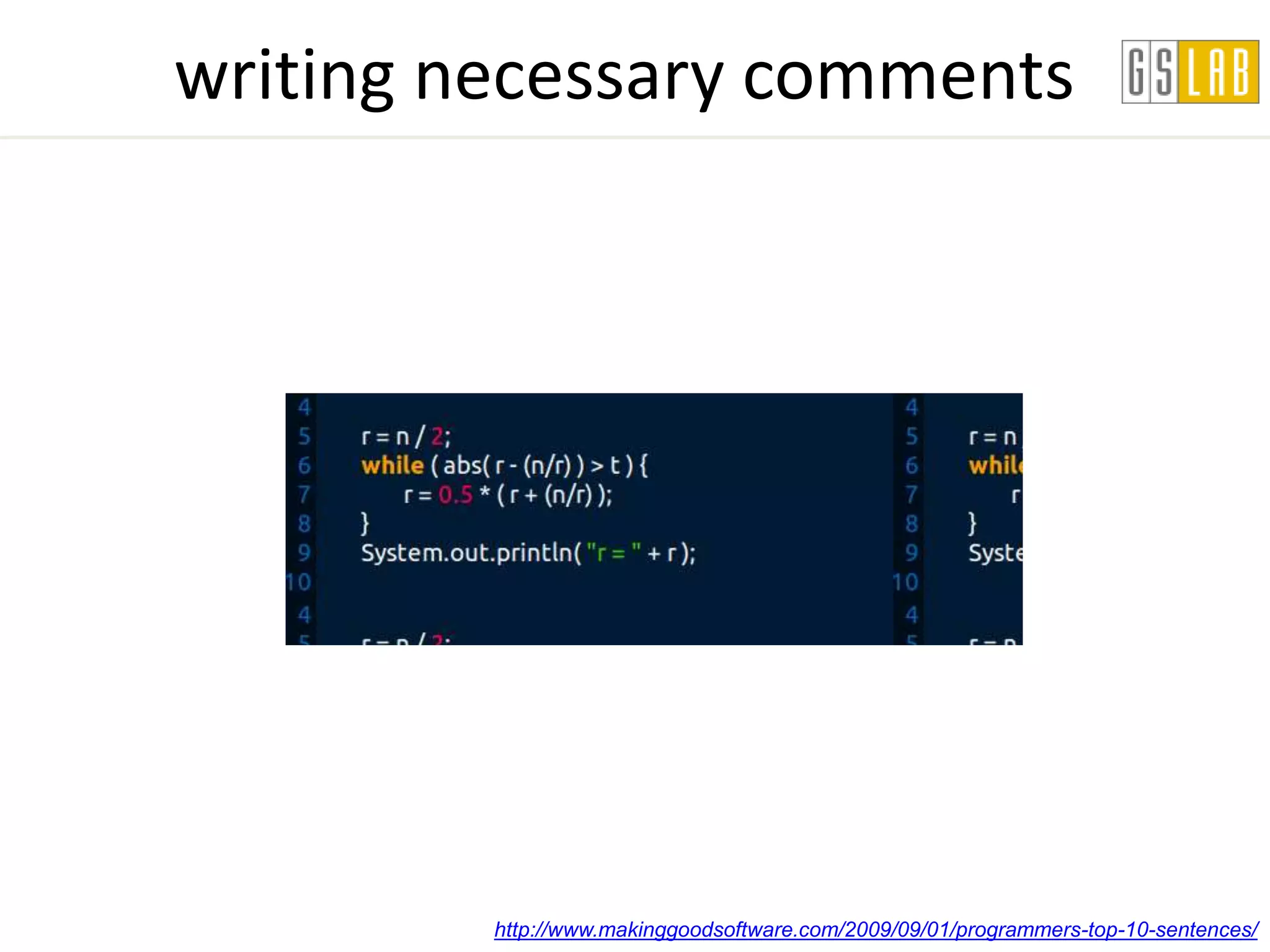
writing necessary comments


         http://www.makinggoodsoftware.com/2009/09/01/programmers-top-10-sentences/
writing necessary comments

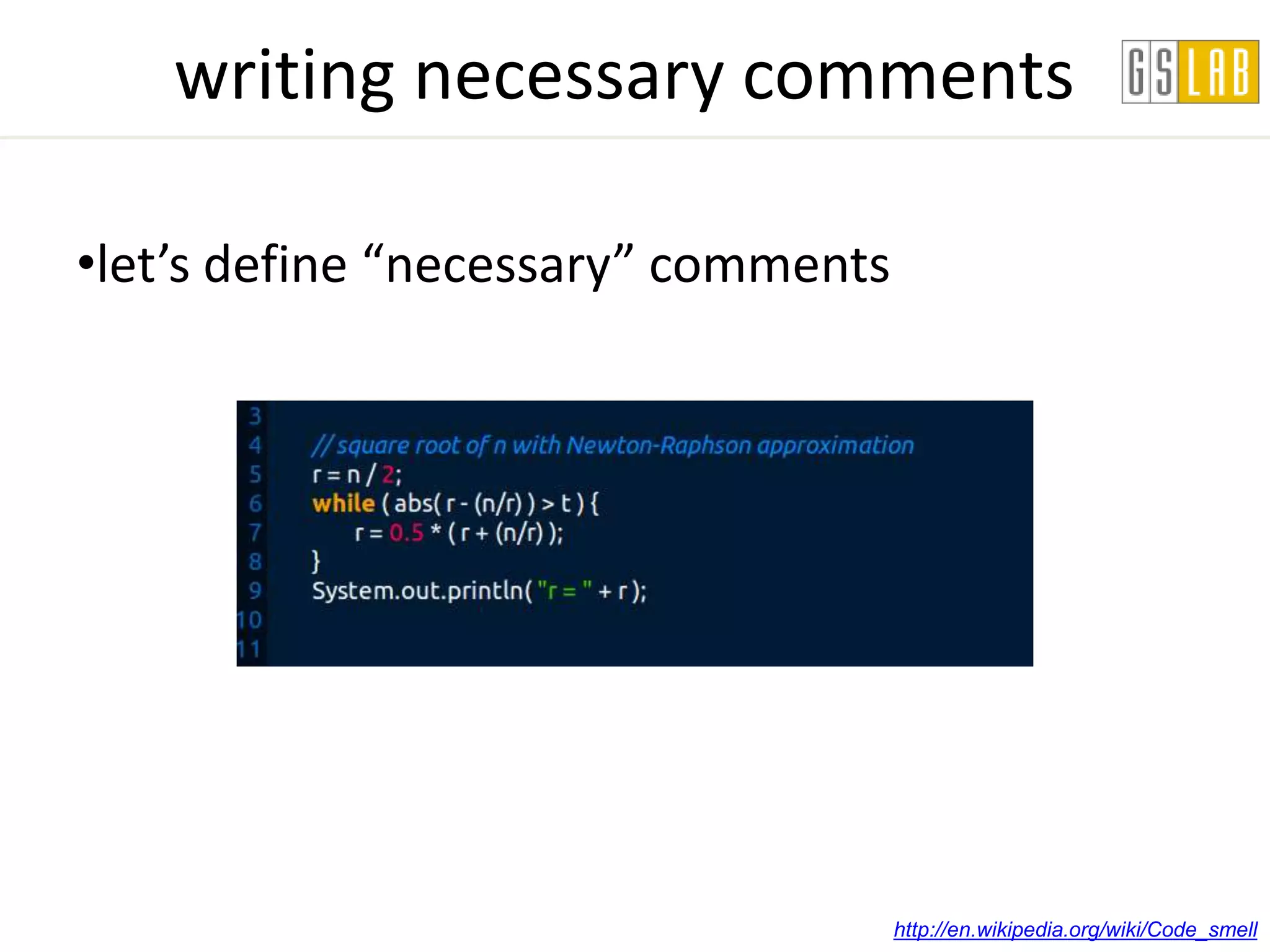
•let’s define “necessary” comments


                                     http://en.wikipedia.org/wiki/Code_smell
writing necessary comments


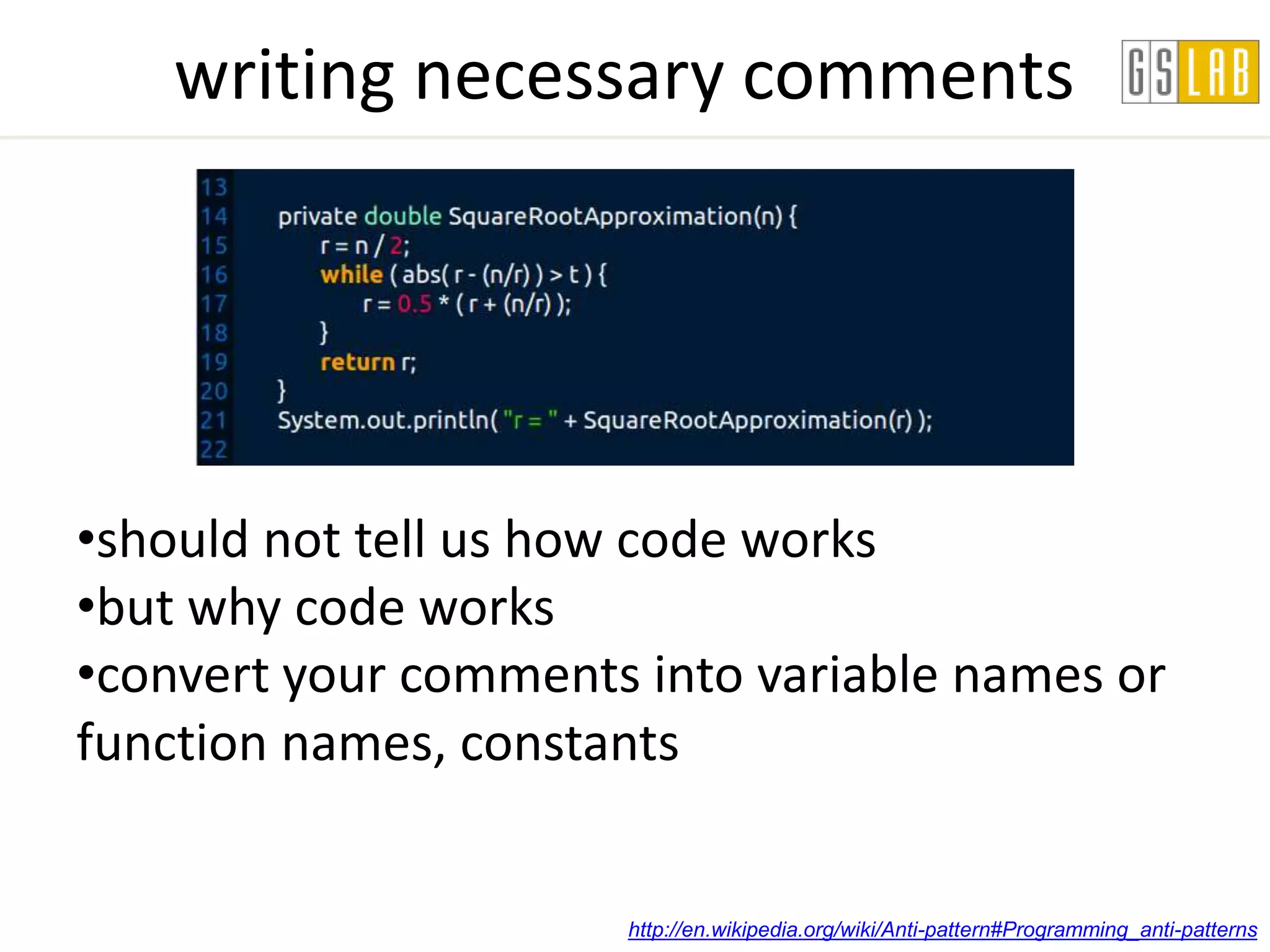
•should not tell us how code works
•but why code works
•convert your comments into variable names or
function names, constants


                      http://en.wikipedia.org/wiki/Anti-pattern#Programming_anti-patterns
follow same indentations

•different people love different editors
•tab is treated differently by different editors
•define tab = 2 or 4 spaces
•good if entire team follows same definition of
tab


                   http://www.makinggoodsoftware.com/2011/05/23/top-7-programmers-bad-habits/
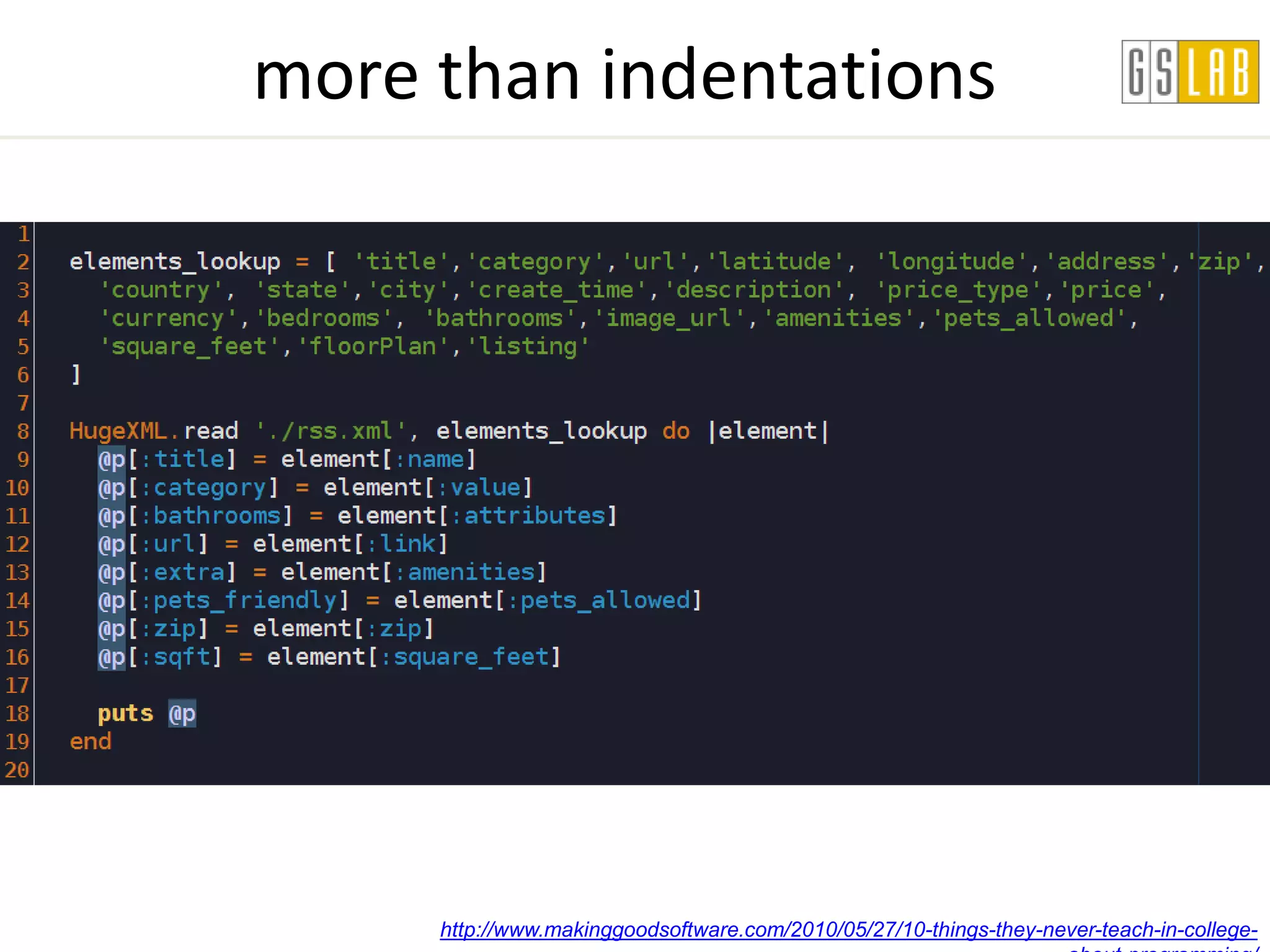
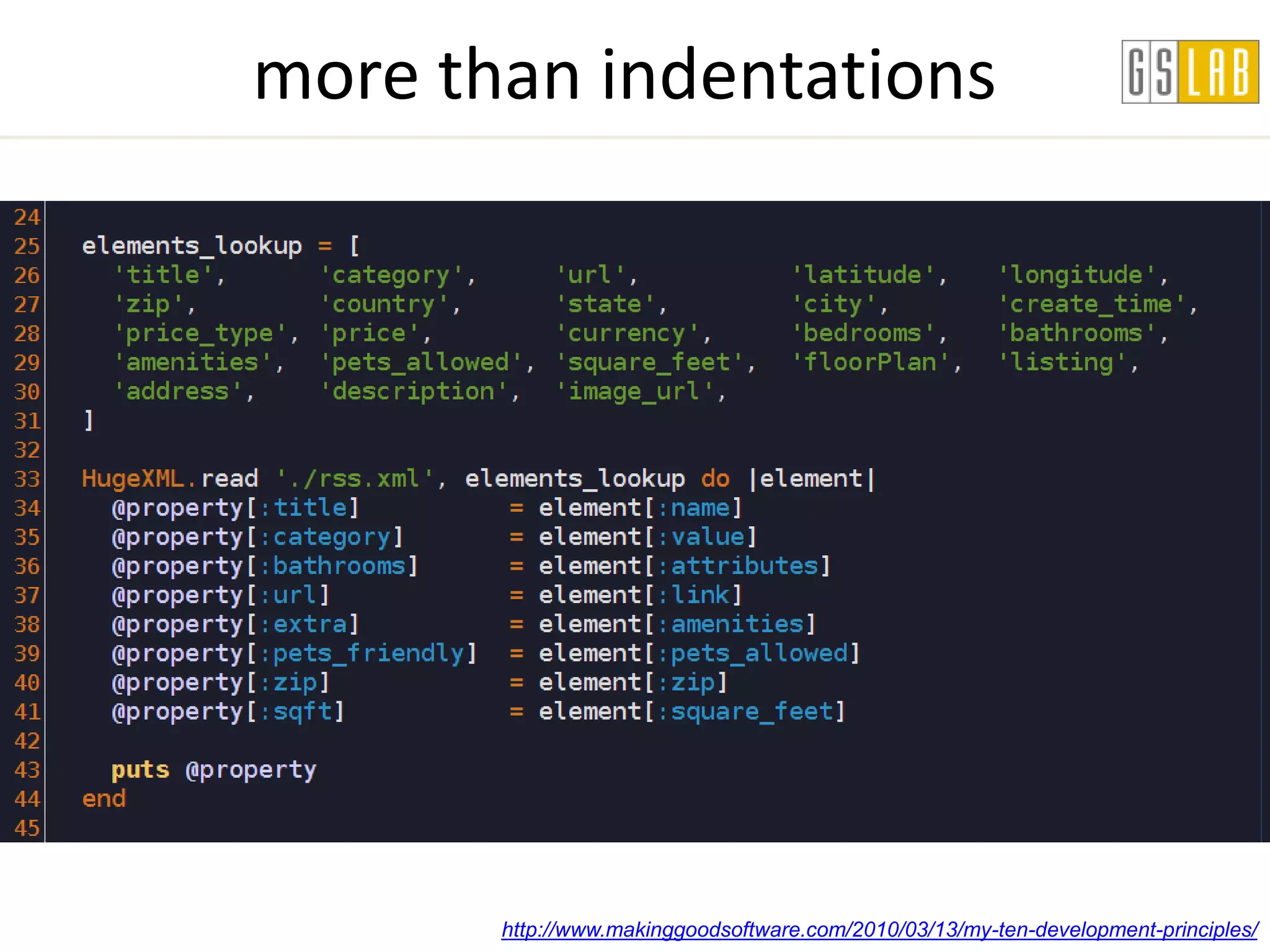
more than indentations


     http://www.makinggoodsoftware.com/2010/05/27/10-things-they-never-teach-in-college-
more than indentations


       http://www.makinggoodsoftware.com/2010/03/13/my-ten-development-principles/
write working pseudo code

•write a program
•given a number
•print “divisible by 3” if it is divisible by 3
•print “divisible by 5 if it is divisible by 5
•print “divisible by 15” if it is divisible by 15


                          http://www.codinghorror.com/blog/2009/05/pseudocode-or-code.html
write working pseudo code

•write a program
•given a number
•print “divisible by 3” if it is divisible by 3
•print “divisible by 5 if it is divisible by 5
•print “divisible by 15” if it is divisible by 15


                          http://www.codinghorror.com/blog/2009/05/pseudocode-or-code.html
write working pseudo code

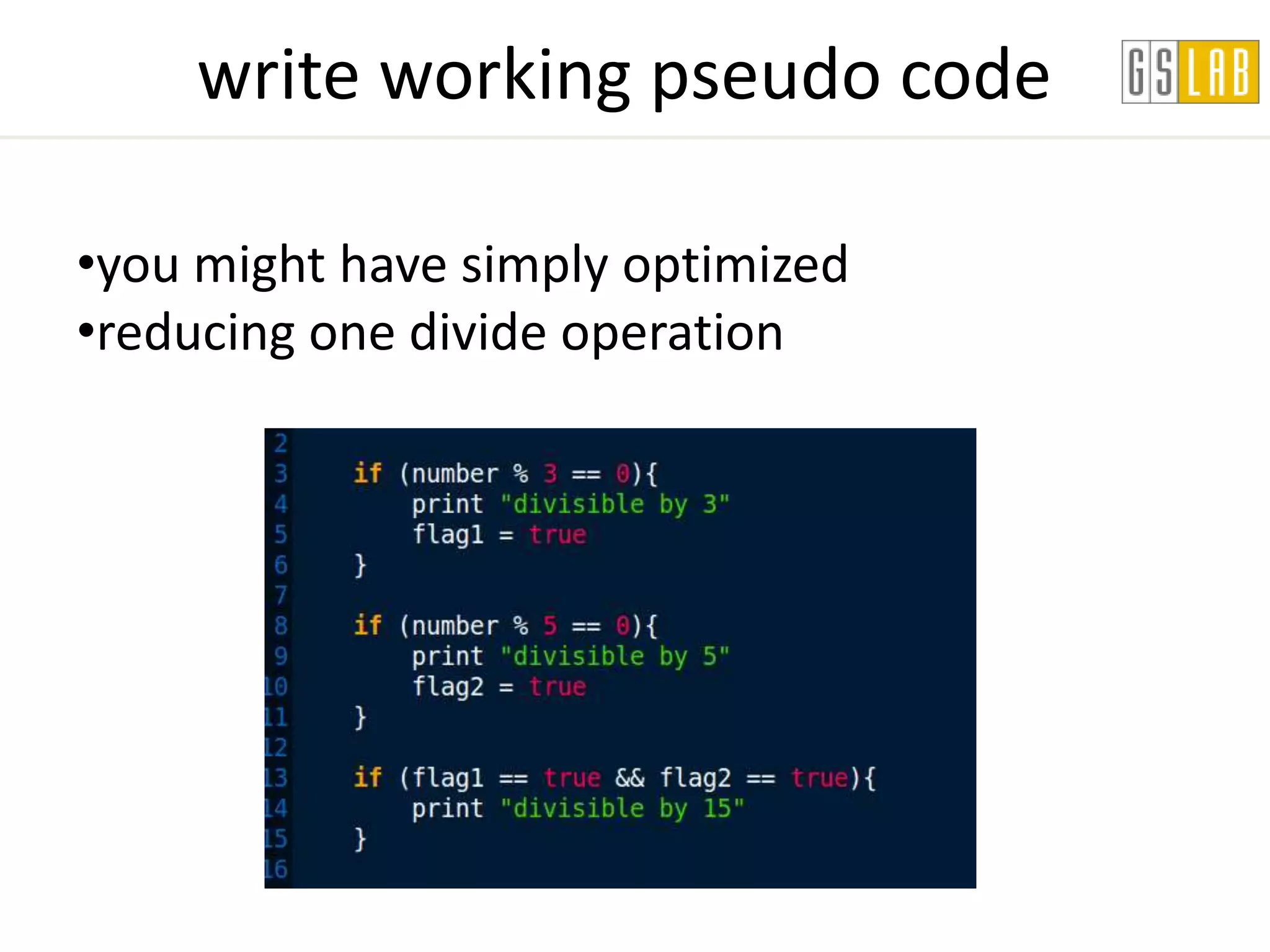
•you might have simply optimized
•reducing one divide operation
write working pseudo code

•write a program
•given a number
•print “divisible by 3” if it is divisible by 3
•print “divisible by 5 if it is divisible by 5
-a change request
print “divisible by 15” if it is divisible by 15
print “divisible by 17” if it is divisible by 17


                    http://stackoverflow.com/questions/84556/whats-your-favorite-programmer-cartoon
write working pseudo code

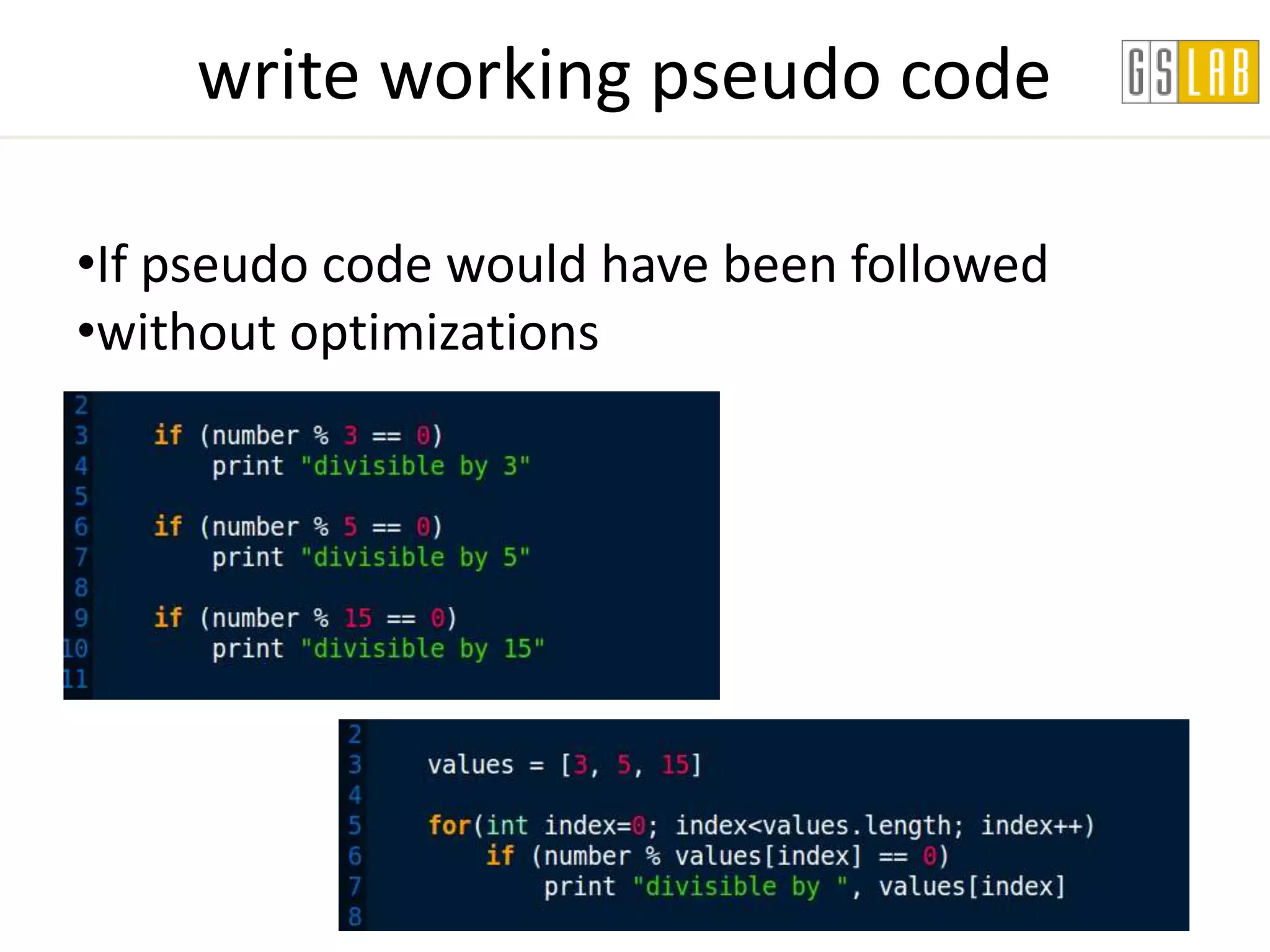
•If pseudo code would have been followed
•without optimizations
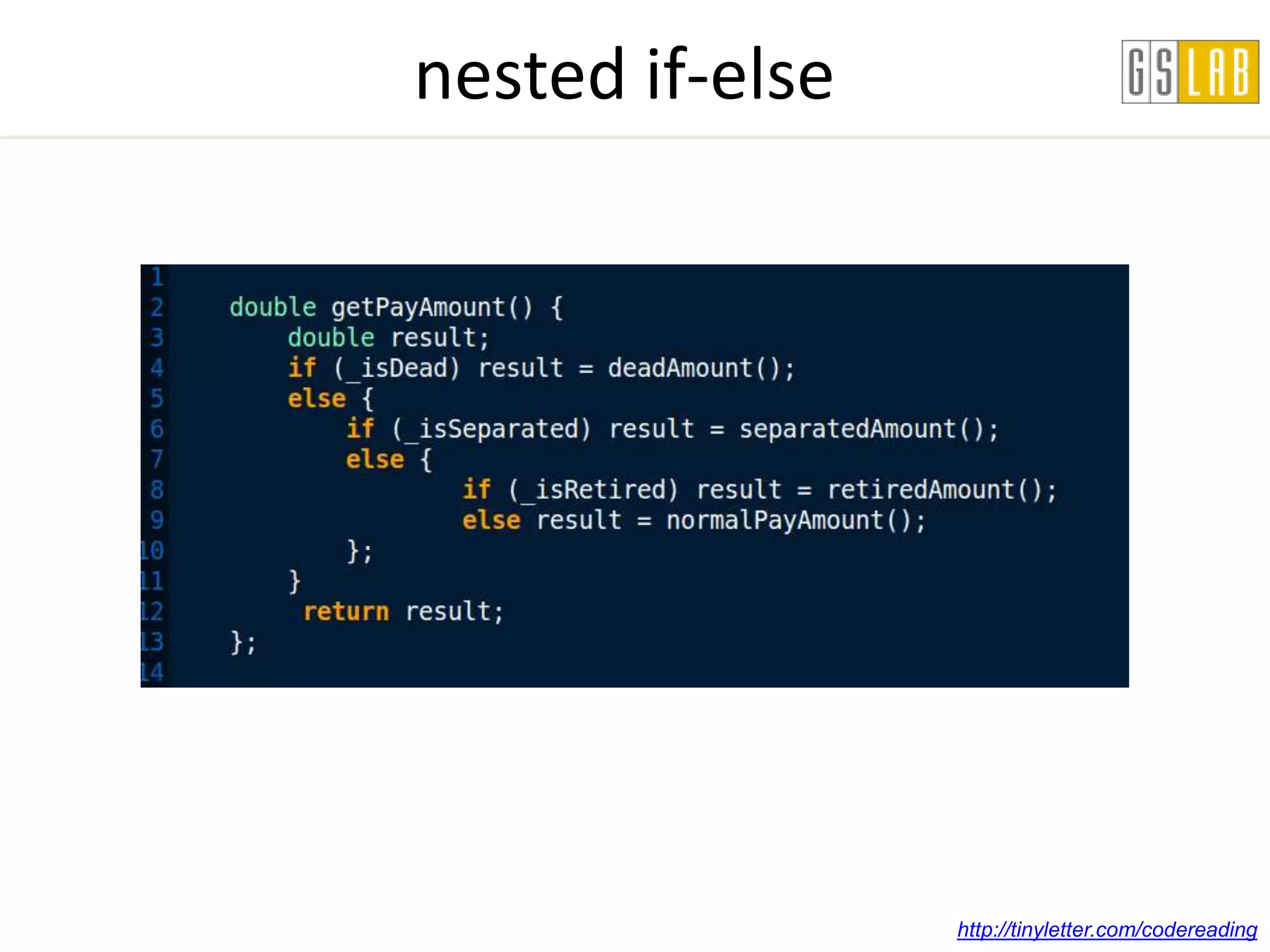
nested if-else


                 http://tinyletter.com/codereading
nested if-else

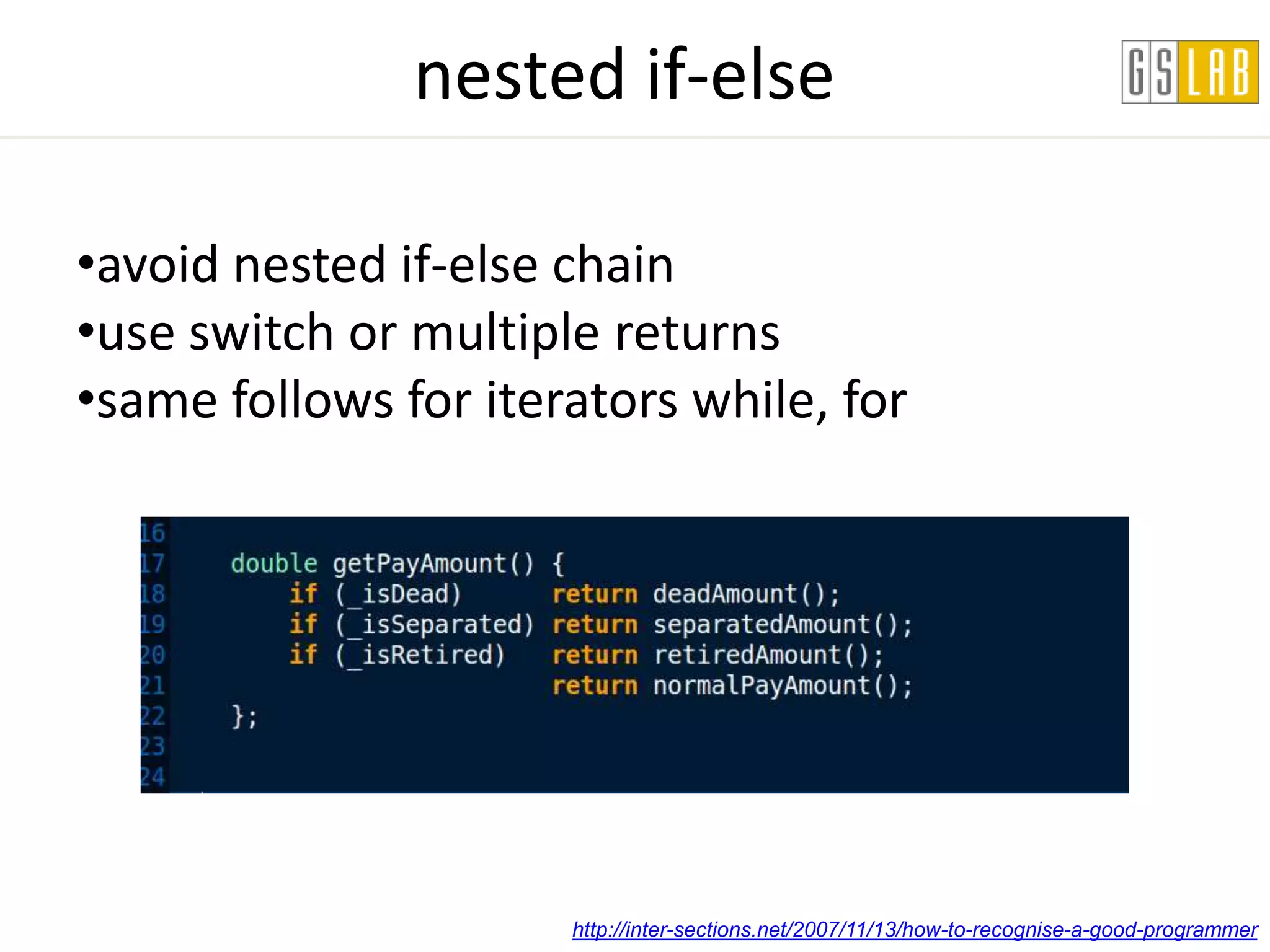
•avoid nested if-else chain
•use switch or multiple returns
•same follows for iterators while, for


                      http://inter-sections.net/2007/11/13/how-to-recognise-a-good-programmer
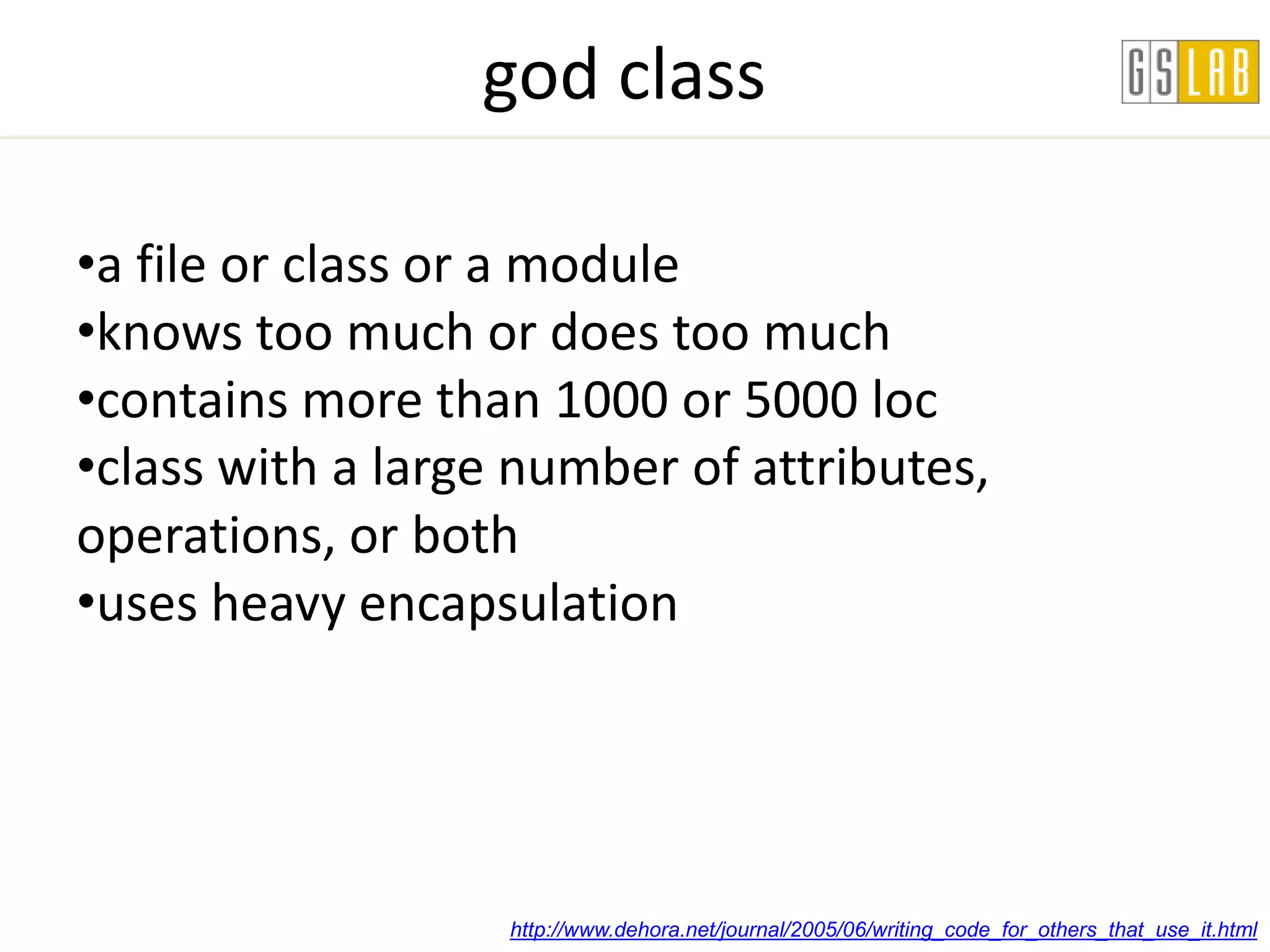
god class

•a file or class or a module
•knows too much or does too much
•contains more than 1000 or 5000 loc
•class with a large number of attributes,
operations, or both
•uses heavy encapsulation


                   http://www.dehora.net/journal/2005/06/writing_code_for_others_that_use_it.html
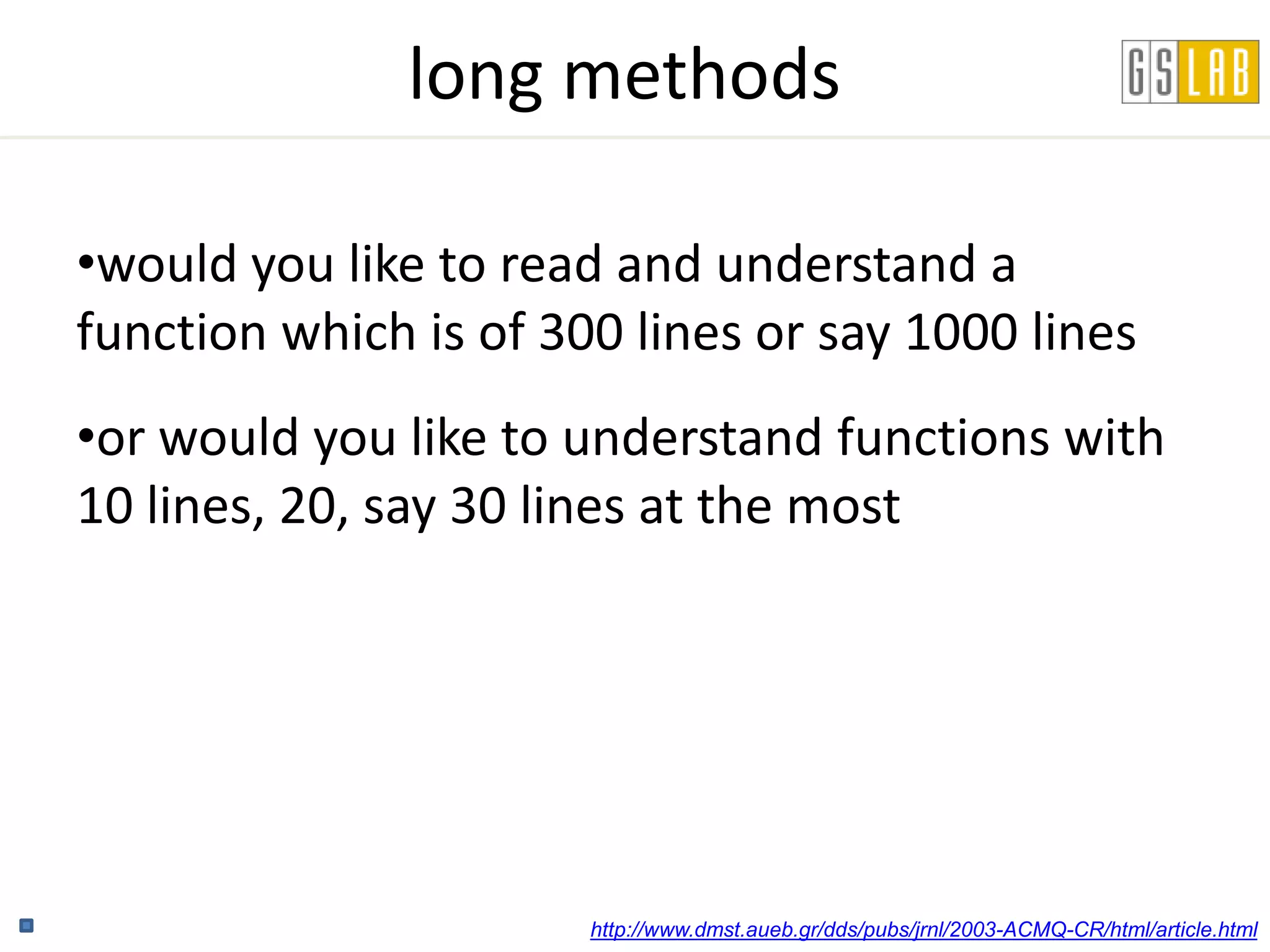
long methods

•would you like to read and understand a
function which is of 300 lines or say 1000 lines
•or would you like to understand functions with
10 lines, 20, say 30 lines at the most


                       http://www.dmst.aueb.gr/dds/pubs/jrnl/2003-ACMQ-CR/html/article.html
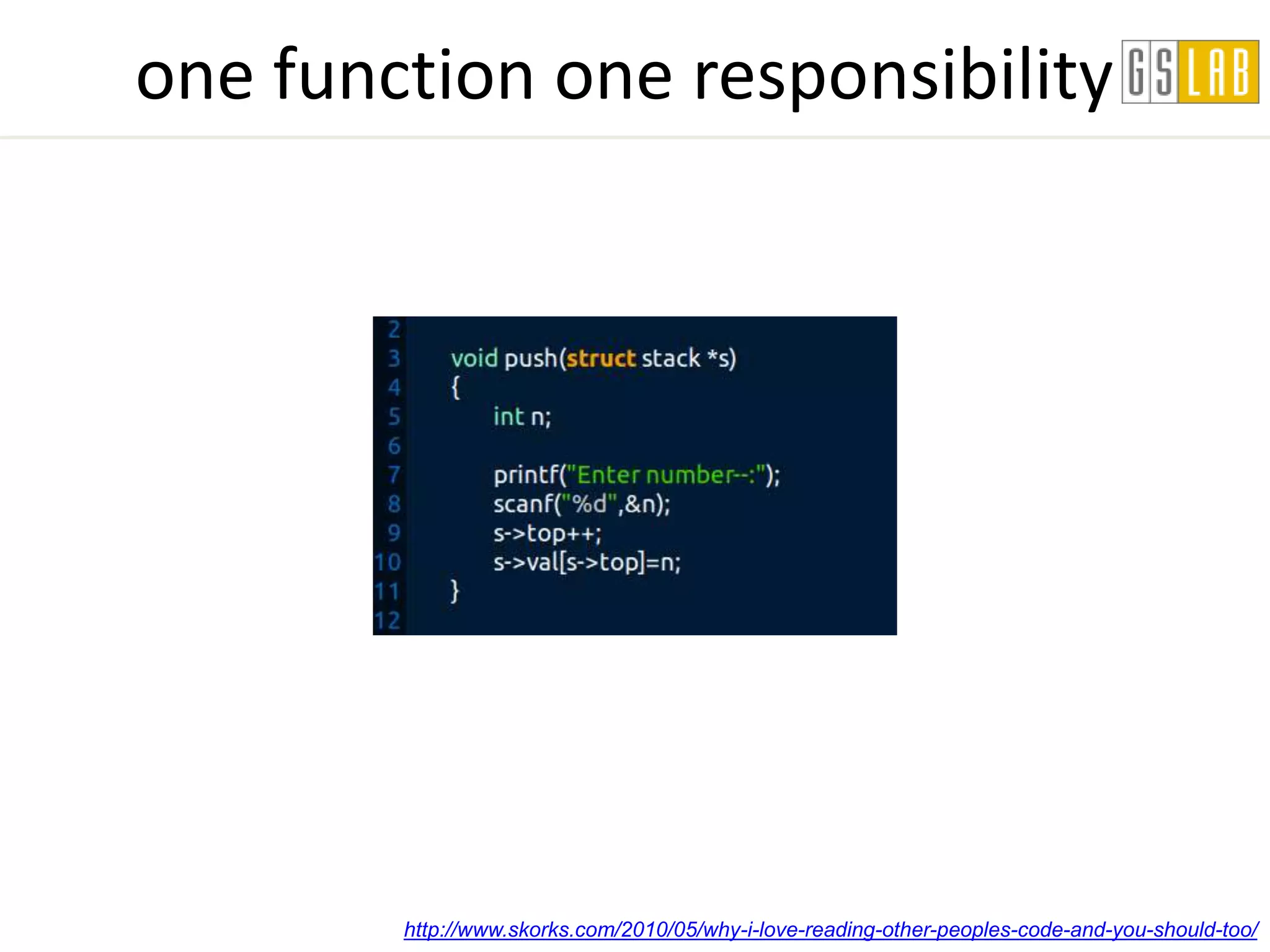
one function one responsibility


        http://www.skorks.com/2010/05/why-i-love-reading-other-peoples-code-and-you-should-too/
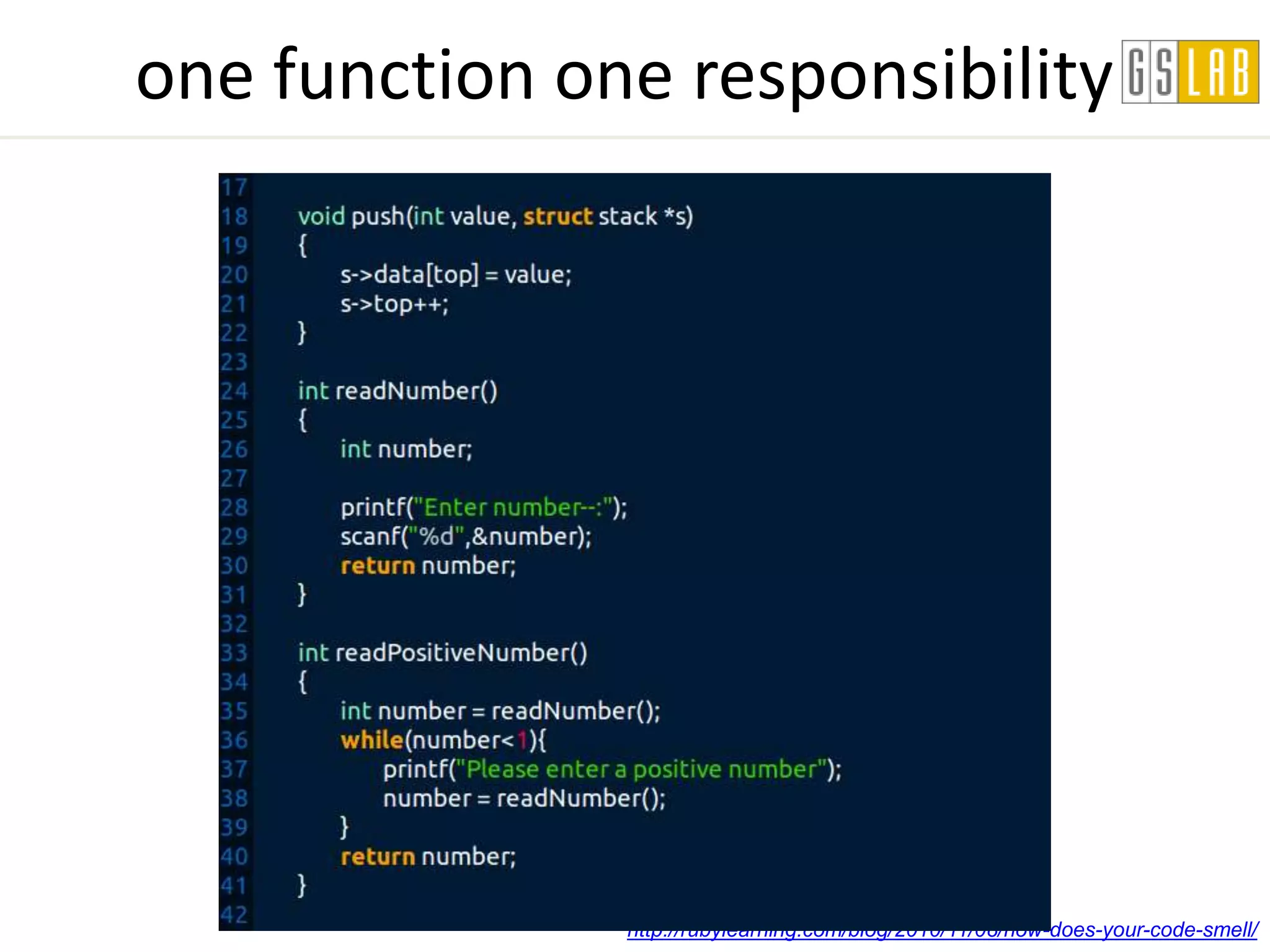
one function one responsibility


               http://rubylearning.com/blog/2010/11/08/how-does-your-code-smell/
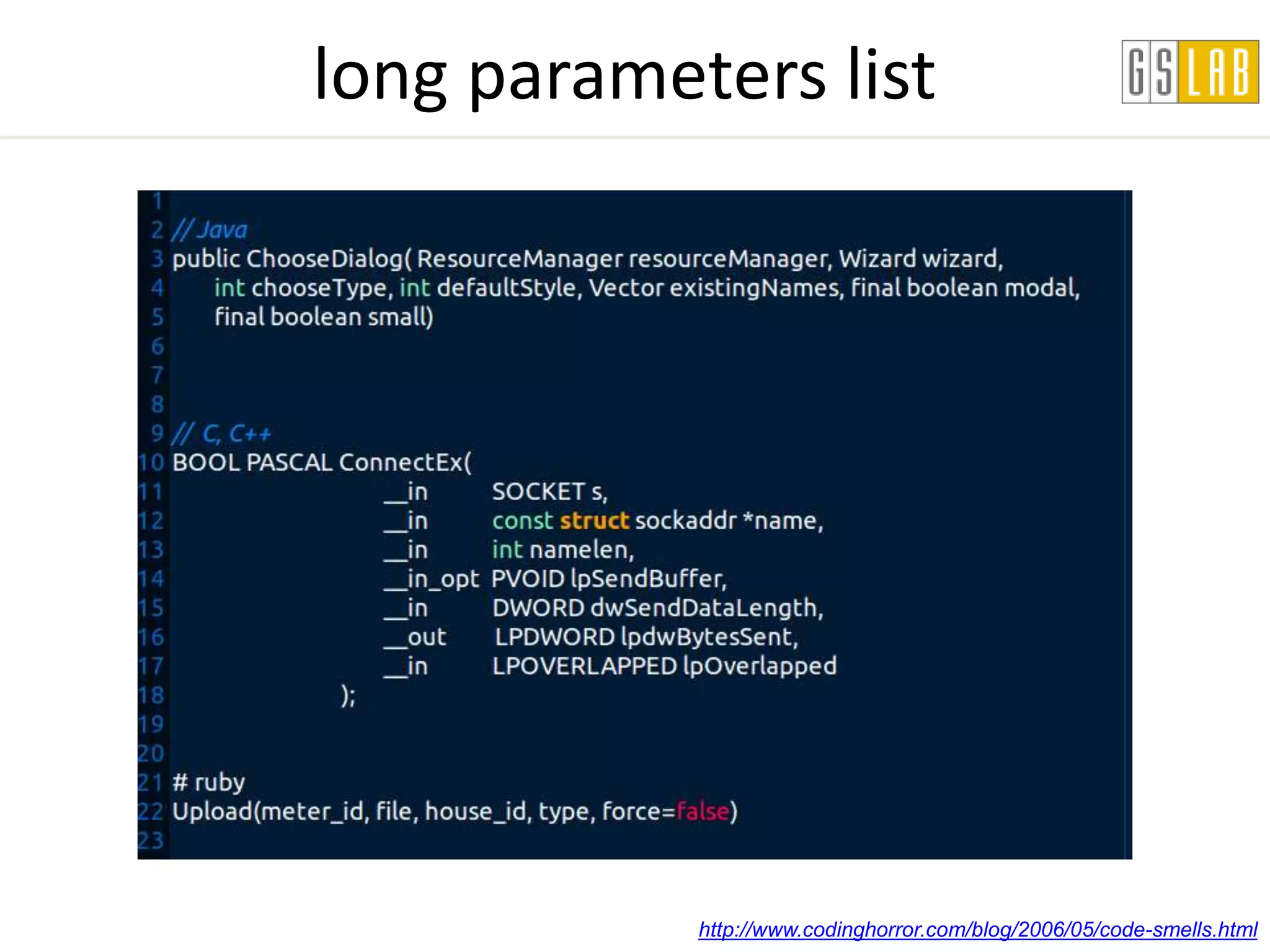
long parameters list


            http://www.codinghorror.com/blog/2006/05/code-smells.html
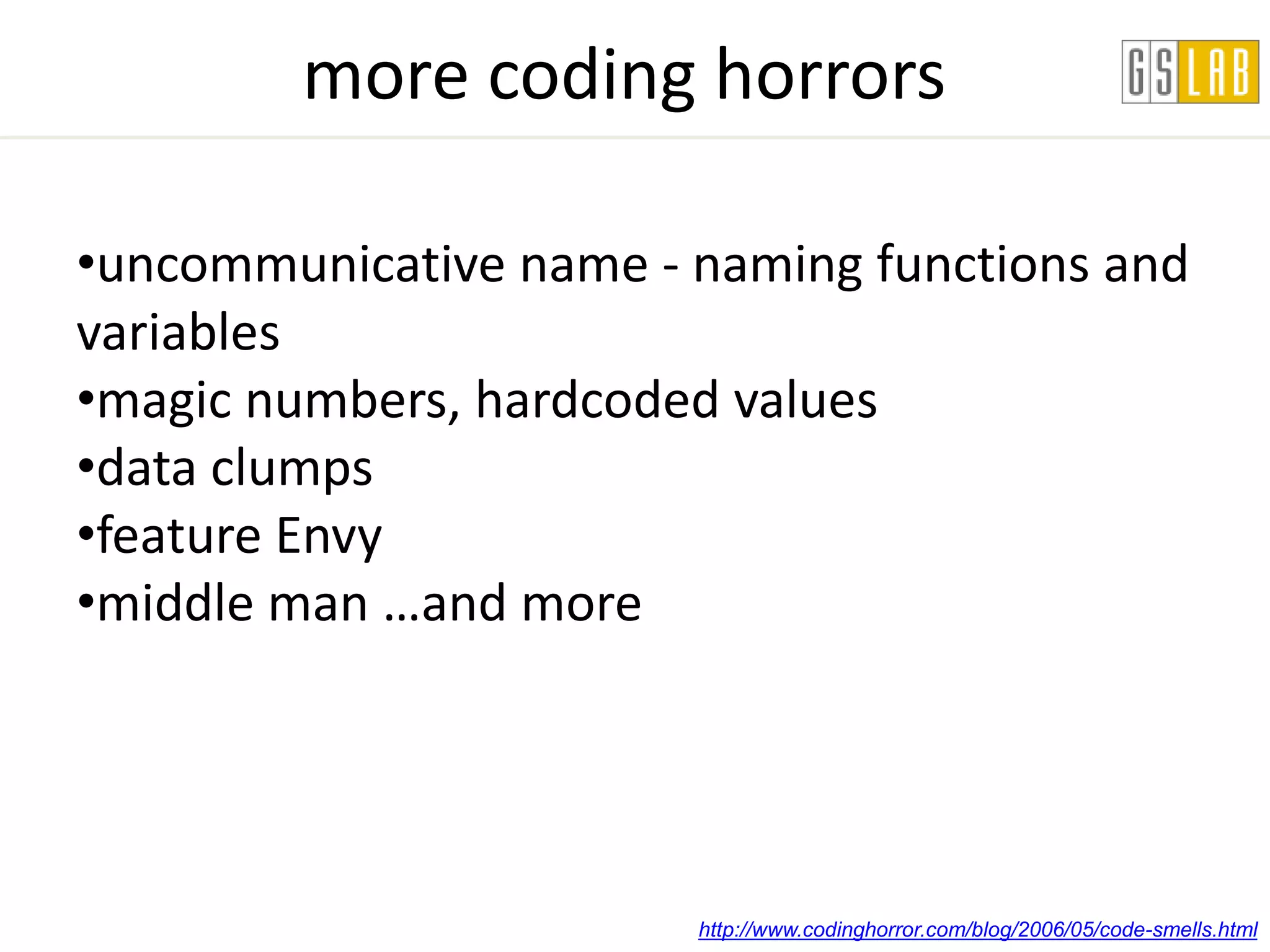
more coding horrors

•uncommunicative name - naming functions and
variables
•magic numbers, hardcoded values
•data clumps
•feature Envy
•middle man …and more


                        http://www.codinghorror.com/blog/2006/05/code-smells.html
characteristics of a good code

•easy to read
•easy to understand
•easy to make any changes
•clean, simple
•looks straight forward
•self explanatory
•short methods, clear names


                              http://www.perlmonks.org/?node_id=592616
characteristics of good code

•easy to read
•easy to use
•clean, simple, straight forward
•easy to make any changes
•self explanatory
•short methods, clear names
•consistent coding standards


                     http://www.thoughtclusters.com/2010/09/characteristics-of-great-programmers/
characteristics of a good coder

•likes to read code written by well known
programmers
•likes to do code review of junior or senior
colleagues
•participates in pair programming
•learns new things weekly w.r.t. coding
•does not make unnecessary complex
optimizations
•does not refractor working code again and
again
                                     http://sourcemaking.com/refactoring
enjoy coding


               http://www.artima.com/intv/ruby.html

Writing code for others

  • 1.
    Writing Code ForOthers amol.pujari@gslab.com http://www.codinghorror.com/blog/
  • 2.
    Why Writing Code ForOthers http://www.makinggoodsoftware.com/
  • 3.
    why do wewrite code? •to get it executed by a machine •the machine understands 0s and 1s only •then why do we use high level languages like c, java, or ruby •did the machine request us to use c or ruby? http://sourcemaking.com/
  • 4.
    we use highlevel languages so humans can understand code by reading it http://www.makinggoodsoftware.com/2009/07/07/5-top-non-technical-mistakes-made-by-
  • 5.
    how do othersfind reading your code? •do they find it helpful in understanding your program –the optimizations you’ve done –your naming conventions, your coding style –how long they should take to do it –more importantly, would they like looking at your code –would they love the way you code •or do they simply find it quite boring http://stackoverflow.com/questions/1711/what-is-the-single-most-influential-book-every-
  • 6.
    you can helpothers to quickly read your code and understand it http://www.joelonsoftware.com/articles/Wrong.html
  • 7.
    characteristics of goodcode •easy to read •easy to use •clean, simple, straight forward •easy to make any changes •self explanatory •short methods, clear names •consistent coding standards http://www.thoughtclusters.com/2010/09/characteristics-of-great-programmers/
  • 8.
    writing necessary comments http://www.makinggoodsoftware.com/2009/09/01/programmers-top-10-sentences/
  • 9.
    writing necessary comments •let’sdefine “necessary” comments http://en.wikipedia.org/wiki/Code_smell
  • 10.
    writing necessary comments •shouldnot tell us how code works •but why code works •convert your comments into variable names or function names, constants http://en.wikipedia.org/wiki/Anti-pattern#Programming_anti-patterns
  • 11.
    follow same indentations •differentpeople love different editors •tab is treated differently by different editors •define tab = 2 or 4 spaces •good if entire team follows same definition of tab http://www.makinggoodsoftware.com/2011/05/23/top-7-programmers-bad-habits/
  • 12.
    more than indentations http://www.makinggoodsoftware.com/2010/05/27/10-things-they-never-teach-in-college-
  • 13.
    more than indentations http://www.makinggoodsoftware.com/2010/03/13/my-ten-development-principles/
  • 14.
    write working pseudocode •write a program •given a number •print “divisible by 3” if it is divisible by 3 •print “divisible by 5 if it is divisible by 5 •print “divisible by 15” if it is divisible by 15 http://www.codinghorror.com/blog/2009/05/pseudocode-or-code.html
  • 15.
    write working pseudocode •write a program •given a number •print “divisible by 3” if it is divisible by 3 •print “divisible by 5 if it is divisible by 5 •print “divisible by 15” if it is divisible by 15 http://www.codinghorror.com/blog/2009/05/pseudocode-or-code.html
  • 16.
    write working pseudocode •you might have simply optimized •reducing one divide operation
  • 17.
    write working pseudocode •write a program •given a number •print “divisible by 3” if it is divisible by 3 •print “divisible by 5 if it is divisible by 5 -a change request print “divisible by 15” if it is divisible by 15 print “divisible by 17” if it is divisible by 17 http://stackoverflow.com/questions/84556/whats-your-favorite-programmer-cartoon
  • 18.
    write working pseudocode •If pseudo code would have been followed •without optimizations
  • 19.
    nested if-else http://tinyletter.com/codereading
  • 20.
    nested if-else •avoid nestedif-else chain •use switch or multiple returns •same follows for iterators while, for http://inter-sections.net/2007/11/13/how-to-recognise-a-good-programmer
  • 21.
    god class •a fileor class or a module •knows too much or does too much •contains more than 1000 or 5000 loc •class with a large number of attributes, operations, or both •uses heavy encapsulation http://www.dehora.net/journal/2005/06/writing_code_for_others_that_use_it.html
  • 22.
    long methods •would youlike to read and understand a function which is of 300 lines or say 1000 lines •or would you like to understand functions with 10 lines, 20, say 30 lines at the most http://www.dmst.aueb.gr/dds/pubs/jrnl/2003-ACMQ-CR/html/article.html
  • 23.
    one function oneresponsibility http://www.skorks.com/2010/05/why-i-love-reading-other-peoples-code-and-you-should-too/
  • 24.
    one function oneresponsibility http://rubylearning.com/blog/2010/11/08/how-does-your-code-smell/
  • 25.
    long parameters list http://www.codinghorror.com/blog/2006/05/code-smells.html
  • 26.
    more coding horrors •uncommunicativename - naming functions and variables •magic numbers, hardcoded values •data clumps •feature Envy •middle man …and more http://www.codinghorror.com/blog/2006/05/code-smells.html
  • 27.
    characteristics of agood code •easy to read •easy to understand •easy to make any changes •clean, simple •looks straight forward •self explanatory •short methods, clear names http://www.perlmonks.org/?node_id=592616
  • 28.
    characteristics of goodcode •easy to read •easy to use •clean, simple, straight forward •easy to make any changes •self explanatory •short methods, clear names •consistent coding standards http://www.thoughtclusters.com/2010/09/characteristics-of-great-programmers/
  • 29.
    characteristics of agood coder •likes to read code written by well known programmers •likes to do code review of junior or senior colleagues •participates in pair programming •learns new things weekly w.r.t. coding •does not make unnecessary complex optimizations •does not refractor working code again and again http://sourcemaking.com/refactoring
  • 30.
    enjoy coding http://www.artima.com/intv/ruby.html