Writing
advice
ISFD N°41
ORAL AND WRITTEN EXPRESSION 4
STELLA MARIS SAUBIDET OYHAMBURU
25/05/2020
MARINA DANIELA VILLAVERDE
Index
 General advice_____________________3
 Planning___________________________5
 Researching________________________9
 Previewing_________________________11
 Summarizing________________________14
 Using sources______________________15
 Revising___________________________18
 Tips at writing____________________19
WRITING AN ACADEMIC ESSAY-WRITING
 It should have an ARGUMENT. It should try to prove something.
 Develop a provitional HYPOTHESIS and invastigate about it.
 A previous ORGANIZATION should be designed.
 Some good METHODS OF COMPOSING are:
- Starting to write early
- Starting for what seems readiest to be written
- Keeping the essay´s overall purpose and organization in mind
- Revising extensively
- Revising sentences and transitions
General advice…
 Note key terms.
 Note which concepts or methodology the topic asks you to use.
 Ask yourself questions about what you read.
 Formulate a tentative thesis statement.
If you feel blocked or stuck... find a topic, ask
questions,
find a researching balance and take a time to do it,
Understanding easy topics
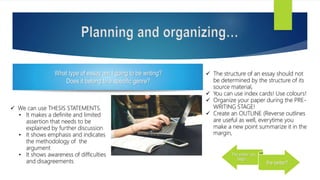
Planning and organizing…
The earlier you
begin…
the better!!
 We can use THESIS STATEMENTS.
• It makes a definite and limited
assertion that needs to be
explained by further discussion
• It shows emphasis and indicates
the methodology of the
argument
• It shows awareness of difficulties
and disagreements
 The structure of an essay should not
be determined by the structure of its
source material,
 You can use index cards! Use colours!
 Organize your paper during the PRE-
WRITING STAGE!
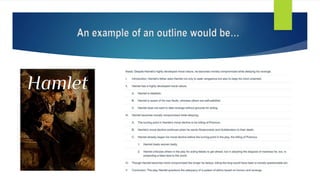
 Create an OUTLINE (Reverse outlines
are useful as well, everytime you
make a new point summarize it in the
margin,
What type of essay am I going to be writing?
Does it belong to a specific genre?
An example of an outline would be…
Introductions and conclusions
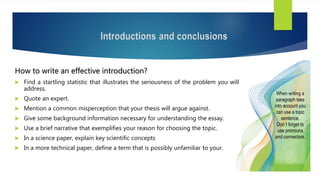
How to write an effective introduction?
 Find a startling statistic that illustrates the seriousness of the problem you will
address.
 Quote an expert.
 Mention a common misperception that your thesis will argue against.
 Give some background information necessary for understanding the essay.
 Use a brief narrative that exemplifies your reason for choosing the topic.
 In a science paper, explain key scientific concepts
 In a more technical paper, define a term that is possibly unfamiliar to your.
When writing a
paragraph take
into account you
can use a topic
sentence.
Don´t forget to
use pronouns
and connectors.
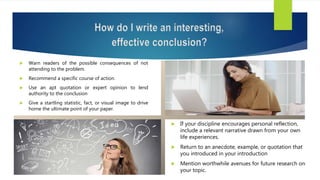
 Warn readers of the possible consequences of not
attending to the problem.
 Recommend a specific course of action.
 Use an apt quotation or expert opinion to lend
authority to the conclusion
 Give a startling statistic, fact, or visual image to drive
home the ultimate point of your paper.
How do I write an interesting,
effective conclusion?
 If your discipline encourages personal reflection,
include a relevant narrative drawn from your own
life experiences.
 Return to an anecdote, example, or quotation that
you introduced in your introduction
 Mention worthwhile avenues for future research on
your topic.
Researching
CRITICAL READING
Critical writing depends on critical reading
 Don’t read looking only or primarily
for information
 Do read looking for ways of thinking
about the subject matter
When taking notes from research reading: focus on
what kind of ideas you need to record, write down
brief notes and level them intelligently
Some steps to follow
1. First determine the central
claims or purpose of the text.
2. Begin to make some judgements
about context.
3. Distinguish the kinds of
reasoning the text employs
4. Examine the evidence (the
supporting facts, examples, etc)
the text employs
5. Critical reading may
involve evaluation.
How to preview?
 Read the title, don’t skip over it.
 Think about the subject matter.
 Who is the author?
 Where was this text originally published?
 When was this text originally published? What is the significance of this time period in this field
of study?
 Read the chapter titles or the headings that break up the chapter or article. What seems to be
the general progression of ideas here?
 Why has your professor assigned this text?
Don’t rely exclusively on Net resources
You don’t need to interrupt your reading
to look up every hard word right away in
the dictionary, better to guess first. Mark
unfamiliar words, but try these tactics for
making an “educated guess” at the
meaning as you go. (Eventually you will
confirm your guesses with a dictionary.)
Skimming and scanning
1. First, prior to skimming, use some of the previewing techniques.
2. Read carefully the introductory paragraph, or perhaps the first two paragraphs. Find the focus of the text.
3. Read carefully the first one or two sentences of each paragraph, as well as the concluding sentence or sentences.
4. In between these opening and closing sentences, keep your eyes moving and try to avoid looking up unfamiliar words
or terminology. Your goal is to pick up the larger concepts and something of the overall pattern and significance of the
text.
5. Read carefully the concluding paragraph or paragraphs. What does the author’s overall purpose seem to be?.
6. Finally, return to the beginning and read through the text carefully. Think of whaat you need to retain from it.
Scanning is basically skimming with a more tightly focused purpose: skimming to locate a particular fact or
figure, or to see whether this text mentions a subject you’re researching
Summarizing
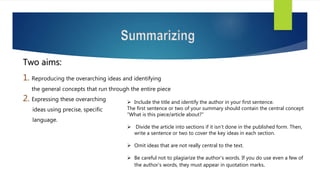
Two aims:
1. Reproducing the overarching ideas and identifying
the general concepts that run through the entire piece
2. Expressing these overarching
ideas using precise, specific
language.
 Include the title and identify the author in your first sentence.
The first sentence or two of your summary should contain the central concept
“What is this piece/article about?”
 Divide the article into sections if it isn’t done in the published form. Then,
write a sentence or two to cover the key ideas in each section.
 Omit ideas that are not really central to the text.
 Be careful not to plagiarize the author’s words. If you do use even a few of
the author’s words, they must appear in quotation marks.
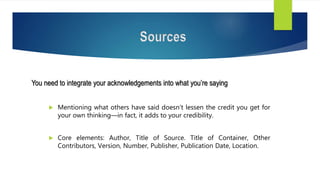
Sources
 Mentioning what others have said doesn’t lessen the credit you get for
your own thinking—in fact, it adds to your credibility.
 Core elements: Author, Title of Source. Title of Container, Other
Contributors, Version, Number, Publisher, Publication Date, Location.
You need to integrate your acknowledgements into what you’re saying
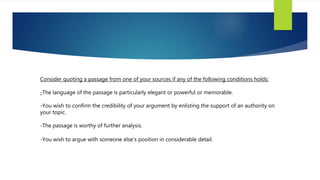
Consider quoting a passage from one of your sources if any of the following conditions holds:
-The language of the passage is particularly elegant or powerful or memorable.
-You wish to confirm the credibility of your argument by enlisting the support of an authority on
your topic.
-The passage is worthy of further analysis.
-You wish to argue with someone else’s position in considerable detail.
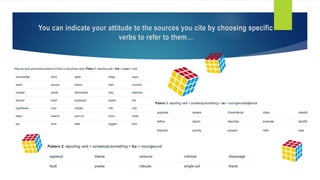
You can indicate your attitude to the sources you cite by choosing specific
verbs to refer to them…
Revising
Revising gives you the chance to preview your work
 First check whether you have fulfilled the intention of
the assignment.
 Then look at overall organization. It’s worthwhile to print out
everything so that you can view the entire document.
 Now polish and edit your style by moving to smaller matters
such as word choice, sentence structure, grammar,
and spelling.
 Read passages aloud to see if you have achieved
the emphasis you want.
 Don’t depend on a grammar checker. The best ones still miss
many errors, and they give a lot of bad advice.
Tips at writing different types of writing...
1 Know your audience
2 Provide context and be concrete
3 Mind your language
4 Do research if necessary but don´t write
a research paper
About literature….
 Avoid plot summary
 Master the art of the analytical thesis. A good thesis is a
statement of roughly one to three sentences that says
something intelligent about a literary work
 Let the structure of your argument determine the structure of
your paper
 Opt for analysis instead of evaluative judgments
 Dont confuse the autor with the speaker
 Integrate quotations fully in your argument
And remember…
The scariest
moment
Bibliogr
aphy
Prof. C.A Silber, Department of English. “Some gereral advice on
Academic Writing Essay” Toronto, Canada. University of Toronto.
Last edited: Oct 04th, 2018 Available at https://writing.utoronto.ca/

Writing advice

  • 1.
    Writing advice ISFD N°41 ORAL ANDWRITTEN EXPRESSION 4 STELLA MARIS SAUBIDET OYHAMBURU 25/05/2020 MARINA DANIELA VILLAVERDE
  • 2.
    Index  General advice_____________________3 Planning___________________________5  Researching________________________9  Previewing_________________________11  Summarizing________________________14  Using sources______________________15  Revising___________________________18  Tips at writing____________________19
  • 3.
    WRITING AN ACADEMICESSAY-WRITING  It should have an ARGUMENT. It should try to prove something.  Develop a provitional HYPOTHESIS and invastigate about it.  A previous ORGANIZATION should be designed.  Some good METHODS OF COMPOSING are: - Starting to write early - Starting for what seems readiest to be written - Keeping the essay´s overall purpose and organization in mind - Revising extensively - Revising sentences and transitions General advice…
  • 4.
     Note keyterms.  Note which concepts or methodology the topic asks you to use.  Ask yourself questions about what you read.  Formulate a tentative thesis statement. If you feel blocked or stuck... find a topic, ask questions, find a researching balance and take a time to do it, Understanding easy topics
  • 5.
    Planning and organizing… Theearlier you begin… the better!!  We can use THESIS STATEMENTS. • It makes a definite and limited assertion that needs to be explained by further discussion • It shows emphasis and indicates the methodology of the argument • It shows awareness of difficulties and disagreements  The structure of an essay should not be determined by the structure of its source material,  You can use index cards! Use colours!  Organize your paper during the PRE- WRITING STAGE!  Create an OUTLINE (Reverse outlines are useful as well, everytime you make a new point summarize it in the margin, What type of essay am I going to be writing? Does it belong to a specific genre?
  • 6.
    An example ofan outline would be…
  • 7.
    Introductions and conclusions Howto write an effective introduction?  Find a startling statistic that illustrates the seriousness of the problem you will address.  Quote an expert.  Mention a common misperception that your thesis will argue against.  Give some background information necessary for understanding the essay.  Use a brief narrative that exemplifies your reason for choosing the topic.  In a science paper, explain key scientific concepts  In a more technical paper, define a term that is possibly unfamiliar to your. When writing a paragraph take into account you can use a topic sentence. Don´t forget to use pronouns and connectors.
  • 8.
     Warn readersof the possible consequences of not attending to the problem.  Recommend a specific course of action.  Use an apt quotation or expert opinion to lend authority to the conclusion  Give a startling statistic, fact, or visual image to drive home the ultimate point of your paper. How do I write an interesting, effective conclusion?  If your discipline encourages personal reflection, include a relevant narrative drawn from your own life experiences.  Return to an anecdote, example, or quotation that you introduced in your introduction  Mention worthwhile avenues for future research on your topic.
  • 9.
    Researching CRITICAL READING Critical writingdepends on critical reading  Don’t read looking only or primarily for information  Do read looking for ways of thinking about the subject matter When taking notes from research reading: focus on what kind of ideas you need to record, write down brief notes and level them intelligently
  • 10.
    Some steps tofollow 1. First determine the central claims or purpose of the text. 2. Begin to make some judgements about context. 3. Distinguish the kinds of reasoning the text employs 4. Examine the evidence (the supporting facts, examples, etc) the text employs 5. Critical reading may involve evaluation.
  • 11.
    How to preview? Read the title, don’t skip over it.  Think about the subject matter.  Who is the author?  Where was this text originally published?  When was this text originally published? What is the significance of this time period in this field of study?  Read the chapter titles or the headings that break up the chapter or article. What seems to be the general progression of ideas here?  Why has your professor assigned this text? Don’t rely exclusively on Net resources
  • 12.
    You don’t needto interrupt your reading to look up every hard word right away in the dictionary, better to guess first. Mark unfamiliar words, but try these tactics for making an “educated guess” at the meaning as you go. (Eventually you will confirm your guesses with a dictionary.)
  • 13.
    Skimming and scanning 1.First, prior to skimming, use some of the previewing techniques. 2. Read carefully the introductory paragraph, or perhaps the first two paragraphs. Find the focus of the text. 3. Read carefully the first one or two sentences of each paragraph, as well as the concluding sentence or sentences. 4. In between these opening and closing sentences, keep your eyes moving and try to avoid looking up unfamiliar words or terminology. Your goal is to pick up the larger concepts and something of the overall pattern and significance of the text. 5. Read carefully the concluding paragraph or paragraphs. What does the author’s overall purpose seem to be?. 6. Finally, return to the beginning and read through the text carefully. Think of whaat you need to retain from it. Scanning is basically skimming with a more tightly focused purpose: skimming to locate a particular fact or figure, or to see whether this text mentions a subject you’re researching
  • 14.
    Summarizing Two aims: 1. Reproducingthe overarching ideas and identifying the general concepts that run through the entire piece 2. Expressing these overarching ideas using precise, specific language.  Include the title and identify the author in your first sentence. The first sentence or two of your summary should contain the central concept “What is this piece/article about?”  Divide the article into sections if it isn’t done in the published form. Then, write a sentence or two to cover the key ideas in each section.  Omit ideas that are not really central to the text.  Be careful not to plagiarize the author’s words. If you do use even a few of the author’s words, they must appear in quotation marks.
  • 15.
    Sources  Mentioning whatothers have said doesn’t lessen the credit you get for your own thinking—in fact, it adds to your credibility.  Core elements: Author, Title of Source. Title of Container, Other Contributors, Version, Number, Publisher, Publication Date, Location. You need to integrate your acknowledgements into what you’re saying
  • 16.
    Consider quoting apassage from one of your sources if any of the following conditions holds: -The language of the passage is particularly elegant or powerful or memorable. -You wish to confirm the credibility of your argument by enlisting the support of an authority on your topic. -The passage is worthy of further analysis. -You wish to argue with someone else’s position in considerable detail.
  • 17.
    You can indicateyour attitude to the sources you cite by choosing specific verbs to refer to them…
  • 18.
    Revising Revising gives youthe chance to preview your work  First check whether you have fulfilled the intention of the assignment.  Then look at overall organization. It’s worthwhile to print out everything so that you can view the entire document.  Now polish and edit your style by moving to smaller matters such as word choice, sentence structure, grammar, and spelling.  Read passages aloud to see if you have achieved the emphasis you want.  Don’t depend on a grammar checker. The best ones still miss many errors, and they give a lot of bad advice.
  • 19.
    Tips at writingdifferent types of writing... 1 Know your audience 2 Provide context and be concrete 3 Mind your language 4 Do research if necessary but don´t write a research paper About literature….  Avoid plot summary  Master the art of the analytical thesis. A good thesis is a statement of roughly one to three sentences that says something intelligent about a literary work  Let the structure of your argument determine the structure of your paper  Opt for analysis instead of evaluative judgments  Dont confuse the autor with the speaker  Integrate quotations fully in your argument
  • 20.
  • 21.
    Bibliogr aphy Prof. C.A Silber,Department of English. “Some gereral advice on Academic Writing Essay” Toronto, Canada. University of Toronto. Last edited: Oct 04th, 2018 Available at https://writing.utoronto.ca/