UNIT 4
• Topic: Languages
• Writing genre: A contrasting paragraph
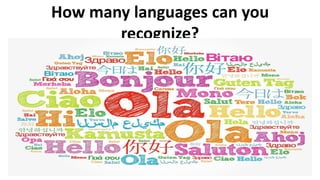
How many languages can you
recognize?
THINK AND SHARE
• What foreign languages are you learning?
• Are the foreign languages which you are
learning similar or different?
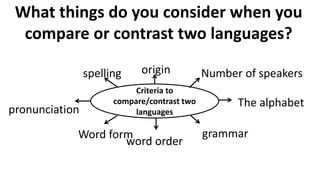
What things do you consider when you
compare or contrast two languages?
Criteria to
compare/contrast two
languages
origin Number of speakers
The alphabet
grammar
word order
Word form
pronunciation
spelling
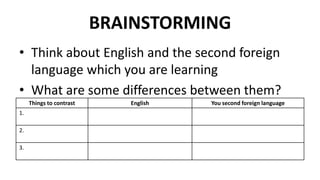
BRAINSTORMING
• Think about English and the second foreign
language which you are learning
• What are some differences between them?
Things to contrast English You second foreign language
1.
2.
3.
WRITING TASK FOR UNIT 4
• Write a paragraph to show the differences
between English and your second foreign
language
• Use expressions of contrast in your writing
• Organize your ideas point-by-point
• Write at least 150 words
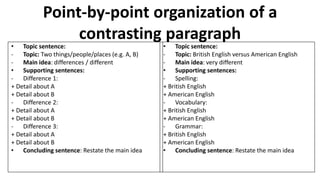
Point-by-point organization of a
contrasting paragraph
• Topic sentence:
- Topic: Two things/people/places (e.g. A, B)
- Main idea: differences / different
• Supporting sentences:
- Difference 1:
+ Detail about A
+ Detail about B
- Difference 2:
+ Detail about A
+ Detail about B
- Difference 3:
+ Detail about A
+ Detail about B
• Concluding sentence: Restate the main idea
• Topic sentence:
- Topic: British English versus American English
- Main idea: very different
• Supporting sentences:
- Spelling:
+ British English
+ American English
- Vocabulary:
+ British English
+ American English
- Grammar:
+ British English
+ American English
• Concluding sentence: Restate the main idea
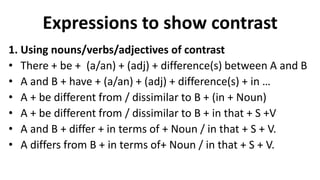
Expressions to show contrast
1. Using nouns/verbs/adjectives of contrast
• There + be + (a/an) + (adj) + difference(s) between A and B
• A and B + have + (a/an) + (adj) + difference(s) + in …
• A + be different from / dissimilar to B + (in + Noun)
• A + be different from / dissimilar to B + in that + S +V
• A and B + differ + in terms of + Noun / in that + S + V.
• A differs from B + in terms of+ Noun / in that + S + V.
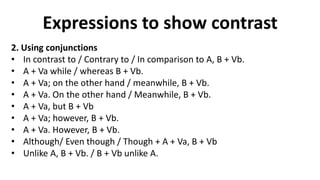
Expressions to show contrast
2. Using conjunctions
• In contrast to / Contrary to / In comparison to A, B + Vb.
• A + Va while / whereas B + Vb.
• A + Va; on the other hand / meanwhile, B + Vb.
• A + Va. On the other hand / Meanwhile, B + Vb.
• A + Va, but B + Vb
• A + Va; however, B + Vb.
• A + Va. However, B + Vb.
• Although/ Even though / Though + A + Va, B + Vb
• Unlike A, B + Vb. / B + Vb unlike A.
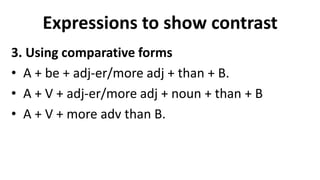
Expressions to show contrast
3. Using comparative forms
• A + be + adj-er/more adj + than + B.
• A + V + adj-er/more adj + noun + than + B
• A + V + more adv than B.
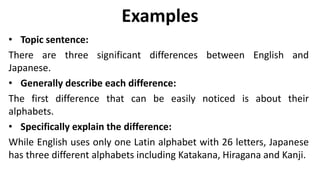
Examples
• Topic sentence:
There are three significant differences between English and
Japanese.
• Generally describe each difference:
The first difference that can be easily noticed is about their
alphabets.
• Specifically explain the difference:
While English uses only one Latin alphabet with 26 letters, Japanese
has three different alphabets including Katakana, Hiragana and Kanji.

Writing 3 - Unit 4

  • 1.
    UNIT 4 • Topic:Languages • Writing genre: A contrasting paragraph
  • 2.
    How many languagescan you recognize?
  • 3.
    THINK AND SHARE •What foreign languages are you learning? • Are the foreign languages which you are learning similar or different?
  • 4.
    What things doyou consider when you compare or contrast two languages? Criteria to compare/contrast two languages origin Number of speakers The alphabet grammar word order Word form pronunciation spelling
  • 5.
    BRAINSTORMING • Think aboutEnglish and the second foreign language which you are learning • What are some differences between them? Things to contrast English You second foreign language 1. 2. 3.
  • 6.
    WRITING TASK FORUNIT 4 • Write a paragraph to show the differences between English and your second foreign language • Use expressions of contrast in your writing • Organize your ideas point-by-point • Write at least 150 words
  • 7.
    Point-by-point organization ofa contrasting paragraph • Topic sentence: - Topic: Two things/people/places (e.g. A, B) - Main idea: differences / different • Supporting sentences: - Difference 1: + Detail about A + Detail about B - Difference 2: + Detail about A + Detail about B - Difference 3: + Detail about A + Detail about B • Concluding sentence: Restate the main idea • Topic sentence: - Topic: British English versus American English - Main idea: very different • Supporting sentences: - Spelling: + British English + American English - Vocabulary: + British English + American English - Grammar: + British English + American English • Concluding sentence: Restate the main idea
  • 8.
    Expressions to showcontrast 1. Using nouns/verbs/adjectives of contrast • There + be + (a/an) + (adj) + difference(s) between A and B • A and B + have + (a/an) + (adj) + difference(s) + in … • A + be different from / dissimilar to B + (in + Noun) • A + be different from / dissimilar to B + in that + S +V • A and B + differ + in terms of + Noun / in that + S + V. • A differs from B + in terms of+ Noun / in that + S + V.
  • 9.
    Expressions to showcontrast 2. Using conjunctions • In contrast to / Contrary to / In comparison to A, B + Vb. • A + Va while / whereas B + Vb. • A + Va; on the other hand / meanwhile, B + Vb. • A + Va. On the other hand / Meanwhile, B + Vb. • A + Va, but B + Vb • A + Va; however, B + Vb. • A + Va. However, B + Vb. • Although/ Even though / Though + A + Va, B + Vb • Unlike A, B + Vb. / B + Vb unlike A.
  • 10.
    Expressions to showcontrast 3. Using comparative forms • A + be + adj-er/more adj + than + B. • A + V + adj-er/more adj + noun + than + B • A + V + more adv than B.
  • 11.
    Examples • Topic sentence: Thereare three significant differences between English and Japanese. • Generally describe each difference: The first difference that can be easily noticed is about their alphabets. • Specifically explain the difference: While English uses only one Latin alphabet with 26 letters, Japanese has three different alphabets including Katakana, Hiragana and Kanji.