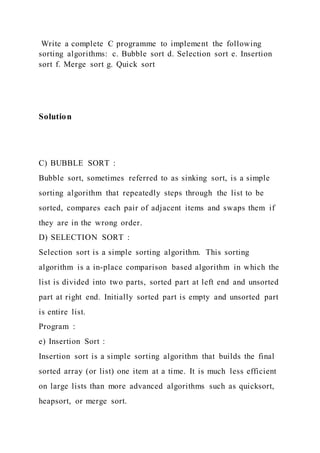
The document discusses and provides code implementations for several sorting algorithms:
1) Bubble sort, selection sort, and insertion sort are presented with brief descriptions of how each algorithm works.
2) Merge sort is explained as dividing the list into single elements, comparing and merging adjacent lists, and finally merging all elements into a sorted list. Pseudocode is provided.
3) Quick sort is described as picking a pivot element, partitioning the array around it, and recursively applying the process to the sub-arrays. Pseudocode is given.
![Program :
f. Merge Sort :
merge sort first divide the list into the smallest unit (1 element),
then compare each element with the adjacent list to sort and
merge the two adjacent lists. Finally all the elements are sorted
and merged.
Program :
#include<stdio.h>
#include<conio.h>
void merge(int [],int ,int ,int );
void part(int [],int ,int );
int main()
{
int arr[30];
int i,size;
printf(" t------- Merge sorting method ------- ");
printf("Enter total no. of elements : ");
scanf("%d",&size);
for(i=0; i<size; i++)
{
printf("Enter %d element : ",i+1);
scanf("%d",&arr[i]);
}
part(arr,0,size-1);
printf(" t------- Merge sorted elements ------- ");](https://image.slidesharecdn.com/writeacompletecprogrammetoimplementthefollowingsortingalgor-220914205907-750b2c4a/85/Write-a-complete-C-programme-to-implement-the-following-sorting-algor-docx-2-320.jpg)
![for(i=0; i<size; i++)
printf("%d ",arr[i]);
getch();
return 0;
}
void part(int arr[],int min,int max)
{
int mid;
if(min<max)
{
mid=(min+max)/2;
part(arr,min,mid);
part(arr,mid+1,max);
merge(arr,min,mid,max);
}
}
void merge(int arr[],int min,int mid,int max)
{
int tmp[30];
int i,j,k,m;
j=min;](https://image.slidesharecdn.com/writeacompletecprogrammetoimplementthefollowingsortingalgor-220914205907-750b2c4a/85/Write-a-complete-C-programme-to-implement-the-following-sorting-algor-docx-3-320.jpg)
![m=mid+1;
for(i=min; j<=mid && m<=max ; i++)
{
if(arr[j]<=arr[m])
{
tmp[i]=arr[j];
j++;
}
else
{
tmp[i]=arr[m];
m++;
}
}
if(j>mid)
{
for(k=m; k<=max; k++)
{
tmp[i]=arr[k];
i++;
}
}
else
{
for(k=j; k<=mid; k++)](https://image.slidesharecdn.com/writeacompletecprogrammetoimplementthefollowingsortingalgor-220914205907-750b2c4a/85/Write-a-complete-C-programme-to-implement-the-following-sorting-algor-docx-4-320.jpg)
![{
tmp[i]=arr[k];
i++;
}
}
for(k=min; k<=max; k++)
arr[k]=tmp[k];
}
g) Quick Sort :
The quicksort algorithm is performed as follows:
This is repeated until the entire array is sorted.
Program :
#include<stdio.h>
#include<conio.h>
void qsort(int arr[20], int fst, int last);
int main()
{
int arr[30];
int i,size;
printf("Enter total no. of the elements : ");
scanf("%d",&size);
printf("Enter total %d elements : ",size);
for(i=0; i<size; i++)
scanf("%d",&arr[i]);](https://image.slidesharecdn.com/writeacompletecprogrammetoimplementthefollowingsortingalgor-220914205907-750b2c4a/85/Write-a-complete-C-programme-to-implement-the-following-sorting-algor-docx-5-320.jpg)
![qsort(arr,0,size-1);
printf("Quick sorted elements are as : ");
for(i=0; i<size; i++)
printf("%dt",arr[i]);
getch();
return 0;
}
void qsort(int arr[20], int fst, int last)
{
int i,j,pivot,tmp;
if(fst<last)
{
pivot=fst;
i=fst;
j=last;
while(i<j)
{
while(arr[i]<=arr[pivot] && i<last)
i++;
while(arr[j]>arr[pivot])
j--;
if(i<j)
{
tmp=arr[i];
arr[i]=arr[j];](https://image.slidesharecdn.com/writeacompletecprogrammetoimplementthefollowingsortingalgor-220914205907-750b2c4a/85/Write-a-complete-C-programme-to-implement-the-following-sorting-algor-docx-6-320.jpg)
![arr[j]=tmp;
}
}
tmp=arr[pivot];
arr[pivot]=arr[j];
arr[j]=tmp;
qsort(arr,fst,j-1);
qsort(arr,j+1,last);
}
}](https://image.slidesharecdn.com/writeacompletecprogrammetoimplementthefollowingsortingalgor-220914205907-750b2c4a/85/Write-a-complete-C-programme-to-implement-the-following-sorting-algor-docx-7-320.jpg)


![UNIT V Searching Sorting Hashing Techniques [Autosaved].pptx](https://cdn.slidesharecdn.com/ss_thumbnails/unitvsearchingsortinghashingtechniquesautosaved-241014040608-74caa0f6-thumbnail.jpg?width=640&height=640&fit=bounds)
![UNIT V Searching Sorting Hashing Techniques [Autosaved].pptx](https://cdn.slidesharecdn.com/ss_thumbnails/unitvsearchingsortinghashingtechniquesautosaved-241126054304-95a69c51-thumbnail.jpg?width=640&height=640&fit=bounds)


