A Systematic Model-Based Approach
for Feedback Control Trade-Off
Evaluation in Autonomic Systems
Sandro S. Andrade e Raimundo J. de A. Macêdo
Distributed Systems Laboratory (LaSiD)
Department of Computer Science
Federal University of Bahia
{sandros, macedo}@ufba.br
XXXII SBRC – IV Workshop de Sistemas Distribuídos Autonômicos – WoSiDA 2014
   
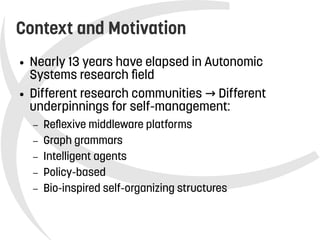
Context and Motivation
● Nearly 13 years have elapsed in Autonomic
Systems research field
● Different research communities Different→
underpinnings for self-management:
– Reflexive middleware platforms
– Graph grammars
– Intelligent agents
– Policy-based
– Bio-inspired self-organizing structures
   
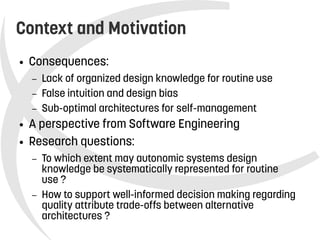
Context and Motivation
● Consequences:
– Lack of organized design knowledge for routine use
– False intuition and design bias
– Sub-optimal architectures for self-management
● A perspective from Software Engineering
● Research questions:
– To which extent may autonomic systems design
knowledge be systematically represented for routine
use ?
– How to support well-informed decision making regarding
quality attribute trade-offs between alternative
architectures ?
   
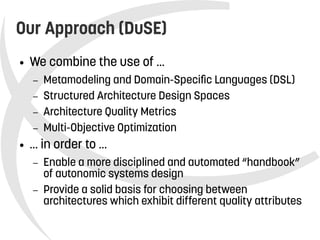
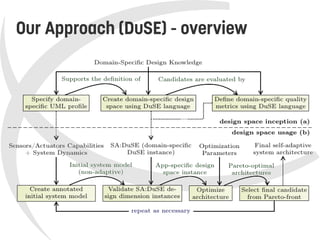
Our Approach (DuSE)
● We combine the use of ...
– Metamodeling and Domain-Specific Languages (DSL)
– Structured Architecture Design Spaces
– Architecture Quality Metrics
– Multi-Objective Optimization
● … in order to …
– Enable a more disciplined and automated “handbook”
of autonomic systems design
– Provide a solid basis for choosing between
architectures which exhibit different quality attributes
   
Our Approach (DuSE) - overview
   
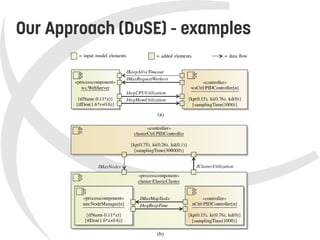
Our Approach (DuSE) - examples
   
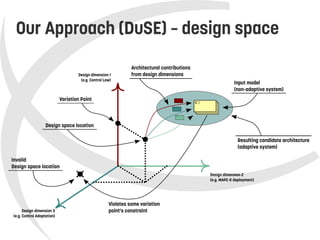
Our Approach (DuSE) – design space
   
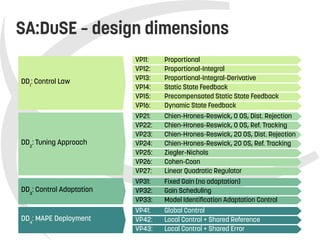
SA:DuSE – design dimensions
VP11: Proportional
VP12: Proportional-Integral
VP13: Proportional-Integral-Derivative
VP14: Static State Feedback
VP15: Precompensated Static State Feedback
VP16: Dynamic State Feedback
DD1
: Control Law
VP31: Fixed Gain (no adaptation)
VP32: Gain Scheduling
VP33: Model Identification Adaptation Control
DD3
: Control Adaptation
VP21: Chien-Hrones-Reswick, 0 OS, Dist. Rejection
VP22: Chien-Hrones-Reswick, 0 OS, Ref. Tracking
VP23: Chien-Hrones-Reswick, 20 OS, Dist. Rejection
VP24: Chien-Hrones-Reswick, 20 OS, Ref. Tracking
VP25: Ziegler-Nichols
VP26: Cohen-Coon
VP27: Linear Quadratic Regulator
DD2
: Tuning Approach
VP41: Global Control
VP42: Local Control + Shared Reference
VP43: Local Control + Shared Error
DD4
: MAPE Deployment
   
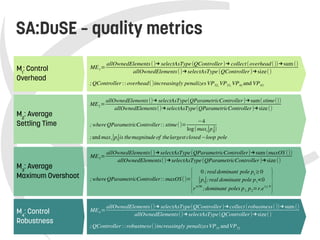
SA:DuSE – quality metrics
M2
: Average
Settling Time
ME2=
allOwnedElements()→ selectAsType(QParametricController)→sum(stime())
allOwnedElements()→selectAsType(QParametricController)→size()
; whereQParametricController:: stime()=
−4
log(maxi∣pi∣)
;and maxi∣pi∣is themagnitude of thelargest closed−loop pole
M1
: Control
Overhead
ME1=
allOwnedElements()→ selectAsType(QController)→ collect(overhead())→sum ()
allOwnedElements()→selectAsType(QController)→size()
;QController :: overhead()increasingly penalizes VP32, VP33, VP41 and VP43
M4
: Control
Robustness
ME4=
allOwnedElements()→ selectAsType(QController)→collect(robustness())→sum ()
allOwnedElements()→selectAsType(QController)→size()
;QController ::robustness()increasingly penalizesVP31 andVP32
M3
: Average
Maximum Overshoot
ME3=
allOwnedElements()→selectAsType(QParametricController)→sum (maxOS ())
allOwnedElements()→selectAsType(QParametricController)→size()
; whereQParametricController:: maxOS()=
{
0 ;realdominant pole p1
≥0
∣p1∣;real dominant pole p1<0
rπ/∣θ∣
;dominant poles p1, p2=r.e±j. θ}
   
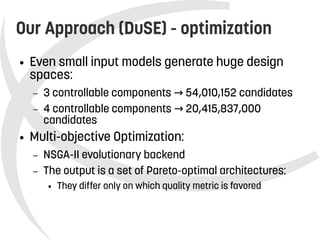
Our Approach (DuSE) - optimization
● Even small input models generate huge design
spaces:
– 3 controllable components 54,010,152 candidates→
– 4 controllable components 20,415,837,000→
candidates
● Multi-objective Optimization:
– NSGA-II evolutionary backend
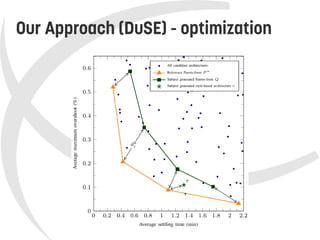
– The output is a set of Pareto-optimal architectures:
● They differ only on which quality metric is favored
   
Our Approach (DuSE) - optimization
   
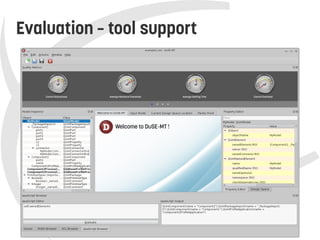
Evaluation – tool support
   
Evaluation
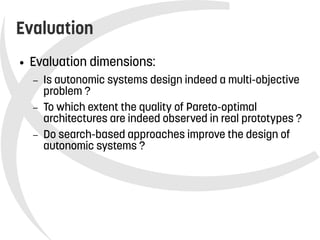
● Evaluation dimensions:
– Is autonomic systems design indeed a multi-objective
problem ?
– To which extent the quality of Pareto-optimal
architectures are indeed observed in real prototypes ?
– Do search-based approaches improve the design of
autonomic systems ?
   
Evaluation
● Evaluation dimensions:
– Is autonomic systems design indeed a multi-objective
problem ?
– To which extent the quality of Pareto-optimal
architectures are indeed observed in real prototypes ?
– Do search-based approaches improve the design of
autonomic systems ?
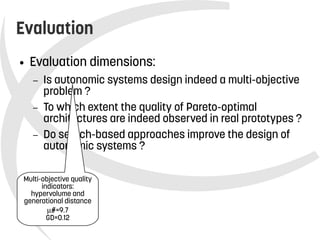
Multi-objective quality
indicators:
hypervolume and
generational distance
#=9.7
GD=0.12
   
Evaluation
● Evaluation dimensions:
– Is autonomic systems design indeed a multi-objective
problem ?
– To which extent the quality of Pareto-optimal
architectures are indeed observed in real prototypes ?
– Do search-based approaches improve the design of
autonomic systems ?
Multi-objective quality
indicators:
hypervolume and
generational distance
#=9.7
GD=0.12
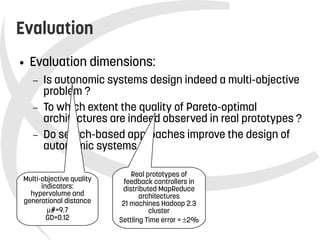
Real prototypes of
feedback controllers in
distributed MapReduce
architectures
21 machines Hadoop 2.3
cluster
Settling Time error = 2%
   
Evaluation
● Evaluation dimensions:
– Is autonomic systems design indeed a multi-objective
problem ?
– To which extent the quality of Pareto-optimal
architectures are indeed observed in real prototypes ?
– Do search-based approaches improve the design of
autonomic systems ?
Multi-objective quality
indicators:
hypervolume and
generational distance
#=9.7
GD=0.12
Real prototypes of
feedback controllers in
distributed MapReduce
architectures
21 machines Hadoop 2.3
cluster
Settling Time error = 2%
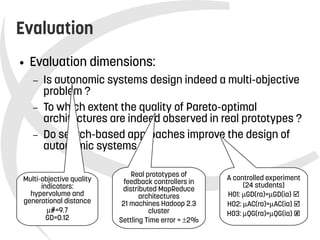
A controlled experiment
(24 students)
H01: GD(ra)=GD(ia) ☑
H02: AC(ra)=AC(ia) ☑
H03: QG(ra)=QG(ia) 
   
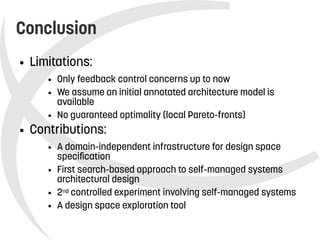
Conclusion
● Limitations:
● Only feedback control concerns up to now
● We assume an initial annotated architecture model is
available
● No guaranteed optimality (local Pareto-fronts)
● Contributions:
● A domain-independent infrastructure for design space
specification
● First search-based approach to self-managed systems
architectural design
● 2nd controlled experiment involving self-managed systems
● A design space exploration tool
   
Obrigado !
Sandro S. Andrade e Raimundo J. de A. Macêdo
Distributed Systems Laboratory (LaSiD)
Department of Computer Science
Federal University of Bahia
{sandros, macedo}@ufba.br

Apresentação no 4o Workshop de Sistemas Distribuídos Autonômicos - WoSiDA 2014 - SBRC 2014

  • 1.
        A SystematicModel-Based Approach for Feedback Control Trade-Off Evaluation in Autonomic Systems Sandro S. Andrade e Raimundo J. de A. Macêdo Distributed Systems Laboratory (LaSiD) Department of Computer Science Federal University of Bahia {sandros, macedo}@ufba.br XXXII SBRC – IV Workshop de Sistemas Distribuídos Autonômicos – WoSiDA 2014
  • 2.
        Context andMotivation ● Nearly 13 years have elapsed in Autonomic Systems research field ● Different research communities Different→ underpinnings for self-management: – Reflexive middleware platforms – Graph grammars – Intelligent agents – Policy-based – Bio-inspired self-organizing structures
  • 3.
        Context andMotivation ● Consequences: – Lack of organized design knowledge for routine use – False intuition and design bias – Sub-optimal architectures for self-management ● A perspective from Software Engineering ● Research questions: – To which extent may autonomic systems design knowledge be systematically represented for routine use ? – How to support well-informed decision making regarding quality attribute trade-offs between alternative architectures ?
  • 4.
        Our Approach(DuSE) ● We combine the use of ... – Metamodeling and Domain-Specific Languages (DSL) – Structured Architecture Design Spaces – Architecture Quality Metrics – Multi-Objective Optimization ● … in order to … – Enable a more disciplined and automated “handbook” of autonomic systems design – Provide a solid basis for choosing between architectures which exhibit different quality attributes
  • 5.
        Our Approach(DuSE) - overview
  • 6.
        Our Approach(DuSE) - examples
  • 7.
        Our Approach(DuSE) – design space
  • 8.
        SA:DuSE –design dimensions VP11: Proportional VP12: Proportional-Integral VP13: Proportional-Integral-Derivative VP14: Static State Feedback VP15: Precompensated Static State Feedback VP16: Dynamic State Feedback DD1 : Control Law VP31: Fixed Gain (no adaptation) VP32: Gain Scheduling VP33: Model Identification Adaptation Control DD3 : Control Adaptation VP21: Chien-Hrones-Reswick, 0 OS, Dist. Rejection VP22: Chien-Hrones-Reswick, 0 OS, Ref. Tracking VP23: Chien-Hrones-Reswick, 20 OS, Dist. Rejection VP24: Chien-Hrones-Reswick, 20 OS, Ref. Tracking VP25: Ziegler-Nichols VP26: Cohen-Coon VP27: Linear Quadratic Regulator DD2 : Tuning Approach VP41: Global Control VP42: Local Control + Shared Reference VP43: Local Control + Shared Error DD4 : MAPE Deployment
  • 9.
        SA:DuSE –quality metrics M2 : Average Settling Time ME2= allOwnedElements()→ selectAsType(QParametricController)→sum(stime()) allOwnedElements()→selectAsType(QParametricController)→size() ; whereQParametricController:: stime()= −4 log(maxi∣pi∣) ;and maxi∣pi∣is themagnitude of thelargest closed−loop pole M1 : Control Overhead ME1= allOwnedElements()→ selectAsType(QController)→ collect(overhead())→sum () allOwnedElements()→selectAsType(QController)→size() ;QController :: overhead()increasingly penalizes VP32, VP33, VP41 and VP43 M4 : Control Robustness ME4= allOwnedElements()→ selectAsType(QController)→collect(robustness())→sum () allOwnedElements()→selectAsType(QController)→size() ;QController ::robustness()increasingly penalizesVP31 andVP32 M3 : Average Maximum Overshoot ME3= allOwnedElements()→selectAsType(QParametricController)→sum (maxOS ()) allOwnedElements()→selectAsType(QParametricController)→size() ; whereQParametricController:: maxOS()= { 0 ;realdominant pole p1 ≥0 ∣p1∣;real dominant pole p1<0 rπ/∣θ∣ ;dominant poles p1, p2=r.e±j. θ}
  • 10.
        Our Approach(DuSE) - optimization ● Even small input models generate huge design spaces: – 3 controllable components 54,010,152 candidates→ – 4 controllable components 20,415,837,000→ candidates ● Multi-objective Optimization: – NSGA-II evolutionary backend – The output is a set of Pareto-optimal architectures: ● They differ only on which quality metric is favored
  • 11.
        Our Approach(DuSE) - optimization
  • 12.
  • 13.
        Evaluation ● Evaluationdimensions: – Is autonomic systems design indeed a multi-objective problem ? – To which extent the quality of Pareto-optimal architectures are indeed observed in real prototypes ? – Do search-based approaches improve the design of autonomic systems ?
  • 14.
        Evaluation ● Evaluationdimensions: – Is autonomic systems design indeed a multi-objective problem ? – To which extent the quality of Pareto-optimal architectures are indeed observed in real prototypes ? – Do search-based approaches improve the design of autonomic systems ? Multi-objective quality indicators: hypervolume and generational distance #=9.7 GD=0.12
  • 15.
        Evaluation ● Evaluationdimensions: – Is autonomic systems design indeed a multi-objective problem ? – To which extent the quality of Pareto-optimal architectures are indeed observed in real prototypes ? – Do search-based approaches improve the design of autonomic systems ? Multi-objective quality indicators: hypervolume and generational distance #=9.7 GD=0.12 Real prototypes of feedback controllers in distributed MapReduce architectures 21 machines Hadoop 2.3 cluster Settling Time error = 2%
  • 16.
        Evaluation ● Evaluationdimensions: – Is autonomic systems design indeed a multi-objective problem ? – To which extent the quality of Pareto-optimal architectures are indeed observed in real prototypes ? – Do search-based approaches improve the design of autonomic systems ? Multi-objective quality indicators: hypervolume and generational distance #=9.7 GD=0.12 Real prototypes of feedback controllers in distributed MapReduce architectures 21 machines Hadoop 2.3 cluster Settling Time error = 2% A controlled experiment (24 students) H01: GD(ra)=GD(ia) ☑ H02: AC(ra)=AC(ia) ☑ H03: QG(ra)=QG(ia) 
  • 17.
        Conclusion ● Limitations: ●Only feedback control concerns up to now ● We assume an initial annotated architecture model is available ● No guaranteed optimality (local Pareto-fronts) ● Contributions: ● A domain-independent infrastructure for design space specification ● First search-based approach to self-managed systems architectural design ● 2nd controlled experiment involving self-managed systems ● A design space exploration tool
  • 18.
        Obrigado ! SandroS. Andrade e Raimundo J. de A. Macêdo Distributed Systems Laboratory (LaSiD) Department of Computer Science Federal University of Bahia {sandros, macedo}@ufba.br