Introductio
n to world
religions
Prepared by: Mikael Dominik Rolando L. Abad,
LPT
Objectives:
At the end of the lesson, the students will be able to:
1. Discuss the concepts of religion, faith, worldview, and other related
terms;
2. Differentiate theology, philosophy of religion, and spirituality;
3. Enumerate and discuss the elements of religion;
4. Enumerate and discuss the elements of spirituality;
5. Discuss the various worldviews; and
6. Discuss the relationship between religion and spirituality.
Preamble of the United Religions Initiative (URI)
We, people of diverse religions, spiritual expressions, and indigenous
traditions throughout the world, hereby establish the United Religions
Initiative to promote enduring, daily interfaith cooperation, to end
religiously motivated violence and create cultures of peace, justice and
healing for the Earth and all living beings.
We respect the uniqueness of each tradition, and differences of practice or
belief.
We value voices that respect others and believe that sharing our values
and wisdom can lead us to act for the good of all.
We believe that our religious, spiritual lives, rather than dividing us, guide
Preamble of the United Religions Initiative (URI)
Therefore, as interdependent people rooted in our traditions, we now
unite for the benefit of our Earth community.
We unite to build cultures of peace and justice.
We unite to heal and protect the Earth.
We unite to build safe places for conflict resolution, healing and
reconciliation.
We unite to support freedom of religion and spiritual expression, and the
rights of all individuals and peoples as set forth in international law.
Preamble of the United Religions Initiative (URI)
We unite in responsible cooperative action to bring the wisdom and values
of our religions, spiritual expressions, and indigenous traditions to bear on
the economic, environmental, political and social challenges facing our
Earth community.
We unite to provide a global opportunity for participation by all people,
especially by those whose voices are not often heard.
We unite to celebrate the joy of blessings and the light of wisdom in both
movement and stillness.
We unite to use our combined resources only for nonviolent, compassionate
action, to awaken to our deepest truths, and to manifest love and justice
among all life in our Earth community.
Discussion
Questions:
● What religious ideas are conveyed in the
preamble?
● Do you believe that despite having different
religious beliefs, people can still be united?
● Which among the ideas expressed in the
preamble is most similar to your own religious
belief? Explain.
Definition
of terms
CREDITS: This presentation template was created by Slidesgo,
including icons by Flaticon, and infographics & images by
Freepik
Belief
Belief is a mental attitude or conviction
that something is true or real, even when
there may not be concrete evidence to
support it. Beliefs can be based on
personal experiences, cultural upbringing,
religious teachings, or simply one's
perception of reality.
CREDITS: This presentation template was created by Slidesgo,
including icons by Flaticon, and infographics & images by
Freepik
faith
Faith is a strong belief or trust in
something, even when there is no
concrete evidence or proof. It often
involves a deep conviction in the absence
of absolute certainty. Faith can relate to
religious or spiritual matters, but it can
also extend to trust in people, concepts, or
ideas.
CREDITS: This presentation template was created by Slidesgo,
including icons by Flaticon, and infographics & images by
Freepik
Belief
systems
Belief systems are like a set of rules or
ideas that help people understand the
world and decide how to behave. These
systems include things like religion,
politics, and culture, and they shape our
views and actions.
CREDITS: This presentation template was created by Slidesgo,
including icons by Flaticon, and infographics & images by
Freepik
worldview
A worldview is a broader and more
comprehensive perspective that
encompasses a person's fundamental
beliefs and assumptions about the nature
of reality, the universe, and human
existence.
Major
Worldviews
Monism
Belief systems are like a set of rules or ideas that
help people understand the world and decide how
to behave. .
Imagine you have a smoothie made from various
fruits like bananas, strawberries, and blueberries.
Monism in this context would be the belief that,
despite the different flavors and colors of these
fruits, they are all fundamentally made of the same
juice or substance. So, it's like saying all the
different fruits in the smoothie are just different
expressions of that one juice.
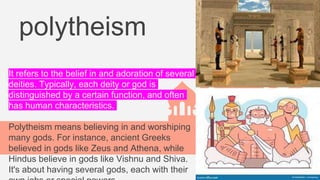
polytheism
It refers to the belief in and adoration of several
deities. Typically, each deity or god is
distinguished by a certain function, and often
has human characteristics.
Polytheism means believing in and worshiping
many gods. For instance, ancient Greeks
believed in gods like Zeus and Athena, while
Hindus believe in gods like Vishnu and Shiva.
It's about having several gods, each with their
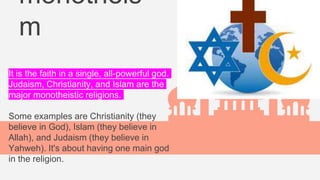
monotheis
m
It is the faith in a single, all-powerful god.
Judaism, Christianity, and Islam are the
major monotheistic religions.
Some examples are Christianity (they
believe in God), Islam (they believe in
Allah), and Judaism (they believe in
Yahweh). It's about having one main god
in the religion.
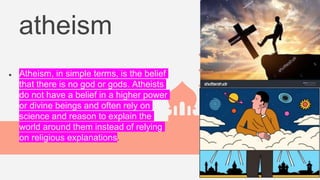
atheism
● Atheism, in simple terms, is the belief
that there is no god or gods. Atheists
do not have a belief in a higher power
or divine beings and often rely on
science and reason to explain the
world around them instead of relying
on religious explanations.
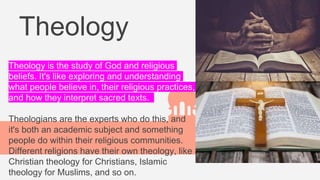
Theology
Theology is the study of God and religious
beliefs. It's like exploring and understanding
what people believe in, their religious practices,
and how they interpret sacred texts.
Theologians are the experts who do this, and
it's both an academic subject and something
people do within their religious communities.
Different religions have their own theology, like
Christian theology for Christians, Islamic
theology for Muslims, and so on.
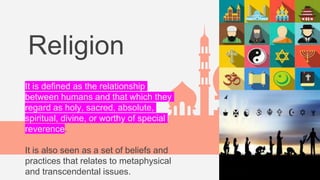
Religion
It is defined as the relationship
between humans and that which they
regard as holy, sacred, absolute,
spiritual, divine, or worthy of special
reverence.
It is also seen as a set of beliefs and
practices that relates to metaphysical
and transcendental issues.
The Five Elements of
Religion
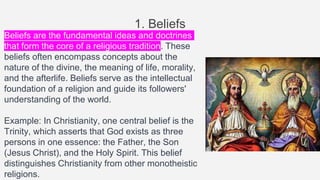
1. Beliefs
Beliefs are the fundamental ideas and doctrines
that form the core of a religious tradition. These
beliefs often encompass concepts about the
nature of the divine, the meaning of life, morality,
and the afterlife. Beliefs serve as the intellectual
foundation of a religion and guide its followers'
understanding of the world.
Example: In Christianity, one central belief is the
Trinity, which asserts that God exists as three
persons in one essence: the Father, the Son
(Jesus Christ), and the Holy Spirit. This belief
distinguishes Christianity from other monotheistic
religions.
2. organization
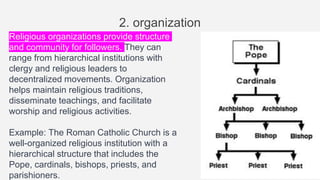
Religious organizations provide structure
and community for followers. They can
range from hierarchical institutions with
clergy and religious leaders to
decentralized movements. Organization
helps maintain religious traditions,
disseminate teachings, and facilitate
worship and religious activities.
Example: The Roman Catholic Church is a
well-organized religious institution with a
hierarchical structure that includes the
Pope, cardinals, bishops, priests, and
parishioners.
3. Emotions and values
Emotions and values are integral to
religious experiences. Religion often
inspires a range of emotions, from
reverence and awe to devotion and love.
Values associated with a religion guide the
ethical and moral behavior of its adherents.
Example: Buddhism emphasizes values
such as compassion and mindfulness.
Practitioners strive to cultivate these
qualities in themselves, leading to a sense
of inner peace and compassion for all living
beings.
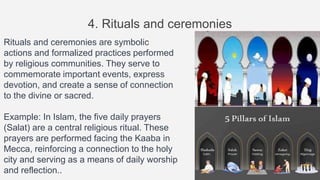
4. Rituals and ceremonies
Rituals and ceremonies are symbolic
actions and formalized practices performed
by religious communities. They serve to
commemorate important events, express
devotion, and create a sense of connection
to the divine or sacred.
Example: In Islam, the five daily prayers
(Salat) are a central religious ritual. These
prayers are performed facing the Kaaba in
Mecca, reinforcing a connection to the holy
city and serving as a means of daily worship
and reflection..
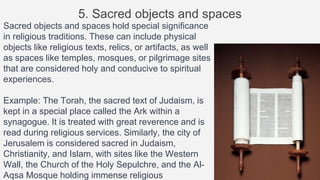
5. Sacred objects and spaces
Sacred objects and spaces hold special significance
in religious traditions. These can include physical
objects like religious texts, relics, or artifacts, as well
as spaces like temples, mosques, or pilgrimage sites
that are considered holy and conducive to spiritual
experiences.
Example: The Torah, the sacred text of Judaism, is
kept in a special place called the Ark within a
synagogue. It is treated with great reverence and is
read during religious services. Similarly, the city of
Jerusalem is considered sacred in Judaism,
Christianity, and Islam, with sites like the Western
Wall, the Church of the Holy Sepulchre, and the Al-
Aqsa Mosque holding immense religious
Religion and
Philosophy
Philosophy
Philosophy is a broad discipline
that involves critical thinking,
questioning, and rational inquiry
into fundamental questions
about reality, knowledge, ethics,
existence, and more. It seeks to
explore and understand these
questions through reasoned
argumentation and logical
analysis, often without relying on
empirical observation or religious
authority.
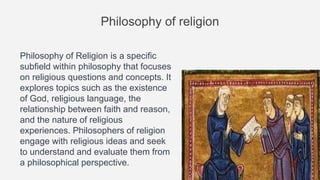
Philosophy of religion
Philosophy of Religion is a specific
subfield within philosophy that focuses
on religious questions and concepts. It
explores topics such as the existence
of God, religious language, the
relationship between faith and reason,
and the nature of religious
experiences. Philosophers of religion
engage with religious ideas and seek
to understand and evaluate them from
a philosophical perspective.
Spirituality and
Religion
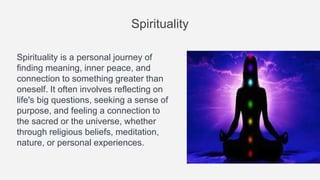
Spirituality
Spirituality is a personal journey of
finding meaning, inner peace, and
connection to something greater than
oneself. It often involves reflecting on
life's big questions, seeking a sense of
purpose, and feeling a connection to
the sacred or the universe, whether
through religious beliefs, meditation,
nature, or personal experiences.
Elements of Spirituality
1. A holistic or fully integrated view of life
2. A search for meaning and purpose in life
3. A desire to attain knowledge regarding the sacred
4. Self-reflective existence
Relationship between spirituality and religion
In essence, spirituality and religion are interconnected in
various ways, and their relationship can be highly
individualized. While religion provides a structured
framework for spirituality for many people, others may find
spiritual fulfillment independently or through a blend of both
religious and personal spiritual experiences. Ultimately, the
nature of this relationship is influenced by personal beliefs,
cultural factors, and individual life experiences.

world-religion-introduction.pptx

  • 1.
    Introductio n to world religions Preparedby: Mikael Dominik Rolando L. Abad, LPT
  • 2.
    Objectives: At the endof the lesson, the students will be able to: 1. Discuss the concepts of religion, faith, worldview, and other related terms; 2. Differentiate theology, philosophy of religion, and spirituality; 3. Enumerate and discuss the elements of religion; 4. Enumerate and discuss the elements of spirituality; 5. Discuss the various worldviews; and 6. Discuss the relationship between religion and spirituality.
  • 3.
    Preamble of theUnited Religions Initiative (URI) We, people of diverse religions, spiritual expressions, and indigenous traditions throughout the world, hereby establish the United Religions Initiative to promote enduring, daily interfaith cooperation, to end religiously motivated violence and create cultures of peace, justice and healing for the Earth and all living beings. We respect the uniqueness of each tradition, and differences of practice or belief. We value voices that respect others and believe that sharing our values and wisdom can lead us to act for the good of all. We believe that our religious, spiritual lives, rather than dividing us, guide
  • 4.
    Preamble of theUnited Religions Initiative (URI) Therefore, as interdependent people rooted in our traditions, we now unite for the benefit of our Earth community. We unite to build cultures of peace and justice. We unite to heal and protect the Earth. We unite to build safe places for conflict resolution, healing and reconciliation. We unite to support freedom of religion and spiritual expression, and the rights of all individuals and peoples as set forth in international law.
  • 5.
    Preamble of theUnited Religions Initiative (URI) We unite in responsible cooperative action to bring the wisdom and values of our religions, spiritual expressions, and indigenous traditions to bear on the economic, environmental, political and social challenges facing our Earth community. We unite to provide a global opportunity for participation by all people, especially by those whose voices are not often heard. We unite to celebrate the joy of blessings and the light of wisdom in both movement and stillness. We unite to use our combined resources only for nonviolent, compassionate action, to awaken to our deepest truths, and to manifest love and justice among all life in our Earth community.
  • 6.
    Discussion Questions: ● What religiousideas are conveyed in the preamble? ● Do you believe that despite having different religious beliefs, people can still be united? ● Which among the ideas expressed in the preamble is most similar to your own religious belief? Explain.
  • 7.
  • 8.
    CREDITS: This presentationtemplate was created by Slidesgo, including icons by Flaticon, and infographics & images by Freepik Belief Belief is a mental attitude or conviction that something is true or real, even when there may not be concrete evidence to support it. Beliefs can be based on personal experiences, cultural upbringing, religious teachings, or simply one's perception of reality.
  • 9.
    CREDITS: This presentationtemplate was created by Slidesgo, including icons by Flaticon, and infographics & images by Freepik faith Faith is a strong belief or trust in something, even when there is no concrete evidence or proof. It often involves a deep conviction in the absence of absolute certainty. Faith can relate to religious or spiritual matters, but it can also extend to trust in people, concepts, or ideas.
  • 10.
    CREDITS: This presentationtemplate was created by Slidesgo, including icons by Flaticon, and infographics & images by Freepik Belief systems Belief systems are like a set of rules or ideas that help people understand the world and decide how to behave. These systems include things like religion, politics, and culture, and they shape our views and actions.
  • 11.
    CREDITS: This presentationtemplate was created by Slidesgo, including icons by Flaticon, and infographics & images by Freepik worldview A worldview is a broader and more comprehensive perspective that encompasses a person's fundamental beliefs and assumptions about the nature of reality, the universe, and human existence.
  • 12.
  • 13.
    Monism Belief systems arelike a set of rules or ideas that help people understand the world and decide how to behave. . Imagine you have a smoothie made from various fruits like bananas, strawberries, and blueberries. Monism in this context would be the belief that, despite the different flavors and colors of these fruits, they are all fundamentally made of the same juice or substance. So, it's like saying all the different fruits in the smoothie are just different expressions of that one juice.
  • 14.
    polytheism It refers tothe belief in and adoration of several deities. Typically, each deity or god is distinguished by a certain function, and often has human characteristics. Polytheism means believing in and worshiping many gods. For instance, ancient Greeks believed in gods like Zeus and Athena, while Hindus believe in gods like Vishnu and Shiva. It's about having several gods, each with their
  • 15.
    monotheis m It is thefaith in a single, all-powerful god. Judaism, Christianity, and Islam are the major monotheistic religions. Some examples are Christianity (they believe in God), Islam (they believe in Allah), and Judaism (they believe in Yahweh). It's about having one main god in the religion.
  • 16.
    atheism ● Atheism, insimple terms, is the belief that there is no god or gods. Atheists do not have a belief in a higher power or divine beings and often rely on science and reason to explain the world around them instead of relying on religious explanations.
  • 17.
    Theology Theology is thestudy of God and religious beliefs. It's like exploring and understanding what people believe in, their religious practices, and how they interpret sacred texts. Theologians are the experts who do this, and it's both an academic subject and something people do within their religious communities. Different religions have their own theology, like Christian theology for Christians, Islamic theology for Muslims, and so on.
  • 18.
    Religion It is definedas the relationship between humans and that which they regard as holy, sacred, absolute, spiritual, divine, or worthy of special reverence. It is also seen as a set of beliefs and practices that relates to metaphysical and transcendental issues.
  • 19.
    The Five Elementsof Religion
  • 20.
    1. Beliefs Beliefs arethe fundamental ideas and doctrines that form the core of a religious tradition. These beliefs often encompass concepts about the nature of the divine, the meaning of life, morality, and the afterlife. Beliefs serve as the intellectual foundation of a religion and guide its followers' understanding of the world. Example: In Christianity, one central belief is the Trinity, which asserts that God exists as three persons in one essence: the Father, the Son (Jesus Christ), and the Holy Spirit. This belief distinguishes Christianity from other monotheistic religions.
  • 21.
    2. organization Religious organizationsprovide structure and community for followers. They can range from hierarchical institutions with clergy and religious leaders to decentralized movements. Organization helps maintain religious traditions, disseminate teachings, and facilitate worship and religious activities. Example: The Roman Catholic Church is a well-organized religious institution with a hierarchical structure that includes the Pope, cardinals, bishops, priests, and parishioners.
  • 22.
    3. Emotions andvalues Emotions and values are integral to religious experiences. Religion often inspires a range of emotions, from reverence and awe to devotion and love. Values associated with a religion guide the ethical and moral behavior of its adherents. Example: Buddhism emphasizes values such as compassion and mindfulness. Practitioners strive to cultivate these qualities in themselves, leading to a sense of inner peace and compassion for all living beings.
  • 23.
    4. Rituals andceremonies Rituals and ceremonies are symbolic actions and formalized practices performed by religious communities. They serve to commemorate important events, express devotion, and create a sense of connection to the divine or sacred. Example: In Islam, the five daily prayers (Salat) are a central religious ritual. These prayers are performed facing the Kaaba in Mecca, reinforcing a connection to the holy city and serving as a means of daily worship and reflection..
  • 24.
    5. Sacred objectsand spaces Sacred objects and spaces hold special significance in religious traditions. These can include physical objects like religious texts, relics, or artifacts, as well as spaces like temples, mosques, or pilgrimage sites that are considered holy and conducive to spiritual experiences. Example: The Torah, the sacred text of Judaism, is kept in a special place called the Ark within a synagogue. It is treated with great reverence and is read during religious services. Similarly, the city of Jerusalem is considered sacred in Judaism, Christianity, and Islam, with sites like the Western Wall, the Church of the Holy Sepulchre, and the Al- Aqsa Mosque holding immense religious
  • 25.
  • 26.
    Philosophy Philosophy is abroad discipline that involves critical thinking, questioning, and rational inquiry into fundamental questions about reality, knowledge, ethics, existence, and more. It seeks to explore and understand these questions through reasoned argumentation and logical analysis, often without relying on empirical observation or religious authority.
  • 27.
    Philosophy of religion Philosophyof Religion is a specific subfield within philosophy that focuses on religious questions and concepts. It explores topics such as the existence of God, religious language, the relationship between faith and reason, and the nature of religious experiences. Philosophers of religion engage with religious ideas and seek to understand and evaluate them from a philosophical perspective.
  • 28.
  • 29.
    Spirituality Spirituality is apersonal journey of finding meaning, inner peace, and connection to something greater than oneself. It often involves reflecting on life's big questions, seeking a sense of purpose, and feeling a connection to the sacred or the universe, whether through religious beliefs, meditation, nature, or personal experiences.
  • 30.
    Elements of Spirituality 1.A holistic or fully integrated view of life 2. A search for meaning and purpose in life 3. A desire to attain knowledge regarding the sacred 4. Self-reflective existence
  • 31.
    Relationship between spiritualityand religion In essence, spirituality and religion are interconnected in various ways, and their relationship can be highly individualized. While religion provides a structured framework for spirituality for many people, others may find spiritual fulfillment independently or through a blend of both religious and personal spiritual experiences. Ultimately, the nature of this relationship is influenced by personal beliefs, cultural factors, and individual life experiences.