World Wealth Report
              2009
HNWI Population and Wealth
Contract Significantly	                            	2

2008 in Review: Financial Market
Crisis Culminates in Global
Economic Downturn	                                 7


HNWIs Sought Refuge in Cash,
Fixed Income and Domestic
Investments in 2008	                              13


World’s HNWIs Scale Back on Their
Investments of Passion Amid
Economic Uncertainty and Rising Costs	            	17

Spotlight: Optimizing Client-Advisor-
Firm Dynamics is Key as Wealth
Management Firms Tackle Crisis Fallout	           	20

Wealth	Management	Firms	Face	a	New	Industry		
Reality	as	Crisis	Tests	Client	Confidence	and		
Long-Standing	Business	Models	                    	20

Client	Retention	and	Attrition	Are	Complex		
Dynamics	                                         22

Enabling	Advisors	Is	Key	to	Delivering	on		
Business	Goals	                                   25

Firms Can Act to Rebuild Shaken
Investor Confidence Through More
Holistic Risk Management	                         27

The Way Forward	                                  30


Appendix A: Methodology	                          34

Appendix B:
Select Country Breakdown	                         35
World Wealth Report
TO OUR READERS,

Capgemini and Merrill Lynch Global Wealth Management are pleased to present the 2009
World Wealth Report. Our annual report, now in its 13th year, was initiated as our two firms began collaborating to

analyze the macroeconomic factors that drive wealth creation, and better understand the key trends that affect High

Net Worth Individuals (HNWIs) around the globe.

2008 ushered in an unprecedented global downturn that originated in 2007. What started as a financial crisis soon

expanded into the larger economy, affecting mature and emerging markets alike. World equity markets lost a decade

of gains, and volatility reached record levels. Our 2008 findings show HNWIs began to lose trust in the markets, regulators,

and, in some cases, their financial advisory firms. They also extended their allocations to safer investments—a trend that

had its inception a year earlier. As a result, our research shows, cash and fixed-income instruments now make up 50% of

HNWIs’ portfolios overall, and many HNWIs have retreated to familiar domestic markets.

Restoring trust and confidence in the markets and the industry are resounding themes as we move forward. Our

Spotlight identifies the trends and forces driving HNWI client behavior and focuses on specific opportunities that wealth

management firms and Advisors can pursue directly to help craft mutually value-creating relationships moving forward

into the future.

We are pleased to present this year’s Report, and hope you find continued value in its insights.


Dan Sontag                             Bertrand Lavayssière
President                              Managing Director
Global Wealth Management               Global Financial Services
Merrill Lynch & Co., Inc.              Capgemini
2       World Wealth Report 2009


                            state oF the
                                                       WoRld’s Wealth
      HNWI POPULATION AND WEALTH CONTRACT SIGNIFICANTLY
      •  ttheendof2008,theworld’spopulationofhighnetworthindividuals(HNWIs1)wasdown14.9%fromtheyear
         A
         before,whiletheirwealthhaddropped19.5%. The unprecedented declines wiped out two robust years of growth
         in 2006 and 2007, reducing both the HNWI population and its wealth to below levels seen at the close of 2005.
      • 
         Ultra-HNWIs2sufferedmoreextensivelossesinfinancialwealththantheHNWIpopulationasawhole. The
         Ultra-HNWI population fell 24.6%, as the group’s wealth dropped 23.9%, pushing many down into the ‘mid-tier
         millionaire’3 pool.
      •  heglobalHNWIpopulationisstillconcentrated,buttheranksareshifting. The U.S., Japan and Germany
         T
         together accounted for 54.0% of the world’s HNWI population in 2008, up very slightly from 53.3% in 2007.
         China’s HNWI population surpassed that of the U.K. to become the fourth largest in the world. Hong Kong’s HNWI
         population shrank the most in percentage terms (down 61.3%).
      •  NWIwealthisforecasttostartgrowingagainastheglobaleconomyrecovers. By 2013, we forecast global
         H
         HNWI financial wealth to recover to $48.5 trillion, after advancing at a sustained annual rate of 8.1%. By 2013,
         we expect Asia-Pacific to overtake North America as the largest region for HNWI financial wealth.


HNWI PoPulatIoN aNd WealtH SHrINk beloW 2005 levelS
at the end of 2008, the world’s population of hNWIs was                                      • In Europe, the HNWI population decline varied widely by
down 14.9% from the year before (see Figure 1) to 8.6 million,                                   country. For example, the number of hNWIs shrank 26.3%
and their wealth had dropped 19.5% (see Figure 2) to $32.8                                       in the U.K., but just 12.6% in France and only 2.7% in
trillion. the declines were unprecedented, and wiped out two                                     Germany, which avoided a steep contraction in part because
robust years of growth in 2006 and 2007.                                                         hNWIs there were more heavily invested in conservative
                                                                                                 asset classes than those in other countries.
as a result, the world’s hNWI population and its wealth
                                                                                             • Japan, which accounts for more than 50% of the HNWIs
ended 2008 below levels seen at the close of 2005. annual
                                                                                                 in the asia-Pacific region, suffered a relatively mild hNWI
hNWI population growth had been a robust 7.2% from
                                                                                                 decline of 9.9%, but others in the region suffered greater
2005 to 2007, before reversing in 2008. the same trend was
                                                                                                 losses, including Hong Kong (-61.3%) and India (-31.6%).
evident in hNWI financial wealth, which grew 10.4% per year
                                                                                                 The apparent resilience of Japan, however, stemmed largely
in 2005-07, before the steep contraction.
                                                                                                 from the fact that the expansion of the hNWI population
the most significant declines in the hNWI population in 2008                                     there had already been capped by the 2007 slowdown in
occurred in the three largest regions: North america (-19.0%),                                   macroeconomic growth and a weakening stock market
europe (-14.4%) and asia-Pacific (-14.2%). But behind the                                        (market capitalization was down 11.1% in 2007).
aggregate numbers lie some interesting developments in the
                                                                                             the contraction in the overall hNWI population was
hNWI populations of those regions:
                                                                                             exacerbated by the steeper-than-average decline (globally
• The number of HNWIs in the U.S. fell 18.5% in 2008, but the U.S.                           and regionally) in the number of Ultra-HNWIs. A decline in
    remains the single largest home to hNWIs, with its 2.5 million                           Ultra-HNWI numbers has a disproportionate effect on overall
    hNWIs accounting for 28.7% of the global hNWI population.                                hNWI wealth, because so much wealth is concentrated at their


1
    HNWIs are defined as those having investable assets of US$1 million or more, excluding   3
                                                                                                 Mid-tier millionaires are HNWI having US$5 million to US$30 million
    primary residence, collectibles, consumables, and consumer durables.
2
    Ultra-HNWIs are defined as those having investable assets of US$30 million or more,
    excluding primary residence, collectibles, consumables, and consumer durables.
World Wealth Report 2009   3


Figure 1. HNWI Population, 2005 – 2008 (by Region)
          HNWI Population, 2005 – 2008 (by Region)
(In Million)

CAGR 2005-2007 7.2%                    Annual Growth 2007-2008 -14.9%
                        8.8              9.5             10.1            8.6
                                                                 0.1
                 10                              0.1             0.4
                                                 0.3             0.4
                                0.1
                                0.3              0.4                             0.1
                                0.3                                              0.4
                  8                                      2.8                     0.4
                                         2.6                                           % Change Total HNWI Population
                        2.4                                                                      2007-2008
Number of                                                                2.4
                  6                                                                         Africa            -8.3%
  HNWIs
Worldwide                                                3.1                                Middle East       -5.9%
                                         2.9
(in Million)            2.8
                  4                                                      2.6
                                                                                            Latin America     -0.7%

                                                                                            Asia-Pacific     -14.2%
                  2
                                         3.2             3.3                                Europe           -14.4%
                        2.9                                              2.7

                                                                                            North America    -19.0%
                  0
                       2005             2006            2007             2008


Note: High Net Worth Individuals (HNWIs) have at least US$1 million in investable assets, excluding primary
      residence, collectibles, consumables, and consumer durables.

       Ultra-High Net Worth Individuals (Ultra-HNWIs) hold at least US$30 million in investable assets,
       excluding primary residence, collectibles, consumables, and consumer durables.


Figure 2. HNWI Wealth distribution, 2005 – 2008 (by Region)
          HNWI Wealth Distribution, 2005 – 2008 (by Region)
(US$ Trillion)

CAGR 2005-2007 10.4%                   Annual Growth 2007-2008 -19.5%

                      US$33.4          US$37.2         US$40.7         US$32.8
                                                                 1.0
                                                                 1.7
                 40
                                                 0.9
                                                 1.4
                 35             0. 8                    6.2
                                1.3                                              0.8
                                         5.1
                                                                                 1.4
                 30    4.2
                                                                        5.8             % Change Total HNWI Wealth,
                                                        9.5
                                         8.4
   Global        25                                                                             2007-2008
                       7.6
   HNWI                                                                                      Africa          -18.7%
                 20                                                     7.4
  Wealth
  (in US$                               10.1            10.7*                                Middle East     -16.2%
  Trillion)      15    9.4
                                                                        8.3                  Latin America    -6.0%
                 10
                                                                                             Asia-Pacific    -22.3%

                       10.2             11.3            11.7
                  5                                                     9.1                  Europe          -21.9%

                                                                                             North America   -22.8%
                  0
                       2005             2006            2007            2008


*The 2007 number for Europe was restated from 10.6 to 10.710.7 as a result of updated data becoming available.
*The 2007 number for Europe was restated from 10.6 to as a result of updated data becoming available.
Source: Capgemini Lorenz curve analysis, 2009
4    World Wealth Report 2009


level (each has investable assets of at least $30 million). at                    addition, hNWIs in latin america tend to have relatively
the end of 2008, Ultra-HNWIs accounted for 34.7% of global                        conservative asset allocations, favoring fixed income.
hNWI wealth, but only 0.9% of the total hNWI population.
                                                                                  GLOBAL HNWI POPULATION IS STILL
The sharp decline in the number of Ultra-HNWIs globally                           CONCENTRATED, BUT THE RANkS ARE
(-24.6%) largely resulted from that group’s partiality for more                   SHIFTING
aggressive products, which tend to deliver greater-than-average
                                                                                  The U.S., Japan and Germany together accounted for 54.0% of
returns in good times, but delivered hefty losses in 2008.
                                                                                  the world’s hNWI population in 2008, up very slightly from
Those losses helped push Ultra-HNWI wealth down 23.9%
                                                                                  53.3% in 2007 (see Figure 4), despite the substantial loss of wealth
in 2008, and pushed a large number of Ultra-HNWIs down
                                                                                  by HNWIs in those countries, particularly the United States.
into the ‘mid-tier millionaire’ bracket. North america still
                                                                                  For example:
accounted for the largest concentration of Ultra-HNWIs
(30.6k) in 2008 (see Figure 3), though that was down sharply                      • China’s HNWI population surpassed that of the U.K. to
from 41.2k in 2007. Regionally, latin america retained the                          become the fourth largest in the world in 2008 (364k hNWIs),
largest percentage of Ultra-HNWIs relative to the overall HNWI                      after having exceeded France in 2007. In 2008, despite
population (2.4%)—which is far higher than the global                               steep market capitalization losses, the closed nature of
average of 0.9%.                                                                    China’s markets combined with robust macroeconomic
                                                                                    growth to help China avoid some of the steep losses felt
In terms of overall hNWI financial wealth, the three largest
                                                                                    elsewhere.
regions suffered the heaviest losses in 2008, but latin
                                                                                  • Brazil surpassed Australia and Spain to reach 10th place
america—the fourth largest—suffered to a lesser degree
                                                                                    among hNWI populations globally (131k hNWIs).
(-6.0%). hNWIs in Brazil, the largest country by hNWI
financial wealth in the region, saw their wealth decline by                       It is also striking to note how the financial crisis impacted
8.4% in 2008, far less than the global average. however,                          hNWIs differently in different types of economies. For
the losses were even smaller for hNWIs in neighboring                             example:
countries, such as Mexico and Colombia, where equity-
                                                                                  • Hong Kong’s HNWI population took by far the largest hit in
market declines were smaller, since selling was not as
                                                                                    percentage terms, with a 61.3% drop to 37k. Hong Kong is
extensive as in Brazil during the second-half of 2008. In
                                                                                    unique in that it is a developing economy with an extremely


Figure 3. Geographic Distribution of HNWIs and Ultra-HNWIs, 2008 (by Region)
Figure 3. Geographic distribution of HNWIs and ultra-HNWIs, 2008
(by Region)

                                                                      100
               10               8.6                78.0

                                        0.1                     1.8   80                               Ultra-HNWIs as %
                                        0.4
                8                                               3.5
                                        0.4                                                             of HNWIs, 2008
                                                    9.8
                                2.4                                   60                              Africa           1.9%
Number of                                          14.3                       Number of
                6
  HNWIs                                                                     Ultra-HNWIs               Middle East      0.9%
Worldwide                                                                     Worldwide
(in Million)                    2.6                18.0               40    (in Thousand)
                4                                                                                     Latin America    2.4%

                                                                                                      Asia-Pacific     0.6%
                2                                                     20
                                2.7                30.6                                               Europe           0.7%

                                                                                                      North America    1.1%
                0                                                     0
                            2008 HNWI         2008 Ultra-HNWI

Source: Capgemini Lorenz Curve Analysis, 2009
Source: Capgemini Lorenz curve analysis, 2009
World Wealth Report 2009   5


  high market-capitalization-to-nominal-GdP ratio (5.76).                                     HNWI WEALTH IS FORECAST TO RESUME
  That ratio indicates Hong Kong is particularly vulnerable to                                GROWTH AS GLOBAL ECONOMy RECOvERS
  large market capitalization declines like the one experienced
                                                                                              We forecast hNWI financial wealth will grow to $48.5 trillion
  in 2008 (-49.9%). By contrast, the ratio is 1.49 in singapore,
                                                                                              by 2013, advancing at an annualized rate of 8.1% (see Figure
  and just 0.83 in the U.S. Furthermore, Hong Kong has a
                                                                                              5). this growth will be driven by the recovery in asset prices
  very large proportion of its hNWIs in the $1m-$5m wealth
                                                                                              as the global economy and financial system right themselves.
  band, and many of these hNWIs dropped below the $1m
                                                                                              also, the 2008 flight-to-safety imperative is expected to ease,
  threshold in 2008 due to market losses.
                                                                                              encouraging hNWIs to return to higher-risk/higher-return
• India’s HNWI population shrank 31.6% to 84k, the second                                     assets, and away from capital-preservation instruments, as
  largest decline in the world, after posting the fastest rate of                             conditions improve.
  growth (up 22.7%) in 2007. India, still an emerging economy,
                                                                                              We expect North america and asia-Pacific to lead the growth
  suffered declining global demand for its goods and services
                                                                                              in hNWI financial wealth, and predict asia-Pacific will actually
  and a hefty drop in market capitalization (64.1%) in 2008.
                                                                                              surpass North america by 2013. Growth in these regions will be
• Russia’s HNWI population declined 28.5% to 97k, the
                                                                                              driven by increased U.S. consumer expenditure as well as new-
  seventh largest per-country drop in 2008, after growing at
                                                                                              found autonomy for the Chinese economy, which is already
  the tenth fastest rate (14.4%) in 2007. Russia’s economy
                                                                                              experiencing increased consumer demand.
  decelerated rapidly, in line with the steep decline in global
  demand for oil and gas. Compounding the problem was the                                     Latin America is poised to grow again when the U.S. and
  sharp fall in equity markets—down 71.7%, and the largest                                    asian economies start to pick up, as it has the commodities
  drop globally.                                                                              and manufacturing capability that will be needed during the
• The U.K. experienced a 26.3% drop in its HNWI population                                    return to growth. europe’s economic recovery is likely to lag,
  in 2008, to 362k. a mature economy, heavily reliant on                                      as several major countries there continue to face difficulties.
  financial services, the U.K. was particularly hard-hit by                                   In the Middle east, oil is expected to be a less dependable
  falling equity and real estate values.                                                      driver of wealth in the future, so growth there is likely to be
                                                                                              slower than it has been in the past.


Figure 4. HNWI Population by Country, 2008
          HNWI Population by Country, 2008
(in Thousand)
    Thousands)

              4000


                      3,019*
              3000                                                                                                                                              2008
 Number                    2,460
    of                                                                                                                                                          2007
  HNWIs       2000
   (in                             1,517*
                                         1,366
thousand)
              1000                               833* 810

                                                            413* 364    491* 362   396* 346
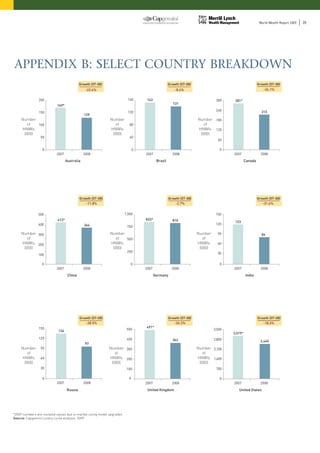
                                                                                               281* 213    212*185      207* 164             169* 129
                                                                                                                                   143 131               161*127
                 0
                       United       Japan        Germany China P. R.    United     France      Canada     Switzerland    Italy     Brazil    Australia    Spain
                       States                                          Kingdom

         Position
                          1            2            3          5           4          6           7           9           8          12         10         11
         in 2007


*2007 data has been revised
*2007 data has been revised as a resultof updated data becoming available
Source: Capgemini Lorenz curve analysis, 2009
6    World Wealth Report 2009


our global forecasts assume continued difficulties for the                                   Notably, hNWI wealth grew at a strong annualized rate of
global economy in 2009. We expect some initial signs of                                      close to 9% in 2002-07—the recovery years following the
growth in selected countries, which could pick up steam from                                 bursting of the technology bubble. While the tech downturn
2010, but protracted weakness in the global economic and/                                    and the most recent financial crisis are not identical forms
or financial systems could force a downward revision in our                                  of disruption, we nevertheless expect the recovery in hNWI
forecast numbers.                                                                            wealth to be similarly robust this time around, as the business
                                                                                             cycle starts to trend back up.


Figure 5. HNWI Financial Wealth Forecast, 2006 – 2013F (by Region)
Figure 5.                                              (by Region)
(US$ Trillion)
(US$ Trillion)

            50                                                                                      US$ 48.5
                                                                                                               1.0
                                                                                                               1.9

                                            US$ 40.7
                                                         1.0                                          7.6
            40           US$ 37.2                        1.7
                                     0.9                                                                                  Annual Growth Rate
                                     1.4       6.2              US$ 32.8                                                     2008-2013F
                                                                             0.8
                            5.1
                                                                             1.4                      13.5                    Africa          4.1%
 Global     30
HNWIs                                          9.5                5.8                                                         Middle East     5.7%
Wealth                      8.4
(in US$                                                                                                                       Latin America   6.8%
Trillion)                                                         7.4
            20                                                                     At 8.1%            11.4                    Asia-Pacific    12.8%
                           10.1               10.7*                                 Global
                                                                                     CAGR                                     Europe          6.5%
                                                                  8.3
            10                                                                                                                North America   7.0%

                                                                                                      12.7
                           11.3               11.7
                                                                  9.1

             0
                           2006               2007                2008                               2013


*The 2007 numbers for Europe was restated from 10.6 to to 10.7 result of updated data becoming available
*The 2007 number for Europe was revised from 10.6 10.7 as
Source: Capgemini Lorenz curve analysis, 2009
World Wealth Report 2009   7


        2008 IN RevIeW:
                                   FINANCIAL MARKET CRISIS CULMINATES
                           IN GLoBAL ECoNoMIC DoWNTURN

      • Therun-uptotheglobaleconomiccrisishad,inhindsight,been10yearsinthemaking. Current-account
        imbalances between creditor and debtor nations had widened, low yields had prompted a rampant search for
        returns, and the increased complexity and opacity of products had intensified systemic risk.
      • 
         TheU.S.financialcrisissoonspilledquickly,broadly,anddeeplyintotherealeconomyworldwide—damagingall
         themacroeconomicdriversofwealth(GDP,savingsandconsumption). National savings rates decreased, but so did
         consumer spending. The global economy is projected to post its worst performance since World War II.
      • Mostassetvalues,weakin2008’sfirsthalf,plungedinthesecondhalf,turningthemarket-performancedriver
        ofwealthfromchallengingtodevastating. Global equity-market capitalization plunged nearly 50%, and global
        investors fled to fixed-income securities, settling for a return of their investment, not on their investment.
      •  hereisnoclearconsensusyetonwhenandhowtheglobaleconomywillreturntogrowth. There are some
         T
         key issues to watch in the coming year, including the fiscal, financial and economic response of governments
         and financial authorities across the globe, with the U.S. and China as key players.


tHe eCoNoMIC Fallout WaS teN YearS IN tHe MakING
accounts are already legend of the financial crisis that began                                      mature markets as another means of diversifying their
in 2007 and accelerated in 2008, before spreading to the global                                     large asset bases.
economy in 2008. In hindsight, several important trends                                         b) Debtor nations spent wildly. as noted in the 2008
over the last 10 years marked the run-up to and unfolding of                                        WWR, nations in the developed world, such as spain,
the economic crisis, and make events far more fathomable.                                           Australia and the U.K.—and certainly the U.S.—had
these include:                                                                                      demonstrated unsustainable spending patterns that
                                                                                                    resulted in large current account deficits. The U.S. con-
1. Current-account imbalances between creditor and
                                                                                                    sumer has been the strongest single driver of global
      debtor nations widened over a 10-year period.
                                                                                                    demand for some time, accounting for $9.2 trillion, or
     a) Creditor nations accumulated massive amounts
                                                                                                    18.6% of the world’s GdP in 2008.6 this is comparable to
         of reserves. after financial crises in the late-1990s, asian
                                                                                                    the combined GdP ($10.8 trillion7) of Japan, China and
         and energy-rich nations started hedging against similar
                                                                                                    Germany—the next three largest economies in the world—
         shocks by increasing their savings, and building large
                                                                                                    bolstering the U.S. position as the leading debtor nation.
         current account surpluses. Much of the national savings
                                                                                           2. Low yields prompted a rampant search for returns.
         were destined for central bank reserves, especially in China,
                                                                                                Notably, real interest rates were driven down by strong
         where foreign currency reserves rose from $0.4 trillion
                                                                                                demand from creditor nations and by government
         in 2003 to almost $2 trillion in 2008.4 these funds were
                                                                                                intervention in the early 2000s. this encouraged investors
         invested primarily in low-risk assets, mainly U.S. Treasury
                                                                                                to search for better yields—often in the form of excessive
         securities. For example, foreign investors (private and
                                                                                                leverage and in novel product alternatives like complex
         official) owned nearly 60% of all U.S. Treasuries bonds
                                                                                                structured products such as mortgage-backed securities
         as of June 20075, up from less than 20% in 1994.
                                                                                                (MBs) and collateralized debt obligations (Cdos).
         sovereign Wealth Funds, such as those of singapore, abu
                                                                                           3. The increased complexity and opacity of many
         Dhabi, and China similarly invested in the U.S. and other
                                                                                                products intensified systemic risk. some of the

4
    Economist Intelligence Unit, Country Data for China, March 2009                        6
                                                                                               Economist Intelligence Unit, Country Data for the US, March 2009
5
    Financial Services Authority, The Turner Review: A Regulatory Response to the Global   7
                                                                                               Economist Intelligence Unit, Country Data for Japan, China and Germany, March 2009
    Banking Crisis (London, U.k. March 2009)
8       World Wealth Report 2009


     products designed in recent years to meet the strong                                                                 WORLD’S GDP SLUMPED IN 2008,
     demand for yield were highly complex and opaque,                                                                     AS ECONOMIES PROvED TO BE MORE
     certainly compared with standard exchange-traded products.                                                           INTERDEPENDENT THAN MANy THOUGHT
     Moreover, it took the rescue of Bear stearns, the collapse of                                                        The global economy is projected to post its worst performance
     lehman, and the crisis at aIG to show the degree to which                                                            since World War II. there had been a general consensus
     the market for products like credit default swaps (Cds)                                                              that certain emerging economies, such as the BRIC nations
     relied on a complex and interrelated web of counterparties,                                                          (Brazil, Russia, India, China), had strengthened to the point
     which became deeply threatened by the changing environ-                                                              that they no longer relied on mature economies for growth.
     ment for the underlying products.                                                                                    this so-called “decoupling” would theoretically insulate those
                                                                                                                          economies from mature-market downturns as well. however,
tHe u.S. FINaNCIal CrISIS SPIlled                                                                                         the decoupling theory was severely tested in 2008, as emerging
QuICklY, broadlY, aNd deePlY INto                                                                                         markets followed in lock-step with the global contraction in
tHe real eCoNoMY WorldWIde                                                                                                GdP (although their declines were not as quick or as steep as
the financial crisis that started in 2007 and continued into                                                              those in mature markets—see Figure 6).
2008 rapidly escalated and expanded into the general economy                                                              World GdP did manage to produce some growth in 2008 (2.0%),
in mature markets, and culminated in a steep, global economic                                                             but it was down from 3.9% in 2007 and 4.0% in 2006. GdP in
downturn, particularly in the last quarter of 2008. export-                                                               G7 economies deteriorated progressively as the crisis unfolded,
driven countries were hit hardest, particularly in asia, as global                                                        and ended the year showing growth of just 0.6%. BRIC nations
demand dried up. Many other countries and markets, especially                                                             continued to outpace many economies, led by China, despite the
in the developing world, were struck by a sharp drop in foreign                                                           steep slowdown in the fourth quarter. although the crisis spread
investment, as well as an overall drop in demand. all in all,                                                             worldwide, some regions posted relatively strong GdP growth
the macroeconomic drivers of wealth (gross domestic product                                                               for 2008, especially latin america (4.0%), and the Middle east
(GdP), savings and consumption) were all hit hard.                                                                        and North africa (5.8%)8, but that only suggests these regions
                                                                                                                          had yet to experience the full extent of the economic fallout.


Figure 6. real GdP Growth rates, 2007-2009F
 Figure 6. Real GDP Growth Rates, 2007-2009F
(%)
 (%)
                                                                                                                                                                                                                         2007
                15
                                                                                                                                                        13.0                                                             2008

                                                                                                                                                                                                                         2009F
                10                                                                                                                                             9.0         9.1
                                                                                               8.1                                       7.8
                                                                                                              6.7
                                                                                                     5.6                                                             6.0         6.0         5.7
                                                                                                                    4.8                                                                5.0         5.1
                 5
                                                                  3.0                                                                                                                                      3.3
                                     2.7           2.5                                                                      2.4
                       2.0                                                       2.1
                             1.1                         1.3                                                                                   1.2                                                               1.4
Percent                                    0.5                          0.7            0.7
Change           0
  (%)                                                                                                                -0.4     -0.7
                                                                                                                                                                                                    -1.5
                                            -2.2
                              -3.2                                                      -3.0           -3.0
                -5                                                        -4.0                                                                                                                                    -4.4
                                                           -5.3
                                                                                                                                  -6.4

               -10                                                                                                                               -8.8
                        United       Canada Germany                United        France        Russia         Poland         Japan       Singapore        China             India             Brazil       Mexico
                        States                                    Kingdom

               -15              North                          Western Europe                          Eastern                                 Asia-Pacific                                           Latin
                               America                                                                 Europe                                                                                        America

Source: Economist Intelligence Unit – April 2009. Real GDP variation over previous year
 Source: Economist Intelligence Unit – April 2009. Real GDP variation over previous year.

8
    Economist Intelligence Unit, Regional Data, March 2009. Capgemini Analysis
World Wealth Report 2009   9


NATIONAL SAvINGS DECREASED IN 2008,                                                              MoSt aSSet valueS, Weak
AND SO DID PERSONAL SPENDING                                                                     IN 2008’S FIrSt HalF, PluNGed
National savings9 decreased worldwide in 2008, negatively
                                                                                                 IN tHe SeCoNd HalF
impacting wealth, as there were fewer funds available for
                                                                                                 Market performance—another key driver of wealth—turned from
future investments. the ratio of combined national savings to
                                                                                                 challenging to devastating in 2008. Most key assets (equities, fixed
GdP fell to 22.6% globally, from 23.1% in 2007, and to 16.4%
                                                                                                 income, real estate and alternative investments) experienced a
in G7 countries, down from 17.2%.10
                                                                                                 mediocre first-half at best. then they were hit by a massive sell-
It is customary for a decreased level of national savings to                                     off, particularly in the fourth quarter, as investors fled to safe
coincide with an increase in total consumption (private                                          havens like cash, gold, and U.S. Treasuries. Many commodities and
and public spending). Global government consumption did                                          currencies—secondary drivers of wealth—also lost value in 2008.
increase in 2008—by $0.3 trillion worldwide                        11—partly       driven        Notable market events during the year included the following:
by widespread government outlays on financial bailouts and
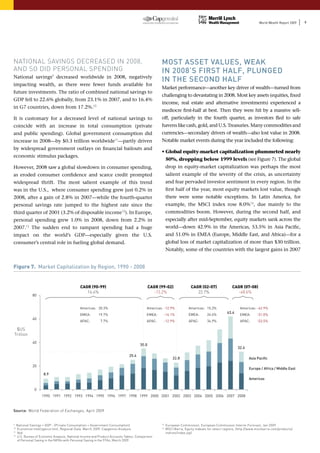
                                                                                                 • Global equity-market capitalization plummeted nearly
economic stimulus packages.
                                                                                                      50%, dropping below 1999 levels (see Figure 7). the global
however, 2008 saw a global slowdown in consumer spending,                                             drop in equity-market capitalization was perhaps the most
as eroded consumer confidence and scarce credit prompted                                              salient example of the severity of the crisis, as uncertainty
widespread thrift. the most salient example of this trend                                             and fear pervaded investor sentiment in every region. In the
was in the U.S., where consumer spending grew just 0.2% in                                            first half of the year, most equity markets lost value, though
2008, after a gain of 2.8% in 2007—while the fourth-quarter                                           there were some notable exceptions. In latin america, for
personal savings rate jumped to the highest rate since the                                            example, the MsCI index rose 8.0%14, due mainly to the
third quarter of 2001 (3.2% of disposable income12). In europe,                                       commodities boom. however, during the second half, and
personal spending grew 1.0% in 2008, down from 2.2% in                                                especially after mid-september, equity markets sank across the
2007.   13   the sudden end to rampant spending had a huge                                            world—down 42.9% in the americas, 53.5% in asia Pacific,
impact on the world’s GDP—especially given the U.S.                                                   and 51.0% in eMea (europe, Middle east, and africa)—for a
consumer’s central role in fueling global demand.                                                     global loss of market capitalization of more than $30 trillion.
                                                                                                      Notably, some of the countries with the largest gains in 2007

Figure 7. Market Capitalization by Region, USD Trillion
Figure 7. Market Capitalization by region, 1990 - 2008
(1990 - 2008)


                                            CAGR (90-99)                                   CAGR (99-02)               CAGR (02-07)               CAGR (07-08)
                                               16.4%                                         -13.2%                      22.7%                     -48.6%
             80


                                            Americas: 20.3%                             Americas: -12.9%            Americas: 15.3%                   Americas: -42.9%
                                                                                                                                             63.4
                                            EMEA:       19.7%                           EMEA:     -14.1%            EMEA:       24.4%                 EMEA:      -51.0%
             60
                                            APAC:        7.7%                           APAC:     -12.9%            APAC:       34.9%                 APAC:      -53.5%

 $US
Trillion
             40
                                                                                    35.0
                                                                                                                                                    32.6

                                                                            25.4
                                                                                                          22.8                                             Asia Pacific

             20
                                                                                                                                                           Europe / Africa / Middle East
                   8.9
                                                                                                                                                           Americas

              0
                  1990 1991 1992 1993 1994 1995 1996 1997 1998 1999 2000 2001 2002 2003 2004 2005 2006 2007 2008


 Source:
Source: World Federation of Exchanges, April 2009.
              Federation of Exchanges, April 2009


9
   National Savings = GDP - (Private Consumption + Government Consumption)                       13
                                                                                                      European Commission. European Commission Interim Forecast, Jan 2009
10
   Economist Intelligence Unit, Regional Data, March 2009. Capgemini Analysis                    14
                                                                                                      MSCI Barra, Equity Indexes for select regions, (http://www.mscibarra.com/products/
11
   Ibid.                                                                                              indices/index.jsp)
12
   U.S. Bureau of Economic Analysis, National Income and Product Accounts Tables: Comparison
   of Personal Saving in the NIPAs with Personal Saving in the FFAs, March 2009
10      World Wealth Report 2009


     posted the worst losses in 2008. China’s market cap was                                         weighted (i.e., more diversified), we see that when the tech
     down 60.3% after a 291% increase the year before, and India                                     bubble burst, the more diversified portfolio lost 37% of
     was down 64.1% after rising 118.4% in 2007.15                                                   its value, while the less diversified portfolio lost 48%. By
• Equity-market volatility dwarfed levels seen in                                                    contrast, the two indexes performed similarly in the late-
     recent crises. the rapid meltdown in equities occurred amid                                     2008 sell-off, and the more diversified index actually lost
     record levels of volatility. the CBoe volatility Index, which                                   more value (41% vs. 38%16).
     many wryly dub “the Fear Index”, surged in mid-september                                   • Global investors fled to fixed-income securities,
     2008 to the same levels seen during the stock market crash                                      looking for a return of their investment, not on their
     of october 1987. The daily volatility of the Dow Jones                                          investment. U.S. Treasuries outperformed every other fixed-
     Global Index (see Figure 8) did the same, and displayed                                         income security in 2008, increasing 13.9% on a total-return
     levels comparable to those seen in the Great depression                                         basis, as demand surged in a flight to quality (see Figure 9).
     of the 1930s. those volatility levels dwarfed anything                                          the flight-to-safety was so intense that yields of short-term
     seen in the last 10 years, including the aftermath of the                                       U.S. Treasuries actually dipped below zero in mid-December,
     asian financial crisis, the collapse of long-term Capital                                       when investors were primarily concerned with preserving
     Management, the bursting of the tech Bubble, and the                                            their capital. total returns on investment-grade corporate
     September 11th terrorist attacks in the U.S.                                                    bonds were down nearly 7%17, while corporate junk bonds
• Faith in equity-market diversification proved to be                                                fell 23.5% in the US and 28.2% in Europe, their worst year in
     misplaced. traditional attempts at equity diversification                                       record, according to the ML US and Euro High Yield indexes.
     offered no respite, even to savvy investors, as the second-                                • Many commodities saw a boom-to-bust cycle.
     half 2008 sell-off afflicted most regions, types of company,                                    Commodities rallied in the first half of 2008, when crude oil
     and industries. data confirm that a more diversified equity                                     prices neared $150 per barrel, and gold reached $1,000 per
     portfolio, which would have helped investors in previous                                        troy-ounce. But, particularly after the collapse of lehman
     crises, would not have protected them in the last quarter of                                    Brothers, commodity prices sank, as investors started to
     2008. In comparing two versions of the MsCI World Index,                                        liquidate positions in a shift to safer assets. The Dow Jones-
     one weighted by market capitalization and the other equally                                     aIG Commodities Benchmark plunged 55%18 from its peak in

Figure 8. Daily Volatility of DJ World Index 1996 - 2008)
Figure 8. daily volatility of dJ World Index, (1996 - 2008


                3.0                                                                                                                                                Q4 2008


                2.5


                2.0
  Daily
                                                                                       Tech Bubble
 Volatility
  of DJ     1.5                       Russian Crisis
  World                                                           September 11, 2001
Index (%)
                1.0


                0.5


                0.0
                 11/1996                       04/1999                       08/2001                     01/2004                       06/2006                      10/2008


Source: Dow Jones World (W1) Index – Daily close values from January 1st, 1993 to December 31st, 2008. Capgemini analysis. analysis
 Source:    Jones World (W1) Index – Daily close values from January 1st, 1993 to December 31st, 2008; Capgemini


15
     World Federation of Exchanges, 2007-2008 market capitalization statistics.(http://www.     17
                                                                                                     Liz Rappaport and Serena Ng, “Bonds on Leading Edge of Crisis; ‘Not a Single Place to
     world-exchanges.org/statistics)                                                                 Hide’”, Wall Street Journal , Jan. 2, 2009
16
     MSCI Barra. Equity Indexes for select regions. (http://www.mscibarra.com/products/         18
                                                                                                     Dow Jones. Historical Dow Jones – AIG commodities benchmark. (www.djindexes.com)
     indices/index.jsp). Capgemini Analysis.
World Wealth Report 2009    11


     early-July of 147.6 points to 65.8 points in early-December,                                               ReIt benchmark index declined steadily, to around 1,000
     wiping out all the gains accumulated since 2002. Gold                                                      (base value) in July 2008, where it held until mid-September
     proved to be the exception, as it benefited from its attrac-                                               2008. thereafter, however, a heavy sell-off pushed the index
     tiveness as a safe-haven holding, and prices posted a gain of                                              down more than 50% in a matter of weeks. the index had
     5.8%19 for the year. Moreover, although jewelry is still the                                               bottomed at 474.5 points by the end of october 2008, and
     predominant use of gold, uses of gold as an alternative to                                                 closed the year at 621.8 points.25
     cash soared in 2008: Bar hoarding jumped by 60%, official                                             • Few hedge funds escaped the losses, even with
                                                                                           20
     coins by 44%, and exchange traded Funds rose 27%.                                                          alternative strategies. hedge funds had the worst
• Real Estate losses intensified toward year-end. Real                                                          performance in their history in 2008, belying the theory
     estate was another case in which a clear but steady down-                                                  that hedge funds naturally outperform in rough markets.
     trend in the first half of the year was dwarfed by sharp losses                                            the fact that too many funds were holding a very similar
     in the second. housing prices fell in many nations in 2008,                                                asset base proved lethal once the equities sell-off accelerated
     making it one of the worst real estate years on record.21                                                  at the year’s end. according to the Credit suisse/tremont
     declines were evident worldwide, including Ireland (-11.8%),                                               hedge Fund Index, leading hedge funds globally returned
     the UK (-21.3%), Hong Kong (-13.4%), South Africa (-7.8%)                                                  a loss of 16.7%. Moreover, hedge funds faced liquidity
     and dubai (-11.0%), where residential unit sales were 45%                                                  constraints, with hard-to-trade investments accounting for
     lower in the fourth quarter than in the third.22 luxury                                                    up to 20% of total portfolios of approximately $400 billion.26
     residential real estate prices also fell 25% on average glob-                                              assets managed by global hedge funds tumbled 25% to
     ally.23 The U.S. housing market continued to deteriorate,                                                  $1.5 trillion from nearly $2 trillion at the start of 2008.
     with a 19.5% loss for the year.24 however, real estate prices                                              Nevertheless, some skilled managers were able to generate
     did remain constant or increase slightly in some countries,                                                alpha despite adverse market conditions. the most successful
     including Japan, China and Germany.                                                                        strategies were Managed Futures, with an 18.3% cumulative
     ReIt prices also ended the year sharply lower. after peaking                                               return for the year, as well as dedicated short, which
     at 1,574.9 at the end of February 2007, the Dow Jones Global                                               returned 14.9%.27


Figure 9. uS treasury Index vs. uS, europe High Yield Index 2008 – rebased
 Figure 9. US Treasury Index Vs. US, Europe High Yield Index 2008 – Rebased
(1/2/2008=100)
 (1/2/2008=100)


                   120

                                                                                                                                                          US Treasury


                   100


 Rebased
 Value (%)


                     80

                                                                                                                                                          US High Yield

                                                                                                                                                          EU High Yield

                     60
                          Jan       Feb       Mar         Apr       May        Jun         Jul       Aug        Sep       Oct      Nov       Dec


Source: Merrill Lynch. US Treasury Master, US High yield Master, and Europe High yield Master daily values 2008
 Source: Merrill Lynch. US Treasury Master, US High Yield Master, and Europe High Yield Master daily values 2008.

19
     Carolyn Cui, “Commodities: Great, Then Ugly”, Wall Street Journal , Jan. 2, 2009                      25
                                                                                                                Historical Dow Jones Wilshire REIT Index values, www.djindexes.com
20
     World Gold Council and GFMS Ltd. Identifiable gold demand (tons), 2009                                26
                                                                                                                Gregory Zuckerman and Jenny Strasburg. “For Many Hedge Funds, No Escape”, Wall
21
     Anton Troianovski, “Real-Estate Markets Still Plumb for Bottom”, Wall Street Journal, Jan 2, 2009          Street Journal , January 2, 2009
22
     Global Property Guide Time Series Database, 2009 (Ireland, Hong kong, Uk and South                    27
                                                                                                                Credit Suisse Tremont Hedge Index. One for the History Books: Hedge Fund Performance
     Africa). Merrill Lynch GCC Quarterly Report, Feb 2009 for Dubai                                            in 2008, Jan 26, 2009
23
     kay Coughlin, President  CEO, Christie’s Great Estates. Interview by Capgemini, April 2009
24
     Global Property Guide Time Series Database, Case-Shiller House Price Index, composite
     10 cities, seasonally adjusted, March 2009
12      World Wealth Report 2009


• Most currencies had a mixed year, but the U.S. dollar                                               global demand remains low, and global unemployment,
     ended higher. during the first half of 2008, currencies                                          particularly in asia, continues to rise.
     such as the euro and the Brazilian real appreciated against                                 • Interdependence of the global economy still prevails.
     the U.S. dollar (10.4% and 7.1%, respectively), while others                                     the road to recovery will require close cooperation among
     remained stable (British pound, -0.1%), and a few lost value                                     countries, given the enduring interdependence among
                                          28
     (Canadian dollar, -3.2% ). however, this trend changed                                           global economies. For example, creditor nations may be able
     drastically in the second half of the year, after commodities                                    to sustain themselves on their surpluses in the short and
     prices sank, and the global economic crisis worsened                                             mid-term, but they will eventually need the force of fueling
     tangibly. two significant second-half devaluations against                                       economies, including the important private-consumption
     the U.S. dollar were the Brazilian real (-46.2%) and the British                                 component, to help resuscitate global and local demand in
     pound (-38.0%). In late-2008, the U.S. dollar and the                                            their economies, and reduce global imbalances. similarly,
     Japanese yen both surged, fueled in part by widespread                                           while in the past the BRIC nations were viewed together as
     purchases from investors unwinding currency carry trades.                                        decoupled engines of global GdP growth, Brazil and India
     In the process, the yen appreciated 14.9% against the                                            will likely support global growth, rather than fuel it, in the
     dollar.29 the dollar also attracted buyers in the second half of                                 current environment, and Russia is expected to require a
     2008 when the U.S. started to look like a stronger economy                                       longer period of repair before it can regain its pre-crisis
     than many of its trading partners.                                                               growth levels.
                                                                                                 • A recovery of the global banking system is critical.
WatCHING tHe eCoNoMIC HorIZoN                                                                         one of the fundamental drivers for economic recovery is
Current conditions suggest any recovery will be slow, as the                                          credit availability—which is heavily dependent on banks’
crisis continues to permeate world economies. there is no                                             balance sheets. although some key indicators of the
clear consensus yet on when and how the global economy                                                banking system, such as the ted33 spread, have improved
will recover, but there are certainly some key factors required:                                      considerably, they are still at worse levels than before
                                                                                                      the crisis. Furthermore, it is not clear how much time
• The U.S. is crucial for global economic recovery. the
                                                                                                      it will take banks to complete the shedding of toxic
     majority of economists agree the U.S. recession will end in the
                                                                                                      assets, but it will be difficult for them to extend
     third or fourth quarter of 2009.30 however, while there have
                                                                                                      significantly more credit to the private sector until
     been some initial signs of growth following government
                                                                                                      they do. and without credit availability, it is much more
     intervention, the outlook for longer-term growth will
                                                                                                      difficult for the private sector to resume taking the risks
     depend largely on private-sector activity. Moreover, U.S.
                                                                                                      necessary for a sustained global recovery, such as increasing
     private consumption is imperative for a sustained, long-term
                                                                                                      employment, business investments, and taking up loans.
     global recovery as the U.S. to date has fueled approximately
                                                                                                 • Global fiscal and economic policies, and politics, will
     one-fifth of world GdP—more than any other economy by
                                                                                                      shape the road to recovery. Financial authorities and
     far. economists expect unemployment to increase through-
                                                                                                      regulators from around the world quickly harmonized their
     out the rest of the year and only begin to dissipate in 2010.
                                                                                                      calls for a global response to a global crisis. the Group-of-
• China is an important engine for growth. China has
                                                                                                      twenty (G-20) Finance Ministers and Central Bankers pledged
     shown some increased signs of growth, mainly due to its
                                                                                                      in April 2009 to act to restore confidence, growth, and jobs,
     domestic stimulus spending (a $585 billion package
                                                                                                      repair financial systems to restore lending, and strengthen
     announced in November 2008). China’s stock market rose
                                                                                                      financial regulation to rebuild trust.34 however, it remains
     8.4% during the first few months of 2009, outperforming all
                                                                                                      to be seen how governments will respond to politically
     G7 economies.31 however, the private sector seems to have
                                                                                                      sensitive issues (e.g., government spending, taxation,
     had a more significant contribution than in the U.S., with a
                                                                                                      protectionism, regulation) that will arise in driving
     rise in car and housing sales suggesting increased confidence
                                                                                                      growth. a meaningful recovery of the global financial
     in the domestic Chinese economy.32 these positive signs are
                                                                                                      system is not expected before 2010, which underscores
     also important for the global economy, as China’s renewed
                                                                                                      the importance of governments, regulatory agencies and
     appetite for products, particularly raw materials, would help
                                                                                                      financial        institutions         getting       fiscal,     monetary           and
     other economies. however, these signs should be treated
                                                                                                      macroeconomic policies right.
     with caution, since Chinese exports are still declining,
28
     Ozforex. Historical data for select currencies against the U.S. dollar. (www.ozforex.com)   33
                                                                                                      TED Spread = Difference between yields on Treasury bills and those on dollar
29
     Ibid                                                                                             denominated deposits of major commercial banks outside the U.S. If the spread widens, it
30
     Phil Izzo, “Economists See a Rebound in September”, Wall Street Journal , April 9, 2009          signals investor concerns on the financial system.
31
     MSCI equity indexes for select China and G7 countries from Jan. 1, 2009 to April 10, 2009   34
                                                                                                      Group of Twenty Finance Ministers and Central Bank Governors, The Global Plan for
32
     Andrew Batson, “China Turns a Corner as Spending Takes Hold”, Wall Street Journal , April        Recovery and Reform, G20.org, statement released April 2, 2009
     11, 2009
World Wealth Report 2009   13


               hNWIs SoUGHT REFUGE
                             IN Cash, FIxed INCoMe aNd doMestIC
                                 INvestMeNts IN 2008

         • HNWIsreducedtheirexposuretoequitiesacrosstheglobein2008,butallocatedmoretofixed-income
           instruments.By year-end 2008, equities accounted for 25% of total global HNWI financial assets, down from
           33% a year earlier, and fixed-income accounted for 29%, up from 27% a year earlier.
         •  NWIskeptfarmorecash/depositsin2008—of global HNWI financial assets, 21% was in cash-based
            H
            holdings at the end of 2008, up 7 percentage points from pre-crisis levels in 2006.
         •  NWIsalsohadslightlymoreoftheirfinancialassetsallocatedtorealestateholdings, which rose to 18%
            H
            of the total global HNWI portfolio from 14% in 2007. They also sought safetyinhome-regionanddomestic
            investments, which increased significantly in all regions in 2008—and by a global average of 6.8%, continuing
            a trend that began in 2006.
         •  NWIsareexpectedtoremainfairlyconservativeinvestorsintheshortterm,with capital preservation being
            H
            a priority over the pursuit of high returns. Looking toward 2010, though, the profile of HNWI portfolios is likely
            to shift as economic conditions improve, instigating a tentative return to equities and alternative investments as
            HNWIs regain their appetite for risk.


HNWIs REDUCED ExPOSURE TO EQUITIES                                                    As global stock markets sold off in 2008, HNWIs joined those
IN 2008 AMID SHIFT TO SAFETy, SIMPLICITy                                              retreating from equity investments. accordingly, the propor-
                                                                                      tion of wealth allocated to equities by hNWIs globally dropped
hNWIs increased the proportion of their assets held in safer,
                                                                                      by 8 percentage points (to 25%).
simpler, more tangible investments in 2008, and reduced their
relative holdings of equities and alternative investments (see                        North american hNWIs also significantly reduced their
Figure 10). Breakdown of HNWI Financial Assets, 2006 to 2008, 2010F to equities—an asset class they have long favored—
Figure 10.                                                  exposure

(%)
Figure 10. breakdown of HNWI Financial assets, 2006 - 2010F
(%)


       100
                      10%                 9%                  7%                           7%

                                                              18%                         15%
                                          14%
                      24%
        75
                                          17%                                             20%                         Alternative Investmentsa
                                                              21%
                      14%                                                                                             Real Estateb
(%)     50                                                                                                            Cash / Deposits
                                          27%
                                                                                          30%
                      21%                                     29%
                                                                                                                      Fixed Income

                                                                                                                      Equities
        25

                      31%                 33%                                             28%
                                                              25%


          0
                      2006                2007               2008                         2010F

a
    Includes: Structured products, hedge funds, derivatives, foreign currency, commodities, private equity, venture capital
b
 Includes: Commercial Real Estate, REITs, Residential Real Estate (excluding primary residence), Undeveloped Property, Farmland and Other
Source: Capgemini/Merrill Lynch Financial Advisor Surveys 2007, 2008, 2009.
14      World Wealth Report 2009


to 34%, from 43% in 2007, but that was still 9 percentage                                          in the second half of 2008, happy to settle for a return of, not
points above the global average allocation to equities.                                            on, their capital.

elsewhere, hNWIs also scaled back on their equity holdings                                         latin american hNWIs allocated the highest proportion
amid stock-market volatility and declines. the allotment was                                       among regions to fixed income investments (40%), though
21% in both europe and the Middle east by the end of 2008,                                         that was up just 1% from 2007. Their preference for fixed
down 10 percentage points from 2007 levels in each case. In                                        income largely reflects their traditionally low risk appetite.
latin america, it was down 8 percentage points to 20%.                                             Conversely, hNWIs in emerging/developing asia (i.e., exclud-
                                                                                                   ing Japan) allocated a much smaller proportion (17%) of their
HNWIs, WARy OF MARkETS AND RISk, kEPT                                                              overall portfolio to fixed income investments.
MORE CASH IN 2008
as the global banking and financial crises worsened, and credit                                    REAL ESTATE, ESPECIALLy RESIDENTIAL,
tightened, hNWIs became more risk-averse and wary of complex                                       REGAINED SOME OF ITS APPEAL FOR
products in 2008, with global net inflows into money market                                        HNWIs IN 2008
funds exceeding $455 billion for the year.35 Ultimately, there was                                 Real estate investments picked up again in 2008, rising to
a significant increase in the amount of hNWI wealth in cash-                                       18% of total hNWI financial assets from 14% in 2007, when
based holdings—an average of 21% of overall portfolios, up 7                                       its share had dropped by 10 percentage points from the year
percentage points from pre-crisis levels in 2006.                                                  before. the return to real estate reflected the preference of
                                                                                                   hNWIs for tangible assets, as well as a trend toward bargain-
the proportion of cash-based holdings was highest among hNWIs
                                                                                                   hunting, especially in commercial real estate and newly built
in Japan (30%), where the savings rate has been traditionally
                                                                                                   segments,36 but also in residential real estate, where prices saw
high, and was nearly as high in the rest of asia (26%, up 5
                                                                                                   the worst decline on record. Inflation hedging may also have
percentage points from 2007). By contrast, hNWIs in North
                                                                                                   spurred some buying.37
america—where the use of credit is a ubiquitous source of funding
and payments—held the lowest amount of cash/deposits as a                                          overall, residential real estate38 accounted for 45% of total
percentage of their total portfolios (14%, up only 3 percentage                                    hNWI real estate investments at the end of 2008. luxury
points).                                                                                           residential property values dropped in 2008 to levels last seen
                                                                                                   in 2003 and 2004, prompting some hNWIs to buy, particularly
Cash-based investments held outside of the formal banking
                                                                                                   “once in a lifetime” properties.39
system (e.g. held in a vault etc) totaled 19% of global hNWI
cash and deposit-based investments. hNWIs across asia                                              the emerging regions of the Middle east and asia-Pacific
(excluding Japan) held the highest proportion of cash                                              (excluding Japan) had the highest HNWI allocation to real
outside of an account—29%, largely reflecting the lack of                                          estate investment (25% and 23%, respectively), and the greatest
confidence hNWIs had in the regions’ emerging-market                                               proportion of residential real estate (54% and 58%, respectively).
banking systems, which tend to be less transparent than those                                      Both regions have experienced an exponential boom in real
in more developed markets. North american hNWIs held                                               estate investment over the last few years, but a steep drop in
the least amount of cash outside of an account, at 14% of cash                                     end-user demand has combined with lack of available financing
holdings.                                                                                          to fuel a rapid decline in prices, particularly in the fourth quarter
                                                                                                   of 2008.
HNWIs, SEEkING SAFETy, ALSO ALLOCATED
                                                                                                   Within the Middle east, the biggest change in the real estate
MORE WEALTH TO FIxED INCOME
                                                                                                   market has been the shift in buyer profile—from short-term
hNWIs continued to allocate an increasing proportion of
                                                                                                   speculative investors back to professional investors, who focus
their investments to fixed-income investments in 2008,
                                                                                                   on cash-on-cash yield potential40 (i.e., focusing on the return
bringing the allotment to 29% of global hNWI portfolios at
                                                                                                   on invested capital, not the asset value itself). Real estate in the
the end of 2008, up 2 percentage points from 2007.
                                                                                                   Middle eastern lynchpin of dubai peaked in september, before
In fact, many hNWIs around the world were willing to eschew                                        falling about 25% in value during the fourth quarter of 2008.41
returns altogether in favor of safety. For example, hNWIs were
                                                                                                   hNWI holdings of commercial real estate accounted for 28%
among the investors who bought zero-yield US Treasury bills
                                                                                                   of total hNWI real estate holdings, little changed from 29% in
35
     Reuters, “Money market funds big winners in 2008”, April 21, 2009, http://uk.reuters.com/     39
                                                                                                        kay Coughlin, President  CEO, Christie’s Great Estates. Interview by Capgemini, April 2009
     article/fundsNews/idUkLNE50602x20090107                                                       40
                                                                                                        Colliers International, GCC Real Estate Overview Second Quarter 2009 [Online], April 21,
36
     knight Frank/Citi Private Bank, The Wealth Report [Online], March 24, 2009, www.                   2009, http://www.colliers-me.com/marketreports.aspx
     knightfrank.com/wealthreport/TheWealthReport2009.pdf                                          41
                                                                                                        The Economist, “Dubai: A new world”, April 25, 2009, http://www.economist.com/finance/
37
     kay Coughlin, President  CEO, Christie’s Great Estates. Interview by Capgemini, April 2009        displaystory.cfm?story_id=13527891
38
     Not including primary residence
World Wealth Report 2009   15


2007. typically, there is little correlation between commercial     hNWIs in europe and latin america saw the largest drop in
and residential real estate performance, as the key drivers of      hedge fund allocations, with both regions seeing their allotments
strength in each market differ. however, the financial crisis       drop by 16% from 2007 totals, to 18% and 32%, respectively.
has impacted drivers of demand in both markets—including
                                                                    Commodities, meanwhile, accounted for a slightly larger share
economic growth, rates of unemployment, consumer spend-
                                                                    of the aggregate hNWI portfolio at the end of 2008—13% vs.
ing and personal income, mortgage availability, consumer
                                                                    10% in 2007—as flight-to-safety purchases of gold (which saw
confidence, and demographics.
                                                                    its eighth straight year of price increases) offset the general
latin american hNWIs had the highest allocation in the world        decline in commodities prices and hNWI investment. hNWIs
to commercial real estate (31%), following the huge boom in         in North america had the highest allocation to commodity
commercial real estate across the region since 2006.                investments (16%), as instability in the banking system fueled
                                                                    the flight to safety.
Farmland and undeveloped property, meanwhile, comprised
15% of aggregate global hNWI real estate portfolios in 2008,        Foreign currency investment comprised only 14% of overall
but that share was much higher (31%) in latin america, where        hNWI alternative investment allocations, but that proportion
a significant amount of wealth has traditionally been derived       was much higher among HNWIs in Japan (27%) and the rest
from agricultural businesses.                                       of asia (25%), as hNWIs sought to hedge the currency exposure
                                                                    of their asset holdings.
Notably, Ultra-HNWIs held more of their real estate holdings
in commercial real estate than hNWIs did in 2008 (33% of            Allocation to structured products jumped to 21% from 15% in
the total vs. 28%), while holding less in residential real estate   2008, as hNWIs pursued the type of structured vehicles with
(39% vs. 45%). This is largely because Ultra-HNWIs have more        provisions that protect capital (not complex, opaque structures),
assets at their disposal, and tend to have broader and more         and sought to capture superior returns to conventional fixed-
diversified portfolios than hNWIs, allowing them to more            income investments.
comfortably allocate a greater proportion of their wealth to
less-liquid assets.                                                 HNWIs SOUGHT REFUGE IN INvESTMENTS
                                                                    CLOSE TO HOME
hNWIs continued to reduce their holdings of real estate
                                                                    amid turbulence in the world economy, hNWIs retreated to
investment trusts (ReIts) in 2008. ReIt investments are
                                                                    familiar territory in 2008, continuing a trend toward home-
generally more liquid than direct property ownership, so
                                                                    region, and domestic investment that began in 2006. this
hNWIs were quick to sell as soon as real-estate sentiment
                                                                    trend has been marked by a reduction in North american
started to turn negative. only 10% of hNWI real estate
                                                                    assets as a percentage of overall hNWI holdings.
holdings were in ReIts by the end of 2008, down from 17%
in 2007, and 22% in 2006. ReIts continued their steady decline      North american hNWIs increased their own domestic holdings,
in performance from 2007 into the first half of 2008, before        though, to 81%, up 8 percentage points from pre-crisis levels
plummeting more than 50% in the second half of 2008. ReIt           in 2006 (see Figure 11).
investment fell the most in North america—to 14% of the re-
                                                                    Most notably, the economies of asia-Pacific and latin-america
gion’s overall hNWI real-estate investments. that was down 11
                                                                    sharply increased home-region investment from 2006 to 2008
percentage points from 2007, but that year had seen a relatively
                                                                    (by 18 percentage points and 25 pts, respectively).
large allocation to ReIts in historical terms.
                                                                    latin america has experienced an especially steep increase in
HNWIs REDUCED THEIR HOLDINGS                                        home-region investment, rising from 20% of global investments
OF ALTERNATIvE INvESTMENTS                                          in 2006, before the crisis, to 45% in 2008. this in part reflects
hNWIs also continued to reduce their holdings of alternative        the significant investment opportunities (e.g., equities) within
investments as a whole in 2008 (from 9% of the aggregate            the region over those years. In addition, government-driven
portfolio to 7%). hedge fund investments accounted for 24%          fiscal incentives in latin america, along with relatively high
of alternative investments by the end of 2008, down from 31%        interest rates, have encouraged hNWIs to repatriate offshore
a year earlier, as the hedge fund industry as a whole posted its    investments.
worst-ever performance and hNWIs shifted to more traditional
investments vehicles.
16       World Wealth Report 2009


                    Breakdown of Predicted HNWI Geographic Allocation by Region, 2006 - 2008

Figure 12. Breakdown of Predicted HNWI Geographic Allocation by Region, 2006 - 2010F
Figure 11. breakdown of HNWI Geographic asset allocation, 2006 - 2010F
(%)
(%)
                              Asia-Pacific                                                         Europe
                    4%          1%           1%            1%                          2%          1%          1%         2%
100                                          1%            1%           100                        2%          2%
                    1%          2%                                              6%                       4%               2%
             4%          6%                  3%            4%                               6%                      5%
                                                                                                        10%
                                                                                14%         11%                     13%
 75                                                                      75
            50%          53%
                                     68%           63%

 50                                                                      50     52%         56%         65%         56%


            14%          12%
 25                                                11%                   25
                                     10%
            27%          26%                                                    26%         24%                     22%
                                     17%           20%                                                  18%                          Africa
     0                                                                     0
            2006         2007        2008          2010F                        2006        2007        2008        2010F            Middle East

                                                                                                                                     Latin America
                           Latin America                                                      North America                          Asia-Pacific
                    2%          1%           1%                                        1%          1%          1%         1%
100                                                        2%           100                                    1%         1%
                                2%                                               4%         4%                       4%              Europe
                                                                                10%         8%          6%     3%
            20%                                                                                                     10%
                         31%                                                                11%         8%                           North America
                                                   41%                          12%                                 10%
 75                                  45%                                 75
            12%

                         10%
            19%
                                                    9%
 50                                  7%                                  50
                         18%
                                     15%           15%                          73%                                 74%
                                                                                            76%         81%

 25         47%                                                          25
                         38%                       33%
                                     32%


     0                                                                     0
             2006        2007        2008          2010F                        2006        2007        2008        2010F


Note: Data for the Middle East not depicted, however trend remains same
Source: Capgemini/Merrill Lynch Financial Advisor Surveys 2007, 2008, 2009


In asia-Pacific home-region however trend remains same
Note: Data for the Middle East not depicted, investment accounted for 68%                   move some of their increased allocations of cash and short-term
Source: March 2007, April 2008, March 2009 Capgemini/ Merrill Lynch FA survey
of overall hNWI investments, a level second only to North                                   deposits back into longer-term, higher-yielding investments.
america, where 81% of investment is domestic. Notably, when
                                                                                            at a regional level, there is likely to be a substantial shift in home-
home-region investment began to rise in 2006, it reflected an
                                                                                            region hNWI investment activity. overall, european hNWIs are
opportunistic pursuit of high returns. In 2008, the motivation
                                                                                            expected to scale back their regional investment to the 2007
became safety, as asian hNWIs fled the instability in more
                                                                                            level of 56% of the total, while their investment in asia is
mature markets.
                                                                                            expected to rise, most likely in developing asian economies,
                                                                                            where returns are expected to be higher (see Figure 11).
HNWIs ARE ExPECTED TO REMAIN FAIRLy
CONSERvATIvE INvESTORS IN THE SHORT TERM                                                    North american hNWIs are also expected to cut back on
In the short term, we expect hNWIs to remain moderately                                     domestic investment, more than reversing the 2008 increase,
conservative in their investment allocations, with capital                                  and putting their overall domestic allocation at 74% of the
preservation being a priority over the pursuit of high returns.                             total in 2010 (down 2 percentage points even from 2007).
                                                                                            however, increased North american investment by other
looking toward 2010, the profile of hNWI portfolios is likely
                                                                                            HNWIs should offset these outflows, especially if the U.S.
to shift as economic conditions improve. In particular, there
                                                                                            economy recovers, with North america remaining the top
is likely to be a tentative return to equities and alternative
                                                                                            destination for hNWI investments overall.
investments as hNWIs regain their appetite for risk. We also
expect fixed-income holdings to increase slightly, as investors
World Wealth Report 2009      17


WoRlds hNWIs SCALE BACK
             oN theIR INvestMeNts oF PassIoN aMId
               ECoNoMIC UNCERTAINTY AND RISING CoSTS
the financial crisis and economic uncertainty of 2008 clearly                             LUxURy COLLECTIBLES REMAINED THE
had an impact on hNWI investments of passion and lifestyle                                PRIMARy HNWI PASSION INvESTMENT, BUT
spending, with luxury goods makers, auction houses, and                                   DEMAND WAS DOWN
high-end service providers reporting significantly reduced                                luxury collectibles continued to account for the largest
demand worldwide.42 the cost of luxury items also rose: the                               portion of hNWIs’ passion investments in 2008—27% of the
Forbes Cost of living extremely Well Index (CleWI), which                                 total among hNWIs globally (see Figure 13), and 33% and
tracks the cost of a basket of luxury goods, rose 12% from                                29% respectively among HNWIs in Japan and North America.44
2007 to 2008, double the rate of inflation.                                               the global-average allocation to luxury collectibles was up

outright global demand was weaker for luxury collectibles (e.g.,                          marginally from the pre-crises level of 26% in 2006, but 2008

automobiles, yachts, jets), luxury consumables (e.g., designer                            clearly saw an outright decline in demand for all of the major

handbags, shoes, clothes), art, and jewelry, but there was also                           purchases in the collectibles bracket.

a shift in luxury-purchasing habits, as many hNWIs looked to                              Private jet owners sold their planes in increasing numbers,
secure their wealth in assets with long-term tangible value.                              as existing and potential HNWI customers of private jet

actual hNWI spending patterns also varied considerably, as                                manufacturers continued to feel the impact of declining

always, from region to region, between mature and emerging                                corporate profits and tight credit markets. Business jet orders

nations, and between wealth bands. For instance, demand for                               for Bombardier, the world’s leading business jet maker by

luxury goods fell significantly in mature markets (which account                          value of deliveries, fell 42% in 2008 (from 452 to 262). orders

for more than 80%43 of world-wide luxury-goods sales), as the                             from previously high-volume business segments, in particular

financial crisis deepened in the first half of 2008. at that time,                        fractional-ownership groups such as NetJets, slowed consider-

demand was still strong from emerging markets, but as the year                            ably.45 as of the end of November 2008, the number of used

wore on, emerging-market hNWIs also pulled back, amid declines                            jets available for sale worldwide had risen by 62% from a year

in key sources of their wealth (oil, commodities, and stocks).                            earlier to reach an all-time high.46


Figure 13. HNWI Allocations of Passion Investments, 2006 vs. 2008
Figure 12. HNWI allocations of Passion Investments, 2006 vs. 2008


                                                           7%                                          Miscellaneousd
               16%
                                                           7%                                          Sports Investmentsc
                6%                                         12%                                         Other Collectiblesb

               14%                                                                                     Jewelry, Gems  Watches
                                                           22%
                                                                                                       Art Collections
               18%
                                                                                                       Luxury Collectiblesa

                                                           25%
               20%


                                                                                          a
                                                                                            “Luxury Collectibles” represents luxury automobiles, boats, jets, etc.
                                                                                          b
                                                                                            “Other Collectibles” represents coins, wine, antiques, etc.
               26%                                         27%                            c
                                                                                            “Sports Investments” represents sports teams, sailing, race horses, etc.
                                                                                          d
                                                                                            “Miscellaneous” represents club memberships, guns, musical instruments etc.
                                                                                          Source: Capgemini/Merrill Lynch Financial Advisor Surveys 2007, 2009
               2006                                       2008

a
   “Luxury Collectibles” represents luxury automobiles, boats, jets, etc.
b
   “Other Collectibles” represents coins, wine, antiques, etc.
42
c
   “Sports goods sales to drop as muchsports teams, two quarters of 2009 according to
   “Luxury Investments” represents as 20% in first sailing, race horses, etc.             45
                                                                                               kevin Done, “Business aircraft makers face severe test”, February 8, 2009, www.ft.com/
d latest Bain  Company luxury forecast ”, Bain  Company press release, April 20, 2009        cms/s/0/15a51a1a-f613-11dd-a9ed-0000779fd2ac.html
   “Miscellaneous” represents club memberships, guns, musical instruments etc.
43
   Ibid                                                                                   46
                                                                                               The Economist, “Corporate jets - Deeply Uncool”, January 8, 2009, http://www.economist.
Source: Capgemini/Merrill Lynch Advisor Survey, 2009
44
   Capgemini/Merrill Lynch Financial
                                     Financial Advisor Survey, March 2007, March 2009          com/displaystory.cfm?story_id=12906373
18      World Wealth Report 2009


luxury car demand also sank in 2008, with sales down in                                          was driven largely by a decline in consignments, as well as
the U.S. at all major luxury makers—Porsche (down 25.2%),                                        some investors refraining on purchases. the profile of the art
Maybach (32.6%), lamborghini (21%), Mercedes (11.5%), and                                        buyer also changed, with demand shifting to more traditional
BMW (9.7%). emerging markets provided some solace, with                                          types of art, such as Impressionists or earlier forms of art.53 the
Bentley sales up 53% in China and 18% in the Middle east in                                      decline in the art market prompted cutbacks by auction houses
2008, although Bentley’s global sales figures were down 24% from                                 at sotheby’s and Christie’s, which have been resizing their
record high levels of 2007.47 luxury car purchases, it seems, are                                organizations and abandoning capital guarantees to sellers.54
moving like many markets for the wealthy from the hyper-priced
                                                                                                 as in previous years, more european (30%) and latin american
and exotic to the more reasonably priced and familiar.
                                                                                                 (27%) hNWIs invested in Fine art than did their asian (23%),
the yacht market offered another indicator that hNWIs were                                       North american (21%), and Middle eastern (17%) counter-
scaling back on passion investments. attendance at yacht shows                                   parts.55 still, the number of Middle eastern buyers at Christie’s
was down in 2008, prices were slashed, and the pool of unsold                                    auctions globally has risen 400% since 2004, so Mideast buyers
yachts grew. In the super-yacht market, there were reportedly                                    now rival Russian buyers in terms of sales.56 still, while
discounts of up to a third being offered on yachts valued                                        investors from emerging markets have increasingly helped fuel
upward of $30 million, and sales of high-end pleasure boats                                      the rise in art sales, prices have come down globally, allowing
plunged after a decade of unprecedented growth. From 1997                                        serious collectors and connoisseurs to buy at more ‘reasonable
to 2007, Beneteau’s annual sales grew from $235 million to                                       prices’.
                                                                                    48
more than $1.4 billion—only to sink 50% in 2008.                                         also
notable was the drop in demand from buyers that have been                                        HNWIs ALLOCATED MORE TO JEWELRy, GEMS,
active in recent years—in particular hNWIs from the Middle                                       AND WATCHES THAN BEFORE THE CRISIS
east and Russia, where wealth was hit by sharp declines in the                                   Jewelry, gems and watches attracted the third largest share of
price of oil and commodities.                                                                    passion investment overall (22%), and the top allocation in
                                                                                                 asia and the Middle east. hNWIs certainly devoted propor-
FINE ART ATTRACTED HNWI BUyERS                                                                   tionately more to this category in 2008 than the 18% allotted
SEEkING TANGIBLE vALUE; DISCRETE                                                                 in 2006, before the crisis, suggesting hNWIs were more likely
PRIvATE SALES JUMP                                                                               to perceive jewelry, gems, and watches as “safer”, tangible
Fine Art remained the primary passion investment for Ultra-                                      investments that might retain long term value.57 Ultra-HNWIs
hNWIs in 2008 (27% of their total passion investments), and                                      devoted a relatively lower percentage (20%) to this category.
was the second-largest (25%) for hNWIs. For hNWIs, the
                                                                                                 Nevertheless, the overall growth in global jewelry sales slowed
allocation to Fine art actually rose from the pre-crisis allotment
                                                                                                 markedly in 2008—to 2.5% growth from 9% in 2007, as
of 20% in 2006, as investors gravitated to assets with a more
                                                                                                 the european and american markets cooled.58 despite the
enduring value. however, the art market still had a tumultuous
                                                                                                 challenging global circumstances, the historic Wittelsbach
year—ranging from a speculative buying frenzy to a price
                                                                                                 blue diamond (35.56cts) fetched $24.3 million in a london
correction of about 30%.49
                                                                                                 auction in december 2008, the highest price for any diamond or
Global Fine art auction sales totaled $8.3 billion in 2008,                                      jewel ever sold at auction.59 Watches were the only category in
down $1 billion from 2007, with U.S. Fine Art sales generating                                   which healthy sales growth was evident (9%), and that increase
$2.9 billion, down $1 billion from 2007. sales in london                                         was largely due to emerging-market demand.60 sotheby’s Geneva
generated $2.96 billion in 2008, up a bit ($271million) from the                                 auction house recorded record sales of about $15 million on
year before.        50
                         Notably, though, private sales nearly doubled, as                       watches, including a Patek Philippe that sold for $1.55 million.61
some hNWI sellers sought discretion, and a quicker sale turn-                                    sales and interest in the Middle east and asia have continued to
              51
around.            declining sales in the popular Contemporary art                               stay strong in this category, despite the crises.
category—in which sales generated 34% less than in 200752—


47
     Hannah Elliot, Luxury Cars Aren’t Selling Either, January 14, 2009, www.forbes.             55
                                                                                                      Capgemini/Merrill Lynch Financial Advisor Survey, 2009
     com/2009/01/14/detroit-luxury-automakers-biz-manufacturing-cx_he_0114luxcars.html           56
                                                                                                      Stefania Bianchi, “Christie’s Jewels Sale Sees Dubai Wealthy Shrug Off Econ Woe”, The
48
     Carol Matlack, “Downturn Hits Europe’s Luxury yacht Makers”, BusinessWeek, April 13, 2009        Wall Street Journal , April 28 2009
49
     2008 Art Market Trends, April 2009, Artprice.com, (http://imgpublic.artprice.com/pdf/       57
                                                                                                      Capgemini/Merrill Lynch Financial Advisor Survey, 2009
     trends2008_en.pdf)                                                                          58
                                                                                                      “Luxury goods sales to drop as much as 20% in first two quarters of 2009 according to latest
50
     Ibid                                                                                             Bain  Company luxury forecast”, Bain  Company press release, April 20, 2009
51
     Toby Usnik, Christie’s Corporate Communications, interview by Capgemini, April, 2009        59
                                                                                                      Christie’s 2008 Global Art Sales Total $5.1 billion, Christie’s press release, February 12, 2009
52
     2008 Art Market Trends, April 2009, www.artprice.com (http://imgpublic.artprice.com/        60
                                                                                                      “Luxury goods sales to drop as much as 20% in first two quarters of 2009 according to latest
     pdf/trends2008_en.pdf)                                                                           Bain  Company luxury forecast”, Bain  Company press release, April 20, 2009
53
     Javier Espinoza, “In The Name Of Art”, Forbes, February 4, 2009                             61
                                                                                                      Jewelers Specialty Insurance Services, Jewelers Block Fine Arts Newsletter - High End
54
     Alexandra Peers “The Fine Art of Surviving The Crash in Auction Prices”, The Wall Street         Jewelry Auction Mixed, December 2008, volume 2, Issue 12
     Journal , November 20, 2008
World Wealth Report 2009        19


ALLOCATIONS TO OTHER COLLECTIBLES                                                                   RECESSION TOOk TOLL ON PHILANTHROPy
HELD STEADy WITH PRE-CRISIS LEvELS                                                                  AS 2008 WORE ON
Investments          in sports Investments (e.g., in teams, race horses)                            While not exactly an investment, philanthropy is neverthe-
and other Collectibles (e.g., wine, antiques, coins, memora-                                        less a passion for many HNWIs and Ultra-HNWIs. There was
bilia) accounted for 7% and 12%, respectively, of all passion                                       little change in the allocation of hNWI wealth to philanthropy
investments in 2008. those proportions were steady around                                           in 2008 in the first half of the year70 —but charitable giving
pre-crisis levels of 2006, but again, outright demand for these                                     was severely impacted in the fourth quarter, as hNWIs gave
items was clearly weaker in 2008.                                                                   less, and focused on fewer causes.71 Moreover, the real impact
                                                                                                    of the financial crisis will probably become more evident in
For example, the liv-ex 100 index, which tracks the price of
                                                                                                    2009. Indeed, 60% of North american hNWIs said they would
100 of the world’s best investment-grade wines, has fallen
                                                                                                    be giving less in 2009 due to the economic downturn, though
steadily since July of 2008. Some wine investors, hit by the
                                                                                                    54% of HNWIs in Japan said they planned to give more.
global financial fallout, resorted to selling their collections of
expensive claret in a bid to raise cash.62 even the Bordeaux
wine market, which was once impervious to market fluctuations,
                                                                                                    ECONOMIC WOES ARE LIkELy TO SUPPRESS
froze after lehman collapsed in september 2008. however, by
                                                                                                    DEMAND FOR PASSION INvESTMENTS INTO 2009
                                                                                                    While HNWIs and Ultra-HNWIs will always indulge in their
the year’s end, Bordeaux sales had revived to more normal
                                                                                                    passions, economic conditions are expected to suppress their
levels, as “affordable luxuries” became favored.63
                                                                                                    demand in 2009. Although the renowned Yves Saint-Laurent
                                                                                                    collection, which sold for $0.5 billion in February of 2009, was
LIFESTyLE SPENDING ROSE ON HEALTH/
                                                                                                    dubbed the “sale of the century”, Christie’s is forecasting lower
WELLNESS, BUT DROPPED ON LUxURy TRAvEL
                                                                                                    volumes of sales for the year.72 some hNWIs and financial
Notably, health and Wellness was the only lifestyle spending
                                                                                                    institutions may be putting their art onto the market to
category to see a significant increase in spending in 2008.
                                                                                                    raise funds and capital, but sellers are also hesitant about the
of surveyed hNWIs, 54% globally, and 64% of those in the
                                                                                                    market, and may want to wait for an overall market return before
asia-Pacific region, said they increased spending on this
                                                                                                    putting pieces up for auction. the last art market downturn,
category64—which includes activities like high-end spa visits,
                                                                                                    which started in 1989, lasted for 4 years, but art experts say
fitness-equipment installations, and preventative medicine
                                                                                                    the market could prove to be more resilient this time around,
procedures like full body scans.
                                                                                                    as recent buying was more broadly based, including buyers in
economic uncertainty did, however, cut into hNWI spending                                           asia, Russia and the Middle east.73
on luxury and experiential travel. Forty percent of hNWIs
                                                                                                    While auction sales will likely diminish in 2009, the quality and
overall, and 55% of hNWIs in North america, said they
                                                                                                    rarity of a piece—whether art, an antique, or jewelry—could
reduced such spending65 —dashing early hopes that luxury
                                                                                                    quickly drive activity, since many serious collectors and connois-
travelers would not spurn travel during the financial turmoil.66
                                                                                                    seurs still seem willing to lay out cash for an unique piece.
Purchases of luxury consumables also fell, and 43% of all
                                                                                                    the global luxury goods industry, meanwhile, could well fall into
surveyed hNWIs, and 60% of those in North america, said
                                                                                                    recession, with an expected decline in global sales of 10% in 2009.74
they spent less on luxury consumables in 2008.67 luxury
                                                                                                    Nevertheless, name-brand luxury goods like hermes and Cartier
goods maker Bulgari announced a 38% lower operating profit
                                                                                                    are expected to be resilient, as their exclusivity and brand
in the third quarter of 2008, compared with the same period
                                                                                                    heritage continue to appeal to the wealthiest of global
in 2007, with sales for accessories falling by 16%.68 Richemont,
                                                                                                    consumers.75 Nevertheless, ‘affordable (and aspirational) luxury
the world’s second-largest luxury goods firm, reported that its
                                                                                                    goods,’ more widely accessible to hNWIs and the ‘mass-affluent’76
sales fell 7% in the last three months of 2008.69
                                                                                                    may suffer more of an impact amid perceptions that such
                                                                                                    purchases are a needless extravagance in tough times.


62
     kelvin Tan, “Wine  Art investments down, but not out”, November 21, 2008, www.                71
                                                                                                         Jan M. Rosen, “In Uncertain Times, Donors Hold Back”, The New york Times, February 26, 2009
     asia-inc.com/investing/332/332.html                                                            72
                                                                                                         Toby Usnik, Christie’s Corporate Communications, interview by Capgemini, April, 2009
63
     Mehmet yorukoglu, House of Burgundy, Inc., New york, interview by Capgemini, February 2009     73
                                                                                                         The Economist , “A special report on the rich - A thing of beauty”, April 2, 2009, http://www.
64
     Capgemini/Merrill Lynch Financial Advisor Survey, 2009                                              economist.com/specialreports/displaystory.cfm?story_id=13356594
65
     Ibid                                                                                           74
                                                                                                         “Luxury goods sales to drop as much as 20% in first two quarters of 2009 according to latest
66
     PricewaterhouseCoopers LLP, Travel  Tourism: A rough ride for luxury travel?, December 2008        Bain  Company luxury forecast”, Bain  Company press release, April 20, 2009
67
     Capgemini/Merrill Lynch Financial Advisor Survey, 2009                                         75
                                                                                                         “Worldwide luxury goods market growth projected to slow substantially by end of year and
68
     Ibid                                                                                                head into recession in 2009”, Bain  Company press release, October 29, 2008
69
     Tacy LTD - Richemont Jewelry House Sales down 12% in Q4 2008, DIB, January 21, 2009,           76
                                                                                                         Individuals with US$100,000 to US$1,000,000 in investable assets
     https://www.diamondintelligence.com/magazine/magazine.aspx?id=7537
70
     Robert Frank, “The Wealth Report: Giving by the Rich to Remain Strong in 2008”, The Wall
     Street Journal , August 20, 2008
20      World Wealth Report 2009


      sPotlIGht:
                oPTIMIzING CLIENT-ADVISoR-FIRM DYNAMICS
                    IS KEY AS WEALTH MANAGEMENT FIRMS
                        TACKLE CRISIS FALLoUT
      •  orethanaquarterofHNWIclientssurveyedwithdrewassetsfromtheirwealthmanagementfirmorleftthat
         M
         firmaltogetherin2008, primarily due to a loss of trust and confidence.
      • WealthmanagementprofitabilitywasnegativelyimpactedduetolowerAssetsunderManagement(marketlosses
        andattrition)andanincreaseinlow-marginassetallocation.
      • Strategicleverscanimproveclientretentionandattritionbyaddressingclients’heighteneddemandfor
        transparencyandsimplicity: statement and reporting quality, online access and capabilities, risk management
        and due diligence capabilities, desired product options and fee structures.
      • Whilefirmsneedtobeclient-focused, attention must also be given to the tools and support mechanisms
        Financial Advisors need, particularly strong firm communications and client reporting.


WealtH MaNaGeMeNt FIrMS FaCe                                                                    market prices decline and clients withdraw assets—threatening
                                                                                                the sustained and robust growth in assets under management
a NeW INduStrY realItY aS CrISIS
                                                                                                (auM) that has long powered the industry.
teStS ClIeNt CoNFIdeNCe aNd
loNG-StaNdING buSINeSS ModelS                                                                   In this environment, wealth management firms need to pay
                                                                                                particularly close attention to client satisfaction, but our
the global economic and market downturn has clearly
                                                                                                research77 shows that firms and advisors may not fully
shaken the trust and confidence that hNWIs placed in
                                                                                                understand what is motivating their clients to leave or stay.
markets, regulators, financial institutions, and the very
                                                                                                Moreover, firms may be misjudging how satisfied their own
principles of portfolio management. Very few HNWIs or Ultra-
                                                                                                advisors are with certain critical service and support areas.
hNWIs have gone unscathed amid the broad and deep decline
in asset values, and many have shifted wealth to safer, more                                    this spotlight, in presenting some of our research findings,
conventional and liquid investments. some hNWIs have                                            provides advisors and wealth management firms with
also spread their assets across more institutions as a means                                    insights on how to optimize their efforts to guide clients
to mitigate risk.                                                                               and advisors through the crisis and its fallout, and how to
                                                                                                identify opportunities for improving client relationships
advisors and wealth management firms are working to help
                                                                                                and experience and effectively enable advisors going forward.
their hNWI clients through the crisis and its aftermath. they
recognize events have taken their toll, and have sought to                                      AUM SHOWED CRITICAL DECLINE IN 2008
increase communication, and offer more simplicity and                                           AS ASSET vALUES SANk AND CLIENTS
transparency to the wealth management process to help                                           DIvERSIFIED
restore eroded trust.
                                                                                                of all hNWI clients surveyed, 27% said they withdrew assets
however, wealth management firms face discrete challenges                                       or left their wealth management firm in 2008. In other words,
of their own. Many are part of larger financial institutions                                    given a global hNWI population of 8.6 million, each holding
that have suffered substantial write-downs and losses tied to                                   an average of $3.8 million78 in investable assets, trillions of
excessive leverage. these units may face significant pressure                                   dollars of hNWI financial wealth were potentially shifting
when it comes to retaining current clients and attracting new                                   among firms in 2008.
ones during these turbulent times. More broadly, the economics
                                                                                                the ability to grow auM is a key profit driver for wealth
of the wealth management business model are being tested as
                                                                                                management firms, but most saw assets decline in 2008.

77
     This research is based on quantitative and qualitative research. All survey samples are    78
                                                                                                     Capgemini Lorenz curve analysis, 2009
     statistically significant, including those of wealth management executives across nearly
     50 firms, hundreds of HNWI clients, and over 1350 financial advisors.
World Wealth Report 2009   21


among 15 leading firms we profiled79, auM fell an average                                     AS AUM SHIFTS PRESSURED THE COST
of 22%, compared with 17% auM growth in 2007. Market                                          BASE, FIRMS JUGGLED CLIENT NEEDS
factors had a significant impact, with the value of global hNWI                               AND ExPEDIENCy
financial assets falling 19.5% in 2008, but the desire of clients                             By definition, any loss of assets under management affects
to allocate assets across more providers was also an issue.                                   the cost base for wealth management firms, and the impact of

Notably, while firms and advisors are limited in what they can                                this trend was tangible in 2008. the cost-to-income ratio rose

do to mitigate widespread portfolio declines of the type seen in                              sharply among the firms we profiled—to 74% in 2008 from

the crisis of 2008, they can be proactive in addressing the drivers                           68% in 2007—even though many firms moved quickly to try

of provider diversification—which relate heavily to the broader                               and stem that cost-base growth.

drivers of client retention and attrition that we will discuss later.                         Wealth management firms employed a wide range of short
                                                                                              and long-term cost-cutting measures, from reducing head-
AUM MIx ALSO SHIFTED TO LOWER-MARGIN                                                          count to realigning/freezing compensation, along with budget
PRODUCTS                                                                                      cuts for line items like travel and marketing. as a result, the
an outright decline in auM was accompanied by a shift in the                                  growth in costs did slow markedly—to just 6% between 2007
auM mix, with clients allocating more holdings to low-margin                                  and 2008 from 17% between 2006 and 2007.
asset classes, such as cash, cash equivalents, and fixed-income
products. (Fixed income generated an average margin of just                                   PROFIT ISSUE IS UNDENIABLE AS WEALTH
31.4 basis points in 2007 which may have slimmed even                                         MANAGEMENT FIRMS EvALUATE STRATEGy
further during 2008.)80                                                                       despite the upheaval in the industry, wealth management

Fifty percent of hNWI assets were in these low-margin classes                                 generally fared far better than other financial services in 2008.

at the end of 2008, up from 44% a year before, and 35% at the                                 Businesses like investment banking bore the brunt of revenue

end of 2006 (see Figure 13). (We reported in the 2008 WWR                                     declines, as weakening economic conditions undermined

that this asset shift was already under way in the second half of                             ubiquitous activities like trading and underwriting, and balance

2007, when financial-market conditions started to deteriorate.)                               sheets were hit by write-downs in assets like mortgage holdings.

                                                                                              In fact, among the firms we profiled, wealth management
Figure 13. HNWI allocation of Investable Financial assets,    divisions significantly outperformed other business lines,
2006 - 2008HNWI Allocation of Investable Financial Assets, 2006 - 2008 the gap between the profitability of firms and
Figure 14.                                                    widening
(US$ Trillion)
(US$ Trillion)
                                                                                              wealth management divisions—a gap that had already begun
                                                              Other Assets                    to appear in 2007 (In 2006, pre-tax profit margins were
                                                                                              equal to 30% for both wealth management divisions and
                                                              Low-Margin Assets
                                                              (e.g., Cash and Fixed Income)   the entire bank, widening in 2007 before arriving at 24.5%
             50
                                                                                              in 2008 for wealth management firms vs. -9.2% for all
                                                  US$ 40.7                                    business lines combined of profiled global firms). Moreover,
             40            US$ 37.2                                                           several leading executives said wealth management played a
                                                                             US$ 32.8         critical role in the success or sustainability of diversified

             30                                      22.8                                     banking companies during the challenges of 2008. some
Global
HNWI                                                                                          institutions even say they are reorganizing around three or
Wealth                        24.2
                                                                               16.3           four core divisions—in which wealth management will be
             20                                                                               featured prominently.

                                                                                              despite the relative strength of wealth management firms,
             10                                      17.9                      16.5
                              13.0                  (44.0%)                   (50.3%)
                                                                                              profits remain an obvious concern, as firms deal with decreased
                             (35.0%)                                                          margins and are forced to cut costs—often to mitigate losses
               0
                                                                                              incurred in other bank divisions. the conundrum for many
                              2006                   2007                      2008           firms is how to make pragmatic business decisions (including
                                                                                              cost cuts) that are appropriate to the tough operating environ-
Source: Capgemini Analysis, 2009
                                                                                              ment, but still maintain and further client-service efforts.

79
     We analyzed the leading wealth management firms by AuM using primary and secondary       80
                                                                                                   Scorpio Partnership, Private Banking kPI Benchmark 2008 (June 2008).
     research sources.
22       World Wealth Report 2009


 Figure 3. Client Retention Strategic Lever Analysis, 2008
Figure 14. Strategic levers of Client retention in 2008
     (in %)


                     40
                                                              Online access and support                                           Strategic Retention
                                                                             capabilities                                         Levers


                                                   Statement and reporting quality
    Gap
  Between    20                                                                                                           Risk management and
                                                                                          Fee structure                   due diligence capabilities
Advisors and
   Clients                                                        Product availability/                                       Portfolio performance/
(Percentage                                                    investment opportunity                                         financial results
   Points)
                                            Geographic reach/expertise                                                                       Service quality
                       0

                                                      Advisor-Client                                                  Investment advice
                                                      Areas of Agreement

                                                                                                                              Advisors Overestimates
                                                                               Firm reputation
                    -20
                                                                                                                      Advisor relationship

                           0                          25                             50                          75                       100
                                                    Importance Level (% of Clients indicating ‘Very important’)

Source: Capgemini Analysis, 2009

 Source: Capgemini Analysis, 2009


our research findings identify and explain what drove clients                                             these levers offer significant potential for improvement,
to leave or stay with their advisor or firm in 2008. as such,                                             because they contribute tangibly to retention in a way many
the results offer wealth management executives perspective                                                advisors apparently do not fully understand. this suggests
on how to prioritize their efforts to improve client service/ex-                                          firms and advisors have yet to address them fully. (By
perience and enable advisors going forward—while balancing                                                contrast, firms are likely to have dealt extensively with drivers
those efforts against the challenging economics of the day.                                               of retention that advisors already understand well.)

                                                                                                          these high-potential levers for improving client retention
ClIeNt reteNtIoN aNd attrItIoN                                                                            (see Figure 14) are as follows:
are CoMPlex dYNaMICS
                                                                                                          • online access and capabilities, which were deemed very
SERvICE QUALITy WAS By FAR THE TOP
                                                                                                           important by 66% of clients, but only 32% of advisors—a
DRIvER OF CLIENT RETENTION IN 2008
                                                                                                           34-percentage-point gap.
Importantly, advisors generally understand the top drivers of
                                                                                                          • statement and reporting quality (63% vs. 39%, a 24-pt gap).
client retention. For example, 88% of surveyed hNWI clients
                                                                                                          • Risk management and due diligence capabilities (73% vs. 54%,
said service quality was a “very important” reason for
                                                                                                           a 19-pt gap—(see sidebar: Firms Can act to Rebuild shaken In-
staying with their wealth management firm in 2008, and
                                                                                                           vestor Confidence through More holistic Risk Management).
87% of advisors anticipated that would be the case. advisors
                                                                                                          • Fee structures (48% vs. 30%, an 18-pt gap).
also understand the similarly high priority clients place on
portfolio performance and investment advice.                                                              the retention analysis also revealed some areas that advisors
                                                                                                          over-value, particularly their own relationship with the client
Beyond these outright priorities, however, our analysis shows
                                                                                                          (92% said the relationship was very important in driving a
four other drivers that are highly influential in prompting clients
                                                                                                          client’s decision to stay, while only 73% of clients concurred),
to stay with a firm/advisor, yet are vastly underestimated by
                                                                                                          and their firm’s reputation (76% vs. 59%). this suggests
advisors.81 We use the term “levers” to describe these influen-
                                                                                                          Advisors have yet to adjust to the new reality in which trust
tial but under-tapped drivers.
                                                                                                          and confidence in advisors, firms and the financial system
                                                                                                          have been eroded (as we discuss next).


81
     In our analysis, a factor had to be cited as ‘very important’ by a statistically significant
     percentage of responding clients to qualify as an influential driver of retention in and of
     itself, before we evaluated the discrepancy between Advisor and client perceptions about
     the role of that driver.
World Wealth Report 2009   23


HNWI ATTRITION WAS FUELED By WIDESPREAD                                                              clients, 62% were from the 41+ age bracket) than younger
LACk OF TRUST/CONFIDENCE IN 2008                                                                     advisors (38%). this suggests that clients value experience in
In 2008, a loss of client trust and confidence took its toll on                                      an advisor, particularly when being guided through a crisis.
the entire wealth management industry. of surveyed hNWI                                             • Of those Advisors that kept clients in 2008, 69%
clients, 46% said they lost trust in their primary advisor and an                                    operated in a team-based model, while only 31%
equal percentage in their wealth management firm, but their                                          were from an individual-advisory model. executives in
misgivings were more extensive even than that. For example,                                          several regions told us the industry is starting to embrace
78% said they lost trust in the financial system’s regulatory                                        the team-based model as the preferred approach for serving
bodies, which were supposed to be help guard against the type of                                     hNWIs going forward, and this finding confirms the validity
staggering market and corporate losses that occurred in 2008.                                        of that shift.

It is not surprising then that so many hNWIs were motivated                                         Seeing the implications of just these few findings indicates
to withdraw assets from their primary wealth management                                             that dealing with client/auM retention is likely to be far
firm, or to leave that firm altogether. as noted earlier, more                                      more complex than it might appear. For one thing, although
than a quarter of surveyed hNWIs said they moved assets                                             huge amounts of wealth did shift between providers in 2008,
in 2008, suggesting trillions of dollars in hNWI assets were                                        our research shows provider diversification was not in and
in motion—and available to firms that could show clients                                            of itself a major driver of attrition—suggesting HNWIs were
a strong value proposition. this stark reality demonstrates                                         actually prompted to defect or move assets because they were
the challenge for wealth management firms as they position                                          dissatisfied on other counts.
themselves to try to retain, recapture, and compete for new
auM in the months and years ahead.                                                                  WHILE TRUST IS PARAMOUNT, SPECIFIC
                                                                                                    LEvERS HAvE SIGNIFICANT POWER TO
Furthermore, behind the aggregate trends in attrition, there                                        CURTAIL ATTRITION
were some notable dynamics among segments of our surveyed                                           In fact, our research confirms loss of trust and confidence was
populations of clients and advisors. these trends could require a                                   actually the most powerful driver of attrition among hNWIs
specific and proactive response from wealth management firms.                                       in 2008, and the importance of the trust issue to clients is
For example:                                                                                        widely understood by advisors.

• Younger and middle-aged HNWIs, were more likely                                                   Not surprisingly, though, clients most often said loss of trust
     to leave or withdraw assets in 2008. as new generations                                        in their advisor had or would prompt them to defect or move
     begin to make up a larger percentage of the hNWI population,                                   assets, while advisors said loss of trust/confidence in the firm
     firms will need to take a closer look at the needs and expecta-                                was the number one driver of client attrition. this is consistent
     tions of these younger, more vocal hNWIs. this group may,                                      with advisors over-valuing their role in client retention.
     for instance, demand a more innovative use of technology                                       to study attrition dynamics, we again used a gap analysis
     and media for communication than traditional clients.                                          of the advisor/Client surveys to identify levers of improve-
• Clients whose wealth is derived from sources such                                                 ment—once more focusing on those areas that were a priority
     as income and business ownership had a greater                                                 for clients in 2008 but were underestimated by advisors.82
     tendency to defect, while clients whose wealth is                                              our analysis identified three levers with significant potential
     inherited or built through investment performance were                                         for stemming attrition. they are (see Figure 15):
     more likely to stay. this is a significant finding, because fully
     52% of hNWI wealth was generated from business ownership                                       • the availability of product/investment options, which was
     in 2008, while income accounted for another 18%. this                                           ranked as “very important” by 55% of clients but only 27%
     indicates that a significant portion of clients have a                                          of advisors—a 28-percentage-point gap.
     higher-than-average propensity to defect, and so their needs                                   • statement and reporting quality (49% vs. 26%, 23-pt gap).
     require proactive management.                                                                  • transaction/management fees (48% vs. 21%, 27-pt gap).
• Advisors aged 41+ were better able to retain clients
     during 2008 (of advisors who were successful in retaining


82
     In our analysis, a factor had to be cited as ‘very important’ by a statistically significant
     percentage of responding clients to qualify as an influential driver of attrition in and of
     itself, before we evaluated the discrepancy between Advisor and client perceptions about
     the role of that driver.
24     World Wealth Report 2009


Figure 17. Client Attrition Strategic Lever Analysis, 2008
Figure 15. Strategic levers of Client attrition in 2008
 (in %)

                                                                                           Desired products/ investment
                  30                                                                       options
                                                  Transaction/                             not available                               Strategic
                                              management fees                                                                          Attrition Levers

                                      Want to directly
                  20                  manage more of
                                   his/her own assets           Not satisfied with                   Not satisfied                    Advisor-Client
                                                                statement and reporting              with investment                  Areas of Agreement
    Gap                                                         quality                              performance
  Between
Advisor and
                  10                                                  Personal                                 Loss of trust and/or
   Client
                                                                                                               confidence in Advisor
(Percentage                                                                   Administrative
   Points)
                                                                                                               Loss of trust and/or
                                         Want to work with fewer firms
                                                                                                               confidence in firm
                   0

                                   Want to work with more firms


                 -10
                       0                     25                         50                         75                       100
                                     Importance Level (% of Clients indicating ‘Very important’)

Source: Capgemini Analysis, 2009


FIRMS CAN PULL ATTRITION/RETENTION                                                        (client reporting, online access, product/investment options,
LEvERS TO POSITION FOR LONG-TERM                                                          and due diligence for risk management).
SUCCESS                                                                                   • Independent Advisors may struggle (data indicates
Finding a way to satisfy customers, and keep them loyal, will                                hNWI clients will use 8% fewer Independent advisors
be critical to the long-term success of any wealth management                                in 2009 and beyond than they did in 2008, after that
firm, given the evolving competitive landscape.                                              usage rose an avg. 14.7% from 2006-08). Prior to the
                                                                                             crisis, hNWIs may have deliberately chosen Independent
our research shows that from 2006 to 2008, there was a large
                                                                                             advisors, believing them to offer an alternative perspective
increase in the number of providers across the board, and
                                                                                             to mainstream firms. however, the financial crisis, and
hNWI clients have identified which types of firms they plan
                                                                                             related fraud scandals have served to undermine hNWI
to use in 2009. there are three key outcomes of changing
                                                                                             confidence in the ability of some Independent advisors
hNWI perceptions and preferences:
                                                                                             to provide adequate due diligence and risk management
• Local and regional banks are poised for success                                            capabilities.
     (hNWI client data indicates usage of local/regional banks
                                                                                          In this highly competitive environment, firms will need to be
     will rise 31% in 2009 and beyond from 2008). amid growing
                                                                                          proactive in mitigating auM attrition, and improving client
     qualms about the stability of the financial markets, hNWIs
                                                                                          retention rates. By combining insights garnered from both the
     have begun to see local and regional banks as safer alternatives,
                                                                                          attrition and retention analyses, and deploying improvement
     at least temporarily, since those institutions were less
                                                                                          initiatives to under-developed capabilities accordingly, firms
     exposed to the more esoteric products that caused the
                                                                                          should be in a better position to meet their clients’ expectations
     demise of larger counterparts.
                                                                                          going forward and, ultimately, to retain and recapture auM.
• Large, global and national banks will be challenged
     to regain the role of trusted advisor, as client data indicates                      on an aggregate basis, for example, our results show fee
     hNWIs will use 6.6% more of these firm types in 2009                                 structures and client statements/reporting quality are common
     and beyond, which is a slower pace of increase than the                              denominators in client retention and attrition, so the average
     avg. 7.6% rise from 2006-2008. however, large global and                             firm may benefit most from pulling these levers first.
     national banks are possibly the best equipped to address
                                                                                          In charting the way forward, however, firms should also pay
     certain strategic levers of client retention and attrition
                                                                                          close attention to the satisfaction of advisors, which our
                                                                                          research shows is vital to preventing auM outflows.
World Wealth Report 2009   25


eNablING advISorS IS keY to                                                                          FIRM COMMUNICATIONS/DIRECTIvES
delIverING oN buSINeSS GoalS                                                                         AND CLIENT REPORTING ARE kEy ADvISOR
of surveyed advisors who said they were dissatisfied with the                                        ENABLERS
service and support enablement provided by their firms,83 fully                                      our findings confirm firms need to vigorously address advisor
90% lost clients in 2008, so it is clearly in the best interests of                                  perceptions and needs through clear and frequent corporate
firms to make sure advisors are satisfied with the core service                                      communications, particularly in times of crisis.
components of advisor enablement.                                                                    In fact, firms underestimated how dissatisfied advisors were
satisfaction also varied among advisor types. For example:                                           with all support areas (see Figure 16), but most notably client
                                                                                                     reporting and firm communications.
• Advisors aged 41+ and those with more years of experience
     tend to be more satisfied—as do those who have a longer                                         • 23% of advisors were dissatisfied with firm communications
     tenure at their current firm.                                                                     and directives during the crisis, yet practically none of the
• those advisors that categorized their practice model as                                              Cxo level executives interviewed thought that advisors were
     ‘investment advisors’ (Ias) were far more likely to be                                            dissatisfied on that count. this suggests firms should take a
     dissatisfied (61% of the dissatisfied advisors were Ias), while                                   deeper look at advisor expectations. Interestingly, interviewed
     those that worked as relationship managers (RMs) are quite                                        executives indicate they are focusing heavily on improving
     likely to be satisfied (49% of satisfied advisors were RMs). this                                 client communication and intimacy, but communication
     finding is perhaps not surprising, though, given that Ias are                                     with advisors may be lagging—especially if firms believe their
     usually more hands-on with clients and portfolios than are                                        advisors have dealt well with this crisis. our findings serve
     relationship managers, who delegate more of the portfolio                                         as a reminder that firms should not underestimate the
     management to internal and external managers.                                                     need to address advisor perceptions and needs vigorously,
                                                                                                       through clear and frequent corporate communications,
Given these differences, it suggests firms should analyze the                                          particularly in times of crisis.
characteristics of their advisor segments when deciding on                                           • 22% of advisors were dissatisfied with client reporting,
the appropriate mix of enablement tools. this will help to                                             but only 12% of executives said they would be. as we noted
ensure advisors are properly aligned with the firm’s business                                          earlier, advisors themselves underestimated the value
model and strategic goals.
 Figure 19. Advisor Satisfaction with Service and Support Enablement in 2008
Figure 16. advisor Satisfaction with Service and Support enablement in 2008
 (% of Respondents Indicating FA Dissatisfied)

(% of respondents Indicating advisor dissatisfied)


                                                                                                                                          WM Executives
                                                                       0.0%       Firms' communications and directives
           23.2%                                                                  during the crisis                                       Financial Advisors


                                        11.8%                                     Client reporting
               21.9%                                                              (online and statements)


                                                        6.7%                      Products and services required
                              15.8%                                               to meet changing client needs


                                                 8.8%                             Advisor desktop and client
                            16.7%                                                 relationship management tools


                                                 8.8%                             Asset allocation models
                               15.3%                                              and methodologies


                                        11.8%                                     Quality of product due diligence (risk)
                            16.6%                                                 and selection process


 Source: Capgemini Analysis, 2009
Source: Capgemini Analysis, 2009
83
     Advisors were classified as “dissatisfied” if they voiced some degree of dissatisfaction
     over major enablement tools provided by firms (i.e., tools/capabilities over which Advisors
     have least control, such as ‘Advisor desktop’ and ‘client relationship management’ tools).
26     World Wealth Report 2009


     clients place on reporting, so advisors and executives could                              Importantly, a significant gap can be found between the
     be compounding the tendency of their firms to under-value                                 opinions of these experts and those who do not fully appreciate
     something valued highly by clients.                                                       client attrition drivers. For example, while the vast majority
                                                                                               of well-informed advisors say quality client statements and
FIRMS CAN FOCUS IMPROvEMENT EFFORTS                                                            reporting are very important to servicing clients, only 45%
ON TOOLS vALUED By kNOWLEDGEABLE                                                               of poorly informed advisors say the same. there are similar
ADvISORS                                                                                       gaps in perceptions regarding other enablement counts (see
to optimize efforts to improve advisor satisfaction, firms can                                 Figure 17), so wealth management firms will want to make sure
also narrow their focus to the specific enablement tools valued                                they are especially listening to well-informed advisors when
by advisors who are already well-informed.                                                     evaluating their client-service strategies—especially since
                                                                                               service quality is the number one driver of client retention.
We characterize ‘well-informed’ advisors as those whose
responses are closely aligned with clients on questions about
                                                                                               CONCLUSION
attrition. these advisors have a better understanding than
                                                                                               our     research         shows   the     numerous        demands        wealth
most of why hNWI clients leave/withdraw assets from their
                                                                                               management firms now face in a bid to get the best out of
wealth management firm. according to these advisors, the
                                                                                               fluid firm-advisor-client dynamics. as a result, firms need to
following enablement tools are very important for servicing
                                                                                               look anew at the assumptions behind their value proposition,
clients:
                                                                                               and see how that proposition must change with the times.
• Quality client statements and reporting (according to 79%
                                                                                               In the Way Forward, we look at some of the practicalities
     of well-informed advisors).
                                                                                               involved for firms in assessing which of these differentiating
• Customer relationship management (73%).
                                                                                               levers has the most potential to drive retention and stem
• online access to information/services (69%).
                                                                                               attrition of clients and assets going forward.
• Client website/portal (59%).


Figure 20. FA Sentiment on Tool Importance for Servicing Clients, 2008
Figure 17. advisor Sentiment toward Importance of tools for Client Service
(% of FA Respondents)
(% of Advisor Respondents)

                 100


                                79.3%
                  80
                                                         72.6%
                                                                                  68.9%
                                        34.1                                                               59.4%
                  60                                             30.9                                                           Advisors who Misunderstand Attrition Drivers
                                        pct pt                                            32.0
     % of                                                        pct pt
Respondents             45.2%                                                             pct pt                                Advisors who Understand Attrition Drivers
                                                 41.7%                                                             32.0
  Indicating      40                                                      36.9%                                    pct pt
 Importance
                                                                                                   27.4%
                  20


                   0
                            Statement/                    CRM               Online access            Client Website/
                            Reporting                                       to Information                Portal
                                                                             and Services


Source: Capgemini Analysis, 2009

Source: Capgemini Analysis, 2009
World Wealth Report 2009   27


             FIRMs CaN aCt to                                       REBUILD SHAKEN
                                    INvestoR CoNFIdeNCe
                            THRoUGH MoRE HoLISTIC
                                                                     RISK MANAGEMENT
the dramatic downturn in 2008 severely shook the confidence                                  U.S. Treasuries and certain structured products into a
of hNWIs in the ability of traditional risk management                                       “fixed-income” bucket. even when such products were
practices to mitigate their downside exposure. Wealth                                        comparable from a credit-ratings standpoint, some key
management firms acknowledge confidence is shaken, but                                       inherent characteristics, such as liquidity, potential down-
many still underestimate how the erosion of trust has and                                    side and complexity, were different.
could affect client relationships.                                                          • Weaknesses in due diligence and risk assessment practices
                                                                                             also came to the fore, negatively impacting clients, when it
to assuage hNWI concerns and restore their confidence,
                                                                                             appeared many firms had failed to recognize market fraud.
firms may need to re-evaluate how best to align their clients’
                                                                                             For example, in the aftermath of various high-profile global
financial/risk profiles and personal goals with their true
                                                                                             fraud cases, such as the Ponzi schemes perpetrated by
risk appetites. this will likely involve improving firms’ due
                                                                                             Bernard Madoff ($65 billion) and allen stanford ($8 billion),
diligence practices, and building more comprehensive risk
                                                                                             some clients discovered they had been exposed to these
assessments.
                                                                                             schemes via their advisors without even realizing it. this issue
                                                                                             may have demonstrated a lack of watchfulness and communi-
2008 PROMPTED HNWIs TO QUESTION
                                                                                             cation by some wealth management firms and advisors.
THE STRENGTH OF PORTFOLIO RISk
MANAGEMENT PRACTICES                                                                        these issues confirm the need for due diligence of products to
Risk management frameworks are deployed at many levels                                      be done by an independent assessment group to help ensure
in financial institutions—from the enterprise-wide to the                                   the risk profile of products is thoroughly evaluated.
product levels—but we are largely talking here about the
                                                                                            our research84 confirmed the extraordinary circumstances
frameworks that apply to hNWIs individuals, their person-
                                                                                            of the crisis negatively impacted perceptions of firms’ due
al risk profiles, and the portfolio-construction process. the
                                                                                            diligence and risk management practices. Both advisors and
unprecedented events of 2008 rattled investors in general,
                                                                                            hNWI clients ranked risk management and product due
but the following issues (separately and together) served in
                                                                                            diligence capabilities as one of the top reasons clients chose
particular to undermine hNWIs’ trust and confidence in the
                                                                                            to stay with or leave a wealth management firm in 2008.
adequacy of wealth management firms’ due diligence and risk
                                                                                            Nevertheless, many advisors underestimated that very client
practices in assessing and managing their portfolio risks:
                                                                                            need. of hNWI clients surveyed, 73% said risk management
• the widespread investment losses incurred by firms around                                 and due diligence capabilities were an important factor in
     the globe eroded confidence in financial institutions—most                             their decision to stay with their firm in 2008, while only 54%
     of which were struggling to manage their own portfolios,                               of advisors said it was a reason clients did and would stay.
     and swallow massive write-downs.
                                                                                            Moreover, many wealth management executives overes-
• Many firms, it transpired, had failed to assess and fully
                                                                                            timated the quality of their firm’s due diligence and risk
     convey to clients the implications of product risks. hNWI
                                                                                            management capabilities. For instance, when asked about
     client portfolios suffered as products and asset classes failed
                                                                                            these processes, 50% of surveyed executives said they were
     to behave as anticipated—in outright performance, and
                                                                                            satisfied with the current quality, compared to 40% of
     compared to the risks implied in their credit ratings. For
                                                                                            advisors. this may be because executives believe that their
     instance, some firms lumped together an extensive range
                                                                                            firms execute their risk processes diligently, but that
     of diverse products into a single category, such as putting
                                                                                            the analyses themselves are overly simplistic, resulting

84
     Research compares responses to the same question in the Financial Advisor and Client
     Surveys—see methodology
28      World Wealth Report 2009


in a systemic failure to deliver investor risk profiles                                            trends to personal events like loss of income. this assessment
of the quality sought by clients and advisors. For example,                                        should go beyond traditional measures such as standard
some          wealth        management              firms      only       employ         basic     deviation, to provide a detailed picture of extreme scenarios,
profiling categories that peg an individual’s risk tolerance                                       including potential cumulative losses over a period of time.
somewhere on a scale from “aggressive” through “Moderate”                                          Moreover, scenario analysis can leverage elements from
to “Conservative”. a more comprehensive risk assessment                                            behavioral finance to show clients the potential dollar
would help them understand client risk appetites on a far                                          amount at stake whether a position’s value goes up or
more granular level.                                                                               down. this is especially helpful because evidence suggests
                                                                                                   losses elicit a far greater negative reaction in investors
Firms clearly need to close any gaps between perception
                                                                                                   than the positive reaction produced by gains of the same
and reality as to risk and due diligence capabilities—both by
                                                                                                   magnitude.
improving those processes, and by doing a better job of
                                                                                                 3. Deeper diversification refers to an exhaustive and
communicating to clients the specific risk implications of
                                                                                                   granular analysis of a wide range of asset categories and
different products, and the risk-weighted role played by
                                                                                                   products, which avoids generalization and increases the
such products in a given portfolio. the need to understand
                                                                                                   transparency in the client portfolio. diversification should
the risks of each product, and communicate the implications
                                                                                                   occur not just along asset classes, but within asset classes.
thoroughly to clients, could be especially challenging for
                                                                                                   For example, this type of approach can draw a distinction
advisors who use open product architectures with access to
                                                                                                   between the role of “fixed income” in a portfolio
a wide variety of products from different sources.
                                                                                                   designed to generate future returns vs. one designed to
                                                                                                   preserve capital. Moreover, deeper diversification should
COMPREHENSIvE RISk ASSESSMENTS ARE
                                                                                                   generally be better able than a random set of overlapping
FUNDAMENTAL GOING FORWARD
                                                                                                   investments, or even a portfolio allocation model, to
In the last two downturns, the portfolios of hNWIs who
                                                                                                   create a truly diversified portfolio. For instance, it could
had gone through a comprehensive risk assessment fared
                                                                                                   be said that virtually any equity portfolio lost money in
better than those of hNWIs who did not. Research shows, for
                                                                                                   2008, regardless of its regional, company size or industry
example, that during the 2000-02 technology bubble down-
                                                                                                   focus, while deeper diversification helped investors who
turn the portfolio of a hNWI who completed a comprehensive
                                                                                                   also had solid allocations in gold and U.S. Treasuries to
risk assessment would have lost 6.1%, whereas a more
                                                                                                   cushion the losses.
conventional risk assessment for the same hNWI would
have resulted in a 15.1% loss.85 similarly, hNWIs who took                                       these elements can lay the foundation of a holistic risk
advantage of a comprehensive risk assessment in 2008                                             assessment, which also incorporates a thorough understanding
suffered smaller losses than those hNWIs who did not.86                                          of clients’ financial and personal goals. accordingly, a client
                                                                                                 might initially identify him or herself as a “Moderate/
a comprehensive risk management assessment can be
                                                                                                 aggressive” investor, but might reconsider their position
characterized by three key elements:
                                                                                                 after learning the potential portfolio impact of a confluence
1. Behavioral finance is a relatively new field that encom-                                      of events like loss of income along with unexpected market
      passes “soft” factors, such as the emotion around economic                                 losses. as a result, the investor might put more emphasis on
      decisions—emotion that is known to skew perceptions                                        containing personal risk, and less on pursuing returns (which
      about risk. Behavioral-finance approaches provide a more                                   may also involve more risk). this shift would clearly change
      complete picture of the way clients make investment                                        the advisor/firm approach to portfolio design and execution
      decisions. this provides a richer level of detail that makes                               for that hNWI.
      it possible to go beyond the traditional “Conservative”,
                                                                                                 additionally, looking at client risk by portfolio value alone
      “Moderate”, and “aggressive” portfolio-model labels often
                                                                                                 is probably not sufficient. Understanding the client risk in
      used for individuals.
                                                                                                 totality, at their total wealth level is also important. Clients’
2. Scenario analysis can be used to assess and communicate
                                                                                                 liquidity needs, income requirements, time horizons, risk
      to clients, in a thorough but simple way, the potential
                                                                                                 tolerance need to be integrated into the full risk assessment
      impact of extreme scenarios on a portfolio —from market
                                                                                                 along with performance expectations.


85
     Chhabra, Ashvin, “Beyond Markowitz – A comprehensive Wealth Allocation Framework for
     Individual Investors”, Merrill Lynch. 2005
86
     Christopher Wolfe, Managing Director, Merrill Lynch. Interview by Capgemini, April 2009.
World Wealth Report 2009   29


USING HOLISTIC RISk ASSESSMENTS CAN                                                            and a proper risk-appetite appraisal—in the context of the
ADDRESS CLIENT RISk PROFILES IN A                                                              client’s total level of wealth.
MORE INNOvATIvE WAy                                                                          • Investment advisory process, i.e., creating an ongoing
Ultimately, then, holistic risk assessment can directly drive                                  relationship         with      the     client   to   monitor       portfolio
the portfolio-construction and investment advisory-process                                     performance—not just of the portfolio itself, but against the
(see Figure 18).                                                                               client’s total wealth picture, so adjustments can be made
                                                                                               for changing life events and needs, and evolving market
the hNWI’s appetite for personal, market, and aspirational
                                                                                               conditions.
risk are weighed against their precise goals and needs—after
                                                                                             several wealth management firms are already leading the
full disclosure of the potential risks and dollar impact of e.g.,
                                                                                             industry in helping their hNWI clients to understand their
a confluence of events or extreme scenarios.
                                                                                             true risk tolerance through these kinds of deeper assessment
a thorough holistic risk assessment could help ensure the                                    processes. these innovative processes help firms to understand
subsequent, inter-related phases of the portfolio-management                                 how clients emotionally process and make decisions about
and individual risk profiling process will be more effective.                                preserving, maintaining, and growing their investments.
those basic stages are:
                                                                                             By participating regularly in holistic risk assessments,
• Broad and deep asset allocation, i.e., finding the most                                    hNWIs are likely to feel a far greater level of confidence in the
  suitable combination of a wide range of asset classes and                                  risk management and due diligence practices at their wealth
  products therein, given the holistic risk assessment.                                      management firm. they will also be better informed, and
• Portfolio construction, i.e., allocating investments to                                    more qualified to participate directly in creating their own
  specific products whose risks and function the client                                      personalized investment strategy. For wealth management
  fully understands. the advisor or investment-team role is                                  firms, then, stronger and more comprehensive risk assessments
  essential in helping ensure                 the selection is done in a                     are a cornerstone of regaining hNWI client trust.
  strategic way, in line with deep diversification processes,


Figure 18. Holistic Client risk assessment as aas a Core Element of Ongoing Client-Advisor Interaction
 Figure 21. Holistic Client Risk Assessment Core element of ongoing Client-advisor Interaction


            HOLISTIC CLIENT RISK ASSESSMENT                                                                 ONGOING CLIENT-ADVISOR INTERACTION

                   Individual Goals and Needs

       Cash flow needs                             Other assets
                                                                                                                     Broad / Deep
                                                                                                                Asset Allocation
       Financial assets                             Net worth

       Ability to weather                           Regional
           shortfalls                              preferences
                                                                                                                                    Holistic             Portfolio
           Event risk                            Lifecycle stage                                                                   Client Risk          Construction
                                                                                                                                  Assessment


        Aligning risk exposure to goals and needs*
            Protect              Maintain            Improve                                                        Investment
           (Personal             (Market           (Aspirational                                                        Advisory
             risk)                 risk)               risk)                                                                Process


*Note: “Protect” goal refers to client desire to minimize losses in falling markets; “Maintain” goal is to minimize risk during unremarkable
markets (e.g., usinggoal refers to client desire to minimize losses in falling markets; “Maintain” goal is to minimize risk during
 *Note: “Protect” a deeply diversified portfolio); “Improve” goal is to maximize returns in rising markets
 unremarkable markets (e.g., using a deeply diversified portfolio); “Improve” goal is to maximize returns in rising markets
30   World Wealth Report 2009


WAY FoRWARD:
        FoR WEALTH MANAGEMENT FIRMS, SUCCESS
            NoW RIDES oN THEIR CAPACITY To

RESToRE CLIENT TRUST
                                      aNd                CoNFIdeNCe,
      THEREBY GRoWING SHARE oF HNWI AUM,
                                AND MANAGING IT PRoFITABLY

the financial crisis has produced seismic shifts in the wealth     likely to be parked in cash and cash-equivalents, so the
management industry heightening the prospect that only             onus will remain on firms to demonstrate a compelling
some will emerge from the disruption as winners. What              and evolving value-proposition, as the market recovers and
presents a distinct opportunity to some firms—and a threat         clients begin to lean toward measured and then greater risks.
to others—is that hNWIs are more engaged than ever in
finding the best management for their assets, their con-           FOUR kEy PRINCIPLES REDEFINE SUCCESS
ception of what constitutes best has changed. as a result,         In this new environment, firms therefore may need to
opportunities exist for firms of all types and scale to            redefine “success” around four key principles:
compete for assets—yet at the same time a dominant position
                                                                   • Retaining existing assets. It is critical to understand and
built on one set of principles may be less secure in the future.
                                                                    improve on the factors most likely to increase the retention
In our research, we interviewed dozens of wealth manage-            of clients and their assets, now that hNWI propensity to
ment executives, surveyed hundreds of hNWI clients and              defect is so high. as explained earlier, the top drivers of
thousands of advisors. the message was clear: hNWI trust            retention are quality service, portfolio performance, and
and confidence has been severely tested—by outright market          investment advice, but advisors already understand those
losses, opacity in products and fees, and perceived failures in     drivers quite well. the highest potential for improvement
the asset/product selection and management process.                 lies in “differentiating levers”. those levers are drivers of
                                                                    retention that most firms still have ample room to
Critically, hNWIs have also turned their misgivings into
                                                                    improve—statement and reporting quality, online access
action. Many have moved or further diversified their assets
                                                                    and capabilities, risk management and due diligence
among a greater number of firms in the hopes of mitigating
                                                                    capabilities, and fee structures.
their risks and losses, or to demonstrate outright dissatisfac-
                                                                   • Shifting    portfolio     allocation    models     toward
tion. In addition, many have reallocated their wealth to less
                                                                    mutually value-creating assets. hNWI risk appetites
risky assets. our research also shows that some have fled to
                                                                    have changed, at least for now, so firms should focus on
local banks and wealth management firms in search of more
                                                                    client-allocation models on averting downside risk—which
traditional practices, and simpler products and fee structures.
                                                                    will greatly contribute to rebuilding confidence and re-
In the process, some firms have been net winners of auM,            establishing client-advisor trust. this approach may not
others have not. however, even the winners are likely to find       generate the returns of the past—for either firm or client—
themselves managing investment activities that will be costly       but should help achieve the goal of building relationships
for them to support in the long term, in light of the extensive     that can create sustained value over time.
services they currently provide. Moreover, simply attracting       • Acquiring client assets. Capturing new client assets
clients and assets in this environment is just the start of         could hinge directly on presenting an attractive proposition
the challenge. For the short-term, newly attracted assets are       relative to heightened client demands. In some cases,
World Wealth Report 2009   31


 success in attracting clients may be as simple as offering a       our research does not advocate that firms attempt to excel on
 proposition that directly addresses issues specifically driving    every lever—which will most likely result in undue complexity.
 dissatisfaction in an existing relationship.                       Rather, the research supports benchmarking current capabilities
• Optimizing operations will require sustained focus and            and advisor perceptions against global and regional realities
 measured actions to align the client and advisor needs of          to assess which of the levers should be the focus, and what
 the service model with the new revenue realities. With             specific measures are most suitable.
 nearly half of all hNWI assets in lower-performing, lower-fee
 asset classes, there will be an impact on profitability—likely     FaCt-baSed beNCHMarkING MaY
 a significant one. thus the mandate is to carve out costs so       debuNk loNG-Held belIeFS
 as to invigorate the firm’s viability, while preserving brand      In conducting a fact-based benchmarking of capabilities,
 integrity, and responding effectively to client and advisor        firms may well debunk some of the industry tenets and
 priorities.                                                        assumptions they have long used to prioritize their
to make astute decisions toward achieving success, each firm        investments. they may also recognize why focusing on the
should differentiate their short and long-term priorities. Firms    client-service priorities they once had—such as geographic
that succeed in retaining and attracting clients and their assets   presence, reputation and brand, and the advisor relation-
now—even if these assets remain in cash and equivalents—will        ship—may have relatively little influence on retaining and
be in a stronger position to generate revenues in the long term.    attracting clients in this new environment.
similarly, aggressive cost management will clearly generate         Robust reporting tools and Online portals offer a
short-term benefits, but firms that pursue cost-cutting as a        classic case in which hNWI priorities have shifted—eclipsing
survival strategy will in fact cripple their strategic ability to   what was acceptable before the crisis. our research concludes
drive revenues in the long term.                                    advisors whose perceptions of value are well-aligned with those
                                                                    of their clients already recognize that online portals enhance
HOW TO MOvE FORWARD? FOCUS ON THE                                   client-advisor relationships, and do not act as a disinterme-
CLIENT MANDATE                                                      diating force. In fact, the right tools will be essential going
the most tangible baseline capabilities hNWIs demand                forward to provide a factual basis for client-advisor collabo-
in a wealth-management relationship are service quality,            ration, and meet the heightened demand for transparency.
investment advice, and investment performance—all of which          Moreover, innovative collaboration tools, combined with
feed directly into less the quantifiable but critical overarching   online reporting capabilities, are likely to be a critical need
qualities of trust and confidence. however, there are other         among younger hNWIs, who the survey shows are more likely to
key capabilities on which hNWIs now place a high priority           defect.
after the events of 2008—capabilities that have been largely
under-tapped by firms, so they offer significant potential as       Client reporting capabilities are obviously in place at most firms,
“differentiating levers” of client retention/attrition going        but their inadequacy has caused concern and suspicion among
forward (see Figure 19).                                            hNWIs in the post-crisis paradigm. one industry executive we
                                                                    interviewed shared a case in which a European Ultra-HNWI
these levers are largely focused on capabilities in which           asked her primary banker in the fourth quarter of 2008 for a
most firms have already invested but hNWI expectations              detailed report on the level and performance of her holdings.
remained unfulfilled. as a result, especially given recent          When 10 days had passed without a reply, the client asked
market forces, hNWIs are now equivocally demanding these            another of her other advisors—at a smaller firm—how long
capabilities from their “trusted advisors”, and primary wealth      such a report would take. the reply was “within a day”, and
management firms.                                                   the client promptly transferred over $25 million from the larger
the implication for wealth management firms is that, in             firm to the smaller one. this was not an isolated incident.
light of this mandate, they should re-evaluate whether the          Clearly, hNWIs have learned first-hand the merits of prompt,
capabilities they provide really are a) simple and transparent,     transparent information during the crisis—whether it is needed
b) of demonstrable value to existing and potential hNWI             to make investment decisions or simply to calm their
clients, and c) good enough to retain and attract clients in a      concerns. Firms are courting attrition if they underestimate
newly competitive environment.                                      how crucial this long withstanding priority has become.
32   World Wealth Report 2009


similarly, the issue of fee structures has come to the fore           • Client Experience—initiatives that support and enhance
among clients who may have grudgingly accepted ambiguity               the client-advisor-firm relationship, especially differentiators
when their asset values were skyrocketing, but now feel more           such as meaningful client segmentation, touch-point
than justified—when viewing their shrunken portfolios—in               alignment and collaboration, operational design, as well as
demanding a full accounting of how fees are calculated and             personalized services. these are usually the most visible to
levied. again, simplicity and transparency are key.                    clients.
                                                                      • Practice and Portfolio Management—alignment of the
In perhaps the most alarming indication of the shift in client
                                                                       organization from a business and technology perspective,
priorities, firms are also finding that long-standing high-value
                                                                       including a variety of advisor-practices models needed to
customers (e.g., HNWIs or Ultra-HNWIs who have kept their
                                                                       optimize different client-advisor relationships.
inherited wealth with the same firm for many generations,
                                                                      • Risk Management and Due Diligence—simplified
or even a single client who has remained loyal for many
                                                                       and transparent communication to clients about due
years) are becoming more demanding across all levers. We are
                                                                       diligence,   institutional   and   product-risk    management
already observing wealth management firms whose long-
                                                                       processes, and the risk-weighted role played by products in
held clients are now asking advisors to submit proposals, so
                                                                       a given portfolio.
they can directly compare the specifics of their offering—fee
                                                                      • Enterprise     Information        and    Services—coherent
structures, reporting capabilities, and so on—with that of
                                                                       enterprise-wide vision and strategy for information, data and
competing advisors at other firms.
                                                                       business processes which shapes the technology mandate
                                                                       for driving operational effectiveness.
TACTICAL APPROACH TO CAPABILITIES
STILL REQUIRES STRATEGIC                                              the overarching goal is to identify and capture synergies
UNDERPINNINGS                                                         from the investment in different levers to deliver a return—
For firms, the first step to success is undertaking a frank assess-   in terms of the firm’s ability to retain and grow auM, and
ment of their ability to demonstrate the capabilities hNWIs           become the client’s primary and trusted advisor.
demand.
                                                                      Ultimately, current events—the global market crisis, world-
the tactical priorities should be to focus on whatever is the         wide generational wealth transfer, the changing shape and
appropriate mixture of investment in the differentiating              size of the global hNWI population—have presented wealth
levers, given the firm’s business model, priorities and short-        management firms with a defining moment from which
term financial situation. Whatever the specifics, firms must          to (re-)emerge as leaders. While it isn’t yet clear which
ultimately hold themselves accountable for meeting client             firms will thrive in the long term, it is clear that wealth
demands for a high degree of transparency, due diligence, and         management firms will need to re-evaluate many of their
simplicity, as well as stellar core capabilities.                     long-standing assumptions about trust and value, and respond
                                                                      proactively and rationally to the new realities facing their
however, to deliver successfully on differentiating levers, such
                                                                      clients, advisors, and the industry.
as client reporting, online portals, risk and due diligence, it
would be prudent for firms to refresh and recommit their
long-term operational strategy, comprising:
World Wealth Report 2009   33


 Figure ?. Wealth Management Client Servicing Framework
Figure 19. Wealth Management Client Servicing Framework


                                                                         INDUSTRY BASELINE


                                 L                        H                 L                     H        L                         H

                                     Service Quality                       Investment Performance              Investment Advice


                                                                      DIFFERENTATING LEVERS


                                                                            L                     H

                                                                                Reporting and
                                                                                 Statements
                                                                                       C A
                                 L                        H                                                L                         H

                                         Risk                                                                        Fee
                                      Management                                                                  Structures
                                             C                                                                        C

                                                                                 Pragmatic and
                                                                                Appropriate Mix
                                                                                   of Levers


                                 L                        H                                               L                          H

                                         Online                                                            Product/Investment
                                       Capabilities                                                             Options
                                             C                                                                        C
                                                                           L                      H

                                                                           Firm Communications
                                                                              and Directives
                                                                                       A


                                           Lever for Managing Client Retention and                    Global Client Priority Level
                                      C    Attrition
                                                                                                      Global Advisor Priority Level
                                           Lever for Enabling Advisors through Service
                                      A    and Support                                                Global Firm Priority Level

Note: The industry baseline and differentiating lever results are based on 2008 data
34   World Wealth Report 2009


APPENDIx A: METHoDoLoGY
the World Wealth Report covers 71 countries in the market-sizing          using a time series of data going back over 100 years, so that the impact
model, accounting for more than 98% of global gross national income       of a sharp currency appreciation for a year or two has a negligible
and 99% of world stock market capitalization.                             effect. For example, our analysis shows that if exchange rates in 2008
                                                                          had remained at the same level as in 2007, global hNWI wealth in
We estimate the size and growth of wealth in various regions using
                                                                          2008 would have been only 0.2% lower than our reported figure of
the Capgemini lorenz curve methodology, which was originally
                                                                          US$32.8 trillion.
developed during consulting engagements with Merrill lynch in
the 1980s. It is updated on an annual basis to calculate the value        The information contained herein was obtained from various sources; we do
of hNWI financial wealth at a macro level.                                not guarantee its accuracy or completeness nor the accuracy or completeness
                                                                          of the analysis relating thereto. This research report is for general circulation
the model is built in two stages: first, the estimation of total wealth
                                                                          and is provided for general information only; any party relying on the
by country, and second, the distribution of this wealth across the
                                                                          contents hereof does so at its own risk.
adult population in that country. total wealth levels by country are
estimated using national account statistics from recognized sources,
such as the International Monetary Fund and the World Bank, to            We would like to thank the following people for helping to compile this
identify the total amount of national savings in each year. these are     report:
summed over time to arrive at total accumulated country wealth.
                                                                          Ileana van der Linde and William Sullivan from Capgemini, for their overall
as this captures financial assets at book value, the final figures are
                                                                          leadership for this year’s report; Benjamin Beauvalot, Frederico do valle,
adjusted based on world stock indexes to reflect the market value
                                                                          Dhawal Jadhav, Bhushan Joshi, vignesh kumar, Jairo Rios, Nikhil Shinde,
of the equity portion of HNWI wealth. In conjunction with the
                                                                          Cassandra venn, and David Wilson, for researching, compiling and writing
Economist Intelligence Unit’s efforts to provide the most accurate
                                                                          the findings, as well as providing in-depth market analysis; Gregory Saxton
data, select historical figures have been updated since publication
                                                                          and members from the Capgemini Wealth Management Practice, for their
in previous reports.
                                                                          insights and industry knowledge and in particular from our global network:
In 2005, we revised the methodology to move from reporting only           Basak Aydin, Judit Benchabo Bengio, Antonio Benavides, Carmen Castellvi,
annual regional findings to include country level information.            Andres Guibert, ville-Matti koskinen, Wayne Li, Robin Segerfeldt, Christine
Wealth distribution, which differs by country, is based on formulized     Stapf, Jonas vedung, Martina Weimart. Additionally, karen Cohen and Lisa
relationships between wealth and income. data on income distribution      Desmond, for their ongoing support globally.
is provided by the World Bank, Global Insight, economist Intelligence
                                                                          Selena Morris, Tricia Nestfield, along with Sara-Louise Boyes, Claire
Unit and by countries’ national statistics. We then use the resulting
                                                                          Pinborough and Stephen Fenichell from Merrill Lynch, who provided
lorenz curves to distribute wealth across the adult population in each
                                                                          direction, access, industry perspective and research to ensure development
country. to arrive at financial wealth as a proportion of total wealth,
                                                                          of topical issues being addressed in the Financial Services industry; Riccardo
we use statistics from countries with available data to calculate their
                                                                          Barbieri, Sheryl king, Richard Orlando, Steve Samuels, and Christopher
financial wealth figures and extrapolated these findings to the rest of
                                                                          Wolfe from Merrill Lynch, who provided expert advice on industry trends.
the world. each year, we continue to enhance our macroeconomic
model with increased analysis of domestic economic factors that           We would also like to thank the hundreds of Financial Advisors and regional
influence wealth creation. We work with colleagues around the globe       experts from Capgemini, Merrill Lynch and other institutions who participated
from several firms to best account for the impact of domestic, fiscal     in surveys and interviews to validate findings and add depth to the analysis.
and monetary policies over time on hNWI wealth generation.
                                                                          We extend a special thanks to those firms that gave us insights into events
the financial asset wealth figures we publish includes the values of      that are impacting the Wealth Industry on a global basis as well as those
private equity holdings stated at book value as well as all forms of      participating in this year’s Financial Advisor Survey, and facilitated the HNWI
publicly quoted equities, bonds, funds and cash deposits. It excludes     Client Survey.
collectibles, consumables, consumer durables and real estate used for
primary residences. offshore investments are theoretically accounted      Altae Banco Privado S.A., ANZ Private Bank; Banco Popular; Banco Urquijo;
for, but only insofar as countries are able to make accurate estimates    Banesto; Bank Hapolim; Bank of America; Bank Sarasin; Bankhaus Lampe
of relative flows of property and investment in and out of their          kG; Barclay’s Wealth; Berenberg Bank; BNP Paribas; Commonwealth
jurisdictions. We accommodate for undeclared savings in the report.       Private Bank; Coutts; Christie’s; Christie’s Great Estates; Credit Suisse
                                                                          Group; Danske Capital; Enam Securities; Deutsche Bank PWM; First
Given exchange rate fluctuations over the past years, especially          Republic Bank; HSBC; Hyposwiss; ICICI; Ipsos MORI; Itaú Unibanco; JM
with respect to the U.S. dollar, we assess the impact of currency         Financial Services; Jyske Bank; kotak Mahindra Bank; La Caixa Banca
fluctuations on our results. From our analysis, we conclude that our      Privada; Marshall  Ilsley Wealth Management; Matanzas Financial
methodology is robust and exchange rate fluctuations do not have          Services LLC; Motilal Oswal Financial Services; National Australia Bank,
a significant impact on the results.                                      Op-Pohjola Group; Overseas-Chinese Banking Corp.; Pictet  Cie; Popular
                                                                          Banca Privada; Rothschild Bank; Sal. Oppenheim; Schretlen  Co.; SG
The translation to U.S. dollars is made using a yearly average exchange
                                                                          Hambros; Societe Generale Private Banking; Standard Life Wealth; TDBFG
rate. The WWR model calculates cumulative wealth in U.S. dollar terms
                                                                          Global Wealth Management; UBS; United Overseas Bank; US Trust
World Wealth Report 2009   35


APPENDIx B: SELECT CoUNTRY BREAKDoWN
 Appendix B: Select Country Breakdown
                                            Growth (07-08)                                           Growth (07-08)                                      Growth (07-08)
                                                -23.4%                                                   -8.4%                                              -24.1%


                200                                                       160        143                                        300     281*
                                                                                                        131
                           169*
                                                                          120                                                   240                        213
                150
                                               129
     Number                                                  Number                                                   Number 180
        of  100                                                 of         80                                            of
     HNWIs                                                   HNWIs                                                    HNWIs 120
      (000)                                                   (000)                                                    (000)
                 50                                                        40
                                                                                                                                 60

                  0                                                           0                                                   0
                           2007                2008                                 2007               2008                            2007                2008
                                   Australia                                                Brazil                                              Canada


                                            Growth (07-08)                                           Growth (07-08)                                      Growth (07-08)
                                               -11.8%                                                    -2.7%                                              -31.6%


               500                                                      1,000                                                   150
                            413*                                                    833*               810                              123
               400                             364                                                                              120
                                                                         750

     Number 300                                              Number                                                   Number     90                        84
        of                                                      of  500                                                  of
     HNWIs 200                                               HNWIs                                                    HNWIs      60
      (000)                                                   (000)                                                    (000)
                                                                         250                                                     30
               100

                  0                                                        0                                                      0
                           2007                2008                                 2007               2008                            2007                2008
                                    China                                                  Germany                                              India


                                            Growth (07-08)                                           Growth (07-08)                                      Growth (07-08)
                                               -28.5%                                                   -26.3%                                              -18.5%
                150                                                                 491*
                            136                                          500                                                   3,500
                                                                                                                                       3,019*
                120                                                      400                                                   2,800
                                                                                                       362                                                 2,460
                                                97
     Number      90                                          Number 300                                               Number 2,100
        of                                                      of                                                       of
     HNWIs       60                                          HNWIs 200                                                HNWIs 1,400
      (000)                                                   (000)                                                    (000)
                 30                                                      100                                                    700

                  0                                                       0                                                       0
                           2007                2008                                 2007               2008                            2007                2008
                                   Russia                                            United Kingdom                                       United States


       *2007 data has been revised as a result of updated data becoming available
        Source: Capgemini values Curve Analysis, 2009
*2007 numbers are restated Lorenz due to market sizing model upgrades
Source: Capgemini Lorenz curve analysis, 2009
36   World Wealth Report 2009


 Capgemini Financial services
 as one of the world’s foremost providers of consulting, technology and outsourcing services, Capgemini enables its clients
 to transform and perform through technologies. Capgemini provides its clients with insights and capabilities that boost their
 freedom to achieve superior results through a unique way of working - the Collaborative Business experience - and through
 a global delivery model called Rightshore®, which aims to offer the right resources in the right location at competitive cost.
 Present in more than 30 countries, Capgemini reported 2008 global revenues of EUR 8.7 billion and employs over 90,000
 people worldwide. Capgemini’s wealth management practice can help firms define the size and potential of their target markets
 across the globe, understand market share, develop growth strategies, and enable them to adapt their practice models and client
 experience strategies to changing market conditions. Capgemini can also help firms differentiate their offerings by providing
 strategic solutions and re-aligning the organization from a business and technology perspective. For more information, please
 visit www.capgemini.com/financialservices


 SELECT CAPGEMINI OFFICES


 beijing                                  +86 10 656 37 388        Milan                                        +39 024 14931
 bratislava                               + 421 2 444 556 78       Mumbai                                    +91 22 675 57000
 brussels                                     +32 2 708 1111       New York                                   +1 212 314 8000
 bucharest                                   +40 21 209 8200       oslo                                         +47 2412 8000
 budapest                                     +36 23 506 800       Paris                                     +33 1 47 54 52 00
 Chicago                                     +1 312 395 5000       Prague                                    +420 225 093 111
 Copenhagen                                  +45 70 11 22 00       Singapore                                    +65 6224 6620
 Cupertino                                   +1 408 850 5500       Stockholm                                  +46 853 68 5000
 dubai                                     +971 4 433 56 95        Sydney                                     +61 292 93 4000
 dublin                                      +353 1 639 0100       taipei                                    +886 2 8780 0909
 Frankfurt                                    +49 69829 010        tokyo                          +81 3 5467 6311 (Ntt data)
 Helsinki                                     +358 9 452 651       toronto                                    +1 416 365 4400
 Johannesburg                                +27 11 280 6000       utrecht                                    +31 306 89 0000
 krakow (bPo Center)                         +48 12 631 6300       vienna                                        +43 1 211630
 lisbon                                    +351 21 412 2200        Warsaw                                     +48 22 850 9200
 london                                    +44 20 7734 5700        Zagreb                                     +385 1 2480 177
 Madrid                                      +34 91 657 7000       Zurich                                     +41 44 560 2400
World	Wealth	Report	2009   37


Merrill Lynch Global Wealth Management
Merrill Lynch Global Wealth Management (GWM) is a leading provider of comprehensive wealth management and investment
services for individuals and businesses globally. With approximately 16,000 financial advisors and more than $1.1 trillion in
client assets, it is among the largest businesses of its kind in the world. More than two-thirds of GWM assets are with clients who
have a net worth of $1 million or more. Within GWM, the Private Banking  Investment Group provides tailored solutions to
ultra high net worth clients, offering both the intimacy of a boutique and the resources of a premier global financial services
company. These clients are served by more than 160 Private Wealth Advisor teams, along with experts in areas such as investment
management, concentrated stock management and intergenerational wealth transfer strategies. Merrill Lynch Global Wealth
Management is part of Bank of America Corporation.


Select Merrill lynch OfficeS
Amsterdam                                    +31 20 592 5777        Miami                                         +1 305 577 6900
Atlanta                                      +1 404 231 2400        Milan                                          +39 02 655 941
Bahrain                                      +973 17 530 260        Montevideo                                    +598 2518 2602
Bangkok                                       +662 685 3548         Mumbai                                      +91 22 6632 8000
Beirut                                        +961 1 983 004        New York City                                 +1 212 236 5500
Beverly Hills                                +1 800 759 6066        Panama                                          +507 263 9911
Boston                                       +1 800 937 0866        Paris                                         +33 1 5365 5555
Brussels                                      +32 2 7619520         Pasadena                                      +1 626 817 6888
Buenos Aires                                +5411 4317 7500         San Francisco                                 +1 415 955 3700
Chicago                                      +1 800 937 0466        Santiago                                        +562 370 7000
City of Industry                             +1 626 965 6691        São Paulo                                    +5511 3175 4100
Dubai                                        +9714 425 8300         Seoul                                         +82 2 3707 0400
Dublin                                       +353 1 243 8611        Shanghai                                     +8621 6132 4888
Geneva                                       +41 22 703 1717        Singapore                                       +65 6331 3888
Hong Kong                                    +852 2844 5678         Sydney                                        +61 2 9225 6500
Houston                                      +1 713 658 1200        Taipei                                      +886 2 8758 3600
London                                     +44 20 7628 1000         Tel Aviv                                      +972 3 607 2000
Los Angeles                                  +1 213 627 7900        Tokyo                                         +81 3 6225 8300
Luxembourg                                    +352 49 49 111        Washington, D.C.                              +1 202 659 7222
Madrid                                       +34 91 432 9900        Zurich                                        +41 44 297 7800
Melbourne                                    +61 3 9659 2666
©2009	Capgemini	and	Merrill	Lynch	Global	Wealth	Management.	All	Rights	
Reserved.	Capgemini	and	Merrill	Lynch	Global	Wealth	Management,	their	
services	mentioned	herein	as	well	as	their	respective	logos,	are	trademarks	
or	registered	trademarks	of	their	respective	companies.	All	other	company,	
product	and	service	names	mentioned	are	the	trademarks	of	their	respective	
owners	and	are	used	herein	with	no	intention	of	trademark	infringement.	
No	part	of	this	document	may	be	reproduced	or	copied	in	any	form	or	by	any	
means	without	written	permission	from	Capgemini	and	Merrill	Lynch	Global	
Wealth	Management.

Disclaimer:
The	information	contained	herein	is	general	in	nature	and	is	not	intended,	
and	should	not	be	construed,	as	professional	advice	or	opinion	provided	to	
the	user.	This	document	does	not	purport	to	be	a	complete	statement	of	
the	approaches	or	steps,	which	may	vary	accordingly	to	individual	factors	
and	circumstances,	necessary	for	a	business	to	accomplish	any	particular	
business	goal.	This	document	is	provided	for	informational	purposes	only;	
it	is	meant	solely	to	provide	helpful	information	to	the	user.	This	document	
is	not	a	recommendation	of	any	particular	approach	and	should	not	be	relied	
upon	to	address	or	solve	any	particular	matter.	The	information	provided	
herein	is	on	an	“as-is”	basis.
Capgemini	and	Merrill	Lynch	Global	Wealth	Management	disclaim	any	and	
all	warranties	of	any	kind	concerning	any	information	provided	in	this	report.


For	more	information,	please	contact:	wealth@capgemini.com

For	Capgemini	press	inquiries,	please	contact:	
Lisa	Desmond	at	+1-786-251-8413	(North	America)	or                                       � 0,000 trees were left standing as a result of the
Karen	Cohen	at	+1-516-607-9652	(Global)                                                  �
                                                                                           recycled paper used in this project.
                                                                                           0,000 gallons of water were saved.
                                                                                         � 0,000 pounds of global warming gases were avoided.
                                                                                         � 0,000 kilowatt-hours of energy were saved
For	Merrill	Lynch	press	inquiries,	please	contact:	                                        (8,200 kWh of energy can heat and cool an average
                                                                                           American home for one year).
Selena	Morris	at	+1-212-449-7283                                                         � 000 cubic feet of solid waste were kept out of
                                                                                           a landfill.

Design	and	Layout:	ZENITH	COLOR	COMMUNICATION	GROUP	INC.                                                            ©2007 Green Print


Cover	Photo:	Picturegarden,	The	Image	Bank/Getty	Images.	All	rights	reserved.

©	2009,	Merrill	Lynch,	Pierce,	Fenner		Smith	Incorporated	and	Capgemini.	All	rights	reserved.


                                                                                         � 202 trees were left standing as a result of the
                                                                                           recycled paper used in this project.
                                                                                         � 10,070 gallons of water were saved.
                                                                                         � 16,638 pounds of global warming gases were avoided.
                                                                                         � 23,879 kilowatt-hours of energy were saved
                                                                                           (8,200 kWh of energy can heat and cool an average
                                                                                           US home for one year).
                                                                                         � 389 cubic feet of solid waste were kept out of
                                                                                                                                                 Cert no. SGS-COC-2807
                                                                                           a landfill.

                                                                                                                    ©2007 Green Print

World Wealth Report 2009

  • 1.
  • 2.
    HNWI Population andWealth Contract Significantly 2 2008 in Review: Financial Market Crisis Culminates in Global Economic Downturn 7 HNWIs Sought Refuge in Cash, Fixed Income and Domestic Investments in 2008 13 World’s HNWIs Scale Back on Their Investments of Passion Amid Economic Uncertainty and Rising Costs 17 Spotlight: Optimizing Client-Advisor- Firm Dynamics is Key as Wealth Management Firms Tackle Crisis Fallout 20 Wealth Management Firms Face a New Industry Reality as Crisis Tests Client Confidence and Long-Standing Business Models 20 Client Retention and Attrition Are Complex Dynamics 22 Enabling Advisors Is Key to Delivering on Business Goals 25 Firms Can Act to Rebuild Shaken Investor Confidence Through More Holistic Risk Management 27 The Way Forward 30 Appendix A: Methodology 34 Appendix B: Select Country Breakdown 35
  • 3.
    World Wealth Report TOOUR READERS, Capgemini and Merrill Lynch Global Wealth Management are pleased to present the 2009 World Wealth Report. Our annual report, now in its 13th year, was initiated as our two firms began collaborating to analyze the macroeconomic factors that drive wealth creation, and better understand the key trends that affect High Net Worth Individuals (HNWIs) around the globe. 2008 ushered in an unprecedented global downturn that originated in 2007. What started as a financial crisis soon expanded into the larger economy, affecting mature and emerging markets alike. World equity markets lost a decade of gains, and volatility reached record levels. Our 2008 findings show HNWIs began to lose trust in the markets, regulators, and, in some cases, their financial advisory firms. They also extended their allocations to safer investments—a trend that had its inception a year earlier. As a result, our research shows, cash and fixed-income instruments now make up 50% of HNWIs’ portfolios overall, and many HNWIs have retreated to familiar domestic markets. Restoring trust and confidence in the markets and the industry are resounding themes as we move forward. Our Spotlight identifies the trends and forces driving HNWI client behavior and focuses on specific opportunities that wealth management firms and Advisors can pursue directly to help craft mutually value-creating relationships moving forward into the future. We are pleased to present this year’s Report, and hope you find continued value in its insights. Dan Sontag Bertrand Lavayssière President Managing Director Global Wealth Management Global Financial Services Merrill Lynch & Co., Inc. Capgemini
  • 4.
    2 World Wealth Report 2009 state oF the WoRld’s Wealth HNWI POPULATION AND WEALTH CONTRACT SIGNIFICANTLY • ttheendof2008,theworld’spopulationofhighnetworthindividuals(HNWIs1)wasdown14.9%fromtheyear A before,whiletheirwealthhaddropped19.5%. The unprecedented declines wiped out two robust years of growth in 2006 and 2007, reducing both the HNWI population and its wealth to below levels seen at the close of 2005. • Ultra-HNWIs2sufferedmoreextensivelossesinfinancialwealththantheHNWIpopulationasawhole. The Ultra-HNWI population fell 24.6%, as the group’s wealth dropped 23.9%, pushing many down into the ‘mid-tier millionaire’3 pool. • heglobalHNWIpopulationisstillconcentrated,buttheranksareshifting. The U.S., Japan and Germany T together accounted for 54.0% of the world’s HNWI population in 2008, up very slightly from 53.3% in 2007. China’s HNWI population surpassed that of the U.K. to become the fourth largest in the world. Hong Kong’s HNWI population shrank the most in percentage terms (down 61.3%). • NWIwealthisforecasttostartgrowingagainastheglobaleconomyrecovers. By 2013, we forecast global H HNWI financial wealth to recover to $48.5 trillion, after advancing at a sustained annual rate of 8.1%. By 2013, we expect Asia-Pacific to overtake North America as the largest region for HNWI financial wealth. HNWI PoPulatIoN aNd WealtH SHrINk beloW 2005 levelS at the end of 2008, the world’s population of hNWIs was • In Europe, the HNWI population decline varied widely by down 14.9% from the year before (see Figure 1) to 8.6 million, country. For example, the number of hNWIs shrank 26.3% and their wealth had dropped 19.5% (see Figure 2) to $32.8 in the U.K., but just 12.6% in France and only 2.7% in trillion. the declines were unprecedented, and wiped out two Germany, which avoided a steep contraction in part because robust years of growth in 2006 and 2007. hNWIs there were more heavily invested in conservative asset classes than those in other countries. as a result, the world’s hNWI population and its wealth • Japan, which accounts for more than 50% of the HNWIs ended 2008 below levels seen at the close of 2005. annual in the asia-Pacific region, suffered a relatively mild hNWI hNWI population growth had been a robust 7.2% from decline of 9.9%, but others in the region suffered greater 2005 to 2007, before reversing in 2008. the same trend was losses, including Hong Kong (-61.3%) and India (-31.6%). evident in hNWI financial wealth, which grew 10.4% per year The apparent resilience of Japan, however, stemmed largely in 2005-07, before the steep contraction. from the fact that the expansion of the hNWI population the most significant declines in the hNWI population in 2008 there had already been capped by the 2007 slowdown in occurred in the three largest regions: North america (-19.0%), macroeconomic growth and a weakening stock market europe (-14.4%) and asia-Pacific (-14.2%). But behind the (market capitalization was down 11.1% in 2007). aggregate numbers lie some interesting developments in the the contraction in the overall hNWI population was hNWI populations of those regions: exacerbated by the steeper-than-average decline (globally • The number of HNWIs in the U.S. fell 18.5% in 2008, but the U.S. and regionally) in the number of Ultra-HNWIs. A decline in remains the single largest home to hNWIs, with its 2.5 million Ultra-HNWI numbers has a disproportionate effect on overall hNWIs accounting for 28.7% of the global hNWI population. hNWI wealth, because so much wealth is concentrated at their 1 HNWIs are defined as those having investable assets of US$1 million or more, excluding 3 Mid-tier millionaires are HNWI having US$5 million to US$30 million primary residence, collectibles, consumables, and consumer durables. 2 Ultra-HNWIs are defined as those having investable assets of US$30 million or more, excluding primary residence, collectibles, consumables, and consumer durables.
  • 5.
    World Wealth Report2009 3 Figure 1. HNWI Population, 2005 – 2008 (by Region) HNWI Population, 2005 – 2008 (by Region) (In Million) CAGR 2005-2007 7.2% Annual Growth 2007-2008 -14.9% 8.8 9.5 10.1 8.6 0.1 10 0.1 0.4 0.3 0.4 0.1 0.3 0.4 0.1 0.3 0.4 8 2.8 0.4 2.6 % Change Total HNWI Population 2.4 2007-2008 Number of 2.4 6 Africa -8.3% HNWIs Worldwide 3.1 Middle East -5.9% 2.9 (in Million) 2.8 4 2.6 Latin America -0.7% Asia-Pacific -14.2% 2 3.2 3.3 Europe -14.4% 2.9 2.7 North America -19.0% 0 2005 2006 2007 2008 Note: High Net Worth Individuals (HNWIs) have at least US$1 million in investable assets, excluding primary residence, collectibles, consumables, and consumer durables. Ultra-High Net Worth Individuals (Ultra-HNWIs) hold at least US$30 million in investable assets, excluding primary residence, collectibles, consumables, and consumer durables. Figure 2. HNWI Wealth distribution, 2005 – 2008 (by Region) HNWI Wealth Distribution, 2005 – 2008 (by Region) (US$ Trillion) CAGR 2005-2007 10.4% Annual Growth 2007-2008 -19.5% US$33.4 US$37.2 US$40.7 US$32.8 1.0 1.7 40 0.9 1.4 35 0. 8 6.2 1.3 0.8 5.1 1.4 30 4.2 5.8 % Change Total HNWI Wealth, 9.5 8.4 Global 25 2007-2008 7.6 HNWI Africa -18.7% 20 7.4 Wealth (in US$ 10.1 10.7* Middle East -16.2% Trillion) 15 9.4 8.3 Latin America -6.0% 10 Asia-Pacific -22.3% 10.2 11.3 11.7 5 9.1 Europe -21.9% North America -22.8% 0 2005 2006 2007 2008 *The 2007 number for Europe was restated from 10.6 to 10.710.7 as a result of updated data becoming available. *The 2007 number for Europe was restated from 10.6 to as a result of updated data becoming available. Source: Capgemini Lorenz curve analysis, 2009 Source: Capgemini Lorenz curve analysis, 2009
  • 6.
    4 World Wealth Report 2009 level (each has investable assets of at least $30 million). at addition, hNWIs in latin america tend to have relatively the end of 2008, Ultra-HNWIs accounted for 34.7% of global conservative asset allocations, favoring fixed income. hNWI wealth, but only 0.9% of the total hNWI population. GLOBAL HNWI POPULATION IS STILL The sharp decline in the number of Ultra-HNWIs globally CONCENTRATED, BUT THE RANkS ARE (-24.6%) largely resulted from that group’s partiality for more SHIFTING aggressive products, which tend to deliver greater-than-average The U.S., Japan and Germany together accounted for 54.0% of returns in good times, but delivered hefty losses in 2008. the world’s hNWI population in 2008, up very slightly from Those losses helped push Ultra-HNWI wealth down 23.9% 53.3% in 2007 (see Figure 4), despite the substantial loss of wealth in 2008, and pushed a large number of Ultra-HNWIs down by HNWIs in those countries, particularly the United States. into the ‘mid-tier millionaire’ bracket. North america still For example: accounted for the largest concentration of Ultra-HNWIs (30.6k) in 2008 (see Figure 3), though that was down sharply • China’s HNWI population surpassed that of the U.K. to from 41.2k in 2007. Regionally, latin america retained the become the fourth largest in the world in 2008 (364k hNWIs), largest percentage of Ultra-HNWIs relative to the overall HNWI after having exceeded France in 2007. In 2008, despite population (2.4%)—which is far higher than the global steep market capitalization losses, the closed nature of average of 0.9%. China’s markets combined with robust macroeconomic growth to help China avoid some of the steep losses felt In terms of overall hNWI financial wealth, the three largest elsewhere. regions suffered the heaviest losses in 2008, but latin • Brazil surpassed Australia and Spain to reach 10th place america—the fourth largest—suffered to a lesser degree among hNWI populations globally (131k hNWIs). (-6.0%). hNWIs in Brazil, the largest country by hNWI financial wealth in the region, saw their wealth decline by It is also striking to note how the financial crisis impacted 8.4% in 2008, far less than the global average. however, hNWIs differently in different types of economies. For the losses were even smaller for hNWIs in neighboring example: countries, such as Mexico and Colombia, where equity- • Hong Kong’s HNWI population took by far the largest hit in market declines were smaller, since selling was not as percentage terms, with a 61.3% drop to 37k. Hong Kong is extensive as in Brazil during the second-half of 2008. In unique in that it is a developing economy with an extremely Figure 3. Geographic Distribution of HNWIs and Ultra-HNWIs, 2008 (by Region) Figure 3. Geographic distribution of HNWIs and ultra-HNWIs, 2008 (by Region) 100 10 8.6 78.0 0.1 1.8 80 Ultra-HNWIs as % 0.4 8 3.5 0.4 of HNWIs, 2008 9.8 2.4 60 Africa 1.9% Number of 14.3 Number of 6 HNWIs Ultra-HNWIs Middle East 0.9% Worldwide Worldwide (in Million) 2.6 18.0 40 (in Thousand) 4 Latin America 2.4% Asia-Pacific 0.6% 2 20 2.7 30.6 Europe 0.7% North America 1.1% 0 0 2008 HNWI 2008 Ultra-HNWI Source: Capgemini Lorenz Curve Analysis, 2009 Source: Capgemini Lorenz curve analysis, 2009
  • 7.
    World Wealth Report2009 5 high market-capitalization-to-nominal-GdP ratio (5.76). HNWI WEALTH IS FORECAST TO RESUME That ratio indicates Hong Kong is particularly vulnerable to GROWTH AS GLOBAL ECONOMy RECOvERS large market capitalization declines like the one experienced We forecast hNWI financial wealth will grow to $48.5 trillion in 2008 (-49.9%). By contrast, the ratio is 1.49 in singapore, by 2013, advancing at an annualized rate of 8.1% (see Figure and just 0.83 in the U.S. Furthermore, Hong Kong has a 5). this growth will be driven by the recovery in asset prices very large proportion of its hNWIs in the $1m-$5m wealth as the global economy and financial system right themselves. band, and many of these hNWIs dropped below the $1m also, the 2008 flight-to-safety imperative is expected to ease, threshold in 2008 due to market losses. encouraging hNWIs to return to higher-risk/higher-return • India’s HNWI population shrank 31.6% to 84k, the second assets, and away from capital-preservation instruments, as largest decline in the world, after posting the fastest rate of conditions improve. growth (up 22.7%) in 2007. India, still an emerging economy, We expect North america and asia-Pacific to lead the growth suffered declining global demand for its goods and services in hNWI financial wealth, and predict asia-Pacific will actually and a hefty drop in market capitalization (64.1%) in 2008. surpass North america by 2013. Growth in these regions will be • Russia’s HNWI population declined 28.5% to 97k, the driven by increased U.S. consumer expenditure as well as new- seventh largest per-country drop in 2008, after growing at found autonomy for the Chinese economy, which is already the tenth fastest rate (14.4%) in 2007. Russia’s economy experiencing increased consumer demand. decelerated rapidly, in line with the steep decline in global demand for oil and gas. Compounding the problem was the Latin America is poised to grow again when the U.S. and sharp fall in equity markets—down 71.7%, and the largest asian economies start to pick up, as it has the commodities drop globally. and manufacturing capability that will be needed during the • The U.K. experienced a 26.3% drop in its HNWI population return to growth. europe’s economic recovery is likely to lag, in 2008, to 362k. a mature economy, heavily reliant on as several major countries there continue to face difficulties. financial services, the U.K. was particularly hard-hit by In the Middle east, oil is expected to be a less dependable falling equity and real estate values. driver of wealth in the future, so growth there is likely to be slower than it has been in the past. Figure 4. HNWI Population by Country, 2008 HNWI Population by Country, 2008 (in Thousand) Thousands) 4000 3,019* 3000 2008 Number 2,460 of 2007 HNWIs 2000 (in 1,517* 1,366 thousand) 1000 833* 810 413* 364 491* 362 396* 346 281* 213 212*185 207* 164 169* 129 143 131 161*127 0 United Japan Germany China P. R. United France Canada Switzerland Italy Brazil Australia Spain States Kingdom Position 1 2 3 5 4 6 7 9 8 12 10 11 in 2007 *2007 data has been revised *2007 data has been revised as a resultof updated data becoming available Source: Capgemini Lorenz curve analysis, 2009 Source: Capgemini Lorenz curve analysis, 2009
  • 8.
    6 World Wealth Report 2009 our global forecasts assume continued difficulties for the Notably, hNWI wealth grew at a strong annualized rate of global economy in 2009. We expect some initial signs of close to 9% in 2002-07—the recovery years following the growth in selected countries, which could pick up steam from bursting of the technology bubble. While the tech downturn 2010, but protracted weakness in the global economic and/ and the most recent financial crisis are not identical forms or financial systems could force a downward revision in our of disruption, we nevertheless expect the recovery in hNWI forecast numbers. wealth to be similarly robust this time around, as the business cycle starts to trend back up. Figure 5. HNWI Financial Wealth Forecast, 2006 – 2013F (by Region) Figure 5. (by Region) (US$ Trillion) (US$ Trillion) 50 US$ 48.5 1.0 1.9 US$ 40.7 1.0 7.6 40 US$ 37.2 1.7 0.9 Annual Growth Rate 1.4 6.2 US$ 32.8 2008-2013F 0.8 5.1 1.4 13.5 Africa 4.1% Global 30 HNWIs 9.5 5.8 Middle East 5.7% Wealth 8.4 (in US$ Latin America 6.8% Trillion) 7.4 20 At 8.1% 11.4 Asia-Pacific 12.8% 10.1 10.7* Global CAGR Europe 6.5% 8.3 10 North America 7.0% 12.7 11.3 11.7 9.1 0 2006 2007 2008 2013 *The 2007 numbers for Europe was restated from 10.6 to to 10.7 result of updated data becoming available *The 2007 number for Europe was revised from 10.6 10.7 as Source: Capgemini Lorenz curve analysis, 2009 Source: Capgemini Lorenz curve analysis, 2009
  • 9.
    World Wealth Report2009 7 2008 IN RevIeW: FINANCIAL MARKET CRISIS CULMINATES IN GLoBAL ECoNoMIC DoWNTURN • Therun-uptotheglobaleconomiccrisishad,inhindsight,been10yearsinthemaking. Current-account imbalances between creditor and debtor nations had widened, low yields had prompted a rampant search for returns, and the increased complexity and opacity of products had intensified systemic risk. • TheU.S.financialcrisissoonspilledquickly,broadly,anddeeplyintotherealeconomyworldwide—damagingall themacroeconomicdriversofwealth(GDP,savingsandconsumption). National savings rates decreased, but so did consumer spending. The global economy is projected to post its worst performance since World War II. • Mostassetvalues,weakin2008’sfirsthalf,plungedinthesecondhalf,turningthemarket-performancedriver ofwealthfromchallengingtodevastating. Global equity-market capitalization plunged nearly 50%, and global investors fled to fixed-income securities, settling for a return of their investment, not on their investment. • hereisnoclearconsensusyetonwhenandhowtheglobaleconomywillreturntogrowth. There are some T key issues to watch in the coming year, including the fiscal, financial and economic response of governments and financial authorities across the globe, with the U.S. and China as key players. tHe eCoNoMIC Fallout WaS teN YearS IN tHe MakING accounts are already legend of the financial crisis that began mature markets as another means of diversifying their in 2007 and accelerated in 2008, before spreading to the global large asset bases. economy in 2008. In hindsight, several important trends b) Debtor nations spent wildly. as noted in the 2008 over the last 10 years marked the run-up to and unfolding of WWR, nations in the developed world, such as spain, the economic crisis, and make events far more fathomable. Australia and the U.K.—and certainly the U.S.—had these include: demonstrated unsustainable spending patterns that resulted in large current account deficits. The U.S. con- 1. Current-account imbalances between creditor and sumer has been the strongest single driver of global debtor nations widened over a 10-year period. demand for some time, accounting for $9.2 trillion, or a) Creditor nations accumulated massive amounts 18.6% of the world’s GdP in 2008.6 this is comparable to of reserves. after financial crises in the late-1990s, asian the combined GdP ($10.8 trillion7) of Japan, China and and energy-rich nations started hedging against similar Germany—the next three largest economies in the world— shocks by increasing their savings, and building large bolstering the U.S. position as the leading debtor nation. current account surpluses. Much of the national savings 2. Low yields prompted a rampant search for returns. were destined for central bank reserves, especially in China, Notably, real interest rates were driven down by strong where foreign currency reserves rose from $0.4 trillion demand from creditor nations and by government in 2003 to almost $2 trillion in 2008.4 these funds were intervention in the early 2000s. this encouraged investors invested primarily in low-risk assets, mainly U.S. Treasury to search for better yields—often in the form of excessive securities. For example, foreign investors (private and leverage and in novel product alternatives like complex official) owned nearly 60% of all U.S. Treasuries bonds structured products such as mortgage-backed securities as of June 20075, up from less than 20% in 1994. (MBs) and collateralized debt obligations (Cdos). sovereign Wealth Funds, such as those of singapore, abu 3. The increased complexity and opacity of many Dhabi, and China similarly invested in the U.S. and other products intensified systemic risk. some of the 4 Economist Intelligence Unit, Country Data for China, March 2009 6 Economist Intelligence Unit, Country Data for the US, March 2009 5 Financial Services Authority, The Turner Review: A Regulatory Response to the Global 7 Economist Intelligence Unit, Country Data for Japan, China and Germany, March 2009 Banking Crisis (London, U.k. March 2009)
  • 10.
    8 World Wealth Report 2009 products designed in recent years to meet the strong WORLD’S GDP SLUMPED IN 2008, demand for yield were highly complex and opaque, AS ECONOMIES PROvED TO BE MORE certainly compared with standard exchange-traded products. INTERDEPENDENT THAN MANy THOUGHT Moreover, it took the rescue of Bear stearns, the collapse of The global economy is projected to post its worst performance lehman, and the crisis at aIG to show the degree to which since World War II. there had been a general consensus the market for products like credit default swaps (Cds) that certain emerging economies, such as the BRIC nations relied on a complex and interrelated web of counterparties, (Brazil, Russia, India, China), had strengthened to the point which became deeply threatened by the changing environ- that they no longer relied on mature economies for growth. ment for the underlying products. this so-called “decoupling” would theoretically insulate those economies from mature-market downturns as well. however, tHe u.S. FINaNCIal CrISIS SPIlled the decoupling theory was severely tested in 2008, as emerging QuICklY, broadlY, aNd deePlY INto markets followed in lock-step with the global contraction in tHe real eCoNoMY WorldWIde GdP (although their declines were not as quick or as steep as the financial crisis that started in 2007 and continued into those in mature markets—see Figure 6). 2008 rapidly escalated and expanded into the general economy World GdP did manage to produce some growth in 2008 (2.0%), in mature markets, and culminated in a steep, global economic but it was down from 3.9% in 2007 and 4.0% in 2006. GdP in downturn, particularly in the last quarter of 2008. export- G7 economies deteriorated progressively as the crisis unfolded, driven countries were hit hardest, particularly in asia, as global and ended the year showing growth of just 0.6%. BRIC nations demand dried up. Many other countries and markets, especially continued to outpace many economies, led by China, despite the in the developing world, were struck by a sharp drop in foreign steep slowdown in the fourth quarter. although the crisis spread investment, as well as an overall drop in demand. all in all, worldwide, some regions posted relatively strong GdP growth the macroeconomic drivers of wealth (gross domestic product for 2008, especially latin america (4.0%), and the Middle east (GdP), savings and consumption) were all hit hard. and North africa (5.8%)8, but that only suggests these regions had yet to experience the full extent of the economic fallout. Figure 6. real GdP Growth rates, 2007-2009F Figure 6. Real GDP Growth Rates, 2007-2009F (%) (%) 2007 15 13.0 2008 2009F 10 9.0 9.1 8.1 7.8 6.7 5.6 6.0 6.0 5.7 4.8 5.0 5.1 5 3.0 3.3 2.7 2.5 2.4 2.0 2.1 1.1 1.3 1.2 1.4 Percent 0.5 0.7 0.7 Change 0 (%) -0.4 -0.7 -1.5 -2.2 -3.2 -3.0 -3.0 -5 -4.0 -4.4 -5.3 -6.4 -10 -8.8 United Canada Germany United France Russia Poland Japan Singapore China India Brazil Mexico States Kingdom -15 North Western Europe Eastern Asia-Pacific Latin America Europe America Source: Economist Intelligence Unit – April 2009. Real GDP variation over previous year Source: Economist Intelligence Unit – April 2009. Real GDP variation over previous year. 8 Economist Intelligence Unit, Regional Data, March 2009. Capgemini Analysis
  • 11.
    World Wealth Report2009 9 NATIONAL SAvINGS DECREASED IN 2008, MoSt aSSet valueS, Weak AND SO DID PERSONAL SPENDING IN 2008’S FIrSt HalF, PluNGed National savings9 decreased worldwide in 2008, negatively IN tHe SeCoNd HalF impacting wealth, as there were fewer funds available for Market performance—another key driver of wealth—turned from future investments. the ratio of combined national savings to challenging to devastating in 2008. Most key assets (equities, fixed GdP fell to 22.6% globally, from 23.1% in 2007, and to 16.4% income, real estate and alternative investments) experienced a in G7 countries, down from 17.2%.10 mediocre first-half at best. then they were hit by a massive sell- It is customary for a decreased level of national savings to off, particularly in the fourth quarter, as investors fled to safe coincide with an increase in total consumption (private havens like cash, gold, and U.S. Treasuries. Many commodities and and public spending). Global government consumption did currencies—secondary drivers of wealth—also lost value in 2008. increase in 2008—by $0.3 trillion worldwide 11—partly driven Notable market events during the year included the following: by widespread government outlays on financial bailouts and • Global equity-market capitalization plummeted nearly economic stimulus packages. 50%, dropping below 1999 levels (see Figure 7). the global however, 2008 saw a global slowdown in consumer spending, drop in equity-market capitalization was perhaps the most as eroded consumer confidence and scarce credit prompted salient example of the severity of the crisis, as uncertainty widespread thrift. the most salient example of this trend and fear pervaded investor sentiment in every region. In the was in the U.S., where consumer spending grew just 0.2% in first half of the year, most equity markets lost value, though 2008, after a gain of 2.8% in 2007—while the fourth-quarter there were some notable exceptions. In latin america, for personal savings rate jumped to the highest rate since the example, the MsCI index rose 8.0%14, due mainly to the third quarter of 2001 (3.2% of disposable income12). In europe, commodities boom. however, during the second half, and personal spending grew 1.0% in 2008, down from 2.2% in especially after mid-september, equity markets sank across the 2007. 13 the sudden end to rampant spending had a huge world—down 42.9% in the americas, 53.5% in asia Pacific, impact on the world’s GDP—especially given the U.S. and 51.0% in eMea (europe, Middle east, and africa)—for a consumer’s central role in fueling global demand. global loss of market capitalization of more than $30 trillion. Notably, some of the countries with the largest gains in 2007 Figure 7. Market Capitalization by Region, USD Trillion Figure 7. Market Capitalization by region, 1990 - 2008 (1990 - 2008) CAGR (90-99) CAGR (99-02) CAGR (02-07) CAGR (07-08) 16.4% -13.2% 22.7% -48.6% 80 Americas: 20.3% Americas: -12.9% Americas: 15.3% Americas: -42.9% 63.4 EMEA: 19.7% EMEA: -14.1% EMEA: 24.4% EMEA: -51.0% 60 APAC: 7.7% APAC: -12.9% APAC: 34.9% APAC: -53.5% $US Trillion 40 35.0 32.6 25.4 22.8 Asia Pacific 20 Europe / Africa / Middle East 8.9 Americas 0 1990 1991 1992 1993 1994 1995 1996 1997 1998 1999 2000 2001 2002 2003 2004 2005 2006 2007 2008 Source: Source: World Federation of Exchanges, April 2009. Federation of Exchanges, April 2009 9 National Savings = GDP - (Private Consumption + Government Consumption) 13 European Commission. European Commission Interim Forecast, Jan 2009 10 Economist Intelligence Unit, Regional Data, March 2009. Capgemini Analysis 14 MSCI Barra, Equity Indexes for select regions, (http://www.mscibarra.com/products/ 11 Ibid. indices/index.jsp) 12 U.S. Bureau of Economic Analysis, National Income and Product Accounts Tables: Comparison of Personal Saving in the NIPAs with Personal Saving in the FFAs, March 2009
  • 12.
    10 World Wealth Report 2009 posted the worst losses in 2008. China’s market cap was weighted (i.e., more diversified), we see that when the tech down 60.3% after a 291% increase the year before, and India bubble burst, the more diversified portfolio lost 37% of was down 64.1% after rising 118.4% in 2007.15 its value, while the less diversified portfolio lost 48%. By • Equity-market volatility dwarfed levels seen in contrast, the two indexes performed similarly in the late- recent crises. the rapid meltdown in equities occurred amid 2008 sell-off, and the more diversified index actually lost record levels of volatility. the CBoe volatility Index, which more value (41% vs. 38%16). many wryly dub “the Fear Index”, surged in mid-september • Global investors fled to fixed-income securities, 2008 to the same levels seen during the stock market crash looking for a return of their investment, not on their of october 1987. The daily volatility of the Dow Jones investment. U.S. Treasuries outperformed every other fixed- Global Index (see Figure 8) did the same, and displayed income security in 2008, increasing 13.9% on a total-return levels comparable to those seen in the Great depression basis, as demand surged in a flight to quality (see Figure 9). of the 1930s. those volatility levels dwarfed anything the flight-to-safety was so intense that yields of short-term seen in the last 10 years, including the aftermath of the U.S. Treasuries actually dipped below zero in mid-December, asian financial crisis, the collapse of long-term Capital when investors were primarily concerned with preserving Management, the bursting of the tech Bubble, and the their capital. total returns on investment-grade corporate September 11th terrorist attacks in the U.S. bonds were down nearly 7%17, while corporate junk bonds • Faith in equity-market diversification proved to be fell 23.5% in the US and 28.2% in Europe, their worst year in misplaced. traditional attempts at equity diversification record, according to the ML US and Euro High Yield indexes. offered no respite, even to savvy investors, as the second- • Many commodities saw a boom-to-bust cycle. half 2008 sell-off afflicted most regions, types of company, Commodities rallied in the first half of 2008, when crude oil and industries. data confirm that a more diversified equity prices neared $150 per barrel, and gold reached $1,000 per portfolio, which would have helped investors in previous troy-ounce. But, particularly after the collapse of lehman crises, would not have protected them in the last quarter of Brothers, commodity prices sank, as investors started to 2008. In comparing two versions of the MsCI World Index, liquidate positions in a shift to safer assets. The Dow Jones- one weighted by market capitalization and the other equally aIG Commodities Benchmark plunged 55%18 from its peak in Figure 8. Daily Volatility of DJ World Index 1996 - 2008) Figure 8. daily volatility of dJ World Index, (1996 - 2008 3.0 Q4 2008 2.5 2.0 Daily Tech Bubble Volatility of DJ 1.5 Russian Crisis World September 11, 2001 Index (%) 1.0 0.5 0.0 11/1996 04/1999 08/2001 01/2004 06/2006 10/2008 Source: Dow Jones World (W1) Index – Daily close values from January 1st, 1993 to December 31st, 2008. Capgemini analysis. analysis Source: Jones World (W1) Index – Daily close values from January 1st, 1993 to December 31st, 2008; Capgemini 15 World Federation of Exchanges, 2007-2008 market capitalization statistics.(http://www. 17 Liz Rappaport and Serena Ng, “Bonds on Leading Edge of Crisis; ‘Not a Single Place to world-exchanges.org/statistics) Hide’”, Wall Street Journal , Jan. 2, 2009 16 MSCI Barra. Equity Indexes for select regions. (http://www.mscibarra.com/products/ 18 Dow Jones. Historical Dow Jones – AIG commodities benchmark. (www.djindexes.com) indices/index.jsp). Capgemini Analysis.
  • 13.
    World Wealth Report2009 11 early-July of 147.6 points to 65.8 points in early-December, ReIt benchmark index declined steadily, to around 1,000 wiping out all the gains accumulated since 2002. Gold (base value) in July 2008, where it held until mid-September proved to be the exception, as it benefited from its attrac- 2008. thereafter, however, a heavy sell-off pushed the index tiveness as a safe-haven holding, and prices posted a gain of down more than 50% in a matter of weeks. the index had 5.8%19 for the year. Moreover, although jewelry is still the bottomed at 474.5 points by the end of october 2008, and predominant use of gold, uses of gold as an alternative to closed the year at 621.8 points.25 cash soared in 2008: Bar hoarding jumped by 60%, official • Few hedge funds escaped the losses, even with 20 coins by 44%, and exchange traded Funds rose 27%. alternative strategies. hedge funds had the worst • Real Estate losses intensified toward year-end. Real performance in their history in 2008, belying the theory estate was another case in which a clear but steady down- that hedge funds naturally outperform in rough markets. trend in the first half of the year was dwarfed by sharp losses the fact that too many funds were holding a very similar in the second. housing prices fell in many nations in 2008, asset base proved lethal once the equities sell-off accelerated making it one of the worst real estate years on record.21 at the year’s end. according to the Credit suisse/tremont declines were evident worldwide, including Ireland (-11.8%), hedge Fund Index, leading hedge funds globally returned the UK (-21.3%), Hong Kong (-13.4%), South Africa (-7.8%) a loss of 16.7%. Moreover, hedge funds faced liquidity and dubai (-11.0%), where residential unit sales were 45% constraints, with hard-to-trade investments accounting for lower in the fourth quarter than in the third.22 luxury up to 20% of total portfolios of approximately $400 billion.26 residential real estate prices also fell 25% on average glob- assets managed by global hedge funds tumbled 25% to ally.23 The U.S. housing market continued to deteriorate, $1.5 trillion from nearly $2 trillion at the start of 2008. with a 19.5% loss for the year.24 however, real estate prices Nevertheless, some skilled managers were able to generate did remain constant or increase slightly in some countries, alpha despite adverse market conditions. the most successful including Japan, China and Germany. strategies were Managed Futures, with an 18.3% cumulative ReIt prices also ended the year sharply lower. after peaking return for the year, as well as dedicated short, which at 1,574.9 at the end of February 2007, the Dow Jones Global returned 14.9%.27 Figure 9. uS treasury Index vs. uS, europe High Yield Index 2008 – rebased Figure 9. US Treasury Index Vs. US, Europe High Yield Index 2008 – Rebased (1/2/2008=100) (1/2/2008=100) 120 US Treasury 100 Rebased Value (%) 80 US High Yield EU High Yield 60 Jan Feb Mar Apr May Jun Jul Aug Sep Oct Nov Dec Source: Merrill Lynch. US Treasury Master, US High yield Master, and Europe High yield Master daily values 2008 Source: Merrill Lynch. US Treasury Master, US High Yield Master, and Europe High Yield Master daily values 2008. 19 Carolyn Cui, “Commodities: Great, Then Ugly”, Wall Street Journal , Jan. 2, 2009 25 Historical Dow Jones Wilshire REIT Index values, www.djindexes.com 20 World Gold Council and GFMS Ltd. Identifiable gold demand (tons), 2009 26 Gregory Zuckerman and Jenny Strasburg. “For Many Hedge Funds, No Escape”, Wall 21 Anton Troianovski, “Real-Estate Markets Still Plumb for Bottom”, Wall Street Journal, Jan 2, 2009 Street Journal , January 2, 2009 22 Global Property Guide Time Series Database, 2009 (Ireland, Hong kong, Uk and South 27 Credit Suisse Tremont Hedge Index. One for the History Books: Hedge Fund Performance Africa). Merrill Lynch GCC Quarterly Report, Feb 2009 for Dubai in 2008, Jan 26, 2009 23 kay Coughlin, President CEO, Christie’s Great Estates. Interview by Capgemini, April 2009 24 Global Property Guide Time Series Database, Case-Shiller House Price Index, composite 10 cities, seasonally adjusted, March 2009
  • 14.
    12 World Wealth Report 2009 • Most currencies had a mixed year, but the U.S. dollar global demand remains low, and global unemployment, ended higher. during the first half of 2008, currencies particularly in asia, continues to rise. such as the euro and the Brazilian real appreciated against • Interdependence of the global economy still prevails. the U.S. dollar (10.4% and 7.1%, respectively), while others the road to recovery will require close cooperation among remained stable (British pound, -0.1%), and a few lost value countries, given the enduring interdependence among 28 (Canadian dollar, -3.2% ). however, this trend changed global economies. For example, creditor nations may be able drastically in the second half of the year, after commodities to sustain themselves on their surpluses in the short and prices sank, and the global economic crisis worsened mid-term, but they will eventually need the force of fueling tangibly. two significant second-half devaluations against economies, including the important private-consumption the U.S. dollar were the Brazilian real (-46.2%) and the British component, to help resuscitate global and local demand in pound (-38.0%). In late-2008, the U.S. dollar and the their economies, and reduce global imbalances. similarly, Japanese yen both surged, fueled in part by widespread while in the past the BRIC nations were viewed together as purchases from investors unwinding currency carry trades. decoupled engines of global GdP growth, Brazil and India In the process, the yen appreciated 14.9% against the will likely support global growth, rather than fuel it, in the dollar.29 the dollar also attracted buyers in the second half of current environment, and Russia is expected to require a 2008 when the U.S. started to look like a stronger economy longer period of repair before it can regain its pre-crisis than many of its trading partners. growth levels. • A recovery of the global banking system is critical. WatCHING tHe eCoNoMIC HorIZoN one of the fundamental drivers for economic recovery is Current conditions suggest any recovery will be slow, as the credit availability—which is heavily dependent on banks’ crisis continues to permeate world economies. there is no balance sheets. although some key indicators of the clear consensus yet on when and how the global economy banking system, such as the ted33 spread, have improved will recover, but there are certainly some key factors required: considerably, they are still at worse levels than before the crisis. Furthermore, it is not clear how much time • The U.S. is crucial for global economic recovery. the it will take banks to complete the shedding of toxic majority of economists agree the U.S. recession will end in the assets, but it will be difficult for them to extend third or fourth quarter of 2009.30 however, while there have significantly more credit to the private sector until been some initial signs of growth following government they do. and without credit availability, it is much more intervention, the outlook for longer-term growth will difficult for the private sector to resume taking the risks depend largely on private-sector activity. Moreover, U.S. necessary for a sustained global recovery, such as increasing private consumption is imperative for a sustained, long-term employment, business investments, and taking up loans. global recovery as the U.S. to date has fueled approximately • Global fiscal and economic policies, and politics, will one-fifth of world GdP—more than any other economy by shape the road to recovery. Financial authorities and far. economists expect unemployment to increase through- regulators from around the world quickly harmonized their out the rest of the year and only begin to dissipate in 2010. calls for a global response to a global crisis. the Group-of- • China is an important engine for growth. China has twenty (G-20) Finance Ministers and Central Bankers pledged shown some increased signs of growth, mainly due to its in April 2009 to act to restore confidence, growth, and jobs, domestic stimulus spending (a $585 billion package repair financial systems to restore lending, and strengthen announced in November 2008). China’s stock market rose financial regulation to rebuild trust.34 however, it remains 8.4% during the first few months of 2009, outperforming all to be seen how governments will respond to politically G7 economies.31 however, the private sector seems to have sensitive issues (e.g., government spending, taxation, had a more significant contribution than in the U.S., with a protectionism, regulation) that will arise in driving rise in car and housing sales suggesting increased confidence growth. a meaningful recovery of the global financial in the domestic Chinese economy.32 these positive signs are system is not expected before 2010, which underscores also important for the global economy, as China’s renewed the importance of governments, regulatory agencies and appetite for products, particularly raw materials, would help financial institutions getting fiscal, monetary and other economies. however, these signs should be treated macroeconomic policies right. with caution, since Chinese exports are still declining, 28 Ozforex. Historical data for select currencies against the U.S. dollar. (www.ozforex.com) 33 TED Spread = Difference between yields on Treasury bills and those on dollar 29 Ibid denominated deposits of major commercial banks outside the U.S. If the spread widens, it 30 Phil Izzo, “Economists See a Rebound in September”, Wall Street Journal , April 9, 2009 signals investor concerns on the financial system. 31 MSCI equity indexes for select China and G7 countries from Jan. 1, 2009 to April 10, 2009 34 Group of Twenty Finance Ministers and Central Bank Governors, The Global Plan for 32 Andrew Batson, “China Turns a Corner as Spending Takes Hold”, Wall Street Journal , April Recovery and Reform, G20.org, statement released April 2, 2009 11, 2009
  • 15.
    World Wealth Report2009 13 hNWIs SoUGHT REFUGE IN Cash, FIxed INCoMe aNd doMestIC INvestMeNts IN 2008 • HNWIsreducedtheirexposuretoequitiesacrosstheglobein2008,butallocatedmoretofixed-income instruments.By year-end 2008, equities accounted for 25% of total global HNWI financial assets, down from 33% a year earlier, and fixed-income accounted for 29%, up from 27% a year earlier. • NWIskeptfarmorecash/depositsin2008—of global HNWI financial assets, 21% was in cash-based H holdings at the end of 2008, up 7 percentage points from pre-crisis levels in 2006. • NWIsalsohadslightlymoreoftheirfinancialassetsallocatedtorealestateholdings, which rose to 18% H of the total global HNWI portfolio from 14% in 2007. They also sought safetyinhome-regionanddomestic investments, which increased significantly in all regions in 2008—and by a global average of 6.8%, continuing a trend that began in 2006. • NWIsareexpectedtoremainfairlyconservativeinvestorsintheshortterm,with capital preservation being H a priority over the pursuit of high returns. Looking toward 2010, though, the profile of HNWI portfolios is likely to shift as economic conditions improve, instigating a tentative return to equities and alternative investments as HNWIs regain their appetite for risk. HNWIs REDUCED ExPOSURE TO EQUITIES As global stock markets sold off in 2008, HNWIs joined those IN 2008 AMID SHIFT TO SAFETy, SIMPLICITy retreating from equity investments. accordingly, the propor- tion of wealth allocated to equities by hNWIs globally dropped hNWIs increased the proportion of their assets held in safer, by 8 percentage points (to 25%). simpler, more tangible investments in 2008, and reduced their relative holdings of equities and alternative investments (see North american hNWIs also significantly reduced their Figure 10). Breakdown of HNWI Financial Assets, 2006 to 2008, 2010F to equities—an asset class they have long favored— Figure 10. exposure (%) Figure 10. breakdown of HNWI Financial assets, 2006 - 2010F (%) 100 10% 9% 7% 7% 18% 15% 14% 24% 75 17% 20% Alternative Investmentsa 21% 14% Real Estateb (%) 50 Cash / Deposits 27% 30% 21% 29% Fixed Income Equities 25 31% 33% 28% 25% 0 2006 2007 2008 2010F a Includes: Structured products, hedge funds, derivatives, foreign currency, commodities, private equity, venture capital b Includes: Commercial Real Estate, REITs, Residential Real Estate (excluding primary residence), Undeveloped Property, Farmland and Other Source: Capgemini/Merrill Lynch Financial Advisor Surveys 2007, 2008, 2009.
  • 16.
    14 World Wealth Report 2009 to 34%, from 43% in 2007, but that was still 9 percentage in the second half of 2008, happy to settle for a return of, not points above the global average allocation to equities. on, their capital. elsewhere, hNWIs also scaled back on their equity holdings latin american hNWIs allocated the highest proportion amid stock-market volatility and declines. the allotment was among regions to fixed income investments (40%), though 21% in both europe and the Middle east by the end of 2008, that was up just 1% from 2007. Their preference for fixed down 10 percentage points from 2007 levels in each case. In income largely reflects their traditionally low risk appetite. latin america, it was down 8 percentage points to 20%. Conversely, hNWIs in emerging/developing asia (i.e., exclud- ing Japan) allocated a much smaller proportion (17%) of their HNWIs, WARy OF MARkETS AND RISk, kEPT overall portfolio to fixed income investments. MORE CASH IN 2008 as the global banking and financial crises worsened, and credit REAL ESTATE, ESPECIALLy RESIDENTIAL, tightened, hNWIs became more risk-averse and wary of complex REGAINED SOME OF ITS APPEAL FOR products in 2008, with global net inflows into money market HNWIs IN 2008 funds exceeding $455 billion for the year.35 Ultimately, there was Real estate investments picked up again in 2008, rising to a significant increase in the amount of hNWI wealth in cash- 18% of total hNWI financial assets from 14% in 2007, when based holdings—an average of 21% of overall portfolios, up 7 its share had dropped by 10 percentage points from the year percentage points from pre-crisis levels in 2006. before. the return to real estate reflected the preference of hNWIs for tangible assets, as well as a trend toward bargain- the proportion of cash-based holdings was highest among hNWIs hunting, especially in commercial real estate and newly built in Japan (30%), where the savings rate has been traditionally segments,36 but also in residential real estate, where prices saw high, and was nearly as high in the rest of asia (26%, up 5 the worst decline on record. Inflation hedging may also have percentage points from 2007). By contrast, hNWIs in North spurred some buying.37 america—where the use of credit is a ubiquitous source of funding and payments—held the lowest amount of cash/deposits as a overall, residential real estate38 accounted for 45% of total percentage of their total portfolios (14%, up only 3 percentage hNWI real estate investments at the end of 2008. luxury points). residential property values dropped in 2008 to levels last seen in 2003 and 2004, prompting some hNWIs to buy, particularly Cash-based investments held outside of the formal banking “once in a lifetime” properties.39 system (e.g. held in a vault etc) totaled 19% of global hNWI cash and deposit-based investments. hNWIs across asia the emerging regions of the Middle east and asia-Pacific (excluding Japan) held the highest proportion of cash (excluding Japan) had the highest HNWI allocation to real outside of an account—29%, largely reflecting the lack of estate investment (25% and 23%, respectively), and the greatest confidence hNWIs had in the regions’ emerging-market proportion of residential real estate (54% and 58%, respectively). banking systems, which tend to be less transparent than those Both regions have experienced an exponential boom in real in more developed markets. North american hNWIs held estate investment over the last few years, but a steep drop in the least amount of cash outside of an account, at 14% of cash end-user demand has combined with lack of available financing holdings. to fuel a rapid decline in prices, particularly in the fourth quarter of 2008. HNWIs, SEEkING SAFETy, ALSO ALLOCATED Within the Middle east, the biggest change in the real estate MORE WEALTH TO FIxED INCOME market has been the shift in buyer profile—from short-term hNWIs continued to allocate an increasing proportion of speculative investors back to professional investors, who focus their investments to fixed-income investments in 2008, on cash-on-cash yield potential40 (i.e., focusing on the return bringing the allotment to 29% of global hNWI portfolios at on invested capital, not the asset value itself). Real estate in the the end of 2008, up 2 percentage points from 2007. Middle eastern lynchpin of dubai peaked in september, before In fact, many hNWIs around the world were willing to eschew falling about 25% in value during the fourth quarter of 2008.41 returns altogether in favor of safety. For example, hNWIs were hNWI holdings of commercial real estate accounted for 28% among the investors who bought zero-yield US Treasury bills of total hNWI real estate holdings, little changed from 29% in 35 Reuters, “Money market funds big winners in 2008”, April 21, 2009, http://uk.reuters.com/ 39 kay Coughlin, President CEO, Christie’s Great Estates. Interview by Capgemini, April 2009 article/fundsNews/idUkLNE50602x20090107 40 Colliers International, GCC Real Estate Overview Second Quarter 2009 [Online], April 21, 36 knight Frank/Citi Private Bank, The Wealth Report [Online], March 24, 2009, www. 2009, http://www.colliers-me.com/marketreports.aspx knightfrank.com/wealthreport/TheWealthReport2009.pdf 41 The Economist, “Dubai: A new world”, April 25, 2009, http://www.economist.com/finance/ 37 kay Coughlin, President CEO, Christie’s Great Estates. Interview by Capgemini, April 2009 displaystory.cfm?story_id=13527891 38 Not including primary residence
  • 17.
    World Wealth Report2009 15 2007. typically, there is little correlation between commercial hNWIs in europe and latin america saw the largest drop in and residential real estate performance, as the key drivers of hedge fund allocations, with both regions seeing their allotments strength in each market differ. however, the financial crisis drop by 16% from 2007 totals, to 18% and 32%, respectively. has impacted drivers of demand in both markets—including Commodities, meanwhile, accounted for a slightly larger share economic growth, rates of unemployment, consumer spend- of the aggregate hNWI portfolio at the end of 2008—13% vs. ing and personal income, mortgage availability, consumer 10% in 2007—as flight-to-safety purchases of gold (which saw confidence, and demographics. its eighth straight year of price increases) offset the general latin american hNWIs had the highest allocation in the world decline in commodities prices and hNWI investment. hNWIs to commercial real estate (31%), following the huge boom in in North america had the highest allocation to commodity commercial real estate across the region since 2006. investments (16%), as instability in the banking system fueled the flight to safety. Farmland and undeveloped property, meanwhile, comprised 15% of aggregate global hNWI real estate portfolios in 2008, Foreign currency investment comprised only 14% of overall but that share was much higher (31%) in latin america, where hNWI alternative investment allocations, but that proportion a significant amount of wealth has traditionally been derived was much higher among HNWIs in Japan (27%) and the rest from agricultural businesses. of asia (25%), as hNWIs sought to hedge the currency exposure of their asset holdings. Notably, Ultra-HNWIs held more of their real estate holdings in commercial real estate than hNWIs did in 2008 (33% of Allocation to structured products jumped to 21% from 15% in the total vs. 28%), while holding less in residential real estate 2008, as hNWIs pursued the type of structured vehicles with (39% vs. 45%). This is largely because Ultra-HNWIs have more provisions that protect capital (not complex, opaque structures), assets at their disposal, and tend to have broader and more and sought to capture superior returns to conventional fixed- diversified portfolios than hNWIs, allowing them to more income investments. comfortably allocate a greater proportion of their wealth to less-liquid assets. HNWIs SOUGHT REFUGE IN INvESTMENTS CLOSE TO HOME hNWIs continued to reduce their holdings of real estate amid turbulence in the world economy, hNWIs retreated to investment trusts (ReIts) in 2008. ReIt investments are familiar territory in 2008, continuing a trend toward home- generally more liquid than direct property ownership, so region, and domestic investment that began in 2006. this hNWIs were quick to sell as soon as real-estate sentiment trend has been marked by a reduction in North american started to turn negative. only 10% of hNWI real estate assets as a percentage of overall hNWI holdings. holdings were in ReIts by the end of 2008, down from 17% in 2007, and 22% in 2006. ReIts continued their steady decline North american hNWIs increased their own domestic holdings, in performance from 2007 into the first half of 2008, before though, to 81%, up 8 percentage points from pre-crisis levels plummeting more than 50% in the second half of 2008. ReIt in 2006 (see Figure 11). investment fell the most in North america—to 14% of the re- Most notably, the economies of asia-Pacific and latin-america gion’s overall hNWI real-estate investments. that was down 11 sharply increased home-region investment from 2006 to 2008 percentage points from 2007, but that year had seen a relatively (by 18 percentage points and 25 pts, respectively). large allocation to ReIts in historical terms. latin america has experienced an especially steep increase in HNWIs REDUCED THEIR HOLDINGS home-region investment, rising from 20% of global investments OF ALTERNATIvE INvESTMENTS in 2006, before the crisis, to 45% in 2008. this in part reflects hNWIs also continued to reduce their holdings of alternative the significant investment opportunities (e.g., equities) within investments as a whole in 2008 (from 9% of the aggregate the region over those years. In addition, government-driven portfolio to 7%). hedge fund investments accounted for 24% fiscal incentives in latin america, along with relatively high of alternative investments by the end of 2008, down from 31% interest rates, have encouraged hNWIs to repatriate offshore a year earlier, as the hedge fund industry as a whole posted its investments. worst-ever performance and hNWIs shifted to more traditional investments vehicles.
  • 18.
    16 World Wealth Report 2009 Breakdown of Predicted HNWI Geographic Allocation by Region, 2006 - 2008 Figure 12. Breakdown of Predicted HNWI Geographic Allocation by Region, 2006 - 2010F Figure 11. breakdown of HNWI Geographic asset allocation, 2006 - 2010F (%) (%) Asia-Pacific Europe 4% 1% 1% 1% 2% 1% 1% 2% 100 1% 1% 100 2% 2% 1% 2% 6% 4% 2% 4% 6% 3% 4% 6% 5% 10% 14% 11% 13% 75 75 50% 53% 68% 63% 50 50 52% 56% 65% 56% 14% 12% 25 11% 25 10% 27% 26% 26% 24% 22% 17% 20% 18% Africa 0 0 2006 2007 2008 2010F 2006 2007 2008 2010F Middle East Latin America Latin America North America Asia-Pacific 2% 1% 1% 1% 1% 1% 1% 100 2% 100 1% 1% 2% 4% 4% 4% Europe 10% 8% 6% 3% 20% 10% 31% 11% 8% North America 41% 12% 10% 75 45% 75 12% 10% 19% 9% 50 7% 50 18% 15% 15% 73% 74% 76% 81% 25 47% 25 38% 33% 32% 0 0 2006 2007 2008 2010F 2006 2007 2008 2010F Note: Data for the Middle East not depicted, however trend remains same Source: Capgemini/Merrill Lynch Financial Advisor Surveys 2007, 2008, 2009 In asia-Pacific home-region however trend remains same Note: Data for the Middle East not depicted, investment accounted for 68% move some of their increased allocations of cash and short-term Source: March 2007, April 2008, March 2009 Capgemini/ Merrill Lynch FA survey of overall hNWI investments, a level second only to North deposits back into longer-term, higher-yielding investments. america, where 81% of investment is domestic. Notably, when at a regional level, there is likely to be a substantial shift in home- home-region investment began to rise in 2006, it reflected an region hNWI investment activity. overall, european hNWIs are opportunistic pursuit of high returns. In 2008, the motivation expected to scale back their regional investment to the 2007 became safety, as asian hNWIs fled the instability in more level of 56% of the total, while their investment in asia is mature markets. expected to rise, most likely in developing asian economies, where returns are expected to be higher (see Figure 11). HNWIs ARE ExPECTED TO REMAIN FAIRLy CONSERvATIvE INvESTORS IN THE SHORT TERM North american hNWIs are also expected to cut back on In the short term, we expect hNWIs to remain moderately domestic investment, more than reversing the 2008 increase, conservative in their investment allocations, with capital and putting their overall domestic allocation at 74% of the preservation being a priority over the pursuit of high returns. total in 2010 (down 2 percentage points even from 2007). however, increased North american investment by other looking toward 2010, the profile of hNWI portfolios is likely HNWIs should offset these outflows, especially if the U.S. to shift as economic conditions improve. In particular, there economy recovers, with North america remaining the top is likely to be a tentative return to equities and alternative destination for hNWI investments overall. investments as hNWIs regain their appetite for risk. We also expect fixed-income holdings to increase slightly, as investors
  • 19.
    World Wealth Report2009 17 WoRlds hNWIs SCALE BACK oN theIR INvestMeNts oF PassIoN aMId ECoNoMIC UNCERTAINTY AND RISING CoSTS the financial crisis and economic uncertainty of 2008 clearly LUxURy COLLECTIBLES REMAINED THE had an impact on hNWI investments of passion and lifestyle PRIMARy HNWI PASSION INvESTMENT, BUT spending, with luxury goods makers, auction houses, and DEMAND WAS DOWN high-end service providers reporting significantly reduced luxury collectibles continued to account for the largest demand worldwide.42 the cost of luxury items also rose: the portion of hNWIs’ passion investments in 2008—27% of the Forbes Cost of living extremely Well Index (CleWI), which total among hNWIs globally (see Figure 13), and 33% and tracks the cost of a basket of luxury goods, rose 12% from 29% respectively among HNWIs in Japan and North America.44 2007 to 2008, double the rate of inflation. the global-average allocation to luxury collectibles was up outright global demand was weaker for luxury collectibles (e.g., marginally from the pre-crises level of 26% in 2006, but 2008 automobiles, yachts, jets), luxury consumables (e.g., designer clearly saw an outright decline in demand for all of the major handbags, shoes, clothes), art, and jewelry, but there was also purchases in the collectibles bracket. a shift in luxury-purchasing habits, as many hNWIs looked to Private jet owners sold their planes in increasing numbers, secure their wealth in assets with long-term tangible value. as existing and potential HNWI customers of private jet actual hNWI spending patterns also varied considerably, as manufacturers continued to feel the impact of declining always, from region to region, between mature and emerging corporate profits and tight credit markets. Business jet orders nations, and between wealth bands. For instance, demand for for Bombardier, the world’s leading business jet maker by luxury goods fell significantly in mature markets (which account value of deliveries, fell 42% in 2008 (from 452 to 262). orders for more than 80%43 of world-wide luxury-goods sales), as the from previously high-volume business segments, in particular financial crisis deepened in the first half of 2008. at that time, fractional-ownership groups such as NetJets, slowed consider- demand was still strong from emerging markets, but as the year ably.45 as of the end of November 2008, the number of used wore on, emerging-market hNWIs also pulled back, amid declines jets available for sale worldwide had risen by 62% from a year in key sources of their wealth (oil, commodities, and stocks). earlier to reach an all-time high.46 Figure 13. HNWI Allocations of Passion Investments, 2006 vs. 2008 Figure 12. HNWI allocations of Passion Investments, 2006 vs. 2008 7% Miscellaneousd 16% 7% Sports Investmentsc 6% 12% Other Collectiblesb 14% Jewelry, Gems Watches 22% Art Collections 18% Luxury Collectiblesa 25% 20% a “Luxury Collectibles” represents luxury automobiles, boats, jets, etc. b “Other Collectibles” represents coins, wine, antiques, etc. 26% 27% c “Sports Investments” represents sports teams, sailing, race horses, etc. d “Miscellaneous” represents club memberships, guns, musical instruments etc. Source: Capgemini/Merrill Lynch Financial Advisor Surveys 2007, 2009 2006 2008 a “Luxury Collectibles” represents luxury automobiles, boats, jets, etc. b “Other Collectibles” represents coins, wine, antiques, etc. 42 c “Sports goods sales to drop as muchsports teams, two quarters of 2009 according to “Luxury Investments” represents as 20% in first sailing, race horses, etc. 45 kevin Done, “Business aircraft makers face severe test”, February 8, 2009, www.ft.com/ d latest Bain Company luxury forecast ”, Bain Company press release, April 20, 2009 cms/s/0/15a51a1a-f613-11dd-a9ed-0000779fd2ac.html “Miscellaneous” represents club memberships, guns, musical instruments etc. 43 Ibid 46 The Economist, “Corporate jets - Deeply Uncool”, January 8, 2009, http://www.economist. Source: Capgemini/Merrill Lynch Advisor Survey, 2009 44 Capgemini/Merrill Lynch Financial Financial Advisor Survey, March 2007, March 2009 com/displaystory.cfm?story_id=12906373
  • 20.
    18 World Wealth Report 2009 luxury car demand also sank in 2008, with sales down in was driven largely by a decline in consignments, as well as the U.S. at all major luxury makers—Porsche (down 25.2%), some investors refraining on purchases. the profile of the art Maybach (32.6%), lamborghini (21%), Mercedes (11.5%), and buyer also changed, with demand shifting to more traditional BMW (9.7%). emerging markets provided some solace, with types of art, such as Impressionists or earlier forms of art.53 the Bentley sales up 53% in China and 18% in the Middle east in decline in the art market prompted cutbacks by auction houses 2008, although Bentley’s global sales figures were down 24% from at sotheby’s and Christie’s, which have been resizing their record high levels of 2007.47 luxury car purchases, it seems, are organizations and abandoning capital guarantees to sellers.54 moving like many markets for the wealthy from the hyper-priced as in previous years, more european (30%) and latin american and exotic to the more reasonably priced and familiar. (27%) hNWIs invested in Fine art than did their asian (23%), the yacht market offered another indicator that hNWIs were North american (21%), and Middle eastern (17%) counter- scaling back on passion investments. attendance at yacht shows parts.55 still, the number of Middle eastern buyers at Christie’s was down in 2008, prices were slashed, and the pool of unsold auctions globally has risen 400% since 2004, so Mideast buyers yachts grew. In the super-yacht market, there were reportedly now rival Russian buyers in terms of sales.56 still, while discounts of up to a third being offered on yachts valued investors from emerging markets have increasingly helped fuel upward of $30 million, and sales of high-end pleasure boats the rise in art sales, prices have come down globally, allowing plunged after a decade of unprecedented growth. From 1997 serious collectors and connoisseurs to buy at more ‘reasonable to 2007, Beneteau’s annual sales grew from $235 million to prices’. 48 more than $1.4 billion—only to sink 50% in 2008. also notable was the drop in demand from buyers that have been HNWIs ALLOCATED MORE TO JEWELRy, GEMS, active in recent years—in particular hNWIs from the Middle AND WATCHES THAN BEFORE THE CRISIS east and Russia, where wealth was hit by sharp declines in the Jewelry, gems and watches attracted the third largest share of price of oil and commodities. passion investment overall (22%), and the top allocation in asia and the Middle east. hNWIs certainly devoted propor- FINE ART ATTRACTED HNWI BUyERS tionately more to this category in 2008 than the 18% allotted SEEkING TANGIBLE vALUE; DISCRETE in 2006, before the crisis, suggesting hNWIs were more likely PRIvATE SALES JUMP to perceive jewelry, gems, and watches as “safer”, tangible Fine Art remained the primary passion investment for Ultra- investments that might retain long term value.57 Ultra-HNWIs hNWIs in 2008 (27% of their total passion investments), and devoted a relatively lower percentage (20%) to this category. was the second-largest (25%) for hNWIs. For hNWIs, the Nevertheless, the overall growth in global jewelry sales slowed allocation to Fine art actually rose from the pre-crisis allotment markedly in 2008—to 2.5% growth from 9% in 2007, as of 20% in 2006, as investors gravitated to assets with a more the european and american markets cooled.58 despite the enduring value. however, the art market still had a tumultuous challenging global circumstances, the historic Wittelsbach year—ranging from a speculative buying frenzy to a price blue diamond (35.56cts) fetched $24.3 million in a london correction of about 30%.49 auction in december 2008, the highest price for any diamond or Global Fine art auction sales totaled $8.3 billion in 2008, jewel ever sold at auction.59 Watches were the only category in down $1 billion from 2007, with U.S. Fine Art sales generating which healthy sales growth was evident (9%), and that increase $2.9 billion, down $1 billion from 2007. sales in london was largely due to emerging-market demand.60 sotheby’s Geneva generated $2.96 billion in 2008, up a bit ($271million) from the auction house recorded record sales of about $15 million on year before. 50 Notably, though, private sales nearly doubled, as watches, including a Patek Philippe that sold for $1.55 million.61 some hNWI sellers sought discretion, and a quicker sale turn- sales and interest in the Middle east and asia have continued to 51 around. declining sales in the popular Contemporary art stay strong in this category, despite the crises. category—in which sales generated 34% less than in 200752— 47 Hannah Elliot, Luxury Cars Aren’t Selling Either, January 14, 2009, www.forbes. 55 Capgemini/Merrill Lynch Financial Advisor Survey, 2009 com/2009/01/14/detroit-luxury-automakers-biz-manufacturing-cx_he_0114luxcars.html 56 Stefania Bianchi, “Christie’s Jewels Sale Sees Dubai Wealthy Shrug Off Econ Woe”, The 48 Carol Matlack, “Downturn Hits Europe’s Luxury yacht Makers”, BusinessWeek, April 13, 2009 Wall Street Journal , April 28 2009 49 2008 Art Market Trends, April 2009, Artprice.com, (http://imgpublic.artprice.com/pdf/ 57 Capgemini/Merrill Lynch Financial Advisor Survey, 2009 trends2008_en.pdf) 58 “Luxury goods sales to drop as much as 20% in first two quarters of 2009 according to latest 50 Ibid Bain Company luxury forecast”, Bain Company press release, April 20, 2009 51 Toby Usnik, Christie’s Corporate Communications, interview by Capgemini, April, 2009 59 Christie’s 2008 Global Art Sales Total $5.1 billion, Christie’s press release, February 12, 2009 52 2008 Art Market Trends, April 2009, www.artprice.com (http://imgpublic.artprice.com/ 60 “Luxury goods sales to drop as much as 20% in first two quarters of 2009 according to latest pdf/trends2008_en.pdf) Bain Company luxury forecast”, Bain Company press release, April 20, 2009 53 Javier Espinoza, “In The Name Of Art”, Forbes, February 4, 2009 61 Jewelers Specialty Insurance Services, Jewelers Block Fine Arts Newsletter - High End 54 Alexandra Peers “The Fine Art of Surviving The Crash in Auction Prices”, The Wall Street Jewelry Auction Mixed, December 2008, volume 2, Issue 12 Journal , November 20, 2008
  • 21.
    World Wealth Report2009 19 ALLOCATIONS TO OTHER COLLECTIBLES RECESSION TOOk TOLL ON PHILANTHROPy HELD STEADy WITH PRE-CRISIS LEvELS AS 2008 WORE ON Investments in sports Investments (e.g., in teams, race horses) While not exactly an investment, philanthropy is neverthe- and other Collectibles (e.g., wine, antiques, coins, memora- less a passion for many HNWIs and Ultra-HNWIs. There was bilia) accounted for 7% and 12%, respectively, of all passion little change in the allocation of hNWI wealth to philanthropy investments in 2008. those proportions were steady around in 2008 in the first half of the year70 —but charitable giving pre-crisis levels of 2006, but again, outright demand for these was severely impacted in the fourth quarter, as hNWIs gave items was clearly weaker in 2008. less, and focused on fewer causes.71 Moreover, the real impact of the financial crisis will probably become more evident in For example, the liv-ex 100 index, which tracks the price of 2009. Indeed, 60% of North american hNWIs said they would 100 of the world’s best investment-grade wines, has fallen be giving less in 2009 due to the economic downturn, though steadily since July of 2008. Some wine investors, hit by the 54% of HNWIs in Japan said they planned to give more. global financial fallout, resorted to selling their collections of expensive claret in a bid to raise cash.62 even the Bordeaux wine market, which was once impervious to market fluctuations, ECONOMIC WOES ARE LIkELy TO SUPPRESS froze after lehman collapsed in september 2008. however, by DEMAND FOR PASSION INvESTMENTS INTO 2009 While HNWIs and Ultra-HNWIs will always indulge in their the year’s end, Bordeaux sales had revived to more normal passions, economic conditions are expected to suppress their levels, as “affordable luxuries” became favored.63 demand in 2009. Although the renowned Yves Saint-Laurent collection, which sold for $0.5 billion in February of 2009, was LIFESTyLE SPENDING ROSE ON HEALTH/ dubbed the “sale of the century”, Christie’s is forecasting lower WELLNESS, BUT DROPPED ON LUxURy TRAvEL volumes of sales for the year.72 some hNWIs and financial Notably, health and Wellness was the only lifestyle spending institutions may be putting their art onto the market to category to see a significant increase in spending in 2008. raise funds and capital, but sellers are also hesitant about the of surveyed hNWIs, 54% globally, and 64% of those in the market, and may want to wait for an overall market return before asia-Pacific region, said they increased spending on this putting pieces up for auction. the last art market downturn, category64—which includes activities like high-end spa visits, which started in 1989, lasted for 4 years, but art experts say fitness-equipment installations, and preventative medicine the market could prove to be more resilient this time around, procedures like full body scans. as recent buying was more broadly based, including buyers in economic uncertainty did, however, cut into hNWI spending asia, Russia and the Middle east.73 on luxury and experiential travel. Forty percent of hNWIs While auction sales will likely diminish in 2009, the quality and overall, and 55% of hNWIs in North america, said they rarity of a piece—whether art, an antique, or jewelry—could reduced such spending65 —dashing early hopes that luxury quickly drive activity, since many serious collectors and connois- travelers would not spurn travel during the financial turmoil.66 seurs still seem willing to lay out cash for an unique piece. Purchases of luxury consumables also fell, and 43% of all the global luxury goods industry, meanwhile, could well fall into surveyed hNWIs, and 60% of those in North america, said recession, with an expected decline in global sales of 10% in 2009.74 they spent less on luxury consumables in 2008.67 luxury Nevertheless, name-brand luxury goods like hermes and Cartier goods maker Bulgari announced a 38% lower operating profit are expected to be resilient, as their exclusivity and brand in the third quarter of 2008, compared with the same period heritage continue to appeal to the wealthiest of global in 2007, with sales for accessories falling by 16%.68 Richemont, consumers.75 Nevertheless, ‘affordable (and aspirational) luxury the world’s second-largest luxury goods firm, reported that its goods,’ more widely accessible to hNWIs and the ‘mass-affluent’76 sales fell 7% in the last three months of 2008.69 may suffer more of an impact amid perceptions that such purchases are a needless extravagance in tough times. 62 kelvin Tan, “Wine Art investments down, but not out”, November 21, 2008, www. 71 Jan M. Rosen, “In Uncertain Times, Donors Hold Back”, The New york Times, February 26, 2009 asia-inc.com/investing/332/332.html 72 Toby Usnik, Christie’s Corporate Communications, interview by Capgemini, April, 2009 63 Mehmet yorukoglu, House of Burgundy, Inc., New york, interview by Capgemini, February 2009 73 The Economist , “A special report on the rich - A thing of beauty”, April 2, 2009, http://www. 64 Capgemini/Merrill Lynch Financial Advisor Survey, 2009 economist.com/specialreports/displaystory.cfm?story_id=13356594 65 Ibid 74 “Luxury goods sales to drop as much as 20% in first two quarters of 2009 according to latest 66 PricewaterhouseCoopers LLP, Travel Tourism: A rough ride for luxury travel?, December 2008 Bain Company luxury forecast”, Bain Company press release, April 20, 2009 67 Capgemini/Merrill Lynch Financial Advisor Survey, 2009 75 “Worldwide luxury goods market growth projected to slow substantially by end of year and 68 Ibid head into recession in 2009”, Bain Company press release, October 29, 2008 69 Tacy LTD - Richemont Jewelry House Sales down 12% in Q4 2008, DIB, January 21, 2009, 76 Individuals with US$100,000 to US$1,000,000 in investable assets https://www.diamondintelligence.com/magazine/magazine.aspx?id=7537 70 Robert Frank, “The Wealth Report: Giving by the Rich to Remain Strong in 2008”, The Wall Street Journal , August 20, 2008
  • 22.
    20 World Wealth Report 2009 sPotlIGht: oPTIMIzING CLIENT-ADVISoR-FIRM DYNAMICS IS KEY AS WEALTH MANAGEMENT FIRMS TACKLE CRISIS FALLoUT • orethanaquarterofHNWIclientssurveyedwithdrewassetsfromtheirwealthmanagementfirmorleftthat M firmaltogetherin2008, primarily due to a loss of trust and confidence. • WealthmanagementprofitabilitywasnegativelyimpactedduetolowerAssetsunderManagement(marketlosses andattrition)andanincreaseinlow-marginassetallocation. • Strategicleverscanimproveclientretentionandattritionbyaddressingclients’heighteneddemandfor transparencyandsimplicity: statement and reporting quality, online access and capabilities, risk management and due diligence capabilities, desired product options and fee structures. • Whilefirmsneedtobeclient-focused, attention must also be given to the tools and support mechanisms Financial Advisors need, particularly strong firm communications and client reporting. WealtH MaNaGeMeNt FIrMS FaCe market prices decline and clients withdraw assets—threatening the sustained and robust growth in assets under management a NeW INduStrY realItY aS CrISIS (auM) that has long powered the industry. teStS ClIeNt CoNFIdeNCe aNd loNG-StaNdING buSINeSS ModelS In this environment, wealth management firms need to pay particularly close attention to client satisfaction, but our the global economic and market downturn has clearly research77 shows that firms and advisors may not fully shaken the trust and confidence that hNWIs placed in understand what is motivating their clients to leave or stay. markets, regulators, financial institutions, and the very Moreover, firms may be misjudging how satisfied their own principles of portfolio management. Very few HNWIs or Ultra- advisors are with certain critical service and support areas. hNWIs have gone unscathed amid the broad and deep decline in asset values, and many have shifted wealth to safer, more this spotlight, in presenting some of our research findings, conventional and liquid investments. some hNWIs have provides advisors and wealth management firms with also spread their assets across more institutions as a means insights on how to optimize their efforts to guide clients to mitigate risk. and advisors through the crisis and its fallout, and how to identify opportunities for improving client relationships advisors and wealth management firms are working to help and experience and effectively enable advisors going forward. their hNWI clients through the crisis and its aftermath. they recognize events have taken their toll, and have sought to AUM SHOWED CRITICAL DECLINE IN 2008 increase communication, and offer more simplicity and AS ASSET vALUES SANk AND CLIENTS transparency to the wealth management process to help DIvERSIFIED restore eroded trust. of all hNWI clients surveyed, 27% said they withdrew assets however, wealth management firms face discrete challenges or left their wealth management firm in 2008. In other words, of their own. Many are part of larger financial institutions given a global hNWI population of 8.6 million, each holding that have suffered substantial write-downs and losses tied to an average of $3.8 million78 in investable assets, trillions of excessive leverage. these units may face significant pressure dollars of hNWI financial wealth were potentially shifting when it comes to retaining current clients and attracting new among firms in 2008. ones during these turbulent times. More broadly, the economics the ability to grow auM is a key profit driver for wealth of the wealth management business model are being tested as management firms, but most saw assets decline in 2008. 77 This research is based on quantitative and qualitative research. All survey samples are 78 Capgemini Lorenz curve analysis, 2009 statistically significant, including those of wealth management executives across nearly 50 firms, hundreds of HNWI clients, and over 1350 financial advisors.
  • 23.
    World Wealth Report2009 21 among 15 leading firms we profiled79, auM fell an average AS AUM SHIFTS PRESSURED THE COST of 22%, compared with 17% auM growth in 2007. Market BASE, FIRMS JUGGLED CLIENT NEEDS factors had a significant impact, with the value of global hNWI AND ExPEDIENCy financial assets falling 19.5% in 2008, but the desire of clients By definition, any loss of assets under management affects to allocate assets across more providers was also an issue. the cost base for wealth management firms, and the impact of Notably, while firms and advisors are limited in what they can this trend was tangible in 2008. the cost-to-income ratio rose do to mitigate widespread portfolio declines of the type seen in sharply among the firms we profiled—to 74% in 2008 from the crisis of 2008, they can be proactive in addressing the drivers 68% in 2007—even though many firms moved quickly to try of provider diversification—which relate heavily to the broader and stem that cost-base growth. drivers of client retention and attrition that we will discuss later. Wealth management firms employed a wide range of short and long-term cost-cutting measures, from reducing head- AUM MIx ALSO SHIFTED TO LOWER-MARGIN count to realigning/freezing compensation, along with budget PRODUCTS cuts for line items like travel and marketing. as a result, the an outright decline in auM was accompanied by a shift in the growth in costs did slow markedly—to just 6% between 2007 auM mix, with clients allocating more holdings to low-margin and 2008 from 17% between 2006 and 2007. asset classes, such as cash, cash equivalents, and fixed-income products. (Fixed income generated an average margin of just PROFIT ISSUE IS UNDENIABLE AS WEALTH 31.4 basis points in 2007 which may have slimmed even MANAGEMENT FIRMS EvALUATE STRATEGy further during 2008.)80 despite the upheaval in the industry, wealth management Fifty percent of hNWI assets were in these low-margin classes generally fared far better than other financial services in 2008. at the end of 2008, up from 44% a year before, and 35% at the Businesses like investment banking bore the brunt of revenue end of 2006 (see Figure 13). (We reported in the 2008 WWR declines, as weakening economic conditions undermined that this asset shift was already under way in the second half of ubiquitous activities like trading and underwriting, and balance 2007, when financial-market conditions started to deteriorate.) sheets were hit by write-downs in assets like mortgage holdings. In fact, among the firms we profiled, wealth management Figure 13. HNWI allocation of Investable Financial assets, divisions significantly outperformed other business lines, 2006 - 2008HNWI Allocation of Investable Financial Assets, 2006 - 2008 the gap between the profitability of firms and Figure 14. widening (US$ Trillion) (US$ Trillion) wealth management divisions—a gap that had already begun Other Assets to appear in 2007 (In 2006, pre-tax profit margins were equal to 30% for both wealth management divisions and Low-Margin Assets (e.g., Cash and Fixed Income) the entire bank, widening in 2007 before arriving at 24.5% 50 in 2008 for wealth management firms vs. -9.2% for all US$ 40.7 business lines combined of profiled global firms). Moreover, 40 US$ 37.2 several leading executives said wealth management played a US$ 32.8 critical role in the success or sustainability of diversified 30 22.8 banking companies during the challenges of 2008. some Global HNWI institutions even say they are reorganizing around three or Wealth 24.2 16.3 four core divisions—in which wealth management will be 20 featured prominently. despite the relative strength of wealth management firms, 10 17.9 16.5 13.0 (44.0%) (50.3%) profits remain an obvious concern, as firms deal with decreased (35.0%) margins and are forced to cut costs—often to mitigate losses 0 incurred in other bank divisions. the conundrum for many 2006 2007 2008 firms is how to make pragmatic business decisions (including cost cuts) that are appropriate to the tough operating environ- Source: Capgemini Analysis, 2009 Source: Capgemini Analysis, 2009 ment, but still maintain and further client-service efforts. 79 We analyzed the leading wealth management firms by AuM using primary and secondary 80 Scorpio Partnership, Private Banking kPI Benchmark 2008 (June 2008). research sources.
  • 24.
    22 World Wealth Report 2009 Figure 3. Client Retention Strategic Lever Analysis, 2008 Figure 14. Strategic levers of Client retention in 2008 (in %) 40 Online access and support Strategic Retention capabilities Levers Statement and reporting quality Gap Between 20 Risk management and Fee structure due diligence capabilities Advisors and Clients Product availability/ Portfolio performance/ (Percentage investment opportunity financial results Points) Geographic reach/expertise Service quality 0 Advisor-Client Investment advice Areas of Agreement Advisors Overestimates Firm reputation -20 Advisor relationship 0 25 50 75 100 Importance Level (% of Clients indicating ‘Very important’) Source: Capgemini Analysis, 2009 Source: Capgemini Analysis, 2009 our research findings identify and explain what drove clients these levers offer significant potential for improvement, to leave or stay with their advisor or firm in 2008. as such, because they contribute tangibly to retention in a way many the results offer wealth management executives perspective advisors apparently do not fully understand. this suggests on how to prioritize their efforts to improve client service/ex- firms and advisors have yet to address them fully. (By perience and enable advisors going forward—while balancing contrast, firms are likely to have dealt extensively with drivers those efforts against the challenging economics of the day. of retention that advisors already understand well.) these high-potential levers for improving client retention ClIeNt reteNtIoN aNd attrItIoN (see Figure 14) are as follows: are CoMPlex dYNaMICS • online access and capabilities, which were deemed very SERvICE QUALITy WAS By FAR THE TOP important by 66% of clients, but only 32% of advisors—a DRIvER OF CLIENT RETENTION IN 2008 34-percentage-point gap. Importantly, advisors generally understand the top drivers of • statement and reporting quality (63% vs. 39%, a 24-pt gap). client retention. For example, 88% of surveyed hNWI clients • Risk management and due diligence capabilities (73% vs. 54%, said service quality was a “very important” reason for a 19-pt gap—(see sidebar: Firms Can act to Rebuild shaken In- staying with their wealth management firm in 2008, and vestor Confidence through More holistic Risk Management). 87% of advisors anticipated that would be the case. advisors • Fee structures (48% vs. 30%, an 18-pt gap). also understand the similarly high priority clients place on portfolio performance and investment advice. the retention analysis also revealed some areas that advisors over-value, particularly their own relationship with the client Beyond these outright priorities, however, our analysis shows (92% said the relationship was very important in driving a four other drivers that are highly influential in prompting clients client’s decision to stay, while only 73% of clients concurred), to stay with a firm/advisor, yet are vastly underestimated by and their firm’s reputation (76% vs. 59%). this suggests advisors.81 We use the term “levers” to describe these influen- Advisors have yet to adjust to the new reality in which trust tial but under-tapped drivers. and confidence in advisors, firms and the financial system have been eroded (as we discuss next). 81 In our analysis, a factor had to be cited as ‘very important’ by a statistically significant percentage of responding clients to qualify as an influential driver of retention in and of itself, before we evaluated the discrepancy between Advisor and client perceptions about the role of that driver.
  • 25.
    World Wealth Report2009 23 HNWI ATTRITION WAS FUELED By WIDESPREAD clients, 62% were from the 41+ age bracket) than younger LACk OF TRUST/CONFIDENCE IN 2008 advisors (38%). this suggests that clients value experience in In 2008, a loss of client trust and confidence took its toll on an advisor, particularly when being guided through a crisis. the entire wealth management industry. of surveyed hNWI • Of those Advisors that kept clients in 2008, 69% clients, 46% said they lost trust in their primary advisor and an operated in a team-based model, while only 31% equal percentage in their wealth management firm, but their were from an individual-advisory model. executives in misgivings were more extensive even than that. For example, several regions told us the industry is starting to embrace 78% said they lost trust in the financial system’s regulatory the team-based model as the preferred approach for serving bodies, which were supposed to be help guard against the type of hNWIs going forward, and this finding confirms the validity staggering market and corporate losses that occurred in 2008. of that shift. It is not surprising then that so many hNWIs were motivated Seeing the implications of just these few findings indicates to withdraw assets from their primary wealth management that dealing with client/auM retention is likely to be far firm, or to leave that firm altogether. as noted earlier, more more complex than it might appear. For one thing, although than a quarter of surveyed hNWIs said they moved assets huge amounts of wealth did shift between providers in 2008, in 2008, suggesting trillions of dollars in hNWI assets were our research shows provider diversification was not in and in motion—and available to firms that could show clients of itself a major driver of attrition—suggesting HNWIs were a strong value proposition. this stark reality demonstrates actually prompted to defect or move assets because they were the challenge for wealth management firms as they position dissatisfied on other counts. themselves to try to retain, recapture, and compete for new auM in the months and years ahead. WHILE TRUST IS PARAMOUNT, SPECIFIC LEvERS HAvE SIGNIFICANT POWER TO Furthermore, behind the aggregate trends in attrition, there CURTAIL ATTRITION were some notable dynamics among segments of our surveyed In fact, our research confirms loss of trust and confidence was populations of clients and advisors. these trends could require a actually the most powerful driver of attrition among hNWIs specific and proactive response from wealth management firms. in 2008, and the importance of the trust issue to clients is For example: widely understood by advisors. • Younger and middle-aged HNWIs, were more likely Not surprisingly, though, clients most often said loss of trust to leave or withdraw assets in 2008. as new generations in their advisor had or would prompt them to defect or move begin to make up a larger percentage of the hNWI population, assets, while advisors said loss of trust/confidence in the firm firms will need to take a closer look at the needs and expecta- was the number one driver of client attrition. this is consistent tions of these younger, more vocal hNWIs. this group may, with advisors over-valuing their role in client retention. for instance, demand a more innovative use of technology to study attrition dynamics, we again used a gap analysis and media for communication than traditional clients. of the advisor/Client surveys to identify levers of improve- • Clients whose wealth is derived from sources such ment—once more focusing on those areas that were a priority as income and business ownership had a greater for clients in 2008 but were underestimated by advisors.82 tendency to defect, while clients whose wealth is our analysis identified three levers with significant potential inherited or built through investment performance were for stemming attrition. they are (see Figure 15): more likely to stay. this is a significant finding, because fully 52% of hNWI wealth was generated from business ownership • the availability of product/investment options, which was in 2008, while income accounted for another 18%. this ranked as “very important” by 55% of clients but only 27% indicates that a significant portion of clients have a of advisors—a 28-percentage-point gap. higher-than-average propensity to defect, and so their needs • statement and reporting quality (49% vs. 26%, 23-pt gap). require proactive management. • transaction/management fees (48% vs. 21%, 27-pt gap). • Advisors aged 41+ were better able to retain clients during 2008 (of advisors who were successful in retaining 82 In our analysis, a factor had to be cited as ‘very important’ by a statistically significant percentage of responding clients to qualify as an influential driver of attrition in and of itself, before we evaluated the discrepancy between Advisor and client perceptions about the role of that driver.
  • 26.
    24 World Wealth Report 2009 Figure 17. Client Attrition Strategic Lever Analysis, 2008 Figure 15. Strategic levers of Client attrition in 2008 (in %) Desired products/ investment 30 options Transaction/ not available Strategic management fees Attrition Levers Want to directly 20 manage more of his/her own assets Not satisfied with Not satisfied Advisor-Client statement and reporting with investment Areas of Agreement Gap quality performance Between Advisor and 10 Personal Loss of trust and/or Client confidence in Advisor (Percentage Administrative Points) Loss of trust and/or Want to work with fewer firms confidence in firm 0 Want to work with more firms -10 0 25 50 75 100 Importance Level (% of Clients indicating ‘Very important’) Source: Capgemini Analysis, 2009 Source: Capgemini Analysis, 2009 FIRMS CAN PULL ATTRITION/RETENTION (client reporting, online access, product/investment options, LEvERS TO POSITION FOR LONG-TERM and due diligence for risk management). SUCCESS • Independent Advisors may struggle (data indicates Finding a way to satisfy customers, and keep them loyal, will hNWI clients will use 8% fewer Independent advisors be critical to the long-term success of any wealth management in 2009 and beyond than they did in 2008, after that firm, given the evolving competitive landscape. usage rose an avg. 14.7% from 2006-08). Prior to the crisis, hNWIs may have deliberately chosen Independent our research shows that from 2006 to 2008, there was a large advisors, believing them to offer an alternative perspective increase in the number of providers across the board, and to mainstream firms. however, the financial crisis, and hNWI clients have identified which types of firms they plan related fraud scandals have served to undermine hNWI to use in 2009. there are three key outcomes of changing confidence in the ability of some Independent advisors hNWI perceptions and preferences: to provide adequate due diligence and risk management • Local and regional banks are poised for success capabilities. (hNWI client data indicates usage of local/regional banks In this highly competitive environment, firms will need to be will rise 31% in 2009 and beyond from 2008). amid growing proactive in mitigating auM attrition, and improving client qualms about the stability of the financial markets, hNWIs retention rates. By combining insights garnered from both the have begun to see local and regional banks as safer alternatives, attrition and retention analyses, and deploying improvement at least temporarily, since those institutions were less initiatives to under-developed capabilities accordingly, firms exposed to the more esoteric products that caused the should be in a better position to meet their clients’ expectations demise of larger counterparts. going forward and, ultimately, to retain and recapture auM. • Large, global and national banks will be challenged to regain the role of trusted advisor, as client data indicates on an aggregate basis, for example, our results show fee hNWIs will use 6.6% more of these firm types in 2009 structures and client statements/reporting quality are common and beyond, which is a slower pace of increase than the denominators in client retention and attrition, so the average avg. 7.6% rise from 2006-2008. however, large global and firm may benefit most from pulling these levers first. national banks are possibly the best equipped to address In charting the way forward, however, firms should also pay certain strategic levers of client retention and attrition close attention to the satisfaction of advisors, which our research shows is vital to preventing auM outflows.
  • 27.
    World Wealth Report2009 25 eNablING advISorS IS keY to FIRM COMMUNICATIONS/DIRECTIvES delIverING oN buSINeSS GoalS AND CLIENT REPORTING ARE kEy ADvISOR of surveyed advisors who said they were dissatisfied with the ENABLERS service and support enablement provided by their firms,83 fully our findings confirm firms need to vigorously address advisor 90% lost clients in 2008, so it is clearly in the best interests of perceptions and needs through clear and frequent corporate firms to make sure advisors are satisfied with the core service communications, particularly in times of crisis. components of advisor enablement. In fact, firms underestimated how dissatisfied advisors were satisfaction also varied among advisor types. For example: with all support areas (see Figure 16), but most notably client reporting and firm communications. • Advisors aged 41+ and those with more years of experience tend to be more satisfied—as do those who have a longer • 23% of advisors were dissatisfied with firm communications tenure at their current firm. and directives during the crisis, yet practically none of the • those advisors that categorized their practice model as Cxo level executives interviewed thought that advisors were ‘investment advisors’ (Ias) were far more likely to be dissatisfied on that count. this suggests firms should take a dissatisfied (61% of the dissatisfied advisors were Ias), while deeper look at advisor expectations. Interestingly, interviewed those that worked as relationship managers (RMs) are quite executives indicate they are focusing heavily on improving likely to be satisfied (49% of satisfied advisors were RMs). this client communication and intimacy, but communication finding is perhaps not surprising, though, given that Ias are with advisors may be lagging—especially if firms believe their usually more hands-on with clients and portfolios than are advisors have dealt well with this crisis. our findings serve relationship managers, who delegate more of the portfolio as a reminder that firms should not underestimate the management to internal and external managers. need to address advisor perceptions and needs vigorously, through clear and frequent corporate communications, Given these differences, it suggests firms should analyze the particularly in times of crisis. characteristics of their advisor segments when deciding on • 22% of advisors were dissatisfied with client reporting, the appropriate mix of enablement tools. this will help to but only 12% of executives said they would be. as we noted ensure advisors are properly aligned with the firm’s business earlier, advisors themselves underestimated the value model and strategic goals. Figure 19. Advisor Satisfaction with Service and Support Enablement in 2008 Figure 16. advisor Satisfaction with Service and Support enablement in 2008 (% of Respondents Indicating FA Dissatisfied) (% of respondents Indicating advisor dissatisfied) WM Executives 0.0% Firms' communications and directives 23.2% during the crisis Financial Advisors 11.8% Client reporting 21.9% (online and statements) 6.7% Products and services required 15.8% to meet changing client needs 8.8% Advisor desktop and client 16.7% relationship management tools 8.8% Asset allocation models 15.3% and methodologies 11.8% Quality of product due diligence (risk) 16.6% and selection process Source: Capgemini Analysis, 2009 Source: Capgemini Analysis, 2009 83 Advisors were classified as “dissatisfied” if they voiced some degree of dissatisfaction over major enablement tools provided by firms (i.e., tools/capabilities over which Advisors have least control, such as ‘Advisor desktop’ and ‘client relationship management’ tools).
  • 28.
    26 World Wealth Report 2009 clients place on reporting, so advisors and executives could Importantly, a significant gap can be found between the be compounding the tendency of their firms to under-value opinions of these experts and those who do not fully appreciate something valued highly by clients. client attrition drivers. For example, while the vast majority of well-informed advisors say quality client statements and FIRMS CAN FOCUS IMPROvEMENT EFFORTS reporting are very important to servicing clients, only 45% ON TOOLS vALUED By kNOWLEDGEABLE of poorly informed advisors say the same. there are similar ADvISORS gaps in perceptions regarding other enablement counts (see to optimize efforts to improve advisor satisfaction, firms can Figure 17), so wealth management firms will want to make sure also narrow their focus to the specific enablement tools valued they are especially listening to well-informed advisors when by advisors who are already well-informed. evaluating their client-service strategies—especially since service quality is the number one driver of client retention. We characterize ‘well-informed’ advisors as those whose responses are closely aligned with clients on questions about CONCLUSION attrition. these advisors have a better understanding than our research shows the numerous demands wealth most of why hNWI clients leave/withdraw assets from their management firms now face in a bid to get the best out of wealth management firm. according to these advisors, the fluid firm-advisor-client dynamics. as a result, firms need to following enablement tools are very important for servicing look anew at the assumptions behind their value proposition, clients: and see how that proposition must change with the times. • Quality client statements and reporting (according to 79% In the Way Forward, we look at some of the practicalities of well-informed advisors). involved for firms in assessing which of these differentiating • Customer relationship management (73%). levers has the most potential to drive retention and stem • online access to information/services (69%). attrition of clients and assets going forward. • Client website/portal (59%). Figure 20. FA Sentiment on Tool Importance for Servicing Clients, 2008 Figure 17. advisor Sentiment toward Importance of tools for Client Service (% of FA Respondents) (% of Advisor Respondents) 100 79.3% 80 72.6% 68.9% 34.1 59.4% 60 30.9 Advisors who Misunderstand Attrition Drivers pct pt 32.0 % of pct pt Respondents 45.2% pct pt Advisors who Understand Attrition Drivers 41.7% 32.0 Indicating 40 36.9% pct pt Importance 27.4% 20 0 Statement/ CRM Online access Client Website/ Reporting to Information Portal and Services Source: Capgemini Analysis, 2009 Source: Capgemini Analysis, 2009
  • 29.
    World Wealth Report2009 27 FIRMs CaN aCt to REBUILD SHAKEN INvestoR CoNFIdeNCe THRoUGH MoRE HoLISTIC RISK MANAGEMENT the dramatic downturn in 2008 severely shook the confidence U.S. Treasuries and certain structured products into a of hNWIs in the ability of traditional risk management “fixed-income” bucket. even when such products were practices to mitigate their downside exposure. Wealth comparable from a credit-ratings standpoint, some key management firms acknowledge confidence is shaken, but inherent characteristics, such as liquidity, potential down- many still underestimate how the erosion of trust has and side and complexity, were different. could affect client relationships. • Weaknesses in due diligence and risk assessment practices also came to the fore, negatively impacting clients, when it to assuage hNWI concerns and restore their confidence, appeared many firms had failed to recognize market fraud. firms may need to re-evaluate how best to align their clients’ For example, in the aftermath of various high-profile global financial/risk profiles and personal goals with their true fraud cases, such as the Ponzi schemes perpetrated by risk appetites. this will likely involve improving firms’ due Bernard Madoff ($65 billion) and allen stanford ($8 billion), diligence practices, and building more comprehensive risk some clients discovered they had been exposed to these assessments. schemes via their advisors without even realizing it. this issue may have demonstrated a lack of watchfulness and communi- 2008 PROMPTED HNWIs TO QUESTION cation by some wealth management firms and advisors. THE STRENGTH OF PORTFOLIO RISk MANAGEMENT PRACTICES these issues confirm the need for due diligence of products to Risk management frameworks are deployed at many levels be done by an independent assessment group to help ensure in financial institutions—from the enterprise-wide to the the risk profile of products is thoroughly evaluated. product levels—but we are largely talking here about the our research84 confirmed the extraordinary circumstances frameworks that apply to hNWIs individuals, their person- of the crisis negatively impacted perceptions of firms’ due al risk profiles, and the portfolio-construction process. the diligence and risk management practices. Both advisors and unprecedented events of 2008 rattled investors in general, hNWI clients ranked risk management and product due but the following issues (separately and together) served in diligence capabilities as one of the top reasons clients chose particular to undermine hNWIs’ trust and confidence in the to stay with or leave a wealth management firm in 2008. adequacy of wealth management firms’ due diligence and risk Nevertheless, many advisors underestimated that very client practices in assessing and managing their portfolio risks: need. of hNWI clients surveyed, 73% said risk management • the widespread investment losses incurred by firms around and due diligence capabilities were an important factor in the globe eroded confidence in financial institutions—most their decision to stay with their firm in 2008, while only 54% of which were struggling to manage their own portfolios, of advisors said it was a reason clients did and would stay. and swallow massive write-downs. Moreover, many wealth management executives overes- • Many firms, it transpired, had failed to assess and fully timated the quality of their firm’s due diligence and risk convey to clients the implications of product risks. hNWI management capabilities. For instance, when asked about client portfolios suffered as products and asset classes failed these processes, 50% of surveyed executives said they were to behave as anticipated—in outright performance, and satisfied with the current quality, compared to 40% of compared to the risks implied in their credit ratings. For advisors. this may be because executives believe that their instance, some firms lumped together an extensive range firms execute their risk processes diligently, but that of diverse products into a single category, such as putting the analyses themselves are overly simplistic, resulting 84 Research compares responses to the same question in the Financial Advisor and Client Surveys—see methodology
  • 30.
    28 World Wealth Report 2009 in a systemic failure to deliver investor risk profiles trends to personal events like loss of income. this assessment of the quality sought by clients and advisors. For example, should go beyond traditional measures such as standard some wealth management firms only employ basic deviation, to provide a detailed picture of extreme scenarios, profiling categories that peg an individual’s risk tolerance including potential cumulative losses over a period of time. somewhere on a scale from “aggressive” through “Moderate” Moreover, scenario analysis can leverage elements from to “Conservative”. a more comprehensive risk assessment behavioral finance to show clients the potential dollar would help them understand client risk appetites on a far amount at stake whether a position’s value goes up or more granular level. down. this is especially helpful because evidence suggests losses elicit a far greater negative reaction in investors Firms clearly need to close any gaps between perception than the positive reaction produced by gains of the same and reality as to risk and due diligence capabilities—both by magnitude. improving those processes, and by doing a better job of 3. Deeper diversification refers to an exhaustive and communicating to clients the specific risk implications of granular analysis of a wide range of asset categories and different products, and the risk-weighted role played by products, which avoids generalization and increases the such products in a given portfolio. the need to understand transparency in the client portfolio. diversification should the risks of each product, and communicate the implications occur not just along asset classes, but within asset classes. thoroughly to clients, could be especially challenging for For example, this type of approach can draw a distinction advisors who use open product architectures with access to between the role of “fixed income” in a portfolio a wide variety of products from different sources. designed to generate future returns vs. one designed to preserve capital. Moreover, deeper diversification should COMPREHENSIvE RISk ASSESSMENTS ARE generally be better able than a random set of overlapping FUNDAMENTAL GOING FORWARD investments, or even a portfolio allocation model, to In the last two downturns, the portfolios of hNWIs who create a truly diversified portfolio. For instance, it could had gone through a comprehensive risk assessment fared be said that virtually any equity portfolio lost money in better than those of hNWIs who did not. Research shows, for 2008, regardless of its regional, company size or industry example, that during the 2000-02 technology bubble down- focus, while deeper diversification helped investors who turn the portfolio of a hNWI who completed a comprehensive also had solid allocations in gold and U.S. Treasuries to risk assessment would have lost 6.1%, whereas a more cushion the losses. conventional risk assessment for the same hNWI would have resulted in a 15.1% loss.85 similarly, hNWIs who took these elements can lay the foundation of a holistic risk advantage of a comprehensive risk assessment in 2008 assessment, which also incorporates a thorough understanding suffered smaller losses than those hNWIs who did not.86 of clients’ financial and personal goals. accordingly, a client might initially identify him or herself as a “Moderate/ a comprehensive risk management assessment can be aggressive” investor, but might reconsider their position characterized by three key elements: after learning the potential portfolio impact of a confluence 1. Behavioral finance is a relatively new field that encom- of events like loss of income along with unexpected market passes “soft” factors, such as the emotion around economic losses. as a result, the investor might put more emphasis on decisions—emotion that is known to skew perceptions containing personal risk, and less on pursuing returns (which about risk. Behavioral-finance approaches provide a more may also involve more risk). this shift would clearly change complete picture of the way clients make investment the advisor/firm approach to portfolio design and execution decisions. this provides a richer level of detail that makes for that hNWI. it possible to go beyond the traditional “Conservative”, additionally, looking at client risk by portfolio value alone “Moderate”, and “aggressive” portfolio-model labels often is probably not sufficient. Understanding the client risk in used for individuals. totality, at their total wealth level is also important. Clients’ 2. Scenario analysis can be used to assess and communicate liquidity needs, income requirements, time horizons, risk to clients, in a thorough but simple way, the potential tolerance need to be integrated into the full risk assessment impact of extreme scenarios on a portfolio —from market along with performance expectations. 85 Chhabra, Ashvin, “Beyond Markowitz – A comprehensive Wealth Allocation Framework for Individual Investors”, Merrill Lynch. 2005 86 Christopher Wolfe, Managing Director, Merrill Lynch. Interview by Capgemini, April 2009.
  • 31.
    World Wealth Report2009 29 USING HOLISTIC RISk ASSESSMENTS CAN and a proper risk-appetite appraisal—in the context of the ADDRESS CLIENT RISk PROFILES IN A client’s total level of wealth. MORE INNOvATIvE WAy • Investment advisory process, i.e., creating an ongoing Ultimately, then, holistic risk assessment can directly drive relationship with the client to monitor portfolio the portfolio-construction and investment advisory-process performance—not just of the portfolio itself, but against the (see Figure 18). client’s total wealth picture, so adjustments can be made for changing life events and needs, and evolving market the hNWI’s appetite for personal, market, and aspirational conditions. risk are weighed against their precise goals and needs—after several wealth management firms are already leading the full disclosure of the potential risks and dollar impact of e.g., industry in helping their hNWI clients to understand their a confluence of events or extreme scenarios. true risk tolerance through these kinds of deeper assessment a thorough holistic risk assessment could help ensure the processes. these innovative processes help firms to understand subsequent, inter-related phases of the portfolio-management how clients emotionally process and make decisions about and individual risk profiling process will be more effective. preserving, maintaining, and growing their investments. those basic stages are: By participating regularly in holistic risk assessments, • Broad and deep asset allocation, i.e., finding the most hNWIs are likely to feel a far greater level of confidence in the suitable combination of a wide range of asset classes and risk management and due diligence practices at their wealth products therein, given the holistic risk assessment. management firm. they will also be better informed, and • Portfolio construction, i.e., allocating investments to more qualified to participate directly in creating their own specific products whose risks and function the client personalized investment strategy. For wealth management fully understands. the advisor or investment-team role is firms, then, stronger and more comprehensive risk assessments essential in helping ensure the selection is done in a are a cornerstone of regaining hNWI client trust. strategic way, in line with deep diversification processes, Figure 18. Holistic Client risk assessment as aas a Core Element of Ongoing Client-Advisor Interaction Figure 21. Holistic Client Risk Assessment Core element of ongoing Client-advisor Interaction HOLISTIC CLIENT RISK ASSESSMENT ONGOING CLIENT-ADVISOR INTERACTION Individual Goals and Needs Cash flow needs Other assets Broad / Deep Asset Allocation Financial assets Net worth Ability to weather Regional shortfalls preferences Holistic Portfolio Event risk Lifecycle stage Client Risk Construction Assessment Aligning risk exposure to goals and needs* Protect Maintain Improve Investment (Personal (Market (Aspirational Advisory risk) risk) risk) Process *Note: “Protect” goal refers to client desire to minimize losses in falling markets; “Maintain” goal is to minimize risk during unremarkable markets (e.g., usinggoal refers to client desire to minimize losses in falling markets; “Maintain” goal is to minimize risk during *Note: “Protect” a deeply diversified portfolio); “Improve” goal is to maximize returns in rising markets unremarkable markets (e.g., using a deeply diversified portfolio); “Improve” goal is to maximize returns in rising markets
  • 32.
    30 World Wealth Report 2009 WAY FoRWARD: FoR WEALTH MANAGEMENT FIRMS, SUCCESS NoW RIDES oN THEIR CAPACITY To RESToRE CLIENT TRUST aNd CoNFIdeNCe, THEREBY GRoWING SHARE oF HNWI AUM, AND MANAGING IT PRoFITABLY the financial crisis has produced seismic shifts in the wealth likely to be parked in cash and cash-equivalents, so the management industry heightening the prospect that only onus will remain on firms to demonstrate a compelling some will emerge from the disruption as winners. What and evolving value-proposition, as the market recovers and presents a distinct opportunity to some firms—and a threat clients begin to lean toward measured and then greater risks. to others—is that hNWIs are more engaged than ever in finding the best management for their assets, their con- FOUR kEy PRINCIPLES REDEFINE SUCCESS ception of what constitutes best has changed. as a result, In this new environment, firms therefore may need to opportunities exist for firms of all types and scale to redefine “success” around four key principles: compete for assets—yet at the same time a dominant position • Retaining existing assets. It is critical to understand and built on one set of principles may be less secure in the future. improve on the factors most likely to increase the retention In our research, we interviewed dozens of wealth manage- of clients and their assets, now that hNWI propensity to ment executives, surveyed hundreds of hNWI clients and defect is so high. as explained earlier, the top drivers of thousands of advisors. the message was clear: hNWI trust retention are quality service, portfolio performance, and and confidence has been severely tested—by outright market investment advice, but advisors already understand those losses, opacity in products and fees, and perceived failures in drivers quite well. the highest potential for improvement the asset/product selection and management process. lies in “differentiating levers”. those levers are drivers of retention that most firms still have ample room to Critically, hNWIs have also turned their misgivings into improve—statement and reporting quality, online access action. Many have moved or further diversified their assets and capabilities, risk management and due diligence among a greater number of firms in the hopes of mitigating capabilities, and fee structures. their risks and losses, or to demonstrate outright dissatisfac- • Shifting portfolio allocation models toward tion. In addition, many have reallocated their wealth to less mutually value-creating assets. hNWI risk appetites risky assets. our research also shows that some have fled to have changed, at least for now, so firms should focus on local banks and wealth management firms in search of more client-allocation models on averting downside risk—which traditional practices, and simpler products and fee structures. will greatly contribute to rebuilding confidence and re- In the process, some firms have been net winners of auM, establishing client-advisor trust. this approach may not others have not. however, even the winners are likely to find generate the returns of the past—for either firm or client— themselves managing investment activities that will be costly but should help achieve the goal of building relationships for them to support in the long term, in light of the extensive that can create sustained value over time. services they currently provide. Moreover, simply attracting • Acquiring client assets. Capturing new client assets clients and assets in this environment is just the start of could hinge directly on presenting an attractive proposition the challenge. For the short-term, newly attracted assets are relative to heightened client demands. In some cases,
  • 33.
    World Wealth Report2009 31 success in attracting clients may be as simple as offering a our research does not advocate that firms attempt to excel on proposition that directly addresses issues specifically driving every lever—which will most likely result in undue complexity. dissatisfaction in an existing relationship. Rather, the research supports benchmarking current capabilities • Optimizing operations will require sustained focus and and advisor perceptions against global and regional realities measured actions to align the client and advisor needs of to assess which of the levers should be the focus, and what the service model with the new revenue realities. With specific measures are most suitable. nearly half of all hNWI assets in lower-performing, lower-fee asset classes, there will be an impact on profitability—likely FaCt-baSed beNCHMarkING MaY a significant one. thus the mandate is to carve out costs so debuNk loNG-Held belIeFS as to invigorate the firm’s viability, while preserving brand In conducting a fact-based benchmarking of capabilities, integrity, and responding effectively to client and advisor firms may well debunk some of the industry tenets and priorities. assumptions they have long used to prioritize their to make astute decisions toward achieving success, each firm investments. they may also recognize why focusing on the should differentiate their short and long-term priorities. Firms client-service priorities they once had—such as geographic that succeed in retaining and attracting clients and their assets presence, reputation and brand, and the advisor relation- now—even if these assets remain in cash and equivalents—will ship—may have relatively little influence on retaining and be in a stronger position to generate revenues in the long term. attracting clients in this new environment. similarly, aggressive cost management will clearly generate Robust reporting tools and Online portals offer a short-term benefits, but firms that pursue cost-cutting as a classic case in which hNWI priorities have shifted—eclipsing survival strategy will in fact cripple their strategic ability to what was acceptable before the crisis. our research concludes drive revenues in the long term. advisors whose perceptions of value are well-aligned with those of their clients already recognize that online portals enhance HOW TO MOvE FORWARD? FOCUS ON THE client-advisor relationships, and do not act as a disinterme- CLIENT MANDATE diating force. In fact, the right tools will be essential going the most tangible baseline capabilities hNWIs demand forward to provide a factual basis for client-advisor collabo- in a wealth-management relationship are service quality, ration, and meet the heightened demand for transparency. investment advice, and investment performance—all of which Moreover, innovative collaboration tools, combined with feed directly into less the quantifiable but critical overarching online reporting capabilities, are likely to be a critical need qualities of trust and confidence. however, there are other among younger hNWIs, who the survey shows are more likely to key capabilities on which hNWIs now place a high priority defect. after the events of 2008—capabilities that have been largely under-tapped by firms, so they offer significant potential as Client reporting capabilities are obviously in place at most firms, “differentiating levers” of client retention/attrition going but their inadequacy has caused concern and suspicion among forward (see Figure 19). hNWIs in the post-crisis paradigm. one industry executive we interviewed shared a case in which a European Ultra-HNWI these levers are largely focused on capabilities in which asked her primary banker in the fourth quarter of 2008 for a most firms have already invested but hNWI expectations detailed report on the level and performance of her holdings. remained unfulfilled. as a result, especially given recent When 10 days had passed without a reply, the client asked market forces, hNWIs are now equivocally demanding these another of her other advisors—at a smaller firm—how long capabilities from their “trusted advisors”, and primary wealth such a report would take. the reply was “within a day”, and management firms. the client promptly transferred over $25 million from the larger the implication for wealth management firms is that, in firm to the smaller one. this was not an isolated incident. light of this mandate, they should re-evaluate whether the Clearly, hNWIs have learned first-hand the merits of prompt, capabilities they provide really are a) simple and transparent, transparent information during the crisis—whether it is needed b) of demonstrable value to existing and potential hNWI to make investment decisions or simply to calm their clients, and c) good enough to retain and attract clients in a concerns. Firms are courting attrition if they underestimate newly competitive environment. how crucial this long withstanding priority has become.
  • 34.
    32 World Wealth Report 2009 similarly, the issue of fee structures has come to the fore • Client Experience—initiatives that support and enhance among clients who may have grudgingly accepted ambiguity the client-advisor-firm relationship, especially differentiators when their asset values were skyrocketing, but now feel more such as meaningful client segmentation, touch-point than justified—when viewing their shrunken portfolios—in alignment and collaboration, operational design, as well as demanding a full accounting of how fees are calculated and personalized services. these are usually the most visible to levied. again, simplicity and transparency are key. clients. • Practice and Portfolio Management—alignment of the In perhaps the most alarming indication of the shift in client organization from a business and technology perspective, priorities, firms are also finding that long-standing high-value including a variety of advisor-practices models needed to customers (e.g., HNWIs or Ultra-HNWIs who have kept their optimize different client-advisor relationships. inherited wealth with the same firm for many generations, • Risk Management and Due Diligence—simplified or even a single client who has remained loyal for many and transparent communication to clients about due years) are becoming more demanding across all levers. We are diligence, institutional and product-risk management already observing wealth management firms whose long- processes, and the risk-weighted role played by products in held clients are now asking advisors to submit proposals, so a given portfolio. they can directly compare the specifics of their offering—fee • Enterprise Information and Services—coherent structures, reporting capabilities, and so on—with that of enterprise-wide vision and strategy for information, data and competing advisors at other firms. business processes which shapes the technology mandate for driving operational effectiveness. TACTICAL APPROACH TO CAPABILITIES STILL REQUIRES STRATEGIC the overarching goal is to identify and capture synergies UNDERPINNINGS from the investment in different levers to deliver a return— For firms, the first step to success is undertaking a frank assess- in terms of the firm’s ability to retain and grow auM, and ment of their ability to demonstrate the capabilities hNWIs become the client’s primary and trusted advisor. demand. Ultimately, current events—the global market crisis, world- the tactical priorities should be to focus on whatever is the wide generational wealth transfer, the changing shape and appropriate mixture of investment in the differentiating size of the global hNWI population—have presented wealth levers, given the firm’s business model, priorities and short- management firms with a defining moment from which term financial situation. Whatever the specifics, firms must to (re-)emerge as leaders. While it isn’t yet clear which ultimately hold themselves accountable for meeting client firms will thrive in the long term, it is clear that wealth demands for a high degree of transparency, due diligence, and management firms will need to re-evaluate many of their simplicity, as well as stellar core capabilities. long-standing assumptions about trust and value, and respond proactively and rationally to the new realities facing their however, to deliver successfully on differentiating levers, such clients, advisors, and the industry. as client reporting, online portals, risk and due diligence, it would be prudent for firms to refresh and recommit their long-term operational strategy, comprising:
  • 35.
    World Wealth Report2009 33 Figure ?. Wealth Management Client Servicing Framework Figure 19. Wealth Management Client Servicing Framework INDUSTRY BASELINE L H L H L H Service Quality Investment Performance Investment Advice DIFFERENTATING LEVERS L H Reporting and Statements C A L H L H Risk Fee Management Structures C C Pragmatic and Appropriate Mix of Levers L H L H Online Product/Investment Capabilities Options C C L H Firm Communications and Directives A Lever for Managing Client Retention and Global Client Priority Level C Attrition Global Advisor Priority Level Lever for Enabling Advisors through Service A and Support Global Firm Priority Level Note: The industry baseline and differentiating lever results are based on 2008 data
  • 36.
    34 World Wealth Report 2009 APPENDIx A: METHoDoLoGY the World Wealth Report covers 71 countries in the market-sizing using a time series of data going back over 100 years, so that the impact model, accounting for more than 98% of global gross national income of a sharp currency appreciation for a year or two has a negligible and 99% of world stock market capitalization. effect. For example, our analysis shows that if exchange rates in 2008 had remained at the same level as in 2007, global hNWI wealth in We estimate the size and growth of wealth in various regions using 2008 would have been only 0.2% lower than our reported figure of the Capgemini lorenz curve methodology, which was originally US$32.8 trillion. developed during consulting engagements with Merrill lynch in the 1980s. It is updated on an annual basis to calculate the value The information contained herein was obtained from various sources; we do of hNWI financial wealth at a macro level. not guarantee its accuracy or completeness nor the accuracy or completeness of the analysis relating thereto. This research report is for general circulation the model is built in two stages: first, the estimation of total wealth and is provided for general information only; any party relying on the by country, and second, the distribution of this wealth across the contents hereof does so at its own risk. adult population in that country. total wealth levels by country are estimated using national account statistics from recognized sources, such as the International Monetary Fund and the World Bank, to We would like to thank the following people for helping to compile this identify the total amount of national savings in each year. these are report: summed over time to arrive at total accumulated country wealth. Ileana van der Linde and William Sullivan from Capgemini, for their overall as this captures financial assets at book value, the final figures are leadership for this year’s report; Benjamin Beauvalot, Frederico do valle, adjusted based on world stock indexes to reflect the market value Dhawal Jadhav, Bhushan Joshi, vignesh kumar, Jairo Rios, Nikhil Shinde, of the equity portion of HNWI wealth. In conjunction with the Cassandra venn, and David Wilson, for researching, compiling and writing Economist Intelligence Unit’s efforts to provide the most accurate the findings, as well as providing in-depth market analysis; Gregory Saxton data, select historical figures have been updated since publication and members from the Capgemini Wealth Management Practice, for their in previous reports. insights and industry knowledge and in particular from our global network: In 2005, we revised the methodology to move from reporting only Basak Aydin, Judit Benchabo Bengio, Antonio Benavides, Carmen Castellvi, annual regional findings to include country level information. Andres Guibert, ville-Matti koskinen, Wayne Li, Robin Segerfeldt, Christine Wealth distribution, which differs by country, is based on formulized Stapf, Jonas vedung, Martina Weimart. Additionally, karen Cohen and Lisa relationships between wealth and income. data on income distribution Desmond, for their ongoing support globally. is provided by the World Bank, Global Insight, economist Intelligence Selena Morris, Tricia Nestfield, along with Sara-Louise Boyes, Claire Unit and by countries’ national statistics. We then use the resulting Pinborough and Stephen Fenichell from Merrill Lynch, who provided lorenz curves to distribute wealth across the adult population in each direction, access, industry perspective and research to ensure development country. to arrive at financial wealth as a proportion of total wealth, of topical issues being addressed in the Financial Services industry; Riccardo we use statistics from countries with available data to calculate their Barbieri, Sheryl king, Richard Orlando, Steve Samuels, and Christopher financial wealth figures and extrapolated these findings to the rest of Wolfe from Merrill Lynch, who provided expert advice on industry trends. the world. each year, we continue to enhance our macroeconomic model with increased analysis of domestic economic factors that We would also like to thank the hundreds of Financial Advisors and regional influence wealth creation. We work with colleagues around the globe experts from Capgemini, Merrill Lynch and other institutions who participated from several firms to best account for the impact of domestic, fiscal in surveys and interviews to validate findings and add depth to the analysis. and monetary policies over time on hNWI wealth generation. We extend a special thanks to those firms that gave us insights into events the financial asset wealth figures we publish includes the values of that are impacting the Wealth Industry on a global basis as well as those private equity holdings stated at book value as well as all forms of participating in this year’s Financial Advisor Survey, and facilitated the HNWI publicly quoted equities, bonds, funds and cash deposits. It excludes Client Survey. collectibles, consumables, consumer durables and real estate used for primary residences. offshore investments are theoretically accounted Altae Banco Privado S.A., ANZ Private Bank; Banco Popular; Banco Urquijo; for, but only insofar as countries are able to make accurate estimates Banesto; Bank Hapolim; Bank of America; Bank Sarasin; Bankhaus Lampe of relative flows of property and investment in and out of their kG; Barclay’s Wealth; Berenberg Bank; BNP Paribas; Commonwealth jurisdictions. We accommodate for undeclared savings in the report. Private Bank; Coutts; Christie’s; Christie’s Great Estates; Credit Suisse Group; Danske Capital; Enam Securities; Deutsche Bank PWM; First Given exchange rate fluctuations over the past years, especially Republic Bank; HSBC; Hyposwiss; ICICI; Ipsos MORI; Itaú Unibanco; JM with respect to the U.S. dollar, we assess the impact of currency Financial Services; Jyske Bank; kotak Mahindra Bank; La Caixa Banca fluctuations on our results. From our analysis, we conclude that our Privada; Marshall Ilsley Wealth Management; Matanzas Financial methodology is robust and exchange rate fluctuations do not have Services LLC; Motilal Oswal Financial Services; National Australia Bank, a significant impact on the results. Op-Pohjola Group; Overseas-Chinese Banking Corp.; Pictet Cie; Popular Banca Privada; Rothschild Bank; Sal. Oppenheim; Schretlen Co.; SG The translation to U.S. dollars is made using a yearly average exchange Hambros; Societe Generale Private Banking; Standard Life Wealth; TDBFG rate. The WWR model calculates cumulative wealth in U.S. dollar terms Global Wealth Management; UBS; United Overseas Bank; US Trust
  • 37.
    World Wealth Report2009 35 APPENDIx B: SELECT CoUNTRY BREAKDoWN Appendix B: Select Country Breakdown Growth (07-08) Growth (07-08) Growth (07-08) -23.4% -8.4% -24.1% 200 160 143 300 281* 131 169* 120 240 213 150 129 Number Number Number 180 of 100 of 80 of HNWIs HNWIs HNWIs 120 (000) (000) (000) 50 40 60 0 0 0 2007 2008 2007 2008 2007 2008 Australia Brazil Canada Growth (07-08) Growth (07-08) Growth (07-08) -11.8% -2.7% -31.6% 500 1,000 150 413* 833* 810 123 400 364 120 750 Number 300 Number Number 90 84 of of 500 of HNWIs 200 HNWIs HNWIs 60 (000) (000) (000) 250 30 100 0 0 0 2007 2008 2007 2008 2007 2008 China Germany India Growth (07-08) Growth (07-08) Growth (07-08) -28.5% -26.3% -18.5% 150 491* 136 500 3,500 3,019* 120 400 2,800 362 2,460 97 Number 90 Number 300 Number 2,100 of of of HNWIs 60 HNWIs 200 HNWIs 1,400 (000) (000) (000) 30 100 700 0 0 0 2007 2008 2007 2008 2007 2008 Russia United Kingdom United States *2007 data has been revised as a result of updated data becoming available Source: Capgemini values Curve Analysis, 2009 *2007 numbers are restated Lorenz due to market sizing model upgrades Source: Capgemini Lorenz curve analysis, 2009
  • 38.
    36 World Wealth Report 2009 Capgemini Financial services as one of the world’s foremost providers of consulting, technology and outsourcing services, Capgemini enables its clients to transform and perform through technologies. Capgemini provides its clients with insights and capabilities that boost their freedom to achieve superior results through a unique way of working - the Collaborative Business experience - and through a global delivery model called Rightshore®, which aims to offer the right resources in the right location at competitive cost. Present in more than 30 countries, Capgemini reported 2008 global revenues of EUR 8.7 billion and employs over 90,000 people worldwide. Capgemini’s wealth management practice can help firms define the size and potential of their target markets across the globe, understand market share, develop growth strategies, and enable them to adapt their practice models and client experience strategies to changing market conditions. Capgemini can also help firms differentiate their offerings by providing strategic solutions and re-aligning the organization from a business and technology perspective. For more information, please visit www.capgemini.com/financialservices SELECT CAPGEMINI OFFICES beijing +86 10 656 37 388 Milan +39 024 14931 bratislava + 421 2 444 556 78 Mumbai +91 22 675 57000 brussels +32 2 708 1111 New York +1 212 314 8000 bucharest +40 21 209 8200 oslo +47 2412 8000 budapest +36 23 506 800 Paris +33 1 47 54 52 00 Chicago +1 312 395 5000 Prague +420 225 093 111 Copenhagen +45 70 11 22 00 Singapore +65 6224 6620 Cupertino +1 408 850 5500 Stockholm +46 853 68 5000 dubai +971 4 433 56 95 Sydney +61 292 93 4000 dublin +353 1 639 0100 taipei +886 2 8780 0909 Frankfurt +49 69829 010 tokyo +81 3 5467 6311 (Ntt data) Helsinki +358 9 452 651 toronto +1 416 365 4400 Johannesburg +27 11 280 6000 utrecht +31 306 89 0000 krakow (bPo Center) +48 12 631 6300 vienna +43 1 211630 lisbon +351 21 412 2200 Warsaw +48 22 850 9200 london +44 20 7734 5700 Zagreb +385 1 2480 177 Madrid +34 91 657 7000 Zurich +41 44 560 2400
  • 39.
    World Wealth Report 2009 37 Merrill Lynch Global Wealth Management Merrill Lynch Global Wealth Management (GWM) is a leading provider of comprehensive wealth management and investment services for individuals and businesses globally. With approximately 16,000 financial advisors and more than $1.1 trillion in client assets, it is among the largest businesses of its kind in the world. More than two-thirds of GWM assets are with clients who have a net worth of $1 million or more. Within GWM, the Private Banking Investment Group provides tailored solutions to ultra high net worth clients, offering both the intimacy of a boutique and the resources of a premier global financial services company. These clients are served by more than 160 Private Wealth Advisor teams, along with experts in areas such as investment management, concentrated stock management and intergenerational wealth transfer strategies. Merrill Lynch Global Wealth Management is part of Bank of America Corporation. Select Merrill lynch OfficeS Amsterdam +31 20 592 5777 Miami +1 305 577 6900 Atlanta +1 404 231 2400 Milan +39 02 655 941 Bahrain +973 17 530 260 Montevideo +598 2518 2602 Bangkok +662 685 3548 Mumbai +91 22 6632 8000 Beirut +961 1 983 004 New York City +1 212 236 5500 Beverly Hills +1 800 759 6066 Panama +507 263 9911 Boston +1 800 937 0866 Paris +33 1 5365 5555 Brussels +32 2 7619520 Pasadena +1 626 817 6888 Buenos Aires +5411 4317 7500 San Francisco +1 415 955 3700 Chicago +1 800 937 0466 Santiago +562 370 7000 City of Industry +1 626 965 6691 São Paulo +5511 3175 4100 Dubai +9714 425 8300 Seoul +82 2 3707 0400 Dublin +353 1 243 8611 Shanghai +8621 6132 4888 Geneva +41 22 703 1717 Singapore +65 6331 3888 Hong Kong +852 2844 5678 Sydney +61 2 9225 6500 Houston +1 713 658 1200 Taipei +886 2 8758 3600 London +44 20 7628 1000 Tel Aviv +972 3 607 2000 Los Angeles +1 213 627 7900 Tokyo +81 3 6225 8300 Luxembourg +352 49 49 111 Washington, D.C. +1 202 659 7222 Madrid +34 91 432 9900 Zurich +41 44 297 7800 Melbourne +61 3 9659 2666
  • 40.
    ©2009 Capgemini and Merrill Lynch Global Wealth Management. All Rights Reserved. Capgemini and Merrill Lynch Global Wealth Management, their services mentioned herein as well as their respective logos, are trademarks or registered trademarks of their respective companies. All other company, product and service names mentioned are the trademarks of their respective owners and are used herein with no intention of trademark infringement. No part of this document may be reproduced or copied in any form or by any means without written permission from Capgemini and Merrill Lynch Global Wealth Management. Disclaimer: The information contained herein is general in nature and is not intended, and should not be construed, as professional advice or opinion provided to the user. This document does not purport to be a complete statement of the approaches or steps, which may vary accordingly to individual factors and circumstances, necessary for a business to accomplish any particular business goal. This document is provided for informational purposes only; it is meant solely to provide helpful information to the user. This document is not a recommendation of any particular approach and should not be relied upon to address or solve any particular matter. The information provided herein is on an “as-is” basis. Capgemini and Merrill Lynch Global Wealth Management disclaim any and all warranties of any kind concerning any information provided in this report. For more information, please contact: wealth@capgemini.com For Capgemini press inquiries, please contact: Lisa Desmond at +1-786-251-8413 (North America) or � 0,000 trees were left standing as a result of the Karen Cohen at +1-516-607-9652 (Global) � recycled paper used in this project. 0,000 gallons of water were saved. � 0,000 pounds of global warming gases were avoided. � 0,000 kilowatt-hours of energy were saved For Merrill Lynch press inquiries, please contact: (8,200 kWh of energy can heat and cool an average American home for one year). Selena Morris at +1-212-449-7283 � 000 cubic feet of solid waste were kept out of a landfill. Design and Layout: ZENITH COLOR COMMUNICATION GROUP INC. ©2007 Green Print Cover Photo: Picturegarden, The Image Bank/Getty Images. All rights reserved. © 2009, Merrill Lynch, Pierce, Fenner Smith Incorporated and Capgemini. All rights reserved. � 202 trees were left standing as a result of the recycled paper used in this project. � 10,070 gallons of water were saved. � 16,638 pounds of global warming gases were avoided. � 23,879 kilowatt-hours of energy were saved (8,200 kWh of energy can heat and cool an average US home for one year). � 389 cubic feet of solid waste were kept out of Cert no. SGS-COC-2807 a landfill. ©2007 Green Print