Asia-Pacific Wealth Report
2011
Asia-Pacific HNW Segment Extended Post-Crisis Recovery in 2010 	 4
2010 in Review: Asia-Pacific Thrived in 2010, Fueling Global Growth	 7
Asia-Pacific HNWIs Continued to Favor Equities and	 13
Real Estate in 2010
Many Asia-Pacific HNWIs Used Investments of Passion as a	 18
Diversification Tool in 2010
Spotlight: Enterprise Value Provides Wealth Management Firms 	 20
with New Opportunities to Serve the Growing HNWI Population
in Asia-Pacific
Fast-Growing Asia-Pacific HNW Segment Presents Great Potential 	 20
and Unique Challenges for Wealth Management Firms
Enterprise Value Could Be the Key to Higher Levels of Service	 21
and Satisfaction
Despite the Growing Imperative for Enterprise Value in Asia-Pacific, 	 24
Few Firms Yet Have a Winning Strategy
Asia-Pacific HNWIs Are More Satisfied with Key “Value Levers” than	 24
Those in Other Regions, but Still Want More
Enterprise Value Can Deliver Tangible Benefits to Both Firms and	 26
HNW Clients
Firms Will Need to Deal with Various Obstacles to Implementing	 26
Enterprise Value
Some Firms Have Already Shown Success with Enterprise Value Initiatives	 27
The Way Forward: Developing an Approach That Balances Enterprise 	 28
Value and the Specific Needs of HNWIs in Emerging Asia-Pacific
Unique Demographics Are Creating Significant Demand for	 29
Succession Planning in Asia-Pacific
Appendix: Methodology	 34
Contents
TO OUR READERS,
Capgemini and Merrill Lynch Global Wealth Management are pleased to present the 2011 Asia-Pacific Wealth
Report, our sixth annual in-depth look at the high net worth (HNW) market in the region. The report builds on the
success of the World Wealth Report, now in its 15th year. Both reports are the result of an extensive collaboration
between our two firms, studying the key trends that affect high net worth individuals (HNWIs).
Asia-Pacific’s HNW segment recovered further in 2010, as investment markets continued to rebound from crisis-related
losses. In fact, the HNWI population in Asia-Pacific exceeded that of Europe for the first time in 2010, and is nearing
that of North America. HNWI wealth in the region had already surpassed Europe’s in 2009, and fueled by its fast-
growing emerging markets, Asia-Pacific has become a large and rapidly growing HNW market.
As such, Asia-Pacific presents enormous opportunity for wealth management firms, but the challenges are also
significant, especially since so much of the wealth in Asia-Pacific is newly generated. In fact, the demographics of
HNWI wealth in Asia-Pacific are quite unique in that two segments—entrepreneurs and Ultra-HNWIs—feature very
prominently, and yet many of the wealthy are first- or second-generation HNWIs.
Many HNWIs in Asia-Pacific therefore require sophisticated and multifaceted services, but have limited experience
with—or access to—the scope or scale of services that exist in highly developed markets. Moreover, the region’s
HNWIs as a whole are starting to consider more complex strategies than in the past in order to achieve returns and yet
maintain balance in their portfolios.
Given these realities, Firms must carefully consider how to craft the most relevant proposition for Asia-Pacific HNWIs.
Some are experimenting with Enterprise Value approaches that leverage capabilities from across different business units
in order to differentiate in meeting client needs. The key for many will be to leverage expertise from other regions while
recognizing the unique needs in Asia-Pacific.
This year’s Report discusses the special needs of Asia-Pacific HNWIs and looks at how Firms are responding to their
demands. As always, the Report also provides detail on trends in the region’s HNWI populations, wealth, and asset
allocations, and outlines some of the key macroeconomic and market factors that helped to drive growth in the region’s
HNW segment in 2010.
It is a pleasure to present this year’s Report, and we hope you draw value from its insights.
Asia-Pacific Wealth Report
Michael Benz
Head of Asia Pacific Wealth Management
Merrill Lynch Global Wealth Management
Jean Lassignardie
Global Head of Sales and Marketing
Global Financial Services
Capgemini
2011 Asia-Pacific WEALTH report4
1	
HNWIs are defined as those having investable assets of US$1 million or more, excluding primary residence, collectibles, consumables, and consumer durables.
HNW SEGMENT IN ASIA-PACIFIC
EXTENDED POST-CRISIS
RECOVERY IN SIZE AND WEALTH
The Asia-Pacific HNW segment again performed well
in 2010, and extended its recovery from the crisis-
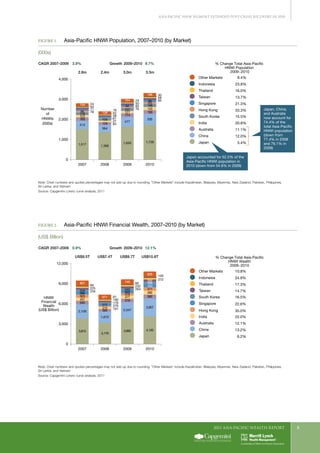
driven decline of 2008. The number of HNWIs in the
region grew to 3.3 million in 2010, from 3.0 million in
2009, making the HNWI population 18.3% larger than
in 2007 (see Figure 1).
As a result of that growth, the Asia-Pacific HNWI
population also became the second-largest in the world,
overtaking Europe (which had 3.1 million HNWIs in
2010), and nearing that of North America (3.4 million).
Globally, the population of HNWIs grew 8.3% in
2010, to reach 10.9 million.
While the HNWI populations of all regions are now
back above the pre-crisis highs of 2007, the Asia-Pacific
HNWI population has grown the most since 2007—by
18.3%. That is more than in emerging regions such as
Latin America (up 14.2%), the Middle East (up 11.3%),
and Africa (up 15.3%). And the HNWI populations in
North America and Europe, by contrast, are barely
bigger than in 2007 (up 2.6% and 2.4% respectively).
Asia-Pacific HNWIs’ wealth also grew for a second
straight year in 2010; rising 12.1% to US$10.8 trillion
(see Figure 2). The wealth increase was much smaller
than the 30.9% increase in 2009, but the gains
nevertheless left the region’s HNWI wealth up 14.1%
from 2007 levels. That is less than the 18.1% relative
growth for Latin America, but more than the rebound
in Africa (up 11.0%). Wealth among HNWIs is still
down from 2007 in the Middle East (by 0.9%), which is
the other largely emerging region. Wealth is also still
below pre-crisis levels in North America (down 0.8%, at
US$11.6 trillion), and Europe (down 4.4%, at US$10.1
trillion). Globally, HNWI wealth rose 9.7% to US$42.7
trillion in 2010, putting it 4.9% above 2007 levels.
The Asia-Pacific population of high net worth
individuals (HNWIs1
) and their wealth expanded
again in 2010, pushing further beyond the 2007
pre-crisis highs.
ƒƒ The Asia-Pacific HNWI population grew 9.7%
to 3.3 million in 2010, exceeding that of Europe,
and is now nearing that of North America. The
HNWI population had grown 25.8% in 2009, and
is now 18.3% larger than in 2007, before the
worst of the global financial crisis.
ƒƒ HNWI wealth in Asia-Pacific had already
overtaken that of Europe in 2009, and extended
that gap in 2010, when the region’s HNWI wealth
grew 12.1% to US$10.8 trillion, which was faster
than the 7.2% rate of growth in Europe. HNWI
wealth ended 2010 up 14.1% from 2007 levels.
ƒƒ Japan remains the single largest HNW
segment in Asia-Pacific, accounting for 52.5%
of the region’s HNWIs, followed by China (16.1%),
and Australia (5.8%). However, the combined
share that those three markets held was down to
74.4% in 2010, from 77.4% in 2008.
ƒƒ Asia-Pacific is home to many of the world’s
fastest-growing HNWI populations. In 2010,
eight of the 20 fastest-growing HNWI
populations were in Asia-Pacific markets,
including Hong Kong, Vietnam, Sri Lanka,
Indonesia, Singapore, and India.
Asia-Pacific HNW Segment Extended
Post-Crisis Recovery in 2010
2011 Asia-Pacific WEALTH report 5
Asia-Pacific HNW Segment Extended Post-Crisis Recovery in 2010
Figure 1.	 Asia-Pacific HNWI Population, 2007–2010 (by Market)
(000s)
149
138
154
166
169
118
123
96
129
105
413
364
477
174
127
127
82
1,517 1,366
1,650 1,739
535
193
153
146
101
9924
19
78
84
37
61
71
44
24 50
76
94
58
30
83
42
58
2.8m 2.4m 3.0m 3.3m
CAGR 2007–2009 3.9% Growth 2009–2010 9.7%
Number
of
HNWIs
(000s)
0
1,000
2,000
3,000
4,000
2010200920082007
Other Markets 8.4%
Indonesia 23.8%
Hong Kong 33.3%
Singapore 21.3%
Taiwan 13.7%
Thailand 16.0%
South Korea 15.5%
Japan 5.4%
China 12.0%
Australia 11.1%
India 20.8%
% Change Total Asia-Pacific
HNWI Population
2009−2010
Japan, China,
and Australia
now account for
74.4% of the
total Asia-Pacific
HNWI population
(down from
77.4% in 2008
and 76.1% in
2009)
Japan accounted for 52.5% of the
Asia-Pacific HNWI population in
2010 (down from 54.6% in 2009)
FIGURE 1. Asia-Pacific HNWI Population by Market, 2007–2010
(000s)
Note: Chart numbers and quoted percentages may not add up due to rounding; “Other Markets” include Kazakhstan, Malaysia, Myanmar, New Zealand, Pakistan, Philippines,
Sri Lanka, and Vietnam
Source: Capgemini Lorenz curve analysis, 2011
Figure 2.	 Asia-Pacific HNWI Financial Wealth, 2007–2010 (by Market)
(US$ Billion)
807
671
749
829
540
437
523
386
319
380
310
272
2,109
1,672
2,347
519
477
379
369
340
3,815
3,179
3,892 4,135
2,657
582
582
511
453
396
302
234
225
181
276
176
190
61
85
264
232
80
100
272
US$9.5T US$7.4T US$9.7T US$10.8T
CAGR 2007–2009 0.9% Growth 2009–2010 12.1%
HNWI
Financial
Wealth
(US$ Billion)
0
3,000
6,000
9,000
12,000
2010200920082007
Other Markets 10.8%
Indonesia 24.9%
Hong Kong 35.0%
Taiwan 14.7%
Thailand 17.3%
Japan 6.2%
China 13.2%
Australia 12.1%
India 22.0%
% Change Total Asia-Pacific
HNWI Wealth
2009−2010
South Korea 16.5%
Singapore 22.6%
FIGURE 1. Asia-Pacific HNWI Financial Wealth by Market, 2007–2010
(US$ Billion)
Note: Chart numbers and quoted percentages may not add up due to rounding; “Other Markets” include Kazakhstan, Malaysia, Myanmar, New Zealand, Pakistan, Philippines,
Sri Lanka, and Vietnam
Source: Capgemini Lorenz curve analysis, 2011
2011 Asia-Pacific WEALTH report6
Asia-Pacific HNW Segment Extended Post-Crisis Recovery in 2010
2	
Mid-tier HNWIs are defined as those having investable assets of US$5 million to US$30 million, excluding primary residence, collectibles, consumables, and consumer durables, and Ultra-
HNWIs have more than US$30 million.
Within Asia-Pacific, many markets had managed to
recoup their 2008 wealth losses in 2009, but Australia,
Singapore, and Indonesia only surpassed 2007 levels in
2010, and Hong Kong has yet to do so. Wealth held by
Hong Kong’s HNWIs declined a staggering 65.4% in
2008, so even the huge gains of the last two years (35.0%
in 2010, and 108.9% in 2009) have not been able to
eradicate those losses. Still, the level of wealth is nearing
2007 highs.
Japan and China Are Still the
Largest HNWI Markets, but
Others Are Catching Up
Japan is the behemoth HNWI market in Asia-Pacific,
home to 1.7 million or 52.5% of the region’s HNWIs.
Next largest, and far behind, are China (535,000, or
16.1%) and Australia (193,000, or 5.8%). Still, other
HNWI markets are clearly growing—especially in
developing and emerging economies, contributing to
very gradual fragmentation. The combined share of
Asia-Pacific’s HNWI population held by Japan, China,
and Australia has declined from 77.4% in 2008, to
74.4% in 2010.
Notably, though, HNWI wealth in the region is heavily
concentrated in very few hands (as these economies are by
definition still “emerging,” so wealth is not broadly
distributed). As the aggregate levels of wealth in these
markets rise, it is likely that the HNWI populations will
naturally expand and diversify over time, but in 2010,
mid-tier and Ultra-HNWIs accounted for nearly 50% of
the region’s HNWI wealth, while comprising less than
10% of the total Asia-Pacific HNWI population.2
Different market-specific developments occurred
in Asia-Pacific during 2010:
ƒƒ Hong Kong HNWIs are known to be aggressive in
pursuit of returns, and their preference for equity and
real estate investments has driven both the demise and
the recovery of the segment during the turbulent years
since 2007. Wealth held by Hong Kong’s HNWIs
surged 35% in 2010, after huge gains (up 108.9%) in
2009, but wealth had sunk a staggering 65.4% in 2008,
so even the recovery of the last two years has yet to push
the level of HNWI wealth above 2007 highs—though
it neared the 2007 level in 2010.
ƒƒ Other growth markets such as Singapore, India, and
China have seen the expansion of HNWI populations
and wealth, fueled by strong macroeconomic growth
(evidenced in indicators such as gross national income
[GNI] and national savings) and by market
performance (especially equities and real estate).
ƒƒ The more mature markets of Australia and Japan have
seen a more moderate pace of recovery—in their
financial markets, economies, and HNW segments.
In 2010, eight of the world’s 20 fastest-growing HNWI
populations were Asia-Pacific markets, including Hong
Kong, Vietnam, Sri Lanka, Indonesia, Singapore, and
India. Asia-Pacific will very likely remain the source of
many of the world’s fastest-growing HNWI
populations in the future, but the pace of their growth
will depend heavily on both the macroeconomic course
of emerging markets and the strength of demand from
mature markets.
Looking forward, the outlook is unclear for many of the
key asset classes that have driven wealth creation for
Asia-Pacific HNWIs (see next chapter, “2010 in
Review”), particularly real estate and equities. Also,
governments face numerous challenges that could
constrain economic expansion in the coming years.
2011 Asia-Pacific WEALTH report 7
3	
Unless otherwise specified, all macroeconomic data and projections are based on Economist Intelligence Unit Regional and Country Reports from January, February, and March 2011.
ƒƒ Gross domestic product (GDP) in Asia-Pacific excluding Japan expanded by 8.3% in 2010, almost
double the 4.2% increase in 2009. The region’s emerging markets powered the global economy out of
recession in 2010, with gains in domestic demand, industrial output, and exports, especially in China, India,
and Indonesia.
ƒƒ Japan also returned to growth in 2010, swinging to 4.0% growth from a 5.2% contraction in 2009. The
outlook for Japan’s economy is uncertain, however, as the market continues to tackle the aftereffects of the
massive earthquake and nuclear crisis that first struck in March 2011, a rising yen, and potential deflation.
ƒƒ International capital flows to Asia-Pacific increased substantially in 2010 as investors were drawn to
the region’s strongly performing economies. These inflows created concerns of overheating and prompted
some governments to start pushing up interest rates, often citing the need to contain rising inflation
pressure. These inflows also contributed to widespread currency appreciation against the U.S. dollar.
ƒƒ Asia-Pacific equity, real estate, and other markets rose in 2010, driven by investment interest and
demand for raw materials. Regional equity-market capitalization rose 19.2%, and real estate prices surged
in markets such as China, Hong Kong, and Singapore, fueling concerns of an asset-price bubble.
ƒƒ Asia-Pacific economic expansion is likely to abate slightly in 2011 and 2012, as economies absorb the
withdrawal of fiscal and monetary stimulus, rising inflation, constrained capacity, and the macroeconomic
imbalances prompted by large foreign-capital inflows. As a result, GDP growth in Asia-Pacific excluding
Japan is expected to slow to 6.9% in 2011, and 6.8% in 2012.
2010 in Review
3
Asia-Pacific Thrived in 2010, Fueling Global Growth
2011 Asia-Pacific WEALTH report8
2010 in Review: Asia-Pacific Thrived in 2010, Fueling Global Growth
ASIA-PACIFIC EMERGING MARKETS
DROVE ECONOMIC EXPANSION IN 2010
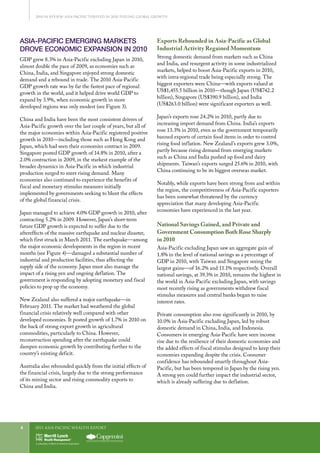
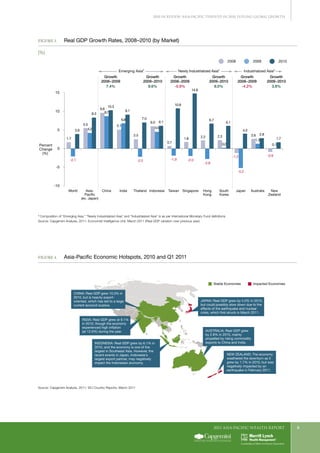
GDP grew 8.3% in Asia-Pacific excluding Japan in 2010,
almost double the pace of 2009, as economies such as
China, India, and Singapore enjoyed strong domestic
demand and a rebound in trade. The 2010 Asia-Pacific
GDP growth rate was by far the fastest pace of regional
growth in the world, and it helped drive world GDP to
expand by 3.9%, when economic growth in more
developed regions was only modest (see Figure 3).
China and India have been the most consistent drivers of
Asia-Pacific growth over the last couple of years, but all of
the major economies within Asia-Pacific registered positive
growth in 2010—including those such as Hong Kong and
Japan, which had seen their economies contract in 2009.
Singapore posted GDP growth of 14.8% in 2010, after a
2.0% contraction in 2009, in the starkest example of the
broader dynamics in Asia-Pacific in which industrial
production surged to meet rising demand. Many
economies also continued to experience the benefits of
fiscal and monetary stimulus measures initially
implemented by governments seeking to blunt the effects
of the global financial crisis.
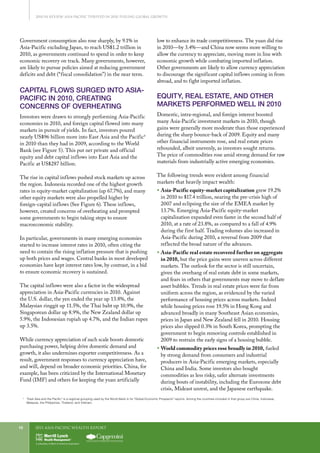
Japan managed to achieve 4.0% GDP growth in 2010, after
contracting 5.2% in 2009. However, Japan’s short-term
future GDP growth is expected to suffer due to the
aftereffects of the massive earthquake and nuclear disaster,
which first struck in March 2011. The earthquake—among
the major economic developments in the region in recent
months (see Figure 4)—damaged a substantial number of
industrial and production facilities, thus affecting the
supply side of the economy. Japan must also manage the
impact of a rising yen and ongoing deflation. The
government is responding by adopting monetary and fiscal
policies to prop up the economy.
New Zealand also suffered a major earthquake—in
February 2011. The market had weathered the global
financial crisis relatively well compared with other
developed economies. It posted growth of 1.7% in 2010 on
the back of strong export growth in agricultural
commodities, particularly to China. However,
reconstruction spending after the earthquake could
dampen economic growth by contributing further to the
country’s existing deficit.
Australia also rebounded quickly from the initial effects of
the financial crisis, largely due to the strong performance
of its mining sector and rising commodity exports to
China and India.
Exports Rebounded in Asia-Pacific as Global
Industrial Activity Regained Momentum
Strong domestic demand from markets such as China
and India, and resurgent activity in some industrialized
markets, helped to boost Asia-Pacific exports in 2010,
with intra-regional trade being especially strong. The
biggest exporters were China—with exports valued at
US$1,455.5 billion in 2010—though Japan (US$742.2
billion), Singapore (US$390.9 billion), and India
(US$263.0 billion) were significant exporters as well.
Japan’s exports rose 24.2% in 2010, partly due to
increasing import demand from China. India’s exports
rose 13.3% in 2010, even as the government temporarily
banned exports of certain food items in order to control
rising food inflation. New Zealand’s exports grew 3.0%,
partly because rising demand from emerging markets
such as China and India pushed up food and dairy
shipments. Taiwan’s exports surged 25.6% in 2010, with
China continuing to be its biggest overseas market.
Notably, while exports have been strong from and within
the region, the competitiveness of Asia-Pacific exporters
has been somewhat threatened by the currency
appreciation that many developing Asia-Pacific
economies have experienced in the last year.
National Savings Gained, and Private and
Government Consumption Both Rose Sharply
in 2010
Asia-Pacific excluding Japan saw an aggregate gain of
1.8% in the level of national savings as a percentage of
GDP in 2010, with Taiwan and Singapore seeing the
largest gains—of 16.2% and 11.1% respectively. Overall
national savings, at 39.3% in 2010, remains the highest in
the world in Asia-Pacific excluding Japan, with savings
most recently rising as governments withdrew fiscal
stimulus measures and central banks began to raise
interest rates.
Private consumption also rose significantly in 2010, by
10.0% in Asia-Pacific excluding Japan, led by robust
domestic demand in China, India, and Indonesia.
Consumers in emerging Asia-Pacific have seen income
rise due to the resilience of their domestic economies and
the added effects of fiscal stimulus designed to keep their
economies expanding despite the crisis. Consumer
confidence has rebounded smartly throughout Asia-
Pacific, but has been tempered in Japan by the rising yen.
A strong yen could further impact the industrial sector,
which is already suffering due to deflation.
2011 Asia-Pacific WEALTH report 9
2010 in Review: Asia-Pacific Thrived in 2010, Fueling Global Growth
Figure 4.	 Asia-Pacific Economic Hotspots, 2010 and Q1 2011
INDIA: Real GDP grew at 9.1%
in 2010, though the economy
experienced high inflation
(at 12.0%) during the year. AUSTRALIA: Real GDP grew
by 2.8% in 2010, mainly
propelled by rising commodity
exports to China and India.
JAPAN: Real GDP grew by 4.0% in 2010,
but could possibly slow down due to the
effects of the earthquake and nuclear
crisis, which first struck in March 2011.
NEW ZEALAND: The economy
weathered the downturn as it
grew by 1.7% in 2010, but was
negatively impacted by an
earthquake in February 2011.
INDONESIA: Real GDP grew by 6.1% in
2010, and the economy is one of the
largest in Southeast Asia. However, the
recent events in Japan, Indonesia's
largest export partner, may negatively
impact the Indonesian economy.
Stable Economies Impacted Economies
CHINA: Real GDP grew 10.3% in
2010, but is heavily export-
oriented, which has led to a large
current account surplus.
Source: Capgemini Analysis, 2011; EIU Country Reports, March 2011
Figure 3.	 Real GDP Growth Rates, 2008–2010 (by Market)
(%)
-10
-5
0
5
10
15
New
Zealand
AustraliaJapanSouth
Korea
Hong
Kong
SingaporeTaiwanIndonesiaThailandIndiaChinaAsia-
Pacific
(ex. Japan)
World
1.7
3.9
5.5
4.2
8.3
9.6
8.7
5.1
6.8
9.1
2.5
7.0
6.0 6.1
0.7
1.8 2.2 2.3
6.1
4.0
2.6 2.8
1.3
0.1
1.7
0.2
6.7
10.8
14.8
4.5
10.3
-2.1 -2.2 -1.9 -2.0
-2.8
-1.2
-5.2
-0.9
Emerging Asiaa
Industrialized Asiaa
Newly Industrialized Asiaa
Growth
2008−2009
7.4%
Growth
2009−2010
9.6%
Growth
2008−2009
-0.9%
Growth
2009−2010
8.0%
Growth
2008−2009
-4.2%
Growth
2009−2010
3.8%
Percent
Change
(%)
20092008 2010
FIGURE 3. Real GDP Growth Rates, 2008-2010
(%)
a
Composition of “Emerging Asia,” “Newly Industrialized Asia” and “Industrialized Asia” is as per International Monetary Fund definitions
Source: Capgemini Analysis, 2011; Economist Intelligence Unit, March 2011 (Real GDP variation over previous year)
2011 Asia-Pacific WEALTH report10
Government consumption also rose sharply, by 9.1% in
Asia-Pacific excluding Japan, to reach US$1.2 trillion in
2010, as governments continued to spend in order to keep
economic recovery on track. Many governments, however,
are likely to pursue policies aimed at reducing government
deficits and debt (“fiscal consolidation”) in the near term.
CAPITAL FLOWS SURGED INTO ASIA-
PACIFIC IN 2010, CREATING
CONCERNS OF OVERHEATING
Investors were drawn to strongly performing Asia-Pacific
economies in 2010, and foreign capital flowed into many
markets in pursuit of yields. In fact, investors poured
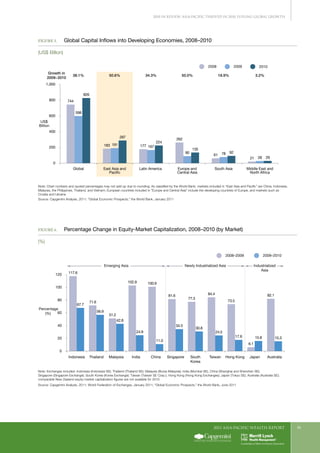
nearly US$96 billion more into East Asia and the Pacific4
in 2010 than they had in 2009, according to the World
Bank (see Figure 5). This put net private and official
equity and debt capital inflows into East Asia and the
Pacific at US$287 billion.
The rise in capital inflows pushed stock markets up across
the region. Indonesia recorded one of the highest growth
rates in equity-market capitalization (up 67.7%), and many
other equity markets were also propelled higher by
foreign-capital inflows (See Figure 6). These inflows,
however, created concerns of overheating and prompted
some governments to begin taking steps to ensure
macroeconomic stability.
In particular, governments in many emerging economies
started to increase interest rates in 2010, often citing the
need to contain the rising inflation pressure that is pushing
up both prices and wages. Central banks in most developed
economies have kept interest rates low, by contrast, in a bid
to ensure economic recovery is sustained.
The capital inflows were also a factor in the widespread
appreciation in Asia-Pacific currencies in 2010. Against
the U.S. dollar, the yen ended the year up 13.8%, the
Malaysian ringgit up 11.5%, the Thai baht up 10.9%, the
Singaporean dollar up 8.9%, the New Zealand dollar up
5.9%, the Indonesian rupiah up 4.7%, and the Indian rupee
up 3.5%.
While currency appreciation of such scale boosts domestic
purchasing power, helping drive domestic demand and
growth, it also undermines exporter competitiveness. As a
result, government responses to currency appreciation have,
and will, depend on broader economic priorities. China, for
example, has been criticized by the International Monetary
Fund (IMF) and others for keeping the yuan artificially
low to enhance its trade competitiveness. The yuan did rise
in 2010—by 3.4%—and China now seems more willing to
allow the currency to appreciate, moving more in line with
economic growth while combating imported inflation.
Other governments are likely to allow currency appreciation
to discourage the significant capital inflows coming in from
abroad, and to fight imported inflation.
EQUITY, REAL ESTATE, AND OTHER
MARKETS PERFORMED WELL IN 2010
Domestic, intra-regional, and foreign interest boosted
many Asia-Pacific investment markets in 2010, though
gains were generally more moderate than those experienced
during the sharp bounce-back of 2009. Equity and many
other financial instruments rose, and real estate prices
rebounded, albeit unevenly, as investors sought returns.
The price of commodities rose amid strong demand for raw
materials from industrially active emerging economies.
The following trends were evident among financial
markets that heavily impact wealth:
ƒƒ Asia-Pacific equity-market capitalization grew 19.2%
in 2010 to $17.4 trillion, nearing the pre-crisis high of
2007 and eclipsing the size of the EMEA market by
13.7%. Emerging Asia-Pacific equity-market
capitalization expanded even faster in the second half of
2010, at a rate of 23.8%, as compared to a fall of 4.9%
during the first half. Trading volumes also increased in
Asia-Pacific during 2010, a reversal from 2009 that
reflected the broad nature of the advances.
ƒƒ Asia-Pacific real estate recovered further on aggregate
in 2010, but the price gains were uneven across different
markets. The outlook for the sector is still uncertain,
given the overhang of real estate debt in some markets,
and fears in others that governments may move to deflate
asset bubbles. Trends in real estate prices were far from
uniform across the region, as evidenced by the varied
performance of housing prices across markets. Indeed
while housing prices rose 19.5% in Hong Kong and
advanced broadly in many Southeast Asian economies,
prices in Japan and New Zealand fell in 2010. Housing
prices also slipped 0.3% in South Korea, prompting the
government to begin removing controls established in
2009 to restrain the early signs of a housing bubble.
ƒƒ World commodity prices rose broadly in 2010, fueled
by strong demand from consumers and industrial
producers in Asia-Pacific emerging markets, especially
China and India. Some investors also bought
commodities as less risky, safer alternate investments
during bouts of instability, including the Eurozone debt
crisis, Mideast unrest, and the Japanese earthquake.
4	
“East Asia and the Pacific” is a regional grouping used by the World Bank in its “Global Economic Prospects” reports. Among the countries included in that group are China, Indonesia,
Malaysia, the Philippines, Thailand, and Vietnam.
2010 in Review: Asia-Pacific Thrived in 2010, Fueling Global Growth
2011 Asia-Pacific WEALTH report 11
Figure 5.	 Global Capital Inflows into Developing Economies, 2008–2010
(US$ Billion)
0
200
400
600
800
1,000
Middle East and
North Africa
South AsiaEurope and
Central Asia
Latin AmericaEast Asia and
Pacific
Global
20092008 2010
US$
Billion
744
598
826
183 191
287
177 167
224
262
90
135
61 78 92
21 28 29
Growth in
2009−2010
38.1% 50.6% 34.3% 50.0% 18.9% 3.2%
FIGURE 5. Global Capital Inflows into Developing Economies, 2008-2010F
(US$ Billion)
Note: Chart numbers and quoted percentages may not add up due to rounding; As classified by the World Bank, markets included in “East Asia and Pacific” are China, Indonesia,
Malaysia, the Philippines, Thailand, and Vietnam; European countries included in “Europe and Central Asia” include the developing countries of Europe, and markets such as
Croatia and Ukraine
Source: Capgemini Analysis, 2011; “Global Economic Prospects,” the World Bank, January 2011
Figure 6.	 Percentage Change in Equity-Market Capitalization, 2008–2010 (by Market)
(%)
0
20
40
60
80
100
120
AustraliaJapanHong KongTaiwanSouth
Korea
SingaporeChinaIndiaMalaysiaThailandIndonesia
117.6
67.7
71.6
56.9
51.2
42.8
24.9
11.0
81.6
34.5
77.3
30.8
84.4
24.5
17.6 15.8 15.3
82.1
6.1
73.5
102.9 100.9
Emerging Asia Industrialized
Asia
Newly Industrialized Asia
Percentage
(%)
2009–20102008–2009
FIGURE 6. Percent Change in Equity Market Capitalization, 2008-2010
(%)
Note: Exchanges included: Indonesia (Indonesia SE); Thailand (Thailand SE); Malaysia (Bursa Malaysia); India (Mumbai SE), China (Shanghai and Shenzhen SE);
Singapore (Singapore Exchange); South Korea (Korea Exchange); Taiwan (Taiwan SE Corp.); Hong Kong (Hong Kong Exchanges); Japan (Tokyo SE); Australia (Australia SE);
comparable New Zealand equity-market capitalization figures are not available for 2010
Source: Capgemini Analysis, 2011; World Federation of Exchanges, January 2011; “Global Economic Prospects,” the World Bank, June 2011
2010 in Review: Asia-Pacific Thrived in 2010, Fueling Global Growth
2011 Asia-Pacific WEALTH report12
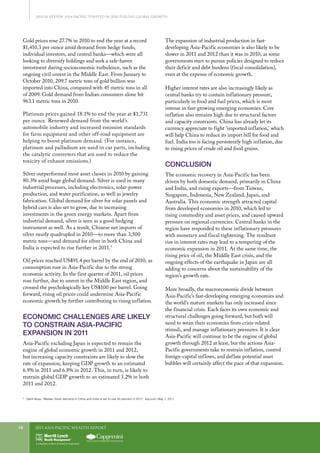
Gold prices rose 27.7% in 2010 to end the year at a record
$1,410.3 per ounce amid demand from hedge funds,
individual investors, and central banks—which were all
looking to diversify holdings and seek a safe-haven
investment during socioeconomic turbulence, such as the
ongoing civil unrest in the Middle East. From January to
October 2010, 209.7 metric tons of gold bullion was
imported into China, compared with 45 metric tons in all
of 2009. Gold demand from Indian consumers alone hit
963.1 metric tons in 2010.
Platinum prices gained 18.1% to end the year at $1,731
per ounce. Renewed demand from the world’s
automobile industry and increased emission standards
for farm equipment and other off-road equipment are
helping to boost platinum demand. (For instance,
platinum and palladium are used in car parts, including
the catalytic converters that are used to reduce the
toxicity of exhaust emissions.)
Silver outperformed most asset classes in 2010 by gaining
80.3% amid huge global demand. Silver is used in many
industrial processes, including electronics, solar-power
production, and water purification, as well as jewelry
fabrication. Global demand for silver for solar panels and
hybrid cars is also set to grow, due to increasing
investments in the green energy markets. Apart from
industrial demand, silver is seen as a good hedging
instrument as well. As a result, Chinese net imports of
silver nearly quadrupled in 2010—to more than 3,500
metric tons—and demand for silver in both China and
India is expected to rise further in 2011.5
Oil prices reached US$91.4 per barrel by the end of 2010, as
consumption rose in Asia-Pacific due to the strong
economic activity. In the first quarter of 2011, oil prices
rose further, due to unrest in the Middle East region, and
crossed the psychologically key US$100 per barrel. Going
forward, rising oil prices could undermine Asia-Pacific
economic growth by further contributing to rising inflation.
ECONOMIC CHALLENGES ARE LIKELY
TO CONSTRAIN ASIA-PACIFIC
EXPANSION IN 2011
Asia-Pacific excluding Japan is expected to remain the
engine of global economic growth in 2011 and 2012,
but increasing capacity constraints are likely to slow the
rate of expansion, keeping GDP growth to an estimated
6.9% in 2011 and 6.8% in 2012. This, in turn, is likely to
restrain global GDP growth to an estimated 3.2% in both
2011 and 2012.
The expansion of industrial production in fast-
developing Asia-Pacific economies is also likely to be
slower in 2011 and 2012 than it was in 2010, as some
governments start to pursue policies designed to reduce
their deficit and debt burdens (fiscal consolidation),
even at the expense of economic growth.
Higher interest rates are also increasingly likely as
central banks try to contain inflationary pressure,
particularly in food and fuel prices, which is most
intense in fast-growing emerging economies. Core
inflation also remains high due to structural factors
and capacity constraints. China has already let its
currency appreciate to fight ‘imported inflation,’ which
will help China to reduce its import bill for food and
fuel. India too is facing persistently high inflation, due
to rising prices of crude oil and food grains.
CONCLUSION
The economic recovery in Asia-Pacific has been
driven by both domestic demand, primarily in China
and India, and rising exports—from Taiwan,
Singapore, Indonesia, New Zealand, Japan, and
Australia. This economic strength attracted capital
from developed economies in 2010, which led to
rising commodity and asset prices, and caused upward
pressure on regional currencies. Central banks in the
region have responded to these inflationary pressures
with monetary and fiscal tightening. The resultant
rise in interest rates may lead to a tempering of the
economic expansion in 2011. At the same time, the
rising price of oil, the Middle East crisis, and the
ongoing effects of the earthquake in Japan are all
adding to concerns about the sustainability of the
region’s growth rate.
More broadly, the macroeconomic divide between
Asia-Pacific’s fast-developing emerging economies and
the world’s mature markets has only increased since
the financial crisis. Each faces its own economic and
structural challenges going forward, but both will
need to wean their economies from crisis-related
stimuli, and manage inflationary pressures. It is clear
Asia-Pacific will continue to be the engine of global
growth through 2012 at least, but the actions Asia-
Pacific governments take to restrain inflation, control
foreign-capital inflows, and deflate potential asset
bubbles will certainly affect the pace of that expansion.
5	
Sahit Muja, “Metals: Silver demand in China and India is set to rise 30 percent in 2011,” wsj.com, May 1, 2011.
2010 in Review: Asia-Pacific Thrived in 2010, Fueling Global Growth
2011 Asia-Pacific WEALTH report 13
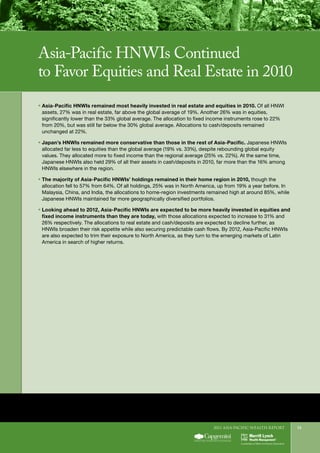
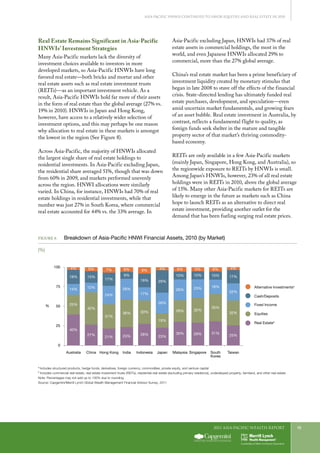
ƒƒ Asia-Pacific HNWIs remained most heavily invested in real estate and equities in 2010. Of all HNWI
assets, 27% was in real estate, far above the global average of 19%. Another 26% was in equities,
significantly lower than the 33% global average. The allocation to fixed income instruments rose to 22%
from 20%, but was still far below the 30% global average. Allocations to cash/deposits remained
unchanged at 22%.
ƒƒ Japan’s HNWIs remained more conservative than those in the rest of Asia-Pacific. Japanese HNWIs
allocated far less to equities than the global average (19% vs. 33%), despite rebounding global equity
values. They allocated more to fixed income than the regional average (25% vs. 22%). At the same time,
Japanese HNWIs also held 29% of all their assets in cash/deposits in 2010, far more than the 16% among
HNWIs elsewhere in the region.
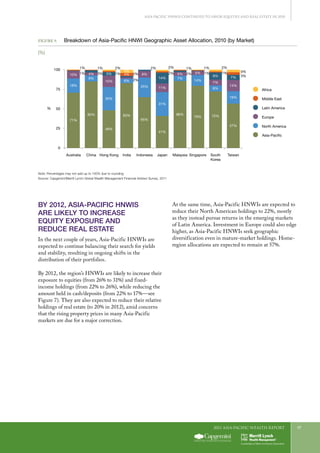
ƒƒ The majority of Asia-Pacific HNWIs’ holdings remained in their home region in 2010, though the
allocation fell to 57% from 64%. Of all holdings, 25% was in North America, up from 19% a year before. In
Malaysia, China, and India, the allocations to home-region investments remained high at around 85%, while
Japanese HNWIs maintained far more geographically diversified portfolios.
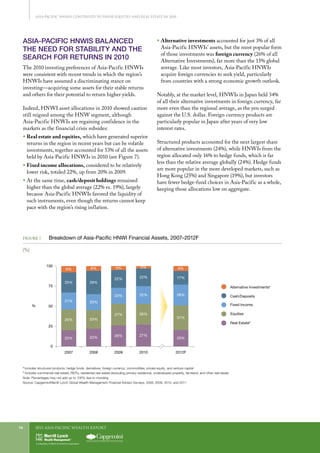
ƒƒ Looking ahead to 2012, Asia-Pacific HNWIs are expected to be more heavily invested in equities and
fixed income instruments than they are today, with those allocations expected to increase to 31% and
26% respectively. The allocations to real estate and cash/deposits are expected to decline further, as
HNWIs broaden their risk appetite while also securing predictable cash flows. By 2012, Asia-Pacific HNWIs
are also expected to trim their exposure to North America, as they turn to the emerging markets of Latin
America in search of higher returns.
Asia-Pacific HNWIs Continued
to Favor Equities and Real Estate in 2010
2011 Asia-Pacific WEALTH report14
Asia-Pacific HNWIs Continued to Favor Equities and Real Estate in 2010
ASIA-PACIFIC HNWIS BALANCED
THE NEED FOR STABILITY AND THE
SEARCH FOR RETURNS IN 2010
The 2010 investing preferences of Asia-Pacific HNWIs
were consistent with recent trends in which the region’s
HNWIs have assumed a discriminating stance on
investing—acquiring some assets for their stable returns
and others for their potential to return higher yields.
Indeed, HNWI asset allocations in 2010 showed caution
still reigned among the HNW segment, although
Asia-Pacific HNWIs are regaining confidence in the
markets as the financial crisis subsides:
ƒƒ Real estate and equities, which have generated superior
returns in the region in recent years but can be volatile
investments, together accounted for 53% of all the assets
held by Asia-Pacific HNWIs in 2010 (see Figure 7).
ƒƒ Fixed income allocations, considered to be relatively
lower risk, totaled 22%, up from 20% in 2009.
ƒƒ At the same time, cash/deposit holdings remained
higher than the global average (22% vs. 19%), largely
because Asia-Pacific HNWIs favored the liquidity of
such instruments, even though the returns cannot keep
pace with the region’s rising inflation.
ƒƒ Alternative investments accounted for just 3% of all
Asia-Pacific HNWIs’ assets, but the most popular form
of those investments was foreign currency (26% of all
Alternative Investments), far more than the 15% global
average. Like most investors, Asia-Pacific HNWIs
acquire foreign currencies to seek yield, particularly
from countries with a strong economic growth outlook.
Notably, at the market level, HNWIs in Japan held 34%
of all their alternative investments in foreign currency, far
more even than the regional average, as the yen surged
against the U.S. dollar. Foreign currency products are
particularly popular in Japan after years of very low
interest rates.
Structured products accounted for the next largest share
of alternative investments (24%), while HNWIs from the
region allocated only 16% to hedge funds, which is far
less than the relative average globally (24%). Hedge funds
are more popular in the more developed markets, such as
Hong Kong (25%) and Singapore (19%), but investors
have fewer hedge-fund choices in Asia-Pacific as a whole,
keeping those allocations low on aggregate.
Figure 7.	 Breakdown of Asia-Pacific HNWI Financial Assets, 2007–2012F
(%)
0
25
50
75
100
2012F2010200920082007
5% 3%6%8%
22% 22%
6%
26% 23%
27%
20% 22%
26%
20%21%
26%
31%
17%
29%25%
%
Real Estateb
Equities
Fixed Income
Cash/Deposits
Alternative Investmentsa
26% 27%
22%20% 20%
a
Includes structured products, hedge funds, derivatives, foreign currency, commodities, private equity, and venture capital
b
Includes commercial real estate, REITs, residential real estate (excluding primary residence), undeveloped property, farmland, and other real estate
Note: Percentages may not add up to 100% due to rounding
Source: Capgemini/Merrill Lynch Global Wealth Management Financial Advisor Surveys, 2008, 2009, 2010, and 2011
2011 Asia-Pacific WEALTH report 15
Asia-Pacific HNWIs Continued to Favor Equities and Real Estate in 2010
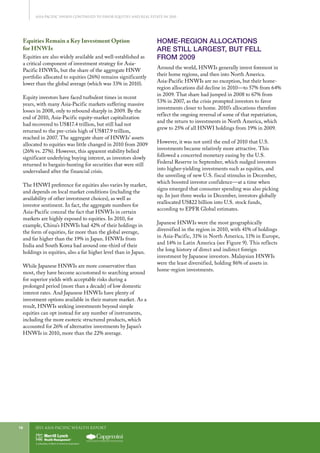
Real Estate Remains Significant in Asia-Pacific
HNWIs’ Investment Strategies
Many Asia-Pacific markets lack the diversity of
investment choices available to investors in more
developed markets, so Asia-Pacific HNWIs have long
favored real estate—both bricks and mortar and other
real estate assets such as real estate investment trusts
(REITs)—as an important investment vehicle. As a
result, Asia-Pacific HNWIs hold far more of their assets
in the form of real estate than the global average (27% vs.
19% in 2010). HNWIs in Japan and Hong Kong,
however, have access to a relatively wider selection of
investment options, and this may perhaps be one reason
why allocation to real estate in these markets is amongst
the lowest in the region (See Figure 8).
Across Asia-Pacific, the majority of HNWIs allocated
the largest single share of real estate holdings to
residential investments. In Asia-Pacific excluding Japan,
the residential share averaged 51%, though that was down
from 60% in 2009, and markets performed unevenly
across the region. HNWI allocations were similarly
varied. In China, for instance, HNWIs had 70% of real
estate holdings in residential investments, while that
number was just 27% in South Korea, where commercial
real estate accounted for 44% vs. the 33% average. In
Asia-Pacific excluding Japan, HNWIs had 37% of real
estate assets in commercial holdings, the most in the
world, and even Japanese HNWIs allocated 29% to
commercial, more than the 27% global average.
China’s real estate market has been a prime beneficiary of
investment liquidity created by monetary stimulus that
began in late 2008 to stave off the effects of the financial
crisis. State-directed lending has ultimately funded real
estate purchases, development, and speculation—even
amid uncertain market fundamentals, and growing fears
of an asset bubble. Real estate investment in Australia, by
contrast, reflects a fundamental flight to quality, as
foreign funds seek shelter in the mature and tangible
property sector of that market’s thriving commodity-
based economy.
REITs are only available in a few Asia-Pacific markets
(mainly Japan, Singapore, Hong Kong, and Australia), so
the regionwide exposure to REITs by HNWIs is small.
Among Japan’s HNWIs, however, 23% of all real estate
holdings were in REITs in 2010, above the global average
of 15%. Many other Asia-Pacific markets for REITs are
likely to emerge in the future as markets such as China
hope to launch REITs as an alternative to direct real
estate investment, providing another outlet for the
demand that has been fueling surging real estate prices.
Figure 8.	 Breakdown of Asia-Pacific HNWI Financial Assets, 2010 (by Market)
(%)
0
25
50
75
100
TaiwanSouth
Korea
SingaporeMalaysiaJapanIndonesiaIndiaHong KongChinaAustralia
25%
42%
31%
29%
10% 10%
6%
36%
28%30%
19%
17%
23%26%
26%
32%
35%
32%
22%
17%
4%
9%
18%
10%
26%
18%
8%6%
24%
7%
18%
17%
12%
15%
5%
14%
4% 4% 5%6%
Real Estateb
Equities
Fixed Income
Cash/Deposits
Alternative Investmentsa
%
30% 29% 31%28% 25%23%21% 23%27%
40%
a
Includes structured products, hedge funds, derivatives, foreign currency, commodities, private equity, and venture capital
b
Includes commercial real estate, real estate investment trusts (REITs), residential real estate (excluding primary residence), undeveloped property, farmland, and other real estate
Note: Percentages may not add up to 100% due to rounding
Source: Capgemini/Merrill Lynch Global Wealth Management Financial Advisor Survey, 2011
2011 Asia-Pacific WEALTH report16
HOME-REGION ALLOCATIONS
ARE STILL LARGEST, BUT FELL
FROM 2009
Around the world, HNWIs generally invest foremost in
their home regions, and then into North America.
Asia-Pacific HNWIs are no exception, but their home-
region allocations did decline in 2010—to 57% from 64%
in 2009. That share had jumped in 2008 to 67% from
53% in 2007, as the crisis prompted investors to favor
investments closer to home. 2010’s allocations therefore
reflect the ongoing reversal of some of that repatriation,
and the return to investments in North America, which
grew to 25% of all HNWI holdings from 19% in 2009.
However, it was not until the end of 2010 that U.S.
investments became relatively more attractive. This
followed a concerted monetary easing by the U.S.
Federal Reserve in September, which nudged investors
into higher-yielding investments such as equities, and
the unveiling of new U.S. fiscal stimulus in December,
which boosted investor confidence—at a time when
signs emerged that consumer spending was also picking
up. In just three weeks in December, investors globally
reallocated US$22 billion into U.S. stock funds,
according to EPFR Global estimates.
Japanese HNWIs were the most geographically
diversified in the region in 2010, with 41% of holdings
in Asia-Pacific, 31% in North America, 11% in Europe,
and 14% in Latin America (see Figure 9). This reflects
the long history of direct and indirect foreign
investment by Japanese investors. Malaysian HNWIs
were the least diversified, holding 86% of assets in
home-region investments.
Equities Remain a Key Investment Option
for HNWIs
Equities are also widely available and well-established as
a critical component of investment strategy for Asia-
Pacific HNWIs, but the share of the aggregate HNW
portfolio allocated to equities (26%) remains significantly
lower than the global average (which was 33% in 2010).
Equity investors have faced turbulent times in recent
years, with many Asia-Pacific markets suffering massive
losses in 2008, only to rebound sharply in 2009. By the
end of 2010, Asia-Pacific equity-market capitalization
had recovered to US$17.4 trillion, but still had not
returned to the pre-crisis high of US$17.9 trillion,
reached in 2007. The aggregate share of HNWIs’ assets
allocated to equities was little changed in 2010 from 2009
(26% vs. 27%). However, this apparent stability belied
significant underlying buying interest, as investors slowly
returned to bargain-hunting for securities that were still
undervalued after the financial crisis.
The HNWI preference for equities also varies by market,
and depends on local market conditions (including the
availability of other investment choices), as well as
investor sentiment. In fact, the aggregate numbers for
Asia-Pacific conceal the fact that HNWIs in certain
markets are highly exposed to equities. In 2010, for
example, China’s HNWIs had 42% of their holdings in
the form of equities, far more than the global average,
and far higher than the 19% in Japan. HNWIs from
India and South Korea had around one-third of their
holdings in equities, also a far higher level than in Japan.
While Japanese HNWIs are more conservative than
most, they have become accustomed to searching around
for superior yields with acceptable risks during a
prolonged period (more than a decade) of low domestic
interest rates. And Japanese HNWIs have plenty of
investment options available in their mature market. As a
result, HNWIs seeking investments beyond simple
equities can opt instead for any number of instruments,
including the more esoteric structured products, which
accounted for 26% of alternative investments by Japan’s
HNWIs in 2010, more than the 22% average.
Asia-Pacific HNWIs Continued to Favor Equities and Real Estate in 2010
2011 Asia-Pacific WEALTH report 17
BY 2012, ASIA-PACIFIC HNWIS
ARE LIKELY TO INCREASE
EQUITY EXPOSURE AND
REDUCE REAL ESTATE
In the next couple of years, Asia-Pacific HNWIs are
expected to continue balancing their search for yields
and stability, resulting in ongoing shifts in the
distribution of their portfolios.
By 2012, the region’s HNWIs are likely to increase their
exposure to equities (from 26% to 31%) and fixed-
income holdings (from 22% to 26%), while reducing the
amount held in cash/deposits (from 22% to 17%—see
Figure 7). They are also expected to reduce their relative
holdings of real estate (to 20% in 2012), amid concerns
that the rising property prices in many Asia-Pacific
markets are due for a major correction.
At the same time, Asia-Pacific HNWIs are expected to
reduce their North American holdings to 22%, mostly
as they instead pursue returns in the emerging markets
of Latin America. Investment in Europe could also edge
higher, as Asia-Pacific HNWIs seek geographic
diversification even in mature-market holdings. Home-
region allocations are expected to remain at 57%.
Figure 9.	 Breakdown of Asia-Pacific HNWI Geographic Asset Allocation, 2010 (by Market)
(%)
0
25
50
75
100
TaiwanSouth
Korea
SingaporeMalaysiaJapanIndonesiaIndiaHong KongChinaAustralia
%
71%
18% 25%
31%
11%
7%14%
30%
6%
4%10%
15%
5%
7%
8%
57%
85%
8%
8%
9%
14%
7%
16%
4%
4%
5%
14%
48%
83%
65%
41%
86%
79% 72%
1%
1%
2%
1%
3% 5%
1% 1% 2%
3%
2%
1%
2%
2% 2%
2% 2% 1% 1%
3%
Africa
Middle East
North America
Europe
Asia-Pacific
Latin America
Note: Percentages may not add up to 100% due to rounding
Source: Capgemini/Merrill Lynch Global Wealth Management Financial Advisor Survey, 2011
Asia-Pacific HNWIs Continued to Favor Equities and Real Estate in 2010
2011 Asia-Pacific WEALTH report18
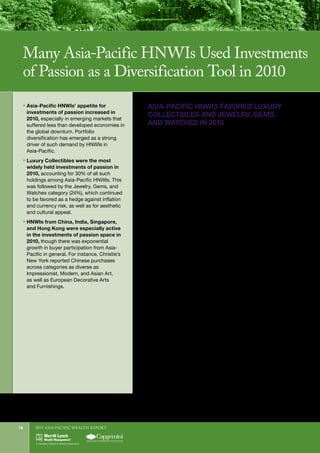
ASIA-PACIFIC HNWIS FAVORED LUXURY
COLLECTIBLES AND JEWELRY, GEMS,
AND WATCHES IN 2010
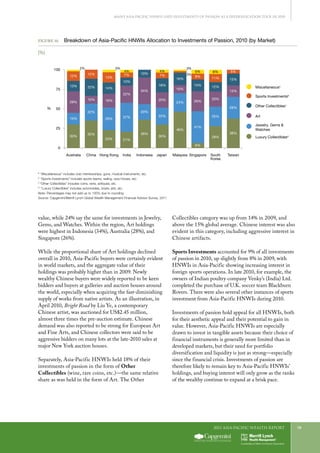
Luxury Collectibles (e.g., luxury automobiles, boats, jets)
remained the primary investment of passion among Asia-
Pacific HNWIs in 2010, with 30% of all investments of passion
falling into this category. That percentage was in line with the
29% held in Luxury Collectibles among HNWIs globally.
Impressive sales figures by luxury car makers were indicative of
such spending. Mercedes-Benz, for example, said its sales in
China (including Hong Kong) jumped 112% in 2010, and
Ferrari reported China sales in 2010 surged nearly 50% from
2009, marking its best ever year. Ferrari added that the
“Greater China Area” (including Hong Kong and Taiwan) is
now one of its top five international markets.
Jewelry, Gems, and Watches continue to hold economic and
cultural appeal for Asia-Pacific HNWIs. The aggregate
allocation to this category was 24% in Asia-Pacific in 2010 vs.
22% globally, and 23% in 2009. In the diamond market,
high-end demand appears to be largely from Russia and the
Middle East, but interest from Chinese and other Asia-Pacific
investors is also growing at a rapid pace.6
Indeed, Christie’s
International reported that its 2010 fine and rare watch auctions
saw “exponential growth in buyer participation from Asian
countries, led primarily by China and Hong Kong.”
The proportional share of the Jewelry, Gems, and Watches
category was highest in Singapore and India (41% and 37%
respectively), where it accounted for the single largest share of
investments of passion—eclipsing Luxury Collectibles, which
accounted for 6% in Singapore and 21% in India (see Figure 10).
The share of investments of passion that Asia-Pacific HNWIs
held in the form of Art was noticeably lower than the global
average (18% vs. 22%), and was down from 22% in the region in
2009. Nevertheless, Art is the most likely of all investments of
passion to be acquired by Asia-Pacific HNWIs as a financial
investment. In fact, 37% of Advisors say they believe their
HNW clients invest in Art primarily for its potential to gain
ƒƒ Asia-Pacific HNWIs’ appetite for
investments of passion increased in
2010, especially in emerging markets that
suffered less than developed economies in
the global downturn. Portfolio
diversification has emerged as a strong
driver of such demand by HNWIs in
Asia-Pacific.
ƒƒ Luxury Collectibles were the most
widely held investments of passion in
2010, accounting for 30% of all such
holdings among Asia-Pacific HNWIs. This
was followed by the Jewelry, Gems, and
Watches category (24%), which continued
to be favored as a hedge against inflation
and currency risk, as well as for aesthetic
and cultural appeal.
ƒƒ HNWIs from China, India, Singapore,
and Hong Kong were especially active
in the investments of passion space in
2010, though there was exponential
growth in buyer participation from Asia-
Pacific in general. For instance, Christie’s
New York reported Chinese purchases
across categories as diverse as
Impressionist, Modern, and Asian Art,
as well as European Decorative Arts
and Furnishings.
Many Asia-Pacific HNWIs Used Investments
of Passion as a Diversification Tool in 2010
6	
Koncept Analytics, “Global Gem and Jewelry Market Report,” 2010.
2011 Asia-Pacific WEALTH report 19
Many Asia-Pacific HNWIs Used Investments of Passion As a Diversification Tool in 2010
value, while 24% say the same for investments in Jewelry,
Gems, and Watches. Within the region, Art holdings
were highest in Indonesia (34%), Australia (28%), and
Singapore (26%).
While the proportional share of Art holdings declined
overall in 2010, Asia-Pacific buyers were certainly evident
in world markets, and the aggregate value of their
holdings was probably higher than in 2009. Newly
wealthy Chinese buyers were widely reported to be keen
bidders and buyers at galleries and auction houses around
the world, especially when acquiring the fast-diminishing
supply of works from native artists. As an illustration, in
April 2010, Bright Road by Liu Ye, a contemporary
Chinese artist, was auctioned for US$2.45 million,
almost three times the pre-auction estimate. Chinese
demand was also reported to be strong for European Art
and Fine Arts, and Chinese collectors were said to be
aggressive bidders on many lots at the late-2010 sales at
major New York auction houses.
Separately, Asia-Pacific HNWIs held 18% of their
investments of passion in the form of Other
Collectibles (wine, rare coins, etc.)—the same relative
share as was held in the form of Art. The Other
Collectibles category was up from 14% in 2009, and
above the 15% global average. Chinese interest was also
evident in this category, including aggressive interest in
Chinese artifacts.
Sports Investments accounted for 9% of all investments
of passion in 2010, up slightly from 8% in 2009, with
HNWIs in Asia-Pacific showing increasing interest in
foreign sports operations. In late 2010, for example, the
owners of Indian poultry company Venky’s (India) Ltd.
completed the purchase of U.K. soccer team Blackburn
Rovers. There were also several other instances of sports
investment from Asia-Pacific HNWIs during 2010.
Investments of passion hold appeal for all HNWIs, both
for their aesthetic appeal and their potential to gain in
value. However, Asia-Pacific HNWIs are especially
drawn to invest in tangible assets because their choice of
financial instruments is generally more limited than in
developed markets, but their need for portfolio
diversification and liquidity is just as strong—especially
since the financial crisis. Investments of passion are
therefore likely to remain key to Asia-Pacific HNWIs’
holdings, and buying interest will only grow as the ranks
of the wealthy continue to expand at a brisk pace.
Figure 10.	 Breakdown of Asia-Pacific HNWIs Allocation to Investments of Passion, 2010 (by Market)
(%)
0
25
50
75
100
TaiwanSouth
Korea
SingaporeMalaysiaJapanIndonesiaIndiaHong KongChinaAustralia
%
30%
15%
34%
22%
20%
24%
7%
5%
29%
22%
37%
28%
12%
13% 22% 14%
10%
10%
18%
16%
15%
15%
13%
18%
12%
38%35%
22%
11%
6%
12%
10%
7%
10%
15%
41%
8%
23% 21%
28%
20%
36%
30%
46%
6%
26%
5%
28%
25%
20%
2% 2%
2%
3%
4% 4%
Miscellaneousa
Sports Investmentsb
Luxury Collectiblesd
Other Collectiblesc
Art
Jewelry, Gems &
Watches
a
“Miscellaneous” includes club memberships, guns, musical instruments, etc.
b
“Sports Investments” includes sports teams, sailing, race horses, etc.
c
“Other Collectibles” includes coins, wine, antiques, etc.
d
“Luxury Collectibles” includes automobiles, boats, jets, etc.
Note: Percentages may not add up to 100% due to rounding
Source: Capgemini/Merrill Lynch Global Wealth Management Financial Advisor Survey, 2011
2011 Asia-Pacific WEALTH report20
7	
Enterprise Value: The ability to leverage capabilities from across different business units in order to differentiate in meeting client needs.
FAST-GROWING ASIA-PACIFIC HNW
SEGMENT PRESENTS GREAT
POTENTIAL AND UNIQUE
CHALLENGES FOR WEALTH
MANAGEMENT FIRMS
The number and wealth of Asia-Pacific HNWIs have
grown faster than the global average in recent years, with
the main contributors being rapid economic growth in
several of the region’s markets, the high savings rate, and
the generally robust performance of real estate and equity
markets. The region’s HNW segment also proved more
resilient than those in the world’s most mature
economies, which were hit hardest by the financial crisis.
India and China have also demonstrated sustained and
rapid economic growth in the last ten years. This has
fulfilled predictions made in 2001 that global economic
power would over time shift away from the developed
G7 economic powers and toward emerging countries—
specifically the BRIC countries (Brazil, Russia, India,
and China).
Moreover, the favorable economic and demographic
conditions point to a continued and significant expansion
of wealth in Asia-Pacific over the coming years,
positioning the region to become the world’s largest
HNWI market if it continues to outperform.
Firms Still Need to Overcome Barriers to
Capture Potential in Asia-Pacific
For wealth management firms, Asia-Pacific clearly
presents an enormous opportunity. Not only do the
economics and demographics point to significant growth
in demand for HNWI services, but regulatory reforms
mean several Asia-Pacific markets, including India and
China, are becoming more open to foreign financial
institutions and capital. Moreover, established markets
such as Singapore and Hong Kong have positioned
themselves as international financial centers, attracting
significant inflows of offshore funds from other regions
and from other markets within Asia-Pacific.
ƒƒ 	Two segments feature prominently among
Asia-Pacific HNWIs: entrepreneurs and
Ultra-HNWIs. Both segments require
sophisticated and multifaceted services—even
as HNWIs in the region are in general starting
to consider more complex products as a way to
generate returns.
ƒƒ 	Enterprise Value could prove to be a critical
differentiator for Firms, given the Ultra-HNWI
and entrepreneurial demographics, and the
emerging needs of HNWIs in the region.
ƒƒ 	Certain elements of Enterprise Value are
already being executed quite effectively,
with HNWIs in Asia-Pacific voicing more
satisfaction than HNWIs in other regions with
regard to specific, highly sought-after elements
of Enterprise Value (“value levers”). Such levers
include cross-enterprise expert advice teams,
unique investment opportunities, preferred
financing, and advice/expertise from private
and investment banks during the wealth-
creation process. Despite these successes,
Asia-Pacific Firms still lag those in other
regions in implementing Enterprise Value
overall, so significant opportunity remains to
build out these capabilities and offerings.
ƒƒ 	Implementing a comprehensive Enterprise
Value approach in Asia-Pacific will require
iteration to capture market-specific
opportunities, especially in fast-growing
emerging markets. Among the key components
will be Firm-wide accountability, appropriate
incentives, and integrated IT. Most importantly,
Firms will need to hone the strategy for each
market, and not impose arbitrary standards
from highly developed markets.
Spotlight
Enterprise Value
7
Provides Wealth Management Firms with New
Opportunities to Serve the Growing HNWI Population in Asia-Pacific
2011 Asia-Pacific WEALTH report 21
SPOTLIGHT 2011
However, to capture the enormous and growing potential
of the Asia-Pacific HNW segment, Firms will need to
overcome certain challenges, including:
ƒƒ Increased competition: As more international wealth
management firms enter Asia-Pacific, the increasing
competition could impact client retention and reduce
profit margins.
ƒƒ Expertise: Wealth managers in Asia-Pacific have
generally had less exposure to the range of sophisticated
capabilities and products that are typically part of the
HNW proposition in highly developed markets—
especially because the HNW segment itself has only
expanded relatively recently. That expertise could be
imported, but those professionals might then lack the
requisite knowledge of local markets.
ƒƒ Income and margin pressure: Investors are still
cautious after the financial crisis, and hence the trading
volume, and by extension, the fee income and margins
in several markets may still lag pre-crisis levels.
ENTERPRISE VALUE COULD BE THE
KEY TO HIGHER LEVELS OF SERVICE
AND SATISFACTION
For Firms to distinguish themselves in meeting the
evolving needs of Asia-Pacific HNWIs, they may also
need to consider some important realities about the
Asia-Pacific HNW segment, including the following:
ƒƒ The majority of HNWIs in Asia-Pacific source their
wealth from business ownership.
ƒƒ Ultra-HNWIs account for a disproportionately large
share of HNWI wealth in Asia-Pacific, making them a
critical constituency for Firms.
ƒƒ Asia-Pacific HNWIs are increasingly exploring the use
of more complex investing strategies as they seek to
balance their desire for yield and stability post-crisis.
Given these realities, one critical differentiator could be
the ability of Firms to call on additional capabilities from
other business units, such as investment and corporate
banking—i.e., leverage Enterprise Value.
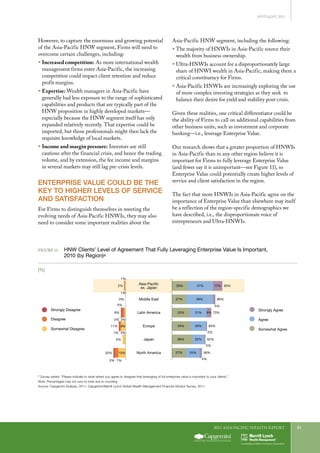
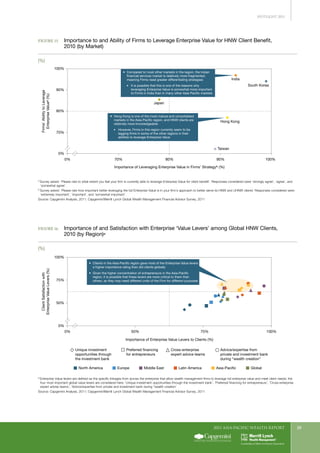
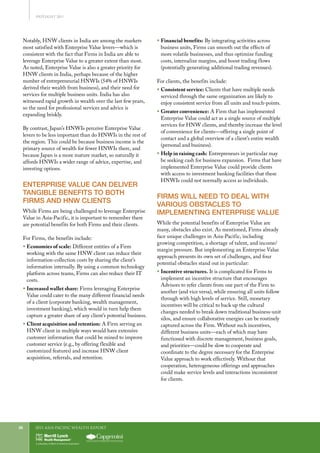
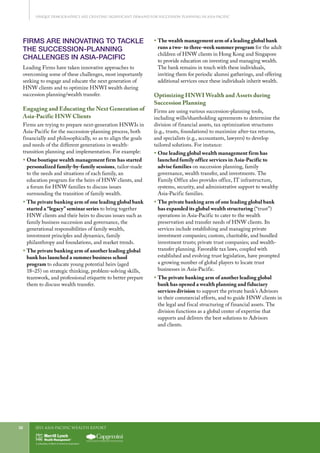
Our research shows that a greater proportion of HNWIs
in Asia-Pacific than in any other region believe it is
important for Firms to fully leverage Enterprise Value
(and fewer say it is unimportant—see Figure 11), so
Enterprise Value could potentially create higher levels of
service and client satisfaction in the region.
The fact that more HNWIs in Asia-Pacific agree on the
importance of Enterprise Value than elsewhere may itself
be a reflection of the region-specific demographics we
have described, i.e., the disproportionate voice of
entrepreneurs and Ultra-HNWIs.
Figure 11.	 HNW Clients’ Level of Agreement That Fully Leveraging Enterprise Value Is Important,
2010 (by Region)a
(%)
1%
1%
2%
2%
4%
2%
Japan
North America
Europe
Latin America
Middle East
Asia-Pacific
ex. Japan
13%22%
7%
8%
8%
0%
11%
2%
2%1%
5%
29% 47% 17% 93%
33% 31% 8% 73%
38% 22% 62%
27% 25% 56%
34% 29%
2%
2%
4%
65%
27% 49%
5%
80%
Somewhat Agree
Agree
Strongly Agree
Disagree
Strongly Disagree
Somewhat Disagree
FIGURE 11. HNWI Clients’ Level of Agreement That Fully Leveraging Enterprise Value Is Important
(%)
a
Survey asked: “Please indicate to what extent you agree or disagree that leveraging of full enterprise value is important to your clients.”
Note: Percentages may not sum to total due to rounding
Source: Capgemini Analysis, 2011; Capgemini/Merrill Lynch Global Wealth Management Financial Advisor Survey, 2011
2011 Asia-Pacific WEALTH report22
SPOTLIGHT 2011
High Levels of Business Ownership among
Asia-Pacific HNWIs Have Implications for
Firms’ Approaches
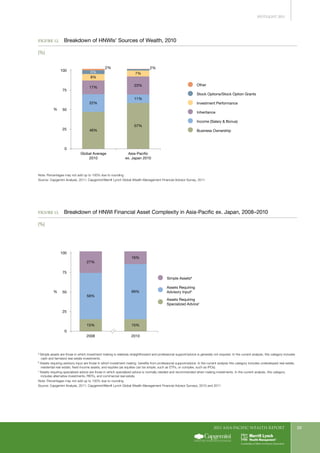
Compared to global averages, more HNWIs garner their
wealth from business ownership in Asia-Pacific than in
other regions.
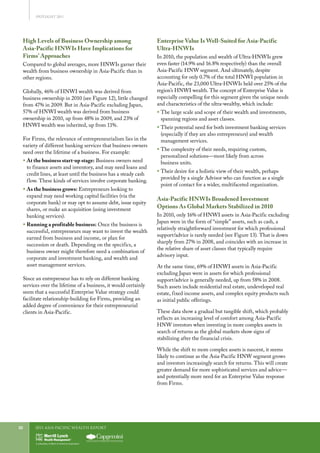
Globally, 46% of HNWI wealth was derived from
business ownership in 2010 (see Figure 12), little changed
from 47% in 2009. But in Asia-Pacific excluding Japan,
57% of HNWI wealth was derived from business
ownership in 2010, up from 48% in 2009, and 23% of
HNWI wealth was inherited, up from 11%.
For Firms, the relevance of entrepreneurialism lies in the
variety of different banking services that business owners
need over the lifetime of a business. For example:
ƒƒ At the business start-up stage: Business owners need
to finance assets and inventory, and may need loans and
credit lines, at least until the business has a steady cash
flow. These kinds of services involve corporate banking.
ƒƒ As the business grows: Entrepreneurs looking to
expand may need working capital facilities (via the
corporate bank) or may opt to assume debt, issue equity
shares, or make an acquisition (using investment
banking services).
ƒƒ Running a profitable business: Once the business is
successful, entrepreneurs may want to invest the wealth
earned from business and income, or plan for
succession or death. Depending on the specifics, a
business owner might therefore need a combination of
corporate and investment banking, and wealth and
asset management services.
Since an entrepreneur has to rely on different banking
services over the lifetime of a business, it would certainly
seem that a successful Enterprise Value strategy could
facilitate relationship-building for Firms, providing an
added degree of convenience for their entrepreneurial
clients in Asia-Pacific.
Enterprise Value Is Well-Suited for Asia-Pacific
Ultra-HNWIs
In 2010, the population and wealth of Ultra-HNWIs grew
even faster (14.9% and 16.8% respectively) than the overall
Asia-Pacific HNW segment. And ultimately, despite
accounting for only 0.7% of the total HNWI population in
Asia-Pacific, the 23,000 Ultra-HNWIs held over 25% of the
region’s HNWI wealth. The concept of Enterprise Value is
especially compelling for this segment given the unique needs
and characteristics of the ultra-wealthy, which include:
ƒƒ The large scale and scope of their wealth and investments,
spanning regions and asset classes.
ƒƒ Their potential need for both investment banking services
(especially if they are also entrepreneurs) and wealth
management services.
ƒƒ The complexity of their needs, requiring custom,
personalized solutions—most likely from across
business units.
ƒƒ Their desire for a holistic view of their wealth, perhaps
provided by a single Advisor who can function as a single
point of contact for a wider, multifaceted organization.
Asia-Pacific HNWIs Broadened Investment
Options As Global Markets Stabilized in 2010
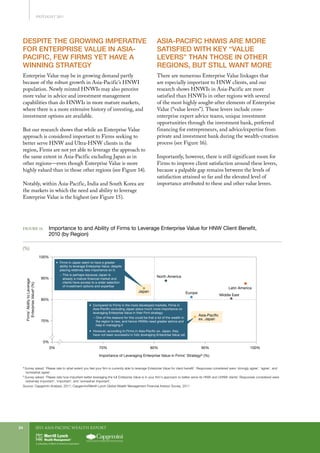
In 2010, only 16% of HNWI assets in Asia-Pacific excluding
Japan were in the form of “simple” assets, such as cash, a
relatively straightforward investment for which professional
support/advice is rarely needed (see Figure 13). That is down
sharply from 27% in 2008, and coincides with an increase in
the relative share of asset classes that typically require
advisory input.
At the same time, 69% of HNWI assets in Asia-Pacific
excluding Japan were in assets for which professional
support/advice is generally needed, up from 58% in 2008.
Such assets include residential real estate, undeveloped real
estate, fixed income assets, and complex equity products such
as initial public offerings.
These data show a gradual but tangible shift, which probably
reflects an increasing level of comfort among Asia-Pacific
HNW investors when investing in more complex assets in
search of returns as the global markets show signs of
stabilizing after the financial crisis.
While the shift to more complex assets is nascent, it seems
likely to continue as the Asia-Pacific HNW segment grows
and investors increasingly search for returns. This will create
greater demand for more sophisticated services and advice—
and potentially more need for an Enterprise Value response
from Firms.
2011 Asia-Pacific WEALTH report 23
Figure 12.	 Breakdown of HNWIs’ Sources of Wealth, 2010
(%)
Asia-Pacific
ex. Japan 2010
Global Average
2010
46%
57%
11%
23%
7%
22%
17%
8%
2%
5%
2%
Business Ownership
Income (Salary & Bonus)
Inheritance
Investment Performance
Stock Options/Stock Option Grants
Other
0
25
50
75
100
%
FIGURE 12. Breakdown of HNWI Source of Wealth, 2010
(%)
Note: Percentages may not add up to 100% due to rounding
Source: Capgemini Analysis, 2011; Capgemini/Merrill Lynch Global Wealth Management Financial Advisor Survey, 2011
Figure 13.	 Breakdown of HNWI Financial Asset Complexity in Asia-Pacific ex. Japan, 2008–2010
(%)
20102008
15%
58%
27%
16%
15%
69%
Assets Requiring
Specialized Advicec
Assets Requiring
Advisory Inputb
Simple Assetsª
0
25
50
75
100
%
a
Simple assets are those in which investment making is relatively straightforward and professional support/advice is generally not required. In the current analysis, this category includes
cash and farmland real estate investments.
b
Assets requiring advisory input are those in which investment making benefits from professional support/advice. In the current analysis this category includes undeveloped real estate,
residential real estate, fixed income assets, and equities (as equities can be simple, such as ETFs, or complex, such as IPOs).
c
Assets requiring specialized advice are those in which specialized advice is normally needed and recommended when making investments. In the current analysis, this category
includes alternative investments, REITs, and commercial real estate.
Note: Percentages may not add up to 100% due to rounding
Source: Capgemini Analysis, 2011; Capgemini/Merrill Lynch Global Wealth Management Financial Advisor Surveys, 2010 and 2011
SPOTLIGHT 2011
2011 Asia-Pacific WEALTH report24
DESPITE THE GROWING IMPERATIVE
FOR ENTERPRISE VALUE IN ASIA-
PACIFIC, FEW FIRMS YET HAVE A
WINNING STRATEGY
Enterprise Value may be in growing demand partly
because of the robust growth in Asia-Pacific’s HNWI
population. Newly minted HNWIs may also perceive
more value in advice and investment management
capabilities than do HNWIs in more mature markets,
where there is a more extensive history of investing, and
investment options are available.
But our research shows that while an Enterprise Value
approach is considered important to Firms seeking to
better serve HNW and Ultra-HNW clients in the
region, Firms are not yet able to leverage the approach to
the same extent in Asia-Pacific excluding Japan as in
other regions—even though Enterprise Value is more
highly valued than in those other regions (see Figure 14).
Notably, within Asia-Pacific, India and South Korea are
the markets in which the need and ability to leverage
Enterprise Value is the highest (see Figure 15).
ASIA-PACIFIC HNWIS ARE MORE
SATISFIED WITH KEY “VALUE
LEVERS” THAN THOSE IN OTHER
REGIONS, BUT STILL WANT MORE
There are numerous Enterprise Value linkages that
are especially important to HNW clients, and our
research shows HNWIs in Asia-Pacific are more
satisfied than HNWIs in other regions with several
of the most highly sought-after elements of Enterprise
Value (“value levers”). These levers include cross-
enterprise expert advice teams, unique investment
opportunities through the investment bank, preferred
financing for entrepreneurs, and advice/expertise from
private and investment bank during the wealth-creation
process (see Figure 16).
Importantly, however, there is still significant room for
Firms to improve client satisfaction around these levers,
because a palpable gap remains between the levels of
satisfaction attained so far and the elevated level of
importance attributed to these and other value levers.
Figure 14.	 Importance to and Ability of Firms to Leverage Enterprise Value for HNW Client Benefit,
2010 (by Region)
(%)
0%
70%
70%
Japan Europe
Latin America
Middle East
Asia-Pacific
ex. Japan
North America
80% 90% 100%
80%
90%
100%
0%
Firms’AbilitytoLeverage
EnterpriseValuea(%)
Importance of Leveraging Enterprise Value in Firms’ Strategyb (%)
I Firms in Japan seem to have a greater
ability to leverage Enterprise Value, despite
placing relatively less importance on it:
− This is perhaps because Japan is
already a mature financial market and
clients have access to a wider selection
of investment options and expertise
I Compared to Firms in the more developed markets, Firms in
Asia-Pacific excluding Japan place much more importance on
leveraging Enterprise Value in their Firm strategy:
− One of the reasons for this could be that a lot of the wealth in
the region is new, and hence HNWIs need greater advice and
help in managing it
I However, according to Firms in Asia-Pacific ex. Japan, they
have not been successful in fully leveraging Enterprise Value yet
a
Survey asked: ‘Please rate to what extent you feel your firm is currently able to leverage Enterprise Value for client benefit’. Responses considered were ‘strongly agree’, ‘agree’, and
‘somewhat agree’.
b
Survey asked: ‘Please rate how important better leveraging the full Enterprise Value is in your firm’s approach to better serve its HNW and UHNW clients’ Responses considered were
‘extremely important’, ‘important’, and ‘somewhat important’.
Source: Capgemini Analysis, 2011; Capgemini/Merrill Lynch Global Wealth Management Financial Advisor Survey, 2011
SPOTLIGHT 2011
2011 Asia-Pacific WEALTH report 25
Figure 15.	 Importance to and Ability of Firms to Leverage Enterprise Value for HNW Client Benefit,
2010 (by Market)
(%)
0%
70%
70% 80% 90% 100%
80%
90%
100%
0%
Firms’AbilitytoLeverage
EnterpriseValuea(%)
Importance of Leveraging Enterprise Value in Firms’ Strategyb (%)
Japan
India
South Korea
Hong Kong
Taiwan
I Hong Kong is one of the most mature and consolidated
markets in the Asia-Pacific region, and HNW clients are
relatively more knowledgeable:
G However, Firms in this region currently seem to be
lagging firms in some of the other regions in their
abilities to leverage Enterprise Value
I Compared to most other markets in the region, the Indian
financial services market is relatively more fragmented,
meaning Firms need greater differentiating strategies:
G It is possible that this is one of the reasons why
leveraging Enterprise Value is somewhat more important
to Firms in India than in many other Asia-Pacific markets
a
Survey asked: ‘Please rate to what extent you feel your firm is currently able to leverage Enterprise Value for client benefit’. Responses considered were ‘strongly agree’, ‘agree’, and
‘somewhat agree’.
b
Survey asked: ‘Please rate how important better leveraging the full Enterprise Value is in your firm’s approach to better serve its HNW and UHNW clients’ Responses considered were
‘extremely important’, ‘important’, and ‘somewhat important’.
Source: Capgemini Analysis, 2011; Capgemini/Merrill Lynch Global Wealth Management Financial Advisor Survey, 2011
Figure 16.	 Importance of and Satisfaction with Enterprise ‘Value Levers’ among Global HNW Clients,
2010 (by Region)a
(%)
0%
50%
75%
100%
0% 50% 75% 100%
ClientSatisfactionwith
EnterpriseValueLevers(%)
Importance of Enterprise Value Levers to Clients (%)
Unique investment
opportunities through
the investment bank
Preferred financing
for entrepreneurs
Cross-enterprise
expert advice teams
Advice/expertise from
private and investment bank
during “wealth creation”
I Clients in the Asia-Pacific region gave most of the Enterprise Value levers
a higher importance rating than did clients globally
I Given the higher concentration of entrepreneurs in the Asia-Pacific
region, it is possible that these levers are more critical to them than
others, as they may need different units of the Firm for different purposes
North America Europe Middle East Latin America Asia-Pacific Global
a
Enterprise Value levers are defined as the specific linkages from across the enterprise that allow wealth management firms to leverage full enterprise value and meet client needs; the
four most important global value levers are considered here: ‘Unique investment opportunities through the investment bank’, ‘Preferred financing for entrepreneurs’, ’Cross-enterprise
expert advise teams’, ‘Advice/expertise from private and investment bank during “wealth creation’
Source: Capgemini Analysis, 2011; Capgemini/Merrill Lynch Global Wealth Management Financial Advisor Survey, 2011
SPOTLIGHT 2011
2011 Asia-Pacific WEALTH report26
Notably, HNW clients in India are among the markets
most satisfied with Enterprise Value levers—which is
consistent with the fact that Firms in India are able to
leverage Enterprise Value to a greater extent than most.
As noted, Enterprise Value is also a greater priority for
HNW clients in India, perhaps because of the higher
number of entrepreneurial HNWIs (54% of HNWIs
derived their wealth from business), and their need for
services for multiple business units. India has also
witnessed rapid growth in wealth over the last few years,
so the need for professional services and advice is
expanding briskly.
By contrast, Japan’s HNWIs perceive Enterprise Value
levers to be less important than do HNWIs in the rest of
the region. This could be because business income is the
primary source of wealth for fewer HNWIs there, and
because Japan is a more mature market, so naturally it
affords HNWIs a wider range of advice, expertise, and
investing options.
ENTERPRISE VALUE CAN DELIVER
TANGIBLE BENEFITS TO BOTH
FIRMS AND HNW CLIENTS
While Firms are being challenged to leverage Enterprise
Value in Asia-Pacific, it is important to remember there
are potential benefits for both Firms and their clients.
For Firms, the benefits include:
ƒƒ Economies of scale: Different entities of a Firm
working with the same HNW client can reduce their
information-collection costs by sharing the client’s
information internally. By using a common technology
platform across teams, Firms can also reduce their IT
costs.
ƒƒ Increased wallet share: Firms leveraging Enterprise
Value could cater to the many different financial needs
of a client (corporate banking, wealth management,
investment banking), which would in turn help them
capture a greater share of any client’s potential business.
ƒƒ Client acquisition and retention: A Firm serving an
HNW client in multiple ways would have extensive
customer information that could be mined to improve
customer service (e.g., by offering flexible and
customized features) and increase HNW client
acquisition, referrals, and retention.
ƒƒ Financial benefits: By integrating activities across
business units, Firms can smooth out the effects of
more volatile businesses, and thus optimize funding
costs, internalize margins, and boost trading flows
(potentially generating additional trading revenues).
For clients, the benefits include:
ƒƒ Consistent service: Clients that have multiple needs
serviced through the same organization are likely to
enjoy consistent service from all units and touch-points.
ƒƒ Greater convenience: A Firm that has implemented
Enterprise Value could act as a single source of multiple
services for HNW clients, and thereby increase the level
of convenience for clients—offering a single point of
contact and a global overview of a client’s entire wealth
(personal and business).
ƒƒ Help in raising cash: Entrepreneurs in particular may
be seeking cash for business expansion. Firms that have
implemented Enterprise Value could provide clients
with access to investment banking facilities that these
HNWIs could not normally access as individuals.
FIRMS WILL NEED TO DEAL WITH
VARIOUS OBSTACLES TO
IMPLEMENTING ENTERPRISE VALUE
While the potential benefits of Enterprise Value are
many, obstacles also exist. As mentioned, Firms already
face unique challenges in Asia-Pacific, including
growing competition, a shortage of talent, and income/
margin pressure. But implementing an Enterprise Value
approach presents its own set of challenges, and four
potential obstacles stand out in particular:
ƒƒ Incentive structures. It is complicated for Firms to
implement an incentive structure that encourages
Advisors to refer clients from one part of the Firm to
another (and vice versa), while ensuring all units follow
through with high levels of service. Still, monetary
incentives will be critical to back up the cultural
changes needed to break down traditional business-unit
silos, and ensure collaborative energies can be routinely
captured across the Firm. Without such incentives,
different business units—each of which may have
functioned with discrete management, business goals,
and priorities—could be slow to cooperate and
coordinate to the degree necessary for the Enterprise
Value approach to work effectively. Without that
cooperation, heterogeneous offerings and approaches
could make service levels and interactions inconsistent
for clients.
SPOTLIGHT 2011
2011 Asia-Pacific WEALTH report 27
ƒƒ Relationship management issues. Given the silo issue,
and the potential for inconsistent levels of expertise,
some business units might actually prefer to refer clients
outside the Firm to ensure comprehensive and superior
service. As Firms develop their Enterprise Value
strategy, they will need to weigh the potential risks to
client relationships if consistent service cannot be
guaranteed across all business units.
ƒƒ Regulation and compliance. Enterprise Value
implementation is likely to involve complex and
detailed flows of both money and information across
business units. Firms will need to make sure they
comply with relevant country-level regulations, and
avoid any potential conflicts of interest (real or
perceived) between units.
ƒƒ Lack of regional policies. Firms will need to strive for
(and accept) an approach that balances the broad, global
principles of the Enterprise Value approach with the
specific needs of the local market. They also need to
acknowledge that the dynamics and standards of
business in Asia-Pacific are likely to differ from those in
more developed markets. For example, the cutoffs for
acceptable deal sizes are likely to be lower for
investment banking units in Asia-Pacific than for those
in highly developed markets where the scale and scope
of business is already far greater.
SOME FIRMS HAVE ALREADY
SHOWN SUCCESS WITH
ENTERPRISE VALUE INITIATIVES
While the challenges to implementing Enterprise Value
are considerable, and few Firms in Asia-Pacific are yet
leveraging Enterprise Value to any great extent, some
have made early progress—often dealing directly with
some of the specific challenges we have outlined.
Notable examples of early moves and successes include:
ƒƒ One leading global wealth management firm
introduced hard dollar incentives for referring clients
across business units in Asia-Pacific. It has helped to
overcome employee resistance to inter-unit cooperation,
and has led directly to an increase in client referrals
among business units.
ƒƒ One leading global financial services company
leveraged its strong Asia-Pacific presence and
expertise in wealth creation to connect its wealth
management, corporate, and private banking units,
using joint servicing teams. The Firm has also placed a
special focus on having the corporate banking unit refer
international and other entrepreneurial corporate
banking clients. The efforts have helped increase
referrals to the private banking unit (which saw US$26
billion in new inflows from 2007 to 2010). The family
office unit, most of whose clients are from emerging
markets and already have an account with the private
bank, has also seen a significant uptick in Ultra HNW
clients. The majority of the private banking unit’s trades
have also been internalized, and they trade through the
global banking and markets unit.
ƒƒ The private banking unit of one global financial
services firm deploys a specialist team to create
customized solutions for Ultra-HNW clients in
Asia-Pacific—borrowing a formula already tested
successfully in developed markets. With a deep
understanding of the investment banking and asset
management businesses, the team is adept at leveraging
all the capabilities of the Firm to create sophisticated
and customized solutions for the bank’s Ultra-HNW
clients. The initiative immediately yielded revenues
from the collaboration among private banking,
investment banking, and asset management divisions.
In 2010, the firm’s Asia-Pacific investment banking
unit credited the private banking unit for referring
several clients that contributed significant revenues.
ƒƒ Another global firm is also developing a specialist
team to meet the evolving needs of clients in Asia-
Pacific in a fast and direct manner. The team brings
together product experts from wealth management,
investment banking, and asset management to develop
new products and offerings based on client preferences.
All the specialists are accountable to both the wealth
management and investment banking units. The Firm’s
Ultra-HNW clients have a single point of contact at the
team, but have access to the entirety of the Firm’s
product range, regardless of their location. The firm is
expecting this strategy to attract a greater number of
clients (and wallet share) and create scale for the
business—which is especially important now that
margins and fees are under pressure.
ƒƒ One global financial services company is setting up a
new unit to act as a bridge between its private banking
and wholesale banking units in Asia-Pacific. The unit
is particularly targeting the business owners among its
private banking clients, primarily to ensure that private
clients with corporate and investment banking needs
receive customized solutions in line with their wider
business and wealth management goals—and provide
access to facilities normally reserved for commercial and
investment banking clients.
SPOTLIGHT 2011
2011 Asia-Pacific WEALTH report28
THE WAY FORWARD: DEVELOPING
AN APPROACH THAT BALANCES
ENTERPRISE VALUE AND THE
SPECIFIC NEEDS OF HNWIS IN
EMERGING ASIA-PACIFIC
Regional regulations and market differences will probably
mean Firms in Asia-Pacific have to develop their
Enterprise Value approach in an iterative way: tailoring a
broader approach as necessary to deal with market-
specific obstacles.
As a result, Firms will need to prioritize their business
needs and leverage IT to shape and evolve an adaptable
Enterprise Value strategy—perhaps rolled out across
different markets in the region over time.
This type of approach will have many components, but
the following will be among its key elements:
ƒƒ Accountability: Firms will need to ensure there is
broad accountability for implementing the Enterprise
Value approach in their organization, and develop a
concrete set of supporting measures, including KPIs
that offer senior business leaders visibility into the
success and progress of the approach.
ƒƒ Regional policies: Firms will need to tailor Enterprise
Value policies for local markets, and those policies may
differ from those in other regions and other markets
within Asia-Pacific.
ƒƒ Employee awareness: Educating employees about the
capabilities of other business units will help Firms to
demonstrate ways in which other teams can deliver
additional value to their clients.
ƒƒ Effective incentive structures: Firms will need to
make sure they have relevant incentive structures (from
recognition to compensation) to encourage internal
client referrals.
ƒƒ Integrated IT systems: Having a unified IT platform
across the Firm can provide all teams with access to the
same, integrated customer data, track client interactions
and referrals, help ensure unified reporting, and support
a variety of performance-management initiatives. It can
also provide Advisors with much-needed consolidated
data on client portfolios, and help Firms to track client
and fund-flow activity to ensure compliance with local
regulations.
These components can all help to provide Firms with the
flexibility they need to develop an Enterprise Value
strategy that balances an integrated approach with the
needs of the local market. To determine exactly how
much customization will be required for each market,
Firms will need to identify and understand which value
levers are most sought after by the HNW clients, and
which of those value levers are poorly served to date.
Then Firms will need to decide what the priority should
be in addressing the most important, underserved value
levers—aligning those priorities with the Firm’s broad
business goals and ambitions to ensure the Enterprise
response is both relevant and viable at the local level.
SPOTLIGHT 2011
2011 Asia-Pacific WEALTH report 29
ƒƒ 	Business ownership and inheritance are the largest sources of HNWI wealth in Asia-Pacific, and
relatively little wealth extends beyond one or two generations. As a result, it is only now that the
demand for succession-planning services is starting to grow significantly. Importantly, this new demand
also reflects a cultural shift, as Asia-Pacific HNWIs have traditionally been uneasy discussing wealth-
transfer issues openly.
ƒƒ 	Unique social, cultural, and generational factors still create challenges for Firms in this space. Most
notably, many HNWIs fear the next generation will not be able to properly manage inherited wealth. In fact,
to be successful, Firms must often help HNWIs to manage not only the financial implications of succession
planning, but the different attitudes among HNW families about the whole concept of wealth transfer.
ƒƒ 	Several leading firms have adopted innovative approaches to address the succession-planning
challenges in Asia-Pacific, in particular seeking to engage and educate the next generation of HNW
clients, and aiming to optimize HNWI wealth during the succession-planning and wealth-transfer processes.
Unique Demographics Are Creating Significant
Demand for Succession Planning in Asia-Pacific
2011 Asia-Pacific WEALTH report30
Unique Demographics Are Creating Significant Demand for Succession Planning in Asia-Pacific
MOST ASIA-PACIFIC HNWIS ARE
ENTREPRENEURS OR HEIRS, AND
MANY HAVE EARNED WEALTH
RELATIVELY RECENTLY
Succession planning is getting increased attention in
Asia-Pacific, with a large number of HNW clients now
acknowledging the need for such services. In fact, our
research shows succession-planning services are now
deemed to be “important” by more HNWIs in Asia-
Pacific than in most other regions. And succession
planning is deemed “extremely important” by 22% of
HNWIs in Asia-Pacific excluding Japan, more than in
any other region (see Figure 17).
Of course, the financial crisis has made Asia-Pacific
HNWIs more aware in general that poor (or non
existent) succession planning can put wealth at risk, but
our research also shows demographics are a major factor
in the succession-planning space in the region. In
particular:
ƒƒ Of all HNWI wealth in Asia-Pacific excluding Japan,
57% is derived from business ownership, and another
23% is inherited. At the same time, much of the
HNWI wealth in the region is still a first- or second-
generation phenomenon, unlike the wealth in many
developed Western markets, where HNW families have
endured for four or five generations, and have already
invested much of that wealth in institutional forms
(trusts, bonds, insurance, etc.).
ƒƒ Age demographics are also a factor: 68% of all HNWIs
in Asia-Pacific excluding Japan are relatively young
(31–55 years of age), while Japan’s HNWI population is
relatively old (47% are over 66, and 15% are over 75).
This suggests there could be a first wave of wealth
transfer in Japan (which has the most HNWIs above 66
years of age), and a potentially large second wave over
the next decade in the rest of the region, where the
HNWI population is much younger.
The demographics are aligned, then, to give Firms and
Advisors a significant opportunity to serve their HNW
clients in Asia-Pacific by providing well-structured
wealth-transfer plans.
Figure 17.	 Importance of Succession Planning Capabilities to HNW Clients, 2010 (by Region)a
(%)
2%
4%
6%
2%
3%
4%
1%
1%
2%
5% 26% 40% 14% 80%
35% 34% 10% 80%
28% 46%
5%
80%
35% 35% 10%80%
19% 43% 22% 84%
29% 38% 19% 86%
3%
2% Japan
North America
Europe
Latin America
Middle East
Asia-Pacific
ex. Japan
Somewhat Important
Important
Extremely Important
Unimportant
Not At All Important
Somewhat Unimportant
FIGURE 17. Importance of Succession Planning Capabilities to HNW Clients
(%)
a
Survey asked: “How important are the following to your clients?”
Note: Percentages may not sum to total due to rounding
Source: Capgemini Analysis, 2011; Capgemini/Merrill Lynch Global Wealth Management Financial Advisor Survey, 2011
2011 Asia-Pacific WEALTH report 31
Unique Demographics Are Creating Significant Demand for Succession Planning in Asia-Pacific
8	
INSEAD/ABN AMRO, http://www.insead.edu/facultyresearch/centres/WICFE/research_cases/docs/MillionaireAsia_ABNAMRO-Jan07_000.pdf.
CULTURAL ISSUES CAN
COMPLICATE SUCCESSION
PLANNING IN PRACTICE
Cultural sensitivities can complicate the succession-
planning process in any market, depending on the ability
of families to discuss death and inheritance openly, the
existence of family “traditions” (such as sons automatically
succeeding fathers in the family business), the desire of
elders to control their legacies, and a family’s preference
for confidentiality.
In Asia-Pacific, it is fair to say some of the “taboos”
around succession planning may be stronger even than in
developed Western markets, but the real challenge for
wealth management firms lies in the fact that the wealth
being transferred by HNW clients has very often been
earned by those individuals. As a result, the conflicts over
intergenerational wealth transfer can be especially
complicated and emotionally charged.
In fact, the primary concern of Asia-Pacific HNWIs
hinges on the ability of the next generation to manage the
family’s wealth, with 88% of HNW clients in Asia-
Pacific excluding Japan, and 75% in Japan, believing the
next generation will not be able to adequately manage
inherited wealth (see Figure 18).
These fears may be well-founded given some of the
statistics on of succession planning in Asia-Pacific: About
30% of family businesses survive into a second generation,
and a mere 10% into the third; and family disputes and
sibling rivalry are the most frequent causes of a family
business’s demise.8
Importantly, the potential for family conflict can be of
particular concern to HNWIs in Asia-Pacific, where
families are traditionally tight-knit across generations—
and older generations might fear that finances could cause
irreparable family rifts.
Asia-Pacific HNWIs have at least become more
comfortable in recent times with seeking advice on
succession planning, having traditionally been loath to
discuss such issues openly. Nevertheless, for Advisors and
Firms, dealing with HNWIs’ emotional and cultural
concerns may ultimately be as big a part of the succession-
planning process as crafting a sound financial plan for
wealth transfer.
Figure 18.	 Level of Agreement That Next Generation Is Unable to Manage Family Wealth, 2010 (by Region)a
(%)
3%3%
7%
8%
7%
7%
5%
12%
13%
6%
6%
7%
4%
4%
7%
3%
5%1%
14%
6%
6%
27% 26% 59%
21% 29% 13% 63%
27% 29% 14% 69%
26% 26% 19% 70%
32% 37% 75%
36% 45% 88%
Japan
North America
Europe
Latin America
Middle-East
Asia-Pacific
ex. Japan
Somewhat Agree
Agree
Strongly Agree
Disagree
Strongly Disagree
Somewhat Disagree
FIGURE 18. Level of Agreement That Next Generation Is Unable to Manage Family Wealth
(%)
a
Survey asked: “Please indicate to what extent you agree or disagree that there is an inability in the next generation to manage family wealth.”
Note: Percentages may not sum to total due to rounding
Source: Capgemini Analysis, 2011; Capgemini/Merrill Lynch Global Wealth Management Financial Advisor Survey, 2011
2011 Asia-Pacific WEALTH report32
ƒƒ The wealth management arm of a leading global bank
runs a two- to three-week summer program for the adult
children of HNW clients in Hong Kong and Singapore
to provide education on investing and managing wealth.
The bank remains in touch with these individuals,
inviting them for periodic alumni gatherings, and offering
additional services once these individuals inherit wealth.
Optimizing HNWI Wealth and Assets during
Succession Planning
Firms are using various succession-planning tools,
including wills/shareholding agreements to determine the
division of financial assets, tax optimization structures
(e.g., trusts, foundations) to maximize after-tax returns,
and specialists (e.g., accountants, lawyers) to develop
tailored solutions. For instance:
ƒƒ One leading global wealth management firm has
launched family office services in Asia-Pacific to
advise families on succession planning, family
governance, wealth transfer, and investments. The
Family Office also provides office, IT infrastructure,
systems, security, and administrative support to wealthy
Asia-Pacific families.
ƒƒ The private banking arm of one leading global bank
has expanded its global wealth structuring (“trust”)
operations in Asia-Pacific to cater to the wealth
preservation and transfer needs of HNW clients. Its
services include establishing and managing private
investment companies; custom, charitable, and bundled
investment trusts; private trust companies; and wealth-
transfer planning. Favorable tax laws, coupled with
established and evolving trust legislation, have prompted
a growing number of global players to locate trust
businesses in Asia-Pacific.
ƒƒ The private banking arm of another leading global
bank has opened a wealth planning and fiduciary
services division to support the private bank’s Advisors
in their commercial efforts, and to guide HNW clients in
the legal and fiscal structuring of financial assets. The
division functions as a global center of expertise that
supports and delivers the best solutions to Advisors
and clients.
FIRMS ARE INNOVATING TO TACKLE
THE SUCCESSION-PLANNING
CHALLENGES IN ASIA-PACIFIC
Leading Firms have taken innovative approaches to
overcoming some of these challenges, most importantly
seeking to engage and educate the next generation of
HNW clients and to optimize HNWI wealth during
succession planning/wealth transfer.
Engaging and Educating the Next Generation of
Asia-Pacific HNW Clients
Firms are trying to prepare next-generation HNWIs in
Asia-Pacific for the succession-planning process, both
financially and philosophically, so as to align the goals
and needs of the different generations in wealth-
transition planning and implementation. For example:
ƒƒ One boutique wealth management firm has started
personalized family-by-family sessions, tailor-made
to the needs and situations of each family, an
education program for the heirs of HNW clients, and
a forum for HNW families to discuss issues
surrounding the transition of family wealth.
ƒƒ The private banking arm of one leading global bank
started a “legacy” seminar series to bring together
HNW clients and their heirs to discuss issues such as
family business succession and governance, the
generational responsibilities of family wealth,
investment principles and dynamics, family
philanthropy and foundations, and market trends.
ƒƒ 	The private banking arm of another leading global
bank has launched a summer business school
program to educate young potential heirs (aged
18–25) on strategic thinking, problem-solving skills,
teamwork, and professional etiquette to better prepare
them to discuss wealth transfer.
Unique Demographics Are Creating Significant Demand for Succession Planning in Asia-Pacific
2011 Asia-Pacific WEALTH report 33
CONCLUSION
The demographics of the HNWI population in Asia-
Pacific, especially in some of the fast-emerging markets,
are creating a growing need for succession-planning
services, but Firms will need to cater to the significant
differences between markets in the region.
Global Firms in particular will need to acknowledge the
considerable differences between the needs of the newly
wealthy in Asia-Pacific and the HNWIs they serve in
more developed markets. From a purely financial
perspective, investing options and preferences—and the
relatively recent acquisition of wealth—means an
enormous amount of Asia-Pacific HNWIs’ wealth tends
to be tied up in operating businesses, liquid assets, and
real estate, both inside and outside the region, so
managing a succession plan for those assets will take
region-specific experience. Then, as noted, there are the
cultural issues to address.
While some Firms have already undertaken specific
initiatives to reach out to HNW families, and help them
work through both the cultural and financial issues
related to succession planning, Firms themselves also face
a significant shortage of expertise in this space.
As a result, many are now investing in rigorous
recruitment, training, and talent-acquisition strategies to
bolster their Advisors skills, groom new talent, and
develop a talent pipeline for succession planning in the
region—to position themselves better for the potential
growth in this segment.
These initiatives will be an important part of Firms’
strategies to develop the right balance of region-specific
and segment-specific expertise to do well in succession
planning in Asia-Pacific. As always, there will be no
one-size-fits-all approach to serving these needs, but
Firms will certainly have to be cognizant of all types of
local customs and priorities to serve Asia-Pacific
HNWIs effectively.
Unique Demographics Are Creating Significant Demand for Succession Planning in Asia-Pacific
2011 Asia-Pacific WEALTH report34
We would like to thank the following people
for helping to compile this report:
William Sullivan, David Wilson,
Chirag Thakral, and Anuj Agarwal from
Capgemini, for their overall leadership for
this year’s report; Ashish Kanchan,
Rajendra Thakur, and Rishi Yadav for
researching, compiling, and writing the
findings, as well as providing in-depth market
analysis; members from the Capgemini
Wealth Management Practice, for their
insights and industry knowledge.
Additionally, Karen Schneider,
Marion Lecorbeiller, Martine Maître,
Matt Hebel, Sourav Mookherjee,
Sunoj Vazhapilly, and Erin Riemer for their
ongoing support globally.
Selena Morris, Chia Peck Wong, and
Sunny Wong from Merrill Lynch, who
provided direction, access, industry
perspective, and research to ensure
development of topical issues being addressed
in the financial services industry; Michael
Benz, Wilson So, Hak Bin Chua, Marcella
Chow, and other Merrill Lynch senior
executives, who provided expert advice on
industry trends.
We would also like to thank the hundreds
of Advisors and regional experts from
Capgemini, Merrill Lynch, and other
institutions who participated in surveys and
executive interviews to validate findings and
add depth to the analysis. We extend a special
thanks to those Firms that gave us insights
into events that are impacting the wealth
management industry on a global basis as
well as those that participated in this year’s
Advisor Survey. The following are among the
contributing firms that agreed to be named:
AL Wealth Partners PTE Ltd; CIMB
Investment Bank; Karvy Private Wealth;
Kotak Mahindra Bank Limited; Mirae Asset
Securities; Morgan Stanley Private Wealth
Management India.
The 2011 Asia-Pacific Wealth Report focuses on 11 core markets:
Australia, China, Hong Kong, India, Indonesia, Japan, Malaysia,
Singapore, South Korea, Thailand, and Taiwan. These markets
together account for 95.7% of the region’s gross domestic product
(GDP). The market-sizing model includes 18 countries and territories
in its Asia-Pacific coverage.
We estimate the size and growth of wealth in various regions using
the Capgemini Lorenz curve methodology, which was originally
developed during consulting engagements with Merrill Lynch in the
1980s. It is updated on an annual basis to calculate the value of
HNWI financial wealth at a macro level.
The model is built in two stages: first, the estimation of total wealth
by country, and second, the distribution of this wealth across the
adult population in that country. Total wealth levels by country are
estimated using national account statistics from recognized sources
such as the International Monetary Fund and the World Bank to
identify the total amount of national savings in each year. These are
summed over time to arrive at total accumulated country wealth. As
this captures financial assets at book value, the final figures are
adjusted based on world stock indexes to reflect the market value of
the equity portion of HNWI wealth.
Wealth distribution by country is based on formulized relationships
between wealth and income. Data on income distribution is provided
by the World Bank, the Economist Intelligence Unit and countries’
national statistics. We then use the resulting Lorenz curves to
distribute wealth across the adult population in each country. To
arrive at financial wealth as a proportion of total wealth, we use
statistics from countries with available data to calculate their financial
wealth figures, and extrapolate these findings to the rest of the world.
Each year, we continue to enhance our macroeconomic model with
increased analysis of domestic economic factors that influence
wealth creation. We work with colleagues around the globe from
several firms to best account for the impact of domestic, fiscal and
monetary policies over time on HNWI wealth generation.
The financial asset figures include the value of private equity
holdings stated at book value as well as all forms of publicly quoted
equities, bonds, funds and cash deposits. They exclude collectibles,
consumables, consumer durables and real estate used for primary
residences. Offshore investments are theoretically accounted for, but
only insofar as countries are able to make accurate estimates of
relative flows of property and investment in and out of their
jurisdictions. We account for undeclared savings in the report.
Given exchange rate fluctuations over recent years, especially with
respect to the U.S. dollar, we assess the impact of currency
fluctuations on our results. From our analysis, we conclude that our
methodology is robust and exchange rate fluctuations do not have a
significant impact on the findings.
Appendix: Methodology
2011 Asia-Pacific WEALTH report 35
Capgemini Financial Services
With 112,000 people in 40 countries, Capgemini is one of the world’s foremost providers of consulting, technology and outsourcing
services. The Group reported 2010 global revenues of EUR 8.7 billion. Together with its clients, Capgemini creates and delivers business
and technology solutions that fit their needs and drive the results they want. A deeply multicultural organization, Capgemini has
developed its own way of working, the Collaborative Business Experience™
, and draws on Rightshore®
, its worldwide delivery model.
Capgemini’s Financial Services unit brings deep industry experience, innovative service offerings and next generation global delivery to
serve the financial services industry. With a network of 17,000 professionals serving over 900 clients worldwide, Capgemini
collaborates with leading banks, insurers and capital market companies to deliver business and IT solutions and thought leadership
which create tangible value.
Capgemini’s wealth management practice can help firms from strategy through to implementation. Based on our unique insights into the
size and potential of target markets across the globe, we help clients implement new client strategies, adapt their practice models, and
ensure solutions and costs are appropriate relative to revenue and profitability expectations. We further help firms develop, and implement
the operational infrastructures—including operating models, processes, and technologies—required to retain existing clients and acquire
new relationships. For more information on how we can help you, please visit www.capgemini.com/financialservices
Select Capgemini Asia-Pacific Offices
Capgemini Corporate Headquarters
Beijing +86 10 656 37 388
Chennai +91 44 6633 1000
Hong Kong +852 3512 3888
Hyderabad +91 40 2312 5000
Mumbai +91 22 6755 7000
Pune +91 20 2760 1000
Shanghai +86 21 6182 2688
Singapore +65 6224 6620
Sydney +61 2 9293 4000
Taipei +886 2 8780 0909
Paris +33 1 47 54 52 00 New York +1 212 314 8000
Merrill Lynch Global Wealth Management is a leading provider of comprehensive wealth management and investment services for
individuals and businesses globally. With more than 16,200 Financial Advisors and more than $1.5 trillion in client balances as of
June 30, 2011, it is among the largest businesses of its kind in the world. More than two-thirds of Merrill Lynch Global Wealth
Management relationships are with clients who have a net worth of $1 million or more. Within Merrill Lynch Global Wealth
Management, the Private Banking & Investment Group provides tailored solutions to ultra affluent clients, offering both the
intimacy of a boutique and the resources of a premier global financial services company. These clients are served by more than 160
Private Wealth Advisor teams, along with experts in areas such as investment management, concentrated stock management and
intergenerational wealth transfer strategies. Merrill Lynch Global Wealth Management is part of Bank of America Corporation.
MERRILL LYNCH GLOBAL WEALTH MANAGEMENt
Select Merrill Lynch Asia-Pacific Offices
Bangkok +662 685 3548
Beijing +86 10 6535 2788
Fukuoka +81 92 715 0030
Hong Kong +852 3508 5678
Mumbai +91 22 6632 8000
Nagoya +81 52 217 2900
Osaka +81 6 6344 1258
Shanghai +86 21 6132 4888
Singapore +65 6331 3888
Taipei +886 2 2376 3600
Tokyo +81 3 6225 8300
Pasadena +1 626 817 6888
San Francisco +1 415 693 5500
New York +1 212 236 2128
Select U.S. Cities Serving Asian Clients
Source: Bank of America. Merrill Lynch Global Wealth Management (MLGWM) represents multiple business areas within Bank of America’s
wealth and investment management division including Merrill Lynch Wealth Management (North America and International), Merrill Lynch
Trust Company, and Private Banking & Investment Group. As of June 30, 2011, MLGWM entities had approximately $1.5 trillion in client
balances. Client Balances consists of the following assets of clients held in their MLGWM accounts: assets under management (AUM) of
MLGWM entities, client brokerage assets, assets in custody of MLGWM entities, loan balances and deposits of MLGWM clients held at Bank
of America, N.A. and affiliated banks.
Rightshore®
is a trademark belonging to Capgemini
For more information, please contact: wealth@capgemini.com
For Capgemini press inquiries, please contact:
Marion Lecorbeiller	 +33 6 12 73 03 44	 Karen Schneider	 +1-516-607-9652
For Merrill Lynch Global Wealth Management press inquiries, please contact:
Selena Morris	 +1-212-236-2272	 Chia Peck Wong	 +852-2161-7746
©2011 Merrill Lynch and Capgemini. All Rights Reserved.
©2011 Capgemini and Merrill Lynch Global Wealth Management. All Rights
Reserved. Capgemini and Merrill Lynch Global Wealth Management, their services
mentioned herein as well as their respective logos are trademarks or registered
trademarks of their respective companies. All other company, product and service
names mentioned are the trademarks of their respective owners and are used
herein with no intention of trademark infringement. No part of this document may
be reproduced or copied in any form or by any means without written permission
from Capgemini and Merrill Lynch Global Wealth Management.
Disclaimer:
The information contained herein was obtained from various sources; we do
not guarantee its accuracy or completeness nor the accuracy or completeness
of the analysis relating thereto. This research report is for general circulation
and is provided for general information only; any party relying on the contents
hereof does so at its own risk.
The material herein is for informational purposes only and is not directed at,
nor intended for distribution to or use by, any person or entity in any country
where such distribution or use would be contrary to law or regulation or which
would subject Bank of America Corporation or its subsidiaries, including
Merrill Lynch, or Capgemini to any licensing or registration requirement within
such country. This is not intended to be either a specific offer by any Bank of
America or Merrill Lynch entity to sell or provide, or a specific invitation to
apply for, any particular financial account, product or service. Bank of America
and Merrill Lynch do not offer accounts, products or services in jurisdictions
where they are not permitted to do so, and, therefore, the Merrill Lynch Global
Wealth Management business is not available in all countries or markets.
Bank of America Corporation is not an Authorised Deposit-taking Institution
within the meaning of the Banking Act 1959 of Australia nor is it regulated by
the Australian Prudential Regulation Authority.
The information contained herein is general in nature and is not intended, and
should not be construed, as professional advice or opinion provided to the
user, nor a recommendation of any particular approach. This document does
not purport to be a complete statement of the approaches or steps that may
be appropriate for the user, does not take into account the user’s specific
investment objectives or risk tolerance and is not intended to be an invitation
to effect a securities transaction or to otherwise participate in any investment
service. Rather, this document is meant solely to provide potentially helpful
information to the user and is provided on an “as-is” basis.
Capgemini and Merrill Lynch disclaim any and all warranties of any kind
concerning any information contained in this document.
APWR-0811

Asia-Pacific_Wealth_Report_2011_____English_Version

  • 1.
  • 2.
    Asia-Pacific HNW SegmentExtended Post-Crisis Recovery in 2010 4 2010 in Review: Asia-Pacific Thrived in 2010, Fueling Global Growth 7 Asia-Pacific HNWIs Continued to Favor Equities and 13 Real Estate in 2010 Many Asia-Pacific HNWIs Used Investments of Passion as a 18 Diversification Tool in 2010 Spotlight: Enterprise Value Provides Wealth Management Firms 20 with New Opportunities to Serve the Growing HNWI Population in Asia-Pacific Fast-Growing Asia-Pacific HNW Segment Presents Great Potential 20 and Unique Challenges for Wealth Management Firms Enterprise Value Could Be the Key to Higher Levels of Service 21 and Satisfaction Despite the Growing Imperative for Enterprise Value in Asia-Pacific, 24 Few Firms Yet Have a Winning Strategy Asia-Pacific HNWIs Are More Satisfied with Key “Value Levers” than 24 Those in Other Regions, but Still Want More Enterprise Value Can Deliver Tangible Benefits to Both Firms and 26 HNW Clients Firms Will Need to Deal with Various Obstacles to Implementing 26 Enterprise Value Some Firms Have Already Shown Success with Enterprise Value Initiatives 27 The Way Forward: Developing an Approach That Balances Enterprise 28 Value and the Specific Needs of HNWIs in Emerging Asia-Pacific Unique Demographics Are Creating Significant Demand for 29 Succession Planning in Asia-Pacific Appendix: Methodology 34 Contents
  • 3.
    TO OUR READERS, Capgeminiand Merrill Lynch Global Wealth Management are pleased to present the 2011 Asia-Pacific Wealth Report, our sixth annual in-depth look at the high net worth (HNW) market in the region. The report builds on the success of the World Wealth Report, now in its 15th year. Both reports are the result of an extensive collaboration between our two firms, studying the key trends that affect high net worth individuals (HNWIs). Asia-Pacific’s HNW segment recovered further in 2010, as investment markets continued to rebound from crisis-related losses. In fact, the HNWI population in Asia-Pacific exceeded that of Europe for the first time in 2010, and is nearing that of North America. HNWI wealth in the region had already surpassed Europe’s in 2009, and fueled by its fast- growing emerging markets, Asia-Pacific has become a large and rapidly growing HNW market. As such, Asia-Pacific presents enormous opportunity for wealth management firms, but the challenges are also significant, especially since so much of the wealth in Asia-Pacific is newly generated. In fact, the demographics of HNWI wealth in Asia-Pacific are quite unique in that two segments—entrepreneurs and Ultra-HNWIs—feature very prominently, and yet many of the wealthy are first- or second-generation HNWIs. Many HNWIs in Asia-Pacific therefore require sophisticated and multifaceted services, but have limited experience with—or access to—the scope or scale of services that exist in highly developed markets. Moreover, the region’s HNWIs as a whole are starting to consider more complex strategies than in the past in order to achieve returns and yet maintain balance in their portfolios. Given these realities, Firms must carefully consider how to craft the most relevant proposition for Asia-Pacific HNWIs. Some are experimenting with Enterprise Value approaches that leverage capabilities from across different business units in order to differentiate in meeting client needs. The key for many will be to leverage expertise from other regions while recognizing the unique needs in Asia-Pacific. This year’s Report discusses the special needs of Asia-Pacific HNWIs and looks at how Firms are responding to their demands. As always, the Report also provides detail on trends in the region’s HNWI populations, wealth, and asset allocations, and outlines some of the key macroeconomic and market factors that helped to drive growth in the region’s HNW segment in 2010. It is a pleasure to present this year’s Report, and we hope you draw value from its insights. Asia-Pacific Wealth Report Michael Benz Head of Asia Pacific Wealth Management Merrill Lynch Global Wealth Management Jean Lassignardie Global Head of Sales and Marketing Global Financial Services Capgemini
  • 4.
    2011 Asia-Pacific WEALTHreport4 1 HNWIs are defined as those having investable assets of US$1 million or more, excluding primary residence, collectibles, consumables, and consumer durables. HNW SEGMENT IN ASIA-PACIFIC EXTENDED POST-CRISIS RECOVERY IN SIZE AND WEALTH The Asia-Pacific HNW segment again performed well in 2010, and extended its recovery from the crisis- driven decline of 2008. The number of HNWIs in the region grew to 3.3 million in 2010, from 3.0 million in 2009, making the HNWI population 18.3% larger than in 2007 (see Figure 1). As a result of that growth, the Asia-Pacific HNWI population also became the second-largest in the world, overtaking Europe (which had 3.1 million HNWIs in 2010), and nearing that of North America (3.4 million). Globally, the population of HNWIs grew 8.3% in 2010, to reach 10.9 million. While the HNWI populations of all regions are now back above the pre-crisis highs of 2007, the Asia-Pacific HNWI population has grown the most since 2007—by 18.3%. That is more than in emerging regions such as Latin America (up 14.2%), the Middle East (up 11.3%), and Africa (up 15.3%). And the HNWI populations in North America and Europe, by contrast, are barely bigger than in 2007 (up 2.6% and 2.4% respectively). Asia-Pacific HNWIs’ wealth also grew for a second straight year in 2010; rising 12.1% to US$10.8 trillion (see Figure 2). The wealth increase was much smaller than the 30.9% increase in 2009, but the gains nevertheless left the region’s HNWI wealth up 14.1% from 2007 levels. That is less than the 18.1% relative growth for Latin America, but more than the rebound in Africa (up 11.0%). Wealth among HNWIs is still down from 2007 in the Middle East (by 0.9%), which is the other largely emerging region. Wealth is also still below pre-crisis levels in North America (down 0.8%, at US$11.6 trillion), and Europe (down 4.4%, at US$10.1 trillion). Globally, HNWI wealth rose 9.7% to US$42.7 trillion in 2010, putting it 4.9% above 2007 levels. The Asia-Pacific population of high net worth individuals (HNWIs1 ) and their wealth expanded again in 2010, pushing further beyond the 2007 pre-crisis highs. ƒƒ The Asia-Pacific HNWI population grew 9.7% to 3.3 million in 2010, exceeding that of Europe, and is now nearing that of North America. The HNWI population had grown 25.8% in 2009, and is now 18.3% larger than in 2007, before the worst of the global financial crisis. ƒƒ HNWI wealth in Asia-Pacific had already overtaken that of Europe in 2009, and extended that gap in 2010, when the region’s HNWI wealth grew 12.1% to US$10.8 trillion, which was faster than the 7.2% rate of growth in Europe. HNWI wealth ended 2010 up 14.1% from 2007 levels. ƒƒ Japan remains the single largest HNW segment in Asia-Pacific, accounting for 52.5% of the region’s HNWIs, followed by China (16.1%), and Australia (5.8%). However, the combined share that those three markets held was down to 74.4% in 2010, from 77.4% in 2008. ƒƒ Asia-Pacific is home to many of the world’s fastest-growing HNWI populations. In 2010, eight of the 20 fastest-growing HNWI populations were in Asia-Pacific markets, including Hong Kong, Vietnam, Sri Lanka, Indonesia, Singapore, and India. Asia-Pacific HNW Segment Extended Post-Crisis Recovery in 2010
  • 5.
    2011 Asia-Pacific WEALTHreport 5 Asia-Pacific HNW Segment Extended Post-Crisis Recovery in 2010 Figure 1. Asia-Pacific HNWI Population, 2007–2010 (by Market) (000s) 149 138 154 166 169 118 123 96 129 105 413 364 477 174 127 127 82 1,517 1,366 1,650 1,739 535 193 153 146 101 9924 19 78 84 37 61 71 44 24 50 76 94 58 30 83 42 58 2.8m 2.4m 3.0m 3.3m CAGR 2007–2009 3.9% Growth 2009–2010 9.7% Number of HNWIs (000s) 0 1,000 2,000 3,000 4,000 2010200920082007 Other Markets 8.4% Indonesia 23.8% Hong Kong 33.3% Singapore 21.3% Taiwan 13.7% Thailand 16.0% South Korea 15.5% Japan 5.4% China 12.0% Australia 11.1% India 20.8% % Change Total Asia-Pacific HNWI Population 2009−2010 Japan, China, and Australia now account for 74.4% of the total Asia-Pacific HNWI population (down from 77.4% in 2008 and 76.1% in 2009) Japan accounted for 52.5% of the Asia-Pacific HNWI population in 2010 (down from 54.6% in 2009) FIGURE 1. Asia-Pacific HNWI Population by Market, 2007–2010 (000s) Note: Chart numbers and quoted percentages may not add up due to rounding; “Other Markets” include Kazakhstan, Malaysia, Myanmar, New Zealand, Pakistan, Philippines, Sri Lanka, and Vietnam Source: Capgemini Lorenz curve analysis, 2011 Figure 2. Asia-Pacific HNWI Financial Wealth, 2007–2010 (by Market) (US$ Billion) 807 671 749 829 540 437 523 386 319 380 310 272 2,109 1,672 2,347 519 477 379 369 340 3,815 3,179 3,892 4,135 2,657 582 582 511 453 396 302 234 225 181 276 176 190 61 85 264 232 80 100 272 US$9.5T US$7.4T US$9.7T US$10.8T CAGR 2007–2009 0.9% Growth 2009–2010 12.1% HNWI Financial Wealth (US$ Billion) 0 3,000 6,000 9,000 12,000 2010200920082007 Other Markets 10.8% Indonesia 24.9% Hong Kong 35.0% Taiwan 14.7% Thailand 17.3% Japan 6.2% China 13.2% Australia 12.1% India 22.0% % Change Total Asia-Pacific HNWI Wealth 2009−2010 South Korea 16.5% Singapore 22.6% FIGURE 1. Asia-Pacific HNWI Financial Wealth by Market, 2007–2010 (US$ Billion) Note: Chart numbers and quoted percentages may not add up due to rounding; “Other Markets” include Kazakhstan, Malaysia, Myanmar, New Zealand, Pakistan, Philippines, Sri Lanka, and Vietnam Source: Capgemini Lorenz curve analysis, 2011
  • 6.
    2011 Asia-Pacific WEALTHreport6 Asia-Pacific HNW Segment Extended Post-Crisis Recovery in 2010 2 Mid-tier HNWIs are defined as those having investable assets of US$5 million to US$30 million, excluding primary residence, collectibles, consumables, and consumer durables, and Ultra- HNWIs have more than US$30 million. Within Asia-Pacific, many markets had managed to recoup their 2008 wealth losses in 2009, but Australia, Singapore, and Indonesia only surpassed 2007 levels in 2010, and Hong Kong has yet to do so. Wealth held by Hong Kong’s HNWIs declined a staggering 65.4% in 2008, so even the huge gains of the last two years (35.0% in 2010, and 108.9% in 2009) have not been able to eradicate those losses. Still, the level of wealth is nearing 2007 highs. Japan and China Are Still the Largest HNWI Markets, but Others Are Catching Up Japan is the behemoth HNWI market in Asia-Pacific, home to 1.7 million or 52.5% of the region’s HNWIs. Next largest, and far behind, are China (535,000, or 16.1%) and Australia (193,000, or 5.8%). Still, other HNWI markets are clearly growing—especially in developing and emerging economies, contributing to very gradual fragmentation. The combined share of Asia-Pacific’s HNWI population held by Japan, China, and Australia has declined from 77.4% in 2008, to 74.4% in 2010. Notably, though, HNWI wealth in the region is heavily concentrated in very few hands (as these economies are by definition still “emerging,” so wealth is not broadly distributed). As the aggregate levels of wealth in these markets rise, it is likely that the HNWI populations will naturally expand and diversify over time, but in 2010, mid-tier and Ultra-HNWIs accounted for nearly 50% of the region’s HNWI wealth, while comprising less than 10% of the total Asia-Pacific HNWI population.2 Different market-specific developments occurred in Asia-Pacific during 2010: ƒƒ Hong Kong HNWIs are known to be aggressive in pursuit of returns, and their preference for equity and real estate investments has driven both the demise and the recovery of the segment during the turbulent years since 2007. Wealth held by Hong Kong’s HNWIs surged 35% in 2010, after huge gains (up 108.9%) in 2009, but wealth had sunk a staggering 65.4% in 2008, so even the recovery of the last two years has yet to push the level of HNWI wealth above 2007 highs—though it neared the 2007 level in 2010. ƒƒ Other growth markets such as Singapore, India, and China have seen the expansion of HNWI populations and wealth, fueled by strong macroeconomic growth (evidenced in indicators such as gross national income [GNI] and national savings) and by market performance (especially equities and real estate). ƒƒ The more mature markets of Australia and Japan have seen a more moderate pace of recovery—in their financial markets, economies, and HNW segments. In 2010, eight of the world’s 20 fastest-growing HNWI populations were Asia-Pacific markets, including Hong Kong, Vietnam, Sri Lanka, Indonesia, Singapore, and India. Asia-Pacific will very likely remain the source of many of the world’s fastest-growing HNWI populations in the future, but the pace of their growth will depend heavily on both the macroeconomic course of emerging markets and the strength of demand from mature markets. Looking forward, the outlook is unclear for many of the key asset classes that have driven wealth creation for Asia-Pacific HNWIs (see next chapter, “2010 in Review”), particularly real estate and equities. Also, governments face numerous challenges that could constrain economic expansion in the coming years.
  • 7.
    2011 Asia-Pacific WEALTHreport 7 3 Unless otherwise specified, all macroeconomic data and projections are based on Economist Intelligence Unit Regional and Country Reports from January, February, and March 2011. ƒƒ Gross domestic product (GDP) in Asia-Pacific excluding Japan expanded by 8.3% in 2010, almost double the 4.2% increase in 2009. The region’s emerging markets powered the global economy out of recession in 2010, with gains in domestic demand, industrial output, and exports, especially in China, India, and Indonesia. ƒƒ Japan also returned to growth in 2010, swinging to 4.0% growth from a 5.2% contraction in 2009. The outlook for Japan’s economy is uncertain, however, as the market continues to tackle the aftereffects of the massive earthquake and nuclear crisis that first struck in March 2011, a rising yen, and potential deflation. ƒƒ International capital flows to Asia-Pacific increased substantially in 2010 as investors were drawn to the region’s strongly performing economies. These inflows created concerns of overheating and prompted some governments to start pushing up interest rates, often citing the need to contain rising inflation pressure. These inflows also contributed to widespread currency appreciation against the U.S. dollar. ƒƒ Asia-Pacific equity, real estate, and other markets rose in 2010, driven by investment interest and demand for raw materials. Regional equity-market capitalization rose 19.2%, and real estate prices surged in markets such as China, Hong Kong, and Singapore, fueling concerns of an asset-price bubble. ƒƒ Asia-Pacific economic expansion is likely to abate slightly in 2011 and 2012, as economies absorb the withdrawal of fiscal and monetary stimulus, rising inflation, constrained capacity, and the macroeconomic imbalances prompted by large foreign-capital inflows. As a result, GDP growth in Asia-Pacific excluding Japan is expected to slow to 6.9% in 2011, and 6.8% in 2012. 2010 in Review 3 Asia-Pacific Thrived in 2010, Fueling Global Growth
  • 8.
    2011 Asia-Pacific WEALTHreport8 2010 in Review: Asia-Pacific Thrived in 2010, Fueling Global Growth ASIA-PACIFIC EMERGING MARKETS DROVE ECONOMIC EXPANSION IN 2010 GDP grew 8.3% in Asia-Pacific excluding Japan in 2010, almost double the pace of 2009, as economies such as China, India, and Singapore enjoyed strong domestic demand and a rebound in trade. The 2010 Asia-Pacific GDP growth rate was by far the fastest pace of regional growth in the world, and it helped drive world GDP to expand by 3.9%, when economic growth in more developed regions was only modest (see Figure 3). China and India have been the most consistent drivers of Asia-Pacific growth over the last couple of years, but all of the major economies within Asia-Pacific registered positive growth in 2010—including those such as Hong Kong and Japan, which had seen their economies contract in 2009. Singapore posted GDP growth of 14.8% in 2010, after a 2.0% contraction in 2009, in the starkest example of the broader dynamics in Asia-Pacific in which industrial production surged to meet rising demand. Many economies also continued to experience the benefits of fiscal and monetary stimulus measures initially implemented by governments seeking to blunt the effects of the global financial crisis. Japan managed to achieve 4.0% GDP growth in 2010, after contracting 5.2% in 2009. However, Japan’s short-term future GDP growth is expected to suffer due to the aftereffects of the massive earthquake and nuclear disaster, which first struck in March 2011. The earthquake—among the major economic developments in the region in recent months (see Figure 4)—damaged a substantial number of industrial and production facilities, thus affecting the supply side of the economy. Japan must also manage the impact of a rising yen and ongoing deflation. The government is responding by adopting monetary and fiscal policies to prop up the economy. New Zealand also suffered a major earthquake—in February 2011. The market had weathered the global financial crisis relatively well compared with other developed economies. It posted growth of 1.7% in 2010 on the back of strong export growth in agricultural commodities, particularly to China. However, reconstruction spending after the earthquake could dampen economic growth by contributing further to the country’s existing deficit. Australia also rebounded quickly from the initial effects of the financial crisis, largely due to the strong performance of its mining sector and rising commodity exports to China and India. Exports Rebounded in Asia-Pacific as Global Industrial Activity Regained Momentum Strong domestic demand from markets such as China and India, and resurgent activity in some industrialized markets, helped to boost Asia-Pacific exports in 2010, with intra-regional trade being especially strong. The biggest exporters were China—with exports valued at US$1,455.5 billion in 2010—though Japan (US$742.2 billion), Singapore (US$390.9 billion), and India (US$263.0 billion) were significant exporters as well. Japan’s exports rose 24.2% in 2010, partly due to increasing import demand from China. India’s exports rose 13.3% in 2010, even as the government temporarily banned exports of certain food items in order to control rising food inflation. New Zealand’s exports grew 3.0%, partly because rising demand from emerging markets such as China and India pushed up food and dairy shipments. Taiwan’s exports surged 25.6% in 2010, with China continuing to be its biggest overseas market. Notably, while exports have been strong from and within the region, the competitiveness of Asia-Pacific exporters has been somewhat threatened by the currency appreciation that many developing Asia-Pacific economies have experienced in the last year. National Savings Gained, and Private and Government Consumption Both Rose Sharply in 2010 Asia-Pacific excluding Japan saw an aggregate gain of 1.8% in the level of national savings as a percentage of GDP in 2010, with Taiwan and Singapore seeing the largest gains—of 16.2% and 11.1% respectively. Overall national savings, at 39.3% in 2010, remains the highest in the world in Asia-Pacific excluding Japan, with savings most recently rising as governments withdrew fiscal stimulus measures and central banks began to raise interest rates. Private consumption also rose significantly in 2010, by 10.0% in Asia-Pacific excluding Japan, led by robust domestic demand in China, India, and Indonesia. Consumers in emerging Asia-Pacific have seen income rise due to the resilience of their domestic economies and the added effects of fiscal stimulus designed to keep their economies expanding despite the crisis. Consumer confidence has rebounded smartly throughout Asia- Pacific, but has been tempered in Japan by the rising yen. A strong yen could further impact the industrial sector, which is already suffering due to deflation.
  • 9.
    2011 Asia-Pacific WEALTHreport 9 2010 in Review: Asia-Pacific Thrived in 2010, Fueling Global Growth Figure 4. Asia-Pacific Economic Hotspots, 2010 and Q1 2011 INDIA: Real GDP grew at 9.1% in 2010, though the economy experienced high inflation (at 12.0%) during the year. AUSTRALIA: Real GDP grew by 2.8% in 2010, mainly propelled by rising commodity exports to China and India. JAPAN: Real GDP grew by 4.0% in 2010, but could possibly slow down due to the effects of the earthquake and nuclear crisis, which first struck in March 2011. NEW ZEALAND: The economy weathered the downturn as it grew by 1.7% in 2010, but was negatively impacted by an earthquake in February 2011. INDONESIA: Real GDP grew by 6.1% in 2010, and the economy is one of the largest in Southeast Asia. However, the recent events in Japan, Indonesia's largest export partner, may negatively impact the Indonesian economy. Stable Economies Impacted Economies CHINA: Real GDP grew 10.3% in 2010, but is heavily export- oriented, which has led to a large current account surplus. Source: Capgemini Analysis, 2011; EIU Country Reports, March 2011 Figure 3. Real GDP Growth Rates, 2008–2010 (by Market) (%) -10 -5 0 5 10 15 New Zealand AustraliaJapanSouth Korea Hong Kong SingaporeTaiwanIndonesiaThailandIndiaChinaAsia- Pacific (ex. Japan) World 1.7 3.9 5.5 4.2 8.3 9.6 8.7 5.1 6.8 9.1 2.5 7.0 6.0 6.1 0.7 1.8 2.2 2.3 6.1 4.0 2.6 2.8 1.3 0.1 1.7 0.2 6.7 10.8 14.8 4.5 10.3 -2.1 -2.2 -1.9 -2.0 -2.8 -1.2 -5.2 -0.9 Emerging Asiaa Industrialized Asiaa Newly Industrialized Asiaa Growth 2008−2009 7.4% Growth 2009−2010 9.6% Growth 2008−2009 -0.9% Growth 2009−2010 8.0% Growth 2008−2009 -4.2% Growth 2009−2010 3.8% Percent Change (%) 20092008 2010 FIGURE 3. Real GDP Growth Rates, 2008-2010 (%) a Composition of “Emerging Asia,” “Newly Industrialized Asia” and “Industrialized Asia” is as per International Monetary Fund definitions Source: Capgemini Analysis, 2011; Economist Intelligence Unit, March 2011 (Real GDP variation over previous year)
  • 10.
    2011 Asia-Pacific WEALTHreport10 Government consumption also rose sharply, by 9.1% in Asia-Pacific excluding Japan, to reach US$1.2 trillion in 2010, as governments continued to spend in order to keep economic recovery on track. Many governments, however, are likely to pursue policies aimed at reducing government deficits and debt (“fiscal consolidation”) in the near term. CAPITAL FLOWS SURGED INTO ASIA- PACIFIC IN 2010, CREATING CONCERNS OF OVERHEATING Investors were drawn to strongly performing Asia-Pacific economies in 2010, and foreign capital flowed into many markets in pursuit of yields. In fact, investors poured nearly US$96 billion more into East Asia and the Pacific4 in 2010 than they had in 2009, according to the World Bank (see Figure 5). This put net private and official equity and debt capital inflows into East Asia and the Pacific at US$287 billion. The rise in capital inflows pushed stock markets up across the region. Indonesia recorded one of the highest growth rates in equity-market capitalization (up 67.7%), and many other equity markets were also propelled higher by foreign-capital inflows (See Figure 6). These inflows, however, created concerns of overheating and prompted some governments to begin taking steps to ensure macroeconomic stability. In particular, governments in many emerging economies started to increase interest rates in 2010, often citing the need to contain the rising inflation pressure that is pushing up both prices and wages. Central banks in most developed economies have kept interest rates low, by contrast, in a bid to ensure economic recovery is sustained. The capital inflows were also a factor in the widespread appreciation in Asia-Pacific currencies in 2010. Against the U.S. dollar, the yen ended the year up 13.8%, the Malaysian ringgit up 11.5%, the Thai baht up 10.9%, the Singaporean dollar up 8.9%, the New Zealand dollar up 5.9%, the Indonesian rupiah up 4.7%, and the Indian rupee up 3.5%. While currency appreciation of such scale boosts domestic purchasing power, helping drive domestic demand and growth, it also undermines exporter competitiveness. As a result, government responses to currency appreciation have, and will, depend on broader economic priorities. China, for example, has been criticized by the International Monetary Fund (IMF) and others for keeping the yuan artificially low to enhance its trade competitiveness. The yuan did rise in 2010—by 3.4%—and China now seems more willing to allow the currency to appreciate, moving more in line with economic growth while combating imported inflation. Other governments are likely to allow currency appreciation to discourage the significant capital inflows coming in from abroad, and to fight imported inflation. EQUITY, REAL ESTATE, AND OTHER MARKETS PERFORMED WELL IN 2010 Domestic, intra-regional, and foreign interest boosted many Asia-Pacific investment markets in 2010, though gains were generally more moderate than those experienced during the sharp bounce-back of 2009. Equity and many other financial instruments rose, and real estate prices rebounded, albeit unevenly, as investors sought returns. The price of commodities rose amid strong demand for raw materials from industrially active emerging economies. The following trends were evident among financial markets that heavily impact wealth: ƒƒ Asia-Pacific equity-market capitalization grew 19.2% in 2010 to $17.4 trillion, nearing the pre-crisis high of 2007 and eclipsing the size of the EMEA market by 13.7%. Emerging Asia-Pacific equity-market capitalization expanded even faster in the second half of 2010, at a rate of 23.8%, as compared to a fall of 4.9% during the first half. Trading volumes also increased in Asia-Pacific during 2010, a reversal from 2009 that reflected the broad nature of the advances. ƒƒ Asia-Pacific real estate recovered further on aggregate in 2010, but the price gains were uneven across different markets. The outlook for the sector is still uncertain, given the overhang of real estate debt in some markets, and fears in others that governments may move to deflate asset bubbles. Trends in real estate prices were far from uniform across the region, as evidenced by the varied performance of housing prices across markets. Indeed while housing prices rose 19.5% in Hong Kong and advanced broadly in many Southeast Asian economies, prices in Japan and New Zealand fell in 2010. Housing prices also slipped 0.3% in South Korea, prompting the government to begin removing controls established in 2009 to restrain the early signs of a housing bubble. ƒƒ World commodity prices rose broadly in 2010, fueled by strong demand from consumers and industrial producers in Asia-Pacific emerging markets, especially China and India. Some investors also bought commodities as less risky, safer alternate investments during bouts of instability, including the Eurozone debt crisis, Mideast unrest, and the Japanese earthquake. 4 “East Asia and the Pacific” is a regional grouping used by the World Bank in its “Global Economic Prospects” reports. Among the countries included in that group are China, Indonesia, Malaysia, the Philippines, Thailand, and Vietnam. 2010 in Review: Asia-Pacific Thrived in 2010, Fueling Global Growth
  • 11.
    2011 Asia-Pacific WEALTHreport 11 Figure 5. Global Capital Inflows into Developing Economies, 2008–2010 (US$ Billion) 0 200 400 600 800 1,000 Middle East and North Africa South AsiaEurope and Central Asia Latin AmericaEast Asia and Pacific Global 20092008 2010 US$ Billion 744 598 826 183 191 287 177 167 224 262 90 135 61 78 92 21 28 29 Growth in 2009−2010 38.1% 50.6% 34.3% 50.0% 18.9% 3.2% FIGURE 5. Global Capital Inflows into Developing Economies, 2008-2010F (US$ Billion) Note: Chart numbers and quoted percentages may not add up due to rounding; As classified by the World Bank, markets included in “East Asia and Pacific” are China, Indonesia, Malaysia, the Philippines, Thailand, and Vietnam; European countries included in “Europe and Central Asia” include the developing countries of Europe, and markets such as Croatia and Ukraine Source: Capgemini Analysis, 2011; “Global Economic Prospects,” the World Bank, January 2011 Figure 6. Percentage Change in Equity-Market Capitalization, 2008–2010 (by Market) (%) 0 20 40 60 80 100 120 AustraliaJapanHong KongTaiwanSouth Korea SingaporeChinaIndiaMalaysiaThailandIndonesia 117.6 67.7 71.6 56.9 51.2 42.8 24.9 11.0 81.6 34.5 77.3 30.8 84.4 24.5 17.6 15.8 15.3 82.1 6.1 73.5 102.9 100.9 Emerging Asia Industrialized Asia Newly Industrialized Asia Percentage (%) 2009–20102008–2009 FIGURE 6. Percent Change in Equity Market Capitalization, 2008-2010 (%) Note: Exchanges included: Indonesia (Indonesia SE); Thailand (Thailand SE); Malaysia (Bursa Malaysia); India (Mumbai SE), China (Shanghai and Shenzhen SE); Singapore (Singapore Exchange); South Korea (Korea Exchange); Taiwan (Taiwan SE Corp.); Hong Kong (Hong Kong Exchanges); Japan (Tokyo SE); Australia (Australia SE); comparable New Zealand equity-market capitalization figures are not available for 2010 Source: Capgemini Analysis, 2011; World Federation of Exchanges, January 2011; “Global Economic Prospects,” the World Bank, June 2011 2010 in Review: Asia-Pacific Thrived in 2010, Fueling Global Growth
  • 12.
    2011 Asia-Pacific WEALTHreport12 Gold prices rose 27.7% in 2010 to end the year at a record $1,410.3 per ounce amid demand from hedge funds, individual investors, and central banks—which were all looking to diversify holdings and seek a safe-haven investment during socioeconomic turbulence, such as the ongoing civil unrest in the Middle East. From January to October 2010, 209.7 metric tons of gold bullion was imported into China, compared with 45 metric tons in all of 2009. Gold demand from Indian consumers alone hit 963.1 metric tons in 2010. Platinum prices gained 18.1% to end the year at $1,731 per ounce. Renewed demand from the world’s automobile industry and increased emission standards for farm equipment and other off-road equipment are helping to boost platinum demand. (For instance, platinum and palladium are used in car parts, including the catalytic converters that are used to reduce the toxicity of exhaust emissions.) Silver outperformed most asset classes in 2010 by gaining 80.3% amid huge global demand. Silver is used in many industrial processes, including electronics, solar-power production, and water purification, as well as jewelry fabrication. Global demand for silver for solar panels and hybrid cars is also set to grow, due to increasing investments in the green energy markets. Apart from industrial demand, silver is seen as a good hedging instrument as well. As a result, Chinese net imports of silver nearly quadrupled in 2010—to more than 3,500 metric tons—and demand for silver in both China and India is expected to rise further in 2011.5 Oil prices reached US$91.4 per barrel by the end of 2010, as consumption rose in Asia-Pacific due to the strong economic activity. In the first quarter of 2011, oil prices rose further, due to unrest in the Middle East region, and crossed the psychologically key US$100 per barrel. Going forward, rising oil prices could undermine Asia-Pacific economic growth by further contributing to rising inflation. ECONOMIC CHALLENGES ARE LIKELY TO CONSTRAIN ASIA-PACIFIC EXPANSION IN 2011 Asia-Pacific excluding Japan is expected to remain the engine of global economic growth in 2011 and 2012, but increasing capacity constraints are likely to slow the rate of expansion, keeping GDP growth to an estimated 6.9% in 2011 and 6.8% in 2012. This, in turn, is likely to restrain global GDP growth to an estimated 3.2% in both 2011 and 2012. The expansion of industrial production in fast- developing Asia-Pacific economies is also likely to be slower in 2011 and 2012 than it was in 2010, as some governments start to pursue policies designed to reduce their deficit and debt burdens (fiscal consolidation), even at the expense of economic growth. Higher interest rates are also increasingly likely as central banks try to contain inflationary pressure, particularly in food and fuel prices, which is most intense in fast-growing emerging economies. Core inflation also remains high due to structural factors and capacity constraints. China has already let its currency appreciate to fight ‘imported inflation,’ which will help China to reduce its import bill for food and fuel. India too is facing persistently high inflation, due to rising prices of crude oil and food grains. CONCLUSION The economic recovery in Asia-Pacific has been driven by both domestic demand, primarily in China and India, and rising exports—from Taiwan, Singapore, Indonesia, New Zealand, Japan, and Australia. This economic strength attracted capital from developed economies in 2010, which led to rising commodity and asset prices, and caused upward pressure on regional currencies. Central banks in the region have responded to these inflationary pressures with monetary and fiscal tightening. The resultant rise in interest rates may lead to a tempering of the economic expansion in 2011. At the same time, the rising price of oil, the Middle East crisis, and the ongoing effects of the earthquake in Japan are all adding to concerns about the sustainability of the region’s growth rate. More broadly, the macroeconomic divide between Asia-Pacific’s fast-developing emerging economies and the world’s mature markets has only increased since the financial crisis. Each faces its own economic and structural challenges going forward, but both will need to wean their economies from crisis-related stimuli, and manage inflationary pressures. It is clear Asia-Pacific will continue to be the engine of global growth through 2012 at least, but the actions Asia- Pacific governments take to restrain inflation, control foreign-capital inflows, and deflate potential asset bubbles will certainly affect the pace of that expansion. 5 Sahit Muja, “Metals: Silver demand in China and India is set to rise 30 percent in 2011,” wsj.com, May 1, 2011. 2010 in Review: Asia-Pacific Thrived in 2010, Fueling Global Growth
  • 13.
    2011 Asia-Pacific WEALTHreport 13 ƒƒ Asia-Pacific HNWIs remained most heavily invested in real estate and equities in 2010. Of all HNWI assets, 27% was in real estate, far above the global average of 19%. Another 26% was in equities, significantly lower than the 33% global average. The allocation to fixed income instruments rose to 22% from 20%, but was still far below the 30% global average. Allocations to cash/deposits remained unchanged at 22%. ƒƒ Japan’s HNWIs remained more conservative than those in the rest of Asia-Pacific. Japanese HNWIs allocated far less to equities than the global average (19% vs. 33%), despite rebounding global equity values. They allocated more to fixed income than the regional average (25% vs. 22%). At the same time, Japanese HNWIs also held 29% of all their assets in cash/deposits in 2010, far more than the 16% among HNWIs elsewhere in the region. ƒƒ The majority of Asia-Pacific HNWIs’ holdings remained in their home region in 2010, though the allocation fell to 57% from 64%. Of all holdings, 25% was in North America, up from 19% a year before. In Malaysia, China, and India, the allocations to home-region investments remained high at around 85%, while Japanese HNWIs maintained far more geographically diversified portfolios. ƒƒ Looking ahead to 2012, Asia-Pacific HNWIs are expected to be more heavily invested in equities and fixed income instruments than they are today, with those allocations expected to increase to 31% and 26% respectively. The allocations to real estate and cash/deposits are expected to decline further, as HNWIs broaden their risk appetite while also securing predictable cash flows. By 2012, Asia-Pacific HNWIs are also expected to trim their exposure to North America, as they turn to the emerging markets of Latin America in search of higher returns. Asia-Pacific HNWIs Continued to Favor Equities and Real Estate in 2010
  • 14.
    2011 Asia-Pacific WEALTHreport14 Asia-Pacific HNWIs Continued to Favor Equities and Real Estate in 2010 ASIA-PACIFIC HNWIS BALANCED THE NEED FOR STABILITY AND THE SEARCH FOR RETURNS IN 2010 The 2010 investing preferences of Asia-Pacific HNWIs were consistent with recent trends in which the region’s HNWIs have assumed a discriminating stance on investing—acquiring some assets for their stable returns and others for their potential to return higher yields. Indeed, HNWI asset allocations in 2010 showed caution still reigned among the HNW segment, although Asia-Pacific HNWIs are regaining confidence in the markets as the financial crisis subsides: ƒƒ Real estate and equities, which have generated superior returns in the region in recent years but can be volatile investments, together accounted for 53% of all the assets held by Asia-Pacific HNWIs in 2010 (see Figure 7). ƒƒ Fixed income allocations, considered to be relatively lower risk, totaled 22%, up from 20% in 2009. ƒƒ At the same time, cash/deposit holdings remained higher than the global average (22% vs. 19%), largely because Asia-Pacific HNWIs favored the liquidity of such instruments, even though the returns cannot keep pace with the region’s rising inflation. ƒƒ Alternative investments accounted for just 3% of all Asia-Pacific HNWIs’ assets, but the most popular form of those investments was foreign currency (26% of all Alternative Investments), far more than the 15% global average. Like most investors, Asia-Pacific HNWIs acquire foreign currencies to seek yield, particularly from countries with a strong economic growth outlook. Notably, at the market level, HNWIs in Japan held 34% of all their alternative investments in foreign currency, far more even than the regional average, as the yen surged against the U.S. dollar. Foreign currency products are particularly popular in Japan after years of very low interest rates. Structured products accounted for the next largest share of alternative investments (24%), while HNWIs from the region allocated only 16% to hedge funds, which is far less than the relative average globally (24%). Hedge funds are more popular in the more developed markets, such as Hong Kong (25%) and Singapore (19%), but investors have fewer hedge-fund choices in Asia-Pacific as a whole, keeping those allocations low on aggregate. Figure 7. Breakdown of Asia-Pacific HNWI Financial Assets, 2007–2012F (%) 0 25 50 75 100 2012F2010200920082007 5% 3%6%8% 22% 22% 6% 26% 23% 27% 20% 22% 26% 20%21% 26% 31% 17% 29%25% % Real Estateb Equities Fixed Income Cash/Deposits Alternative Investmentsa 26% 27% 22%20% 20% a Includes structured products, hedge funds, derivatives, foreign currency, commodities, private equity, and venture capital b Includes commercial real estate, REITs, residential real estate (excluding primary residence), undeveloped property, farmland, and other real estate Note: Percentages may not add up to 100% due to rounding Source: Capgemini/Merrill Lynch Global Wealth Management Financial Advisor Surveys, 2008, 2009, 2010, and 2011
  • 15.
    2011 Asia-Pacific WEALTHreport 15 Asia-Pacific HNWIs Continued to Favor Equities and Real Estate in 2010 Real Estate Remains Significant in Asia-Pacific HNWIs’ Investment Strategies Many Asia-Pacific markets lack the diversity of investment choices available to investors in more developed markets, so Asia-Pacific HNWIs have long favored real estate—both bricks and mortar and other real estate assets such as real estate investment trusts (REITs)—as an important investment vehicle. As a result, Asia-Pacific HNWIs hold far more of their assets in the form of real estate than the global average (27% vs. 19% in 2010). HNWIs in Japan and Hong Kong, however, have access to a relatively wider selection of investment options, and this may perhaps be one reason why allocation to real estate in these markets is amongst the lowest in the region (See Figure 8). Across Asia-Pacific, the majority of HNWIs allocated the largest single share of real estate holdings to residential investments. In Asia-Pacific excluding Japan, the residential share averaged 51%, though that was down from 60% in 2009, and markets performed unevenly across the region. HNWI allocations were similarly varied. In China, for instance, HNWIs had 70% of real estate holdings in residential investments, while that number was just 27% in South Korea, where commercial real estate accounted for 44% vs. the 33% average. In Asia-Pacific excluding Japan, HNWIs had 37% of real estate assets in commercial holdings, the most in the world, and even Japanese HNWIs allocated 29% to commercial, more than the 27% global average. China’s real estate market has been a prime beneficiary of investment liquidity created by monetary stimulus that began in late 2008 to stave off the effects of the financial crisis. State-directed lending has ultimately funded real estate purchases, development, and speculation—even amid uncertain market fundamentals, and growing fears of an asset bubble. Real estate investment in Australia, by contrast, reflects a fundamental flight to quality, as foreign funds seek shelter in the mature and tangible property sector of that market’s thriving commodity- based economy. REITs are only available in a few Asia-Pacific markets (mainly Japan, Singapore, Hong Kong, and Australia), so the regionwide exposure to REITs by HNWIs is small. Among Japan’s HNWIs, however, 23% of all real estate holdings were in REITs in 2010, above the global average of 15%. Many other Asia-Pacific markets for REITs are likely to emerge in the future as markets such as China hope to launch REITs as an alternative to direct real estate investment, providing another outlet for the demand that has been fueling surging real estate prices. Figure 8. Breakdown of Asia-Pacific HNWI Financial Assets, 2010 (by Market) (%) 0 25 50 75 100 TaiwanSouth Korea SingaporeMalaysiaJapanIndonesiaIndiaHong KongChinaAustralia 25% 42% 31% 29% 10% 10% 6% 36% 28%30% 19% 17% 23%26% 26% 32% 35% 32% 22% 17% 4% 9% 18% 10% 26% 18% 8%6% 24% 7% 18% 17% 12% 15% 5% 14% 4% 4% 5%6% Real Estateb Equities Fixed Income Cash/Deposits Alternative Investmentsa % 30% 29% 31%28% 25%23%21% 23%27% 40% a Includes structured products, hedge funds, derivatives, foreign currency, commodities, private equity, and venture capital b Includes commercial real estate, real estate investment trusts (REITs), residential real estate (excluding primary residence), undeveloped property, farmland, and other real estate Note: Percentages may not add up to 100% due to rounding Source: Capgemini/Merrill Lynch Global Wealth Management Financial Advisor Survey, 2011
  • 16.
    2011 Asia-Pacific WEALTHreport16 HOME-REGION ALLOCATIONS ARE STILL LARGEST, BUT FELL FROM 2009 Around the world, HNWIs generally invest foremost in their home regions, and then into North America. Asia-Pacific HNWIs are no exception, but their home- region allocations did decline in 2010—to 57% from 64% in 2009. That share had jumped in 2008 to 67% from 53% in 2007, as the crisis prompted investors to favor investments closer to home. 2010’s allocations therefore reflect the ongoing reversal of some of that repatriation, and the return to investments in North America, which grew to 25% of all HNWI holdings from 19% in 2009. However, it was not until the end of 2010 that U.S. investments became relatively more attractive. This followed a concerted monetary easing by the U.S. Federal Reserve in September, which nudged investors into higher-yielding investments such as equities, and the unveiling of new U.S. fiscal stimulus in December, which boosted investor confidence—at a time when signs emerged that consumer spending was also picking up. In just three weeks in December, investors globally reallocated US$22 billion into U.S. stock funds, according to EPFR Global estimates. Japanese HNWIs were the most geographically diversified in the region in 2010, with 41% of holdings in Asia-Pacific, 31% in North America, 11% in Europe, and 14% in Latin America (see Figure 9). This reflects the long history of direct and indirect foreign investment by Japanese investors. Malaysian HNWIs were the least diversified, holding 86% of assets in home-region investments. Equities Remain a Key Investment Option for HNWIs Equities are also widely available and well-established as a critical component of investment strategy for Asia- Pacific HNWIs, but the share of the aggregate HNW portfolio allocated to equities (26%) remains significantly lower than the global average (which was 33% in 2010). Equity investors have faced turbulent times in recent years, with many Asia-Pacific markets suffering massive losses in 2008, only to rebound sharply in 2009. By the end of 2010, Asia-Pacific equity-market capitalization had recovered to US$17.4 trillion, but still had not returned to the pre-crisis high of US$17.9 trillion, reached in 2007. The aggregate share of HNWIs’ assets allocated to equities was little changed in 2010 from 2009 (26% vs. 27%). However, this apparent stability belied significant underlying buying interest, as investors slowly returned to bargain-hunting for securities that were still undervalued after the financial crisis. The HNWI preference for equities also varies by market, and depends on local market conditions (including the availability of other investment choices), as well as investor sentiment. In fact, the aggregate numbers for Asia-Pacific conceal the fact that HNWIs in certain markets are highly exposed to equities. In 2010, for example, China’s HNWIs had 42% of their holdings in the form of equities, far more than the global average, and far higher than the 19% in Japan. HNWIs from India and South Korea had around one-third of their holdings in equities, also a far higher level than in Japan. While Japanese HNWIs are more conservative than most, they have become accustomed to searching around for superior yields with acceptable risks during a prolonged period (more than a decade) of low domestic interest rates. And Japanese HNWIs have plenty of investment options available in their mature market. As a result, HNWIs seeking investments beyond simple equities can opt instead for any number of instruments, including the more esoteric structured products, which accounted for 26% of alternative investments by Japan’s HNWIs in 2010, more than the 22% average. Asia-Pacific HNWIs Continued to Favor Equities and Real Estate in 2010
  • 17.
    2011 Asia-Pacific WEALTHreport 17 BY 2012, ASIA-PACIFIC HNWIS ARE LIKELY TO INCREASE EQUITY EXPOSURE AND REDUCE REAL ESTATE In the next couple of years, Asia-Pacific HNWIs are expected to continue balancing their search for yields and stability, resulting in ongoing shifts in the distribution of their portfolios. By 2012, the region’s HNWIs are likely to increase their exposure to equities (from 26% to 31%) and fixed- income holdings (from 22% to 26%), while reducing the amount held in cash/deposits (from 22% to 17%—see Figure 7). They are also expected to reduce their relative holdings of real estate (to 20% in 2012), amid concerns that the rising property prices in many Asia-Pacific markets are due for a major correction. At the same time, Asia-Pacific HNWIs are expected to reduce their North American holdings to 22%, mostly as they instead pursue returns in the emerging markets of Latin America. Investment in Europe could also edge higher, as Asia-Pacific HNWIs seek geographic diversification even in mature-market holdings. Home- region allocations are expected to remain at 57%. Figure 9. Breakdown of Asia-Pacific HNWI Geographic Asset Allocation, 2010 (by Market) (%) 0 25 50 75 100 TaiwanSouth Korea SingaporeMalaysiaJapanIndonesiaIndiaHong KongChinaAustralia % 71% 18% 25% 31% 11% 7%14% 30% 6% 4%10% 15% 5% 7% 8% 57% 85% 8% 8% 9% 14% 7% 16% 4% 4% 5% 14% 48% 83% 65% 41% 86% 79% 72% 1% 1% 2% 1% 3% 5% 1% 1% 2% 3% 2% 1% 2% 2% 2% 2% 2% 1% 1% 3% Africa Middle East North America Europe Asia-Pacific Latin America Note: Percentages may not add up to 100% due to rounding Source: Capgemini/Merrill Lynch Global Wealth Management Financial Advisor Survey, 2011 Asia-Pacific HNWIs Continued to Favor Equities and Real Estate in 2010
  • 18.
    2011 Asia-Pacific WEALTHreport18 ASIA-PACIFIC HNWIS FAVORED LUXURY COLLECTIBLES AND JEWELRY, GEMS, AND WATCHES IN 2010 Luxury Collectibles (e.g., luxury automobiles, boats, jets) remained the primary investment of passion among Asia- Pacific HNWIs in 2010, with 30% of all investments of passion falling into this category. That percentage was in line with the 29% held in Luxury Collectibles among HNWIs globally. Impressive sales figures by luxury car makers were indicative of such spending. Mercedes-Benz, for example, said its sales in China (including Hong Kong) jumped 112% in 2010, and Ferrari reported China sales in 2010 surged nearly 50% from 2009, marking its best ever year. Ferrari added that the “Greater China Area” (including Hong Kong and Taiwan) is now one of its top five international markets. Jewelry, Gems, and Watches continue to hold economic and cultural appeal for Asia-Pacific HNWIs. The aggregate allocation to this category was 24% in Asia-Pacific in 2010 vs. 22% globally, and 23% in 2009. In the diamond market, high-end demand appears to be largely from Russia and the Middle East, but interest from Chinese and other Asia-Pacific investors is also growing at a rapid pace.6 Indeed, Christie’s International reported that its 2010 fine and rare watch auctions saw “exponential growth in buyer participation from Asian countries, led primarily by China and Hong Kong.” The proportional share of the Jewelry, Gems, and Watches category was highest in Singapore and India (41% and 37% respectively), where it accounted for the single largest share of investments of passion—eclipsing Luxury Collectibles, which accounted for 6% in Singapore and 21% in India (see Figure 10). The share of investments of passion that Asia-Pacific HNWIs held in the form of Art was noticeably lower than the global average (18% vs. 22%), and was down from 22% in the region in 2009. Nevertheless, Art is the most likely of all investments of passion to be acquired by Asia-Pacific HNWIs as a financial investment. In fact, 37% of Advisors say they believe their HNW clients invest in Art primarily for its potential to gain ƒƒ Asia-Pacific HNWIs’ appetite for investments of passion increased in 2010, especially in emerging markets that suffered less than developed economies in the global downturn. Portfolio diversification has emerged as a strong driver of such demand by HNWIs in Asia-Pacific. ƒƒ Luxury Collectibles were the most widely held investments of passion in 2010, accounting for 30% of all such holdings among Asia-Pacific HNWIs. This was followed by the Jewelry, Gems, and Watches category (24%), which continued to be favored as a hedge against inflation and currency risk, as well as for aesthetic and cultural appeal. ƒƒ HNWIs from China, India, Singapore, and Hong Kong were especially active in the investments of passion space in 2010, though there was exponential growth in buyer participation from Asia- Pacific in general. For instance, Christie’s New York reported Chinese purchases across categories as diverse as Impressionist, Modern, and Asian Art, as well as European Decorative Arts and Furnishings. Many Asia-Pacific HNWIs Used Investments of Passion as a Diversification Tool in 2010 6 Koncept Analytics, “Global Gem and Jewelry Market Report,” 2010.
  • 19.
    2011 Asia-Pacific WEALTHreport 19 Many Asia-Pacific HNWIs Used Investments of Passion As a Diversification Tool in 2010 value, while 24% say the same for investments in Jewelry, Gems, and Watches. Within the region, Art holdings were highest in Indonesia (34%), Australia (28%), and Singapore (26%). While the proportional share of Art holdings declined overall in 2010, Asia-Pacific buyers were certainly evident in world markets, and the aggregate value of their holdings was probably higher than in 2009. Newly wealthy Chinese buyers were widely reported to be keen bidders and buyers at galleries and auction houses around the world, especially when acquiring the fast-diminishing supply of works from native artists. As an illustration, in April 2010, Bright Road by Liu Ye, a contemporary Chinese artist, was auctioned for US$2.45 million, almost three times the pre-auction estimate. Chinese demand was also reported to be strong for European Art and Fine Arts, and Chinese collectors were said to be aggressive bidders on many lots at the late-2010 sales at major New York auction houses. Separately, Asia-Pacific HNWIs held 18% of their investments of passion in the form of Other Collectibles (wine, rare coins, etc.)—the same relative share as was held in the form of Art. The Other Collectibles category was up from 14% in 2009, and above the 15% global average. Chinese interest was also evident in this category, including aggressive interest in Chinese artifacts. Sports Investments accounted for 9% of all investments of passion in 2010, up slightly from 8% in 2009, with HNWIs in Asia-Pacific showing increasing interest in foreign sports operations. In late 2010, for example, the owners of Indian poultry company Venky’s (India) Ltd. completed the purchase of U.K. soccer team Blackburn Rovers. There were also several other instances of sports investment from Asia-Pacific HNWIs during 2010. Investments of passion hold appeal for all HNWIs, both for their aesthetic appeal and their potential to gain in value. However, Asia-Pacific HNWIs are especially drawn to invest in tangible assets because their choice of financial instruments is generally more limited than in developed markets, but their need for portfolio diversification and liquidity is just as strong—especially since the financial crisis. Investments of passion are therefore likely to remain key to Asia-Pacific HNWIs’ holdings, and buying interest will only grow as the ranks of the wealthy continue to expand at a brisk pace. Figure 10. Breakdown of Asia-Pacific HNWIs Allocation to Investments of Passion, 2010 (by Market) (%) 0 25 50 75 100 TaiwanSouth Korea SingaporeMalaysiaJapanIndonesiaIndiaHong KongChinaAustralia % 30% 15% 34% 22% 20% 24% 7% 5% 29% 22% 37% 28% 12% 13% 22% 14% 10% 10% 18% 16% 15% 15% 13% 18% 12% 38%35% 22% 11% 6% 12% 10% 7% 10% 15% 41% 8% 23% 21% 28% 20% 36% 30% 46% 6% 26% 5% 28% 25% 20% 2% 2% 2% 3% 4% 4% Miscellaneousa Sports Investmentsb Luxury Collectiblesd Other Collectiblesc Art Jewelry, Gems & Watches a “Miscellaneous” includes club memberships, guns, musical instruments, etc. b “Sports Investments” includes sports teams, sailing, race horses, etc. c “Other Collectibles” includes coins, wine, antiques, etc. d “Luxury Collectibles” includes automobiles, boats, jets, etc. Note: Percentages may not add up to 100% due to rounding Source: Capgemini/Merrill Lynch Global Wealth Management Financial Advisor Survey, 2011
  • 20.
    2011 Asia-Pacific WEALTHreport20 7 Enterprise Value: The ability to leverage capabilities from across different business units in order to differentiate in meeting client needs. FAST-GROWING ASIA-PACIFIC HNW SEGMENT PRESENTS GREAT POTENTIAL AND UNIQUE CHALLENGES FOR WEALTH MANAGEMENT FIRMS The number and wealth of Asia-Pacific HNWIs have grown faster than the global average in recent years, with the main contributors being rapid economic growth in several of the region’s markets, the high savings rate, and the generally robust performance of real estate and equity markets. The region’s HNW segment also proved more resilient than those in the world’s most mature economies, which were hit hardest by the financial crisis. India and China have also demonstrated sustained and rapid economic growth in the last ten years. This has fulfilled predictions made in 2001 that global economic power would over time shift away from the developed G7 economic powers and toward emerging countries— specifically the BRIC countries (Brazil, Russia, India, and China). Moreover, the favorable economic and demographic conditions point to a continued and significant expansion of wealth in Asia-Pacific over the coming years, positioning the region to become the world’s largest HNWI market if it continues to outperform. Firms Still Need to Overcome Barriers to Capture Potential in Asia-Pacific For wealth management firms, Asia-Pacific clearly presents an enormous opportunity. Not only do the economics and demographics point to significant growth in demand for HNWI services, but regulatory reforms mean several Asia-Pacific markets, including India and China, are becoming more open to foreign financial institutions and capital. Moreover, established markets such as Singapore and Hong Kong have positioned themselves as international financial centers, attracting significant inflows of offshore funds from other regions and from other markets within Asia-Pacific. ƒƒ Two segments feature prominently among Asia-Pacific HNWIs: entrepreneurs and Ultra-HNWIs. Both segments require sophisticated and multifaceted services—even as HNWIs in the region are in general starting to consider more complex products as a way to generate returns. ƒƒ Enterprise Value could prove to be a critical differentiator for Firms, given the Ultra-HNWI and entrepreneurial demographics, and the emerging needs of HNWIs in the region. ƒƒ Certain elements of Enterprise Value are already being executed quite effectively, with HNWIs in Asia-Pacific voicing more satisfaction than HNWIs in other regions with regard to specific, highly sought-after elements of Enterprise Value (“value levers”). Such levers include cross-enterprise expert advice teams, unique investment opportunities, preferred financing, and advice/expertise from private and investment banks during the wealth- creation process. Despite these successes, Asia-Pacific Firms still lag those in other regions in implementing Enterprise Value overall, so significant opportunity remains to build out these capabilities and offerings. ƒƒ Implementing a comprehensive Enterprise Value approach in Asia-Pacific will require iteration to capture market-specific opportunities, especially in fast-growing emerging markets. Among the key components will be Firm-wide accountability, appropriate incentives, and integrated IT. Most importantly, Firms will need to hone the strategy for each market, and not impose arbitrary standards from highly developed markets. Spotlight Enterprise Value 7 Provides Wealth Management Firms with New Opportunities to Serve the Growing HNWI Population in Asia-Pacific
  • 21.
    2011 Asia-Pacific WEALTHreport 21 SPOTLIGHT 2011 However, to capture the enormous and growing potential of the Asia-Pacific HNW segment, Firms will need to overcome certain challenges, including: ƒƒ Increased competition: As more international wealth management firms enter Asia-Pacific, the increasing competition could impact client retention and reduce profit margins. ƒƒ Expertise: Wealth managers in Asia-Pacific have generally had less exposure to the range of sophisticated capabilities and products that are typically part of the HNW proposition in highly developed markets— especially because the HNW segment itself has only expanded relatively recently. That expertise could be imported, but those professionals might then lack the requisite knowledge of local markets. ƒƒ Income and margin pressure: Investors are still cautious after the financial crisis, and hence the trading volume, and by extension, the fee income and margins in several markets may still lag pre-crisis levels. ENTERPRISE VALUE COULD BE THE KEY TO HIGHER LEVELS OF SERVICE AND SATISFACTION For Firms to distinguish themselves in meeting the evolving needs of Asia-Pacific HNWIs, they may also need to consider some important realities about the Asia-Pacific HNW segment, including the following: ƒƒ The majority of HNWIs in Asia-Pacific source their wealth from business ownership. ƒƒ Ultra-HNWIs account for a disproportionately large share of HNWI wealth in Asia-Pacific, making them a critical constituency for Firms. ƒƒ Asia-Pacific HNWIs are increasingly exploring the use of more complex investing strategies as they seek to balance their desire for yield and stability post-crisis. Given these realities, one critical differentiator could be the ability of Firms to call on additional capabilities from other business units, such as investment and corporate banking—i.e., leverage Enterprise Value. Our research shows that a greater proportion of HNWIs in Asia-Pacific than in any other region believe it is important for Firms to fully leverage Enterprise Value (and fewer say it is unimportant—see Figure 11), so Enterprise Value could potentially create higher levels of service and client satisfaction in the region. The fact that more HNWIs in Asia-Pacific agree on the importance of Enterprise Value than elsewhere may itself be a reflection of the region-specific demographics we have described, i.e., the disproportionate voice of entrepreneurs and Ultra-HNWIs. Figure 11. HNW Clients’ Level of Agreement That Fully Leveraging Enterprise Value Is Important, 2010 (by Region)a (%) 1% 1% 2% 2% 4% 2% Japan North America Europe Latin America Middle East Asia-Pacific ex. Japan 13%22% 7% 8% 8% 0% 11% 2% 2%1% 5% 29% 47% 17% 93% 33% 31% 8% 73% 38% 22% 62% 27% 25% 56% 34% 29% 2% 2% 4% 65% 27% 49% 5% 80% Somewhat Agree Agree Strongly Agree Disagree Strongly Disagree Somewhat Disagree FIGURE 11. HNWI Clients’ Level of Agreement That Fully Leveraging Enterprise Value Is Important (%) a Survey asked: “Please indicate to what extent you agree or disagree that leveraging of full enterprise value is important to your clients.” Note: Percentages may not sum to total due to rounding Source: Capgemini Analysis, 2011; Capgemini/Merrill Lynch Global Wealth Management Financial Advisor Survey, 2011
  • 22.
    2011 Asia-Pacific WEALTHreport22 SPOTLIGHT 2011 High Levels of Business Ownership among Asia-Pacific HNWIs Have Implications for Firms’ Approaches Compared to global averages, more HNWIs garner their wealth from business ownership in Asia-Pacific than in other regions. Globally, 46% of HNWI wealth was derived from business ownership in 2010 (see Figure 12), little changed from 47% in 2009. But in Asia-Pacific excluding Japan, 57% of HNWI wealth was derived from business ownership in 2010, up from 48% in 2009, and 23% of HNWI wealth was inherited, up from 11%. For Firms, the relevance of entrepreneurialism lies in the variety of different banking services that business owners need over the lifetime of a business. For example: ƒƒ At the business start-up stage: Business owners need to finance assets and inventory, and may need loans and credit lines, at least until the business has a steady cash flow. These kinds of services involve corporate banking. ƒƒ As the business grows: Entrepreneurs looking to expand may need working capital facilities (via the corporate bank) or may opt to assume debt, issue equity shares, or make an acquisition (using investment banking services). ƒƒ Running a profitable business: Once the business is successful, entrepreneurs may want to invest the wealth earned from business and income, or plan for succession or death. Depending on the specifics, a business owner might therefore need a combination of corporate and investment banking, and wealth and asset management services. Since an entrepreneur has to rely on different banking services over the lifetime of a business, it would certainly seem that a successful Enterprise Value strategy could facilitate relationship-building for Firms, providing an added degree of convenience for their entrepreneurial clients in Asia-Pacific. Enterprise Value Is Well-Suited for Asia-Pacific Ultra-HNWIs In 2010, the population and wealth of Ultra-HNWIs grew even faster (14.9% and 16.8% respectively) than the overall Asia-Pacific HNW segment. And ultimately, despite accounting for only 0.7% of the total HNWI population in Asia-Pacific, the 23,000 Ultra-HNWIs held over 25% of the region’s HNWI wealth. The concept of Enterprise Value is especially compelling for this segment given the unique needs and characteristics of the ultra-wealthy, which include: ƒƒ The large scale and scope of their wealth and investments, spanning regions and asset classes. ƒƒ Their potential need for both investment banking services (especially if they are also entrepreneurs) and wealth management services. ƒƒ The complexity of their needs, requiring custom, personalized solutions—most likely from across business units. ƒƒ Their desire for a holistic view of their wealth, perhaps provided by a single Advisor who can function as a single point of contact for a wider, multifaceted organization. Asia-Pacific HNWIs Broadened Investment Options As Global Markets Stabilized in 2010 In 2010, only 16% of HNWI assets in Asia-Pacific excluding Japan were in the form of “simple” assets, such as cash, a relatively straightforward investment for which professional support/advice is rarely needed (see Figure 13). That is down sharply from 27% in 2008, and coincides with an increase in the relative share of asset classes that typically require advisory input. At the same time, 69% of HNWI assets in Asia-Pacific excluding Japan were in assets for which professional support/advice is generally needed, up from 58% in 2008. Such assets include residential real estate, undeveloped real estate, fixed income assets, and complex equity products such as initial public offerings. These data show a gradual but tangible shift, which probably reflects an increasing level of comfort among Asia-Pacific HNW investors when investing in more complex assets in search of returns as the global markets show signs of stabilizing after the financial crisis. While the shift to more complex assets is nascent, it seems likely to continue as the Asia-Pacific HNW segment grows and investors increasingly search for returns. This will create greater demand for more sophisticated services and advice— and potentially more need for an Enterprise Value response from Firms.
  • 23.
    2011 Asia-Pacific WEALTHreport 23 Figure 12. Breakdown of HNWIs’ Sources of Wealth, 2010 (%) Asia-Pacific ex. Japan 2010 Global Average 2010 46% 57% 11% 23% 7% 22% 17% 8% 2% 5% 2% Business Ownership Income (Salary & Bonus) Inheritance Investment Performance Stock Options/Stock Option Grants Other 0 25 50 75 100 % FIGURE 12. Breakdown of HNWI Source of Wealth, 2010 (%) Note: Percentages may not add up to 100% due to rounding Source: Capgemini Analysis, 2011; Capgemini/Merrill Lynch Global Wealth Management Financial Advisor Survey, 2011 Figure 13. Breakdown of HNWI Financial Asset Complexity in Asia-Pacific ex. Japan, 2008–2010 (%) 20102008 15% 58% 27% 16% 15% 69% Assets Requiring Specialized Advicec Assets Requiring Advisory Inputb Simple Assetsª 0 25 50 75 100 % a Simple assets are those in which investment making is relatively straightforward and professional support/advice is generally not required. In the current analysis, this category includes cash and farmland real estate investments. b Assets requiring advisory input are those in which investment making benefits from professional support/advice. In the current analysis this category includes undeveloped real estate, residential real estate, fixed income assets, and equities (as equities can be simple, such as ETFs, or complex, such as IPOs). c Assets requiring specialized advice are those in which specialized advice is normally needed and recommended when making investments. In the current analysis, this category includes alternative investments, REITs, and commercial real estate. Note: Percentages may not add up to 100% due to rounding Source: Capgemini Analysis, 2011; Capgemini/Merrill Lynch Global Wealth Management Financial Advisor Surveys, 2010 and 2011 SPOTLIGHT 2011
  • 24.
    2011 Asia-Pacific WEALTHreport24 DESPITE THE GROWING IMPERATIVE FOR ENTERPRISE VALUE IN ASIA- PACIFIC, FEW FIRMS YET HAVE A WINNING STRATEGY Enterprise Value may be in growing demand partly because of the robust growth in Asia-Pacific’s HNWI population. Newly minted HNWIs may also perceive more value in advice and investment management capabilities than do HNWIs in more mature markets, where there is a more extensive history of investing, and investment options are available. But our research shows that while an Enterprise Value approach is considered important to Firms seeking to better serve HNW and Ultra-HNW clients in the region, Firms are not yet able to leverage the approach to the same extent in Asia-Pacific excluding Japan as in other regions—even though Enterprise Value is more highly valued than in those other regions (see Figure 14). Notably, within Asia-Pacific, India and South Korea are the markets in which the need and ability to leverage Enterprise Value is the highest (see Figure 15). ASIA-PACIFIC HNWIS ARE MORE SATISFIED WITH KEY “VALUE LEVERS” THAN THOSE IN OTHER REGIONS, BUT STILL WANT MORE There are numerous Enterprise Value linkages that are especially important to HNW clients, and our research shows HNWIs in Asia-Pacific are more satisfied than HNWIs in other regions with several of the most highly sought-after elements of Enterprise Value (“value levers”). These levers include cross- enterprise expert advice teams, unique investment opportunities through the investment bank, preferred financing for entrepreneurs, and advice/expertise from private and investment bank during the wealth-creation process (see Figure 16). Importantly, however, there is still significant room for Firms to improve client satisfaction around these levers, because a palpable gap remains between the levels of satisfaction attained so far and the elevated level of importance attributed to these and other value levers. Figure 14. Importance to and Ability of Firms to Leverage Enterprise Value for HNW Client Benefit, 2010 (by Region) (%) 0% 70% 70% Japan Europe Latin America Middle East Asia-Pacific ex. Japan North America 80% 90% 100% 80% 90% 100% 0% Firms’AbilitytoLeverage EnterpriseValuea(%) Importance of Leveraging Enterprise Value in Firms’ Strategyb (%) I Firms in Japan seem to have a greater ability to leverage Enterprise Value, despite placing relatively less importance on it: − This is perhaps because Japan is already a mature financial market and clients have access to a wider selection of investment options and expertise I Compared to Firms in the more developed markets, Firms in Asia-Pacific excluding Japan place much more importance on leveraging Enterprise Value in their Firm strategy: − One of the reasons for this could be that a lot of the wealth in the region is new, and hence HNWIs need greater advice and help in managing it I However, according to Firms in Asia-Pacific ex. Japan, they have not been successful in fully leveraging Enterprise Value yet a Survey asked: ‘Please rate to what extent you feel your firm is currently able to leverage Enterprise Value for client benefit’. Responses considered were ‘strongly agree’, ‘agree’, and ‘somewhat agree’. b Survey asked: ‘Please rate how important better leveraging the full Enterprise Value is in your firm’s approach to better serve its HNW and UHNW clients’ Responses considered were ‘extremely important’, ‘important’, and ‘somewhat important’. Source: Capgemini Analysis, 2011; Capgemini/Merrill Lynch Global Wealth Management Financial Advisor Survey, 2011 SPOTLIGHT 2011
  • 25.
    2011 Asia-Pacific WEALTHreport 25 Figure 15. Importance to and Ability of Firms to Leverage Enterprise Value for HNW Client Benefit, 2010 (by Market) (%) 0% 70% 70% 80% 90% 100% 80% 90% 100% 0% Firms’AbilitytoLeverage EnterpriseValuea(%) Importance of Leveraging Enterprise Value in Firms’ Strategyb (%) Japan India South Korea Hong Kong Taiwan I Hong Kong is one of the most mature and consolidated markets in the Asia-Pacific region, and HNW clients are relatively more knowledgeable: G However, Firms in this region currently seem to be lagging firms in some of the other regions in their abilities to leverage Enterprise Value I Compared to most other markets in the region, the Indian financial services market is relatively more fragmented, meaning Firms need greater differentiating strategies: G It is possible that this is one of the reasons why leveraging Enterprise Value is somewhat more important to Firms in India than in many other Asia-Pacific markets a Survey asked: ‘Please rate to what extent you feel your firm is currently able to leverage Enterprise Value for client benefit’. Responses considered were ‘strongly agree’, ‘agree’, and ‘somewhat agree’. b Survey asked: ‘Please rate how important better leveraging the full Enterprise Value is in your firm’s approach to better serve its HNW and UHNW clients’ Responses considered were ‘extremely important’, ‘important’, and ‘somewhat important’. Source: Capgemini Analysis, 2011; Capgemini/Merrill Lynch Global Wealth Management Financial Advisor Survey, 2011 Figure 16. Importance of and Satisfaction with Enterprise ‘Value Levers’ among Global HNW Clients, 2010 (by Region)a (%) 0% 50% 75% 100% 0% 50% 75% 100% ClientSatisfactionwith EnterpriseValueLevers(%) Importance of Enterprise Value Levers to Clients (%) Unique investment opportunities through the investment bank Preferred financing for entrepreneurs Cross-enterprise expert advice teams Advice/expertise from private and investment bank during “wealth creation” I Clients in the Asia-Pacific region gave most of the Enterprise Value levers a higher importance rating than did clients globally I Given the higher concentration of entrepreneurs in the Asia-Pacific region, it is possible that these levers are more critical to them than others, as they may need different units of the Firm for different purposes North America Europe Middle East Latin America Asia-Pacific Global a Enterprise Value levers are defined as the specific linkages from across the enterprise that allow wealth management firms to leverage full enterprise value and meet client needs; the four most important global value levers are considered here: ‘Unique investment opportunities through the investment bank’, ‘Preferred financing for entrepreneurs’, ’Cross-enterprise expert advise teams’, ‘Advice/expertise from private and investment bank during “wealth creation’ Source: Capgemini Analysis, 2011; Capgemini/Merrill Lynch Global Wealth Management Financial Advisor Survey, 2011 SPOTLIGHT 2011
  • 26.
    2011 Asia-Pacific WEALTHreport26 Notably, HNW clients in India are among the markets most satisfied with Enterprise Value levers—which is consistent with the fact that Firms in India are able to leverage Enterprise Value to a greater extent than most. As noted, Enterprise Value is also a greater priority for HNW clients in India, perhaps because of the higher number of entrepreneurial HNWIs (54% of HNWIs derived their wealth from business), and their need for services for multiple business units. India has also witnessed rapid growth in wealth over the last few years, so the need for professional services and advice is expanding briskly. By contrast, Japan’s HNWIs perceive Enterprise Value levers to be less important than do HNWIs in the rest of the region. This could be because business income is the primary source of wealth for fewer HNWIs there, and because Japan is a more mature market, so naturally it affords HNWIs a wider range of advice, expertise, and investing options. ENTERPRISE VALUE CAN DELIVER TANGIBLE BENEFITS TO BOTH FIRMS AND HNW CLIENTS While Firms are being challenged to leverage Enterprise Value in Asia-Pacific, it is important to remember there are potential benefits for both Firms and their clients. For Firms, the benefits include: ƒƒ Economies of scale: Different entities of a Firm working with the same HNW client can reduce their information-collection costs by sharing the client’s information internally. By using a common technology platform across teams, Firms can also reduce their IT costs. ƒƒ Increased wallet share: Firms leveraging Enterprise Value could cater to the many different financial needs of a client (corporate banking, wealth management, investment banking), which would in turn help them capture a greater share of any client’s potential business. ƒƒ Client acquisition and retention: A Firm serving an HNW client in multiple ways would have extensive customer information that could be mined to improve customer service (e.g., by offering flexible and customized features) and increase HNW client acquisition, referrals, and retention. ƒƒ Financial benefits: By integrating activities across business units, Firms can smooth out the effects of more volatile businesses, and thus optimize funding costs, internalize margins, and boost trading flows (potentially generating additional trading revenues). For clients, the benefits include: ƒƒ Consistent service: Clients that have multiple needs serviced through the same organization are likely to enjoy consistent service from all units and touch-points. ƒƒ Greater convenience: A Firm that has implemented Enterprise Value could act as a single source of multiple services for HNW clients, and thereby increase the level of convenience for clients—offering a single point of contact and a global overview of a client’s entire wealth (personal and business). ƒƒ Help in raising cash: Entrepreneurs in particular may be seeking cash for business expansion. Firms that have implemented Enterprise Value could provide clients with access to investment banking facilities that these HNWIs could not normally access as individuals. FIRMS WILL NEED TO DEAL WITH VARIOUS OBSTACLES TO IMPLEMENTING ENTERPRISE VALUE While the potential benefits of Enterprise Value are many, obstacles also exist. As mentioned, Firms already face unique challenges in Asia-Pacific, including growing competition, a shortage of talent, and income/ margin pressure. But implementing an Enterprise Value approach presents its own set of challenges, and four potential obstacles stand out in particular: ƒƒ Incentive structures. It is complicated for Firms to implement an incentive structure that encourages Advisors to refer clients from one part of the Firm to another (and vice versa), while ensuring all units follow through with high levels of service. Still, monetary incentives will be critical to back up the cultural changes needed to break down traditional business-unit silos, and ensure collaborative energies can be routinely captured across the Firm. Without such incentives, different business units—each of which may have functioned with discrete management, business goals, and priorities—could be slow to cooperate and coordinate to the degree necessary for the Enterprise Value approach to work effectively. Without that cooperation, heterogeneous offerings and approaches could make service levels and interactions inconsistent for clients. SPOTLIGHT 2011
  • 27.
    2011 Asia-Pacific WEALTHreport 27 ƒƒ Relationship management issues. Given the silo issue, and the potential for inconsistent levels of expertise, some business units might actually prefer to refer clients outside the Firm to ensure comprehensive and superior service. As Firms develop their Enterprise Value strategy, they will need to weigh the potential risks to client relationships if consistent service cannot be guaranteed across all business units. ƒƒ Regulation and compliance. Enterprise Value implementation is likely to involve complex and detailed flows of both money and information across business units. Firms will need to make sure they comply with relevant country-level regulations, and avoid any potential conflicts of interest (real or perceived) between units. ƒƒ Lack of regional policies. Firms will need to strive for (and accept) an approach that balances the broad, global principles of the Enterprise Value approach with the specific needs of the local market. They also need to acknowledge that the dynamics and standards of business in Asia-Pacific are likely to differ from those in more developed markets. For example, the cutoffs for acceptable deal sizes are likely to be lower for investment banking units in Asia-Pacific than for those in highly developed markets where the scale and scope of business is already far greater. SOME FIRMS HAVE ALREADY SHOWN SUCCESS WITH ENTERPRISE VALUE INITIATIVES While the challenges to implementing Enterprise Value are considerable, and few Firms in Asia-Pacific are yet leveraging Enterprise Value to any great extent, some have made early progress—often dealing directly with some of the specific challenges we have outlined. Notable examples of early moves and successes include: ƒƒ One leading global wealth management firm introduced hard dollar incentives for referring clients across business units in Asia-Pacific. It has helped to overcome employee resistance to inter-unit cooperation, and has led directly to an increase in client referrals among business units. ƒƒ One leading global financial services company leveraged its strong Asia-Pacific presence and expertise in wealth creation to connect its wealth management, corporate, and private banking units, using joint servicing teams. The Firm has also placed a special focus on having the corporate banking unit refer international and other entrepreneurial corporate banking clients. The efforts have helped increase referrals to the private banking unit (which saw US$26 billion in new inflows from 2007 to 2010). The family office unit, most of whose clients are from emerging markets and already have an account with the private bank, has also seen a significant uptick in Ultra HNW clients. The majority of the private banking unit’s trades have also been internalized, and they trade through the global banking and markets unit. ƒƒ The private banking unit of one global financial services firm deploys a specialist team to create customized solutions for Ultra-HNW clients in Asia-Pacific—borrowing a formula already tested successfully in developed markets. With a deep understanding of the investment banking and asset management businesses, the team is adept at leveraging all the capabilities of the Firm to create sophisticated and customized solutions for the bank’s Ultra-HNW clients. The initiative immediately yielded revenues from the collaboration among private banking, investment banking, and asset management divisions. In 2010, the firm’s Asia-Pacific investment banking unit credited the private banking unit for referring several clients that contributed significant revenues. ƒƒ Another global firm is also developing a specialist team to meet the evolving needs of clients in Asia- Pacific in a fast and direct manner. The team brings together product experts from wealth management, investment banking, and asset management to develop new products and offerings based on client preferences. All the specialists are accountable to both the wealth management and investment banking units. The Firm’s Ultra-HNW clients have a single point of contact at the team, but have access to the entirety of the Firm’s product range, regardless of their location. The firm is expecting this strategy to attract a greater number of clients (and wallet share) and create scale for the business—which is especially important now that margins and fees are under pressure. ƒƒ One global financial services company is setting up a new unit to act as a bridge between its private banking and wholesale banking units in Asia-Pacific. The unit is particularly targeting the business owners among its private banking clients, primarily to ensure that private clients with corporate and investment banking needs receive customized solutions in line with their wider business and wealth management goals—and provide access to facilities normally reserved for commercial and investment banking clients. SPOTLIGHT 2011
  • 28.
    2011 Asia-Pacific WEALTHreport28 THE WAY FORWARD: DEVELOPING AN APPROACH THAT BALANCES ENTERPRISE VALUE AND THE SPECIFIC NEEDS OF HNWIS IN EMERGING ASIA-PACIFIC Regional regulations and market differences will probably mean Firms in Asia-Pacific have to develop their Enterprise Value approach in an iterative way: tailoring a broader approach as necessary to deal with market- specific obstacles. As a result, Firms will need to prioritize their business needs and leverage IT to shape and evolve an adaptable Enterprise Value strategy—perhaps rolled out across different markets in the region over time. This type of approach will have many components, but the following will be among its key elements: ƒƒ Accountability: Firms will need to ensure there is broad accountability for implementing the Enterprise Value approach in their organization, and develop a concrete set of supporting measures, including KPIs that offer senior business leaders visibility into the success and progress of the approach. ƒƒ Regional policies: Firms will need to tailor Enterprise Value policies for local markets, and those policies may differ from those in other regions and other markets within Asia-Pacific. ƒƒ Employee awareness: Educating employees about the capabilities of other business units will help Firms to demonstrate ways in which other teams can deliver additional value to their clients. ƒƒ Effective incentive structures: Firms will need to make sure they have relevant incentive structures (from recognition to compensation) to encourage internal client referrals. ƒƒ Integrated IT systems: Having a unified IT platform across the Firm can provide all teams with access to the same, integrated customer data, track client interactions and referrals, help ensure unified reporting, and support a variety of performance-management initiatives. It can also provide Advisors with much-needed consolidated data on client portfolios, and help Firms to track client and fund-flow activity to ensure compliance with local regulations. These components can all help to provide Firms with the flexibility they need to develop an Enterprise Value strategy that balances an integrated approach with the needs of the local market. To determine exactly how much customization will be required for each market, Firms will need to identify and understand which value levers are most sought after by the HNW clients, and which of those value levers are poorly served to date. Then Firms will need to decide what the priority should be in addressing the most important, underserved value levers—aligning those priorities with the Firm’s broad business goals and ambitions to ensure the Enterprise response is both relevant and viable at the local level. SPOTLIGHT 2011
  • 29.
    2011 Asia-Pacific WEALTHreport 29 ƒƒ Business ownership and inheritance are the largest sources of HNWI wealth in Asia-Pacific, and relatively little wealth extends beyond one or two generations. As a result, it is only now that the demand for succession-planning services is starting to grow significantly. Importantly, this new demand also reflects a cultural shift, as Asia-Pacific HNWIs have traditionally been uneasy discussing wealth- transfer issues openly. ƒƒ Unique social, cultural, and generational factors still create challenges for Firms in this space. Most notably, many HNWIs fear the next generation will not be able to properly manage inherited wealth. In fact, to be successful, Firms must often help HNWIs to manage not only the financial implications of succession planning, but the different attitudes among HNW families about the whole concept of wealth transfer. ƒƒ Several leading firms have adopted innovative approaches to address the succession-planning challenges in Asia-Pacific, in particular seeking to engage and educate the next generation of HNW clients, and aiming to optimize HNWI wealth during the succession-planning and wealth-transfer processes. Unique Demographics Are Creating Significant Demand for Succession Planning in Asia-Pacific
  • 30.
    2011 Asia-Pacific WEALTHreport30 Unique Demographics Are Creating Significant Demand for Succession Planning in Asia-Pacific MOST ASIA-PACIFIC HNWIS ARE ENTREPRENEURS OR HEIRS, AND MANY HAVE EARNED WEALTH RELATIVELY RECENTLY Succession planning is getting increased attention in Asia-Pacific, with a large number of HNW clients now acknowledging the need for such services. In fact, our research shows succession-planning services are now deemed to be “important” by more HNWIs in Asia- Pacific than in most other regions. And succession planning is deemed “extremely important” by 22% of HNWIs in Asia-Pacific excluding Japan, more than in any other region (see Figure 17). Of course, the financial crisis has made Asia-Pacific HNWIs more aware in general that poor (or non existent) succession planning can put wealth at risk, but our research also shows demographics are a major factor in the succession-planning space in the region. In particular: ƒƒ Of all HNWI wealth in Asia-Pacific excluding Japan, 57% is derived from business ownership, and another 23% is inherited. At the same time, much of the HNWI wealth in the region is still a first- or second- generation phenomenon, unlike the wealth in many developed Western markets, where HNW families have endured for four or five generations, and have already invested much of that wealth in institutional forms (trusts, bonds, insurance, etc.). ƒƒ Age demographics are also a factor: 68% of all HNWIs in Asia-Pacific excluding Japan are relatively young (31–55 years of age), while Japan’s HNWI population is relatively old (47% are over 66, and 15% are over 75). This suggests there could be a first wave of wealth transfer in Japan (which has the most HNWIs above 66 years of age), and a potentially large second wave over the next decade in the rest of the region, where the HNWI population is much younger. The demographics are aligned, then, to give Firms and Advisors a significant opportunity to serve their HNW clients in Asia-Pacific by providing well-structured wealth-transfer plans. Figure 17. Importance of Succession Planning Capabilities to HNW Clients, 2010 (by Region)a (%) 2% 4% 6% 2% 3% 4% 1% 1% 2% 5% 26% 40% 14% 80% 35% 34% 10% 80% 28% 46% 5% 80% 35% 35% 10%80% 19% 43% 22% 84% 29% 38% 19% 86% 3% 2% Japan North America Europe Latin America Middle East Asia-Pacific ex. Japan Somewhat Important Important Extremely Important Unimportant Not At All Important Somewhat Unimportant FIGURE 17. Importance of Succession Planning Capabilities to HNW Clients (%) a Survey asked: “How important are the following to your clients?” Note: Percentages may not sum to total due to rounding Source: Capgemini Analysis, 2011; Capgemini/Merrill Lynch Global Wealth Management Financial Advisor Survey, 2011
  • 31.
    2011 Asia-Pacific WEALTHreport 31 Unique Demographics Are Creating Significant Demand for Succession Planning in Asia-Pacific 8 INSEAD/ABN AMRO, http://www.insead.edu/facultyresearch/centres/WICFE/research_cases/docs/MillionaireAsia_ABNAMRO-Jan07_000.pdf. CULTURAL ISSUES CAN COMPLICATE SUCCESSION PLANNING IN PRACTICE Cultural sensitivities can complicate the succession- planning process in any market, depending on the ability of families to discuss death and inheritance openly, the existence of family “traditions” (such as sons automatically succeeding fathers in the family business), the desire of elders to control their legacies, and a family’s preference for confidentiality. In Asia-Pacific, it is fair to say some of the “taboos” around succession planning may be stronger even than in developed Western markets, but the real challenge for wealth management firms lies in the fact that the wealth being transferred by HNW clients has very often been earned by those individuals. As a result, the conflicts over intergenerational wealth transfer can be especially complicated and emotionally charged. In fact, the primary concern of Asia-Pacific HNWIs hinges on the ability of the next generation to manage the family’s wealth, with 88% of HNW clients in Asia- Pacific excluding Japan, and 75% in Japan, believing the next generation will not be able to adequately manage inherited wealth (see Figure 18). These fears may be well-founded given some of the statistics on of succession planning in Asia-Pacific: About 30% of family businesses survive into a second generation, and a mere 10% into the third; and family disputes and sibling rivalry are the most frequent causes of a family business’s demise.8 Importantly, the potential for family conflict can be of particular concern to HNWIs in Asia-Pacific, where families are traditionally tight-knit across generations— and older generations might fear that finances could cause irreparable family rifts. Asia-Pacific HNWIs have at least become more comfortable in recent times with seeking advice on succession planning, having traditionally been loath to discuss such issues openly. Nevertheless, for Advisors and Firms, dealing with HNWIs’ emotional and cultural concerns may ultimately be as big a part of the succession- planning process as crafting a sound financial plan for wealth transfer. Figure 18. Level of Agreement That Next Generation Is Unable to Manage Family Wealth, 2010 (by Region)a (%) 3%3% 7% 8% 7% 7% 5% 12% 13% 6% 6% 7% 4% 4% 7% 3% 5%1% 14% 6% 6% 27% 26% 59% 21% 29% 13% 63% 27% 29% 14% 69% 26% 26% 19% 70% 32% 37% 75% 36% 45% 88% Japan North America Europe Latin America Middle-East Asia-Pacific ex. Japan Somewhat Agree Agree Strongly Agree Disagree Strongly Disagree Somewhat Disagree FIGURE 18. Level of Agreement That Next Generation Is Unable to Manage Family Wealth (%) a Survey asked: “Please indicate to what extent you agree or disagree that there is an inability in the next generation to manage family wealth.” Note: Percentages may not sum to total due to rounding Source: Capgemini Analysis, 2011; Capgemini/Merrill Lynch Global Wealth Management Financial Advisor Survey, 2011
  • 32.
    2011 Asia-Pacific WEALTHreport32 ƒƒ The wealth management arm of a leading global bank runs a two- to three-week summer program for the adult children of HNW clients in Hong Kong and Singapore to provide education on investing and managing wealth. The bank remains in touch with these individuals, inviting them for periodic alumni gatherings, and offering additional services once these individuals inherit wealth. Optimizing HNWI Wealth and Assets during Succession Planning Firms are using various succession-planning tools, including wills/shareholding agreements to determine the division of financial assets, tax optimization structures (e.g., trusts, foundations) to maximize after-tax returns, and specialists (e.g., accountants, lawyers) to develop tailored solutions. For instance: ƒƒ One leading global wealth management firm has launched family office services in Asia-Pacific to advise families on succession planning, family governance, wealth transfer, and investments. The Family Office also provides office, IT infrastructure, systems, security, and administrative support to wealthy Asia-Pacific families. ƒƒ The private banking arm of one leading global bank has expanded its global wealth structuring (“trust”) operations in Asia-Pacific to cater to the wealth preservation and transfer needs of HNW clients. Its services include establishing and managing private investment companies; custom, charitable, and bundled investment trusts; private trust companies; and wealth- transfer planning. Favorable tax laws, coupled with established and evolving trust legislation, have prompted a growing number of global players to locate trust businesses in Asia-Pacific. ƒƒ The private banking arm of another leading global bank has opened a wealth planning and fiduciary services division to support the private bank’s Advisors in their commercial efforts, and to guide HNW clients in the legal and fiscal structuring of financial assets. The division functions as a global center of expertise that supports and delivers the best solutions to Advisors and clients. FIRMS ARE INNOVATING TO TACKLE THE SUCCESSION-PLANNING CHALLENGES IN ASIA-PACIFIC Leading Firms have taken innovative approaches to overcoming some of these challenges, most importantly seeking to engage and educate the next generation of HNW clients and to optimize HNWI wealth during succession planning/wealth transfer. Engaging and Educating the Next Generation of Asia-Pacific HNW Clients Firms are trying to prepare next-generation HNWIs in Asia-Pacific for the succession-planning process, both financially and philosophically, so as to align the goals and needs of the different generations in wealth- transition planning and implementation. For example: ƒƒ One boutique wealth management firm has started personalized family-by-family sessions, tailor-made to the needs and situations of each family, an education program for the heirs of HNW clients, and a forum for HNW families to discuss issues surrounding the transition of family wealth. ƒƒ The private banking arm of one leading global bank started a “legacy” seminar series to bring together HNW clients and their heirs to discuss issues such as family business succession and governance, the generational responsibilities of family wealth, investment principles and dynamics, family philanthropy and foundations, and market trends. ƒƒ The private banking arm of another leading global bank has launched a summer business school program to educate young potential heirs (aged 18–25) on strategic thinking, problem-solving skills, teamwork, and professional etiquette to better prepare them to discuss wealth transfer. Unique Demographics Are Creating Significant Demand for Succession Planning in Asia-Pacific
  • 33.
    2011 Asia-Pacific WEALTHreport 33 CONCLUSION The demographics of the HNWI population in Asia- Pacific, especially in some of the fast-emerging markets, are creating a growing need for succession-planning services, but Firms will need to cater to the significant differences between markets in the region. Global Firms in particular will need to acknowledge the considerable differences between the needs of the newly wealthy in Asia-Pacific and the HNWIs they serve in more developed markets. From a purely financial perspective, investing options and preferences—and the relatively recent acquisition of wealth—means an enormous amount of Asia-Pacific HNWIs’ wealth tends to be tied up in operating businesses, liquid assets, and real estate, both inside and outside the region, so managing a succession plan for those assets will take region-specific experience. Then, as noted, there are the cultural issues to address. While some Firms have already undertaken specific initiatives to reach out to HNW families, and help them work through both the cultural and financial issues related to succession planning, Firms themselves also face a significant shortage of expertise in this space. As a result, many are now investing in rigorous recruitment, training, and talent-acquisition strategies to bolster their Advisors skills, groom new talent, and develop a talent pipeline for succession planning in the region—to position themselves better for the potential growth in this segment. These initiatives will be an important part of Firms’ strategies to develop the right balance of region-specific and segment-specific expertise to do well in succession planning in Asia-Pacific. As always, there will be no one-size-fits-all approach to serving these needs, but Firms will certainly have to be cognizant of all types of local customs and priorities to serve Asia-Pacific HNWIs effectively. Unique Demographics Are Creating Significant Demand for Succession Planning in Asia-Pacific
  • 34.
    2011 Asia-Pacific WEALTHreport34 We would like to thank the following people for helping to compile this report: William Sullivan, David Wilson, Chirag Thakral, and Anuj Agarwal from Capgemini, for their overall leadership for this year’s report; Ashish Kanchan, Rajendra Thakur, and Rishi Yadav for researching, compiling, and writing the findings, as well as providing in-depth market analysis; members from the Capgemini Wealth Management Practice, for their insights and industry knowledge. Additionally, Karen Schneider, Marion Lecorbeiller, Martine Maître, Matt Hebel, Sourav Mookherjee, Sunoj Vazhapilly, and Erin Riemer for their ongoing support globally. Selena Morris, Chia Peck Wong, and Sunny Wong from Merrill Lynch, who provided direction, access, industry perspective, and research to ensure development of topical issues being addressed in the financial services industry; Michael Benz, Wilson So, Hak Bin Chua, Marcella Chow, and other Merrill Lynch senior executives, who provided expert advice on industry trends. We would also like to thank the hundreds of Advisors and regional experts from Capgemini, Merrill Lynch, and other institutions who participated in surveys and executive interviews to validate findings and add depth to the analysis. We extend a special thanks to those Firms that gave us insights into events that are impacting the wealth management industry on a global basis as well as those that participated in this year’s Advisor Survey. The following are among the contributing firms that agreed to be named: AL Wealth Partners PTE Ltd; CIMB Investment Bank; Karvy Private Wealth; Kotak Mahindra Bank Limited; Mirae Asset Securities; Morgan Stanley Private Wealth Management India. The 2011 Asia-Pacific Wealth Report focuses on 11 core markets: Australia, China, Hong Kong, India, Indonesia, Japan, Malaysia, Singapore, South Korea, Thailand, and Taiwan. These markets together account for 95.7% of the region’s gross domestic product (GDP). The market-sizing model includes 18 countries and territories in its Asia-Pacific coverage. We estimate the size and growth of wealth in various regions using the Capgemini Lorenz curve methodology, which was originally developed during consulting engagements with Merrill Lynch in the 1980s. It is updated on an annual basis to calculate the value of HNWI financial wealth at a macro level. The model is built in two stages: first, the estimation of total wealth by country, and second, the distribution of this wealth across the adult population in that country. Total wealth levels by country are estimated using national account statistics from recognized sources such as the International Monetary Fund and the World Bank to identify the total amount of national savings in each year. These are summed over time to arrive at total accumulated country wealth. As this captures financial assets at book value, the final figures are adjusted based on world stock indexes to reflect the market value of the equity portion of HNWI wealth. Wealth distribution by country is based on formulized relationships between wealth and income. Data on income distribution is provided by the World Bank, the Economist Intelligence Unit and countries’ national statistics. We then use the resulting Lorenz curves to distribute wealth across the adult population in each country. To arrive at financial wealth as a proportion of total wealth, we use statistics from countries with available data to calculate their financial wealth figures, and extrapolate these findings to the rest of the world. Each year, we continue to enhance our macroeconomic model with increased analysis of domestic economic factors that influence wealth creation. We work with colleagues around the globe from several firms to best account for the impact of domestic, fiscal and monetary policies over time on HNWI wealth generation. The financial asset figures include the value of private equity holdings stated at book value as well as all forms of publicly quoted equities, bonds, funds and cash deposits. They exclude collectibles, consumables, consumer durables and real estate used for primary residences. Offshore investments are theoretically accounted for, but only insofar as countries are able to make accurate estimates of relative flows of property and investment in and out of their jurisdictions. We account for undeclared savings in the report. Given exchange rate fluctuations over recent years, especially with respect to the U.S. dollar, we assess the impact of currency fluctuations on our results. From our analysis, we conclude that our methodology is robust and exchange rate fluctuations do not have a significant impact on the findings. Appendix: Methodology
  • 35.
    2011 Asia-Pacific WEALTHreport 35 Capgemini Financial Services With 112,000 people in 40 countries, Capgemini is one of the world’s foremost providers of consulting, technology and outsourcing services. The Group reported 2010 global revenues of EUR 8.7 billion. Together with its clients, Capgemini creates and delivers business and technology solutions that fit their needs and drive the results they want. A deeply multicultural organization, Capgemini has developed its own way of working, the Collaborative Business Experience™ , and draws on Rightshore® , its worldwide delivery model. Capgemini’s Financial Services unit brings deep industry experience, innovative service offerings and next generation global delivery to serve the financial services industry. With a network of 17,000 professionals serving over 900 clients worldwide, Capgemini collaborates with leading banks, insurers and capital market companies to deliver business and IT solutions and thought leadership which create tangible value. Capgemini’s wealth management practice can help firms from strategy through to implementation. Based on our unique insights into the size and potential of target markets across the globe, we help clients implement new client strategies, adapt their practice models, and ensure solutions and costs are appropriate relative to revenue and profitability expectations. We further help firms develop, and implement the operational infrastructures—including operating models, processes, and technologies—required to retain existing clients and acquire new relationships. For more information on how we can help you, please visit www.capgemini.com/financialservices Select Capgemini Asia-Pacific Offices Capgemini Corporate Headquarters Beijing +86 10 656 37 388 Chennai +91 44 6633 1000 Hong Kong +852 3512 3888 Hyderabad +91 40 2312 5000 Mumbai +91 22 6755 7000 Pune +91 20 2760 1000 Shanghai +86 21 6182 2688 Singapore +65 6224 6620 Sydney +61 2 9293 4000 Taipei +886 2 8780 0909 Paris +33 1 47 54 52 00 New York +1 212 314 8000 Merrill Lynch Global Wealth Management is a leading provider of comprehensive wealth management and investment services for individuals and businesses globally. With more than 16,200 Financial Advisors and more than $1.5 trillion in client balances as of June 30, 2011, it is among the largest businesses of its kind in the world. More than two-thirds of Merrill Lynch Global Wealth Management relationships are with clients who have a net worth of $1 million or more. Within Merrill Lynch Global Wealth Management, the Private Banking & Investment Group provides tailored solutions to ultra affluent clients, offering both the intimacy of a boutique and the resources of a premier global financial services company. These clients are served by more than 160 Private Wealth Advisor teams, along with experts in areas such as investment management, concentrated stock management and intergenerational wealth transfer strategies. Merrill Lynch Global Wealth Management is part of Bank of America Corporation. MERRILL LYNCH GLOBAL WEALTH MANAGEMENt Select Merrill Lynch Asia-Pacific Offices Bangkok +662 685 3548 Beijing +86 10 6535 2788 Fukuoka +81 92 715 0030 Hong Kong +852 3508 5678 Mumbai +91 22 6632 8000 Nagoya +81 52 217 2900 Osaka +81 6 6344 1258 Shanghai +86 21 6132 4888 Singapore +65 6331 3888 Taipei +886 2 2376 3600 Tokyo +81 3 6225 8300 Pasadena +1 626 817 6888 San Francisco +1 415 693 5500 New York +1 212 236 2128 Select U.S. Cities Serving Asian Clients Source: Bank of America. Merrill Lynch Global Wealth Management (MLGWM) represents multiple business areas within Bank of America’s wealth and investment management division including Merrill Lynch Wealth Management (North America and International), Merrill Lynch Trust Company, and Private Banking & Investment Group. As of June 30, 2011, MLGWM entities had approximately $1.5 trillion in client balances. Client Balances consists of the following assets of clients held in their MLGWM accounts: assets under management (AUM) of MLGWM entities, client brokerage assets, assets in custody of MLGWM entities, loan balances and deposits of MLGWM clients held at Bank of America, N.A. and affiliated banks. Rightshore® is a trademark belonging to Capgemini
  • 36.
    For more information,please contact: wealth@capgemini.com For Capgemini press inquiries, please contact: Marion Lecorbeiller +33 6 12 73 03 44 Karen Schneider +1-516-607-9652 For Merrill Lynch Global Wealth Management press inquiries, please contact: Selena Morris +1-212-236-2272 Chia Peck Wong +852-2161-7746 ©2011 Merrill Lynch and Capgemini. All Rights Reserved. ©2011 Capgemini and Merrill Lynch Global Wealth Management. All Rights Reserved. Capgemini and Merrill Lynch Global Wealth Management, their services mentioned herein as well as their respective logos are trademarks or registered trademarks of their respective companies. All other company, product and service names mentioned are the trademarks of their respective owners and are used herein with no intention of trademark infringement. No part of this document may be reproduced or copied in any form or by any means without written permission from Capgemini and Merrill Lynch Global Wealth Management. Disclaimer: The information contained herein was obtained from various sources; we do not guarantee its accuracy or completeness nor the accuracy or completeness of the analysis relating thereto. This research report is for general circulation and is provided for general information only; any party relying on the contents hereof does so at its own risk. The material herein is for informational purposes only and is not directed at, nor intended for distribution to or use by, any person or entity in any country where such distribution or use would be contrary to law or regulation or which would subject Bank of America Corporation or its subsidiaries, including Merrill Lynch, or Capgemini to any licensing or registration requirement within such country. This is not intended to be either a specific offer by any Bank of America or Merrill Lynch entity to sell or provide, or a specific invitation to apply for, any particular financial account, product or service. Bank of America and Merrill Lynch do not offer accounts, products or services in jurisdictions where they are not permitted to do so, and, therefore, the Merrill Lynch Global Wealth Management business is not available in all countries or markets. Bank of America Corporation is not an Authorised Deposit-taking Institution within the meaning of the Banking Act 1959 of Australia nor is it regulated by the Australian Prudential Regulation Authority. The information contained herein is general in nature and is not intended, and should not be construed, as professional advice or opinion provided to the user, nor a recommendation of any particular approach. This document does not purport to be a complete statement of the approaches or steps that may be appropriate for the user, does not take into account the user’s specific investment objectives or risk tolerance and is not intended to be an invitation to effect a securities transaction or to otherwise participate in any investment service. Rather, this document is meant solely to provide potentially helpful information to the user and is provided on an “as-is” basis. Capgemini and Merrill Lynch disclaim any and all warranties of any kind concerning any information contained in this document. APWR-0811