WORLD WAR ONEThe War in Asia
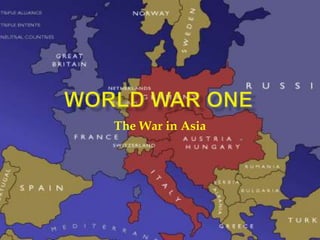
BackgroundEuropean powers were struggling to maintain balance in the mainland because of their expanding colonies and influenceEuropean countries started making intricate alliances among themselves. The leading powers formed The Triple Entente(France, Russia, England) and The Central Powers(Austria-Hungary Empire and German Empire
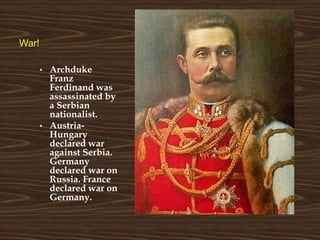
War!Archduke Franz Ferdinand was assassinated by a Serbian nationalist.
Austria- Hungary declared war against Serbia. Germany declared war on Russia. France declared war on Germany.Asian InvolvementAs the war progressed the European countries took soldiers from their colonies(example: India)Japan being allied to England began attacking German controlled lands.China joined the war because America joined in during 1917 and because a ship full of Chinese nationals was sunk by a German submarine
Asian InvolvementThailand sent a regiment of soldiers to aid the BritishThe  Germans hatched a series of plans(1914-1917) with the Indian nationaliststo overthrow the British Raj in India and replace it with a Pro- German government. It was known as the Hindu-German Conspiracy.
Asian InvolvementThe Japanese attacked the German controlled town of TsingtaoThe Filipinos wanted to help in the war so the Philippine national guard was established by Gov. Harrison and Manuel QuezonThe weakening Ottoman Empire later joined the war on the side of the Central Powers
End of the warThe war officially ended on 1918 when the victorious Allies signed the Treaty of Versailles with the defeated Central PowersThe League of Nations was established to avoid another world war
EFFECTS US & Japan became world powersRussia, Austria-Hungary, German and Ottoman Empires collapsed or were overthrownEurope was severely weakened due to the fightingUS stock market collapsed in the 1920’s(Great Depression) this affected the whole world.Gandhi started a peaceful freedom movementChina was forced to take the 21 mandates from Japan and lost Shangdong to the Japanese.
EFFECTSThe May 4th movement which is anti-foreigner started in China after the weak response to the Shangdong ProblemThe Ottoman Empire collapsed. West Asia was divided under different mandates. Saudi Arabia remained free under King Ibn Saud.
EFFECTSIn the middle of the war the Russian royal family was overthrown and replaced by a Communist Government lead by Vladimir LeninJapan started a rapid militarization in response to their victoryChina was under the lead of the Kuomintang, led by Chiang Kai Shek, when the war ended.The Balfour Declaration allowed Jews in Europe to live in Palestine. This began Muslim-Jewish tensions.Calls for independence in the Philippines became louder and gave way for the Tydings-Mcduffie act.Through the decadesThe League of Nations didn’t fulfill their purpose in preventing another war.WW1 shifted the power from Europe to US and Japan.The mandates given to the allies shaped the Middle East today and gave rise to Jewish-Muslim conflicts.The fight for independence and ideas of nationalism became more rampant.
THE END
World War One

World War One

  • 1.
    WORLD WAR ONETheWar in Asia
  • 2.
    BackgroundEuropean powers werestruggling to maintain balance in the mainland because of their expanding colonies and influenceEuropean countries started making intricate alliances among themselves. The leading powers formed The Triple Entente(France, Russia, England) and The Central Powers(Austria-Hungary Empire and German Empire
  • 3.
    War!Archduke Franz Ferdinandwas assassinated by a Serbian nationalist.
  • 4.
    Austria- Hungary declaredwar against Serbia. Germany declared war on Russia. France declared war on Germany.Asian InvolvementAs the war progressed the European countries took soldiers from their colonies(example: India)Japan being allied to England began attacking German controlled lands.China joined the war because America joined in during 1917 and because a ship full of Chinese nationals was sunk by a German submarine
  • 5.
    Asian InvolvementThailand senta regiment of soldiers to aid the BritishThe Germans hatched a series of plans(1914-1917) with the Indian nationaliststo overthrow the British Raj in India and replace it with a Pro- German government. It was known as the Hindu-German Conspiracy.
  • 6.
    Asian InvolvementThe Japaneseattacked the German controlled town of TsingtaoThe Filipinos wanted to help in the war so the Philippine national guard was established by Gov. Harrison and Manuel QuezonThe weakening Ottoman Empire later joined the war on the side of the Central Powers
  • 7.
    End of thewarThe war officially ended on 1918 when the victorious Allies signed the Treaty of Versailles with the defeated Central PowersThe League of Nations was established to avoid another world war
  • 8.
    EFFECTS US &Japan became world powersRussia, Austria-Hungary, German and Ottoman Empires collapsed or were overthrownEurope was severely weakened due to the fightingUS stock market collapsed in the 1920’s(Great Depression) this affected the whole world.Gandhi started a peaceful freedom movementChina was forced to take the 21 mandates from Japan and lost Shangdong to the Japanese.
  • 9.
    EFFECTSThe May 4thmovement which is anti-foreigner started in China after the weak response to the Shangdong ProblemThe Ottoman Empire collapsed. West Asia was divided under different mandates. Saudi Arabia remained free under King Ibn Saud.
  • 10.
    EFFECTSIn the middleof the war the Russian royal family was overthrown and replaced by a Communist Government lead by Vladimir LeninJapan started a rapid militarization in response to their victoryChina was under the lead of the Kuomintang, led by Chiang Kai Shek, when the war ended.The Balfour Declaration allowed Jews in Europe to live in Palestine. This began Muslim-Jewish tensions.Calls for independence in the Philippines became louder and gave way for the Tydings-Mcduffie act.Through the decadesThe League of Nations didn’t fulfill their purpose in preventing another war.WW1 shifted the power from Europe to US and Japan.The mandates given to the allies shaped the Middle East today and gave rise to Jewish-Muslim conflicts.The fight for independence and ideas of nationalism became more rampant.
  • 11.