ESTABLISHING
A WORKPLACE
WELLNESS
INITIATIVE
A TOOLKIT FOR MINNESOTA EMPLOYERS
W H Y
WORKPLACE
WELLNESS?
2 ESTABLISHING A WORKPLACE WELLNESS INITIATIVE
Seventy-seven percent of the U.S.
population is in the workforce.1
Because
the majority of adults spend nearly half
of their waking hours at work, the work
environment has a significant potential
to influence health.
1
U.S. Census Bureau, American Community Survey Public Use Microdata Sample (PUMS) single-year estimates.
http://factfinder.census.gov/faces/tableservices/jsf/pages/productview.xhtml?pid=ACS_13_1YR_S2301&prodType=table
A well-designed workplace wellness initiative offers an organizational structure and physical environment that
supports employee health and encourages positive lifestyle behaviors. Some benefits to employers in offering
a comprehensive workplace wellness initiative include:
A B O U T W O R K P L A C E W E L L N E S S I N M I N N E S O TA
Workplaces in communities across Minnesota have
joined together through the Statewide Health
Improvement Partnership (SHIP) to establish
workplace wellness initiatives. This toolkit will guide
you through the process of developing, implementing and
evaluating a comprehensive worksite wellness initiative.
•	 Decreased absenteeism, employee
turnover and health care costs
•	 Improved productivity
•	 Improved time and stress
management for employees
•	 Increased employee recruitment
and retention
•	 Bolstered employee morale and
commitment to the company by
showing management cares about
their well-being
•	 Enhanced organizational image,
which helps make you an employer
of choice
A TOOLKIT FOR MINNESOTA EMPLOYERS 3
W H AT ’S I N S I D E
TABLE OF
CONTENTS
4 ESTABLISHING A WORKPLACE WELLNESS INITIATIVE
CREATING A CULTURE OF HEALTH  .  .  .  .  .  .  .  .  .  .  .  .  .  .  .  .  .  .  .  .  .  page 6
OVERVIEW  .  .  .  .  .  .  .  .  .  .  .  .  .  .  .  .  .  .  .  .  .  .  .  .  .  .  .  .  .  .  .  .  .  .  .  .  .  .  .  .  .  page 8
STEPS TO A SUSTAINABLE PROGRAM
Step 1: Secure Leadership Support .  .  .  .  .  .  .  .  .  .  .  .  .  .  .  .  .  .  .  .  .  .  .  .  .  .  .  . page 9
Step 2: Convene a Wellness Committee .  .  .  .  .  .  .  .  .  .  .  .  .  .  .  .  .  .  .  .  .  .  .  .page 10
Step 3: Develop a Vision and a Brand .  .  .  .  .  .  .  .  .  .  .  .  .  .  .  .  .  .  .  .  .  .  .  .  .  .  page 11
Step 4: Conduct Assessments / Collect Data .  .  .  .  .  .  .  .  .  .  .  .  .  .  .  .  .  .  .  .  . page 12
Step 5: Develop and Implement the Plan  .  .  .  .  .  .  .  .  .  .  .  .  .  .  .  .  .  .  .  .  .  .  . page 14
Action Plan Worksheet  .  .  .  .  .  .  .  .  .  .  .  .  .  .  .  .  .  .  .  .  .  .  .  .  .  .  .  .  .  .  .  .  . page 15
Step 6: Evaluation  .  .  .  .  .  .  .  .  .  .  .  .  .  .  .  .  .  .  .  .  .  .  .  .  .  .  .  .  .  .  .  .  .  .  .  . page 17
STRATEGIES TO SUPPORT HEALTHIER EMPLOYEES .  .  .  .  .  .  .  page 18
TOBACCO USE .  .  .  .  .  .  .  .  .  .  .  .  .  .  .  .  .  .  .  .  .  .  .  .  .  .  .  .  .  .  .  .  .  .  . page 19
PHYSICAL ACTIVIT Y  .  .  .  .  .  .  .  .  .  .  .  .  .  .  .  .  .  .  .  .  .  .  .  .  .  .  .  .  .  page 20
	 Physical Activity: Best Practice Worksheet .  .  .  .  .  .  .  .  .  .  .  .  .  .  .  .  .  .  .  . page 21
	 Sample Physical Activity Policy .  .  .  .  .  .  .  .  .  .  .  .  .  .  .  .  .  .  .  .  .  .  .  .  .  .  .page 22
	 Potential Liability Issues .  .  .  .  .  .  .  .  .  .  .  .  .  .  .  .  .  .  .  .  .  .  .  .  .  .  .  .  .  .  .page 23
	 Communications Plan .  .  .  .  .  .  .  .  .  .  .  .  .  .  .  .  .  .  .  .  .  .  .  .  .  .  .  .  .  .  .  . page 24
NUTRITION  .  .  .  .  .  .  .  .  .  .  .  .  .  .  .  .  .  .  .  .  .  .  .  .  .  .  .  .  .  .  .  .  .  .  .  .  . page 25
	 Nutrition: Best Practice Worksheet .  .  .  .  .  .  .  .  .  .  .  .  .  .  .  .  .  .  .  .  .  .  .  . page 26
	 Sample Nutrition Policy .  .  .  .  .  .  .  .  .  .  .  .  .  .  .  .  .  .  .  .  .  .  .  .  .  .  .  .  .  .  .page 27
	 Communications Plan  .  .  .  .  .  .  .  .  .  .  .  .  .  .  .  .  .  .  .  .  .  .  .  .  .  .  .  .  .  .  .  .page 28
A TOOLKIT FOR MINNESOTA EMPLOYERS 5
BREASTFEEDING .  .  .  .  .  .  .  .  .  .  .  .  .  .  .  .  .  .  .  .  .  .  .  .  .  .  .  .  .  .  .  .  .page 29
	 Becoming a Breastfeeding Friendly Workplace .  .  .  .  .  .  .  .  .  .  .  .  .  .  .  .  . page 30
	 Sample Breastfeeding Policy .  .  .  .  .  .  .  .  .  .  .  .  .  .  .  .  .  .  .  .  .  .  .  .  .  .  .  . page 31
	 Communications Plan .  .  .  .  .  .  .  .  .  .  .  .  .  .  .  .  .  .  .  .  .  .  .  .  .  .  .  .  .  .  . page 33
STRESS MANAGEMENT .  .  .  .  .  .  .  .  .  .  .  .  .  .  .  .  .  .  .  .  .  .  .  .  .  .  .  page 34
	 Family Health .  .  .  .  .  .  .  .  .  .  .  .  .  .  .  .  .  .  .  .  .  .  .  .  .  .  .  .  .  .  .  .  .  .  .  page 35
	 Financial Health .  .  .  .  .  .  .  .  .  .  .  .  .  .  .  .  .  .  .  .  .  .  .  .  .  .  .  .  .  .  .  .  .  . page 35
	Strategies .  .  .  .  .  .  .  .  .  .  .  .  .  .  .  .  .  .  .  .  .  .  .  .  .  .  .  .  .  .  .  .  .  .  .  .  .  . page 35
	 Stress Management: Best Practice Worksheet  .  .  .  .  .  .  .  .  .  .  .  .  .  .  .  .  page 36
WORKPL ACE WELLNESS RESOURCES  .  .  .  .  .  .  .  .  .  .  .  .  .  .  .  .  .  .  .page 37
ACKNOWLEDGMENTS  .  .  .  .  .  .  .  .  .  .  .  .  .  .  .  .  .  .  .  .  .  .  .  .  .  .  .  .  .  .  .  .page 39
NOTES .  .  .  .  .  .  .  .  .  .  .  .  .  .  .  .  .  .  .  .  .  .  .  .  .  .  .  .  .  .  .  .  .  .  .  .  .  .  .  .  .  .  .  .  .page 39
C R E AT I N G A
CULTURE OF HEALTH
T H E E N G I N E B E H I N D S U S TA I N A B L E B E H AV I O R C H A N G E
The Statewide Health Improvement Partnership (SHIP) focuses on policy, systems and environmental (PSE)
changes. If workplace wellness efforts focus on PSE changes, they will provide the foundation that helps a
workplace create a culture of health.
A culture of health is one in which individuals and their
organizations are able to make healthy life choices within a
larger social environment that values, provides and promotes
options that are capable of producing health and well-being
for everyone regardless of background or environment.2
Here are a few examples:
•	 Policy change: Employer adopts a tobacco-
free grounds policy, which greatly influences
tobacco users to make a quit attempt and
protects others from secondhand smoke.
•	 Systems change: Employer begins to offer
annual health assessment to employees,
allowing employees to get a baseline on their
personal health and reaffirm or make healthy
lifestyle changes. Aggregate health data
becomes available so that an effective health
promotion program can be designed with
specific employee needs in mind.
•	 Environmental change: Employer makes
refrigeration available so fruits and vegetables
can be properly stored and easily accessible to
employees, or the employer includes healthy
choices in vending machines that meet certain
nutritional standards. This allows for increased
support and opportunities for improved
nutrition in the workplace.
2
Robert Wood Johnson Foundation. RWJF’s model for advancing a culture of health. Available at
http://www.rwjf.org/en/blogs/culture-of-health/2013/05/about culture ofhea.html
6 ESTABLISHING A WORKPLACE WELLNESS INITIATIVE
A TOOLKIT FOR MINNESOTA EMPLOYERS 7
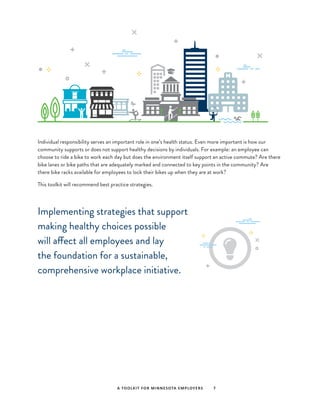
Individual responsibility serves an important role in one’s health status. Even more important is how our
community supports or does not support healthy decisions by individuals. For example: an employee can
choose to ride a bike to work each day but does the environment itself support an active commute? Are there
bike lanes or bike paths that are adequately marked and connected to key points in the community? Are
there bike racks available for employees to lock their bikes up when they are at work?
This toolkit will recommend best practice strategies.
Implementing strategies that support
making healthy choices possible
will affect all employees and lay
the foundation for a sustainable,
comprehensive workplace initiative.
OVERVIEW
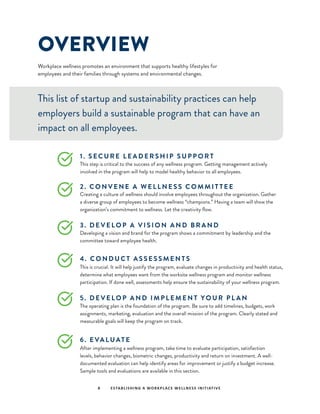
Workplace wellness promotes an environment that supports healthy lifestyles for
employees and their families through systems and environmental changes.
1. S E C U R E L E A D E R S H I P S U P P O R T
This step is critical to the success of any wellness program. Getting management actively
involved in the program will help to model healthy behavior to all employees.
2. C O N V E N E A W E L L N E S S C O M M I T T E E
Creating a culture of wellness should involve employees throughout the organization. Gather
a diverse group of employees to become wellness “champions.” Having a team will show the
organization’s commitment to wellness. Let the creativity flow.
This list of startup and sustainability practices can help
employers build a sustainable program that can have an
impact on all employees.
3. D E V E L O P A V I S I O N A N D B R A N D
Developing a vision and brand for the program shows a commitment by leadership and the
committee toward employee health.
4. C O N D U C T A S S E S S M E N T S
This is crucial. It will help justify the program, evaluate changes in productivity and health status,
determine what employees want from the worksite wellness program and monitor wellness
participation. If done well, assessments help ensure the sustainability of your wellness program.
5. D E V E L O P A N D I M P L E M E N T YO U R P L A N
The operating plan is the foundation of the program. Be sure to add timelines, budgets, work
assignments, marketing, evaluation and the overall mission of the program. Clearly stated and
measurable goals will keep the program on track.
6. E VA L UAT E
After implementing a wellness program, take time to evaluate participation, satisfaction
levels, behavior changes, biometric changes, productivity and return on investment. A well-
documented evaluation can help identify areas for improvement or justify a budget increase.
Sample tools and evaluations are available in this section.
8 ESTABLISHING A WORKPLACE WELLNESS INITIATIVE
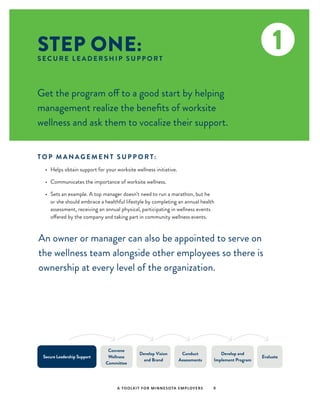
STEP ONE:
A TOOLKIT FOR MINNESOTA EMPLOYERS 9
S E C U R E L E A D E R S H I P S U P P O R T
Get the program off to a good start by helping
management realize the benefits of worksite
wellness and ask them to vocalize their support.
1
Secure Leadership Support
Convene
Wellness
Committee
Develop Vision
and Brand
Conduct
Assessments
Develop and
Implement Program
Evaluate
T O P M A N A G E M E N T S U P P O R T:
•	 Helps obtain support for your worksite wellness initiative.
•	 Communicates the importance of worksite wellness.
•	 Sets an example. A top manager doesn’t need to run a marathon, but he
or she should embrace a healthful lifestyle by completing an annual health
assessment, receiving an annual physical, participating in wellness events
offered by the company and taking part in community wellness events.
An owner or manager can also be appointed to serve on
the wellness team alongside other employees so there is
ownership at every level of the organization.
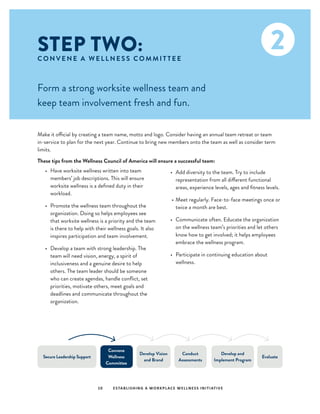
STEP TWO:
C O N V E N E A W E L L N E S S C O M M I T T E E
Form a strong worksite wellness team and
keep team involvement fresh and fun.
2
Secure Leadership Support
Convene
Wellness
Committee
Develop Vision
and Brand
Conduct
Assessments
Develop and
Implement Program
Evaluate
10 ESTABLISHING A WORKPLACE WELLNESS INITIATIVE
Make it official by creating a team name, motto and logo. Consider having an annual team retreat or team
in-service to plan for the next year. Continue to bring new members onto the team as well as consider term
limits.
•	 Have worksite wellness written into team
members’ job descriptions. This will ensure
worksite wellness is a defined duty in their
workload.
•	 Promote the wellness team throughout the
organization. Doing so helps employees see
that worksite wellness is a priority and the team
is there to help with their wellness goals. It also
inspires participation and team involvement.
•	 Develop a team with strong leadership. The
team will need vision, energy, a spirit of
inclusiveness and a genuine desire to help
others. The team leader should be someone
who can create agendas, handle conflict, set
priorities, motivate others, meet goals and
deadlines and communicate throughout the
organization.
•	 Add diversity to the team. Try to include
representation from all different functional
areas, experience levels, ages and fitness levels.
•	Meet regularly. Face-to-face meetings once or
twice a month are best.
•	 Communicate often. Educate the organization
on the wellness team’s priorities and let others
know how to get involved; it helps employees
embrace the wellness program.
•	 Participate in continuing education about
wellness.
These tips from the Wellness Council of America will ensure a successful team:
A TOOLKIT FOR MINNESOTA EMPLOYERS 11
D E V E L O P V I S I O N A N D B R A N D
•	 Work with the wellness committee to develop a vision for
the wellness program. The wellness program vision statement
should complement the organization’s mission statement. It
can be as short as two sentences.
•	 The vision and brand should be used in any communication
materials the committee sends to employees to help convey
that the information is coming from the wellness committee
and is a part of the organization’s wellness program.
3
Secure Leadership Support
Convene
Wellness
Committee
Develop Vision
and Brand
Conduct
Assessments
Develop and
Implement Program
Evaluate
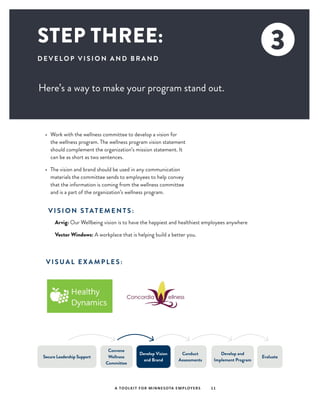
STEP THREE:
V I S I O N S TAT E M E N T S :
Here’s a way to make your program stand out.
Arvig: Our Wellbeing vision is to have the happiest and healthiest employees anywhere
Vector Windows: A workplace that is helping build a better you.
V I S U A L E X A M P L E S :
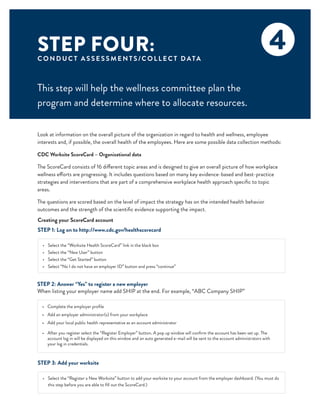
STEP FOUR:
C O N D U C T A S S E S S M E N T S /C O L L E C T D ATA
This step will help the wellness committee plan the
program and determine where to allocate resources.
4
Look at information on the overall picture of the organization in regard to health and wellness, employee
interests and, if possible, the overall health of the employees. Here are some possible data collection methods:
CDC Worksite ScoreCard – Organizational data
The ScoreCard consists of 16 different topic areas and is designed to give an overall picture of how workplace
wellness efforts are progressing. It includes questions based on many key evidence-based and best-practice
strategies and interventions that are part of a comprehensive workplace health approach specific to topic
areas.
The questions are scored based on the level of impact the strategy has on the intended health behavior
outcomes and the strength of the scientific evidence supporting the impact.
STEP 1: Log on to http://www.cdc.gov/healthscorecard
•	 Select the “Worksite Health ScoreCard” link in the black box
•	 Select the “New User” button
•	 Select the “Get Started” button
•	 Select “No I do not have an employer ID” button and press “continue”
Creating your ScoreCard account
STEP 2: Answer “Yes” to register a new employer
When listing your employer name add SHIP at the end. For example, “ABC Company SHIP”
•	 Complete the employer profile
•	 Add an employer administrator(s) from your workplace
•	 Add your local public health representative as an account administrator
•	 After you register select the “Register Employer” button. A pop up window will confirm the account has been set up. The
account log in will be displayed on this window and an auto generated e-mail will be sent to the account administrators with
your log in credentials.
STEP 3: Add your worksite
•	 Select the “Register a New Worksite” button to add your worksite to your account from the employer dashboard. (You must do
this step before you are able to fill out the ScoreCard.)
A TOOLKIT FOR MINNESOTA EMPLOYERS 13
Secure Leadership Support
Convene
Wellness
Committee
Develop Vision
and Brand
Conduct
Assessments
Develop and
Implement Program
Evaluate
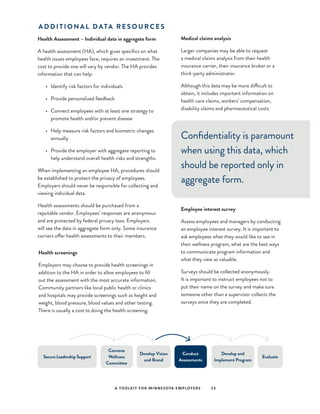
A D D I T I O N A L D ATA R E S O U R C E S
Medical claims analysis
Larger companies may be able to request
a medical claims analysis from their health
insurance carrier, their insurance broker or a
third-party administrator.
Although this data may be more difficult to
obtain, it includes important information on
health care claims, workers’ compensation,
disability claims and pharmaceutical costs.
Health screenings
Employers may choose to provide health screenings in
addition to the HA in order to allow employees to fill
out the assessment with the most accurate information.
Community partners like local public health or clinics
and hospitals may provide screenings such as height and
weight, blood pressure, blood values and other testing.
There is usually a cost to doing the health screening.
Employee interest survey
Assess employees and managers by conducting
an employee interest survey. It is important to
ask employees what they would like to see in
their wellness program, what are the best ways
to communicate program information and
what they view as valuable.
Surveys should be collected anonymously.
It is important to instruct employees not to
put their name on the survey and make sure
someone other than a supervisor collects the
surveys once they are completed.
Health Assessment – Individual data in aggregate form
A health assessment (HA), which gives specifics on what
health issues employees face, requires an investment. The
cost to provide one will vary by vendor. The HA provides
information that can help:
•	 Identify risk factors for individuals
•	 Provide personalized feedback
•	 Connect employees with at least one strategy to
promote health and/or prevent disease
•	 Help measure risk factors and biometric changes
annually
•	 Provide the employer with aggregate reporting to
help understand overall health risks and strengths.
When implementing an employee HA, procedures should
be established to protect the privacy of employees.
Employers should never be responsible for collecting and
viewing individual data.
Health assessments should be purchased from a
reputable vendor. Employees’ responses are anonymous
and are protected by federal privacy laws. Employers
will see the data in aggregate form only. Some insurance
carriers offer health assessments to their members.
Confidentiality is paramount
when using this data, which
should be reported only in
aggregate form.
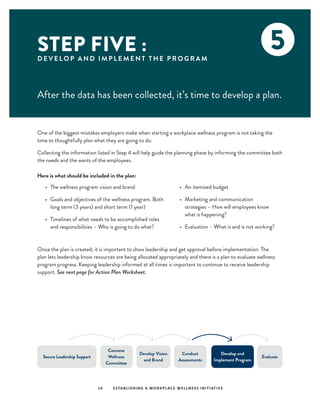
STEP FIVE :
D E V E L O P A N D I M P L E M E N T T H E P R O G R A M
After the data has been collected, it’s time to develop a plan.
5
Secure Leadership Support
Convene
Wellness
Committee
Develop Vision
and Brand
Conduct
Assessments
Develop and
Implement Program
Evaluate
14 ESTABLISHING A WORKPLACE WELLNESS INITIATIVE
One of the biggest mistakes employers make when starting a workplace wellness program is not taking the
time to thoughtfully plan what they are going to do.
Collecting the information listed in Step 4 will help guide the planning phase by informing the committee both
the needs and the wants of the employees.
Here is what should be included in the plan:
•	 An itemized budget
•	 Marketing and communication
strategies – How will employees know
what is happening?
•	 Evaluation – What is and is not working?
Once the plan is created, it is important to show leadership and get approval before implementation. The
plan lets leadership know resources are being allocated appropriately and there is a plan to evaluate wellness
program progress. Keeping leadership informed at all times is important to continue to receive leadership
support. See next page for Action Plan Worksheet.
•	 The wellness program vision and brand
•	 Goals and objectives of the wellness program. Both
long term (3 years) and short term (1 year)
•	 Timelines of what needs to be accomplished roles
and responsibilities – Who is going to do what?
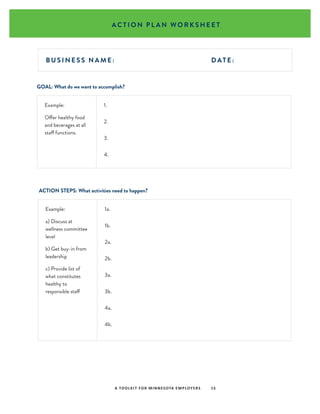
A C T I O N P L A N W O R K S H E E T
B U S I N E S S N A M E :	 D AT E :
GOAL: What do we want to accomplish?
Example:
Offer healthy food
and beverages at all
staff functions.
1.
2.
3.
4.
ACTION STEPS: What activities need to happen?
Example:
a) Discuss at
wellness committee
level
b) Get buy-in from
leadership
c) Provide list of
what constitutes
healthy to
responsible staff
1a.
1b.
2a.
2b.
3a.
3b.
4a.
4b.
A TOOLKIT FOR MINNESOTA EMPLOYERS 15
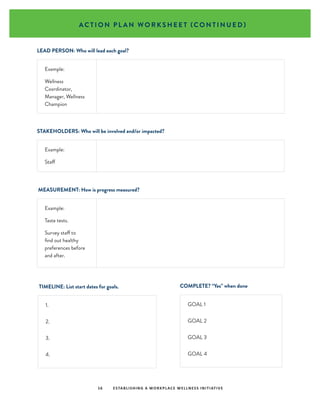
A C T I O N P L A N W O R K S H E E T (C O N T I N U E D )
MEASUREMENT: How is progress measured?
Example:
Taste tests.
Survey staff to
find out healthy
preferences before
and after.
STAKEHOLDERS: Who will be involved and/or impacted?
Example:
Staff
LEAD PERSON: Who will lead each goal?
Example:
Wellness
Coordinator,
Manager, Wellness
Champion
TIMELINE: List start dates for goals.
1.
2.
3.
4.
COMPLETE? “Yes” when done
GOAL 1
GOAL 2
GOAL 3
GOAL 4
16 ESTABLISHING A WORKPLACE WELLNESS INITIATIVE
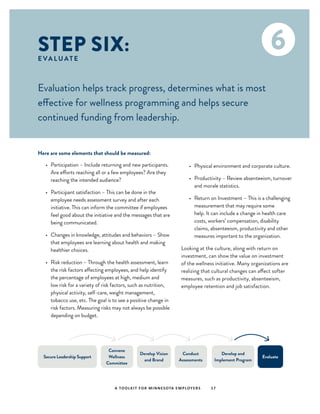
STEP SIX:
A TOOLKIT FOR MINNESOTA EMPLOYERS 17
6
Secure Leadership Support
Convene
Wellness
Committee
Develop Vision
and Brand
Conduct
Assessments
Develop and
Implement Program
Evaluate
E VA LUAT E
Evaluation helps track progress, determines what is most
effective for wellness programming and helps secure
continued funding from leadership.
Here are some elements that should be measured:
•	 Physical environment and corporate culture.
•	 Productivity – Review absenteeism, turnover
and morale statistics.
•	 Return on Investment – This is a challenging
measurement that may require some
help. It can include a change in health care
costs, workers’ compensation, disability
claims, absenteeism, productivity and other
measures important to the organization.
Looking at the culture, along with return on
investment, can show the value on investment
of the wellness initiative. Many organizations are
realizing that cultural changes can affect softer
measures, such as productivity, absenteeism,
employee retention and job satisfaction.
•	 Participation – Include returning and new participants.
Are efforts reaching all or a few employees? Are they
reaching the intended audience?
•	 Participant satisfaction – This can be done in the
employee needs assessment survey and after each
initiative. This can inform the committee if employees
feel good about the initiative and the messages that are
being communicated.
•	 Changes in knowledge, attitudes and behaviors – Show
that employees are learning about health and making
healthier choices.
•	 Risk reduction – Through the health assessment, learn
the risk factors affecting employees, and help identify
the percentage of employees at high, medium and
low risk for a variety of risk factors, such as nutrition,
physical activity, self-care, weight management,
tobacco use, etc. The goal is to see a positive change in
risk factors. Measuring risks may not always be possible
depending on budget.
S T R AT E G I E S T O
SUPPORT
HEALTHIER
EMPLOYEES
18 ESTABLISHING A WORKPLACE WELLNESS INITIATIVE
Companies can help employees be
healthier by making changes that
help workers reduce commercial
tobacco use and increase access
to and opportunities for physical
activity and healthy eating at work.
TOBACCO USE
The negative health effects of tobacco use are well known.
Smoking is the leading cause of preventable U.S. deaths
each year and the associated diseases and health care costs
are significant. In fact, 480,000 Americans and 5,900
Minnesotans die each year as a result of smoking and
exposure to secondhand smoke.3
Smokers incur more medical costs, see physicians more often and are admitted to hospitals for longer
periods than non-smokers. In Minnesota, $3.2 billion per year is spent on healthcare costs. Smokers miss
2.6 more days than non-smoking peers. The average smoker takes two 15 minute smoke breaks per day
in excess of regular break time. Healthcare expenses of a smoker can be eight percent higher than for a
non-smoker.4
In addition to direct health affects to tobacco users, other employees are affected by secondhand and
third hand smoke. Committing to a tobacco free workplace/grounds and promoting cessation will help all
employees be healthier.
Tobacco cessation best practices
•	 Create policy prohibiting tobacco use anywhere
on the property and in company vehicles,
including the use of e-cigarettes.
•	 Provide prompts/posters to support a tobacco-
free policy, including signs indicating this is a
tobacco-free workplace.
•	 Provide counseling through an individual, group
or telephone program, including a program
on-site and programs provided through an
insurance provider.
•	 Promote cessation tools like over-the-counter
and prescription medication available to
employees through your insurance provider.
The American Lung Association has published
Making Your Worksite Tobacco-Free, a free,
step-by-step guide to making your workplace
tobacco free.
A TOOLKIT FOR MINNESOTA EMPLOYERS 19
3
US Department of Health and Human Services (2014) The Health Consequences of Smoking – 50
Years of Progress Campaign for Tobacco-Free Kids (2015) The Toll of Tobacco in Minnesota
4 “
Making Your Worksite Tobacco Free,” American Lung Association. Available at
http://www.lung.org/local-content/minnesota/documents/worksite-wellness-toolkit.pdf
PHYSICAL
ACTIVITY
The benefits of regular physical activity are numerous, yet the majority of Americans don’t get the
recommended 150 minutes of moderate activity per week. In Minnesota, nearly one-third of adults
do not get enough activity per week to meet the recommendations.5
The good news is regardless of its size, setting and location, the workplace can help employees be
active. When employers provide support for employees to be active, employees are more likely
to incorporate activity into their workday. In fact, many employers believe creating a culture
that encourages physical activity can help recruit and retain employees and have a wide range of
benefits.
Research has shown that employees who get at least
75 minutes of vigorous activity per week miss an
average of 4.1 fewer days of work per year.6
20 ESTABLISHING A WORKPLACE WELLNESS INITIATIVE
5
CDC physical activity recommendation as measured in the Minnesota Physical Activity Survey 2007.
*Recommendation: a minimum of 150 minutes of moderate activity per week OR a minimum of 75 minutes of
vigorous activity per week OR a combination of the two where vigorous minutes count double toward the 150
minute requirement. Spreading activity over several days per week is encouraged but not required.
6
Goetzel, R. Z. et al. Ten modifiable health risk factors are linked to more than one-fifth of employer-employee
health care spending. Health Aff. (Millwood) 31, 2474–2484 (2012).
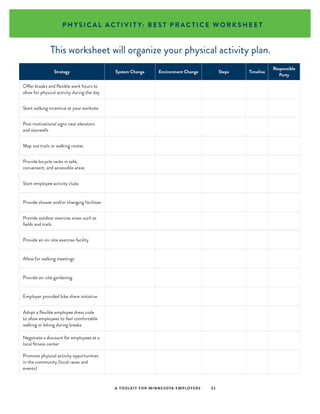
The table and policy example on the next page can be used as a framework for developing
sustainable changes in the physical environment. Here are questions to consider:
•	 What policy changes need to be addressed or added?
•	 What system changes need to be addressed?
•	 What issues within the work environment need to be added or revised?
•	 What are the steps to accomplish the PSE change?
•	 What is the timeline and who is responsible for following through?
A TOOLKIT FOR MINNESOTA EMPLOYERS 21
P H Y S I C A L A C T I V I T Y: B E S T P R A C T I C E W O R K S H E E T
This worksheet will organize your physical activity plan.
Strategy System Change Environment Change Steps Timeline
Responsible
Party
Offer breaks and flexible work hours to
allow for physical activity during the day
Start walking incentive at your worksite
Post motivational signs near elevators
and stairwells
Map out trails or walking routes
Provide bicycle racks in safe,
convenient, and accessible areas
Start employee activity clubs
Provide shower and/or changing facilities
Provide outdoor exercise areas such as
fields and trails
Provide an on-site exercise facility
Allow for walking meetings
Provide on-site gardening
Employer provided bike share initiative
Adopt a flexible employee dress code
to allow employees to feel comfortable
walking or biking during breaks
Negotiate a discount for employees at a
local fitness center
Promote physical activity opportunities
in the community (local races and
events)
22 ESTABLISHING A WORKPLACE WELLNESS INITIATIVE
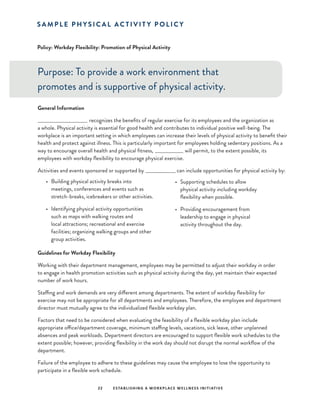
Policy: Workday Flexibility: Promotion of Physical Activity
Purpose: To provide a work environment that
promotes and is supportive of physical activity.
General Information
____________________________ recognizes the benefits of regular exercise for its employees and the organization as
a whole. Physical activity is essential for good health and contributes to individual positive well-being. The
workplace is an important setting in which employees can increase their levels of physical activity to benefit their
health and protect against illness. This is particularly important for employees holding sedentary positions. As a
way to encourage overall health and physical fitness, __________________ will permit, to the extent possible, its
employees with workday flexibility to encourage physical exercise.
Activities and events sponsored or supported by __________________ can include opportunities for physical activity by:
S A M P L E P H Y S I C A L A C T I V I T Y P O L I C Y
•	 Building physical activity breaks into
meetings, conferences and events such as
stretch-breaks, icebreakers or other activities.
•	 Identifying physical activity opportunities
such as maps with walking routes and
local attractions; recreational and exercise
facilities; organizing walking groups and other
group activities.
Guidelines for Workday Flexibility
Working with their department management, employees may be permitted to adjust their workday in order
to engage in health promotion activities such as physical activity during the day, yet maintain their expected
number of work hours.
Staffing and work demands are very different among departments. The extent of workday flexibility for
exercise may not be appropriate for all departments and employees. Therefore, the employee and department
director must mutually agree to the individualized flexible workday plan.
Factors that need to be considered when evaluating the feasibility of a flexible workday plan include
appropriate office/department coverage, minimum staffing levels, vacations, sick leave, other unplanned
absences and peak workloads. Department directors are encouraged to support flexible work schedules to the
extent possible; however, providing flexibility in the work day should not disrupt the normal workflow of the
department.
Failure of the employee to adhere to these guidelines may cause the employee to lose the opportunity to
participate in a flexible work schedule.
•	 Supporting schedules to allow
physical activity including workday
flexibility when possible.
•	 Providing encouragement from
leadership to engage in physical
activity throughout the day.
A TOOLKIT FOR MINNESOTA EMPLOYERS 23
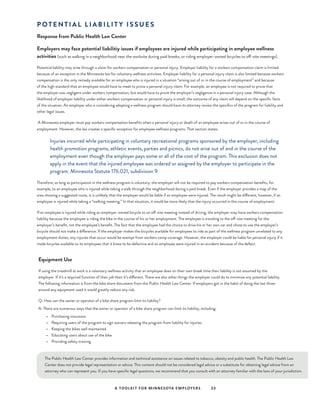
P O T E N T I A L L I A B I L I T Y I S S U E S
Response from Public Health Law Center
Employers may face potential liabilitiy issues if employees are injured while participating in employee wellness
activities (such as walking in a neighborhood near the worksite during paid breaks, or riding employer-owned bicycles to off-site meetings).
Potential liability may arise through a claim for workers compensation or personal injury. Employer liability for a workers compensation claim is limited
because of an exception in the Minnesota law for voluntary wellness activities. Employer liability for a personal injury claim is also limited because workers
compensation is the only remedy available for an employee who is injured in a situation “arising out of or in the course of employment” and because
of the high standard that an employee would have to meet to prove a personal injury claim. For example, an employee is not required to prove that
the employer was negligent under workers compensation, but would have to prove the employer’s negligence in a personal injury case. Although the
likelihood of employer liability under either workers compensation or personal injury is small, the outcome of any claim will depend on the specific facts
of the situation. An employer who is considering adopting a wellness program should have its attorney review the specifics of the program for liability and
other legal issues.
A Minnesota employer must pay workers compensation benefits when a personal injury or death of an employee arises out of or in the course of
employment. However, the law creates a specific exception for employee wellness programs. That section states:
	 Injuries incurred while participating in voluntary recreational programs sponsored by the employer, including
health promotion programs, athletic events, parties and picnics, do not arise out of and in the course of the
employment even though the employer pays some or all of the cost of the program. This exclusion does not
apply in the event that the injured employee was ordered or assigned by the employer to participate in the
program. Minnesota Statute 176.021, subdivision 9.
Therefore, as long as participation in the wellness program is voluntary, the employer will not be required to pay workers compensation benefits, for
example, to an employee who is injured while taking a walk through the neighborhood during a paid break. Even if the employer provides a map of the
area showing a suggested route, it is unlikely that the employer would be liable if an employee were injured. The result might be different, however, if an
employee is injured while taking a “walking meeting.” In that situation, it would be more likely that the injury occurred in the course of employment.
If an employee is injured while riding an employer-owned bicycle to an off-site meeting instead of driving, the employer may have workers compensation
liability because the employee is riding the bike in the course of his or her employment. The employee is traveling to the off-site meeting for the
employer’s benefit, not the employee’s benefit. The fact that the employee had the choice to drive his or her own car and chose to use the employer’s
bicycle should not make a difference. If the employer makes the bicycles available for employees to ride as part of the wellness program unrelated to any
employment duties, any injuries that occur would be exempt from workers comp coverage. However, the employer could be liable for personal injury if it
made bicycles available to its employees that it knew to be defective and an employee were injured in an accident because of the defect.
Equipment Use
If using the treadmill at work is a voluntary wellness activity that an employee does on their own break time then liability is not assumed by the
employer. If it’s a required function of their job then it’s different. There are also other things the employer could do to minimize any potential liability.
The following information is from the bike share document from the Public Health Law Center. If employers got in the habit of doing the last three
around any equipment used it would greatly reduce any risk.
Q: How can the owner or operator of a bike share program limit its liability?
A: There are numerous ways that the owner or operator of a bike share program can limit its liability, including:
•	 Purchasing insurance
•	 Requiring users of the program to sign waivers releasing the program from liability for injuries
•	 Keeping the bikes well maintained
•	 Educating users about use of the bike
•	 Providing safety training
The Public Health Law Center provides information and technical assistance on issues related to tobacco, obesity and public health. The Public Health Law
Center does not provide legal representation or advice. This content should not be considered legal advice or a substitute for obtaining legal advice from an
attorney who can represent you. If you have specific legal questions, we recommend that you consult with an attorney familiar with the laws of your jurisdiction.
C O M M U N I C AT I O N S P L A N
It is important to communicate regularly about
opportunities for physical activity in the workplace.
Communications pieces should:
•	 Set a positive and fun tone
•	 Come from leadership when possible
•	 Use a variety of channels (intranet, newsletter, break room bulletin board, e-mail)
•	 Focus on the immediate benefits of physical activity (increased energy, reduced stress, feeling better).
Be honest with employees about why this plan is being implemented and make sure employees understand
this is a benefit, not a job requirement.
24 ESTABLISHING A WORKPLACE WELLNESS INITIATIVE
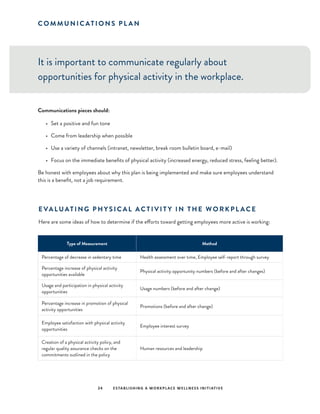
E VA LU AT I N G P H Y S I C A L A C T I V I T Y I N T H E W O R K P L A C E
Here are some ideas of how to determine if the efforts toward getting employees more active is working:
Type of Measurement Method
Percentage of decrease in sedentary time Health assessment over time, Employee self-report through survey
Percentage increase of physical activity
opportunities available
Physical activity opportunity numbers (before and after changes)
Usage and participation in physical activity
opportunities
Usage numbers (before and after change)
Percentage increase in promotion of physical
activity opportunities
Promotions (before and after change)
Employee satisfaction with physical activity
opportunities
Employee interest survey
Creation of a physical activity policy, and
regular quality assurance checks on the
commitments outlined in the policy
Human resources and leadership
A TOOLKIT FOR MINNESOTA EMPLOYERS 25
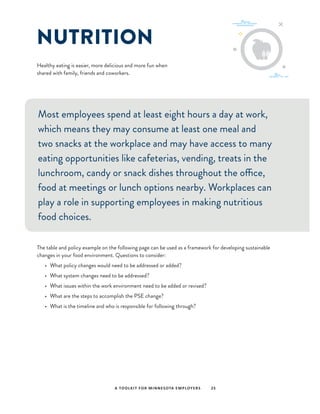
NUTRITION
Healthy eating is easier, more delicious and more fun when
shared with family, friends and coworkers.
Most employees spend at least eight hours a day at work,
which means they may consume at least one meal and
two snacks at the workplace and may have access to many
eating opportunities like cafeterias, vending, treats in the
lunchroom, candy or snack dishes throughout the office,
food at meetings or lunch options nearby. Workplaces can
play a role in supporting employees in making nutritious
food choices.
The table and policy example on the following page can be used as a framework for developing sustainable
changes in your food environment. Questions to consider:
•	 What policy changes would need to be addressed or added?
•	 What system changes need to be addressed?
•	 What issues within the work environment need to be added or revised?
•	 What are the steps to accomplish the PSE change?
•	 What is the timeline and who is responsible for following through?
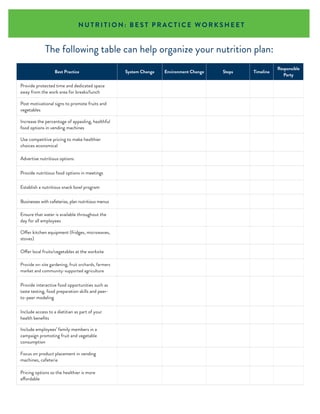
N U T R I T I O N: B E S T P R A C T I C E W O R K S H E E T
The following table can help organize your nutrition plan:
Best Practice System Change Environment Change Steps Timeline
Responsible
Party
Provide protected time and dedicated space
away from the work area for breaks/lunch
Post motivational signs to promote fruits and
vegetables
Increase the percentage of appealing, healthful
food options in vending machines
Use competitive pricing to make healthier
choices economical
Advertise nutritious options
Provide nutritious food options in meetings
Establish a nutritious snack bowl program
Businesses with cafeterias, plan nutritious menus
Ensure that water is available throughout the
day for all employees
Offer kitchen equipment (fridges, microwaves,
stoves)
Offer local fruits/vegetables at the worksite
Provide on-site gardening, fruit orchards, farmers
market and community-supported agriculture
Provide interactive food opportunities such as
taste testing, food preparation skills and peer-
to-peer modeling
Include access to a dietitian as part of your
health benefits
Include employees’ family members in a
campaign promoting fruit and vegetable
consumption
Focus on product placement in vending
machines, cafeteria
Pricing options so the healthier is more
affordable
A TOOLKIT FOR MINNESOTA EMPLOYERS 27
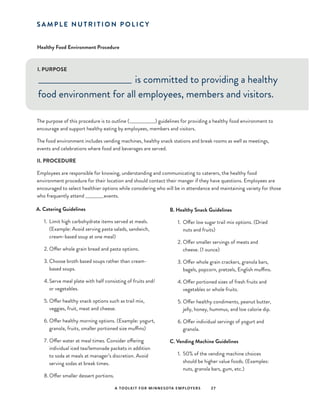
Healthy Food Environment Procedure
I. PURPOSE
S A M P L E N U T R I T I O N P O L I C Y
_____________________________ is committed to providing a healthy
food environment for all employees, members and visitors.
The purpose of this procedure is to outline (________________) guidelines for providing a healthy food environment to
encourage and support healthy eating by employees, members and visitors.
The food environment includes vending machines, healthy snack stations and break rooms as well as meetings,
events and celebrations where food and beverages are served.
II. PROCEDURE
Employees are responsible for knowing, understanding and communicating to caterers, the healthy food
environment procedure for their location and should contact their manger if they have questions. Employees are
encouraged to select healthier options while considering who will be in attendance and maintaining variety for those
who frequently attend___________events.
A. Catering Guidelines
1.	 Limit high carbohydrate items served at meals.
(Example: Avoid serving pasta salads, sandwich,
cream-based soup at one meal)
2.	Offer whole grain bread and pasta options.
3.	Choose broth based soups rather than cream-
based soups.
4.	Serve meal plate with half consisting of fruits and/
or vegetables.
5.	Offer healthy snack options such as trail mix,
veggies, fruit, meat and cheese.
6.	Offer healthy morning options. (Example: yogurt,
granola, fruits, smaller portioned size muffins)
7.	Offer water at meal times. Consider offering
individual iced tea/lemonade packets in addition
to soda at meals at manager’s discretion. Avoid
serving sodas at break times.
8.	Offer smaller dessert portions.
B. Healthy Snack Guidelines
1.	 Offer low sugar trail mix options. (Dried
nuts and fruits)
2.	Offer smaller servings of meats and
cheese. (1 ounce)
3.	Offer whole grain crackers, granola bars,
bagels, popcorn, pretzels, English muffins.
4.	Offer portioned sizes of fresh fruits and
vegetables or whole fruits.
5.	Offer healthy condiments, peanut butter,
jelly, honey, hummus, and low calorie dip.
6.	Offer individual servings of yogurt and
granola.
C. Vending Machine Guidelines
1.	 50% of the vending machine choices
should be higher value foods. (Examples:
nuts, granola bars, gum, etc.)
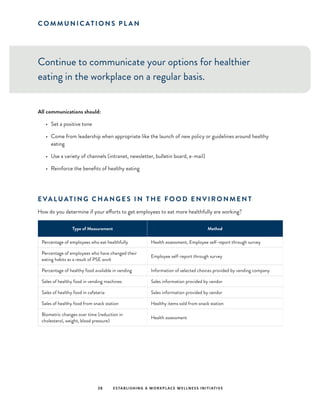
C O M M U N I C AT I O N S P L A N
Continue to communicate your options for healthier
eating in the workplace on a regular basis.
All communications should:
•	 Set a positive tone
•	 Come from leadership when appropriate like the launch of new policy or guidelines around healthy
eating
•	 Use a variety of channels (intranet, newsletter, bulletin board, e-mail)
•	 Reinforce the benefits of healthy eating
28 ESTABLISHING A WORKPLACE WELLNESS INITIATIVE
E VA LU AT I N G C H A N G E S I N T H E F O O D E N V I R O N M E N T
How do you determine if your efforts to get employees to eat more healthfully are working?
Type of Measurement Method
Percentage of employees who eat healthfully Health assessment, Employee self-report through survey
Percentage of employees who have changed their
eating habits as a result of PSE work
Employee self-report through survey
Percentage of healthy food available in vending Information of selected choices provided by vending company
Sales of healthy food in vending machines Sales information provided by vendor
Sales of healthy food in cafeteria Sales information provided by vendor
Sales of healthy food from snack station Healthy items sold from snack station
Biometric changes over time (reduction in
cholesterol, weight, blood pressure)
Health assessment
A TOOLKIT FOR MINNESOTA EMPLOYERS 29
BREASTFEEDING
Many Minnesota mothers work outside of the home.
By supporting breastfeeding in the workplace,
mothers reduce their risk of:
•	 Breast and ovarian cancer
•	 Type 2 diabetes
•	 Postpartum depression
And help babies reduce the risk of:
•	 Ear, skin, respiratory and stomach
infections
•	Diarrhea
•	SIDS
•	Obesity
•	 Type 1 and 2 diabetes
•	Asthma
•	Leukemia
Employers who provide lactation support can see a 3:1 return
on investment. In fact, $13 billion in direct health care costs
would be saved annually if 90 percent of women were able to
breastfeed for at least six months.7
In Minnesota, mothers are
encouraged to breastfeed for at least one year.
Providing accommodations for nursing mothers is the law both at the federal and state level. Workplaces must
provide time for moms to express milk and a private place that is not a bathroom stall. For more information
on state and federal laws, see the links below:
https://www.dol.gov/whd/nursingmothers/Sec7rFLSA_btnm.htm
https://www.revisor.mn.gov/statutes/?id=181.939
7
United States Breastfeeding Committee Workplace Accommodations to Support and Protect Breastfeeding
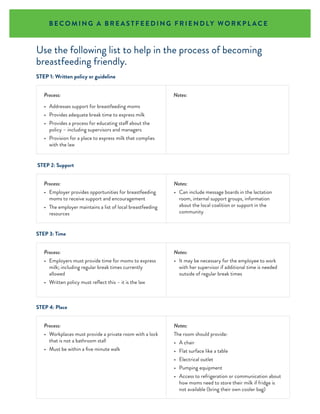
B E C O M I N G A B R E A S T F E E D I N G F R I E N D LY W O R K P L A C E
STEP 1: Written policy or guideline
Process:
•	 Addresses support for breastfeeding moms
•	 Provides adequate break time to express milk
•	 Provides a process for educating staff about the
policy – including supervisors and managers
•	 Provision for a place to express milk that complies
with the law
Notes:
Use the following list to help in the process of becoming
breastfeeding friendly.
STEP 2: Support
Process:
•	 Employer provides opportunities for breastfeeding
moms to receive support and encouragement
•	 The employer maintains a list of local breastfeeding
resources
Notes:
•	 Can include message boards in the lactation
room, internal support groups, information
about the local coalition or support in the
community
STEP 3: Time
Process:
•	 Employers must provide time for moms to express
milk; including regular break times currently
allowed
•	 Written policy must reflect this – it is the law
Notes:
•	 It may be necessary for the employee to work
with her supervisor if additional time is needed
outside of regular break times
STEP 4: Place
Process:
•	 Workplaces must provide a private room with a lock
that is not a bathroom stall
•	 Must be within a five minute walk
Notes:
The room should provide:
•	 A chair
•	 Flat surface like a table
•	 Electrical outlet
•	 Pumping equipment
•	 Access to refrigeration or communication about
how moms need to store their milk if fridge is
not available (bring their own cooler bag)
A TOOLKIT FOR MINNESOTA EMPLOYERS 31
Policy for supporting breastfeeding employees
S A M P L E B R E A S T F E E D I N G P O L I C Y
In recognition of the well documented health advantages of
breastfeeding for infants and mothers, _________________________
provides a supportive environment to enable breastfeeding
employees to express their milk during work hours.
This includes a company-wide lactation support program administered by ___________________________________.
_______________________________	subscribes to the following worksite support policy. This policy shall be
communicated to all current employees and included in new employee orientation training.
•	 Milk expression breaks. Breastfeeding employees
are allowed to breastfeed or express milk during
work hours using their normal breaks and meal
times. For time that may be needed beyond the
usual break times, employees may use personal leave
or may make up the time as negotiated with their
supervisors.
•	 A place to express milk. A private room (not a toilet
stall or restroom) shall be available for employees to
breastfeed or express milk. The room will be private
and sanitary, located near a sink with running water
for washing hands and rinsing out breast pump parts
and have an electrical outlet. If employees prefer,
they may also breastfeed or express milk in their
own private offices, or in other comfortable locations
agreed upon in consultation with the employee’s
supervisor. Expressed milk can be stored [in general
company refrigerators/in designated refrigerators
provided in the lactation room or other location/in
employee’s personal cooler].
•	 Breastfeeding equipment. _____________ [provides/
subsidizes/rents] electric breast pumps to assist
breastfeeding employees with milk expression during
work hours. The company provides [hospital
grade pump that can be used by more than one
employee/or portable personal use electric breast
pump that the employee retains] throughout the
course of breastfeeding for the employee. [If
using a standard hospital-grade pump, indicate
whether the company provides/subsidizes
personal attachment kit or where the employee
can purchase the kit.] [Indicate whether breast
pumps are also available for partners of male
employees.]
•	 Education. Prenatal and postpartum
breastfeeding classes and informational materials
are available for all mothers and fathers, as well
as their partners.
•	 Staff support. Supervisors are responsible for
alerting pregnant and breastfeeding employees
about the company’s worksite lactation
support program, and for negotiating policies
and practices that will help facilitate each
employees’ infant feeding goals. It is expected
that all employees will assist in providing a
positive atmosphere of support for breastfeeding
employees.
COMPANY RESPONSIBILITIES
Breastfeeding employees who choose to continue providing their milk for their infants after returning to work shall
receive:
S A M P L E B R E A S T F E E D I N G P O L I C Y (C O N T I N U E D )
EMPLOYEE RESPONSIBILITIES
•	 Communication with supervisors. Employees who
wish to express milk during the work period shall
keep supervisors informed of their needs so that
appropriate accommodations can be made to satisfy
the needs of both the employee and the company.
•	 Maintenance of milk expression areas. Breastfeeding
employees are responsible for keeping milk
expression areas clean, using anti-microbial wipes to
clean the pump and area around it. Employees are
also responsible for keeping the general lactation
room clean for the next user. This responsibility
extends to both designated milk expression areas, as
well as other areas where expressing milk will occur.
•	 Milk storage. Employees should label all milk
expressed with their name and date collected
so it is not inadvertently confused with another
employee’s milk. Each employee is responsible
for proper storage of her milk using [company
provided refrigerator/personal storage coolers].
•	 Use of break times to express milk. When more
than one breastfeeding employee needs to use
the designated lactation room, employees can use
the sign-in log provided in the room to negotiate
milk expression times that are most convenient or
best meet their needs.
BREASTFEEDING FRIENDLY WORKPLACE DESIGNATION
The Minnesota Department of Health
recognizes employers that follow best
practices in providing support for nursing
moms. The Breastfeeding Friendly Workplace
designation is given out twice per year.
Learn more about the designation at the Breastfeeding Friendly Designation website at
http://www.health.state.mn.us/breastfeedingfriendly
32 ESTABLISHING A WORKPLACE WELLNESS INITIATIVE
A TOOLKIT FOR MINNESOTA EMPLOYERS 33
C O M M U N I C AT I O N S P L A N
Once the policy and supports are in place it is important
to communicate your organization’s support for nursing
moms through a variety of different channels and through
management acknowledgment. Supervisors should be made
aware of the policy and the role they play in supporting
nursing moms. Providing policy information at new employee
orientation will also be a valuable introduction.
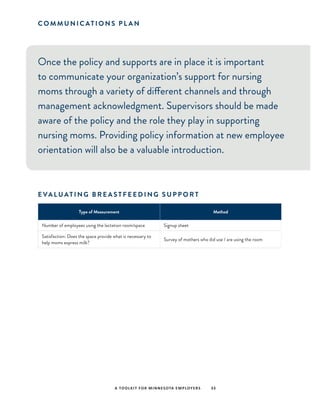
E VA LUAT I N G B R E A S T F E E D I N G S U P P O R T
Type of Measurement Method
Number of employees using the lactation room/space Signup sheet
Satisfaction: Does the space provide what is necessary to
help moms express milk?
Survey of mothers who did use / are using the room
STRESS MANAGEMENT
Stress management refers to the comprehensive way people meet the demands of life. It’s a
key component in overall health and well-being. Mental health issues such as stress, anxiety and
depression are common, and are routinely listed as top concerns in employee health surveys.
34 ESTABLISHING A WORKPLACE WELLNESS INITIATIVE
8
http://www.who.int/occupational_health/publications/pwh3rev.pdf
9
http://www.who.int/occupational_health/publications/pwh3rev.pdf
Workplace stress is recognized worldwide
as a challenge to workers’ health and
happiness. Workers who are stressed
are more likely to be unhealthy, poorly
motivated and less productive at work.8
When the healthy choice is available, people are more likely to feel better. Workplaces can play a role in
supporting employees by making it easier for employees to seek resources and receive mental health referral
and treatment. Employers may also benefit from looking at the organizational culture and learn about what
impacts employees’ stress level.
The World Health Organization states “Stress results from
a mismatch between the demands and pressures on the
person and their knowledge and skill set.” 9
A TOOLKIT FOR MINNESOTA EMPLOYERS 35
FA M I LY H E A LT H
Families play an important role in the health of employees. No matter their family make-up, employers can
help show support of family health. Parenting concerns shift at every age of childhood. By providing resources
to help parents understand these changes and teaching them the skills to deal with change, they will be able to
worry less at work.
Health experts agree that there are many practices that can help all families be healthy, and most of them are
free. The benefits, however, are priceless.
Family health commitment opportunities include:
•	 Spend time together
•	 Eat meals together
•	 Be active together
•	 Practice positive parenting
Mental wellness—taking care of aging parents
Many Minnesotans are all too familiar with the term
“sandwich generation”—caring for their children and
assisting their aging parents at the same time. This
type of stress-building situation can result in reduced
productivity at work.
F I N A N C I A L H E A LT H
Help employees take charge of their financial health and in turn, help them reduce stress and anxiety. Like
many things in life, successful finances start with a plan.
S T R AT E G I E S
The worksheet and policy example on the next page can be used as best practices framework for developing
sustainable changes in issues related to stress in the workplace. Questions to consider include:
•	 What policy changes would need to be addressed or added?
•	 What system changes need to be addressed?
•	 What issues within your work environment needs to be added or revised?
•	 What are the steps to accomplish the PSE change?
•	 What is the timeline and who is responsible for following through?
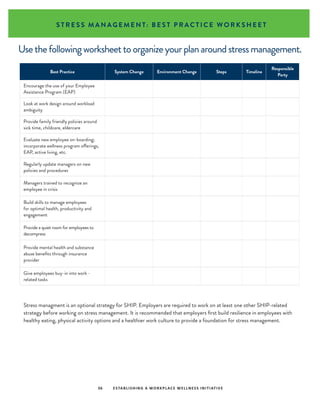
S T R E S S M A N A G E M E N T: B E S T P R A C T I C E W O R K S H E E T
Usethefollowingworksheettoorganizeyourplanaroundstressmanagement.
Best Practice System Change Environment Change Steps Timeline
Responsible
Party
Encourage the use of your Employee
Assistance Program (EAP)
Look at work design around workload
ambiguity
Provide family friendly policies around
sick time, childcare, eldercare
Evaluate new employee on-boarding;
incorporate wellness program offerings,
EAP, active living, etc.
Regularly update managers on new
policies and procedures
Managers trained to recognize an
employee in crisis
Build skills to manage employees
for optimal health, productivity and
engagement
Provide a quiet room for employees to
decompress
Provide mental health and substance
abuse benefits through insurance
provider
Give employees buy-in into work -
related tasks
Stress managment is an optional strategy for SHIP. Employers are required to work on at least one other SHIP-related
strategy before working on stress management. It is recommended that employers first build resilience in employees with
healthy eating, physical activity options and a healthier work culture to provide a foundation for stress management.
36 ESTABLISHING A WORKPLACE WELLNESS INITIATIVE
A TOOLKIT FOR MINNESOTA EMPLOYERS 37
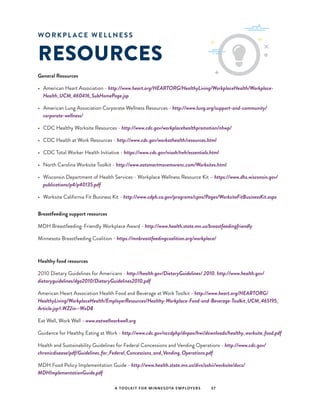
W O R K P L A C E W E L L N E S S
RESOURCES
General Resources
•	 American Heart Association - http://www.heart.org/HEARTORG/HealthyLiving/WorkplaceHealth/Workplace-
Health_UCM_460416_SubHomePage.jsp
•	 American Lung Association Corporate Wellness Resources - http://www.lung.org/support-and-community/
corporate-wellness/
•	 CDC Healthy Worksite Resources - http://www.cdc.gov/workplacehealthpromotion/nhwp/
•	 CDC Health at Work Resources - http://www.cdc.gov/workathealth/resources.html
•	 CDC Total Worker Health Initiative - https://www.cdc.gov/niosh/twh/essentials.html
•	 North Carolina Worksite Toolkit - http://www.eatsmartmovemorenc.com/Worksites.html
•	 Wisconsin Department of Health Services - Workplace Wellness Resource Kit – https://www.dhs.wisconsin.gov/
publications/p4/p40135.pdf
•	 Worksite California Fit Business Kit - http://www.cdph.ca.gov/programs/cpns/Pages/WorksiteFitBusinessKit.aspx
Breastfeeding support resources
MDH Breastfeeding-Friendly Workplace Award - http://www.health.state.mn.us/breastfeedingfriendly
Minnesota Breastfeeding Coalition - https://mnbreastfeedingcoalition.org/workplace/
Healthy food resources
2010 Dietary Guidelines for Americans - http://health.gov/DietaryGuidelines/ 2010. http://www.health.gov/
dietaryguidelines/dga2010/DietaryGuidelines2010.pdf
American Heart Association Health Food and Beverage at Work Toolkit - http://www.heart.org/HEARTORG/
HealthyLiving/WorkplaceHealth/EmployerResources/Healthy-Workplace-Food-and-Beverage-Toolkit_UCM_465195_
Article.jsp#.WZ2in--WxD8
Eat Well, Work Well - www.eatwellworkwell.org
Guidance for Healthy Eating at Work - http://www.cdc.gov/nccdphp/dnpao/hwi/downloads/healthy_worksite_food.pdf
Health and Sustainability Guidelines for Federal Concessions and Vending Operations - http://www.cdc.gov/
chronicdisease/pdf/Guidelines_for_Federal_Concessions_and_Vending_Operations.pdf
MDH Food Policy Implementation Guide - http://www.health.state.mn.us/divs/oshii/worksite/docs/
MDHImplementationGuide.pdf
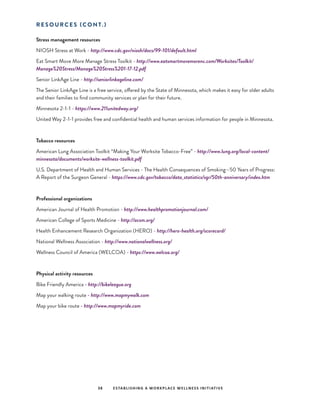
18 ESTABLISHING A WORKPLACE WELLNESS INITIATIVE
Stress management resources
NIOSH Stress at Work - http://www.cdc.gov/niosh/docs/99-101/default.html
Eat Smart Move More Manage Stress Toolkit - http://www.eatsmartmovemorenc.com/Worksites/Toolkit/
Manage%20Stress/Manage%20Stress%201-17-12.pdf
Senior LinkAge Line - http://seniorlinkageline.com/
The Senior LinkAge Line is a free service, offered by the State of Minnesota, which makes it easy for older adults
and their families to find community services or plan for their future.
Minnesota 2-1-1 - https://www.211unitedway.org/
United Way 2-1-1 provides free and confidential health and human services information for people in Minnesota.
Tobacco resources
American Lung Association Toolkit “Making Your Worksite Tobacco-Free” - http://www.lung.org/local-content/
minnesota/documents/worksite-wellness-toolkit.pdf
U.S. Department of Health and Human Services - The Health Consequences of Smoking—50 Years of Progress:
A Report of the Surgeon General - https://www.cdc.gov/tobacco/data_statistics/sgr/50th-anniversary/index.htm
Professional organizations
American Journal of Health Promotion - http://www.healthpromotionjournal.com/
American College of Sports Medicine - http://acsm.org/
Health Enhancement Research Organization (HERO) - http://hero-health.org/scorecard/
National Wellness Association - http://www.nationalwellness.org/
Wellness Council of America (WELCOA) - https://www.welcoa.org/
Physical activity resources
Bike Friendly America - http://bikeleague.org
Map your walking route - http://www.mapmywalk.com
Map your bike route - http://www.mapmyride.com
R E S O U R C E S (C O N T.)
38 ESTABLISHING A WORKPLACE WELLNESS INITIATIVE
A D D I T I O N A L
NOTES
A TOOLKIT FOR MINNESOTA EMPLOYERS 39
ACKNOWLEDGMENTS
This toolkit was developed
with resources from:
•	 PartnerSHIP 4 Health
•	 CDC Workplace Health Resource Center
•	 American Lung Association’s Making Your Worksite
Tobacco Free
•	 The Wellness Council of America
•	 Minnesota Department of Health, Office of
Statewide Health Improvement Initiatives
health.state.mn.us/ship

Workplace-Wellness-Workbook.pdf

  • 1.
  • 2.
    W H Y WORKPLACE WELLNESS? 2ESTABLISHING A WORKPLACE WELLNESS INITIATIVE Seventy-seven percent of the U.S. population is in the workforce.1 Because the majority of adults spend nearly half of their waking hours at work, the work environment has a significant potential to influence health. 1 U.S. Census Bureau, American Community Survey Public Use Microdata Sample (PUMS) single-year estimates. http://factfinder.census.gov/faces/tableservices/jsf/pages/productview.xhtml?pid=ACS_13_1YR_S2301&prodType=table
  • 3.
    A well-designed workplacewellness initiative offers an organizational structure and physical environment that supports employee health and encourages positive lifestyle behaviors. Some benefits to employers in offering a comprehensive workplace wellness initiative include: A B O U T W O R K P L A C E W E L L N E S S I N M I N N E S O TA Workplaces in communities across Minnesota have joined together through the Statewide Health Improvement Partnership (SHIP) to establish workplace wellness initiatives. This toolkit will guide you through the process of developing, implementing and evaluating a comprehensive worksite wellness initiative. • Decreased absenteeism, employee turnover and health care costs • Improved productivity • Improved time and stress management for employees • Increased employee recruitment and retention • Bolstered employee morale and commitment to the company by showing management cares about their well-being • Enhanced organizational image, which helps make you an employer of choice A TOOLKIT FOR MINNESOTA EMPLOYERS 3
  • 4.
    W H AT’S I N S I D E TABLE OF CONTENTS 4 ESTABLISHING A WORKPLACE WELLNESS INITIATIVE CREATING A CULTURE OF HEALTH . . . . . . . . . . . . . . . . . . . . . page 6 OVERVIEW . . . . . . . . . . . . . . . . . . . . . . . . . . . . . . . . . . . . . . . . . page 8 STEPS TO A SUSTAINABLE PROGRAM Step 1: Secure Leadership Support . . . . . . . . . . . . . . . . . . . . . . . . . . . . page 9 Step 2: Convene a Wellness Committee . . . . . . . . . . . . . . . . . . . . . . . .page 10 Step 3: Develop a Vision and a Brand . . . . . . . . . . . . . . . . . . . . . . . . . . page 11 Step 4: Conduct Assessments / Collect Data . . . . . . . . . . . . . . . . . . . . . page 12 Step 5: Develop and Implement the Plan . . . . . . . . . . . . . . . . . . . . . . . page 14 Action Plan Worksheet . . . . . . . . . . . . . . . . . . . . . . . . . . . . . . . . . page 15 Step 6: Evaluation . . . . . . . . . . . . . . . . . . . . . . . . . . . . . . . . . . . . page 17 STRATEGIES TO SUPPORT HEALTHIER EMPLOYEES . . . . . . . page 18 TOBACCO USE . . . . . . . . . . . . . . . . . . . . . . . . . . . . . . . . . . . page 19 PHYSICAL ACTIVIT Y . . . . . . . . . . . . . . . . . . . . . . . . . . . . . page 20 Physical Activity: Best Practice Worksheet . . . . . . . . . . . . . . . . . . . . page 21 Sample Physical Activity Policy . . . . . . . . . . . . . . . . . . . . . . . . . . .page 22 Potential Liability Issues . . . . . . . . . . . . . . . . . . . . . . . . . . . . . . .page 23 Communications Plan . . . . . . . . . . . . . . . . . . . . . . . . . . . . . . . . page 24 NUTRITION . . . . . . . . . . . . . . . . . . . . . . . . . . . . . . . . . . . . . page 25 Nutrition: Best Practice Worksheet . . . . . . . . . . . . . . . . . . . . . . . . page 26 Sample Nutrition Policy . . . . . . . . . . . . . . . . . . . . . . . . . . . . . . .page 27 Communications Plan . . . . . . . . . . . . . . . . . . . . . . . . . . . . . . . .page 28
  • 5.
    A TOOLKIT FORMINNESOTA EMPLOYERS 5 BREASTFEEDING . . . . . . . . . . . . . . . . . . . . . . . . . . . . . . . . .page 29 Becoming a Breastfeeding Friendly Workplace . . . . . . . . . . . . . . . . . page 30 Sample Breastfeeding Policy . . . . . . . . . . . . . . . . . . . . . . . . . . . . page 31 Communications Plan . . . . . . . . . . . . . . . . . . . . . . . . . . . . . . . page 33 STRESS MANAGEMENT . . . . . . . . . . . . . . . . . . . . . . . . . . . page 34 Family Health . . . . . . . . . . . . . . . . . . . . . . . . . . . . . . . . . . . page 35 Financial Health . . . . . . . . . . . . . . . . . . . . . . . . . . . . . . . . . . page 35 Strategies . . . . . . . . . . . . . . . . . . . . . . . . . . . . . . . . . . . . . . page 35 Stress Management: Best Practice Worksheet . . . . . . . . . . . . . . . . page 36 WORKPL ACE WELLNESS RESOURCES . . . . . . . . . . . . . . . . . . .page 37 ACKNOWLEDGMENTS . . . . . . . . . . . . . . . . . . . . . . . . . . . . . . . .page 39 NOTES . . . . . . . . . . . . . . . . . . . . . . . . . . . . . . . . . . . . . . . . . . . . .page 39
  • 6.
    C R EAT I N G A CULTURE OF HEALTH T H E E N G I N E B E H I N D S U S TA I N A B L E B E H AV I O R C H A N G E The Statewide Health Improvement Partnership (SHIP) focuses on policy, systems and environmental (PSE) changes. If workplace wellness efforts focus on PSE changes, they will provide the foundation that helps a workplace create a culture of health. A culture of health is one in which individuals and their organizations are able to make healthy life choices within a larger social environment that values, provides and promotes options that are capable of producing health and well-being for everyone regardless of background or environment.2 Here are a few examples: • Policy change: Employer adopts a tobacco- free grounds policy, which greatly influences tobacco users to make a quit attempt and protects others from secondhand smoke. • Systems change: Employer begins to offer annual health assessment to employees, allowing employees to get a baseline on their personal health and reaffirm or make healthy lifestyle changes. Aggregate health data becomes available so that an effective health promotion program can be designed with specific employee needs in mind. • Environmental change: Employer makes refrigeration available so fruits and vegetables can be properly stored and easily accessible to employees, or the employer includes healthy choices in vending machines that meet certain nutritional standards. This allows for increased support and opportunities for improved nutrition in the workplace. 2 Robert Wood Johnson Foundation. RWJF’s model for advancing a culture of health. Available at http://www.rwjf.org/en/blogs/culture-of-health/2013/05/about culture ofhea.html 6 ESTABLISHING A WORKPLACE WELLNESS INITIATIVE
  • 7.
    A TOOLKIT FORMINNESOTA EMPLOYERS 7 Individual responsibility serves an important role in one’s health status. Even more important is how our community supports or does not support healthy decisions by individuals. For example: an employee can choose to ride a bike to work each day but does the environment itself support an active commute? Are there bike lanes or bike paths that are adequately marked and connected to key points in the community? Are there bike racks available for employees to lock their bikes up when they are at work? This toolkit will recommend best practice strategies. Implementing strategies that support making healthy choices possible will affect all employees and lay the foundation for a sustainable, comprehensive workplace initiative.
  • 8.
    OVERVIEW Workplace wellness promotesan environment that supports healthy lifestyles for employees and their families through systems and environmental changes. 1. S E C U R E L E A D E R S H I P S U P P O R T This step is critical to the success of any wellness program. Getting management actively involved in the program will help to model healthy behavior to all employees. 2. C O N V E N E A W E L L N E S S C O M M I T T E E Creating a culture of wellness should involve employees throughout the organization. Gather a diverse group of employees to become wellness “champions.” Having a team will show the organization’s commitment to wellness. Let the creativity flow. This list of startup and sustainability practices can help employers build a sustainable program that can have an impact on all employees. 3. D E V E L O P A V I S I O N A N D B R A N D Developing a vision and brand for the program shows a commitment by leadership and the committee toward employee health. 4. C O N D U C T A S S E S S M E N T S This is crucial. It will help justify the program, evaluate changes in productivity and health status, determine what employees want from the worksite wellness program and monitor wellness participation. If done well, assessments help ensure the sustainability of your wellness program. 5. D E V E L O P A N D I M P L E M E N T YO U R P L A N The operating plan is the foundation of the program. Be sure to add timelines, budgets, work assignments, marketing, evaluation and the overall mission of the program. Clearly stated and measurable goals will keep the program on track. 6. E VA L UAT E After implementing a wellness program, take time to evaluate participation, satisfaction levels, behavior changes, biometric changes, productivity and return on investment. A well- documented evaluation can help identify areas for improvement or justify a budget increase. Sample tools and evaluations are available in this section. 8 ESTABLISHING A WORKPLACE WELLNESS INITIATIVE
  • 9.
    STEP ONE: A TOOLKITFOR MINNESOTA EMPLOYERS 9 S E C U R E L E A D E R S H I P S U P P O R T Get the program off to a good start by helping management realize the benefits of worksite wellness and ask them to vocalize their support. 1 Secure Leadership Support Convene Wellness Committee Develop Vision and Brand Conduct Assessments Develop and Implement Program Evaluate T O P M A N A G E M E N T S U P P O R T: • Helps obtain support for your worksite wellness initiative. • Communicates the importance of worksite wellness. • Sets an example. A top manager doesn’t need to run a marathon, but he or she should embrace a healthful lifestyle by completing an annual health assessment, receiving an annual physical, participating in wellness events offered by the company and taking part in community wellness events. An owner or manager can also be appointed to serve on the wellness team alongside other employees so there is ownership at every level of the organization.
  • 10.
    STEP TWO: C ON V E N E A W E L L N E S S C O M M I T T E E Form a strong worksite wellness team and keep team involvement fresh and fun. 2 Secure Leadership Support Convene Wellness Committee Develop Vision and Brand Conduct Assessments Develop and Implement Program Evaluate 10 ESTABLISHING A WORKPLACE WELLNESS INITIATIVE Make it official by creating a team name, motto and logo. Consider having an annual team retreat or team in-service to plan for the next year. Continue to bring new members onto the team as well as consider term limits. • Have worksite wellness written into team members’ job descriptions. This will ensure worksite wellness is a defined duty in their workload. • Promote the wellness team throughout the organization. Doing so helps employees see that worksite wellness is a priority and the team is there to help with their wellness goals. It also inspires participation and team involvement. • Develop a team with strong leadership. The team will need vision, energy, a spirit of inclusiveness and a genuine desire to help others. The team leader should be someone who can create agendas, handle conflict, set priorities, motivate others, meet goals and deadlines and communicate throughout the organization. • Add diversity to the team. Try to include representation from all different functional areas, experience levels, ages and fitness levels. • Meet regularly. Face-to-face meetings once or twice a month are best. • Communicate often. Educate the organization on the wellness team’s priorities and let others know how to get involved; it helps employees embrace the wellness program. • Participate in continuing education about wellness. These tips from the Wellness Council of America will ensure a successful team:
  • 11.
    A TOOLKIT FORMINNESOTA EMPLOYERS 11 D E V E L O P V I S I O N A N D B R A N D • Work with the wellness committee to develop a vision for the wellness program. The wellness program vision statement should complement the organization’s mission statement. It can be as short as two sentences. • The vision and brand should be used in any communication materials the committee sends to employees to help convey that the information is coming from the wellness committee and is a part of the organization’s wellness program. 3 Secure Leadership Support Convene Wellness Committee Develop Vision and Brand Conduct Assessments Develop and Implement Program Evaluate STEP THREE: V I S I O N S TAT E M E N T S : Here’s a way to make your program stand out. Arvig: Our Wellbeing vision is to have the happiest and healthiest employees anywhere Vector Windows: A workplace that is helping build a better you. V I S U A L E X A M P L E S :
  • 12.
    STEP FOUR: C ON D U C T A S S E S S M E N T S /C O L L E C T D ATA This step will help the wellness committee plan the program and determine where to allocate resources. 4 Look at information on the overall picture of the organization in regard to health and wellness, employee interests and, if possible, the overall health of the employees. Here are some possible data collection methods: CDC Worksite ScoreCard – Organizational data The ScoreCard consists of 16 different topic areas and is designed to give an overall picture of how workplace wellness efforts are progressing. It includes questions based on many key evidence-based and best-practice strategies and interventions that are part of a comprehensive workplace health approach specific to topic areas. The questions are scored based on the level of impact the strategy has on the intended health behavior outcomes and the strength of the scientific evidence supporting the impact. STEP 1: Log on to http://www.cdc.gov/healthscorecard • Select the “Worksite Health ScoreCard” link in the black box • Select the “New User” button • Select the “Get Started” button • Select “No I do not have an employer ID” button and press “continue” Creating your ScoreCard account STEP 2: Answer “Yes” to register a new employer When listing your employer name add SHIP at the end. For example, “ABC Company SHIP” • Complete the employer profile • Add an employer administrator(s) from your workplace • Add your local public health representative as an account administrator • After you register select the “Register Employer” button. A pop up window will confirm the account has been set up. The account log in will be displayed on this window and an auto generated e-mail will be sent to the account administrators with your log in credentials. STEP 3: Add your worksite • Select the “Register a New Worksite” button to add your worksite to your account from the employer dashboard. (You must do this step before you are able to fill out the ScoreCard.)
  • 13.
    A TOOLKIT FORMINNESOTA EMPLOYERS 13 Secure Leadership Support Convene Wellness Committee Develop Vision and Brand Conduct Assessments Develop and Implement Program Evaluate A D D I T I O N A L D ATA R E S O U R C E S Medical claims analysis Larger companies may be able to request a medical claims analysis from their health insurance carrier, their insurance broker or a third-party administrator. Although this data may be more difficult to obtain, it includes important information on health care claims, workers’ compensation, disability claims and pharmaceutical costs. Health screenings Employers may choose to provide health screenings in addition to the HA in order to allow employees to fill out the assessment with the most accurate information. Community partners like local public health or clinics and hospitals may provide screenings such as height and weight, blood pressure, blood values and other testing. There is usually a cost to doing the health screening. Employee interest survey Assess employees and managers by conducting an employee interest survey. It is important to ask employees what they would like to see in their wellness program, what are the best ways to communicate program information and what they view as valuable. Surveys should be collected anonymously. It is important to instruct employees not to put their name on the survey and make sure someone other than a supervisor collects the surveys once they are completed. Health Assessment – Individual data in aggregate form A health assessment (HA), which gives specifics on what health issues employees face, requires an investment. The cost to provide one will vary by vendor. The HA provides information that can help: • Identify risk factors for individuals • Provide personalized feedback • Connect employees with at least one strategy to promote health and/or prevent disease • Help measure risk factors and biometric changes annually • Provide the employer with aggregate reporting to help understand overall health risks and strengths. When implementing an employee HA, procedures should be established to protect the privacy of employees. Employers should never be responsible for collecting and viewing individual data. Health assessments should be purchased from a reputable vendor. Employees’ responses are anonymous and are protected by federal privacy laws. Employers will see the data in aggregate form only. Some insurance carriers offer health assessments to their members. Confidentiality is paramount when using this data, which should be reported only in aggregate form.
  • 14.
    STEP FIVE : DE V E L O P A N D I M P L E M E N T T H E P R O G R A M After the data has been collected, it’s time to develop a plan. 5 Secure Leadership Support Convene Wellness Committee Develop Vision and Brand Conduct Assessments Develop and Implement Program Evaluate 14 ESTABLISHING A WORKPLACE WELLNESS INITIATIVE One of the biggest mistakes employers make when starting a workplace wellness program is not taking the time to thoughtfully plan what they are going to do. Collecting the information listed in Step 4 will help guide the planning phase by informing the committee both the needs and the wants of the employees. Here is what should be included in the plan: • An itemized budget • Marketing and communication strategies – How will employees know what is happening? • Evaluation – What is and is not working? Once the plan is created, it is important to show leadership and get approval before implementation. The plan lets leadership know resources are being allocated appropriately and there is a plan to evaluate wellness program progress. Keeping leadership informed at all times is important to continue to receive leadership support. See next page for Action Plan Worksheet. • The wellness program vision and brand • Goals and objectives of the wellness program. Both long term (3 years) and short term (1 year) • Timelines of what needs to be accomplished roles and responsibilities – Who is going to do what?
  • 15.
    A C TI O N P L A N W O R K S H E E T B U S I N E S S N A M E : D AT E : GOAL: What do we want to accomplish? Example: Offer healthy food and beverages at all staff functions. 1. 2. 3. 4. ACTION STEPS: What activities need to happen? Example: a) Discuss at wellness committee level b) Get buy-in from leadership c) Provide list of what constitutes healthy to responsible staff 1a. 1b. 2a. 2b. 3a. 3b. 4a. 4b. A TOOLKIT FOR MINNESOTA EMPLOYERS 15
  • 16.
    A C TI O N P L A N W O R K S H E E T (C O N T I N U E D ) MEASUREMENT: How is progress measured? Example: Taste tests. Survey staff to find out healthy preferences before and after. STAKEHOLDERS: Who will be involved and/or impacted? Example: Staff LEAD PERSON: Who will lead each goal? Example: Wellness Coordinator, Manager, Wellness Champion TIMELINE: List start dates for goals. 1. 2. 3. 4. COMPLETE? “Yes” when done GOAL 1 GOAL 2 GOAL 3 GOAL 4 16 ESTABLISHING A WORKPLACE WELLNESS INITIATIVE
  • 17.
    STEP SIX: A TOOLKITFOR MINNESOTA EMPLOYERS 17 6 Secure Leadership Support Convene Wellness Committee Develop Vision and Brand Conduct Assessments Develop and Implement Program Evaluate E VA LUAT E Evaluation helps track progress, determines what is most effective for wellness programming and helps secure continued funding from leadership. Here are some elements that should be measured: • Physical environment and corporate culture. • Productivity – Review absenteeism, turnover and morale statistics. • Return on Investment – This is a challenging measurement that may require some help. It can include a change in health care costs, workers’ compensation, disability claims, absenteeism, productivity and other measures important to the organization. Looking at the culture, along with return on investment, can show the value on investment of the wellness initiative. Many organizations are realizing that cultural changes can affect softer measures, such as productivity, absenteeism, employee retention and job satisfaction. • Participation – Include returning and new participants. Are efforts reaching all or a few employees? Are they reaching the intended audience? • Participant satisfaction – This can be done in the employee needs assessment survey and after each initiative. This can inform the committee if employees feel good about the initiative and the messages that are being communicated. • Changes in knowledge, attitudes and behaviors – Show that employees are learning about health and making healthier choices. • Risk reduction – Through the health assessment, learn the risk factors affecting employees, and help identify the percentage of employees at high, medium and low risk for a variety of risk factors, such as nutrition, physical activity, self-care, weight management, tobacco use, etc. The goal is to see a positive change in risk factors. Measuring risks may not always be possible depending on budget.
  • 18.
    S T RAT E G I E S T O SUPPORT HEALTHIER EMPLOYEES 18 ESTABLISHING A WORKPLACE WELLNESS INITIATIVE Companies can help employees be healthier by making changes that help workers reduce commercial tobacco use and increase access to and opportunities for physical activity and healthy eating at work.
  • 19.
    TOBACCO USE The negativehealth effects of tobacco use are well known. Smoking is the leading cause of preventable U.S. deaths each year and the associated diseases and health care costs are significant. In fact, 480,000 Americans and 5,900 Minnesotans die each year as a result of smoking and exposure to secondhand smoke.3 Smokers incur more medical costs, see physicians more often and are admitted to hospitals for longer periods than non-smokers. In Minnesota, $3.2 billion per year is spent on healthcare costs. Smokers miss 2.6 more days than non-smoking peers. The average smoker takes two 15 minute smoke breaks per day in excess of regular break time. Healthcare expenses of a smoker can be eight percent higher than for a non-smoker.4 In addition to direct health affects to tobacco users, other employees are affected by secondhand and third hand smoke. Committing to a tobacco free workplace/grounds and promoting cessation will help all employees be healthier. Tobacco cessation best practices • Create policy prohibiting tobacco use anywhere on the property and in company vehicles, including the use of e-cigarettes. • Provide prompts/posters to support a tobacco- free policy, including signs indicating this is a tobacco-free workplace. • Provide counseling through an individual, group or telephone program, including a program on-site and programs provided through an insurance provider. • Promote cessation tools like over-the-counter and prescription medication available to employees through your insurance provider. The American Lung Association has published Making Your Worksite Tobacco-Free, a free, step-by-step guide to making your workplace tobacco free. A TOOLKIT FOR MINNESOTA EMPLOYERS 19 3 US Department of Health and Human Services (2014) The Health Consequences of Smoking – 50 Years of Progress Campaign for Tobacco-Free Kids (2015) The Toll of Tobacco in Minnesota 4 “ Making Your Worksite Tobacco Free,” American Lung Association. Available at http://www.lung.org/local-content/minnesota/documents/worksite-wellness-toolkit.pdf
  • 20.
    PHYSICAL ACTIVITY The benefits ofregular physical activity are numerous, yet the majority of Americans don’t get the recommended 150 minutes of moderate activity per week. In Minnesota, nearly one-third of adults do not get enough activity per week to meet the recommendations.5 The good news is regardless of its size, setting and location, the workplace can help employees be active. When employers provide support for employees to be active, employees are more likely to incorporate activity into their workday. In fact, many employers believe creating a culture that encourages physical activity can help recruit and retain employees and have a wide range of benefits. Research has shown that employees who get at least 75 minutes of vigorous activity per week miss an average of 4.1 fewer days of work per year.6 20 ESTABLISHING A WORKPLACE WELLNESS INITIATIVE 5 CDC physical activity recommendation as measured in the Minnesota Physical Activity Survey 2007. *Recommendation: a minimum of 150 minutes of moderate activity per week OR a minimum of 75 minutes of vigorous activity per week OR a combination of the two where vigorous minutes count double toward the 150 minute requirement. Spreading activity over several days per week is encouraged but not required. 6 Goetzel, R. Z. et al. Ten modifiable health risk factors are linked to more than one-fifth of employer-employee health care spending. Health Aff. (Millwood) 31, 2474–2484 (2012). The table and policy example on the next page can be used as a framework for developing sustainable changes in the physical environment. Here are questions to consider: • What policy changes need to be addressed or added? • What system changes need to be addressed? • What issues within the work environment need to be added or revised? • What are the steps to accomplish the PSE change? • What is the timeline and who is responsible for following through?
  • 21.
    A TOOLKIT FORMINNESOTA EMPLOYERS 21 P H Y S I C A L A C T I V I T Y: B E S T P R A C T I C E W O R K S H E E T This worksheet will organize your physical activity plan. Strategy System Change Environment Change Steps Timeline Responsible Party Offer breaks and flexible work hours to allow for physical activity during the day Start walking incentive at your worksite Post motivational signs near elevators and stairwells Map out trails or walking routes Provide bicycle racks in safe, convenient, and accessible areas Start employee activity clubs Provide shower and/or changing facilities Provide outdoor exercise areas such as fields and trails Provide an on-site exercise facility Allow for walking meetings Provide on-site gardening Employer provided bike share initiative Adopt a flexible employee dress code to allow employees to feel comfortable walking or biking during breaks Negotiate a discount for employees at a local fitness center Promote physical activity opportunities in the community (local races and events)
  • 22.
    22 ESTABLISHING AWORKPLACE WELLNESS INITIATIVE Policy: Workday Flexibility: Promotion of Physical Activity Purpose: To provide a work environment that promotes and is supportive of physical activity. General Information ____________________________ recognizes the benefits of regular exercise for its employees and the organization as a whole. Physical activity is essential for good health and contributes to individual positive well-being. The workplace is an important setting in which employees can increase their levels of physical activity to benefit their health and protect against illness. This is particularly important for employees holding sedentary positions. As a way to encourage overall health and physical fitness, __________________ will permit, to the extent possible, its employees with workday flexibility to encourage physical exercise. Activities and events sponsored or supported by __________________ can include opportunities for physical activity by: S A M P L E P H Y S I C A L A C T I V I T Y P O L I C Y • Building physical activity breaks into meetings, conferences and events such as stretch-breaks, icebreakers or other activities. • Identifying physical activity opportunities such as maps with walking routes and local attractions; recreational and exercise facilities; organizing walking groups and other group activities. Guidelines for Workday Flexibility Working with their department management, employees may be permitted to adjust their workday in order to engage in health promotion activities such as physical activity during the day, yet maintain their expected number of work hours. Staffing and work demands are very different among departments. The extent of workday flexibility for exercise may not be appropriate for all departments and employees. Therefore, the employee and department director must mutually agree to the individualized flexible workday plan. Factors that need to be considered when evaluating the feasibility of a flexible workday plan include appropriate office/department coverage, minimum staffing levels, vacations, sick leave, other unplanned absences and peak workloads. Department directors are encouraged to support flexible work schedules to the extent possible; however, providing flexibility in the work day should not disrupt the normal workflow of the department. Failure of the employee to adhere to these guidelines may cause the employee to lose the opportunity to participate in a flexible work schedule. • Supporting schedules to allow physical activity including workday flexibility when possible. • Providing encouragement from leadership to engage in physical activity throughout the day.
  • 23.
    A TOOLKIT FORMINNESOTA EMPLOYERS 23 P O T E N T I A L L I A B I L I T Y I S S U E S Response from Public Health Law Center Employers may face potential liabilitiy issues if employees are injured while participating in employee wellness activities (such as walking in a neighborhood near the worksite during paid breaks, or riding employer-owned bicycles to off-site meetings). Potential liability may arise through a claim for workers compensation or personal injury. Employer liability for a workers compensation claim is limited because of an exception in the Minnesota law for voluntary wellness activities. Employer liability for a personal injury claim is also limited because workers compensation is the only remedy available for an employee who is injured in a situation “arising out of or in the course of employment” and because of the high standard that an employee would have to meet to prove a personal injury claim. For example, an employee is not required to prove that the employer was negligent under workers compensation, but would have to prove the employer’s negligence in a personal injury case. Although the likelihood of employer liability under either workers compensation or personal injury is small, the outcome of any claim will depend on the specific facts of the situation. An employer who is considering adopting a wellness program should have its attorney review the specifics of the program for liability and other legal issues. A Minnesota employer must pay workers compensation benefits when a personal injury or death of an employee arises out of or in the course of employment. However, the law creates a specific exception for employee wellness programs. That section states: Injuries incurred while participating in voluntary recreational programs sponsored by the employer, including health promotion programs, athletic events, parties and picnics, do not arise out of and in the course of the employment even though the employer pays some or all of the cost of the program. This exclusion does not apply in the event that the injured employee was ordered or assigned by the employer to participate in the program. Minnesota Statute 176.021, subdivision 9. Therefore, as long as participation in the wellness program is voluntary, the employer will not be required to pay workers compensation benefits, for example, to an employee who is injured while taking a walk through the neighborhood during a paid break. Even if the employer provides a map of the area showing a suggested route, it is unlikely that the employer would be liable if an employee were injured. The result might be different, however, if an employee is injured while taking a “walking meeting.” In that situation, it would be more likely that the injury occurred in the course of employment. If an employee is injured while riding an employer-owned bicycle to an off-site meeting instead of driving, the employer may have workers compensation liability because the employee is riding the bike in the course of his or her employment. The employee is traveling to the off-site meeting for the employer’s benefit, not the employee’s benefit. The fact that the employee had the choice to drive his or her own car and chose to use the employer’s bicycle should not make a difference. If the employer makes the bicycles available for employees to ride as part of the wellness program unrelated to any employment duties, any injuries that occur would be exempt from workers comp coverage. However, the employer could be liable for personal injury if it made bicycles available to its employees that it knew to be defective and an employee were injured in an accident because of the defect. Equipment Use If using the treadmill at work is a voluntary wellness activity that an employee does on their own break time then liability is not assumed by the employer. If it’s a required function of their job then it’s different. There are also other things the employer could do to minimize any potential liability. The following information is from the bike share document from the Public Health Law Center. If employers got in the habit of doing the last three around any equipment used it would greatly reduce any risk. Q: How can the owner or operator of a bike share program limit its liability? A: There are numerous ways that the owner or operator of a bike share program can limit its liability, including: • Purchasing insurance • Requiring users of the program to sign waivers releasing the program from liability for injuries • Keeping the bikes well maintained • Educating users about use of the bike • Providing safety training The Public Health Law Center provides information and technical assistance on issues related to tobacco, obesity and public health. The Public Health Law Center does not provide legal representation or advice. This content should not be considered legal advice or a substitute for obtaining legal advice from an attorney who can represent you. If you have specific legal questions, we recommend that you consult with an attorney familiar with the laws of your jurisdiction.
  • 24.
    C O MM U N I C AT I O N S P L A N It is important to communicate regularly about opportunities for physical activity in the workplace. Communications pieces should: • Set a positive and fun tone • Come from leadership when possible • Use a variety of channels (intranet, newsletter, break room bulletin board, e-mail) • Focus on the immediate benefits of physical activity (increased energy, reduced stress, feeling better). Be honest with employees about why this plan is being implemented and make sure employees understand this is a benefit, not a job requirement. 24 ESTABLISHING A WORKPLACE WELLNESS INITIATIVE E VA LU AT I N G P H Y S I C A L A C T I V I T Y I N T H E W O R K P L A C E Here are some ideas of how to determine if the efforts toward getting employees more active is working: Type of Measurement Method Percentage of decrease in sedentary time Health assessment over time, Employee self-report through survey Percentage increase of physical activity opportunities available Physical activity opportunity numbers (before and after changes) Usage and participation in physical activity opportunities Usage numbers (before and after change) Percentage increase in promotion of physical activity opportunities Promotions (before and after change) Employee satisfaction with physical activity opportunities Employee interest survey Creation of a physical activity policy, and regular quality assurance checks on the commitments outlined in the policy Human resources and leadership
  • 25.
    A TOOLKIT FORMINNESOTA EMPLOYERS 25 NUTRITION Healthy eating is easier, more delicious and more fun when shared with family, friends and coworkers. Most employees spend at least eight hours a day at work, which means they may consume at least one meal and two snacks at the workplace and may have access to many eating opportunities like cafeterias, vending, treats in the lunchroom, candy or snack dishes throughout the office, food at meetings or lunch options nearby. Workplaces can play a role in supporting employees in making nutritious food choices. The table and policy example on the following page can be used as a framework for developing sustainable changes in your food environment. Questions to consider: • What policy changes would need to be addressed or added? • What system changes need to be addressed? • What issues within the work environment need to be added or revised? • What are the steps to accomplish the PSE change? • What is the timeline and who is responsible for following through?
  • 26.
    N U TR I T I O N: B E S T P R A C T I C E W O R K S H E E T The following table can help organize your nutrition plan: Best Practice System Change Environment Change Steps Timeline Responsible Party Provide protected time and dedicated space away from the work area for breaks/lunch Post motivational signs to promote fruits and vegetables Increase the percentage of appealing, healthful food options in vending machines Use competitive pricing to make healthier choices economical Advertise nutritious options Provide nutritious food options in meetings Establish a nutritious snack bowl program Businesses with cafeterias, plan nutritious menus Ensure that water is available throughout the day for all employees Offer kitchen equipment (fridges, microwaves, stoves) Offer local fruits/vegetables at the worksite Provide on-site gardening, fruit orchards, farmers market and community-supported agriculture Provide interactive food opportunities such as taste testing, food preparation skills and peer- to-peer modeling Include access to a dietitian as part of your health benefits Include employees’ family members in a campaign promoting fruit and vegetable consumption Focus on product placement in vending machines, cafeteria Pricing options so the healthier is more affordable
  • 27.
    A TOOLKIT FORMINNESOTA EMPLOYERS 27 Healthy Food Environment Procedure I. PURPOSE S A M P L E N U T R I T I O N P O L I C Y _____________________________ is committed to providing a healthy food environment for all employees, members and visitors. The purpose of this procedure is to outline (________________) guidelines for providing a healthy food environment to encourage and support healthy eating by employees, members and visitors. The food environment includes vending machines, healthy snack stations and break rooms as well as meetings, events and celebrations where food and beverages are served. II. PROCEDURE Employees are responsible for knowing, understanding and communicating to caterers, the healthy food environment procedure for their location and should contact their manger if they have questions. Employees are encouraged to select healthier options while considering who will be in attendance and maintaining variety for those who frequently attend___________events. A. Catering Guidelines 1. Limit high carbohydrate items served at meals. (Example: Avoid serving pasta salads, sandwich, cream-based soup at one meal) 2. Offer whole grain bread and pasta options. 3. Choose broth based soups rather than cream- based soups. 4. Serve meal plate with half consisting of fruits and/ or vegetables. 5. Offer healthy snack options such as trail mix, veggies, fruit, meat and cheese. 6. Offer healthy morning options. (Example: yogurt, granola, fruits, smaller portioned size muffins) 7. Offer water at meal times. Consider offering individual iced tea/lemonade packets in addition to soda at meals at manager’s discretion. Avoid serving sodas at break times. 8. Offer smaller dessert portions. B. Healthy Snack Guidelines 1. Offer low sugar trail mix options. (Dried nuts and fruits) 2. Offer smaller servings of meats and cheese. (1 ounce) 3. Offer whole grain crackers, granola bars, bagels, popcorn, pretzels, English muffins. 4. Offer portioned sizes of fresh fruits and vegetables or whole fruits. 5. Offer healthy condiments, peanut butter, jelly, honey, hummus, and low calorie dip. 6. Offer individual servings of yogurt and granola. C. Vending Machine Guidelines 1. 50% of the vending machine choices should be higher value foods. (Examples: nuts, granola bars, gum, etc.)
  • 28.
    C O MM U N I C AT I O N S P L A N Continue to communicate your options for healthier eating in the workplace on a regular basis. All communications should: • Set a positive tone • Come from leadership when appropriate like the launch of new policy or guidelines around healthy eating • Use a variety of channels (intranet, newsletter, bulletin board, e-mail) • Reinforce the benefits of healthy eating 28 ESTABLISHING A WORKPLACE WELLNESS INITIATIVE E VA LU AT I N G C H A N G E S I N T H E F O O D E N V I R O N M E N T How do you determine if your efforts to get employees to eat more healthfully are working? Type of Measurement Method Percentage of employees who eat healthfully Health assessment, Employee self-report through survey Percentage of employees who have changed their eating habits as a result of PSE work Employee self-report through survey Percentage of healthy food available in vending Information of selected choices provided by vending company Sales of healthy food in vending machines Sales information provided by vendor Sales of healthy food in cafeteria Sales information provided by vendor Sales of healthy food from snack station Healthy items sold from snack station Biometric changes over time (reduction in cholesterol, weight, blood pressure) Health assessment
  • 29.
    A TOOLKIT FORMINNESOTA EMPLOYERS 29 BREASTFEEDING Many Minnesota mothers work outside of the home. By supporting breastfeeding in the workplace, mothers reduce their risk of: • Breast and ovarian cancer • Type 2 diabetes • Postpartum depression And help babies reduce the risk of: • Ear, skin, respiratory and stomach infections • Diarrhea • SIDS • Obesity • Type 1 and 2 diabetes • Asthma • Leukemia Employers who provide lactation support can see a 3:1 return on investment. In fact, $13 billion in direct health care costs would be saved annually if 90 percent of women were able to breastfeed for at least six months.7 In Minnesota, mothers are encouraged to breastfeed for at least one year. Providing accommodations for nursing mothers is the law both at the federal and state level. Workplaces must provide time for moms to express milk and a private place that is not a bathroom stall. For more information on state and federal laws, see the links below: https://www.dol.gov/whd/nursingmothers/Sec7rFLSA_btnm.htm https://www.revisor.mn.gov/statutes/?id=181.939 7 United States Breastfeeding Committee Workplace Accommodations to Support and Protect Breastfeeding
  • 30.
    B E CO M I N G A B R E A S T F E E D I N G F R I E N D LY W O R K P L A C E STEP 1: Written policy or guideline Process: • Addresses support for breastfeeding moms • Provides adequate break time to express milk • Provides a process for educating staff about the policy – including supervisors and managers • Provision for a place to express milk that complies with the law Notes: Use the following list to help in the process of becoming breastfeeding friendly. STEP 2: Support Process: • Employer provides opportunities for breastfeeding moms to receive support and encouragement • The employer maintains a list of local breastfeeding resources Notes: • Can include message boards in the lactation room, internal support groups, information about the local coalition or support in the community STEP 3: Time Process: • Employers must provide time for moms to express milk; including regular break times currently allowed • Written policy must reflect this – it is the law Notes: • It may be necessary for the employee to work with her supervisor if additional time is needed outside of regular break times STEP 4: Place Process: • Workplaces must provide a private room with a lock that is not a bathroom stall • Must be within a five minute walk Notes: The room should provide: • A chair • Flat surface like a table • Electrical outlet • Pumping equipment • Access to refrigeration or communication about how moms need to store their milk if fridge is not available (bring their own cooler bag)
  • 31.
    A TOOLKIT FORMINNESOTA EMPLOYERS 31 Policy for supporting breastfeeding employees S A M P L E B R E A S T F E E D I N G P O L I C Y In recognition of the well documented health advantages of breastfeeding for infants and mothers, _________________________ provides a supportive environment to enable breastfeeding employees to express their milk during work hours. This includes a company-wide lactation support program administered by ___________________________________. _______________________________ subscribes to the following worksite support policy. This policy shall be communicated to all current employees and included in new employee orientation training. • Milk expression breaks. Breastfeeding employees are allowed to breastfeed or express milk during work hours using their normal breaks and meal times. For time that may be needed beyond the usual break times, employees may use personal leave or may make up the time as negotiated with their supervisors. • A place to express milk. A private room (not a toilet stall or restroom) shall be available for employees to breastfeed or express milk. The room will be private and sanitary, located near a sink with running water for washing hands and rinsing out breast pump parts and have an electrical outlet. If employees prefer, they may also breastfeed or express milk in their own private offices, or in other comfortable locations agreed upon in consultation with the employee’s supervisor. Expressed milk can be stored [in general company refrigerators/in designated refrigerators provided in the lactation room or other location/in employee’s personal cooler]. • Breastfeeding equipment. _____________ [provides/ subsidizes/rents] electric breast pumps to assist breastfeeding employees with milk expression during work hours. The company provides [hospital grade pump that can be used by more than one employee/or portable personal use electric breast pump that the employee retains] throughout the course of breastfeeding for the employee. [If using a standard hospital-grade pump, indicate whether the company provides/subsidizes personal attachment kit or where the employee can purchase the kit.] [Indicate whether breast pumps are also available for partners of male employees.] • Education. Prenatal and postpartum breastfeeding classes and informational materials are available for all mothers and fathers, as well as their partners. • Staff support. Supervisors are responsible for alerting pregnant and breastfeeding employees about the company’s worksite lactation support program, and for negotiating policies and practices that will help facilitate each employees’ infant feeding goals. It is expected that all employees will assist in providing a positive atmosphere of support for breastfeeding employees. COMPANY RESPONSIBILITIES Breastfeeding employees who choose to continue providing their milk for their infants after returning to work shall receive:
  • 32.
    S A MP L E B R E A S T F E E D I N G P O L I C Y (C O N T I N U E D ) EMPLOYEE RESPONSIBILITIES • Communication with supervisors. Employees who wish to express milk during the work period shall keep supervisors informed of their needs so that appropriate accommodations can be made to satisfy the needs of both the employee and the company. • Maintenance of milk expression areas. Breastfeeding employees are responsible for keeping milk expression areas clean, using anti-microbial wipes to clean the pump and area around it. Employees are also responsible for keeping the general lactation room clean for the next user. This responsibility extends to both designated milk expression areas, as well as other areas where expressing milk will occur. • Milk storage. Employees should label all milk expressed with their name and date collected so it is not inadvertently confused with another employee’s milk. Each employee is responsible for proper storage of her milk using [company provided refrigerator/personal storage coolers]. • Use of break times to express milk. When more than one breastfeeding employee needs to use the designated lactation room, employees can use the sign-in log provided in the room to negotiate milk expression times that are most convenient or best meet their needs. BREASTFEEDING FRIENDLY WORKPLACE DESIGNATION The Minnesota Department of Health recognizes employers that follow best practices in providing support for nursing moms. The Breastfeeding Friendly Workplace designation is given out twice per year. Learn more about the designation at the Breastfeeding Friendly Designation website at http://www.health.state.mn.us/breastfeedingfriendly 32 ESTABLISHING A WORKPLACE WELLNESS INITIATIVE
  • 33.
    A TOOLKIT FORMINNESOTA EMPLOYERS 33 C O M M U N I C AT I O N S P L A N Once the policy and supports are in place it is important to communicate your organization’s support for nursing moms through a variety of different channels and through management acknowledgment. Supervisors should be made aware of the policy and the role they play in supporting nursing moms. Providing policy information at new employee orientation will also be a valuable introduction. E VA LUAT I N G B R E A S T F E E D I N G S U P P O R T Type of Measurement Method Number of employees using the lactation room/space Signup sheet Satisfaction: Does the space provide what is necessary to help moms express milk? Survey of mothers who did use / are using the room
  • 34.
    STRESS MANAGEMENT Stress managementrefers to the comprehensive way people meet the demands of life. It’s a key component in overall health and well-being. Mental health issues such as stress, anxiety and depression are common, and are routinely listed as top concerns in employee health surveys. 34 ESTABLISHING A WORKPLACE WELLNESS INITIATIVE 8 http://www.who.int/occupational_health/publications/pwh3rev.pdf 9 http://www.who.int/occupational_health/publications/pwh3rev.pdf Workplace stress is recognized worldwide as a challenge to workers’ health and happiness. Workers who are stressed are more likely to be unhealthy, poorly motivated and less productive at work.8 When the healthy choice is available, people are more likely to feel better. Workplaces can play a role in supporting employees by making it easier for employees to seek resources and receive mental health referral and treatment. Employers may also benefit from looking at the organizational culture and learn about what impacts employees’ stress level. The World Health Organization states “Stress results from a mismatch between the demands and pressures on the person and their knowledge and skill set.” 9
  • 35.
    A TOOLKIT FORMINNESOTA EMPLOYERS 35 FA M I LY H E A LT H Families play an important role in the health of employees. No matter their family make-up, employers can help show support of family health. Parenting concerns shift at every age of childhood. By providing resources to help parents understand these changes and teaching them the skills to deal with change, they will be able to worry less at work. Health experts agree that there are many practices that can help all families be healthy, and most of them are free. The benefits, however, are priceless. Family health commitment opportunities include: • Spend time together • Eat meals together • Be active together • Practice positive parenting Mental wellness—taking care of aging parents Many Minnesotans are all too familiar with the term “sandwich generation”—caring for their children and assisting their aging parents at the same time. This type of stress-building situation can result in reduced productivity at work. F I N A N C I A L H E A LT H Help employees take charge of their financial health and in turn, help them reduce stress and anxiety. Like many things in life, successful finances start with a plan. S T R AT E G I E S The worksheet and policy example on the next page can be used as best practices framework for developing sustainable changes in issues related to stress in the workplace. Questions to consider include: • What policy changes would need to be addressed or added? • What system changes need to be addressed? • What issues within your work environment needs to be added or revised? • What are the steps to accomplish the PSE change? • What is the timeline and who is responsible for following through?
  • 36.
    S T RE S S M A N A G E M E N T: B E S T P R A C T I C E W O R K S H E E T Usethefollowingworksheettoorganizeyourplanaroundstressmanagement. Best Practice System Change Environment Change Steps Timeline Responsible Party Encourage the use of your Employee Assistance Program (EAP) Look at work design around workload ambiguity Provide family friendly policies around sick time, childcare, eldercare Evaluate new employee on-boarding; incorporate wellness program offerings, EAP, active living, etc. Regularly update managers on new policies and procedures Managers trained to recognize an employee in crisis Build skills to manage employees for optimal health, productivity and engagement Provide a quiet room for employees to decompress Provide mental health and substance abuse benefits through insurance provider Give employees buy-in into work - related tasks Stress managment is an optional strategy for SHIP. Employers are required to work on at least one other SHIP-related strategy before working on stress management. It is recommended that employers first build resilience in employees with healthy eating, physical activity options and a healthier work culture to provide a foundation for stress management. 36 ESTABLISHING A WORKPLACE WELLNESS INITIATIVE
  • 37.
    A TOOLKIT FORMINNESOTA EMPLOYERS 37 W O R K P L A C E W E L L N E S S RESOURCES General Resources • American Heart Association - http://www.heart.org/HEARTORG/HealthyLiving/WorkplaceHealth/Workplace- Health_UCM_460416_SubHomePage.jsp • American Lung Association Corporate Wellness Resources - http://www.lung.org/support-and-community/ corporate-wellness/ • CDC Healthy Worksite Resources - http://www.cdc.gov/workplacehealthpromotion/nhwp/ • CDC Health at Work Resources - http://www.cdc.gov/workathealth/resources.html • CDC Total Worker Health Initiative - https://www.cdc.gov/niosh/twh/essentials.html • North Carolina Worksite Toolkit - http://www.eatsmartmovemorenc.com/Worksites.html • Wisconsin Department of Health Services - Workplace Wellness Resource Kit – https://www.dhs.wisconsin.gov/ publications/p4/p40135.pdf • Worksite California Fit Business Kit - http://www.cdph.ca.gov/programs/cpns/Pages/WorksiteFitBusinessKit.aspx Breastfeeding support resources MDH Breastfeeding-Friendly Workplace Award - http://www.health.state.mn.us/breastfeedingfriendly Minnesota Breastfeeding Coalition - https://mnbreastfeedingcoalition.org/workplace/ Healthy food resources 2010 Dietary Guidelines for Americans - http://health.gov/DietaryGuidelines/ 2010. http://www.health.gov/ dietaryguidelines/dga2010/DietaryGuidelines2010.pdf American Heart Association Health Food and Beverage at Work Toolkit - http://www.heart.org/HEARTORG/ HealthyLiving/WorkplaceHealth/EmployerResources/Healthy-Workplace-Food-and-Beverage-Toolkit_UCM_465195_ Article.jsp#.WZ2in--WxD8 Eat Well, Work Well - www.eatwellworkwell.org Guidance for Healthy Eating at Work - http://www.cdc.gov/nccdphp/dnpao/hwi/downloads/healthy_worksite_food.pdf Health and Sustainability Guidelines for Federal Concessions and Vending Operations - http://www.cdc.gov/ chronicdisease/pdf/Guidelines_for_Federal_Concessions_and_Vending_Operations.pdf MDH Food Policy Implementation Guide - http://www.health.state.mn.us/divs/oshii/worksite/docs/ MDHImplementationGuide.pdf
  • 38.
    18 ESTABLISHING AWORKPLACE WELLNESS INITIATIVE Stress management resources NIOSH Stress at Work - http://www.cdc.gov/niosh/docs/99-101/default.html Eat Smart Move More Manage Stress Toolkit - http://www.eatsmartmovemorenc.com/Worksites/Toolkit/ Manage%20Stress/Manage%20Stress%201-17-12.pdf Senior LinkAge Line - http://seniorlinkageline.com/ The Senior LinkAge Line is a free service, offered by the State of Minnesota, which makes it easy for older adults and their families to find community services or plan for their future. Minnesota 2-1-1 - https://www.211unitedway.org/ United Way 2-1-1 provides free and confidential health and human services information for people in Minnesota. Tobacco resources American Lung Association Toolkit “Making Your Worksite Tobacco-Free” - http://www.lung.org/local-content/ minnesota/documents/worksite-wellness-toolkit.pdf U.S. Department of Health and Human Services - The Health Consequences of Smoking—50 Years of Progress: A Report of the Surgeon General - https://www.cdc.gov/tobacco/data_statistics/sgr/50th-anniversary/index.htm Professional organizations American Journal of Health Promotion - http://www.healthpromotionjournal.com/ American College of Sports Medicine - http://acsm.org/ Health Enhancement Research Organization (HERO) - http://hero-health.org/scorecard/ National Wellness Association - http://www.nationalwellness.org/ Wellness Council of America (WELCOA) - https://www.welcoa.org/ Physical activity resources Bike Friendly America - http://bikeleague.org Map your walking route - http://www.mapmywalk.com Map your bike route - http://www.mapmyride.com R E S O U R C E S (C O N T.) 38 ESTABLISHING A WORKPLACE WELLNESS INITIATIVE
  • 39.
    A D DI T I O N A L NOTES A TOOLKIT FOR MINNESOTA EMPLOYERS 39 ACKNOWLEDGMENTS This toolkit was developed with resources from: • PartnerSHIP 4 Health • CDC Workplace Health Resource Center • American Lung Association’s Making Your Worksite Tobacco Free • The Wellness Council of America • Minnesota Department of Health, Office of Statewide Health Improvement Initiatives
  • 40.