WORK
Describe a job
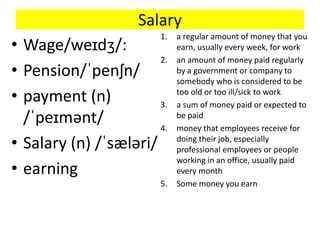
Salary
• Wage/weɪdʒ/:
• Pension/ˈpenʃn/
• payment (n)
/ˈpeɪmənt/
• Salary (n) /ˈsæləri/
• earning
1. a regular amount of money that you
earn, usually every week, for work
2. an amount of money paid regularly
by a government or company to
somebody who is considered to be
too old or too ill/sick to work
3. a sum of money paid or expected to
be paid
4. money that employees receive for
doing their job, especially
professional employees or people
working in an office, usually paid
every month
5. Some money you earn
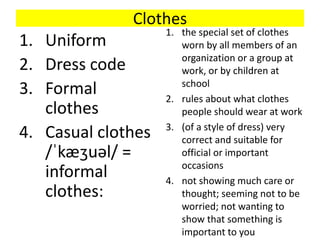
Clothes
1. Uniform
2. Dress code
3. Formal
clothes
4. Casual clothes
/ˈkæʒuəl/ =
informal
clothes:
1. the special set of clothes
worn by all members of an
organization or a group at
work, or by children at
school
2. rules about what clothes
people should wear at work
3. (of a style of dress) very
correct and suitable for
official or important
occasions
4. not showing much care or
thought; seeming not to be
worried; not wanting to
show that something is
important to you
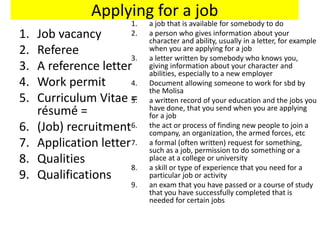
Applying for a job
1. Job vacancy
2. Referee
3. A reference letter
4. Work permit
5. Curriculum Vitae =
résumé =
6. (Job) recruitment
7. Application letter
8. Qualities
9. Qualifications
1. a job that is available for somebody to do
2. a person who gives information about your
character and ability, usually in a letter, for example
when you are applying for a job
3. a letter written by somebody who knows you,
giving information about your character and
abilities, especially to a new employer
4. Document allowing someone to work for sbd by
the Molisa
5. a written record of your education and the jobs you
have done, that you send when you are applying
for a job
6. the act or process of finding new people to join a
company, an organization, the armed forces, etc
7. a formal (often written) request for something,
such as a job, permission to do something or a
place at a college or university
8. a skill or type of experience that you need for a
particular job or activity
9. an exam that you have passed or a course of study
that you have successfully completed that is
needed for certain jobs
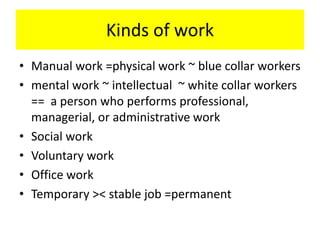
Kinds of work
• Manual work =physical work ~ blue collar workers
• mental work ~ intellectual ~ white collar workers
== a person who performs professional,
managerial, or administrative work
• Social work
• Voluntary work
• Office work
• Temporary >< stable job =permanent
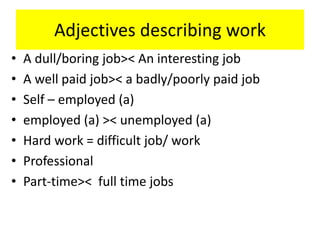
Adjectives describing work
• A dull/boring job>< An interesting job
• A well paid job>< a badly/poorly paid job
• Self – employed (a)
• employed (a) >< unemployed (a)
• Hard work = difficult job/ work
• Professional
• Part-time>< full time jobs
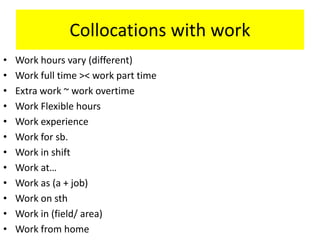
Collocations with work
• Work hours vary (different)
• Work full time >< work part time
• Extra work ~ work overtime
• Work Flexible hours
• Work experience
• Work for sb.
• Work in shift
• Work at…
• Work as (a + job)
• Work on sth
• Work in (field/ area)
• Work from home
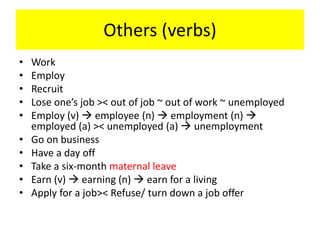
Others (verbs)
• Work
• Employ
• Recruit
• Lose one’s job >< out of job ~ out of work ~ unemployed
• Employ (v)  employee (n)  employment (n) 
employed (a) >< unemployed (a)  unemployment
• Go on business
• Have a day off
• Take a six-month maternal leave
• Earn (v)  earning (n)  earn for a living
• Apply for a job>< Refuse/ turn down a job offer
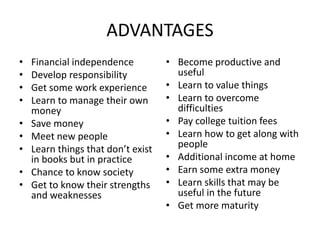
ADVANTAGES
• Financial independence
• Develop responsibility
• Get some work experience
• Learn to manage their own
money
• Save money
• Meet new people
• Learn things that don’t exist
in books but in practice
• Chance to know society
• Get to know their strengths
and weaknesses
• Become productive and
useful
• Learn to value things
• Learn to overcome
difficulties
• Pay college tuition fees
• Learn how to get along with
people
• Additional income at home
• Earn some extra money
• Learn skills that may be
useful in the future
• Get more maturity
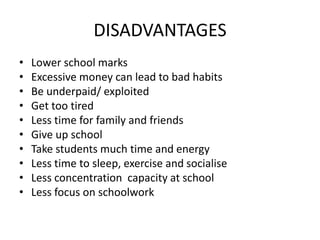
DISADVANTAGES
• Lower school marks
• Excessive money can lead to bad habits
• Be underpaid/ exploited
• Get too tired
• Less time for family and friends
• Give up school
• Take students much time and energy
• Less time to sleep, exercise and socialise
• Less concentration capacity at school
• Less focus on schoolwork
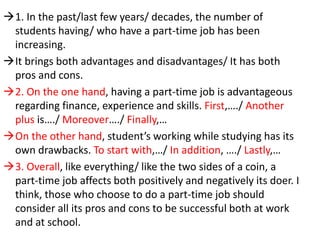
1. In the past/last few years/ decades, the number of
students having/ who have a part-time job has been
increasing.
It brings both advantages and disadvantages/ It has both
pros and cons.
2. On the one hand, having a part-time job is advantageous
regarding finance, experience and skills. First,…./ Another
plus is…./ Moreover…./ Finally,…
On the other hand, student’s working while studying has its
own drawbacks. To start with,…/ In addition, …./ Lastly,…
3. Overall, like everything/ like the two sides of a coin, a
part-time job affects both positively and negatively its doer. I
think, those who choose to do a part-time job should
consider all its pros and cons to be successful both at work
and at school.
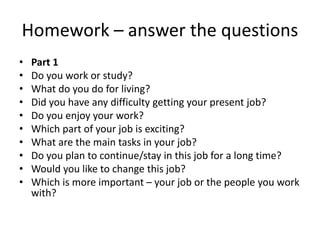
Homework – answer the questions
• Part 1
• Do you work or study?
• What do you do for living?
• Did you have any difficulty getting your present job?
• Do you enjoy your work?
• Which part of your job is exciting?
• What are the main tasks in your job?
• Do you plan to continue/stay in this job for a long time?
• Would you like to change this job?
• Which is more important – your job or the people you work
with?

WORK_P1.pptx

  • 1.
  • 2.
    Salary • Wage/weɪdʒ/: • Pension/ˈpenʃn/ •payment (n) /ˈpeɪmənt/ • Salary (n) /ˈsæləri/ • earning 1. a regular amount of money that you earn, usually every week, for work 2. an amount of money paid regularly by a government or company to somebody who is considered to be too old or too ill/sick to work 3. a sum of money paid or expected to be paid 4. money that employees receive for doing their job, especially professional employees or people working in an office, usually paid every month 5. Some money you earn
  • 3.
    Clothes 1. Uniform 2. Dresscode 3. Formal clothes 4. Casual clothes /ˈkæʒuəl/ = informal clothes: 1. the special set of clothes worn by all members of an organization or a group at work, or by children at school 2. rules about what clothes people should wear at work 3. (of a style of dress) very correct and suitable for official or important occasions 4. not showing much care or thought; seeming not to be worried; not wanting to show that something is important to you
  • 4.
    Applying for ajob 1. Job vacancy 2. Referee 3. A reference letter 4. Work permit 5. Curriculum Vitae = résumé = 6. (Job) recruitment 7. Application letter 8. Qualities 9. Qualifications 1. a job that is available for somebody to do 2. a person who gives information about your character and ability, usually in a letter, for example when you are applying for a job 3. a letter written by somebody who knows you, giving information about your character and abilities, especially to a new employer 4. Document allowing someone to work for sbd by the Molisa 5. a written record of your education and the jobs you have done, that you send when you are applying for a job 6. the act or process of finding new people to join a company, an organization, the armed forces, etc 7. a formal (often written) request for something, such as a job, permission to do something or a place at a college or university 8. a skill or type of experience that you need for a particular job or activity 9. an exam that you have passed or a course of study that you have successfully completed that is needed for certain jobs
  • 5.
    Kinds of work •Manual work =physical work ~ blue collar workers • mental work ~ intellectual ~ white collar workers == a person who performs professional, managerial, or administrative work • Social work • Voluntary work • Office work • Temporary >< stable job =permanent
  • 6.
    Adjectives describing work •A dull/boring job>< An interesting job • A well paid job>< a badly/poorly paid job • Self – employed (a) • employed (a) >< unemployed (a) • Hard work = difficult job/ work • Professional • Part-time>< full time jobs
  • 7.
    Collocations with work •Work hours vary (different) • Work full time >< work part time • Extra work ~ work overtime • Work Flexible hours • Work experience • Work for sb. • Work in shift • Work at… • Work as (a + job) • Work on sth • Work in (field/ area) • Work from home
  • 8.
    Others (verbs) • Work •Employ • Recruit • Lose one’s job >< out of job ~ out of work ~ unemployed • Employ (v)  employee (n)  employment (n)  employed (a) >< unemployed (a)  unemployment • Go on business • Have a day off • Take a six-month maternal leave • Earn (v)  earning (n)  earn for a living • Apply for a job>< Refuse/ turn down a job offer
  • 9.
    ADVANTAGES • Financial independence •Develop responsibility • Get some work experience • Learn to manage their own money • Save money • Meet new people • Learn things that don’t exist in books but in practice • Chance to know society • Get to know their strengths and weaknesses • Become productive and useful • Learn to value things • Learn to overcome difficulties • Pay college tuition fees • Learn how to get along with people • Additional income at home • Earn some extra money • Learn skills that may be useful in the future • Get more maturity
  • 10.
    DISADVANTAGES • Lower schoolmarks • Excessive money can lead to bad habits • Be underpaid/ exploited • Get too tired • Less time for family and friends • Give up school • Take students much time and energy • Less time to sleep, exercise and socialise • Less concentration capacity at school • Less focus on schoolwork
  • 11.
    1. In thepast/last few years/ decades, the number of students having/ who have a part-time job has been increasing. It brings both advantages and disadvantages/ It has both pros and cons. 2. On the one hand, having a part-time job is advantageous regarding finance, experience and skills. First,…./ Another plus is…./ Moreover…./ Finally,… On the other hand, student’s working while studying has its own drawbacks. To start with,…/ In addition, …./ Lastly,… 3. Overall, like everything/ like the two sides of a coin, a part-time job affects both positively and negatively its doer. I think, those who choose to do a part-time job should consider all its pros and cons to be successful both at work and at school.
  • 12.
    Homework – answerthe questions • Part 1 • Do you work or study? • What do you do for living? • Did you have any difficulty getting your present job? • Do you enjoy your work? • Which part of your job is exciting? • What are the main tasks in your job? • Do you plan to continue/stay in this job for a long time? • Would you like to change this job? • Which is more important – your job or the people you work with?