Economic DEVELOPMENT
It is commonly understood that the factors of
without ‘human capital’ the other factors cannot be
and drive economic growth.
Businesses need access to workers with appropriate
Human capital is the most valuable resource in a
and apply skills in a workplace context – provides the
meet this challenge.
supply across enterprises and industry sectors. This in
LEVEL
Strategy in 2010 and 2013 and is currently developing
the 2016 strategy. The vision of the strategy is to realise
The workforce development strategy outlines how
Australia can develop its knowledge economy and
There is a strong emphasis in the strategy on ‘demand-
up-skilling of the workforce. The strategy promotes the
planning strategies at the regional level. The means by
which this can be achieved is outlined below.
It is important that those who are involved in
workforce planning work within the same conceptual
WORKFORCE PLANNING
AN ESSENTIAL ELEMENT OF
A REGIONAL ECONOMIC
DEVELOPMENT STRATEGY
vol. 8 no. 2 2015 | 11
Economic DEVELOPMENT
end:
those who are employed. A broad
workers and unskilled workers.
those who are engaged in the workforce
• Employed (Skills Adequate) – Those who are
employed who have skills that meet or exceed the
job requirements of business and industry.
• Employed (Skills Inadequate)– Those who are
that meet the job requirements.
SIDE COMPONENTS
The labour market is best analysed in terms of demand
and supply-side factors. The demand side refers to the
number of jobs available measured by the number of
people employed plus the number of job vacancies.
persons in the labour force plus those under-employed
following:
those who are in the workforce
seeking work plus those who are under-employed.
those who wish to be in the
workforce (employed) but are not.
workforce.
those who desire to be
employed but do not join the labour force due to an
the number of
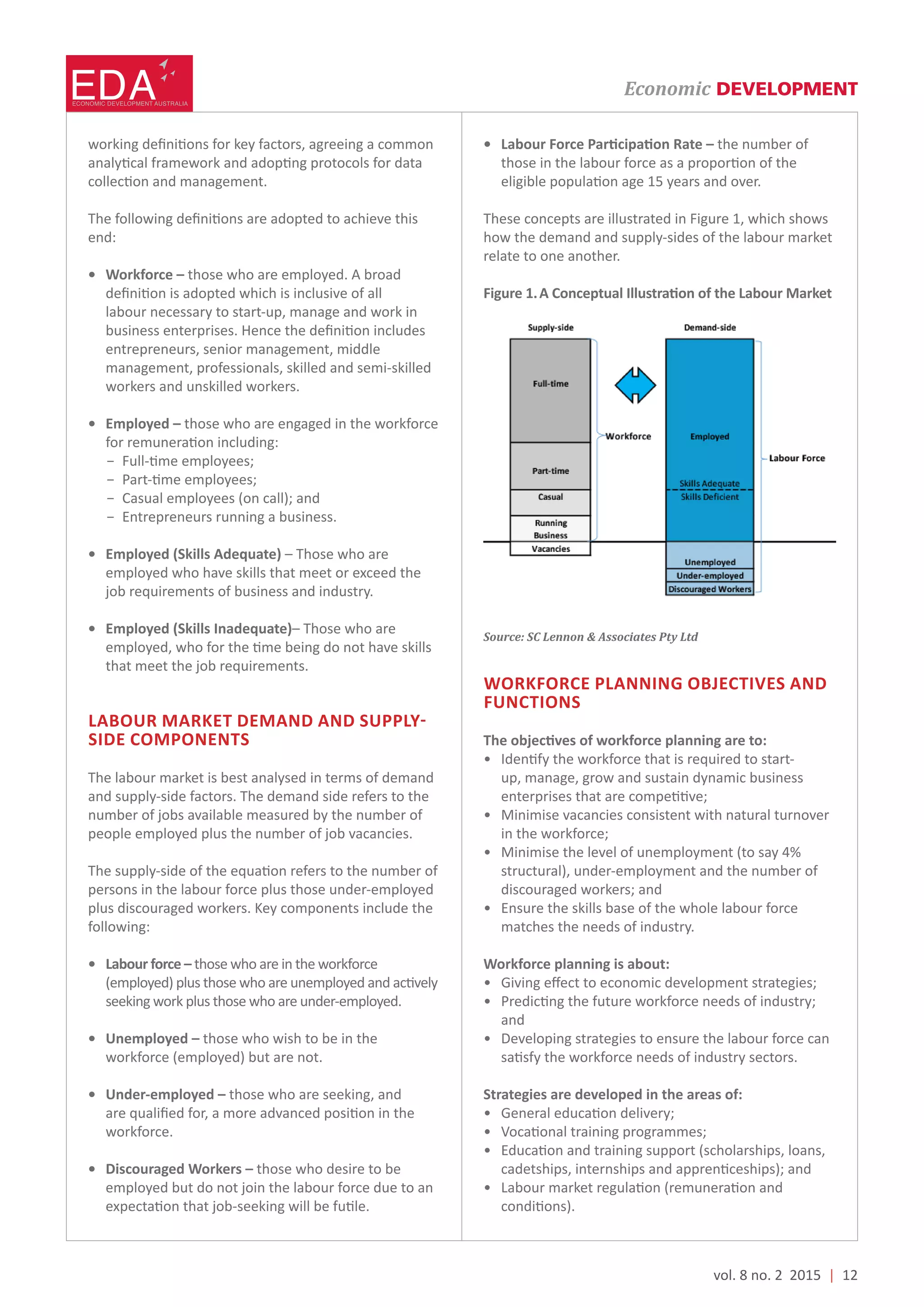
how the demand and supply-sides of the labour market
relate to one another.
Source: SC Lennon & Associates Pty Ltd
FUNCTIONS
• Minimise vacancies consistent with natural turnover
• Ensure the skills base of the whole labour force
matches the needs of industry.
and
• Developing strategies to ensure the labour force can
Strategies are developed in the areas of:
vol. 8 no. 2 2015 | 12
Economic DEVELOPMENT
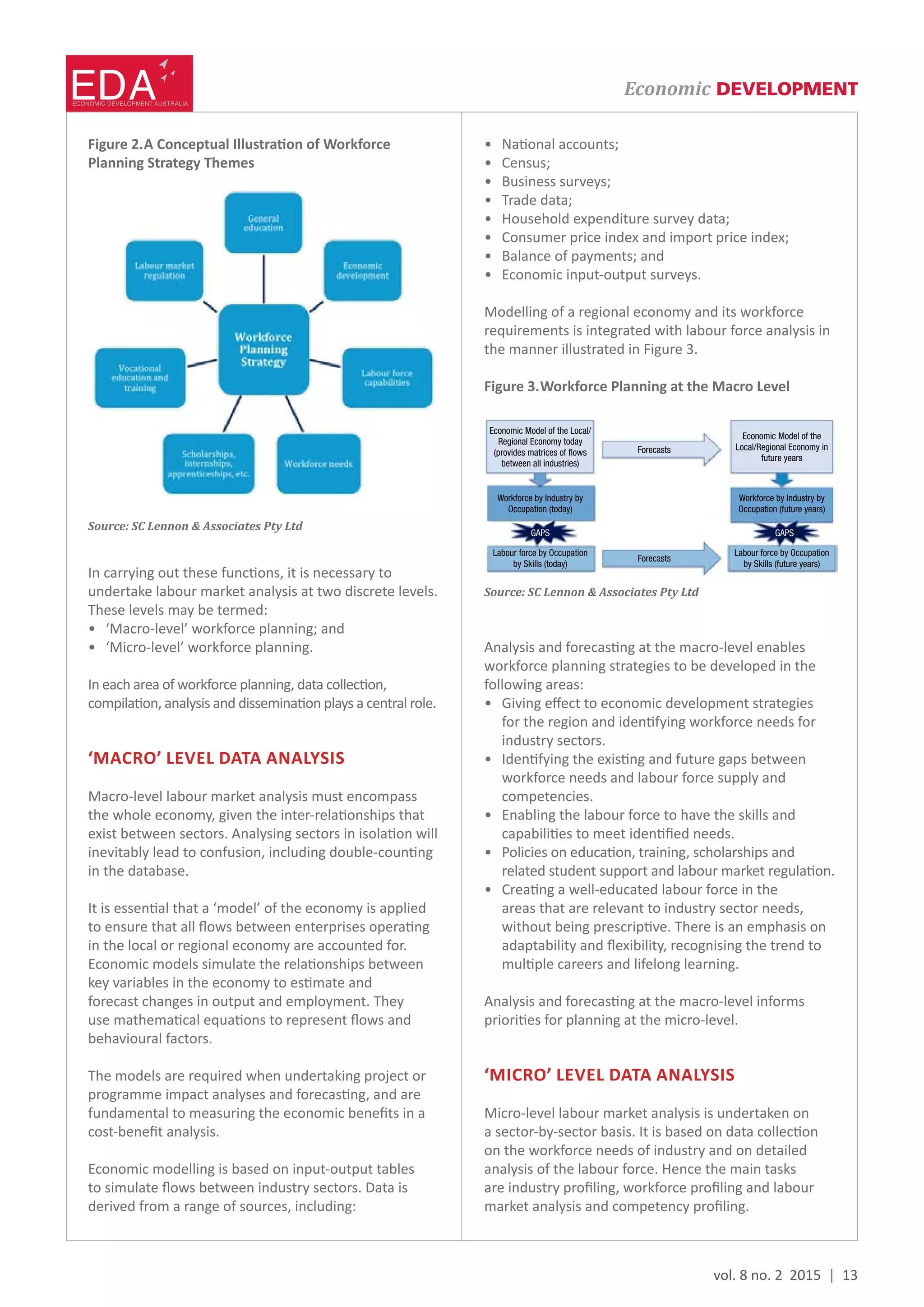
Planning Strategy Themes
Source: SC Lennon & Associates Pty Ltd
undertake labour market analysis at two discrete levels.
These levels may be termed:
• ‘Micro-level’ workforce planning.
‘MACRO’ LEVEL DATA ANALYSIS
Macro-level labour market analysis must encompass
in the database.
in the local or regional economy are accounted for.
forecast changes in output and employment. They
behavioural factors.
The models are required when undertaking project or
Economic modelling is based on input-output tables
• Economic input-output surveys.
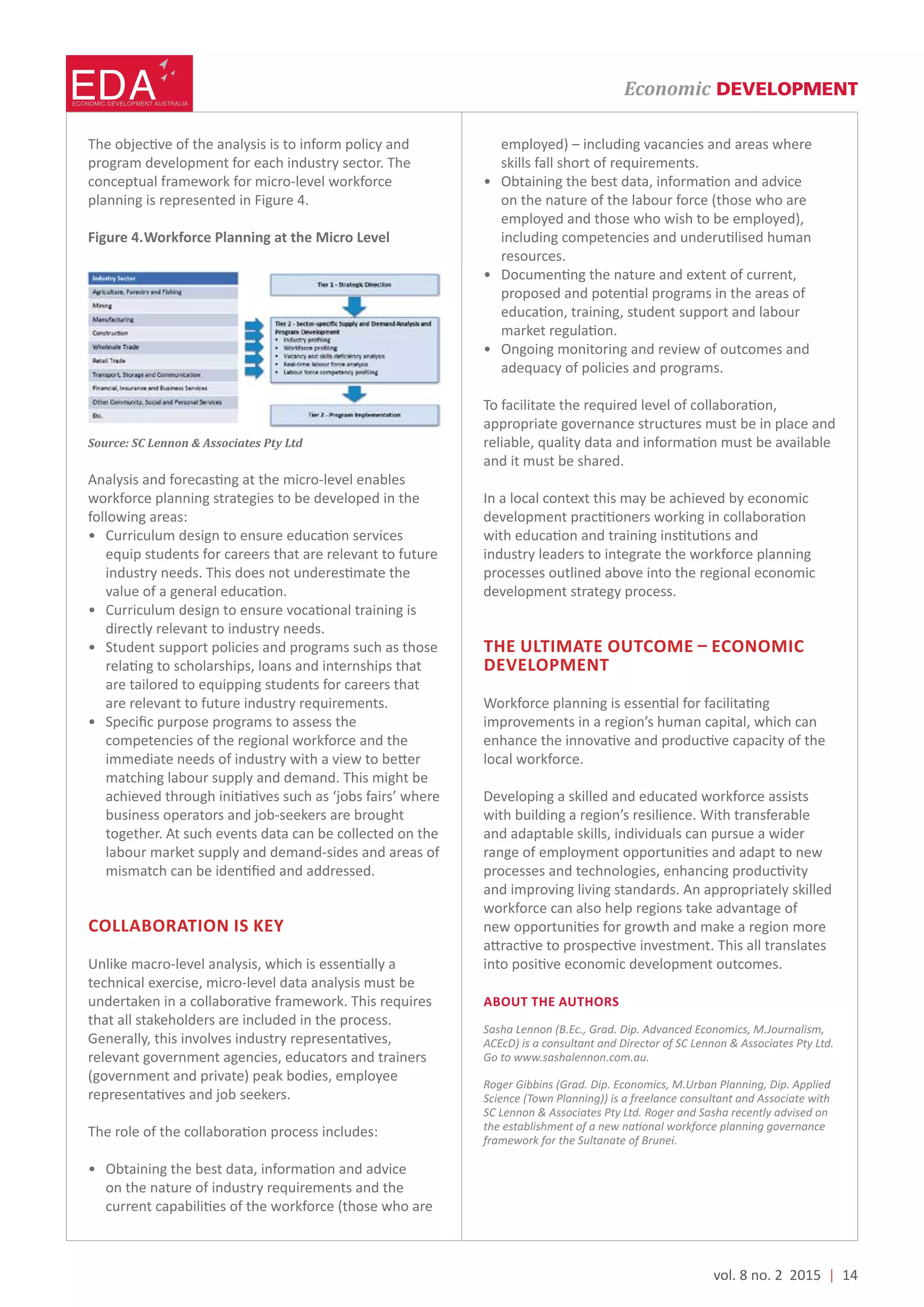
Modelling of a regional economy and its workforce
requirements is integrated with labour force analysis in
the manner illustrated in Figure 3.
Source: SC Lennon & Associates Pty Ltd
workforce planning strategies to be developed in the
following areas:
industry sectors.
workforce needs and labour force supply and
competencies.
• Enabling the labour force to have the skills and
‘MICRO’ LEVEL DATA ANALYSIS
Micro-level labour market analysis is undertaken on
on the workforce needs of industry and on detailed
analysis of the labour force. Hence the main tasks
Economic Model of the Local/
Regional Economy today
(provides matrices of flows
between all industries)
Workforce by Industry by
Occupation (today)
Labour force by Occupation
by Skills (today)
Labour force by Occupation
by Skills (future years)
GAPS GAPS
Workforce by Industry by
Occupation (future years)
Economic Model of the
Local/Regional Economy in
future years
Forecasts
Forecasts
vol. 8 no. 2 2015 | 13
Economic DEVELOPMENT
program development for each industry sector. The
conceptual framework for micro-level workforce
planning is represented in Figure 4.
Source: SC Lennon & Associates Pty Ltd
workforce planning strategies to be developed in the
following areas:
equip students for careers that are relevant to future
directly relevant to industry needs.
• Student support policies and programs such as those
are tailored to equipping students for careers that
are relevant to future industry requirements.
competencies of the regional workforce and the
matching labour supply and demand. This might be
business operators and job-seekers are brought
together. At such events data can be collected on the
labour market supply and demand-sides and areas of
that all stakeholders are included in the process.
on the nature of industry requirements and the
employed) – including vacancies and areas where
skills fall short of requirements.
on the nature of the labour force (those who are
resources.
• Ongoing monitoring and review of outcomes and
adequacy of policies and programs.
appropriate governance structures must be in place and
and it must be shared.
In a local context this may be achieved by economic
industry leaders to integrate the workforce planning
processes outlined above into the regional economic
development strategy process.
DEVELOPMENT
local workforce.
Developing a skilled and educated workforce assists
with building a region’s resilience. With transferable
and improving living standards. An appropriately skilled
workforce can also help regions take advantage of
Go to www.sashalennon.com.au.
framework for the Sultanate of Brunei.
vol. 8 no. 2 2015 | 14

Workforce Planning EDA Article

  • 1.
    Economic DEVELOPMENT It iscommonly understood that the factors of without ‘human capital’ the other factors cannot be and drive economic growth. Businesses need access to workers with appropriate Human capital is the most valuable resource in a and apply skills in a workplace context – provides the meet this challenge. supply across enterprises and industry sectors. This in LEVEL Strategy in 2010 and 2013 and is currently developing the 2016 strategy. The vision of the strategy is to realise The workforce development strategy outlines how Australia can develop its knowledge economy and There is a strong emphasis in the strategy on ‘demand- up-skilling of the workforce. The strategy promotes the planning strategies at the regional level. The means by which this can be achieved is outlined below. It is important that those who are involved in workforce planning work within the same conceptual WORKFORCE PLANNING AN ESSENTIAL ELEMENT OF A REGIONAL ECONOMIC DEVELOPMENT STRATEGY vol. 8 no. 2 2015 | 11
  • 2.
    Economic DEVELOPMENT end: those whoare employed. A broad workers and unskilled workers. those who are engaged in the workforce • Employed (Skills Adequate) – Those who are employed who have skills that meet or exceed the job requirements of business and industry. • Employed (Skills Inadequate)– Those who are that meet the job requirements. SIDE COMPONENTS The labour market is best analysed in terms of demand and supply-side factors. The demand side refers to the number of jobs available measured by the number of people employed plus the number of job vacancies. persons in the labour force plus those under-employed following: those who are in the workforce seeking work plus those who are under-employed. those who wish to be in the workforce (employed) but are not. workforce. those who desire to be employed but do not join the labour force due to an the number of how the demand and supply-sides of the labour market relate to one another. Source: SC Lennon & Associates Pty Ltd FUNCTIONS • Minimise vacancies consistent with natural turnover • Ensure the skills base of the whole labour force matches the needs of industry. and • Developing strategies to ensure the labour force can Strategies are developed in the areas of: vol. 8 no. 2 2015 | 12
  • 3.
    Economic DEVELOPMENT Planning StrategyThemes Source: SC Lennon & Associates Pty Ltd undertake labour market analysis at two discrete levels. These levels may be termed: • ‘Micro-level’ workforce planning. ‘MACRO’ LEVEL DATA ANALYSIS Macro-level labour market analysis must encompass in the database. in the local or regional economy are accounted for. forecast changes in output and employment. They behavioural factors. The models are required when undertaking project or Economic modelling is based on input-output tables • Economic input-output surveys. Modelling of a regional economy and its workforce requirements is integrated with labour force analysis in the manner illustrated in Figure 3. Source: SC Lennon & Associates Pty Ltd workforce planning strategies to be developed in the following areas: industry sectors. workforce needs and labour force supply and competencies. • Enabling the labour force to have the skills and ‘MICRO’ LEVEL DATA ANALYSIS Micro-level labour market analysis is undertaken on on the workforce needs of industry and on detailed analysis of the labour force. Hence the main tasks Economic Model of the Local/ Regional Economy today (provides matrices of flows between all industries) Workforce by Industry by Occupation (today) Labour force by Occupation by Skills (today) Labour force by Occupation by Skills (future years) GAPS GAPS Workforce by Industry by Occupation (future years) Economic Model of the Local/Regional Economy in future years Forecasts Forecasts vol. 8 no. 2 2015 | 13
  • 4.
    Economic DEVELOPMENT program developmentfor each industry sector. The conceptual framework for micro-level workforce planning is represented in Figure 4. Source: SC Lennon & Associates Pty Ltd workforce planning strategies to be developed in the following areas: equip students for careers that are relevant to future directly relevant to industry needs. • Student support policies and programs such as those are tailored to equipping students for careers that are relevant to future industry requirements. competencies of the regional workforce and the matching labour supply and demand. This might be business operators and job-seekers are brought together. At such events data can be collected on the labour market supply and demand-sides and areas of that all stakeholders are included in the process. on the nature of industry requirements and the employed) – including vacancies and areas where skills fall short of requirements. on the nature of the labour force (those who are resources. • Ongoing monitoring and review of outcomes and adequacy of policies and programs. appropriate governance structures must be in place and and it must be shared. In a local context this may be achieved by economic industry leaders to integrate the workforce planning processes outlined above into the regional economic development strategy process. DEVELOPMENT local workforce. Developing a skilled and educated workforce assists with building a region’s resilience. With transferable and improving living standards. An appropriately skilled workforce can also help regions take advantage of Go to www.sashalennon.com.au. framework for the Sultanate of Brunei. vol. 8 no. 2 2015 | 14