Workforce: Alabama
Presenters
Mary Scott Hunter
Representative - Alabama
State Board of Education
District 8 (Limestone, Madison,
Jackson, DeKalb, Etowah)
www.maryscotthunter.com
(888) 531-1312
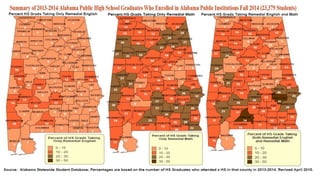
hunter@maryscotthunter.com
Twitter: @maryscotthunter
Overview
• College and Career Readiness
• Statewide Labor Force Industry and Occupation
Trends
• Demographics
• Industry Projections v. College Majors (Middle
Skills Gap)
• Understanding the Challenges
• What Solutions?
• Questions
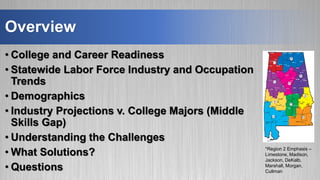
*Region 2 Emphasis –
Limestone, Madison,
Jackson, DeKalb,
Marshall, Morgan,
Cullman
College and Career
Readiness
What You Should Know
Graduation Rate
(Statewide)
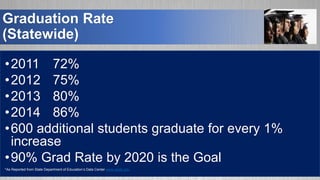
•2011 72%
•2012 75%
•2013 80%
•2014 86%
•600 additional students graduate for every 1%
increase
•90% Grad Rate by 2020 is the Goal
*As Reported from State Department of Education’s Data Center www.alsde.edu
Obstacles Into Opportunities
•By 2020, assuming the 90-percent goal is reached,
economic output would be $430 million higher than
it otherwise would have been, and Education Trust
Fund revenues would be up by $22 million.
Obstacles Into Opportunities
•By year 2020, the impact of higher high school
graduation rates on the State’s economy
resembles that of recruiting a Mercedes or Airbus
type investment every year.
Source: www.beaalabama.com
Obstacles Into Opportunities: A report prepared for the Business
Education Alliance by the Public Affairs Research Council of Alabama
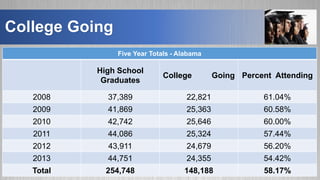
College Going
Five Year Totals - Alabama
High School
Graduates
College Going Percent Attending
2008 37,389 22,821 61.04%
2009 41,869 25,363 60.58%
2010 42,742 25,646 60.00%
2011 44,086 25,324 57.44%
2012 43,911 24,679 56.20%
2013 44,751 24,355 54.42%
Total 254,748 148,188 58.17%
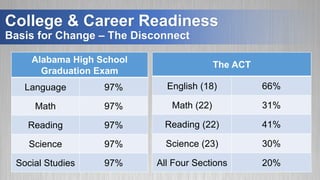
College & Career Readiness
Basis for Change – The Disconnect
Alabama High School
Graduation Exam
Language 97%
Math 97%
Reading 97%
Science 97%
Social Studies 97%
The ACT
English (18) 66%
Math (22) 31%
Reading (22) 41%
Science (23) 30%
All Four Sections 20%
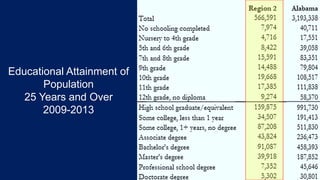
Educational Attainment of
Population
25 Years and Over
2009-2013
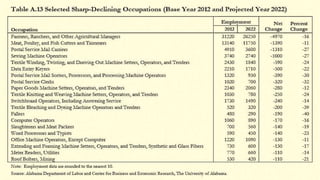
Statewide Labor Force,
Industries, and Occupations
A Snapshot
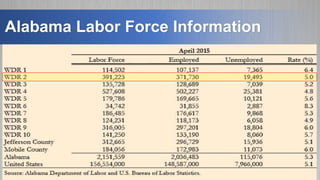
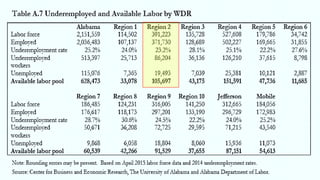
Alabama Labor Force Information
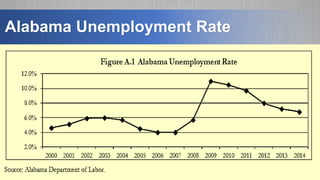
Alabama Unemployment Rate
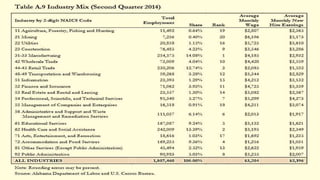
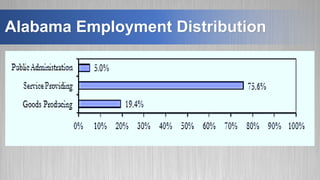
Alabama Employment Distribution
Workforce Development
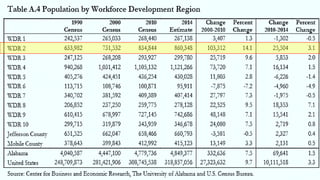
Region 2
Demographic Trends
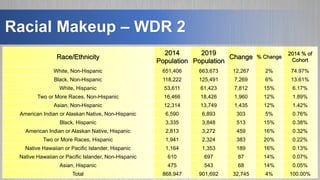
Race/Ethnicity
2014
Population
2019
Population
Change % Change
2014 % of
Cohort
White, Non-Hispanic 651,406 663,673 12,267 2% 74.97%
Black, Non-Hispanic 118,222 125,491 7,269 6% 13.61%
White, Hispanic 53,611 61,423 7,812 15% 6.17%
Two or More Races, Non-Hispanic 16,466 18,426 1,960 12% 1.89%
Asian, Non-Hispanic 12,314 13,749 1,435 12% 1.42%
American Indian or Alaskan Native, Non-Hispanic 6,590 6,893 303 5% 0.76%
Black, Hispanic 3,335 3,848 513 15% 0.38%
American Indian or Alaskan Native, Hispanic 2,813 3,272 459 16% 0.32%
Two or More Races, Hispanic 1,941 2,324 383 20% 0.22%
Native Hawaiian or Pacific Islander, Hispanic 1,164 1,353 189 16% 0.13%
Native Hawaiian or Pacific Islander, Non-Hispanic 610 697 87 14% 0.07%
Asian, Hispanic 475 543 68 14% 0.05%
Total 868,947 901,692 32,745 4% 100.00%
Racial Makeup – WDR 2
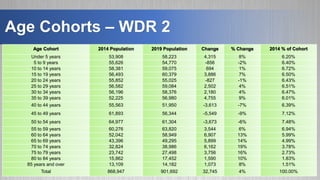
Age Cohort 2014 Population 2019 Population Change % Change 2014 % of Cohort
Under 5 years 53,908 58,223 4,315 8% 6.20%
5 to 9 years 55,626 54,770 -856 -2% 6.40%
10 to 14 years 58,381 59,075 694 1% 6.72%
15 to 19 years 56,493 60,379 3,886 7% 6.50%
20 to 24 years 55,852 55,025 -827 -1% 6.43%
25 to 29 years 56,582 59,084 2,502 4% 6.51%
30 to 34 years 56,196 58,376 2,180 4% 6.47%
35 to 39 years 52,225 56,980 4,755 9% 6.01%
40 to 44 years 55,563 51,950 -3,613 -7% 6.39%
45 to 49 years 61,893 56,344 -5,549 -9% 7.12%
50 to 54 years 64,977 61,304 -3,673 -6% 7.48%
55 to 59 years 60,276 63,820 3,544 6% 6.94%
60 to 64 years 52,042 58,949 6,907 13% 5.99%
65 to 69 years 43,396 49,295 5,899 14% 4.99%
70 to 74 years 32,824 38,986 6,162 19% 3.78%
75 to 79 years 23,742 27,498 3,756 16% 2.73%
80 to 84 years 15,862 17,452 1,590 10% 1.83%
85 years and over 13,109 14,182 1,073 8% 1.51%
Total 868,947 901,692 32,745 4% 100.00%
Age Cohorts – WDR 2
Region 2 Industry Projections
vs. College Major Choices
Largest, Highest Paying, & Fastest Growing
Industries
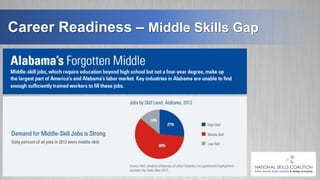
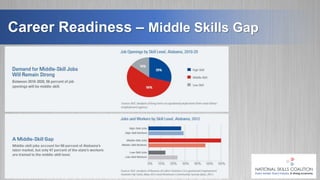
Career Readiness – Middle Skills Gap
Rank
#
Undergrads
1 8,350
2 2,191
3 1,114
4 738
5 621
6 517
7 386
8 300
9 242
10 222
11 192
12 184
13 165
14 157
15 138
16 130
17 124
18 105
19 105
20 104
21 93
22 83
23 82
24 77
25 76
26 76
27 75
28 73
29 72
30 69
31 65
32 65
33 63
34 53
35 52
SOURCE: Alabama Statewide Student Database
Workforce Dev. Region 2 includes: Cullman, DeKalb, Jackson, Limestone, Madison, Marshall, and Morgan.
Heating, Ventilation, Air Conditioning and Refrigeration Engineering Technology/Technician.
Surgical Technology/Technologist.
Music, Other.
Workforce Development Region 2 - 2YR Colleges
Radiologic Technology/Science - Radiographer.
Drafting and Design Technology/Technician, General.
Dental Hygiene/Hygienist.
Health Information/Medical Records Technology/Technician.
Business/Commerce, General.
Engineering Technology, General.
Automotive Engineering Technology/Technician.
Licensed Practical/Vocational Nurse Training.
Industrial Mechanics and Maintenance Technology.
Office Management and Supervision.
Culinary Arts/Chef Training.
Dental Assisting/Assistant.
Tool and Die Technology/Technician.
Criminal Justice/Police Science.
Industrial Electronics Technology/Technician.
Diagnostic Medical Sonography/Sonographer and Ultrasound Technician.
Clinical/Medical Laboratory Technician.
Manufacturing Engineering Technology/Technician.
Computer and Information Sciences, General.
Child Care and Support Services Management.
Medical/Clinical Assistant.
Administrative Assistant and Secretarial Science, General.
Emergency Medical Technology/Technician (EMT Paramedic).
Liberal Arts and Sciences/Liberal Studies.
Physical Therapy Technician/Assistant.
Salon/Beauty Salon Management/Manager.
Welding Technology/Welder.
Design and Visual Communications, General.
General Studies.
Undeclared/Not Reported.
Registered Nursing/Registered Nurse.
Business Administration and Management, General.
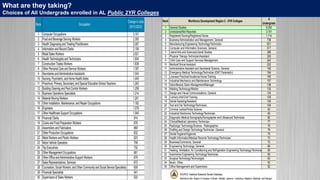
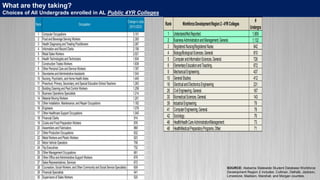
What are they taking?
Choices of All Undergrads enrolled in AL Public 2YR Colleges
Rank WorkforceDevelopmentRegion2-4YRColleges
#
Undergra
1 Undeclared/NotReported. 1,959
2 BusinessAdministrationandManagement,General. 1,132
3 RegisteredNursing/RegisteredNurse. 842
4 Biology/BiologicalSciences,General. 810
5 ComputerandInformationSciences,General. 726
6 ElementaryEducationandTeaching. 672
9 MechanicalEngineering. 437
10 GeneralStudies. 412
16 ElectricalandElectronicsEngineering 231
26 CivilEngineering,General. 167
30 BiomedicalSciences,General. 143
39 IndustrialEngineering. 79
41 ComputerEngineering,General. 78
42 Sociology. 76
46 Health/HealthCareAdministration/Management. 73
48 Health/MedicalPreparatoryPrograms,Other. 71
SOURCE: Alabama Statewide Student Database Workforce
Development Region 2 includes: Cullman, DeKalb, Jackson,
Limestone, Madison, Marshall, and Morgan counties.
What are they taking?
Choices of All Undergrads enrolled in AL Public 4YR Colleges
Rank
#
Undergrads
1 8,350
2 2,191
3 1,114
4 738
5 621
6 517
7 386
8 300
10 222
12 184
13 165
14 157
16 130
19 105
20 104
22 83
23 82
24 77
25 76
26 76
27 75
28 73
30 69
31 65
32 65
33 63
38 42
39 39
41 26
Electrical, Electronic and Communications EngineeringTechnology/Technician.
OccupationalTherapistAssistant.
Workforce Development Region 2 - 2YR Colleges
Automobile/Automotive Mechanics Technology/Technician.
Drafting and DesignTechnology/Technician, General.
Dental Hygiene/Hygienist.
Health Information/Medical RecordsTechnology/Technician.
EngineeringTechnology, General.
Heating, Ventilation,Air Conditioning and Refrigeration EngineeringTechnology/Technician.
SurgicalTechnology/Technologist.
LiberalArts and Sciences/Liberal Studies.
PhysicalTherapyTechnician/Assistant.
Automotive EngineeringTechnology/Technician.
Licensed Practical/Vocational Nurse Training.
Industrial Mechanics and MaintenanceTechnology.
DentalAssisting/Assistant.
Tool and DieTechnology/Technician.
Industrial ElectronicsTechnology/Technician.
Diagnostic Medical Sonography/Sonographer and UltrasoundTechnician.
RadiologicTechnology/Science - Radiographer.
WeldingTechnology/Welder.
General Studies.
Undeclared/Not Reported.
Registered Nursing/Registered Nurse.
BusinessAdministration and Management, General.
Clinical/Medical LaboratoryTechnician.
Manufacturing EngineeringTechnology/Technician.
Computer and Information Sciences, General.
Medical/ClinicalAssistant.
Emergency MedicalTechnology/Technician (EMT Paramedic).
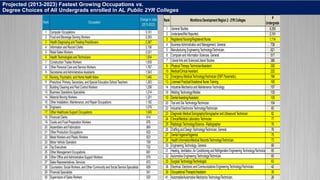
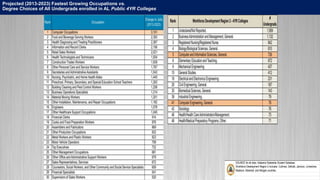
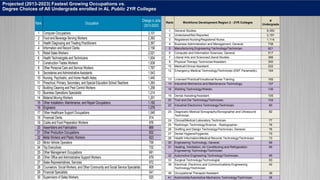
Projected (2013-2023) Fastest Growing Occupations vs.
Degree Choices of All Undergrads enrolled in AL Public 2YR Colleges
SOURCE: Alabama Statewide Student Database Workforce
Development Region 2 includes: Cullman, DeKalb, Jackson,
Limestone, Madison, Marshall, and Morgan counties.
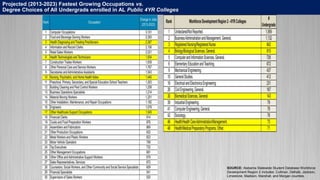
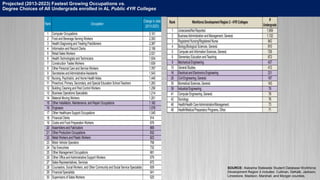
Projected (2013-2023) Fastest Growing Occupations vs.
Degree Choices of All Undergrads enrolled in AL Public 4YR Colleges
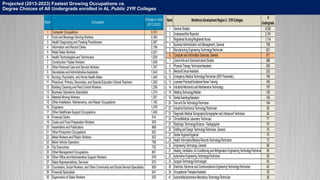
Projected (2013-2023) Fastest Growing Occupations vs.
Degree Choices of All Undergrads enrolled in AL Public 2YR Colleges
Rank
#
Undergrads
1 8,350
2 2,191
3 1,114
4 738
5 621
6 517
7 386
8 300
10 222
12 184
13 165
14 157
16 130
19 105
20 104
22 83
23 82
24 77
25 76
26 76
27 75
28 73
30 69
31 65
32 65
33 63
38 42
39 39
41 26
Electrical,ElectronicandCommunicationsEngineeringTechnology/Technician.
OccupationalTherapistAssistant.
WorkforceDevelopmentRegion2-2YRColleges
Automobile/AutomotiveMechanicsTechnology/Technician.
DraftingandDesignTechnology/Technician,General.
DentalHygiene/Hygienist.
HealthInformation/MedicalRecordsTechnology/Technician.
EngineeringTechnology,General.
Heating,Ventilation,AirConditioningandRefrigerationEngineeringTechnology/Technician.
SurgicalTechnology/Technologist.
LiberalArtsandSciences/LiberalStudies.
PhysicalTherapyTechnician/Assistant.
AutomotiveEngineeringTechnology/Technician.
LicensedPractical/VocationalNurseTraining.
IndustrialMechanicsandMaintenanceTechnology.
DentalAssisting/Assistant.
ToolandDieTechnology/Technician.
IndustrialElectronicsTechnology/Technician.
DiagnosticMedicalSonography/SonographerandUltrasoundTechnician.
RadiologicTechnology/Science-Radiographer.
WeldingTechnology/Welder.
GeneralStudies.
Undeclared/NotReported.
RegisteredNursing/RegisteredNurse.
BusinessAdministrationandManagement,General.
Clinical/MedicalLaboratoryTechnician.
ManufacturingEngineeringTechnology/Technician.
ComputerandInformationSciences,General.
Medical/ClinicalAssistant.
EmergencyMedicalTechnology/Technician(EMTParamedic).
SOURCE for all data: Alabama Statewide Student Database
Workforce Development Region 2 includes: Cullman, DeKalb, Jackson, Limestone,
Madison, Marshall, and Morgan counties.
Projected (2013-2023) Fastest Growing Occupations vs.
Degree Choices of All Undergrads enrolled in AL Public 4YR Colleges
Rank Occupation
Change in Jobs
(2013-2023)
1 Computer Occupations 3,101
2 Food and Beverage Serving Workers 2,393
3 Health Diagnosing and Treating Practitioners 2,367
4 Information and Record Clerks 2,156
5 Retail Sales Workers 2,021
6 Health Technologists and Technicians 1,934
7 Construction Trades Workers 1,839
8 Other Personal Care and Service Workers 1,767
9 Secretaries andAdministrative Assistants 1,543
10 Nursing, Psychiatric, and Home Health Aides 1,445
11 Preschool, Primary, Secondary, and Special Education School Teachers 1,263
12 Building Cleaning and Pest Control Workers 1,258
13 Business Operations Specialists 1,214
14 Material Moving Workers 1,201
15 Other Installation, Maintenance, and Repair Occupations 1,182
16 Engineers 1,078
17 Other Healthcare Support Occupations 1,045
18 Financial Clerks 914
19 Cooks and Food Preparation Workers 876
20 Assemblers and Fabricators 869
21 Other Production Occupations 832
22 Metal Workers and Plastic Workers 823
23 Motor Vehicle Operators 758
24 Top Executives 732
25 Other Management Occupations 681
26 Other Office and Administrative Support Workers 679
27 Sales Representatives, Services 672
28 Counselors, Social Workers, and Other Community and Social Service Specialists 609
29 Financial Specialists 541
30 Supervisors of Sales Workers 520
Projected (2013-2023) Fastest Growing Occupations vs.
Degree Choices of All Undergrads enrolled in AL Public 2YR Colleges
Rank Workforce Development Region 2 - 2YR Colleges
#
Undergrads
1 General Studies. 8,350
2 Undeclared/Not Reported. 2,191
3 Registered Nursing/Registered Nurse. 1,114
4 Business Administration and Management, General. 738
5 Manufacturing Engineering Technology/Technician. 621
6 Computer and Information Sciences, General. 517
7 Liberal Arts and Sciences/Liberal Studies. 386
8 Physical Therapy Technician/Assistant. 300
10 Medical/Clinical Assistant. 222
12 Emergency Medical Technology/Technician (EMT Paramedic). 184
13 Licensed Practical/Vocational Nurse Training. 165
14 Industrial Mechanics and Maintenance Technology. 157
16 Welding Technology/Welder. 130
19 Dental Assisting/Assistant. 105
20 Tool and Die Technology/Technician. 104
22 Industrial Electronics Technology/Technician. 83
23 Diagnostic Medical Sonography/Sonographer and Ultrasound
Technician.
82
24 Clinical/Medical Laboratory Technician. 77
25 Radiologic Technology/Science - Radiographer. 76
26 Drafting and Design Technology/Technician, General. 76
27 Dental Hygiene/Hygienist. 75
28 Health Information/Medical Records Technology/Technician. 73
30 Engineering Technology, General. 69
31 Heating, Ventilation, Air Conditioning and Refrigeration
Engineering Technology/Technician.
65
32 Automotive Engineering Technology/Technician. 65
33 Surgical Technology/Technologist. 63
38 Electrical, Electronic and Communications Engineering
Technology/Technician.
42
39 Occupational Therapist Assistant. 39
41 Automobile/Automotive Mechanics Technology/Technician. 26
Rank Occupation
Change in Jobs
(2013-2023)
1 Computer Occupations 3,101
2 Food and Beverage Serving Workers 2,393
3 Health Diagnosing and Treating Practitioners 2,367
4 Information and Record Clerks 2,156
5 Retail Sales Workers 2,021
6 Health Technologists and Technicians 1,934
7 Construction Trades Workers 1,839
8 Other Personal Care and Service Workers 1,767
9 Secretaries andAdministrativeAssistants 1,543
10 Nursing, Psychiatric, and Home HealthAides 1,445
11 Preschool, Primary, Secondary, and Special Education School Teachers 1,263
12 Building Cleaning and Pest Control Workers 1,258
13 Business Operations Specialists 1,214
14 Material Moving Workers 1,201
15 Other Installation, Maintenance, and Repair Occupations 1,182
16 Engineers 1,078
17 Other Healthcare Support Occupations 1,045
18 Financial Clerks 914
19 Cooks and Food Preparation Workers 876
20 Assemblers and Fabricators 869
21 Other Production Occupations 832
22 Metal Workers and Plastic Workers 823
23 Motor Vehicle Operators 758
24 Top Executives 732
25 Other Management Occupations 681
26 Other Office andAdministrative Support Workers 679
27 Sales Representatives, Services 672
28 Counselors, Social Workers, and Other Community and Social Service Specialists 609
29 Financial Specialists 541
30 Supervisors of Sales Workers 520
Projected (2013-2023) Fastest Growing Occupations vs.
Degree Choices of All Undergrads enrolled in AL Public 4YR Colleges
SOURCE: Alabama Statewide Student Database Workforce
Development Region 2 includes: Cullman, DeKalb, Jackson,
Limestone, Madison, Marshall, and Morgan counties.
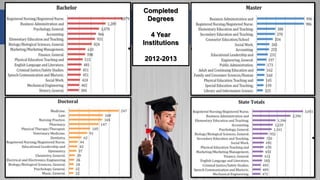
Completed
Degrees
4 Year
Institutions
2012-2013
Understand the Challenges
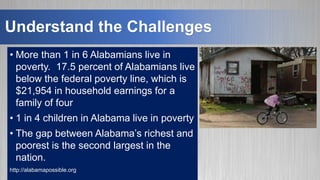
• More than 1 in 6 Alabamians live in
poverty. 17.5 percent of Alabamians live
below the federal poverty line, which is
$21,954 in household earnings for a
family of four
• 1 in 4 children in Alabama live in poverty
• The gap between Alabama’s richest and
poorest is the second largest in the
nation.
http://alabamapossible.org
Understand the Challenges
• Alabama ranks 42nd in the nation in per capita income.
Nearly 60 percent of that wage gap can be attributed
to our high school drop out rate, which was 41.4
percent in 2007
• Alabama is the second most obese state in the
country and has the fourth highest rate of diabetes
among adults.
• 2nd hungriest state in the nation and 25 percent of
Alabamians experienced food hardship in 2010.
http://alabamapossible.org
Understand the Challenges
• Alabama Public School Students
in Poverty (qualify for reduced or
free lunches): 72%
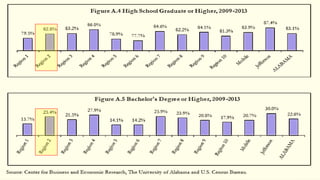
• Individuals with a high school
diploma: 82.1%
Understand the Challenges
•Individuals with a four year
college degree: 23.3%
•Teens ages 16 to 19 not attending
school and not working: 10%
•Percent of college students with
debt: 54%
Understand the Challenges
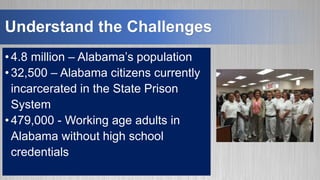
•4.8 million – Alabama’s population
•32,500 – Alabama citizens currently
incarcerated in the State Prison
System
•479,000 - Working age adults in
Alabama without high school
credentials
Understand the Challenges
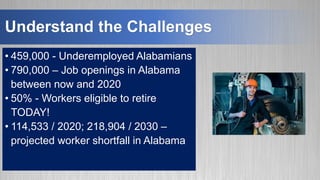
• 459,000 - Underemployed Alabamians
• 790,000 – Job openings in Alabama
between now and 2020
• 50% - Workers eligible to retire
TODAY!
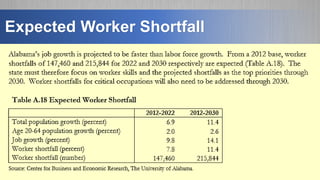
• 114,533 / 2020; 218,904 / 2030 –
projected worker shortfall in Alabama
Understand the Challenges
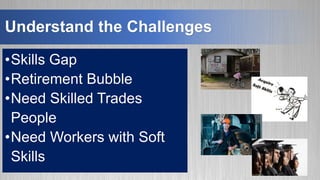
•Skills Gap
•Retirement Bubble
•Need Skilled Trades
People
•Need Workers with Soft
Skills
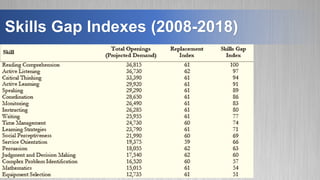
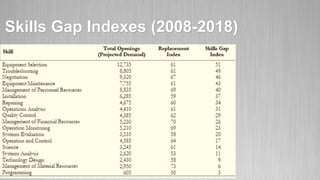
Skills Gap Indexes (2008-2018)
Expected Worker Shortfall
What are the Solutions?
K-12, 2-Year Community Colleges, 4-Year Colleges,
Training….
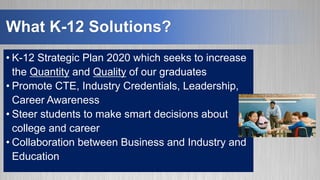
What K-12 Solutions?
• K-12 Strategic Plan 2020 which seeks to increase
the Quantity and Quality of our graduates
• Promote CTE, Industry Credentials, Leadership,
Career Awareness
• Steer students to make smart decisions about
college and career
• Collaboration between Business and Industry and
Education
What 2-Year College Solutions?
•Dual Enrollment, Apprenticeships, Internships
•Promote CTE, Industry Credentials, Leadership,
Career Awareness
•Steer students to make smart decisions about
college and career
•Collaboration between Business and Industry
and Education
What 4-Year College Solutions?
•Hands-on opportunities
•Internships
•Change student interests / Promote
available job opportunities
•Deal with skyrocketing costs
What Training Solutions?
•Ready To Work (ACCS)
•Workforce Skills (Soft Skills/AIDT)
•Manufacturing Fundamentals (AIDT)
•AIDT Preemployment Training
•Adult Education (ACCS)
Presenters
Mary Scott Hunter
Representative - Alabama
State Board of Education
District 8 (Limestone, Madison,
Jackson, DeKalb, Etowah)
www.maryscotthunter.com
(888) 531-1312
hunter@maryscotthunter.com
Twitter: @maryscotthunter
“All one can really leave
one's children is what's
inside their heads.
Education, in other words,
and not earthly possessions,
is the ultimate legacy, the
only thing that cannot be
taken away.”
- Werner Von Braun
“All one can really leave one's children is what's inside their heads. Education, in
other words, and not earthly possessions, is the ultimate legacy, the only thing
that cannot be taken away.” - Werner Von Braun
Mary Scott Hunter
District 8, Alabama State Board of Education
www.maryscotthunter.com

Workforce: Alabama

  • 1.
  • 2.
    Presenters Mary Scott Hunter Representative- Alabama State Board of Education District 8 (Limestone, Madison, Jackson, DeKalb, Etowah) www.maryscotthunter.com (888) 531-1312 hunter@maryscotthunter.com Twitter: @maryscotthunter
  • 3.
    Overview • College andCareer Readiness • Statewide Labor Force Industry and Occupation Trends • Demographics • Industry Projections v. College Majors (Middle Skills Gap) • Understanding the Challenges • What Solutions? • Questions *Region 2 Emphasis – Limestone, Madison, Jackson, DeKalb, Marshall, Morgan, Cullman
  • 4.
  • 5.
    Graduation Rate (Statewide) •2011 72% •201275% •2013 80% •2014 86% •600 additional students graduate for every 1% increase •90% Grad Rate by 2020 is the Goal *As Reported from State Department of Education’s Data Center www.alsde.edu
  • 6.
    Obstacles Into Opportunities •By2020, assuming the 90-percent goal is reached, economic output would be $430 million higher than it otherwise would have been, and Education Trust Fund revenues would be up by $22 million.
  • 7.
    Obstacles Into Opportunities •Byyear 2020, the impact of higher high school graduation rates on the State’s economy resembles that of recruiting a Mercedes or Airbus type investment every year. Source: www.beaalabama.com Obstacles Into Opportunities: A report prepared for the Business Education Alliance by the Public Affairs Research Council of Alabama
  • 8.
    College Going Five YearTotals - Alabama High School Graduates College Going Percent Attending 2008 37,389 22,821 61.04% 2009 41,869 25,363 60.58% 2010 42,742 25,646 60.00% 2011 44,086 25,324 57.44% 2012 43,911 24,679 56.20% 2013 44,751 24,355 54.42% Total 254,748 148,188 58.17%
  • 9.
    College & CareerReadiness Basis for Change – The Disconnect Alabama High School Graduation Exam Language 97% Math 97% Reading 97% Science 97% Social Studies 97% The ACT English (18) 66% Math (22) 31% Reading (22) 41% Science (23) 30% All Four Sections 20%
  • 12.
  • 13.
    Statewide Labor Force, Industries,and Occupations A Snapshot
  • 14.
  • 16.
  • 18.
  • 20.
  • 22.
    Race/Ethnicity 2014 Population 2019 Population Change % Change 2014% of Cohort White, Non-Hispanic 651,406 663,673 12,267 2% 74.97% Black, Non-Hispanic 118,222 125,491 7,269 6% 13.61% White, Hispanic 53,611 61,423 7,812 15% 6.17% Two or More Races, Non-Hispanic 16,466 18,426 1,960 12% 1.89% Asian, Non-Hispanic 12,314 13,749 1,435 12% 1.42% American Indian or Alaskan Native, Non-Hispanic 6,590 6,893 303 5% 0.76% Black, Hispanic 3,335 3,848 513 15% 0.38% American Indian or Alaskan Native, Hispanic 2,813 3,272 459 16% 0.32% Two or More Races, Hispanic 1,941 2,324 383 20% 0.22% Native Hawaiian or Pacific Islander, Hispanic 1,164 1,353 189 16% 0.13% Native Hawaiian or Pacific Islander, Non-Hispanic 610 697 87 14% 0.07% Asian, Hispanic 475 543 68 14% 0.05% Total 868,947 901,692 32,745 4% 100.00% Racial Makeup – WDR 2
  • 23.
    Age Cohort 2014Population 2019 Population Change % Change 2014 % of Cohort Under 5 years 53,908 58,223 4,315 8% 6.20% 5 to 9 years 55,626 54,770 -856 -2% 6.40% 10 to 14 years 58,381 59,075 694 1% 6.72% 15 to 19 years 56,493 60,379 3,886 7% 6.50% 20 to 24 years 55,852 55,025 -827 -1% 6.43% 25 to 29 years 56,582 59,084 2,502 4% 6.51% 30 to 34 years 56,196 58,376 2,180 4% 6.47% 35 to 39 years 52,225 56,980 4,755 9% 6.01% 40 to 44 years 55,563 51,950 -3,613 -7% 6.39% 45 to 49 years 61,893 56,344 -5,549 -9% 7.12% 50 to 54 years 64,977 61,304 -3,673 -6% 7.48% 55 to 59 years 60,276 63,820 3,544 6% 6.94% 60 to 64 years 52,042 58,949 6,907 13% 5.99% 65 to 69 years 43,396 49,295 5,899 14% 4.99% 70 to 74 years 32,824 38,986 6,162 19% 3.78% 75 to 79 years 23,742 27,498 3,756 16% 2.73% 80 to 84 years 15,862 17,452 1,590 10% 1.83% 85 years and over 13,109 14,182 1,073 8% 1.51% Total 868,947 901,692 32,745 4% 100.00% Age Cohorts – WDR 2
  • 24.
    Region 2 IndustryProjections vs. College Major Choices Largest, Highest Paying, & Fastest Growing Industries
  • 25.
    Career Readiness –Middle Skills Gap
  • 26.
    Career Readiness –Middle Skills Gap
  • 27.
    Rank # Undergrads 1 8,350 2 2,191 31,114 4 738 5 621 6 517 7 386 8 300 9 242 10 222 11 192 12 184 13 165 14 157 15 138 16 130 17 124 18 105 19 105 20 104 21 93 22 83 23 82 24 77 25 76 26 76 27 75 28 73 29 72 30 69 31 65 32 65 33 63 34 53 35 52 SOURCE: Alabama Statewide Student Database Workforce Dev. Region 2 includes: Cullman, DeKalb, Jackson, Limestone, Madison, Marshall, and Morgan. Heating, Ventilation, Air Conditioning and Refrigeration Engineering Technology/Technician. Surgical Technology/Technologist. Music, Other. Workforce Development Region 2 - 2YR Colleges Radiologic Technology/Science - Radiographer. Drafting and Design Technology/Technician, General. Dental Hygiene/Hygienist. Health Information/Medical Records Technology/Technician. Business/Commerce, General. Engineering Technology, General. Automotive Engineering Technology/Technician. Licensed Practical/Vocational Nurse Training. Industrial Mechanics and Maintenance Technology. Office Management and Supervision. Culinary Arts/Chef Training. Dental Assisting/Assistant. Tool and Die Technology/Technician. Criminal Justice/Police Science. Industrial Electronics Technology/Technician. Diagnostic Medical Sonography/Sonographer and Ultrasound Technician. Clinical/Medical Laboratory Technician. Manufacturing Engineering Technology/Technician. Computer and Information Sciences, General. Child Care and Support Services Management. Medical/Clinical Assistant. Administrative Assistant and Secretarial Science, General. Emergency Medical Technology/Technician (EMT Paramedic). Liberal Arts and Sciences/Liberal Studies. Physical Therapy Technician/Assistant. Salon/Beauty Salon Management/Manager. Welding Technology/Welder. Design and Visual Communications, General. General Studies. Undeclared/Not Reported. Registered Nursing/Registered Nurse. Business Administration and Management, General. What are they taking? Choices of All Undergrads enrolled in AL Public 2YR Colleges
  • 28.
    Rank WorkforceDevelopmentRegion2-4YRColleges # Undergra 1 Undeclared/NotReported.1,959 2 BusinessAdministrationandManagement,General. 1,132 3 RegisteredNursing/RegisteredNurse. 842 4 Biology/BiologicalSciences,General. 810 5 ComputerandInformationSciences,General. 726 6 ElementaryEducationandTeaching. 672 9 MechanicalEngineering. 437 10 GeneralStudies. 412 16 ElectricalandElectronicsEngineering 231 26 CivilEngineering,General. 167 30 BiomedicalSciences,General. 143 39 IndustrialEngineering. 79 41 ComputerEngineering,General. 78 42 Sociology. 76 46 Health/HealthCareAdministration/Management. 73 48 Health/MedicalPreparatoryPrograms,Other. 71 SOURCE: Alabama Statewide Student Database Workforce Development Region 2 includes: Cullman, DeKalb, Jackson, Limestone, Madison, Marshall, and Morgan counties. What are they taking? Choices of All Undergrads enrolled in AL Public 4YR Colleges
  • 29.
    Rank # Undergrads 1 8,350 2 2,191 31,114 4 738 5 621 6 517 7 386 8 300 10 222 12 184 13 165 14 157 16 130 19 105 20 104 22 83 23 82 24 77 25 76 26 76 27 75 28 73 30 69 31 65 32 65 33 63 38 42 39 39 41 26 Electrical, Electronic and Communications EngineeringTechnology/Technician. OccupationalTherapistAssistant. Workforce Development Region 2 - 2YR Colleges Automobile/Automotive Mechanics Technology/Technician. Drafting and DesignTechnology/Technician, General. Dental Hygiene/Hygienist. Health Information/Medical RecordsTechnology/Technician. EngineeringTechnology, General. Heating, Ventilation,Air Conditioning and Refrigeration EngineeringTechnology/Technician. SurgicalTechnology/Technologist. LiberalArts and Sciences/Liberal Studies. PhysicalTherapyTechnician/Assistant. Automotive EngineeringTechnology/Technician. Licensed Practical/Vocational Nurse Training. Industrial Mechanics and MaintenanceTechnology. DentalAssisting/Assistant. Tool and DieTechnology/Technician. Industrial ElectronicsTechnology/Technician. Diagnostic Medical Sonography/Sonographer and UltrasoundTechnician. RadiologicTechnology/Science - Radiographer. WeldingTechnology/Welder. General Studies. Undeclared/Not Reported. Registered Nursing/Registered Nurse. BusinessAdministration and Management, General. Clinical/Medical LaboratoryTechnician. Manufacturing EngineeringTechnology/Technician. Computer and Information Sciences, General. Medical/ClinicalAssistant. Emergency MedicalTechnology/Technician (EMT Paramedic). Projected (2013-2023) Fastest Growing Occupations vs. Degree Choices of All Undergrads enrolled in AL Public 2YR Colleges
  • 30.
    SOURCE: Alabama StatewideStudent Database Workforce Development Region 2 includes: Cullman, DeKalb, Jackson, Limestone, Madison, Marshall, and Morgan counties. Projected (2013-2023) Fastest Growing Occupations vs. Degree Choices of All Undergrads enrolled in AL Public 4YR Colleges
  • 31.
    Projected (2013-2023) FastestGrowing Occupations vs. Degree Choices of All Undergrads enrolled in AL Public 2YR Colleges Rank # Undergrads 1 8,350 2 2,191 3 1,114 4 738 5 621 6 517 7 386 8 300 10 222 12 184 13 165 14 157 16 130 19 105 20 104 22 83 23 82 24 77 25 76 26 76 27 75 28 73 30 69 31 65 32 65 33 63 38 42 39 39 41 26 Electrical,ElectronicandCommunicationsEngineeringTechnology/Technician. OccupationalTherapistAssistant. WorkforceDevelopmentRegion2-2YRColleges Automobile/AutomotiveMechanicsTechnology/Technician. DraftingandDesignTechnology/Technician,General. DentalHygiene/Hygienist. HealthInformation/MedicalRecordsTechnology/Technician. EngineeringTechnology,General. Heating,Ventilation,AirConditioningandRefrigerationEngineeringTechnology/Technician. SurgicalTechnology/Technologist. LiberalArtsandSciences/LiberalStudies. PhysicalTherapyTechnician/Assistant. AutomotiveEngineeringTechnology/Technician. LicensedPractical/VocationalNurseTraining. IndustrialMechanicsandMaintenanceTechnology. DentalAssisting/Assistant. ToolandDieTechnology/Technician. IndustrialElectronicsTechnology/Technician. DiagnosticMedicalSonography/SonographerandUltrasoundTechnician. RadiologicTechnology/Science-Radiographer. WeldingTechnology/Welder. GeneralStudies. Undeclared/NotReported. RegisteredNursing/RegisteredNurse. BusinessAdministrationandManagement,General. Clinical/MedicalLaboratoryTechnician. ManufacturingEngineeringTechnology/Technician. ComputerandInformationSciences,General. Medical/ClinicalAssistant. EmergencyMedicalTechnology/Technician(EMTParamedic).
  • 32.
    SOURCE for alldata: Alabama Statewide Student Database Workforce Development Region 2 includes: Cullman, DeKalb, Jackson, Limestone, Madison, Marshall, and Morgan counties. Projected (2013-2023) Fastest Growing Occupations vs. Degree Choices of All Undergrads enrolled in AL Public 4YR Colleges
  • 33.
    Rank Occupation Change inJobs (2013-2023) 1 Computer Occupations 3,101 2 Food and Beverage Serving Workers 2,393 3 Health Diagnosing and Treating Practitioners 2,367 4 Information and Record Clerks 2,156 5 Retail Sales Workers 2,021 6 Health Technologists and Technicians 1,934 7 Construction Trades Workers 1,839 8 Other Personal Care and Service Workers 1,767 9 Secretaries andAdministrative Assistants 1,543 10 Nursing, Psychiatric, and Home Health Aides 1,445 11 Preschool, Primary, Secondary, and Special Education School Teachers 1,263 12 Building Cleaning and Pest Control Workers 1,258 13 Business Operations Specialists 1,214 14 Material Moving Workers 1,201 15 Other Installation, Maintenance, and Repair Occupations 1,182 16 Engineers 1,078 17 Other Healthcare Support Occupations 1,045 18 Financial Clerks 914 19 Cooks and Food Preparation Workers 876 20 Assemblers and Fabricators 869 21 Other Production Occupations 832 22 Metal Workers and Plastic Workers 823 23 Motor Vehicle Operators 758 24 Top Executives 732 25 Other Management Occupations 681 26 Other Office and Administrative Support Workers 679 27 Sales Representatives, Services 672 28 Counselors, Social Workers, and Other Community and Social Service Specialists 609 29 Financial Specialists 541 30 Supervisors of Sales Workers 520 Projected (2013-2023) Fastest Growing Occupations vs. Degree Choices of All Undergrads enrolled in AL Public 2YR Colleges Rank Workforce Development Region 2 - 2YR Colleges # Undergrads 1 General Studies. 8,350 2 Undeclared/Not Reported. 2,191 3 Registered Nursing/Registered Nurse. 1,114 4 Business Administration and Management, General. 738 5 Manufacturing Engineering Technology/Technician. 621 6 Computer and Information Sciences, General. 517 7 Liberal Arts and Sciences/Liberal Studies. 386 8 Physical Therapy Technician/Assistant. 300 10 Medical/Clinical Assistant. 222 12 Emergency Medical Technology/Technician (EMT Paramedic). 184 13 Licensed Practical/Vocational Nurse Training. 165 14 Industrial Mechanics and Maintenance Technology. 157 16 Welding Technology/Welder. 130 19 Dental Assisting/Assistant. 105 20 Tool and Die Technology/Technician. 104 22 Industrial Electronics Technology/Technician. 83 23 Diagnostic Medical Sonography/Sonographer and Ultrasound Technician. 82 24 Clinical/Medical Laboratory Technician. 77 25 Radiologic Technology/Science - Radiographer. 76 26 Drafting and Design Technology/Technician, General. 76 27 Dental Hygiene/Hygienist. 75 28 Health Information/Medical Records Technology/Technician. 73 30 Engineering Technology, General. 69 31 Heating, Ventilation, Air Conditioning and Refrigeration Engineering Technology/Technician. 65 32 Automotive Engineering Technology/Technician. 65 33 Surgical Technology/Technologist. 63 38 Electrical, Electronic and Communications Engineering Technology/Technician. 42 39 Occupational Therapist Assistant. 39 41 Automobile/Automotive Mechanics Technology/Technician. 26
  • 34.
    Rank Occupation Change inJobs (2013-2023) 1 Computer Occupations 3,101 2 Food and Beverage Serving Workers 2,393 3 Health Diagnosing and Treating Practitioners 2,367 4 Information and Record Clerks 2,156 5 Retail Sales Workers 2,021 6 Health Technologists and Technicians 1,934 7 Construction Trades Workers 1,839 8 Other Personal Care and Service Workers 1,767 9 Secretaries andAdministrativeAssistants 1,543 10 Nursing, Psychiatric, and Home HealthAides 1,445 11 Preschool, Primary, Secondary, and Special Education School Teachers 1,263 12 Building Cleaning and Pest Control Workers 1,258 13 Business Operations Specialists 1,214 14 Material Moving Workers 1,201 15 Other Installation, Maintenance, and Repair Occupations 1,182 16 Engineers 1,078 17 Other Healthcare Support Occupations 1,045 18 Financial Clerks 914 19 Cooks and Food Preparation Workers 876 20 Assemblers and Fabricators 869 21 Other Production Occupations 832 22 Metal Workers and Plastic Workers 823 23 Motor Vehicle Operators 758 24 Top Executives 732 25 Other Management Occupations 681 26 Other Office andAdministrative Support Workers 679 27 Sales Representatives, Services 672 28 Counselors, Social Workers, and Other Community and Social Service Specialists 609 29 Financial Specialists 541 30 Supervisors of Sales Workers 520 Projected (2013-2023) Fastest Growing Occupations vs. Degree Choices of All Undergrads enrolled in AL Public 4YR Colleges SOURCE: Alabama Statewide Student Database Workforce Development Region 2 includes: Cullman, DeKalb, Jackson, Limestone, Madison, Marshall, and Morgan counties.
  • 35.
  • 36.
  • 37.
    Understand the Challenges •More than 1 in 6 Alabamians live in poverty. 17.5 percent of Alabamians live below the federal poverty line, which is $21,954 in household earnings for a family of four • 1 in 4 children in Alabama live in poverty • The gap between Alabama’s richest and poorest is the second largest in the nation. http://alabamapossible.org
  • 38.
    Understand the Challenges •Alabama ranks 42nd in the nation in per capita income. Nearly 60 percent of that wage gap can be attributed to our high school drop out rate, which was 41.4 percent in 2007 • Alabama is the second most obese state in the country and has the fourth highest rate of diabetes among adults. • 2nd hungriest state in the nation and 25 percent of Alabamians experienced food hardship in 2010. http://alabamapossible.org
  • 39.
    Understand the Challenges •Alabama Public School Students in Poverty (qualify for reduced or free lunches): 72% • Individuals with a high school diploma: 82.1%
  • 40.
    Understand the Challenges •Individualswith a four year college degree: 23.3% •Teens ages 16 to 19 not attending school and not working: 10% •Percent of college students with debt: 54%
  • 41.
    Understand the Challenges •4.8million – Alabama’s population •32,500 – Alabama citizens currently incarcerated in the State Prison System •479,000 - Working age adults in Alabama without high school credentials
  • 42.
    Understand the Challenges •459,000 - Underemployed Alabamians • 790,000 – Job openings in Alabama between now and 2020 • 50% - Workers eligible to retire TODAY! • 114,533 / 2020; 218,904 / 2030 – projected worker shortfall in Alabama
  • 43.
    Understand the Challenges •SkillsGap •Retirement Bubble •Need Skilled Trades People •Need Workers with Soft Skills
  • 44.
    Skills Gap Indexes(2008-2018)
  • 45.
    Skills Gap Indexes(2008-2018)
  • 46.
  • 47.
    What are theSolutions? K-12, 2-Year Community Colleges, 4-Year Colleges, Training….
  • 48.
    What K-12 Solutions? •K-12 Strategic Plan 2020 which seeks to increase the Quantity and Quality of our graduates • Promote CTE, Industry Credentials, Leadership, Career Awareness • Steer students to make smart decisions about college and career • Collaboration between Business and Industry and Education
  • 49.
    What 2-Year CollegeSolutions? •Dual Enrollment, Apprenticeships, Internships •Promote CTE, Industry Credentials, Leadership, Career Awareness •Steer students to make smart decisions about college and career •Collaboration between Business and Industry and Education
  • 50.
    What 4-Year CollegeSolutions? •Hands-on opportunities •Internships •Change student interests / Promote available job opportunities •Deal with skyrocketing costs
  • 51.
    What Training Solutions? •ReadyTo Work (ACCS) •Workforce Skills (Soft Skills/AIDT) •Manufacturing Fundamentals (AIDT) •AIDT Preemployment Training •Adult Education (ACCS)
  • 52.
    Presenters Mary Scott Hunter Representative- Alabama State Board of Education District 8 (Limestone, Madison, Jackson, DeKalb, Etowah) www.maryscotthunter.com (888) 531-1312 hunter@maryscotthunter.com Twitter: @maryscotthunter
  • 53.
    “All one canreally leave one's children is what's inside their heads. Education, in other words, and not earthly possessions, is the ultimate legacy, the only thing that cannot be taken away.” - Werner Von Braun
  • 54.
    “All one canreally leave one's children is what's inside their heads. Education, in other words, and not earthly possessions, is the ultimate legacy, the only thing that cannot be taken away.” - Werner Von Braun Mary Scott Hunter District 8, Alabama State Board of Education www.maryscotthunter.com