Work Readiness
Modules on 21st
Century Skills
Goals of the Work Readiness Modules
on 21st Century Skills
 Welcome to the Work Readiness Modules on 21st Century
Skills! These modules will help prepare you to transition to
further education and training as well as equip you with
the knowledge and skills necessary to successfully find
work or start your own business. The curriculum addresses
the TESDA Competencies for 21st Century Skills.
Upon completion of the NC I modules,
you will be able to:
 Communicate verbally and in writing in the workplace
 Get along well with others, contribute to group activities
 Demonstrate behavior and attitudes that are appropriate for the
workplace and follow workplace policies and procedures
 Solve and address routine problems
 Develop personal and career goals, explore emotional reactions in work
settings and identify learning styles and strategies
 Demonstrate standard health and safety practices, identify unsafe
situations, and respond to emergencies and accidents
 Support innovation in your area of work
 Gather, explore and manage information
 Identify environmental hazards and comply with environmental
guidelines Develop an entrepreneurial mindset
✓
21st
Century Modules of NC I
1. PARTICIPATING IN WORKPLACE COMMUNICATION
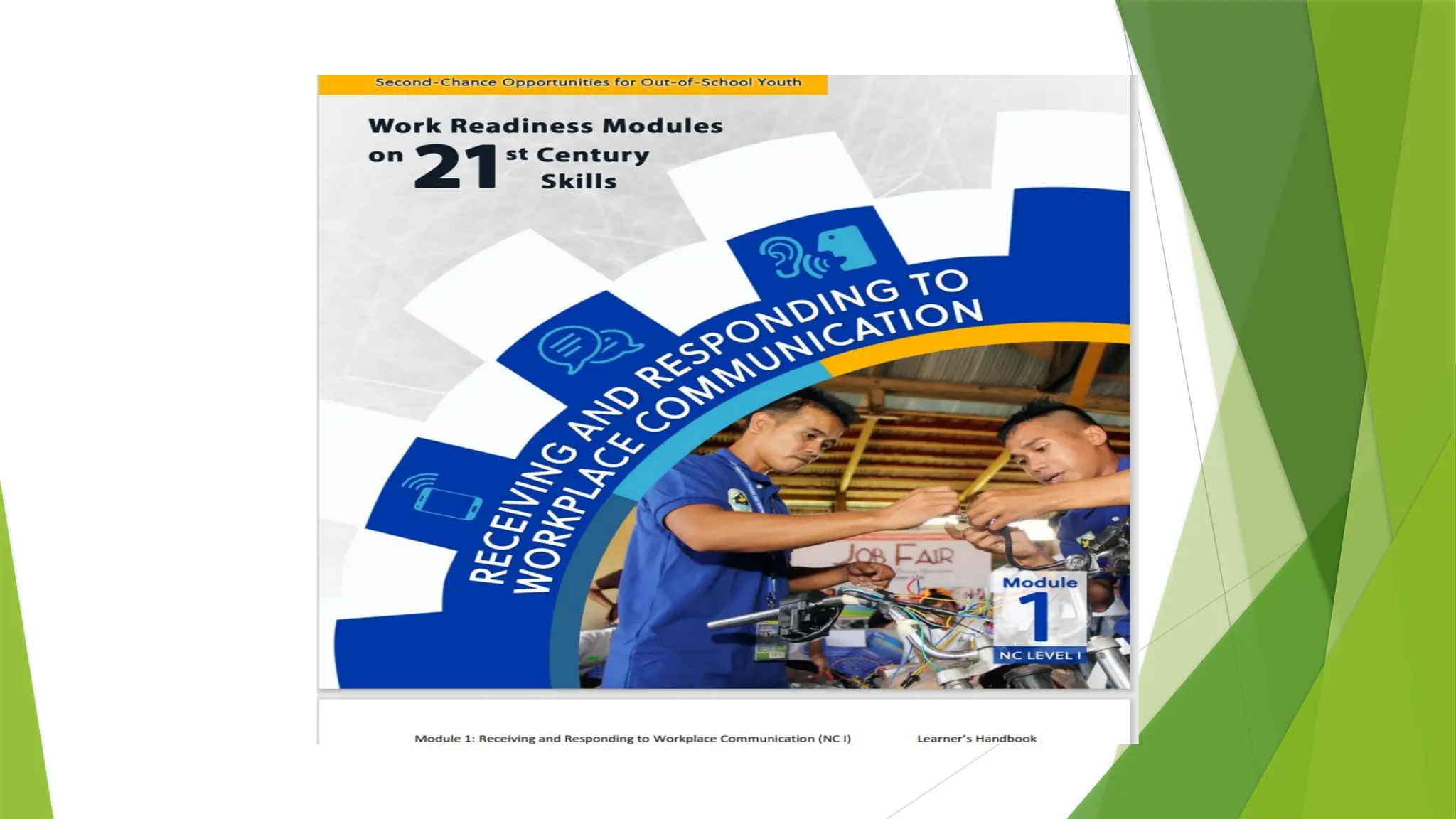
2. RECEIVING AND RESPONDING TO WORKPLACE
COMMUNICATION
3. SOLVING AND ADDRESSING ROUTINE PROBLEMS
4. ENHANCING SELF-MANAGEMENT SKILLS
5. SUPPORTING INNOVATION
21st
Century Modules of NC I
6. ACCESSING AND MAINTAINING INFORMATION
7. FOLLOWING OCCUPATIONAL SAFETY AND HEALTH POLICIES AND
PROCEDURES
8. APPLYING ENVIRONMENT WORK STANDARDS
9. ADOPTING AN ENTREPRENEURIAL MINDSET IN THE WORKPLACE
Work Readiness Modules on 21st Century
Skills Self-Directed Learning Approach
 The Work Readiness Modules on 21st Century Skills are
meant to be engaging and interactive.
 Self-Directed Learning Approach
What can we see in the Modules
1. TESDA unit description and learning outcomes and an overview of
activities and recommended time to complete the activities.
2. Each module has a list of written assignments and skills demonstration box
which lists the activities that will help you develop your skills. Some of
these will be measured using a rubric.
3. A module begins and ends with a learner reflection (self-assessment)
which is used as a skills check.
4. There is also a short end-of module assessment (quiz) at the end of each
module. You will also find key to correction at the tail end pages of each
module where you can check your answers to quiz as well as appropriate
responses to exercises and activities.
5. Modules are divided into sessions which correspond to the learning
outcomes. Each session contains 2 – 5 activities.
6. At the beginning of each session, you will find a table that links the
session to TESDA’s performance criteria. Each session typically has 3
or more performance criteria.
7. This is followed by a textbox containing the key topic and learning
points of the session.
8. Then there are the main activities, including that activity name, objectives, time required
and a variety of tasks for you to do.
 The tasks are represented by icons. Some of the icons you will see
include:
Requirements of the Learner’s to be
pass each module:
1. Learner Reflection at the beginning and end of
each module
2. Written Assignments: Please complete all written
work in the module.
3. End-of-Module Assessment
SAMPLE OF THE
MODULE
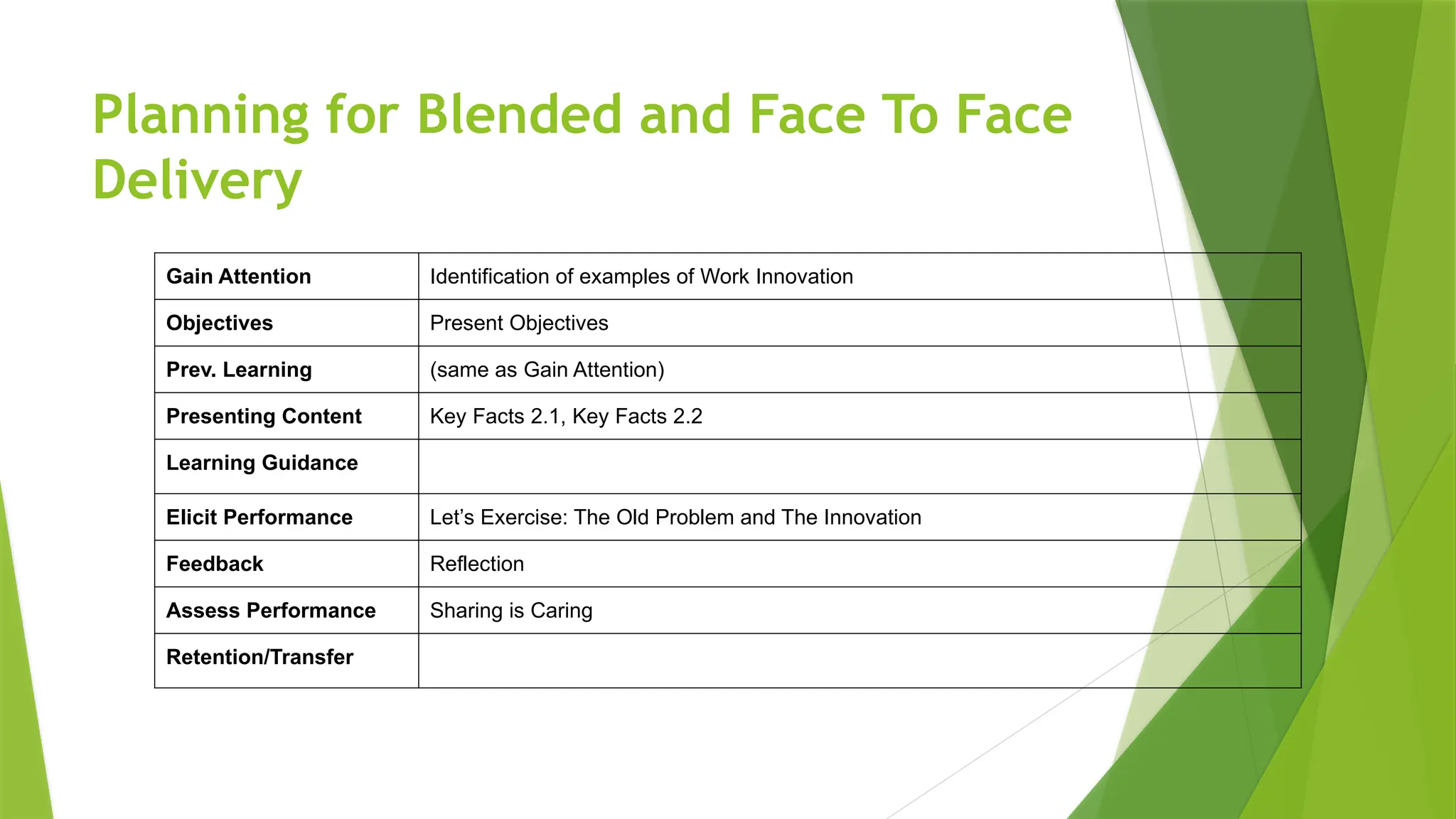
Planning for Blended and Face To Face
Delivery
Gain Attention Identification of examples of Work Innovation
Objectives Present Objectives
Prev. Learning (same as Gain Attention)
Presenting Content Key Facts 2.1, Key Facts 2.2
Learning Guidance
Elicit Performance Let’s Exercise: The Old Problem and The Innovation
Feedback Reflection
Assess Performance Sharing is Caring
Retention/Transfer
Thank you for listening
Presented by: Raymund SA. Catahimican

Work Readiness Modules on 21st Century Skills.pptx

  • 1.
    Work Readiness Modules on21st Century Skills
  • 2.
    Goals of theWork Readiness Modules on 21st Century Skills  Welcome to the Work Readiness Modules on 21st Century Skills! These modules will help prepare you to transition to further education and training as well as equip you with the knowledge and skills necessary to successfully find work or start your own business. The curriculum addresses the TESDA Competencies for 21st Century Skills.
  • 3.
    Upon completion ofthe NC I modules, you will be able to:  Communicate verbally and in writing in the workplace  Get along well with others, contribute to group activities  Demonstrate behavior and attitudes that are appropriate for the workplace and follow workplace policies and procedures  Solve and address routine problems  Develop personal and career goals, explore emotional reactions in work settings and identify learning styles and strategies
  • 4.
     Demonstrate standardhealth and safety practices, identify unsafe situations, and respond to emergencies and accidents  Support innovation in your area of work  Gather, explore and manage information  Identify environmental hazards and comply with environmental guidelines Develop an entrepreneurial mindset ✓
  • 5.
    21st Century Modules ofNC I 1. PARTICIPATING IN WORKPLACE COMMUNICATION 2. RECEIVING AND RESPONDING TO WORKPLACE COMMUNICATION 3. SOLVING AND ADDRESSING ROUTINE PROBLEMS 4. ENHANCING SELF-MANAGEMENT SKILLS 5. SUPPORTING INNOVATION
  • 6.
    21st Century Modules ofNC I 6. ACCESSING AND MAINTAINING INFORMATION 7. FOLLOWING OCCUPATIONAL SAFETY AND HEALTH POLICIES AND PROCEDURES 8. APPLYING ENVIRONMENT WORK STANDARDS 9. ADOPTING AN ENTREPRENEURIAL MINDSET IN THE WORKPLACE
  • 7.
    Work Readiness Moduleson 21st Century Skills Self-Directed Learning Approach  The Work Readiness Modules on 21st Century Skills are meant to be engaging and interactive.  Self-Directed Learning Approach
  • 8.
    What can wesee in the Modules 1. TESDA unit description and learning outcomes and an overview of activities and recommended time to complete the activities. 2. Each module has a list of written assignments and skills demonstration box which lists the activities that will help you develop your skills. Some of these will be measured using a rubric. 3. A module begins and ends with a learner reflection (self-assessment) which is used as a skills check. 4. There is also a short end-of module assessment (quiz) at the end of each module. You will also find key to correction at the tail end pages of each module where you can check your answers to quiz as well as appropriate responses to exercises and activities.
  • 9.
    5. Modules aredivided into sessions which correspond to the learning outcomes. Each session contains 2 – 5 activities. 6. At the beginning of each session, you will find a table that links the session to TESDA’s performance criteria. Each session typically has 3 or more performance criteria.
  • 10.
    7. This isfollowed by a textbox containing the key topic and learning points of the session. 8. Then there are the main activities, including that activity name, objectives, time required and a variety of tasks for you to do.
  • 11.
     The tasksare represented by icons. Some of the icons you will see include:
  • 12.
    Requirements of theLearner’s to be pass each module: 1. Learner Reflection at the beginning and end of each module 2. Written Assignments: Please complete all written work in the module. 3. End-of-Module Assessment
  • 13.
  • 18.
    Planning for Blendedand Face To Face Delivery Gain Attention Identification of examples of Work Innovation Objectives Present Objectives Prev. Learning (same as Gain Attention) Presenting Content Key Facts 2.1, Key Facts 2.2 Learning Guidance Elicit Performance Let’s Exercise: The Old Problem and The Innovation Feedback Reflection Assess Performance Sharing is Caring Retention/Transfer
  • 20.
    Thank you forlistening Presented by: Raymund SA. Catahimican