FINAL PROJECT: FINAL SUBMISSION
SUBMITTED BY
ERIC BENJAMIN
WALDEN UNIVERSITY
(PUBH 6129)(SPRING QUARTER)
17TH May, 2015
2
Final Project Component1: Introduction
Malaria is a life-threatening blood disease that is characterized by intermittent and remittent fever and
anemia, jaundice, splenomegaly and hypoglycemia in severe cases.Malaria is caused by a protozoan
parasite that invades human red blood cells, and can be transmitted from one person to another by
mosquitoes. Among the four kinds of malaria parasites (p. ovale, p. vivax, p. malariae and p. falciparum)
that infect humans, Plasmodium falciparum most often result in severe infection that may lead to death if
not promptly treated (Markle, Fisher & Smego, 2014).
There are certain factors that must be present for the parasite to complete its life cycle depending on the
species of mosquito involved. For instance, the tropical climate in the sub-Saharan Africa regions
particularly Nigeria is highly favorable to the Anopheles species. The human host and breeding sites
(stagnant waters and tropical forests) are also common factors that have warranted malaria to be endemic
in Africa (Markle, et al. 2014). As a result, the focus of this project would be Nigeria because malaria is
the major public health problem coupled with the weak public health system (The Presidential Malaria
Initiative [PMI], 2014).
In the global context, the estimated number of malaria cases in Nigeria is 100 million with about 300,000
deaths per year. Thus making Nigeria the most populous nation with about 2.6% estimated annual growth
rate in a total population of approximately 172 million in Africa. The mortality rate resulting from malaria
is very high compared to that of HIV/AIDS (215,000). Also, about 65% of Nigerians live in poverty,
hence making it difficult to combat malaria efficiently. The burden of malaria placed Nigeria as the 17th
PMI country in 2010, and $43.6 and $43.2 million were received in 2011 and 2012 respectively as an aid
to combat the disease (PMI,2014). Because malaria is preventable and treatable, the burden can be
eliminated.
3
Health Indicators
Nigeria is divided into 36 states and a centralized capital city – Abuja. The states are further grouped into
six geopolitical zones – North Central, North East, North West,South-South, and South West. There are
774 constitutionally recognized local government areas that are unevenly distributed across the states
(Federal Ministry of Health [FMOH], 2013).
Nigeria is considered one of the most populous countries in Africa with over 160 million people. The
morbidity rate resulting from malaria infection is approximately 90 percent of the total population, and
mortality rate of 207,000 each year. Due to this high figure, Nigeria is ranked as the country with the
highest burden of malaria in the sub-Saharan Africa (Noland, Graves, Sallau, Eigege, Emukah,
Patterson…& Richards,2014). The country’s geographic setting and climate is suitable for the breeding
of the Anopheles mosquito; thus making it a malaria-endemic region. However,the distribution of the
health indicators mentioned above varies considerably according to the six geopolitical zones. For
instance, in a cross-sectional study between two northern states – Sokoto and Bauchi; it was found that
malaria infection among children below the age five were high relatively high (Millar, McCutcheon,
Coakley, Brieger, Ibrahim, Mohammed, ….& Sambisa, 2014).
In another cross-sectionalstudy, high morbidity and mortality due to malaria was observed among
children at the same age level – below five (Odu, Mitchell, Isa, Ugot, Yusuf, Cockroft,…. & Anderson,
2015). The observed differences in the disease distribution among the children below age five were
related to socioeconomic status. For instance, the examined northern states experienced a shortage of
essential malaria supplies and limited access to the health facility (Millar, et al. 2014). But in the South
East– Cross River, mothers were less likely to seek treatment for affected children even when health
facilities were available (Odu et al. (2015). Also, in a study based on multilevel analysis, the prevalence
of malaria was found to be higher in the rural environment than in the urban setting (Yusuf, Adeoye,
4
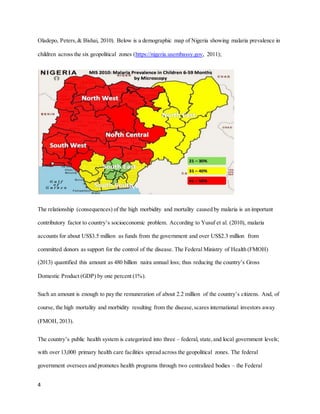
Oladepo, Peters,& Bishai, 2010). Below is a demographic map of Nigeria showing malaria prevalence in
children across the six geopolitical zones (https://nigeria.usembassy.gov, 2011);
The relationship (consequences) of the high morbidity and mortality caused by malaria is an important
contributory factor to country’s socioeconomic problem. According to Yusuf et al. (2010), malaria
accounts for about US$3.5 million as funds from the government and over US$2.3 million from
committed donors as support for the control of the disease. The Federal Ministry of Health (FMOH)
(2013) quantified this amount as 480 billion naira annual loss; thus reducing the country’s Gross
Domestic Product (GDP) by one percent (1%).
Such an amount is enough to pay the remuneration of about 2.2 million of the country’s citizens. And, of
course, the high mortality and morbidity resulting from the disease,scares international investors away
(FMOH, 2013).
The country’s public health system is categorized into three – federal, state,and local government levels;
with over 13,000 primary health care facilities spread across the geopolitical zones. The federal
government oversees and promotes health programs through two centralized bodies – the Federal
5
Ministry of Health (FMOH) and the National Primary Health Care Development Agency. Unfortunately,
the health facilities are not evenly distributed among the 36 states owing to weak economy and
corruption. The existing health facilities lack proper coordination and skilled manpower (The Presidential
Malaria Initiative [PMI], 2014).
The inefficiency of the health system has also contributed to the incidence of malaria in the country. For
example, the lack of health facilities in a majority of the rural areas can lead to self-medication with
unhygienic locally made herbs; and even death from acute infection. Shortage of well-trained health
professionals and ill-equipped primary health care centers can result in inadequate diagnosis and
treatment. Poor logistic and inadequate coordination between the primary care facilities and the FMOH
leads in inequitable distribution of malaria supplies. As a consequence the intervention measures become
ineffective; including the MDG6 goal – combating HIV/AIDS,malaria and other diseases (PMI,2014).
The reasons for the setback mentioned above in combating the disease is poor economy exacerbated by –
large population, drug resistance,and insecurity as well as civil unrest (PMI, 2014).
Health Determinants
Among African nations, Nigeria is faced with the highest malaria burden (51 million cases and a
mortality of 207,000) every year. Also, of the 160 million populations, about 97% are prone to
Plasmodium infection. In spite of intervention strategies adopted to curb the menace,malaria has
remained critical to public health (Noland, Graves, Sallau, Eigege, Emukah, Patterson & Richards, 2014).
The burden of malaria can be attributed to severalcauses such as – socio-cultural, economic and
environmental factors. Non-compliance with the use of mosquito treated nets is an example of a socio-
cultural factor. Eteng, Mitchell, Garba, Ana, Liman, Cockroft, & Anderson (2014), found in their research
that the fear of adverse effect and discomfort associated with the use of treated net; as well as poorly
ventilated apartments were some given reasons by participants for not using the treated bed net.
6
Also, according to Eteng et al. (2014), education played a significant role as children to educated parents
who attended Anti-Natal Clinic (ANC) slept more under treated net compared to those of non-educated
parents. The observed disparity was related to high cost of accessing health care facilities in distant
locations by the non-educated parents. As a consequence of poverty, lack of education also affected the
way parents understand message included in public awareness campaigns.
In another study, the relationship between social determinants and the time frame parents take to seek
malaria treatment for their children was examined. The result revealed that of the 738 participating
mothers, only 22% sought treatment within 24 hours after onset of malaria symptom. The remaining 78%
delayed seeking treatment owing to various reasons. For instance, 30.5% considered transportation cost to
distant health centers,and 28.5% were due to the cultural belief (Chukwuocha, Okpanma, & Nwakwuo,
2013). In another example, mothers from polygamous marriage sought treatment for their children more
than their monogamous counterpart; due to competition among the former to maintain more children
believing that such will create room for more favor and love from their husband (Chukwuocha et al.,
2013). The majority of the mothers that delayed seeking treatment used native herbs and drugs with high
resistance against malaria to treat their children.
In terms of an environmental factor, the climate (warm temperature and high rainfall) in Nigeria is
favorable for the breeding of Anopheles Mosquitoes. Also, due to poverty majority of the population
reside in a dirty environment with poor drainage and sanitary systems. The un-channeled waste water
from such systems is suitable breeding sites for Anopheles Mosquitoes (PMI,2014).
The poor population especially children under-five (one in every five deaths) spread across the six geo-
political zones are more vulnerable to the disease. The factors associated with this vulnerability include –
cultural beliefs, and poverty in relation to a lack of education. According to Chukwuocha et al. (2013),
mothers in monogamous marriages depending on their husbands decision was significantly associated
with delay in seeking treatment for children. In addition, the exclusion of women in the decision-making
7
process is a function of lack of education. Another factor responsible for the under-five susceptibility to
the disease is their lack of developed immune system to fight infection.
In a global context, Ghana is another West African country with a similar burden of Plasmodium
infection. There are over 3.5 million cases and 20,000 deaths of children under the ages of five; as well as
61% hospital admissions of children under-five annually (Nyarko, & Cobblah, 2014). Nigeria and DRC
Congo are by geographic and economic standard in a similar situation in terms of the malaria burden.
Both countries are said to account for about 58% of malaria infection and deaths in Africa. And 60% of
the World Bank donated resources for malaria control goes to both countries. Contrarily, the number of
confirmed malaria cases in South Africa has reduced to the barest minimum (20 per 1000) cases as at
2013. As a result, the World Bank classified South Africa as an upper middle-income country with
moderate cases that requires no funding (World Bank, 2014).
Responding to malaria challenges
Nigeria joined the league of African countries to ensure the realization of the 2001 Abuja declaration to
reduce by half the burden of malaria by the year 2010. The strategic plan was however revised by the
National Malaria Control Program (NMCP),the Roll Back Malaria (RBM) partners,state and local
government health authorities; to cover 2013 period to respond to the new global approach to malaria
control efforts. The action plans include the following: Distribution of long-lasting Insecticide Nets
(LLINs) and Mass Drug Administration (MDA). The country adopted two strategies to achieve this – the
“catch-up” and keep-up distribution campaigns. The former involves house-to-house distribution of net
cards,which serves as a pre-requisite for every household to receive at least two LLINs. Whereas,the
latter is to maintain the coverage attained by the catch-up by redistribution of the LLINs when needed.
Where house-to-house distribution is not feasible, a central point distribution is recommended and
pregnant women, and mothers of under-five children attending antenatal and postnatal clinics are
provided with LLINs and other malaria intervention materials (FMOH,2013).
8
Another strategy is the Indoor Residual Spraying (IRS). The NMCP have trained malaria focal persons as
well as Front Line Health Facility (FLHF) staff at the state and local government levels to sensitize
community leaders to the importance of IRS (FMOH, 2013). The LLINs and the IRS are referred to as
Integrated Vector Management (IVM) strategy and are the most effective intervention strategies. In
addition to the above, NMCP also adopted the Larval Source Management (LSM) and Prompt Case
Management (PCM) strategies. The LSM involves larviciding larval sources in the environment as may
have been identified by community members or malaria focal persons at the State/LGA levels. Whereas,
at the PCM level, malaria focal persons and FLHF staff are trained to recognize, detect and report signs of
malaria morbidity using common symptoms. Treatment of confirmed malaria infections is carried out at
the FLHF center in the community, but severe and adverse events and non-response cases are referred to
the nearest secondary health facility for expertise management. The reason for adopting the above
strategies is to give direction towards the attainment of reduction by half malaria-related morbidity and
mortality in Nigeria (FMOH, 2013).
Policies for global health ethics
Nigeria has malaria policies that highlight the position of the government in terms of implementing the
activities of the designated programs. They include co-implementation of interventions and sharing of
resource between programs; maintaining training and re-training of FLHF staff and focal persons at the
national, state and local government levels; joint routine monitoring of all programs and evaluation of
programs by external team to assess performance indicators. Under the NMCP,there is a policy requiring
all pregnant women to receive a minimum of two doses of Sulfadoxine-pyrimidine (SP/Fansidar)
medication during antenatalcare to reduce the risk of malaria (FMOH, 2013).
Communication strategies
The malaria communication strategies in place for this country include – social mobilization, behavioral
change communication and communication through mass media. In social mobilization, program officials
9
take advantage of non-traditional channels such as drama,new yam festivals and other social gatherings
to sensitize and educate the population on malaria health messages. Health messages on posters and T-
shirts are also conveyed in schools, and markets through social mobilization. Program officials also
involve celebrities and stakeholders on TV and Live talk shows, radio advertisements and advocacy visits
to policy makers at the level of implementation. Lastly, the behavioral change communication involves
home based demonstrations of LLNs use by Community Oriented Resource Persons (CORPS). CORPs
also negotiates the hosting of malaria desired promotional messages at the community level. The above
strategies are highly effective. According FMOH (2013) report, as of 2013, about 50 million LLINs had
been distributed through mass campaigns to 34 out of 36 states in the country.
While the above intervention measures are unique, they cannot be exhaustive. Thus, in addition to the
above, the NMCP will need to assess the knowledge, attitudes and practices regarding malaria in the
population across the states. Program officials should advocate policies that regulate environmental
sanitation since it is the major factor promote the morbidity of the disease in the country. Examples
include the construction of a closed drainage system and fumigation of stagnant water bodies. In addition
adequate distribution of effective drugs for prompt treatment and improving the remuneration of public
health workers will help to bring about positive social change in curbing malaria.
10
References
Chukwuocha, UM., Okpanma, AC., & Chukwuocha, GC. (2013).Social determinants of malaria
treatment seeking time by mothers for children (0-5 years) in South Eastern Nigeria,
Journal of Tropical Diseases, 3(1), 1-6.http://dx.doi.org/10.4172/2329-891x.1000154
Eteng, M., Mitchell, S., Garba, L., Ana, O., Liman, M., Cockroft, A., & Andersson, N.
(2014).Socio-economic determinants of ownership and use of treated bed nets in Nigeria:
results from a cross-sectional study in Cross River and Bauchi States in 2011, Malaria
Journal 13(1), 310-316. Retrieved from http://www.malariajournal.com/content/13/1/316
Federal Ministry of Health (2013).Guideline for malaria-lymphatic filariasis co-implementation
in Nigeria, Retrieved from
http://www.cartercenter.org/resources/pdfs/news/health_publications/malaria/guidelines-
malaria-lf-co-implementation-nigeria-9-13.pdf
Markle, W. H.,Fisher, M. A., & Smego, R. A.,Jr. (2014).Understanding global health (2nd
ed.). New
York, NY:McGraw-Hill
Millar, K., McCutcheon, J., Coakley, E., Brieger, W., Ibrahim, M., Mohammed, Z.…& Sambisa,
W. (2014).Patterns and predictors of malaria care-seeking, diagnostic testing, and
artemisinin-based combination therapy for children under five with fever in northern
Nigeria: a cross-sectional study, Malaria Journal, 13(447), 1-12.doi:10.1186/1475-2875-
13-447
Noland, G., Graves, P., Sallau, A., Eigege, A., Emukah, E., Patterson, A…& Richards, F.
(2014).Malaria prevalence, anemia and baseline intervention coverage prior to mass net
distribution in Abia and Plateau States, Nigeria, BMC Infectious Diseases, 14(168), 1-
9.doi.10.1186/1471-2334-14-168
Nyarko, H., & Cobblah, A. (2014).Sociodemographic determinants of malaria among under-five
children in Ghana, Malaria Research and Treatment, 2014(2014), 1-
6.http://dx.doi.org/10.1155/2014/304361
11
Odu, B., Mitchell, S., Isa, H., Ugot, I., Yusuf, R., Cockroft, A., & Anderson, N. (2015).Equity
and seeking treatment for young children with fever in Nigeria: a cross-sectional study in
Cross River and Bauchi States, Infectious Disease of Poverty, 4(1), 1-
2.doi.10.1186/2049-9957-4-1
The President’s Malaria Initiative (2014).Nigeria malaria operational plan FY 2014.Retrieved
from www.pmi.gov/docs/default-source/default-document-library/malaria-operational-
plans/fy14/nigeria_mop_fy14.pdf?stvrsn=10
United States Embassy in Nigeria (2011).Nigeria malaria fact sheet. Retrieved from
http://photos.state.gov/libraries/nigeria/231771/Public/December-MalariaFactSheet2.pdf
World Bank (2014).Highlights world development indicators, Retrieved from
data.worldbank.org/sites/default/files/wdi2014-highlights.pdf

WK11ProjBenjaminE

  • 1.
    FINAL PROJECT: FINALSUBMISSION SUBMITTED BY ERIC BENJAMIN WALDEN UNIVERSITY (PUBH 6129)(SPRING QUARTER) 17TH May, 2015
  • 2.
    2 Final Project Component1:Introduction Malaria is a life-threatening blood disease that is characterized by intermittent and remittent fever and anemia, jaundice, splenomegaly and hypoglycemia in severe cases.Malaria is caused by a protozoan parasite that invades human red blood cells, and can be transmitted from one person to another by mosquitoes. Among the four kinds of malaria parasites (p. ovale, p. vivax, p. malariae and p. falciparum) that infect humans, Plasmodium falciparum most often result in severe infection that may lead to death if not promptly treated (Markle, Fisher & Smego, 2014). There are certain factors that must be present for the parasite to complete its life cycle depending on the species of mosquito involved. For instance, the tropical climate in the sub-Saharan Africa regions particularly Nigeria is highly favorable to the Anopheles species. The human host and breeding sites (stagnant waters and tropical forests) are also common factors that have warranted malaria to be endemic in Africa (Markle, et al. 2014). As a result, the focus of this project would be Nigeria because malaria is the major public health problem coupled with the weak public health system (The Presidential Malaria Initiative [PMI], 2014). In the global context, the estimated number of malaria cases in Nigeria is 100 million with about 300,000 deaths per year. Thus making Nigeria the most populous nation with about 2.6% estimated annual growth rate in a total population of approximately 172 million in Africa. The mortality rate resulting from malaria is very high compared to that of HIV/AIDS (215,000). Also, about 65% of Nigerians live in poverty, hence making it difficult to combat malaria efficiently. The burden of malaria placed Nigeria as the 17th PMI country in 2010, and $43.6 and $43.2 million were received in 2011 and 2012 respectively as an aid to combat the disease (PMI,2014). Because malaria is preventable and treatable, the burden can be eliminated.
  • 3.
    3 Health Indicators Nigeria isdivided into 36 states and a centralized capital city – Abuja. The states are further grouped into six geopolitical zones – North Central, North East, North West,South-South, and South West. There are 774 constitutionally recognized local government areas that are unevenly distributed across the states (Federal Ministry of Health [FMOH], 2013). Nigeria is considered one of the most populous countries in Africa with over 160 million people. The morbidity rate resulting from malaria infection is approximately 90 percent of the total population, and mortality rate of 207,000 each year. Due to this high figure, Nigeria is ranked as the country with the highest burden of malaria in the sub-Saharan Africa (Noland, Graves, Sallau, Eigege, Emukah, Patterson…& Richards,2014). The country’s geographic setting and climate is suitable for the breeding of the Anopheles mosquito; thus making it a malaria-endemic region. However,the distribution of the health indicators mentioned above varies considerably according to the six geopolitical zones. For instance, in a cross-sectional study between two northern states – Sokoto and Bauchi; it was found that malaria infection among children below the age five were high relatively high (Millar, McCutcheon, Coakley, Brieger, Ibrahim, Mohammed, ….& Sambisa, 2014). In another cross-sectionalstudy, high morbidity and mortality due to malaria was observed among children at the same age level – below five (Odu, Mitchell, Isa, Ugot, Yusuf, Cockroft,…. & Anderson, 2015). The observed differences in the disease distribution among the children below age five were related to socioeconomic status. For instance, the examined northern states experienced a shortage of essential malaria supplies and limited access to the health facility (Millar, et al. 2014). But in the South East– Cross River, mothers were less likely to seek treatment for affected children even when health facilities were available (Odu et al. (2015). Also, in a study based on multilevel analysis, the prevalence of malaria was found to be higher in the rural environment than in the urban setting (Yusuf, Adeoye,
  • 4.
    4 Oladepo, Peters,& Bishai,2010). Below is a demographic map of Nigeria showing malaria prevalence in children across the six geopolitical zones (https://nigeria.usembassy.gov, 2011); The relationship (consequences) of the high morbidity and mortality caused by malaria is an important contributory factor to country’s socioeconomic problem. According to Yusuf et al. (2010), malaria accounts for about US$3.5 million as funds from the government and over US$2.3 million from committed donors as support for the control of the disease. The Federal Ministry of Health (FMOH) (2013) quantified this amount as 480 billion naira annual loss; thus reducing the country’s Gross Domestic Product (GDP) by one percent (1%). Such an amount is enough to pay the remuneration of about 2.2 million of the country’s citizens. And, of course, the high mortality and morbidity resulting from the disease,scares international investors away (FMOH, 2013). The country’s public health system is categorized into three – federal, state,and local government levels; with over 13,000 primary health care facilities spread across the geopolitical zones. The federal government oversees and promotes health programs through two centralized bodies – the Federal
  • 5.
    5 Ministry of Health(FMOH) and the National Primary Health Care Development Agency. Unfortunately, the health facilities are not evenly distributed among the 36 states owing to weak economy and corruption. The existing health facilities lack proper coordination and skilled manpower (The Presidential Malaria Initiative [PMI], 2014). The inefficiency of the health system has also contributed to the incidence of malaria in the country. For example, the lack of health facilities in a majority of the rural areas can lead to self-medication with unhygienic locally made herbs; and even death from acute infection. Shortage of well-trained health professionals and ill-equipped primary health care centers can result in inadequate diagnosis and treatment. Poor logistic and inadequate coordination between the primary care facilities and the FMOH leads in inequitable distribution of malaria supplies. As a consequence the intervention measures become ineffective; including the MDG6 goal – combating HIV/AIDS,malaria and other diseases (PMI,2014). The reasons for the setback mentioned above in combating the disease is poor economy exacerbated by – large population, drug resistance,and insecurity as well as civil unrest (PMI, 2014). Health Determinants Among African nations, Nigeria is faced with the highest malaria burden (51 million cases and a mortality of 207,000) every year. Also, of the 160 million populations, about 97% are prone to Plasmodium infection. In spite of intervention strategies adopted to curb the menace,malaria has remained critical to public health (Noland, Graves, Sallau, Eigege, Emukah, Patterson & Richards, 2014). The burden of malaria can be attributed to severalcauses such as – socio-cultural, economic and environmental factors. Non-compliance with the use of mosquito treated nets is an example of a socio- cultural factor. Eteng, Mitchell, Garba, Ana, Liman, Cockroft, & Anderson (2014), found in their research that the fear of adverse effect and discomfort associated with the use of treated net; as well as poorly ventilated apartments were some given reasons by participants for not using the treated bed net.
  • 6.
    6 Also, according toEteng et al. (2014), education played a significant role as children to educated parents who attended Anti-Natal Clinic (ANC) slept more under treated net compared to those of non-educated parents. The observed disparity was related to high cost of accessing health care facilities in distant locations by the non-educated parents. As a consequence of poverty, lack of education also affected the way parents understand message included in public awareness campaigns. In another study, the relationship between social determinants and the time frame parents take to seek malaria treatment for their children was examined. The result revealed that of the 738 participating mothers, only 22% sought treatment within 24 hours after onset of malaria symptom. The remaining 78% delayed seeking treatment owing to various reasons. For instance, 30.5% considered transportation cost to distant health centers,and 28.5% were due to the cultural belief (Chukwuocha, Okpanma, & Nwakwuo, 2013). In another example, mothers from polygamous marriage sought treatment for their children more than their monogamous counterpart; due to competition among the former to maintain more children believing that such will create room for more favor and love from their husband (Chukwuocha et al., 2013). The majority of the mothers that delayed seeking treatment used native herbs and drugs with high resistance against malaria to treat their children. In terms of an environmental factor, the climate (warm temperature and high rainfall) in Nigeria is favorable for the breeding of Anopheles Mosquitoes. Also, due to poverty majority of the population reside in a dirty environment with poor drainage and sanitary systems. The un-channeled waste water from such systems is suitable breeding sites for Anopheles Mosquitoes (PMI,2014). The poor population especially children under-five (one in every five deaths) spread across the six geo- political zones are more vulnerable to the disease. The factors associated with this vulnerability include – cultural beliefs, and poverty in relation to a lack of education. According to Chukwuocha et al. (2013), mothers in monogamous marriages depending on their husbands decision was significantly associated with delay in seeking treatment for children. In addition, the exclusion of women in the decision-making
  • 7.
    7 process is afunction of lack of education. Another factor responsible for the under-five susceptibility to the disease is their lack of developed immune system to fight infection. In a global context, Ghana is another West African country with a similar burden of Plasmodium infection. There are over 3.5 million cases and 20,000 deaths of children under the ages of five; as well as 61% hospital admissions of children under-five annually (Nyarko, & Cobblah, 2014). Nigeria and DRC Congo are by geographic and economic standard in a similar situation in terms of the malaria burden. Both countries are said to account for about 58% of malaria infection and deaths in Africa. And 60% of the World Bank donated resources for malaria control goes to both countries. Contrarily, the number of confirmed malaria cases in South Africa has reduced to the barest minimum (20 per 1000) cases as at 2013. As a result, the World Bank classified South Africa as an upper middle-income country with moderate cases that requires no funding (World Bank, 2014). Responding to malaria challenges Nigeria joined the league of African countries to ensure the realization of the 2001 Abuja declaration to reduce by half the burden of malaria by the year 2010. The strategic plan was however revised by the National Malaria Control Program (NMCP),the Roll Back Malaria (RBM) partners,state and local government health authorities; to cover 2013 period to respond to the new global approach to malaria control efforts. The action plans include the following: Distribution of long-lasting Insecticide Nets (LLINs) and Mass Drug Administration (MDA). The country adopted two strategies to achieve this – the “catch-up” and keep-up distribution campaigns. The former involves house-to-house distribution of net cards,which serves as a pre-requisite for every household to receive at least two LLINs. Whereas,the latter is to maintain the coverage attained by the catch-up by redistribution of the LLINs when needed. Where house-to-house distribution is not feasible, a central point distribution is recommended and pregnant women, and mothers of under-five children attending antenatal and postnatal clinics are provided with LLINs and other malaria intervention materials (FMOH,2013).
  • 8.
    8 Another strategy isthe Indoor Residual Spraying (IRS). The NMCP have trained malaria focal persons as well as Front Line Health Facility (FLHF) staff at the state and local government levels to sensitize community leaders to the importance of IRS (FMOH, 2013). The LLINs and the IRS are referred to as Integrated Vector Management (IVM) strategy and are the most effective intervention strategies. In addition to the above, NMCP also adopted the Larval Source Management (LSM) and Prompt Case Management (PCM) strategies. The LSM involves larviciding larval sources in the environment as may have been identified by community members or malaria focal persons at the State/LGA levels. Whereas, at the PCM level, malaria focal persons and FLHF staff are trained to recognize, detect and report signs of malaria morbidity using common symptoms. Treatment of confirmed malaria infections is carried out at the FLHF center in the community, but severe and adverse events and non-response cases are referred to the nearest secondary health facility for expertise management. The reason for adopting the above strategies is to give direction towards the attainment of reduction by half malaria-related morbidity and mortality in Nigeria (FMOH, 2013). Policies for global health ethics Nigeria has malaria policies that highlight the position of the government in terms of implementing the activities of the designated programs. They include co-implementation of interventions and sharing of resource between programs; maintaining training and re-training of FLHF staff and focal persons at the national, state and local government levels; joint routine monitoring of all programs and evaluation of programs by external team to assess performance indicators. Under the NMCP,there is a policy requiring all pregnant women to receive a minimum of two doses of Sulfadoxine-pyrimidine (SP/Fansidar) medication during antenatalcare to reduce the risk of malaria (FMOH, 2013). Communication strategies The malaria communication strategies in place for this country include – social mobilization, behavioral change communication and communication through mass media. In social mobilization, program officials
  • 9.
    9 take advantage ofnon-traditional channels such as drama,new yam festivals and other social gatherings to sensitize and educate the population on malaria health messages. Health messages on posters and T- shirts are also conveyed in schools, and markets through social mobilization. Program officials also involve celebrities and stakeholders on TV and Live talk shows, radio advertisements and advocacy visits to policy makers at the level of implementation. Lastly, the behavioral change communication involves home based demonstrations of LLNs use by Community Oriented Resource Persons (CORPS). CORPs also negotiates the hosting of malaria desired promotional messages at the community level. The above strategies are highly effective. According FMOH (2013) report, as of 2013, about 50 million LLINs had been distributed through mass campaigns to 34 out of 36 states in the country. While the above intervention measures are unique, they cannot be exhaustive. Thus, in addition to the above, the NMCP will need to assess the knowledge, attitudes and practices regarding malaria in the population across the states. Program officials should advocate policies that regulate environmental sanitation since it is the major factor promote the morbidity of the disease in the country. Examples include the construction of a closed drainage system and fumigation of stagnant water bodies. In addition adequate distribution of effective drugs for prompt treatment and improving the remuneration of public health workers will help to bring about positive social change in curbing malaria.
  • 10.
    10 References Chukwuocha, UM., Okpanma,AC., & Chukwuocha, GC. (2013).Social determinants of malaria treatment seeking time by mothers for children (0-5 years) in South Eastern Nigeria, Journal of Tropical Diseases, 3(1), 1-6.http://dx.doi.org/10.4172/2329-891x.1000154 Eteng, M., Mitchell, S., Garba, L., Ana, O., Liman, M., Cockroft, A., & Andersson, N. (2014).Socio-economic determinants of ownership and use of treated bed nets in Nigeria: results from a cross-sectional study in Cross River and Bauchi States in 2011, Malaria Journal 13(1), 310-316. Retrieved from http://www.malariajournal.com/content/13/1/316 Federal Ministry of Health (2013).Guideline for malaria-lymphatic filariasis co-implementation in Nigeria, Retrieved from http://www.cartercenter.org/resources/pdfs/news/health_publications/malaria/guidelines- malaria-lf-co-implementation-nigeria-9-13.pdf Markle, W. H.,Fisher, M. A., & Smego, R. A.,Jr. (2014).Understanding global health (2nd ed.). New York, NY:McGraw-Hill Millar, K., McCutcheon, J., Coakley, E., Brieger, W., Ibrahim, M., Mohammed, Z.…& Sambisa, W. (2014).Patterns and predictors of malaria care-seeking, diagnostic testing, and artemisinin-based combination therapy for children under five with fever in northern Nigeria: a cross-sectional study, Malaria Journal, 13(447), 1-12.doi:10.1186/1475-2875- 13-447 Noland, G., Graves, P., Sallau, A., Eigege, A., Emukah, E., Patterson, A…& Richards, F. (2014).Malaria prevalence, anemia and baseline intervention coverage prior to mass net distribution in Abia and Plateau States, Nigeria, BMC Infectious Diseases, 14(168), 1- 9.doi.10.1186/1471-2334-14-168 Nyarko, H., & Cobblah, A. (2014).Sociodemographic determinants of malaria among under-five children in Ghana, Malaria Research and Treatment, 2014(2014), 1- 6.http://dx.doi.org/10.1155/2014/304361
  • 11.
    11 Odu, B., Mitchell,S., Isa, H., Ugot, I., Yusuf, R., Cockroft, A., & Anderson, N. (2015).Equity and seeking treatment for young children with fever in Nigeria: a cross-sectional study in Cross River and Bauchi States, Infectious Disease of Poverty, 4(1), 1- 2.doi.10.1186/2049-9957-4-1 The President’s Malaria Initiative (2014).Nigeria malaria operational plan FY 2014.Retrieved from www.pmi.gov/docs/default-source/default-document-library/malaria-operational- plans/fy14/nigeria_mop_fy14.pdf?stvrsn=10 United States Embassy in Nigeria (2011).Nigeria malaria fact sheet. Retrieved from http://photos.state.gov/libraries/nigeria/231771/Public/December-MalariaFactSheet2.pdf World Bank (2014).Highlights world development indicators, Retrieved from data.worldbank.org/sites/default/files/wdi2014-highlights.pdf