1
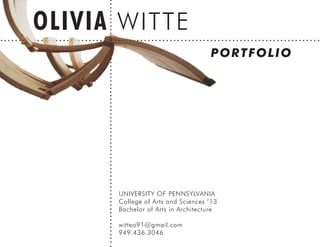
OLIVIA WITTE
UNIVERSITY OF PENNSYLVANIA
College of Arts and Sciences ‘13
Bachelor of Arts in Architecture
witteo91@gmail.com
949.436.3046
PORTFOLIO
2
TABLE OF CONTENTS
Representation
EXPLORATION
p. 1Body Survey
p. 3
Recut
FABRICATION
p. 4
Panel
p. 5
Biomimicry
ADAPTATION
p. 7
Habit(at) p. 9
Sun Facade
ENVIRONMENT
p. 12
Urban High Line p. 15
AP Art
EXPRESSION
p. 17
Graphics p. 19
3
Body Mapping
Using the dimensions and contours of the body, this project
focused on measuring the movement of a particular joint. First, I
created a photoshop image of the kinetic sequence. Next, I used
triangulation to map points and create hand drawings, which
detailed the change in movement and creasing in the foot.
ARCH 201: BODY SURVEY
1
4
BODY SURVEY
2
5
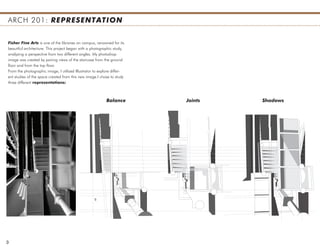
ARCH 201: REPRESENTATION
Balance			 	 Joints			 Shadows		
Fisher Fine Arts is one of the libraries on campus, renowned for its
beautiful architecture. This project began with a photographic study,
analyzing a perspective from two different angles. My photoshop
image was created by pairing views of the staircase from the ground
floor and from the top floor.
From the photographic image, I utilized Illustrator to explore differ-
ent studies of the space created from this new image.I chose to study
three different representations:
3
6
Recut: Recreate
Given a single 4x6 panel of plywood, this assig-
ment required recutting the material to create a
new design. From the small amount of material
given, I wanted to create a volume seemingly
much bigger. I did this by lasercutting identical
pieces that fit together to create this expanding,
spiral shape.
4
ARCH 202: RECUT
7
Environment
This project entailed creating a panel that took into account environmental surroundings.
The mobility of each of the individual panels allows for a space to be either fully enclosed,
or opened in an variety of different positions. To further facilitate the interaction with
humans in the space, the curve of the overall panel was created through a study with the
human body and how it would most easily fit in the space.
5
ARCH 202: PANEL
8
Half Scale Model
PANEL
6
9
Hand Drawings, Orthographic Views
HONEY BEE
	 Latina name: Apis mellifera
	 Order: Hymenoptera
Honey bees are a subset of bees in the genus Apis, primarily
distinguished by the production and storage of honey and the
construction of perennial, colonial nests out of wax. The honey
bee’s mouth is made up of two parts: the mandible and the pro-
boscis. The mandibles are the strong jaws of the bee, while the
proboscis is responsible for all tongue functions, incuding food
exchange.
In creating an analog, I chose to focus on the surprisingly strong
and important mouth section of the honeybee; using simplified
geometric forms to show the vertical movement of the mouth
parts that usually goes unnoticed.
7
ARCH 300: BIOMIMICRY
Analog, Axonometric
Analogical Model, Kinetic Sequence
BIOMIMICRY
8
11
ARCH 302: HABIT(AT)
9
Habit:
Our lives are made up of habits. This
project began by mapping and analyzing
a personal habit. For me, the first thing I
do every morning is put my contact lenses
in. I wear daily-use contact lenses, so I
have been forced to put my contacts in
every morning for the past eight years
of my life. While the location of where I
do this has changed over the years, the
movement and act of putting the contacts
into my eyes has become second nature
to me.
12
Using the mapping of the movement, the project
was transformed to inhabit a space that would best
faciliate the habit. I chose to focus on playing with
the idea between being in focus and out of focus;
in other words, before and after my contacts are in.
The space designed creates an environment that al-
lows the habit to be performed with as little eyesight
as possible and then allows one to enter the open
world, in focus, after the habit is completed.
Interpretation:
HABIT(AT)
10
13
HABIT(AT)
11
In the next step of the project, I translated my
original habit(at) design into a public, interactive
space along Philadelphia’s Schuylkill River. Placed
along the popular running path along the river, I
wanted to create a relaxing oasis where not only
runners could cool off, but also where children
could play.
14
12
ARCH 401: SUNSHADE
Weave to Sunshade:
This project began by studying a particular
weaving technique - in my case, the pearl
weave. The design for our sunshade, was
then developed by creating an originally
designed iteration of that weave. The final
design was fabricated and tested in the
sunlight to produce and analyze it’s shading
abilities and effects.
15
13
SUN FACADE
Sunshade to Sun Facade
The next development of the project was to
take the sunshade design, and transform it
into a larger scale project in Philadelphia’s
own Rittenhouse Square. In this new design,
I chose to explore and refine the kinetics and
shading abilities of the window.
16
SUN FACADE
14
Operational Diagrams
Exterior and Interior Renders
17
15
URBAN HIGH LINE
Urban Kale Farm:
Inspired by New York’s successfully
transfomed High Line in the Meatpack-
ing District, our final studio project
aimed to develop and evolve Philadel-
phia’s abandoned reading viaduct into
a thriving urban farm that gave back to
it’s surrounding community.
The project began by studying a
single crop - our group decided to
choose kale because not only was it
able to grow successfully throughout
all seasons, but it would also provide
healthy alternatives in a previously
obesity-stricken, and poor environment.
We then created a watering system
throughout the viaudct and its sur-
rounding areas, that was both able to
grow the kale hydroponically, as well
as create a visual spectable that would
make the viaduct a destination for all
community members.
18
16
URBAN HIGH LINE
Watering System:
The watering system that we devised also
sought to rectify another growing problem in
Philadelphia - the sewage system. Philaelphia,
in fact, has an overabundance of water in it’s
drainage systems. In our watering system, we
collected the majority of the water in large
collection pools on the tops of surrounding
buildings, which then cascaded down the
sides of the buildings (as seen in the section
drawings). From there, the water was used to
water the crops, and then were drained and
pumped up back to the collection pools to
keep from overflowing the sewage systems.
19
Shoe Craze:
These paintings (Acrylic on canvas) are selections from my AP
Art portfolio. For the theme of my portfolio, I chose to depict
the beautiful display of art that was my mother’s shoe closet.
I began the series by depicting just the shoes themselves, or
the shoes being used and put on, and then gradually grew
to depict the shoes becoming a life and entity of their own.
AP Art: Selections
17
20
AP Art
18
21
19
GRAPHICS: The Beet Box
22
20
GRAPHICS: Rent the RunwayPublished in Rent the Runway emails every week
23
GRAPHICS: Rent the Runway
21
24WITTE PORTFOLIO
witteo91@gmail.com
949.436.3046

Witte portfolio

  • 1.
    1 OLIVIA WITTE UNIVERSITY OFPENNSYLVANIA College of Arts and Sciences ‘13 Bachelor of Arts in Architecture witteo91@gmail.com 949.436.3046 PORTFOLIO
  • 2.
    2 TABLE OF CONTENTS Representation EXPLORATION p.1Body Survey p. 3 Recut FABRICATION p. 4 Panel p. 5 Biomimicry ADAPTATION p. 7 Habit(at) p. 9 Sun Facade ENVIRONMENT p. 12 Urban High Line p. 15 AP Art EXPRESSION p. 17 Graphics p. 19
  • 3.
    3 Body Mapping Using thedimensions and contours of the body, this project focused on measuring the movement of a particular joint. First, I created a photoshop image of the kinetic sequence. Next, I used triangulation to map points and create hand drawings, which detailed the change in movement and creasing in the foot. ARCH 201: BODY SURVEY 1
  • 4.
  • 5.
    5 ARCH 201: REPRESENTATION Balance Joints Shadows Fisher Fine Arts is one of the libraries on campus, renowned for its beautiful architecture. This project began with a photographic study, analyzing a perspective from two different angles. My photoshop image was created by pairing views of the staircase from the ground floor and from the top floor. From the photographic image, I utilized Illustrator to explore differ- ent studies of the space created from this new image.I chose to study three different representations: 3
  • 6.
    6 Recut: Recreate Given asingle 4x6 panel of plywood, this assig- ment required recutting the material to create a new design. From the small amount of material given, I wanted to create a volume seemingly much bigger. I did this by lasercutting identical pieces that fit together to create this expanding, spiral shape. 4 ARCH 202: RECUT
  • 7.
    7 Environment This project entailedcreating a panel that took into account environmental surroundings. The mobility of each of the individual panels allows for a space to be either fully enclosed, or opened in an variety of different positions. To further facilitate the interaction with humans in the space, the curve of the overall panel was created through a study with the human body and how it would most easily fit in the space. 5 ARCH 202: PANEL
  • 8.
  • 9.
    9 Hand Drawings, OrthographicViews HONEY BEE Latina name: Apis mellifera Order: Hymenoptera Honey bees are a subset of bees in the genus Apis, primarily distinguished by the production and storage of honey and the construction of perennial, colonial nests out of wax. The honey bee’s mouth is made up of two parts: the mandible and the pro- boscis. The mandibles are the strong jaws of the bee, while the proboscis is responsible for all tongue functions, incuding food exchange. In creating an analog, I chose to focus on the surprisingly strong and important mouth section of the honeybee; using simplified geometric forms to show the vertical movement of the mouth parts that usually goes unnoticed. 7 ARCH 300: BIOMIMICRY Analog, Axonometric
  • 10.
    Analogical Model, KineticSequence BIOMIMICRY 8
  • 11.
    11 ARCH 302: HABIT(AT) 9 Habit: Ourlives are made up of habits. This project began by mapping and analyzing a personal habit. For me, the first thing I do every morning is put my contact lenses in. I wear daily-use contact lenses, so I have been forced to put my contacts in every morning for the past eight years of my life. While the location of where I do this has changed over the years, the movement and act of putting the contacts into my eyes has become second nature to me.
  • 12.
    12 Using the mappingof the movement, the project was transformed to inhabit a space that would best faciliate the habit. I chose to focus on playing with the idea between being in focus and out of focus; in other words, before and after my contacts are in. The space designed creates an environment that al- lows the habit to be performed with as little eyesight as possible and then allows one to enter the open world, in focus, after the habit is completed. Interpretation: HABIT(AT) 10
  • 13.
    13 HABIT(AT) 11 In the nextstep of the project, I translated my original habit(at) design into a public, interactive space along Philadelphia’s Schuylkill River. Placed along the popular running path along the river, I wanted to create a relaxing oasis where not only runners could cool off, but also where children could play.
  • 14.
    14 12 ARCH 401: SUNSHADE Weaveto Sunshade: This project began by studying a particular weaving technique - in my case, the pearl weave. The design for our sunshade, was then developed by creating an originally designed iteration of that weave. The final design was fabricated and tested in the sunlight to produce and analyze it’s shading abilities and effects.
  • 15.
    15 13 SUN FACADE Sunshade toSun Facade The next development of the project was to take the sunshade design, and transform it into a larger scale project in Philadelphia’s own Rittenhouse Square. In this new design, I chose to explore and refine the kinetics and shading abilities of the window.
  • 16.
  • 17.
    17 15 URBAN HIGH LINE UrbanKale Farm: Inspired by New York’s successfully transfomed High Line in the Meatpack- ing District, our final studio project aimed to develop and evolve Philadel- phia’s abandoned reading viaduct into a thriving urban farm that gave back to it’s surrounding community. The project began by studying a single crop - our group decided to choose kale because not only was it able to grow successfully throughout all seasons, but it would also provide healthy alternatives in a previously obesity-stricken, and poor environment. We then created a watering system throughout the viaudct and its sur- rounding areas, that was both able to grow the kale hydroponically, as well as create a visual spectable that would make the viaduct a destination for all community members.
  • 18.
    18 16 URBAN HIGH LINE WateringSystem: The watering system that we devised also sought to rectify another growing problem in Philadelphia - the sewage system. Philaelphia, in fact, has an overabundance of water in it’s drainage systems. In our watering system, we collected the majority of the water in large collection pools on the tops of surrounding buildings, which then cascaded down the sides of the buildings (as seen in the section drawings). From there, the water was used to water the crops, and then were drained and pumped up back to the collection pools to keep from overflowing the sewage systems.
  • 19.
    19 Shoe Craze: These paintings(Acrylic on canvas) are selections from my AP Art portfolio. For the theme of my portfolio, I chose to depict the beautiful display of art that was my mother’s shoe closet. I began the series by depicting just the shoes themselves, or the shoes being used and put on, and then gradually grew to depict the shoes becoming a life and entity of their own. AP Art: Selections 17
  • 20.
  • 21.
  • 22.
    22 20 GRAPHICS: Rent theRunwayPublished in Rent the Runway emails every week
  • 23.
  • 24.