How Will Climate Change Affect Culture
and Global Supply Chains?
Global Summit 2022
Kevin Lyons, Ph.D.
Associate Professor, Supply Chain Archaeology
Supply Chain Management Department
Rutgers Business School
Co-Director, Office of Climate Action
Co-Director, Rutgers Energy Institute
Faculty Board Member, Rutgers Global Health Institute
How Will Climate Change Affect Culture
and Global Supply Chains?
Global Summit 2022
The Negative Impacts of Climate Change
on Culture, Cultural Heritage and Cultural
Rights Impacts on cultural practices:
• Disruption of cultural life
• Loss of stability
• Destruction of resources, both built and
natural
• Displacement
• Threatened local/traditional knowledge
and practices
• Fading accuracy of seasonal and place-
based knowledge
Climate Change and Supply Chain
Impacts:
• Declining Supplies
• Workplace Disruptions
• Transportation Risks
• Rising Costs
• How Can Supply Chains Respond?
Climate Change Actions:
• Climate Resilient Supply Chains
• Greening the Supply Chain
• Climate Action Plan (Rutgers)
Current Board Membership:
• Rutgers Climate Action Office; Co-Director
• NJ Council on the Green Economy
• NJ Recycling Market Development Council
• Newark Equitable Growth Advisory Commission
• Rutgers Institute for Corporate Social Innovation
• Rutgers Global Health Institute (Core Faculty Member)
• Rutgers Center for African Studies
• Rutgers Office for the Promotion of Women in Science,
Engineering & Mathematics (WiSEM)
• Rutgers Earth, Ocean and Atmospheric Science Institute
• Rutgers EOHSI Division of Global Environmental Health
Member:
Institute for Supply Management (ISM)
Chartered Institute of Procurement and Supply (CIPS)
Current Significant Research Project:
• Newark 2020-Buy Local (Researcher, Board Member)
• Newark Anchor Collaborative (Member, Researcher)
• NJEDA (NJMEP Grant) NJ Manufacturing Research
(NJMEP Board of Trustees)
• Center of Accelerated Real Time Analytics an NSF
Industry/University Cooperative
Research Center (Researcher)
• Rutgers Energy Institute (Associate Director)
• Rutgers EcoComplex (Researcher)
• Rutgers Edison Papers (Board Member and Researcher)
• DOE Supply Chain Risk Roundtable (Researcher)
Kevin Lyons, Ph.D.
Rutgers – 33 Years (Faculty-CPO)
St. Peter’s Medical Center – 2 Years
U.S. Air Force – 6 years
Ph.D. Supply Chain Management
and Environmental Management
Areas of Research/Work:
• Procurement – Supply Chain
Management
• Supplier Diversity
• Economic Development – Social
Impact – Social Determinants of
Health (Newark 2020)
• Complex Decision Analysis
• Manufacturing
• Supply Chain Workforce
Development
• Environmental Sustainability
• Mandela Washington Fellowship
• Sub-Saharan Africa Agriculture
and Entrepreneurship
3
Rutgers Business School
Founded: 1929 (RU 1766)
Dean: Lei Lei
Number of students: 9,813
Undergraduates: 7,403
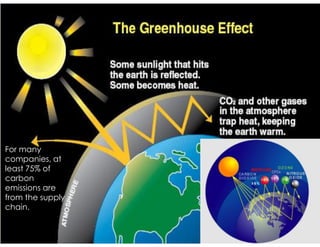
For many
companies, at
least 75% of
carbon
emissions are
from the supply
chain.
Kevin Lyons, Ph.D. klyons@business.rutgers.edu
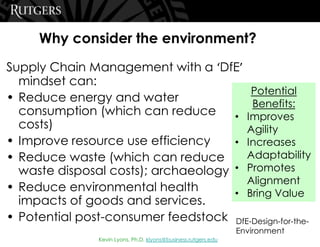
Why consider the environment?
Supply Chain Management with a ‘DfE’
mindset can:
• Reduce energy and water
consumption (which can reduce
costs)
• Improve resource use efficiency
• Reduce waste (which can reduce
waste disposal costs); archaeology
• Reduce environmental health
impacts of goods and services.
• Potential post-consumer feedstock
Potential
Benefits:
• Improves
Agility
• Increases
Adaptability
• Promotes
Alignment
• Bring Value
DfE-Design-for-the-
Environment
Kevin Lyons, Ph.D. klyons@business.rutgers.edu
7
The Negative Impacts of Climate Change on Culture, Cultural
Heritage and Cultural Rights Impacts on cultural practices:
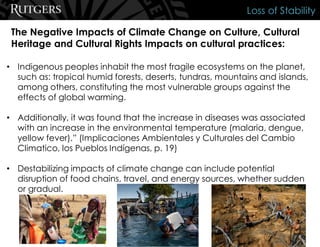
Loss of Stability
• Indigenous peoples inhabit the most fragile ecosystems on the planet,
such as: tropical humid forests, deserts, tundras, mountains and islands,
among others, constituting the most vulnerable groups against the
effects of global warming.
• Additionally, it was found that the increase in diseases was associated
with an increase in the environmental temperature (malaria, dengue,
yellow fever).” (Implicaciones Ambientales y Culturales del Cambio
Climatico, los Pueblos Indígenas, p. 19)
• Destabilizing impacts of climate change can include potential
disruption of food chains, travel, and energy sources, whether sudden
or gradual.
The Negative Impacts of Climate Change on Culture, Cultural
Heritage and Cultural Rights Impacts on cultural practices:
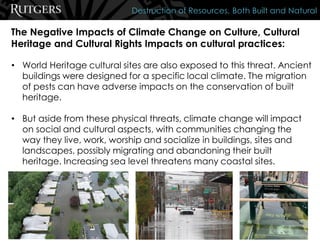
Destruction of Resources, Both Built and Natural
• World Heritage cultural sites are also exposed to this threat. Ancient
buildings were designed for a specific local climate. The migration
of pests can have adverse impacts on the conservation of built
heritage.
• But aside from these physical threats, climate change will impact
on social and cultural aspects, with communities changing the
way they live, work, worship and socialize in buildings, sites and
landscapes, possibly migrating and abandoning their built
heritage. Increasing sea level threatens many coastal sites.
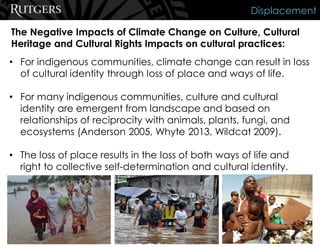
Displacement
• For indigenous communities, climate change can result in loss
of cultural identity through loss of place and ways of life.
• For many indigenous communities, culture and cultural
identity are emergent from landscape and based on
relationships of reciprocity with animals, plants, fungi, and
ecosystems (Anderson 2005, Whyte 2013, Wildcat 2009).
• The loss of place results in the loss of both ways of life and
right to collective self-determination and cultural identity.
The Negative Impacts of Climate Change on Culture, Cultural
Heritage and Cultural Rights Impacts on cultural practices:
The Negative Impacts of Climate Change on Culture, Cultural
Heritage and Cultural Rights Impacts on cultural practices:
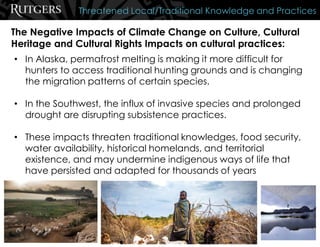
Threatened Local/Traditional Knowledge and Practices
• In Alaska, permafrost melting is making it more difficult for
hunters to access traditional hunting grounds and is changing
the migration patterns of certain species.
• In the Southwest, the influx of invasive species and prolonged
drought are disrupting subsistence practices.
• These impacts threaten traditional knowledges, food security,
water availability, historical homelands, and territorial
existence, and may undermine indigenous ways of life that
have persisted and adapted for thousands of years
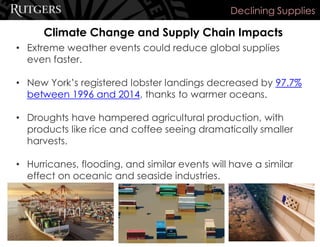
Climate Change and Supply Chain Impacts
Declining Supplies
• Extreme weather events could reduce global supplies
even faster.
• New York’s registered lobster landings decreased by 97.7%
between 1996 and 2014, thanks to warmer oceans.
• Droughts have hampered agricultural production, with
products like rice and coffee seeing dramatically smaller
harvests.
• Hurricanes, flooding, and similar events will have a similar
effect on oceanic and seaside industries.
Climate Change and Supply Chain Impacts
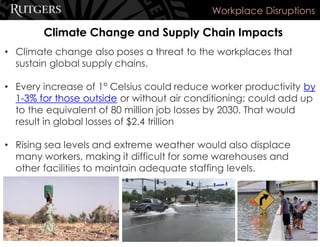
Workplace Disruptions
• Climate change also poses a threat to the workplaces that
sustain global supply chains.
• Every increase of 1° Celsius could reduce worker productivity by
1-3% for those outside or without air conditioning; could add up
to the equivalent of 80 million job losses by 2030. That would
result in global losses of $2.4 trillion
• Rising sea levels and extreme weather would also displace
many workers, making it difficult for some warehouses and
other facilities to maintain adequate staffing levels.
Climate Change and Supply Chain Impacts
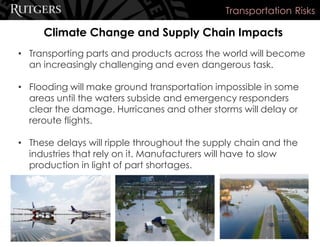
Transportation Risks
• Transporting parts and products across the world will become
an increasingly challenging and even dangerous task.
• Flooding will make ground transportation impossible in some
areas until the waters subside and emergency responders
clear the damage. Hurricanes and other storms will delay or
reroute flights.
• These delays will ripple throughout the supply chain and the
industries that rely on it. Manufacturers will have to slow
production in light of part shortages.
Climate Change and Supply Chain Impacts
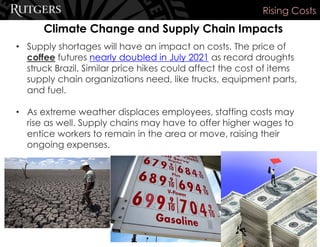
Rising Costs
• Supply shortages will have an impact on costs. The price of
coffee futures nearly doubled in July 2021 as record droughts
struck Brazil. Similar price hikes could affect the cost of items
supply chain organizations need, like trucks, equipment parts,
and fuel.
• As extreme weather displaces employees, staffing costs may
rise as well. Supply chains may have to offer higher wages to
entice workers to remain in the area or move, raising their
ongoing expenses.
How Can We
Respond?
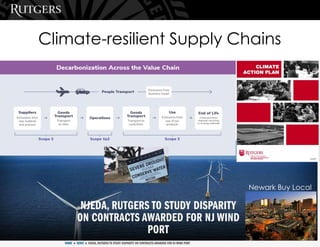
Climate-resilient Supply Chains
Newark Buy Local
Climate-resilient Supply Chains
Government Policy: Set the example and report (issue CAP)
Start small: Begin with a selection of facilities, locations, or
products that represent important aspects of your operations.
This will allow you to identify the most useful and important data
points before scaling your approach across the organization.
Integrate into existing systems: Rather than approaching climate
risk and resilience as a new, standalone exercise, consider
integrating climate considerations into existing risk management
and/or sustainability systems.
Appreciate both the global and the local: Climate risk and
building resilience is both a global and intensely local challenge.
While some tenets and approaches can be broadly applied,
individual interventions must be customized and reflect on-the-
ground realities. Diversity and Inclusion is a must (NAC)!
What is a “Green” Supply Chain?
Integrating environment thinking into supply
chain management, including
• Product design
• Material sourcing and selection
• Manufacturing processes
• Delivery of the final product to the consumers
• End-of-life management of the product after
its useful life.
- Executive Order 13101, Greening the Government Through Waste
Prevention, Recycling, and Federal Acquisition, September 16, 1998
Product Carbon/Climate Impact Research
Term Project #1 and #2
Term Project #1: Collecting product information and data
will allow us to measure the carbon emissions of your
product and this could lead to valuable environmental,
energy and cost saving Opportunities (life cycle analysis
and supply chain integration).
Term Project #2: Scope III GHG Emissions Data
We will collect additional data (added to your Project #1
data) to show the total Greenhouse gas emissions from
every stage of the product's lifecycle, including production,
transportation, preparation, use and disposal.
“Carbon Footprinting” is a way to measure the impact human activities have
on the environment, in terms of the amount of greenhouse gases produced,
measured in units of carbon dioxide.
Research
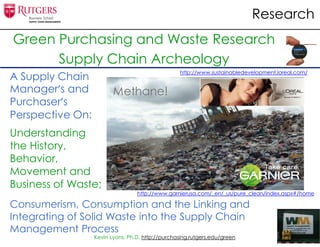
Kevin Lyons, Ph.D. http://purchasing.rutgers.edu/green
Green Purchasing and Waste Research
Supply Chain Archeology
Consumerism, Consumption and the Linking and
Integrating of Solid Waste into the Supply Chain
Management Process
A Supply Chain
Manager’s and
Purchaser’s
Perspective On:
Understanding
the History,
Behavior,
Movement and
Business of Waste;
Methane!
http://www.sustainabledevelopment.loreal.com/
http://www.garnierusa.com/_en/_us/pure_clean/index.aspx#/home
Research
Kevin Lyons, Ph.D. http://purchasing.rutgers.edu/green
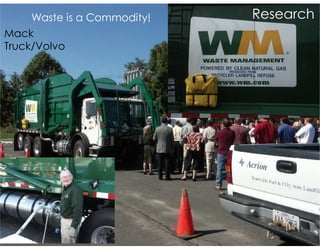
Waste is a Commodity!
Mack
Truck/Volvo
Research
Research
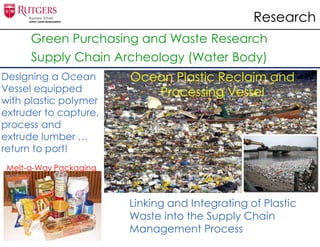
Green Purchasing and Waste Research
Supply Chain Archeology (Water Body)
Linking and Integrating of Plastic
Waste into the Supply Chain
Management Process
Designing a Ocean
Vessel equipped
with plastic polymer
extruder to capture,
process and
extrude lumber …
return to port!
Ocean Plastic Reclaim and
Processing Vessel
Melt-a-Way Packaging
Research
Kevin Lyons, Ph.D. http://purchasing.rutgers.edu/green
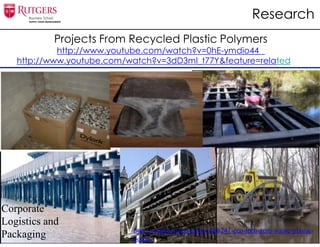
Projects From Recycled Plastic Polymers
http://www.youtube.com/watch?v=0hE-ymdio44
http://www.youtube.com/watch?v=3dD3ml_t77Y&feature=related
Corporate
Logistics and
Packaging http://vodpod.com/watch/1866241-eco-tech-zero-waste-plastic-
bottles
Research
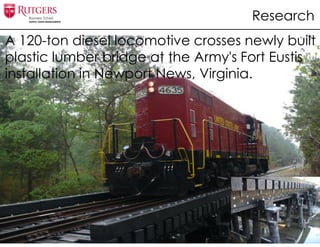
A 120-ton diesel locomotive crosses newly built
plastic lumber bridge at the Army's Fort Eustis
installation in Newport News, Virginia.
Research
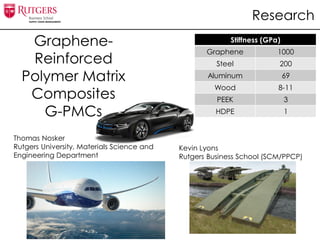
Graphene-
Reinforced
Polymer Matrix
Composites
G-PMCs
Thomas Nosker
Rutgers University, Materials Science and
Engineering Department
Kevin Lyons
Rutgers Business School (SCM/PPCP)
Stiffness (GPa)
Graphene 1000
Steel 200
Aluminum 69
Wood 8-11
PEEK 3
HDPE 1
Research
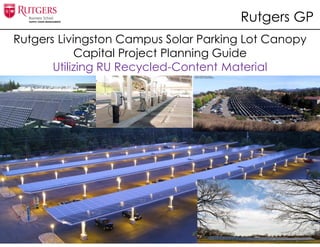
Rutgers Livingston Campus Solar Parking Lot Canopy
Capital Project Planning Guide
Utilizing RU Recycled-Content Material
Rutgers GP
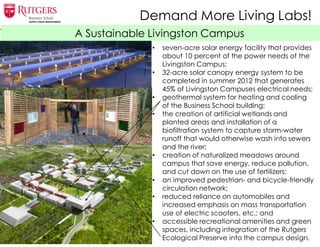
A Sustainable Livingston Campus
• seven-acre solar energy facility that provides
about 10 percent of the power needs of the
Livingston Campus;
• 32-acre solar canopy energy system to be
completed in summer 2012 that generates
45% of Livingston Campuses electrical needs;
• geothermal system for heating and cooling
of the Business School building;
• the creation of artificial wetlands and
planted areas and installation of a
biofiltration system to capture storm-water
runoff that would otherwise wash into sewers
and the river;
• creation of naturalized meadows around
campus that save energy, reduce pollution,
and cut down on the use of fertilizers;
• an improved pedestrian- and bicycle-friendly
circulation network;
• reduced reliance on automobiles and
increased emphasis on mass transportation
use of electric scooters, etc.; and
• accessible recreational amenities and green
spaces, including integration of the Rutgers
Ecological Preserve into the campus design.
Demand More Living Labs!
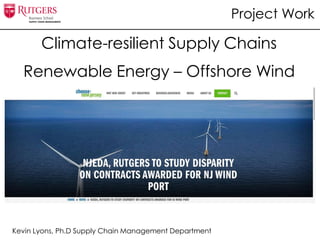
Climate-resilient Supply Chains
Renewable Energy – Offshore Wind
Kevin Lyons, Ph.D Supply Chain Management Department
Research
Project Work
Kevin Lyons, Ph.D. klyons@business.rutgers.edu
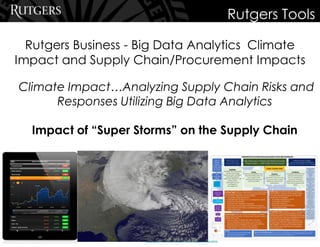
Climate Impact…Analyzing Supply Chain Risks and
Responses Utilizing Big Data Analytics
Impact of “Super Storms” on the Supply Chain
Rutgers Business - Big Data Analytics Climate
Impact and Supply Chain/Procurement Impacts
Rutgers Tools
Rutgers Tools
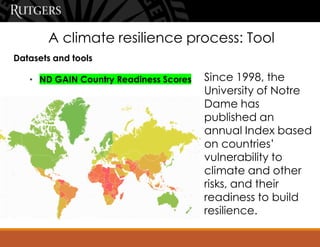
Datasets and tools
• ND GAIN Country Readiness Scores Since 1998, the
University of Notre
Dame has
published an
annual Index based
on countries’
vulnerability to
climate and other
risks, and their
readiness to build
resilience.
A climate resilience process: Tool
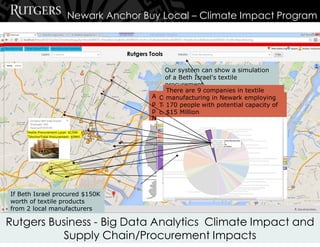
At the same time the Anchor
procures $5 Million worth of textile
products from outside of the
Newark area
TAnchorTotal Procurement: $5Mill.
If Beth Israel procured $150K
worth of textile products
from 2 local manufacturers
Textile Procurement Local: $150K
Our system can show a simulation
of a Beth Israel's textile
procurement
Using the industry filter all companies
in textile industry can be visualized
on the map
Our analytics shows that Newark’s
Textile industry is very significant
compared to the neighboring cities
There are 9 companies in textile
manufacturing in Newark employing
170 people with potential capacity of
$15 Million
Newark Anchor Buy Local – Climate Impact Program
Rutgers Business - Big Data Analytics Climate Impact and
Supply Chain/Procurement Impacts
Rutgers Tools
35
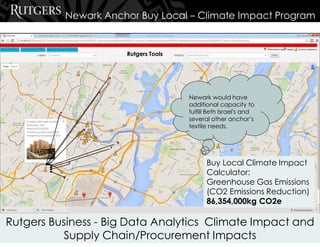
Newark would have
additional capacity to
fulfill Beth Israel's and
several other anchor’s
textile needs.
Buy Local Climate Impact
Calculator:
Greenhouse Gas Emissions
(CO2 Emissions Reduction)
86,354,000kg CO2e
Newark Anchor Buy Local – Climate Impact Program
Rutgers Business - Big Data Analytics Climate Impact and
Supply Chain/Procurement Impacts
Rutgers Tools
CLIMATE
ACTION PLAN
December 6, 2021
Rutgers University Office of
Climate Action Bob Kopp and
Kevin Lyons, Co-Directors
Angie Oberg, Associate Director
September 24, 2019:
Task Force Established
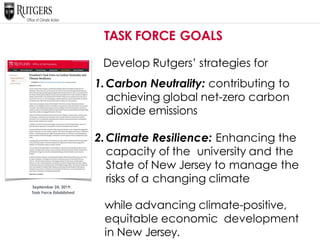
TASK FORCE GOALS
Develop Rutgers’ strategies for
1.Carbon Neutrality: contributing to
achieving global net-zero carbon
dioxide emissions
2.Climate Resilience: Enhancing the
capacity of the university and the
State of New Jersey to manage the
risks of a changing climate
while advancing climate-positive,
equitable economic development
in New Jersey.
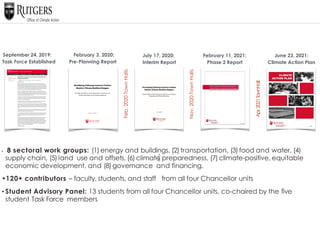
February 3, 2020:
Pre-Planning Report
July 17, 2020:
Interim Report
September 24, 2019:
Task Force Established
February 11, 2021:
Phase 2 Report
June 23, 2021:
Climate Action Plan
3
8
Feb.
2020
Town
Halls
• 8 sectoral work groups: (1) energy and buildings, (2) transportation, (3) food and water, (4)
supply chain, (5) land use and offsets, (6) climate preparedness, (7) climate-positive, equitable
economic development, and (8) governance and financing.
•120+ contributors – faculty, students, and staff from all four Chancellor units
• Student Advisory Panel: 13 students from all four Chancellor units, co-chaired by the five
student Task Force members
Nov.
2020
Town
Halls
Apr.
2021
TownHall
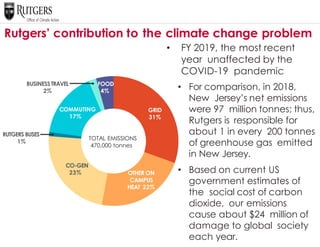
Rutgers’ contribution to the climate change problem
• FY 2019, the most recent
year unaffected by the
COVID-19 pandemic
• For comparison, in 2018,
New Jersey’s net emissions
were 97 million tonnes; thus,
Rutgers is responsible for
about 1 in every 200 tonnes
of greenhouse gas emitted
in New Jersey.
• Based on current US
government estimates of
the social cost of carbon
dioxide, our emissions
cause about $24 million of
damage to global society
each year.
TOTAL EMISSIONS
470,000 tonnes
GRID
31%
CO-GEN
23%
FOOD
4%
COMMUTING
17%
RUTGERS BUSES
1%
BUSINESSTRAVEL
2%
OTHER ON
CAMPUS
HEAT 22%
CLIMATE GOALS
1. Achieve carbon neutrality by 2040 and become
carbon-negative in 2041
2. Establish comprehensive plans for just and
equitable climate adaptation
3. Build a culture of sustainability that integrates
climate action into every aspect of the Rutgers
community
4. Foster the creation of educational opportunities
for our students, economic opportunities for our
host communities and New Jersey residents, and a
global model for cross-sectoral collaboration to
advance climate action
UNIVERSITY OFFICE OF CLIMATE ACTION: Mission
4
1
The Office of Climate Action:
1. Advocates for climate action and sustainability
at the highest levels of University leadership,
2. Provides oversight and accountability for and
facilitates Climate Action Plan implementation,
3. Communicates about and engages internal and
external stakeholders in climate action and
sustainability, and
4. Oversees regular updating of the Climate Action
Plan
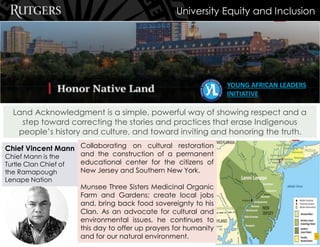
Land Acknowledgment is a simple, powerful way of showing respect and a
step toward correcting the stories and practices that erase Indigenous
people’s history and culture, and toward inviting and honoring the truth.
Chief Vincent Mann
Chief Mann is the
Turtle Clan Chief of
the Ramapough
Lenape Nation
Collaborating on cultural restoration
and the construction of a permanent
educational center for the citizens of
New Jersey and Southern New York.
Munsee Three Sisters Medicinal Organic
Farm and Gardens; create local jobs
and, bring back food sovereignty to his
Clan. As an advocate for cultural and
environmental issues, he continues to
this day to offer up prayers for humanity
and for our natural environment.
University Equity and Inclusion
YOUNG AFRICAN LEADERS
INITIATIVE
To build a more resilient, beneficial growth model for people we must
accelerate structural transformation in five key economic sectors:
• Clean energy systems
o Decarbonization of the energy system coupled with decentralized, digitized
electrification technologies could give a billion more people access to
modern energy services.
• Smarter urban developments
o More compact, connected and coordinated cities would save US
$ 17 billion by 2050 and stimulate economic growth by improving access
to work and housing.
• Sustainable land use
o A switch to more sustainable farming methods combined with strict forestry
protection could generate economic benefits of around 2 billion dollars per
year.
• Smart water management
o In areas with a water shortage, GNP could fall by up to 6% in 2050. This
could be prevented by making more efficient use of water through
technological improvements and investment in public infrastructure.
• Circular industrial economy
o Today, 95% of the value of the material from plastic packaging - up to 120
billion dollars a year - is lost after the first use. Policies that encourage more
circular and efficient use of materials could improve global economic
activity and reduce waste and pollution.
Closing Thoughts 1
The Global Commission on the Economy and Climate is urging
public and private sector leaders to take these urgent
measures in the next two or three years:
• put a price on carbon and force companies to disclose
climate-related financial risks, speed up investment in
sustainable infrastructure, harness the power of the private
sector, boosting innovation and increasing the transparency
of the value chain, and adopt a people-centric focus to
ensure equitable growth and a fair transition.
The United Nations Organization (UNO) says that it is not too
late to turn around climate change and minimize its terrible
effects. The truth is that humankind has the organizational and
technological capacity to counteract and solve all the
problems and damage we have done to the planet, and
repair the harm caused to nature.
Closing Thoughts 2
Dr. Kevin Lyons Ph.D.
Associate Professor PP,
Supply Chain Management
Rutgers University
klyons@rutgers.edu

Withum Global Summit 2022 6.8.22.pdf

  • 1.
    How Will ClimateChange Affect Culture and Global Supply Chains? Global Summit 2022 Kevin Lyons, Ph.D. Associate Professor, Supply Chain Archaeology Supply Chain Management Department Rutgers Business School Co-Director, Office of Climate Action Co-Director, Rutgers Energy Institute Faculty Board Member, Rutgers Global Health Institute
  • 2.
    How Will ClimateChange Affect Culture and Global Supply Chains? Global Summit 2022 The Negative Impacts of Climate Change on Culture, Cultural Heritage and Cultural Rights Impacts on cultural practices: • Disruption of cultural life • Loss of stability • Destruction of resources, both built and natural • Displacement • Threatened local/traditional knowledge and practices • Fading accuracy of seasonal and place- based knowledge Climate Change and Supply Chain Impacts: • Declining Supplies • Workplace Disruptions • Transportation Risks • Rising Costs • How Can Supply Chains Respond? Climate Change Actions: • Climate Resilient Supply Chains • Greening the Supply Chain • Climate Action Plan (Rutgers)
  • 3.
    Current Board Membership: •Rutgers Climate Action Office; Co-Director • NJ Council on the Green Economy • NJ Recycling Market Development Council • Newark Equitable Growth Advisory Commission • Rutgers Institute for Corporate Social Innovation • Rutgers Global Health Institute (Core Faculty Member) • Rutgers Center for African Studies • Rutgers Office for the Promotion of Women in Science, Engineering & Mathematics (WiSEM) • Rutgers Earth, Ocean and Atmospheric Science Institute • Rutgers EOHSI Division of Global Environmental Health Member: Institute for Supply Management (ISM) Chartered Institute of Procurement and Supply (CIPS) Current Significant Research Project: • Newark 2020-Buy Local (Researcher, Board Member) • Newark Anchor Collaborative (Member, Researcher) • NJEDA (NJMEP Grant) NJ Manufacturing Research (NJMEP Board of Trustees) • Center of Accelerated Real Time Analytics an NSF Industry/University Cooperative Research Center (Researcher) • Rutgers Energy Institute (Associate Director) • Rutgers EcoComplex (Researcher) • Rutgers Edison Papers (Board Member and Researcher) • DOE Supply Chain Risk Roundtable (Researcher) Kevin Lyons, Ph.D. Rutgers – 33 Years (Faculty-CPO) St. Peter’s Medical Center – 2 Years U.S. Air Force – 6 years Ph.D. Supply Chain Management and Environmental Management Areas of Research/Work: • Procurement – Supply Chain Management • Supplier Diversity • Economic Development – Social Impact – Social Determinants of Health (Newark 2020) • Complex Decision Analysis • Manufacturing • Supply Chain Workforce Development • Environmental Sustainability • Mandela Washington Fellowship • Sub-Saharan Africa Agriculture and Entrepreneurship 3 Rutgers Business School Founded: 1929 (RU 1766) Dean: Lei Lei Number of students: 9,813 Undergraduates: 7,403
  • 4.
    For many companies, at least75% of carbon emissions are from the supply chain.
  • 6.
    Kevin Lyons, Ph.D.klyons@business.rutgers.edu Why consider the environment? Supply Chain Management with a ‘DfE’ mindset can: • Reduce energy and water consumption (which can reduce costs) • Improve resource use efficiency • Reduce waste (which can reduce waste disposal costs); archaeology • Reduce environmental health impacts of goods and services. • Potential post-consumer feedstock Potential Benefits: • Improves Agility • Increases Adaptability • Promotes Alignment • Bring Value DfE-Design-for-the- Environment
  • 7.
    Kevin Lyons, Ph.D.klyons@business.rutgers.edu 7
  • 8.
    The Negative Impactsof Climate Change on Culture, Cultural Heritage and Cultural Rights Impacts on cultural practices: Loss of Stability • Indigenous peoples inhabit the most fragile ecosystems on the planet, such as: tropical humid forests, deserts, tundras, mountains and islands, among others, constituting the most vulnerable groups against the effects of global warming. • Additionally, it was found that the increase in diseases was associated with an increase in the environmental temperature (malaria, dengue, yellow fever).” (Implicaciones Ambientales y Culturales del Cambio Climatico, los Pueblos Indígenas, p. 19) • Destabilizing impacts of climate change can include potential disruption of food chains, travel, and energy sources, whether sudden or gradual.
  • 9.
    The Negative Impactsof Climate Change on Culture, Cultural Heritage and Cultural Rights Impacts on cultural practices: Destruction of Resources, Both Built and Natural • World Heritage cultural sites are also exposed to this threat. Ancient buildings were designed for a specific local climate. The migration of pests can have adverse impacts on the conservation of built heritage. • But aside from these physical threats, climate change will impact on social and cultural aspects, with communities changing the way they live, work, worship and socialize in buildings, sites and landscapes, possibly migrating and abandoning their built heritage. Increasing sea level threatens many coastal sites.
  • 10.
    Displacement • For indigenouscommunities, climate change can result in loss of cultural identity through loss of place and ways of life. • For many indigenous communities, culture and cultural identity are emergent from landscape and based on relationships of reciprocity with animals, plants, fungi, and ecosystems (Anderson 2005, Whyte 2013, Wildcat 2009). • The loss of place results in the loss of both ways of life and right to collective self-determination and cultural identity. The Negative Impacts of Climate Change on Culture, Cultural Heritage and Cultural Rights Impacts on cultural practices:
  • 11.
    The Negative Impactsof Climate Change on Culture, Cultural Heritage and Cultural Rights Impacts on cultural practices: Threatened Local/Traditional Knowledge and Practices • In Alaska, permafrost melting is making it more difficult for hunters to access traditional hunting grounds and is changing the migration patterns of certain species. • In the Southwest, the influx of invasive species and prolonged drought are disrupting subsistence practices. • These impacts threaten traditional knowledges, food security, water availability, historical homelands, and territorial existence, and may undermine indigenous ways of life that have persisted and adapted for thousands of years
  • 12.
    Climate Change andSupply Chain Impacts Declining Supplies • Extreme weather events could reduce global supplies even faster. • New York’s registered lobster landings decreased by 97.7% between 1996 and 2014, thanks to warmer oceans. • Droughts have hampered agricultural production, with products like rice and coffee seeing dramatically smaller harvests. • Hurricanes, flooding, and similar events will have a similar effect on oceanic and seaside industries.
  • 13.
    Climate Change andSupply Chain Impacts Workplace Disruptions • Climate change also poses a threat to the workplaces that sustain global supply chains. • Every increase of 1° Celsius could reduce worker productivity by 1-3% for those outside or without air conditioning; could add up to the equivalent of 80 million job losses by 2030. That would result in global losses of $2.4 trillion • Rising sea levels and extreme weather would also displace many workers, making it difficult for some warehouses and other facilities to maintain adequate staffing levels.
  • 14.
    Climate Change andSupply Chain Impacts Transportation Risks • Transporting parts and products across the world will become an increasingly challenging and even dangerous task. • Flooding will make ground transportation impossible in some areas until the waters subside and emergency responders clear the damage. Hurricanes and other storms will delay or reroute flights. • These delays will ripple throughout the supply chain and the industries that rely on it. Manufacturers will have to slow production in light of part shortages.
  • 15.
    Climate Change andSupply Chain Impacts Rising Costs • Supply shortages will have an impact on costs. The price of coffee futures nearly doubled in July 2021 as record droughts struck Brazil. Similar price hikes could affect the cost of items supply chain organizations need, like trucks, equipment parts, and fuel. • As extreme weather displaces employees, staffing costs may rise as well. Supply chains may have to offer higher wages to entice workers to remain in the area or move, raising their ongoing expenses.
  • 16.
  • 17.
  • 18.
    Climate-resilient Supply Chains GovernmentPolicy: Set the example and report (issue CAP) Start small: Begin with a selection of facilities, locations, or products that represent important aspects of your operations. This will allow you to identify the most useful and important data points before scaling your approach across the organization. Integrate into existing systems: Rather than approaching climate risk and resilience as a new, standalone exercise, consider integrating climate considerations into existing risk management and/or sustainability systems. Appreciate both the global and the local: Climate risk and building resilience is both a global and intensely local challenge. While some tenets and approaches can be broadly applied, individual interventions must be customized and reflect on-the- ground realities. Diversity and Inclusion is a must (NAC)!
  • 19.
    What is a“Green” Supply Chain? Integrating environment thinking into supply chain management, including • Product design • Material sourcing and selection • Manufacturing processes • Delivery of the final product to the consumers • End-of-life management of the product after its useful life. - Executive Order 13101, Greening the Government Through Waste Prevention, Recycling, and Federal Acquisition, September 16, 1998
  • 20.
    Product Carbon/Climate ImpactResearch Term Project #1 and #2 Term Project #1: Collecting product information and data will allow us to measure the carbon emissions of your product and this could lead to valuable environmental, energy and cost saving Opportunities (life cycle analysis and supply chain integration). Term Project #2: Scope III GHG Emissions Data We will collect additional data (added to your Project #1 data) to show the total Greenhouse gas emissions from every stage of the product's lifecycle, including production, transportation, preparation, use and disposal. “Carbon Footprinting” is a way to measure the impact human activities have on the environment, in terms of the amount of greenhouse gases produced, measured in units of carbon dioxide. Research
  • 21.
    Kevin Lyons, Ph.D.http://purchasing.rutgers.edu/green Green Purchasing and Waste Research Supply Chain Archeology Consumerism, Consumption and the Linking and Integrating of Solid Waste into the Supply Chain Management Process A Supply Chain Manager’s and Purchaser’s Perspective On: Understanding the History, Behavior, Movement and Business of Waste; Methane! http://www.sustainabledevelopment.loreal.com/ http://www.garnierusa.com/_en/_us/pure_clean/index.aspx#/home Research
  • 22.
    Kevin Lyons, Ph.D.http://purchasing.rutgers.edu/green Waste is a Commodity! Mack Truck/Volvo Research
  • 23.
  • 24.
    Green Purchasing andWaste Research Supply Chain Archeology (Water Body) Linking and Integrating of Plastic Waste into the Supply Chain Management Process Designing a Ocean Vessel equipped with plastic polymer extruder to capture, process and extrude lumber … return to port! Ocean Plastic Reclaim and Processing Vessel Melt-a-Way Packaging Research
  • 25.
    Kevin Lyons, Ph.D.http://purchasing.rutgers.edu/green Projects From Recycled Plastic Polymers http://www.youtube.com/watch?v=0hE-ymdio44 http://www.youtube.com/watch?v=3dD3ml_t77Y&feature=related Corporate Logistics and Packaging http://vodpod.com/watch/1866241-eco-tech-zero-waste-plastic- bottles Research
  • 26.
    A 120-ton diesellocomotive crosses newly built plastic lumber bridge at the Army's Fort Eustis installation in Newport News, Virginia. Research
  • 27.
    Graphene- Reinforced Polymer Matrix Composites G-PMCs Thomas Nosker RutgersUniversity, Materials Science and Engineering Department Kevin Lyons Rutgers Business School (SCM/PPCP) Stiffness (GPa) Graphene 1000 Steel 200 Aluminum 69 Wood 8-11 PEEK 3 HDPE 1 Research
  • 28.
    Rutgers Livingston CampusSolar Parking Lot Canopy Capital Project Planning Guide Utilizing RU Recycled-Content Material Rutgers GP
  • 29.
    A Sustainable LivingstonCampus • seven-acre solar energy facility that provides about 10 percent of the power needs of the Livingston Campus; • 32-acre solar canopy energy system to be completed in summer 2012 that generates 45% of Livingston Campuses electrical needs; • geothermal system for heating and cooling of the Business School building; • the creation of artificial wetlands and planted areas and installation of a biofiltration system to capture storm-water runoff that would otherwise wash into sewers and the river; • creation of naturalized meadows around campus that save energy, reduce pollution, and cut down on the use of fertilizers; • an improved pedestrian- and bicycle-friendly circulation network; • reduced reliance on automobiles and increased emphasis on mass transportation use of electric scooters, etc.; and • accessible recreational amenities and green spaces, including integration of the Rutgers Ecological Preserve into the campus design. Demand More Living Labs!
  • 30.
    Climate-resilient Supply Chains RenewableEnergy – Offshore Wind Kevin Lyons, Ph.D Supply Chain Management Department Research Project Work
  • 31.
    Kevin Lyons, Ph.D.klyons@business.rutgers.edu Climate Impact…Analyzing Supply Chain Risks and Responses Utilizing Big Data Analytics Impact of “Super Storms” on the Supply Chain Rutgers Business - Big Data Analytics Climate Impact and Supply Chain/Procurement Impacts Rutgers Tools
  • 32.
  • 33.
    Datasets and tools •ND GAIN Country Readiness Scores Since 1998, the University of Notre Dame has published an annual Index based on countries’ vulnerability to climate and other risks, and their readiness to build resilience. A climate resilience process: Tool
  • 34.
    At the sametime the Anchor procures $5 Million worth of textile products from outside of the Newark area TAnchorTotal Procurement: $5Mill. If Beth Israel procured $150K worth of textile products from 2 local manufacturers Textile Procurement Local: $150K Our system can show a simulation of a Beth Israel's textile procurement Using the industry filter all companies in textile industry can be visualized on the map Our analytics shows that Newark’s Textile industry is very significant compared to the neighboring cities There are 9 companies in textile manufacturing in Newark employing 170 people with potential capacity of $15 Million Newark Anchor Buy Local – Climate Impact Program Rutgers Business - Big Data Analytics Climate Impact and Supply Chain/Procurement Impacts Rutgers Tools
  • 35.
    35 Newark would have additionalcapacity to fulfill Beth Israel's and several other anchor’s textile needs. Buy Local Climate Impact Calculator: Greenhouse Gas Emissions (CO2 Emissions Reduction) 86,354,000kg CO2e Newark Anchor Buy Local – Climate Impact Program Rutgers Business - Big Data Analytics Climate Impact and Supply Chain/Procurement Impacts Rutgers Tools
  • 36.
    CLIMATE ACTION PLAN December 6,2021 Rutgers University Office of Climate Action Bob Kopp and Kevin Lyons, Co-Directors Angie Oberg, Associate Director
  • 37.
    September 24, 2019: TaskForce Established TASK FORCE GOALS Develop Rutgers’ strategies for 1.Carbon Neutrality: contributing to achieving global net-zero carbon dioxide emissions 2.Climate Resilience: Enhancing the capacity of the university and the State of New Jersey to manage the risks of a changing climate while advancing climate-positive, equitable economic development in New Jersey.
  • 38.
    February 3, 2020: Pre-PlanningReport July 17, 2020: Interim Report September 24, 2019: Task Force Established February 11, 2021: Phase 2 Report June 23, 2021: Climate Action Plan 3 8 Feb. 2020 Town Halls • 8 sectoral work groups: (1) energy and buildings, (2) transportation, (3) food and water, (4) supply chain, (5) land use and offsets, (6) climate preparedness, (7) climate-positive, equitable economic development, and (8) governance and financing. •120+ contributors – faculty, students, and staff from all four Chancellor units • Student Advisory Panel: 13 students from all four Chancellor units, co-chaired by the five student Task Force members Nov. 2020 Town Halls Apr. 2021 TownHall
  • 39.
    Rutgers’ contribution tothe climate change problem • FY 2019, the most recent year unaffected by the COVID-19 pandemic • For comparison, in 2018, New Jersey’s net emissions were 97 million tonnes; thus, Rutgers is responsible for about 1 in every 200 tonnes of greenhouse gas emitted in New Jersey. • Based on current US government estimates of the social cost of carbon dioxide, our emissions cause about $24 million of damage to global society each year. TOTAL EMISSIONS 470,000 tonnes GRID 31% CO-GEN 23% FOOD 4% COMMUTING 17% RUTGERS BUSES 1% BUSINESSTRAVEL 2% OTHER ON CAMPUS HEAT 22%
  • 40.
    CLIMATE GOALS 1. Achievecarbon neutrality by 2040 and become carbon-negative in 2041 2. Establish comprehensive plans for just and equitable climate adaptation 3. Build a culture of sustainability that integrates climate action into every aspect of the Rutgers community 4. Foster the creation of educational opportunities for our students, economic opportunities for our host communities and New Jersey residents, and a global model for cross-sectoral collaboration to advance climate action
  • 41.
    UNIVERSITY OFFICE OFCLIMATE ACTION: Mission 4 1 The Office of Climate Action: 1. Advocates for climate action and sustainability at the highest levels of University leadership, 2. Provides oversight and accountability for and facilitates Climate Action Plan implementation, 3. Communicates about and engages internal and external stakeholders in climate action and sustainability, and 4. Oversees regular updating of the Climate Action Plan
  • 42.
    Land Acknowledgment isa simple, powerful way of showing respect and a step toward correcting the stories and practices that erase Indigenous people’s history and culture, and toward inviting and honoring the truth. Chief Vincent Mann Chief Mann is the Turtle Clan Chief of the Ramapough Lenape Nation Collaborating on cultural restoration and the construction of a permanent educational center for the citizens of New Jersey and Southern New York. Munsee Three Sisters Medicinal Organic Farm and Gardens; create local jobs and, bring back food sovereignty to his Clan. As an advocate for cultural and environmental issues, he continues to this day to offer up prayers for humanity and for our natural environment. University Equity and Inclusion YOUNG AFRICAN LEADERS INITIATIVE
  • 43.
    To build amore resilient, beneficial growth model for people we must accelerate structural transformation in five key economic sectors: • Clean energy systems o Decarbonization of the energy system coupled with decentralized, digitized electrification technologies could give a billion more people access to modern energy services. • Smarter urban developments o More compact, connected and coordinated cities would save US $ 17 billion by 2050 and stimulate economic growth by improving access to work and housing. • Sustainable land use o A switch to more sustainable farming methods combined with strict forestry protection could generate economic benefits of around 2 billion dollars per year. • Smart water management o In areas with a water shortage, GNP could fall by up to 6% in 2050. This could be prevented by making more efficient use of water through technological improvements and investment in public infrastructure. • Circular industrial economy o Today, 95% of the value of the material from plastic packaging - up to 120 billion dollars a year - is lost after the first use. Policies that encourage more circular and efficient use of materials could improve global economic activity and reduce waste and pollution. Closing Thoughts 1
  • 44.
    The Global Commissionon the Economy and Climate is urging public and private sector leaders to take these urgent measures in the next two or three years: • put a price on carbon and force companies to disclose climate-related financial risks, speed up investment in sustainable infrastructure, harness the power of the private sector, boosting innovation and increasing the transparency of the value chain, and adopt a people-centric focus to ensure equitable growth and a fair transition. The United Nations Organization (UNO) says that it is not too late to turn around climate change and minimize its terrible effects. The truth is that humankind has the organizational and technological capacity to counteract and solve all the problems and damage we have done to the planet, and repair the harm caused to nature. Closing Thoughts 2
  • 45.
    Dr. Kevin LyonsPh.D. Associate Professor PP, Supply Chain Management Rutgers University klyons@rutgers.edu