WIRELESS SENSOR NETWORKS (WSN)
BASED ON WISLAB WIRELESS SENSOR NETWORKS SIMULATION
Moiz Ahmed Ansari (Researcher – Federal Urdu University of Arts Science and Technology, Karachi, Pakistan)
INTRODUCTION:
ThisresearchisbasedonWirelessSensorNetworks(WSN)simulationof amodelproposedby MilanSimek
in whichthere is a predefinedfieldof particulararea. The aimis to place varioussensorin this area and
find the shortest path route to the sink node which is at a fixed location. There are two approaches for
the sensorplacement,eitherrandomtopologyisselectedinwhichsensorsare placedatrandomlocation
or a gridtopologyinwhichsensorsare placedinfixedposition.We have tofindthe throughputandmean
energyconsumptionforthe sensorswhichsendpacketstothe sinknode inagivenamountof time.Inthe
case when,the energygiventothe sensorisutilizedbyenergyconsumptionduringpacket sendingtosink
node, then the particular node will be dead and its route to receiver is closed.
ANALYSIS AND COMPUTATIONS:
In this research, we have extendedthe work done by WISLAB where, we have made calculations and
implementationsforcalculatingthroughputandmeanenergyconsumptioninthe givenamountof time.
Also,we have introducedthe conceptof deadnodesinthe givenwork,inwhichifasensorhasconsumed
all of its energy then the particular node is dead and its route to neighbor nodes are closed.
The throughput is calculated using the following formula,
𝑡ℎ𝑟𝑜𝑢𝑔ℎ𝑝𝑢𝑡 =
𝑇𝑜𝑡𝑎𝑙 𝑛𝑜. 𝑜𝑓 𝑝𝑎𝑐𝑘𝑒𝑡𝑠 ∗ 𝑠𝑖𝑧𝑒 𝑜𝑓 1 𝑝𝑎𝑐𝑘𝑒𝑡
𝑒𝑙𝑎𝑝𝑠𝑒𝑑 𝑡𝑖𝑚𝑒
In our case, we have assumed the size of 1 packet is 256 bits and the elapsed time is approximately1
minute.
The energy consumption is calculated using the formula,
𝑒𝑛𝑒𝑟𝑔𝑦 𝑐𝑜𝑛𝑠𝑢𝑚𝑒𝑑 = 𝑒𝑛𝑒𝑟𝑔𝑦 𝑎𝑡 𝑠𝑡𝑎𝑟𝑡𝑖𝑛𝑔 𝑙𝑒𝑣𝑒𝑙 − 𝑒𝑛𝑒𝑟𝑔𝑦 𝑢𝑡𝑖𝑙𝑖𝑧𝑒𝑑 𝑓𝑜𝑟 𝑠𝑒𝑛𝑑𝑖𝑛𝑔 𝑎𝑙𝑙 𝑝𝑎𝑐𝑘𝑒𝑡𝑠.
Where, energy utilized may be depend on number of methods, we have decrementedgiven amount of
energywhenapacketisreceivedatthe sensornode.If inthiscase,theenergyconsumedbyasenornode
becomes zero in the mid of simulation then the particular node is labelled as dead node and it cannot
send further packets to any node.
Screenshots:
For n=16:
RandomTopology:
Grid Topology:
For n=25:
RandomTopology:
For Grid Topology:
For n=36:
RandomTopology:
Grid Topology:
Asseenfromourpreviousfigures,the numberof nodesmustbe perfectsquare of wholenumberinorder
to fill in our grid topology otherwise it will give an error.
Simulation:
For n=16 random topology:
From the figure above, it is clear that since node 8 and 16 becomes dead, the sender node 2 sends the
packet to receiver node 1 using route [2, 11, 1].
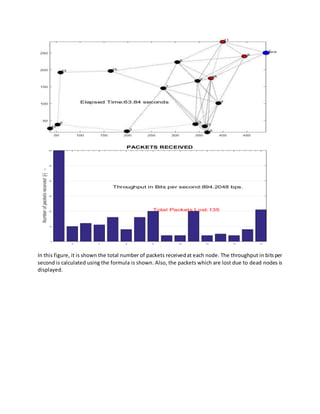
In this figure, it is shown the total number of packets receivedat each node. The throughput in bitsper
second is calculated using the formula is shown. Also, the packets which are lost due to dead nodes is
displayed.
In this figure, the energyconsumption for each node is given using the formula. Also,the mean energy
consumption is displayed.
For n=25 random topology:
RESULT:
Number
of nodes
Throughput
inbits/sec
Total Packets
Receivedin1minute
Total
PacketsLost
Mean Energy
Consumptionin Joules
16 894.2048 223 135 102
25 971.0171 257 62 80
36 809.3204 195 30 43
49 923.9475 245 1 40
CONCLUSION:
From the table andthe chart above,we have analyzedthatasour numberof nodesare increasing,the
total numberof packetslostare decreasingdue tomanypaths to sinknodes.Alsothe meanenergy
consumptiondecreasesasnumberof nodesincreases,thissuggestthatsince mostnumberof nodes
consumedpartial amountof energythenonaverage the energyislow.
0
200
400
600
800
1000
1200
16 25 36 49
Comparison of number of nodes for randomtopology
Throughput in bits/sec Total Packets Received in 1 minute
Total Packets Lost Mean Energy Consumption in Joules

Wireless sensor networks simulation

  • 1.
    WIRELESS SENSOR NETWORKS(WSN) BASED ON WISLAB WIRELESS SENSOR NETWORKS SIMULATION Moiz Ahmed Ansari (Researcher – Federal Urdu University of Arts Science and Technology, Karachi, Pakistan) INTRODUCTION: ThisresearchisbasedonWirelessSensorNetworks(WSN)simulationof amodelproposedby MilanSimek in whichthere is a predefinedfieldof particulararea. The aimis to place varioussensorin this area and find the shortest path route to the sink node which is at a fixed location. There are two approaches for the sensorplacement,eitherrandomtopologyisselectedinwhichsensorsare placedatrandomlocation or a gridtopologyinwhichsensorsare placedinfixedposition.We have tofindthe throughputandmean energyconsumptionforthe sensorswhichsendpacketstothe sinknode inagivenamountof time.Inthe case when,the energygiventothe sensorisutilizedbyenergyconsumptionduringpacket sendingtosink node, then the particular node will be dead and its route to receiver is closed. ANALYSIS AND COMPUTATIONS: In this research, we have extendedthe work done by WISLAB where, we have made calculations and implementationsforcalculatingthroughputandmeanenergyconsumptioninthe givenamountof time. Also,we have introducedthe conceptof deadnodesinthe givenwork,inwhichifasensorhasconsumed all of its energy then the particular node is dead and its route to neighbor nodes are closed. The throughput is calculated using the following formula, 𝑡ℎ𝑟𝑜𝑢𝑔ℎ𝑝𝑢𝑡 = 𝑇𝑜𝑡𝑎𝑙 𝑛𝑜. 𝑜𝑓 𝑝𝑎𝑐𝑘𝑒𝑡𝑠 ∗ 𝑠𝑖𝑧𝑒 𝑜𝑓 1 𝑝𝑎𝑐𝑘𝑒𝑡 𝑒𝑙𝑎𝑝𝑠𝑒𝑑 𝑡𝑖𝑚𝑒 In our case, we have assumed the size of 1 packet is 256 bits and the elapsed time is approximately1 minute. The energy consumption is calculated using the formula, 𝑒𝑛𝑒𝑟𝑔𝑦 𝑐𝑜𝑛𝑠𝑢𝑚𝑒𝑑 = 𝑒𝑛𝑒𝑟𝑔𝑦 𝑎𝑡 𝑠𝑡𝑎𝑟𝑡𝑖𝑛𝑔 𝑙𝑒𝑣𝑒𝑙 − 𝑒𝑛𝑒𝑟𝑔𝑦 𝑢𝑡𝑖𝑙𝑖𝑧𝑒𝑑 𝑓𝑜𝑟 𝑠𝑒𝑛𝑑𝑖𝑛𝑔 𝑎𝑙𝑙 𝑝𝑎𝑐𝑘𝑒𝑡𝑠. Where, energy utilized may be depend on number of methods, we have decrementedgiven amount of energywhenapacketisreceivedatthe sensornode.If inthiscase,theenergyconsumedbyasenornode becomes zero in the mid of simulation then the particular node is labelled as dead node and it cannot send further packets to any node. Screenshots: For n=16: RandomTopology:
  • 2.
  • 3.
  • 4.
  • 5.
    Asseenfromourpreviousfigures,the numberof nodesmustbeperfectsquare of wholenumberinorder to fill in our grid topology otherwise it will give an error. Simulation: For n=16 random topology: From the figure above, it is clear that since node 8 and 16 becomes dead, the sender node 2 sends the packet to receiver node 1 using route [2, 11, 1].
  • 6.
    In this figure,it is shown the total number of packets receivedat each node. The throughput in bitsper second is calculated using the formula is shown. Also, the packets which are lost due to dead nodes is displayed.
  • 7.
    In this figure,the energyconsumption for each node is given using the formula. Also,the mean energy consumption is displayed. For n=25 random topology:
  • 9.
    RESULT: Number of nodes Throughput inbits/sec Total Packets Receivedin1minute Total PacketsLost MeanEnergy Consumptionin Joules 16 894.2048 223 135 102 25 971.0171 257 62 80 36 809.3204 195 30 43 49 923.9475 245 1 40 CONCLUSION: From the table andthe chart above,we have analyzedthatasour numberof nodesare increasing,the total numberof packetslostare decreasingdue tomanypaths to sinknodes.Alsothe meanenergy consumptiondecreasesasnumberof nodesincreases,thissuggestthatsince mostnumberof nodes consumedpartial amountof energythenonaverage the energyislow. 0 200 400 600 800 1000 1200 16 25 36 49 Comparison of number of nodes for randomtopology Throughput in bits/sec Total Packets Received in 1 minute Total Packets Lost Mean Energy Consumption in Joules