Wireless Systems &
Standards
Unit – 5.1
Made By
Navdeep Kumar Chopra
AMPS
• Advanced Mobile Phone Service (AMPS) is a standard system
for Analog signal cellular telephone service in the United States
and is also used in other countries.
• It is based on the initial electromagnetic radiation spectrum
allocation for cellular service by the Federal Communications
Commission (FCC) in 1970.
• Introduced by AT&T in 1983, AMPS became one of the most
widely deployed cellular system in the United States.
• AMPS allocates frequency ranges within the 800 and 900
Megahertz (MHz) spectrum to cellular telephone.
– 824-849 MHz range for receiving signals from cellular
phones and
– 869-894 MHz range for transmitting to cellular phones.
AMPS
• The bands are divided into 30 kHz sub-bands, called channels.
– The receiving channels are called reverse channels and the
sending channels are called forward channels.
• The division of the spectrum into sub-band channels is achieved
by using frequency division multiple access (FDMA).
• The analog service of AMPS has been updated
with digital cellular service by adding to FDMA a further
subdivision of each channel using time division multiple access
(TDMA). This service is known as digital AMPS (D-AMPS).
Although AMPS and D-AMPS originated for the North
American cellular telephone market, they are now used
worldwide with over 74 million subscribers, according to
Ericsson, one of the major cellular phone manufacturers.
AMPS
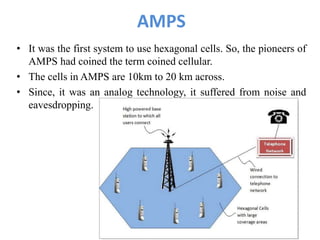
• It was the first system to use hexagonal cells. So, the pioneers of
AMPS had coined the term coined cellular.
• The cells in AMPS are 10km to 20 km across.
• Since, it was an analog technology, it suffered from noise and
eavesdropping.
ETACS
Extended Total Access Communication System
• Total Access Communication System (TACS) and ETACS are
mostly-obsolete variants of Advanced Mobile Phone
System (AMPS) which was announced as the choice for the first
two UK national cellular systems in February 1983, less than a
year after the UK government announced the T&Cs for the two
competing mobile phone networks in June 1982.
• Vodafone (known then as Racal-Vodafone) opted for a £30
million turnkey contract from Ericsson (ERA) to design, build
and set up its initial network of 100 base station sites.
ETACS
• A 1G analog cellular radio derivate of the Advanced Mobile
Phone Service (AMPS) technology, TACS was developed for
use in the United Kingdom.
• TACS operates in the 900 MHz band and supports either 600 or
1,000 channels of 25 kHz, compared with the 666/832 channels
of 30 kHz supported by AMPS.
• A number of variations were developed, including Narrowband
TACS (NTACS), Extended TACS (ETACS), and Japanese Total
Access Communications System (JTACS).
• TACS found acceptance in very few nations, largely has been
replaced by GSM, and is considered obsolete in the United
Kingdom.
ETACS
• ETACS was an extended version of TACS with more channels.
• TACS and ETACS are now obsolete in Europe, having been
replaced by the GSM (Global System for Mobile
Communications) system.
• In the United Kingdom, the last ETACS service operated by
Vodafone was discontinued on 31 May 2001, after 16 years of
service. The competing service in the UK operated by Cellnet
(latterly BT Cellnet) was closed on Sunday 1 October 2000.
• Analog cellular standard first used in the U.K. for services in the
900MHz frequency band.
• It allows up to 1,320 channels using 25kHz channel spacing.
US Digital Cellular System

Wireless Communication_Bluetooth Unit 4.1.ppt

  • 1.
    Wireless Systems & Standards Unit– 5.1 Made By Navdeep Kumar Chopra
  • 2.
    AMPS • Advanced MobilePhone Service (AMPS) is a standard system for Analog signal cellular telephone service in the United States and is also used in other countries. • It is based on the initial electromagnetic radiation spectrum allocation for cellular service by the Federal Communications Commission (FCC) in 1970. • Introduced by AT&T in 1983, AMPS became one of the most widely deployed cellular system in the United States. • AMPS allocates frequency ranges within the 800 and 900 Megahertz (MHz) spectrum to cellular telephone. – 824-849 MHz range for receiving signals from cellular phones and – 869-894 MHz range for transmitting to cellular phones.
  • 3.
    AMPS • The bandsare divided into 30 kHz sub-bands, called channels. – The receiving channels are called reverse channels and the sending channels are called forward channels. • The division of the spectrum into sub-band channels is achieved by using frequency division multiple access (FDMA). • The analog service of AMPS has been updated with digital cellular service by adding to FDMA a further subdivision of each channel using time division multiple access (TDMA). This service is known as digital AMPS (D-AMPS). Although AMPS and D-AMPS originated for the North American cellular telephone market, they are now used worldwide with over 74 million subscribers, according to Ericsson, one of the major cellular phone manufacturers.
  • 4.
    AMPS • It wasthe first system to use hexagonal cells. So, the pioneers of AMPS had coined the term coined cellular. • The cells in AMPS are 10km to 20 km across. • Since, it was an analog technology, it suffered from noise and eavesdropping.
  • 5.
    ETACS Extended Total AccessCommunication System • Total Access Communication System (TACS) and ETACS are mostly-obsolete variants of Advanced Mobile Phone System (AMPS) which was announced as the choice for the first two UK national cellular systems in February 1983, less than a year after the UK government announced the T&Cs for the two competing mobile phone networks in June 1982. • Vodafone (known then as Racal-Vodafone) opted for a £30 million turnkey contract from Ericsson (ERA) to design, build and set up its initial network of 100 base station sites.
  • 6.
    ETACS • A 1Ganalog cellular radio derivate of the Advanced Mobile Phone Service (AMPS) technology, TACS was developed for use in the United Kingdom. • TACS operates in the 900 MHz band and supports either 600 or 1,000 channels of 25 kHz, compared with the 666/832 channels of 30 kHz supported by AMPS. • A number of variations were developed, including Narrowband TACS (NTACS), Extended TACS (ETACS), and Japanese Total Access Communications System (JTACS). • TACS found acceptance in very few nations, largely has been replaced by GSM, and is considered obsolete in the United Kingdom.
  • 7.
    ETACS • ETACS wasan extended version of TACS with more channels. • TACS and ETACS are now obsolete in Europe, having been replaced by the GSM (Global System for Mobile Communications) system. • In the United Kingdom, the last ETACS service operated by Vodafone was discontinued on 31 May 2001, after 16 years of service. The competing service in the UK operated by Cellnet (latterly BT Cellnet) was closed on Sunday 1 October 2000. • Analog cellular standard first used in the U.K. for services in the 900MHz frequency band. • It allows up to 1,320 channels using 25kHz channel spacing.
  • 8.