Welcome to
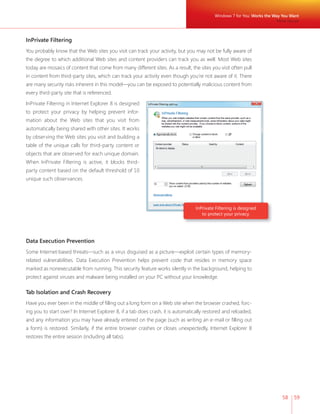
  Windows 7


         1   1
You told us what you wanted. We listened.
This Windows 7 Product Guide highlights
             ®


the new and improved features that will
help deliver the one thing you said you
wanted the most:


  Your PC, simplified.

                                            3   3
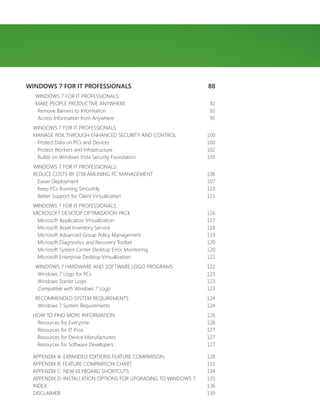
Contents
           INTRODUCTION TO WINDOWS 7                        6
            DESIGNING WINDOWS 7                             8
              Market Trends that Inspired Windows 7         9
            WINDOWS 7 EDITIONS                             10
             Windows 7 Starter                             11
             Windows 7 Home Basic                          11
             Windows 7 Home Premium                        12
             Windows 7 Professional                        12
             Windows 7 Enterprise / Windows 7 Ultimate     13
             Windows Anytime Upgrade                       14
             Microsoft Desktop Optimization Pack           14
             Windows 7 Editions Comparison                 15
             GETTING STARTED WITH WINDOWS 7                16
              Upgrading a PC to Windows 7                  16
            WHAT’S NEW IN WINDOWS 7                        20
             Top Features for You                          20
             Top Features for IT Professionals             22
             Application and Device Compatibility          23

           WINDOWS 7 FOR YOU                               24
            WINDOWS 7 FOR YOU: SIMPLIFIES EVERYDAY TASKS   28
             Simple to Navigate                            28
             Easier to Find Things                         35
             Easy to Browse the Web                        38
             Easy to Connect PCs and Manage Devices        41
             Easy to Communicate and Share                 47
            WINDOWS 7 FOR YOU: WORKS THE WAY YOU WANT      50
             Speed, Reliability, and Responsiveness        50
             More Secure                                   55
             Compatible with You                           62
             Better Troubleshooting and Problem Solving    66
            WINDOWS 7 FOR YOU: MAKES NEW THINGS POSSIBLE   70
             Media the Way You Want It                     70
             Work Anywhere                                 81
             New Ways to Engage                            84
WINDOWS 7 FOR IT PROFESSIONALS                                  88
   WINDOWS 7 FOR IT PROFESSIONALS:
   MAKE PEOPLE PRODUCTIVE ANYWHERE                               92
    Remove Barriers to Information                               92
    Access Information from Anywhere                             95
  WINDOWS 7 FOR IT PROFESSIONALS:
  MANAGE RISK THROUGH ENHANCED SECURITY AND CONTROL             100
   Protect Data on PCs and Devices                              100
   Protect Workers and Infrastructure                           102
   Builds on Windows Vista Security Foundation                  103
  WINDOWS 7 FOR IT PROFESSIONALS:
  REDUCE COSTS BY STREAMLINING PC MANAGEMENT                    106
    Easier Deployment                                           107
    Keep PCs Running Smoothly                                   110
    Better Support for Client Virtualization                    115
  WINDOWS 7 FOR IT PROFESSIONALS:
  MICROSOFT DESKTOP OPTIMIZATION PACK                           116
   Microsoft Application Virtualization                         117
   Microsoft Asset Inventory Service                            118
   Microsoft Advanced Group Policy Management                   119
   Microsoft Diagnostics and Recovery Toolset                   120
   Microsoft System Center Desktop Error Monitoring             120
   Microsoft Enterprise Desktop Virtualization                  121
   WINDOWS 7 HARDWARE AND SOFTWARE LOGO PROGRAMS                122
    Windows 7 Logo for PCs                                      123
    Windows Starter Logo                                        123
    Compatible with Windows 7 Logo                              123
   RECOMMENDED SYSTEM REQUIREMENTS                              124
    Windows 7 System Requirements                               124
  HOW TO FIND MORE INFORMATION                                  126
   Resources for Everyone                                       126
   Resources for IT Pros                                        127
   Resources for Device Manufacturers                           127
   Resources for Software Developers                            127

  APPENDIX A: EXPANDED EDITIONS FEATURE COMPARISON              128
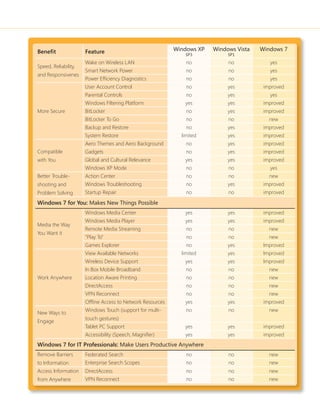
  APPENDIX B: FEATURE COMPARISON CHART                          131
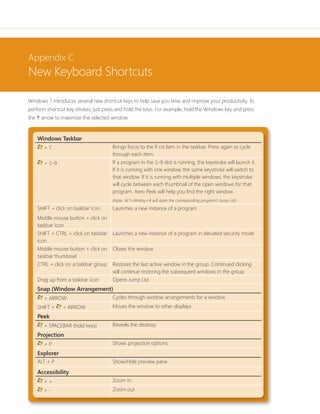
  APPENDIX C: NEW KEYBOARD SHORTCUTS                            134
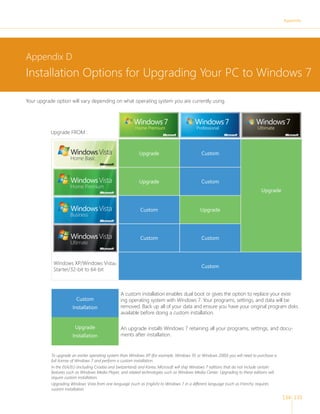
  APPENDIX D: INSTALLATION OPTIONS FOR UPGRADING TO WINDOWS 7   135
  INDEX                                                         136
  DISCLAIMER                                                    139
PCs are an integral part of the daily lives of billions of people around the world. They are
used for more functions than anyone could have imagined just a few years ago, and as
PCs become more deeply woven into our everyday lives, our expectations keep increasing.
With Windows® 7, you told us what you expect from a PC. And we listened.

In Windows 7 we’ve developed hundreds of little improvements and a few big ones that
add up, frankly, to a whole lot less. Less waiting, less clicks, less hassle connecting to devices,
less power consumed and less overall complexity.

And with less of what you don’t need, your PC running Windows 7 will help you do more
by making everyday tasks simpler and easier. Windows 7 is clean and uncluttered, with
a streamlined interface that puts the tasks you want to accomplish right at your finger-
tips. You have more control over where to put the things you use most often. Managing
multiple windows is easier. And we’ve improved search so that you can find the information
you want quickly.

We’ve made it easier to add PCs to your home network, share files between networked
PCs, and use and manage other connected devices like cell phones, cameras, and MP3
players. Even browsing the Internet is easier thanks to improvements in Windows Internet
Explorer® 8.

You asked for improvements in the basic fundamentals like performance, responsiveness,
safety, reliability, and compatibility. We designed Windows 7 to start up, shut down, and
resume from sleep quickly so you don’t have to wait as long to get stuff done. We’ve
reduced the number of system prompts that can interrupt your day. And you’ll have greater
control over what your kids can do on the PC. Even better, you’ll find innovative ways to
safeguard your personal data—all while getting more ways to personalize your PC and
make it truly your own.

With Windows 7, we’ve also made new things possible. You’ll find fresh ways to enjoy and
share your music, photos, video, and recorded TV when and where you want regardless of
how or where it’s stored. Windows 7 gives you more ways to access your data and work
productively from any location including making it easier to connect to wireless networks.
And we’ve added new ways to interact with your PC through touch-enabled screens.

In the enterprise, the role of the PC is evolving just as quickly as it is in the home. With
Windows 7, IT professionals have more ways to help their people get more done—more
securely and from more locations—while still maintaining control over increasingly complex
computing environments.


Welcome to Windows 7.
                                                                                               7      7
Designing Windows 7
  More than a billion people use Microsoft Windows every day. You use it
                                                            ®


  in significant ways, like earning a living. You use it in personally meaningful
  ways, such as using a webcam to visit with a faraway loved one. And you
  experience it in small ways, like playing your favorite song or whiling away
  a few minutes with a game. Though each situation might be different, your
  satisfaction relies on one thing: that your PC works, plain and simple.

  In designing Windows 7, we focused on creating a better experience,
  regardless of what you do on your PC. And although we’ve made some
  architectural changes in Windows 7, we’ve focused mainly on building
  upon the platform improvements of the Windows Vista and Windows                  ®


  Server 2008 operating systems.
           ®


  By definition, a great PC experience means seamless operation across all of your hardware, software, and
  devices. We want to make sure you have a broad choice for the programs and devices you use with your
  PCs. Today, the Windows Vista Compatibility Center lists more than 10,500 applications and 9,500 devices
  with a compatible download or driver version. In most cases, the same software and hardware that works
  on Windows Vista will also work on Windows 7.

  Furthermore, we were careful to design Windows 7 so that the investments that our partners and our
  enterprise customers have made in Windows Vista will continue to deliver great value as they upgrade
  to Windows 7. We’ve worked closely with our partners from the earliest planning phase. Before writing
  code, we talked to original equipment manufacturers, the companies that make PCs. Before defining
  application programming interfaces, we talked to developers. And before adding support for new
  devices, we worked with device manufacturers to understand how next-generation hardware could
  create new scenarios.
Designing Windows 7


Market Trends that Inspired Windows 7
As we planned Windows 7, we took a hard look at how the world of technology is changing and what
that means for you. In doing so, we identified some key themes that influenced our engineering design
efforts and helped us to focus on where we could deliver the highest value to you.

     • Hardware advances. Since Tablet PCs with touch screens were introduced more than five years
       ago, a whole range of new devices has made touch technology more popular. Similarly, the
       reduced cost of random access memory (RAM) has led many more people to use 64-bit proces-
       sors. Other advances include solid-state drives (SSDs), faster wireless networking, enhanced
       Bluetooth connectivity, multicore central processing units (CPUs), and powerful new graphics
       accelerators.

     • Expanded diversity and sophistication of devices. The type and range of devices continue
       to expand. Nearly 1,500 new Plug and Play devices are identified each day, with more than 4
       million expected by 2010. At the same time, devices like MP3 players and mobile phones store
       more information and offer more features than ever before.

     • Growth of mobile computing. In the United States, portable computers are becoming more
       prevalent than desktops, and we’re seeing a growing variety of them, like small notebook PCs,
       ultra-mobile PCs, and Tablet PCs.

     • More connection options. People want to get online easily and stay online using whatever
       Internet connection is available. Furthermore, people want to be able to access work and home
       information, no matter where they are.

     • Connecting multiple PCs in the home. Today, more than half of U.S. households have more
       than one PC—yet setting up a home network can still be a challenge. For many people, it’s even
       more difficult to manage, find, and share information across multiple PCs.

     • More digital media. People now have access to more types of digital media than ever, includ-
       ing music, video, TV, photos, and an ever-increasing amount of rich content on the Web. This
       media needs to be easier to find, use, and share—digital media should be accessible through
       more devices without any added complexity, regardless of whether people are listening to music
       on wireless headphones or watching movies on a big-screen TV.

     • A rapidly evolving Web. Browsing the Web remains the single most popular activity on the
       PC, with people spending more time—and doing more things—online. They want a Web
       browsing experience that supports all that the Web has to offer, with everyday tasks and
       content at their fingertips. They want easier ways to connect with friends and interact with
       social networks. And they also want protection from hackers, malicious software (malware),
       and other Internet-based threats.

     • Increased focus on costs. Although businesses often adopt new operating systems for better
       security and quantifiable cost savings, application and device compatibility can prevent them
       from moving forward. IT professionals need to know that adopting new technologies will make
       running and managing PCs easier, help increase data security, and extend the investments they
       have already made in existing applications and devices


                                                                                                                 8       9
Windows 7 Editions
         Different people expect different things from their PCs, which is why we offer
         multiple editions of Windows 7. And because your needs can change over
         time, we have designed Windows 7 so that you can move up to editions
         with more features, without giving up the features you already have.


                                            Windows 7 Enterprise and Windows 7 Ultimate are no-compromise
Windows® 7 Enterprise/Windows® 7 Ultimate   editions for people who want everything Windows 7 has to offer*.

                                            Windows 7 Professional is everything you need for work and home.
Windows® 7 Professional                     This business-focused edition is great for small- and medium-sized
                                            companies, and people who have networking, backup, and security
                                            needs and multiple PCs or servers.


                                            Windows 7 Home Premium is the best entertainment experience on
Windows® 7 Home Premium                     your PC. This edition provides full functionality on the latest hardware,
                                            easy ways to connect, and a visually rich environment.


                                            Windows 7 Home Basic makes the things you do every day faster and
Windows® 7 Home Basic                       easier. This edition is designed for value PCs in emerging markets.


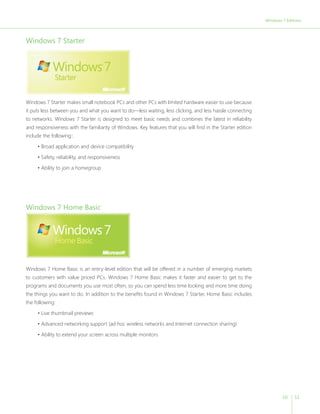
Windows® 7 Starter                          Windows 7 Starter Edition is the entry-level edition for small notebook
                                            PCs and other PCs with limited hardware. It makes using your PC simpler.


                                              *Note: Windows 7 Enterprise has the same features as Ultimate, and also
                                              includes volume activation capabilities. It is available only to customers with
                                              a Software Assurance Agreement.
Windows 7 Editions


Windows 7 Starter


Windows 7 Starter makes small notebook PCs and other PCs with limited hardware easier to use because
it puts less between you and what you want to do—less waiting, less clicking, and less hassle connecting
to networks. Windows 7 Starter is designed to meet basic needs and combines the latest in reliability
and responsiveness with the familiarity of Windows. Key features that you will find in the Starter edition
include the following::

     • Broad application and device compatibility

     • Safety, reliability, and responsiveness

     • Ability to join a homegroup


Windows 7 Home Basic


Windows 7 Home Basic is an entry-level edition that will be offered in a number of emerging markets
to customers with value priced PCs. Windows 7 Home Basic makes it faster and easier to get to the
programs and documents you use most often, so you can spend less time looking and more time doing
the things you want to do. In addition to the benefits found in Windows 7 Starter, Home Basic includes
the following:

     • Live thumbnail previews

     • Advanced networking support (ad hoc wireless networks and Internet connection sharing)

     • Ability to extend your screen across multiple monitors


                                                                                                                     10    11
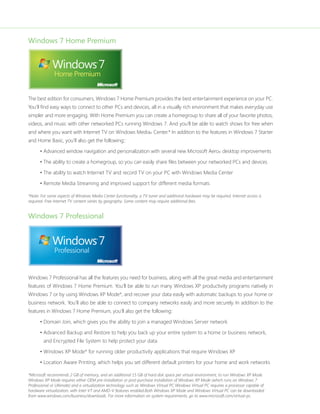
Windows 7 Home Premium


The best edition for consumers, Windows 7 Home Premium provides the best entertainment experience on your PC.
You’ll find easy ways to connect to other PCs and devices, all in a visually rich environment that makes everyday use
simpler and more engaging. With Home Premium you can create a homegroup to share all of your favorite photos,
videos, and music with other networked PCs running Windows 7. And you’ll be able to watch shows for free when
and where you want with Internet TV on Windows Media® Center.* In addition to the features in Windows 7 Starter
and Home Basic, you’ll also get the following::

      • Advanced window navigation and personalization with several new Microsoft Aero® desktop improvements

      • The ability to create a homegroup, so you can easily share files between your networked PCs and devices

      • The ability to watch Internet TV and record TV on your PC with Windows Media Center

      • Remote Media Streaming and improved support for different media formats

*Note: For some aspects of Windows Media Center functionality, a TV tuner and additional hardware may be required. Internet access is
required. Free Internet TV content varies by geography. Some content may require additional fees.


Windows 7 Professional


Windows 7 Professional has all the features you need for business, along with all the great media and entertainment
features of Windows 7 Home Premium. You’ll be able to run many Windows XP productivity programs natively in
Windows 7 or by using Windows XP Mode*, and recover your data easily with automatic backups to your home or
business network. You’ll also be able to connect to company networks easily and more securely. In addition to the
features in Windows 7 Home Premium, you’ll also get the following:

      • Domain Join, which gives you the ability to join a managed Windows Server network

      • Advanced Backup and Restore to help you back up your entire system to a home or business network,
        and Encrypted File System to help protect your data

      • Windows XP Mode* for running older productivity applications that require Windows XP

      • Location Aware Printing, which helps you set different default printers for your home and work networks

*Microsoft recommends 2 GB of memory, and an additional 15 GB of hard disk space per virtual environment, to run Windows XP Mode.
Windows XP Mode requires either OEM pre-installation or post-purchase installation of Windows XP Mode (which runs on Windows 7
Professional or Ultimate) and a virtualization technology such as Windows Virtual PC.Windows Virtual PC requires a processor capable of
hardware virtualization, with Intel-VT and AMD-V features enabled.Both Windows XP Mode and Windows Virtual PC can be downloaded
from www.windows.com/business/downloads. For more information on system requirements, go to www.microsoft.com/virtual-pc.
Windows 7 Editions


Windows 7 Enterprise / Windows 7 Ultimate


Windows 7 Enterprise and Windows 7 Ultimate are the most versatile and powerful editions and are designed to
address the needs of both enterprise customers and consumers who want every feature of Windows 7. While the
features in these editions are the same, Windows 7 Enterprise includes volume activation capabilities and is only
available to customers with a Microsoft Software Assurance Agreement.

Windows 7 Enterprise and Windows 7 Ultimate help make you productive anywhere, enhance security and
control, and streamline PC management. They also offer remarkable ease of use with the entertainment
features of Home Premium and the business features of Professional, plus the flexibility to work in many differ-
ent languages. Quite simply, Windows 7 Enterprise and Windows 7 Ultimate include everything Windows 7 has
to offer.

In addition to the previously mentioned features, these editions include the following:

      • Microsoft BitLocker™ and BitLocker To Go™ drive encryption and data protection on internal and external
        drives and storage devices

      • DirectAccess, which helps give you a more secure connection to your corporate network over the Internet

      • Microsoft BranchCache™, which helps provide faster access to content from remote file and Web servers
        at branch locations

      • Microsoft AppLocker™, which helps prevent unauthorized software from running on workers’ PCs

      • Enterprise Search Scopes, which make it easy to discover and search content on intranet portals

      • Multilingual user interface packs, which let you work in any of 35 languages


                                                                                                                        12    13
Windows Anytime Upgrade
Sometimes you want to be able to do more with your PC. That’s why we’ve made it easier for you to
move from one edition of Windows to the next. For example, you may have purchased a small notebook
PC with Windows 7 Starter but decide soon after that you want to customize your desktop or create
a homegroup. With Windows Anytime Upgrade, you can add features to Windows 7 in as few as 10
minutes. Upgrading from one edition of Windows 7 to another with more features is easy and quick, and
you’ll keep your programs, files, and settings.


SPECIAL NOTE:

In the EEA/EU (including Croatia and Switzerland) and Korea, Microsoft will ship versions of these editions that do not include
certain features.

“N” editions (for example, Windows 7 Home Premium N) do not include Windows Media Player and related technologies such as
Windows Media Center and Windows DVD Maker (distribution in EEA/EU only).

“KN” editions (for example, Windows 7 Home Premium KN) will not include Windows Media Player and related technologies such as
Windows Media Center and Windows DVD Maker (distribution in Korea only).

“K” editions (for example, Windows 7 Home Premium K) are the Korean language versions of the products, which contain links
added to the Programs menu that go to Web sites that contain links to download competing media players and instant messaging
software (distributed worldwide).


Microsoft Desktop Optimization Pack
Microsoft Desktop Optimization Pack for Software Assurance is a dynamic desktop solution available to
Software Assurance customers for use with Windows 7. It helps reduce application deployment costs,
enables delivery of applications as services, and allows for better management and control of enterprise
desktop environments. Technologies provided in the Microsoft Desktop Optimization Pack include:

      • Microsoft Application Virtualization

      • Microsoft Asset Inventory Service

      • Microsoft Advanced Group Policy Management

      • Microsoft Diagnostics and Recovery Toolset

      • Microsoft System Center Desktop Error Monitoring

      • Microsoft Enterprise Desktop Virtualization
Windows 7 Editions


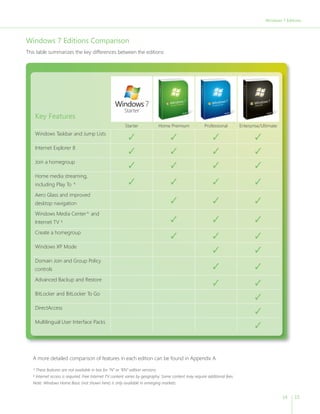
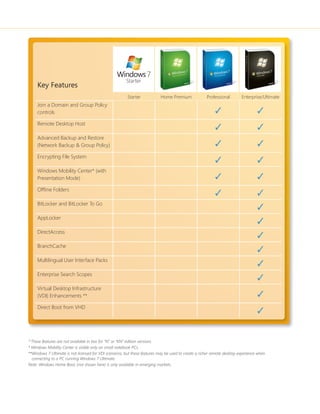
Windows 7 Editions Comparison
This table summarizes the key differences between the editions:


    Key Features
                                                          Starter               Home Premium           Professional         Enterprise/Ultimate
    Windows Taskbar and Jump Lists
                                                            ✓                       ✓                       ✓                      ✓
    Internet Explorer 8
                                                            ✓                       ✓                       ✓                      ✓
    Join a homegroup
                                                            ✓                       ✓                       ✓                      ✓
    Home media streaming,
    including Play To ^                                     ✓                       ✓                       ✓                      ✓
    Aero Glass and improved
    desktop navigation                                                              ✓                       ✓                      ✓
    Windows Media Center^ and
    Internet TV ¹                                                                   ✓                       ✓                      ✓
    Create a homegroup
                                                                                    ✓                       ✓                      ✓
    Windows XP Mode
                                                                                                            ✓                      ✓
    Domain Join and Group Policy
    controls                                                                                                ✓                      ✓
    Advanced Backup and Restore
                                                                                                            ✓                      ✓
    BitLocker and BitLocker To Go
                                                                                                                                   ✓
    DirectAccess
                                                                                                                                   ✓
    Multilingual User Interface Packs
                                                                                                                                   ✓


   A more detailed comparison of features in each edition can be found in Appendix A.

   ^These features are not available in box for “N” or “KN” edition versions.
   ¹ Internet access is required. Free Internet TV content varies by geography. Some content may require additional fees.
   Note: Windows Home Basic (not shown here) is only available in emerging markets.


                                                                                                                                                  14   15
Getting Started with Windows 7
   Whether you’re buying a new PC or upgrading your current PC to Windows
   7, you probably want to get through the setup process as quickly as
   possible. Windows 7 is designed to get you up and running fast.

   Windows 7 includes a new Getting Started experience that points you in
   the right direction by highlighting some common tasks associated with
   setting up your new PC. You’ll see Getting Started on the Start menu when
   you first use Windows 7. Use it to explore new features, transfer files from
   your old PC, add user accounts, and more. Getting Started is there when
   you need it and stays out of your way when you’re doing other things.

   Upgrading a PC to Windows 7
   We realize that upgrading to a newer version of Windows can sometimes be a challenge, depend-
   ing on what operating system you are currently running, your familiarity with PCs in general, and your
   current system configuration. With that in mind, we have designed Windows 7 for a smooth upgrade
   from Windows Vista and have improved several tools that can aid you in the upgrade process. (See the
   Windows Easy Transfer and Windows Upgrade Advisor sections that follow.)

   Because Windows 7 is built on the same architectural platform as Windows Vista, the transition to
   Windows 7 should be fairly smooth whether you’re using a 32-bit or 64-bit system, although you will
   need to ensure that your PC has the latest service pack first.* If your upgrade gets blocked due to incom-
   patible or missing drivers, you may be able to load a new or updated driver from the Compatibility Center
   and continue with the upgrade.
   *Note: Windows Vista Service Pack 1 (SP1) was released in April 2008. Windows Vista Service Pack 2 (SP2) was released in May
   2009. While you can upgrade from Windows Vista to Windows 7 with SP1, Microsoft recommends that you install both Service
   Packs before upgrading.
Getting Started with Windows 7


Migrating from Windows XP
Windows 7 is best experienced on a new PC with the latest hardware, but if your computer meets the
minimum specifications, you can install Windows 7 on a PC running Windows XP Windows 7 must be
                                                                            .
“custom” installed (also known as a “clean” installation) over Windows XP Before beginning the installation,
                                                                         .
you’ll need to copy your files and settings to an external drive. After Windows 7 has been installed you will
need to re-install all of your programs using the original installation media and then copy over the files
and settings you backed up to your external drive. Because Windows 7 requires a custom installation, we
strongly recommend that you get help with this process from your local computer service provider.

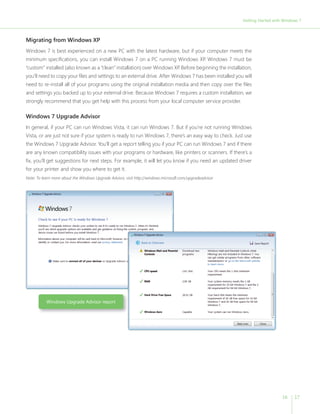
Windows 7 Upgrade Advisor
In general, if your PC can run Windows Vista, it can run Windows 7. But if you’re not running Windows
Vista, or are just not sure if your system is ready to run Windows 7, there’s an easy way to check. Just use
the Windows 7 Upgrade Advisor. You’ll get a report telling you if your PC can run Windows 7 and if there
are any known compatibility issues with your programs or hardware, like printers or scanners. If there’s a
fix, you’ll get suggestions for next steps. For example, it will let you know if you need an updated driver
for your printer and show you where to get it.
Note: To learn more about the Windows Upgrade Advisor, visit http://windows.microsoft.com/upgradeadvisor


           Windows Upgrade Advisor report


                                                                                                                               16    17
Windows Compatibility Center
You may want to know if your devices and software will work with your computer, and that you have all
the latest updates so your stuff works the way it’s supposed to. First introduced with Windows Vista, the
Windows Compatibility Center is a single location where you can quickly and easily verify that your exist-
ing devices and applications will work—and double-check to make sure that your new purchases work
too. The Compatibility Center is updated frequently so you can find the most current software and drivers
to make things run perfectly. You can even share feedback with Microsoft to help improve the Compat-
ibility Center or get help from the Windows community.
Note: To learn more about the Windows Compatibility Center, visit http://www.microsoft.com/windows/compatibility.


                                                                                                      Windows Compatibility Center
Getting Started with Windows 7


Windows Easy Transfer
Windows Easy Transfer helps you move files, folders, program settings, and system settings from your
old PC to your new one. With the newest version of Windows Easy Transfer, you can leave the transfer
unattended. If Windows encounters a file or setting that it can’t transfer, it will complete the rest of the
migration and then show you any items that failed to transfer and give you the option to try again.

Windows Easy Transfer also works well if you’re adding a second PC. With the new Windows Easy Transfer
file explorer, you can see files on other PCs and choose the ones you want to copy to your new PC. If
you’re not sure what you want to transfer, you can use the new Selective Restore feature to save all the
files and settings on your old PC to removable media. You can then choose the files and settings you
want to transfer. Everything else remains safely stored in your Windows Easy Transfer archive, in case you
want to access it later.

You’ll need the same version of Windows Easy Transfer on all PCs to transfer files, folders, program
settings, and system settings. For PCs running Windows 7, Windows Easy Transfer automatically copies
the latest version of Windows Easy Transfer to other PCs running Windows 7 after you’ve connected
them. If you’re running Windows Vista or Windows XP however, you will need to manually install the
                                                   ,
Windows 7 version of Windows Easy Transfer on your PC from the installation media in Windows 7 before
you can begin transferring data.


                                      Windows Easy Transfer helps you move your
                                       files, folders, and settings to your new PC.


                                                                                                                           18    19
What’s New in Windows 7
  Top Features for You
  We’ve designed Windows 7 to be the easiest, fastest, and most engaging version of Windows yet. We
  focused on helping your PC perform the way you want it to—quickly, easily, and with less effort. Although
  many of the new improvements are under the covers, Windows 7 also includes many more visible
  enhancements that will help you play with, work with, and manage your PC.

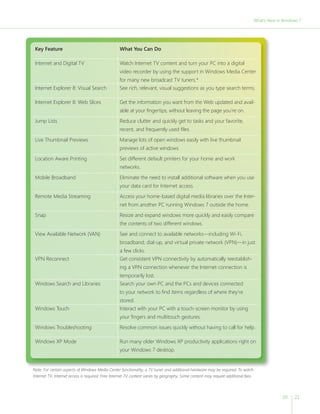
  The following table highlights some of the features that we think you’ll really like.


      Key Feature                              What You Can Do

      Aero Shake                               Click a window pane and shake your mouse to minimize all
                                               other open windows. Shake the pane again to restore the
                                               windows to their original sizes.
      Aero Themes and Aero Background          Use new themes or choose a slideshow of your favorite photos
                                               to make your PC reflect your personal taste.

      BitLocker and BitLocker To Go            Help protect sensitive data with new, easier ways to protect
                                               and recover drives and extend that protection to USB remov-
                                               able storage devices, such as flash memory drives and
                                               portable hard disk drives.
      Home Media Streaming                     Use your PC as a hub and make music, videos, photos, and
                                               recorded TV available on other PCs or stream it to supported
                                               devices using Play To.
      HomeGroup                                Easily share files and printers between PCs running Windows 7
                                               that are connected to your home network.

      Improved Windows Taskbar                 Open files and get around your PC faster. Pin programs you
                                               use often to the taskbar and launch them with a single click.
What’s New in Windows 7


 Key Feature                                      What You Can Do

 Internet and Digital TV                          Watch Internet TV content and turn your PC into a digital
                                                  video recorder by using the support in Windows Media Center
                                                  for many new broadcast TV tuners.*
 Internet Explorer 8: Visual Search               See rich, relevant, visual suggestions as you type search terms.

 Internet Explorer 8: Web Slices                  Get the information you want from the Web updated and avail-
                                                  able at your fingertips, without leaving the page you’re on.

 Jump Lists                                       Reduce clutter and quickly get to tasks and your favorite,
                                                  recent, and frequently used files.

 Live Thumbnail Previews                          Manage lots of open windows easily with live thumbnail
                                                  previews of active windows

 Location Aware Printing                          Set different default printers for your home and work
                                                  networks.

 Mobile Broadband                                 Eliminate the need to install additional software when you use
                                                  your data card for Internet access.

 Remote Media Streaming                           Access your home-based digital media libraries over the Inter-
                                                  net from another PC running Windows 7 outside the home.

 Snap                                             Resize and expand windows more quickly and easily compare
                                                  the contents of two different windows.

 View Available Network (VAN)                     See and connect to available networks—including Wi-Fi,
                                                  broadband, dial-up, and virtual private network (VPN)—in just
                                                  a few clicks.
 VPN Reconnect                                    Get consistent VPN connectivity by automatically reestablish-
                                                  ing a VPN connection whenever the Internet connection is
                                                  temporarily lost.
 Windows Search and Libraries                     Search your own PC and the PCs and devices connected
                                                  to your network to find items regardless of where they’re
                                                  stored.
 Windows Touch                                    Interact with your PC with a touch-screen monitor by using
                                                  your fingers and multitouch gestures.

 Windows Troubleshooting                          Resolve common issues quickly without having to call for help.

 Windows XP Mode                                  Run many older Windows XP productivity applications right on
                                                  your Windows 7 desktop.


Note: For certain aspects of Windows Media Center functionality, a TV tuner and additional hardware may be required. To watch
Internet TV, Internet access is required. Free Internet TV content varies by geography. Some content may require additional fees.


                                                                                                                                                 20    21
Top Features for IT Professionals
From networking to security and search to user management, Windows 7 offers IT professionals a wide
range of new and improved features. These include the following:


    Key Feature                           What You Can Do


    AppLocker                             Control which applications are allowed to run on user PCs.


    BranchCache                           Improve application responsiveness and end user productivity
                                          at branch offices while reducing the load on your Wide Area
                                          Network (WAN).
    DirectAccess                          Enable workers to more securely connect to corporate
                                          networks over any Internet connection—without requiring the
                                          extra step of initiating a VPN connection.
    Federated Search and Enterprise       Enable search engines, document repositories, Web appli-
    Search Scopes                         cations, and proprietary data stores to be searched from
                                          Windows 7, without writing and deploying client code.
    Problem Steps Recorder                Help your workers troubleshoot application failures by giving
                                          them the ability to reproduce and record their experiences and
                                          then send that information to support staff.
    VHD Boot                              Ease the transition between virtual and physical environments
                                          by reusing the same master image within a VDI infrastructure
                                          and on physical PCs.
    Windows PowerShell 2.0™               Automate repetitive tasks with this graphical scripting editor that
                                          helps you write scripts that access underlying technologies.
What;’s New in Windows 7


Application and Device Compatibility
We recognize that your PC experience involves programs and devices from many different providers, so
we’ve made a significant effort to ensure that the applications and devices you use and love are compat-
ible with Windows 7 and work the way you’d expect them to.

Windows 7 helps address application compatibility in several ways. Perhaps most importantly, we worked
to minimize changes in the way applications and devices interact with Windows. As a result, the work
done by third-party software and hardware developers to make their products work on Windows Vista
generally carries forward for Windows 7. In most cases, the same software and hardware that works with
Windows Vista will also work with Windows 7.

In addition, we created a comprehensive list of the most widely used consumer and business applica-
tions, which were tested throughout the development cycle. We also created new and improved tools
such as the Windows Upgrade Advisor, Application Compatibility Toolkit (ACT), Windows Compatibility
Center, Quality Cookbook, Application Verifier, and ISV Developer Portal to help customers and software
developers assess application compatibility.

For untested programs or applications developed in-house, Windows 7 offers a number of in-the-box
compatibility aids. For example, if a program fails to install because of a hard-coded version check,
the Program Compatibility Troubleshooter can automatically fix the problem (with the user’s consent)
and rerun the installer. Windows 7 also includes an expanded application shim infrastructure and a
Problem Steps Recorder that people can use to capture application compatibility issues for evaluation
by technical experts.

Furthermore, we continually monitor application compatibility issues throughout the Windows ecosys-
tem. We designed Windows 7 to monitor application health and, with the user’s permission, provide
feedback to Microsoft so that we can work quickly with application developers to resolve compatibility
problems and issue a fix if necessary. Microsoft has also invested in partner outreach efforts so that soft-
ware developers have the resources required to ensure application compatibility.

As with applications, we are also working to ensure that devices compatible with Windows Vista will work
just as well with Windows 7. As a part of this effort, we have greatly expanded the list of devices and
peripherals being tracked for compatibility with Windows 7. We have identified thousands of devices
through data collected via the Customer Experience Improvement Program and through outreach efforts
to device and PC manufacturers, and we have tested those devices for compatibility with Windows 7.
When updated device drivers are required, we are working to ensure that you can get them directly from
Windows Update or through links to driver downloads on device manufacturer Web sites.


                                                                                                                             22    23
Windows 7
for You
Windows 7 is more than just engineering and innovation—it’s
the product that you asked for.

You’ve told us you want everything you do on your PC
to be faster and easier. You’ve said that you’d like it if the
technology and devices in your home worked better together.
And because you spend a lot of time on the Web, you’ve
mentioned that you’d like that experience to be faster and
safer—and that you’d like it to be consistent with your offline
experience so that you don’t have to learn two different ways
to do the same thing.

In essence, you said that you wanted your PC simplified. And
with Windows 7, that’s exactly what you’ll get.


                                                                  25   25
Windows 7 for You
Simplifies Everyday Tasks
Windows 7 streamlines and simplifies the tasks you do most often. Its enhanced Start menu and Windows
Taskbar put the files and programs you use most within easy reach, so they don’t clutter your desktop. And
the desktop’s new streamlined interface puts you in control so you can get where you want to go faster.

With an improved search engine and Windows Explorer in Windows 7, you don’t have to wade through
multiple results to get the files or programs you’re looking for. No matter where files are located on your
PC or on your network, finding them is a snap. Browsing the Web is simpler too, thanks to new features
in Internet Explorer 8 that put the information you’re looking for right at your fingertips.

With Windows 7, you’ll even find it easier to share things, whether you’re using Windows Live Essentials
to communicate and share with friends, or sharing content and printers among devices connected to
your home network.


Works the Way You Want
Superior performance, reliability, and security enhancements make your PC work the way you want—that
is, without fuss and with fewer problems. Windows 7 is designed to start, shut down, and resume from
Standby faster. We’ve even engineered Windows 7 to help extend the battery life of your portable PC.

Windows 7 gives you new ways to help keep you and your data safe with enhanced security features, a
more secure online experience, and Parental Controls. Keeping your PC running smoothly—and finding
out what to do when there’s a problem—is much simpler too because you’ll be able to resolve most
issues from one central location. You’ll recover from problems faster with self-healing diagnostic features
and troubleshooters. In fact, Windows 7 will often fix issues without any impact to you.

Best yet, Windows 7 is extremely flexible. Need to run older business and productivity programs that require
Windows XP? Now you can, with the new Windows XP Mode. Plus, you can make your PC truly your own
with more options than ever for you to customize and personalize your PC to match your personality.


Makes New Things Possible
Windows 7 delivers enhancements that will help you do exciting new things with your PC. Windows
Media Center and Windows Media Player help you enjoy your media in new ways and places. Are your
family photos located on a different PC in your home? No problem.What if you’re away on business and
want to listen to a playlist that’s on your home PC? Believe it or not, you can do that too.

With Windows 7, it’s easier than ever to keep communications flowing and get things done—no matter
where you are—with new features that help you connect to the Internet and your corporate network
from remote locations. Choose separate default printers for your home office or business office. When
you’re ready for a break, use the improved Games Explorer to discover and play new games featuring
higher definition graphics with finer resolution.

Windows 7 makes it easier to move beyond the traditional mouse and keyboard and interact with your
PC using your fingers and multitouch gestures to control what happens on your screen.
Windows 7 for You:
Simplifies Everyday Tasks
    In Windows 7, we set out to streamline and simplify the things you do
    every day—and you’ll find you can get more done with a lot less effort. The
    user interface is nimbler and more responsive, with navigation that gets
    you where you want to go—fast. Connecting PCs and devices is easier.
    Networks are simpler to discover and use. And through the combination
    of Windows 7 and Windows Live, you can simplify your life online with
    great programs, innovative Web services from Microsoft, and integration
    with other popular online services.


    Simple to Navigate
    You’re probably already familiar with how to use and manage windows and don’t want to have to relearn
    what you already know. So the new Windows 7 features that help you get to files, work with windows, and
    manage your desktop, have been designed to be intuitive and familiar. These enhancements deliver great
    new ways to help you get more done with less effort.
Windows 7 for You: Simplifies Everyday Tasks
                                                                                                                    Simple to Navigate


Windows Taskbar
The taskbar is one of the most familiar aspects of Windows. When you open files and programs, their
icons show up on the taskbar so you can switch between them. Previous versions of Windows, however,
automatically decide where on the taskbar to place each item, and the locations sometimes change with
new sessions.

In Windows 7, the taskbar puts what you want to do at your fingertips. You decide where each program
goes so you know precisely where to click. When you install a new program, its icon is temporarily placed
at the bottom of the Start menu so you can drag it to the taskbar for convenient access in the future.
You can pin frequently used programs to
the taskbar or even pin a specific document
to a program. For example, if you are work-
ing on a large document over the course of
a week, you might want to pin your word
processing program to the taskbar and the
document to that program. That way, you’ll                                    Pin frequently used programs
always have a fast way to launch the docu-                                            to the taskbar.

ment and continue working.

You’ll see live taskbar thumb-
nails of each open window so
you can keep track of the files
and programs you’re using and
select them more easily. Rest
your cursor on the thumbnail,
and Aero Peek brings the full size
window into focus. You can also
close a window directly from the
thumbnail preview window.


                                                                             Rest your cursor on a thumbnail
                                                                             preview to see the open window.


                                                                                                                           28     29
When you have a large number of windows open for
a program, the open windows for that program are
displayed as a list. We’ve enhanced this list view by
adding the ability to peek at a highlighted window or
even close a window directly from the list.

Programs use the new taskbar to provide more infor-
mation in more intuitive ways. For example, you can see
progress bars on a taskbar icon, so that you can stay
aware of progress without keeping the window visible.


                                                                                    Thumbnail overflow list
                                                                                   supports closing windows.


   Windows Taskbar Shortcuts


       +T                               Brings focus to the first item in the taskbar. Press
                                        again to cycle through each item.

       + # (1–9)                        If a program in the 1–9 slot is running, the
                                        keystroke will launch it. If it is running with one
                                        window, the same keystroke will switch to that
                                        window. If it is running with multiple windows,
                                        the keystroke will cycle between each thumbnail
                                        of the open windows for that program. Aero
                                        Peek will help you find the right window. (Note:
                                        ALT+WinKey+# will open the corresponding
                                        program’s Jump List)
    SHIFT + click on taskbar icon       Launches a new instance of a program
    Middle mouse button +
    click on taskbar icon
    SHIFT + CTRL +                      Launches a new instance of a program in
    click on taskbar icon               elevated security mode
    Middle mouse button +               Closes the window
    click on taskbar thumbnail
    CTRL + click on a taskbar group     Restores the last active window in the group.
                                        Continued clicking will continue restoring the
                                        successive windows in the group
    Drag up from a taskbar icon         Opens Jump List
Windows 7 for You: Simplifies Everyday Tasks
                                                                                                                    Simple to Navigate


Jump Lists
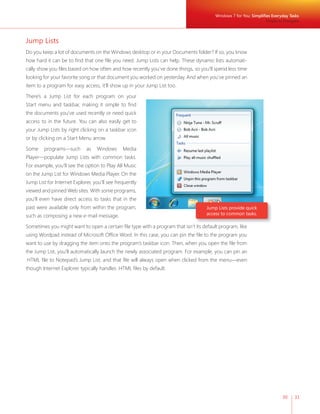
Do you keep a lot of documents on the Windows desktop or in your Documents folder? If so, you know
how hard it can be to find that one file you need. Jump Lists can help. These dynamic lists automati-
cally show you files based on how often and how recently you’ve done things, so you’ll spend less time
looking for your favorite song or that document you worked on yesterday. And when you’ve pinned an
item to a program for easy access, it’ll show up in your Jump List too.

There’s a Jump List for each program on your
Start menu and taskbar, making it simple to find
the documents you’ve used recently or need quick
access to in the future. You can also easily get to
your Jump Lists by right clicking on a taskbar icon
or by clicking on a Start Menu arrow.

Some    programs—such        as   Windows      Media
Player—populate Jump Lists with common tasks.
For example, you’ll see the option to Play All Music
on the Jump List for Windows Media Player. On the
Jump List for Internet Explorer, you’ll see frequently
viewed and pinned Web sites. With some programs,
you’ll even have direct access to tasks that in the
past were available only from within the program,                                   Jump Lists provide quick
such as composing a new e-mail message.                                             access to common tasks.

Sometimes you might want to open a certain file type with a program that isn’t its default program, like
using Wordpad instead of Microsoft Office Word. In this case, you can pin the file to the program you
want to use by dragging the item onto the program’s taskbar icon. Then, when you open the file from
the Jump List, you’ll automatically launch the newly associated program. For example, you can pin an
.HTML file to Notepad’s Jump List, and that file will always open when clicked from the menu—even
though Internet Explorer typically handles .HTML files by default.


                                                                                                                             30    31
Desktop Enhancements
One of the many benefits of Windows is the ability to work with large numbers of documents and
programs at the same time. But have you ever had to wade through a dozen open windows to get to the
right document? Or had to minimize a number of windows to view a gadget on your desktop? Or do you
often line up two windows so that you can easily compare their contents?

With desktop enhancements in Windows 7, working with multiple windows on your desktop is easier than
ever. For instance, you can use Aero Peek to get a quick look at your desktop. Simply hover your cursor
over the far-right side of the taskbar and all your open windows will become transparent. You can also
peek at a specific window to see exactly where it is by either using the live thumbnail previews or by using
Windows Flip (ALT + TAB) to quickly cycle through running windows. Pausing on a thumbnail will bring
the highlighted window into full size view.


                                                                         Place your cursor on the right side of
                                                                         the taskbar to peek at your desktop.


                                                                         Pause on a thumbnail using Windows
                                                                           Flip to bring a window into focus.
Windows 7 for You: Simplifies Everyday Tasks
                                                                                                                        Simple to Navigate


Want to get all but one window out of the way? Try Aero Shake. Grab the top of that window and shake
it, and all the other windows on your screen will minimize to the taskbar. Shake the window again to
restore the windows to their original sizes.

You can also snap open windows to screen borders, so you’ll no longer have to click tiny objects in the
corner of a window to change the window size. Maximize a window by dragging its border to the top
of the screen. To return the window to its original size, drag the top of the window away from the top
of the screen. To expand a window vertically, drag its bottom border to the bottom of the screen.

Do you sometimes compare the contents of two different windows? That’s easy too. When you drag
the top of each window to opposite sides of the screen, as your cursor touches the edge, the window
will resize to fill that half of the screen.


                                                                Snap allows for easy
                                                                resizing of windows.


   New Peek Shortcut

        + SPACEBAR (hold keys)                 Reveals the desktop


   New Snap Shortcuts

        + ARROW                                Cycles through window arrangements for a
                                               window (for example:  snaps to left,  snaps to
                                               right, and  maximizes window)
    SHIFT +       + ARROW                      Moves the window to other displays


                                                                                                                                 32    33
Windows Explorer

As you use your PC more and more, you may find the number of files you have to manage getting larger.
Windows Explorer in Windows 7 give you a central place to view and organize all the files on your PC.
The new layout of Windows Explorer reduces clutter and makes better use of space, while an improved
navigation pane helps you find and organize your files—even when those files are on other PCs in your
home network. In addition, it’s now simpler than ever to sort your files according to how you want to see
them with new arrangement options such as by author, subject, date created, file type, storage location,
or any other tag or property.

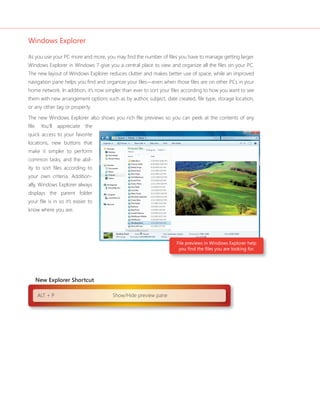
The new Windows Explorer also shows you rich file previews so you can peek at the contents of any
file. You’ll appreciate the
quick access to your favorite
locations, new buttons that
make it simpler to perform
common tasks, and the abil-
ity to sort files according to
your own criteria. Addition-
ally, Windows Explorer always
displays the parent folder
your file is in so it’s easier to
know where you are.


                                                                    File previews in Windows Explorer help
                                                                     you find the files you are looking for.


   New Explorer Shortcut

    ALT + P                            Show/Hide preview pane
Windows 7 for You: Simplifies Everyday Tasks
                                                                                                                      Easier to Find Things


Easier to Find Things
Windows 7 helps you search more efficiently, regardless of whether what you’re looking for is on your PC,
on another PC running Windows 7, on your home network, or on the Web. The new Libraries feature and
Windows Search enhancements go hand-in-hand with improvements to the Aero Desktop and Windows
Explorer to make finding what you want a breeze.


Libraries
If you store a large number of files in different file folders or on several PCs or devices, you might find
it hard to find the exact file you’re looking for or manage all your files efficiently. Libraries can help. At
their most fundamental level, Libraries are a way
to view files with common characteristics—even
if those files are located in different places. The
purpose of Libraries is to make it easier to view,
organize, manage, and search for files without
the hassle of organizing the files into specific
folders. Windows 7 automatically creates Librar-
ies for items such as documents, music, pictures,
and videos.

The great thing about Libraries is that they
make the actual location of your files irrelevant.
                                                                                          Windows 7 automatically
Whether files are located in different folders on                                          creates some Libraries.
your PC, on a different drive, or even a different
PC in your home network that Windows Search
has indexed, Libraries help you consolidate all
those files and their locations so you can browse
and search across them as if they were in one
location.


                                                                                          Libraries help you search
                                                                                            multiple file locations.


                                                                                                                                  34    35
You can even arrange and view the files in your Libraries by some of its metadata. For example the
“Month” and “Day” views in the Pictures Library group together the photos taken on the same date. And
the Videos Library features a way to arrange the files by length so you can separate the shorter clips from
the longer movies.

Libraries are automatically indexed by Windows Search so viewing and searching is fast. And because it’s
easier to get to all your items, you won’t end up keeping multiple copies of the same file in different folders.


                                                                       Libraries help you browse and search across
                                                                         folders even if they are on different PCs.


Searching from the Start Menu
The Search box in the Start menu is a fast and easy access
point for all your programs, data, and PC settings. Just type
a few letters in the Search box, and you’ll be presented with
a list of matching programs, documents, pictures, music,
e-mail, and other files, all arranged by category. You can even
search for Control Panel tasks directly from the Start menu
to more quickly adjust PC settings. And because the Search
box in the Start menu also looks for files in your Libraries
and groups them accordingly, it’s easier to understand your
results within context.


                                                                                     Search from the Start menu.
Windows 7 for You: Simplifies Everyday Tasks
                                                                                                                                   Easier to Find Things


Improved Search Relevance
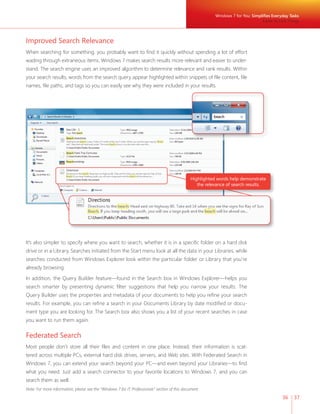
When searching for something, you probably want to find it quickly without spending a lot of effort
wading through extraneous items. Windows 7 makes search results more relevant and easier to under-
stand. The search engine uses an improved algorithm to determine relevance and rank results. Within
your search results, words from the search query appear highlighted within snippets of file content, file
names, file paths, and tags so you can easily see why they were included in your results.


                                                                                                Highlighted words help demonstrate
                                                                                                   the relevance of search results.


It’s also simpler to specify where you want to search, whether it is in a specific folder on a hard disk
drive or in a Library. Searches initiated from the Start menu look at all the data in your Libraries, while
searches conducted from Windows Explorer look within the particular folder or Library that you’re
already browsing.

In addition, the Query Builder feature—found in the Search box in Windows Explorer—helps you
search smarter by presenting dynamic filter suggestions that help you narrow your results. The
Query Builder uses the properties and metadata of your documents to help you refine your search
results. For example, you can refine a search in your Documents Library by date modified or docu-
ment type you are looking for. The Search box also shows you a list of your recent searches in case
you want to run them again.


Federated Search
Most people don’t store all their files and content in one place. Instead, their information is scat-
tered across multiple PCs, external hard disk drives, servers, and Web sites. With Federated Search in
Windows 7, you can extend your search beyond your PC—and even beyond your Libraries—to find
what you need. Just add a search connector to your favorite locations to Windows 7, and you can
search them as well.
Note: For more information, please see the “Windows 7 for IT Professionals” section of this document.

                                                                                                                                               36    37
Easy to Browse the Web
As people spend more time online, their demands on the browser have increased. Since Microsoft
delivered Internet Explorer 7, millions of people around the world have taken advantage of its tabbed
browsing, the built-in search box, and other features to improve their Web browsing experience. Internet
Explorer 8 takes these features a step further to help meet your browsing expectations.


Instant and Visual Search
We’ve improved the Search box in Internet Explorer 8 so that search providers can deliver rich, contex-
tual search suggestions in real time. As you type a search term, you’ll see relevant suggestions that can
be categorized and may even include
images. For instance, you might find
images of products from your favor-
ite store as you search, or stock charts
from your online brokerage account
in the Search Box drop-down list.
Internet Explorer 8 provides the tech-
nology, but the choice of what to
show is made by the search provider.
Popular sites such as Bing, Wikipedia,
Amazon.com, The New York Times
online, Yahoo!, eBay, OneRiot, ESPN,
Photobucket, and TinyPic are all taking
advantage of the new search capabili-
                                                                           Search providers can provide images
ties in Internet Explorer 8. In addition,                                     within contextual suggestions.
because people often use Search to
get back to sites that they’ve visited
before, Internet Explorer 8 includes matches from your Favorites and History in the bottom of the
Search Box drop-down list.

The enhanced Instant Search box in Internet Explorer 8 is more helpful than before, making it easier to
find interesting content and returning more relevant search results. As you type a search term, you’ll
see real-time search suggestions—including images and rich text—from the search provider you’ve
chosen. The Instant Search box will even display results from your Favorites and browsing history. A
quick pick menu at the bottom of the Instant Search box lets you switch back and forth between your
favorite Web sites and search provider’s search suggestions with a click of the mouse.
Windows 7 for You: Simplifies Everyday Tasks
                                                                                                               Easy to Browse the Web


Web Slices
E-mail, weather, sports scores, stock
quotes, or auction item status—there are
Web sites we visit multiple times during
the day to get updates. Web Slices in
Internet Explorer 8 make it simple to
access this information without having to
navigate to the Web site again and again.
Web site owners can now mark parts of
their pages as Web Slices. See something
you want to track? Just click on the Web
Slice icon that appears next a block of
content when you pause on it, and you’ll
get the option to add it to your Favorites
Bar. Alternatively, you can click Get More                                          Web Slice showing traffic.
Add-ons to add Web Slices.


Accelerators
Do you spend a lot of time copying information from one Web page, pasting it into another,
viewing the results—and then returning to the original page to pick up where you left off? With
Internet Explorer 8, you won’t have to do this any longer; Accelerators in Internet Explorer 8 make
the process of accessing online services easy. Just select some text and right-click to select an
Accelerator and get the results instantly.

For example, let’s say you’ve just read a review of a great new restaurant and want to see its loca-
tion. In the past, you would have had to copy the address, navigate to a mapping service, and
paste the address into the address field. With the Accelerator called Map with Bing, you can high-
light the address and then see your map overlaid on the page you’re currently on.

Internet Explorer 8 includes a number
of useful Accelerators from Microsoft
that cover search, mapping, word
definitions, translation, blogging and
e-mail. But you can easily find and
use Accelerators from other providers
too using the Find More Accelerators
option on the Accelerators menu. For
example, eBay, Yahoo!, Facebook,
ESPN, Photobucket, and TinyPic all
offer Accelerators that make it easier
for you to interact with their Web sites                                 Map with Bing Accelerator overlays a
and services.                                                            map based on the highlighted address.


                                                                                                                            38    39
Smart Address Bar
If you use Internet Explorer 7, you know that the Address Bar presents matching Web addresses from
your history as you type. However, you have to type the same beginning of the Web address to display
the same results—and there’s no way
to delete an entry if you’ve mistyped
it. In Internet Explorer 8, the Smart
Address Bar makes navigation easier
by providing matches from your
History, Favorites, and Really Simple
Syndication (RSS) Feeds as you type,
and it searches against all parts of the
Web address—and the titles for those
Web pages too. You can also now
delete unwanted entries, whether it’s
a mistyped address or a site that you
know you won’t visit again and don’t
want appearing in search results.                                   Smart Address Bar provides matching Web
                                                                     addresses from your history as you type.


The Find on this Page Toolbar
The Find dialog box in Internet Explorer 7 helps you locate specific content on a Web page, but it can
sometimes obscure the page itself. In Internet Explorer 8, we’ve changed the dialog box into a toolbar so
that it doesn’t hide any of the content on the page. This toolbar is also linked to the Internet Explorer 8
Search box, so you can first find a specific Web page and then find the desired text on the page.
Windows 7 for You: Simplifies Everyday Tasks
                                                                                              Easy to Connect PCs and Manage Devices


Easy to Connect PCs and Manage Devices
More than half of all U.S. households have more than one PC. If you live in one of those households,
you may have experienced trouble setting up a network or found that the PCs in your home don’t work
together as well as they could. Even when your PCs are successfully networked together, sharing content
and devices such as printers doesn’t happen automatically. Windows 7 makes it much easier to connect
the technology in your home, and to share media, folders, files, and printers among connected devices.


HomeGroup
Do you have multiple PCs in your home but only one printer? If you’re like most people, when you need
to print a file from your laptop in the bedroom to the printer in the den, you probably e-mail the file from
one PC to another or transfer it on a USB drive. And if you need to find a file but don’t know which PC
it’s stored on, it can take hours to search each one.

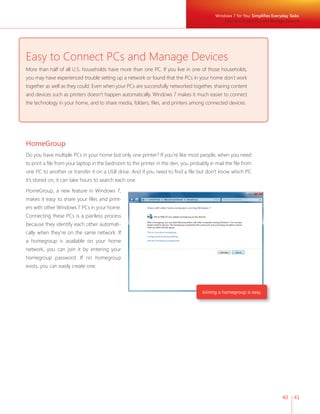
HomeGroup, a new feature in Windows 7,
makes it easy to share your files and print-
ers with other Windows 7 PCs in your home.
Connecting these PCs is a painless process
because they identify each other automati-
cally when they’re on the same network. If
a homegroup is available on your home
network, you can join it by entering your
homegroup password. If no homegroup
exists, you can easily create one.


                                                                                    Joining a homegroup is easy.


                                                                                                                             40    41
After you’ve created your homegroup, accessing and sharing files among the various PCs—or other
devices—in your home is like having all your data on a single hard disk drive. For example, you might
have digital photos stored on a PC in your den. With HomeGroup, you can easily access those photos
from a laptop or any other PC in the home-
group from anywhere in your home. Similarly,
if there’s a printer connected to a PC in your
homegroup, the printer is set up automatically
on PCs that join the homegroup. In addition,
with HomeGroup, you can specify exactly
what you want to share so you can choose to
keep private things private.

HomeGroup also works for PCs that are
connected to a work domain. When your
domain-joined work PC is joined to a home-
                                                                        Homegroup gives you control over
group, you automatically have access to your                              what to share with other PCs.
shared home printer and any content shared
with the homegroup. However, for a domain-joined PC, HomeGroup file sharing is turned off by default,
and IT professionals can use Group Policy to stop employees from joining a homegroup. (See “Group
Policy Improvements in the IT Professionals” section for more information.)


                                                                      Devices in a homegroup can
                                                                        share files and printers.


Small businesses that do not have a server can also use HomeGroup to easily share documents and
printers across multiple PCs running Windows 7.
Windows 7 for You: Simplifies Everyday Tasks
                                                                                              Easy to Connect PCs and Manage Devices


Windows Connect Now
The first step in sharing information between PCs is to connect them to a network. Windows Connect
Now is a feature of Windows 7 that makes it fast and easy to set up your home or office network and
connect additional PCs.

In the past, it’s been difficult to get a new network up and running. Now, all you have to do is turn on a
router that has the Compatible with Windows 7 logo and click “Connect.” Windows Connect Now walks
you through all the steps—including naming your network and setting security levels. Within minutes
you will have a highly secure wireless network setup to protect your family and personal information.

When it comes time to add new PCs to your new network, you don’t even have to remember the
network security key. Windows 7 automatically detects your network and prompts you to use the Wi-Fi
Protected Setup push button on your router. The router then applies your network and security settings
to any additional PCs you are connecting.


                                                                      Windows Connect Now


                                                                                                                             42    43
The Devices and Printers Folder
The Devices and Printers folder is a single location where you can access and interact with all your
devices. When Windows 7 detects a device it automatically downloads and installs any required drivers.
After your device has been installed, it
will appear in the Devices and Printers
folder with a photo-realistic icon. From
there you can access any task you want
to perform, such as customizing your
mouse or webcam settings. In addition,
your multifunction devices will appear
just as they do on your desk—as a
single, unified device instead of multiple
separate devices. With Windows 7 you
won’t have to go to different places to
manage different parts of the device for
things like printing and scanning.
                                                                     Devices and Printers provides a
Windows 7 makes it simple to add your                              consolidated view of all your devices.
networked and wireless devices— such
as printers, keyboards, and digital picture frames. Using
the Add a Device wizard you can connect to network,
Wi-Fi, and Bluetooth (Windows 7 supports Bluetooth
2.1) devices. For Wi-Fi devices that feature the Compat-
ible with Windows 7 logo, simply launch the Add a
Device wizard to so your computer can detect your new
device. Windows 7 will configure the device to connect
to your wireless network. After your device is connected,
Windows 7 will download and install any necessary
device drivers so that you can use it right away.


                                                                 The Add a Device wizard helps you easily
                                                                   add networked and wireless devices.
Windows 7 for You: Simplifies Everyday Tasks
                                                                                                Easy to Connect PCs and Manage Devices


Device Stage
Do you have a lot of digital devices like phones, music players, or digital cameras? Device Stage helps
you manage all of your devices more efficiently by showing you the status of each and displaying the
common things you can do with them in a single familiar window. When you connect portable devices
such as digital cameras and cell phones to your PC, you’ll see a photo realistic image right on the taskbar.
From there, you can easily launch the Device
Stage for that device or quickly access tasks
for the device with a right-click of your
mouse. For example, you can use Device
Stage to synchronize important data and
media between Windows 7 and cell phones
or portable media players. You can add or
create ringtones for your mobile phone or
even see how much remaining storage is
available on your digital camera.

Each Device Stage window has the same
structure—according to device—but the
device manufacturer may create custom-                                          Device stage shows you the status
ized content for those windows. Any time                                        of your devices and the common
                                                                                  things you can do with them.
your devices are updated, you’ll automati-
cally see those updates in Device Stage.

Device Stage supports PCs too. If a desktop or laptop PC maker chooses to create content for device
stage, you’ll see your PC in the Device Stage screen. Just double-click a PC icon in the Devices and Print-
ers folder, and you can use Device Stage to help manage it.


Monitor Support
LCD monitors are becoming more popular because of their slim size, crisp text, and superior graphics
capabilities. However, you might not be getting all the benefits from your LCD monitor that you could.
Windows 7 improves support for monitors—especially LCD displays—to help you get the most out of
them. You can adjust the size of text, optimize its clarity, and color-calibrate your monitor. And if you have
a laptop, you can more easily take advantage of external displays.


                                                                                                                               44    45
Improved Support for External Displays
If you have a laptop, you may want to connect it to an external display to watch a movie at home or
give a presentation at work. Windows 7 makes it easier to connect to external displays because all of the
common display-related features are gathered in one place, under Display in Control Panel. You can use
the Windows key + P shortcut to toggle between your laptop screen and an external display.


                                                                         Support for external displays


   New Projection Shortcut

       +P                                 Shows projection options


Display Color Calibration
Ever notice that colors vary on different devices, monitors, or when printed? Display Color Calibration
in Windows 7 helps you adjust your display to be as close as possible to the computer industry (sRGB)
standard color representation so that colors will appear the same on different screens. It guides you
through a simple series of adjustments using your display’s front-panel controls, on-screen controls, and
easy-to-use visual calibration targets.

High DPI Support
Microsoft research shows that only half of the people who use Windows have their displays set to the
native resolution, with many people decreasing the resolution of their displays because they can’t read
the small text of the higher resolution. Unfortunately, doing this can make text and parts of the user
interface appear fuzzy, and it prevents you from
viewing digital photos or high-definition video at
full fidelity. If you have the right hardware and
display drivers, Windows 7 will automatically
select the optimal display resolution for your
monitor. And if you want to, you can make your
text more readable by choosing to display it at
125 percent or 150 percent of its normal size.


                                                                        Make text larger and more readable
                                                                             with the Control Panel.
Windows 7 for You: Simplifies Everyday Tasks
                                                                                                   Easy to Communicate and Share


Easy to Communicate and Share
With Windows 7 and Windows Live Essentials, your PC will help you stay connected to the people and
things you care about and do it safely. Windows Live Essentials is a free suite of programs for e-mail,
photos, instant messaging, and more. It can be downloaded from the Web and, for some new PCs,
comes pre-installed. Windows Live Essentials includes the following programs:


Windows Live Mail
Windows Live Mail is a great program for accessing Windows Live Hotmail®, Windows Live Calendar, and
Windows Live Contacts—and you can even access previously synchronized e-mail, calendar, and contact
information when you’re offline. POP and IMAP support makes it easy to access and manage third-
party e-mail services such as
Yahoo!*, Gmail, and AOL. And,
with built-in photo mail, you can
send photos to friends without
overloading their Inboxes with
large    attachments.        Instead,
they’ll receive light, embed-
ded thumbnail images, along
with links to easily download
the full-resolution versions or
to see the images played as a
slideshow.
Note: POP access is available only with
Yahoo!Plus, not with free Yahoo! e-mail
accounts.


                                                                                     Windows Live Mail


                                                                                                                         46    47
Windows Live Messenger
Windows Live Messenger makes it effortless to connect to your favorite people or groups, chat via IM,
video or voice, play games, share photos and monitor what’s new with your circle of friends. The latest
release of Messenger doesn’t just feature a brand new look and feel—it’s also designed so that you can
personalize nearly everything. For instance, you can change your profile picture, background scene, and
status messages whenever you like, create a
dynamic avatar, and record a short video. You
can even designate your own signature sound
that contacts hear when you start a conversa-
tion and assign unique sounds to the people
in your contact list. For more fun, create
multiple display pictures, or moods, and alter
what your contacts see by the emoticons you
use in your conversations. And in response to
one of the most common customer requests,
you can now more safely include hyperlinks in
your personal status message.


                                                                               Windows Live Messenger


Windows Live Movie Maker
Are you looking for a better way to share and show off your videos and snapshots? Windows Live
Movie Maker makes it fast and easy to make great-looking movies and slideshows from your videos and
photos. It’s simple to import standard or high definition video and photos, and have AutoMovie add
animations,       music,      and
a title in minutes. Then
just burn your movie to a
DVD* or upload it directly
to YouTube to share.


*DVD burning capability is
available for these editions of
Windows 7: Home Premium,
Professional, Enterprise, and
Ultimate.

                                                                              Windows Live Movie Maker
Windows 7 for You: Simplifies Everyday Tasks
                                                                                                                      Easy to Communicate and Share


Windows Live Photo Gallery
After you import photos to your PC running Windows 7, use Windows Live Photo Gallery to edit, organize,
and publish them to the Web. You can even tag photos in Photo Gallery so that you can easily find them
later. Windows Live Photo Gallery not only incorporates a revolutionary face-detection technology that
helps make people-tagging simple,
but it also offers photo-stitching, a
feature that lets you build panoramic
views from a collection of photos. With
Windows Live Photo Gallery, you can
publish to Windows Live Photos and
other popular photo-sharing services,
and you can order prints directly from
thousands of print services partners
around the world.


                                                                                                    Windows Live Photo Gallery


Windows Live Writer
Windows Live Writer, a blogging program, gives you the tools you need to blog on Windows Live Spaces
in addition to other popular blogging services such as Blogger, WordPress, TypePad, LiveJournal, and
Community Server. Now you can create, preview, and publish content within a familiar interface based
on Windows. Windows Live Writer isn’t just for hardcore bloggers. It’s also a great storytelling tool that’s
easy for anyone to use. With Windows Live Writer, creating and formatting blog entries is a lot like using
Microsoft Word, but with features that are specific to blogging. You can also arrange and edit images
within a blog entry and add videos from YouTube.


Windows Live Family Safety
Windows Live Family Safety can help you protect your children when they’re online. For more details,
please see the “Parental Controls” section of this document.


Windows Live Toolbar
Windows Live Toolbar gives you at-a-glance summaries and access to the people and information you
care about. Plus, you get quick access to other Windows Live services, such as Windows Live Mail and
Windows Live Calendar, so you can easily share stuff you find on the Web.
Note: For additional information on Windows Live, please see the Windows Live Wave 3 Reviewers Guide.


                                                                                                                                            48    49
Windows 7 for You:
Works the Way You Want
    More than anything else, you’ve told us that you care about the basics.
    No one has the time to deal with PCs that aren’t snappy and responsive
    or fall short of expected performance—like taking too long to wake up
    from sleep. And we’d all like to feel more secure, online and off.

    In other words, everything should just work—and work the way you want
    it to. Windows 7 takes the improvements we made in Windows Vista
    and extends them. And that means you’ll get an operating system that is
    designed to start quickly, be more secure, and take advantage of powerful
    new hardware.


    Speed, Reliability, and Responsiveness
    Many of the improvements of Windows 7 are things you’ll never see because they happen under the
    hood, so to speak. You’ll likely notice a difference though. For example, there’s less background activity
    now, and system services are started only when they’re needed. We’ve also designed Windows 7 to be
    more reliable so you’ll experience fewer interruptions, and you can recover more quickly from problems
    when they do occur because Windows 7 will help you fix them.
Windows 7 for You: Works the Way You Want
                                                                                                   Speed, Reliability, and Responsiveness


Start, Shutdown, and Resume
Windows 7 is ready when you are. It’s designed to start, hibernate, and shut down faster than Windows
Vista. We also focused on ways to resume from sleep more quickly and reliably. And because resuming
from sleep is much faster than rebooting your PC, you can use sleep when you really need your PC to
come to life quickly.


Search and Indexing
When looking for information, you want answers, not delays. Search and indexing are both much faster
now, because Windows 7 includes all the performance improvements from Windows Search 4.0, a
Windows technology that indexes all the files on your PC, as well as several other significant new perfor-
mance optimizations. Sorting and grouping of search results are significantly faster too. (See pages 34–37
for a more detailed discussion of improvements to Windows Search.)


ReadyBoost
PCs that are low on memory frequently swap data to disk, which can make performance lag. With
Microsoft ReadyBoost™ technology, which we introduced in Windows Vista, you can use a flash memory
device to cache frequently used data, which in turn makes your PC more responsive. With ReadyBoost in
Windows 7, you can use multiple flash devices—such as USB keys, Secure Digital cards, and internal flash
devices—at the same time.


Improved Memory Utilization
We’ve worked hard to reduce overall memory requirements in Windows 7. For example, hundreds of
runtime components now use less memory, while the core memory needs are smaller when the computer
is idle. Windows 7 can reduce the memory requirements for each open window by up to 50 percent. In
addition, we’ve introduced trigger start services, an innovative feature that launches system services only
when they’re needed and reduces the number of programs competing for system memory.


Solid State Drives
Solid-state drives (SSDs), an alternative to traditional hard disk drives, are becoming more popular. This
popularity is partially due to the fact that SSDs are typically faster than conventional hard disk drives. We
designed Windows 7 to work well with SSDs so you’ll have a chance to experience improved PC perfor-
mance, more consistent responsiveness, increased battery life, superior ruggedness, quicker startup
times, and reductions in noise and vibrations. Features such as disk defragmentation, Microsoft Super-
Fetch™ memory management technology, and ReadyBoost (described above) are designed to improve
system responsiveness and performance when data is being retrieved from traditional hard disk drives. In
Windows 7, these features respond to a computer’s configuration and automatically turn themselves off
for the newer, faster SSDs, where they are not necessary, which helps free up system memory.


                                                                                                                               50     51
Windows Experience Index
The Windows Experience Index measures the capabilities of your PC’s hardware and software, and
expresses this measurement as a number called a base score. A higher base score generally means that
your computer will perform better and faster than a computer with a lower base score.

In Windows 7, the Windows Experience Index has been updated to reflect advances in processor, graph-
ics, and hard disk technology. Maximum scores should generally be the same or higher for a computer
system after upgrading from Windows Vista to Windows 7.


Battery Life and Notifications
We all know what it’s like to run out of power at a critical moment. That’s why we designed Windows 7
to extend the battery life for your mobile PC. Power-saving enhancements include increased idle time
for the processor, automatic dimming of the display, and more power-efficient playback for DVDs. We’ve
also made battery life notifications more prominent and accurate, so you know exactly how much power
you’ve used and how much battery time you have left.

Idle Processing
When your PC is idle, it uses less power. Windows 7 reduces background activities and supports the trig-
ger-starting of system services, so your PC’s processor can be in an idle state for longer periods of time.

Adaptive Display Brightness
The display on a typical mobile PC consumes more battery power than any other part of the PC. Windows
7 automatically reduces display brightness if you are inactive for a period time, much like cell phones
do today. Windows 7 also adapts to your activity intelligently. For example, if the screen dims after 30
seconds and you immediately move the mouse to brighten the display, Windows 7 will wait 60 seconds
before dimming the display again.


               Adaptive display before and after
Windows 7 for You: Works the Way You Want
                                                                                                Speed, Reliability, and Responsiveness


Power-Saving DVD Playback
With Windows 7, your PC will use less power when playing a DVD. Windows 7 requires less processing
power than previous versions of Windows and is more efficient when it spins discs.

Wake on Wireless LAN
Having your PC go into Sleep state when idle is a good way to conserve power. But what if you need to
access your PC remotely? In Windows Vista, you can wake another PC in Sleep state only if it has a wired
network connection. In Windows 7, you can use the Wake on Wireless LAN feature to wake the PC over a
wireless network connection. Let’s say you’re using your laptop in the bedroom and want to see a photo
on the PC in the kitchen. Because both are connected to your home network, it doesn’t matter if the
kitchen PC is in Sleep state, because you can use Wake on Wireless LAN and view the photo. Similarly,
the IT administrator in your company can wake up wirelessly connected PCs to apply software updates
or perform other maintenance—and save on power costs too.

Smart Network Power
Your mobile PC may send energy to parts of your computer even when they’re not being used—such
as sending power to the network adapter when you don’t have an Ethernet cable plugged in. Windows
7 automatically turns off power to the network adapter (subject to adapters and drivers supporting this
feature) when the cable is disconnected and restores power when the cable is connected. IT professionals
can take advantage of this feature to reduce power costs.

Power Efficiency Diagnostics
In Windows 7, we’ve updated the power configuration utility to detect problems with devices, policies,
firmware, system settings, programs, and other common items where settings can reduce power effi-
ciency. The information is presented in an easy-to-understand report. Although we designed this feature
primarily for developers and system integrators, it may also be useful to the tech-savvy.


                                                                                                                            52     53
64-Bit Computing Support
If you’ve gone PC shopping lately, you’ve probably noticed more computers with 64-bit processors and
wondered what advantages they offer. Put simply, a 64-bit PC can handle larger amounts of information
than traditional 32-bit systems. Because it can use more RAM (4 GB and up) a 64-bit PC can be faster
and more responsive depending on the workload. If you tend to have a lot of programs open simultane-
ously, need to switch frequently between programs, or are an avid gamer, a 64-bit PC is a great choice.
Windows 7 fully supports 64-bit PCs.


DirectX 11: DirectCompute
For PCs that have a graphics card that supports the Microsoft DirectX® 11 application programming
interface, DirectCompute-enabled applications will perform faster on your Windows 7-based PC. For
instance, certain applications that convert a digital media file to a different size or format will do that
conversion (called transcoding) faster. So you’ll spend less time moving your home movies from a PC with
Windows 7 to a portable playback device. DirectCompute boosts PC performance by taking on some or
all of the application’s processing load, freeing up the computer’s main processor to perform additional
tasks. If your PC has a graphics card that supports DirectCompute, look for applications specifically built
for DirectX 11. (Also see Direct X: Direct3D 11 in the “Media the Way You Want It” section.)
Windows 7 for You: Works the Way You Want
                                                                                                                              More Secure


More Secure
Whether your hard disk drive contains irreplaceable family photos or the financial data critical to your business,
the information on your PC is valuable. Viruses, spyware and other unwanted software, root kits, and phishing
scams pose a constant risk today. In Windows Vista, we created multiple layers of defense to help protect you
against online and offline threats. Windows 7 builds on this foundation of security with new and improved
features. In addition, we’ve created new ways to protect your data and help safeguard against loss, theft, or
accidental erasure due to hardware failures. Windows 7 even provides new ways to securely store data and
files on removable USB storage devices making them less risky for transporting and sharing data.


User Account Control
The User Account Control (UAC) feature we introduced in Windows Vista has been successful at reducing
the incidence of malware infection, with Windows Vista customers experiencing 60 percent fewer malware
infections than users of Windows XP with SP2. However, we’ve heard your call for better control of how
often a UAC prompt launches a notification window. In Windows 7, you won’t see as many prompts
because fewer operating system programs and tasks require elevation. And if you have administrative
privileges, you can adjust what
you are prompted for. In order
to help ensure your security, the
UAC control panel runs in a high
integrity process. Any change to
the level of the UAC will prompt
for confirmation.


                                                                               User Account Control settings let you
                                                                              adjust when you’ll receive notifications.


                                                                                                                                54    55
Parental Controls
If you’re a parent, Windows 7 Parental Controls can give you greater peace of mind and confidence in
your ability to manage what your kids can do on the PC. You can specify which PC games your children
can play and which programs they can use. You can even specify the times when your child is allowed to
use the PC.

Windows Live Family Safety is a free download that works with Windows 7 and gives you tools to manage
and monitor what your children do on the Web. For example, Web filtering and contact management help
you manage who your chil-
dren can talk to on Windows
Live Hotmail, Messenger and
Spaces. When you customize
the settings for each of your
children, you’ll even get an
activity report that informs
you how your children have
been using the PC and what
Web sites they have visited.
And with the ability to view
reports or modify settings
remotely, you can keep tabs
on your kids no matter where
you are.                                                          Parental controls help you manage what
                                                                      your children can do on your PC.
Windows 7 for You: Works the Way You Want
                                                                                                                            More Secure


Internet Explorer Security
The Web can be a dangerous place, with sites that attempt to download malicious code, trick you
into divulging personal information, or track your actions without your knowledge or consent. Internet
Explorer 8 improves your defense against security and privacy threats, and includes the ability to help
identify malicious sites and block the download of malicious software.

SmartScreen Filter
Microsoft SmartScreen® filter in Internet Explorer 8 boosts the anti-phishing protection found in Inter-
net Explorer 7 by more closely examining the entire Web address and comparing it to a continually
updated reputation database. If SmartScreen is active, the browser checks with the centrally hosted
reputation service on the Web to help ensure that the site isn’t a known phishing or malware hosting
site. It also notifies you if you’ve navigated to a site that is known to distribute malicious software or has
attempted to download files that others have reported as unsafe.


                                                                                  SmartScreen filter notifies you of
                                                                                    unsafe sites and downloads.


                                                                                                                              56    57
Cross-Site Scripting Filter
You could do everything right with respect to security—such as always installing the latest security
updates—yet still remain vulnerable to some types of security threats. For example, cross-site scripting
attacks are a leading threat against Web sites and can be used to steal cookies or other data, deface
pages, steal credentials, or launch more exotic attacks. Cross-scripting is not a browser vulnerability in
itself, but Internet Explorer 8 includes a Cross-Site Scripting filter that runs silently in the background to
help detect type-1 cross-site scripting attacks. If an attack is detected, the filter sanitizes the script to
prevent it from doing harm.

Domain Name Highlighting
Phishing sites frequently use part of a legitimate domain name in a Web address to trick people into
thinking they are on a trusted, familiar Web site. Internet Explorer 8 highlights the domain name portion
of the Web address in the Address bar in bold text, making it easier for you to tell which site you’re on
and helping you identify phishing sites and other deceptive sites.


                                                                          Domain Name Highlighting helps
                                                                            you see what site you are on.


InPrivate Browsing
There may be times when you’re not comfortable leaving traces of your Web browsing on a PC, such
as when you’re researching health information during your lunch break at work or checking e-mail on
a friend’s PC. InPrivate Browsing in Internet Explorer 8 helps protect your data and privacy by prevent-
ing your browsing history, temporary Internet files, form data, cookies, and usernames/passwords from
being stored by the browser.


                                                                                       InPrivate Browsing
Windows 7 for You: Works the Way You Want
                                                                                                                           More Secure


InPrivate Filtering
You probably know that the Web sites you visit can track your activity, but you may not be fully aware of
the degree to which additional Web sites and content providers can track you as well. Most Web sites
today are mosaics of content that come from many different sites. As a result, the sites you visit often pull
in content from third-party sites, which can track your activity even though you’re not aware of it. There
are many security risks inherent in this model—you can be exposed to potentially malicious content from
every third-party site that is referenced.

InPrivate Filtering in Internet Explorer 8 is designed
to protect your privacy by helping prevent infor-
mation about the Web sites that you visit from
automatically being shared with other sites. It works
by observing the Web sites you visit and building a
table of the unique calls for third-party content or
objects that are observed for each unique domain.
When InPrivate Filtering is active, it blocks third-
party content based on the default threshold of 10
unique such observances.


                                                                                  InPrivate Filtering is designed
                                                                                     to protect your privacy.


Data Execution Prevention
Some Internet-based threats—such as a virus disguised as a picture—exploit certain types of memory-
related vulnerabilities. Data Execution Prevention helps prevent code that resides in memory space
marked as nonexecutable from running. This security feature works silently in the background, helping to
protect against viruses and malware being installed on your PC without your knowledge.

Tab Isolation and Crash Recovery
Have you ever been in the middle of filling out a long form on a Web site when the browser crashed, forc-
ing you to start over? In Internet Explorer 8, if a tab does crash, it is automatically restored and reloaded,
and any information you may have already entered on the page (such as writing an e-mail or filling out
a form) is restored. Similarly, if the entire browser crashes or closes unexpectedly, Internet Explorer 8
restores the entire session (including all tabs).


                                                                                                                             58    59
Windows Filtering Platform
The Windows Filtering Platform (WFP) architecture in Windows 7 helps software companies create
firewalls, antivirus software, and other types of applications and services that work with Windows. For
example, third-party developers can use the WFP to create a product that selectively turns parts of the
Windows Firewall on or off, which allows you to choose which software firewall you want to use and have
it coexist with Windows Firewall. As a result, you’ll have a wide range of choices for security software, yet
know that they will work with your PC running Windows 7.


BitLocker
Each year, hundreds of thousands of PCs
are retired, lost, or stolen. BitLocker, which
was first introduced in Windows Vista, gives
you a way to encrypt your hard disk drive
to better protect data in case your laptop is
stolen or lost. In Windows 7, we’ve improved
BitLocker in many ways. For instance, you can
now right-click a drive to enable BitLocker
protection. In addition, you no longer need
to repartition your hard disk drive, because
BitLocker automatically creates the neces-
sary hidden boot partition. It’s also easier to                                BitLocker helps you protect
recover your data with Data Recovery Agent                                         the data on your PC.
(DRA) support for all protected volumes.
Note: For more information on this feature, please
see the “Windows 7 for IT Professionals” section of
this document.


BitLocker To Go
There are numerous ways you can lose your data without losing your PC, especially if you use USB
flash drives and other personal storage devices. For example, you might want to take your household
budget to a meeting with your financial advisor or transport some
work to a PC in your home using a removable storage device.
BitLocker To Go extends support for BitLocker drive encryption
to USB removable storage devices, such as flash memory drives
and portable hard disk drives, helping protect the data on those
devices if they’re lost or stolen. When you use BitLocker to Go,
your data will be protected with a password, helping to ensure
that only authorized people can access it. In addition, you can
view the information on a device using BitLocker To Go with a PC
running Windows XP or Windows Vista.
Note: For more information on this feature, please see           BitLocker To Go encrypts removable
the “Windows 7 for IT Professionals” section of this document.             storage devices.
Windows 7 for You: Works the Way You Want
                                                                                                                          More Secure


Backup and Restore
Even the most reliable PC can be subject to a hardware failure, and even the most careful person can
delete a file by mistake. When these things happen, it’s important to have a recent backup of impor-
tant data—yet many people forget to back up their PCs
regularly. Windows 7 helps streamline the backup process.
Now you can configure backup settings in three quick
clicks, capturing all your personal files and, if you want,
your system files too. You can easily schedule regular
backups, so you won’t have to remember to do it manu-
ally. Choose to back up everything or just specific files,
and then choose from a number of advanced backup
options, such as backing up files to a network location and
performing system backups to DVD.

Windows 7 also improves the restore experience, so you
can restore individual files, selected folders, or all of your
                                                                                           Backup and restore
personal files. You can even re-image or restore your
entire PC from a recent backup if your hard disk drive fails
or your PC becomes infected with a virus.


System Restore
If your PC isn’t working properly, you may want to return to a previous configuration—back to a time when
it was running well. However, you still want to retain all of the new data and changes to existing files that
you’ve made since then. Introduced in Windows XP System Restore provides a nondestructive way to return
                                                ,
your PC to the way it was at a previous point in time, without deleting any of your personal files.

With Windows 7, System Restore is more reliable, predictable, and effective. You’ll see a list of programs
that will be removed or added, providing you with more information on which restore point to choose.
System restore points are also available in your backups, giving you more restore points to choose over
a longer period of time.


                                                                                                                            60    61
Compatible With You
A cluttered Windows desktop is like a cluttered desk—it can make it harder to focus on the task at hand.
When you start using Windows 7, you’ll immediately notice its clean and uncluttered appearance. For
example, the Notification Area in the lower-right corner displays only four icons by default. New icons don’t
appear automatically when you install programs. Instead, you control what gets placed where, so your
desktop stays clean and reflects your personal preferences. Of course, you may want to change the desktop
and add or delete gadgets and desktop themes. With Windows 7, you’ll find more options than ever.


Aero Themes and Aero Background
Windows 7 comes with many new themes, so you’ll have more options for making your PC reflect your
personal taste. Each theme includes rich backgrounds, glass colors, and a unique sound scheme. You
can download new themes, create
your own unique themes, and share
your themes with friends and family.
And within any theme, you’ll have
16 glass color options to choose
from instead of the eight options
that are included with Windows
Vista. Windows 7 also includes some
themes that are customized for
specific regions of the world.
Note: For more information, please see the
“Global and Cultural Relevance” section later
in this document.)


                                                                                Windows 7 includes numerous
                                                                                   personalization options
Windows 7 for You: Works the Way You Want
                                                                                                                Compatible With You


Ever wanted to turn your desktop background into a photo slideshow? Then you’ll love Aero Background,
the new feature in Windows 7 that lets you choose photos from your PC and display them as your desk-
top background.


                      Desktop samples


Gadgets
Windows 7 improves the Gadget feature first found in Windows Vista by making gadgets easy to posi-
tion anywhere on the desktop and simple to resize. If you like to keep your gadgets at the edges of your
screen where they have traditionally resided, they’ll snap right into place as if they were magnets.


                                                       Place gadgets where you want them.


                                                                                                                          62    63
Global and Cultural Relevance
Windows 7 offers many desktop themes tailored to different regions and languages, with special wall-
papers, sounds, and Aero Glass colors to provide a more locally relevant experience. In addition,
Internet Explorer favorites and RSS feeds automatically show you locally relevant content, so you feel
right at home.

Regional options, such as currency and date format, are set automatically based on the location you
choose, and your preferences help shape your experience with the programs on your desktop. Also,
multilingual browsing no longer requires font installation or setting updates.

Windows 7 supports text display and fonts for more languages too. And fonts are now classified by the
languages you’ve enabled for your keyboard. When you want to switch the font in a document, you’ll
see only fonts that are relevant to the particular language or languages you use. If you use multiple
languages at home or at work, you’ll appreciate the multilingual capabilities in Windows 7. Download
the language packs and you can change the display language on your PC to view wizards, dialog boxes,
menus, Help topics, and other items in Windows in whichever language you choose. IT professionals can
configure a single disk image that supports multiple languages.

Windows XP Mode
Do you want all the benefits of the latest PCs but still need to run older business and productivity programs?
Windows 7 will run many Windows XP programs with no problem. But for those programs that require
a PC running Windows XP small and medium-sized business customers can use Windows XP Mode.*
                       ,
Windows XP Mode is a virtual Windows XP environment that works on Windows 7 using a virtualization
technology, such as Windows Virtual PC. Once installed, you can set up Windows XP Mode with just a few
clicks and install your programs
within the virtual Windows XP
environment. You’ll be able to
open your programs right from
your Windows 7 desktop and
access printers and other USB
devices just like you always do.
To use Windows XP Mode, your
PC will need to support proces-
sor-based virtualization.


                                                                                         Windows XP Mode runs older
                                                                                      programs designed for Windows XP.


*Windows XP Mode requires either OEM pre-installation or post-purchase installation of Windows XP Mode (which runs on Windows
7 Professional or Ultimate) and a virtualization technology, such as Windows Virtual PC. You can download both Windows XP Mode
and Windows Virtual PC by visiting: www.microsoft.com/windows/xpmode.
Windows 7 for You: Works the Way You Want
                                                                                                               Compatible With You


Access Your Windows 7-based PC’s Network Connections
You can still access the Internet when you’re working in Windows XP Mode because the network connec-
tions of your Windows 7-based PC are always accessible. In addition, you can also connect your virtual
machine to your company network.

Share Files and Folders
The Clipboard is shared between physical and virtual machines, so you can copy and paste any infor-
mation you want between Windows XP and Windows 7 programs. And because your Windows 7 My
Documents folder appears on your virtual Windows XP desktop, you’ll always have easy access to any
files you need.

Access USB Devices
When you’re in Windows XP Mode, you can still use the external USB devices attached to your PC
running Windows 7. You can also easily access the host CD drive, and print on a local or network printer
from within your applications for Windows XP.

If a USB device does not appear in the My Computer window, it’s easy to make it available. Just navigate
to the USB drop-down menu that appears either in the upper-left hand corner of the Windows XP desk-
top window (Desktop Mode), or at the top of the desktop (Full-Screen Desktop Mode). Click the device’s
name to use it on the virtual machine. When you’re done, click it once more.


                                                        Loading an application from a USB
                                                          device in Windows XP Mode.


                                                                                                                        64    65
Better Troubleshooting and Problem Solving
We created Windows 7 to help give you a trouble-free computing experience. But if problems do arise,
Windows 7 notifies you in more intelligent ways and makes resolution easier and faster. When something
in Windows 7 needs your attention, you’ll have one place to go, with troubleshooters that help solve
many common problems.


Action Center
In previous versions, Windows notifies you that something needs attention on your PC by using pop-ups
or other messages. These messages are helpful if the problem requires immediate attention, but they can
be very distracting if the problem isn’t urgent.

Windows 7 not only helps you
solve more problems, but it also
helps you solve them on your
own schedule. The Action Center,
a new, integrated Control Panel
experience, is the central place
for all tasks and notifications
associated with keeping your
PC running safely and smoothly.
It makes it easier for you to fix
problems yourself by providing a
new streamlined way to address
                                                                           Action Center centralizes all tasks
notifications and manage PC                                                and notifications associated with
issues, including configuring the                                         keeping your PC running smoothly.

User Account Control.

You’ll see fewer notifications on your desktop because the Action
Center consolidates alerts from 10 existing Windows features,
including Security Center, Problem Reports and Solutions, Windows
Defender, Windows Update, Diagnostics, Network Access Protection,
Backup and Restore, Recovery, and User Account Control. When
Windows 7 needs your attention, you’ll see a new icon in the notifica-
tion area. To find out more, click the icon to launch a menu that gives
you options to fix the issue immediately or go to the Action Center
for more details. If you don’t have time to address the issue immedi-
ately, the information you need will be waiting for you the next time        Action Center consolidates alerts
                                                                               and makes follow-up easier.
you visit the Action Center.
Windows 7 for You: Works the Way You Want
                                                                                            Better Troubleshooting and Problem Solving


Windows Troubleshooting
Wouldn’t it be nice if your PC could recognize and solve many common problems, so that you could stay
productive rather than calling for help?

Windows Troubleshooting—new in Windows 7—diagnoses and resolves common operating system and
hardware issues by using built-in troubleshooters for several different types of problems. For example, the
printing troubleshooter helps you resolve
problems with local printers, such as remov-
ing a job that’s stuck in the print queue,
as well as problems related to networked
printers at the office. Similarly, the power-
efficiency troubleshooter runs a simple test
to determine the percentage degradation
in storage capacity for your portable PC’s
battery, so that you can be proactive in
replacing a battery that’s near the end of
its useful life.

To launch the troubleshooting platform, just
go to the Start menu and type fix or trou-
bleshoot. A wizard will launch automatically.
                                                                                     Windows Troubleshooting
Other troubleshooters in Windows 7 run
in the background on a scheduled basis. If
these troubleshooters discover a problem, they’ll let you know in the Action Center. With Windows 7, it’s
easier than ever to perform tasks like cleaning up temporary files, detecting hard disk errors, removing
broken shortcuts, and ensuring that the system time is correct.

Windows 7 has built-in troubleshooters for many categories, as shown in the following table. New and
updated troubleshooters provided by Microsoft and your PC vendor will be posted online for you to
download. In addition, businesses can create their own troubleshooters. For more details, please see the
“Windows 7 for IT Professionals” section of this guide.


                                                                                                                             66    67
Built-in Troubleshooters in Windows 7


Troubleshooter                  Description

Aero                            Troubleshoot problems that prevent you from experiencing
                                Aero animations and effects.
Browse the Web                  Troubleshoot problems that prevent you from browsing the
                                Web with Internet Explorer.
Connection to a Shared Folder   Access shared files and folders on other PCs.

Connection to a Workplace       Troubleshoot problems that prevent you from connecting to
Using Direct Access             your workplace network over the Internet using DirectAccess.
Hardware and Devices            Troubleshoot problems with hardware and devices.

HomeGroup Networking            Troubleshoot problems that prevent you from viewing PC or
                                shared files in a homegroup.
Incoming Connections to This    Allow other PCs to connect to this computer.
Computer
Internet Connections            Connect to the Internet or to a particular Web site.

Maintenance                     Clean up unused files and shortcuts, and perform other
                                maintenance tasks.
Network Adapter                 Troubleshoot Ethernet, wireless, or other network adapters.

Performance                     Adjust settings in Windows that can help improve overall
                                speed and performance.
Play a DVD in Windows Media     Troubleshoot problems that prevent a DVD from playing in
Player                          Windows Media Player.
Play Sound                      Troubleshoot problems that prevent your PC from playing
                                sound.
Power                           Adjust power settings to improve battery life and reduce
                                power consumption.
Printer                         Troubleshoot problems that prevent you from using a printer.

Program Compatibility           Troubleshoot a program that doesn’t work in this version of
Troubleshooter                  Windows.
Record Sound                    Troubleshoot problems that prevent your PC from recording
                                sound.
Web Browsing Safety             Adjust settings for browser safety in Internet Explorer.

Windows Media Player Library    Troubleshoot problems that prevent music and movies from
                                being shown in the Windows Media Player Library.
Windows Media Player Settings   Reset Windows Media Player back to default settings.
Windows 7 for You: Works the Way You Want
                                                                                                                  Better Troubleshooting and Problem Solving


Startup Repair
Startup problems can be difficult to troubleshoot, because if you can’t start the operating system you
can’t use the built-in troubleshooting tools. In the past, you or your support professionals may have
found it easier to reinstall your operating system than troubleshoot, even though the solution may be as
simple as replacing a single file. And although Windows Vista provides an automated Startup Repair tool
to diagnose and recover unbootable systems, the tool requires extra steps if the operating system is on
a different partition.

Windows 7 automatically installs the Startup Repair tool onto the operating system partition, so you’ll
always have access to it. After an unsuccessful boot, Windows 7 automatically loads Startup Repair, which
scans your PC for issues (such as corrupt registry and system files or an invalid Boot Configuration Data-
base), automatically repairs files when possible, and then reboots as normal.
Note: For more information on this feature, please see the “Windows 7 for IT Professionals” section of this document.


                                                                                                                                                   68    69
Windows 7 for You:
Makes New Things Possible
   As new technologies emerge, we’re busy translating them into exciting
   new experiences that are sophisticated, yet fun and easy to use. We’re
   providing new ways for you to view TV, listen to and share music, and
   bring your PC to life with multi-touch technology. And when you need to
   work remotely, you’ll have more ways to maintain productivity and stay
   connected with your family and colleagues.


   Media the Way You Want It
   Today we have access to more digital media than ever, with options that range from DVDs to digital
   music and Internet TV. Windows 7 brings your media world together, whether you’re listening to music,
   watching TV and movies, playing games, or creating rich photo experiences. And that means you can
   enjoy your media when you want and where you want.
Windows 7 for You: Makes New Things Possible
                                                                                                      Media the Way You Want It


Windows Media Center
With a streamlined user interface and support for new content types and digital TV, Windows Media
Center in Windows 7 makes viewing TV, movies, and other media content on your PC easier than ever.
The new Electronic Program Guide (EPG) in Windows Media Center brings together both broadcast and
Internet TV so you can find all your favorite programs in one place.

Internet TV
Windows 7 pulls the growing amount of media content on the Internet into the Windows Media Center
experience. You can choose from a variety of online TV shows and movies, all organized and view-
able with a consistent look
and feel. With a broadband
connection, Windows Media
Center is populated auto-
matically with Internet TV
channels and content, which
are conveniently organized
in the familiar program
guide for easy discovery.
Note: Internet access is required.
Free Internet TV content varies by
geography. Some content may
require additional fees.

                                                                            Electronic Program Guide consolidates
                                                                                 Internet TV and broadcast TV.


Digital TV
Turn your PC into a digital video recorder by adding a broadcast TV tuner, which you can find at many
popular retail electronics stores. Windows 7 Media Center includes support for a wide range of TV
standards     to    meet      the
needs of television viewers
around the world. Digital TV
in Windows 7 works in more
than 20 global markets,
with certified support for
the United States ATSC
and QAM cable standards,
Japan’s      ISDB     standards
(ISDB-T and ISDB-S), Euro-
pean DVB TV standards
(DVB-T, DVB-S), and Pay TV
standards.
                                                                                             Recorded TV

                                                                                                                        70 71
Sharing TV around the Home
If you have multiple PCs running Windows Media Center in your homegroup, you can access recorded
TV Libraries—in addition to your music, photos, and videos—on those different PCs. You can also copy
a TV show to your laptop to enjoy on the go.

Windows Media Center in Windows 7 makes sure that all unprotected Windows TV recordings can be
discovered, played, and copied by any PC running Windows 7 in your homegroup.

Enhanced UI
Through its enhanced user interface (UI), Windows 7 Media Center makes TV as personal as your PC. It’s
easy to set up, and fast to find the media you want. For example, with the new Turbo Scroll feature, you can
quickly move through a large Library or TV guide by pressing and holding the right arrow button. When
viewing a recorded TV show, you can quickly jump to a specific spot in a show by clicking the Seek bar.
Watching a live show
and want to see what
else is playing? A mini
guide can be viewed
on top of your show.
And because Windows
Media        Center        is
touch-enabled, with a
touch-enabled monitor
you can use your finger
to navigate the start
menu, program guide,
and photo galleries—or
even slide your finger                                                       Pull up the mini guide to see what else
                                                                              is playing—while you are watching.
across     the    program
guide screen to turbo-
scroll through listings.
Note: Some product features of Windows 7, such as the ability to watch and
record live TV, may require advanced or additional hardware.
Windows 7 for You: Makes New Things Possible
                                                                                                           Media the Way You Want It


Windows Media Player
Windows Media Player in Windows 7 plays more media and delivers a richer media experience than
earlier versions. Whether you want to listen to your favorite songs while you’re working or watch a DVD
in full-screen mode, playback starts quickly and remains consistent. Windows 7 can also play more
types of media than ever before, so you can play more of your content without having to switch players
or download additional software.

Listen to and View More Media
Are you tired of having to use different media players to listen to, view, transfer, and manage different
media formats? Windows 7 supports more media formats, making it easier for you to manage and
play your media from one place—and to synchronize your media with a broad range of devices. In
most cases, if your device doesn’t support the file type you’re synchronizing or streaming, Windows will
convert that content into a format that the device you selected will play.

For example, let’s say you want to sync a movie you captured with your Flip Video camera from your
PC running Windows 7 to a portable media player that does not natively support Flip Video movies.
If the portable media device features a Compatible with Windows 7 logo, the file will automatically be
converted during the sync to a format your portable device can play.

Windows 7 features built-in playback support for many common media formats, including WMV,
WMA, MPEG-4, most iTunes non-digital rights managed content (including audio and video podcasts),
FlipVideo files, most DivX and XviD files, and most AVI files. Windows 7 also supports playback of
most MOV files that are produced by digital cameras and camcorders. Windows 7 Home Premium,
Professional, Enterprise, and Ultimate editions will also play video from popular high-definition digital
camcorders (AVCHD).

Now Playing Mode
Enjoying your favorite media on your PC has never been simpler. Windows Media Player includes a
new lightweight playback mode. The compact size changes
depending on whether you’re playing a song or video, and
the UI is streamlined for playback, with pause, skip, and
volume controls presented in an uncluttered interface that
fits comfortably into a window on your desktop. Now Play-
ing Mode is particularly useful when you have many windows
open because it makes it easy to control your playback expe-
rience without overtaking your screen.


                                           Now playing mode


                                                                                                                           72    73
Improved Content Filtering
In Windows 7, content that cannot be played, such as Apple’s Lossless .M4A or H.263 MPEG-4 content,
will no longer appear in the music or video library view so you don’t get distracted by files that won’t
work. But if you need to get them for some reason, these files will still be listed in the Other Media library
in Windows Media Player.

Better Access to your Media
With Windows 7, you always have quick access to media and how it’s played. For instance, Libraries
(described earlier) make it easy to browse and access photos, music, and videos on other PCs and
devices on your home network. The content of Jump Lists in Windows Media Player on the Start menu
and Windows Taskbar changes based on what you play, helping you quickly get to the media you use
the most. Then, as you’re playing music, you can rest the mouse pointer on the Windows Media Player
taskbar thumbnail to access playback controls or to just see the title of the song that’s playing.


                Windows Media Jump Lists change
                    based on what you play.


                                                                             Windows Media player taskbar
                                                                          thumbnail includes playback controls.
Windows 7 for You: Makes New Things Possible
                                                                                                          Media the Way You Want It


Media Streaming
As you acquire more PCs and devices, you’ll have more physical places to store your music, photos,
and video. But what if all your music is on a laptop, yet you want to play it on your main PC with the
great speakers? Now, with Media Streaming, you can.

When you join a homegroup or set up media streaming from within Windows Media Player, the music,
pictures, and videos you want to access will be
immediately available on other PCs and devices
that are part of your homegroup, and, if you
choose, can even be shared with PCs that are
not part of your homegroup. The new media
sharing experience in Windows 7 is easier than
ever to set up—and you can add new PCs,
media servers, and playback devices at any
time. Windows 7 also makes it simpler to find
the settings you want to change and to under-
stand your choices. And of course, you can
always restrict access to media you don’t wish
to share.
                                                                               Stream media to other devices
                                                                                   on your home network.
Play To
Do you have media on your PC that you want to play on your home entertainment system? More
and more consumer electronics devices have the capability to connect to networks or to the Internet.
However, the user interfaces on those devices can be inconsistent or difficult to use, especially if you
have a large collection of digital media.

Windows 7 helps you use your home audio-video system and other networked media devices to play
music, watch videos, and display photos from
your PC.

Using your PC as a controller, you can stream
digital media directly to a supported device on
your home network such as a Compatible with
Windows 7 Digital Media Receiver, another PC
running Windows 7, or an Extender for Windows
Media Center, such as an Xbox 360® video game
and entertainment system console.


                                                                                With Play To, you can stream
                                                                              digital media to devices on your
                                                                                       home network.


                                                                                                                          74    75
For example, say you’re sitting on your couch, using your laptop to read e-mail or surf the Web, and
you’d like to listen to some music, but your laptop speakers don’t sound good enough. With Windows 7,
you can open Windows Media Player, right-click the song, album, or playlist you’d like to hear, select Play
To, and you’ll see a list of supported devices and PCs on which you can play your music. In most cases, if
your media receiver cannot play the file format for your media, Windows 7 will automatically detect that
and translate the file into a format that your media receiver can play.


                                                             With Play To, you can use your PC as a controller
                                                              to stream digital media to supported devices.


Windows 7 supports the Digital Living Network Alliance (DLNA) v.1.5 standard, so you’ll have access to
many different devices and functionality. You can use your PC running Windows 7 to stream media to
network media devices that feature the Compatible with Windows 7 logo, which incorporates the DNLA
v1.5 specification.
Windows 7 for You: Makes New Things Possible
                                                                                                                   Media the Way You Want It


Remote Media Streaming
If you’re like most people, your home PC is the central place where you store and enjoy your photo,
music, and video collections. But you probably also often take your laptop to other locations such as
hotels, airports, or coffee shops.

Windows 7 offers Remote Media Streaming, which allows you to access your home-based digital media
Libraries over the Internet from another PC running Windows 7 outside the home. Just associate two or
more PCs running Windows 7 with your online ID provider credentials (such as your Windows Live e-mail
address and password) and allow Internet access to your media. Windows Media Player displays and
plays the media Libraries from
remote PCs the same way it does
for those on a home network. You
can even stream content from
any other PC in your homegroup
that has enabled Remote Media
Streaming.
Note: Corporate networks often block
home media streaming, so accessing
media libraries from other PCs over the
Internet may not be possible.


                                                                                    Associate two Windows 7 PCs
                                                                                   and allow Internet Access to use
                                                                                     Remote Media Streaming.


                                          Access home-based digital media Libraries over the
                                            Internet from another PC running Windows 7.


                                                                                                                                  76    77
Outstanding Sound
Whether you’re playing music, watching a video, or listening to voicemail through your PC, you want
a high-quality sound experience. With improved sound management features in Windows 7, you’ll get
great sound for both entertainment and communications. For instance, Windows 7 automatically routes
sounds—such as music, calls, and Windows sounds—to the right devices. The new HDMI feature means
you can stream mono, stereo, or multichannel, high-definition audio and video using a single HDMI
cable. Windows automatically detects the capabilities of the device and adjusts the sound settings for the
right format and number of speakers.


Gaming
For many people, gaming is a favorite pastime. Windows 7 includes new features and technology that
improve gaming. Windows 7 includes six basic games: FreeCell, Hearts, Minesweeper, Purble Place, Soli-
taire, and Spider Solitaire.

Home Premium, Professional, Enterprise, and Ultimate editions also include five additional premium games:
Chess Titans, Mahjong Titans, and three new online multiplayer games—Internet Backgammon, Internet
Checkers, and Internet Spades..


                                      Premium Games (clockwise from top):
                     Internet Spades, Internet Checkers, Internet Backgammon, Chess Titans
Windows 7 for You: Makes New Things Possible
                                                                                                       Media the Way You Want It


Games Explorer
Games Explorer is the center for gaming on Windows 7. Just type games in the Windows Search box, and
you’ll see all your games organized in one central location. Games Explorer provides information about
games, such as game play statistics, ratings, and
requirements. In addition, you can find new games
or more information about your favorite games
from online Game Providers right from Games
Explorer. With the Game Update feature within
Games Explorer, you can request to be notified
whenever there are updates for your games. And
as mentioned in the “Parental Controls” section of
this guide, you can even specify which PC games
your children can play.


                                                                                      Games Explorer


               Control what games your children can
                  play through Parental Controls.


                                                                                                                       78    79
A notification appears any time
                                                        an update is available.


64-bit Gaming
If you’re a gamer, you know how graphics, sound, and interaction capabilities are becoming richer. You
probably also know that the hardware limitations of 32-bit PCs can limit your gaming experience. As more
people start using 64-bit PCs, more games will be available to take advantage of its powerful processing.
And because Windows 7 fully supports 64-bit PCs, you’ll be ready when they arrive.

DirectX: Direct3D 11
As part of the newest DirectX Graphics Technology Platform, Direct3D® 11 helps game developers create
high performance games with richer, more realistic graphics. With a DirectX 11 compatible graphics card,
you’ll be playing games with higher frame rates, more organic, realistic looking characters, smarter arti-
ficial intelligence, and more natural-looking effects. A large subset of the Direct3D 11 feature set is also
available on existing DirectX 10-compatible graphics cards. (See also DirectX 11: DirectCompute in the
“Works the Way You Want” section.)
Windows 7 for You: Makes New Things Possible
                                                                                                                         Work Anywhere


Work Anywhere
We live in a mobile world, taking our laptops and devices with us as we move between home, work, and
other places. With Windows 7, you can easily get online and stay online as you move from place to place.
Whether you’re switching from one network to another, attempting to access the Internet from a device,
or taking advantage of mobile broadband, Windows 7 helps keep you connected.


Location Aware Printing
Do you use one printer at home and another at work? With
Windows 7, you no longer need to select the printer each
time you’re in a different place. Instead, you can select a
default printer for each network location you’ve configured,
and Windows 7 will automatically use that printer when
you’re connected to that network. So when you print at
work, Windows 7 will automatically print to your work printer.
When you print at home, Windows 7 will automatically select
and use your home printer.                                                  Location aware printing—set a different
                                                                             default printer for different networks.


View Available Networks
Windows 7 improves how you view and connect to all of your networks, making
the process simple and consistent. You’ll always have one-click access to available
networks, regardless of whether those networks are based on Wi-Fi, mobile broad-
band, dial-up, or your corporate VPN.


                                                                                       Viewing available networks

Mobile Broadband
With Windows 7, it’s much simpler to connect your PC to the Internet using a wire-
less data card, regardless of which mobile provider you use. It’s just like connecting
to any other wireless network, which can be accomplished by using the View Avail-
able Networks feature, mentioned above. You don’t need to install any additional
software—just insert your wireless data card, your drivers will be installed on first use
and your PC will connect to the Internet automatically. And if your PC has a built-in
data card, you’ll be connected to the Internet wherever there’s mobile service.


                                                                                             Mobile Broadband
                                                                                                                               80    81
DirectAccess
With Windows 7, working from locations other than your office becomes even simpler. With DirectAc-
cess, you can more securely connect to your corporate network over any Internet connection—without
having to use VPN technology. It’s easy to connect to corporate resources whenever you have an Inter-
net connection and, in most cases, it will seem as if you are connecting from your desktop computer at
work. You can also still access public Web sites without going through your work network. When you use
DirectAccess, your IT department can administer your PC whenever it’s connected to the Internet, so you
can easily stay up-to-date with company policies.
Note: For more information on this feature, please see the “Windows 7 for IT Professionals” section of this document.


VPN Reconnect
You may still need to use a VPN if your company can’t start using DirectAccess right away. In Windows 7,
VPNs are easier to use than before. In the past, when using a VPN connection, you had to redial whenever
you lost your Internet connection. VPN Reconnect in Windows 7 keeps you connected by automatically
reestablishing a VPN connection any time you temporarily lose your Internet connection.
Note: For more information on this feature, please see the “Windows 7 for IT Professionals” section of this document.


Offline Access to Network Sources
When you’re out of the office and don’t have an Internet connection, Offline Files provides a great way
to continue to work with documents and files that are stored on your corporate network. For example,
while traveling on a long flight, you can work on a copy of a file that’s cached on your PC, and any
changes you make will automatically be synchronized with the server the next time you connect to the
corporate network.

Before Windows 7, when IT professionals implemented
Offline Files, you had to wait for files to be moved to the
server when you logged on for the first time. Windows 7
eliminates this delay by first copying data files to the
local Offline Files cache and then synchronizing the
cache with the server in the background.
Note: For more information on this feature, please see the “Windows 7
for IT Professionals” section of this document.


         Offline files are quickly synched with your work server
            when you reconnect to your corporate network.
Windows 7 for You: Makes New Things Possible
                                                                                                                   Work Anywhere


XPS Documents
XML Paper Specification (XPS) documents are fixed-format documents that you can share and archive
in a high-quality, efficient format. XPS documents can be opened without having the original program
in which the document was created, so you can easily share your work. You can preview XPS docu-
ments within the Windows Explorer or Microsoft Office Outlook® messaging and collaboration client
preview panes.

With Windows 7, it’s easy to create XPS documents using the Microsoft XPS Document Writer. Available
from any program that you can print from, just select the XPS Document Writer rather than a physical
printer from the print dialogue and follow the prompts to create your document. Office 2007 users
can also use the Save as XPS function from the Save As menu to create XPS documents from Office
2007 applications.

Windows 7 also provides a richer viewing experience with the XPS Viewer. The improved experience
features a more streamlined user interface, easier ways to navigate through the document, and relevancy-
ranked XPS searches. You can even display pages as thumbnails to get an interactive view of several
pages at once, which is great for visually searching through long documents. Finally, you can use the XPS
Viewer to digitally sign XPS documents and, if your company uses Windows Rights Management Services,
control who can open an XPS
document and what they can
do with it.


                                                                                 XPS Viewer showing pages
                                                                                       as thumbnails.


                                             Create XPS files from any application
                                                   that allows you to print.


                                                                                                                         82    83
New Ways to Engage
As new technologies emerge, Microsoft is working to translate them into exciting new experiences.
Windows 7 builds on the work we’ve done in next-generation user interfaces, moving beyond the mouse
and keyboard so that you can interact with your PC with multitouch gestures, handwriting, or voice. In
addition, Microsoft continues to add support for Tablet PCs and to extend and improve accessibility
options.


Windows Touch
Humans are tactile beings, with brains that are wired for touch. PCs and devices can come to life in
entirely new ways when you use your fingers to control what happens on the screen, making PC use
simple and intuitive. Instead of pointing and clicking, you just touch and tap. Pan the screen to scroll
through Web pages and lists and tap to launch programs and open documents. Sort and resize photos
more naturally. With Windows 7 and a touch-enabled monitor, virtually any program that works with
Windows now responds to your touch.


                                                                   Use your fingers to sort
                                                                     and resize photos.

                                                                  (Shown here: Microsoft Surface Collage, part of the free
                                                                  Microsoft Touch Pack for Windows 7)


                      The Start menu is touch friendly.
Windows 7 for You: Makes New Things Possible
                                                                                                                                   New Ways to Engage


Windows 7 is touch-friendly throughout. For instance, the Start menu, Windows Taskbar, and Windows
Explorer all have bigger icons that are easier to select with your finger. You can use your finger to arrange
the pictures in a photo album or scroll through and select recorded TV in Windows Media Center.

You can also control what happens on the screen by using more than one finger. Zoom in on an image by
moving two fingers apart, or zoom out by moving two fingers closer together, like you’re pinching some-
thing. Rotate an image on the screen by rotating one finger around another, or right-click by holding one
finger on your target and tapping the screen with a second finger.

The multitouch features built into Windows 7 also provide a rich platform for software developers, giving
them full access to multitouch data and manipulation APIs for stretching, rotating, or moving objects.
Note: Some product features of Windows 7, such as the ability to watch and record live TV or navigation through the use of touch,
may require advanced or additional hardware.


                                                                                                                                             84    85
Tablet PC Enhancements
Windows 7 improves the Tablet PC with greater accuracy and speed for handwriting recognition, support for
handwritten math expressions, personalized custom dictionaries for handwriting recognition, and more.

Improved Handwriting Recognition
The Tablet PC writing surface has been completely re-designed so that handwriting is converted to
text automatically as you write. When combined with the new editing gestures and smart correction
(correcting one character will automatically update the rest of the word to match it) you’ll experience new
flexibility and efficiency during
handwriting input. In fact, you’ll
notice much better handwriting-
recognition accuracy and speed
for   all   supported        languages
including      Chinese       Simplified,
Chinese      Traditional,    Japanese,                                                        Handwriting on the Tablet PC
and Korean.

Handwritten Math Expressions
If you work with math expressions, you’ll be especially pleased with how you can use handwriting recog-
nition to enter those expressions in Windows 7. The Math Input Panel is a new accessory that recognizes
handwritten math expressions, provides a rich correction experience, and inserts math expressions into
target programs.

Text Prediction for Touch Keyboard
When using the Touch keyboard in Windows 7, text prediction helps you enter text more efficiently. Just
type a few letters and you’ll be offered a list of words that match. Based on the words you use frequently
and the corrections that you make, Windows 7 will become even better at predicting what you type over
time. The redesigned keyboard also offers better support for using your fingers with features like the glow
feedback (that shows you the key you tapped), automatic larger size when used with touch vs. a pen, and
Web keys to make entering Web addresses even easier.

Custom Dictionaries
If you need specialized vocabularies, you’ll find it easier to create and install custom dictionaries that will
improve handwriting recognition. For instance, if you’re a doctor, you can add medical terminology.

Support for Additional Languages
In addition to the 12 languages supported by Windows Vista, Windows 7 adds handwriting support for
Swedish, Danish, Norwegian, Finnish, Portuguese (Portugal), Polish, Russian, Romanian, Catalan, Serbian
Latin, Croatian, Serbian-Cyrillic, and Czech. Text Prediction with pen input has been expanded from
Windows Vista too.
Note: Windows Vista supports handwriting recognition for Tablet PCs in 12 languages: English (U.S.), English (U.K.), German,
French, Spanish, Italian, Dutch, Portuguese (Brazil), Chinese Simplified, Chinese Traditional, Japanese, and Korean.
Windows 7 for You: Makes New Things Possible
                                                                                                               New Ways to Engage


Accessibility
Windows 7 enhances the accessibility options that are so important to people with special needs.
From more personalized speech recognition to a new on-screen layout, Windows 7 is more accessible
to everyone.

Speech
In Windows 7, we’ve improved the accuracy of Windows Speech Recognition so that you can dictate to
your PC in many common programs and tell it what to do. For instance, you can easily dictate an e-mail
by speaking the recipient’s name and the content of the message.

Magnifier
Use Magnifier whenever you need to magnify the entire screen or parts of it. It’s particularly helpful for
people who are visually impaired or have difficulty seeing the screen, but it can be used anytime you
want to see an object better—even when using a small notebook PC. You can use full-screen mode
to magnify the entire desktop or lens-mode to magnify only a portion of the screen. In Windows 7,
Magnifier works with DirectX content and supports the use of a pen, touch, and keyboard shortcuts in
full-screen magnification.

On-Screen Keyboard
The on-screen keyboard in Windows 7 has a new look, and now includes personalized word and next-
word prediction based on the same technology used for the Tablet PC. If you’re unable to use a standard
keyboard, this feature can dramatically improve how fast you enter words.


                                                                                    On-Screen keyboard


   New Accessibility Shortcuts

       ++                              Zoom in

       +-                              Zoom out


                                                                                                                         86    87
Windows 7
for IT Pros
As people become increasingly computer-savvy, they
expect more from the technology they use at work.
They expect to be able to work from home, from
branch offices, and on the road, all without a decrease
in productivity. As their needs have grown, so have
the demands placed on IT professionals, who are
being asked to deliver new capabilities and support
greater flexibility, while continuing to reduce risk and
minimize costs.

With Windows 7, you can meet diverse needs in a
way that’s more manageable. Enhanced security
and control reduce the risk associated with data on
lost PCs or external hard disk drives. Streamlined
PC management means it takes less work to deploy
Windows 7 and keep it running smoothly. And because
Windows 7 is based on the Windows Vista foundation,
companies that have already deployed Windows Vista
will find that Windows 7 is highly compatible with
existing hardware, software, and tools.

In other words, Windows 7 works the way you want
it to.

                                                       89   89
Windows 7 for IT Pros
Make People Productive Anywhere
Windows 7 helps your people be productive no matter where they are or where the data they need
resides. They won’t have to look in multiple places to find information because a single search can examine
a Microsoft SharePoint® team services site on a company intranet in addition to files on their PCs. With
DirectAccess, mobile workers can more simply and securely access corporate resources when out of the
office, without dialing a VPN. Workers in branch offices with slow connections will be more productive
because BranchCache in Windows 7 can increase the network responsiveness of centralized applications
accessed from remote offices.


Manage Risks Through Enhanced Security
and Control
Windows 7 builds on the foundation of Windows Vista by adding more flexibility in securing PCs and data.
Businesses using Windows 7 can worry less about the loss of sensitive data because they can protect inter-
nal PC hard disks with BitLocker and use BitLocker To Go to encrypt external thumb drives and hard disks.
Both BitLocker and BitLocker To Go provide recovery keys so that the data is accessible when needed.
Enterprises that demand the highest levels of compliance can use AppLocker to dictate which applications
are allowed to run on user PCs, providing yet another way to limit the risk of malicious software.


Reduce Costs by Streamlining PC Management
Whether you manage and deploy desktops, laptops, or virtual environments, Windows 7 makes the
job easier while helping you use the same tools and skills you do with Windows Vista. Advanced image
management and deployment tools help you add, remove, and report on drivers, language packs, and
updates—and push those system images out to PCs using less network bandwidth. New scripting and
automation capabilities based on Windows PowerShell™ 2.0 command line interface will reduce the costs
of managing and troubleshooting PCs. For companies making the leap to client virtualization, Windows 7
helps maintain virtual machine images and provides a richer user experience over remote connections.


Optimize the Desktop with Microsoft Desktop
Optimization Pack
The Microsoft Desktop Optimization Pack (MDOP), which is updated at least once a year, completes the
enterprise experience. By using Windows 7 and the MDOP together, companies can optimize their desktop
infrastructure and gain the flexibility to address their unique business needs. (The MDOP is an optional,
additional subscription for Microsoft Software Assurance customers.)
Windows 7 for IT Pros:
Make People Productive Anywhere
    With Windows 7, you can respond to the need to make your workers
    productive on a range of applications, locations, and devices. They can
    access information more easily whether they’re on the road or in branch
    offices, and they can search in more places, including remote data sources
    and locations within the enterprise. And through it all, you’ll see the
    improved performance and reliability that helps keep productivity high
    and reduces calls to your help desk.


    Remove Barriers to Information
    Windows 7 removes barriers that keep people from getting to their information, regardless of where it’s
    stored, and helps them stay productive no matter where they are. They’ll get even more flexibility when
    their companies take advantage of the Microsoft Desktop Optimization Pack, which includes virtualization
    technologies that give them access to their desktop and applications from almost any PC.
Windows 7 for IT Pros: Make People Productive Anywhere
                                                                                                         Remove Barriers to Information


Search and Federated Search
In Windows 7, search is better integrated with enterprise infrastructures to help people more easily find
the information they need. They can search in more places more easily—including remote data sources
and within encrypted files—and IT professionals can publish important search locations through Group
Policy. In addition, Windows 7 search significantly reduces the impact of indexing e-mail in Microsoft
Exchange Server when Cached Exchange mode is disabled.

Search results in Windows 7 are
more relevant and simpler to under-
stand, and workers can easily narrow
down or expand the locations being
searched. In addition, Federated
Search     provides   out-of-the-box
support for searching beyond the
user’s PC. Developers and IT profes-
sionals alike can configure document
repositories,   Web     applications,
and proprietary data stores to be
searched from Windows 7, with-                                                          Search Federation
out writing and deploying client
code. This ability enables people to
search these remote indexes easily as they search their local files—all from within the same familiar
Windows interface.

Federated Search supports the public OpenSearch 1.1 standard, so with a few minor updates, Web
developers can take advantage of existing investments in RSS lists to quickly return results to Windows
7. In most cases, this represents a few days’ work for a Web developer. After a server has been made
capable of responding to OpenSearch requests, a simple data-driven install file (called an Open Search
Description File) is used to integrate the search results into Windows Explorer in Windows 7. These Open
Search Descriptors can be placed on Web sites so that people can install them in a manner similar to
subscribing to an RSS feed today. Office SharePoint Server 2007 and many third-party products already
support Federated Search, so companies can immediately begin taking advantage of this feature in
Windows 7.


                                                                                                                            92     93
Federated search uses
                                                             OpenSearch 1.1


Enterprise Search Scopes
Making it easy to discover and search intranet sites can help organizations maximize their return on these
investments. With Windows 7, you can deploy up to five pre-defined links or search scopes through
Group Policy on worker PCs to direct them to the right data sources and help them more easily find what
they need. Enterprise Search Scopes appear on the Start menu and at the bottom of the search results in
Windows Explorer in the Search Again In section of the search box.


                                                                             Define up to five pre-defined
                                                                                    search scopes.
Windows 7 for IT Pros: Make People Productive Anywhere
                                                                                                        Access Information from Anywhere


Access Information from Anywhere
Whether traveling for business, taking work home at night, or simply bringing a portable computer
to a meeting in the conference room down the hall, mobility is essential to a worker’s computing
experience. As a result, more organizations are helping their people work from anywhere. Windows
7 makes it easy for workers to get connected and stay connected, regardless of location or type of
network. Windows 7 not only supports the needs of employees, but it also helps you meet those needs
securely, reliably, and cost-effectively.


More Secure Access and PC Management with DirectAccess
More people are working from places other than the office and accessing corporate network resources
securely and maintaining connectivity using remote access solutions, such as VPN, can add complexity
and effort. It’s also harder for you to manage those mobile PCs.

DirectAccess is a new feature that helps solve both these issues. Using DirectAccess, workers can easily
navigate to intranet sites or internal file shares and access documents from remote locations, without
establishing a VPN connection.

Because it’s based on IPv6 technology, DirectAccess also streamlines the management of remote comput-
ers. You no longer need to wait for users to return to the office to or connect to VPNs to update PCs.
Instead, you can keep these remote computers up-to-date with required policies or updates any time the
computers connect to the Internet—even if they aren’t logged on to the corporate network.

DirectAccess also helps improve security by taking advantage of IPsec for authentication and encryption.
As an IT administrator you can configure the DirectAccess server to restrict the servers that workers and
individual applications can access remotely, and choose whether they require smart cards for authentica-
tion. Furthermore, smart card support does not require Windows 7 Domain Functional Mode because
it now focuses only on edge enforcement rather than both edge enforcement and local client enforce-
ment. (Please note that the option to enforce smart cards for all interactive logons is not available in the
DirectAccess wizard. If a smart card is required, an enhanced user notification will help inform the user.)
DirectAccess integrates with Network Access Protection (NAP) to perform compliance checking on client
computers before allowing them to connect to internal resources.


                                                                                                                              94     95
By default, Windows 7 does not deploy DirectAccess automatically. If you choose to enable DirectAccess,
you will need to deploy Windows 7 Enterprise Edition or Windows 7 Ultimate Edition on worker PCs. You
will also need to deploy Windows Server 2008 R2 DirectAccess Server on the edge of your network.
Note: For more information on this feature, please see the “Windows 7 for You” section of this document.


                                           DirectAccess clients access the
                                           intranet using IPv6 and IPsec.


VPN Reconnect
While many organizations can use DirectAccess as their only way to connect remotely, some may still need
to use VPN technology. VPN Reconnect (also described in Windows 7 for You) keep workers productive and
connected. By using Internet Key Exchange version 2 (IKEv2) technology to provide consistent VPN connec-
tivity, it automatically reestablishes a VPN when users temporarily lose their Internet connections.


RemoteApp and Desktop Connections
Many companies want to host client applications centrally because of concerns over security, continual
cost pressures, and the need to support remote workers. For many years, Microsoft Terminal Services
RemoteApp® network software technology met this need. In previous versions of Windows, however,
the user experience for Terminal Services-hosted applications was noticeably different than that of
client-hosted applications. With RemoteApp and Desktop Connections, you can enable a better remote
experience while keeping costs in check and maintaining security and control.

Now, it’s easier for workers to connect to remote applications and remote desktop sessions from any PC
running Windows 7, no matter where they are. Once connected, they can launch sessions from the Start
menu, just as they do for local applications. Even better, each application launches, looks, and feels as if
it’s running locally, and new programs appear automatically on the Start menu as they become available.
And with the addition of support for audio recording, multimedia playback, and more, the experience will
be remarkably similar to running programs locally on your PC.
Note: Although the names are similar, RemoteApp and Desktop Connections should not be confused with Remote Desktop.
RemoteApp and Desktop Connections provides a way for users to more intuitively access centrally hosted desktops and programs
that run on a server, under Terminal Services, as typically deployed and managed by a company’s IT department. Remote Desktop
is typically used to access one PC running Windows from another.
Windows 7 for IT Pros: Make People Productive Anywhere
                                                                                                        Access Information from Anywhere


Folder Redirection and Offline Files
Using Folder Redirection and Offline Files is a convenient way for people not connected to the corporate
network to access files stored on a central server. Windows 7 reduces initial wait times and improves
branch office and remote access scenarios by operating in a Usually Offline mode when users are not
connected to the same local area network (LAN) as the central server. Any changes made to copies
of files that are cached on a user’s computer are synchronized to the central server the next time that
person connects to the corporate network.

Windows 7 makes it easier to manage Folder Redirection and Offline Files. For example, you can use
Group Policy to prevent specific types of files (such as music files) from being synchronized to the server.
Administrators can also control when offline files are synchronized with the server, set up specific time
intervals for synchronization, block out other times for bandwidth management, and configure a maxi-
mum stale time after which files must be resynchronized.

Users can rename and delete folders even while in the offline mode. If network latency slows, and a share
is transitioned into the slow-link mode, the share will automatically transition back to the online mode if
network latency improves.


Improved Roaming User Profiles
Windows 7 makes Roaming User Profiles more useful and reliable because you can now automatically
synchronize user settings with the data server while workers are still logged on, rather than waiting until
after they log off.


                                                                                                                              96     97
BranchCache
For branch offices, network bandwidth limitations and latency in application response times can nega-
tively affect productivity. We introduced Background Intelligent Transfer Service in Windows XP and the
Distributed File System Replication service in Windows Server 2008 to help resolve these issues. Branch-
Cache in Windows 7 and Windows Server 2008 R2 is the next step for improving worker productivity in
branch offices and giving them an experience more like working in the main office. By caching content
from remote file and Web servers in the branch location, workers can more quickly access the informa-
tion they need.

BranchCache can operate in one of two modes:

     • Distributed Cache. Using a peer-to-peer architecture, Windows 7 client computers cache
       copies of files and send them directly to other Windows 7 client computers as necessary.
       Improving performance is as easy as enabling BranchCache on your Windows 7 client and
       Windows Server 2008 R2 PCs. Distributed Cache is especially beneficial for branch offices that
       do not have a local server.

     • Hosted Cache. Using a client/server architecture, Windows 7 client computers cache content to
       a computer on the local network running Windows Server 2008 R2, known as the Hosted Cache.
       Other clients that need the same content retrieve it directly from the Hosted Cache which offers
       more reliable availability than Distributed Cache. Hosted Cache does not require a dedicated
       machine, making it ideal for branch offices with server hardware already installed. Hosted Cache
       can be configured on a branch file server, read-only domain controller, ISA server and more,
       while the Hosted Cache computer can run the Server Core.


                                       Hosted Cache can be configured on
                                     existing server hardware within a branch.
Windows 7 for IT Pros: Make People Productive Anywhere
                                                                                                      Access Information from Anywhere


BranchCache supports the same network protocols that are commonly used in enterprises—HTTP(S)
and SMB—so that any applications based on these network protocols will automatically benefit from the
technology. Examples of these applications include Microsoft Office SharePoint 2007, Internet Explorer,
CopyFile, and others. For example, Windows Media Player uses the HTTP protocol so internal training
videos can be cached and viewed more efficiently by branch office users. BranchCache also supports
network security protocols (such as SSL and IPSec), helping ensure that only authorized PCs can access
requested data.

To implement BranchCache, you need to install Windows Server 2008 R2 on the remote file servers, Web
servers, and optionally the branch office server on which the cache is hosted.


Transparent Caching
Before Windows 7, client PCs always retrieved the file from the server computer to open a file across a
slow network—even if the client PC had recently read the file. With transparent caching in Windows 7,
client PCs cache remote files more frequently, which helps reduce the number of times a client PC has to
retrieve the same data from a server computer.

The first time a user opens a file in a shared folder, Windows 7 reads the file from the server computer
and then stores it in a cache on the PC’s hard disk. For any subsequent times a user reads the same
file, Windows 7 retrieves the cached file from the hard disk instead of the server computer. Windows 7
always contacts the server computer to make sure the cached copy is up-to-date. The cache is never
accessed if the server computer is unavailable, and updates to the file are always written directly to
the server computer.

By default, transparent caching is not enabled on fast networks. You can use Group Policy to enable
transparent caching to improve the efficiency of the cache and to save disk space on the client.
You can also configure the amount of disk space the cache uses and prevent specific file types from
being synchronized.

As the feature name implies, transparent caching is invisible to users, which makes it seem more like they
are on the same LAN as the server computer. In addition, transparent caching helps reduce bandwidth
utilization across WAN links.


                                                                                                                            98     99
Windows 7 for IT Pros:
Manage Risk Through Enhanced
Security and Control
    As we become more connected and our IT infrastructures become more
    complex, the risks to systems and data continue to increase. Windows 7
    builds on the security we developed in Windows Vista, retaining the multiple
    layers of defense that made Windows Vista the most secure version of
    the Windows client to date. We took into account requests to make the
    security features in Windows Vista more usable and manageable, and in
    Windows 7 we deliver new security features to help you better address
    the evolving threat landscape. You can also take advantage of Advanced
    Group Policy Management and other features in the Microsoft Desktop
    Optimization Pack (MDOP) to further enhance security and control.


    Protect Data on PCs and Devices
    Windows 7 addresses the continued threat of data leakage with deployment and manageability updates
    to BitLocker Drive Encryption and the introduction of BitLocker To Go, which provides data protection
    for removable storage devices such as USB flash drives and portable hard disk drives. Whether people
    are traveling with their portable computers, sharing large files with trusted partners, or taking work
    home, BitLocker-protected devices help ensure that only authorized users can read the data, even if
    the physical media is lost, stolen, or misused. Best of all, BitLocker protection is easy to deploy and easy
    for workers to use.
Windows 7 for IT Pros:
                                                                                                     Manage Risk Through Enhanced Security and Control
                                                                                                                          Protect Data on PCs and Devices


Easier Deployment and Management of BitLocker
In Windows 7, we enhanced core BitLocker functionality in many ways. One improvement is the ability
to right-click a drive to enable BitLocker protection. With Windows Vista, if you deploy BitLocker after
the operating system is installed, you may have to repartition the hard disk drive on each worker’s PC to
create the second, hidden boot partition required by BitLocker. Windows 7 creates that second partition
automatically upon installation, which makes deploying BitLocker much easier.

Based on your requests, we’ve also added Data Recovery Agent (DRA) support for all protected volumes.
In Windows Vista, you have to maintain a unique recovery key for each BitLocker-encrypted volume. With
DRA support, you can dictate that all BitLocker-protected volumes (operating system, fixed data, and the
new removable volumes) are encrypted with an appropriate DRA, so you get a single key with which to
recover data on any BitLocker-encrypted volume.
Note: For more information on this feature, please see the “Windows 7 for You” section of this document.


Managing BitLocker To Go
Misplaced USB drives often go
unreported—or even unnoticed. Yet
prohibiting the use of USB storage
devices is often impractical. Employ-
ees have valid business reasons to
store data on removable USB stor-
age devices—from sharing large
files with a trusted partner to taking
work home.

With BitLocker To Go, you get more
control over how removable storage devices can be used and
the strength of protection required. Now you can require data
protection for writing to any removable storage device while
still allowing unprotected storage devices to be used in a read-
only mode. You can also use Group Policy to require strong
passwords or a smart card for protected removable storage
devices. Additionally, BitLocker To Go provides configurable
read-only support for removable devices on older versions of
Windows, so that users running Windows 7 can share BitLocker-
protected files with people who are still running Windows Vista
and Windows XP.
Note: For more information on this feature, please see the “Windows 7 for You”
section of this document.
                                                                                                             BitLocker To Go


                                                                                                                                              100 101
Protect Workers and Infrastructure
People who run unauthorized software often experience a higher incidence of malware infections and
generate more help desk calls. We understand how difficult it can be for IT departments to make sure that
user PCs are running only approved, licensed software. With Windows 7, you’ll get even greater control
over which applications can run on PCs.


AppLocker
In Windows 7, we’ve enhanced application control policies with AppLocker, a flexible and easily adminis-
tered mechanism with which you can specify exactly what is allowed to run on user PCs. As a result, you’ll
be able to standardize applications for better
security and operations.

AppLocker      provides     simple,    powerful,
rule-based structures for specifying which appli-
cations can run, so you get the flexibility you
need in determining which users can run which
applications, installation programs, and scripts.
AppLocker also introduces publisher rules that
are based on an application’s digital signature,
which makes it possible to build rules that
                                                                                    AppLocker showing
survive application updates. For example, you
                                                                                     executable rules.
could create a rule to “allow all versions greater
than 9.0 of the program Acrobat Reader to run
if it’s signed by the software publisher Adobe.”
In this way, when Adobe updates Acrobat, you
can safely deploy the application update with-
out having to build another rule for the new
version of Acrobat.

With the Audit Only Enforcement Mode
setting, you can determine which applica-
tions are used in an organization and test
rules before deploying them. When the
AppLocker policy for a rule collection is set
to Audit Only, rules for that rule collection
are not enforced. However, before applica-
tions are deployed, you can import rules
                                                                                   AppLocker summary
into AppLocker and test them using the
Audit Only enforcement mode.
Windows 7 for IT Pros:
                                                                                Manage Risk Through Enhanced Security and Control
                                                                                           Builds on Windows Vista Security Foundation


Builds on Windows Vista Security Foundation
Windows 7 builds on the proven security lineage of Windows Vista, retaining the multiple layers
of defense that have made it the most secure version of the Windows client to date. Windows 7
is supported by Windows Update, Automatic Updates, Microsoft Updates, and a Software Update
Validation program that provides rigorous testing of updates before they‘re released to customers. In
addition, Windows 7 is engineered to support Common Criteria requirements to achieve Evaluation
Assurance Level 4 certification and Federal Information Processing Standard 140-2 evaluation.


Multiple Active Firewall Profiles
When firewall policy is based on the type of network connection established—such as Home, Work,
Public, or Domain (which is a fourth, hidden type)—it can be difficult to deal with unnecessary security
obstacles. Windows 7 supports multiple active firewall policies, which allows user PCs to obtain and
apply domain firewall profile infor-
mation regardless of other networks
that may be active on the PC. As a
result, you can simplify connectivity
and security policies by maintaining
a single set of rules for both remote
clients and clients that are physically
connected to the corporate network.


                                                                                       Windows Firewall


                                                                                                                           102 103
Improved Smart Card Support
Although password-based authentication has well-understood security limitations, deploying strong
authentication technologies remains a challenge for many organizations. Building on the smart card
infrastructure advances made in Windows Vista, Windows 7 eases smart card deployment through the
support of Plug and Play. The drivers required to support smart cards and smart card readers are auto-
matically installed without the need for administrative permissions or user interaction, which helps ease
the deployment of strong, two-factor authentication in the enterprise. Also, Windows 7 extends the
platform support of PKINIT (RFC 5349) to include ECC-based smart cards, allowing the use of Elliptic
Curve-backed certificates on smart cards for Windows Logon.


Enhanced Audit
Windows 7 improves on the audit capabilities provided in Windows Vista, making it easier for organizations
to meet regulatory and business requirements. Enhancements include simplified management of audit
configurations through integration with Group Policy, reporting on why someone was granted or denied
access to specific information, and easier monitoring of the changes made by specific people or groups.


Streamlined User Account Control
We introduced User Account Control (UAC) in Windows Vista to help increase security and improve total
cost of ownership by allowing the operating system to be deployed without administrative privileges.
Windows 7 continues the investment in UAC with changes that enhance the user experience and give
users more control over when UAC prompts are displayed. We’ve reduced the number of operating
system applications and tasks that require elevation, so standard users can do more than before while
experiencing fewer elevation prompts.
Note: For more information on how UAC in Windows 7 enhances the user experience, please see the “Windows 7 for You” section of
this document.


Domain Name System Security Extensions
The Domain Name System (DNS) is an essential protocol that supports many everyday Internet activities,
including e-mail delivery, Web browsing, and instant messaging. DNS, however, was designed more than
three decades ago, at a time when today’s security concerns couldn’t possibly be anticipated. DNS Secu-
rity Extensions (DNSSEC) provide the security services required for today’s Internet. Windows 7 supports
DNSSEC as specified in RFCs 4033, 4034, and 4035, giving you greater confidence that domain name
records are not being spoofed and helping you protect against malicious activities.
Windows 7 for IT Pros:
Manage Risk Through Enhanced Security and Control
           Builds on Windows Vista Security Foundation


                                           104 105
Windows 7 for IT Pros:
Reduce Costs by Streamlining
PC Management
    The PC life cycle has a direct impact on costs, service levels, user
    productivity, and the ability to deliver business value. Organizations are
    constantly struggling to streamline all stages of the PC life cycle, including
    operating system and application deployment, ongoing management, and
    troubleshooting. In Windows 7, we’ve created desktop and application
    deployment tools that build on the advances made in Windows Vista,
    helping you more easily manage and deliver operating system images,
    provision drivers, and migrate user data and settings. Similarly, features
    such as Windows PowerShell 2.0, enhanced Group Policy, and the Windows
    Troubleshooting Platform help you better manage PCs and troubleshoot
    problems, so you can keep workers productive, reduce costs, maintain
    compliance, and improve operational efficiency. Windows 7 also includes
    several enhancements that make it easier for you to deploy virtual desktop
    infrastructures. Enterprises that want to further optimize PC life cycle
    management can take advantage of the advanced capabilities provided
    in the MDOP  .
Windows 7 for IT Pros:
                                                                                                            Reduce Costs by Streamlining PC Management
                                                                                                                                        Easier Deployment


Easier Deployment
Windows 7 enhances desktop and application deployment in several ways, beginning with improvements
in application and hardware compatibility that reduce the evaluation and readiness cycle. New system
imaging tools expand on the advances made in Windows Vista, helping you manage operating system
images by using a single, consolidated toolset. Multicast Multiple Stream Transfer improves system image
delivery over the network, and Dynamic Driver Provisioning helps reduce image sizes. Through our
improved migration tools and enhancements to VHD image management and deployment, rolling out
Windows 7 is faster and easier than ever.
Note: For a detailed discussion of enhancements that support application and device compatibility, please see the “What’s New in
Windows 7” section.


Deployment Image Servicing and Management
The Deployment Image Servicing and Management (DISM) tool in Windows 7 provides a central place for
you to build and service Windows images offline. DISM is a scriptable command-line tool that combines
the functionality of several offline image management utilities provided with Windows Vista, including
International Settings Configuration (Intlcfg.exe), PEImg, and Package Manager (PkgMgr.exe).


Dynamic Driver Provisioning
With Dynamic Driver Provisioning in Windows 7, you can reduce the size of system images and the
number of images to manage. Plus, you won’t need to update images when new hardware is introduced.
Drivers are stored centrally—separate from images—and can either be installed dynamically based on
the Plug and Play IDs of a PC’s hardware or as predetermined sets based on information contained in the
basic input/output system (BIOS). When clients are deployed, Plug and Play enumeration is performed,
and applicable drivers from the deployment server are located and applied. Reducing the number of
drivers on individual computers reduces the number of potential driver conflicts, ultimately speeding up
installation and setup times.


Multicast Multiple Stream Transfer
With Multicast Multiple Stream Transfer in Windows 7, you can deploy images across networks more
efficiently. Instead of requiring separate direct connections between deployment servers and each client,
Multicast Multiple Stream Transfer enables deployment servers to broadcast image data to multiple
clients simultaneously. Multicast Multiple Stream Transfer also helps servers group clients with similar
bandwidth capabilities into network streams, ensuring the fastest possible overall transfer rate. You can
define minimum performance thresholds to automatically remove slower PCs from a multicast group.
(This is different from the standard multicast introduced in Windows Server 2008, in which the slowest PC
throttles the transfer rate for all clients.)


                                                                                                                                                106 107
User State Migration Tool
The User State Migration Tool (USMT) is a command-line tool you can use to migrate user profiles, files,
and system and application settings from one operating system installation to another. For Windows 7,
USMT adds a Hardlink Migration feature that migrates files from one operating system to another on
the same PC without physically moving those files on the disk, providing significant performance gains
compared to previous file-moving methods. In this case, files are indexed and redirected through the use
of links in the new operating system. USMT for Windows 7 also reduces the need to write custom XML
files to control migration by providing a dynamic algorithm that discovers user documents at runtime.
Additionally, USMT for Windows 7 adds flexibility by enabling offline migrations. And it provides support
for volume shadow copy, enabling the migration of files that an application is using at the time of file
capture.

Windows Easy Transfer is another migration tool that can help simplify upgrading your PC to Windows 7
by making the transfer of personal data easy and intuitive.
Note: For more information on Windows Easy Transfer, please see the “Getting Started with Windows 7” section.


VHD Image Management and Deployment
Virtual machine images have traditionally required different management and deployment solutions than
native file-based Windows Imaging Format (WIM) system images. With Windows 7, you can use the same
processes and tools while managing WIM and virtual hard disk (VHD) image files. VHD files based on
Windows 7 can be treated similarly to WIM files with regard to offline image servicing and image-based
setup. You can manage virtual machine images using DISM and deploy VHD files using Windows Deploy-
ment Services and multicast deployment options. VHD files can be deployed in an automated manner,
just like WIM files, and can be natively booted into by Windows 7.

VHD boot is a feature of Windows 7 that helps ease the transition between virtual and physical envi-
ronments. With VHD boot, enterprises can reuse the same master image both within a virtual desktop
infrastructure (VDI) and on physical PCs. For example, imagine a call center with 100 users who work
remotely through VDI but need the same desktop images as their counterparts who work onsite using
traditional PCs. VHD boot is designed for users in a highly managed environment and is best used with
technologies such as Folder Redirection and Roaming User Profiles so that the user’s state is not stored
in the image.

In Windows 7, deployment tools such as Windows Deployment Services also support deployment and
servicing of VHD files. Although this technology opens up new deployment scenarios, there will not be
full parity between WIM and VHD in the user experience. For this reason, Microsoft recommends physical
deployment of VHDs only to desktops in highly managed environments.
Note: For more information about VHD Boot in Windows 7, please see the “VHD Boot” section of this document.
Windows 7 for IT Pros:
                                                                                          Reduce Costs by Streamlining PC Management
                                                                                                                      Easier Deployment


Flexible Deployment of Internet Explorer 8
With Internet Explorer 8, organizations will get the flexibility they need to deploy Internet Explorer 8 in
ways that make sense for their particular needs. For instance, you can deploy it on its own by using the
publicly available download or creating a custom installation package, and then using one of a variety
of deployment services, such as Microsoft Active Directory® directory service, Windows Server Update
Services, or Microsoft System Center Configuration Manager. Alternatively, Internet Explorer 8 can be
deployed and customized as part of an operating system image. When Internet Explorer 8 is deployed
in this way, it behaves as part of Windows and cannot be uninstalled by users, thereby improving desk-
top consistency and manageability.

An enhanced Internet Explorer Administrator Kit helps IT professionals more easily configure deploy-
ment settings. Three licensing modes are now provided for the Internet Explorer Administrator Kit to
give IT professionals a version that closely aligns with their needs.

In addition, an enhanced Application Compatibility Toolkit (ACT) supports new types of events to help
system administrators identify potential compatibility issues. Granular Group Policy settings help IT
professionals address compatibility issues. On intranets, Internet Explorer 8 defaults to the Internet
Explorer 7 rendering mode.


                                                                                                                              108 109
Keep PCs Running Smoothly
One of the best ways to minimize desktop support costs is to maintain a stable, secure desktop
configuration, but this can be a challenge. Windows 7 builds on enhancements in Windows Vista to help
IT organizations more effectively manage desktop and mobile PCs. Features such as Windows PowerShell
2.0, enhanced Group Policy, and the Windows Troubleshooting Platform help IT professionals balance
the need to keep people productive with the continual pressures they face to reduce costs, maintain
compliance, and improve operational efficiency.


Automation Improvements
Windows PowerShell and its graphical scripting editor help you easily automate repetitive tasks so you
can be more consistent and productive. Some of the new automation capabilities in Windows 7 include
the following:

     • Windows PowerShell 2.0. Built into Windows 7, Windows PowerShell 2.0 is a powerful,
       complete scripting language that supports branching, looping, functions, debugging, exception
       handling, and internationalization. It delivers a growing set of cmdlets that you use to manage
       both PCs and servers running Windows.

     • Windows PowerShell Integrated Scripting Environment. Windows PowerShell is a power-
       ful command and scripting engine, but it’s also accessible to the novice scripter. The Windows
       PowerShell Integrated Scripting Environment makes Windows PowerShell even easier to use,
       providing a graphical environment to write, debug, and execute Windows PowerShell scripts.


                                                                                  Windows PowerShell
Windows 7 for IT Pros:
                                                                                        Reduce Costs by Streamlining PC Management
                                                                                                            Keep PCs Running Smoothly


     • PowerShell Remoting. Windows PowerShell uses the standard management protocol WS
       Management (WS-MAN) to invoke cmdlets on client PCs. It supports two types of remoting:
       fan-out remoting, which provides one-to-many remoting capabilities so you can run manage-
       ment scripts across multiple PCs from a single console, and one-to-one interactive remoting, for
       remotely troubleshooting a specific computer.

     • Script Internationalization. With Windows 7, you can easily localize messages and content for
       Windows PowerShell scripts using the .NET localization model. This can be especially useful for
       companies in which employees work in several different languages.

     • PowerShell Restricted Shell. You can use the PowerShell Restricted Shell to create a custom
       shell in which only certain commands and command parameters are available to system admin-
       istrators. You can also set access permissions—or active control lists (ACLs) on custom scripts, so
       that system administrators can access only scripts to which they have been granted rights. This
       increases the ability to drive automation throughout an organization by enabling IT profession-
       als to delegate only certain tasks.

     • Automating Group Policy. With the Group Policy Management Console, which is available as
       a separate download, you can use scripting to manage Group Policy Objects (GPOs) and create
       and edit registry-based Group Policy settings in Windows 7. In this way, you can save time and
       avoid errors when managing multiple Group Policies.

     • Richer Logon Scripts. Use Windows PowerShell to create simple yet powerful logon, logoff,
       startup, and shutdown scripts that are executed through Group Policy. Windows PowerShell
       offers a more advanced way to configure PCs than by using simple batch files.


Group Policy Improvements
Now you can flexibly manage PCs that are disconnected from the corporate network, limit which applica-
tions people can run, require removable storage devices to be encrypted, and audit user activity more
granularly. For example, organizations that use DirectAccess to provide users with seamless remote access
to corporate resources using an Internet connection also can manage remote PCs more effectively. Windows
7 also provides more comprehensive Group Policy settings so you can better configure and manage user
PCs. There are additional settings for security and data protection, and you can manage new Group Policy
scenarios using BitLocker To Go, more granular auditing, and AppLocker. In addition, an improved adminis-
trative experience for Group Policy helps you take advantage of predefined best practices, further automate
activities, and use Group Policy Preferences to extend the range of managed settings.


                                                                                                                            110 111
Group Policy Preferences
Group Policy Preferences extend the reach of what Group Policy can manage and how settings are
applied. With Group Policy Preferences, system administrators can manage Windows components that
are not Group Policy-aware, such as mapped network drives and desktop shortcuts. Windows 7 contains
new Group Policy Preferences for flexible power management and more advanced task scheduling. You
can also use Group Policy Preferences to deploy registry settings for managing applications. System
administrators can even create custom Group Policy Preferences extensions.

Unlike traditional Group Policy settings, Group Policy Preferences are not enforced. Rather, they are treated
as defaults that users can change. Preferences can be configured to reapply preferred settings every time
that standard Group Policies are applied (if the user has made a change), or to use the preferred setting
as a baseline configuration that the user can permanently change. This gives you the flexibility to strike
an optimal balance between control and user productivity. Group Policy Preferences provides additional
flexibility by enabling system administrators to configure unique settings for different groups of users or
PCs within a single GPO, without requiring WMI filters.

Internet Explorer 8 Group Policy
Internet Explorer 8 supports more than 1,300 group policies so that organizations can easily create
Internet Explorer configurations. It includes more than 100 new Group Policy settings designed to ease
browser deployment, configuration, and customization and supports many features, such as Compatibil-
ity View, Accelerators, and InPrivate Browsing Mode. For example, you can turn off InPrivate Browsing by
enabling the Turn Off InPrivate Group Policy. Group Policy also supports many Internet Explorer security
features such as SmartScreen filter, Data URI, and Encryption support to help ensure that people will be
safe in the corporate environment.

System administrators can easily change settings for Internet Explorer 8 after it has been deployed.
They can use the Internet Explorer Administrator Kit to create a configuration-only package with which
they can update security settings, apply custom branding, and change other settings for existing Inter-
net Explorer 8 deployments. System administrators also can use Group Policy to centrally change and
manage machine and user settings.

Starter Group Policy Objects
Starter GPOs in Windows 7 are collections of preconfigured administrative templates that you can use
as standard baseline configurations to create a live GPO. These templates encapsulate Microsoft best
practices, containing recommended policy settings and values for key enterprise scenarios. You can also
create and share you own Starter GPOs based on internal or industry regulatory requirements.

URL-based Quality of Service
System administrators today prioritize network traffic based on application, port number, and IP address.
New initiatives such as Software-as-a-Service, however, introduce the need to prioritize network traffic in
new ways. Windows 7 provides the ability to implement Quality of Service (QoS) based on URL. URL-based
QoS is configurable through Group Policy, giving you the ability to more finely tune your networks.
Windows 7 for IT Pros:
                                                                                       Reduce Costs by Streamlining PC Management
                                                                                                           Keep PCs Running Smoothly


Troubleshooting and Support
Windows 7 provides richer built-in troubleshooting capabilities so consumers can resolve more technical
issues on their own. If a call to the help desk is unavoidable, Windows 7 gives you the tools you need to
resolve the issue quickly.

Problem Steps Recorder
The Problem Steps Recorder can aid you in troubleshooting
application failures by helping users reproduce and record their
experiences with application failures. The Problem Steps Recorder
records each step as a screen image, along with accompany-
ing logs and software configuration data, and then produces a
compressed file that can be sent to support staff to troubleshoot
the problem.


                                       Problem steps recorder


                                                                                 Problem steps recorder output


Windows Recovery Environment (Windows RE)
With Windows Vista, IT professionals and OEMs have to
take extra steps to deploy the Windows RE partition (which
supports functions such as System Restore and Startup
Repair). Windows 7 automatically installs Windows RE into
the operating system partition by default, so that all users
will have access to it.


                               Windows Recovery Environment

                                                                                                                           112 113
Windows Troubleshooting Platform
Windows 7 delivers a comprehensive, extensible troubleshooting platform that uses a mechanism based
on Windows PowerShell to troubleshoot problems. Key components of the Windows Troubleshooting
Platform are as follows:

     • Windows Troubleshooting Packs. Windows troubleshooting packs are collections of Windows
       PowerShell scripts and related information. IT professionals can execute troubleshooting packs
       remotely from the command line, and enterprises can control troubleshooting pack execution
       through Group Policy settings. OEMs, ISVs, and IT professionals can easily author troubleshoot-
       ing packs to address needs specific to their infrastructures or applications. Troubleshooting packs
       are packaged into .CAB files for simple deployment to PCs across the enterprise.

     • Windows Troubleshooting Pack Designer. The Windows Troubleshooting Pack Designer
       provides a graphical environment to assist IT professionals and third parties in building rich
       troubleshooting packs. It links to the PowerShell Integrated Scripting Environment to facilitate
       the authoring of detection, resolution, and verification scripts. The Windows Troubleshooting
       Pack Designer also includes a single-click, compile-and-run feature, which enables the author of
       a troubleshooting pack to easily compile it, sign it with a certificate, package it into a .CAB file,
       and even test it—all by pressing a button in the toolkit’s GUI. The Windows Troubleshooting Pack
       Designer is provided as part of the Windows 7 software development kit (SDK).

Unified Tracing
Problems with network connectivity can be very difficult to identify and resolve. While the network diag-
nostics included in Windows can resolve many problems for users and help avoid support calls, there are
always cases for which assisted support is required. Before Windows 7, each networking component had
its own method for tracing and collecting the information needed for troubleshooting, often with differ-
ent output formats. This made it difficult to collect and analyze all of the information needed to solve the
problem, often requiring several cycles of problem reproduction and data collection.

Unified Tracing provides a single tool for determining what’s happening in the Windows 7 networking
stack, making it much easier for support professionals, system administrators, and developers to diagnose
and solve problems. It collects event logs and captures packets from across all layers of the networking
stack using only in-box tools, and groups the data into activities on individual components.

Remote Access to Reliability Data
Windows Vista introduced the Reliability Monitor, a graphical tool that correlates overall system stability
and events such as application or device driver installations and system failures. This tool is helpful in
guiding support staff to identify the cause of many common problems.

Windows 7 provides programmatic access to reliability data through Windows Management Instrumen-
tation (WMI), which means that you can remotely access that data for one or many PCs using PowerShell,
System Center Configuration Manager, System Center Operations Manager, and third-party manage-
ment tools. In this way, you can easily check stability status and view recent events remotely, reducing the
time it takes to solve problems.
Windows 7 for IT Pros:
                                                                                           Reduce Costs by Streamlining PC Management
                                                                                                     Better Support for Client Virtualization


Better Support for Client Virtualization
With VDI, you can run user desktops running in virtual machines on centralized servers. VDI provides
an alternative to traditional desktop environments for nonmobile workers, with benefits that include
flexibility (including user access from multiple locations) and increased business continuity. Key issues with
VDI today are total cost of ownership (because VDI requires a significant upfront investment in servers
and infrastructure) and the quality of the user experience, which is delivered over the network.

Windows 7 delivers improvements in both of these areas—including richer remote graphics and
improved performance and reliability—when coupled with Microsoft Windows Server 2008 R2 Hyper-V™
technology. Also, through the introduction of direct VHD boot, you can now use the same image to
deploy a virtual desktop as you use to deploy a typical PC.


Richer Remoting Experience
Windows 7 delivers a richer virtual desktop experience that is closer to the experience provided by a local
Windows desktop.

Graphics
Windows 7 provides multimonitor support for virtual desktops. Enterprises can now realize the benefits of
VDI in scenarios such as financial trading, where users need to view information on multiple physical moni-
tors. Other graphics improvements include remoting of the Aero UI and more fluid video performance with
Windows Media Player. Specifically engineered 3-D applications are also remoted more efficiently.

Audio
With support for bidirectional audio, workers can now use microphones, meaning that remote desktops
can use functionality such as Voice over Internet Protocol (VoIP), speech recognition, and unified commu-
nications. Improved audio playback over low-latency connections helps mitigate A/V synchronization
issues when remoting multimedia content.

Devices
Workers can easily print to a local printer from their client PCs while operating in a VDI environment,
without the need to install printer drivers on the server.


VHD Boot
VHD boot is a feature of Windows 7 that helps ease the transition between virtual and physical environ-
ments, by helping enterprises reuse the same master image within a VDI infrastructure and on physical
PCs. For example, imagine a call center with 100 users who work remotely through VDI but need the
same desktop images as their counterparts who work onsite using traditional PCs. VHD boot is designed
for users in a highly managed environment and is best used with technologies such as Folder Redirection
and Roaming User Profiles so that the user’s state is not stored in the image.
                                                                                                                                  114 115
Windows 7 for IT Pros:
Microsoft Desktop Optimization Pack
    In addition to providing new enterprise benefits in each release of
    Windows, Microsoft regularly delivers new enterprise technologies
    through the Microsoft Desktop Optimization Pack (MDOP) for Software
    Assurance. With this optional subscription, IT professionals can take
    advantage of MDOP technologies today to move closer to a fully
    automated desktop environment, streamline their environment using
    virtualization technologies, and ease the transition to Windows 7. The
    MDOP subscription includes a variety of technologies.
Windows 7 for IT Pros:
                                                                                                 Microsoft Desktop Optimization Pack


Microsoft Application Virtualization
Application virtualization turns programs based on Windows into centrally managed virtual services that
can be delivered to any physical or virtual desktop or portable computer worldwide.

With application virtualization, you
can deploy new applications in days
instead of months, without worrying
about whether the application will play
work with other programs. As a result,
you can respond to your organization’s
needs, whether it’s automating business
processes or increasing user productiv-
ity. At the same time, your people can
run applications locally without install-
ing them—including multiple versions
of the same application—yet also be
                                                                         Side-by-side isolation enables each
able to access them when using another                                application to have its own virtual registry
PC.                                                                    and run in its own virtual environment.

You’ll get more flexible deployment
models and simpler and faster appli-
cation migrations, while reducing the
need for regression testing and the time spent on support issues. In addition, application virtualization
also makes it easier to upgrade to future versions of Windows because all user applications are available
as soon as they logon for the first time.


                                                                                                                           116 117
Microsoft Asset Inventory Service
To remain compliant and optimize IT budgets, organizations must effectively manage their software-
asset inventory, and the first step toward upgrading to a new version of Windows is to get an accurate
inventory of all their applications. The Microsoft Asset Inventory Service provides advanced software
inventory scanning capabilities, with a robust database of software titles that translates application data
into useful, IT-friendly information for
on-demand access. The Asset Inven-
tory Service is an easily administered
hosted service that you can access
from virtually anywhere in the world,
which makes it easy for IT profes-
sionals to send reports to anyone
in the organization. The service also
supports remote workers, telecom-
muters, and branch office scenarios.

With the Asset Inventory Service,
you can quickly and easily identify
installed applications that contradict
corporate policies. Its rich categoriza-
tion and intelligence features can be
used in a broad variety of ways—from
forecasting organizational needs to
identifying individual computers for
recovery and troubleshooting.


                                                                                   Asset Inventory Service
                                                                                    management console
Windows 7 for IT Pros:
                                                                                            Microsoft Desktop Optimization Pack


Microsoft Advanced Group Policy Management
With Microsoft Advanced Group Policy Management (AGPM), IT professionals can take control of user
PCs through effective change management, versioning, and rollbacks—all based on Group Policy Objects
(GPOs) and a robust, role-based administration and delegation model. Not only can Advanced Group
Policy Management help you take advantage of the power of Group Policy in the current version of
Windows running on user PCs, but it will also help you to more fully take advantage of the new Group
Policy enhancements in Windows 7.

With Advanced Group Policy Manage-
ment, you can reduce the possibility of
errors and better respond to requests
to implement new or modified policies.
It can even help bridge organizational
gaps, such as departmental policies that
may prevent desktop administrators
from managing PCs using Group Policy
when server Group Policy Objects are
managed by server administrators.


                                                                     Advanced Group Policy Management
                                                                    acts as a native extension to the Group
                                                                         Policy Management Console.


                                           AGPM history


                                                                                                                      118 119
Microsoft Diagnostics and Recovery Toolset
The Diagnostics and Recovery Toolset aids IT professionals in quickly diagnosing critical infrastructure
problems so you can reduce support costs and keep people productive. It provides advanced diagnos-
tic tools that can restore unbootable PCs, clean
computers infected with malicious software,
and help recover lost data. The Diagnostics and
Recovery Toolset complements the capabilities
provided by the new Windows Troubleshoot-
ing Platform in Windows 7, which is designed
to resolve common issues. For instance, you
can use the Diagnostics and Recovery Toolset
to diagnose and handle severe issues, such as
repairing unbootable or locked-out systems,
recovering users’ PCs without wiping and reload-
ing the operating system image, recovering data,                                    Diagnostic tools
diagnosing system issues, and removing malware
from infected PCs while they are safely discon-
nected from the network.


Microsoft System Center Desktop Error Monitoring
Microsoft System Center Desktop Error Monitoring helps IT professionals proactively address problems
with applications and system components that may cause user PCs to crash or stop responding—even
if the user never reports the issue. It provides a
scalable, low-cost, enterprise-ready solution for
granular error-reporting and alerting. Through
its agentless crash-monitoring technology, which
can be rapidly deployed across the enterprise
with a single GPO, this tool can help identify the
impact, probable cause, and means of resolution
for all failures.


                                                                         Desktop Error Monitoring reports
                                                                          application crashes and hangs.


                                                     Desktop Error Monitoring
                                                         top applications
Windows 7 for IT Pros:
                                                                                                Microsoft Desktop Optimization Pack


Microsoft Enterprise Desktop Virtualization
Microsoft Enterprise Desktop Virtualization (MED-V), enables deployment and management of Microsoft
virtual PC Windows desktops to address key enterprise scenarios. Primarily, MED-V helps enterprises
upgrade to the latest version of Windows even when some applications are not yet functional or
supported. MED-V builds on top of Virtual PC to run two operating systems on one device, adding virtual
image delivery, policy-based provisioning, and centralized management.

MED-V helps to minimize application-to-operating system compatibility issues while accelerating oper-
ating system migration. In fact, MED-V helps remove the barriers of upgrading the operating system.
By delivering Windows XP or Windows 2000 productivity applications in a Virtual PC, you can complete
testing more quickly and manage incompatible applications after the upgrade. MED-V also gives users
a seamless experience because virtualized applications can be accessed from the standard desktop Start
menu and appear alongside native applications.

When you add MED-V to a Microsoft Virtual PC, you’ll get the following administration capabilities:

     • Virtual images repository and delivery to provide mechanisms for simplifying the process of
       creating, testing, delivering, and maintaining virtual images from a central location.

     • Centralized management and monitoring to help administrators manage the entire life-cycle of
       virtual machines deployed on desktops throughout the enterprise

     • Usage policy and data transfer control on the MED-V client to enforce user or group usage poli-
       cies, access permissions to virtual images, and data transfer permissions


                                                                                                                          120 121
Windows 7 Hardware and Software
Logo Program
  With millions of choices in PCs, software, and devices, it can sometimes be time-consuming to find high
  quality products that are easy to use. The Windows 7 logo program helps you make better purchase
  decisions by identifying products that have passed Microsoft designed tests for compatibility and reli-
  ability with Windows 7, for both 32-bit and 64-bit systems.

  Microsoft has evolved (and simplified) its hardware and software logo programs to help you identify
  products that work well with Windows 7. The primary goals of the program are to help ensure compat-
  ibility and reliability.


       Compatibility Goals                   Reliability Goals
       • Installs without worry              • Tested to minimize the number of

       • Compatible with all versions          crashes, hangs, and reboots

         of Windows 7 including 64-bit       • Ensure that there is no malware or
         systems                               spyware in any application with the
                                               Compatible with Windows 7 logo

                                             • All executable and drivers are
                                               signed
Windows 7 Hardware and Software Logos


Windows 7 Logo for PCs
                     PCs with the Windows 7 Logo are tested to run and ship with Windows 7. If you see
                     this logo, you’ll know that the PC meets the logo certification process, it has passed
                     our comprehensive logo tests, and it can be upgraded to any edition of Windows
                     7. The Windows 7 Logo is your assurance that the PC meets or exceeds the system
                     performance requirements for the Windows 7 operating system.

PCs with the Windows 7 Logo meet or exceed the Windows 7 system performance requirements.


Windows Starter Logo
                     In addition, you may see the Windows 7 Starter logo on PCs that come preinstalled
                     with the Windows 7 Starter Edition. These PCs provide solid performance with less
                     memory and lower processing speeds. Windows 7 Starter is the entry-level edition
                     of Windows 7 that has basic features and limited options for personalizing your PC.
                     These PCs can be upgraded to premium editions of Windows 7 that offer more
                     features and more ways to personalize your PC at any time though the Windows
                     Anytime Upgrade process.

Windows 7 Starter Logo can be found on PCs with the Windows 7 Starter Edition


Compatible with Windows 7 Logo
                     Microsoft recommends choosing products that have earned the Compatible with
                     Windows 7 logo. You’ll find the Compatible with Windows 7 logo on devices, soft-
                     ware, and games.


Compatible with Windows 7 products install without worry and run reliably with Windows 7

Software applications that carry the Compatible with Windows 7 logo have passed Microsoft-designed
tests to help ensure they install readily every time and minimize the number of crashes, restarts, and
other problems that you experience. Devices that have earned the Compatible with Windows 7 logo
install without worry—just connect the device for a reliable Windows 7 experience. Devices with this logo
are compatible with all versions of Windows 7, including 64-bit.


                                                                                                                         122 123
Recommended System Requirements
  Microsoft recommends the following minimum system requirements to make sure you get all the benefits
  of Windows 7.


  Windows 7 System Requirements
       • 1 gigahertz (GHz) or faster 32-bit (x86) or 64-bit (x64) processor

       • 1 gigabyte (GB) RAM (32-bit) / 2 GB RAM (64-bit)

       • 16 GB available disk space (32-bit) / 20 GB (64-bit)

       • DirectX 9 graphics processor with WDDM 1.0 or higher driver

  If you’re not sure which features and editions of Windows 7 will run on your existing PC, the Windows 7
  Upgrade Advisor can help. Please visit http://windows.microsoft.com/upgradeadvisor.


  Additional Requirements to Use Certain Features
       • Internet access (fees may apply)

       • Depending on resolution, video playback may require additional memory and advanced graph-
        ics hardware

       • For some aspects of Windows Media Center functionality, a TV tuner and additional hardware
        may be required

       • Windows Touch and Tablet PCs require specific hardware

       • HomeGroup requires a network and PCs running Windows 7

       • DVD/CD authoring requires a compatible optical drive

       • BitLocker requires Trusted Platform Module (TPM) 1.2

       • BitLocker To Go requires a USB flash drive
Recommended System Requirements


     • Music and sound require audio output

     • Windows XP Mode requires the following:

     • Additional 1 GB of RAM

     • Additional 15 GB of available hard disk space

     • Processor capable of hardware virtualization, with Intel-VT or AMD-V turned on

Product functionality and graphics may vary based on your system configuration. Some features may
require advanced or additional hardware. For more information, visit http://windows.microsoft.com/
systemrequirements.


                                                                                                                   124 125
How to Find More Information
   Although this guide provides a summary of the new and improved features in Windows 7, we realize that
   some of you might want to delve deeper into certain areas. A number of great resources are available to
   you to further your knowledge of these subjects.


   Resources for Everyone
   Whether you want to learn more about individual features or check out new security features to safe-
   guard your precious information, there’s a wealth of information about Windows 7 online.

   Windows 7 Home
   http://www.microsoft.com/windows/windows-7/

   Windows keyboard shortcuts
   http://windows.microsoft.com/en-us/Windows7/Keyboard-shortcuts

   Accessibility features
   http://windows.microsoft.com/en-us/windows7/What-accessibility-features-does-Windows-offer

   Windows Help and How To
   http://windows.microsoft.com/en-US/windows7/help

   Security checklist
   http://windows.microsoft.com/en-us/windows7/Security-checklist-for-Windows-7

   Windows Live Essentials
   http://www.windowslive.com/Desktop

   Internet Explorer 8
   http://www.microsoft.com/windows/internet-explorer/
How to Find More Information


Resources for IT Pros
The Springboard Series on TechNet is the resource for Windows desktop IT professionals, offering
dynamic content and monthly features about structured guidance and resources to ease your imple-
mentation experience wherever you are in the Windows Client adoption and management life cycle. Visit
http://www.microsoft.com/springboard to access these resources today. At TechNet’s Springboard Series
Web site, you will find screencasts as well as resources on deployment, application compatibility, security,
imaging, and more.

To hear inside stories Windows 7 development from the engineering team and other IT pros, please visit:
http://www.talkingaboutwindows.com


Resources for Device Manufacturers
Windows Hardware Developer Central (WHDC) is the definitive source of resources for system designers,
driver developers, and test engineers. Please visit: http://www.microsoft.com/whdc/default.mspx

To learn more about the Windows Ecosystem Readiness Program, please visit:
http://www.microsoft.com/whdc/win7/default.mspx

To learn more about the Windows Logo Program, please visit:
http://www.microsoft.com/whdc/winlogo/default.mspx


Resources for Software Developers
To learn more about building software for Windows 7, please visit the Windows Developer Center at:
http://msdn.microsoft.com/windows

Get the latest news on Windows 7 and access trainings and toolkits to jumpstart your development
efforts. Watch videos on Channel 9 or learn about how you can partner with Microsoft. Here you can
visit the Develop for Windows 7 page to learn all about developing for the Windows 7 client. The
site also includes a Windows 7 Developer Guide and a link to the Software Development for Windows
Client Forums.


                                                                                                                           126 127
Appendix A
Expanded Editions Feature Comparison

The following table shows some of the most significant differences between the editions to help you
determine which edition is right for you.


    Key Features
                                            Starter        Home Premium        Professional    Enterprise/Ultimate
    Windows Taskbar and Jump Lists
                                             ✓                  ✓                  ✓                  ✓
    Windows Search
                                             ✓                  ✓                  ✓                  ✓
    Join a homegroup
                                             ✓                  ✓                  ✓                  ✓
    Windows Media Player ^
                                             ✓                  ✓                  ✓                  ✓
    Backup and Restore
                                             ✓                  ✓                  ✓                  ✓
    Enhanced media playback ^
                                             ✓                  ✓                  ✓                  ✓
    Action Center
                                             ✓                  ✓                  ✓                  ✓
    Device Stage™
                                             ✓                  ✓                  ✓                  ✓
    Home media streaming,
    including Play To ^                      ✓                  ✓                  ✓                  ✓
    Bluetooth support
                                             ✓                  ✓                  ✓                  ✓
    Fax and Scan
                                             ✓                  ✓                  ✓                  ✓
    Basic games, including
    Solitaire and Minesweeper                ✓                  ✓                  ✓                  ✓
    Credentials Manager
                                             ✓                  ✓                  ✓                  ✓
    Live Taskbar Thumbnails
                                                                ✓                  ✓                  ✓
Appendix


Key Features
                                    Starter   Home Premium   Professional   Enterprise/Ultimate
Switch between users without
having to log on and off                          ✓              ✓                 ✓
Connect to other PCs in your
vicinity without a network access                 ✓              ✓                 ✓
device
Location and Other Sensors
                                                  ✓              ✓                 ✓
Multiple monitor support
                                                  ✓              ✓                 ✓
Windows Mobility Center (without
presentation settings)*                           ✓              ✓                 ✓
Aero Glass & simpler window
navigation                                        ✓              ✓                 ✓
Aero Background
                                                  ✓              ✓                 ✓
Windows Touch
                                                  ✓              ✓                 ✓
Create a homegroup
                                                  ✓              ✓                 ✓
Windows Media Center ^
                                                  ✓              ✓                 ✓
Create and play DVDs ^
                                                  ✓              ✓                 ✓
Remote Media Streaming ^
                                                  ✓              ✓                 ✓
Premium games, including Chess
Titans and Internet Backgammon                    ✓              ✓                 ✓
Snipping Tool, Sticky Notes,
Windows Journal                                   ✓              ✓                 ✓
Windows SideShow (auxiliary
display)                                          ✓              ✓                 ✓
Windows XP Mode: Run many
existing Windows XP productivity
programs in Windows 7
                                                                 ✓                 ✓

Location Aware Printing
                                                                 ✓                 ✓
Key Features
                                                         Starter            Home Premium              Professional        Enterprise/Ultimate
     Join a Domain and Group Policy
     controls                                                                                              ✓                       ✓
     Remote Desktop Host
                                                                                                           ✓                       ✓
     Advanced Backup and Restore
     (Network Backup & Group Policy)                                                                       ✓                       ✓
     Encrypting File System
                                                                                                           ✓                       ✓
     Windows Mobility Center* (with
     Presentation Mode)                                                                                    ✓                       ✓
     Offline Folders
                                                                                                           ✓                       ✓
     BitLocker and BitLocker To Go
                                                                                                                                   ✓
     AppLocker
                                                                                                                                   ✓
     DirectAccess
                                                                                                                                   ✓
     BranchCache
                                                                                                                                   ✓
     Multilingual User Interface Packs
                                                                                                                                   ✓
     Enterprise Search Scopes
                                                                                                                                   ✓
     Virtual Desktop Infrastructure
     (VDI) Enhancements **                                                                                                         ✓
     Direct Boot from VHD
                                                                                                                                   ✓


^These features are not available in box for “N” or “KN” edition versions.
* Windows Mobility Center is visible only on small notebook PCs.
**Windows 7 Ultimate is not licensed for VDI scenarios, but these features may be used to create a richer remote desktop experience when
  connecting to a PC running Windows 7 Ultimate.
Note: Windows Home Basic (not shown here) is only available in emerging markets.
Appendix


Appendix B
Feature Comparison Chart

The following table compares features of Windows 7 with those in Windows Vista with SP1 and Windows XP with SP3.


    Benefit               Feature                              Windows XP       Windows Vista        Windows 7
                                                                    SP3                SP1

    Windows 7 for You: Simplifies Everyday Tasks
                          Windows Easy Transfer                      no                yes            improved
    Get Started Quickly
                          Windows Anytime Upgrade                    no              limited          improved
                          Windows Taskbar                           yes                yes            improved
                          Jump Lists                                 no                no                new
    Simple to Navigate
                          Desktop Enhancements                       no              limited          improved
                          Windows Explorer                          yes                yes            improved
                          Libraries                                  no                no                new
    Easier to Find        Searching from the Start Menu              no                yes            improved
    Things                Search Relevance                           no                yes            improved
                          Federated Search                           no                no                new
                          HomeGroup                                  no                no                new
    Easy to Connect
                          Windows Connect Now (WCN)                  no                no                new
    PCs and Manage
                          The Devices and Printers Folder           yes                yes            improved
    Devices
                          Device Stage                               no                no                new
                          Multiple Monitor Support                  yes                yes            improved
                          External Display Support                  yes                yes            improved
    Monitor Support       Windows + P Display Switch                 no                no                new
                          Up to 144 DPI                              no                no                new
                          Display Color Calibration                  no                no                new
    Windows 7 for You: Works the Way You Want
                          Faster Start, Shutdown, and Resume         no                yes            improved
                          Search and Indexing                        no                yes            improved
                          ReadyBoost                                 no                yes            improved
    Speed, Reliability,
                          In Box Solid State Drive Support           no                no                yes
    and Responsiveness
                          Idle Processing                            no                yes            improved
                          Adaptive Display Brightness                no                no                yes
                          Power-Saving DVD Playback                  no                no                yes


                                                                                                                   130 131
Benefit               Feature                               Windows XP   Windows Vista   Windows 7
                                                               SP3            SP1
                      Wake on Wireless LAN                      no            no            yes
Speed, Reliability,
                      Smart Network Power                       no            no            yes
and Responsivenes
                      Power Efficiency Diagnostics              no            no            yes
                      User Account Control                      no            yes         improved
                      Parental Controls                         no            yes           yes
                      Windows Filtering Platform               yes            yes         improved
More Secure           BitLocker                                 no            yes         improved
                      BitLocker To Go                           no            no            new
                      Backup and Restore                        no            yes         improved
                      System Restore                          limited         yes         improved
                      Aero Themes and Aero Background           no            yes         improved
Compatible            Gadgets                                   no            yes         improved
with You              Global and Cultural Relevance            yes            yes         improved
                      Windows XP Mode                           no            no            yes
Better Trouble-       Action Center                             no            no            new
shooting and          Windows Troubleshooting                   no            yes         improved
Problem Solving       Startup Repair                            no            no          improved

Windows 7 for You: Makes New Things Possible
                      Windows Media Center                     yes            yes         improved
                      Windows Media Player                     yes            yes         improved
Media the Way
                      Remote Media Streaming                    no            no            new
You Want it
                      “Play To”                                 no            no            new
                      Games Explorer                            no            yes         Improved
                      View Available Networks                 limited         yes         Improved
                      Wireless Device Support                  yes            yes         Improved
                      In Box Mobile Broadband                   no            no            new
Work Anywhere         Location Aware Printing                   no            no            new
                      DirectAccess                              no            no            new
                      VPN Reconnect                             no            no            new
                      Offline Access to Network Resources      yes            yes         improved
                      Windows Touch (support for multi-         no            no            new
New Ways to
                      touch gestures)
Engage
                      Tablet PC Support                        yes            yes         improved
                      Accessibility (Speech, Magnifier)        yes            yes         improved
Windows 7 for IT Professionals: Make Users Productive Anywhere
Remove Barriers       Federated Search                          no            no            new
to Information        Enterprise Search Scopes                  no            no            new
Access Information    DirectAccess                              no            no            new
from Anywhere         VPN Reconnect                             no            no            new
Appendix


Benefit                 Feature                                Windows XP   Windows Vista   Windows 7
                                                                  SP3            SP1
                        RemoteApp and Desktop Connections         yes            yes         improved
                        Folder Redirection and Offline Files      yes            yes         improved
Access Information
                        Roaming User Profiles                     yes            yes         improved
from Anywhere
                        BranchCache                                no            no            new
                        Transparent Caching                        no            no            new
Windows 7 for IT Professionals: Manage Risks Through Enhanced Security and Control
Protect Data on PC      BitLocker                                  no            yes         improved
and Devices             BitLocker To Go                            no            no            new
Protect Workers         AppLocker                                  no            no            new
and Infrastructure
                        Multiple Active Firewall Profiles        limited       limited       improved
                        Smart Card Support                        yes            yes         improved
Build on
                        Enhanced Audit                             no          limited       improved
Windows Vista
                        User Account Control                       no            yes         improved
Security Foundation
                        Domain Name System Security                no            no            new
                        Extensions
Windows 7 for IT Professionals: Reduce Costs by Streamlining PC Management
                        Deployment Image Servicing and             no          limited       improved
                        Management
                        Dynamic Driver Provisioning                no            no            new
Easier Deployment
                        Multicast Multiple Stream Transfer         no            no            new
from Windows Vista
                        User State Migration Tool                limited       limited       improved
                        VHD Image Management and                   no            no            new
                        Deployment
                        Windows PowerShell Improvements         download      download       improved
                        Group Policy Preferences                   no         download       improved
                        Windows Recovery Environment               no            yes         improved
Keep PCs Running
                        Windows Troubleshooting                    no            yes         improved
Smoothly
                        Unified Tracing                          limited       limited       improved
                        Problem Steps Recorder                     no            No            new
                        Remote Access to Reliability Data          no            No            new
                        Dynamic Memory                             no            No            new
Better Support for
                        Richer Remoting Experience                 no            No            new
Client Virtualization
                        VHD Boot                                   no            No            new


                                                                                                        132 133
Appendix C
New Keyboard Shortcuts

Windows 7 introduces several new shortcut keys to help save you time and improve your productivity. To
perform shortcut key strokes, just press and hold the keys. For example, hold the Windows key and press
the  arrow to maximize the selected window.


    Windows Taskbar
       +T                             Brings focus to the fi rst item in the taskbar. Press again to cycle
                                      through each item.
       + 1–9                          If a program in the 1–9 slot is running, the keystroke will launch it.
                                      If it is running with one window, the same keystroke will switch to
                                      that window. If it is running with multiple windows, the keystroke
                                      will cycle between each thumbnail of the open windows for that
                                      program. Aero Peek will help you find the right window.
                                      (Note: ALT+WinKey+# will open the corresponding program’s Jump List)
    SHIFT + click on taskbar icon     Launches a new instance of a program
    Middle mouse button + click on
    taskbar icon
    SHIFT + CTRL + click on taskbar   Launches a new instance of a program in elevated security mode
    icon
    Middle mouse button + click on    Closes the window
    taskbar thumbnail
    CTRL + click on a taskbar group   Restores the last active window in the group. Continued clicking
                                      will continue restoring the subsequent windows in the group
    Drag up from a taskbar icon       Opens Jump List
    Snap (Window Arrangement)
       + ARROW                        Cycles through window arrangements for a window
    SHIFT +    + ARROW                Moves the window to other displays
    Peek
       + SPACEBAR (hold keys)         Reveals the desktop
    Projection
       +P                             Shows projection options
    Explorer
    ALT + P                           Show/Hide preview pane

    Accessibility
       ++                             Zoom in
       +-                             Zoom out
Appendix


Appendix D
Installation Options for Upgrading Your PC to Windows 7

Your upgrade option will vary depending on what operating system you are currently using.


                                                                           7                                  7                               7
           Upgrade FROM :


                                                             Upgrade                            Custom


                                                             Upgrade                            Custom
                                                                                                                                  Upgrade


                                                             Custom                             Upgrade


                                                             Custom                             Custom


            Windows XP/Windows Vista®
                                                                                                Custom
            Starter/32-bit to 64-bit


                                                  A custom installation enables dual boot or gives the option to replace your exist-
                         Custom                   ing operating system with Windows 7. Your programs, settings, and data will be
                       Installation               removed. Back up all of your data and ensure you have your original program disks
                                                  available before doing a custom installation.

                        Upgrade                   An upgrade installs Windows 7 retaining all your programs, settings, and docu-
                       Installation               ments after installation.


           To upgrade an earlier operating system than Windows XP (for example, Windows 95 or Windows 2000) you will need to purchase a
           full license of Windows 7 and perform a custom installation.
           In the EEA/EU (including Croatia and Switzerland) and Korea, Microsoft will ship Windows 7 editions that do not include certain
           features such as Windows Media Player, and related technologies such as Windows Media Center. Upgrading to these editions will
           require custom installation.
           Upgrading Windows Vista from one language (such as English) to Windows 7 in a different language (such as French), requires
           custom installation.

                                                                                                                                             134 135
Index

64-Bit 9, 16, 54, 80, 122, 123, 124                                    DirectAccess 13, 15, 22, 68, 82, 91, 95, 96, 111, 130, 132, 133

64-bit Gaming 80                                                       DirectX 54, 80, 87, 124

Accelerators 9, 39, 112                                                DirectX: Direct3D 11 54, 80

Access Information from Anywhere 95, 132                               DirectX: DirectCompute 54, 80

Accessibility 87, 126, 133, 134                                        Display 38, 40, 46, 48, 51, 52, 62, 63, 64, 75, 83, 129

Action Center 66, 67, 128, 132                                         Domain Name Highlighting 58

Adaptive Display Brightness 52, 131                                    Domain Name System Security Extensions 104, 133

Additional Resources 126                                               Dynamic Driver Provisioning 197, 133

Aero Background 62, 63, 129, 132                                       Enhanced Audit 104, 133

Aero Themes 20, 62, 132                                                Enterprise Search Scopes 13, 22, 44, 130, 133

AppLocker 13, 22, 91, 102, 111, 130, 133                               Feature Comparison 128, 131

Audio 73, 78, 96, 115, 125                                             Federated Search 22, 37, 93, 131, 133

Backup and Restore 12, 15, 61, 66, 128, 130, 132                       Flexible Deployment of Internet Explorer 8, 109

Battery Life and Notifications 51                                      Folder Redirection and Offline Files 97, 133

BitLocker 13, 15, 20, 60, 91, 100, 101, 111, 124, 125, 130, 132,       Gadgets 63, 132
          133                                                          Games Explorer 27, 79, 132
BitLocker To Go 13, 15, 20, 60, 91, 100, 101, 130, 132, 133            Gaming 78, 79, 80
BranchCache 13, 22, 91, 98, 99, 130, 133                               Global and Cultural Relevance 62, 64, 132
Browse the Web 38, 68                                                  Graphics 9, 27, 45, 51, 52, 54, 80, 115, 124, 125
Browsing 7, 9, 37, 38, 58, 64, 68, 104                                 Group Policy 14, 15, 42, 193, 97, 100, 101, 104, 106, 109, 110,
Client Virtualization 91, 115, 133                                                  111, 112, 114, 119, 130, 133

Compatibility 7, 9, 11, 17, 23, 107, 109, 121, 122, 127                Handwriting Recognition 86

Compatible with Windows 7 23, 43, 44, 73, 76, 122, 123                 Handwritten Math Expression 86

Content Filtering 74                                                   HomeGroup 11, 12, 14, 15, 20, 41, 42, 68, 72, 75, 77, 124, 128,
                                                                                 129, 131
Cross-Site Scripting Filter 58
                                                                       Idle Processing 52, 131
Data Execution Prevention 59
                                                                       Improved Memory Utilization 51
Deployment 14, 91, 100, 104, 106, 107, 108, 109, 112, 114, 117,
           121, 127                                                    InPrivate Browsing 58

Deployment Image Servicing and Management 107, 133                     InPrivate Filtering 59

Desktop 12, 14, 15, 21, 27, 31, 32, 45, 62, 63, 64, 65, 66, 73, 82,    Instant Search 38
        87, 91, 92, 96, 106, 107, 108, 109, 110, 12, 115, 116,         Internet Explorer 31, 38, 40, 57, 64, 68, 99, 109, 112
        117, 119, 121, 127, 130, 134
                                                                       Internet Explorer 8 7, 15, 21, 27, 38, 39, 40, 57, 58, 59, 109, 112,
Device Stage 45, 128, 131                                                                  126
Devices 7, 8, 9, 12, 18, 20, 21, 23, 27, 28, 41, 42, 44, 45, 46, 51,   Internet TV 12, 15, 21, 70, 71
        53, 55, 60, 68, 73, 74, 75, 76, 78, 81, 84, 92, 100, 101,
        111, 122, 123                                                  Jump Lists 21, 31, 74, 128, 131

Digital TV 21, 71                                                      Keyboard shortcuts 87, 126, 134
Index


Libraries 21, 35, 36, 37, 72, 74, 77,131                            Security 9, 13, 27, 43, 55, 57, 58, 59, 60, 66, 89, 95, 96, 99, 100,
                                                                             102, 103, 104, 111, 112, 126, 127, 133, 134
Location Aware Printing 12, 81, 129, 132
                                                                    Share 7, 9, 12, 18, 20, 27, 41, 42, 47, 48, 49, 62, 70, 75, 83, 97,
Magnifier 87, 133
                                                                          101, 112
Manage Devices 41, 131
                                                                    Share Files and Folders 65
MDOP 91, 100, 106, 116
                                                                    Sharing TV 72
Media Streaming 12, 15, 20, 21, 75, 128, 129
                                                                    Smart Address Bar 40
Microsoft Advanced Group Policy Management 119
                                                                    Smart Card Support 95, 104
Microsoft Application Virtualization 14, 117
                                                                    Smart Network Power 53, 132
Microsoft Asset Inventory Service 14, 118
                                                                    SmartScreen Filter 57, 112,
Microsoft Desktop Optimization Pack (MDOP) 14, 91, 92, 100,
                                                                    Solid State Drives 51
                                           116
                                                                    Speech 87, 115, 133
Microsoft Diagnostics and Recovery Toolset 14, 120
                                                                    Speed, Reliability, and Responsiveness 50, 131
Microsoft Enterprise Desktop Virtualization 14, 121
                                                                    Start Menu 16, 27, 29, 31, 36, 37, 67, 74, 85, 96, 131
Microsoft System Center Desktop Error Monitoring 14, 120
                                                                    Start, Shutdown, and Resume 51, 131
Mobile Broadband 81, 132
                                                                    Startup Repair 69, 114, 132
Monitor 21, 23, 45, 46, 48, 56, 72, 84, 114, 129, 131
                                                                    Support for Additional Languages 86
Multicast Multiple Stream Transfer 102, 133
                                                                    System Requirements 12, 124
Multilingual User Interface Packs 13, 15
                                                                    System Restore 61, 114, 132
Multiple Active Firewall Profiles 103, 133
                                                                    Tab Isolation and Crash Recovery 59
Navigate 28, 39, 65, 72, 83, 95
                                                                    Tablet PC 9, 84, 86, 87, 124, 133
Navigation 12, 28, 34, 40, 129
                                                                    Taskbar 15, 20, 27, 29, 30, 31, 32, 33, 45, 74, 85, 128, 131, 134
Network Connections 65
                                                                    Toolbar 40
Now Playing Mode 73
                                                                    Touch Keyboard 86
Offline Access 82, 133
                                                                    Transparent Caching 99, 133
Offline Files 82, 133
                                                                    Troubleshooting 66, 67, 69, 91, 106, 111, 113, 114, 118, 132
On-Screen Keyboard 87
                                                                    UAC 104
Parental Controls 27, 49, 56, 79, 132
                                                                    Unified Tracing 114, 133
Play To 20, 75, 76, 128, 132
                                                                    URL-based Quality of Service 112
Power Efficiency Diagnostics 53, 132
                                                                    USB Devices 64, 65
Power-Saving DVD Playback 53, 131
                                                                    User Account Control 55, 66, 104, 132, 133
Problem Solving 66
                                                                    User State Migration Tool 108, 133
Problem Steps Recorder 22, 23, 113,, 133
                                                                    VHD Boot 22, 108, 115, 133
Protect Data on PCs and Devices 100
                                                                    VHD Image Management and Deployment 107, 108, 133
ReadyBoost 51, 131
                                                                    View Available Networks (VAN) 81, 133
Remote Access to Reliability Data 114, 133
                                                                    Visual Search 21, 38
Remote Media Streaming 77, 132
                                                                    VPN Reconnect 82, 96, 132, 133
RemoteApp and Desktop Connections 96, 133
                                                                    Wake on Wireless LAN 21, 39
Remoting Experience 115, 133
                                                                    Web Slices 10, 13, 96
Roaming User Profiles 97, 108, 115, 133
                                                                    Windows 7 Enterprise 10, 13, 96
Search 7, 13, 21, 22, 27, 35, 36, 37, 38, 39, 40, 51, 91, 92, 93,
       131                                                          Windows 7 Home Basic 10, 11

Secure Access 95                                                    Windows 7 Home Premium 10, 12, 14, 73

                                                                                                                                           136 137
Windows 7 Logo Program 122

Windows 7 Professional 10, 12

Windows 7 Starter 10, 11, 14, 123

Windows 7 Ultimate 10, 13, 96, 130

Windows 7 Upgrade Advisor 16, 17, 124

Windows Anytime Upgrade 14, 123, 131

Windows Compatibility Center 18, 23

Windows Connect Now 43, 131

Windows Easy Transfer 16, 19, 131

Windows Experience Index 51, 52

Windows Explorer 27, 34, 35, 37, 83, 85, 93, 131

Windows Filtering Platform 60, 132

Windows Live Family Safety 49, 56

Windows Live Mail 47, 49

Windows Live Messenger 48

Windows Live Movie Maker 48

Windows Live Photo Gallery 49

Windows Live Toolbar 49

Windows Live Writer 49

Windows Media Center 12, 14, 15, 21, 27, 71, 72, 76, 85, 124,
                     129, 132, 135

Windows Media Player 14, 27, 31, 68, 73, 74, 75, 76, 77, 99, 115,
                     128, 132, 135

Windows Recovery Environment (Windows RE) 114

Windows Touch 84, 124, 129, 133

Windows Troubleshooting 21, 67, 68, 106, 110, 114, 120,, 132,
                        133, 138

Windows Vista 8, 16, 17, 18, 19, 50, 51, 52, 53, 55, 60, 62, 63,
              69, 86, 89, 91, 100, 101, 103, 104, 106, 107, 110,
              113, 131 ,132, 133, 135

Windows XP Mode 12, 15, 21, 27, 64, 65, 125, 129, 132
DISCLAIMER

The information contained in this document represents the current view of Microsoft
Corp. on the issues discussed as of the date of publication. Because Microsoft
must respond to changing market conditions, it should not be interpreted to be a
commitment on the part of Microsoft, and Microsoft cannot guarantee the accuracy of
any information presented after the date of publication.

This guide is for informational purposes only. MICROSOFT MAKES NO WARRANTIES,
EXPRESS OR IMPLIED, IN THIS SUMMARY.

Complying with all applicable copyright laws is the responsibility of the user. Without
limiting the rights under copyright, no part of this document may be reproduced, stored
in or introduced into a retrieval system, or transmitted in any form, by any means
(electronic, mechanical, photocopying, recording or otherwise), or for any purpose,
without the express written permission of Microsoft.

Microsoft may have patents, patent applications, trademarks, copyrights or other
intellectual property rights covering subject matter in this document. Except as expressly
provided in any written license agreement from Microsoft, the furnishing of this
document does not give you any license to these patents, trademarks, copyrights, or
other intellectual property.

Unless otherwise noted, the example companies, organizations, products, domain
names, e-mail addresses, logos, people, places, and events depicted herein are fictitious,
and no association with any real company, organization, product, domain name,
e-mail address, logo, person, place, or event is intended or should be inferred.

© 2009 Microsoft Corp. All rights reserved.

Microsoft, Active Directory, Aero, AppLocker, BitLocker, BitLocker To Go, BranchCache,
DirectX, Hyper-V, Internet Explorer, Outlook, PowerShell, ReadyBoost, SharePoint,
SmartScreen, SuperFetch, Terminal Services RemoteApp, Windows, Windows Live,
Windows Media, Windows Server, Windows Vista, and Xbox 360 are either registered
trademarks or trademarks of Microsoft Corporation in the United States and/or other
countries. All other trademarks are property of their respective owners.


                                                                                             138 139
Part No. 098-115613

Windows 7 Product Guide

  • 1.
    Welcome to Windows 7 1 1
  • 3.
    You told uswhat you wanted. We listened. This Windows 7 Product Guide highlights ® the new and improved features that will help deliver the one thing you said you wanted the most: Your PC, simplified. 3 3
  • 4.
    Contents INTRODUCTION TO WINDOWS 7 6 DESIGNING WINDOWS 7 8 Market Trends that Inspired Windows 7 9 WINDOWS 7 EDITIONS 10 Windows 7 Starter 11 Windows 7 Home Basic 11 Windows 7 Home Premium 12 Windows 7 Professional 12 Windows 7 Enterprise / Windows 7 Ultimate 13 Windows Anytime Upgrade 14 Microsoft Desktop Optimization Pack 14 Windows 7 Editions Comparison 15 GETTING STARTED WITH WINDOWS 7 16 Upgrading a PC to Windows 7 16 WHAT’S NEW IN WINDOWS 7 20 Top Features for You 20 Top Features for IT Professionals 22 Application and Device Compatibility 23 WINDOWS 7 FOR YOU 24 WINDOWS 7 FOR YOU: SIMPLIFIES EVERYDAY TASKS 28 Simple to Navigate 28 Easier to Find Things 35 Easy to Browse the Web 38 Easy to Connect PCs and Manage Devices 41 Easy to Communicate and Share 47 WINDOWS 7 FOR YOU: WORKS THE WAY YOU WANT 50 Speed, Reliability, and Responsiveness 50 More Secure 55 Compatible with You 62 Better Troubleshooting and Problem Solving 66 WINDOWS 7 FOR YOU: MAKES NEW THINGS POSSIBLE 70 Media the Way You Want It 70 Work Anywhere 81 New Ways to Engage 84
  • 5.
    WINDOWS 7 FORIT PROFESSIONALS 88 WINDOWS 7 FOR IT PROFESSIONALS: MAKE PEOPLE PRODUCTIVE ANYWHERE 92 Remove Barriers to Information 92 Access Information from Anywhere 95 WINDOWS 7 FOR IT PROFESSIONALS: MANAGE RISK THROUGH ENHANCED SECURITY AND CONTROL 100 Protect Data on PCs and Devices 100 Protect Workers and Infrastructure 102 Builds on Windows Vista Security Foundation 103 WINDOWS 7 FOR IT PROFESSIONALS: REDUCE COSTS BY STREAMLINING PC MANAGEMENT 106 Easier Deployment 107 Keep PCs Running Smoothly 110 Better Support for Client Virtualization 115 WINDOWS 7 FOR IT PROFESSIONALS: MICROSOFT DESKTOP OPTIMIZATION PACK 116 Microsoft Application Virtualization 117 Microsoft Asset Inventory Service 118 Microsoft Advanced Group Policy Management 119 Microsoft Diagnostics and Recovery Toolset 120 Microsoft System Center Desktop Error Monitoring 120 Microsoft Enterprise Desktop Virtualization 121 WINDOWS 7 HARDWARE AND SOFTWARE LOGO PROGRAMS 122 Windows 7 Logo for PCs 123 Windows Starter Logo 123 Compatible with Windows 7 Logo 123 RECOMMENDED SYSTEM REQUIREMENTS 124 Windows 7 System Requirements 124 HOW TO FIND MORE INFORMATION 126 Resources for Everyone 126 Resources for IT Pros 127 Resources for Device Manufacturers 127 Resources for Software Developers 127 APPENDIX A: EXPANDED EDITIONS FEATURE COMPARISON 128 APPENDIX B: FEATURE COMPARISON CHART 131 APPENDIX C: NEW KEYBOARD SHORTCUTS 134 APPENDIX D: INSTALLATION OPTIONS FOR UPGRADING TO WINDOWS 7 135 INDEX 136 DISCLAIMER 139
  • 7.
    PCs are anintegral part of the daily lives of billions of people around the world. They are used for more functions than anyone could have imagined just a few years ago, and as PCs become more deeply woven into our everyday lives, our expectations keep increasing. With Windows® 7, you told us what you expect from a PC. And we listened. In Windows 7 we’ve developed hundreds of little improvements and a few big ones that add up, frankly, to a whole lot less. Less waiting, less clicks, less hassle connecting to devices, less power consumed and less overall complexity. And with less of what you don’t need, your PC running Windows 7 will help you do more by making everyday tasks simpler and easier. Windows 7 is clean and uncluttered, with a streamlined interface that puts the tasks you want to accomplish right at your finger- tips. You have more control over where to put the things you use most often. Managing multiple windows is easier. And we’ve improved search so that you can find the information you want quickly. We’ve made it easier to add PCs to your home network, share files between networked PCs, and use and manage other connected devices like cell phones, cameras, and MP3 players. Even browsing the Internet is easier thanks to improvements in Windows Internet Explorer® 8. You asked for improvements in the basic fundamentals like performance, responsiveness, safety, reliability, and compatibility. We designed Windows 7 to start up, shut down, and resume from sleep quickly so you don’t have to wait as long to get stuff done. We’ve reduced the number of system prompts that can interrupt your day. And you’ll have greater control over what your kids can do on the PC. Even better, you’ll find innovative ways to safeguard your personal data—all while getting more ways to personalize your PC and make it truly your own. With Windows 7, we’ve also made new things possible. You’ll find fresh ways to enjoy and share your music, photos, video, and recorded TV when and where you want regardless of how or where it’s stored. Windows 7 gives you more ways to access your data and work productively from any location including making it easier to connect to wireless networks. And we’ve added new ways to interact with your PC through touch-enabled screens. In the enterprise, the role of the PC is evolving just as quickly as it is in the home. With Windows 7, IT professionals have more ways to help their people get more done—more securely and from more locations—while still maintaining control over increasingly complex computing environments. Welcome to Windows 7. 7 7
  • 8.
    Designing Windows 7 More than a billion people use Microsoft Windows every day. You use it ® in significant ways, like earning a living. You use it in personally meaningful ways, such as using a webcam to visit with a faraway loved one. And you experience it in small ways, like playing your favorite song or whiling away a few minutes with a game. Though each situation might be different, your satisfaction relies on one thing: that your PC works, plain and simple. In designing Windows 7, we focused on creating a better experience, regardless of what you do on your PC. And although we’ve made some architectural changes in Windows 7, we’ve focused mainly on building upon the platform improvements of the Windows Vista and Windows ® Server 2008 operating systems. ® By definition, a great PC experience means seamless operation across all of your hardware, software, and devices. We want to make sure you have a broad choice for the programs and devices you use with your PCs. Today, the Windows Vista Compatibility Center lists more than 10,500 applications and 9,500 devices with a compatible download or driver version. In most cases, the same software and hardware that works on Windows Vista will also work on Windows 7. Furthermore, we were careful to design Windows 7 so that the investments that our partners and our enterprise customers have made in Windows Vista will continue to deliver great value as they upgrade to Windows 7. We’ve worked closely with our partners from the earliest planning phase. Before writing code, we talked to original equipment manufacturers, the companies that make PCs. Before defining application programming interfaces, we talked to developers. And before adding support for new devices, we worked with device manufacturers to understand how next-generation hardware could create new scenarios.
  • 9.
    Designing Windows 7 MarketTrends that Inspired Windows 7 As we planned Windows 7, we took a hard look at how the world of technology is changing and what that means for you. In doing so, we identified some key themes that influenced our engineering design efforts and helped us to focus on where we could deliver the highest value to you. • Hardware advances. Since Tablet PCs with touch screens were introduced more than five years ago, a whole range of new devices has made touch technology more popular. Similarly, the reduced cost of random access memory (RAM) has led many more people to use 64-bit proces- sors. Other advances include solid-state drives (SSDs), faster wireless networking, enhanced Bluetooth connectivity, multicore central processing units (CPUs), and powerful new graphics accelerators. • Expanded diversity and sophistication of devices. The type and range of devices continue to expand. Nearly 1,500 new Plug and Play devices are identified each day, with more than 4 million expected by 2010. At the same time, devices like MP3 players and mobile phones store more information and offer more features than ever before. • Growth of mobile computing. In the United States, portable computers are becoming more prevalent than desktops, and we’re seeing a growing variety of them, like small notebook PCs, ultra-mobile PCs, and Tablet PCs. • More connection options. People want to get online easily and stay online using whatever Internet connection is available. Furthermore, people want to be able to access work and home information, no matter where they are. • Connecting multiple PCs in the home. Today, more than half of U.S. households have more than one PC—yet setting up a home network can still be a challenge. For many people, it’s even more difficult to manage, find, and share information across multiple PCs. • More digital media. People now have access to more types of digital media than ever, includ- ing music, video, TV, photos, and an ever-increasing amount of rich content on the Web. This media needs to be easier to find, use, and share—digital media should be accessible through more devices without any added complexity, regardless of whether people are listening to music on wireless headphones or watching movies on a big-screen TV. • A rapidly evolving Web. Browsing the Web remains the single most popular activity on the PC, with people spending more time—and doing more things—online. They want a Web browsing experience that supports all that the Web has to offer, with everyday tasks and content at their fingertips. They want easier ways to connect with friends and interact with social networks. And they also want protection from hackers, malicious software (malware), and other Internet-based threats. • Increased focus on costs. Although businesses often adopt new operating systems for better security and quantifiable cost savings, application and device compatibility can prevent them from moving forward. IT professionals need to know that adopting new technologies will make running and managing PCs easier, help increase data security, and extend the investments they have already made in existing applications and devices 8 9
  • 10.
    Windows 7 Editions Different people expect different things from their PCs, which is why we offer multiple editions of Windows 7. And because your needs can change over time, we have designed Windows 7 so that you can move up to editions with more features, without giving up the features you already have. Windows 7 Enterprise and Windows 7 Ultimate are no-compromise Windows® 7 Enterprise/Windows® 7 Ultimate editions for people who want everything Windows 7 has to offer*. Windows 7 Professional is everything you need for work and home. Windows® 7 Professional This business-focused edition is great for small- and medium-sized companies, and people who have networking, backup, and security needs and multiple PCs or servers. Windows 7 Home Premium is the best entertainment experience on Windows® 7 Home Premium your PC. This edition provides full functionality on the latest hardware, easy ways to connect, and a visually rich environment. Windows 7 Home Basic makes the things you do every day faster and Windows® 7 Home Basic easier. This edition is designed for value PCs in emerging markets. Windows® 7 Starter Windows 7 Starter Edition is the entry-level edition for small notebook PCs and other PCs with limited hardware. It makes using your PC simpler. *Note: Windows 7 Enterprise has the same features as Ultimate, and also includes volume activation capabilities. It is available only to customers with a Software Assurance Agreement.
  • 11.
    Windows 7 Editions Windows7 Starter Windows 7 Starter makes small notebook PCs and other PCs with limited hardware easier to use because it puts less between you and what you want to do—less waiting, less clicking, and less hassle connecting to networks. Windows 7 Starter is designed to meet basic needs and combines the latest in reliability and responsiveness with the familiarity of Windows. Key features that you will find in the Starter edition include the following:: • Broad application and device compatibility • Safety, reliability, and responsiveness • Ability to join a homegroup Windows 7 Home Basic Windows 7 Home Basic is an entry-level edition that will be offered in a number of emerging markets to customers with value priced PCs. Windows 7 Home Basic makes it faster and easier to get to the programs and documents you use most often, so you can spend less time looking and more time doing the things you want to do. In addition to the benefits found in Windows 7 Starter, Home Basic includes the following: • Live thumbnail previews • Advanced networking support (ad hoc wireless networks and Internet connection sharing) • Ability to extend your screen across multiple monitors 10 11
  • 12.
    Windows 7 HomePremium The best edition for consumers, Windows 7 Home Premium provides the best entertainment experience on your PC. You’ll find easy ways to connect to other PCs and devices, all in a visually rich environment that makes everyday use simpler and more engaging. With Home Premium you can create a homegroup to share all of your favorite photos, videos, and music with other networked PCs running Windows 7. And you’ll be able to watch shows for free when and where you want with Internet TV on Windows Media® Center.* In addition to the features in Windows 7 Starter and Home Basic, you’ll also get the following:: • Advanced window navigation and personalization with several new Microsoft Aero® desktop improvements • The ability to create a homegroup, so you can easily share files between your networked PCs and devices • The ability to watch Internet TV and record TV on your PC with Windows Media Center • Remote Media Streaming and improved support for different media formats *Note: For some aspects of Windows Media Center functionality, a TV tuner and additional hardware may be required. Internet access is required. Free Internet TV content varies by geography. Some content may require additional fees. Windows 7 Professional Windows 7 Professional has all the features you need for business, along with all the great media and entertainment features of Windows 7 Home Premium. You’ll be able to run many Windows XP productivity programs natively in Windows 7 or by using Windows XP Mode*, and recover your data easily with automatic backups to your home or business network. You’ll also be able to connect to company networks easily and more securely. In addition to the features in Windows 7 Home Premium, you’ll also get the following: • Domain Join, which gives you the ability to join a managed Windows Server network • Advanced Backup and Restore to help you back up your entire system to a home or business network, and Encrypted File System to help protect your data • Windows XP Mode* for running older productivity applications that require Windows XP • Location Aware Printing, which helps you set different default printers for your home and work networks *Microsoft recommends 2 GB of memory, and an additional 15 GB of hard disk space per virtual environment, to run Windows XP Mode. Windows XP Mode requires either OEM pre-installation or post-purchase installation of Windows XP Mode (which runs on Windows 7 Professional or Ultimate) and a virtualization technology such as Windows Virtual PC.Windows Virtual PC requires a processor capable of hardware virtualization, with Intel-VT and AMD-V features enabled.Both Windows XP Mode and Windows Virtual PC can be downloaded from www.windows.com/business/downloads. For more information on system requirements, go to www.microsoft.com/virtual-pc.
  • 13.
    Windows 7 Editions Windows7 Enterprise / Windows 7 Ultimate Windows 7 Enterprise and Windows 7 Ultimate are the most versatile and powerful editions and are designed to address the needs of both enterprise customers and consumers who want every feature of Windows 7. While the features in these editions are the same, Windows 7 Enterprise includes volume activation capabilities and is only available to customers with a Microsoft Software Assurance Agreement. Windows 7 Enterprise and Windows 7 Ultimate help make you productive anywhere, enhance security and control, and streamline PC management. They also offer remarkable ease of use with the entertainment features of Home Premium and the business features of Professional, plus the flexibility to work in many differ- ent languages. Quite simply, Windows 7 Enterprise and Windows 7 Ultimate include everything Windows 7 has to offer. In addition to the previously mentioned features, these editions include the following: • Microsoft BitLocker™ and BitLocker To Go™ drive encryption and data protection on internal and external drives and storage devices • DirectAccess, which helps give you a more secure connection to your corporate network over the Internet • Microsoft BranchCache™, which helps provide faster access to content from remote file and Web servers at branch locations • Microsoft AppLocker™, which helps prevent unauthorized software from running on workers’ PCs • Enterprise Search Scopes, which make it easy to discover and search content on intranet portals • Multilingual user interface packs, which let you work in any of 35 languages 12 13
  • 14.
    Windows Anytime Upgrade Sometimesyou want to be able to do more with your PC. That’s why we’ve made it easier for you to move from one edition of Windows to the next. For example, you may have purchased a small notebook PC with Windows 7 Starter but decide soon after that you want to customize your desktop or create a homegroup. With Windows Anytime Upgrade, you can add features to Windows 7 in as few as 10 minutes. Upgrading from one edition of Windows 7 to another with more features is easy and quick, and you’ll keep your programs, files, and settings. SPECIAL NOTE: In the EEA/EU (including Croatia and Switzerland) and Korea, Microsoft will ship versions of these editions that do not include certain features. “N” editions (for example, Windows 7 Home Premium N) do not include Windows Media Player and related technologies such as Windows Media Center and Windows DVD Maker (distribution in EEA/EU only). “KN” editions (for example, Windows 7 Home Premium KN) will not include Windows Media Player and related technologies such as Windows Media Center and Windows DVD Maker (distribution in Korea only). “K” editions (for example, Windows 7 Home Premium K) are the Korean language versions of the products, which contain links added to the Programs menu that go to Web sites that contain links to download competing media players and instant messaging software (distributed worldwide). Microsoft Desktop Optimization Pack Microsoft Desktop Optimization Pack for Software Assurance is a dynamic desktop solution available to Software Assurance customers for use with Windows 7. It helps reduce application deployment costs, enables delivery of applications as services, and allows for better management and control of enterprise desktop environments. Technologies provided in the Microsoft Desktop Optimization Pack include: • Microsoft Application Virtualization • Microsoft Asset Inventory Service • Microsoft Advanced Group Policy Management • Microsoft Diagnostics and Recovery Toolset • Microsoft System Center Desktop Error Monitoring • Microsoft Enterprise Desktop Virtualization
  • 15.
    Windows 7 Editions Windows7 Editions Comparison This table summarizes the key differences between the editions: Key Features Starter Home Premium Professional Enterprise/Ultimate Windows Taskbar and Jump Lists ✓ ✓ ✓ ✓ Internet Explorer 8 ✓ ✓ ✓ ✓ Join a homegroup ✓ ✓ ✓ ✓ Home media streaming, including Play To ^ ✓ ✓ ✓ ✓ Aero Glass and improved desktop navigation ✓ ✓ ✓ Windows Media Center^ and Internet TV ¹ ✓ ✓ ✓ Create a homegroup ✓ ✓ ✓ Windows XP Mode ✓ ✓ Domain Join and Group Policy controls ✓ ✓ Advanced Backup and Restore ✓ ✓ BitLocker and BitLocker To Go ✓ DirectAccess ✓ Multilingual User Interface Packs ✓ A more detailed comparison of features in each edition can be found in Appendix A. ^These features are not available in box for “N” or “KN” edition versions. ¹ Internet access is required. Free Internet TV content varies by geography. Some content may require additional fees. Note: Windows Home Basic (not shown here) is only available in emerging markets. 14 15
  • 16.
    Getting Started withWindows 7 Whether you’re buying a new PC or upgrading your current PC to Windows 7, you probably want to get through the setup process as quickly as possible. Windows 7 is designed to get you up and running fast. Windows 7 includes a new Getting Started experience that points you in the right direction by highlighting some common tasks associated with setting up your new PC. You’ll see Getting Started on the Start menu when you first use Windows 7. Use it to explore new features, transfer files from your old PC, add user accounts, and more. Getting Started is there when you need it and stays out of your way when you’re doing other things. Upgrading a PC to Windows 7 We realize that upgrading to a newer version of Windows can sometimes be a challenge, depend- ing on what operating system you are currently running, your familiarity with PCs in general, and your current system configuration. With that in mind, we have designed Windows 7 for a smooth upgrade from Windows Vista and have improved several tools that can aid you in the upgrade process. (See the Windows Easy Transfer and Windows Upgrade Advisor sections that follow.) Because Windows 7 is built on the same architectural platform as Windows Vista, the transition to Windows 7 should be fairly smooth whether you’re using a 32-bit or 64-bit system, although you will need to ensure that your PC has the latest service pack first.* If your upgrade gets blocked due to incom- patible or missing drivers, you may be able to load a new or updated driver from the Compatibility Center and continue with the upgrade. *Note: Windows Vista Service Pack 1 (SP1) was released in April 2008. Windows Vista Service Pack 2 (SP2) was released in May 2009. While you can upgrade from Windows Vista to Windows 7 with SP1, Microsoft recommends that you install both Service Packs before upgrading.
  • 17.
    Getting Started withWindows 7 Migrating from Windows XP Windows 7 is best experienced on a new PC with the latest hardware, but if your computer meets the minimum specifications, you can install Windows 7 on a PC running Windows XP Windows 7 must be . “custom” installed (also known as a “clean” installation) over Windows XP Before beginning the installation, . you’ll need to copy your files and settings to an external drive. After Windows 7 has been installed you will need to re-install all of your programs using the original installation media and then copy over the files and settings you backed up to your external drive. Because Windows 7 requires a custom installation, we strongly recommend that you get help with this process from your local computer service provider. Windows 7 Upgrade Advisor In general, if your PC can run Windows Vista, it can run Windows 7. But if you’re not running Windows Vista, or are just not sure if your system is ready to run Windows 7, there’s an easy way to check. Just use the Windows 7 Upgrade Advisor. You’ll get a report telling you if your PC can run Windows 7 and if there are any known compatibility issues with your programs or hardware, like printers or scanners. If there’s a fix, you’ll get suggestions for next steps. For example, it will let you know if you need an updated driver for your printer and show you where to get it. Note: To learn more about the Windows Upgrade Advisor, visit http://windows.microsoft.com/upgradeadvisor Windows Upgrade Advisor report 16 17
  • 18.
    Windows Compatibility Center Youmay want to know if your devices and software will work with your computer, and that you have all the latest updates so your stuff works the way it’s supposed to. First introduced with Windows Vista, the Windows Compatibility Center is a single location where you can quickly and easily verify that your exist- ing devices and applications will work—and double-check to make sure that your new purchases work too. The Compatibility Center is updated frequently so you can find the most current software and drivers to make things run perfectly. You can even share feedback with Microsoft to help improve the Compat- ibility Center or get help from the Windows community. Note: To learn more about the Windows Compatibility Center, visit http://www.microsoft.com/windows/compatibility. Windows Compatibility Center
  • 19.
    Getting Started withWindows 7 Windows Easy Transfer Windows Easy Transfer helps you move files, folders, program settings, and system settings from your old PC to your new one. With the newest version of Windows Easy Transfer, you can leave the transfer unattended. If Windows encounters a file or setting that it can’t transfer, it will complete the rest of the migration and then show you any items that failed to transfer and give you the option to try again. Windows Easy Transfer also works well if you’re adding a second PC. With the new Windows Easy Transfer file explorer, you can see files on other PCs and choose the ones you want to copy to your new PC. If you’re not sure what you want to transfer, you can use the new Selective Restore feature to save all the files and settings on your old PC to removable media. You can then choose the files and settings you want to transfer. Everything else remains safely stored in your Windows Easy Transfer archive, in case you want to access it later. You’ll need the same version of Windows Easy Transfer on all PCs to transfer files, folders, program settings, and system settings. For PCs running Windows 7, Windows Easy Transfer automatically copies the latest version of Windows Easy Transfer to other PCs running Windows 7 after you’ve connected them. If you’re running Windows Vista or Windows XP however, you will need to manually install the , Windows 7 version of Windows Easy Transfer on your PC from the installation media in Windows 7 before you can begin transferring data. Windows Easy Transfer helps you move your files, folders, and settings to your new PC. 18 19
  • 20.
    What’s New inWindows 7 Top Features for You We’ve designed Windows 7 to be the easiest, fastest, and most engaging version of Windows yet. We focused on helping your PC perform the way you want it to—quickly, easily, and with less effort. Although many of the new improvements are under the covers, Windows 7 also includes many more visible enhancements that will help you play with, work with, and manage your PC. The following table highlights some of the features that we think you’ll really like. Key Feature What You Can Do Aero Shake Click a window pane and shake your mouse to minimize all other open windows. Shake the pane again to restore the windows to their original sizes. Aero Themes and Aero Background Use new themes or choose a slideshow of your favorite photos to make your PC reflect your personal taste. BitLocker and BitLocker To Go Help protect sensitive data with new, easier ways to protect and recover drives and extend that protection to USB remov- able storage devices, such as flash memory drives and portable hard disk drives. Home Media Streaming Use your PC as a hub and make music, videos, photos, and recorded TV available on other PCs or stream it to supported devices using Play To. HomeGroup Easily share files and printers between PCs running Windows 7 that are connected to your home network. Improved Windows Taskbar Open files and get around your PC faster. Pin programs you use often to the taskbar and launch them with a single click.
  • 21.
    What’s New inWindows 7 Key Feature What You Can Do Internet and Digital TV Watch Internet TV content and turn your PC into a digital video recorder by using the support in Windows Media Center for many new broadcast TV tuners.* Internet Explorer 8: Visual Search See rich, relevant, visual suggestions as you type search terms. Internet Explorer 8: Web Slices Get the information you want from the Web updated and avail- able at your fingertips, without leaving the page you’re on. Jump Lists Reduce clutter and quickly get to tasks and your favorite, recent, and frequently used files. Live Thumbnail Previews Manage lots of open windows easily with live thumbnail previews of active windows Location Aware Printing Set different default printers for your home and work networks. Mobile Broadband Eliminate the need to install additional software when you use your data card for Internet access. Remote Media Streaming Access your home-based digital media libraries over the Inter- net from another PC running Windows 7 outside the home. Snap Resize and expand windows more quickly and easily compare the contents of two different windows. View Available Network (VAN) See and connect to available networks—including Wi-Fi, broadband, dial-up, and virtual private network (VPN)—in just a few clicks. VPN Reconnect Get consistent VPN connectivity by automatically reestablish- ing a VPN connection whenever the Internet connection is temporarily lost. Windows Search and Libraries Search your own PC and the PCs and devices connected to your network to find items regardless of where they’re stored. Windows Touch Interact with your PC with a touch-screen monitor by using your fingers and multitouch gestures. Windows Troubleshooting Resolve common issues quickly without having to call for help. Windows XP Mode Run many older Windows XP productivity applications right on your Windows 7 desktop. Note: For certain aspects of Windows Media Center functionality, a TV tuner and additional hardware may be required. To watch Internet TV, Internet access is required. Free Internet TV content varies by geography. Some content may require additional fees. 20 21
  • 22.
    Top Features forIT Professionals From networking to security and search to user management, Windows 7 offers IT professionals a wide range of new and improved features. These include the following: Key Feature What You Can Do AppLocker Control which applications are allowed to run on user PCs. BranchCache Improve application responsiveness and end user productivity at branch offices while reducing the load on your Wide Area Network (WAN). DirectAccess Enable workers to more securely connect to corporate networks over any Internet connection—without requiring the extra step of initiating a VPN connection. Federated Search and Enterprise Enable search engines, document repositories, Web appli- Search Scopes cations, and proprietary data stores to be searched from Windows 7, without writing and deploying client code. Problem Steps Recorder Help your workers troubleshoot application failures by giving them the ability to reproduce and record their experiences and then send that information to support staff. VHD Boot Ease the transition between virtual and physical environments by reusing the same master image within a VDI infrastructure and on physical PCs. Windows PowerShell 2.0™ Automate repetitive tasks with this graphical scripting editor that helps you write scripts that access underlying technologies.
  • 23.
    What;’s New inWindows 7 Application and Device Compatibility We recognize that your PC experience involves programs and devices from many different providers, so we’ve made a significant effort to ensure that the applications and devices you use and love are compat- ible with Windows 7 and work the way you’d expect them to. Windows 7 helps address application compatibility in several ways. Perhaps most importantly, we worked to minimize changes in the way applications and devices interact with Windows. As a result, the work done by third-party software and hardware developers to make their products work on Windows Vista generally carries forward for Windows 7. In most cases, the same software and hardware that works with Windows Vista will also work with Windows 7. In addition, we created a comprehensive list of the most widely used consumer and business applica- tions, which were tested throughout the development cycle. We also created new and improved tools such as the Windows Upgrade Advisor, Application Compatibility Toolkit (ACT), Windows Compatibility Center, Quality Cookbook, Application Verifier, and ISV Developer Portal to help customers and software developers assess application compatibility. For untested programs or applications developed in-house, Windows 7 offers a number of in-the-box compatibility aids. For example, if a program fails to install because of a hard-coded version check, the Program Compatibility Troubleshooter can automatically fix the problem (with the user’s consent) and rerun the installer. Windows 7 also includes an expanded application shim infrastructure and a Problem Steps Recorder that people can use to capture application compatibility issues for evaluation by technical experts. Furthermore, we continually monitor application compatibility issues throughout the Windows ecosys- tem. We designed Windows 7 to monitor application health and, with the user’s permission, provide feedback to Microsoft so that we can work quickly with application developers to resolve compatibility problems and issue a fix if necessary. Microsoft has also invested in partner outreach efforts so that soft- ware developers have the resources required to ensure application compatibility. As with applications, we are also working to ensure that devices compatible with Windows Vista will work just as well with Windows 7. As a part of this effort, we have greatly expanded the list of devices and peripherals being tracked for compatibility with Windows 7. We have identified thousands of devices through data collected via the Customer Experience Improvement Program and through outreach efforts to device and PC manufacturers, and we have tested those devices for compatibility with Windows 7. When updated device drivers are required, we are working to ensure that you can get them directly from Windows Update or through links to driver downloads on device manufacturer Web sites. 22 23
  • 25.
    Windows 7 for You Windows7 is more than just engineering and innovation—it’s the product that you asked for. You’ve told us you want everything you do on your PC to be faster and easier. You’ve said that you’d like it if the technology and devices in your home worked better together. And because you spend a lot of time on the Web, you’ve mentioned that you’d like that experience to be faster and safer—and that you’d like it to be consistent with your offline experience so that you don’t have to learn two different ways to do the same thing. In essence, you said that you wanted your PC simplified. And with Windows 7, that’s exactly what you’ll get. 25 25
  • 26.
  • 27.
    Simplifies Everyday Tasks Windows7 streamlines and simplifies the tasks you do most often. Its enhanced Start menu and Windows Taskbar put the files and programs you use most within easy reach, so they don’t clutter your desktop. And the desktop’s new streamlined interface puts you in control so you can get where you want to go faster. With an improved search engine and Windows Explorer in Windows 7, you don’t have to wade through multiple results to get the files or programs you’re looking for. No matter where files are located on your PC or on your network, finding them is a snap. Browsing the Web is simpler too, thanks to new features in Internet Explorer 8 that put the information you’re looking for right at your fingertips. With Windows 7, you’ll even find it easier to share things, whether you’re using Windows Live Essentials to communicate and share with friends, or sharing content and printers among devices connected to your home network. Works the Way You Want Superior performance, reliability, and security enhancements make your PC work the way you want—that is, without fuss and with fewer problems. Windows 7 is designed to start, shut down, and resume from Standby faster. We’ve even engineered Windows 7 to help extend the battery life of your portable PC. Windows 7 gives you new ways to help keep you and your data safe with enhanced security features, a more secure online experience, and Parental Controls. Keeping your PC running smoothly—and finding out what to do when there’s a problem—is much simpler too because you’ll be able to resolve most issues from one central location. You’ll recover from problems faster with self-healing diagnostic features and troubleshooters. In fact, Windows 7 will often fix issues without any impact to you. Best yet, Windows 7 is extremely flexible. Need to run older business and productivity programs that require Windows XP? Now you can, with the new Windows XP Mode. Plus, you can make your PC truly your own with more options than ever for you to customize and personalize your PC to match your personality. Makes New Things Possible Windows 7 delivers enhancements that will help you do exciting new things with your PC. Windows Media Center and Windows Media Player help you enjoy your media in new ways and places. Are your family photos located on a different PC in your home? No problem.What if you’re away on business and want to listen to a playlist that’s on your home PC? Believe it or not, you can do that too. With Windows 7, it’s easier than ever to keep communications flowing and get things done—no matter where you are—with new features that help you connect to the Internet and your corporate network from remote locations. Choose separate default printers for your home office or business office. When you’re ready for a break, use the improved Games Explorer to discover and play new games featuring higher definition graphics with finer resolution. Windows 7 makes it easier to move beyond the traditional mouse and keyboard and interact with your PC using your fingers and multitouch gestures to control what happens on your screen.
  • 28.
    Windows 7 forYou: Simplifies Everyday Tasks In Windows 7, we set out to streamline and simplify the things you do every day—and you’ll find you can get more done with a lot less effort. The user interface is nimbler and more responsive, with navigation that gets you where you want to go—fast. Connecting PCs and devices is easier. Networks are simpler to discover and use. And through the combination of Windows 7 and Windows Live, you can simplify your life online with great programs, innovative Web services from Microsoft, and integration with other popular online services. Simple to Navigate You’re probably already familiar with how to use and manage windows and don’t want to have to relearn what you already know. So the new Windows 7 features that help you get to files, work with windows, and manage your desktop, have been designed to be intuitive and familiar. These enhancements deliver great new ways to help you get more done with less effort.
  • 29.
    Windows 7 forYou: Simplifies Everyday Tasks Simple to Navigate Windows Taskbar The taskbar is one of the most familiar aspects of Windows. When you open files and programs, their icons show up on the taskbar so you can switch between them. Previous versions of Windows, however, automatically decide where on the taskbar to place each item, and the locations sometimes change with new sessions. In Windows 7, the taskbar puts what you want to do at your fingertips. You decide where each program goes so you know precisely where to click. When you install a new program, its icon is temporarily placed at the bottom of the Start menu so you can drag it to the taskbar for convenient access in the future. You can pin frequently used programs to the taskbar or even pin a specific document to a program. For example, if you are work- ing on a large document over the course of a week, you might want to pin your word processing program to the taskbar and the document to that program. That way, you’ll Pin frequently used programs always have a fast way to launch the docu- to the taskbar. ment and continue working. You’ll see live taskbar thumb- nails of each open window so you can keep track of the files and programs you’re using and select them more easily. Rest your cursor on the thumbnail, and Aero Peek brings the full size window into focus. You can also close a window directly from the thumbnail preview window. Rest your cursor on a thumbnail preview to see the open window. 28 29
  • 30.
    When you havea large number of windows open for a program, the open windows for that program are displayed as a list. We’ve enhanced this list view by adding the ability to peek at a highlighted window or even close a window directly from the list. Programs use the new taskbar to provide more infor- mation in more intuitive ways. For example, you can see progress bars on a taskbar icon, so that you can stay aware of progress without keeping the window visible. Thumbnail overflow list supports closing windows. Windows Taskbar Shortcuts +T Brings focus to the first item in the taskbar. Press again to cycle through each item. + # (1–9) If a program in the 1–9 slot is running, the keystroke will launch it. If it is running with one window, the same keystroke will switch to that window. If it is running with multiple windows, the keystroke will cycle between each thumbnail of the open windows for that program. Aero Peek will help you find the right window. (Note: ALT+WinKey+# will open the corresponding program’s Jump List) SHIFT + click on taskbar icon Launches a new instance of a program Middle mouse button + click on taskbar icon SHIFT + CTRL + Launches a new instance of a program in click on taskbar icon elevated security mode Middle mouse button + Closes the window click on taskbar thumbnail CTRL + click on a taskbar group Restores the last active window in the group. Continued clicking will continue restoring the successive windows in the group Drag up from a taskbar icon Opens Jump List
  • 31.
    Windows 7 forYou: Simplifies Everyday Tasks Simple to Navigate Jump Lists Do you keep a lot of documents on the Windows desktop or in your Documents folder? If so, you know how hard it can be to find that one file you need. Jump Lists can help. These dynamic lists automati- cally show you files based on how often and how recently you’ve done things, so you’ll spend less time looking for your favorite song or that document you worked on yesterday. And when you’ve pinned an item to a program for easy access, it’ll show up in your Jump List too. There’s a Jump List for each program on your Start menu and taskbar, making it simple to find the documents you’ve used recently or need quick access to in the future. You can also easily get to your Jump Lists by right clicking on a taskbar icon or by clicking on a Start Menu arrow. Some programs—such as Windows Media Player—populate Jump Lists with common tasks. For example, you’ll see the option to Play All Music on the Jump List for Windows Media Player. On the Jump List for Internet Explorer, you’ll see frequently viewed and pinned Web sites. With some programs, you’ll even have direct access to tasks that in the past were available only from within the program, Jump Lists provide quick such as composing a new e-mail message. access to common tasks. Sometimes you might want to open a certain file type with a program that isn’t its default program, like using Wordpad instead of Microsoft Office Word. In this case, you can pin the file to the program you want to use by dragging the item onto the program’s taskbar icon. Then, when you open the file from the Jump List, you’ll automatically launch the newly associated program. For example, you can pin an .HTML file to Notepad’s Jump List, and that file will always open when clicked from the menu—even though Internet Explorer typically handles .HTML files by default. 30 31
  • 32.
    Desktop Enhancements One ofthe many benefits of Windows is the ability to work with large numbers of documents and programs at the same time. But have you ever had to wade through a dozen open windows to get to the right document? Or had to minimize a number of windows to view a gadget on your desktop? Or do you often line up two windows so that you can easily compare their contents? With desktop enhancements in Windows 7, working with multiple windows on your desktop is easier than ever. For instance, you can use Aero Peek to get a quick look at your desktop. Simply hover your cursor over the far-right side of the taskbar and all your open windows will become transparent. You can also peek at a specific window to see exactly where it is by either using the live thumbnail previews or by using Windows Flip (ALT + TAB) to quickly cycle through running windows. Pausing on a thumbnail will bring the highlighted window into full size view. Place your cursor on the right side of the taskbar to peek at your desktop. Pause on a thumbnail using Windows Flip to bring a window into focus.
  • 33.
    Windows 7 forYou: Simplifies Everyday Tasks Simple to Navigate Want to get all but one window out of the way? Try Aero Shake. Grab the top of that window and shake it, and all the other windows on your screen will minimize to the taskbar. Shake the window again to restore the windows to their original sizes. You can also snap open windows to screen borders, so you’ll no longer have to click tiny objects in the corner of a window to change the window size. Maximize a window by dragging its border to the top of the screen. To return the window to its original size, drag the top of the window away from the top of the screen. To expand a window vertically, drag its bottom border to the bottom of the screen. Do you sometimes compare the contents of two different windows? That’s easy too. When you drag the top of each window to opposite sides of the screen, as your cursor touches the edge, the window will resize to fill that half of the screen. Snap allows for easy resizing of windows. New Peek Shortcut + SPACEBAR (hold keys) Reveals the desktop New Snap Shortcuts + ARROW Cycles through window arrangements for a window (for example:  snaps to left,  snaps to right, and  maximizes window) SHIFT + + ARROW Moves the window to other displays 32 33
  • 34.
    Windows Explorer As youuse your PC more and more, you may find the number of files you have to manage getting larger. Windows Explorer in Windows 7 give you a central place to view and organize all the files on your PC. The new layout of Windows Explorer reduces clutter and makes better use of space, while an improved navigation pane helps you find and organize your files—even when those files are on other PCs in your home network. In addition, it’s now simpler than ever to sort your files according to how you want to see them with new arrangement options such as by author, subject, date created, file type, storage location, or any other tag or property. The new Windows Explorer also shows you rich file previews so you can peek at the contents of any file. You’ll appreciate the quick access to your favorite locations, new buttons that make it simpler to perform common tasks, and the abil- ity to sort files according to your own criteria. Addition- ally, Windows Explorer always displays the parent folder your file is in so it’s easier to know where you are. File previews in Windows Explorer help you find the files you are looking for. New Explorer Shortcut ALT + P Show/Hide preview pane
  • 35.
    Windows 7 forYou: Simplifies Everyday Tasks Easier to Find Things Easier to Find Things Windows 7 helps you search more efficiently, regardless of whether what you’re looking for is on your PC, on another PC running Windows 7, on your home network, or on the Web. The new Libraries feature and Windows Search enhancements go hand-in-hand with improvements to the Aero Desktop and Windows Explorer to make finding what you want a breeze. Libraries If you store a large number of files in different file folders or on several PCs or devices, you might find it hard to find the exact file you’re looking for or manage all your files efficiently. Libraries can help. At their most fundamental level, Libraries are a way to view files with common characteristics—even if those files are located in different places. The purpose of Libraries is to make it easier to view, organize, manage, and search for files without the hassle of organizing the files into specific folders. Windows 7 automatically creates Librar- ies for items such as documents, music, pictures, and videos. The great thing about Libraries is that they make the actual location of your files irrelevant. Windows 7 automatically Whether files are located in different folders on creates some Libraries. your PC, on a different drive, or even a different PC in your home network that Windows Search has indexed, Libraries help you consolidate all those files and their locations so you can browse and search across them as if they were in one location. Libraries help you search multiple file locations. 34 35
  • 36.
    You can evenarrange and view the files in your Libraries by some of its metadata. For example the “Month” and “Day” views in the Pictures Library group together the photos taken on the same date. And the Videos Library features a way to arrange the files by length so you can separate the shorter clips from the longer movies. Libraries are automatically indexed by Windows Search so viewing and searching is fast. And because it’s easier to get to all your items, you won’t end up keeping multiple copies of the same file in different folders. Libraries help you browse and search across folders even if they are on different PCs. Searching from the Start Menu The Search box in the Start menu is a fast and easy access point for all your programs, data, and PC settings. Just type a few letters in the Search box, and you’ll be presented with a list of matching programs, documents, pictures, music, e-mail, and other files, all arranged by category. You can even search for Control Panel tasks directly from the Start menu to more quickly adjust PC settings. And because the Search box in the Start menu also looks for files in your Libraries and groups them accordingly, it’s easier to understand your results within context. Search from the Start menu.
  • 37.
    Windows 7 forYou: Simplifies Everyday Tasks Easier to Find Things Improved Search Relevance When searching for something, you probably want to find it quickly without spending a lot of effort wading through extraneous items. Windows 7 makes search results more relevant and easier to under- stand. The search engine uses an improved algorithm to determine relevance and rank results. Within your search results, words from the search query appear highlighted within snippets of file content, file names, file paths, and tags so you can easily see why they were included in your results. Highlighted words help demonstrate the relevance of search results. It’s also simpler to specify where you want to search, whether it is in a specific folder on a hard disk drive or in a Library. Searches initiated from the Start menu look at all the data in your Libraries, while searches conducted from Windows Explorer look within the particular folder or Library that you’re already browsing. In addition, the Query Builder feature—found in the Search box in Windows Explorer—helps you search smarter by presenting dynamic filter suggestions that help you narrow your results. The Query Builder uses the properties and metadata of your documents to help you refine your search results. For example, you can refine a search in your Documents Library by date modified or docu- ment type you are looking for. The Search box also shows you a list of your recent searches in case you want to run them again. Federated Search Most people don’t store all their files and content in one place. Instead, their information is scat- tered across multiple PCs, external hard disk drives, servers, and Web sites. With Federated Search in Windows 7, you can extend your search beyond your PC—and even beyond your Libraries—to find what you need. Just add a search connector to your favorite locations to Windows 7, and you can search them as well. Note: For more information, please see the “Windows 7 for IT Professionals” section of this document. 36 37
  • 38.
    Easy to Browsethe Web As people spend more time online, their demands on the browser have increased. Since Microsoft delivered Internet Explorer 7, millions of people around the world have taken advantage of its tabbed browsing, the built-in search box, and other features to improve their Web browsing experience. Internet Explorer 8 takes these features a step further to help meet your browsing expectations. Instant and Visual Search We’ve improved the Search box in Internet Explorer 8 so that search providers can deliver rich, contex- tual search suggestions in real time. As you type a search term, you’ll see relevant suggestions that can be categorized and may even include images. For instance, you might find images of products from your favor- ite store as you search, or stock charts from your online brokerage account in the Search Box drop-down list. Internet Explorer 8 provides the tech- nology, but the choice of what to show is made by the search provider. Popular sites such as Bing, Wikipedia, Amazon.com, The New York Times online, Yahoo!, eBay, OneRiot, ESPN, Photobucket, and TinyPic are all taking advantage of the new search capabili- Search providers can provide images ties in Internet Explorer 8. In addition, within contextual suggestions. because people often use Search to get back to sites that they’ve visited before, Internet Explorer 8 includes matches from your Favorites and History in the bottom of the Search Box drop-down list. The enhanced Instant Search box in Internet Explorer 8 is more helpful than before, making it easier to find interesting content and returning more relevant search results. As you type a search term, you’ll see real-time search suggestions—including images and rich text—from the search provider you’ve chosen. The Instant Search box will even display results from your Favorites and browsing history. A quick pick menu at the bottom of the Instant Search box lets you switch back and forth between your favorite Web sites and search provider’s search suggestions with a click of the mouse.
  • 39.
    Windows 7 forYou: Simplifies Everyday Tasks Easy to Browse the Web Web Slices E-mail, weather, sports scores, stock quotes, or auction item status—there are Web sites we visit multiple times during the day to get updates. Web Slices in Internet Explorer 8 make it simple to access this information without having to navigate to the Web site again and again. Web site owners can now mark parts of their pages as Web Slices. See something you want to track? Just click on the Web Slice icon that appears next a block of content when you pause on it, and you’ll get the option to add it to your Favorites Bar. Alternatively, you can click Get More Web Slice showing traffic. Add-ons to add Web Slices. Accelerators Do you spend a lot of time copying information from one Web page, pasting it into another, viewing the results—and then returning to the original page to pick up where you left off? With Internet Explorer 8, you won’t have to do this any longer; Accelerators in Internet Explorer 8 make the process of accessing online services easy. Just select some text and right-click to select an Accelerator and get the results instantly. For example, let’s say you’ve just read a review of a great new restaurant and want to see its loca- tion. In the past, you would have had to copy the address, navigate to a mapping service, and paste the address into the address field. With the Accelerator called Map with Bing, you can high- light the address and then see your map overlaid on the page you’re currently on. Internet Explorer 8 includes a number of useful Accelerators from Microsoft that cover search, mapping, word definitions, translation, blogging and e-mail. But you can easily find and use Accelerators from other providers too using the Find More Accelerators option on the Accelerators menu. For example, eBay, Yahoo!, Facebook, ESPN, Photobucket, and TinyPic all offer Accelerators that make it easier for you to interact with their Web sites Map with Bing Accelerator overlays a and services. map based on the highlighted address. 38 39
  • 40.
    Smart Address Bar Ifyou use Internet Explorer 7, you know that the Address Bar presents matching Web addresses from your history as you type. However, you have to type the same beginning of the Web address to display the same results—and there’s no way to delete an entry if you’ve mistyped it. In Internet Explorer 8, the Smart Address Bar makes navigation easier by providing matches from your History, Favorites, and Really Simple Syndication (RSS) Feeds as you type, and it searches against all parts of the Web address—and the titles for those Web pages too. You can also now delete unwanted entries, whether it’s a mistyped address or a site that you know you won’t visit again and don’t want appearing in search results. Smart Address Bar provides matching Web addresses from your history as you type. The Find on this Page Toolbar The Find dialog box in Internet Explorer 7 helps you locate specific content on a Web page, but it can sometimes obscure the page itself. In Internet Explorer 8, we’ve changed the dialog box into a toolbar so that it doesn’t hide any of the content on the page. This toolbar is also linked to the Internet Explorer 8 Search box, so you can first find a specific Web page and then find the desired text on the page.
  • 41.
    Windows 7 forYou: Simplifies Everyday Tasks Easy to Connect PCs and Manage Devices Easy to Connect PCs and Manage Devices More than half of all U.S. households have more than one PC. If you live in one of those households, you may have experienced trouble setting up a network or found that the PCs in your home don’t work together as well as they could. Even when your PCs are successfully networked together, sharing content and devices such as printers doesn’t happen automatically. Windows 7 makes it much easier to connect the technology in your home, and to share media, folders, files, and printers among connected devices. HomeGroup Do you have multiple PCs in your home but only one printer? If you’re like most people, when you need to print a file from your laptop in the bedroom to the printer in the den, you probably e-mail the file from one PC to another or transfer it on a USB drive. And if you need to find a file but don’t know which PC it’s stored on, it can take hours to search each one. HomeGroup, a new feature in Windows 7, makes it easy to share your files and print- ers with other Windows 7 PCs in your home. Connecting these PCs is a painless process because they identify each other automati- cally when they’re on the same network. If a homegroup is available on your home network, you can join it by entering your homegroup password. If no homegroup exists, you can easily create one. Joining a homegroup is easy. 40 41
  • 42.
    After you’ve createdyour homegroup, accessing and sharing files among the various PCs—or other devices—in your home is like having all your data on a single hard disk drive. For example, you might have digital photos stored on a PC in your den. With HomeGroup, you can easily access those photos from a laptop or any other PC in the home- group from anywhere in your home. Similarly, if there’s a printer connected to a PC in your homegroup, the printer is set up automatically on PCs that join the homegroup. In addition, with HomeGroup, you can specify exactly what you want to share so you can choose to keep private things private. HomeGroup also works for PCs that are connected to a work domain. When your domain-joined work PC is joined to a home- Homegroup gives you control over group, you automatically have access to your what to share with other PCs. shared home printer and any content shared with the homegroup. However, for a domain-joined PC, HomeGroup file sharing is turned off by default, and IT professionals can use Group Policy to stop employees from joining a homegroup. (See “Group Policy Improvements in the IT Professionals” section for more information.) Devices in a homegroup can share files and printers. Small businesses that do not have a server can also use HomeGroup to easily share documents and printers across multiple PCs running Windows 7.
  • 43.
    Windows 7 forYou: Simplifies Everyday Tasks Easy to Connect PCs and Manage Devices Windows Connect Now The first step in sharing information between PCs is to connect them to a network. Windows Connect Now is a feature of Windows 7 that makes it fast and easy to set up your home or office network and connect additional PCs. In the past, it’s been difficult to get a new network up and running. Now, all you have to do is turn on a router that has the Compatible with Windows 7 logo and click “Connect.” Windows Connect Now walks you through all the steps—including naming your network and setting security levels. Within minutes you will have a highly secure wireless network setup to protect your family and personal information. When it comes time to add new PCs to your new network, you don’t even have to remember the network security key. Windows 7 automatically detects your network and prompts you to use the Wi-Fi Protected Setup push button on your router. The router then applies your network and security settings to any additional PCs you are connecting. Windows Connect Now 42 43
  • 44.
    The Devices andPrinters Folder The Devices and Printers folder is a single location where you can access and interact with all your devices. When Windows 7 detects a device it automatically downloads and installs any required drivers. After your device has been installed, it will appear in the Devices and Printers folder with a photo-realistic icon. From there you can access any task you want to perform, such as customizing your mouse or webcam settings. In addition, your multifunction devices will appear just as they do on your desk—as a single, unified device instead of multiple separate devices. With Windows 7 you won’t have to go to different places to manage different parts of the device for things like printing and scanning. Devices and Printers provides a Windows 7 makes it simple to add your consolidated view of all your devices. networked and wireless devices— such as printers, keyboards, and digital picture frames. Using the Add a Device wizard you can connect to network, Wi-Fi, and Bluetooth (Windows 7 supports Bluetooth 2.1) devices. For Wi-Fi devices that feature the Compat- ible with Windows 7 logo, simply launch the Add a Device wizard to so your computer can detect your new device. Windows 7 will configure the device to connect to your wireless network. After your device is connected, Windows 7 will download and install any necessary device drivers so that you can use it right away. The Add a Device wizard helps you easily add networked and wireless devices.
  • 45.
    Windows 7 forYou: Simplifies Everyday Tasks Easy to Connect PCs and Manage Devices Device Stage Do you have a lot of digital devices like phones, music players, or digital cameras? Device Stage helps you manage all of your devices more efficiently by showing you the status of each and displaying the common things you can do with them in a single familiar window. When you connect portable devices such as digital cameras and cell phones to your PC, you’ll see a photo realistic image right on the taskbar. From there, you can easily launch the Device Stage for that device or quickly access tasks for the device with a right-click of your mouse. For example, you can use Device Stage to synchronize important data and media between Windows 7 and cell phones or portable media players. You can add or create ringtones for your mobile phone or even see how much remaining storage is available on your digital camera. Each Device Stage window has the same structure—according to device—but the device manufacturer may create custom- Device stage shows you the status ized content for those windows. Any time of your devices and the common things you can do with them. your devices are updated, you’ll automati- cally see those updates in Device Stage. Device Stage supports PCs too. If a desktop or laptop PC maker chooses to create content for device stage, you’ll see your PC in the Device Stage screen. Just double-click a PC icon in the Devices and Print- ers folder, and you can use Device Stage to help manage it. Monitor Support LCD monitors are becoming more popular because of their slim size, crisp text, and superior graphics capabilities. However, you might not be getting all the benefits from your LCD monitor that you could. Windows 7 improves support for monitors—especially LCD displays—to help you get the most out of them. You can adjust the size of text, optimize its clarity, and color-calibrate your monitor. And if you have a laptop, you can more easily take advantage of external displays. 44 45
  • 46.
    Improved Support forExternal Displays If you have a laptop, you may want to connect it to an external display to watch a movie at home or give a presentation at work. Windows 7 makes it easier to connect to external displays because all of the common display-related features are gathered in one place, under Display in Control Panel. You can use the Windows key + P shortcut to toggle between your laptop screen and an external display. Support for external displays New Projection Shortcut +P Shows projection options Display Color Calibration Ever notice that colors vary on different devices, monitors, or when printed? Display Color Calibration in Windows 7 helps you adjust your display to be as close as possible to the computer industry (sRGB) standard color representation so that colors will appear the same on different screens. It guides you through a simple series of adjustments using your display’s front-panel controls, on-screen controls, and easy-to-use visual calibration targets. High DPI Support Microsoft research shows that only half of the people who use Windows have their displays set to the native resolution, with many people decreasing the resolution of their displays because they can’t read the small text of the higher resolution. Unfortunately, doing this can make text and parts of the user interface appear fuzzy, and it prevents you from viewing digital photos or high-definition video at full fidelity. If you have the right hardware and display drivers, Windows 7 will automatically select the optimal display resolution for your monitor. And if you want to, you can make your text more readable by choosing to display it at 125 percent or 150 percent of its normal size. Make text larger and more readable with the Control Panel.
  • 47.
    Windows 7 forYou: Simplifies Everyday Tasks Easy to Communicate and Share Easy to Communicate and Share With Windows 7 and Windows Live Essentials, your PC will help you stay connected to the people and things you care about and do it safely. Windows Live Essentials is a free suite of programs for e-mail, photos, instant messaging, and more. It can be downloaded from the Web and, for some new PCs, comes pre-installed. Windows Live Essentials includes the following programs: Windows Live Mail Windows Live Mail is a great program for accessing Windows Live Hotmail®, Windows Live Calendar, and Windows Live Contacts—and you can even access previously synchronized e-mail, calendar, and contact information when you’re offline. POP and IMAP support makes it easy to access and manage third- party e-mail services such as Yahoo!*, Gmail, and AOL. And, with built-in photo mail, you can send photos to friends without overloading their Inboxes with large attachments. Instead, they’ll receive light, embed- ded thumbnail images, along with links to easily download the full-resolution versions or to see the images played as a slideshow. Note: POP access is available only with Yahoo!Plus, not with free Yahoo! e-mail accounts. Windows Live Mail 46 47
  • 48.
    Windows Live Messenger WindowsLive Messenger makes it effortless to connect to your favorite people or groups, chat via IM, video or voice, play games, share photos and monitor what’s new with your circle of friends. The latest release of Messenger doesn’t just feature a brand new look and feel—it’s also designed so that you can personalize nearly everything. For instance, you can change your profile picture, background scene, and status messages whenever you like, create a dynamic avatar, and record a short video. You can even designate your own signature sound that contacts hear when you start a conversa- tion and assign unique sounds to the people in your contact list. For more fun, create multiple display pictures, or moods, and alter what your contacts see by the emoticons you use in your conversations. And in response to one of the most common customer requests, you can now more safely include hyperlinks in your personal status message. Windows Live Messenger Windows Live Movie Maker Are you looking for a better way to share and show off your videos and snapshots? Windows Live Movie Maker makes it fast and easy to make great-looking movies and slideshows from your videos and photos. It’s simple to import standard or high definition video and photos, and have AutoMovie add animations, music, and a title in minutes. Then just burn your movie to a DVD* or upload it directly to YouTube to share. *DVD burning capability is available for these editions of Windows 7: Home Premium, Professional, Enterprise, and Ultimate. Windows Live Movie Maker
  • 49.
    Windows 7 forYou: Simplifies Everyday Tasks Easy to Communicate and Share Windows Live Photo Gallery After you import photos to your PC running Windows 7, use Windows Live Photo Gallery to edit, organize, and publish them to the Web. You can even tag photos in Photo Gallery so that you can easily find them later. Windows Live Photo Gallery not only incorporates a revolutionary face-detection technology that helps make people-tagging simple, but it also offers photo-stitching, a feature that lets you build panoramic views from a collection of photos. With Windows Live Photo Gallery, you can publish to Windows Live Photos and other popular photo-sharing services, and you can order prints directly from thousands of print services partners around the world. Windows Live Photo Gallery Windows Live Writer Windows Live Writer, a blogging program, gives you the tools you need to blog on Windows Live Spaces in addition to other popular blogging services such as Blogger, WordPress, TypePad, LiveJournal, and Community Server. Now you can create, preview, and publish content within a familiar interface based on Windows. Windows Live Writer isn’t just for hardcore bloggers. It’s also a great storytelling tool that’s easy for anyone to use. With Windows Live Writer, creating and formatting blog entries is a lot like using Microsoft Word, but with features that are specific to blogging. You can also arrange and edit images within a blog entry and add videos from YouTube. Windows Live Family Safety Windows Live Family Safety can help you protect your children when they’re online. For more details, please see the “Parental Controls” section of this document. Windows Live Toolbar Windows Live Toolbar gives you at-a-glance summaries and access to the people and information you care about. Plus, you get quick access to other Windows Live services, such as Windows Live Mail and Windows Live Calendar, so you can easily share stuff you find on the Web. Note: For additional information on Windows Live, please see the Windows Live Wave 3 Reviewers Guide. 48 49
  • 50.
    Windows 7 forYou: Works the Way You Want More than anything else, you’ve told us that you care about the basics. No one has the time to deal with PCs that aren’t snappy and responsive or fall short of expected performance—like taking too long to wake up from sleep. And we’d all like to feel more secure, online and off. In other words, everything should just work—and work the way you want it to. Windows 7 takes the improvements we made in Windows Vista and extends them. And that means you’ll get an operating system that is designed to start quickly, be more secure, and take advantage of powerful new hardware. Speed, Reliability, and Responsiveness Many of the improvements of Windows 7 are things you’ll never see because they happen under the hood, so to speak. You’ll likely notice a difference though. For example, there’s less background activity now, and system services are started only when they’re needed. We’ve also designed Windows 7 to be more reliable so you’ll experience fewer interruptions, and you can recover more quickly from problems when they do occur because Windows 7 will help you fix them.
  • 51.
    Windows 7 forYou: Works the Way You Want Speed, Reliability, and Responsiveness Start, Shutdown, and Resume Windows 7 is ready when you are. It’s designed to start, hibernate, and shut down faster than Windows Vista. We also focused on ways to resume from sleep more quickly and reliably. And because resuming from sleep is much faster than rebooting your PC, you can use sleep when you really need your PC to come to life quickly. Search and Indexing When looking for information, you want answers, not delays. Search and indexing are both much faster now, because Windows 7 includes all the performance improvements from Windows Search 4.0, a Windows technology that indexes all the files on your PC, as well as several other significant new perfor- mance optimizations. Sorting and grouping of search results are significantly faster too. (See pages 34–37 for a more detailed discussion of improvements to Windows Search.) ReadyBoost PCs that are low on memory frequently swap data to disk, which can make performance lag. With Microsoft ReadyBoost™ technology, which we introduced in Windows Vista, you can use a flash memory device to cache frequently used data, which in turn makes your PC more responsive. With ReadyBoost in Windows 7, you can use multiple flash devices—such as USB keys, Secure Digital cards, and internal flash devices—at the same time. Improved Memory Utilization We’ve worked hard to reduce overall memory requirements in Windows 7. For example, hundreds of runtime components now use less memory, while the core memory needs are smaller when the computer is idle. Windows 7 can reduce the memory requirements for each open window by up to 50 percent. In addition, we’ve introduced trigger start services, an innovative feature that launches system services only when they’re needed and reduces the number of programs competing for system memory. Solid State Drives Solid-state drives (SSDs), an alternative to traditional hard disk drives, are becoming more popular. This popularity is partially due to the fact that SSDs are typically faster than conventional hard disk drives. We designed Windows 7 to work well with SSDs so you’ll have a chance to experience improved PC perfor- mance, more consistent responsiveness, increased battery life, superior ruggedness, quicker startup times, and reductions in noise and vibrations. Features such as disk defragmentation, Microsoft Super- Fetch™ memory management technology, and ReadyBoost (described above) are designed to improve system responsiveness and performance when data is being retrieved from traditional hard disk drives. In Windows 7, these features respond to a computer’s configuration and automatically turn themselves off for the newer, faster SSDs, where they are not necessary, which helps free up system memory. 50 51
  • 52.
    Windows Experience Index TheWindows Experience Index measures the capabilities of your PC’s hardware and software, and expresses this measurement as a number called a base score. A higher base score generally means that your computer will perform better and faster than a computer with a lower base score. In Windows 7, the Windows Experience Index has been updated to reflect advances in processor, graph- ics, and hard disk technology. Maximum scores should generally be the same or higher for a computer system after upgrading from Windows Vista to Windows 7. Battery Life and Notifications We all know what it’s like to run out of power at a critical moment. That’s why we designed Windows 7 to extend the battery life for your mobile PC. Power-saving enhancements include increased idle time for the processor, automatic dimming of the display, and more power-efficient playback for DVDs. We’ve also made battery life notifications more prominent and accurate, so you know exactly how much power you’ve used and how much battery time you have left. Idle Processing When your PC is idle, it uses less power. Windows 7 reduces background activities and supports the trig- ger-starting of system services, so your PC’s processor can be in an idle state for longer periods of time. Adaptive Display Brightness The display on a typical mobile PC consumes more battery power than any other part of the PC. Windows 7 automatically reduces display brightness if you are inactive for a period time, much like cell phones do today. Windows 7 also adapts to your activity intelligently. For example, if the screen dims after 30 seconds and you immediately move the mouse to brighten the display, Windows 7 will wait 60 seconds before dimming the display again. Adaptive display before and after
  • 53.
    Windows 7 forYou: Works the Way You Want Speed, Reliability, and Responsiveness Power-Saving DVD Playback With Windows 7, your PC will use less power when playing a DVD. Windows 7 requires less processing power than previous versions of Windows and is more efficient when it spins discs. Wake on Wireless LAN Having your PC go into Sleep state when idle is a good way to conserve power. But what if you need to access your PC remotely? In Windows Vista, you can wake another PC in Sleep state only if it has a wired network connection. In Windows 7, you can use the Wake on Wireless LAN feature to wake the PC over a wireless network connection. Let’s say you’re using your laptop in the bedroom and want to see a photo on the PC in the kitchen. Because both are connected to your home network, it doesn’t matter if the kitchen PC is in Sleep state, because you can use Wake on Wireless LAN and view the photo. Similarly, the IT administrator in your company can wake up wirelessly connected PCs to apply software updates or perform other maintenance—and save on power costs too. Smart Network Power Your mobile PC may send energy to parts of your computer even when they’re not being used—such as sending power to the network adapter when you don’t have an Ethernet cable plugged in. Windows 7 automatically turns off power to the network adapter (subject to adapters and drivers supporting this feature) when the cable is disconnected and restores power when the cable is connected. IT professionals can take advantage of this feature to reduce power costs. Power Efficiency Diagnostics In Windows 7, we’ve updated the power configuration utility to detect problems with devices, policies, firmware, system settings, programs, and other common items where settings can reduce power effi- ciency. The information is presented in an easy-to-understand report. Although we designed this feature primarily for developers and system integrators, it may also be useful to the tech-savvy. 52 53
  • 54.
    64-Bit Computing Support Ifyou’ve gone PC shopping lately, you’ve probably noticed more computers with 64-bit processors and wondered what advantages they offer. Put simply, a 64-bit PC can handle larger amounts of information than traditional 32-bit systems. Because it can use more RAM (4 GB and up) a 64-bit PC can be faster and more responsive depending on the workload. If you tend to have a lot of programs open simultane- ously, need to switch frequently between programs, or are an avid gamer, a 64-bit PC is a great choice. Windows 7 fully supports 64-bit PCs. DirectX 11: DirectCompute For PCs that have a graphics card that supports the Microsoft DirectX® 11 application programming interface, DirectCompute-enabled applications will perform faster on your Windows 7-based PC. For instance, certain applications that convert a digital media file to a different size or format will do that conversion (called transcoding) faster. So you’ll spend less time moving your home movies from a PC with Windows 7 to a portable playback device. DirectCompute boosts PC performance by taking on some or all of the application’s processing load, freeing up the computer’s main processor to perform additional tasks. If your PC has a graphics card that supports DirectCompute, look for applications specifically built for DirectX 11. (Also see Direct X: Direct3D 11 in the “Media the Way You Want It” section.)
  • 55.
    Windows 7 forYou: Works the Way You Want More Secure More Secure Whether your hard disk drive contains irreplaceable family photos or the financial data critical to your business, the information on your PC is valuable. Viruses, spyware and other unwanted software, root kits, and phishing scams pose a constant risk today. In Windows Vista, we created multiple layers of defense to help protect you against online and offline threats. Windows 7 builds on this foundation of security with new and improved features. In addition, we’ve created new ways to protect your data and help safeguard against loss, theft, or accidental erasure due to hardware failures. Windows 7 even provides new ways to securely store data and files on removable USB storage devices making them less risky for transporting and sharing data. User Account Control The User Account Control (UAC) feature we introduced in Windows Vista has been successful at reducing the incidence of malware infection, with Windows Vista customers experiencing 60 percent fewer malware infections than users of Windows XP with SP2. However, we’ve heard your call for better control of how often a UAC prompt launches a notification window. In Windows 7, you won’t see as many prompts because fewer operating system programs and tasks require elevation. And if you have administrative privileges, you can adjust what you are prompted for. In order to help ensure your security, the UAC control panel runs in a high integrity process. Any change to the level of the UAC will prompt for confirmation. User Account Control settings let you adjust when you’ll receive notifications. 54 55
  • 56.
    Parental Controls If you’rea parent, Windows 7 Parental Controls can give you greater peace of mind and confidence in your ability to manage what your kids can do on the PC. You can specify which PC games your children can play and which programs they can use. You can even specify the times when your child is allowed to use the PC. Windows Live Family Safety is a free download that works with Windows 7 and gives you tools to manage and monitor what your children do on the Web. For example, Web filtering and contact management help you manage who your chil- dren can talk to on Windows Live Hotmail, Messenger and Spaces. When you customize the settings for each of your children, you’ll even get an activity report that informs you how your children have been using the PC and what Web sites they have visited. And with the ability to view reports or modify settings remotely, you can keep tabs on your kids no matter where you are. Parental controls help you manage what your children can do on your PC.
  • 57.
    Windows 7 forYou: Works the Way You Want More Secure Internet Explorer Security The Web can be a dangerous place, with sites that attempt to download malicious code, trick you into divulging personal information, or track your actions without your knowledge or consent. Internet Explorer 8 improves your defense against security and privacy threats, and includes the ability to help identify malicious sites and block the download of malicious software. SmartScreen Filter Microsoft SmartScreen® filter in Internet Explorer 8 boosts the anti-phishing protection found in Inter- net Explorer 7 by more closely examining the entire Web address and comparing it to a continually updated reputation database. If SmartScreen is active, the browser checks with the centrally hosted reputation service on the Web to help ensure that the site isn’t a known phishing or malware hosting site. It also notifies you if you’ve navigated to a site that is known to distribute malicious software or has attempted to download files that others have reported as unsafe. SmartScreen filter notifies you of unsafe sites and downloads. 56 57
  • 58.
    Cross-Site Scripting Filter Youcould do everything right with respect to security—such as always installing the latest security updates—yet still remain vulnerable to some types of security threats. For example, cross-site scripting attacks are a leading threat against Web sites and can be used to steal cookies or other data, deface pages, steal credentials, or launch more exotic attacks. Cross-scripting is not a browser vulnerability in itself, but Internet Explorer 8 includes a Cross-Site Scripting filter that runs silently in the background to help detect type-1 cross-site scripting attacks. If an attack is detected, the filter sanitizes the script to prevent it from doing harm. Domain Name Highlighting Phishing sites frequently use part of a legitimate domain name in a Web address to trick people into thinking they are on a trusted, familiar Web site. Internet Explorer 8 highlights the domain name portion of the Web address in the Address bar in bold text, making it easier for you to tell which site you’re on and helping you identify phishing sites and other deceptive sites. Domain Name Highlighting helps you see what site you are on. InPrivate Browsing There may be times when you’re not comfortable leaving traces of your Web browsing on a PC, such as when you’re researching health information during your lunch break at work or checking e-mail on a friend’s PC. InPrivate Browsing in Internet Explorer 8 helps protect your data and privacy by prevent- ing your browsing history, temporary Internet files, form data, cookies, and usernames/passwords from being stored by the browser. InPrivate Browsing
  • 59.
    Windows 7 forYou: Works the Way You Want More Secure InPrivate Filtering You probably know that the Web sites you visit can track your activity, but you may not be fully aware of the degree to which additional Web sites and content providers can track you as well. Most Web sites today are mosaics of content that come from many different sites. As a result, the sites you visit often pull in content from third-party sites, which can track your activity even though you’re not aware of it. There are many security risks inherent in this model—you can be exposed to potentially malicious content from every third-party site that is referenced. InPrivate Filtering in Internet Explorer 8 is designed to protect your privacy by helping prevent infor- mation about the Web sites that you visit from automatically being shared with other sites. It works by observing the Web sites you visit and building a table of the unique calls for third-party content or objects that are observed for each unique domain. When InPrivate Filtering is active, it blocks third- party content based on the default threshold of 10 unique such observances. InPrivate Filtering is designed to protect your privacy. Data Execution Prevention Some Internet-based threats—such as a virus disguised as a picture—exploit certain types of memory- related vulnerabilities. Data Execution Prevention helps prevent code that resides in memory space marked as nonexecutable from running. This security feature works silently in the background, helping to protect against viruses and malware being installed on your PC without your knowledge. Tab Isolation and Crash Recovery Have you ever been in the middle of filling out a long form on a Web site when the browser crashed, forc- ing you to start over? In Internet Explorer 8, if a tab does crash, it is automatically restored and reloaded, and any information you may have already entered on the page (such as writing an e-mail or filling out a form) is restored. Similarly, if the entire browser crashes or closes unexpectedly, Internet Explorer 8 restores the entire session (including all tabs). 58 59
  • 60.
    Windows Filtering Platform TheWindows Filtering Platform (WFP) architecture in Windows 7 helps software companies create firewalls, antivirus software, and other types of applications and services that work with Windows. For example, third-party developers can use the WFP to create a product that selectively turns parts of the Windows Firewall on or off, which allows you to choose which software firewall you want to use and have it coexist with Windows Firewall. As a result, you’ll have a wide range of choices for security software, yet know that they will work with your PC running Windows 7. BitLocker Each year, hundreds of thousands of PCs are retired, lost, or stolen. BitLocker, which was first introduced in Windows Vista, gives you a way to encrypt your hard disk drive to better protect data in case your laptop is stolen or lost. In Windows 7, we’ve improved BitLocker in many ways. For instance, you can now right-click a drive to enable BitLocker protection. In addition, you no longer need to repartition your hard disk drive, because BitLocker automatically creates the neces- sary hidden boot partition. It’s also easier to BitLocker helps you protect recover your data with Data Recovery Agent the data on your PC. (DRA) support for all protected volumes. Note: For more information on this feature, please see the “Windows 7 for IT Professionals” section of this document. BitLocker To Go There are numerous ways you can lose your data without losing your PC, especially if you use USB flash drives and other personal storage devices. For example, you might want to take your household budget to a meeting with your financial advisor or transport some work to a PC in your home using a removable storage device. BitLocker To Go extends support for BitLocker drive encryption to USB removable storage devices, such as flash memory drives and portable hard disk drives, helping protect the data on those devices if they’re lost or stolen. When you use BitLocker to Go, your data will be protected with a password, helping to ensure that only authorized people can access it. In addition, you can view the information on a device using BitLocker To Go with a PC running Windows XP or Windows Vista. Note: For more information on this feature, please see BitLocker To Go encrypts removable the “Windows 7 for IT Professionals” section of this document. storage devices.
  • 61.
    Windows 7 forYou: Works the Way You Want More Secure Backup and Restore Even the most reliable PC can be subject to a hardware failure, and even the most careful person can delete a file by mistake. When these things happen, it’s important to have a recent backup of impor- tant data—yet many people forget to back up their PCs regularly. Windows 7 helps streamline the backup process. Now you can configure backup settings in three quick clicks, capturing all your personal files and, if you want, your system files too. You can easily schedule regular backups, so you won’t have to remember to do it manu- ally. Choose to back up everything or just specific files, and then choose from a number of advanced backup options, such as backing up files to a network location and performing system backups to DVD. Windows 7 also improves the restore experience, so you can restore individual files, selected folders, or all of your Backup and restore personal files. You can even re-image or restore your entire PC from a recent backup if your hard disk drive fails or your PC becomes infected with a virus. System Restore If your PC isn’t working properly, you may want to return to a previous configuration—back to a time when it was running well. However, you still want to retain all of the new data and changes to existing files that you’ve made since then. Introduced in Windows XP System Restore provides a nondestructive way to return , your PC to the way it was at a previous point in time, without deleting any of your personal files. With Windows 7, System Restore is more reliable, predictable, and effective. You’ll see a list of programs that will be removed or added, providing you with more information on which restore point to choose. System restore points are also available in your backups, giving you more restore points to choose over a longer period of time. 60 61
  • 62.
    Compatible With You Acluttered Windows desktop is like a cluttered desk—it can make it harder to focus on the task at hand. When you start using Windows 7, you’ll immediately notice its clean and uncluttered appearance. For example, the Notification Area in the lower-right corner displays only four icons by default. New icons don’t appear automatically when you install programs. Instead, you control what gets placed where, so your desktop stays clean and reflects your personal preferences. Of course, you may want to change the desktop and add or delete gadgets and desktop themes. With Windows 7, you’ll find more options than ever. Aero Themes and Aero Background Windows 7 comes with many new themes, so you’ll have more options for making your PC reflect your personal taste. Each theme includes rich backgrounds, glass colors, and a unique sound scheme. You can download new themes, create your own unique themes, and share your themes with friends and family. And within any theme, you’ll have 16 glass color options to choose from instead of the eight options that are included with Windows Vista. Windows 7 also includes some themes that are customized for specific regions of the world. Note: For more information, please see the “Global and Cultural Relevance” section later in this document.) Windows 7 includes numerous personalization options
  • 63.
    Windows 7 forYou: Works the Way You Want Compatible With You Ever wanted to turn your desktop background into a photo slideshow? Then you’ll love Aero Background, the new feature in Windows 7 that lets you choose photos from your PC and display them as your desk- top background. Desktop samples Gadgets Windows 7 improves the Gadget feature first found in Windows Vista by making gadgets easy to posi- tion anywhere on the desktop and simple to resize. If you like to keep your gadgets at the edges of your screen where they have traditionally resided, they’ll snap right into place as if they were magnets. Place gadgets where you want them. 62 63
  • 64.
    Global and CulturalRelevance Windows 7 offers many desktop themes tailored to different regions and languages, with special wall- papers, sounds, and Aero Glass colors to provide a more locally relevant experience. In addition, Internet Explorer favorites and RSS feeds automatically show you locally relevant content, so you feel right at home. Regional options, such as currency and date format, are set automatically based on the location you choose, and your preferences help shape your experience with the programs on your desktop. Also, multilingual browsing no longer requires font installation or setting updates. Windows 7 supports text display and fonts for more languages too. And fonts are now classified by the languages you’ve enabled for your keyboard. When you want to switch the font in a document, you’ll see only fonts that are relevant to the particular language or languages you use. If you use multiple languages at home or at work, you’ll appreciate the multilingual capabilities in Windows 7. Download the language packs and you can change the display language on your PC to view wizards, dialog boxes, menus, Help topics, and other items in Windows in whichever language you choose. IT professionals can configure a single disk image that supports multiple languages. Windows XP Mode Do you want all the benefits of the latest PCs but still need to run older business and productivity programs? Windows 7 will run many Windows XP programs with no problem. But for those programs that require a PC running Windows XP small and medium-sized business customers can use Windows XP Mode.* , Windows XP Mode is a virtual Windows XP environment that works on Windows 7 using a virtualization technology, such as Windows Virtual PC. Once installed, you can set up Windows XP Mode with just a few clicks and install your programs within the virtual Windows XP environment. You’ll be able to open your programs right from your Windows 7 desktop and access printers and other USB devices just like you always do. To use Windows XP Mode, your PC will need to support proces- sor-based virtualization. Windows XP Mode runs older programs designed for Windows XP. *Windows XP Mode requires either OEM pre-installation or post-purchase installation of Windows XP Mode (which runs on Windows 7 Professional or Ultimate) and a virtualization technology, such as Windows Virtual PC. You can download both Windows XP Mode and Windows Virtual PC by visiting: www.microsoft.com/windows/xpmode.
  • 65.
    Windows 7 forYou: Works the Way You Want Compatible With You Access Your Windows 7-based PC’s Network Connections You can still access the Internet when you’re working in Windows XP Mode because the network connec- tions of your Windows 7-based PC are always accessible. In addition, you can also connect your virtual machine to your company network. Share Files and Folders The Clipboard is shared between physical and virtual machines, so you can copy and paste any infor- mation you want between Windows XP and Windows 7 programs. And because your Windows 7 My Documents folder appears on your virtual Windows XP desktop, you’ll always have easy access to any files you need. Access USB Devices When you’re in Windows XP Mode, you can still use the external USB devices attached to your PC running Windows 7. You can also easily access the host CD drive, and print on a local or network printer from within your applications for Windows XP. If a USB device does not appear in the My Computer window, it’s easy to make it available. Just navigate to the USB drop-down menu that appears either in the upper-left hand corner of the Windows XP desk- top window (Desktop Mode), or at the top of the desktop (Full-Screen Desktop Mode). Click the device’s name to use it on the virtual machine. When you’re done, click it once more. Loading an application from a USB device in Windows XP Mode. 64 65
  • 66.
    Better Troubleshooting andProblem Solving We created Windows 7 to help give you a trouble-free computing experience. But if problems do arise, Windows 7 notifies you in more intelligent ways and makes resolution easier and faster. When something in Windows 7 needs your attention, you’ll have one place to go, with troubleshooters that help solve many common problems. Action Center In previous versions, Windows notifies you that something needs attention on your PC by using pop-ups or other messages. These messages are helpful if the problem requires immediate attention, but they can be very distracting if the problem isn’t urgent. Windows 7 not only helps you solve more problems, but it also helps you solve them on your own schedule. The Action Center, a new, integrated Control Panel experience, is the central place for all tasks and notifications associated with keeping your PC running safely and smoothly. It makes it easier for you to fix problems yourself by providing a new streamlined way to address Action Center centralizes all tasks notifications and manage PC and notifications associated with issues, including configuring the keeping your PC running smoothly. User Account Control. You’ll see fewer notifications on your desktop because the Action Center consolidates alerts from 10 existing Windows features, including Security Center, Problem Reports and Solutions, Windows Defender, Windows Update, Diagnostics, Network Access Protection, Backup and Restore, Recovery, and User Account Control. When Windows 7 needs your attention, you’ll see a new icon in the notifica- tion area. To find out more, click the icon to launch a menu that gives you options to fix the issue immediately or go to the Action Center for more details. If you don’t have time to address the issue immedi- ately, the information you need will be waiting for you the next time Action Center consolidates alerts and makes follow-up easier. you visit the Action Center.
  • 67.
    Windows 7 forYou: Works the Way You Want Better Troubleshooting and Problem Solving Windows Troubleshooting Wouldn’t it be nice if your PC could recognize and solve many common problems, so that you could stay productive rather than calling for help? Windows Troubleshooting—new in Windows 7—diagnoses and resolves common operating system and hardware issues by using built-in troubleshooters for several different types of problems. For example, the printing troubleshooter helps you resolve problems with local printers, such as remov- ing a job that’s stuck in the print queue, as well as problems related to networked printers at the office. Similarly, the power- efficiency troubleshooter runs a simple test to determine the percentage degradation in storage capacity for your portable PC’s battery, so that you can be proactive in replacing a battery that’s near the end of its useful life. To launch the troubleshooting platform, just go to the Start menu and type fix or trou- bleshoot. A wizard will launch automatically. Windows Troubleshooting Other troubleshooters in Windows 7 run in the background on a scheduled basis. If these troubleshooters discover a problem, they’ll let you know in the Action Center. With Windows 7, it’s easier than ever to perform tasks like cleaning up temporary files, detecting hard disk errors, removing broken shortcuts, and ensuring that the system time is correct. Windows 7 has built-in troubleshooters for many categories, as shown in the following table. New and updated troubleshooters provided by Microsoft and your PC vendor will be posted online for you to download. In addition, businesses can create their own troubleshooters. For more details, please see the “Windows 7 for IT Professionals” section of this guide. 66 67
  • 68.
    Built-in Troubleshooters inWindows 7 Troubleshooter Description Aero Troubleshoot problems that prevent you from experiencing Aero animations and effects. Browse the Web Troubleshoot problems that prevent you from browsing the Web with Internet Explorer. Connection to a Shared Folder Access shared files and folders on other PCs. Connection to a Workplace Troubleshoot problems that prevent you from connecting to Using Direct Access your workplace network over the Internet using DirectAccess. Hardware and Devices Troubleshoot problems with hardware and devices. HomeGroup Networking Troubleshoot problems that prevent you from viewing PC or shared files in a homegroup. Incoming Connections to This Allow other PCs to connect to this computer. Computer Internet Connections Connect to the Internet or to a particular Web site. Maintenance Clean up unused files and shortcuts, and perform other maintenance tasks. Network Adapter Troubleshoot Ethernet, wireless, or other network adapters. Performance Adjust settings in Windows that can help improve overall speed and performance. Play a DVD in Windows Media Troubleshoot problems that prevent a DVD from playing in Player Windows Media Player. Play Sound Troubleshoot problems that prevent your PC from playing sound. Power Adjust power settings to improve battery life and reduce power consumption. Printer Troubleshoot problems that prevent you from using a printer. Program Compatibility Troubleshoot a program that doesn’t work in this version of Troubleshooter Windows. Record Sound Troubleshoot problems that prevent your PC from recording sound. Web Browsing Safety Adjust settings for browser safety in Internet Explorer. Windows Media Player Library Troubleshoot problems that prevent music and movies from being shown in the Windows Media Player Library. Windows Media Player Settings Reset Windows Media Player back to default settings.
  • 69.
    Windows 7 forYou: Works the Way You Want Better Troubleshooting and Problem Solving Startup Repair Startup problems can be difficult to troubleshoot, because if you can’t start the operating system you can’t use the built-in troubleshooting tools. In the past, you or your support professionals may have found it easier to reinstall your operating system than troubleshoot, even though the solution may be as simple as replacing a single file. And although Windows Vista provides an automated Startup Repair tool to diagnose and recover unbootable systems, the tool requires extra steps if the operating system is on a different partition. Windows 7 automatically installs the Startup Repair tool onto the operating system partition, so you’ll always have access to it. After an unsuccessful boot, Windows 7 automatically loads Startup Repair, which scans your PC for issues (such as corrupt registry and system files or an invalid Boot Configuration Data- base), automatically repairs files when possible, and then reboots as normal. Note: For more information on this feature, please see the “Windows 7 for IT Professionals” section of this document. 68 69
  • 70.
    Windows 7 forYou: Makes New Things Possible As new technologies emerge, we’re busy translating them into exciting new experiences that are sophisticated, yet fun and easy to use. We’re providing new ways for you to view TV, listen to and share music, and bring your PC to life with multi-touch technology. And when you need to work remotely, you’ll have more ways to maintain productivity and stay connected with your family and colleagues. Media the Way You Want It Today we have access to more digital media than ever, with options that range from DVDs to digital music and Internet TV. Windows 7 brings your media world together, whether you’re listening to music, watching TV and movies, playing games, or creating rich photo experiences. And that means you can enjoy your media when you want and where you want.
  • 71.
    Windows 7 forYou: Makes New Things Possible Media the Way You Want It Windows Media Center With a streamlined user interface and support for new content types and digital TV, Windows Media Center in Windows 7 makes viewing TV, movies, and other media content on your PC easier than ever. The new Electronic Program Guide (EPG) in Windows Media Center brings together both broadcast and Internet TV so you can find all your favorite programs in one place. Internet TV Windows 7 pulls the growing amount of media content on the Internet into the Windows Media Center experience. You can choose from a variety of online TV shows and movies, all organized and view- able with a consistent look and feel. With a broadband connection, Windows Media Center is populated auto- matically with Internet TV channels and content, which are conveniently organized in the familiar program guide for easy discovery. Note: Internet access is required. Free Internet TV content varies by geography. Some content may require additional fees. Electronic Program Guide consolidates Internet TV and broadcast TV. Digital TV Turn your PC into a digital video recorder by adding a broadcast TV tuner, which you can find at many popular retail electronics stores. Windows 7 Media Center includes support for a wide range of TV standards to meet the needs of television viewers around the world. Digital TV in Windows 7 works in more than 20 global markets, with certified support for the United States ATSC and QAM cable standards, Japan’s ISDB standards (ISDB-T and ISDB-S), Euro- pean DVB TV standards (DVB-T, DVB-S), and Pay TV standards. Recorded TV 70 71
  • 72.
    Sharing TV aroundthe Home If you have multiple PCs running Windows Media Center in your homegroup, you can access recorded TV Libraries—in addition to your music, photos, and videos—on those different PCs. You can also copy a TV show to your laptop to enjoy on the go. Windows Media Center in Windows 7 makes sure that all unprotected Windows TV recordings can be discovered, played, and copied by any PC running Windows 7 in your homegroup. Enhanced UI Through its enhanced user interface (UI), Windows 7 Media Center makes TV as personal as your PC. It’s easy to set up, and fast to find the media you want. For example, with the new Turbo Scroll feature, you can quickly move through a large Library or TV guide by pressing and holding the right arrow button. When viewing a recorded TV show, you can quickly jump to a specific spot in a show by clicking the Seek bar. Watching a live show and want to see what else is playing? A mini guide can be viewed on top of your show. And because Windows Media Center is touch-enabled, with a touch-enabled monitor you can use your finger to navigate the start menu, program guide, and photo galleries—or even slide your finger Pull up the mini guide to see what else is playing—while you are watching. across the program guide screen to turbo- scroll through listings. Note: Some product features of Windows 7, such as the ability to watch and record live TV, may require advanced or additional hardware.
  • 73.
    Windows 7 forYou: Makes New Things Possible Media the Way You Want It Windows Media Player Windows Media Player in Windows 7 plays more media and delivers a richer media experience than earlier versions. Whether you want to listen to your favorite songs while you’re working or watch a DVD in full-screen mode, playback starts quickly and remains consistent. Windows 7 can also play more types of media than ever before, so you can play more of your content without having to switch players or download additional software. Listen to and View More Media Are you tired of having to use different media players to listen to, view, transfer, and manage different media formats? Windows 7 supports more media formats, making it easier for you to manage and play your media from one place—and to synchronize your media with a broad range of devices. In most cases, if your device doesn’t support the file type you’re synchronizing or streaming, Windows will convert that content into a format that the device you selected will play. For example, let’s say you want to sync a movie you captured with your Flip Video camera from your PC running Windows 7 to a portable media player that does not natively support Flip Video movies. If the portable media device features a Compatible with Windows 7 logo, the file will automatically be converted during the sync to a format your portable device can play. Windows 7 features built-in playback support for many common media formats, including WMV, WMA, MPEG-4, most iTunes non-digital rights managed content (including audio and video podcasts), FlipVideo files, most DivX and XviD files, and most AVI files. Windows 7 also supports playback of most MOV files that are produced by digital cameras and camcorders. Windows 7 Home Premium, Professional, Enterprise, and Ultimate editions will also play video from popular high-definition digital camcorders (AVCHD). Now Playing Mode Enjoying your favorite media on your PC has never been simpler. Windows Media Player includes a new lightweight playback mode. The compact size changes depending on whether you’re playing a song or video, and the UI is streamlined for playback, with pause, skip, and volume controls presented in an uncluttered interface that fits comfortably into a window on your desktop. Now Play- ing Mode is particularly useful when you have many windows open because it makes it easy to control your playback expe- rience without overtaking your screen. Now playing mode 72 73
  • 74.
    Improved Content Filtering InWindows 7, content that cannot be played, such as Apple’s Lossless .M4A or H.263 MPEG-4 content, will no longer appear in the music or video library view so you don’t get distracted by files that won’t work. But if you need to get them for some reason, these files will still be listed in the Other Media library in Windows Media Player. Better Access to your Media With Windows 7, you always have quick access to media and how it’s played. For instance, Libraries (described earlier) make it easy to browse and access photos, music, and videos on other PCs and devices on your home network. The content of Jump Lists in Windows Media Player on the Start menu and Windows Taskbar changes based on what you play, helping you quickly get to the media you use the most. Then, as you’re playing music, you can rest the mouse pointer on the Windows Media Player taskbar thumbnail to access playback controls or to just see the title of the song that’s playing. Windows Media Jump Lists change based on what you play. Windows Media player taskbar thumbnail includes playback controls.
  • 75.
    Windows 7 forYou: Makes New Things Possible Media the Way You Want It Media Streaming As you acquire more PCs and devices, you’ll have more physical places to store your music, photos, and video. But what if all your music is on a laptop, yet you want to play it on your main PC with the great speakers? Now, with Media Streaming, you can. When you join a homegroup or set up media streaming from within Windows Media Player, the music, pictures, and videos you want to access will be immediately available on other PCs and devices that are part of your homegroup, and, if you choose, can even be shared with PCs that are not part of your homegroup. The new media sharing experience in Windows 7 is easier than ever to set up—and you can add new PCs, media servers, and playback devices at any time. Windows 7 also makes it simpler to find the settings you want to change and to under- stand your choices. And of course, you can always restrict access to media you don’t wish to share. Stream media to other devices on your home network. Play To Do you have media on your PC that you want to play on your home entertainment system? More and more consumer electronics devices have the capability to connect to networks or to the Internet. However, the user interfaces on those devices can be inconsistent or difficult to use, especially if you have a large collection of digital media. Windows 7 helps you use your home audio-video system and other networked media devices to play music, watch videos, and display photos from your PC. Using your PC as a controller, you can stream digital media directly to a supported device on your home network such as a Compatible with Windows 7 Digital Media Receiver, another PC running Windows 7, or an Extender for Windows Media Center, such as an Xbox 360® video game and entertainment system console. With Play To, you can stream digital media to devices on your home network. 74 75
  • 76.
    For example, sayyou’re sitting on your couch, using your laptop to read e-mail or surf the Web, and you’d like to listen to some music, but your laptop speakers don’t sound good enough. With Windows 7, you can open Windows Media Player, right-click the song, album, or playlist you’d like to hear, select Play To, and you’ll see a list of supported devices and PCs on which you can play your music. In most cases, if your media receiver cannot play the file format for your media, Windows 7 will automatically detect that and translate the file into a format that your media receiver can play. With Play To, you can use your PC as a controller to stream digital media to supported devices. Windows 7 supports the Digital Living Network Alliance (DLNA) v.1.5 standard, so you’ll have access to many different devices and functionality. You can use your PC running Windows 7 to stream media to network media devices that feature the Compatible with Windows 7 logo, which incorporates the DNLA v1.5 specification.
  • 77.
    Windows 7 forYou: Makes New Things Possible Media the Way You Want It Remote Media Streaming If you’re like most people, your home PC is the central place where you store and enjoy your photo, music, and video collections. But you probably also often take your laptop to other locations such as hotels, airports, or coffee shops. Windows 7 offers Remote Media Streaming, which allows you to access your home-based digital media Libraries over the Internet from another PC running Windows 7 outside the home. Just associate two or more PCs running Windows 7 with your online ID provider credentials (such as your Windows Live e-mail address and password) and allow Internet access to your media. Windows Media Player displays and plays the media Libraries from remote PCs the same way it does for those on a home network. You can even stream content from any other PC in your homegroup that has enabled Remote Media Streaming. Note: Corporate networks often block home media streaming, so accessing media libraries from other PCs over the Internet may not be possible. Associate two Windows 7 PCs and allow Internet Access to use Remote Media Streaming. Access home-based digital media Libraries over the Internet from another PC running Windows 7. 76 77
  • 78.
    Outstanding Sound Whether you’replaying music, watching a video, or listening to voicemail through your PC, you want a high-quality sound experience. With improved sound management features in Windows 7, you’ll get great sound for both entertainment and communications. For instance, Windows 7 automatically routes sounds—such as music, calls, and Windows sounds—to the right devices. The new HDMI feature means you can stream mono, stereo, or multichannel, high-definition audio and video using a single HDMI cable. Windows automatically detects the capabilities of the device and adjusts the sound settings for the right format and number of speakers. Gaming For many people, gaming is a favorite pastime. Windows 7 includes new features and technology that improve gaming. Windows 7 includes six basic games: FreeCell, Hearts, Minesweeper, Purble Place, Soli- taire, and Spider Solitaire. Home Premium, Professional, Enterprise, and Ultimate editions also include five additional premium games: Chess Titans, Mahjong Titans, and three new online multiplayer games—Internet Backgammon, Internet Checkers, and Internet Spades.. Premium Games (clockwise from top): Internet Spades, Internet Checkers, Internet Backgammon, Chess Titans
  • 79.
    Windows 7 forYou: Makes New Things Possible Media the Way You Want It Games Explorer Games Explorer is the center for gaming on Windows 7. Just type games in the Windows Search box, and you’ll see all your games organized in one central location. Games Explorer provides information about games, such as game play statistics, ratings, and requirements. In addition, you can find new games or more information about your favorite games from online Game Providers right from Games Explorer. With the Game Update feature within Games Explorer, you can request to be notified whenever there are updates for your games. And as mentioned in the “Parental Controls” section of this guide, you can even specify which PC games your children can play. Games Explorer Control what games your children can play through Parental Controls. 78 79
  • 80.
    A notification appearsany time an update is available. 64-bit Gaming If you’re a gamer, you know how graphics, sound, and interaction capabilities are becoming richer. You probably also know that the hardware limitations of 32-bit PCs can limit your gaming experience. As more people start using 64-bit PCs, more games will be available to take advantage of its powerful processing. And because Windows 7 fully supports 64-bit PCs, you’ll be ready when they arrive. DirectX: Direct3D 11 As part of the newest DirectX Graphics Technology Platform, Direct3D® 11 helps game developers create high performance games with richer, more realistic graphics. With a DirectX 11 compatible graphics card, you’ll be playing games with higher frame rates, more organic, realistic looking characters, smarter arti- ficial intelligence, and more natural-looking effects. A large subset of the Direct3D 11 feature set is also available on existing DirectX 10-compatible graphics cards. (See also DirectX 11: DirectCompute in the “Works the Way You Want” section.)
  • 81.
    Windows 7 forYou: Makes New Things Possible Work Anywhere Work Anywhere We live in a mobile world, taking our laptops and devices with us as we move between home, work, and other places. With Windows 7, you can easily get online and stay online as you move from place to place. Whether you’re switching from one network to another, attempting to access the Internet from a device, or taking advantage of mobile broadband, Windows 7 helps keep you connected. Location Aware Printing Do you use one printer at home and another at work? With Windows 7, you no longer need to select the printer each time you’re in a different place. Instead, you can select a default printer for each network location you’ve configured, and Windows 7 will automatically use that printer when you’re connected to that network. So when you print at work, Windows 7 will automatically print to your work printer. When you print at home, Windows 7 will automatically select and use your home printer. Location aware printing—set a different default printer for different networks. View Available Networks Windows 7 improves how you view and connect to all of your networks, making the process simple and consistent. You’ll always have one-click access to available networks, regardless of whether those networks are based on Wi-Fi, mobile broad- band, dial-up, or your corporate VPN. Viewing available networks Mobile Broadband With Windows 7, it’s much simpler to connect your PC to the Internet using a wire- less data card, regardless of which mobile provider you use. It’s just like connecting to any other wireless network, which can be accomplished by using the View Avail- able Networks feature, mentioned above. You don’t need to install any additional software—just insert your wireless data card, your drivers will be installed on first use and your PC will connect to the Internet automatically. And if your PC has a built-in data card, you’ll be connected to the Internet wherever there’s mobile service. Mobile Broadband 80 81
  • 82.
    DirectAccess With Windows 7,working from locations other than your office becomes even simpler. With DirectAc- cess, you can more securely connect to your corporate network over any Internet connection—without having to use VPN technology. It’s easy to connect to corporate resources whenever you have an Inter- net connection and, in most cases, it will seem as if you are connecting from your desktop computer at work. You can also still access public Web sites without going through your work network. When you use DirectAccess, your IT department can administer your PC whenever it’s connected to the Internet, so you can easily stay up-to-date with company policies. Note: For more information on this feature, please see the “Windows 7 for IT Professionals” section of this document. VPN Reconnect You may still need to use a VPN if your company can’t start using DirectAccess right away. In Windows 7, VPNs are easier to use than before. In the past, when using a VPN connection, you had to redial whenever you lost your Internet connection. VPN Reconnect in Windows 7 keeps you connected by automatically reestablishing a VPN connection any time you temporarily lose your Internet connection. Note: For more information on this feature, please see the “Windows 7 for IT Professionals” section of this document. Offline Access to Network Sources When you’re out of the office and don’t have an Internet connection, Offline Files provides a great way to continue to work with documents and files that are stored on your corporate network. For example, while traveling on a long flight, you can work on a copy of a file that’s cached on your PC, and any changes you make will automatically be synchronized with the server the next time you connect to the corporate network. Before Windows 7, when IT professionals implemented Offline Files, you had to wait for files to be moved to the server when you logged on for the first time. Windows 7 eliminates this delay by first copying data files to the local Offline Files cache and then synchronizing the cache with the server in the background. Note: For more information on this feature, please see the “Windows 7 for IT Professionals” section of this document. Offline files are quickly synched with your work server when you reconnect to your corporate network.
  • 83.
    Windows 7 forYou: Makes New Things Possible Work Anywhere XPS Documents XML Paper Specification (XPS) documents are fixed-format documents that you can share and archive in a high-quality, efficient format. XPS documents can be opened without having the original program in which the document was created, so you can easily share your work. You can preview XPS docu- ments within the Windows Explorer or Microsoft Office Outlook® messaging and collaboration client preview panes. With Windows 7, it’s easy to create XPS documents using the Microsoft XPS Document Writer. Available from any program that you can print from, just select the XPS Document Writer rather than a physical printer from the print dialogue and follow the prompts to create your document. Office 2007 users can also use the Save as XPS function from the Save As menu to create XPS documents from Office 2007 applications. Windows 7 also provides a richer viewing experience with the XPS Viewer. The improved experience features a more streamlined user interface, easier ways to navigate through the document, and relevancy- ranked XPS searches. You can even display pages as thumbnails to get an interactive view of several pages at once, which is great for visually searching through long documents. Finally, you can use the XPS Viewer to digitally sign XPS documents and, if your company uses Windows Rights Management Services, control who can open an XPS document and what they can do with it. XPS Viewer showing pages as thumbnails. Create XPS files from any application that allows you to print. 82 83
  • 84.
    New Ways toEngage As new technologies emerge, Microsoft is working to translate them into exciting new experiences. Windows 7 builds on the work we’ve done in next-generation user interfaces, moving beyond the mouse and keyboard so that you can interact with your PC with multitouch gestures, handwriting, or voice. In addition, Microsoft continues to add support for Tablet PCs and to extend and improve accessibility options. Windows Touch Humans are tactile beings, with brains that are wired for touch. PCs and devices can come to life in entirely new ways when you use your fingers to control what happens on the screen, making PC use simple and intuitive. Instead of pointing and clicking, you just touch and tap. Pan the screen to scroll through Web pages and lists and tap to launch programs and open documents. Sort and resize photos more naturally. With Windows 7 and a touch-enabled monitor, virtually any program that works with Windows now responds to your touch. Use your fingers to sort and resize photos. (Shown here: Microsoft Surface Collage, part of the free Microsoft Touch Pack for Windows 7) The Start menu is touch friendly.
  • 85.
    Windows 7 forYou: Makes New Things Possible New Ways to Engage Windows 7 is touch-friendly throughout. For instance, the Start menu, Windows Taskbar, and Windows Explorer all have bigger icons that are easier to select with your finger. You can use your finger to arrange the pictures in a photo album or scroll through and select recorded TV in Windows Media Center. You can also control what happens on the screen by using more than one finger. Zoom in on an image by moving two fingers apart, or zoom out by moving two fingers closer together, like you’re pinching some- thing. Rotate an image on the screen by rotating one finger around another, or right-click by holding one finger on your target and tapping the screen with a second finger. The multitouch features built into Windows 7 also provide a rich platform for software developers, giving them full access to multitouch data and manipulation APIs for stretching, rotating, or moving objects. Note: Some product features of Windows 7, such as the ability to watch and record live TV or navigation through the use of touch, may require advanced or additional hardware. 84 85
  • 86.
    Tablet PC Enhancements Windows7 improves the Tablet PC with greater accuracy and speed for handwriting recognition, support for handwritten math expressions, personalized custom dictionaries for handwriting recognition, and more. Improved Handwriting Recognition The Tablet PC writing surface has been completely re-designed so that handwriting is converted to text automatically as you write. When combined with the new editing gestures and smart correction (correcting one character will automatically update the rest of the word to match it) you’ll experience new flexibility and efficiency during handwriting input. In fact, you’ll notice much better handwriting- recognition accuracy and speed for all supported languages including Chinese Simplified, Chinese Traditional, Japanese, Handwriting on the Tablet PC and Korean. Handwritten Math Expressions If you work with math expressions, you’ll be especially pleased with how you can use handwriting recog- nition to enter those expressions in Windows 7. The Math Input Panel is a new accessory that recognizes handwritten math expressions, provides a rich correction experience, and inserts math expressions into target programs. Text Prediction for Touch Keyboard When using the Touch keyboard in Windows 7, text prediction helps you enter text more efficiently. Just type a few letters and you’ll be offered a list of words that match. Based on the words you use frequently and the corrections that you make, Windows 7 will become even better at predicting what you type over time. The redesigned keyboard also offers better support for using your fingers with features like the glow feedback (that shows you the key you tapped), automatic larger size when used with touch vs. a pen, and Web keys to make entering Web addresses even easier. Custom Dictionaries If you need specialized vocabularies, you’ll find it easier to create and install custom dictionaries that will improve handwriting recognition. For instance, if you’re a doctor, you can add medical terminology. Support for Additional Languages In addition to the 12 languages supported by Windows Vista, Windows 7 adds handwriting support for Swedish, Danish, Norwegian, Finnish, Portuguese (Portugal), Polish, Russian, Romanian, Catalan, Serbian Latin, Croatian, Serbian-Cyrillic, and Czech. Text Prediction with pen input has been expanded from Windows Vista too. Note: Windows Vista supports handwriting recognition for Tablet PCs in 12 languages: English (U.S.), English (U.K.), German, French, Spanish, Italian, Dutch, Portuguese (Brazil), Chinese Simplified, Chinese Traditional, Japanese, and Korean.
  • 87.
    Windows 7 forYou: Makes New Things Possible New Ways to Engage Accessibility Windows 7 enhances the accessibility options that are so important to people with special needs. From more personalized speech recognition to a new on-screen layout, Windows 7 is more accessible to everyone. Speech In Windows 7, we’ve improved the accuracy of Windows Speech Recognition so that you can dictate to your PC in many common programs and tell it what to do. For instance, you can easily dictate an e-mail by speaking the recipient’s name and the content of the message. Magnifier Use Magnifier whenever you need to magnify the entire screen or parts of it. It’s particularly helpful for people who are visually impaired or have difficulty seeing the screen, but it can be used anytime you want to see an object better—even when using a small notebook PC. You can use full-screen mode to magnify the entire desktop or lens-mode to magnify only a portion of the screen. In Windows 7, Magnifier works with DirectX content and supports the use of a pen, touch, and keyboard shortcuts in full-screen magnification. On-Screen Keyboard The on-screen keyboard in Windows 7 has a new look, and now includes personalized word and next- word prediction based on the same technology used for the Tablet PC. If you’re unable to use a standard keyboard, this feature can dramatically improve how fast you enter words. On-Screen keyboard New Accessibility Shortcuts ++ Zoom in +- Zoom out 86 87
  • 89.
    Windows 7 for ITPros As people become increasingly computer-savvy, they expect more from the technology they use at work. They expect to be able to work from home, from branch offices, and on the road, all without a decrease in productivity. As their needs have grown, so have the demands placed on IT professionals, who are being asked to deliver new capabilities and support greater flexibility, while continuing to reduce risk and minimize costs. With Windows 7, you can meet diverse needs in a way that’s more manageable. Enhanced security and control reduce the risk associated with data on lost PCs or external hard disk drives. Streamlined PC management means it takes less work to deploy Windows 7 and keep it running smoothly. And because Windows 7 is based on the Windows Vista foundation, companies that have already deployed Windows Vista will find that Windows 7 is highly compatible with existing hardware, software, and tools. In other words, Windows 7 works the way you want it to. 89 89
  • 90.
  • 91.
    Make People ProductiveAnywhere Windows 7 helps your people be productive no matter where they are or where the data they need resides. They won’t have to look in multiple places to find information because a single search can examine a Microsoft SharePoint® team services site on a company intranet in addition to files on their PCs. With DirectAccess, mobile workers can more simply and securely access corporate resources when out of the office, without dialing a VPN. Workers in branch offices with slow connections will be more productive because BranchCache in Windows 7 can increase the network responsiveness of centralized applications accessed from remote offices. Manage Risks Through Enhanced Security and Control Windows 7 builds on the foundation of Windows Vista by adding more flexibility in securing PCs and data. Businesses using Windows 7 can worry less about the loss of sensitive data because they can protect inter- nal PC hard disks with BitLocker and use BitLocker To Go to encrypt external thumb drives and hard disks. Both BitLocker and BitLocker To Go provide recovery keys so that the data is accessible when needed. Enterprises that demand the highest levels of compliance can use AppLocker to dictate which applications are allowed to run on user PCs, providing yet another way to limit the risk of malicious software. Reduce Costs by Streamlining PC Management Whether you manage and deploy desktops, laptops, or virtual environments, Windows 7 makes the job easier while helping you use the same tools and skills you do with Windows Vista. Advanced image management and deployment tools help you add, remove, and report on drivers, language packs, and updates—and push those system images out to PCs using less network bandwidth. New scripting and automation capabilities based on Windows PowerShell™ 2.0 command line interface will reduce the costs of managing and troubleshooting PCs. For companies making the leap to client virtualization, Windows 7 helps maintain virtual machine images and provides a richer user experience over remote connections. Optimize the Desktop with Microsoft Desktop Optimization Pack The Microsoft Desktop Optimization Pack (MDOP), which is updated at least once a year, completes the enterprise experience. By using Windows 7 and the MDOP together, companies can optimize their desktop infrastructure and gain the flexibility to address their unique business needs. (The MDOP is an optional, additional subscription for Microsoft Software Assurance customers.)
  • 92.
    Windows 7 forIT Pros: Make People Productive Anywhere With Windows 7, you can respond to the need to make your workers productive on a range of applications, locations, and devices. They can access information more easily whether they’re on the road or in branch offices, and they can search in more places, including remote data sources and locations within the enterprise. And through it all, you’ll see the improved performance and reliability that helps keep productivity high and reduces calls to your help desk. Remove Barriers to Information Windows 7 removes barriers that keep people from getting to their information, regardless of where it’s stored, and helps them stay productive no matter where they are. They’ll get even more flexibility when their companies take advantage of the Microsoft Desktop Optimization Pack, which includes virtualization technologies that give them access to their desktop and applications from almost any PC.
  • 93.
    Windows 7 forIT Pros: Make People Productive Anywhere Remove Barriers to Information Search and Federated Search In Windows 7, search is better integrated with enterprise infrastructures to help people more easily find the information they need. They can search in more places more easily—including remote data sources and within encrypted files—and IT professionals can publish important search locations through Group Policy. In addition, Windows 7 search significantly reduces the impact of indexing e-mail in Microsoft Exchange Server when Cached Exchange mode is disabled. Search results in Windows 7 are more relevant and simpler to under- stand, and workers can easily narrow down or expand the locations being searched. In addition, Federated Search provides out-of-the-box support for searching beyond the user’s PC. Developers and IT profes- sionals alike can configure document repositories, Web applications, and proprietary data stores to be searched from Windows 7, with- Search Federation out writing and deploying client code. This ability enables people to search these remote indexes easily as they search their local files—all from within the same familiar Windows interface. Federated Search supports the public OpenSearch 1.1 standard, so with a few minor updates, Web developers can take advantage of existing investments in RSS lists to quickly return results to Windows 7. In most cases, this represents a few days’ work for a Web developer. After a server has been made capable of responding to OpenSearch requests, a simple data-driven install file (called an Open Search Description File) is used to integrate the search results into Windows Explorer in Windows 7. These Open Search Descriptors can be placed on Web sites so that people can install them in a manner similar to subscribing to an RSS feed today. Office SharePoint Server 2007 and many third-party products already support Federated Search, so companies can immediately begin taking advantage of this feature in Windows 7. 92 93
  • 94.
    Federated search uses OpenSearch 1.1 Enterprise Search Scopes Making it easy to discover and search intranet sites can help organizations maximize their return on these investments. With Windows 7, you can deploy up to five pre-defined links or search scopes through Group Policy on worker PCs to direct them to the right data sources and help them more easily find what they need. Enterprise Search Scopes appear on the Start menu and at the bottom of the search results in Windows Explorer in the Search Again In section of the search box. Define up to five pre-defined search scopes.
  • 95.
    Windows 7 forIT Pros: Make People Productive Anywhere Access Information from Anywhere Access Information from Anywhere Whether traveling for business, taking work home at night, or simply bringing a portable computer to a meeting in the conference room down the hall, mobility is essential to a worker’s computing experience. As a result, more organizations are helping their people work from anywhere. Windows 7 makes it easy for workers to get connected and stay connected, regardless of location or type of network. Windows 7 not only supports the needs of employees, but it also helps you meet those needs securely, reliably, and cost-effectively. More Secure Access and PC Management with DirectAccess More people are working from places other than the office and accessing corporate network resources securely and maintaining connectivity using remote access solutions, such as VPN, can add complexity and effort. It’s also harder for you to manage those mobile PCs. DirectAccess is a new feature that helps solve both these issues. Using DirectAccess, workers can easily navigate to intranet sites or internal file shares and access documents from remote locations, without establishing a VPN connection. Because it’s based on IPv6 technology, DirectAccess also streamlines the management of remote comput- ers. You no longer need to wait for users to return to the office to or connect to VPNs to update PCs. Instead, you can keep these remote computers up-to-date with required policies or updates any time the computers connect to the Internet—even if they aren’t logged on to the corporate network. DirectAccess also helps improve security by taking advantage of IPsec for authentication and encryption. As an IT administrator you can configure the DirectAccess server to restrict the servers that workers and individual applications can access remotely, and choose whether they require smart cards for authentica- tion. Furthermore, smart card support does not require Windows 7 Domain Functional Mode because it now focuses only on edge enforcement rather than both edge enforcement and local client enforce- ment. (Please note that the option to enforce smart cards for all interactive logons is not available in the DirectAccess wizard. If a smart card is required, an enhanced user notification will help inform the user.) DirectAccess integrates with Network Access Protection (NAP) to perform compliance checking on client computers before allowing them to connect to internal resources. 94 95
  • 96.
    By default, Windows7 does not deploy DirectAccess automatically. If you choose to enable DirectAccess, you will need to deploy Windows 7 Enterprise Edition or Windows 7 Ultimate Edition on worker PCs. You will also need to deploy Windows Server 2008 R2 DirectAccess Server on the edge of your network. Note: For more information on this feature, please see the “Windows 7 for You” section of this document. DirectAccess clients access the intranet using IPv6 and IPsec. VPN Reconnect While many organizations can use DirectAccess as their only way to connect remotely, some may still need to use VPN technology. VPN Reconnect (also described in Windows 7 for You) keep workers productive and connected. By using Internet Key Exchange version 2 (IKEv2) technology to provide consistent VPN connec- tivity, it automatically reestablishes a VPN when users temporarily lose their Internet connections. RemoteApp and Desktop Connections Many companies want to host client applications centrally because of concerns over security, continual cost pressures, and the need to support remote workers. For many years, Microsoft Terminal Services RemoteApp® network software technology met this need. In previous versions of Windows, however, the user experience for Terminal Services-hosted applications was noticeably different than that of client-hosted applications. With RemoteApp and Desktop Connections, you can enable a better remote experience while keeping costs in check and maintaining security and control. Now, it’s easier for workers to connect to remote applications and remote desktop sessions from any PC running Windows 7, no matter where they are. Once connected, they can launch sessions from the Start menu, just as they do for local applications. Even better, each application launches, looks, and feels as if it’s running locally, and new programs appear automatically on the Start menu as they become available. And with the addition of support for audio recording, multimedia playback, and more, the experience will be remarkably similar to running programs locally on your PC. Note: Although the names are similar, RemoteApp and Desktop Connections should not be confused with Remote Desktop. RemoteApp and Desktop Connections provides a way for users to more intuitively access centrally hosted desktops and programs that run on a server, under Terminal Services, as typically deployed and managed by a company’s IT department. Remote Desktop is typically used to access one PC running Windows from another.
  • 97.
    Windows 7 forIT Pros: Make People Productive Anywhere Access Information from Anywhere Folder Redirection and Offline Files Using Folder Redirection and Offline Files is a convenient way for people not connected to the corporate network to access files stored on a central server. Windows 7 reduces initial wait times and improves branch office and remote access scenarios by operating in a Usually Offline mode when users are not connected to the same local area network (LAN) as the central server. Any changes made to copies of files that are cached on a user’s computer are synchronized to the central server the next time that person connects to the corporate network. Windows 7 makes it easier to manage Folder Redirection and Offline Files. For example, you can use Group Policy to prevent specific types of files (such as music files) from being synchronized to the server. Administrators can also control when offline files are synchronized with the server, set up specific time intervals for synchronization, block out other times for bandwidth management, and configure a maxi- mum stale time after which files must be resynchronized. Users can rename and delete folders even while in the offline mode. If network latency slows, and a share is transitioned into the slow-link mode, the share will automatically transition back to the online mode if network latency improves. Improved Roaming User Profiles Windows 7 makes Roaming User Profiles more useful and reliable because you can now automatically synchronize user settings with the data server while workers are still logged on, rather than waiting until after they log off. 96 97
  • 98.
    BranchCache For branch offices,network bandwidth limitations and latency in application response times can nega- tively affect productivity. We introduced Background Intelligent Transfer Service in Windows XP and the Distributed File System Replication service in Windows Server 2008 to help resolve these issues. Branch- Cache in Windows 7 and Windows Server 2008 R2 is the next step for improving worker productivity in branch offices and giving them an experience more like working in the main office. By caching content from remote file and Web servers in the branch location, workers can more quickly access the informa- tion they need. BranchCache can operate in one of two modes: • Distributed Cache. Using a peer-to-peer architecture, Windows 7 client computers cache copies of files and send them directly to other Windows 7 client computers as necessary. Improving performance is as easy as enabling BranchCache on your Windows 7 client and Windows Server 2008 R2 PCs. Distributed Cache is especially beneficial for branch offices that do not have a local server. • Hosted Cache. Using a client/server architecture, Windows 7 client computers cache content to a computer on the local network running Windows Server 2008 R2, known as the Hosted Cache. Other clients that need the same content retrieve it directly from the Hosted Cache which offers more reliable availability than Distributed Cache. Hosted Cache does not require a dedicated machine, making it ideal for branch offices with server hardware already installed. Hosted Cache can be configured on a branch file server, read-only domain controller, ISA server and more, while the Hosted Cache computer can run the Server Core. Hosted Cache can be configured on existing server hardware within a branch.
  • 99.
    Windows 7 forIT Pros: Make People Productive Anywhere Access Information from Anywhere BranchCache supports the same network protocols that are commonly used in enterprises—HTTP(S) and SMB—so that any applications based on these network protocols will automatically benefit from the technology. Examples of these applications include Microsoft Office SharePoint 2007, Internet Explorer, CopyFile, and others. For example, Windows Media Player uses the HTTP protocol so internal training videos can be cached and viewed more efficiently by branch office users. BranchCache also supports network security protocols (such as SSL and IPSec), helping ensure that only authorized PCs can access requested data. To implement BranchCache, you need to install Windows Server 2008 R2 on the remote file servers, Web servers, and optionally the branch office server on which the cache is hosted. Transparent Caching Before Windows 7, client PCs always retrieved the file from the server computer to open a file across a slow network—even if the client PC had recently read the file. With transparent caching in Windows 7, client PCs cache remote files more frequently, which helps reduce the number of times a client PC has to retrieve the same data from a server computer. The first time a user opens a file in a shared folder, Windows 7 reads the file from the server computer and then stores it in a cache on the PC’s hard disk. For any subsequent times a user reads the same file, Windows 7 retrieves the cached file from the hard disk instead of the server computer. Windows 7 always contacts the server computer to make sure the cached copy is up-to-date. The cache is never accessed if the server computer is unavailable, and updates to the file are always written directly to the server computer. By default, transparent caching is not enabled on fast networks. You can use Group Policy to enable transparent caching to improve the efficiency of the cache and to save disk space on the client. You can also configure the amount of disk space the cache uses and prevent specific file types from being synchronized. As the feature name implies, transparent caching is invisible to users, which makes it seem more like they are on the same LAN as the server computer. In addition, transparent caching helps reduce bandwidth utilization across WAN links. 98 99
  • 100.
    Windows 7 forIT Pros: Manage Risk Through Enhanced Security and Control As we become more connected and our IT infrastructures become more complex, the risks to systems and data continue to increase. Windows 7 builds on the security we developed in Windows Vista, retaining the multiple layers of defense that made Windows Vista the most secure version of the Windows client to date. We took into account requests to make the security features in Windows Vista more usable and manageable, and in Windows 7 we deliver new security features to help you better address the evolving threat landscape. You can also take advantage of Advanced Group Policy Management and other features in the Microsoft Desktop Optimization Pack (MDOP) to further enhance security and control. Protect Data on PCs and Devices Windows 7 addresses the continued threat of data leakage with deployment and manageability updates to BitLocker Drive Encryption and the introduction of BitLocker To Go, which provides data protection for removable storage devices such as USB flash drives and portable hard disk drives. Whether people are traveling with their portable computers, sharing large files with trusted partners, or taking work home, BitLocker-protected devices help ensure that only authorized users can read the data, even if the physical media is lost, stolen, or misused. Best of all, BitLocker protection is easy to deploy and easy for workers to use.
  • 101.
    Windows 7 forIT Pros: Manage Risk Through Enhanced Security and Control Protect Data on PCs and Devices Easier Deployment and Management of BitLocker In Windows 7, we enhanced core BitLocker functionality in many ways. One improvement is the ability to right-click a drive to enable BitLocker protection. With Windows Vista, if you deploy BitLocker after the operating system is installed, you may have to repartition the hard disk drive on each worker’s PC to create the second, hidden boot partition required by BitLocker. Windows 7 creates that second partition automatically upon installation, which makes deploying BitLocker much easier. Based on your requests, we’ve also added Data Recovery Agent (DRA) support for all protected volumes. In Windows Vista, you have to maintain a unique recovery key for each BitLocker-encrypted volume. With DRA support, you can dictate that all BitLocker-protected volumes (operating system, fixed data, and the new removable volumes) are encrypted with an appropriate DRA, so you get a single key with which to recover data on any BitLocker-encrypted volume. Note: For more information on this feature, please see the “Windows 7 for You” section of this document. Managing BitLocker To Go Misplaced USB drives often go unreported—or even unnoticed. Yet prohibiting the use of USB storage devices is often impractical. Employ- ees have valid business reasons to store data on removable USB stor- age devices—from sharing large files with a trusted partner to taking work home. With BitLocker To Go, you get more control over how removable storage devices can be used and the strength of protection required. Now you can require data protection for writing to any removable storage device while still allowing unprotected storage devices to be used in a read- only mode. You can also use Group Policy to require strong passwords or a smart card for protected removable storage devices. Additionally, BitLocker To Go provides configurable read-only support for removable devices on older versions of Windows, so that users running Windows 7 can share BitLocker- protected files with people who are still running Windows Vista and Windows XP. Note: For more information on this feature, please see the “Windows 7 for You” section of this document. BitLocker To Go 100 101
  • 102.
    Protect Workers andInfrastructure People who run unauthorized software often experience a higher incidence of malware infections and generate more help desk calls. We understand how difficult it can be for IT departments to make sure that user PCs are running only approved, licensed software. With Windows 7, you’ll get even greater control over which applications can run on PCs. AppLocker In Windows 7, we’ve enhanced application control policies with AppLocker, a flexible and easily adminis- tered mechanism with which you can specify exactly what is allowed to run on user PCs. As a result, you’ll be able to standardize applications for better security and operations. AppLocker provides simple, powerful, rule-based structures for specifying which appli- cations can run, so you get the flexibility you need in determining which users can run which applications, installation programs, and scripts. AppLocker also introduces publisher rules that are based on an application’s digital signature, which makes it possible to build rules that AppLocker showing survive application updates. For example, you executable rules. could create a rule to “allow all versions greater than 9.0 of the program Acrobat Reader to run if it’s signed by the software publisher Adobe.” In this way, when Adobe updates Acrobat, you can safely deploy the application update with- out having to build another rule for the new version of Acrobat. With the Audit Only Enforcement Mode setting, you can determine which applica- tions are used in an organization and test rules before deploying them. When the AppLocker policy for a rule collection is set to Audit Only, rules for that rule collection are not enforced. However, before applica- tions are deployed, you can import rules AppLocker summary into AppLocker and test them using the Audit Only enforcement mode.
  • 103.
    Windows 7 forIT Pros: Manage Risk Through Enhanced Security and Control Builds on Windows Vista Security Foundation Builds on Windows Vista Security Foundation Windows 7 builds on the proven security lineage of Windows Vista, retaining the multiple layers of defense that have made it the most secure version of the Windows client to date. Windows 7 is supported by Windows Update, Automatic Updates, Microsoft Updates, and a Software Update Validation program that provides rigorous testing of updates before they‘re released to customers. In addition, Windows 7 is engineered to support Common Criteria requirements to achieve Evaluation Assurance Level 4 certification and Federal Information Processing Standard 140-2 evaluation. Multiple Active Firewall Profiles When firewall policy is based on the type of network connection established—such as Home, Work, Public, or Domain (which is a fourth, hidden type)—it can be difficult to deal with unnecessary security obstacles. Windows 7 supports multiple active firewall policies, which allows user PCs to obtain and apply domain firewall profile infor- mation regardless of other networks that may be active on the PC. As a result, you can simplify connectivity and security policies by maintaining a single set of rules for both remote clients and clients that are physically connected to the corporate network. Windows Firewall 102 103
  • 104.
    Improved Smart CardSupport Although password-based authentication has well-understood security limitations, deploying strong authentication technologies remains a challenge for many organizations. Building on the smart card infrastructure advances made in Windows Vista, Windows 7 eases smart card deployment through the support of Plug and Play. The drivers required to support smart cards and smart card readers are auto- matically installed without the need for administrative permissions or user interaction, which helps ease the deployment of strong, two-factor authentication in the enterprise. Also, Windows 7 extends the platform support of PKINIT (RFC 5349) to include ECC-based smart cards, allowing the use of Elliptic Curve-backed certificates on smart cards for Windows Logon. Enhanced Audit Windows 7 improves on the audit capabilities provided in Windows Vista, making it easier for organizations to meet regulatory and business requirements. Enhancements include simplified management of audit configurations through integration with Group Policy, reporting on why someone was granted or denied access to specific information, and easier monitoring of the changes made by specific people or groups. Streamlined User Account Control We introduced User Account Control (UAC) in Windows Vista to help increase security and improve total cost of ownership by allowing the operating system to be deployed without administrative privileges. Windows 7 continues the investment in UAC with changes that enhance the user experience and give users more control over when UAC prompts are displayed. We’ve reduced the number of operating system applications and tasks that require elevation, so standard users can do more than before while experiencing fewer elevation prompts. Note: For more information on how UAC in Windows 7 enhances the user experience, please see the “Windows 7 for You” section of this document. Domain Name System Security Extensions The Domain Name System (DNS) is an essential protocol that supports many everyday Internet activities, including e-mail delivery, Web browsing, and instant messaging. DNS, however, was designed more than three decades ago, at a time when today’s security concerns couldn’t possibly be anticipated. DNS Secu- rity Extensions (DNSSEC) provide the security services required for today’s Internet. Windows 7 supports DNSSEC as specified in RFCs 4033, 4034, and 4035, giving you greater confidence that domain name records are not being spoofed and helping you protect against malicious activities.
  • 105.
    Windows 7 forIT Pros: Manage Risk Through Enhanced Security and Control Builds on Windows Vista Security Foundation 104 105
  • 106.
    Windows 7 forIT Pros: Reduce Costs by Streamlining PC Management The PC life cycle has a direct impact on costs, service levels, user productivity, and the ability to deliver business value. Organizations are constantly struggling to streamline all stages of the PC life cycle, including operating system and application deployment, ongoing management, and troubleshooting. In Windows 7, we’ve created desktop and application deployment tools that build on the advances made in Windows Vista, helping you more easily manage and deliver operating system images, provision drivers, and migrate user data and settings. Similarly, features such as Windows PowerShell 2.0, enhanced Group Policy, and the Windows Troubleshooting Platform help you better manage PCs and troubleshoot problems, so you can keep workers productive, reduce costs, maintain compliance, and improve operational efficiency. Windows 7 also includes several enhancements that make it easier for you to deploy virtual desktop infrastructures. Enterprises that want to further optimize PC life cycle management can take advantage of the advanced capabilities provided in the MDOP .
  • 107.
    Windows 7 forIT Pros: Reduce Costs by Streamlining PC Management Easier Deployment Easier Deployment Windows 7 enhances desktop and application deployment in several ways, beginning with improvements in application and hardware compatibility that reduce the evaluation and readiness cycle. New system imaging tools expand on the advances made in Windows Vista, helping you manage operating system images by using a single, consolidated toolset. Multicast Multiple Stream Transfer improves system image delivery over the network, and Dynamic Driver Provisioning helps reduce image sizes. Through our improved migration tools and enhancements to VHD image management and deployment, rolling out Windows 7 is faster and easier than ever. Note: For a detailed discussion of enhancements that support application and device compatibility, please see the “What’s New in Windows 7” section. Deployment Image Servicing and Management The Deployment Image Servicing and Management (DISM) tool in Windows 7 provides a central place for you to build and service Windows images offline. DISM is a scriptable command-line tool that combines the functionality of several offline image management utilities provided with Windows Vista, including International Settings Configuration (Intlcfg.exe), PEImg, and Package Manager (PkgMgr.exe). Dynamic Driver Provisioning With Dynamic Driver Provisioning in Windows 7, you can reduce the size of system images and the number of images to manage. Plus, you won’t need to update images when new hardware is introduced. Drivers are stored centrally—separate from images—and can either be installed dynamically based on the Plug and Play IDs of a PC’s hardware or as predetermined sets based on information contained in the basic input/output system (BIOS). When clients are deployed, Plug and Play enumeration is performed, and applicable drivers from the deployment server are located and applied. Reducing the number of drivers on individual computers reduces the number of potential driver conflicts, ultimately speeding up installation and setup times. Multicast Multiple Stream Transfer With Multicast Multiple Stream Transfer in Windows 7, you can deploy images across networks more efficiently. Instead of requiring separate direct connections between deployment servers and each client, Multicast Multiple Stream Transfer enables deployment servers to broadcast image data to multiple clients simultaneously. Multicast Multiple Stream Transfer also helps servers group clients with similar bandwidth capabilities into network streams, ensuring the fastest possible overall transfer rate. You can define minimum performance thresholds to automatically remove slower PCs from a multicast group. (This is different from the standard multicast introduced in Windows Server 2008, in which the slowest PC throttles the transfer rate for all clients.) 106 107
  • 108.
    User State MigrationTool The User State Migration Tool (USMT) is a command-line tool you can use to migrate user profiles, files, and system and application settings from one operating system installation to another. For Windows 7, USMT adds a Hardlink Migration feature that migrates files from one operating system to another on the same PC without physically moving those files on the disk, providing significant performance gains compared to previous file-moving methods. In this case, files are indexed and redirected through the use of links in the new operating system. USMT for Windows 7 also reduces the need to write custom XML files to control migration by providing a dynamic algorithm that discovers user documents at runtime. Additionally, USMT for Windows 7 adds flexibility by enabling offline migrations. And it provides support for volume shadow copy, enabling the migration of files that an application is using at the time of file capture. Windows Easy Transfer is another migration tool that can help simplify upgrading your PC to Windows 7 by making the transfer of personal data easy and intuitive. Note: For more information on Windows Easy Transfer, please see the “Getting Started with Windows 7” section. VHD Image Management and Deployment Virtual machine images have traditionally required different management and deployment solutions than native file-based Windows Imaging Format (WIM) system images. With Windows 7, you can use the same processes and tools while managing WIM and virtual hard disk (VHD) image files. VHD files based on Windows 7 can be treated similarly to WIM files with regard to offline image servicing and image-based setup. You can manage virtual machine images using DISM and deploy VHD files using Windows Deploy- ment Services and multicast deployment options. VHD files can be deployed in an automated manner, just like WIM files, and can be natively booted into by Windows 7. VHD boot is a feature of Windows 7 that helps ease the transition between virtual and physical envi- ronments. With VHD boot, enterprises can reuse the same master image both within a virtual desktop infrastructure (VDI) and on physical PCs. For example, imagine a call center with 100 users who work remotely through VDI but need the same desktop images as their counterparts who work onsite using traditional PCs. VHD boot is designed for users in a highly managed environment and is best used with technologies such as Folder Redirection and Roaming User Profiles so that the user’s state is not stored in the image. In Windows 7, deployment tools such as Windows Deployment Services also support deployment and servicing of VHD files. Although this technology opens up new deployment scenarios, there will not be full parity between WIM and VHD in the user experience. For this reason, Microsoft recommends physical deployment of VHDs only to desktops in highly managed environments. Note: For more information about VHD Boot in Windows 7, please see the “VHD Boot” section of this document.
  • 109.
    Windows 7 forIT Pros: Reduce Costs by Streamlining PC Management Easier Deployment Flexible Deployment of Internet Explorer 8 With Internet Explorer 8, organizations will get the flexibility they need to deploy Internet Explorer 8 in ways that make sense for their particular needs. For instance, you can deploy it on its own by using the publicly available download or creating a custom installation package, and then using one of a variety of deployment services, such as Microsoft Active Directory® directory service, Windows Server Update Services, or Microsoft System Center Configuration Manager. Alternatively, Internet Explorer 8 can be deployed and customized as part of an operating system image. When Internet Explorer 8 is deployed in this way, it behaves as part of Windows and cannot be uninstalled by users, thereby improving desk- top consistency and manageability. An enhanced Internet Explorer Administrator Kit helps IT professionals more easily configure deploy- ment settings. Three licensing modes are now provided for the Internet Explorer Administrator Kit to give IT professionals a version that closely aligns with their needs. In addition, an enhanced Application Compatibility Toolkit (ACT) supports new types of events to help system administrators identify potential compatibility issues. Granular Group Policy settings help IT professionals address compatibility issues. On intranets, Internet Explorer 8 defaults to the Internet Explorer 7 rendering mode. 108 109
  • 110.
    Keep PCs RunningSmoothly One of the best ways to minimize desktop support costs is to maintain a stable, secure desktop configuration, but this can be a challenge. Windows 7 builds on enhancements in Windows Vista to help IT organizations more effectively manage desktop and mobile PCs. Features such as Windows PowerShell 2.0, enhanced Group Policy, and the Windows Troubleshooting Platform help IT professionals balance the need to keep people productive with the continual pressures they face to reduce costs, maintain compliance, and improve operational efficiency. Automation Improvements Windows PowerShell and its graphical scripting editor help you easily automate repetitive tasks so you can be more consistent and productive. Some of the new automation capabilities in Windows 7 include the following: • Windows PowerShell 2.0. Built into Windows 7, Windows PowerShell 2.0 is a powerful, complete scripting language that supports branching, looping, functions, debugging, exception handling, and internationalization. It delivers a growing set of cmdlets that you use to manage both PCs and servers running Windows. • Windows PowerShell Integrated Scripting Environment. Windows PowerShell is a power- ful command and scripting engine, but it’s also accessible to the novice scripter. The Windows PowerShell Integrated Scripting Environment makes Windows PowerShell even easier to use, providing a graphical environment to write, debug, and execute Windows PowerShell scripts. Windows PowerShell
  • 111.
    Windows 7 forIT Pros: Reduce Costs by Streamlining PC Management Keep PCs Running Smoothly • PowerShell Remoting. Windows PowerShell uses the standard management protocol WS Management (WS-MAN) to invoke cmdlets on client PCs. It supports two types of remoting: fan-out remoting, which provides one-to-many remoting capabilities so you can run manage- ment scripts across multiple PCs from a single console, and one-to-one interactive remoting, for remotely troubleshooting a specific computer. • Script Internationalization. With Windows 7, you can easily localize messages and content for Windows PowerShell scripts using the .NET localization model. This can be especially useful for companies in which employees work in several different languages. • PowerShell Restricted Shell. You can use the PowerShell Restricted Shell to create a custom shell in which only certain commands and command parameters are available to system admin- istrators. You can also set access permissions—or active control lists (ACLs) on custom scripts, so that system administrators can access only scripts to which they have been granted rights. This increases the ability to drive automation throughout an organization by enabling IT profession- als to delegate only certain tasks. • Automating Group Policy. With the Group Policy Management Console, which is available as a separate download, you can use scripting to manage Group Policy Objects (GPOs) and create and edit registry-based Group Policy settings in Windows 7. In this way, you can save time and avoid errors when managing multiple Group Policies. • Richer Logon Scripts. Use Windows PowerShell to create simple yet powerful logon, logoff, startup, and shutdown scripts that are executed through Group Policy. Windows PowerShell offers a more advanced way to configure PCs than by using simple batch files. Group Policy Improvements Now you can flexibly manage PCs that are disconnected from the corporate network, limit which applica- tions people can run, require removable storage devices to be encrypted, and audit user activity more granularly. For example, organizations that use DirectAccess to provide users with seamless remote access to corporate resources using an Internet connection also can manage remote PCs more effectively. Windows 7 also provides more comprehensive Group Policy settings so you can better configure and manage user PCs. There are additional settings for security and data protection, and you can manage new Group Policy scenarios using BitLocker To Go, more granular auditing, and AppLocker. In addition, an improved adminis- trative experience for Group Policy helps you take advantage of predefined best practices, further automate activities, and use Group Policy Preferences to extend the range of managed settings. 110 111
  • 112.
    Group Policy Preferences GroupPolicy Preferences extend the reach of what Group Policy can manage and how settings are applied. With Group Policy Preferences, system administrators can manage Windows components that are not Group Policy-aware, such as mapped network drives and desktop shortcuts. Windows 7 contains new Group Policy Preferences for flexible power management and more advanced task scheduling. You can also use Group Policy Preferences to deploy registry settings for managing applications. System administrators can even create custom Group Policy Preferences extensions. Unlike traditional Group Policy settings, Group Policy Preferences are not enforced. Rather, they are treated as defaults that users can change. Preferences can be configured to reapply preferred settings every time that standard Group Policies are applied (if the user has made a change), or to use the preferred setting as a baseline configuration that the user can permanently change. This gives you the flexibility to strike an optimal balance between control and user productivity. Group Policy Preferences provides additional flexibility by enabling system administrators to configure unique settings for different groups of users or PCs within a single GPO, without requiring WMI filters. Internet Explorer 8 Group Policy Internet Explorer 8 supports more than 1,300 group policies so that organizations can easily create Internet Explorer configurations. It includes more than 100 new Group Policy settings designed to ease browser deployment, configuration, and customization and supports many features, such as Compatibil- ity View, Accelerators, and InPrivate Browsing Mode. For example, you can turn off InPrivate Browsing by enabling the Turn Off InPrivate Group Policy. Group Policy also supports many Internet Explorer security features such as SmartScreen filter, Data URI, and Encryption support to help ensure that people will be safe in the corporate environment. System administrators can easily change settings for Internet Explorer 8 after it has been deployed. They can use the Internet Explorer Administrator Kit to create a configuration-only package with which they can update security settings, apply custom branding, and change other settings for existing Inter- net Explorer 8 deployments. System administrators also can use Group Policy to centrally change and manage machine and user settings. Starter Group Policy Objects Starter GPOs in Windows 7 are collections of preconfigured administrative templates that you can use as standard baseline configurations to create a live GPO. These templates encapsulate Microsoft best practices, containing recommended policy settings and values for key enterprise scenarios. You can also create and share you own Starter GPOs based on internal or industry regulatory requirements. URL-based Quality of Service System administrators today prioritize network traffic based on application, port number, and IP address. New initiatives such as Software-as-a-Service, however, introduce the need to prioritize network traffic in new ways. Windows 7 provides the ability to implement Quality of Service (QoS) based on URL. URL-based QoS is configurable through Group Policy, giving you the ability to more finely tune your networks.
  • 113.
    Windows 7 forIT Pros: Reduce Costs by Streamlining PC Management Keep PCs Running Smoothly Troubleshooting and Support Windows 7 provides richer built-in troubleshooting capabilities so consumers can resolve more technical issues on their own. If a call to the help desk is unavoidable, Windows 7 gives you the tools you need to resolve the issue quickly. Problem Steps Recorder The Problem Steps Recorder can aid you in troubleshooting application failures by helping users reproduce and record their experiences with application failures. The Problem Steps Recorder records each step as a screen image, along with accompany- ing logs and software configuration data, and then produces a compressed file that can be sent to support staff to troubleshoot the problem. Problem steps recorder Problem steps recorder output Windows Recovery Environment (Windows RE) With Windows Vista, IT professionals and OEMs have to take extra steps to deploy the Windows RE partition (which supports functions such as System Restore and Startup Repair). Windows 7 automatically installs Windows RE into the operating system partition by default, so that all users will have access to it. Windows Recovery Environment 112 113
  • 114.
    Windows Troubleshooting Platform Windows7 delivers a comprehensive, extensible troubleshooting platform that uses a mechanism based on Windows PowerShell to troubleshoot problems. Key components of the Windows Troubleshooting Platform are as follows: • Windows Troubleshooting Packs. Windows troubleshooting packs are collections of Windows PowerShell scripts and related information. IT professionals can execute troubleshooting packs remotely from the command line, and enterprises can control troubleshooting pack execution through Group Policy settings. OEMs, ISVs, and IT professionals can easily author troubleshoot- ing packs to address needs specific to their infrastructures or applications. Troubleshooting packs are packaged into .CAB files for simple deployment to PCs across the enterprise. • Windows Troubleshooting Pack Designer. The Windows Troubleshooting Pack Designer provides a graphical environment to assist IT professionals and third parties in building rich troubleshooting packs. It links to the PowerShell Integrated Scripting Environment to facilitate the authoring of detection, resolution, and verification scripts. The Windows Troubleshooting Pack Designer also includes a single-click, compile-and-run feature, which enables the author of a troubleshooting pack to easily compile it, sign it with a certificate, package it into a .CAB file, and even test it—all by pressing a button in the toolkit’s GUI. The Windows Troubleshooting Pack Designer is provided as part of the Windows 7 software development kit (SDK). Unified Tracing Problems with network connectivity can be very difficult to identify and resolve. While the network diag- nostics included in Windows can resolve many problems for users and help avoid support calls, there are always cases for which assisted support is required. Before Windows 7, each networking component had its own method for tracing and collecting the information needed for troubleshooting, often with differ- ent output formats. This made it difficult to collect and analyze all of the information needed to solve the problem, often requiring several cycles of problem reproduction and data collection. Unified Tracing provides a single tool for determining what’s happening in the Windows 7 networking stack, making it much easier for support professionals, system administrators, and developers to diagnose and solve problems. It collects event logs and captures packets from across all layers of the networking stack using only in-box tools, and groups the data into activities on individual components. Remote Access to Reliability Data Windows Vista introduced the Reliability Monitor, a graphical tool that correlates overall system stability and events such as application or device driver installations and system failures. This tool is helpful in guiding support staff to identify the cause of many common problems. Windows 7 provides programmatic access to reliability data through Windows Management Instrumen- tation (WMI), which means that you can remotely access that data for one or many PCs using PowerShell, System Center Configuration Manager, System Center Operations Manager, and third-party manage- ment tools. In this way, you can easily check stability status and view recent events remotely, reducing the time it takes to solve problems.
  • 115.
    Windows 7 forIT Pros: Reduce Costs by Streamlining PC Management Better Support for Client Virtualization Better Support for Client Virtualization With VDI, you can run user desktops running in virtual machines on centralized servers. VDI provides an alternative to traditional desktop environments for nonmobile workers, with benefits that include flexibility (including user access from multiple locations) and increased business continuity. Key issues with VDI today are total cost of ownership (because VDI requires a significant upfront investment in servers and infrastructure) and the quality of the user experience, which is delivered over the network. Windows 7 delivers improvements in both of these areas—including richer remote graphics and improved performance and reliability—when coupled with Microsoft Windows Server 2008 R2 Hyper-V™ technology. Also, through the introduction of direct VHD boot, you can now use the same image to deploy a virtual desktop as you use to deploy a typical PC. Richer Remoting Experience Windows 7 delivers a richer virtual desktop experience that is closer to the experience provided by a local Windows desktop. Graphics Windows 7 provides multimonitor support for virtual desktops. Enterprises can now realize the benefits of VDI in scenarios such as financial trading, where users need to view information on multiple physical moni- tors. Other graphics improvements include remoting of the Aero UI and more fluid video performance with Windows Media Player. Specifically engineered 3-D applications are also remoted more efficiently. Audio With support for bidirectional audio, workers can now use microphones, meaning that remote desktops can use functionality such as Voice over Internet Protocol (VoIP), speech recognition, and unified commu- nications. Improved audio playback over low-latency connections helps mitigate A/V synchronization issues when remoting multimedia content. Devices Workers can easily print to a local printer from their client PCs while operating in a VDI environment, without the need to install printer drivers on the server. VHD Boot VHD boot is a feature of Windows 7 that helps ease the transition between virtual and physical environ- ments, by helping enterprises reuse the same master image within a VDI infrastructure and on physical PCs. For example, imagine a call center with 100 users who work remotely through VDI but need the same desktop images as their counterparts who work onsite using traditional PCs. VHD boot is designed for users in a highly managed environment and is best used with technologies such as Folder Redirection and Roaming User Profiles so that the user’s state is not stored in the image. 114 115
  • 116.
    Windows 7 forIT Pros: Microsoft Desktop Optimization Pack In addition to providing new enterprise benefits in each release of Windows, Microsoft regularly delivers new enterprise technologies through the Microsoft Desktop Optimization Pack (MDOP) for Software Assurance. With this optional subscription, IT professionals can take advantage of MDOP technologies today to move closer to a fully automated desktop environment, streamline their environment using virtualization technologies, and ease the transition to Windows 7. The MDOP subscription includes a variety of technologies.
  • 117.
    Windows 7 forIT Pros: Microsoft Desktop Optimization Pack Microsoft Application Virtualization Application virtualization turns programs based on Windows into centrally managed virtual services that can be delivered to any physical or virtual desktop or portable computer worldwide. With application virtualization, you can deploy new applications in days instead of months, without worrying about whether the application will play work with other programs. As a result, you can respond to your organization’s needs, whether it’s automating business processes or increasing user productiv- ity. At the same time, your people can run applications locally without install- ing them—including multiple versions of the same application—yet also be Side-by-side isolation enables each able to access them when using another application to have its own virtual registry PC. and run in its own virtual environment. You’ll get more flexible deployment models and simpler and faster appli- cation migrations, while reducing the need for regression testing and the time spent on support issues. In addition, application virtualization also makes it easier to upgrade to future versions of Windows because all user applications are available as soon as they logon for the first time. 116 117
  • 118.
    Microsoft Asset InventoryService To remain compliant and optimize IT budgets, organizations must effectively manage their software- asset inventory, and the first step toward upgrading to a new version of Windows is to get an accurate inventory of all their applications. The Microsoft Asset Inventory Service provides advanced software inventory scanning capabilities, with a robust database of software titles that translates application data into useful, IT-friendly information for on-demand access. The Asset Inven- tory Service is an easily administered hosted service that you can access from virtually anywhere in the world, which makes it easy for IT profes- sionals to send reports to anyone in the organization. The service also supports remote workers, telecom- muters, and branch office scenarios. With the Asset Inventory Service, you can quickly and easily identify installed applications that contradict corporate policies. Its rich categoriza- tion and intelligence features can be used in a broad variety of ways—from forecasting organizational needs to identifying individual computers for recovery and troubleshooting. Asset Inventory Service management console
  • 119.
    Windows 7 forIT Pros: Microsoft Desktop Optimization Pack Microsoft Advanced Group Policy Management With Microsoft Advanced Group Policy Management (AGPM), IT professionals can take control of user PCs through effective change management, versioning, and rollbacks—all based on Group Policy Objects (GPOs) and a robust, role-based administration and delegation model. Not only can Advanced Group Policy Management help you take advantage of the power of Group Policy in the current version of Windows running on user PCs, but it will also help you to more fully take advantage of the new Group Policy enhancements in Windows 7. With Advanced Group Policy Manage- ment, you can reduce the possibility of errors and better respond to requests to implement new or modified policies. It can even help bridge organizational gaps, such as departmental policies that may prevent desktop administrators from managing PCs using Group Policy when server Group Policy Objects are managed by server administrators. Advanced Group Policy Management acts as a native extension to the Group Policy Management Console. AGPM history 118 119
  • 120.
    Microsoft Diagnostics andRecovery Toolset The Diagnostics and Recovery Toolset aids IT professionals in quickly diagnosing critical infrastructure problems so you can reduce support costs and keep people productive. It provides advanced diagnos- tic tools that can restore unbootable PCs, clean computers infected with malicious software, and help recover lost data. The Diagnostics and Recovery Toolset complements the capabilities provided by the new Windows Troubleshoot- ing Platform in Windows 7, which is designed to resolve common issues. For instance, you can use the Diagnostics and Recovery Toolset to diagnose and handle severe issues, such as repairing unbootable or locked-out systems, recovering users’ PCs without wiping and reload- ing the operating system image, recovering data, Diagnostic tools diagnosing system issues, and removing malware from infected PCs while they are safely discon- nected from the network. Microsoft System Center Desktop Error Monitoring Microsoft System Center Desktop Error Monitoring helps IT professionals proactively address problems with applications and system components that may cause user PCs to crash or stop responding—even if the user never reports the issue. It provides a scalable, low-cost, enterprise-ready solution for granular error-reporting and alerting. Through its agentless crash-monitoring technology, which can be rapidly deployed across the enterprise with a single GPO, this tool can help identify the impact, probable cause, and means of resolution for all failures. Desktop Error Monitoring reports application crashes and hangs. Desktop Error Monitoring top applications
  • 121.
    Windows 7 forIT Pros: Microsoft Desktop Optimization Pack Microsoft Enterprise Desktop Virtualization Microsoft Enterprise Desktop Virtualization (MED-V), enables deployment and management of Microsoft virtual PC Windows desktops to address key enterprise scenarios. Primarily, MED-V helps enterprises upgrade to the latest version of Windows even when some applications are not yet functional or supported. MED-V builds on top of Virtual PC to run two operating systems on one device, adding virtual image delivery, policy-based provisioning, and centralized management. MED-V helps to minimize application-to-operating system compatibility issues while accelerating oper- ating system migration. In fact, MED-V helps remove the barriers of upgrading the operating system. By delivering Windows XP or Windows 2000 productivity applications in a Virtual PC, you can complete testing more quickly and manage incompatible applications after the upgrade. MED-V also gives users a seamless experience because virtualized applications can be accessed from the standard desktop Start menu and appear alongside native applications. When you add MED-V to a Microsoft Virtual PC, you’ll get the following administration capabilities: • Virtual images repository and delivery to provide mechanisms for simplifying the process of creating, testing, delivering, and maintaining virtual images from a central location. • Centralized management and monitoring to help administrators manage the entire life-cycle of virtual machines deployed on desktops throughout the enterprise • Usage policy and data transfer control on the MED-V client to enforce user or group usage poli- cies, access permissions to virtual images, and data transfer permissions 120 121
  • 122.
    Windows 7 Hardwareand Software Logo Program With millions of choices in PCs, software, and devices, it can sometimes be time-consuming to find high quality products that are easy to use. The Windows 7 logo program helps you make better purchase decisions by identifying products that have passed Microsoft designed tests for compatibility and reli- ability with Windows 7, for both 32-bit and 64-bit systems. Microsoft has evolved (and simplified) its hardware and software logo programs to help you identify products that work well with Windows 7. The primary goals of the program are to help ensure compat- ibility and reliability. Compatibility Goals Reliability Goals • Installs without worry • Tested to minimize the number of • Compatible with all versions crashes, hangs, and reboots of Windows 7 including 64-bit • Ensure that there is no malware or systems spyware in any application with the Compatible with Windows 7 logo • All executable and drivers are signed
  • 123.
    Windows 7 Hardwareand Software Logos Windows 7 Logo for PCs PCs with the Windows 7 Logo are tested to run and ship with Windows 7. If you see this logo, you’ll know that the PC meets the logo certification process, it has passed our comprehensive logo tests, and it can be upgraded to any edition of Windows 7. The Windows 7 Logo is your assurance that the PC meets or exceeds the system performance requirements for the Windows 7 operating system. PCs with the Windows 7 Logo meet or exceed the Windows 7 system performance requirements. Windows Starter Logo In addition, you may see the Windows 7 Starter logo on PCs that come preinstalled with the Windows 7 Starter Edition. These PCs provide solid performance with less memory and lower processing speeds. Windows 7 Starter is the entry-level edition of Windows 7 that has basic features and limited options for personalizing your PC. These PCs can be upgraded to premium editions of Windows 7 that offer more features and more ways to personalize your PC at any time though the Windows Anytime Upgrade process. Windows 7 Starter Logo can be found on PCs with the Windows 7 Starter Edition Compatible with Windows 7 Logo Microsoft recommends choosing products that have earned the Compatible with Windows 7 logo. You’ll find the Compatible with Windows 7 logo on devices, soft- ware, and games. Compatible with Windows 7 products install without worry and run reliably with Windows 7 Software applications that carry the Compatible with Windows 7 logo have passed Microsoft-designed tests to help ensure they install readily every time and minimize the number of crashes, restarts, and other problems that you experience. Devices that have earned the Compatible with Windows 7 logo install without worry—just connect the device for a reliable Windows 7 experience. Devices with this logo are compatible with all versions of Windows 7, including 64-bit. 122 123
  • 124.
    Recommended System Requirements Microsoft recommends the following minimum system requirements to make sure you get all the benefits of Windows 7. Windows 7 System Requirements • 1 gigahertz (GHz) or faster 32-bit (x86) or 64-bit (x64) processor • 1 gigabyte (GB) RAM (32-bit) / 2 GB RAM (64-bit) • 16 GB available disk space (32-bit) / 20 GB (64-bit) • DirectX 9 graphics processor with WDDM 1.0 or higher driver If you’re not sure which features and editions of Windows 7 will run on your existing PC, the Windows 7 Upgrade Advisor can help. Please visit http://windows.microsoft.com/upgradeadvisor. Additional Requirements to Use Certain Features • Internet access (fees may apply) • Depending on resolution, video playback may require additional memory and advanced graph- ics hardware • For some aspects of Windows Media Center functionality, a TV tuner and additional hardware may be required • Windows Touch and Tablet PCs require specific hardware • HomeGroup requires a network and PCs running Windows 7 • DVD/CD authoring requires a compatible optical drive • BitLocker requires Trusted Platform Module (TPM) 1.2 • BitLocker To Go requires a USB flash drive
  • 125.
    Recommended System Requirements • Music and sound require audio output • Windows XP Mode requires the following: • Additional 1 GB of RAM • Additional 15 GB of available hard disk space • Processor capable of hardware virtualization, with Intel-VT or AMD-V turned on Product functionality and graphics may vary based on your system configuration. Some features may require advanced or additional hardware. For more information, visit http://windows.microsoft.com/ systemrequirements. 124 125
  • 126.
    How to FindMore Information Although this guide provides a summary of the new and improved features in Windows 7, we realize that some of you might want to delve deeper into certain areas. A number of great resources are available to you to further your knowledge of these subjects. Resources for Everyone Whether you want to learn more about individual features or check out new security features to safe- guard your precious information, there’s a wealth of information about Windows 7 online. Windows 7 Home http://www.microsoft.com/windows/windows-7/ Windows keyboard shortcuts http://windows.microsoft.com/en-us/Windows7/Keyboard-shortcuts Accessibility features http://windows.microsoft.com/en-us/windows7/What-accessibility-features-does-Windows-offer Windows Help and How To http://windows.microsoft.com/en-US/windows7/help Security checklist http://windows.microsoft.com/en-us/windows7/Security-checklist-for-Windows-7 Windows Live Essentials http://www.windowslive.com/Desktop Internet Explorer 8 http://www.microsoft.com/windows/internet-explorer/
  • 127.
    How to FindMore Information Resources for IT Pros The Springboard Series on TechNet is the resource for Windows desktop IT professionals, offering dynamic content and monthly features about structured guidance and resources to ease your imple- mentation experience wherever you are in the Windows Client adoption and management life cycle. Visit http://www.microsoft.com/springboard to access these resources today. At TechNet’s Springboard Series Web site, you will find screencasts as well as resources on deployment, application compatibility, security, imaging, and more. To hear inside stories Windows 7 development from the engineering team and other IT pros, please visit: http://www.talkingaboutwindows.com Resources for Device Manufacturers Windows Hardware Developer Central (WHDC) is the definitive source of resources for system designers, driver developers, and test engineers. Please visit: http://www.microsoft.com/whdc/default.mspx To learn more about the Windows Ecosystem Readiness Program, please visit: http://www.microsoft.com/whdc/win7/default.mspx To learn more about the Windows Logo Program, please visit: http://www.microsoft.com/whdc/winlogo/default.mspx Resources for Software Developers To learn more about building software for Windows 7, please visit the Windows Developer Center at: http://msdn.microsoft.com/windows Get the latest news on Windows 7 and access trainings and toolkits to jumpstart your development efforts. Watch videos on Channel 9 or learn about how you can partner with Microsoft. Here you can visit the Develop for Windows 7 page to learn all about developing for the Windows 7 client. The site also includes a Windows 7 Developer Guide and a link to the Software Development for Windows Client Forums. 126 127
  • 128.
    Appendix A Expanded EditionsFeature Comparison The following table shows some of the most significant differences between the editions to help you determine which edition is right for you. Key Features Starter Home Premium Professional Enterprise/Ultimate Windows Taskbar and Jump Lists ✓ ✓ ✓ ✓ Windows Search ✓ ✓ ✓ ✓ Join a homegroup ✓ ✓ ✓ ✓ Windows Media Player ^ ✓ ✓ ✓ ✓ Backup and Restore ✓ ✓ ✓ ✓ Enhanced media playback ^ ✓ ✓ ✓ ✓ Action Center ✓ ✓ ✓ ✓ Device Stage™ ✓ ✓ ✓ ✓ Home media streaming, including Play To ^ ✓ ✓ ✓ ✓ Bluetooth support ✓ ✓ ✓ ✓ Fax and Scan ✓ ✓ ✓ ✓ Basic games, including Solitaire and Minesweeper ✓ ✓ ✓ ✓ Credentials Manager ✓ ✓ ✓ ✓ Live Taskbar Thumbnails ✓ ✓ ✓
  • 129.
    Appendix Key Features Starter Home Premium Professional Enterprise/Ultimate Switch between users without having to log on and off ✓ ✓ ✓ Connect to other PCs in your vicinity without a network access ✓ ✓ ✓ device Location and Other Sensors ✓ ✓ ✓ Multiple monitor support ✓ ✓ ✓ Windows Mobility Center (without presentation settings)* ✓ ✓ ✓ Aero Glass & simpler window navigation ✓ ✓ ✓ Aero Background ✓ ✓ ✓ Windows Touch ✓ ✓ ✓ Create a homegroup ✓ ✓ ✓ Windows Media Center ^ ✓ ✓ ✓ Create and play DVDs ^ ✓ ✓ ✓ Remote Media Streaming ^ ✓ ✓ ✓ Premium games, including Chess Titans and Internet Backgammon ✓ ✓ ✓ Snipping Tool, Sticky Notes, Windows Journal ✓ ✓ ✓ Windows SideShow (auxiliary display) ✓ ✓ ✓ Windows XP Mode: Run many existing Windows XP productivity programs in Windows 7 ✓ ✓ Location Aware Printing ✓ ✓
  • 130.
    Key Features Starter Home Premium Professional Enterprise/Ultimate Join a Domain and Group Policy controls ✓ ✓ Remote Desktop Host ✓ ✓ Advanced Backup and Restore (Network Backup & Group Policy) ✓ ✓ Encrypting File System ✓ ✓ Windows Mobility Center* (with Presentation Mode) ✓ ✓ Offline Folders ✓ ✓ BitLocker and BitLocker To Go ✓ AppLocker ✓ DirectAccess ✓ BranchCache ✓ Multilingual User Interface Packs ✓ Enterprise Search Scopes ✓ Virtual Desktop Infrastructure (VDI) Enhancements ** ✓ Direct Boot from VHD ✓ ^These features are not available in box for “N” or “KN” edition versions. * Windows Mobility Center is visible only on small notebook PCs. **Windows 7 Ultimate is not licensed for VDI scenarios, but these features may be used to create a richer remote desktop experience when connecting to a PC running Windows 7 Ultimate. Note: Windows Home Basic (not shown here) is only available in emerging markets.
  • 131.
    Appendix Appendix B Feature ComparisonChart The following table compares features of Windows 7 with those in Windows Vista with SP1 and Windows XP with SP3. Benefit Feature Windows XP Windows Vista Windows 7 SP3 SP1 Windows 7 for You: Simplifies Everyday Tasks Windows Easy Transfer no yes improved Get Started Quickly Windows Anytime Upgrade no limited improved Windows Taskbar yes yes improved Jump Lists no no new Simple to Navigate Desktop Enhancements no limited improved Windows Explorer yes yes improved Libraries no no new Easier to Find Searching from the Start Menu no yes improved Things Search Relevance no yes improved Federated Search no no new HomeGroup no no new Easy to Connect Windows Connect Now (WCN) no no new PCs and Manage The Devices and Printers Folder yes yes improved Devices Device Stage no no new Multiple Monitor Support yes yes improved External Display Support yes yes improved Monitor Support Windows + P Display Switch no no new Up to 144 DPI no no new Display Color Calibration no no new Windows 7 for You: Works the Way You Want Faster Start, Shutdown, and Resume no yes improved Search and Indexing no yes improved ReadyBoost no yes improved Speed, Reliability, In Box Solid State Drive Support no no yes and Responsiveness Idle Processing no yes improved Adaptive Display Brightness no no yes Power-Saving DVD Playback no no yes 130 131
  • 132.
    Benefit Feature Windows XP Windows Vista Windows 7 SP3 SP1 Wake on Wireless LAN no no yes Speed, Reliability, Smart Network Power no no yes and Responsivenes Power Efficiency Diagnostics no no yes User Account Control no yes improved Parental Controls no yes yes Windows Filtering Platform yes yes improved More Secure BitLocker no yes improved BitLocker To Go no no new Backup and Restore no yes improved System Restore limited yes improved Aero Themes and Aero Background no yes improved Compatible Gadgets no yes improved with You Global and Cultural Relevance yes yes improved Windows XP Mode no no yes Better Trouble- Action Center no no new shooting and Windows Troubleshooting no yes improved Problem Solving Startup Repair no no improved Windows 7 for You: Makes New Things Possible Windows Media Center yes yes improved Windows Media Player yes yes improved Media the Way Remote Media Streaming no no new You Want it “Play To” no no new Games Explorer no yes Improved View Available Networks limited yes Improved Wireless Device Support yes yes Improved In Box Mobile Broadband no no new Work Anywhere Location Aware Printing no no new DirectAccess no no new VPN Reconnect no no new Offline Access to Network Resources yes yes improved Windows Touch (support for multi- no no new New Ways to touch gestures) Engage Tablet PC Support yes yes improved Accessibility (Speech, Magnifier) yes yes improved Windows 7 for IT Professionals: Make Users Productive Anywhere Remove Barriers Federated Search no no new to Information Enterprise Search Scopes no no new Access Information DirectAccess no no new from Anywhere VPN Reconnect no no new
  • 133.
    Appendix Benefit Feature Windows XP Windows Vista Windows 7 SP3 SP1 RemoteApp and Desktop Connections yes yes improved Folder Redirection and Offline Files yes yes improved Access Information Roaming User Profiles yes yes improved from Anywhere BranchCache no no new Transparent Caching no no new Windows 7 for IT Professionals: Manage Risks Through Enhanced Security and Control Protect Data on PC BitLocker no yes improved and Devices BitLocker To Go no no new Protect Workers AppLocker no no new and Infrastructure Multiple Active Firewall Profiles limited limited improved Smart Card Support yes yes improved Build on Enhanced Audit no limited improved Windows Vista User Account Control no yes improved Security Foundation Domain Name System Security no no new Extensions Windows 7 for IT Professionals: Reduce Costs by Streamlining PC Management Deployment Image Servicing and no limited improved Management Dynamic Driver Provisioning no no new Easier Deployment Multicast Multiple Stream Transfer no no new from Windows Vista User State Migration Tool limited limited improved VHD Image Management and no no new Deployment Windows PowerShell Improvements download download improved Group Policy Preferences no download improved Windows Recovery Environment no yes improved Keep PCs Running Windows Troubleshooting no yes improved Smoothly Unified Tracing limited limited improved Problem Steps Recorder no No new Remote Access to Reliability Data no No new Dynamic Memory no No new Better Support for Richer Remoting Experience no No new Client Virtualization VHD Boot no No new 132 133
  • 134.
    Appendix C New KeyboardShortcuts Windows 7 introduces several new shortcut keys to help save you time and improve your productivity. To perform shortcut key strokes, just press and hold the keys. For example, hold the Windows key and press the  arrow to maximize the selected window. Windows Taskbar +T Brings focus to the fi rst item in the taskbar. Press again to cycle through each item. + 1–9 If a program in the 1–9 slot is running, the keystroke will launch it. If it is running with one window, the same keystroke will switch to that window. If it is running with multiple windows, the keystroke will cycle between each thumbnail of the open windows for that program. Aero Peek will help you find the right window. (Note: ALT+WinKey+# will open the corresponding program’s Jump List) SHIFT + click on taskbar icon Launches a new instance of a program Middle mouse button + click on taskbar icon SHIFT + CTRL + click on taskbar Launches a new instance of a program in elevated security mode icon Middle mouse button + click on Closes the window taskbar thumbnail CTRL + click on a taskbar group Restores the last active window in the group. Continued clicking will continue restoring the subsequent windows in the group Drag up from a taskbar icon Opens Jump List Snap (Window Arrangement) + ARROW Cycles through window arrangements for a window SHIFT + + ARROW Moves the window to other displays Peek + SPACEBAR (hold keys) Reveals the desktop Projection +P Shows projection options Explorer ALT + P Show/Hide preview pane Accessibility ++ Zoom in +- Zoom out
  • 135.
    Appendix Appendix D Installation Optionsfor Upgrading Your PC to Windows 7 Your upgrade option will vary depending on what operating system you are currently using. 7 7 7 Upgrade FROM : Upgrade Custom Upgrade Custom Upgrade Custom Upgrade Custom Custom Windows XP/Windows Vista® Custom Starter/32-bit to 64-bit A custom installation enables dual boot or gives the option to replace your exist- Custom ing operating system with Windows 7. Your programs, settings, and data will be Installation removed. Back up all of your data and ensure you have your original program disks available before doing a custom installation. Upgrade An upgrade installs Windows 7 retaining all your programs, settings, and docu- Installation ments after installation. To upgrade an earlier operating system than Windows XP (for example, Windows 95 or Windows 2000) you will need to purchase a full license of Windows 7 and perform a custom installation. In the EEA/EU (including Croatia and Switzerland) and Korea, Microsoft will ship Windows 7 editions that do not include certain features such as Windows Media Player, and related technologies such as Windows Media Center. Upgrading to these editions will require custom installation. Upgrading Windows Vista from one language (such as English) to Windows 7 in a different language (such as French), requires custom installation. 134 135
  • 136.
    Index 64-Bit 9, 16,54, 80, 122, 123, 124 DirectAccess 13, 15, 22, 68, 82, 91, 95, 96, 111, 130, 132, 133 64-bit Gaming 80 DirectX 54, 80, 87, 124 Accelerators 9, 39, 112 DirectX: Direct3D 11 54, 80 Access Information from Anywhere 95, 132 DirectX: DirectCompute 54, 80 Accessibility 87, 126, 133, 134 Display 38, 40, 46, 48, 51, 52, 62, 63, 64, 75, 83, 129 Action Center 66, 67, 128, 132 Domain Name Highlighting 58 Adaptive Display Brightness 52, 131 Domain Name System Security Extensions 104, 133 Additional Resources 126 Dynamic Driver Provisioning 197, 133 Aero Background 62, 63, 129, 132 Enhanced Audit 104, 133 Aero Themes 20, 62, 132 Enterprise Search Scopes 13, 22, 44, 130, 133 AppLocker 13, 22, 91, 102, 111, 130, 133 Feature Comparison 128, 131 Audio 73, 78, 96, 115, 125 Federated Search 22, 37, 93, 131, 133 Backup and Restore 12, 15, 61, 66, 128, 130, 132 Flexible Deployment of Internet Explorer 8, 109 Battery Life and Notifications 51 Folder Redirection and Offline Files 97, 133 BitLocker 13, 15, 20, 60, 91, 100, 101, 111, 124, 125, 130, 132, Gadgets 63, 132 133 Games Explorer 27, 79, 132 BitLocker To Go 13, 15, 20, 60, 91, 100, 101, 130, 132, 133 Gaming 78, 79, 80 BranchCache 13, 22, 91, 98, 99, 130, 133 Global and Cultural Relevance 62, 64, 132 Browse the Web 38, 68 Graphics 9, 27, 45, 51, 52, 54, 80, 115, 124, 125 Browsing 7, 9, 37, 38, 58, 64, 68, 104 Group Policy 14, 15, 42, 193, 97, 100, 101, 104, 106, 109, 110, Client Virtualization 91, 115, 133 111, 112, 114, 119, 130, 133 Compatibility 7, 9, 11, 17, 23, 107, 109, 121, 122, 127 Handwriting Recognition 86 Compatible with Windows 7 23, 43, 44, 73, 76, 122, 123 Handwritten Math Expression 86 Content Filtering 74 HomeGroup 11, 12, 14, 15, 20, 41, 42, 68, 72, 75, 77, 124, 128, 129, 131 Cross-Site Scripting Filter 58 Idle Processing 52, 131 Data Execution Prevention 59 Improved Memory Utilization 51 Deployment 14, 91, 100, 104, 106, 107, 108, 109, 112, 114, 117, 121, 127 InPrivate Browsing 58 Deployment Image Servicing and Management 107, 133 InPrivate Filtering 59 Desktop 12, 14, 15, 21, 27, 31, 32, 45, 62, 63, 64, 65, 66, 73, 82, Instant Search 38 87, 91, 92, 96, 106, 107, 108, 109, 110, 12, 115, 116, Internet Explorer 31, 38, 40, 57, 64, 68, 99, 109, 112 117, 119, 121, 127, 130, 134 Internet Explorer 8 7, 15, 21, 27, 38, 39, 40, 57, 58, 59, 109, 112, Device Stage 45, 128, 131 126 Devices 7, 8, 9, 12, 18, 20, 21, 23, 27, 28, 41, 42, 44, 45, 46, 51, Internet TV 12, 15, 21, 70, 71 53, 55, 60, 68, 73, 74, 75, 76, 78, 81, 84, 92, 100, 101, 111, 122, 123 Jump Lists 21, 31, 74, 128, 131 Digital TV 21, 71 Keyboard shortcuts 87, 126, 134
  • 137.
    Index Libraries 21, 35,36, 37, 72, 74, 77,131 Security 9, 13, 27, 43, 55, 57, 58, 59, 60, 66, 89, 95, 96, 99, 100, 102, 103, 104, 111, 112, 126, 127, 133, 134 Location Aware Printing 12, 81, 129, 132 Share 7, 9, 12, 18, 20, 27, 41, 42, 47, 48, 49, 62, 70, 75, 83, 97, Magnifier 87, 133 101, 112 Manage Devices 41, 131 Share Files and Folders 65 MDOP 91, 100, 106, 116 Sharing TV 72 Media Streaming 12, 15, 20, 21, 75, 128, 129 Smart Address Bar 40 Microsoft Advanced Group Policy Management 119 Smart Card Support 95, 104 Microsoft Application Virtualization 14, 117 Smart Network Power 53, 132 Microsoft Asset Inventory Service 14, 118 SmartScreen Filter 57, 112, Microsoft Desktop Optimization Pack (MDOP) 14, 91, 92, 100, Solid State Drives 51 116 Speech 87, 115, 133 Microsoft Diagnostics and Recovery Toolset 14, 120 Speed, Reliability, and Responsiveness 50, 131 Microsoft Enterprise Desktop Virtualization 14, 121 Start Menu 16, 27, 29, 31, 36, 37, 67, 74, 85, 96, 131 Microsoft System Center Desktop Error Monitoring 14, 120 Start, Shutdown, and Resume 51, 131 Mobile Broadband 81, 132 Startup Repair 69, 114, 132 Monitor 21, 23, 45, 46, 48, 56, 72, 84, 114, 129, 131 Support for Additional Languages 86 Multicast Multiple Stream Transfer 102, 133 System Requirements 12, 124 Multilingual User Interface Packs 13, 15 System Restore 61, 114, 132 Multiple Active Firewall Profiles 103, 133 Tab Isolation and Crash Recovery 59 Navigate 28, 39, 65, 72, 83, 95 Tablet PC 9, 84, 86, 87, 124, 133 Navigation 12, 28, 34, 40, 129 Taskbar 15, 20, 27, 29, 30, 31, 32, 33, 45, 74, 85, 128, 131, 134 Network Connections 65 Toolbar 40 Now Playing Mode 73 Touch Keyboard 86 Offline Access 82, 133 Transparent Caching 99, 133 Offline Files 82, 133 Troubleshooting 66, 67, 69, 91, 106, 111, 113, 114, 118, 132 On-Screen Keyboard 87 UAC 104 Parental Controls 27, 49, 56, 79, 132 Unified Tracing 114, 133 Play To 20, 75, 76, 128, 132 URL-based Quality of Service 112 Power Efficiency Diagnostics 53, 132 USB Devices 64, 65 Power-Saving DVD Playback 53, 131 User Account Control 55, 66, 104, 132, 133 Problem Solving 66 User State Migration Tool 108, 133 Problem Steps Recorder 22, 23, 113,, 133 VHD Boot 22, 108, 115, 133 Protect Data on PCs and Devices 100 VHD Image Management and Deployment 107, 108, 133 ReadyBoost 51, 131 View Available Networks (VAN) 81, 133 Remote Access to Reliability Data 114, 133 Visual Search 21, 38 Remote Media Streaming 77, 132 VPN Reconnect 82, 96, 132, 133 RemoteApp and Desktop Connections 96, 133 Wake on Wireless LAN 21, 39 Remoting Experience 115, 133 Web Slices 10, 13, 96 Roaming User Profiles 97, 108, 115, 133 Windows 7 Enterprise 10, 13, 96 Search 7, 13, 21, 22, 27, 35, 36, 37, 38, 39, 40, 51, 91, 92, 93, 131 Windows 7 Home Basic 10, 11 Secure Access 95 Windows 7 Home Premium 10, 12, 14, 73 136 137
  • 138.
    Windows 7 LogoProgram 122 Windows 7 Professional 10, 12 Windows 7 Starter 10, 11, 14, 123 Windows 7 Ultimate 10, 13, 96, 130 Windows 7 Upgrade Advisor 16, 17, 124 Windows Anytime Upgrade 14, 123, 131 Windows Compatibility Center 18, 23 Windows Connect Now 43, 131 Windows Easy Transfer 16, 19, 131 Windows Experience Index 51, 52 Windows Explorer 27, 34, 35, 37, 83, 85, 93, 131 Windows Filtering Platform 60, 132 Windows Live Family Safety 49, 56 Windows Live Mail 47, 49 Windows Live Messenger 48 Windows Live Movie Maker 48 Windows Live Photo Gallery 49 Windows Live Toolbar 49 Windows Live Writer 49 Windows Media Center 12, 14, 15, 21, 27, 71, 72, 76, 85, 124, 129, 132, 135 Windows Media Player 14, 27, 31, 68, 73, 74, 75, 76, 77, 99, 115, 128, 132, 135 Windows Recovery Environment (Windows RE) 114 Windows Touch 84, 124, 129, 133 Windows Troubleshooting 21, 67, 68, 106, 110, 114, 120,, 132, 133, 138 Windows Vista 8, 16, 17, 18, 19, 50, 51, 52, 53, 55, 60, 62, 63, 69, 86, 89, 91, 100, 101, 103, 104, 106, 107, 110, 113, 131 ,132, 133, 135 Windows XP Mode 12, 15, 21, 27, 64, 65, 125, 129, 132
  • 139.
    DISCLAIMER The information containedin this document represents the current view of Microsoft Corp. on the issues discussed as of the date of publication. Because Microsoft must respond to changing market conditions, it should not be interpreted to be a commitment on the part of Microsoft, and Microsoft cannot guarantee the accuracy of any information presented after the date of publication. This guide is for informational purposes only. MICROSOFT MAKES NO WARRANTIES, EXPRESS OR IMPLIED, IN THIS SUMMARY. Complying with all applicable copyright laws is the responsibility of the user. Without limiting the rights under copyright, no part of this document may be reproduced, stored in or introduced into a retrieval system, or transmitted in any form, by any means (electronic, mechanical, photocopying, recording or otherwise), or for any purpose, without the express written permission of Microsoft. Microsoft may have patents, patent applications, trademarks, copyrights or other intellectual property rights covering subject matter in this document. Except as expressly provided in any written license agreement from Microsoft, the furnishing of this document does not give you any license to these patents, trademarks, copyrights, or other intellectual property. Unless otherwise noted, the example companies, organizations, products, domain names, e-mail addresses, logos, people, places, and events depicted herein are fictitious, and no association with any real company, organization, product, domain name, e-mail address, logo, person, place, or event is intended or should be inferred. © 2009 Microsoft Corp. All rights reserved. Microsoft, Active Directory, Aero, AppLocker, BitLocker, BitLocker To Go, BranchCache, DirectX, Hyper-V, Internet Explorer, Outlook, PowerShell, ReadyBoost, SharePoint, SmartScreen, SuperFetch, Terminal Services RemoteApp, Windows, Windows Live, Windows Media, Windows Server, Windows Vista, and Xbox 360 are either registered trademarks or trademarks of Microsoft Corporation in the United States and/or other countries. All other trademarks are property of their respective owners. 138 139
  • 140.