Wilton Park   September 2009  Dr. Marianne Moscoso-Osterkorn/ REEEP Director General Binu Parthan/ REEEP Deputy Director General, Director Programs
REEEP was established to accelerate RE/EE focusing on underdeveloped and emerging economies  REEEP acts as a  market facilitator  by reducing market barriers for renewables and energy efficiency systems through focus on: policy/regulation development and improvement finance and business models REEEP is driven by a  bottom-up  approach to meet the real needs on the ground REEEP works with  governments  as well as with the  private sector REEEP is committed to the achievement of MDGs and aims to  improve access  to sustainable clean energy for the poor REEEP is unique in  combining  the benefits of renewables and energy efficiency
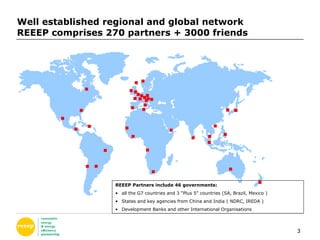
Well established regional and global network REEEP comprises 270 partners + 3000 friends REEEP Partners include 46 governments: all the G7 countries and 3 “Plus 5” countries (SA, Brazil, Mexico ) States and key agencies from China and India ( NDRC, IREDA ) Development Banks and other International Organisations
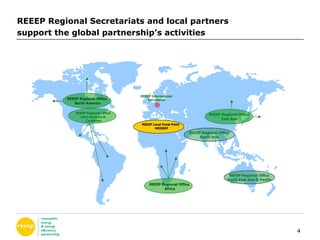
REEEP Regional Secretariats and local partners  support the global partnership’s activities REEEP Regional Office  Africa REEEP Regional Office  East Asia REEEP Regional Office  Latin America &  Caribbean REEEP Regional Office  North America REEEP Local Focal Point  MEDREP REEEP Regional Office South Asia REEEP Regional Office South East Asia & Pacific REEEP International Secretariat
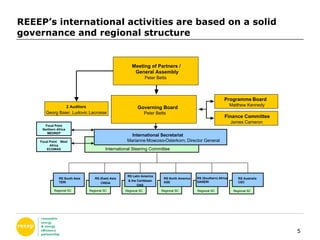
REEEP’s international activities are based on a solid governance and regional structure Programme Board Matthew Kennedy  Finance Committee James Cameron Governing Board Peter Betts  International Secretariat Marianne  Moscoso - Osterkorn , Director General - Meeting of Partners / General Assembly Peter Betts  2 Auditors International Steering Committee Focal Point Northern Africa MEDREP Focal Point  West Africa ECOWAS Georg Baier, Ludovic Lacrosse RS (East) Asia CREIA RS Latin America  & the Caribbean OAS RS North America ASE RS Australia CEC RS South Asia TERI RS (Southern) Africa SANERI Regional SC Regional SC Regional SC Regional SC Regional SC Regional SC
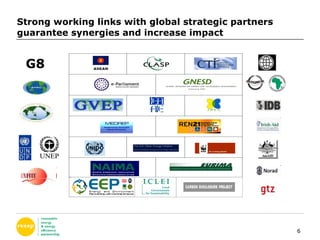
Strong working links with global strategic partners guarantee synergies and increase impact G8
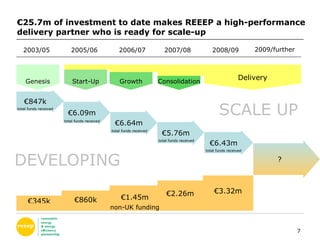
€ 25.7m of investment to date makes REEEP a high-performance  delivery partner who is ready for scale-up € 847k € 6.09m € 6.64m € 5.76m € 6.43m Genesis Start-Up Growth Consolidation Delivery 2003/05 2005/06 2006/07 2007/08 2008/09 2009/further ? DEVELOPING SCALE UP € 345k € 860k € 1.45m € 2.26m non-UK funding € 3.32m total funds received  total funds received  total funds received  total funds received  total funds received
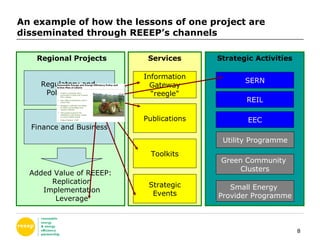
An example of how the lessons of one project are disseminated through REEEP’s channels Strategic Activities SERN REIL EEC Green Community  Clusters Utility Programme Small Energy  Provider Programme Regional Projects Regulatory and  Policy Issues Finance and Business Added Value of REEEP: Replication Implementation Leverage Services Information Gateway “reegle" Publications Toolkits Strategic Events
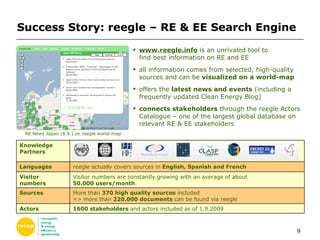
Success Story: reegle – RE & EE Search Engine www.reegle.info  is an unrivaled tool to  find best information on RE and EE  all information comes from selected, high-quality sources and can be  visualized on a world-map offers the  latest news and events  (including a frequently updated Clean Energy Blog) connects stakeholders  through the reegle Actors Catalogue – one of the largest global database on relevant RE & EE stakeholders reegle actually covers sources in  English, Spanish and French Languages 1600 stakeholders  and actors included as of 1.9.2009 Actors More than  370 high quality sources  included => more than  220.000 documents  can be found via reegle Sources Visitor numbers are constantly growing with an average of about   50.000 users/month . Visitor numbers Knowledge Partners RE News Japan (8.9.) on reegle world-map
Value of REEEP for market transformation as other organizations emerge? Build on a substantial track record of market transforming projects Flexible in meeting specific country or regional needs and promoting innovative approaches which would not get funded otherwise Fast reaction on needs and opportunities: maximum 6 months from identification to implementation  Technology and methodology neutral, Best-for-customer approach Increase impact by sharing of learnings and communication of all REEEP activities on a regional and global level Flexible, Fast and Focused
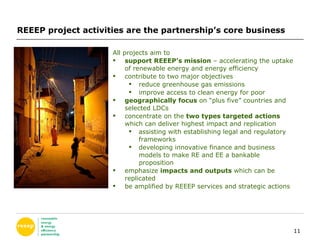
REEEP project activities are the partnership’s core business All projects aim to support REEEP’s mission  – accelerating the uptake of renewable energy and energy efficiency contribute to two major objectives  reduce greenhouse gas emissions improve access to clean energy for poor geographically focus  on “plus five” countries and selected LDCs  concentrate on the  two types targeted actions  which can deliver highest impact and replication  assisting with establishing legal and regulatory frameworks developing innovative finance and business models to make RE and EE a bankable proposition  emphasize  impacts and outputs  which can be replicated be amplified by REEEP services and strategic actions
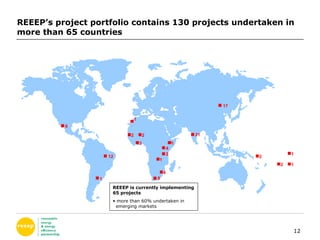
REEEP’s project portfolio contains 130 projects undertaken in more than 65 countries 17 12 6 8 21 3 1 2 2 1 4 1 2 2 1 REEEP is currently implementing 65 projects more than 60% undertaken in   emerging markets 1 4 1 2
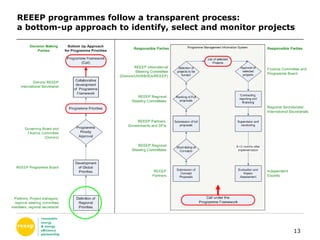
REEEP programmes follow a transparent process:  a bottom-up approach to identify, select and monitor projects
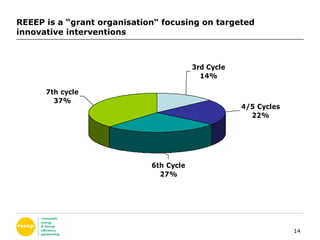
REEEP is a “grant organisation“ focusing on targeted innovative interventions
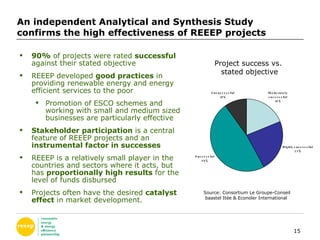
An independent Analytical and Synthesis Study confirms the high effectiveness of REEEP projects 90%  of projects were rated  successful  against their stated objective REEEP developed  good practices  in providing renewable energy and energy efficient services to the poor Promotion of ESCO schemes and working with small and medium sized businesses are particularly effective  Stakeholder participation  is a central feature of REEEP projects and an  instrumental factor in successes REEEP is a relatively small player in the countries and sectors where it acts, but has  proportionally high results  for the level of funds disbursed Projects often have the desired  catalyst effect  in market development. Project success vs.  stated objective Source: Consortium Le Groupe-Conseil baastel Itée & Econoler International
REEEP program activities have a testified high success rate
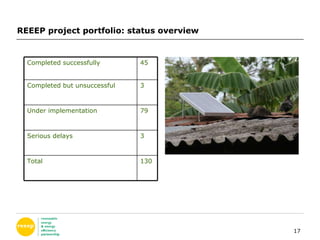
REEEP project portfolio: status overview   130 Total 3 Serious delays 79 Under implementation 3 Completed but unsuccessful 45 Completed successfully
Thematic and sectoral shares are evenly split
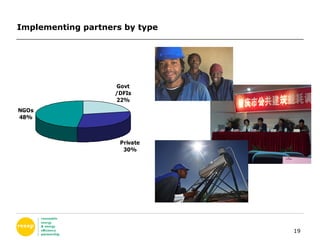
Implementing partners by type
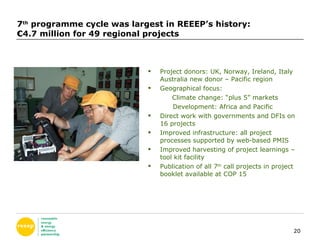
7 th  programme cycle was largest in REEEP’s history: €4.7 million for 49 regional projects Project donors: UK, Norway, Ireland, Italy Australia new donor – Pacific region Geographical focus: Climate change: “plus 5” markets  Development: Africa and Pacific Direct work with governments and DFIs on 16 projects Improved infrastructure: all project processes supported by web-based PMIS Improved harvesting of project learnings – tool kit facility  Publication of all 7 th  call projects in project booklet available at COP 15
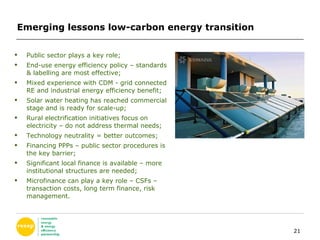
Emerging lessons low-carbon energy transition  Public sector plays a key role; End-use energy efficiency policy – standards & labelling are most effective; Mixed experience with CDM - grid connected RE and industrial energy efficiency benefit; Solar water heating has reached commercial stage and is ready for scale-up; Rural electrification initiatives focus on electricity – do not address thermal needs; Technology neutrality = better outcomes; Financing PPPs – public sector procedures is the key barrier; Significant local finance is available – more institutional structures are needed; Microfinance can play a key role – CSFs – transaction costs, long term finance, risk management.
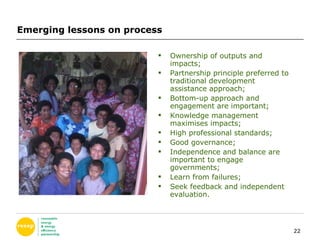
Emerging lessons on process Ownership of outputs and impacts; Partnership principle preferred to traditional development assistance approach; Bottom-up approach and engagement are important; Knowledge management maximises impacts; High professional standards; Good governance; Independence and balance are important to engage governments; Learn from failures; Seek feedback and independent evaluation.
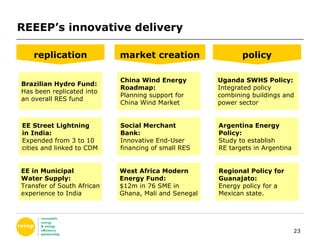
REEEP’s innovative delivery replication market creation policy Brazilian Hydro Fund: Has been replicated into  an overall RES fund EE Street Lightning  in India: Expended from 3 to 10  cities and linked to CDM China Wind Energy  Roadmap: Planning support for  China Wind Market  Social Merchant  Bank: Innovative End-User  financing of small RES West Africa Modern  Energy Fund: $12m in 76 SME in  Ghana, Mali and Senegal Uganda SWHS Policy: Integrated policy  combining buildings and  power sector  Argentina Energy  Policy: Study to establish RE targets in Argentina Regional Policy for  Guanajato: Energy policy for a  Mexican state. EE in Municipal  Water Supply: Transfer of South African experience to India
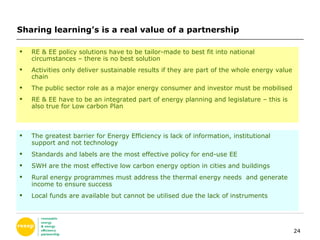
Sharing learning’s is a real value of a partnership The greatest barrier for Energy Efficiency is lack of information, institutional support and not technology Standards and labels are the most effective policy for end-use EE SWH are the most effective low carbon energy option in cities and buildings Rural energy programmes must address the thermal energy needs  and generate income to ensure success Local funds are available but cannot be utilised due the lack of instruments RE & EE policy solutions have to be tailor-made to best fit into national circumstances – there is no best solution Activities only deliver sustainable results if they are part of the whole energy value chain  The public sector role as a major energy consumer and investor must be mobilised RE & EE have to be an integrated part of energy planning and legislature – this is also true for Low carbon Plan
[email_address] www.reeep.org   www.reegle.info All pictures from REEEP-supported projects . Thank you!
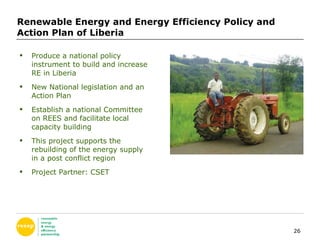
Renewable Energy and Energy Efficiency Policy and Action Plan of Liberia Produce a national policy instrument to build and increase RE in Liberia New National legislation and an Action Plan Establish a national Committee on REES and facilitate local capacity building  This project supports the rebuilding of the energy supply in a post conflict region Project Partner: CSET

Wilton Park Presentation

  • 1.
    Wilton Park September 2009 Dr. Marianne Moscoso-Osterkorn/ REEEP Director General Binu Parthan/ REEEP Deputy Director General, Director Programs
  • 2.
    REEEP was establishedto accelerate RE/EE focusing on underdeveloped and emerging economies REEEP acts as a market facilitator by reducing market barriers for renewables and energy efficiency systems through focus on: policy/regulation development and improvement finance and business models REEEP is driven by a bottom-up approach to meet the real needs on the ground REEEP works with governments as well as with the private sector REEEP is committed to the achievement of MDGs and aims to improve access to sustainable clean energy for the poor REEEP is unique in combining the benefits of renewables and energy efficiency
  • 3.
    Well established regionaland global network REEEP comprises 270 partners + 3000 friends REEEP Partners include 46 governments: all the G7 countries and 3 “Plus 5” countries (SA, Brazil, Mexico ) States and key agencies from China and India ( NDRC, IREDA ) Development Banks and other International Organisations
  • 4.
    REEEP Regional Secretariatsand local partners support the global partnership’s activities REEEP Regional Office Africa REEEP Regional Office East Asia REEEP Regional Office Latin America & Caribbean REEEP Regional Office North America REEEP Local Focal Point MEDREP REEEP Regional Office South Asia REEEP Regional Office South East Asia & Pacific REEEP International Secretariat
  • 5.
    REEEP’s international activitiesare based on a solid governance and regional structure Programme Board Matthew Kennedy Finance Committee James Cameron Governing Board Peter Betts International Secretariat Marianne Moscoso - Osterkorn , Director General - Meeting of Partners / General Assembly Peter Betts 2 Auditors International Steering Committee Focal Point Northern Africa MEDREP Focal Point West Africa ECOWAS Georg Baier, Ludovic Lacrosse RS (East) Asia CREIA RS Latin America & the Caribbean OAS RS North America ASE RS Australia CEC RS South Asia TERI RS (Southern) Africa SANERI Regional SC Regional SC Regional SC Regional SC Regional SC Regional SC
  • 6.
    Strong working linkswith global strategic partners guarantee synergies and increase impact G8
  • 7.
    € 25.7m ofinvestment to date makes REEEP a high-performance delivery partner who is ready for scale-up € 847k € 6.09m € 6.64m € 5.76m € 6.43m Genesis Start-Up Growth Consolidation Delivery 2003/05 2005/06 2006/07 2007/08 2008/09 2009/further ? DEVELOPING SCALE UP € 345k € 860k € 1.45m € 2.26m non-UK funding € 3.32m total funds received total funds received total funds received total funds received total funds received
  • 8.
    An example ofhow the lessons of one project are disseminated through REEEP’s channels Strategic Activities SERN REIL EEC Green Community Clusters Utility Programme Small Energy Provider Programme Regional Projects Regulatory and Policy Issues Finance and Business Added Value of REEEP: Replication Implementation Leverage Services Information Gateway “reegle" Publications Toolkits Strategic Events
  • 9.
    Success Story: reegle– RE & EE Search Engine www.reegle.info is an unrivaled tool to find best information on RE and EE all information comes from selected, high-quality sources and can be visualized on a world-map offers the latest news and events (including a frequently updated Clean Energy Blog) connects stakeholders through the reegle Actors Catalogue – one of the largest global database on relevant RE & EE stakeholders reegle actually covers sources in English, Spanish and French Languages 1600 stakeholders and actors included as of 1.9.2009 Actors More than 370 high quality sources included => more than 220.000 documents can be found via reegle Sources Visitor numbers are constantly growing with an average of about 50.000 users/month . Visitor numbers Knowledge Partners RE News Japan (8.9.) on reegle world-map
  • 10.
    Value of REEEPfor market transformation as other organizations emerge? Build on a substantial track record of market transforming projects Flexible in meeting specific country or regional needs and promoting innovative approaches which would not get funded otherwise Fast reaction on needs and opportunities: maximum 6 months from identification to implementation Technology and methodology neutral, Best-for-customer approach Increase impact by sharing of learnings and communication of all REEEP activities on a regional and global level Flexible, Fast and Focused
  • 11.
    REEEP project activitiesare the partnership’s core business All projects aim to support REEEP’s mission – accelerating the uptake of renewable energy and energy efficiency contribute to two major objectives reduce greenhouse gas emissions improve access to clean energy for poor geographically focus on “plus five” countries and selected LDCs concentrate on the two types targeted actions which can deliver highest impact and replication assisting with establishing legal and regulatory frameworks developing innovative finance and business models to make RE and EE a bankable proposition emphasize impacts and outputs which can be replicated be amplified by REEEP services and strategic actions
  • 12.
    REEEP’s project portfoliocontains 130 projects undertaken in more than 65 countries 17 12 6 8 21 3 1 2 2 1 4 1 2 2 1 REEEP is currently implementing 65 projects more than 60% undertaken in emerging markets 1 4 1 2
  • 13.
    REEEP programmes followa transparent process: a bottom-up approach to identify, select and monitor projects
  • 14.
    REEEP is a“grant organisation“ focusing on targeted innovative interventions
  • 15.
    An independent Analyticaland Synthesis Study confirms the high effectiveness of REEEP projects 90% of projects were rated successful against their stated objective REEEP developed good practices in providing renewable energy and energy efficient services to the poor Promotion of ESCO schemes and working with small and medium sized businesses are particularly effective Stakeholder participation is a central feature of REEEP projects and an instrumental factor in successes REEEP is a relatively small player in the countries and sectors where it acts, but has proportionally high results for the level of funds disbursed Projects often have the desired catalyst effect in market development. Project success vs. stated objective Source: Consortium Le Groupe-Conseil baastel Itée & Econoler International
  • 16.
    REEEP program activitieshave a testified high success rate
  • 17.
    REEEP project portfolio:status overview 130 Total 3 Serious delays 79 Under implementation 3 Completed but unsuccessful 45 Completed successfully
  • 18.
    Thematic and sectoralshares are evenly split
  • 19.
  • 20.
    7 th programme cycle was largest in REEEP’s history: €4.7 million for 49 regional projects Project donors: UK, Norway, Ireland, Italy Australia new donor – Pacific region Geographical focus: Climate change: “plus 5” markets Development: Africa and Pacific Direct work with governments and DFIs on 16 projects Improved infrastructure: all project processes supported by web-based PMIS Improved harvesting of project learnings – tool kit facility Publication of all 7 th call projects in project booklet available at COP 15
  • 21.
    Emerging lessons low-carbonenergy transition Public sector plays a key role; End-use energy efficiency policy – standards & labelling are most effective; Mixed experience with CDM - grid connected RE and industrial energy efficiency benefit; Solar water heating has reached commercial stage and is ready for scale-up; Rural electrification initiatives focus on electricity – do not address thermal needs; Technology neutrality = better outcomes; Financing PPPs – public sector procedures is the key barrier; Significant local finance is available – more institutional structures are needed; Microfinance can play a key role – CSFs – transaction costs, long term finance, risk management.
  • 22.
    Emerging lessons onprocess Ownership of outputs and impacts; Partnership principle preferred to traditional development assistance approach; Bottom-up approach and engagement are important; Knowledge management maximises impacts; High professional standards; Good governance; Independence and balance are important to engage governments; Learn from failures; Seek feedback and independent evaluation.
  • 23.
    REEEP’s innovative deliveryreplication market creation policy Brazilian Hydro Fund: Has been replicated into an overall RES fund EE Street Lightning in India: Expended from 3 to 10 cities and linked to CDM China Wind Energy Roadmap: Planning support for China Wind Market Social Merchant Bank: Innovative End-User financing of small RES West Africa Modern Energy Fund: $12m in 76 SME in Ghana, Mali and Senegal Uganda SWHS Policy: Integrated policy combining buildings and power sector Argentina Energy Policy: Study to establish RE targets in Argentina Regional Policy for Guanajato: Energy policy for a Mexican state. EE in Municipal Water Supply: Transfer of South African experience to India
  • 24.
    Sharing learning’s isa real value of a partnership The greatest barrier for Energy Efficiency is lack of information, institutional support and not technology Standards and labels are the most effective policy for end-use EE SWH are the most effective low carbon energy option in cities and buildings Rural energy programmes must address the thermal energy needs and generate income to ensure success Local funds are available but cannot be utilised due the lack of instruments RE & EE policy solutions have to be tailor-made to best fit into national circumstances – there is no best solution Activities only deliver sustainable results if they are part of the whole energy value chain The public sector role as a major energy consumer and investor must be mobilised RE & EE have to be an integrated part of energy planning and legislature – this is also true for Low carbon Plan
  • 25.
    [email_address] www.reeep.org www.reegle.info All pictures from REEEP-supported projects . Thank you!
  • 26.
    Renewable Energy andEnergy Efficiency Policy and Action Plan of Liberia Produce a national policy instrument to build and increase RE in Liberia New National legislation and an Action Plan Establish a national Committee on REES and facilitate local capacity building This project supports the rebuilding of the energy supply in a post conflict region Project Partner: CSET