
WILLS IN THE INDIAN PERSPECTIVE MEANING AND PROCEDURE
INTRODUCTION A Will mainly aims at: Disposition  of property Being made according to the  wishes  of the testator Its primary Characteristics are: It takes effect after the  death  of the testator It is  revocable  during the lifetime of the testator
KINDS OF WILLS Conditional/ Contingent Will:  This is only enforceable in the event of the happening of the mentioned  contingency Joint Will :  Two or more persons may agree to make a conjoint will This does not imply joint ownership Mutual Will:  Two testators may confer reciprocal benefits through this instrument Duplicate Will: This is for safety purposes One copy stays with the testator The duplicate copy is kept with a bank/ executor/ trustee Mutilation /Destruction of testator’s copy revokes the Will Both copies must be duly signed and attested
KINDS OF WILLS Concurrent Will:  This is generally used for disposition of properties in different countries They are to be treated as independent of each other 6.  Privileged Will: A soldier in actual warfare may pronounce his will orally before two witnesses
ADVANTAGES OF A WILL Avoidance of any  family dispute  by clear disposition of property in the will Fraudulent  family members can be excluded Sensible  choice today Advantageous from the  tax planning  perspective Special responsibilities can be catered to towards a  needy family member Special provision can be made for  non family members
WHO CAN MAKE A WILL? The person should be of  sound mind The person should be a  major Person with disability (impaired hearing, vision or speech) An insane person in a  lucid interval  of sanity Aliens  and  convicts  The following  cannot  make a will: A person who is  intoxicated  or  ill  to a level that hampers his comprehension Corporate bodies  are incapable of making a will
ELIGIBILITY FOR MAKING A WILL As has been provided for in  Section 59 of the Indian Succession Act , the following are the basic criteria for making a will: Testamentary capacity and sound disposing mind Knowledge of contents Free from undue influence/ fraud/ coercion Voluntary act
EXECUTOR OF WILL Defined in  Section 2 (c)  of the  Indian Succession Act Has power and duty to carry out following directions in the will: Collect and realise estate  of deceased Payment of debts  of the deceased Distribute the legacies  of the deceased The choice of an executor is only made by the testator The following are the advisable but not mandatory criteria of selection: Younger  than the testator for the purpose of outliving the testator Should be a  major  (or the grant of probate can only happen after attainment of majority) Preferably with residence in  same city  as testator Should be  known to the beneficiaries Should be of  good moral character
WHO CAN BE EXECUTOR? The following  can be appointed as executors : Person nominated by Author Executor by conditional appointment (e.g. son, on attainment of majority) Executor by implied appointment (one performing all essential duties in Will, e.g. residual beneficiary) Partnership Firm Banks (solely/ jointly/ alternately) The persons of the following categories  cannot be appointed as executor  because the Court will appoint a guardian on behalf of the same before granting probate: Disabled person Minor Person of unsound mind
FUNCTIONS OF EXECUTOR To  ascertain the assets  of the deceased person.  To pay  testamentary  and  funeral expenses .  To  collect the debts  and  assets  of the deceased.  To  pay the debts  of the deceased.  To  apply for a Probate,  whenever necessary.
NESSECITY OF EXECUTOR The appointment of an executor is a necessity by law ( Section 222,  The Indian Succession Act ) This is also because of the following reasons: The probate can only be granted to an executor appointed by the Will The Will can only be effectual if the probate is granted Without the executor, the Will becomes as ineffectual as the deceased being intestate.
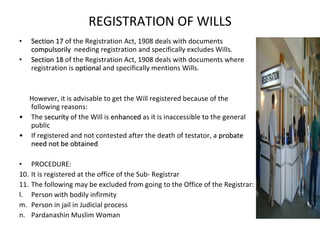
REGISTRATION OF WILLS Section 17  of the Registration Act, 1908 deals with documents  compulsorily  needing registration and specifically excludes Wills. Section 18  of the Registration Act, 1908 deals with documents where registration is  optional  and specifically mentions Wills. However, it is advisable to get the Will registered because of the following reasons: The  security  of the Will is  enhanced  as it is inaccessible to the general public If registered and not contested after the death of testator, a  probate need not be obtained PROCEDURE: It is registered at the office of the Sub- Registrar The following may be excluded from going to the Office of the Registrar: Person with bodily infirmity Person in jail in Judicial process Pardanashin Muslim Woman
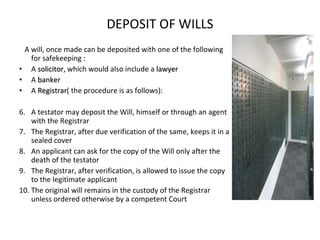
DEPOSIT OF WILLS A will, once made can be deposited with one of the following for safekeeping : A  solicitor,  which would also include a  lawyer A  banker A  Registrar ( the procedure is as follows): A testator may deposit the Will, himself or through an agent with the Registrar The Registrar, after due verification of the same, keeps it in a sealed cover An applicant can ask for the copy of the Will only after the death of the testator The Registrar, after verification, is allowed to issue the copy to the legitimate applicant The original will remains in the custody of the Registrar unless ordered otherwise by a competent Court
REVOCATION AND ALTERATION OF WILL Section 62  of the  Indian Succession Act  clearly states that a Will can be  altered  or  revoked  by its maker anytime when he is competent to dispose of his property by will The following are the modes of revocation/ alteration of Will( encompassed from  Section 67-73  of the  Indian Succession Act ): By  execution  of a new Will By  revocation  of the earlier Will By  registration  of the new Will (this is only in case the old Will is registered) By  destruction  of the old Will By the inclusion of a  codicil In case of the marriage of a Parsi or a Christian testator, his/her Will stands revoked(this however does not apply to Hindus, Sikhs, Jains and Buddhists)
ENFORCEMENT OF WILL PROBATE : Defined in  Section 2(f)  of the  Indian Succession Act It means the copy of a Will It is a certified under the seal of a  Court of Competent Jurisdiction It holds the  grant of administration  to the estate of the testator It validates all  intermediate acts  of the executor NECESSARY NATURE OF PROBATE : Explained in  Section 213  of the  Indian Succession Act Unless the probate is granted by a Court of competent jurisdiction,  no right as executor or legatee shall be established
ENFORCEMENT OF WILL LETTER OF ADMINISTRATION: It is granted  in lieu of a probate It is granted to a legatee in respect of  either the whole estate or a part of it that still remains to be administered Its  necessity  is of the same degree as that of a probate It is granted in the following cases: When no executor has been appointed When the executor is deceased after proving the will but before administration When the executor does not have the legal capacity When the executor dies before the testator and another executor is not appointed
Flat No 903, Indra Prakash, 21, Barakhamba  Road, New Delhi 110001 (India) Phone: +91 11 42492532 (Direct) Phone: +91 11 42492525 Ext 532 Mobile :- 9810081079 Fax: +91 11 23320484 email:-  [email_address]

Wills In The Indian Perspective

  • 1.
    WILLS IN THEINDIAN PERSPECTIVE MEANING AND PROCEDURE
  • 2.
    INTRODUCTION A Willmainly aims at: Disposition of property Being made according to the wishes of the testator Its primary Characteristics are: It takes effect after the death of the testator It is revocable during the lifetime of the testator
  • 3.
    KINDS OF WILLSConditional/ Contingent Will: This is only enforceable in the event of the happening of the mentioned contingency Joint Will : Two or more persons may agree to make a conjoint will This does not imply joint ownership Mutual Will: Two testators may confer reciprocal benefits through this instrument Duplicate Will: This is for safety purposes One copy stays with the testator The duplicate copy is kept with a bank/ executor/ trustee Mutilation /Destruction of testator’s copy revokes the Will Both copies must be duly signed and attested
  • 4.
    KINDS OF WILLSConcurrent Will: This is generally used for disposition of properties in different countries They are to be treated as independent of each other 6. Privileged Will: A soldier in actual warfare may pronounce his will orally before two witnesses
  • 5.
    ADVANTAGES OF AWILL Avoidance of any family dispute by clear disposition of property in the will Fraudulent family members can be excluded Sensible choice today Advantageous from the tax planning perspective Special responsibilities can be catered to towards a needy family member Special provision can be made for non family members
  • 6.
    WHO CAN MAKEA WILL? The person should be of sound mind The person should be a major Person with disability (impaired hearing, vision or speech) An insane person in a lucid interval of sanity Aliens and convicts The following cannot make a will: A person who is intoxicated or ill to a level that hampers his comprehension Corporate bodies are incapable of making a will
  • 7.
    ELIGIBILITY FOR MAKINGA WILL As has been provided for in Section 59 of the Indian Succession Act , the following are the basic criteria for making a will: Testamentary capacity and sound disposing mind Knowledge of contents Free from undue influence/ fraud/ coercion Voluntary act
  • 8.
    EXECUTOR OF WILLDefined in Section 2 (c) of the Indian Succession Act Has power and duty to carry out following directions in the will: Collect and realise estate of deceased Payment of debts of the deceased Distribute the legacies of the deceased The choice of an executor is only made by the testator The following are the advisable but not mandatory criteria of selection: Younger than the testator for the purpose of outliving the testator Should be a major (or the grant of probate can only happen after attainment of majority) Preferably with residence in same city as testator Should be known to the beneficiaries Should be of good moral character
  • 9.
    WHO CAN BEEXECUTOR? The following can be appointed as executors : Person nominated by Author Executor by conditional appointment (e.g. son, on attainment of majority) Executor by implied appointment (one performing all essential duties in Will, e.g. residual beneficiary) Partnership Firm Banks (solely/ jointly/ alternately) The persons of the following categories cannot be appointed as executor because the Court will appoint a guardian on behalf of the same before granting probate: Disabled person Minor Person of unsound mind
  • 10.
    FUNCTIONS OF EXECUTORTo ascertain the assets of the deceased person. To pay testamentary and funeral expenses . To collect the debts and assets of the deceased. To pay the debts of the deceased. To apply for a Probate, whenever necessary.
  • 11.
    NESSECITY OF EXECUTORThe appointment of an executor is a necessity by law ( Section 222, The Indian Succession Act ) This is also because of the following reasons: The probate can only be granted to an executor appointed by the Will The Will can only be effectual if the probate is granted Without the executor, the Will becomes as ineffectual as the deceased being intestate.
  • 12.
    REGISTRATION OF WILLSSection 17 of the Registration Act, 1908 deals with documents compulsorily needing registration and specifically excludes Wills. Section 18 of the Registration Act, 1908 deals with documents where registration is optional and specifically mentions Wills. However, it is advisable to get the Will registered because of the following reasons: The security of the Will is enhanced as it is inaccessible to the general public If registered and not contested after the death of testator, a probate need not be obtained PROCEDURE: It is registered at the office of the Sub- Registrar The following may be excluded from going to the Office of the Registrar: Person with bodily infirmity Person in jail in Judicial process Pardanashin Muslim Woman
  • 13.
    DEPOSIT OF WILLSA will, once made can be deposited with one of the following for safekeeping : A solicitor, which would also include a lawyer A banker A Registrar ( the procedure is as follows): A testator may deposit the Will, himself or through an agent with the Registrar The Registrar, after due verification of the same, keeps it in a sealed cover An applicant can ask for the copy of the Will only after the death of the testator The Registrar, after verification, is allowed to issue the copy to the legitimate applicant The original will remains in the custody of the Registrar unless ordered otherwise by a competent Court
  • 14.
    REVOCATION AND ALTERATIONOF WILL Section 62 of the Indian Succession Act clearly states that a Will can be altered or revoked by its maker anytime when he is competent to dispose of his property by will The following are the modes of revocation/ alteration of Will( encompassed from Section 67-73 of the Indian Succession Act ): By execution of a new Will By revocation of the earlier Will By registration of the new Will (this is only in case the old Will is registered) By destruction of the old Will By the inclusion of a codicil In case of the marriage of a Parsi or a Christian testator, his/her Will stands revoked(this however does not apply to Hindus, Sikhs, Jains and Buddhists)
  • 15.
    ENFORCEMENT OF WILLPROBATE : Defined in Section 2(f) of the Indian Succession Act It means the copy of a Will It is a certified under the seal of a Court of Competent Jurisdiction It holds the grant of administration to the estate of the testator It validates all intermediate acts of the executor NECESSARY NATURE OF PROBATE : Explained in Section 213 of the Indian Succession Act Unless the probate is granted by a Court of competent jurisdiction, no right as executor or legatee shall be established
  • 16.
    ENFORCEMENT OF WILLLETTER OF ADMINISTRATION: It is granted in lieu of a probate It is granted to a legatee in respect of either the whole estate or a part of it that still remains to be administered Its necessity is of the same degree as that of a probate It is granted in the following cases: When no executor has been appointed When the executor is deceased after proving the will but before administration When the executor does not have the legal capacity When the executor dies before the testator and another executor is not appointed
  • 17.
    Flat No 903,Indra Prakash, 21, Barakhamba  Road, New Delhi 110001 (India) Phone: +91 11 42492532 (Direct) Phone: +91 11 42492525 Ext 532 Mobile :- 9810081079 Fax: +91 11 23320484 email:- [email_address]