Web Archiving for University
Records
Elliot Williams
School of Information, The University
of Texas at Austin
Roadmap
Defining web archiving
Why university archives should care
Web archiving methods
Appraisal challenges
“Web archiving is the process of collecting
websites and the information that they contain
from the World Wide Web, and preserving these
in an archive.” (UK National Archives, 2011)
Also, providing access to those materials!
Why should university archives care?
“At present the Internet is an essential record of human
life and continues to grow in size daily, which has
instigated a need and an opportunity for archivists to be
actively documenting this base of human knowledge. No
single organization will be able to fully archive the entire
Internet; therefore it will become imperative that as
many archives as can take part in web archiving.”
- SAA Web Archiving RT, “Goals and Objectives”
Why should university archives care?
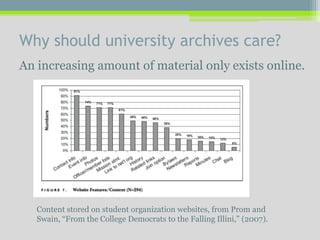
Content stored on student organization websites, from Prom and
Swain, “From the College Democrats to the Falling Illini,” (2007).
An increasing amount of material only exists online.
Web archiving methods
• Web crawlers - e.g. Heritrix
• Offline browser software – e.g. HTTrack
• Archiving constituent files obtained from site
creator or administrator
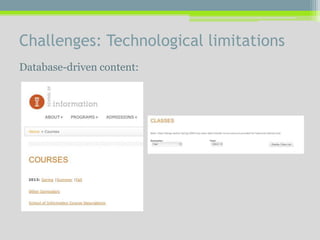
Challenges: Technological limitations
Depending on the method used, certain kinds of
content cannot be captured or preserved.
• Social media sites (especially Facebook)
• Flash and Javascript
• Streaming video or audio
• Database-driven content
Challenges: Technological limitations
Database-driven content:
Challenges: Privacy and IP
Is all material that is posted online fair game to be
captured by an archives?
Is it feasible for archival staff to thoroughly review
everything that is captured for privacy and
intellectual property issues?
Challenges: Engaging with donors
Web records can be captured and preserved
without disrupting the ongoing existence of the
site, and even without notifying the record
creator.
Saves time for archivists and expands universe of
possible materials for inclusion
But, also isolates archivists, eliminates the
possibility of incorporating creators’ knowledge,
and diminishes opportunities for education and
outreach
Conclusion
Web archiving can and should be a part of any
attempt to documenting the history, culture, and
functioning on colleges and universities.
Traditional archival tools and perspectives will
continue to be important in this new realm.
Works Cited
The National Archives (UK). “Web Archiving Guidance” (2011)
http://www.nationalarchives.gov.uk/documents/information-
management/web-archiving-guidance.pdf.
Prom, Christopher J., and Ellen D. Swain. “From the College Democrats to the
Falling Illini: Identifying, Capturing, and Appraising Student Organization
Websites.” The American Archivist 70 (2007): 344-363.
Society of American Archivists Web Archiving Roundtable. “Goals and
Objectives” (2013) http://saa.archivists.org/4DCGI/committees/SAATBL-
WEBRT.html?Action=Show_Comm_Detail&CommCode=SAA**TBL-
WEBRT&.
Wagner, Jessica L., and Debbi A. Smith. “Students as Donors to University
Archives: A Study of Student Perceptions with Recommendations.” The
American Archivist 75 (2012): 538-566.
Links to these sources, a copy of this presentation, examples of
university web archives, and general web archiving resources can be
found at: www.elliotdwilliams.com/ssa-web-archiving

Web Archiving for University Records

  • 1.
    Web Archiving forUniversity Records Elliot Williams School of Information, The University of Texas at Austin
  • 2.
    Roadmap Defining web archiving Whyuniversity archives should care Web archiving methods Appraisal challenges
  • 3.
    “Web archiving isthe process of collecting websites and the information that they contain from the World Wide Web, and preserving these in an archive.” (UK National Archives, 2011) Also, providing access to those materials!
  • 4.
    Why should universityarchives care? “At present the Internet is an essential record of human life and continues to grow in size daily, which has instigated a need and an opportunity for archivists to be actively documenting this base of human knowledge. No single organization will be able to fully archive the entire Internet; therefore it will become imperative that as many archives as can take part in web archiving.” - SAA Web Archiving RT, “Goals and Objectives”
  • 5.
    Why should universityarchives care? Content stored on student organization websites, from Prom and Swain, “From the College Democrats to the Falling Illini,” (2007). An increasing amount of material only exists online.
  • 6.
    Web archiving methods •Web crawlers - e.g. Heritrix • Offline browser software – e.g. HTTrack • Archiving constituent files obtained from site creator or administrator
  • 7.
    Challenges: Technological limitations Dependingon the method used, certain kinds of content cannot be captured or preserved. • Social media sites (especially Facebook) • Flash and Javascript • Streaming video or audio • Database-driven content
  • 8.
  • 9.
    Challenges: Privacy andIP Is all material that is posted online fair game to be captured by an archives? Is it feasible for archival staff to thoroughly review everything that is captured for privacy and intellectual property issues?
  • 10.
    Challenges: Engaging withdonors Web records can be captured and preserved without disrupting the ongoing existence of the site, and even without notifying the record creator. Saves time for archivists and expands universe of possible materials for inclusion But, also isolates archivists, eliminates the possibility of incorporating creators’ knowledge, and diminishes opportunities for education and outreach
  • 11.
    Conclusion Web archiving canand should be a part of any attempt to documenting the history, culture, and functioning on colleges and universities. Traditional archival tools and perspectives will continue to be important in this new realm.
  • 12.
    Works Cited The NationalArchives (UK). “Web Archiving Guidance” (2011) http://www.nationalarchives.gov.uk/documents/information- management/web-archiving-guidance.pdf. Prom, Christopher J., and Ellen D. Swain. “From the College Democrats to the Falling Illini: Identifying, Capturing, and Appraising Student Organization Websites.” The American Archivist 70 (2007): 344-363. Society of American Archivists Web Archiving Roundtable. “Goals and Objectives” (2013) http://saa.archivists.org/4DCGI/committees/SAATBL- WEBRT.html?Action=Show_Comm_Detail&CommCode=SAA**TBL- WEBRT&. Wagner, Jessica L., and Debbi A. Smith. “Students as Donors to University Archives: A Study of Student Perceptions with Recommendations.” The American Archivist 75 (2012): 538-566. Links to these sources, a copy of this presentation, examples of university web archives, and general web archiving resources can be found at: www.elliotdwilliams.com/ssa-web-archiving