This poem is written by William Shakespeare.
William Shakespeare (26 April 1564 – 23 April 1616) was an
English poet and playwright, widely regarded as the
greatest writer in the English language and the world's pre-
eminent dramatist. He is often called England's national
poet and the "Bard of Avon" (or simply "The Bard"). His
surviving works consist of 38 plays 154 sonnets, two long
narrative poems, and several other poems. His plays have
been translated into every major living language and are
performed more often than those of any other playwright .
All the world’s a stage
And all men and women merely players:
They have their exits and their entrances;
And one men in his time plays many parts,
His acts being seven ages.
Word meanings-
•Stage- a platform
•Merely- only
•Players- (here) actors/actresses
•Exits- a way by which a one goes out
•Entrances- a way by which one enters
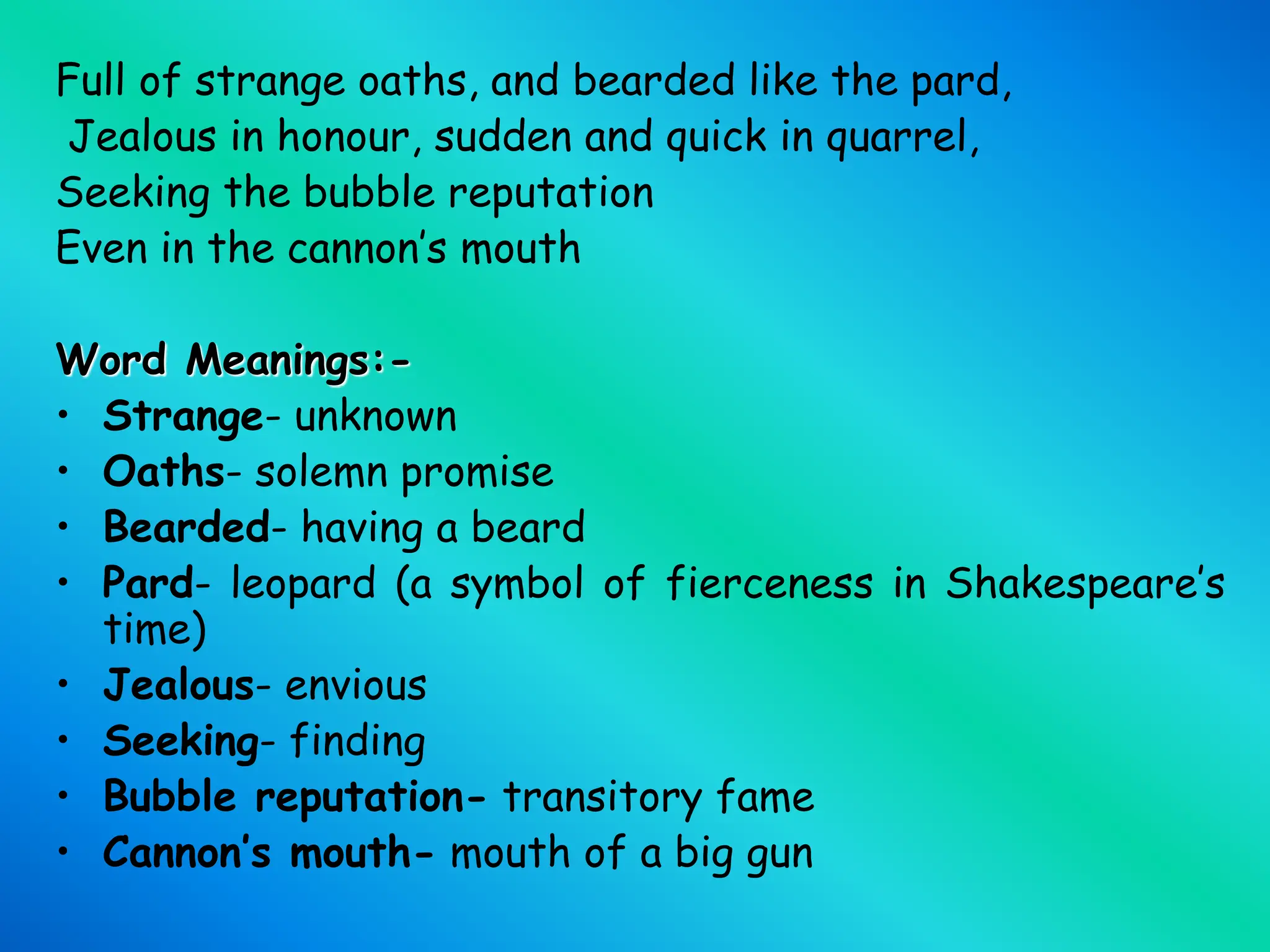
Introduction
In this poem, the poet William
Shakespeare compares the world to a
stage in a theatre in which men and women
have to play different roles in their life
time. Each player has his/her entrance and
exit. When they are born in this world it is
their entrance and when they die it is
their exit. They come to this stage, play
different roles and bid good-bye. These
parts, acts or stages are normally seven.
At first the infant,
mewling and puking in the nurse’s arms.
Word Meanings-
• Infant- a baby/very small kid
• Mewling- crying
• Puking- vomiting
First stage-
Infant
The poet describes the birth of the
child as the first act of the drama
of human life. The human baby cries
and vomits in the nurse’s arms.
According the poet the baby is very
innocent. At his birth he is full of
joy but still he starts crying and
weeping on very small matters as he
has no sense. In this stanza the
poet describes about the
dependence of baby on others. He
also tells about child’s simplicity.
Then the whining school boy, with his satchel
And shining morning face, creeping like a snail
Unwillingly to school.
Word Meanings:-
•Whining- complaining
•Satchel- a small bag to carry school books
•Shining- bright
•Creeping- crawling/slowly slowly
•Snail- a small soft animal that moves very slowly.
•Unwillingly- not interested/ not wishing
Second stage-
School boy
After some time as the child grows up, he starts
going to school. The poet describes this school
going age as the second act of human’s life. At
this stage the boy has a shining face and he is
very neat and clean. While going to school, he
carries a bag of books. He goes to school
unwillingly, creeping like a snail. He is not happy
to go to school. Two phrases which shows his
unwillingness in going to school are –
•Whining school boy
•Creeping like a snail unwillingly.
And then the lover,
Sighing like a furnace, with a woeful ballad
Made to his mistress’ eyebrows.
Word Meanings:-
• Sighing- breathing deeply
• Furnace- a fireplace
• Woeful ballad- a very sad poem
• Made to- dedicated to
• Mistress- beloved
• Eyebrows- the brow over the eyes
Third stage-
Lover
The third role that a person plays in his
life, according to the poet, is of lover.
Shakespeare presents the teenager or
an adolescent boy as a lover. The poet
says that in this age the boy is greatly
impressed by a beautiful face of a girl.
He sighs loudly due to his frustration in
love just like a furnace. The lover sighs
loudly just like the sound of bellows in
the furnace.
The lover also sing songs in praise of his beloved.
Full of strange oaths, and bearded like the pard,
Jealous in honour, sudden and quick in quarrel,
Seeking the bubble reputation
Even in the cannon’s mouth
Word Meanings:-
• Strange- unknown
• Oaths- solemn promise
• Bearded- having a beard
• Pard- leopard (a symbol of fierceness in Shakespeare’s
time)
• Jealous- envious
• Seeking- finding
• Bubble reputation- transitory fame
• Cannon’s mouth- mouth of a big gun
Fourth stage-
Soldier
After the lover comes the stage of a
soldier. The poet describes the main
characteristics of the lover as follows :-
The soldier is full of strange oaths.
He is bearded like a leopard.
He is jealous in matters concerning honour.
He is quick in quarrels and is ready to fight
for small things.
He seeks reputation which is short lived,
but for the soldier it matters more than his
life. For this he is even ready to face a
canons mouth. Facing a canon invites sure
death but it also provides honour and glory
to the brave soldier.
And then the justice,
In fair round belly with good capon lined,
With eyes severe and beard of formal cut,
Full of wise saws and modern instances;
And so he plays his part.
Word Meanings:-
• Justice- judge
• Saws- sayings
• Belly- stomach
• Capon- a fat and big male chicken
• Lined- filled with
• Severe- harsh looking
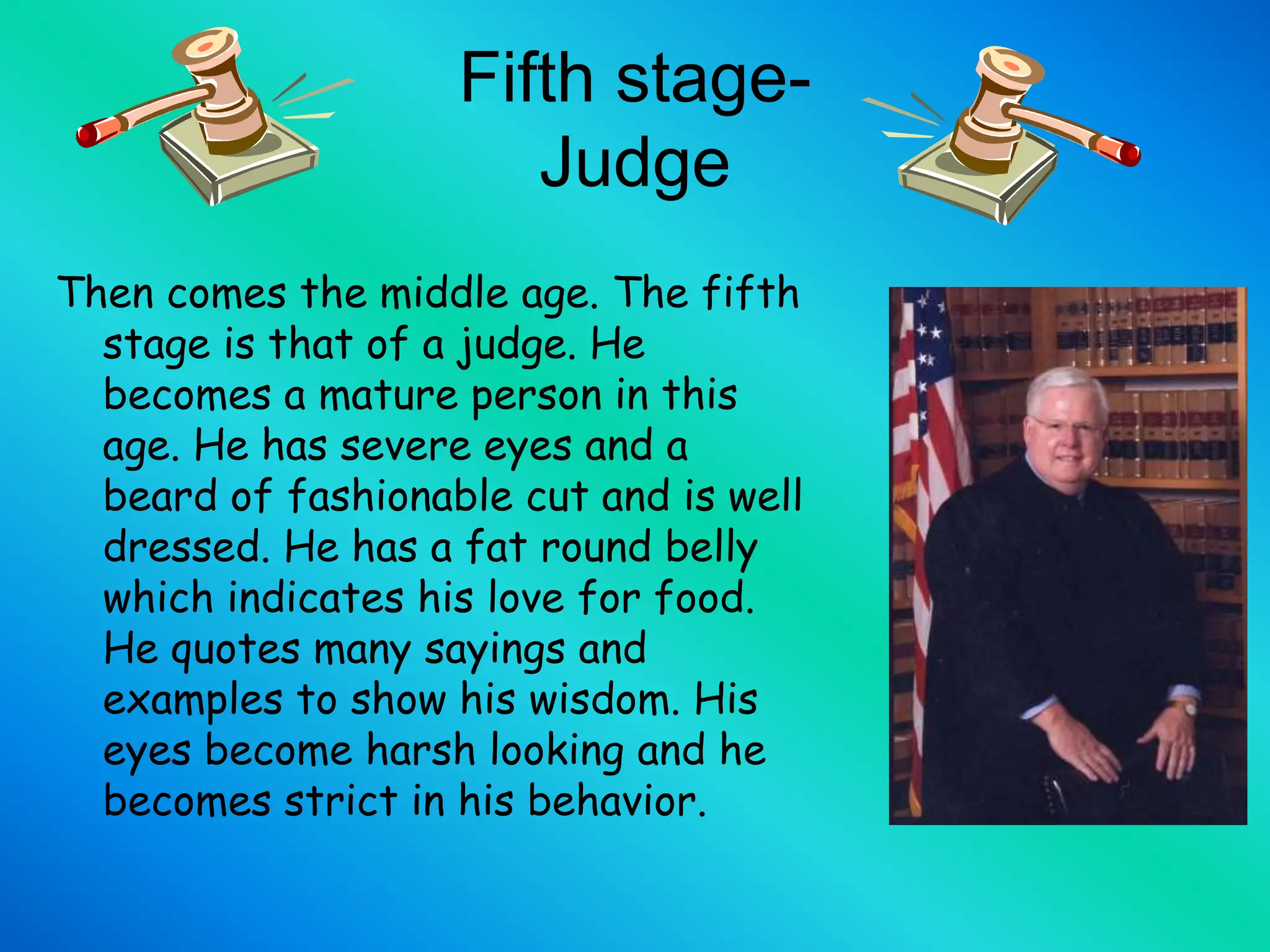
Fifth stage-
Judge
Then comes the middle age. The fifth
stage is that of a judge. He
becomes a mature person in this
age. He has severe eyes and a
beard of fashionable cut and is well
dressed. He has a fat round belly
which indicates his love for food.
He quotes many sayings and
examples to show his wisdom. His
eyes become harsh looking and he
becomes strict in his behavior.
The sixth age shifts
Into the lean and slippered pantaloon,
With spectacles on nose and pouch on side,
His youthful hose, well saved, a world too wide
For his shrunk shrank; and his big manly voice,
Turning again toward childish treble, pipes
And whistles in his sound
Word meanings:-
• Lean – thin
• Slippered pantaloon- a funny old man wearing
slippers
• Spectacles- eyeglasses
• Pouch- a soft fold of loose skin that hangs down
as a result of as a result of illness or old age.
• Youthful hose- tight fitting leg coverings of
young days.
• Well saved- preserved well
• A world too wide- (here) very loose
• Shrunk shrank- thin, weak and shrunk legs from
knee to the ankles
• Manly- manlike
• Treble- a high voice
• Pipes and whistles- sings
Sixth Stage-
Old Man
The sixth stage of a person is of an
old man. During this stage he becomes
weak in health and thin in body. He
wears spectacles on his nose and
wears slippers. He wears clothes of
his youth which have become very lose
to his shrunk body. His voice becomes
hoarse and rough. He has a soft and
loose skin that hangs down as a result
of illness and old age. In his slippers
and loose fitting garments he looks a
funny old man-a pantaloon-a comic
figure.
Last scene of all,
That ends this strange eventful history,
Is second childishness and mere oblivion,
Sans teeth, sans eyes, sans taste, sans everything.
Word meanings:-
• Eventful- full of significant incidents
• Mere- only
• Oblivion- forgetfulness
• Sans- without
The seventh age-
Extremely old man
According the poet the last stage is of
extremely old man. This act shows him
as a helpless baby. At this age the man
becomes extremely old and is at door of
death. He loses control on all the
senses. He is toothless, he has problem
in hearing clearly, becomes weak in
eyesight and fails to recognise people,
his memory becomes weak. So in this
way most of his characteristics are
similar to that of an infant.

William Shakespeare seven stages of life.pptx

  • 2.
    This poem iswritten by William Shakespeare. William Shakespeare (26 April 1564 – 23 April 1616) was an English poet and playwright, widely regarded as the greatest writer in the English language and the world's pre- eminent dramatist. He is often called England's national poet and the "Bard of Avon" (or simply "The Bard"). His surviving works consist of 38 plays 154 sonnets, two long narrative poems, and several other poems. His plays have been translated into every major living language and are performed more often than those of any other playwright .
  • 3.
    All the world’sa stage And all men and women merely players: They have their exits and their entrances; And one men in his time plays many parts, His acts being seven ages. Word meanings- •Stage- a platform •Merely- only •Players- (here) actors/actresses •Exits- a way by which a one goes out •Entrances- a way by which one enters
  • 4.
    Introduction In this poem,the poet William Shakespeare compares the world to a stage in a theatre in which men and women have to play different roles in their life time. Each player has his/her entrance and exit. When they are born in this world it is their entrance and when they die it is their exit. They come to this stage, play different roles and bid good-bye. These parts, acts or stages are normally seven.
  • 5.
    At first theinfant, mewling and puking in the nurse’s arms. Word Meanings- • Infant- a baby/very small kid • Mewling- crying • Puking- vomiting
  • 6.
    First stage- Infant The poetdescribes the birth of the child as the first act of the drama of human life. The human baby cries and vomits in the nurse’s arms. According the poet the baby is very innocent. At his birth he is full of joy but still he starts crying and weeping on very small matters as he has no sense. In this stanza the poet describes about the dependence of baby on others. He also tells about child’s simplicity.
  • 7.
    Then the whiningschool boy, with his satchel And shining morning face, creeping like a snail Unwillingly to school. Word Meanings:- •Whining- complaining •Satchel- a small bag to carry school books •Shining- bright •Creeping- crawling/slowly slowly •Snail- a small soft animal that moves very slowly. •Unwillingly- not interested/ not wishing
  • 8.
    Second stage- School boy Aftersome time as the child grows up, he starts going to school. The poet describes this school going age as the second act of human’s life. At this stage the boy has a shining face and he is very neat and clean. While going to school, he carries a bag of books. He goes to school unwillingly, creeping like a snail. He is not happy to go to school. Two phrases which shows his unwillingness in going to school are – •Whining school boy •Creeping like a snail unwillingly.
  • 9.
    And then thelover, Sighing like a furnace, with a woeful ballad Made to his mistress’ eyebrows. Word Meanings:- • Sighing- breathing deeply • Furnace- a fireplace • Woeful ballad- a very sad poem • Made to- dedicated to • Mistress- beloved • Eyebrows- the brow over the eyes
  • 10.
    Third stage- Lover The thirdrole that a person plays in his life, according to the poet, is of lover. Shakespeare presents the teenager or an adolescent boy as a lover. The poet says that in this age the boy is greatly impressed by a beautiful face of a girl. He sighs loudly due to his frustration in love just like a furnace. The lover sighs loudly just like the sound of bellows in the furnace. The lover also sing songs in praise of his beloved.
  • 11.
    Full of strangeoaths, and bearded like the pard, Jealous in honour, sudden and quick in quarrel, Seeking the bubble reputation Even in the cannon’s mouth Word Meanings:- • Strange- unknown • Oaths- solemn promise • Bearded- having a beard • Pard- leopard (a symbol of fierceness in Shakespeare’s time) • Jealous- envious • Seeking- finding • Bubble reputation- transitory fame • Cannon’s mouth- mouth of a big gun
  • 12.
    Fourth stage- Soldier After thelover comes the stage of a soldier. The poet describes the main characteristics of the lover as follows :- The soldier is full of strange oaths. He is bearded like a leopard. He is jealous in matters concerning honour. He is quick in quarrels and is ready to fight for small things. He seeks reputation which is short lived, but for the soldier it matters more than his life. For this he is even ready to face a canons mouth. Facing a canon invites sure death but it also provides honour and glory to the brave soldier.
  • 13.
    And then thejustice, In fair round belly with good capon lined, With eyes severe and beard of formal cut, Full of wise saws and modern instances; And so he plays his part. Word Meanings:- • Justice- judge • Saws- sayings • Belly- stomach • Capon- a fat and big male chicken • Lined- filled with • Severe- harsh looking
  • 14.
    Fifth stage- Judge Then comesthe middle age. The fifth stage is that of a judge. He becomes a mature person in this age. He has severe eyes and a beard of fashionable cut and is well dressed. He has a fat round belly which indicates his love for food. He quotes many sayings and examples to show his wisdom. His eyes become harsh looking and he becomes strict in his behavior.
  • 15.
    The sixth ageshifts Into the lean and slippered pantaloon, With spectacles on nose and pouch on side, His youthful hose, well saved, a world too wide For his shrunk shrank; and his big manly voice, Turning again toward childish treble, pipes And whistles in his sound Word meanings:- • Lean – thin • Slippered pantaloon- a funny old man wearing slippers • Spectacles- eyeglasses
  • 16.
    • Pouch- asoft fold of loose skin that hangs down as a result of as a result of illness or old age. • Youthful hose- tight fitting leg coverings of young days. • Well saved- preserved well • A world too wide- (here) very loose • Shrunk shrank- thin, weak and shrunk legs from knee to the ankles • Manly- manlike • Treble- a high voice • Pipes and whistles- sings
  • 17.
    Sixth Stage- Old Man Thesixth stage of a person is of an old man. During this stage he becomes weak in health and thin in body. He wears spectacles on his nose and wears slippers. He wears clothes of his youth which have become very lose to his shrunk body. His voice becomes hoarse and rough. He has a soft and loose skin that hangs down as a result of illness and old age. In his slippers and loose fitting garments he looks a funny old man-a pantaloon-a comic figure.
  • 18.
    Last scene ofall, That ends this strange eventful history, Is second childishness and mere oblivion, Sans teeth, sans eyes, sans taste, sans everything. Word meanings:- • Eventful- full of significant incidents • Mere- only • Oblivion- forgetfulness • Sans- without
  • 19.
    The seventh age- Extremelyold man According the poet the last stage is of extremely old man. This act shows him as a helpless baby. At this age the man becomes extremely old and is at door of death. He loses control on all the senses. He is toothless, he has problem in hearing clearly, becomes weak in eyesight and fails to recognise people, his memory becomes weak. So in this way most of his characteristics are similar to that of an infant.