Richard Wilkinson Emeritus Professor of  Social Epidemiology University of Nottingham & Kate Pickett Professor of Epidemiology University of York http://www.equalitytrust.org.uk
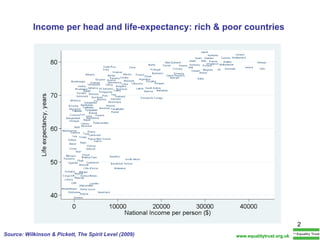
Income per head and life-expectancy: rich & poor countries Source: Wilkinson & Pickett, The Spirit Level (2009) www.equalitytrust.org.uk
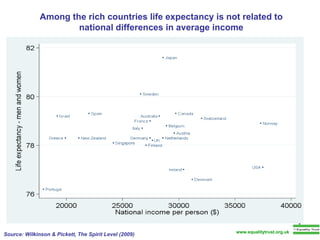
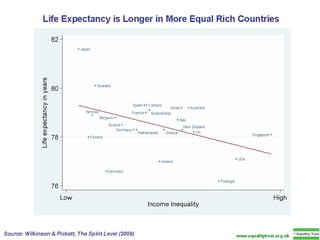
Among the rich countries life expectancy is not related to national differences in average income Source: Wilkinson & Pickett, The Spirit Level (2009) www.equalitytrust.org.uk
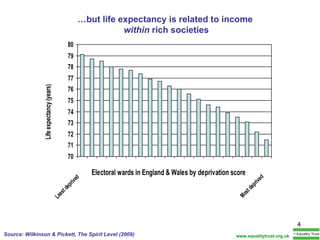
… but life expectancy is related to income  within  rich societies Source: Wilkinson & Pickett, The Spirit Level (2009) www.equalitytrust.org.uk
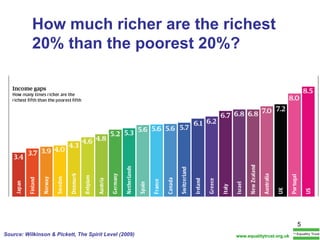
How much richer are the richest 20% than the poorest 20%? Source: Wilkinson & Pickett, The Spirit Level (2009) www.equalitytrust.org.uk
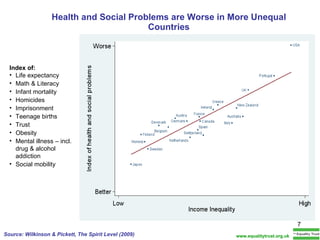
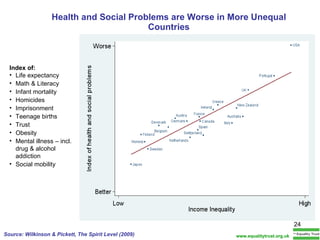
Health and Social Problems are Worse in More Unequal Countries Index of:  Life expectancy Math & Literacy  Infant mortality Homicides Imprisonment Teenage births  Trust Obesity Mental illness – incl. drug & alcohol addiction Social mobility Source: Wilkinson & Pickett, The Spirit Level (2009) www.equalitytrust.org.uk
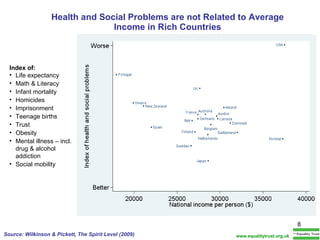
Health and Social Problems are not Related to Average Income in Rich Countries Index of:  Life expectancy Math & Literacy  Infant mortality Homicides Imprisonment Teenage births  Trust Obesity Mental illness – incl. drug & alcohol addiction Social mobility Source: Wilkinson & Pickett, The Spirit Level (2009) www.equalitytrust.org.uk
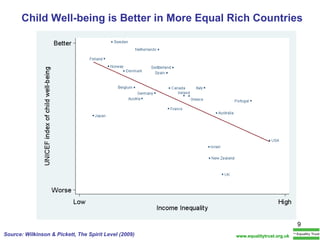
Child Well-being is Better in More Equal Rich Countries  Source: Wilkinson & Pickett, The Spirit Level (2009) www.equalitytrust.org.uk
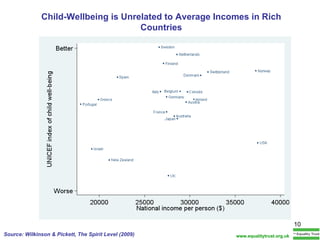
Child-Wellbeing is Unrelated to Average Incomes in Rich Countries Source: Wilkinson & Pickett, The Spirit Level (2009) www.equalitytrust.org.uk
 
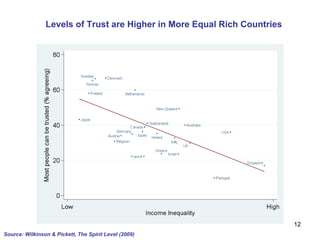
Levels of Trust are Higher in More Equal Rich Countries Source: Wilkinson & Pickett, The Spirit Level (2009)
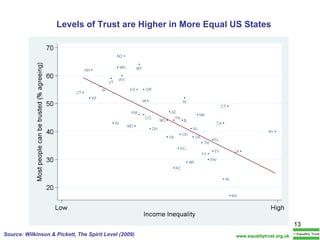
Levels of Trust are Higher in More Equal US States Source: Wilkinson & Pickett, The Spirit Level (2009) www.equalitytrust.org.uk
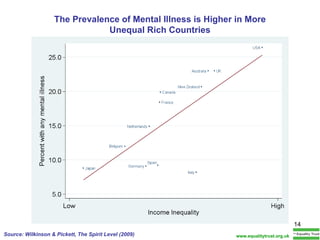
The Prevalence of Mental Illness is Higher in More Unequal Rich Countries Source: Wilkinson & Pickett, The Spirit Level (2009) www.equalitytrust.org.uk
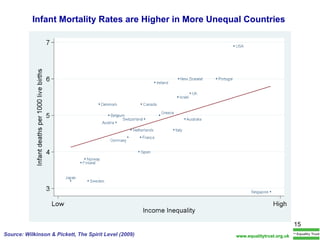
Infant Mortality Rates are Higher in More Unequal Countries Source: Wilkinson & Pickett, The Spirit Level (2009) www.equalitytrust.org.uk
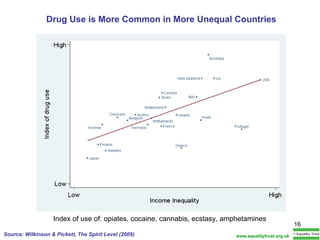
Drug Use is More Common in More Unequal Countries Source: Wilkinson & Pickett, The Spirit Level (2009) Index of use of: opiates, cocaine, cannabis, ecstasy, amphetamines www.equalitytrust.org.uk
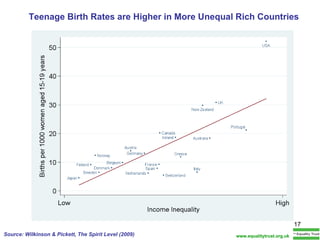
Teenage Birth Rates are Higher in More Unequal Rich Countries Source: Wilkinson & Pickett, The Spirit Level (2009) www.equalitytrust.org.uk
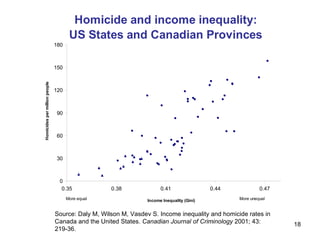
Source: Daly M, Wilson M, Vasdev S. Income inequality and homicide rates in Canada and the United States.  Canadian Journal of Criminology  2001; 43: 219-36.
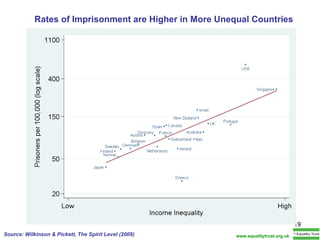
Rates of Imprisonment are Higher in More Unequal Countries Source: Wilkinson & Pickett, The Spirit Level (2009) www.equalitytrust.org.uk
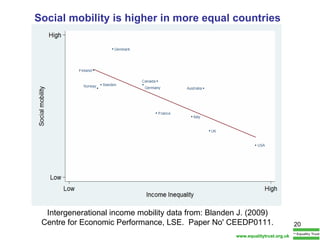
Social mobility is higher in more equal countries Intergenerational income mobility data from:  Blanden J. (2009) Centre for Economic Performance, LSE.  Paper No' CEEDP0111. www.equalitytrust.org.uk
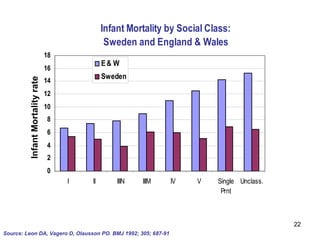
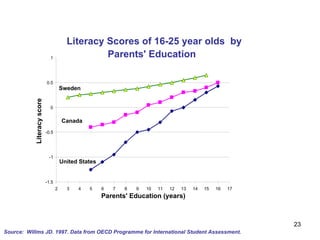
Almost everyone benefits from greater equality. Usually the benefits are greatest among the poor but extend to the majority of the population
Source: Leon DA, Vagero D, Olausson PO. BMJ 1992; 305; 687-91 Infant Mortality rate
Source:  Willms JD. 1997. Data from OECD Programme for International Student Assessment. Literacy Scores of 16-25 year olds  by  Parents' Education -1.5 -1 -0.5 0 0.5 1 2 3 4 5 6 7 8 9 10 11 12 13 14 15 16 17 Parents' Education (years) Literacy score Sweden Canada United States
Health and Social Problems are Worse in More Unequal Countries Index of:  Life expectancy Math & Literacy  Infant mortality Homicides Imprisonment Teenage births  Trust Obesity Mental illness – incl. drug & alcohol addiction Social mobility Source: Wilkinson & Pickett, The Spirit Level (2009) www.equalitytrust.org.uk
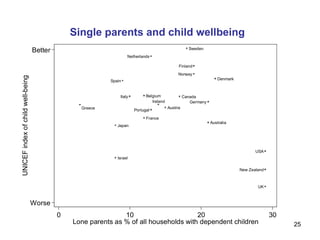
Single parents and child wellbeing
Why are we so sensitive to inequality?
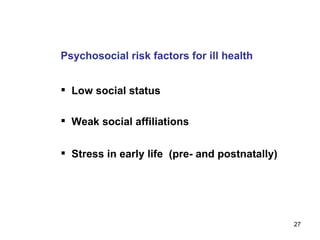
Psychosocial risk factors for ill health Low social status  Weak social affiliations Stress in early life  (pre- and postnatally)
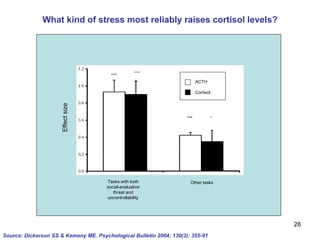
What kind of stress most reliably raises cortisol levels? Source: Dickerson SS & Kemeny ME. Psychological Bulletin 2004; 130(3): 355-91 ACTH Cortisol Tasks with both social-evaluative threat and uncontrollability Other tasks Effect size
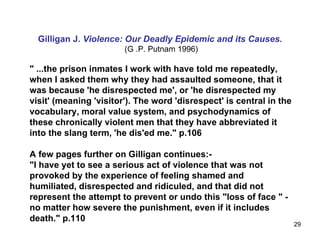
Gilligan J.  Violence: Our Deadly Epidemic and its Causes.   (G .P. Putnam 1996) " ...the prison inmates I work with have told me repeatedly, when I asked them why they had assaulted someone, that it was because 'he disrespected me', or 'he disrespected my visit' (meaning 'visitor'). The word 'disrespect' is central in the vocabulary, moral value system, and psychodynamics of these chronically violent men that they have abbreviated it into the slang term, 'he dis'ed me." p.106  A few pages further on Gilligan continues:-  "I have yet to see a serious act of violence that was not provoked by the experience of feeling shamed and humiliated, disrespected and ridiculed, and that did not represent the attempt to prevent or undo this "loss of face " - no matter how severe the punishment, even if it includes death." p.110
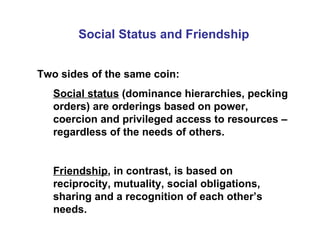
Social Status and Friendship Two sides of the same coin: Social status  (dominance hierarchies, pecking orders) are orderings based on power, coercion and privileged access to resources – regardless of the needs of others. Friendship , in contrast, is based on reciprocity, mutuality, social obligations, sharing and a recognition of each other’s needs.
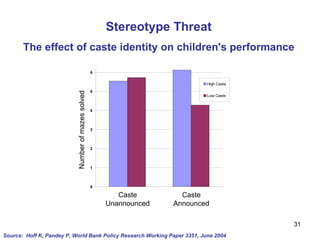
Stereotype Threat The effect of caste identity on children's performance Number of mazes solved Source:  Hoff K, Pandey P, World Bank Policy Research Working Paper 3351, June 2004 Caste Unannounced Caste Announced
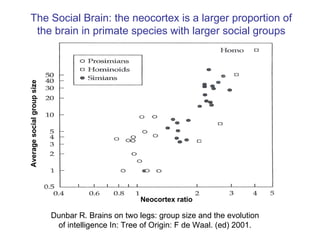
Dunbar R. Brains on two legs: group size and the evolution of intelligence In: Tree of Origin: F de Waal. (ed) 2001. The Social Brain: the neocortex is a larger proportion of the brain in primate species with larger social groups Average social group size Neocortex ratio
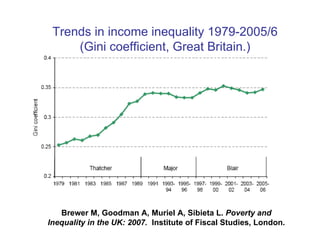
Trends in income inequality 1979-2005/6 (Gini coefficient, Great Britain.) Brewer M, Goodman A, Muriel A, Sibieta L.  Poverty and Inequality in the UK: 2007.   Institute of Fiscal Studies, London.
http://www.equalitytrust.org.uk For more information: …  a book and a website…
Equality and Sustainability  . . . a convenient truth
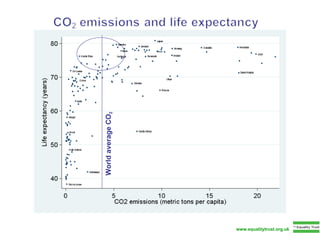
www.equalitytrust.org.uk World average CO 2
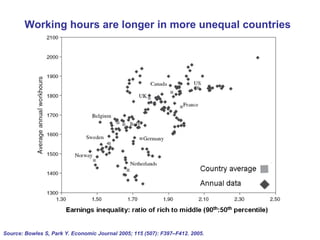
Source: Bowles S, Park Y. Economic Journal 2005; 115 (507): F397–F412. 2005. Working hours are longer in more unequal countries
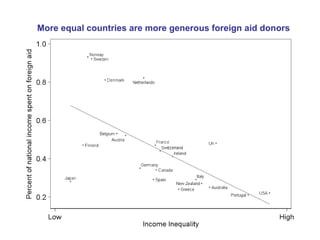
More equal countries are more generous foreign aid donors
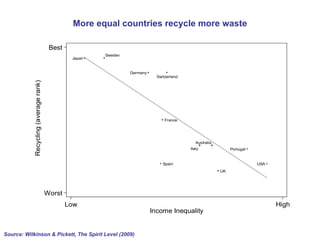
More equal countries recycle more waste Source: Wilkinson & Pickett, The Spirit Level (2009)
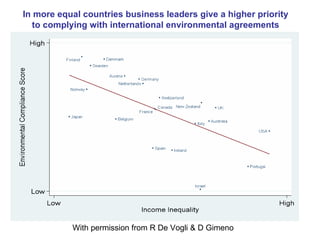
In more equal countries business leaders give a higher priority to complying with international environmental agreements With permission from R De Vogli & D Gimeno
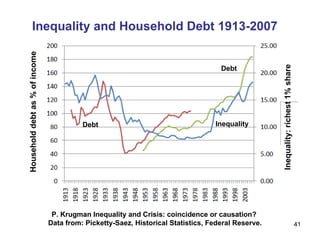
Inequality Debt Debt P. Krugman Inequality and Crisis: coincidence or causation?  Data from: Picketty-Saez, Historical Statistics, Federal Reserve. Inequality and Household Debt 1913-2007 Household debt as % of income Inequality: richest 1% share
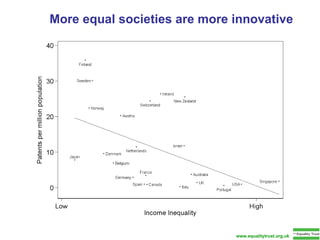
More equal societies are more innovative www.equalitytrust.org.uk
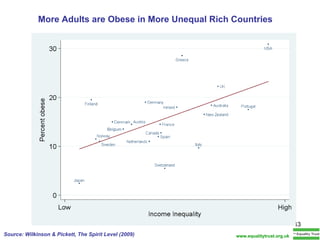
More Adults are Obese in More Unequal Rich Countries Source: Wilkinson & Pickett, The Spirit Level (2009) www.equalitytrust.org.uk
The public and policy response? more:- Police Doctors Social Workers Drug rehabilitation units Educational Psychologists But…services are expensive and only partially effective.
 
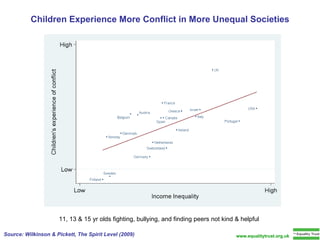
Children Experience More Conflict in More Unequal Societies Source: Wilkinson & Pickett, The Spirit Level (2009) 11, 13 & 15 yr olds fighting, bullying, and finding peers not kind & helpful www.equalitytrust.org.uk
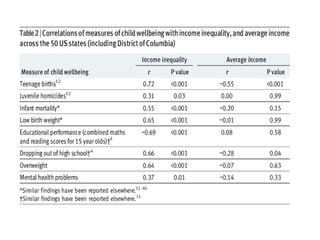
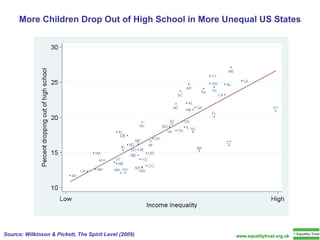
More Children Drop Out of High School in More Unequal US States Source: Wilkinson & Pickett, The Spirit Level (2009) www.equalitytrust.org.uk
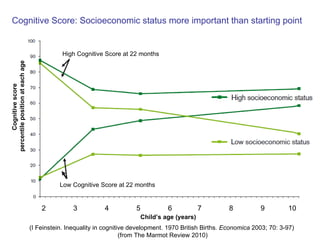
Cognitive Score: Socioeconomic status more important than starting point High Cognitive Score at 22 months Low Cognitive Score at 22 months 2  3  4  5  6  7  8  9  10   Child’s age (years) Cognitive score  percentile position at each age (I Feinstein. Inequality in cognitive development. 1970 British Births.  Economica  2003; 70: 3-97)  (from The Marmot Review 2010)
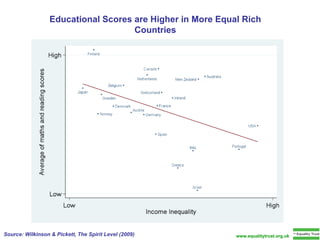
Educational Scores are Higher in More Equal Rich Countries Source: Wilkinson & Pickett, The Spirit Level (2009) www.equalitytrust.org.uk
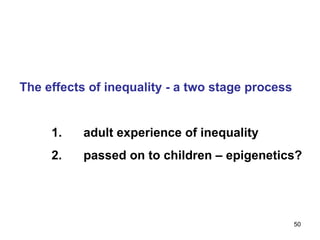
The effects of inequality - a two stage process adult experience of inequality passed on to children – epigenetics?

Wilkinson Presentation 110111

  • 1.
    Richard Wilkinson EmeritusProfessor of Social Epidemiology University of Nottingham & Kate Pickett Professor of Epidemiology University of York http://www.equalitytrust.org.uk
  • 2.
    Income per headand life-expectancy: rich & poor countries Source: Wilkinson & Pickett, The Spirit Level (2009) www.equalitytrust.org.uk
  • 3.
    Among the richcountries life expectancy is not related to national differences in average income Source: Wilkinson & Pickett, The Spirit Level (2009) www.equalitytrust.org.uk
  • 4.
    … but lifeexpectancy is related to income within rich societies Source: Wilkinson & Pickett, The Spirit Level (2009) www.equalitytrust.org.uk
  • 5.
    How much richerare the richest 20% than the poorest 20%? Source: Wilkinson & Pickett, The Spirit Level (2009) www.equalitytrust.org.uk
  • 7.
    Health and SocialProblems are Worse in More Unequal Countries Index of: Life expectancy Math & Literacy Infant mortality Homicides Imprisonment Teenage births Trust Obesity Mental illness – incl. drug & alcohol addiction Social mobility Source: Wilkinson & Pickett, The Spirit Level (2009) www.equalitytrust.org.uk
  • 8.
    Health and SocialProblems are not Related to Average Income in Rich Countries Index of: Life expectancy Math & Literacy Infant mortality Homicides Imprisonment Teenage births Trust Obesity Mental illness – incl. drug & alcohol addiction Social mobility Source: Wilkinson & Pickett, The Spirit Level (2009) www.equalitytrust.org.uk
  • 9.
    Child Well-being isBetter in More Equal Rich Countries Source: Wilkinson & Pickett, The Spirit Level (2009) www.equalitytrust.org.uk
  • 10.
    Child-Wellbeing is Unrelatedto Average Incomes in Rich Countries Source: Wilkinson & Pickett, The Spirit Level (2009) www.equalitytrust.org.uk
  • 11.
  • 12.
    Levels of Trustare Higher in More Equal Rich Countries Source: Wilkinson & Pickett, The Spirit Level (2009)
  • 13.
    Levels of Trustare Higher in More Equal US States Source: Wilkinson & Pickett, The Spirit Level (2009) www.equalitytrust.org.uk
  • 14.
    The Prevalence ofMental Illness is Higher in More Unequal Rich Countries Source: Wilkinson & Pickett, The Spirit Level (2009) www.equalitytrust.org.uk
  • 15.
    Infant Mortality Ratesare Higher in More Unequal Countries Source: Wilkinson & Pickett, The Spirit Level (2009) www.equalitytrust.org.uk
  • 16.
    Drug Use isMore Common in More Unequal Countries Source: Wilkinson & Pickett, The Spirit Level (2009) Index of use of: opiates, cocaine, cannabis, ecstasy, amphetamines www.equalitytrust.org.uk
  • 17.
    Teenage Birth Ratesare Higher in More Unequal Rich Countries Source: Wilkinson & Pickett, The Spirit Level (2009) www.equalitytrust.org.uk
  • 18.
    Source: Daly M,Wilson M, Vasdev S. Income inequality and homicide rates in Canada and the United States. Canadian Journal of Criminology 2001; 43: 219-36.
  • 19.
    Rates of Imprisonmentare Higher in More Unequal Countries Source: Wilkinson & Pickett, The Spirit Level (2009) www.equalitytrust.org.uk
  • 20.
    Social mobility ishigher in more equal countries Intergenerational income mobility data from: Blanden J. (2009) Centre for Economic Performance, LSE. Paper No' CEEDP0111. www.equalitytrust.org.uk
  • 21.
    Almost everyone benefitsfrom greater equality. Usually the benefits are greatest among the poor but extend to the majority of the population
  • 22.
    Source: Leon DA,Vagero D, Olausson PO. BMJ 1992; 305; 687-91 Infant Mortality rate
  • 23.
    Source: WillmsJD. 1997. Data from OECD Programme for International Student Assessment. Literacy Scores of 16-25 year olds by Parents' Education -1.5 -1 -0.5 0 0.5 1 2 3 4 5 6 7 8 9 10 11 12 13 14 15 16 17 Parents' Education (years) Literacy score Sweden Canada United States
  • 24.
    Health and SocialProblems are Worse in More Unequal Countries Index of: Life expectancy Math & Literacy Infant mortality Homicides Imprisonment Teenage births Trust Obesity Mental illness – incl. drug & alcohol addiction Social mobility Source: Wilkinson & Pickett, The Spirit Level (2009) www.equalitytrust.org.uk
  • 25.
    Single parents andchild wellbeing
  • 26.
    Why are weso sensitive to inequality?
  • 27.
    Psychosocial risk factorsfor ill health Low social status Weak social affiliations Stress in early life (pre- and postnatally)
  • 28.
    What kind ofstress most reliably raises cortisol levels? Source: Dickerson SS & Kemeny ME. Psychological Bulletin 2004; 130(3): 355-91 ACTH Cortisol Tasks with both social-evaluative threat and uncontrollability Other tasks Effect size
  • 29.
    Gilligan J. Violence: Our Deadly Epidemic and its Causes. (G .P. Putnam 1996) " ...the prison inmates I work with have told me repeatedly, when I asked them why they had assaulted someone, that it was because 'he disrespected me', or 'he disrespected my visit' (meaning 'visitor'). The word 'disrespect' is central in the vocabulary, moral value system, and psychodynamics of these chronically violent men that they have abbreviated it into the slang term, 'he dis'ed me." p.106 A few pages further on Gilligan continues:- "I have yet to see a serious act of violence that was not provoked by the experience of feeling shamed and humiliated, disrespected and ridiculed, and that did not represent the attempt to prevent or undo this "loss of face " - no matter how severe the punishment, even if it includes death." p.110
  • 30.
    Social Status andFriendship Two sides of the same coin: Social status (dominance hierarchies, pecking orders) are orderings based on power, coercion and privileged access to resources – regardless of the needs of others. Friendship , in contrast, is based on reciprocity, mutuality, social obligations, sharing and a recognition of each other’s needs.
  • 31.
    Stereotype Threat Theeffect of caste identity on children's performance Number of mazes solved Source: Hoff K, Pandey P, World Bank Policy Research Working Paper 3351, June 2004 Caste Unannounced Caste Announced
  • 32.
    Dunbar R. Brainson two legs: group size and the evolution of intelligence In: Tree of Origin: F de Waal. (ed) 2001. The Social Brain: the neocortex is a larger proportion of the brain in primate species with larger social groups Average social group size Neocortex ratio
  • 33.
    Trends in incomeinequality 1979-2005/6 (Gini coefficient, Great Britain.) Brewer M, Goodman A, Muriel A, Sibieta L. Poverty and Inequality in the UK: 2007. Institute of Fiscal Studies, London.
  • 34.
    http://www.equalitytrust.org.uk For moreinformation: … a book and a website…
  • 35.
    Equality and Sustainability . . . a convenient truth
  • 36.
  • 37.
    Source: Bowles S,Park Y. Economic Journal 2005; 115 (507): F397–F412. 2005. Working hours are longer in more unequal countries
  • 38.
    More equal countriesare more generous foreign aid donors
  • 39.
    More equal countriesrecycle more waste Source: Wilkinson & Pickett, The Spirit Level (2009)
  • 40.
    In more equalcountries business leaders give a higher priority to complying with international environmental agreements With permission from R De Vogli & D Gimeno
  • 41.
    Inequality Debt DebtP. Krugman Inequality and Crisis: coincidence or causation? Data from: Picketty-Saez, Historical Statistics, Federal Reserve. Inequality and Household Debt 1913-2007 Household debt as % of income Inequality: richest 1% share
  • 42.
    More equal societiesare more innovative www.equalitytrust.org.uk
  • 43.
    More Adults areObese in More Unequal Rich Countries Source: Wilkinson & Pickett, The Spirit Level (2009) www.equalitytrust.org.uk
  • 44.
    The public andpolicy response? more:- Police Doctors Social Workers Drug rehabilitation units Educational Psychologists But…services are expensive and only partially effective.
  • 45.
  • 46.
    Children Experience MoreConflict in More Unequal Societies Source: Wilkinson & Pickett, The Spirit Level (2009) 11, 13 & 15 yr olds fighting, bullying, and finding peers not kind & helpful www.equalitytrust.org.uk
  • 47.
    More Children DropOut of High School in More Unequal US States Source: Wilkinson & Pickett, The Spirit Level (2009) www.equalitytrust.org.uk
  • 48.
    Cognitive Score: Socioeconomicstatus more important than starting point High Cognitive Score at 22 months Low Cognitive Score at 22 months 2 3 4 5 6 7 8 9 10 Child’s age (years) Cognitive score percentile position at each age (I Feinstein. Inequality in cognitive development. 1970 British Births. Economica 2003; 70: 3-97) (from The Marmot Review 2010)
  • 49.
    Educational Scores areHigher in More Equal Rich Countries Source: Wilkinson & Pickett, The Spirit Level (2009) www.equalitytrust.org.uk
  • 50.
    The effects ofinequality - a two stage process adult experience of inequality passed on to children – epigenetics?

Editor's Notes

  • #7 The public and policy response? more:- Police Doctors Social Workers Drug rehabilitation units Educational Psychologists But…services are expensive and only partially effective.
  • #28 Most important sources of chronic stress – relative risks and population attributable risk Pointer – underlying source of stress: Social anxiety Eyes of others Social Gateway
  • #29 A meta-analysis of 208 laboratory studies of cortisol responses to acute stressors found that “Tasks that included social-evaluative threat (such as threats to self-esteem or social status), in which others could negatively judge performance, particularly when the outcome of the performance was uncontrollable, provoked larger and more reliable cortisol changes than stressors without these particular threats.” (p.377) "Humans are driven to preserve the social self and are vigilant to threats that may jeopardize their social esteem or status.” (p.357)
  • #45 Len Syme – MRFIT – smoking