.NET  PortfolioAlexander F Vogelalexfvogel@gmail.com(608) 481-3624
Table of ContentsFramework Project – p.3
Library Phase 1: Windows Front-End – p.6
Library Phase 2: Business and Data Access Layers – p.9
Library Phase 3: Web Application – p.12
Library Phase 4: Distributed Programming & Web Services – p.14
SetFocus Testing Application – p.17Framework ProjectObjective:
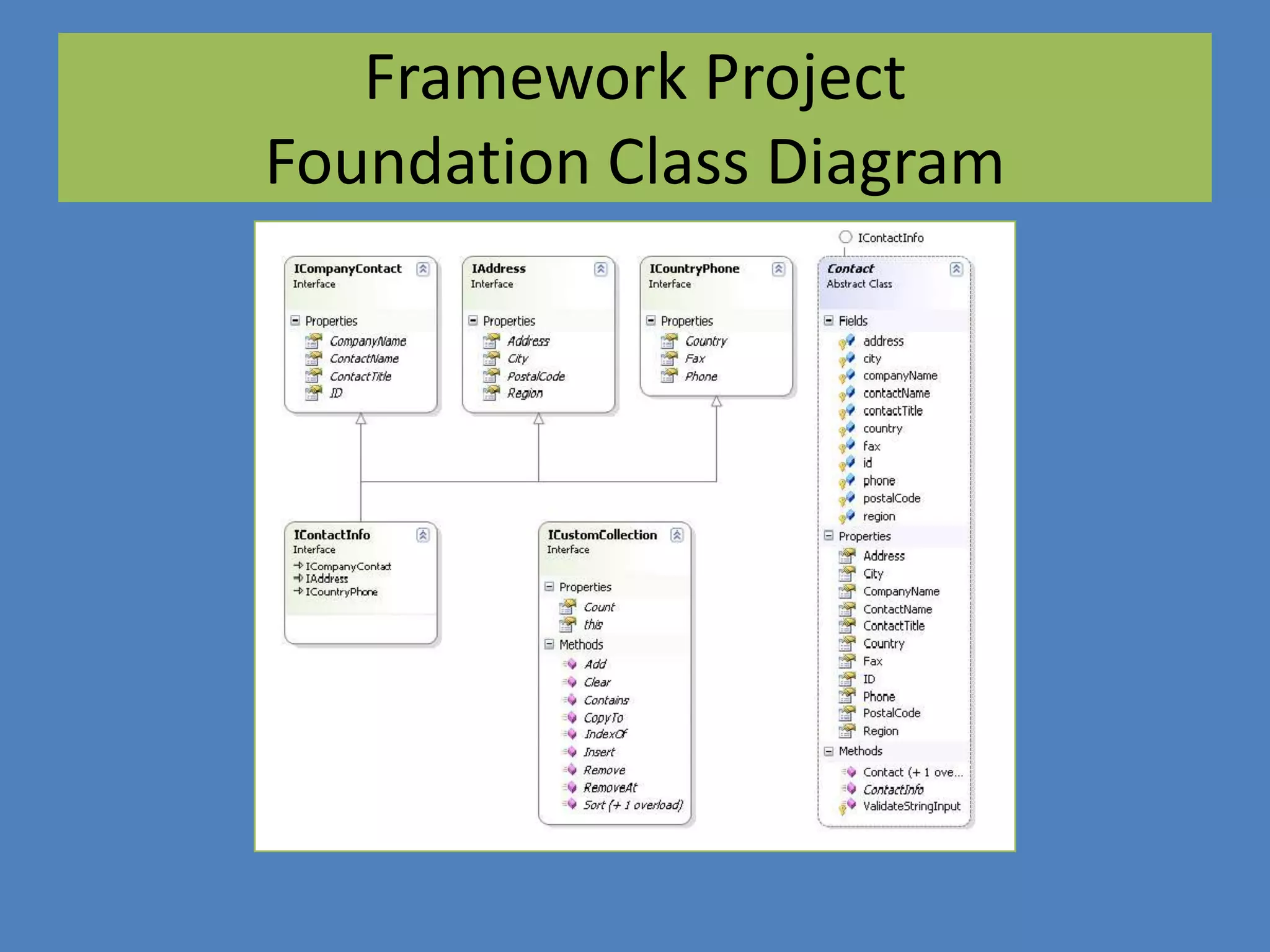
In this project, the goal is to create and test two assemblies for the business tier of a retail company. The first, Foundation, will contain various interfaces and base classes as specified in the design document. The second, AppTypes, will contain various entity, collection, and exception classes used by various business processes. The business processes have already been implemented.
Project Goals:
Code in C# using Visual Studio 2008
Implement interfaces, classes, properties, constructors, serialization, enums, and delegates according to design specifications
Implement IEnumerable and IEnumeration on a class and override methods (Equal and GetHashCode) and operators (==, !=, <, >, <=, >=)
Produce XML documentation on public membersFramework ProjectFoundation Class Diagram
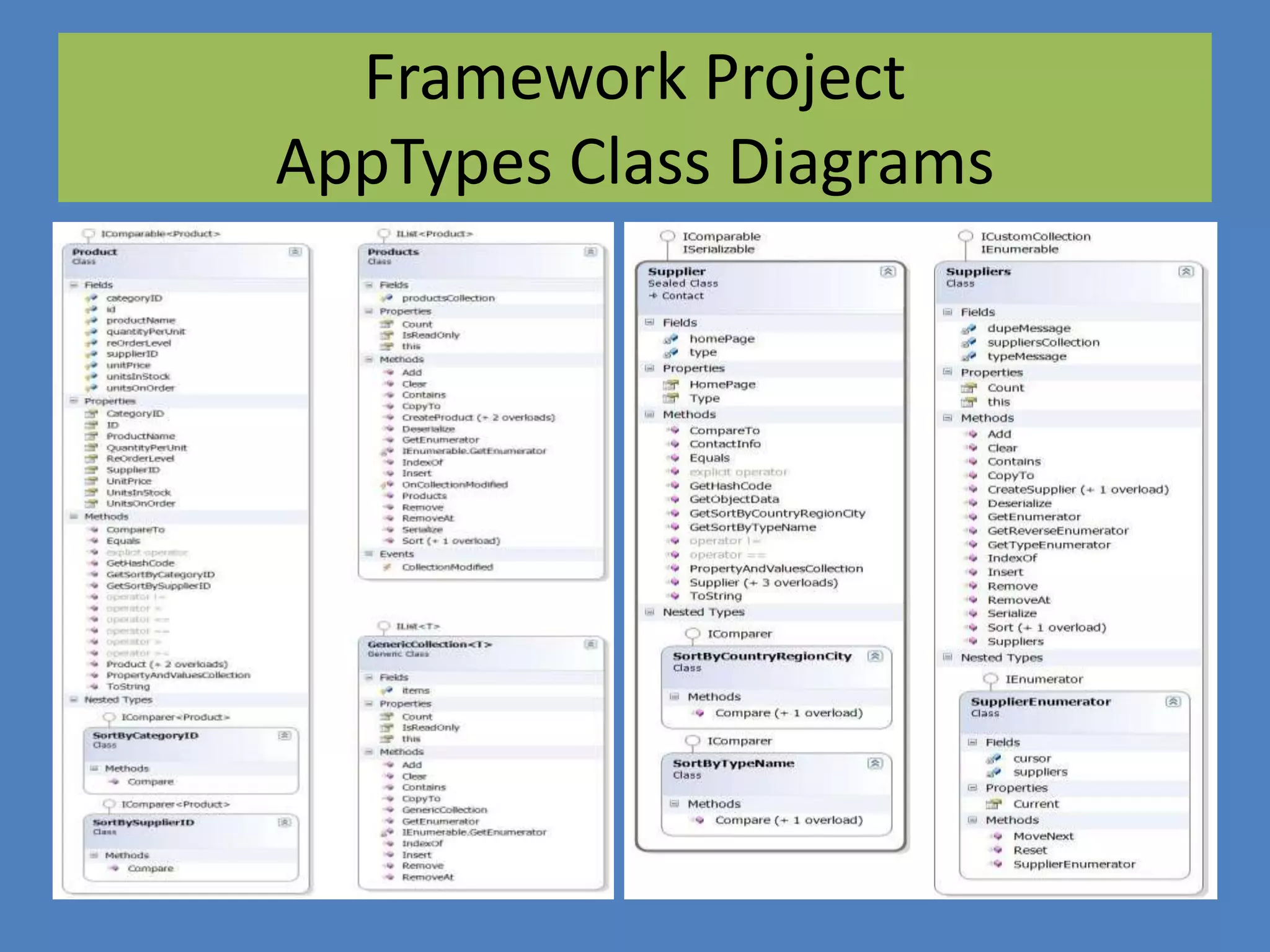
Framework ProjectAppTypes Class Diagrams
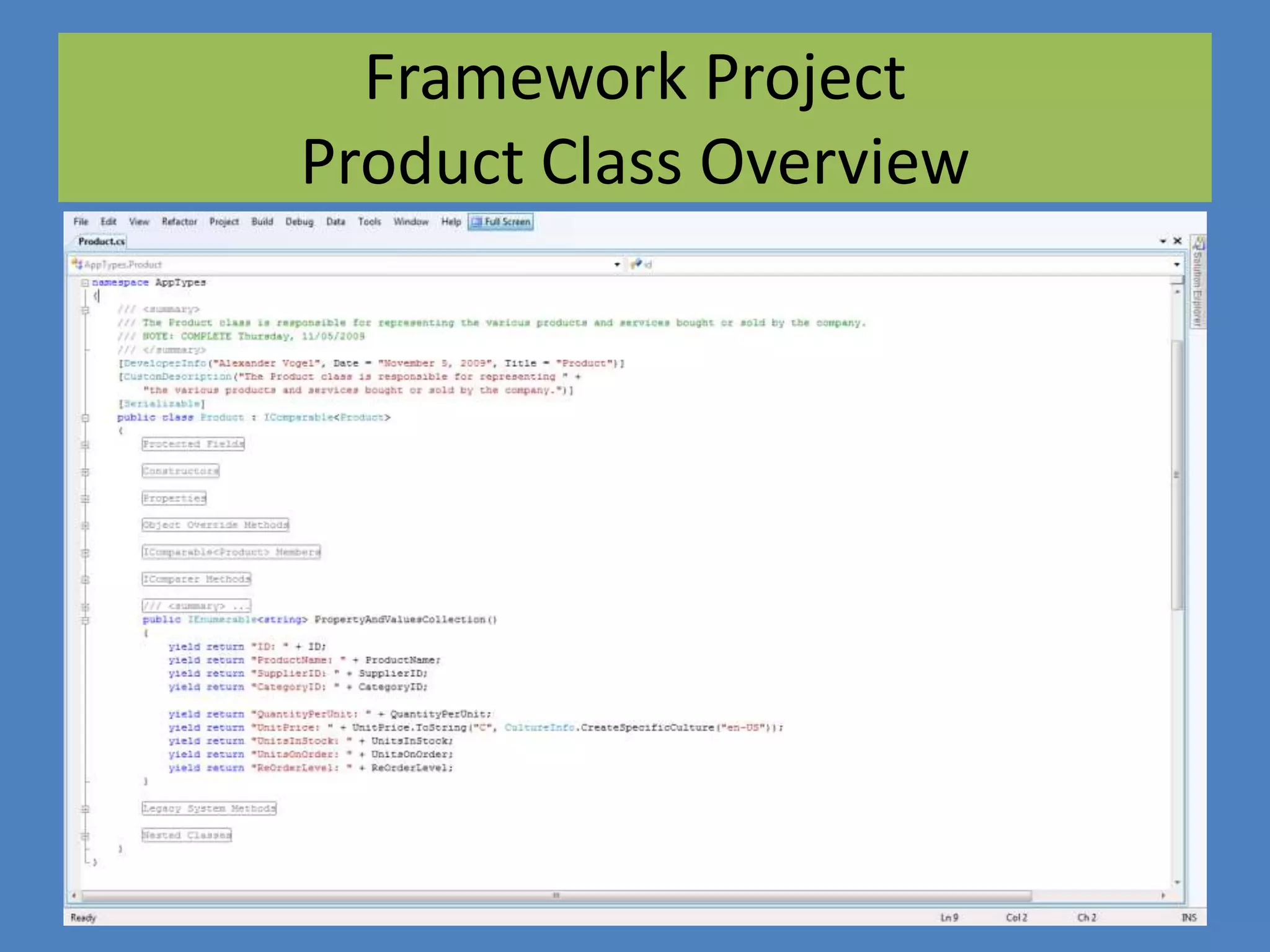
Framework ProjectProduct Class Overview
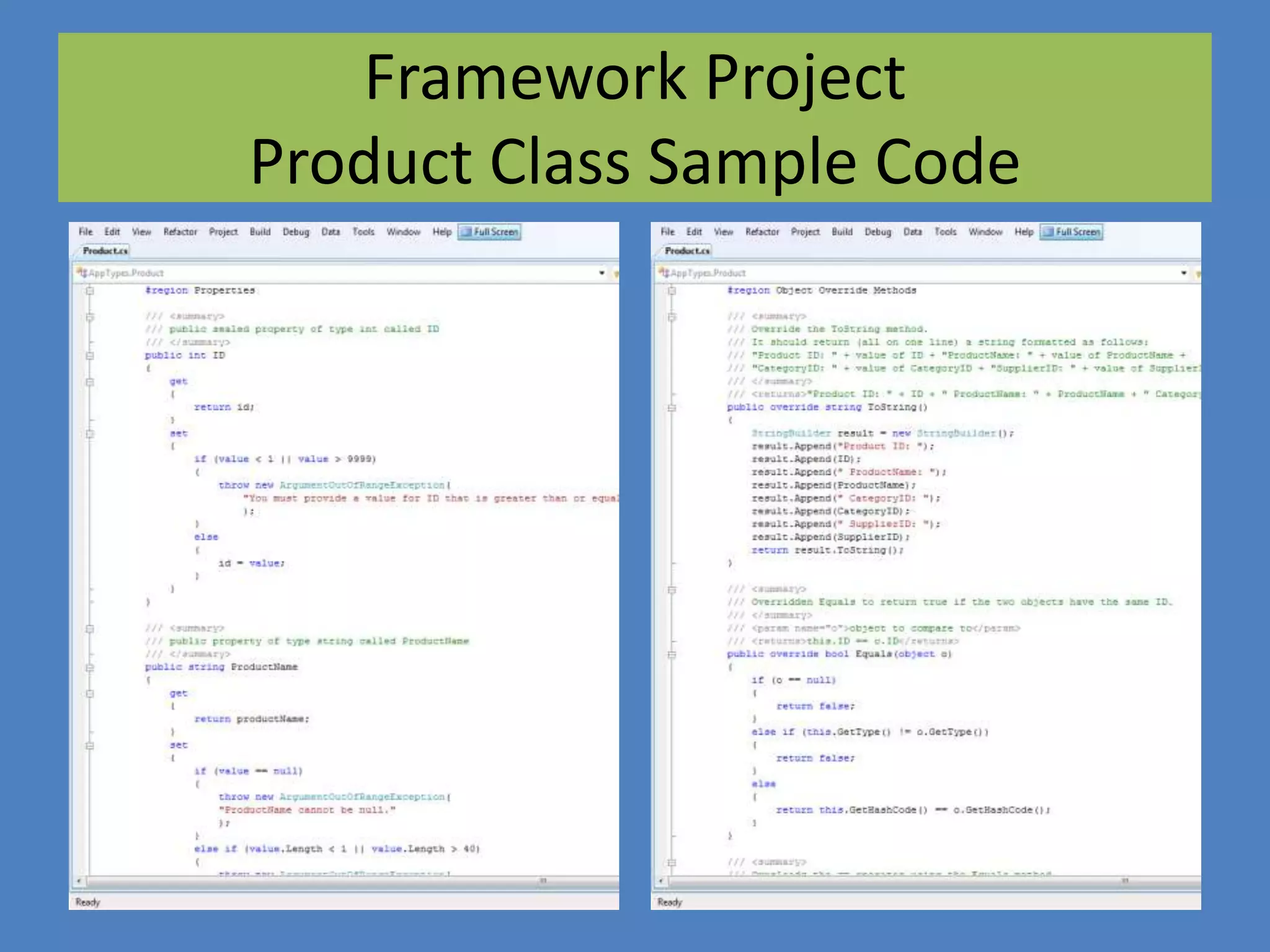
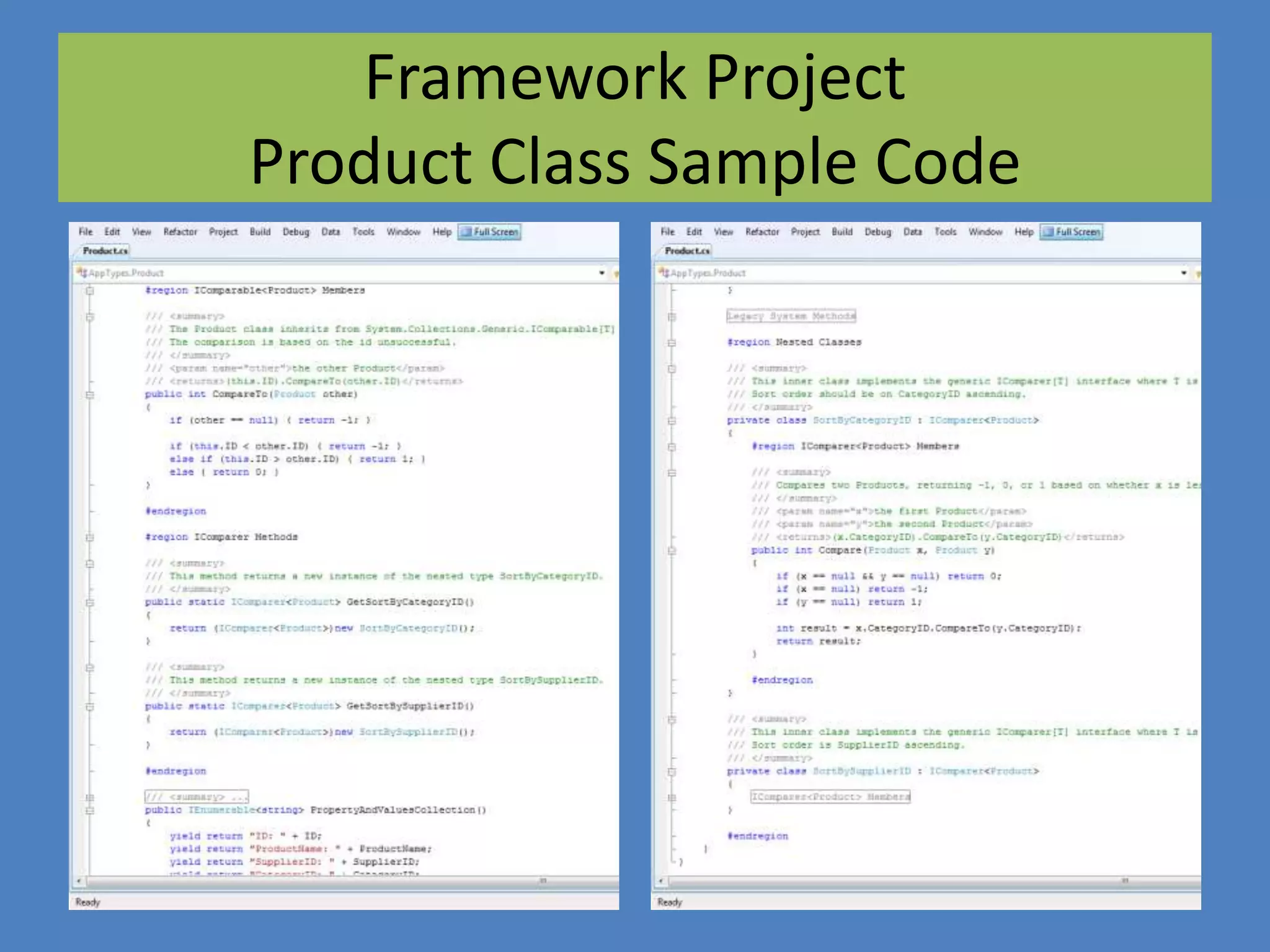
Framework ProjectProduct Class Sample Code
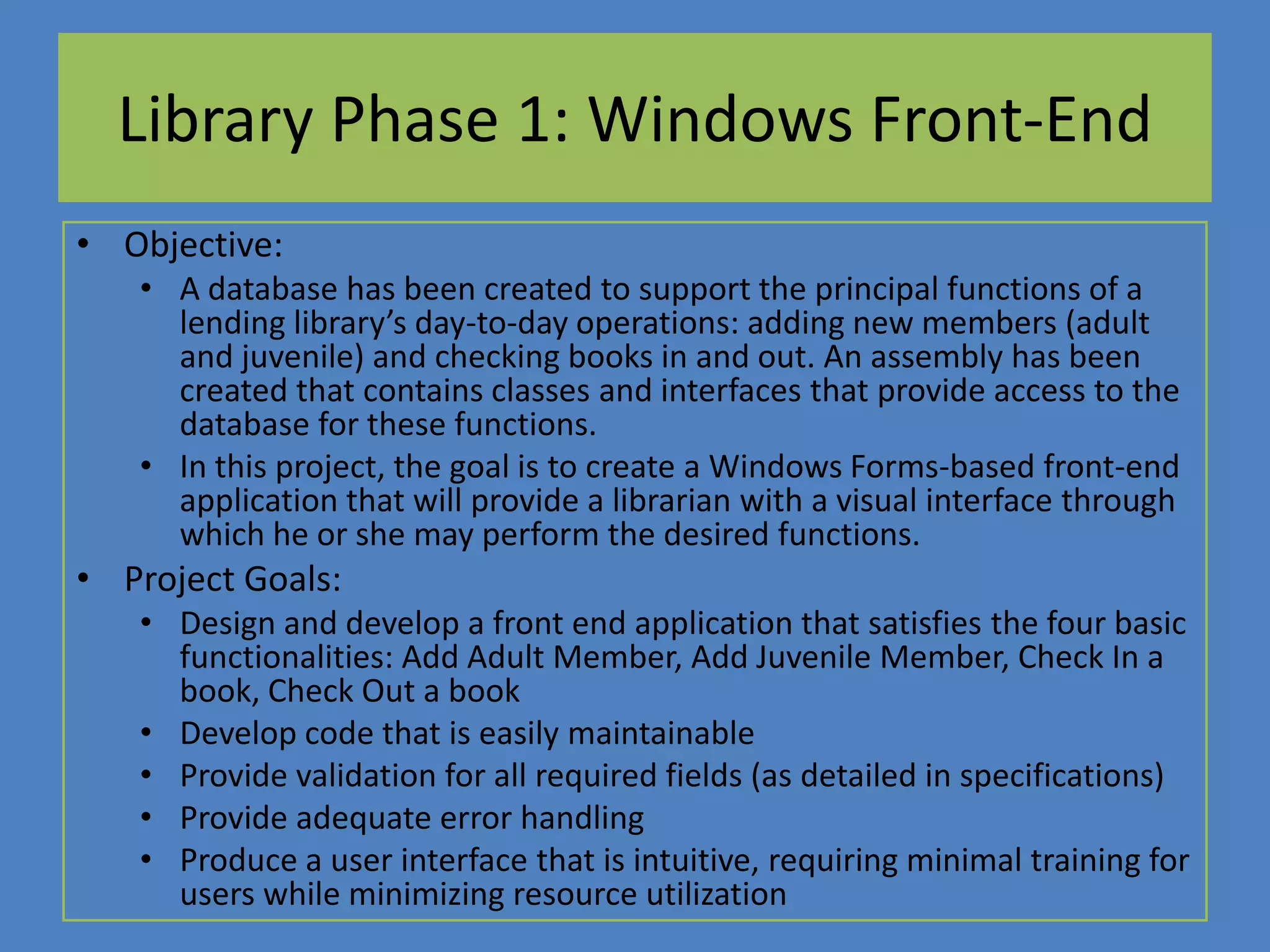
Library Phase 1: Windows Front-End Objective:
A database has been created to support the principal functions of a lending library’s day-to-day operations: adding new members (adult and juvenile) and checking books in and out. An assembly has been created that contains classes and interfaces that provide access to the database for these functions.
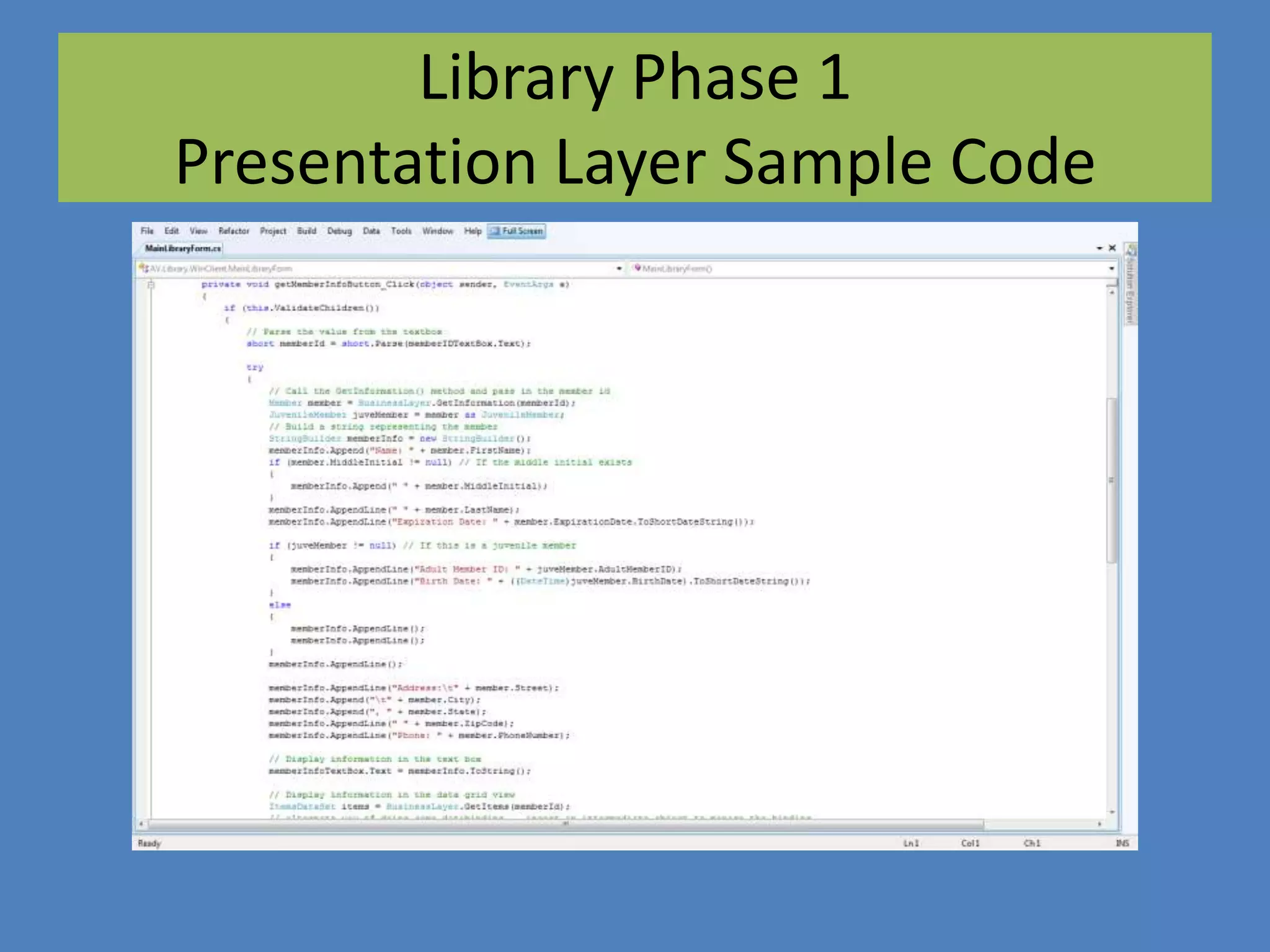
In this project, the goal is to create a Windows Forms-based front-end application that will provide a librarian with a visual interface through which he or she may perform the desired functions.

Software Portfolio - SetFocus

  • 1.
    .NET PortfolioAlexanderF Vogelalexfvogel@gmail.com(608) 481-3624
  • 2.
  • 3.
    Library Phase 1:Windows Front-End – p.6
  • 4.
    Library Phase 2:Business and Data Access Layers – p.9
  • 5.
    Library Phase 3:Web Application – p.12
  • 6.
    Library Phase 4:Distributed Programming & Web Services – p.14
  • 7.
    SetFocus Testing Application– p.17Framework ProjectObjective:
  • 8.
    In this project,the goal is to create and test two assemblies for the business tier of a retail company. The first, Foundation, will contain various interfaces and base classes as specified in the design document. The second, AppTypes, will contain various entity, collection, and exception classes used by various business processes. The business processes have already been implemented.
  • 9.
  • 10.
    Code in C#using Visual Studio 2008
  • 11.
    Implement interfaces, classes,properties, constructors, serialization, enums, and delegates according to design specifications
  • 12.
    Implement IEnumerable andIEnumeration on a class and override methods (Equal and GetHashCode) and operators (==, !=, <, >, <=, >=)
  • 13.
    Produce XML documentationon public membersFramework ProjectFoundation Class Diagram
  • 14.
  • 15.
  • 16.
  • 17.
  • 18.
  • 19.
    Library Phase 1:Windows Front-End Objective:
  • 20.
    A database hasbeen created to support the principal functions of a lending library’s day-to-day operations: adding new members (adult and juvenile) and checking books in and out. An assembly has been created that contains classes and interfaces that provide access to the database for these functions.
  • 21.
    In this project,the goal is to create a Windows Forms-based front-end application that will provide a librarian with a visual interface through which he or she may perform the desired functions.
  • 22.
  • 23.
    Design and developa front end application that satisfies the four basic functionalities: Add Adult Member, Add Juvenile Member, Check In a book, Check Out a book
  • 24.
    Develop code thatis easily maintainable
  • 25.
    Provide validation forall required fields (as detailed in specifications)
  • 26.
  • 27.
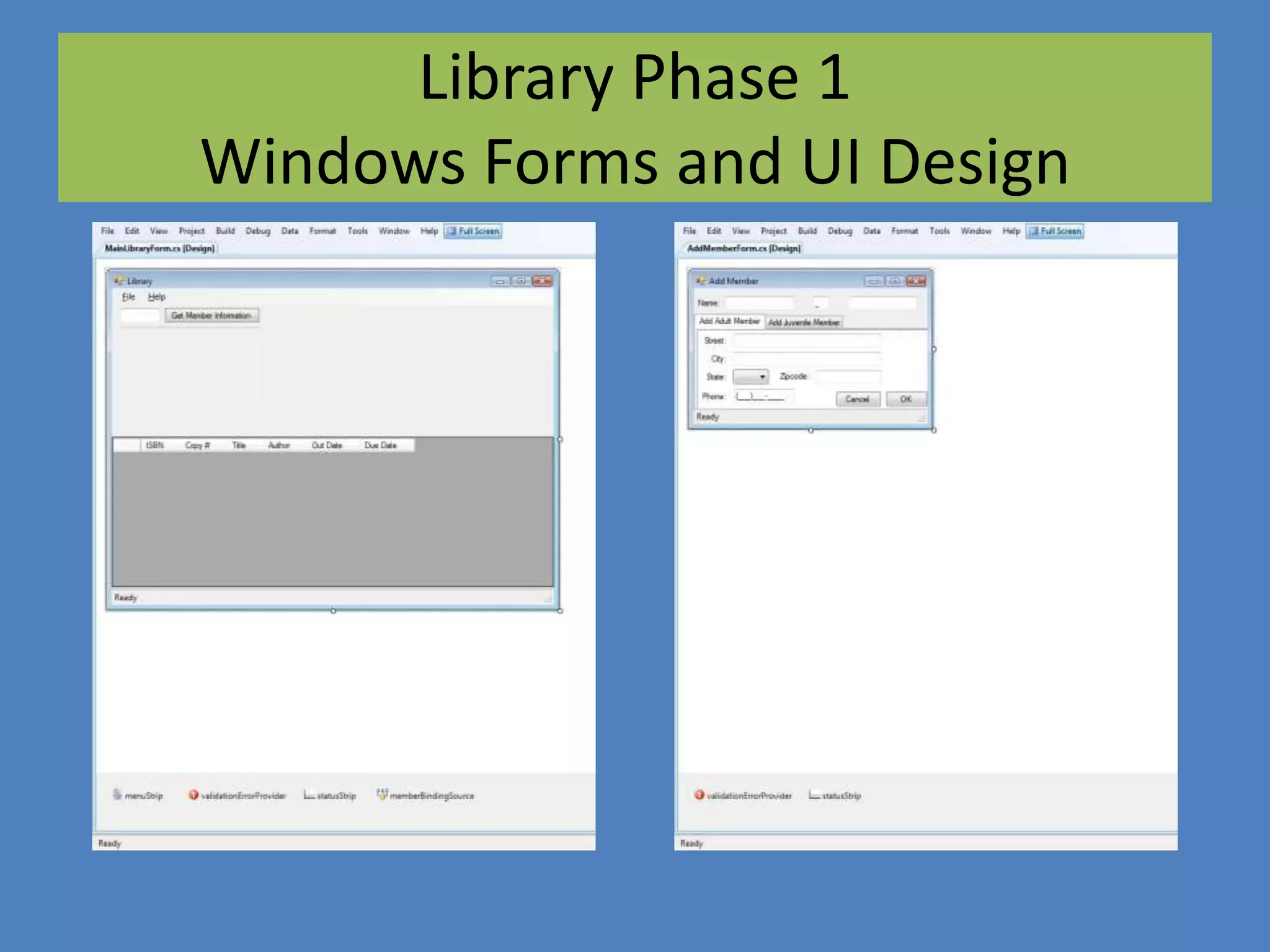
    Produce a userinterface that is intuitive, requiring minimal training for users while minimizing resource utilizationLibrary Phase 1Windows Forms and UI Design
  • 28.
    Library Phase 1WindowsForms and UI Design
  • 29.
  • 30.
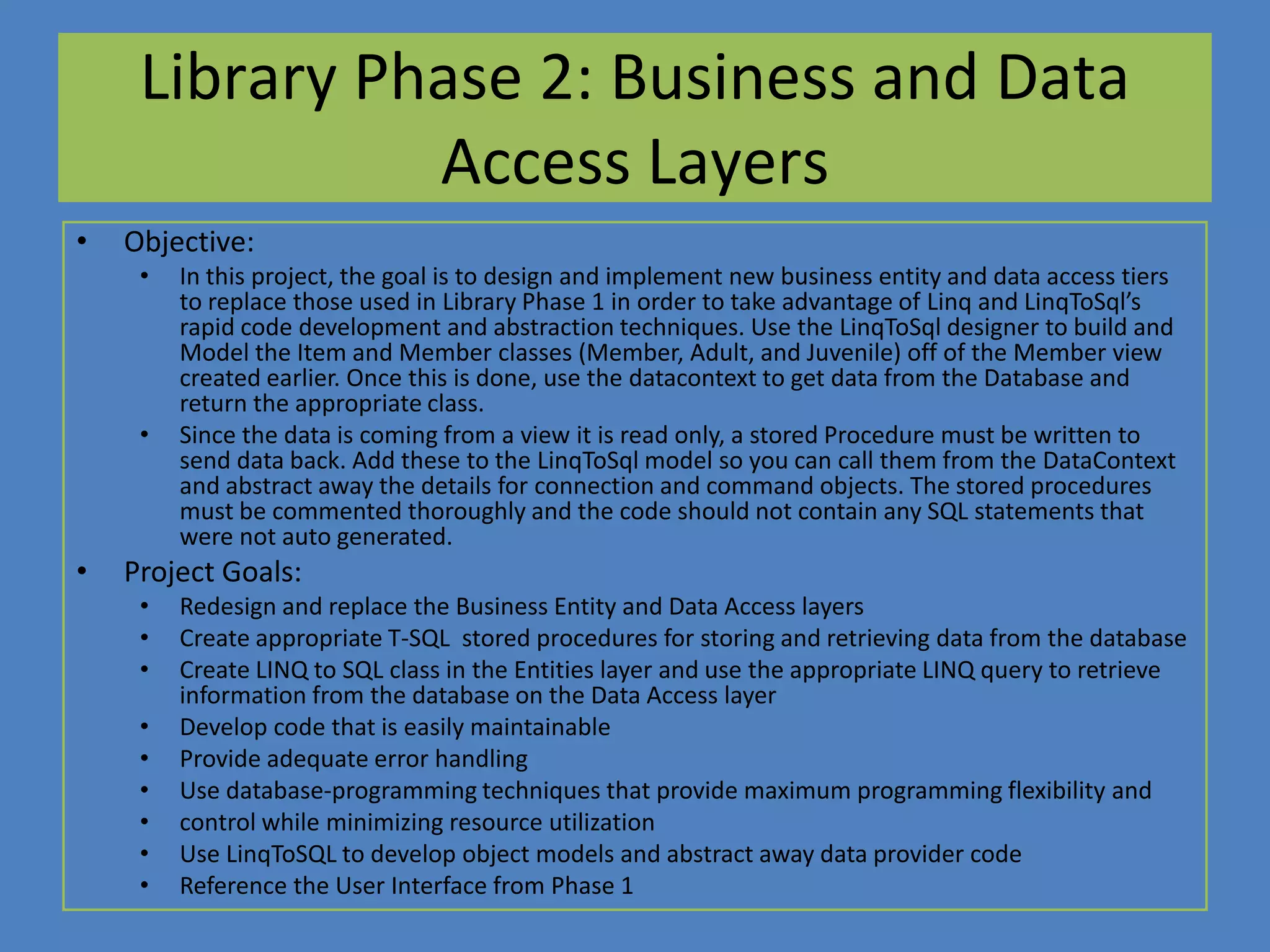
    Library Phase 2:Business and Data Access LayersObjective:
  • 31.
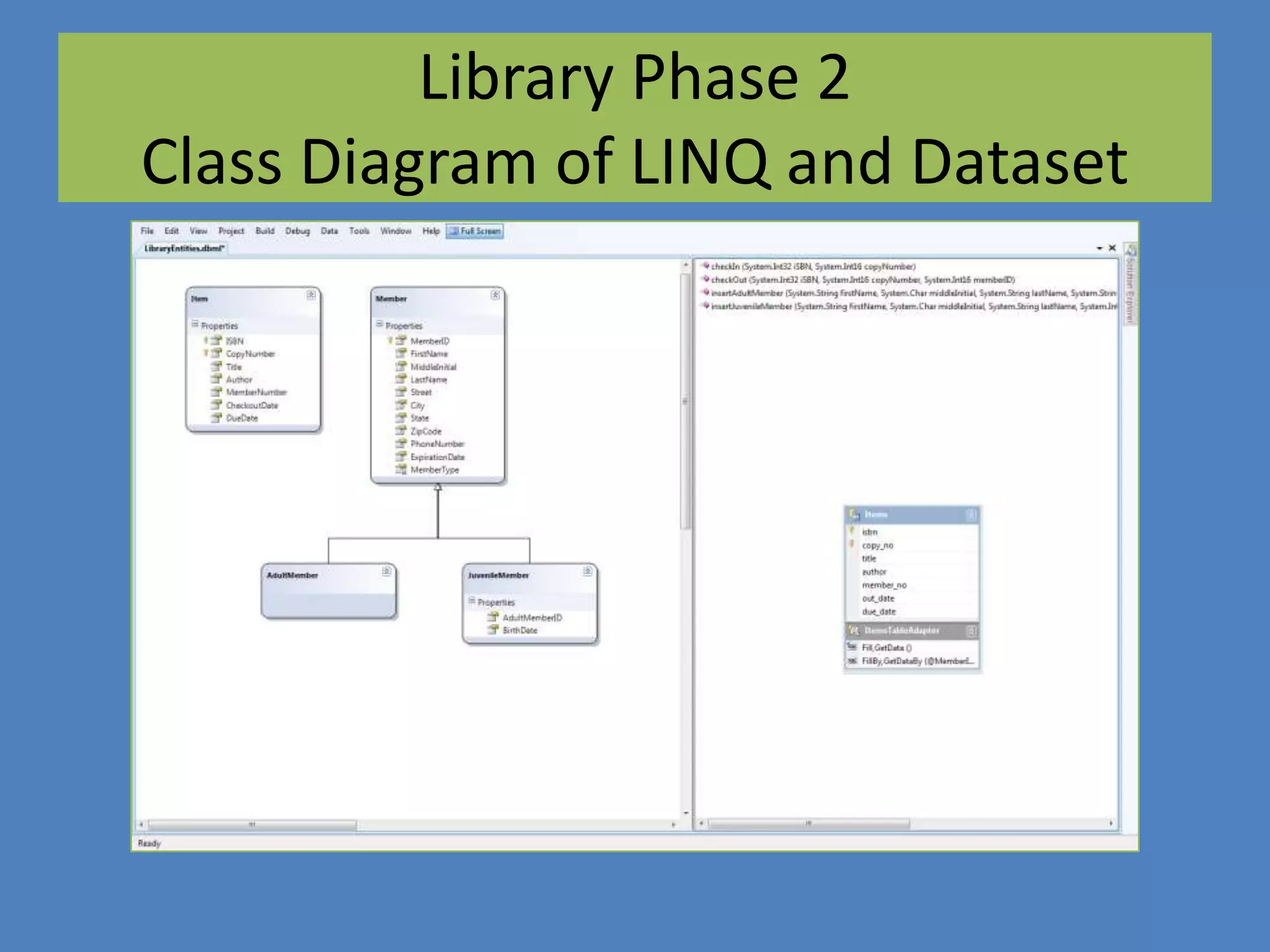
    In this project,the goal is to design and implement new business entity and data access tiers to replace those used in Library Phase 1 in order to take advantage of Linq and LinqToSql’s rapid code development and abstraction techniques. Use the LinqToSql designer to build and Model the Item and Member classes (Member, Adult, and Juvenile) off of the Member view created earlier. Once this is done, use the datacontext to get data from the Database and return the appropriate class.
  • 32.
    Since the datais coming from a view it is read only, a stored Procedure must be written to send data back. Add these to the LinqToSql model so you can call them from the DataContext and abstract away the details for connection and command objects. The stored procedures must be commented thoroughly and the code should not contain any SQL statements that were not auto generated.
  • 33.
  • 34.
    Redesign and replacethe Business Entity and Data Access layers
  • 35.
    Create appropriate T-SQL stored procedures for storing and retrieving data from the database
  • 36.
    Create LINQ toSQL class in the Entities layer and use the appropriate LINQ query to retrieve information from the database on the Data Access layer
  • 37.
    Develop code thatis easily maintainable
  • 38.
  • 39.
    Use database-programming techniquesthat provide maximum programming flexibility and
  • 40.
    control while minimizingresource utilization
  • 41.
    Use LinqToSQL todevelop object models and abstract away data provider code
  • 42.
    Reference the UserInterface from Phase 1Library Phase 2Business Layer & Validation
  • 43.
    Library Phase 2ClassDiagram of LINQ and Dataset
  • 44.
  • 45.
    Library Phase 2T-SQLStored Procedures
  • 46.
    Library Phase 3:Web ApplicationObjective:
  • 47.
    Create a webapplication that supports all the functionality required for Library Phase 1 and 2.
  • 48.
  • 49.
    Design and developa front end web application that can Add Adult Member, Add Juvenile Member, Check In a book, Check Out a book, and Renew Membership
  • 50.
    Create Add Itemweb form for adding new items to the library
  • 51.
    Modify the MemberInformation page to use two AJAX controls, the Update Panel control and the Update Progress control
  • 52.
    Reference the Business,Data Access, and Entities layers from Phase 2
  • 53.
    Reference the T-SQLstored procedures from Phase 2
  • 54.
  • 55.
    Only members ofthe Librarian role can use the web applicationLibrary Phase 4: Distributed Programming & Web ServicesObjective:
  • 56.
    Our library systemroll-out has been very successful. As the potential to acquire libraries and creating partnerships with others increases, we see the need to take the library system to the next level – allow interoperability with other systems. With the success on the library system thus far, we need to provide a proof of concept implementation that utilizes Web services.
  • 57.
    Use Windows CommunicationFoundation (WCF) to implement the service. To provide the proof of concept system, implement a system that uses Web services to offer access to the business layer. Due to the possibility of utilizing the service between our own systems and those of our partners, security must be employed. Use the existing presentation front-end for the client layer.
  • 58.
  • 59.
    Create a WCFservice that calls into the business layer
  • 60.
    Update the presentation(UI) layer to call the WCF service
  • 61.
    The WCF Servicemust be implemented with or support the following:
  • 62.
    WCF Service Libraryproject, WCF Service Website, WsHttpBinding, Authentication using ASP.NET membership, Authorization using ASP.NET roles
  • 63.
  • 64.
    Use certificates, signing,encryption, and secure session for security
  • 65.
    Support all previousfunctionality from Phase 3SetFocus Testing ApplicationObjective:
  • 66.
    SetFocus is acompany that specializes in training business professionals in a variety of programming disciplines. After lecture weeks students will be tested on the material reviewed during class. The testing link is sent via email. Students are able to answer questions, review answers, and submit their exams for grading.
  • 67.
    The objective ofthis project is to create a windows based application for creating the test that will link to a web based application that will allow participants to respond with the answers to the test. 
  • 68.
    The development teamswill be provided with a draft version of the database. They will also be given access to stored procedures that are currently used for the testing application.
  • 69.
  • 70.
    Design and developa windows application that will satisfy the below listed user functions
  • 71.
    Create stored proceduresfor the required functionality
  • 72.
    Use a multi-tieredprogramming approach when designing the application
  • 73.
    Follow the providednaming conventions when creating the stored procedures
  • 74.
    Develop code thatis easily maintainable and well commented
  • 75.
    Produce a userinterface that is intuitive and requires minimal training for the user
  • 76.
    Employ Framework 2.0,ADO.NET 2.0, ASP.NET 2.0, and SQL Server 2005 technologies