Why UML Modeling?
UML Tutorial Series
Visual Paradigm International
UML Modeling
Building Small
 o architect a dog house can be done by one person. It involves a simple process,
performed with basic tools such as nails, hammer, saw, tape etc.
 In few hours you end with a house for dog and can do with no one else's help. Modeling
effort is minimal or sometimes unnecessary.
Building Large Scale
 If you want to build a house for your family with same things, is it possible? It requires
detailed planning, some sketches etc.
 Of Course, architecting a house is best achieved by a team. It requires detailed
modelling, well-defined processes and powerful tools.
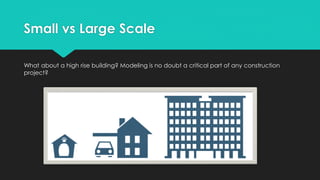
Small vs Large Scale
What about a high rise building? Modeling is no doubt a critical part of any construction
project?
What the UML Guru Said?
"Modeling is a central part of all the activities that lead up to the deployment of good
software. We build models to communicate the desired structure and behavior of our system.
We build models to visualize and control the system's architecture. We build models to better
understand the system we are building, often exposing opportunities for simplification and
reuse. And we build models to manage risk.“
- Grady Booch, The Unified Modeling Language User Guide (2nd Edition)
Importance of Modeling
Modeling is a proven & well accepted engineering techniques. In building architecture, we
develop architectural models of houses & high rises to help visualize the final products.
In Unified Modeling Language (UML), a model may be structural, emphasizing the
organization of the system or it may be behavioral, emphasizing the dynamics of the system.
A model is a simplification of reality, providing blueprints of a system.
UML, in specific:
 Permits you to specify the structure or behavior of a system.
 Helps you visualize a system.
 Provides template that guides you in constructing a system.
 Helps to understand complex system part by part.
 Document the decisions that you have made.
Overview & Detailed Model
 We can build model so that we can better understand the system we are developing.
 A model may encompass:
 an overview of the system under consideration,
 as well as a detailed planning:
 for system design,
 Implementation;
 and testing.
Principles of UML Modeling
1. The choice of model is important
2. Every model may be expressed at different levels of precision
3. The best models are connected to reality
4. No single model is sufficient
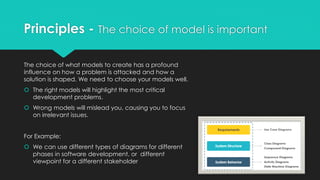
Principles - The choice of model is important
The choice of what models to create has a profound
influence on how a problem is attacked and how a
solution is shaped. We need to choose your models well.
 The right models will highlight the most critical
development problems.
 Wrong models will mislead you, causing you to focus
on irrelevant issues.
For Example:
 We can use different types of diagrams for different
phases in software development, or different
viewpoint for a different stakeholder
Principles - Every model may be expressed at different levels of precision
For Example,
 If you are building a high rise, sometimes you need a 30,000-foot view for instance, to help
your investors visualize its look and feel.
 Other times, you need to get down to the level of the studs for instance, when there's a
tricky pipe run or an unusual structural element.
Principles - The best models are connected to reality
 All models simplify reality and a good model reflects important key characteristics.
Principles - No single model is sufficient
Every non-trivial system is best approached through a small set of nearly independent
models. Create models that can be built and studied separately, but are still interrelated. In
the case of a building:
 You can study electrical plans in isolation
 But you can also see their mapping to the floor plan and perhaps even their interaction
with the routing of pipes in the plumbing plan.
Related Links
 What is Unified Modeling Language?
 A list of UML & SysML tools
 Try Visual Paradigm FREE

Why UML Modeling

  • 1.
    Why UML Modeling? UMLTutorial Series Visual Paradigm International
  • 2.
    UML Modeling Building Small o architect a dog house can be done by one person. It involves a simple process, performed with basic tools such as nails, hammer, saw, tape etc.  In few hours you end with a house for dog and can do with no one else's help. Modeling effort is minimal or sometimes unnecessary. Building Large Scale  If you want to build a house for your family with same things, is it possible? It requires detailed planning, some sketches etc.  Of Course, architecting a house is best achieved by a team. It requires detailed modelling, well-defined processes and powerful tools.
  • 3.
    Small vs LargeScale What about a high rise building? Modeling is no doubt a critical part of any construction project?
  • 4.
    What the UMLGuru Said? "Modeling is a central part of all the activities that lead up to the deployment of good software. We build models to communicate the desired structure and behavior of our system. We build models to visualize and control the system's architecture. We build models to better understand the system we are building, often exposing opportunities for simplification and reuse. And we build models to manage risk.“ - Grady Booch, The Unified Modeling Language User Guide (2nd Edition)
  • 5.
    Importance of Modeling Modelingis a proven & well accepted engineering techniques. In building architecture, we develop architectural models of houses & high rises to help visualize the final products. In Unified Modeling Language (UML), a model may be structural, emphasizing the organization of the system or it may be behavioral, emphasizing the dynamics of the system. A model is a simplification of reality, providing blueprints of a system. UML, in specific:  Permits you to specify the structure or behavior of a system.  Helps you visualize a system.  Provides template that guides you in constructing a system.  Helps to understand complex system part by part.  Document the decisions that you have made.
  • 6.
    Overview & DetailedModel  We can build model so that we can better understand the system we are developing.  A model may encompass:  an overview of the system under consideration,  as well as a detailed planning:  for system design,  Implementation;  and testing.
  • 7.
    Principles of UMLModeling 1. The choice of model is important 2. Every model may be expressed at different levels of precision 3. The best models are connected to reality 4. No single model is sufficient
  • 8.
    Principles - Thechoice of model is important The choice of what models to create has a profound influence on how a problem is attacked and how a solution is shaped. We need to choose your models well.  The right models will highlight the most critical development problems.  Wrong models will mislead you, causing you to focus on irrelevant issues. For Example:  We can use different types of diagrams for different phases in software development, or different viewpoint for a different stakeholder
  • 9.
    Principles - Everymodel may be expressed at different levels of precision For Example,  If you are building a high rise, sometimes you need a 30,000-foot view for instance, to help your investors visualize its look and feel.  Other times, you need to get down to the level of the studs for instance, when there's a tricky pipe run or an unusual structural element.
  • 10.
    Principles - Thebest models are connected to reality  All models simplify reality and a good model reflects important key characteristics.
  • 11.
    Principles - Nosingle model is sufficient Every non-trivial system is best approached through a small set of nearly independent models. Create models that can be built and studied separately, but are still interrelated. In the case of a building:  You can study electrical plans in isolation  But you can also see their mapping to the floor plan and perhaps even their interaction with the routing of pipes in the plumbing plan.
  • 12.
    Related Links  Whatis Unified Modeling Language?  A list of UML & SysML tools  Try Visual Paradigm FREE