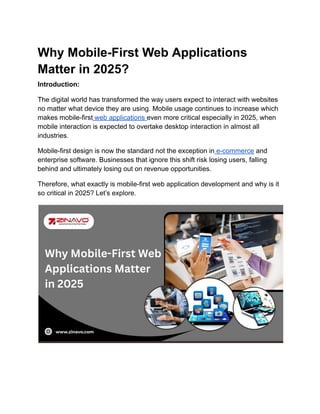
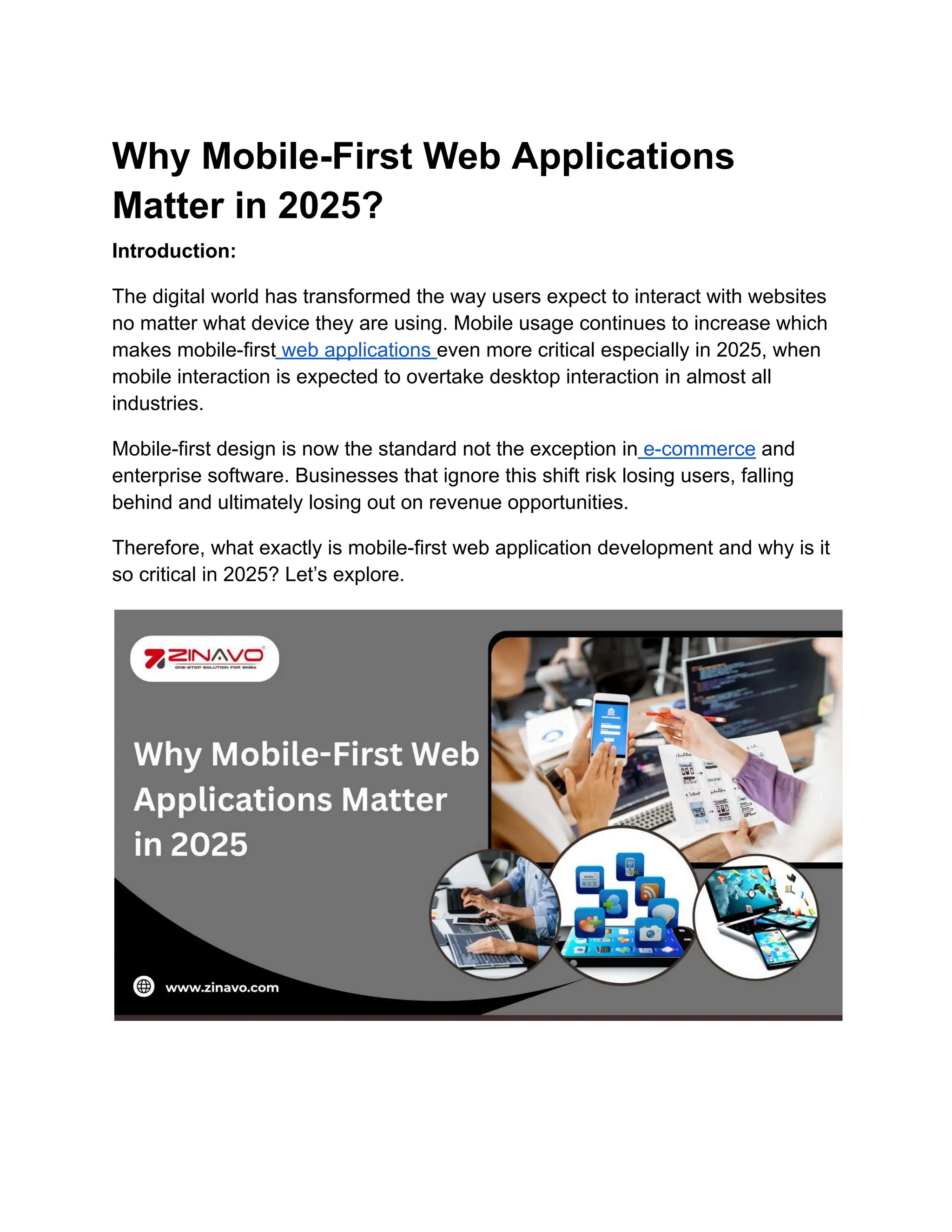
Why Mobile-First Web Applications
Matter in 2025?
Introduction:
The digital world has transformed the way users expect to interact with websites
no matter what device they are using. Mobile usage continues to increase which
makes mobile-first web applications even more critical especially in 2025, when
mobile interaction is expected to overtake desktop interaction in almost all
industries.
Mobile-first design is now the standard not the exception in e-commerce and
enterprise software. Businesses that ignore this shift risk losing users, falling
behind and ultimately losing out on revenue opportunities.
Therefore, what exactly is mobile-first web application development and why is it
so critical in 2025? Let’s explore.
What is a mobile-first web application?
Web applications designed primarily for mobile devices typically have smaller
screens and an interface that is optimized for small screens. The mobile-first
development approach focuses on creating the best possible experience on
smartphones and tablets before scaling up.
This approach ensures:
●​ Faster load times
●​ Cleaner, more focused user interface
●​ Better user engagement
●​ Improved responsiveness and usability
Modern web development has become crucial with mobile traffic now making up
more than 60% of global internet usage.
The importance of mobile-first in 2025
1. Mobile Usage Continues to Dominate
Smartphone usage is expected to increase to over 6.5 billion by 2025 and rise
even further. Users use mobile devices to access online shopping, email, virtual
meetings and enterprise apps.
It's not just that you miss out on a trend if your web application is not mobile-first,
but you'll also turn off the majority of your users.
2. Better User Experience - Higher Conversions
The user experience (UX) of a digital product is at the core of its design. When a
design is mobile-first, these factors are ensured:
●​ Buttons are easily tapable.
●​ Navigation is smooth
●​ Content is readable without zooming
●​ Actions are quick and intuitive
The average user will have less patience in 2025 than in any other year.
If your app does not guarantee an easy mobile experience, they will leave-and
likely not return. Increased conversion rates and engagement are directly related
to good user experiences.
3. Google’s Mobile-First Indexing
Indexing and ranking are now mostly based on mobile content due to Google's
mobile-first indexing. If your desktop web application is insufficiently optimized,
your SEO rankings will suffer, regardless of how polished your desktop version
may be.
In 2025 SEO will be more competitive than ever. A mobile-first web app gives
you a significant advantage in visibility and traffic.
4. Social Media Drives Mobile Traffic
Social platforms like Instagram, Facebook, Twitter and TikTok are mobile apps.
Any traffic driven from social media to your web application will likely come from
mobile users. If the landing experience is difficult or unresponsive, the bounce
rate will exponentially increase.
Mobile-first approaches ensure social traffic converts effectively into leads,
customers or subscribers.
5. The rise of Progressive Web Apps (PWAs).
Progressive Web Apps (PWAs) are transforming web applications. A number of
features are available in mobile apps, such as fast loading, offline access, and
push notifications.
Businesses looking to deliver native app-like experiences without the cost of
developing multiple platform-specific apps will turn to progressive web apps by
2025.
6. Cost-Effective and Scalable
Designing for the mobile-first is user-centric and cost-effective. It simplifies the
development process and ensures:
●​ Efficient use of resources
●​ Easier scalability
●​ Lower maintenance costs
Starting small and scaling up allows businesses to build lean,
performance-optimized applications from the ground up.
Key Features of a Mobile-First Web Application
If you want your mobile-first web application to meet modern standards, consider
integrating the following features:
●​ Responsive design using flexible grids and layouts
●​ Fast load times with lightweight assets and optimized code
●​ Touch-optimized UI for improved navigation and input
●​ Minimalist design highlights key actions and content
●​ Cross-browser compatibility
●​ Offline access using service workers
●​ Push notifications for user re-engagement
Industries Benefitting from Mobile-First Applications in 2025
Mobile-first is the key to success in 2025. If you are not mobile-first, you will be
mobile-last. Consumers expect simple, fast and engaging experiences on mobile
devices. If your web application fails to deliver, users will switch to competitors
who can.
Mobile-first business practices future-proof digital platforms, but also enhance
speed, usability, accessibility and performance.
1.​ E-Commerce – Faster browsing and simplified checkout increase mobile
sales
2.​ Education – Interactive and remote learning apps succeed on mobile
3.​ Healthcare – Remote medical care and appointment booking becomes
simple
4.​ Banking & FinTech – Secure mobile transactions and user dashboards
5.​ Travel & Hospitality – Bookings, schedules, and customer support
on-the-go
6.​ Transport – Real-time tracking and vehicle management for mobile staff
7.​ Engaging with social networks, streaming content, and playing games on
mobile devices - Entertainment
The flexibility and user-centricity offered by mobile-first web applications are
critical to competing and growing in today's marketplace, regardless of the
industry.
Conclusion:
Mobile-first approaches will dominate digital landscapes by 2025. Designing with
mobile users in mind is essential whether you're launching a new web application
or improving an existing one.
Web applications have become the backbone of digital innovation in an era
defined by speed, connectivity and personalization. The technologies bridge the
gap between user expectations and business capabilities - providing real-time
access, effortless interactions, and scaled functionality across all industries.
Zinavo's team of industry experts delivers solutions based on advanced
technology, responsive design and strategic UX to ensure user satisfaction and
measurable results. Invest in a modern design that won't hold you back. We can
help you create a mobile-first web application that will set you apart in 2025 and
long after. Zinavo can help you get started on the mobile-first journey with a free
consultation.

Why Mobile-First Web Applications Matter in 2025.pdf

  • 1.
    Why Mobile-First WebApplications Matter in 2025? Introduction: The digital world has transformed the way users expect to interact with websites no matter what device they are using. Mobile usage continues to increase which makes mobile-first web applications even more critical especially in 2025, when mobile interaction is expected to overtake desktop interaction in almost all industries. Mobile-first design is now the standard not the exception in e-commerce and enterprise software. Businesses that ignore this shift risk losing users, falling behind and ultimately losing out on revenue opportunities. Therefore, what exactly is mobile-first web application development and why is it so critical in 2025? Let’s explore.
  • 2.
    What is amobile-first web application? Web applications designed primarily for mobile devices typically have smaller screens and an interface that is optimized for small screens. The mobile-first development approach focuses on creating the best possible experience on smartphones and tablets before scaling up. This approach ensures: ●​ Faster load times ●​ Cleaner, more focused user interface ●​ Better user engagement ●​ Improved responsiveness and usability Modern web development has become crucial with mobile traffic now making up more than 60% of global internet usage. The importance of mobile-first in 2025 1. Mobile Usage Continues to Dominate Smartphone usage is expected to increase to over 6.5 billion by 2025 and rise even further. Users use mobile devices to access online shopping, email, virtual meetings and enterprise apps. It's not just that you miss out on a trend if your web application is not mobile-first, but you'll also turn off the majority of your users. 2. Better User Experience - Higher Conversions The user experience (UX) of a digital product is at the core of its design. When a design is mobile-first, these factors are ensured: ●​ Buttons are easily tapable. ●​ Navigation is smooth ●​ Content is readable without zooming ●​ Actions are quick and intuitive The average user will have less patience in 2025 than in any other year.
  • 3.
    If your appdoes not guarantee an easy mobile experience, they will leave-and likely not return. Increased conversion rates and engagement are directly related to good user experiences. 3. Google’s Mobile-First Indexing Indexing and ranking are now mostly based on mobile content due to Google's mobile-first indexing. If your desktop web application is insufficiently optimized, your SEO rankings will suffer, regardless of how polished your desktop version may be. In 2025 SEO will be more competitive than ever. A mobile-first web app gives you a significant advantage in visibility and traffic. 4. Social Media Drives Mobile Traffic Social platforms like Instagram, Facebook, Twitter and TikTok are mobile apps. Any traffic driven from social media to your web application will likely come from mobile users. If the landing experience is difficult or unresponsive, the bounce rate will exponentially increase. Mobile-first approaches ensure social traffic converts effectively into leads, customers or subscribers. 5. The rise of Progressive Web Apps (PWAs). Progressive Web Apps (PWAs) are transforming web applications. A number of features are available in mobile apps, such as fast loading, offline access, and push notifications. Businesses looking to deliver native app-like experiences without the cost of developing multiple platform-specific apps will turn to progressive web apps by 2025. 6. Cost-Effective and Scalable Designing for the mobile-first is user-centric and cost-effective. It simplifies the development process and ensures: ●​ Efficient use of resources ●​ Easier scalability
  • 4.
    ●​ Lower maintenancecosts Starting small and scaling up allows businesses to build lean, performance-optimized applications from the ground up. Key Features of a Mobile-First Web Application If you want your mobile-first web application to meet modern standards, consider integrating the following features: ●​ Responsive design using flexible grids and layouts ●​ Fast load times with lightweight assets and optimized code ●​ Touch-optimized UI for improved navigation and input ●​ Minimalist design highlights key actions and content ●​ Cross-browser compatibility ●​ Offline access using service workers ●​ Push notifications for user re-engagement Industries Benefitting from Mobile-First Applications in 2025 Mobile-first is the key to success in 2025. If you are not mobile-first, you will be mobile-last. Consumers expect simple, fast and engaging experiences on mobile devices. If your web application fails to deliver, users will switch to competitors who can. Mobile-first business practices future-proof digital platforms, but also enhance speed, usability, accessibility and performance. 1.​ E-Commerce – Faster browsing and simplified checkout increase mobile sales 2.​ Education – Interactive and remote learning apps succeed on mobile 3.​ Healthcare – Remote medical care and appointment booking becomes simple 4.​ Banking & FinTech – Secure mobile transactions and user dashboards 5.​ Travel & Hospitality – Bookings, schedules, and customer support on-the-go 6.​ Transport – Real-time tracking and vehicle management for mobile staff 7.​ Engaging with social networks, streaming content, and playing games on mobile devices - Entertainment
  • 5.
    The flexibility anduser-centricity offered by mobile-first web applications are critical to competing and growing in today's marketplace, regardless of the industry. Conclusion: Mobile-first approaches will dominate digital landscapes by 2025. Designing with mobile users in mind is essential whether you're launching a new web application or improving an existing one. Web applications have become the backbone of digital innovation in an era defined by speed, connectivity and personalization. The technologies bridge the gap between user expectations and business capabilities - providing real-time access, effortless interactions, and scaled functionality across all industries. Zinavo's team of industry experts delivers solutions based on advanced technology, responsive design and strategic UX to ensure user satisfaction and measurable results. Invest in a modern design that won't hold you back. We can help you create a mobile-first web application that will set you apart in 2025 and long after. Zinavo can help you get started on the mobile-first journey with a free consultation.