1 
SHOULD I GET AN MBA?
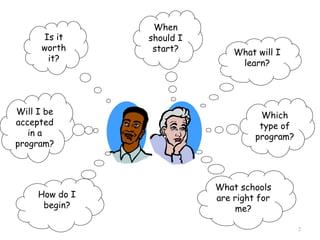
Is it 
worth 
it? What will I 
learn? 
When 
should I 
start? 
Will I be 
accepted 
in a 
program? 
Which 
type of 
program? 
What schools 
are right for 
me? 
How do I 
begin? 
2
MBA Trends 
• 1965 - <10,000 MBAs awarded 
• 1977 - 48,000 MBAs awarded 
• 1998 – 94,000 MBAs awarded 
• 2004 – 110,000 MBA’s awarded 
• Two-thirds of these degrees awarded to part-time 
or distance students 
• 20% of graduates plan to go into business for 
themselves 
3
Where do MBAs Work? 
• Manufacturing 
• Service Industries 
• Government 
4
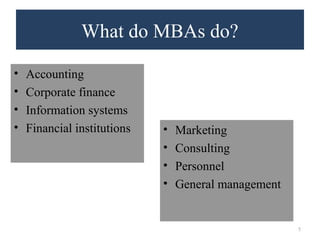
What do MBAs do? 
• Accounting 
• Corporate finance 
• Information systems 
• Financial institutions • Marketing 
• Consulting 
• Personnel 
• General management 
5
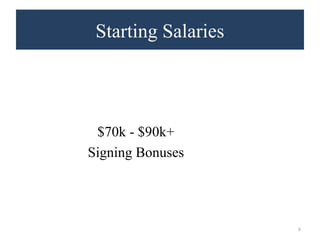
Starting Salaries 
$70k - $90k+ 
Signing Bonuses 
6
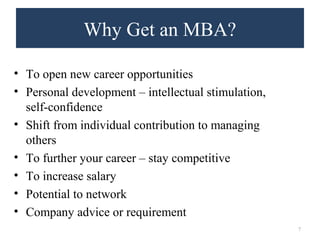
Why Get an MBA? 
• To open new career opportunities 
• Personal development – intellectual stimulation, 
self-confidence 
• Shift from individual contribution to managing 
others 
• To further your career – stay competitive 
• To increase salary 
• Potential to network 
• Company advice or requirement 
7
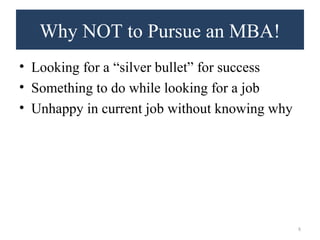
Why NOT to Pursue an MBA! 
• Looking for a “silver bullet” for success 
• Something to do while looking for a job 
• Unhappy in current job without knowing why 
8
Typical MBA Student Profile 
• Mid twenties to early thirties 
• Good academic background with solid work 
experience 
• Ambitious and determined 
• Strong idea of career direction 
9
What You Get with an MBA 
• “Boot camp” training for management 
• A focus on all specialist areas of management 
• Combination of technical and “soft” skills 
• In-depth focus of a particular discipline, if 
desired 
• Credentials 
10
Choosing a Program 
• Curriculum 
• Teaching methods 
• Delivery methods 
• Schools 
11
Curriculum 
• Traditional 
– Begin with functional core courses – finance, marketing, 
accounting, macro and micro economics, operations, IT, 
human resources, quantitative analysis 
– General management themes – legal, social, ethical and 
technological issues; change management; organizational 
theory and behavior; strategic management 
– Advanced courses or electives in a core area leading to 

major concentration 
• Variations 
– Incorporate “softer” skills – leadership, negotiation, 
teamwork 
– Internationalize their focus 
12
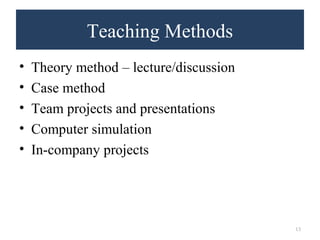
Teaching Methods 
• Theory method – lecture/discussion 
• Case method 
• Team projects and presentations 
• Computer simulation 
• In-company projects 
13
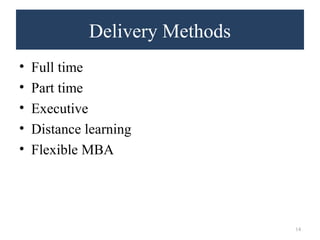
Delivery Methods 
• Full time 
• Part time 
• Executive 
• Distance learning 
• Flexible MBA 
14
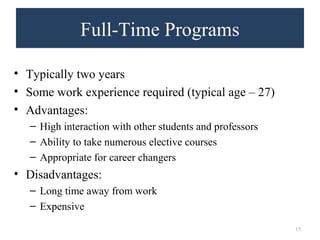
Full-Time Programs 
• Typically two years 
• Some work experience required (typical age – 27) 
• Advantages: 
– High interaction with other students and professors 
– Ability to take numerous elective courses 
– Appropriate for career changers 
• Disadvantages: 
– Long time away from work 
– Expensive 
15
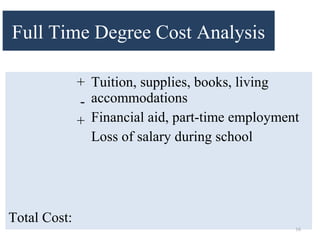
Full Time Degree Cost Analysis 
+ 
- 
+ 
Tuition, supplies, books, living 
accommodations 
Financial aid, part-time employment 
Loss of salary during school 
Total Cost: 
16
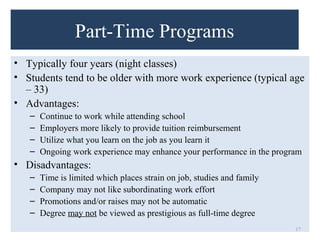
Part-Time Programs 
• Typically four years (night classes) 
• Students tend to be older with more work experience (typical age 
– 33) 
• Advantages: 
– Continue to work while attending school 
– Employers more likely to provide tuition reimbursement 
– Utilize what you learn on the job as you learn it 
– Ongoing work experience may enhance your performance in the program 
• Disadvantages: 
– Time is limited which places strain on job, studies and family 
– Company may not like subordinating work effort 
– Promotions and/or raises may not be automatic 
– Degree may not be viewed as prestigious as full-time degree 
17
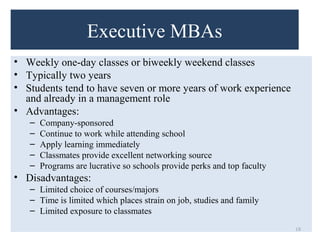
Executive MBAs 
• Weekly one-day classes or biweekly weekend classes 
• Typically two years 
• Students tend to have seven or more years of work experience 
and already in a management role 
• Advantages: 
– Company-sponsored 
– Continue to work while attending school 
– Apply learning immediately 
– Classmates provide excellent networking source 
– Programs are lucrative so schools provide perks and top faculty 
• Disadvantages: 
– Limited choice of courses/majors 
– Time is limited which places strain on job, studies and family 
– Limited exposure to classmates 
18
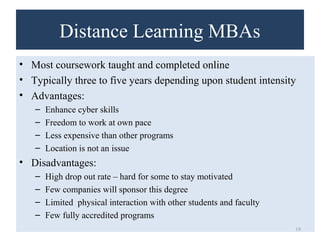
Distance Learning MBAs 
• Most coursework taught and completed online 
• Typically three to five years depending upon student intensity 
• Advantages: 
– Enhance cyber skills 
– Freedom to work at own pace 
– Less expensive than other programs 
– Location is not an issue 
• Disadvantages: 
– High drop out rate – hard for some to stay motivated 
– Few companies will sponsor this degree 
– Limited physical interaction with other students and faculty 
– Few fully accredited programs 
19
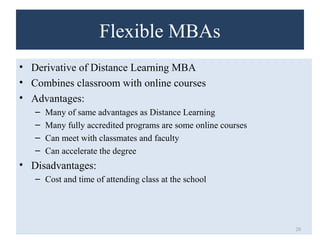
Flexible MBAs 
• Derivative of Distance Learning MBA 
• Combines classroom with online courses 
• Advantages: 
– Many of same advantages as Distance Learning 
– Many fully accredited programs are some online courses 
– Can meet with classmates and faculty 
– Can accelerate the degree 
• Disadvantages: 
– Cost and time of attending class at the school 
20
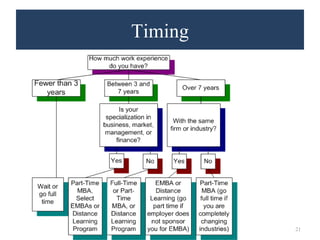
Timing 
21
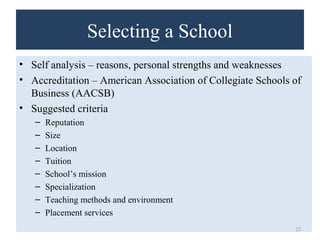
Selecting a School 
• Self analysis – reasons, personal strengths and weaknesses 
• Accreditation – American Association of Collegiate Schools of 
Business (AACSB) 
• Suggested criteria 
– Reputation 
– Size 
– Location 
– Tuition 
– School’s mission 
– Specialization 
– Teaching methods and environment 
– Placement services 
22
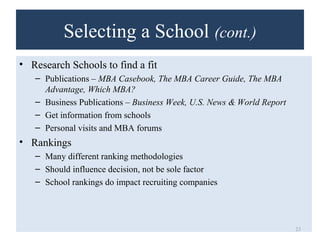
Selecting a School (cont.) 
• Research Schools to find a fit 
– Publications – MBA Casebook, The MBA Career Guide, The MBA 
Advantage, Which MBA? 
– Business Publications – Business Week, U.S. News & World Report 
– Get information from schools 
– Personal visits and MBA forums 
• Rankings 
– Many different ranking methodologies 
– Should influence decision, not be sole factor 
– School rankings do impact recruiting companies 
23
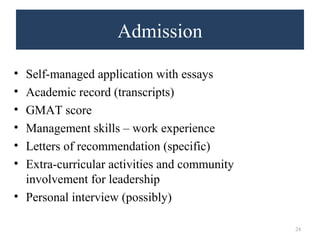
Admission 
• Self-managed application with essays 
• Academic record (transcripts) 
• GMAT score 
• Management skills – work experience 
• Letters of recommendation (specific) 
• Extra-curricular activities and community 
involvement for leadership 
• Personal interview (possibly) 
24
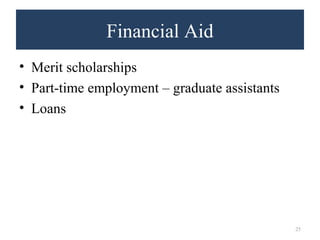
Financial Aid 
• Merit scholarships 
• Part-time employment – graduate assistants 
• Loans 
25
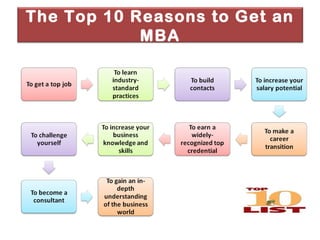
The Top 10 Reasons to Get an 
MBA
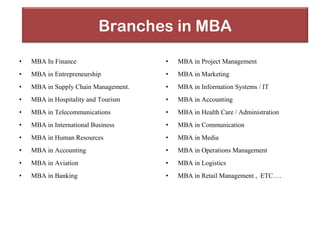
Branches in MBA 
• MBA In Finance 
• MBA in Entrepreneurship 
• MBA in Supply Chain Management. 
• MBA in Hospitality and Tourism 
• MBA in Telecommunications 
• MBA in International Business 
• MBA in Human Resources 
• MBA in Accounting 
• MBA in Aviation 
• MBA in Banking 
• MBA in Project Management 
• MBA in Marketing 
• MBA in Information Systems / IT 
• MBA in Accounting 
• MBA in Health Care / Administration 
• MBA in Communication 
• MBA in Media 
• MBA in Operations Management 
• MBA in Logistics 
• MBA in Retail Management , ETC….
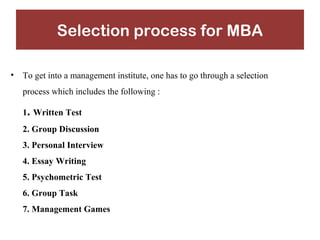
Selection process for MBA 
• To get into a management institute, one has to go through a selection 
process which includes the following : 
1. Written Test 
2. Group Discussion 
3. Personal Interview 
4. Essay Writing 
5. Psychometric Test 
6. Group Task 
7. Management Games
Written Exam Tests 
(MAT, XAT, CAT, ATMA) 
• The written exam tests the aptitude of the candidate in a number of areas. 
It usually consists of questions related to : 
1. Quantitative Ability 
(Mathematics mostly from 8-9-10 standard, Geometry, Menstruation, 
Algebra, Trigonometry and Co-ordinate Geometry) 
2. Verbal Section - 
(Grammar, Sentence Correction, Vocabulary, Reading Comprehension & 
Verbal Analogies) 
3. Data Interpretation 
(Analysis of Data. Usually data is in form of tables, charts, graphs.) 
4. Logical Reasoning/Ability 
(using Common Logic) 
5. General Awareness. 
(current/past issues (national & global), economics, general knowledge 
etc.
Facing the GD
MBA Admissions- Common 
Interview Questions 
 Tell me about yourself. 
 Why MBA ? 
 What makes you stand out among other candidates? 
 What can you contribute to our program ? 
 What are your expectations of this program ? 
 What are your main strengths and weaknesses? 
 Where do you expect to be in 5 years? 
 What do you expect to get from an MBA? ETC…
Jobs After MBA in Marketing 
 Manager 
 Marketing Manager 
 Event Manager 
 Sales Officer 
 Sale Manager 
 Marketing Executive 
 Marketing officer 
 Public Relation Officer 
 Advertising Executive 
 Product Development Officer 
 Relationship Manager 
 Networking officer , etc…..
Jobs After MBA in Finance 
 Invest Manager 
 Fund Manager 
 Junior Dealer 
 Junior Manager 
 Stock Analysts 
 Junior Stock Analysts 
 Investment Officer 
 Branch Manager, etc…
Jobs After MBA in Human Resource 
 Manager 
 H.R. Manager 
 H.R. Executive 
 H.R. officer 
 Public Relation Officer 
 Front desk officer, etc…..
Jobs After MBA in System 
 Project leaders in IT companies 
 Business process consultants 
 Techno Managers in marketing firms 
 Business Analyst 
 Junior Programmer 
 ERP consultant, etc…..
Jobs After MBA in Operations 
• Operation Manager 
• Sales Operational Officer 
• Operation Executive 
• Section Manager 
• Supply Chain Management 
• Inventory 
• Material Management 
• Logistic and Productivity 
• Total Quality Management, etc….
Few Tips to Crack Entrance 
I. Think positive, how much you have learnt in a year, that’s enough. 
II. Reach at least half an hour before the commencement of 
the examination. 
III. Read thoroughly all the instructions supplied in the exam paper. 
IV. Avoid guessing, there is negative marking. Guessing is 
definitely a RISK 
V. Attempt your favourite section first, followed by the toughest one 
next. Then attempt the other two sections.
SHOULD I GET AN MBA? 
38

Why mba presentation

  • 1.
    1 SHOULD IGET AN MBA?
  • 2.
    Is it worth it? What will I learn? When should I start? Will I be accepted in a program? Which type of program? What schools are right for me? How do I begin? 2
  • 3.
    MBA Trends •1965 - <10,000 MBAs awarded • 1977 - 48,000 MBAs awarded • 1998 – 94,000 MBAs awarded • 2004 – 110,000 MBA’s awarded • Two-thirds of these degrees awarded to part-time or distance students • 20% of graduates plan to go into business for themselves 3
  • 4.
    Where do MBAsWork? • Manufacturing • Service Industries • Government 4
  • 5.
    What do MBAsdo? • Accounting • Corporate finance • Information systems • Financial institutions • Marketing • Consulting • Personnel • General management 5
  • 6.
    Starting Salaries $70k- $90k+ Signing Bonuses 6
  • 7.
    Why Get anMBA? • To open new career opportunities • Personal development – intellectual stimulation, self-confidence • Shift from individual contribution to managing others • To further your career – stay competitive • To increase salary • Potential to network • Company advice or requirement 7
  • 8.
    Why NOT toPursue an MBA! • Looking for a “silver bullet” for success • Something to do while looking for a job • Unhappy in current job without knowing why 8
  • 9.
    Typical MBA StudentProfile • Mid twenties to early thirties • Good academic background with solid work experience • Ambitious and determined • Strong idea of career direction 9
  • 10.
    What You Getwith an MBA • “Boot camp” training for management • A focus on all specialist areas of management • Combination of technical and “soft” skills • In-depth focus of a particular discipline, if desired • Credentials 10
  • 11.
    Choosing a Program • Curriculum • Teaching methods • Delivery methods • Schools 11
  • 12.
    Curriculum • Traditional – Begin with functional core courses – finance, marketing, accounting, macro and micro economics, operations, IT, human resources, quantitative analysis – General management themes – legal, social, ethical and technological issues; change management; organizational theory and behavior; strategic management – Advanced courses or electives in a core area leading to major concentration • Variations – Incorporate “softer” skills – leadership, negotiation, teamwork – Internationalize their focus 12
  • 13.
    Teaching Methods •Theory method – lecture/discussion • Case method • Team projects and presentations • Computer simulation • In-company projects 13
  • 14.
    Delivery Methods •Full time • Part time • Executive • Distance learning • Flexible MBA 14
  • 15.
    Full-Time Programs •Typically two years • Some work experience required (typical age – 27) • Advantages: – High interaction with other students and professors – Ability to take numerous elective courses – Appropriate for career changers • Disadvantages: – Long time away from work – Expensive 15
  • 16.
    Full Time DegreeCost Analysis + - + Tuition, supplies, books, living accommodations Financial aid, part-time employment Loss of salary during school Total Cost: 16
  • 17.
    Part-Time Programs •Typically four years (night classes) • Students tend to be older with more work experience (typical age – 33) • Advantages: – Continue to work while attending school – Employers more likely to provide tuition reimbursement – Utilize what you learn on the job as you learn it – Ongoing work experience may enhance your performance in the program • Disadvantages: – Time is limited which places strain on job, studies and family – Company may not like subordinating work effort – Promotions and/or raises may not be automatic – Degree may not be viewed as prestigious as full-time degree 17
  • 18.
    Executive MBAs •Weekly one-day classes or biweekly weekend classes • Typically two years • Students tend to have seven or more years of work experience and already in a management role • Advantages: – Company-sponsored – Continue to work while attending school – Apply learning immediately – Classmates provide excellent networking source – Programs are lucrative so schools provide perks and top faculty • Disadvantages: – Limited choice of courses/majors – Time is limited which places strain on job, studies and family – Limited exposure to classmates 18
  • 19.
    Distance Learning MBAs • Most coursework taught and completed online • Typically three to five years depending upon student intensity • Advantages: – Enhance cyber skills – Freedom to work at own pace – Less expensive than other programs – Location is not an issue • Disadvantages: – High drop out rate – hard for some to stay motivated – Few companies will sponsor this degree – Limited physical interaction with other students and faculty – Few fully accredited programs 19
  • 20.
    Flexible MBAs •Derivative of Distance Learning MBA • Combines classroom with online courses • Advantages: – Many of same advantages as Distance Learning – Many fully accredited programs are some online courses – Can meet with classmates and faculty – Can accelerate the degree • Disadvantages: – Cost and time of attending class at the school 20
  • 21.
  • 22.
    Selecting a School • Self analysis – reasons, personal strengths and weaknesses • Accreditation – American Association of Collegiate Schools of Business (AACSB) • Suggested criteria – Reputation – Size – Location – Tuition – School’s mission – Specialization – Teaching methods and environment – Placement services 22
  • 23.
    Selecting a School(cont.) • Research Schools to find a fit – Publications – MBA Casebook, The MBA Career Guide, The MBA Advantage, Which MBA? – Business Publications – Business Week, U.S. News & World Report – Get information from schools – Personal visits and MBA forums • Rankings – Many different ranking methodologies – Should influence decision, not be sole factor – School rankings do impact recruiting companies 23
  • 24.
    Admission • Self-managedapplication with essays • Academic record (transcripts) • GMAT score • Management skills – work experience • Letters of recommendation (specific) • Extra-curricular activities and community involvement for leadership • Personal interview (possibly) 24
  • 25.
    Financial Aid •Merit scholarships • Part-time employment – graduate assistants • Loans 25
  • 26.
    The Top 10Reasons to Get an MBA
  • 27.
    Branches in MBA • MBA In Finance • MBA in Entrepreneurship • MBA in Supply Chain Management. • MBA in Hospitality and Tourism • MBA in Telecommunications • MBA in International Business • MBA in Human Resources • MBA in Accounting • MBA in Aviation • MBA in Banking • MBA in Project Management • MBA in Marketing • MBA in Information Systems / IT • MBA in Accounting • MBA in Health Care / Administration • MBA in Communication • MBA in Media • MBA in Operations Management • MBA in Logistics • MBA in Retail Management , ETC….
  • 28.
    Selection process forMBA • To get into a management institute, one has to go through a selection process which includes the following : 1. Written Test 2. Group Discussion 3. Personal Interview 4. Essay Writing 5. Psychometric Test 6. Group Task 7. Management Games
  • 29.
    Written Exam Tests (MAT, XAT, CAT, ATMA) • The written exam tests the aptitude of the candidate in a number of areas. It usually consists of questions related to : 1. Quantitative Ability (Mathematics mostly from 8-9-10 standard, Geometry, Menstruation, Algebra, Trigonometry and Co-ordinate Geometry) 2. Verbal Section - (Grammar, Sentence Correction, Vocabulary, Reading Comprehension & Verbal Analogies) 3. Data Interpretation (Analysis of Data. Usually data is in form of tables, charts, graphs.) 4. Logical Reasoning/Ability (using Common Logic) 5. General Awareness. (current/past issues (national & global), economics, general knowledge etc.
  • 30.
  • 31.
    MBA Admissions- Common Interview Questions  Tell me about yourself.  Why MBA ?  What makes you stand out among other candidates?  What can you contribute to our program ?  What are your expectations of this program ?  What are your main strengths and weaknesses?  Where do you expect to be in 5 years?  What do you expect to get from an MBA? ETC…
  • 32.
    Jobs After MBAin Marketing  Manager  Marketing Manager  Event Manager  Sales Officer  Sale Manager  Marketing Executive  Marketing officer  Public Relation Officer  Advertising Executive  Product Development Officer  Relationship Manager  Networking officer , etc…..
  • 33.
    Jobs After MBAin Finance  Invest Manager  Fund Manager  Junior Dealer  Junior Manager  Stock Analysts  Junior Stock Analysts  Investment Officer  Branch Manager, etc…
  • 34.
    Jobs After MBAin Human Resource  Manager  H.R. Manager  H.R. Executive  H.R. officer  Public Relation Officer  Front desk officer, etc…..
  • 35.
    Jobs After MBAin System  Project leaders in IT companies  Business process consultants  Techno Managers in marketing firms  Business Analyst  Junior Programmer  ERP consultant, etc…..
  • 36.
    Jobs After MBAin Operations • Operation Manager • Sales Operational Officer • Operation Executive • Section Manager • Supply Chain Management • Inventory • Material Management • Logistic and Productivity • Total Quality Management, etc….
  • 37.
    Few Tips toCrack Entrance I. Think positive, how much you have learnt in a year, that’s enough. II. Reach at least half an hour before the commencement of the examination. III. Read thoroughly all the instructions supplied in the exam paper. IV. Avoid guessing, there is negative marking. Guessing is definitely a RISK V. Attempt your favourite section first, followed by the toughest one next. Then attempt the other two sections.
  • 38.
    SHOULD I GETAN MBA? 38