Water
Management
Water
Management
The Water Management program
works with communities to revive
traditional water bodies, construct water
harvesting and conservation
infrastructure, and safe disposal of
wastewater, and promote safe drinking
water with innovative low-cost,
sustainable technologies and WASH
behavior.
It also empowers local communities to
take care of operation and maintenance
for long term sustainability of structures
created.
WATER MANAGEMENT
Watch Complete Video Here
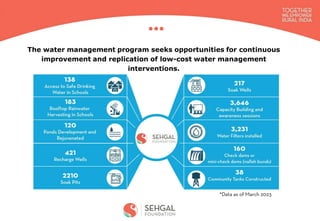
The water management program seeks opportunities for continuous
improvement and replication of low-cost water management
interventions.
• India sustains apx. 18% of world’s population with just 4% of world’s fresh water
resources.
• The average annual per capita availability in 1950 was more than 5000 cubic metres per
person which has declined to 1,545 cubic metres in 2011 and may further reduce to 1,367
cubic metres in 2031. This per capita water availability is also not same throughout India.
• It makes India severely water-stressed, making it a national priority.
• The annual groundwater extraction in India for all uses is 245 BCM, out of which 217 BCM
(89%) is for irrigation use and 27 BCM (11 %) is for domestic uses.
• The crisis has worsened further due to climate change, which causes erratic and intense
rainfall, coupled with a lack of infrastructure for safe disposal of wastewater in villages,
leading to contamination of water resources, and giving rise to health and hygiene
concerns.
WHY DO WE NEED WATER MANAGEMENT?
• Focuses on replenishing depleted underground
aquifers and augmenting groundwater primarily with
rainwater harvesting structures such as check dams,
ponds, tanks, recharge wells etc.
• Improves the availability and quality of groundwater
by recharging aquifers and provides water security to
rural households and irrigating the crops.
• It also improves the soil moisture (green water) that’s
helps in reviving area’s ecology and environment.
• Works with communities to revive traditional water
bodies, and construct cost-effective water
conservation and recharging structures to harvest
surplus monsoon runoff.
WATER RESOURCE AUGMENTATION
• Desilting and rejuvenation of traditional tanks in Kolar
brought a sea change in availability of surface and
groundwater in intervention villages which has
translated in improved crop yields.
• Villagers Revive Kere habba, a lake festival,
after 40 years in Kempasandra village of Kolar
• Farmers used tank silt in their field have reported that
their yield of tomatoes, beans, ragi etc has almost
doubled due to highly nutrient rich tank silt, good soil
moisture retention and timely availability of adequate
water for irrigation from their borewells following
continuous recharging.
• Some of their wells started overflowing due to large
scale recharging from tanks.
WATER RESOURCE AUGMENTATION
• Similarly check dam constructed in Anantapur,
Andhra Pradesh brough water back in their dried well
as groundwater levels rose considerably in six
villages after construction of 5 check dams.
• Farmers typically growing a single rainfed crop of
groundnut only (which was highly loss making) but
these farmers have now shifted to profit making
crops such as maize, paddy, vegetables, oil seeds
etc and taking two crops a year due to improved
water availability.
WATER RESOURCE AUGMENTATION
• Promotes installation of rooftop rainwater harvesting
systems in public buildings that store rainwater in over-
ground or underground tanks.
• The water is recharged in the saline aquifer to create a
local source of fresh water inside it.
• It is passed through an appropriate filtering process
prior to human consumption, eliminating the risk of
biological and other contaminants from the rainwater.
• Excess water is recharged back into the ground.
• It has ensured access to safe water for drinking,
sanitation and cooking mid day meal in schools.
• It has also improved retention rate of students due to
lack of drinking water specially adolescent girls who use
to escape school due to shortage of water for personal
hygiene.
ROOFTOP RAINWATER HARVESTING
• Advocates the adoption of sustainable
technologies to improve access to safe drinking
water at end user for rural communities,
preventing the spread of waterborne diseases.
• JalKalp biosand water filters and MatiKalp water
filters are two such promoted innovations.
• JalKalp is effective against pathogens such as E.
coli, total coliforms, parasites, microbes, and
worms, as well as eliminating turbidity, iron,
manganese, and arsenic contamination.
• MatiKalp takes care of pathogens, iron, and
manganese present in water.
SAFE DRINKING WATER
Advocates for
integrated
WASH behavior
change within
communities.
Promotes
affordable and
local solutions for
the safe disposal
of wastewater, at
the household and
community levels.
Provides WASH
training and hand-
holding support for
the capacity
building of
practitioners.
WASH
• Promotes a variety of soil and water conservation
measures to maintain and improve soil fertility and
productivity.
• With support from the communities, structures are
built for soil and water conservation to improve soil
moisture retention.
• Promotes large-scale plantations on water
catchments to improve the quality of runoff, and
the slow release of water which increases
percolation into the soil.
• It helps in increasing availability of grass and
fodder for milch animals and over all improvement
of vegetation in the areas.
SOIL CONSERVATION
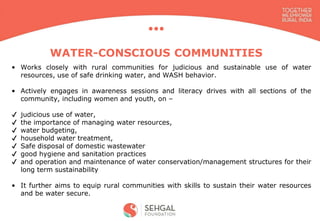
• Works closely with rural communities for judicious and sustainable use of water
resources, use of safe drinking water, and WASH behavior.
• Actively engages in awareness sessions and literacy drives with all sections of the
community, including women and youth, on –
✔ judicious use of water,
✔ the importance of managing water resources,
✔ water budgeting,
✔ household water treatment,
✔ Safe disposal of domestic wastewater
✔ good hygiene and sanitation practices
✔ and operation and maintenance of water conservation/management structures for their
long term sustainability
• It further aims to equip rural communities with skills to sustain their water resources
and be water secure.
WATER-CONSCIOUS COMMUNITIES
Bihar’s Sitamarhi district faced challenges in wastewater disposal due to
inadequate drainage, resulting in water accumulation and related diseases. Here’s
what the top rural development NGO in India did -
• The S M Sehgal Foundation addressed this as a part of the Adarsh Panchayat
Bhandari project.
• Constructed soak pits using locally available materials and minimal assistance
for reducing the risk of contamination of water resources and water borne
diseases.
INNOVATION AND COST-EFFECTIVE
SOLUTIONS: AN ABSOLUTE NEED
• The soak pit allows only water into the pit, regulating water flow, and ensuring smooth
drainage.
• It filters solid waste and replenishes the groundwater table with clean water.
• These cost-effective pits require minimal maintenance and contribute to sustainable
wastewater management.
Groundwater is vital for rural and urban domestic needs,
however, a potent environmental pollutant, arsenic (As) poses
a silent yet significant threat. Learn what the top sustainable
rural development NGO in India did to tackle this issue -
• The S M Sehgal Foundation introduced JalKalp, an
innovative biosand filter technology to address
manganese, iron, and microbial contamination.
ARSENIC REMOVAL IN GROUNDWATER
• This had a positive community impact, leading to health improvements and economic
benefits.
• Those who considered contaminated water as harmless have adapted to safe drinking
water.
• The foundation educated children in households to disseminate knowledge to create
awareness within families.
With a dearth of perennial surface water sources, a
staggering 78% of Nuh grapples with saline
groundwater. This dire shortage of clean water
amplifies sanitation and hygiene issues, particularly
affecting women. Addressing the pressing concern of
groundwater salinity, here’s what the top rural
development NGO in India did -
PRESENT ISSUES AND INSPIRATIONAL
STORIES FROM THE WATER DEFICIT
REGIONS OF HARYANA
• S M Sehgal Foundation partnered with the Millennium Alliance, an initiative
for the installation of high-pressure recharge wells.
• It has amplified rainwater harvesting models to create pockets of freshwater
within the saline aquifer.
• These ingenious recharge wells replenish rainwater beneath the groundwater
level, establishing a freshwater enclave amidst the saline expanse.
• These wells were seen in four schools in villages within the Nuh district.
• To ensure success and sustainability, the team worked closely with local villagers
and generated awareness about its proper utilization.
• Remarkably, students and residents attested to the purity and quality of the
water, equating it to the taste of commercially available packaged mineral water.
WHY DO WE NEED WATER MANAGEMENT

WHY DO WE NEED WATER MANAGEMENT

  • 1.
  • 2.
    The Water Managementprogram works with communities to revive traditional water bodies, construct water harvesting and conservation infrastructure, and safe disposal of wastewater, and promote safe drinking water with innovative low-cost, sustainable technologies and WASH behavior. It also empowers local communities to take care of operation and maintenance for long term sustainability of structures created. WATER MANAGEMENT Watch Complete Video Here
  • 3.
    The water managementprogram seeks opportunities for continuous improvement and replication of low-cost water management interventions.
  • 4.
    • India sustainsapx. 18% of world’s population with just 4% of world’s fresh water resources. • The average annual per capita availability in 1950 was more than 5000 cubic metres per person which has declined to 1,545 cubic metres in 2011 and may further reduce to 1,367 cubic metres in 2031. This per capita water availability is also not same throughout India. • It makes India severely water-stressed, making it a national priority. • The annual groundwater extraction in India for all uses is 245 BCM, out of which 217 BCM (89%) is for irrigation use and 27 BCM (11 %) is for domestic uses. • The crisis has worsened further due to climate change, which causes erratic and intense rainfall, coupled with a lack of infrastructure for safe disposal of wastewater in villages, leading to contamination of water resources, and giving rise to health and hygiene concerns. WHY DO WE NEED WATER MANAGEMENT?
  • 5.
    • Focuses onreplenishing depleted underground aquifers and augmenting groundwater primarily with rainwater harvesting structures such as check dams, ponds, tanks, recharge wells etc. • Improves the availability and quality of groundwater by recharging aquifers and provides water security to rural households and irrigating the crops. • It also improves the soil moisture (green water) that’s helps in reviving area’s ecology and environment. • Works with communities to revive traditional water bodies, and construct cost-effective water conservation and recharging structures to harvest surplus monsoon runoff. WATER RESOURCE AUGMENTATION
  • 6.
    • Desilting andrejuvenation of traditional tanks in Kolar brought a sea change in availability of surface and groundwater in intervention villages which has translated in improved crop yields. • Villagers Revive Kere habba, a lake festival, after 40 years in Kempasandra village of Kolar • Farmers used tank silt in their field have reported that their yield of tomatoes, beans, ragi etc has almost doubled due to highly nutrient rich tank silt, good soil moisture retention and timely availability of adequate water for irrigation from their borewells following continuous recharging. • Some of their wells started overflowing due to large scale recharging from tanks. WATER RESOURCE AUGMENTATION
  • 7.
    • Similarly checkdam constructed in Anantapur, Andhra Pradesh brough water back in their dried well as groundwater levels rose considerably in six villages after construction of 5 check dams. • Farmers typically growing a single rainfed crop of groundnut only (which was highly loss making) but these farmers have now shifted to profit making crops such as maize, paddy, vegetables, oil seeds etc and taking two crops a year due to improved water availability. WATER RESOURCE AUGMENTATION
  • 8.
    • Promotes installationof rooftop rainwater harvesting systems in public buildings that store rainwater in over- ground or underground tanks. • The water is recharged in the saline aquifer to create a local source of fresh water inside it. • It is passed through an appropriate filtering process prior to human consumption, eliminating the risk of biological and other contaminants from the rainwater. • Excess water is recharged back into the ground. • It has ensured access to safe water for drinking, sanitation and cooking mid day meal in schools. • It has also improved retention rate of students due to lack of drinking water specially adolescent girls who use to escape school due to shortage of water for personal hygiene. ROOFTOP RAINWATER HARVESTING
  • 9.
    • Advocates theadoption of sustainable technologies to improve access to safe drinking water at end user for rural communities, preventing the spread of waterborne diseases. • JalKalp biosand water filters and MatiKalp water filters are two such promoted innovations. • JalKalp is effective against pathogens such as E. coli, total coliforms, parasites, microbes, and worms, as well as eliminating turbidity, iron, manganese, and arsenic contamination. • MatiKalp takes care of pathogens, iron, and manganese present in water. SAFE DRINKING WATER
  • 10.
    Advocates for integrated WASH behavior changewithin communities. Promotes affordable and local solutions for the safe disposal of wastewater, at the household and community levels. Provides WASH training and hand- holding support for the capacity building of practitioners. WASH
  • 11.
    • Promotes avariety of soil and water conservation measures to maintain and improve soil fertility and productivity. • With support from the communities, structures are built for soil and water conservation to improve soil moisture retention. • Promotes large-scale plantations on water catchments to improve the quality of runoff, and the slow release of water which increases percolation into the soil. • It helps in increasing availability of grass and fodder for milch animals and over all improvement of vegetation in the areas. SOIL CONSERVATION
  • 12.
    • Works closelywith rural communities for judicious and sustainable use of water resources, use of safe drinking water, and WASH behavior. • Actively engages in awareness sessions and literacy drives with all sections of the community, including women and youth, on – ✔ judicious use of water, ✔ the importance of managing water resources, ✔ water budgeting, ✔ household water treatment, ✔ Safe disposal of domestic wastewater ✔ good hygiene and sanitation practices ✔ and operation and maintenance of water conservation/management structures for their long term sustainability • It further aims to equip rural communities with skills to sustain their water resources and be water secure. WATER-CONSCIOUS COMMUNITIES
  • 13.
    Bihar’s Sitamarhi districtfaced challenges in wastewater disposal due to inadequate drainage, resulting in water accumulation and related diseases. Here’s what the top rural development NGO in India did - • The S M Sehgal Foundation addressed this as a part of the Adarsh Panchayat Bhandari project. • Constructed soak pits using locally available materials and minimal assistance for reducing the risk of contamination of water resources and water borne diseases. INNOVATION AND COST-EFFECTIVE SOLUTIONS: AN ABSOLUTE NEED
  • 14.
    • The soakpit allows only water into the pit, regulating water flow, and ensuring smooth drainage. • It filters solid waste and replenishes the groundwater table with clean water. • These cost-effective pits require minimal maintenance and contribute to sustainable wastewater management.
  • 16.
    Groundwater is vitalfor rural and urban domestic needs, however, a potent environmental pollutant, arsenic (As) poses a silent yet significant threat. Learn what the top sustainable rural development NGO in India did to tackle this issue - • The S M Sehgal Foundation introduced JalKalp, an innovative biosand filter technology to address manganese, iron, and microbial contamination. ARSENIC REMOVAL IN GROUNDWATER • This had a positive community impact, leading to health improvements and economic benefits. • Those who considered contaminated water as harmless have adapted to safe drinking water. • The foundation educated children in households to disseminate knowledge to create awareness within families.
  • 17.
    With a dearthof perennial surface water sources, a staggering 78% of Nuh grapples with saline groundwater. This dire shortage of clean water amplifies sanitation and hygiene issues, particularly affecting women. Addressing the pressing concern of groundwater salinity, here’s what the top rural development NGO in India did - PRESENT ISSUES AND INSPIRATIONAL STORIES FROM THE WATER DEFICIT REGIONS OF HARYANA • S M Sehgal Foundation partnered with the Millennium Alliance, an initiative for the installation of high-pressure recharge wells.
  • 18.
    • It hasamplified rainwater harvesting models to create pockets of freshwater within the saline aquifer. • These ingenious recharge wells replenish rainwater beneath the groundwater level, establishing a freshwater enclave amidst the saline expanse. • These wells were seen in four schools in villages within the Nuh district. • To ensure success and sustainability, the team worked closely with local villagers and generated awareness about its proper utilization. • Remarkably, students and residents attested to the purity and quality of the water, equating it to the taste of commercially available packaged mineral water.