Why businesses fail and some of the warning signs of insolvency Paul Nogueira – Partner Worrells Solvency & Forensic Accountants
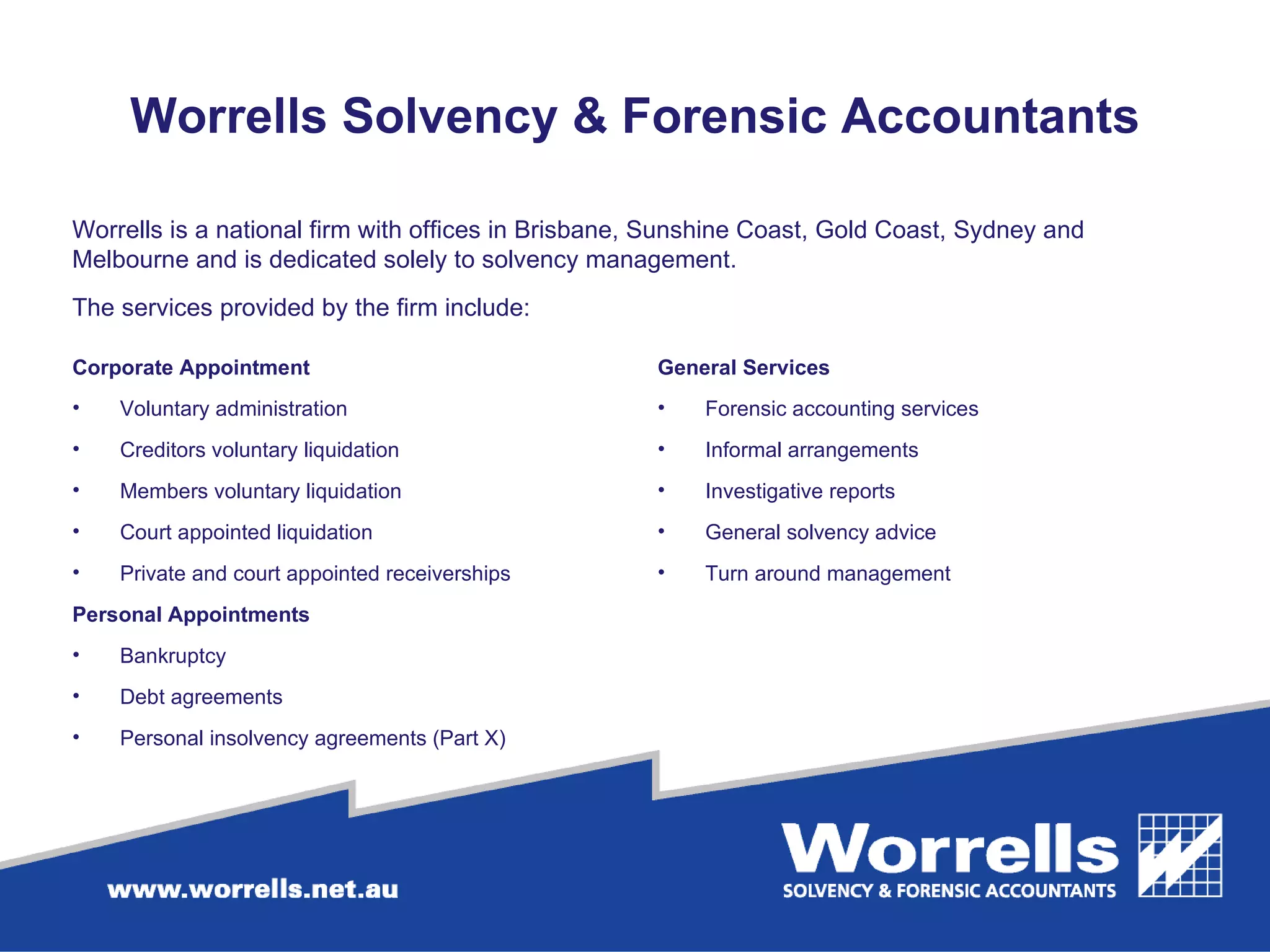
Worrells Solvency & Forensic Accountants Wor rells is a national firm with offices in Brisbane, Sunshine Coast, Gold Coast, Sydney and Melbourne and is dedicated solely to solvency management.  The services provided by the firm include: Corporate Appointment Voluntary administration Creditors voluntary liquidation Members voluntary liquidation Court appointed liquidation Private and court appointed receiverships Personal Appointments Bankruptcy Debt agreements Personal insolvency agreements (Part X) General Services Forensic accounting services Informal arrangements Investigative reports General solvency advice Turn around management
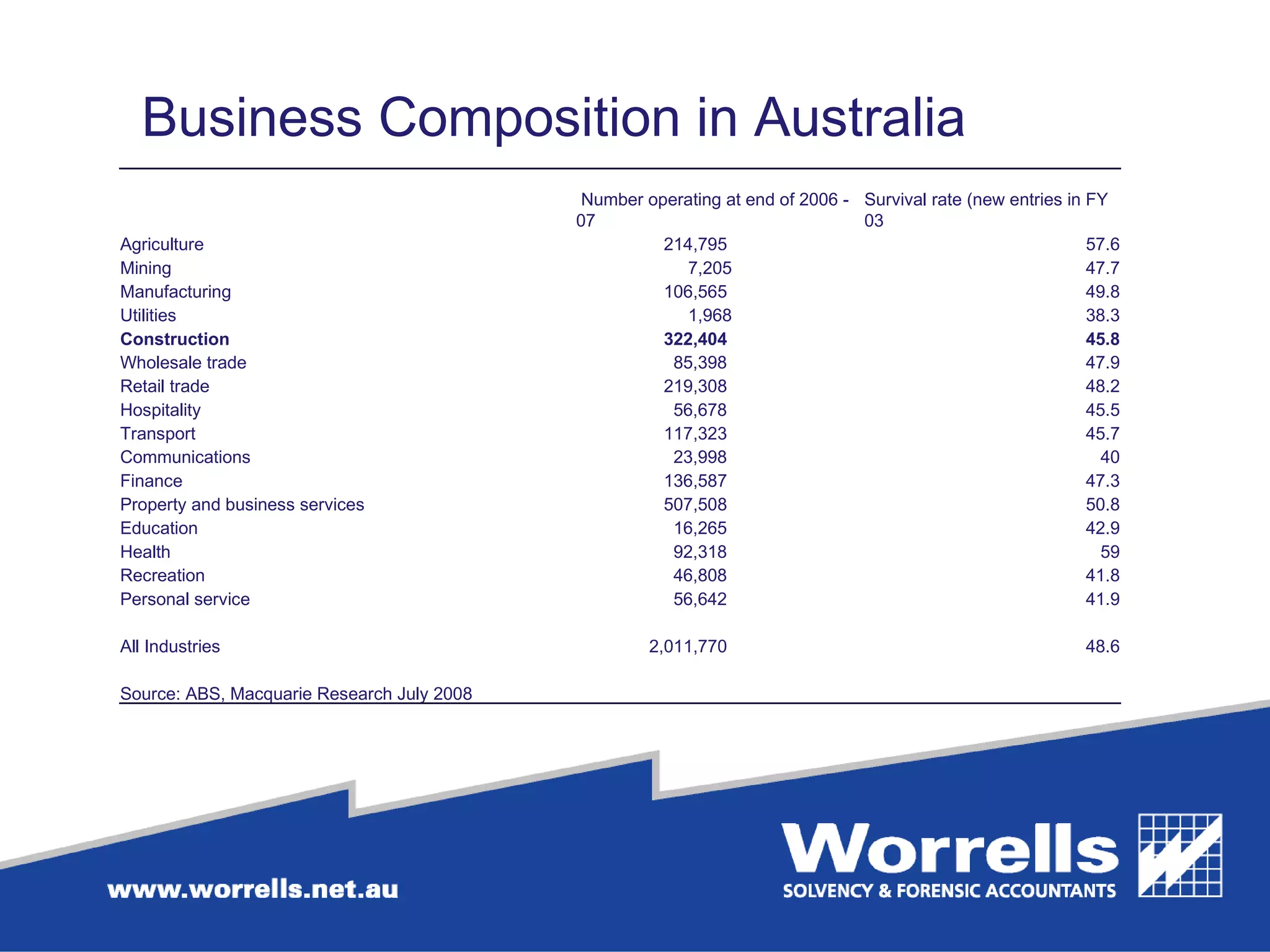
Business Composition in Australia Number operating at end of 2006 - 07  Survival rate (new entries in FY 03 Agriculture 214,795 57.6 Mining 7,205 47.7 Manufacturing 106,565 49.8 Utilities 1,968 38.3 Construction 322,404 45.8 Wholesale trade  85,398 47.9 Retail trade 219,308 48.2 Hospitality 56,678 45.5 Transport 117,323 45.7 Communications 23,998 40 Finance 136,587 47.3 Property and business services 507,508 50.8 Education 16,265 42.9 Health 92,318 59 Recreation 46,808 41.8 Personal service 56,642 41.9 All Industries 2,011,770 48.6 Source: ABS, Macquarie Research July 2008
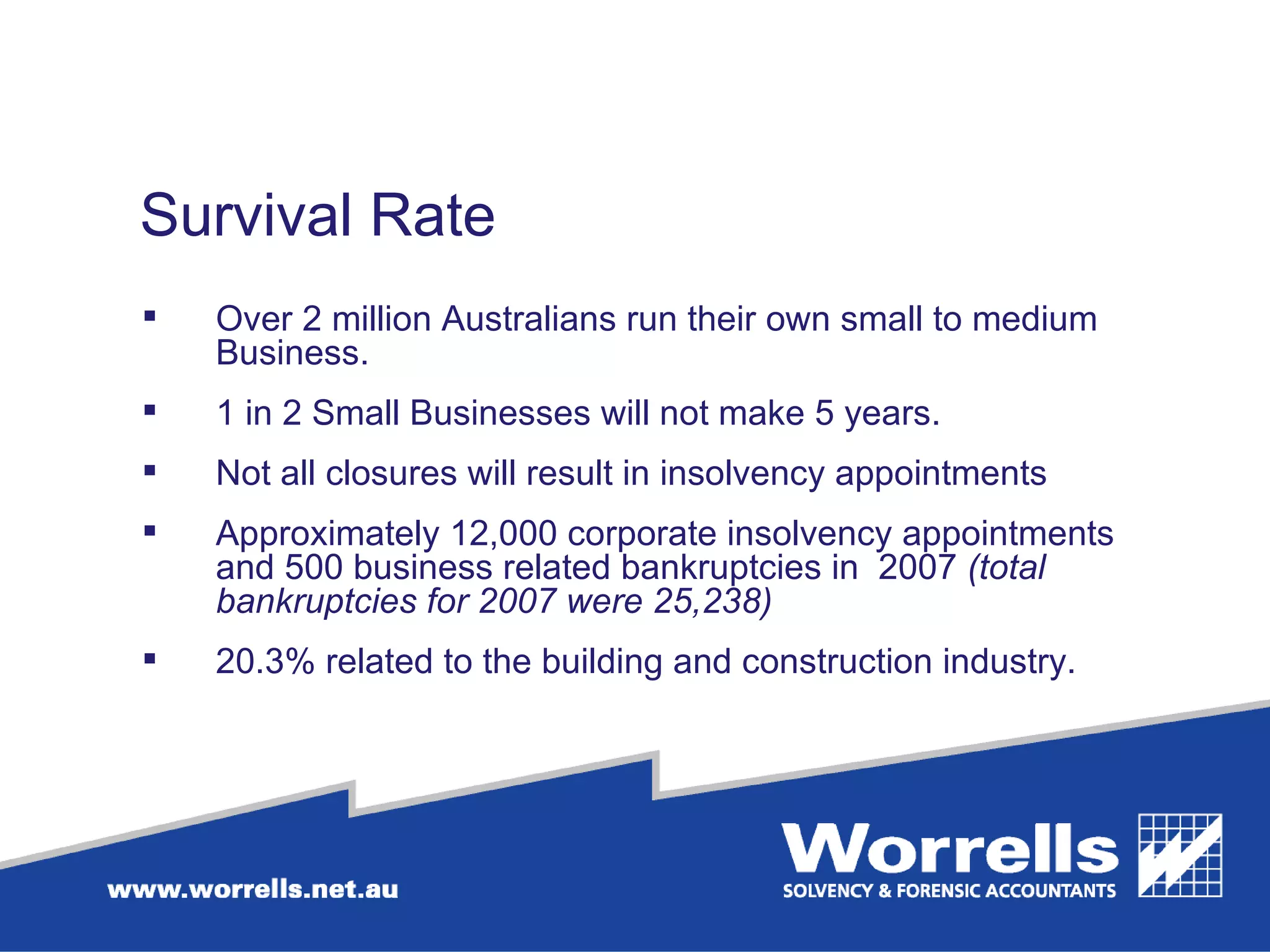
Survival Rate Over 2 million Australians run their own small to medium Business. 1 in 2 Small Businesses will not make 5 years. Not all closures will result in insolvency appointments Approximately 12,000 corporate insolvency appointments and 500 business related bankruptcies in  2007  (total bankruptcies for 2007 were 25,238) 20.3% related to the building and construction industry.
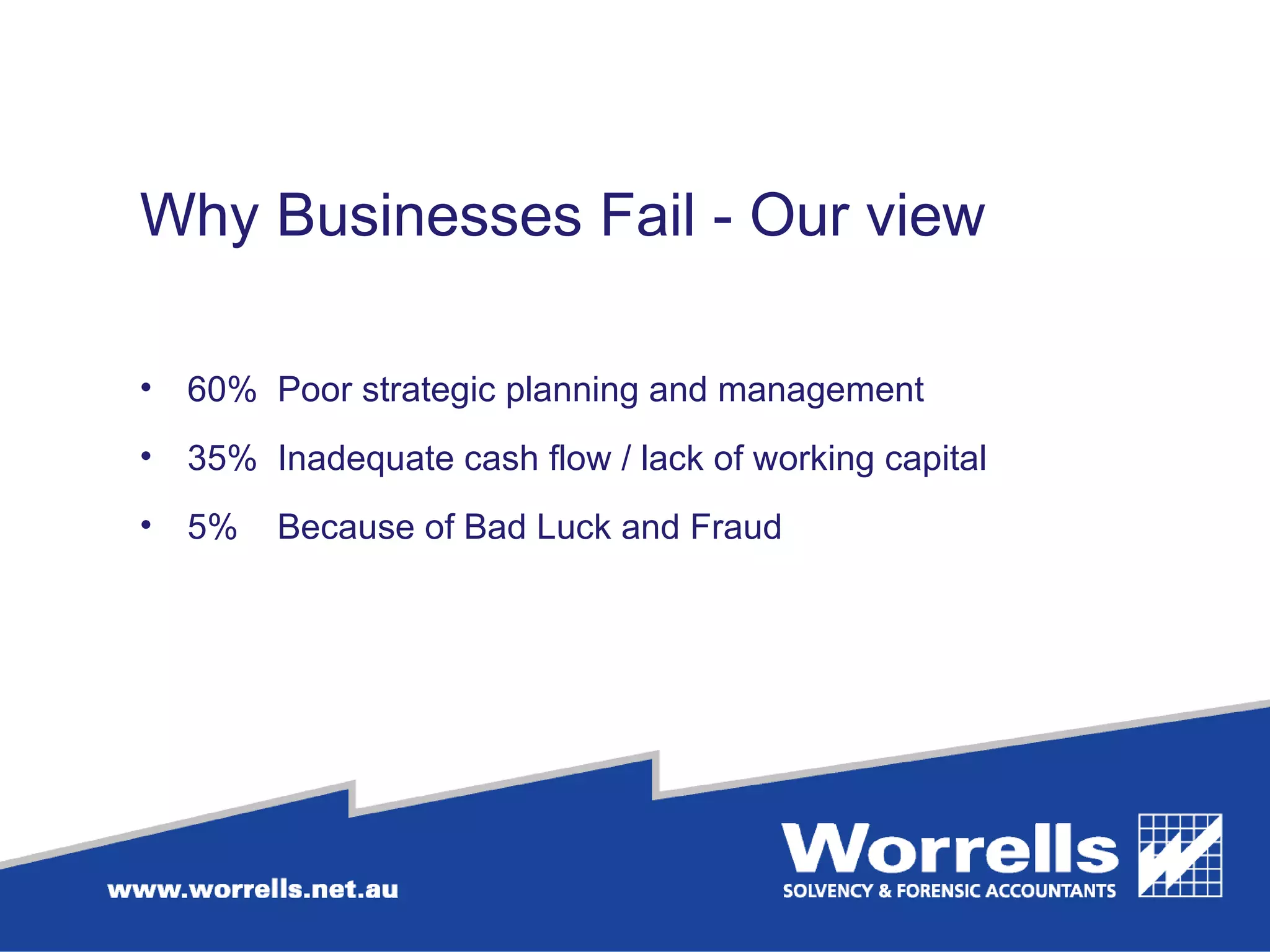
Why Businesses Fail - Our view  60%  Poor strategic planning and management 35%  Inadequate cash flow / lack of working capital 5%  Because of Bad Luck and Fraud
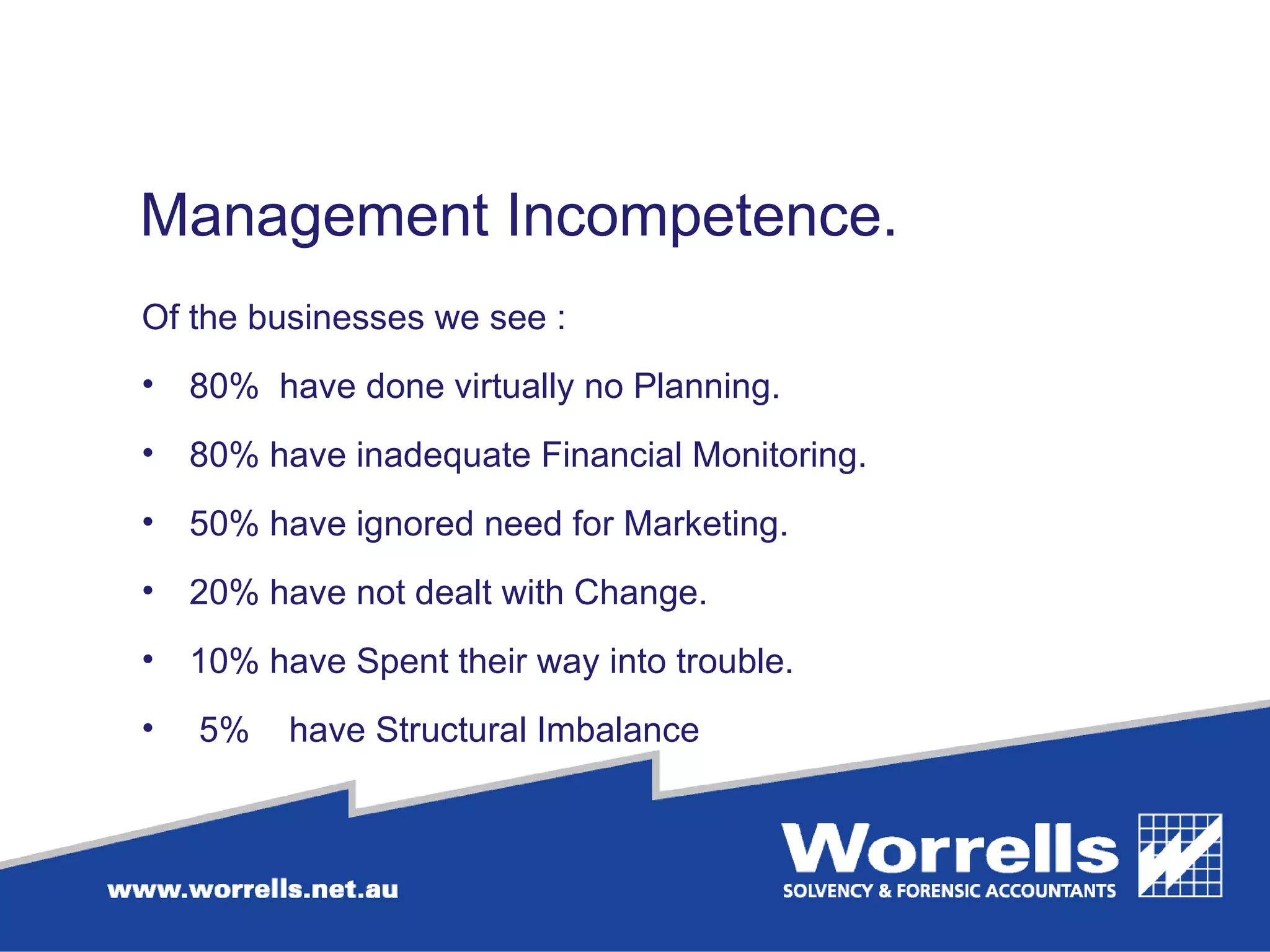
Management Incompetence.  Of the businesses we see : 80%  have done virtually no Planning. 80% have inadequate Financial Monitoring.  50% have ignored need for Marketing. 20% have not dealt with Change. 10% have Spent their way into trouble.  5%  have Structural Imbalance
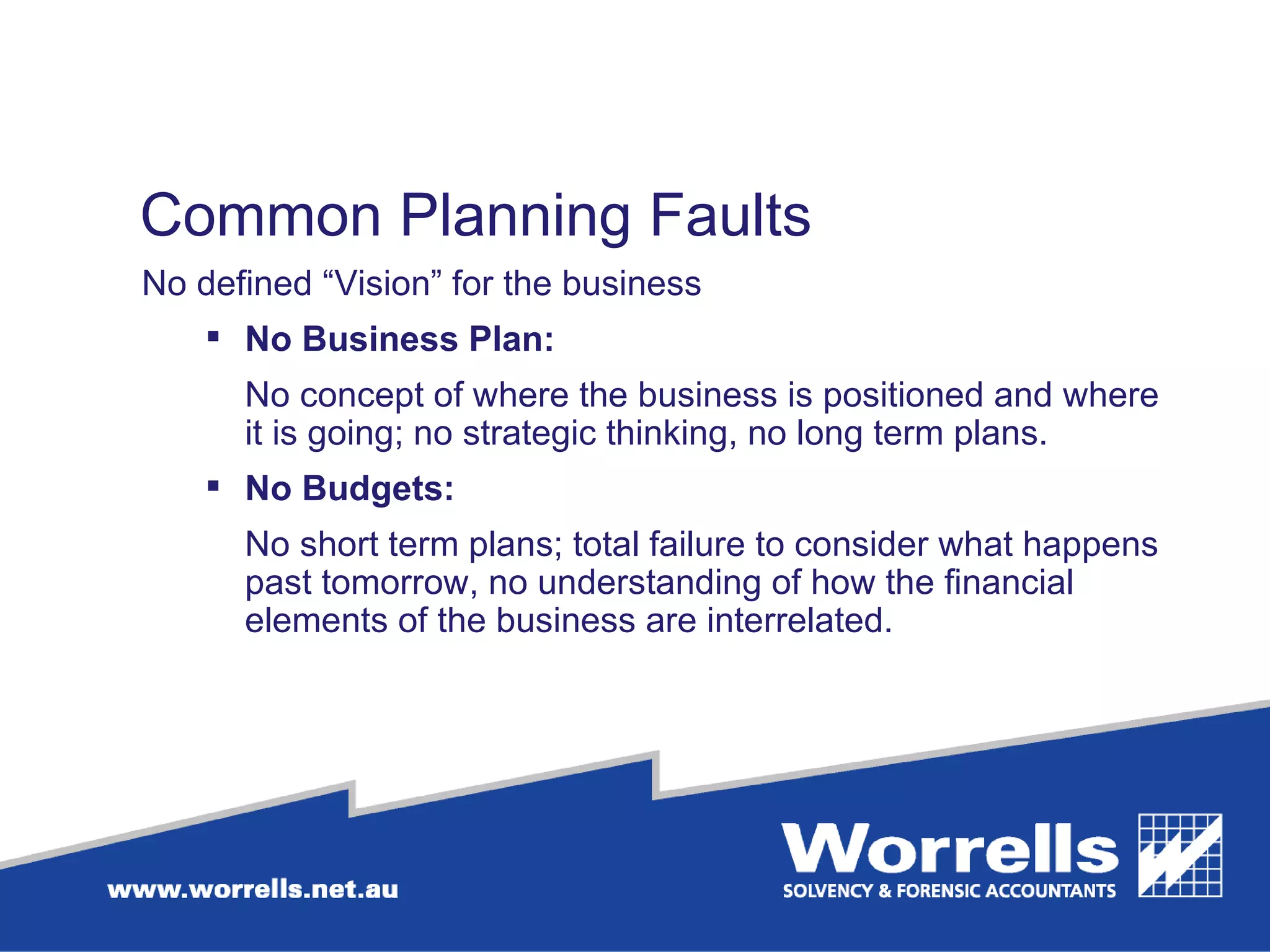
Common Planning Faults  No defined “Vision” for the business  No Business Plan:  No concept of where the business is positioned and where it is going; no strategic thinking, no long term plans. No Budgets: No short term plans; total failure to consider what happens past tomorrow, no understanding of how the financial elements of the business are interrelated.
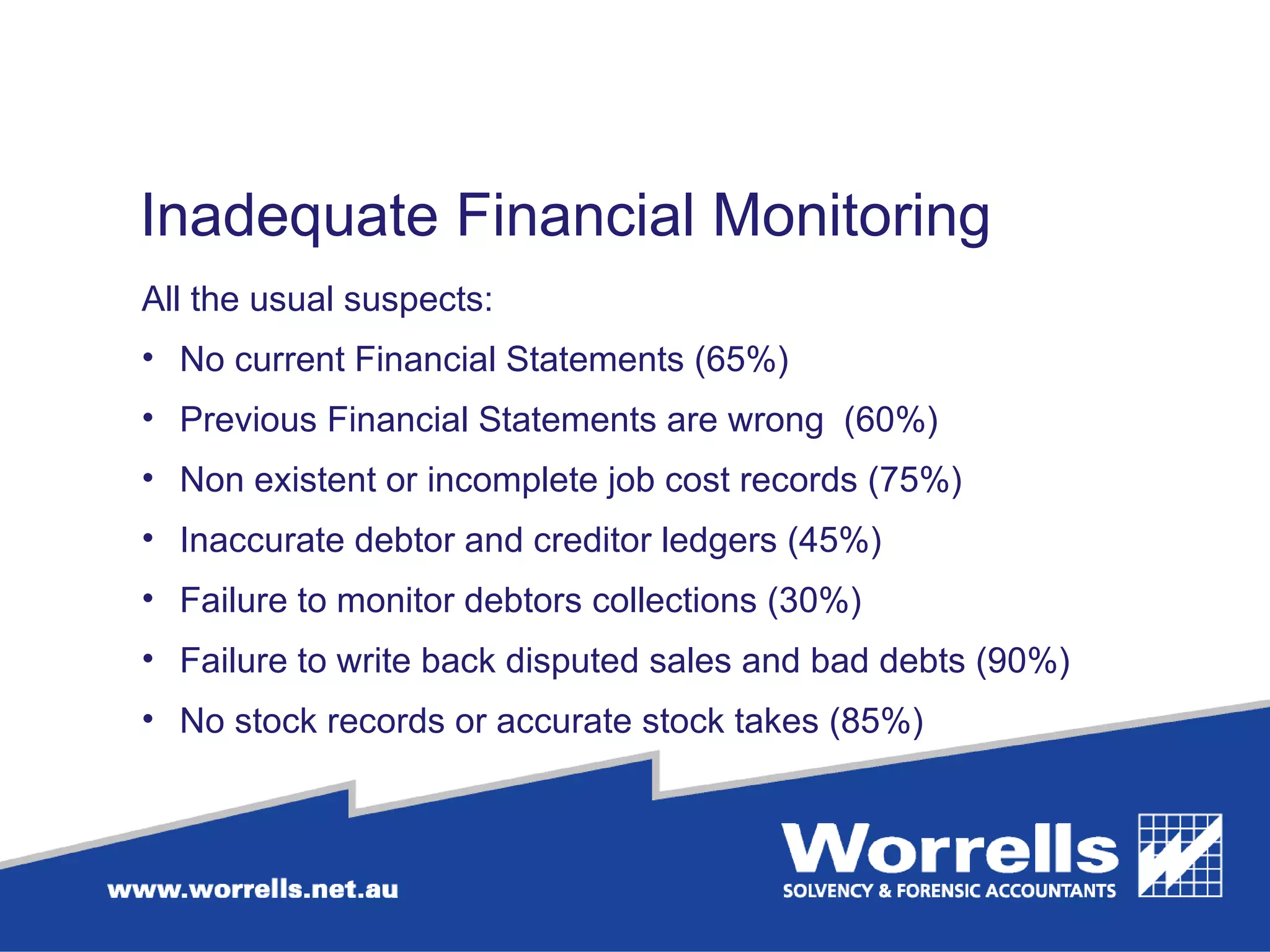
Inadequate Financial Monitoring  All the usual suspects: No current Financial Statements (65%) Previous Financial Statements are wrong  (60%) Non existent or incomplete job cost records (75%) Inaccurate debtor and creditor ledgers (45%) Failure to monitor debtors collections (30%) Failure to write back disputed sales and bad debts (90%)  No stock records or accurate stock takes (85%)
Failing to Face up to and Deal with Change can be fatal ! Failure to recognize that:  Product or Service is outdated  Plant is obsolete and  uneconomical  Business is in the wrong spot Young blood is needed in all aspects of the business Businesses that rely primarily on one strong man will die with that man.
Marketing and  Promotion This function is one which many professional and technical people are uncomfortable with and so pay it inadequate attention. Typically they: Don’t know the Market or what motivates it. Are a  Follower with no New Ideas. Fail to identify what makes their business different. Don’t let Potential Clients know about their Products or what they can do for them Don’t Develop a Marketing Plan
Spending Induced Insolvency.  It is a strange paradox that even profitable businesses fail. Here’s some reasons why: Excessive funds withdrawn to pay for lifestyle. Overtrading (too big too fast). Lack of cash budgeting, so no provision for seasonal trading changes or large periodic outflows.
Other Management Faults  Weak Personal Skills: Don’t  Put Plans into Action; Can’t say No or Procrastinate over  hard decisions. Not Qualified yet Opinionated :Don’t know what is needed but refuse to consult experts (Accountants, Solicitors, Designers, Professional Sales Staff etc)  Bad Staff Policies: Promote or hire incompetent staff (often unqualified family or friends) while allowing those who could make a difference to leave
Strategic Imbalances  Reliance on one customer  Must be able to expand and contract with customers requirements Operating in New Industry  Must “stick to what you know” Lack of due diligence on acquisition Avoid being sold a lemon
Some External Warning Signs Extending time for payment of creditors Dishonored cheques Paying creditors round amounts Loss of Senior Staff Low Stock Levels or holding of Old Stock Uncontactability of Management Reduction in Marketing High levels of staff stress Slow production of sales or delays in contracts
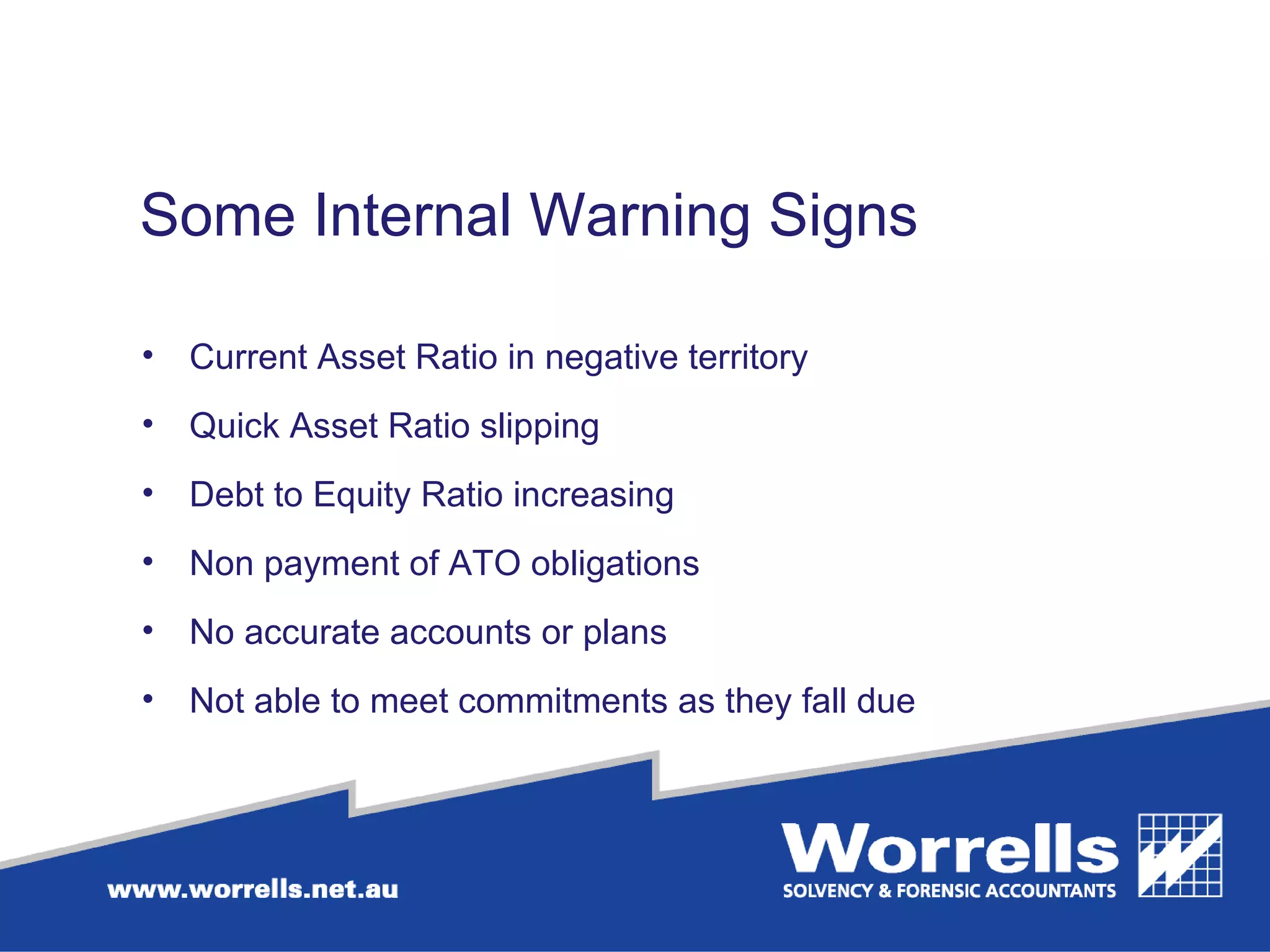
Some Internal Warning Signs Current Asset Ratio in negative territory Quick Asset Ratio slipping Debt to Equity Ratio increasing Non payment of ATO obligations No accurate accounts or plans  Not able to meet commitments as they fall due
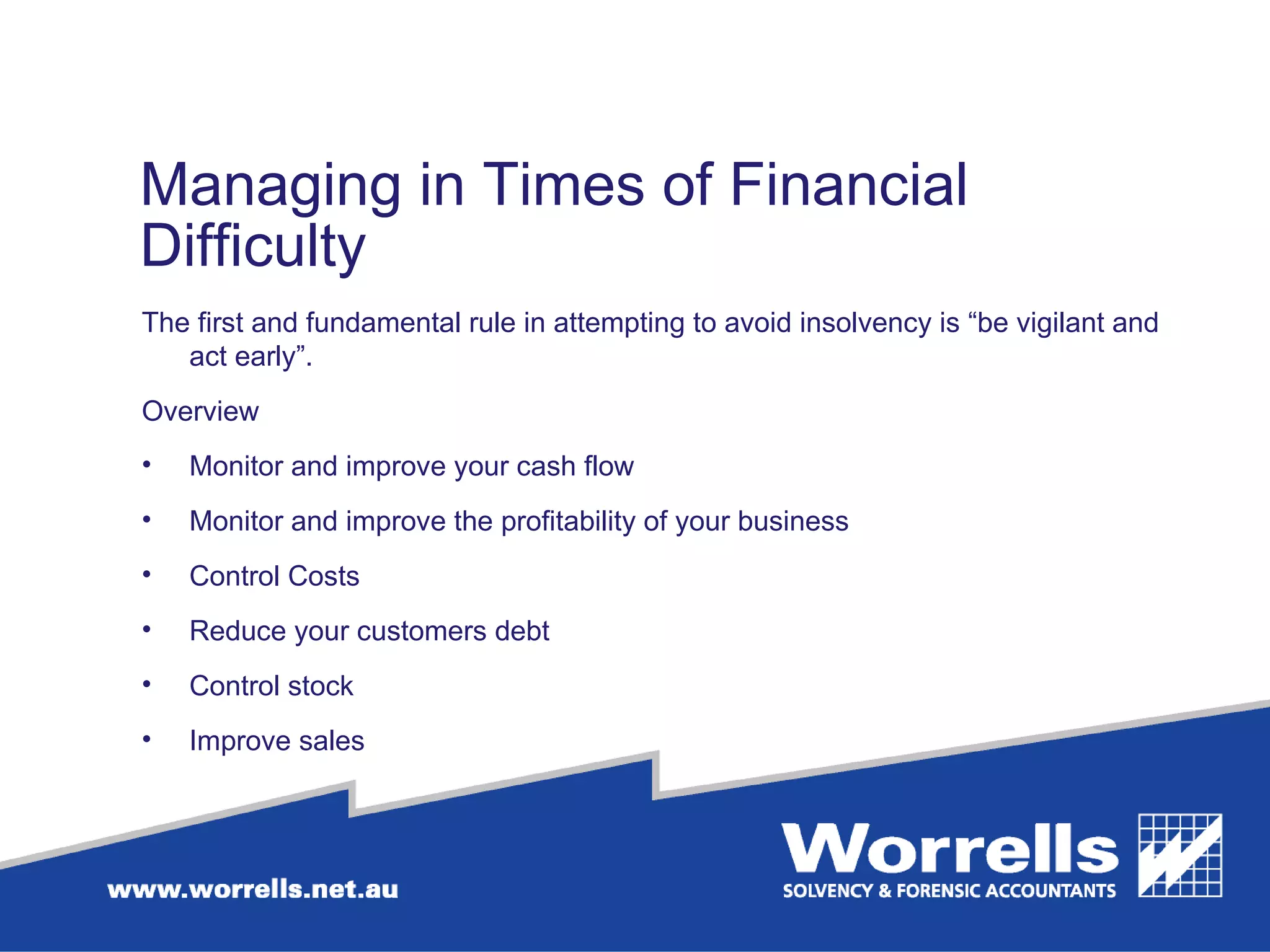
Managing in Times of Financial Difficulty The first and fundamental rule in attempting to avoid insolvency is “be vigilant and act early”.  Overview Monitor and improve your cash flow Monitor and improve the profitability of your business Control Costs Reduce your customers debt Control stock Improve sales
Worrells Solvency & Forensic Accountants www.worrells.net.au

Why Businesses Fail And Some Of The Warning Signs Of Insolvency

  • 1.
    Why businesses failand some of the warning signs of insolvency Paul Nogueira – Partner Worrells Solvency & Forensic Accountants
  • 2.
    Worrells Solvency &Forensic Accountants Wor rells is a national firm with offices in Brisbane, Sunshine Coast, Gold Coast, Sydney and Melbourne and is dedicated solely to solvency management. The services provided by the firm include: Corporate Appointment Voluntary administration Creditors voluntary liquidation Members voluntary liquidation Court appointed liquidation Private and court appointed receiverships Personal Appointments Bankruptcy Debt agreements Personal insolvency agreements (Part X) General Services Forensic accounting services Informal arrangements Investigative reports General solvency advice Turn around management
  • 3.
    Business Composition inAustralia Number operating at end of 2006 - 07 Survival rate (new entries in FY 03 Agriculture 214,795 57.6 Mining 7,205 47.7 Manufacturing 106,565 49.8 Utilities 1,968 38.3 Construction 322,404 45.8 Wholesale trade 85,398 47.9 Retail trade 219,308 48.2 Hospitality 56,678 45.5 Transport 117,323 45.7 Communications 23,998 40 Finance 136,587 47.3 Property and business services 507,508 50.8 Education 16,265 42.9 Health 92,318 59 Recreation 46,808 41.8 Personal service 56,642 41.9 All Industries 2,011,770 48.6 Source: ABS, Macquarie Research July 2008
  • 4.
    Survival Rate Over2 million Australians run their own small to medium Business. 1 in 2 Small Businesses will not make 5 years. Not all closures will result in insolvency appointments Approximately 12,000 corporate insolvency appointments and 500 business related bankruptcies in 2007 (total bankruptcies for 2007 were 25,238) 20.3% related to the building and construction industry.
  • 5.
    Why Businesses Fail- Our view 60% Poor strategic planning and management 35% Inadequate cash flow / lack of working capital 5% Because of Bad Luck and Fraud
  • 6.
    Management Incompetence. Of the businesses we see : 80% have done virtually no Planning. 80% have inadequate Financial Monitoring. 50% have ignored need for Marketing. 20% have not dealt with Change. 10% have Spent their way into trouble. 5% have Structural Imbalance
  • 7.
    Common Planning Faults No defined “Vision” for the business No Business Plan: No concept of where the business is positioned and where it is going; no strategic thinking, no long term plans. No Budgets: No short term plans; total failure to consider what happens past tomorrow, no understanding of how the financial elements of the business are interrelated.
  • 8.
    Inadequate Financial Monitoring All the usual suspects: No current Financial Statements (65%) Previous Financial Statements are wrong (60%) Non existent or incomplete job cost records (75%) Inaccurate debtor and creditor ledgers (45%) Failure to monitor debtors collections (30%) Failure to write back disputed sales and bad debts (90%) No stock records or accurate stock takes (85%)
  • 9.
    Failing to Faceup to and Deal with Change can be fatal ! Failure to recognize that: Product or Service is outdated Plant is obsolete and uneconomical Business is in the wrong spot Young blood is needed in all aspects of the business Businesses that rely primarily on one strong man will die with that man.
  • 10.
    Marketing and Promotion This function is one which many professional and technical people are uncomfortable with and so pay it inadequate attention. Typically they: Don’t know the Market or what motivates it. Are a Follower with no New Ideas. Fail to identify what makes their business different. Don’t let Potential Clients know about their Products or what they can do for them Don’t Develop a Marketing Plan
  • 11.
    Spending Induced Insolvency. It is a strange paradox that even profitable businesses fail. Here’s some reasons why: Excessive funds withdrawn to pay for lifestyle. Overtrading (too big too fast). Lack of cash budgeting, so no provision for seasonal trading changes or large periodic outflows.
  • 12.
    Other Management Faults Weak Personal Skills: Don’t Put Plans into Action; Can’t say No or Procrastinate over hard decisions. Not Qualified yet Opinionated :Don’t know what is needed but refuse to consult experts (Accountants, Solicitors, Designers, Professional Sales Staff etc) Bad Staff Policies: Promote or hire incompetent staff (often unqualified family or friends) while allowing those who could make a difference to leave
  • 13.
    Strategic Imbalances Reliance on one customer Must be able to expand and contract with customers requirements Operating in New Industry Must “stick to what you know” Lack of due diligence on acquisition Avoid being sold a lemon
  • 14.
    Some External WarningSigns Extending time for payment of creditors Dishonored cheques Paying creditors round amounts Loss of Senior Staff Low Stock Levels or holding of Old Stock Uncontactability of Management Reduction in Marketing High levels of staff stress Slow production of sales or delays in contracts
  • 15.
    Some Internal WarningSigns Current Asset Ratio in negative territory Quick Asset Ratio slipping Debt to Equity Ratio increasing Non payment of ATO obligations No accurate accounts or plans Not able to meet commitments as they fall due
  • 16.
    Managing in Timesof Financial Difficulty The first and fundamental rule in attempting to avoid insolvency is “be vigilant and act early”. Overview Monitor and improve your cash flow Monitor and improve the profitability of your business Control Costs Reduce your customers debt Control stock Improve sales
  • 17.
    Worrells Solvency &Forensic Accountants www.worrells.net.au