Who’s Your People
An Introduction to Genealogical Research
Getting Started
• Get organized
• Read about genealogy
• Connect with a genealogy group
• Decide on an approach
Do Your Homework
• Identify what you already know
• Start with yourself and work backwards
• Talk to your relatives
• Locate family documents and public
records
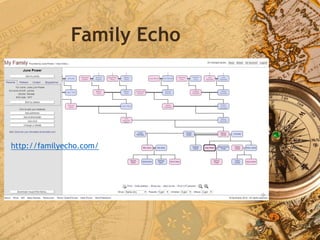
Family Echo
http://familyecho.com/
Useful Family Documents
for Genealogical Research
• Family Bibles
• Birth, baptism, marriage, and death
certificates
• School report cards and diplomas
• Old family letters
• Scrapbooks and photographs
• Diaries and Journals
Useful Public Records for
Genealogical Research
• Church registers
• Newspapers
• Municipal, state, and federal records –
census, naturalization papers, vital
statistics
• Local and state archives, historical
societies, and libraries
Useful Internet Sources for
Genealogical Research
• Genealogy.com – http://www.genealogy.com
• FamilySearch.org – http://familysearch.org
• Ancestry.com – http://www.ancestry.com
• HeritageQuest.com –
http://www.heritagequestonline.com
• USGenWeb.org and NCGenWeb.us -
http://www.usgenweb.org/ and
http://www.ncgenweb.us/
• East Carolina Roots – http://eastcarolinaroots.com/
American Indian Genealogy
Beginning Research
• Requires a cross-disciplinary approach
• Very few census records have notations about Native
Americans
• Church and local records often contain more
information
• Tribal histories and records are very important
• Family History Library in Salt Lake City contains many
American Indian records
• Thomas J. Blumer, "Practical Pointers in Tracing Your
Indian Ancestry in the Southeast," Journal of the Afro-
American Historical and Genealogical Society, 13
(Spring/Fall 1994): 67-82.
American Indian
Genealogy Record Types
• Correspondence
• Maps
• Removal Records
• Enrollment Records
• Oral Histories
• Treaties
• Tribal Office Records
• Bureau of Indian Affairs records – often
available through national and regional
archives (also Department of War,
Department of the Interior, Department of
State)
African-American
Genealogical Sources
• Freedmen’s Bureau Records -
http://www.ncgenweb.us/ncstate/afam/fre
edmen.htm
• Transportation Records
• Civil War military records
• Records of the Freedman's Savings and Trust
Company
• Slave ownership and manumission records
and wills
• Look for name changes after the Civil War
• Afrigeneas - http://www.afrigeneas.com/
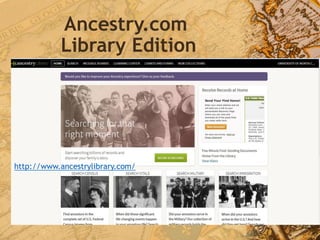
Ancestry.com
Library Edition
http://www.ancestrylibrary.com/
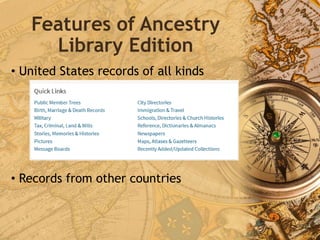
Features of Ancestry
Library Edition
• United States records of all kinds
• Records from other countries
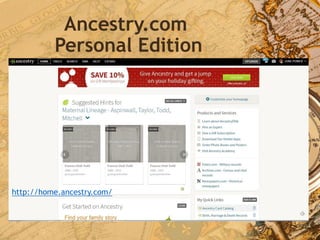
Ancestry.com
Personal Edition
http://home.ancestry.com/
Features of Ancestry
Personal Edition
• Family Trees
• Searching for Information
• DNA
• Hints
• Profile View
• Lifestory
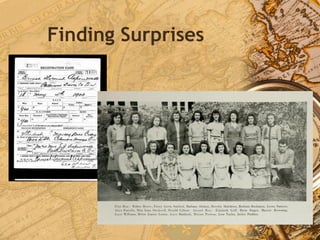
Finding Surprises
Other Tips and Tricks
• Women usually listed under maiden name
• Spelling variations
• When in doubt – start with the U.S. Census
• Less is often more
• Look at originals when possible – don’t rely
on transcriptions
• Not all databases are indexed (e.g.
FamilySearch’s North Carolina County
Records 1833-1970 Collection –
https://familysearch.org/search/collection/
1916185.)
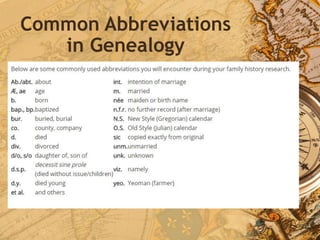
Common Abbreviations
in Genealogy
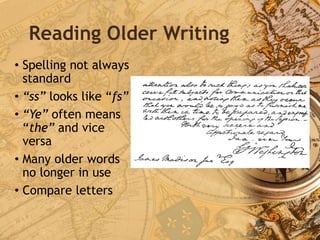
Reading Older Writing
• Spelling not always
standard
• “ss” looks like “fs”
• “Ye” often means
“the” and vice
versa
• Many older words
no longer in use
• Compare letters
Useful Books for
Genealogical Research
• Unpuzzling Your Past: The Best-Selling Basic Guide to Genealogy - Emily
Anne Croom
• The Genealogist’s Companian and Sourcebook – Emily Anne Croom
• The Researcher’s Guide to American Genealogy – Val D. Greenwood
• The Source: A Guidebook to American Genealogy – Sandra Hargreaves
Luebking and Loretto Dennis Szucs
• The Everything Guide to Online Geneaology: A Complete Resource for
Using the Web to Trace Your Family History – Kimberly Powell
• Geneology 101: How to Trace Your Family’s History and Heritage –
Barbara Renick
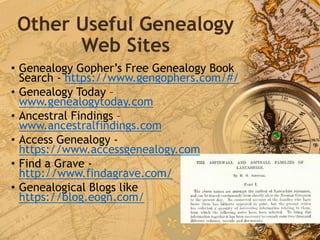
Other Useful Genealogy
Web Sites
• Genealogy Gopher’s Free Genealogy Book
Search - https://www.gengophers.com/#/
• Genealogy Today –
www.genealogytoday.com
• Ancestral Findings –
www.ancestralfindings.com
• Access Genealogy -
https://www.accessgenealogy.com
• Find a Grave -
http://www.findagrave.com/
• Genealogical Blogs like
https://blog.eogn.com/

Who's Your People

  • 1.
    Who’s Your People AnIntroduction to Genealogical Research
  • 2.
    Getting Started • Getorganized • Read about genealogy • Connect with a genealogy group • Decide on an approach
  • 3.
    Do Your Homework •Identify what you already know • Start with yourself and work backwards • Talk to your relatives • Locate family documents and public records
  • 4.
  • 5.
    Useful Family Documents forGenealogical Research • Family Bibles • Birth, baptism, marriage, and death certificates • School report cards and diplomas • Old family letters • Scrapbooks and photographs • Diaries and Journals
  • 6.
    Useful Public Recordsfor Genealogical Research • Church registers • Newspapers • Municipal, state, and federal records – census, naturalization papers, vital statistics • Local and state archives, historical societies, and libraries
  • 7.
    Useful Internet Sourcesfor Genealogical Research • Genealogy.com – http://www.genealogy.com • FamilySearch.org – http://familysearch.org • Ancestry.com – http://www.ancestry.com • HeritageQuest.com – http://www.heritagequestonline.com • USGenWeb.org and NCGenWeb.us - http://www.usgenweb.org/ and http://www.ncgenweb.us/ • East Carolina Roots – http://eastcarolinaroots.com/
  • 8.
    American Indian Genealogy BeginningResearch • Requires a cross-disciplinary approach • Very few census records have notations about Native Americans • Church and local records often contain more information • Tribal histories and records are very important • Family History Library in Salt Lake City contains many American Indian records • Thomas J. Blumer, "Practical Pointers in Tracing Your Indian Ancestry in the Southeast," Journal of the Afro- American Historical and Genealogical Society, 13 (Spring/Fall 1994): 67-82.
  • 9.
    American Indian Genealogy RecordTypes • Correspondence • Maps • Removal Records • Enrollment Records • Oral Histories • Treaties • Tribal Office Records • Bureau of Indian Affairs records – often available through national and regional archives (also Department of War, Department of the Interior, Department of State)
  • 10.
    African-American Genealogical Sources • Freedmen’sBureau Records - http://www.ncgenweb.us/ncstate/afam/fre edmen.htm • Transportation Records • Civil War military records • Records of the Freedman's Savings and Trust Company • Slave ownership and manumission records and wills • Look for name changes after the Civil War • Afrigeneas - http://www.afrigeneas.com/
  • 11.
  • 12.
    Features of Ancestry LibraryEdition • United States records of all kinds • Records from other countries
  • 13.
  • 14.
    Features of Ancestry PersonalEdition • Family Trees • Searching for Information • DNA • Hints • Profile View • Lifestory
  • 15.
  • 16.
    Other Tips andTricks • Women usually listed under maiden name • Spelling variations • When in doubt – start with the U.S. Census • Less is often more • Look at originals when possible – don’t rely on transcriptions • Not all databases are indexed (e.g. FamilySearch’s North Carolina County Records 1833-1970 Collection – https://familysearch.org/search/collection/ 1916185.)
  • 17.
  • 18.
    Reading Older Writing •Spelling not always standard • “ss” looks like “fs” • “Ye” often means “the” and vice versa • Many older words no longer in use • Compare letters
  • 19.
    Useful Books for GenealogicalResearch • Unpuzzling Your Past: The Best-Selling Basic Guide to Genealogy - Emily Anne Croom • The Genealogist’s Companian and Sourcebook – Emily Anne Croom • The Researcher’s Guide to American Genealogy – Val D. Greenwood • The Source: A Guidebook to American Genealogy – Sandra Hargreaves Luebking and Loretto Dennis Szucs • The Everything Guide to Online Geneaology: A Complete Resource for Using the Web to Trace Your Family History – Kimberly Powell • Geneology 101: How to Trace Your Family’s History and Heritage – Barbara Renick
  • 20.
    Other Useful Genealogy WebSites • Genealogy Gopher’s Free Genealogy Book Search - https://www.gengophers.com/#/ • Genealogy Today – www.genealogytoday.com • Ancestral Findings – www.ancestralfindings.com • Access Genealogy - https://www.accessgenealogy.com • Find a Grave - http://www.findagrave.com/ • Genealogical Blogs like https://blog.eogn.com/