Technology Development and Transfer
Dr Sunil Kanvinde
10 August 2023
privileged and confidential - Dr Sunil Kanvinde
Technology Development and Transfer
privileged and confidential - Dr Sunil Kanvinde
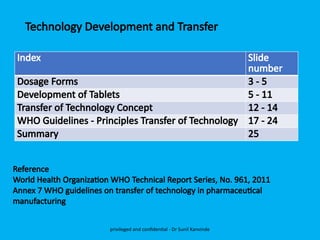
Index Slide
number
Dosage Forms 3 - 5
Development of Tablets 5 - 11
Transfer of Technology Concept 12 - 14
WHO Guidelines - Principles Transfer of Technology 17 - 24
Summary 25
Reference
World Health Organization WHO Technical Report Series, No. 961, 2011
Annex 7 WHO guidelines on transfer of technology in pharmaceutical
manufacturing
privileged and confidential - Dr Sunil Kanvinde
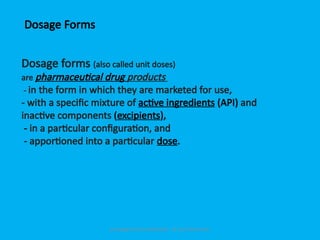
Dosage Forms
Dosage forms (also called unit doses)
are pharmaceutical drug products
- in the form in which they are marketed for use,
- with a specific mixture of active ingredients (API) and
inactive components (excipients),
- in a particular configuration, and
- apportioned into a particular dose.
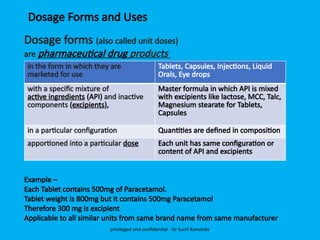
Dosage Forms and Uses
privileged and confidential - Dr Sunil Kanvinde
Dosage forms (also called unit doses)
are pharmaceutical drug products
Example –
Each Tablet contains 500mg of Paracetamol.
Tablet weight is 800mg but it contains 500mg Paracetamol
Therefore 300 mg is excipient
Applicable to all similar units from same brand name from same manufacturer
in the form in which they are
marketed for use
Tablets, Capsules, Injections, Liquid
Orals, Eye drops
with a specific mixture of
active ingredients (API) and inactive
components (excipients),
Master formula in which API is mixed
with excipients like lactose, MCC, Talc,
Magnesium stearate for Tablets,
Capsules
in a particular configuration Quantities are defined in composition
apportioned into a particular dose Each unit has same configuration or
content of API and excipients
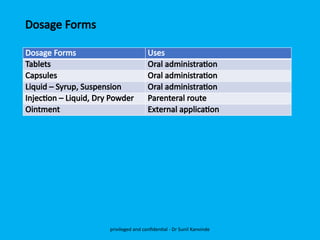
Dosage Forms
Dosage Forms Uses
Tablets Oral administration
Capsules Oral administration
Liquid – Syrup, Suspension Oral administration
Injection – Liquid, Dry Powder Parenteral route
Ointment External application
privileged and confidential - Dr Sunil Kanvinde
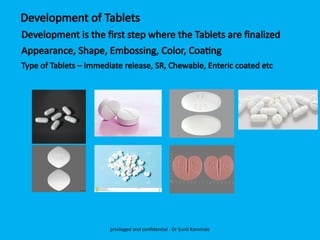
Development of Tablets
Development is the first step where the Tablets are finalized
Appearance, Shape, Embossing, Color, Coating
Type of Tablets – Immediate release, SR, Chewable, Enteric coated etc
privileged and confidential - Dr Sunil Kanvinde
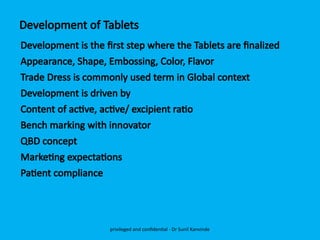
Development of Tablets
Development is the first step where the Tablets are finalized
Appearance, Shape, Embossing, Color, Flavor
Trade Dress is commonly used term in Global context
Development is driven by
Content of active, active/ excipient ratio
Bench marking with innovator
QBD concept
Marketing expectations
Patient compliance
privileged and confidential - Dr Sunil Kanvinde
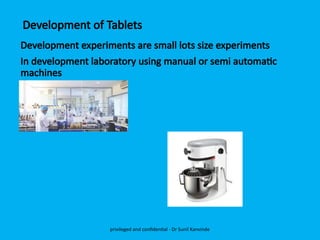
Development of Tablets
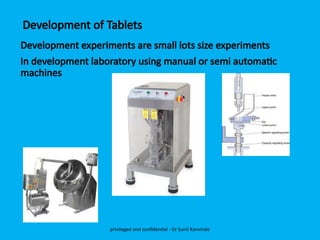
Development experiments are small lots size experiments
In development laboratory using manual or semi automatic
machines
privileged and confidential - Dr Sunil Kanvinde
Development of Tablets
Development experiments are small lots size experiments
In development laboratory using manual or semi automatic
machines
privileged and confidential - Dr Sunil Kanvinde
Development of Tablets
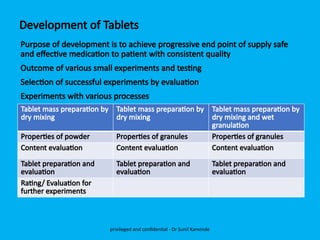
Purpose of development is to achieve progressive end point of supply safe
and effective medication to patient with consistent quality
Outcome of various small experiments and testing
Selection of successful experiments by evaluation
Experiments with various processes
privileged and confidential - Dr Sunil Kanvinde
Tablet mass preparation by
dry mixing
Tablet mass preparation by
dry mixing
Tablet mass preparation by
dry mixing and wet
granulation
Properties of powder Properties of granules Properties of granules
Content evaluation Content evaluation Content evaluation
Tablet preparation and
evaluation
Tablet preparation and
evaluation
Tablet preparation and
evaluation
Rating/ Evaluation for
further experiments
Development of Tablets
Purpose of development is to achieve progressive end point of
supply safe and effective medication to patient with consistent
quality
Outcome of various small experiments and testing
Selection of successful experiments by evaluation
Development knowledge is therefore important database for
future life cycle
It is a starting point of successful commercial product available
in market.
privileged and confidential - Dr Sunil Kanvinde
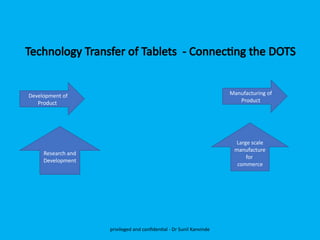
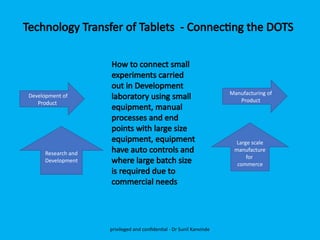
Technology Transfer of Tablets - Connecting the DOTS
privileged and confidential - Dr Sunil Kanvinde
Development of
Product
Manufacturing of
Product
Research and
Development
Large scale
manufacture
for
commerce
Technology Transfer of Tablets - Connecting the DOTS
privileged and confidential - Dr Sunil Kanvinde
Development of
Product
Manufacturing of
Product
Research and
Development
Large scale
manufacture
for
commerce
How to connect small
experiments carried
out in Development
laboratory using small
equipment, manual
processes and end
points with large size
equipment, equipment
have auto controls and
where large batch size
is required due to
commercial needs
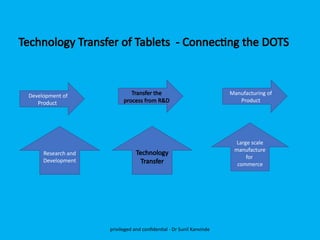
Technology Transfer of Tablets - Connecting the DOTS
privileged and confidential - Dr Sunil Kanvinde
Development of
Product
Manufacturing of
Product
Research and
Development
Large scale
manufacture
for
commerce
Transfer the
process from R&D
Technology
Transfer
WHO guidelines - Principles
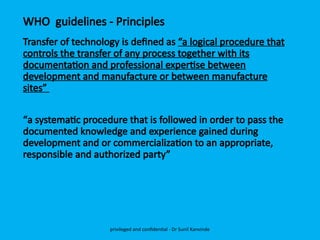
Transfer of technology is defined as “a logical procedure that
controls the transfer of any process together with its
documentation and professional expertise between
development and manufacture or between manufacture
sites”
“a systematic procedure that is followed in order to pass the
documented knowledge and experience gained during
development and or commercialization to an appropriate,
responsible and authorized party”
privileged and confidential - Dr Sunil Kanvinde
WHO guidelines - Principles
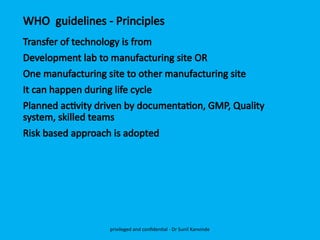
Transfer of technology is from
Development lab to manufacturing site OR
One manufacturing site to other manufacturing site
It can happen during life cycle
Planned activity driven by documentation, GMP, Quality
system, skilled teams
Risk based approach is adopted
privileged and confidential - Dr Sunil Kanvinde
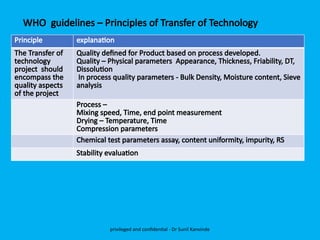
WHO guidelines – Principles of Transfer of Technology
Principle explanation
The Transfer of
technology
project should
encompass the
quality aspects
of the project
Quality defined for Product based on process developed.
Quality – Physical parameters Appearance, Thickness, Friability, DT,
Dissolution
In process quality parameters - Bulk Density, Moisture content, Sieve
analysis
Process –
Mixing speed, Time, end point measurement
Drying – Temperature, Time
Compression parameters
Chemical test parameters assay, content uniformity, impurity, RS
Stability evaluation
privileged and confidential - Dr Sunil Kanvinde
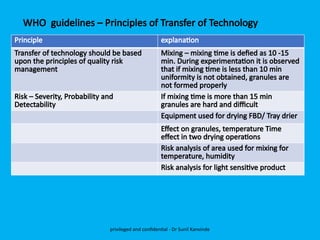
WHO guidelines – Principles of Transfer of Technology
Principle explanation
Transfer of technology should be based
upon the principles of quality risk
management
Mixing – mixing time is defied as 10 -15
min. During experimentation it is observed
that if mixing time is less than 10 min
uniformity is not obtained, granules are
not formed properly
Risk – Severity, Probability and
Detectability
If mixing time is more than 15 min
granules are hard and difficult
Equipment used for drying FBD/ Tray drier
Effect on granules, temperature Time
effect in two drying operations
Risk analysis of area used for mixing for
temperature, humidity
Risk analysis for light sensitive product
privileged and confidential - Dr Sunil Kanvinde
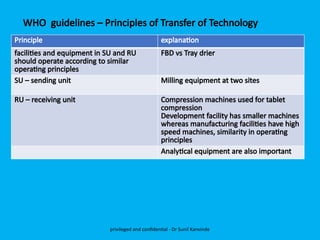
WHO guidelines – Principles of Transfer of Technology
Principle explanation
facilities and equipment in SU and RU
should operate according to similar
operating principles
FBD vs Tray drier
SU – sending unit Milling equipment at two sites
RU – receiving unit Compression machines used for tablet
compression
Development facility has smaller machines
whereas manufacturing facilities have high
speed machines, similarity in operating
principles
Analytical equipment are also important
privileged and confidential - Dr Sunil Kanvinde
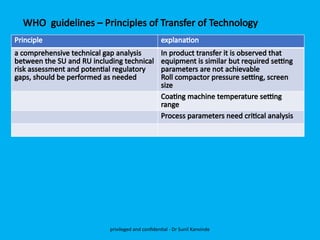
WHO guidelines – Principles of Transfer of Technology
Principle explanation
a comprehensive technical gap analysis
between the SU and RU including technical
risk assessment and potential regulatory
gaps, should be performed as needed
In product transfer it is observed that
equipment is similar but required setting
parameters are not achievable
Roll compactor pressure setting, screen
size
Coating machine temperature setting
range
Process parameters need critical analysis
privileged and confidential - Dr Sunil Kanvinde
WHO guidelines – Principles of Transfer of Technology
Principle explanation
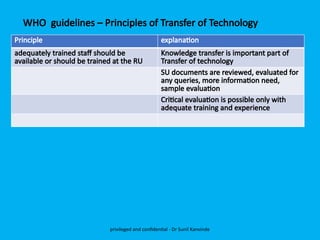
adequately trained staff should be
available or should be trained at the RU
Knowledge transfer is important part of
Transfer of technology
SU documents are reviewed, evaluated for
any queries, more information need,
sample evaluation
Critical evaluation is possible only with
adequate training and experience
privileged and confidential - Dr Sunil Kanvinde
WHO guidelines – Principles of Transfer of Technology
Principle explanation
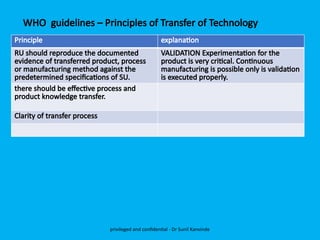
RU should reproduce the documented
evidence of transferred product, process
or manufacturing method against the
predetermined specifications of SU.
VALIDATION Experimentation for the
product is very critical. Continuous
manufacturing is possible only is validation
is executed properly.
there should be effective process and
product knowledge transfer.
Clarity of transfer process
privileged and confidential - Dr Sunil Kanvinde
WHO guidelines – Principles of Transfer of Technology
Principle explanation
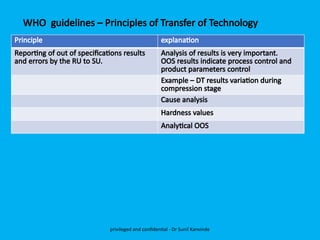
Reporting of out of specifications results
and errors by the RU to SU.
Analysis of results is very important.
OOS results indicate process control and
product parameters control
Example – DT results variation during
compression stage
Cause analysis
Hardness values
Analytical OOS
privileged and confidential - Dr Sunil Kanvinde
WHO guidelines –Transfer of Technology
privileged and confidential - Dr Sunil Kanvinde
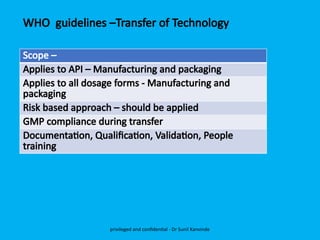
Scope –
Applies to API – Manufacturing and packaging
Applies to all dosage forms - Manufacturing and
packaging
Risk based approach – should be applied
GMP compliance during transfer
Documentation, Qualification, Validation, People
training
privileged and confidential - Dr Sunil Kanvinde
Summary
Transfer of Technology is important intermediate step
connecting development and manufacturing site or one
manufacturing site with other
It is knowledge based approach supported by documentation
and Risk based evaluation of processes
People play important role in knowledge creation and sharing
Guidelines help to formulate Transfer of Technology process
by providing Principles and practices to define systems and
evaluation criteria

WHO guidelines ON Technology TRANSFER ip

  • 1.
    Technology Development andTransfer Dr Sunil Kanvinde 10 August 2023 privileged and confidential - Dr Sunil Kanvinde
  • 2.
    Technology Development andTransfer privileged and confidential - Dr Sunil Kanvinde Index Slide number Dosage Forms 3 - 5 Development of Tablets 5 - 11 Transfer of Technology Concept 12 - 14 WHO Guidelines - Principles Transfer of Technology 17 - 24 Summary 25 Reference World Health Organization WHO Technical Report Series, No. 961, 2011 Annex 7 WHO guidelines on transfer of technology in pharmaceutical manufacturing
  • 3.
    privileged and confidential- Dr Sunil Kanvinde Dosage Forms Dosage forms (also called unit doses) are pharmaceutical drug products - in the form in which they are marketed for use, - with a specific mixture of active ingredients (API) and inactive components (excipients), - in a particular configuration, and - apportioned into a particular dose.
  • 4.
    Dosage Forms andUses privileged and confidential - Dr Sunil Kanvinde Dosage forms (also called unit doses) are pharmaceutical drug products Example – Each Tablet contains 500mg of Paracetamol. Tablet weight is 800mg but it contains 500mg Paracetamol Therefore 300 mg is excipient Applicable to all similar units from same brand name from same manufacturer in the form in which they are marketed for use Tablets, Capsules, Injections, Liquid Orals, Eye drops with a specific mixture of active ingredients (API) and inactive components (excipients), Master formula in which API is mixed with excipients like lactose, MCC, Talc, Magnesium stearate for Tablets, Capsules in a particular configuration Quantities are defined in composition apportioned into a particular dose Each unit has same configuration or content of API and excipients
  • 5.
    Dosage Forms Dosage FormsUses Tablets Oral administration Capsules Oral administration Liquid – Syrup, Suspension Oral administration Injection – Liquid, Dry Powder Parenteral route Ointment External application privileged and confidential - Dr Sunil Kanvinde
  • 6.
    Development of Tablets Developmentis the first step where the Tablets are finalized Appearance, Shape, Embossing, Color, Coating Type of Tablets – Immediate release, SR, Chewable, Enteric coated etc privileged and confidential - Dr Sunil Kanvinde
  • 7.
    Development of Tablets Developmentis the first step where the Tablets are finalized Appearance, Shape, Embossing, Color, Flavor Trade Dress is commonly used term in Global context Development is driven by Content of active, active/ excipient ratio Bench marking with innovator QBD concept Marketing expectations Patient compliance privileged and confidential - Dr Sunil Kanvinde
  • 8.
    Development of Tablets Developmentexperiments are small lots size experiments In development laboratory using manual or semi automatic machines privileged and confidential - Dr Sunil Kanvinde
  • 9.
    Development of Tablets Developmentexperiments are small lots size experiments In development laboratory using manual or semi automatic machines privileged and confidential - Dr Sunil Kanvinde
  • 10.
    Development of Tablets Purposeof development is to achieve progressive end point of supply safe and effective medication to patient with consistent quality Outcome of various small experiments and testing Selection of successful experiments by evaluation Experiments with various processes privileged and confidential - Dr Sunil Kanvinde Tablet mass preparation by dry mixing Tablet mass preparation by dry mixing Tablet mass preparation by dry mixing and wet granulation Properties of powder Properties of granules Properties of granules Content evaluation Content evaluation Content evaluation Tablet preparation and evaluation Tablet preparation and evaluation Tablet preparation and evaluation Rating/ Evaluation for further experiments
  • 11.
    Development of Tablets Purposeof development is to achieve progressive end point of supply safe and effective medication to patient with consistent quality Outcome of various small experiments and testing Selection of successful experiments by evaluation Development knowledge is therefore important database for future life cycle It is a starting point of successful commercial product available in market. privileged and confidential - Dr Sunil Kanvinde
  • 12.
    Technology Transfer ofTablets - Connecting the DOTS privileged and confidential - Dr Sunil Kanvinde Development of Product Manufacturing of Product Research and Development Large scale manufacture for commerce
  • 13.
    Technology Transfer ofTablets - Connecting the DOTS privileged and confidential - Dr Sunil Kanvinde Development of Product Manufacturing of Product Research and Development Large scale manufacture for commerce How to connect small experiments carried out in Development laboratory using small equipment, manual processes and end points with large size equipment, equipment have auto controls and where large batch size is required due to commercial needs
  • 14.
    Technology Transfer ofTablets - Connecting the DOTS privileged and confidential - Dr Sunil Kanvinde Development of Product Manufacturing of Product Research and Development Large scale manufacture for commerce Transfer the process from R&D Technology Transfer
  • 15.
    WHO guidelines -Principles Transfer of technology is defined as “a logical procedure that controls the transfer of any process together with its documentation and professional expertise between development and manufacture or between manufacture sites” “a systematic procedure that is followed in order to pass the documented knowledge and experience gained during development and or commercialization to an appropriate, responsible and authorized party” privileged and confidential - Dr Sunil Kanvinde
  • 16.
    WHO guidelines -Principles Transfer of technology is from Development lab to manufacturing site OR One manufacturing site to other manufacturing site It can happen during life cycle Planned activity driven by documentation, GMP, Quality system, skilled teams Risk based approach is adopted privileged and confidential - Dr Sunil Kanvinde
  • 17.
    WHO guidelines –Principles of Transfer of Technology Principle explanation The Transfer of technology project should encompass the quality aspects of the project Quality defined for Product based on process developed. Quality – Physical parameters Appearance, Thickness, Friability, DT, Dissolution In process quality parameters - Bulk Density, Moisture content, Sieve analysis Process – Mixing speed, Time, end point measurement Drying – Temperature, Time Compression parameters Chemical test parameters assay, content uniformity, impurity, RS Stability evaluation privileged and confidential - Dr Sunil Kanvinde
  • 18.
    WHO guidelines –Principles of Transfer of Technology Principle explanation Transfer of technology should be based upon the principles of quality risk management Mixing – mixing time is defied as 10 -15 min. During experimentation it is observed that if mixing time is less than 10 min uniformity is not obtained, granules are not formed properly Risk – Severity, Probability and Detectability If mixing time is more than 15 min granules are hard and difficult Equipment used for drying FBD/ Tray drier Effect on granules, temperature Time effect in two drying operations Risk analysis of area used for mixing for temperature, humidity Risk analysis for light sensitive product privileged and confidential - Dr Sunil Kanvinde
  • 19.
    WHO guidelines –Principles of Transfer of Technology Principle explanation facilities and equipment in SU and RU should operate according to similar operating principles FBD vs Tray drier SU – sending unit Milling equipment at two sites RU – receiving unit Compression machines used for tablet compression Development facility has smaller machines whereas manufacturing facilities have high speed machines, similarity in operating principles Analytical equipment are also important privileged and confidential - Dr Sunil Kanvinde
  • 20.
    WHO guidelines –Principles of Transfer of Technology Principle explanation a comprehensive technical gap analysis between the SU and RU including technical risk assessment and potential regulatory gaps, should be performed as needed In product transfer it is observed that equipment is similar but required setting parameters are not achievable Roll compactor pressure setting, screen size Coating machine temperature setting range Process parameters need critical analysis privileged and confidential - Dr Sunil Kanvinde
  • 21.
    WHO guidelines –Principles of Transfer of Technology Principle explanation adequately trained staff should be available or should be trained at the RU Knowledge transfer is important part of Transfer of technology SU documents are reviewed, evaluated for any queries, more information need, sample evaluation Critical evaluation is possible only with adequate training and experience privileged and confidential - Dr Sunil Kanvinde
  • 22.
    WHO guidelines –Principles of Transfer of Technology Principle explanation RU should reproduce the documented evidence of transferred product, process or manufacturing method against the predetermined specifications of SU. VALIDATION Experimentation for the product is very critical. Continuous manufacturing is possible only is validation is executed properly. there should be effective process and product knowledge transfer. Clarity of transfer process privileged and confidential - Dr Sunil Kanvinde
  • 23.
    WHO guidelines –Principles of Transfer of Technology Principle explanation Reporting of out of specifications results and errors by the RU to SU. Analysis of results is very important. OOS results indicate process control and product parameters control Example – DT results variation during compression stage Cause analysis Hardness values Analytical OOS privileged and confidential - Dr Sunil Kanvinde
  • 24.
    WHO guidelines –Transferof Technology privileged and confidential - Dr Sunil Kanvinde Scope – Applies to API – Manufacturing and packaging Applies to all dosage forms - Manufacturing and packaging Risk based approach – should be applied GMP compliance during transfer Documentation, Qualification, Validation, People training
  • 25.
    privileged and confidential- Dr Sunil Kanvinde Summary Transfer of Technology is important intermediate step connecting development and manufacturing site or one manufacturing site with other It is knowledge based approach supported by documentation and Risk based evaluation of processes People play important role in knowledge creation and sharing Guidelines help to formulate Transfer of Technology process by providing Principles and practices to define systems and evaluation criteria