Greenland and Arctic
Climate
What are the impacts of Greenland and Arctic warming on air
quality?
Paige A Whitfield
GEOG 3700
102 Dec 14
Table of Contents
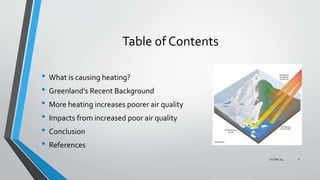
• What is causing heating?
• Greenland’s Recent Background
• More heating increases poorer air quality
• Impacts from increased poor air quality
• Conclusion
• References
02 Dec 14 2
What is causing warming in Greenland and the
Artic?
• There are natural causes:
• Uneven heating of solar radiation
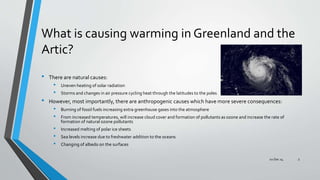
• Storms and changes in air pressure cycling heat through the latitudes to the poles
• However, most importantly, there are anthropogenic causes which have more severe consequences:
• Burning of fossil fuels increasing extra greenhouse gases into the atmosphere
• From increased temperatures, will increase cloud cover and formation of pollutants as ozone and increase the rate of
formation of natural ozone pollutants
• Increased melting of polar ice sheets
• Sea levels increase due to freshwater addition to the oceans
• Changing of albedo on the surfaces
02 Dec 14 3
Changes in Greenland’s ice sheet
• Greenland ice sheet is covered by 85% ice, the
rest of the surface is melted liquid water pushing
the ice sheet 1000 feet below sea level
• If the entire Greenland ice sheet would melt,
would increase the global ocean levels by 23 feet
• Increased ocean levels would change
atmosphere circulation patterns
• Affecting air pollutant travel
02 Dec 14 4
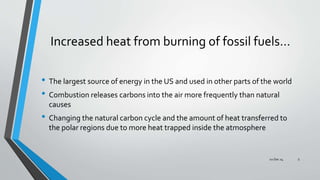
Increased heat from burning of fossil fuels…
• The largest source of energy in the US and used in other parts of the world
• Combustion releases carbons into the air more frequently than natural
causes
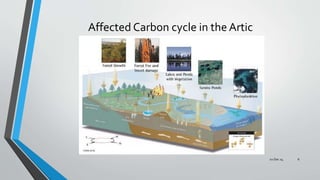
• Changing the natural carbon cycle and the amount of heat transferred to
the polar regions due to more heat trapped inside the atmosphere
02 Dec 14 5
Affected Carbon cycle in the Artic
02 Dec 14 6
…then increases the greenhouse gas
concentrations in the atmosphere…
• From the increased greenhouse gases, ice forms later in the year and melt sooner
in the year, so a smaller net amount of ice in the polar regions
• Affect wildlife dependent on the polar regions
• Could increase forest fires in other regions
• The melted freshwater flows into the oceans, increasing level and changing the
circulation of ocean currents, affecting the natural flow of heat
• The albedo becomes lower in the polar ice caps causing a positive feedback loop
02 Dec 14 7
…thus creating poorer air quality circulation…
• The air pollutants that travel across the US will be taken further and in different
locations from changes in weather patterns from changes in temperature and air
pressure in the atmosphere
• The permanent High pressure Zone in the Atlantic could be affected and possibly
move and not be present, causing the jet stream to flow in abnormal paths and
become more wavy
• Changes in temperature can cause increased cloud coverage which could increase
production of pollutants as ozone and increased circulation of pollutants and force
air pollutants into areas normally with lower pollution levels
02 Dec 14 8
Suggestions and conclusions
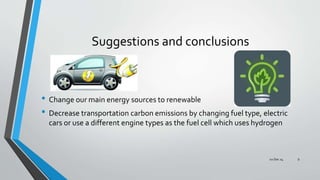
• Change our main energy sources to renewable
• Decrease transportation carbon emissions by changing fuel type, electric
cars or use a different engine types as the fuel cell which uses hydrogen
02 Dec 14 9
References
• EPA. “Air Quality and Climate Change Interactions.” United States Environmental Protection Agency, May 2014.
<http://www.epa.gov/AMD/Research/RIA/aqcc.html>.
• EPA. “Climate Change Research Questions.” United States Environmental Protection Agency, August 2014.
<http://www.epa.gov/research/climatescience/climate-questions.htm>.
• GreenFacts.com. “Artic Climate Change.” GreenFacts, January 2014.
<http://www.greenfacts.org/en/arctic-climate-change/>.
• Helmholtz Centre Potsdam - GFZ German Research Centre for Geosciences. "Greenland ice is melting -- even from below:
Heat flow from the mantle contributes to the ice melt." ScienceDaily. ScienceDaily, 11 August 2013.
<www.sciencedaily.com/releases/2013/08/130811150608.htm>.
• Michael, Edalin, Jeff Masters. “Greenland.”Weather Underground, 2014.
<http://www.wunderground.com/climate/greenland.asp?MR=1>.
• NSIDC. “Climate Change in the Artic.” National Snow and Ice Data Center, 2014.
<https://nsidc.org/cryosphere/arctic-meteorology/climate_change.html>.
1002 Dec 14

Whitfield_GreenlandClimate

  • 1.
    Greenland and Arctic Climate Whatare the impacts of Greenland and Arctic warming on air quality? Paige A Whitfield GEOG 3700 102 Dec 14
  • 2.
    Table of Contents •What is causing heating? • Greenland’s Recent Background • More heating increases poorer air quality • Impacts from increased poor air quality • Conclusion • References 02 Dec 14 2
  • 3.
    What is causingwarming in Greenland and the Artic? • There are natural causes: • Uneven heating of solar radiation • Storms and changes in air pressure cycling heat through the latitudes to the poles • However, most importantly, there are anthropogenic causes which have more severe consequences: • Burning of fossil fuels increasing extra greenhouse gases into the atmosphere • From increased temperatures, will increase cloud cover and formation of pollutants as ozone and increase the rate of formation of natural ozone pollutants • Increased melting of polar ice sheets • Sea levels increase due to freshwater addition to the oceans • Changing of albedo on the surfaces 02 Dec 14 3
  • 4.
    Changes in Greenland’sice sheet • Greenland ice sheet is covered by 85% ice, the rest of the surface is melted liquid water pushing the ice sheet 1000 feet below sea level • If the entire Greenland ice sheet would melt, would increase the global ocean levels by 23 feet • Increased ocean levels would change atmosphere circulation patterns • Affecting air pollutant travel 02 Dec 14 4
  • 5.
    Increased heat fromburning of fossil fuels… • The largest source of energy in the US and used in other parts of the world • Combustion releases carbons into the air more frequently than natural causes • Changing the natural carbon cycle and the amount of heat transferred to the polar regions due to more heat trapped inside the atmosphere 02 Dec 14 5
  • 6.
    Affected Carbon cyclein the Artic 02 Dec 14 6
  • 7.
    …then increases thegreenhouse gas concentrations in the atmosphere… • From the increased greenhouse gases, ice forms later in the year and melt sooner in the year, so a smaller net amount of ice in the polar regions • Affect wildlife dependent on the polar regions • Could increase forest fires in other regions • The melted freshwater flows into the oceans, increasing level and changing the circulation of ocean currents, affecting the natural flow of heat • The albedo becomes lower in the polar ice caps causing a positive feedback loop 02 Dec 14 7
  • 8.
    …thus creating poorerair quality circulation… • The air pollutants that travel across the US will be taken further and in different locations from changes in weather patterns from changes in temperature and air pressure in the atmosphere • The permanent High pressure Zone in the Atlantic could be affected and possibly move and not be present, causing the jet stream to flow in abnormal paths and become more wavy • Changes in temperature can cause increased cloud coverage which could increase production of pollutants as ozone and increased circulation of pollutants and force air pollutants into areas normally with lower pollution levels 02 Dec 14 8
  • 9.
    Suggestions and conclusions •Change our main energy sources to renewable • Decrease transportation carbon emissions by changing fuel type, electric cars or use a different engine types as the fuel cell which uses hydrogen 02 Dec 14 9
  • 10.
    References • EPA. “AirQuality and Climate Change Interactions.” United States Environmental Protection Agency, May 2014. <http://www.epa.gov/AMD/Research/RIA/aqcc.html>. • EPA. “Climate Change Research Questions.” United States Environmental Protection Agency, August 2014. <http://www.epa.gov/research/climatescience/climate-questions.htm>. • GreenFacts.com. “Artic Climate Change.” GreenFacts, January 2014. <http://www.greenfacts.org/en/arctic-climate-change/>. • Helmholtz Centre Potsdam - GFZ German Research Centre for Geosciences. "Greenland ice is melting -- even from below: Heat flow from the mantle contributes to the ice melt." ScienceDaily. ScienceDaily, 11 August 2013. <www.sciencedaily.com/releases/2013/08/130811150608.htm>. • Michael, Edalin, Jeff Masters. “Greenland.”Weather Underground, 2014. <http://www.wunderground.com/climate/greenland.asp?MR=1>. • NSIDC. “Climate Change in the Artic.” National Snow and Ice Data Center, 2014. <https://nsidc.org/cryosphere/arctic-meteorology/climate_change.html>. 1002 Dec 14