Where’s the Disconnect?
Analyzing barriers to web-based e-participation tools for planning
Cullen Meves
Research Purpose and Goals
 Track current use of e-participation tools in planning
 Planning & Community Development Departments serving
populations of 100,000 or less
 Benchmark study of which tools and how often
 Identify barriers to further incorporation of e-
participation tools
 Barriers identified through literature review, personal
experience, and survey/interview responses
 Solutions suggested based on research, interview
response, and personal experience
Research Purpose and Goals
 Identify trends for how e-participation tools are being
utilized based on:
 Population size
 Regional location
 Level of government
 Population density
 Mean age of population
 Median age of population
Research Methods
 Literature Review
 Extensive review of
benchmark studies
 Online Survey
 349 respondents
 Phone Interviews
 8 respondents
 Survey Results Analysis
 Included Chi Square Test
Analysis
Source: Image created by C. Meves
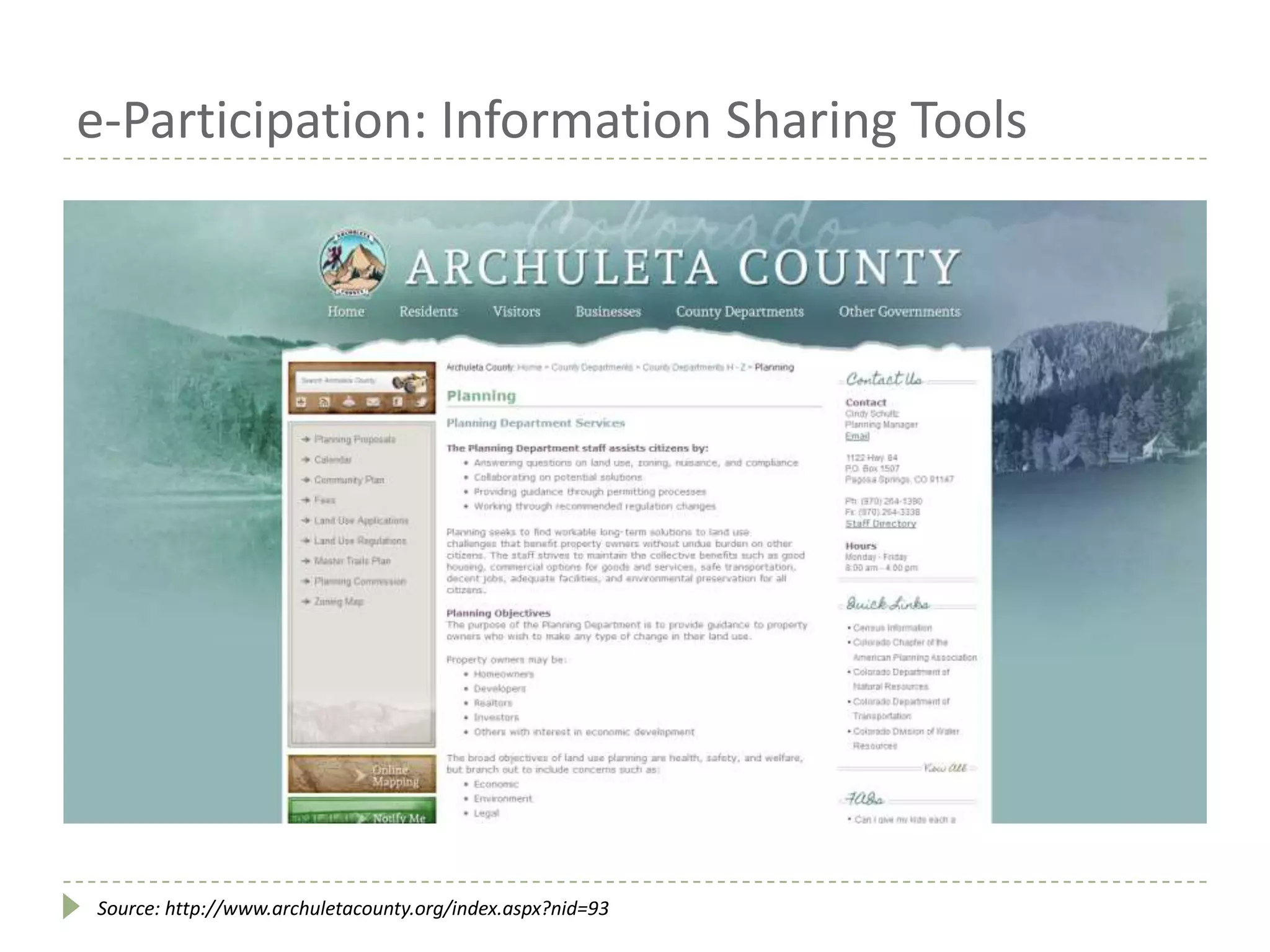
e-Participation: Information Sharing Tools
Source: http://www.archuletacounty.org/index.aspx?nid=93
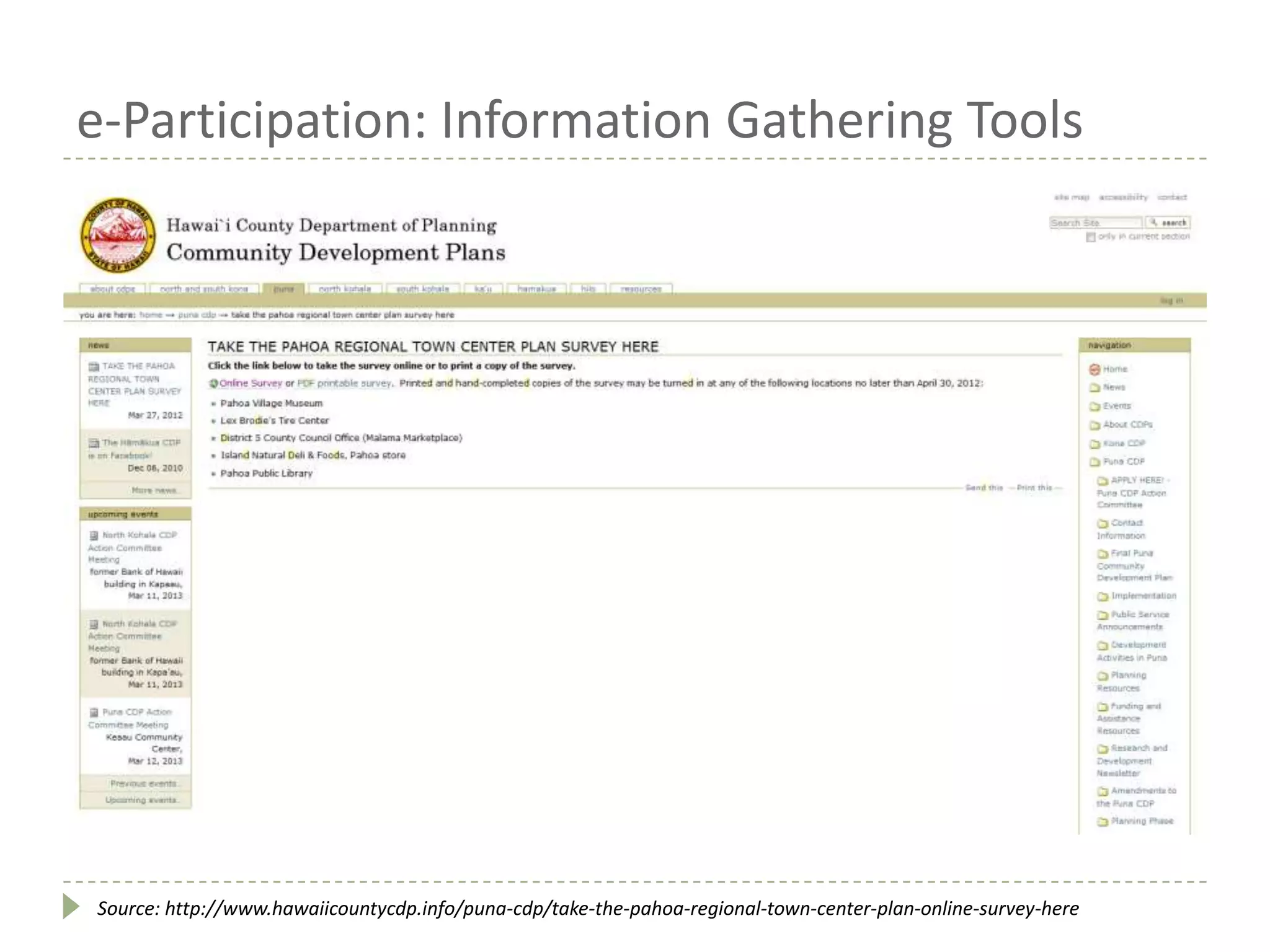
e-Participation: Information Gathering Tools
Source: http://www.hawaiicountycdp.info/puna-cdp/take-the-pahoa-regional-town-center-plan-online-survey-here
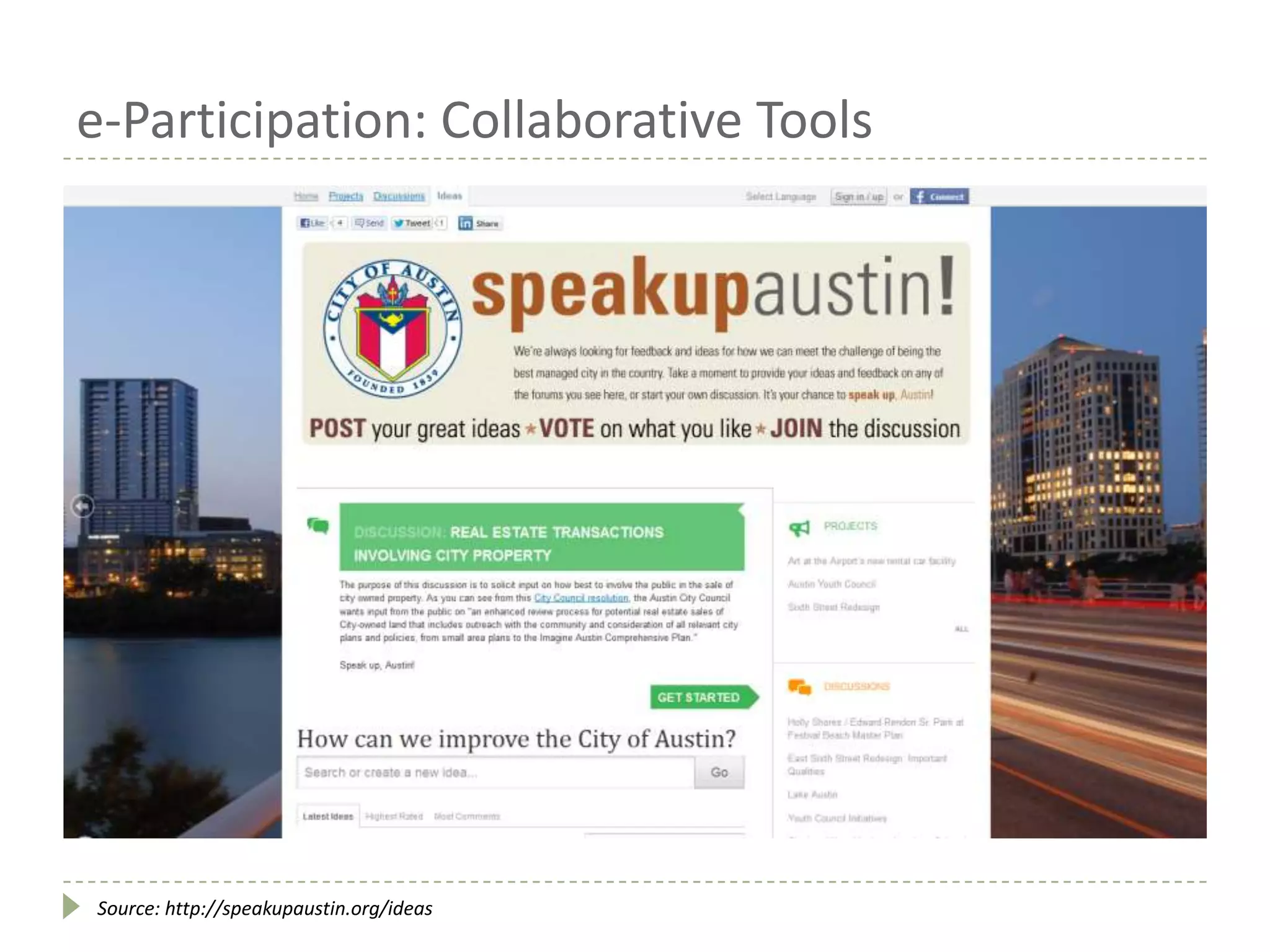
e-Participation: Collaborative Tools
Source: http://speakupaustin.org/ideas
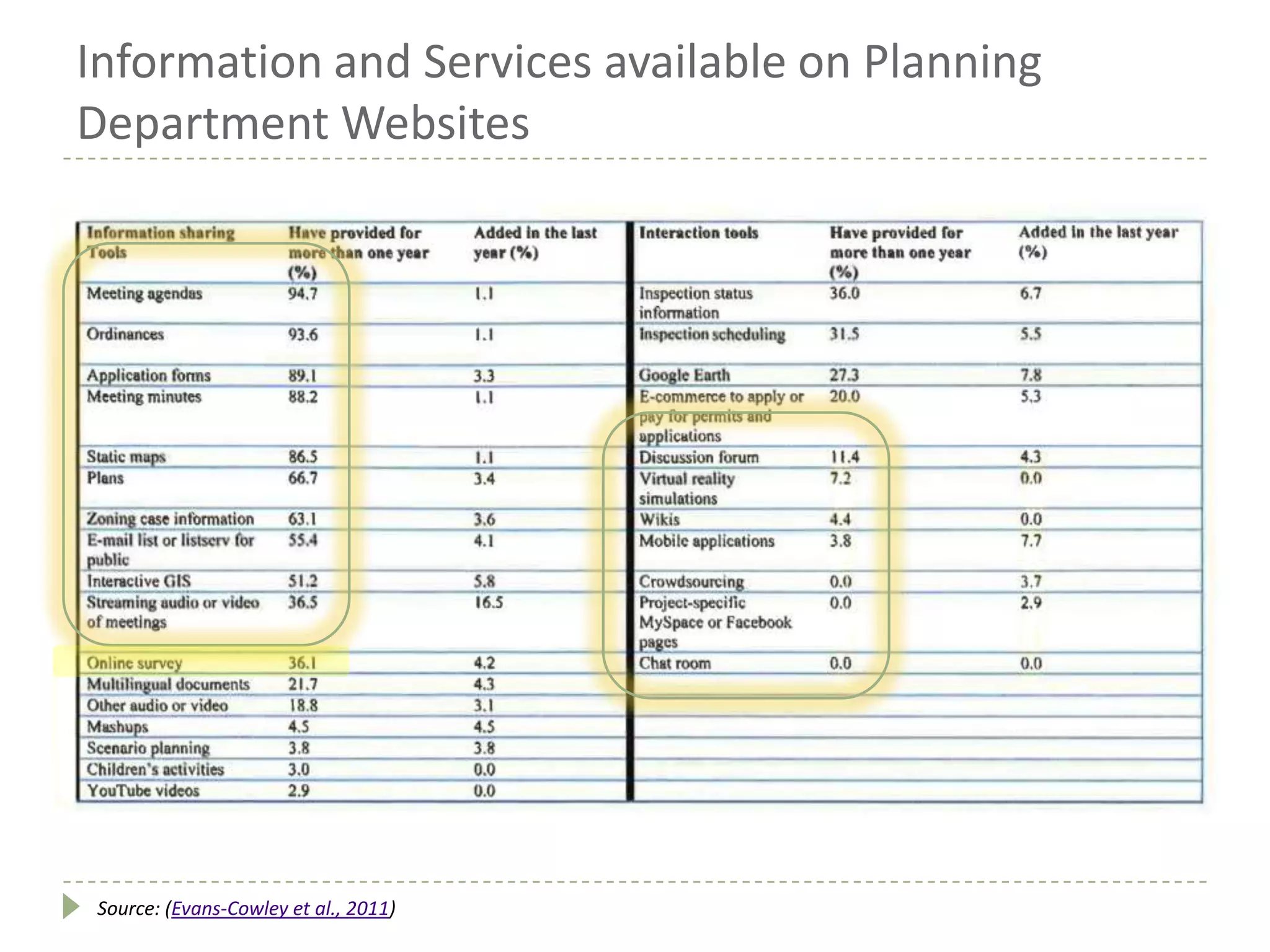
Information and Services available on Planning
Department Websites
Source: (Evans-Cowley et al., 2011)
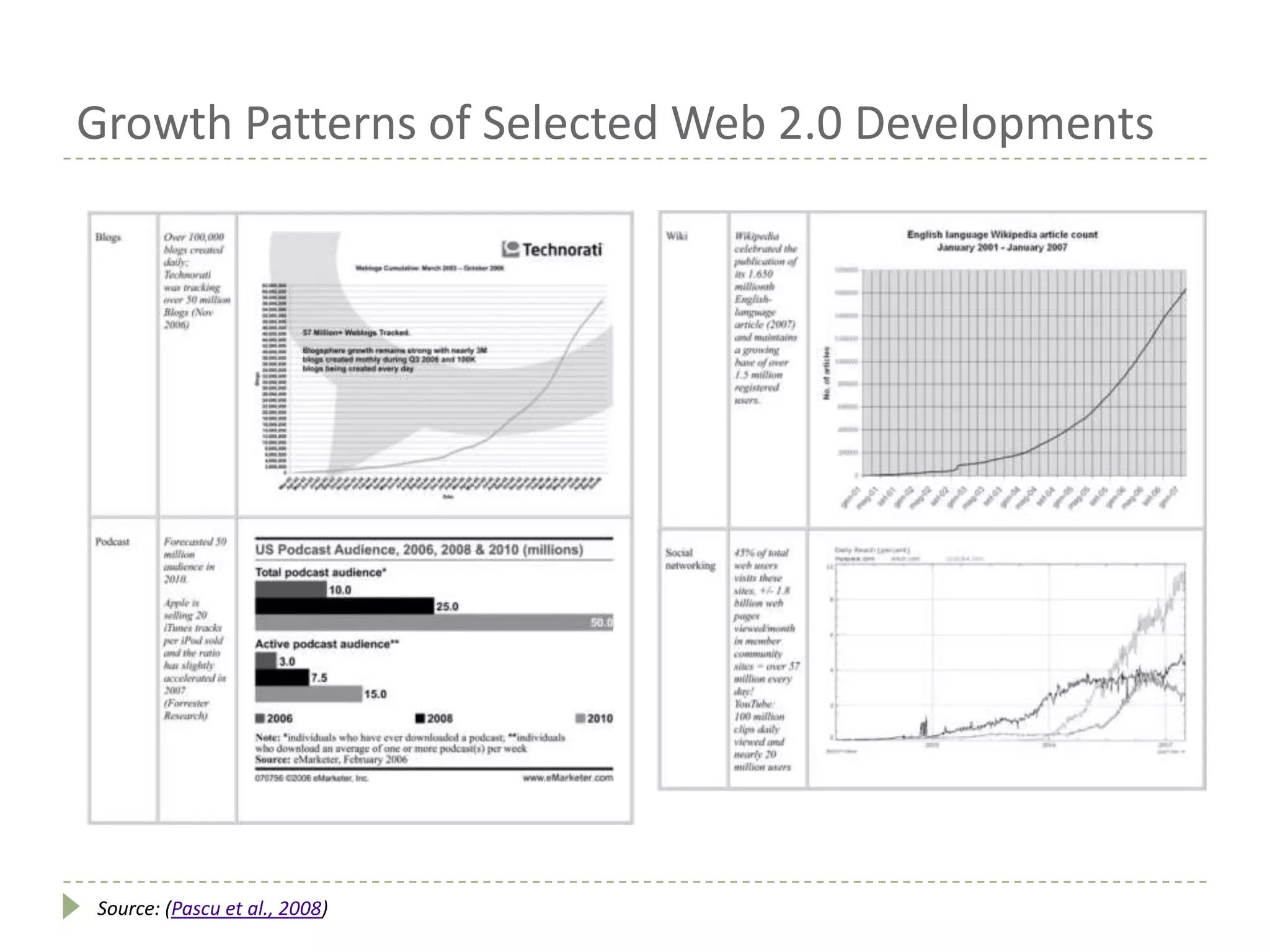
Growth Patterns of Selected Web 2.0 Developments
Source: (Pascu et al., 2008)
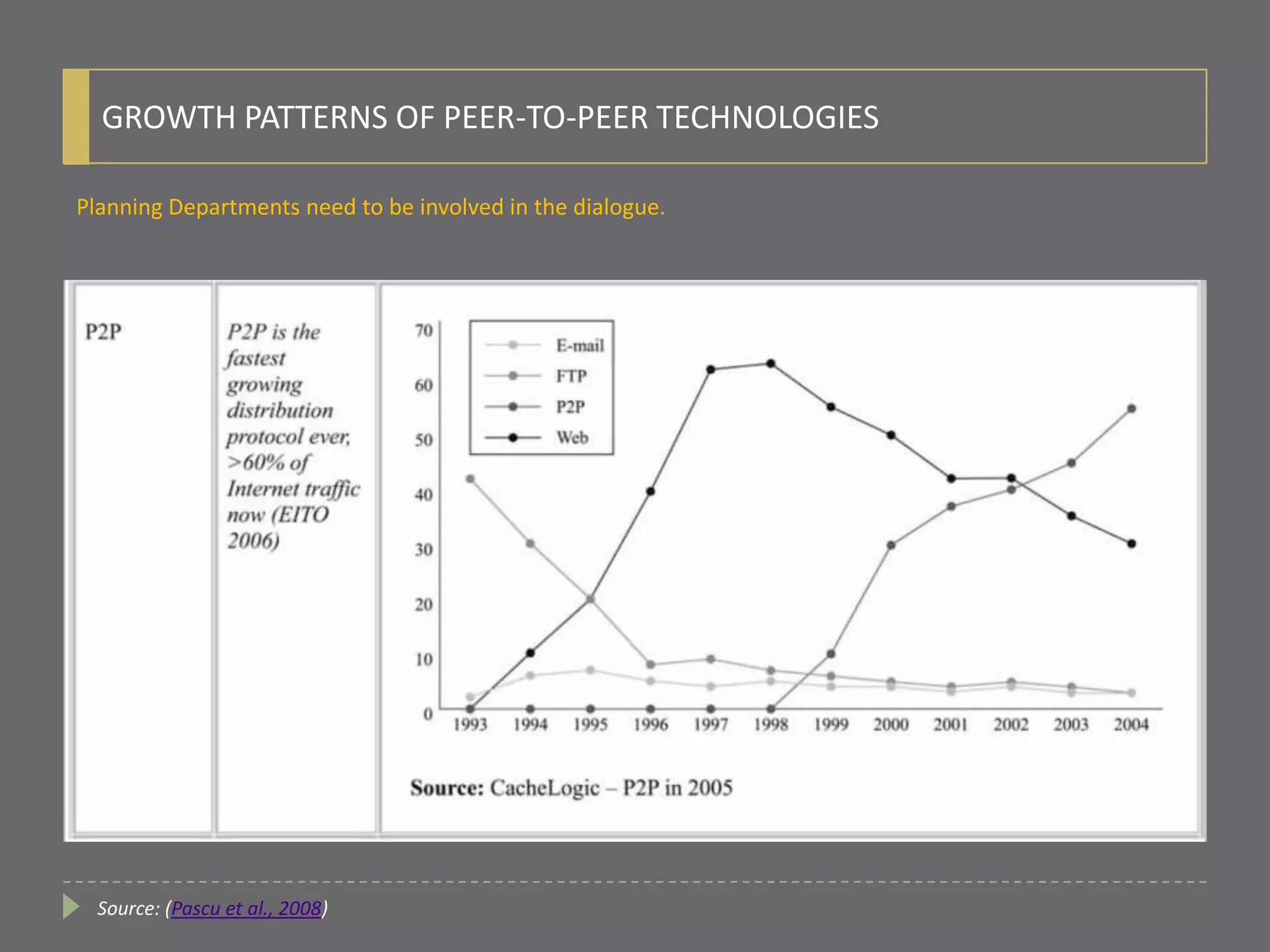
GROWTH PATTERNS OF PEER-TO-PEER TECHNOLOGIES
Planning Departments need to be involved in the dialogue.
Source: (Pascu et al., 2008)
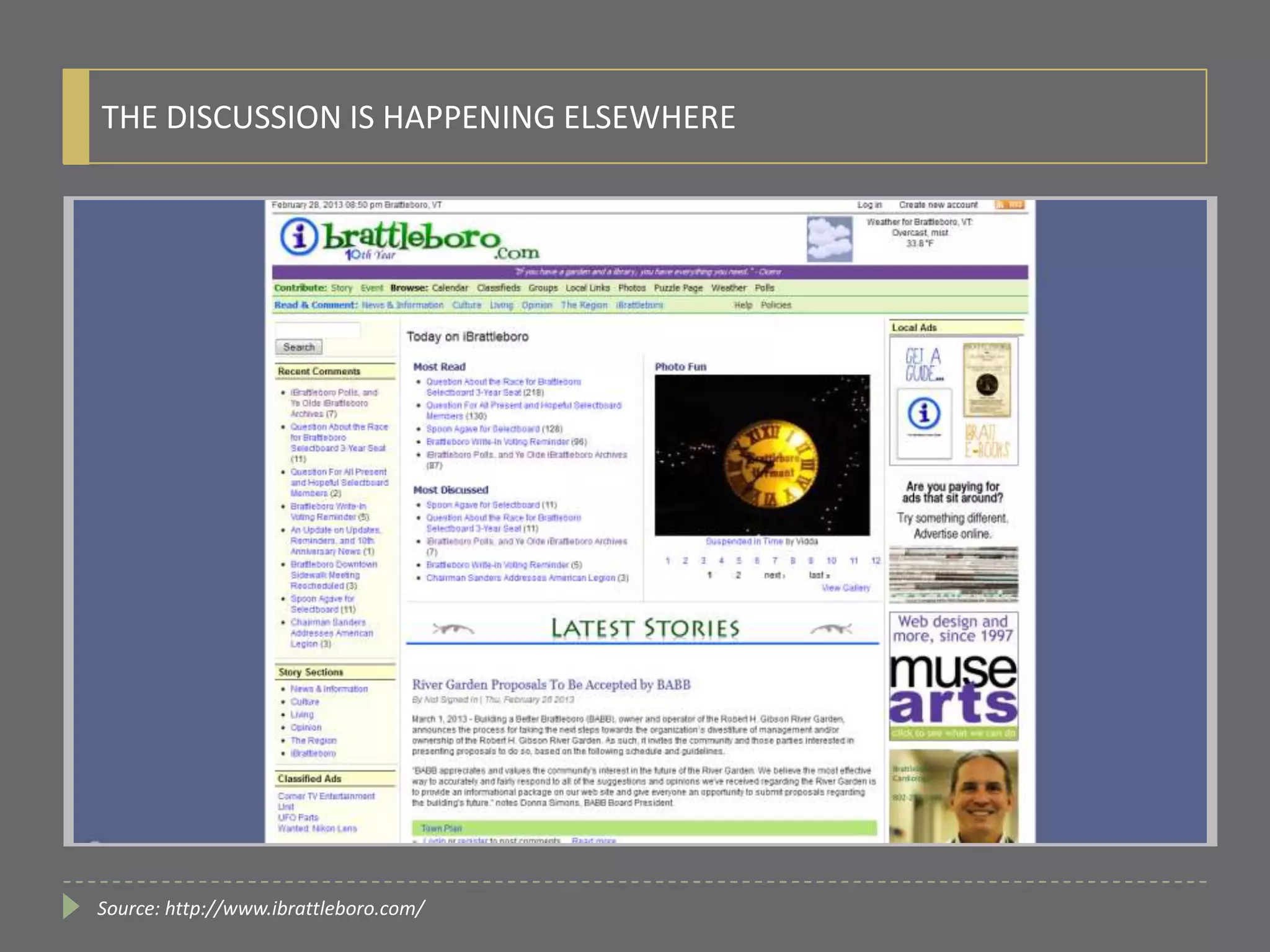
THE DISCUSSION IS HAPPENING ELSEWHERE
Source: http://www.ibrattleboro.com/
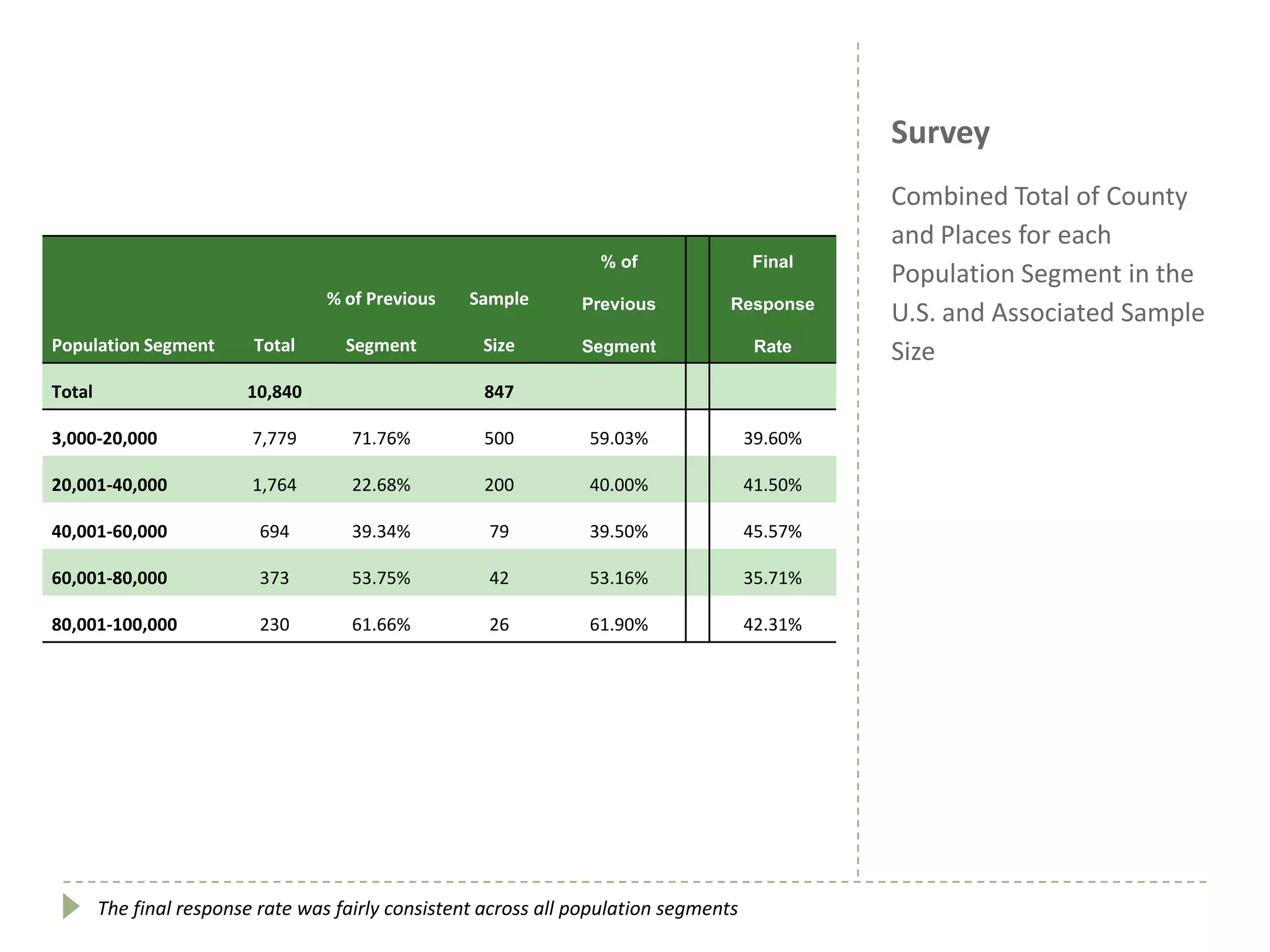
Survey
Combined Total of County
and Places for each
Population Segment in the
U.S. and Associated Sample
SizePopulation Segment Total
% of Previous
Segment
Sample
Size
% of
Previous
Segment
Final
Response
Rate
Total 10,840 847
3,000-20,000 7,779 71.76% 500 59.03% 39.60%
20,001-40,000 1,764 22.68% 200 40.00% 41.50%
40,001-60,000 694 39.34% 79 39.50% 45.57%
60,001-80,000 373 53.75% 42 53.16% 35.71%
80,001-100,000 230 61.66% 26 61.90% 42.31%
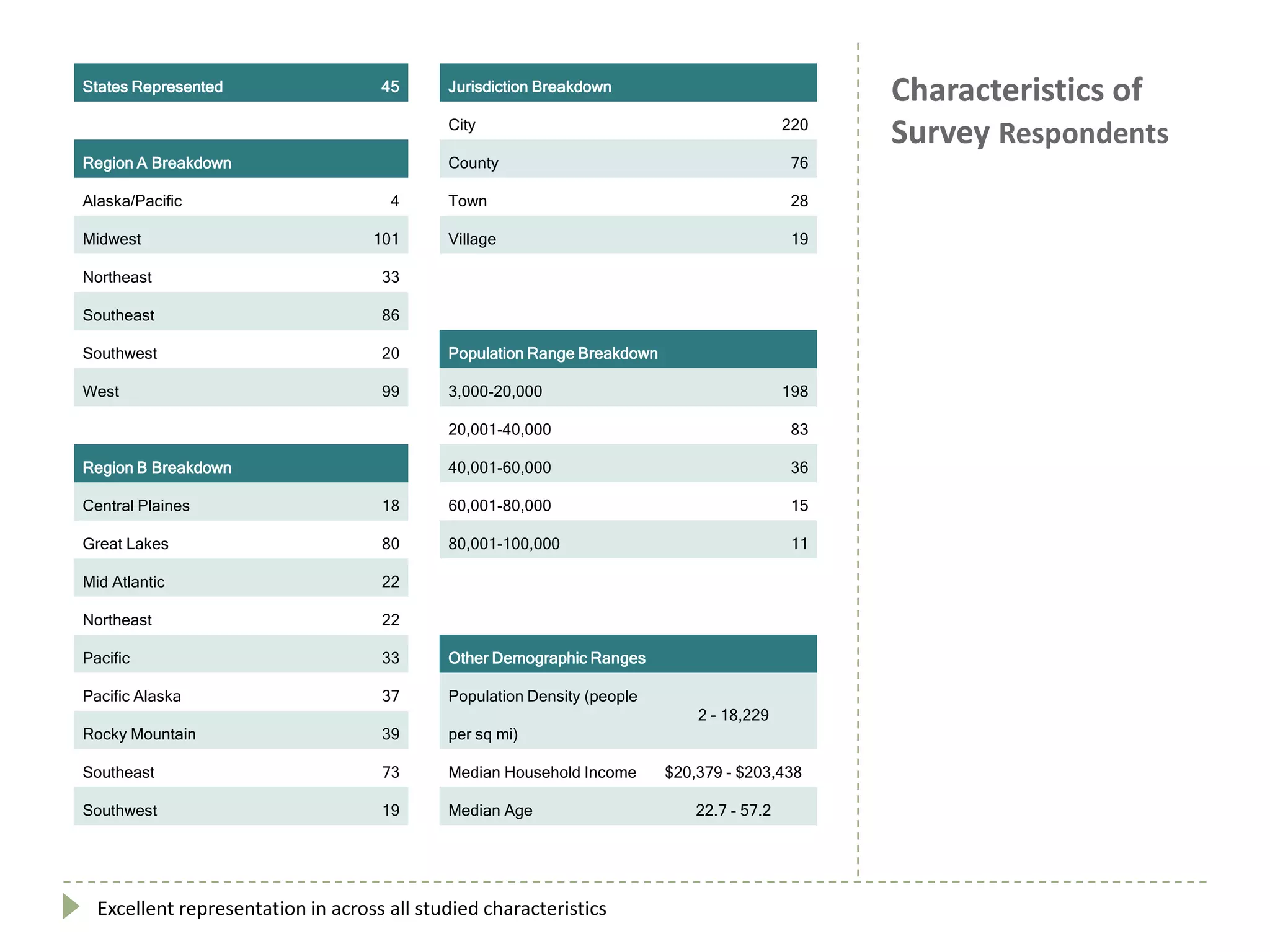
The final response rate was fairly consistent across all population segments
Characteristics of
Survey Respondents
States Represented 45 Jurisdiction Breakdown
City 220
Region A Breakdown County 76
Alaska/Pacific 4 Town 28
Midwest 101 Village 19
Northeast 33
Southeast 86
Southwest 20 Population Range Breakdown
West 99 3,000-20,000 198
20,001-40,000 83
Region B Breakdown 40,001-60,000 36
Central Plaines 18 60,001-80,000 15
Great Lakes 80 80,001-100,000 11
Mid Atlantic 22
Northeast 22
Pacific 33 Other Demographic Ranges
Pacific Alaska 37 Population Density (people
per sq mi)
2 - 18,229
Rocky Mountain 39
Southeast 73 Median Household Income $20,379 - $203,438
Southwest 19 Median Age 22.7 - 57.2
Excellent representation in across all studied characteristics
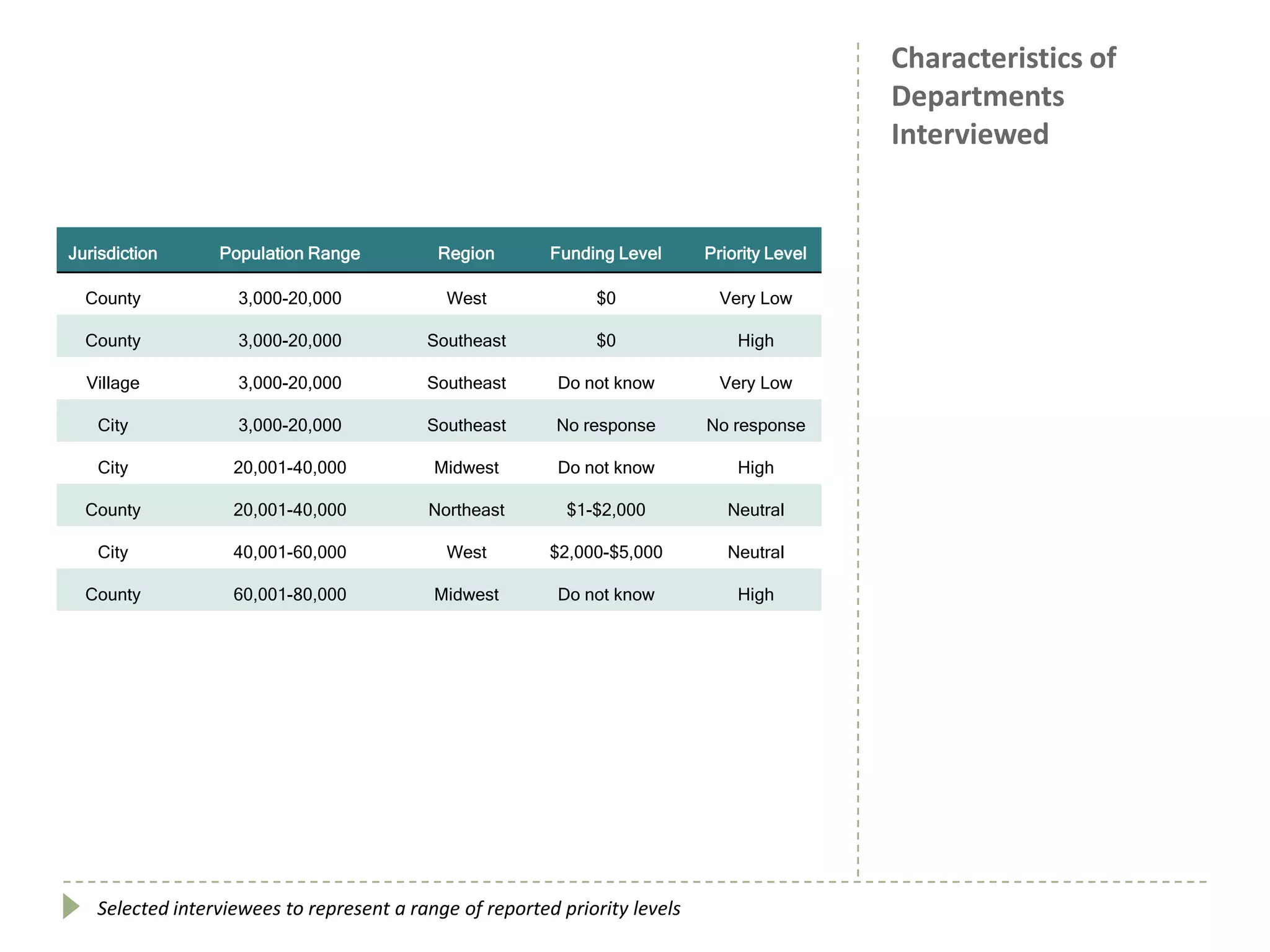
Characteristics of
Departments
Interviewed
Jurisdiction Population Range Region Funding Level Priority Level
County 3,000-20,000 West $0 Very Low
County 3,000-20,000 Southeast $0 High
Village 3,000-20,000 Southeast Do not know Very Low
City 3,000-20,000 Southeast No response No response
City 20,001-40,000 Midwest Do not know High
County 20,001-40,000 Northeast $1-$2,000 Neutral
City 40,001-60,000 West $2,000-$5,000 Neutral
County 60,001-80,000 Midwest Do not know High
Selected interviewees to represent a range of reported priority levels
Survey and Interview Results
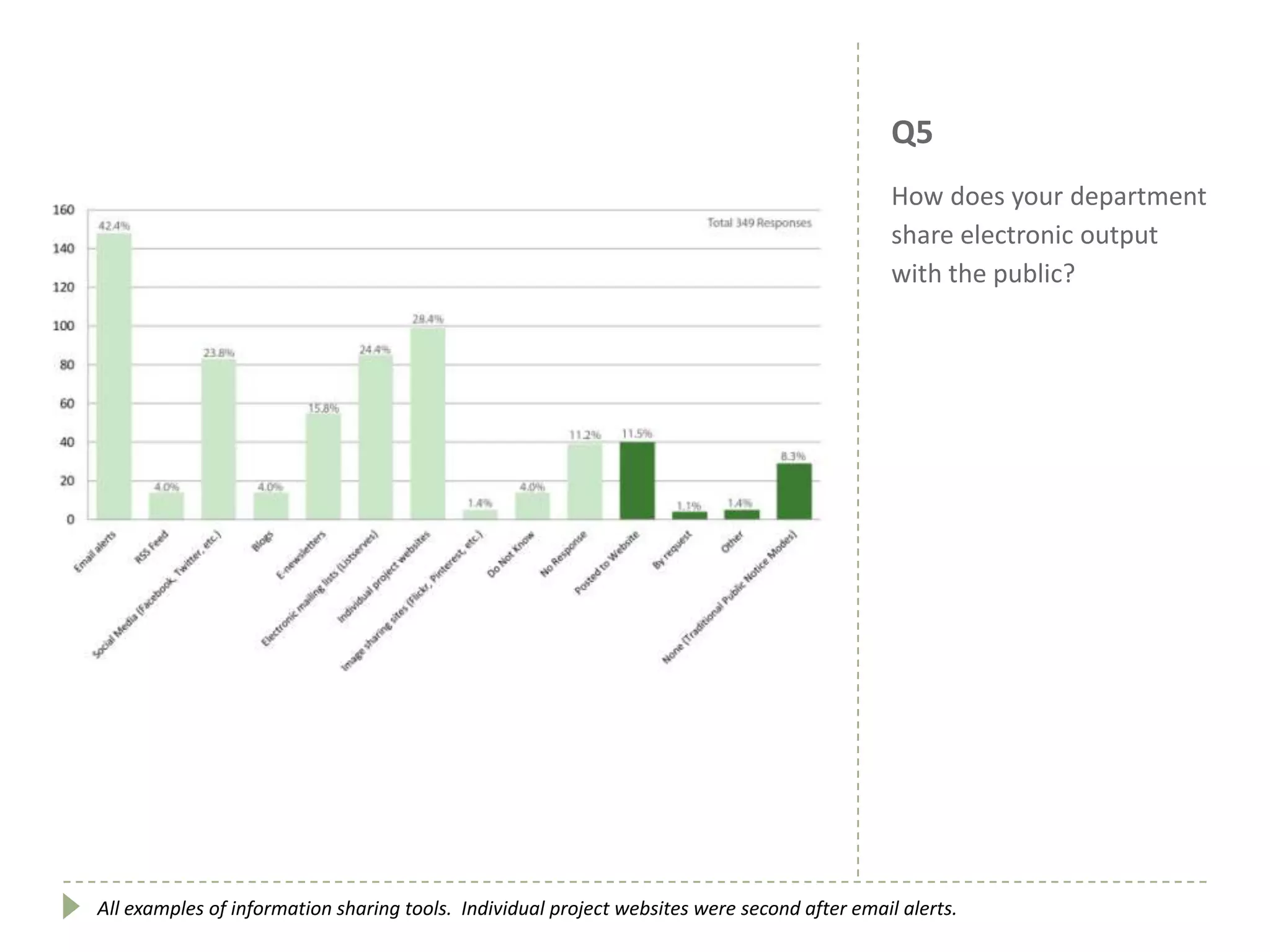
Q5
How does your department
share electronic output
with the public?
All examples of information sharing tools. Individual project websites were second after email alerts.
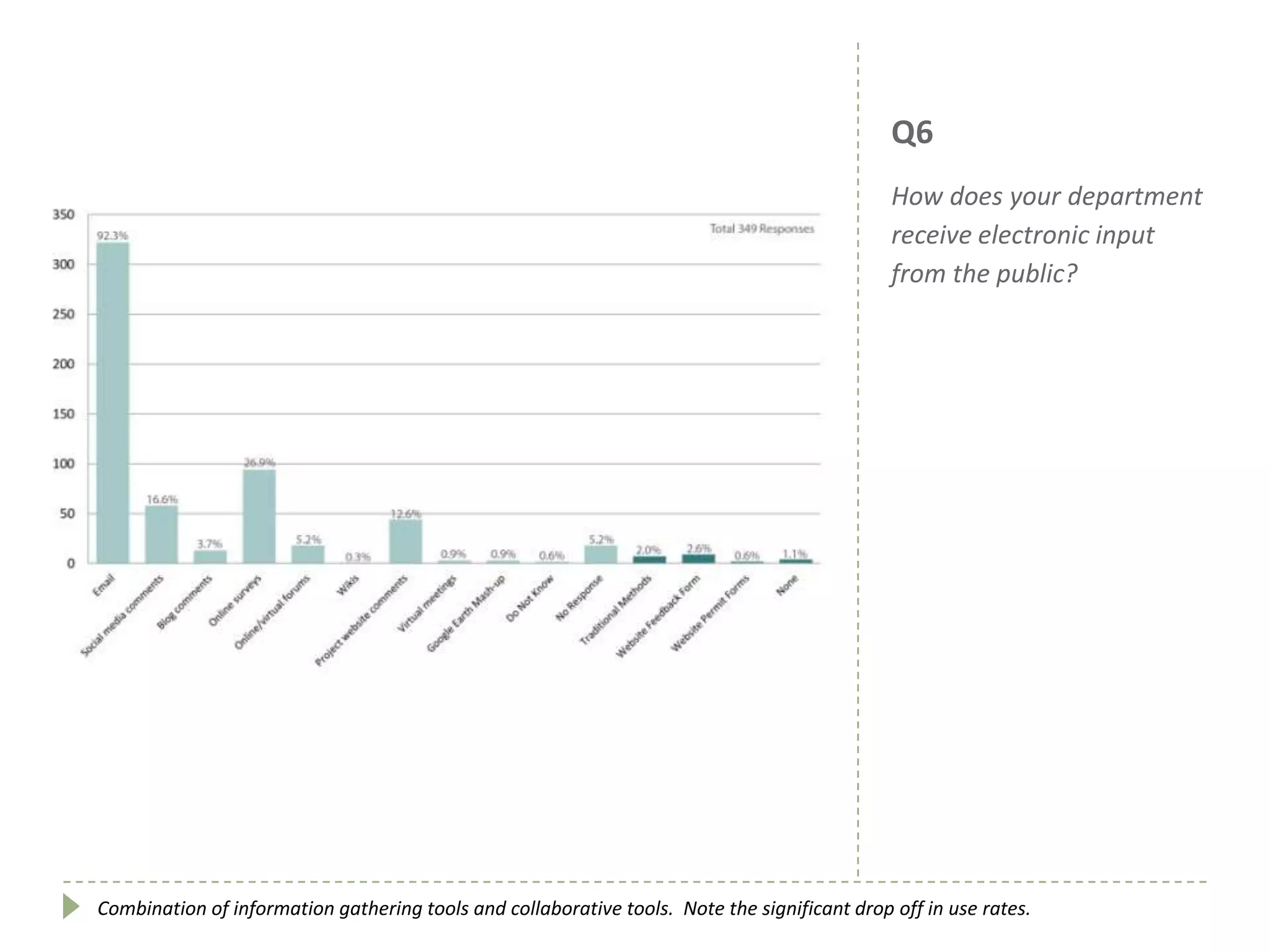
Q6
How does your department
receive electronic input
from the public?
Combination of information gathering tools and collaborative tools. Note the significant drop off in use rates.
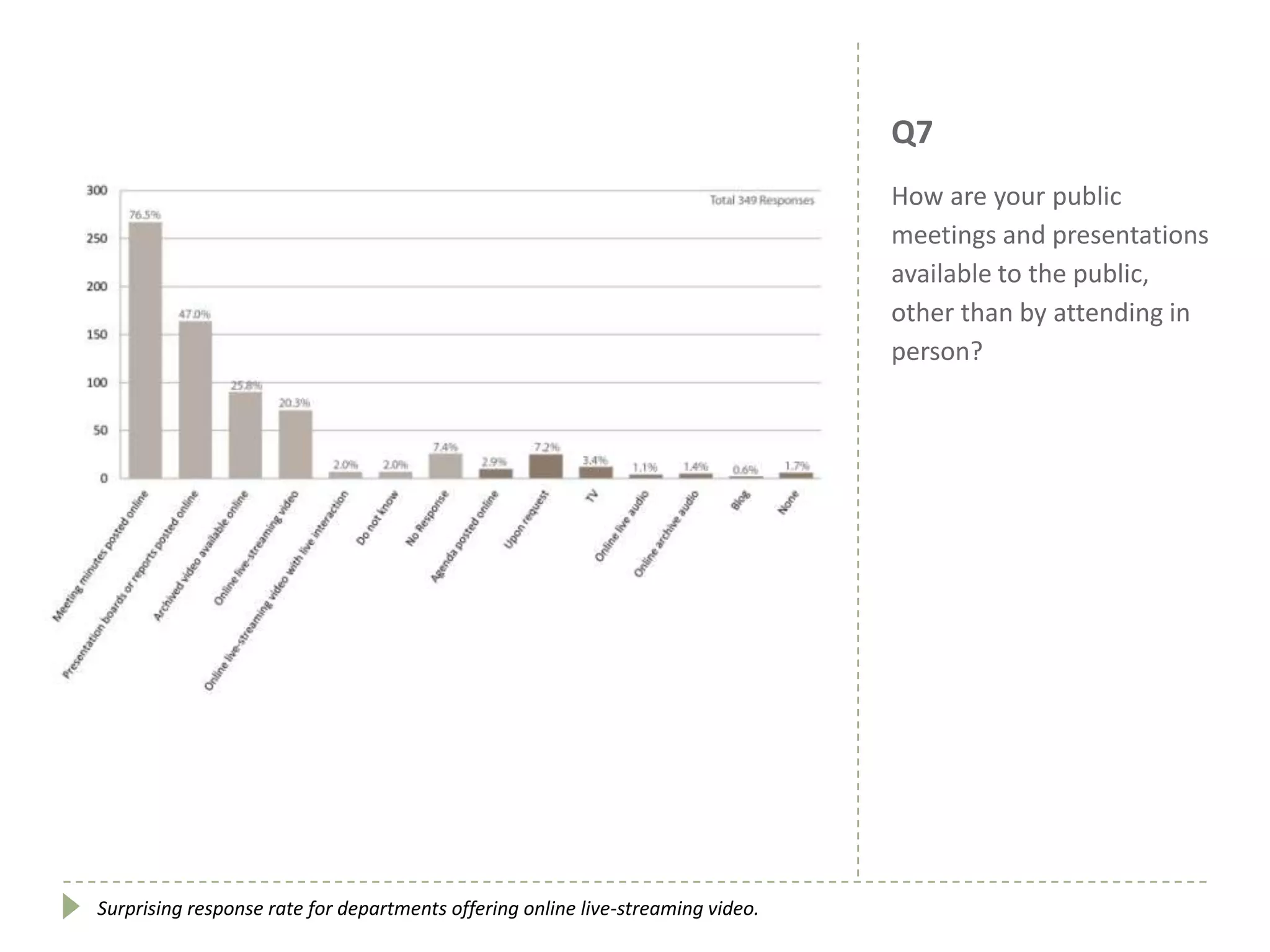
Q7
How are your public
meetings and presentations
available to the public,
other than by attending in
person?
Surprising response rate for departments offering online live-streaming video.
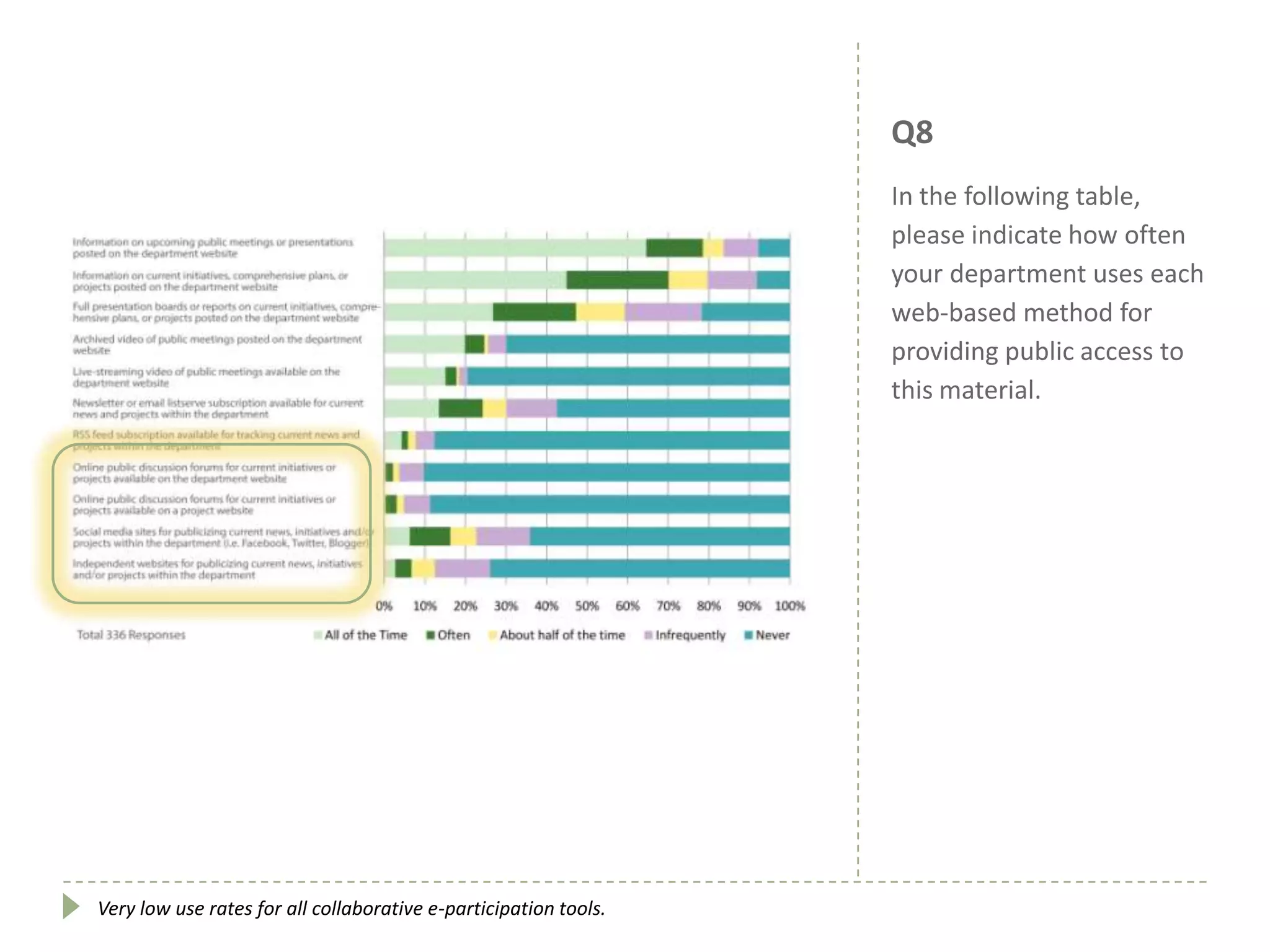
Q8
In the following table,
please indicate how often
your department uses each
web-based method for
providing public access to
this material.
Very low use rates for all collaborative e-participation tools.
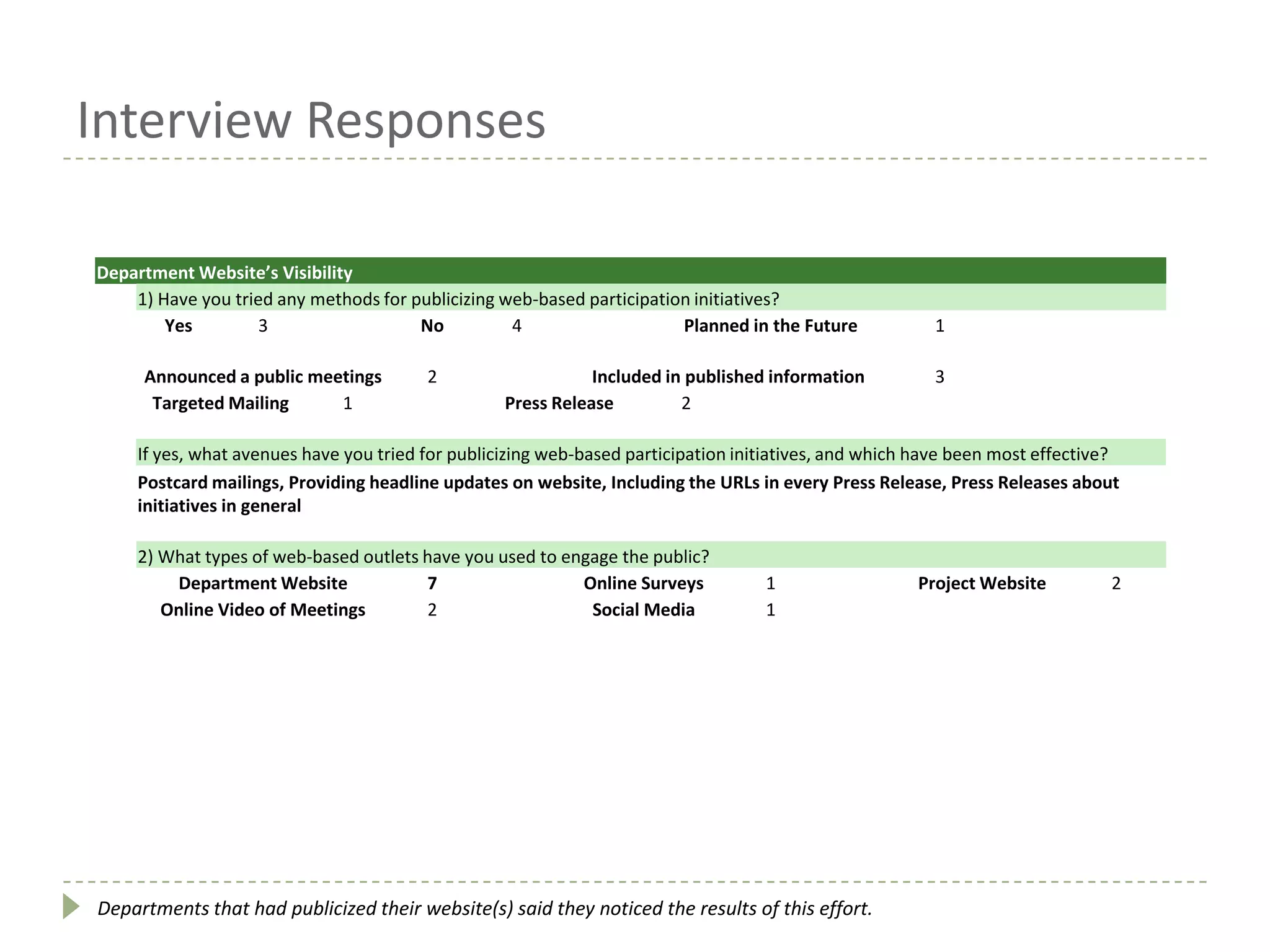
Interview Responses
Department Website’s Visibility
1) Have you tried any methods for publicizing web-based participation initiatives?
Yes 3 No 4 Planned in the Future 1
Announced a public meetings 2 Included in published information 3
Targeted Mailing 1 Press Release 2
If yes, what avenues have you tried for publicizing web-based participation initiatives, and which have been most effective?
Postcard mailings, Providing headline updates on website, Including the URLs in every Press Release, Press Releases about
initiatives in general
2) What types of web-based outlets have you used to engage the public?
Department Website 7 Online Surveys 1 Project Website 2
Online Video of Meetings 2 Social Media 1
Departments that had publicized their website(s) said they noticed the results of this effort.
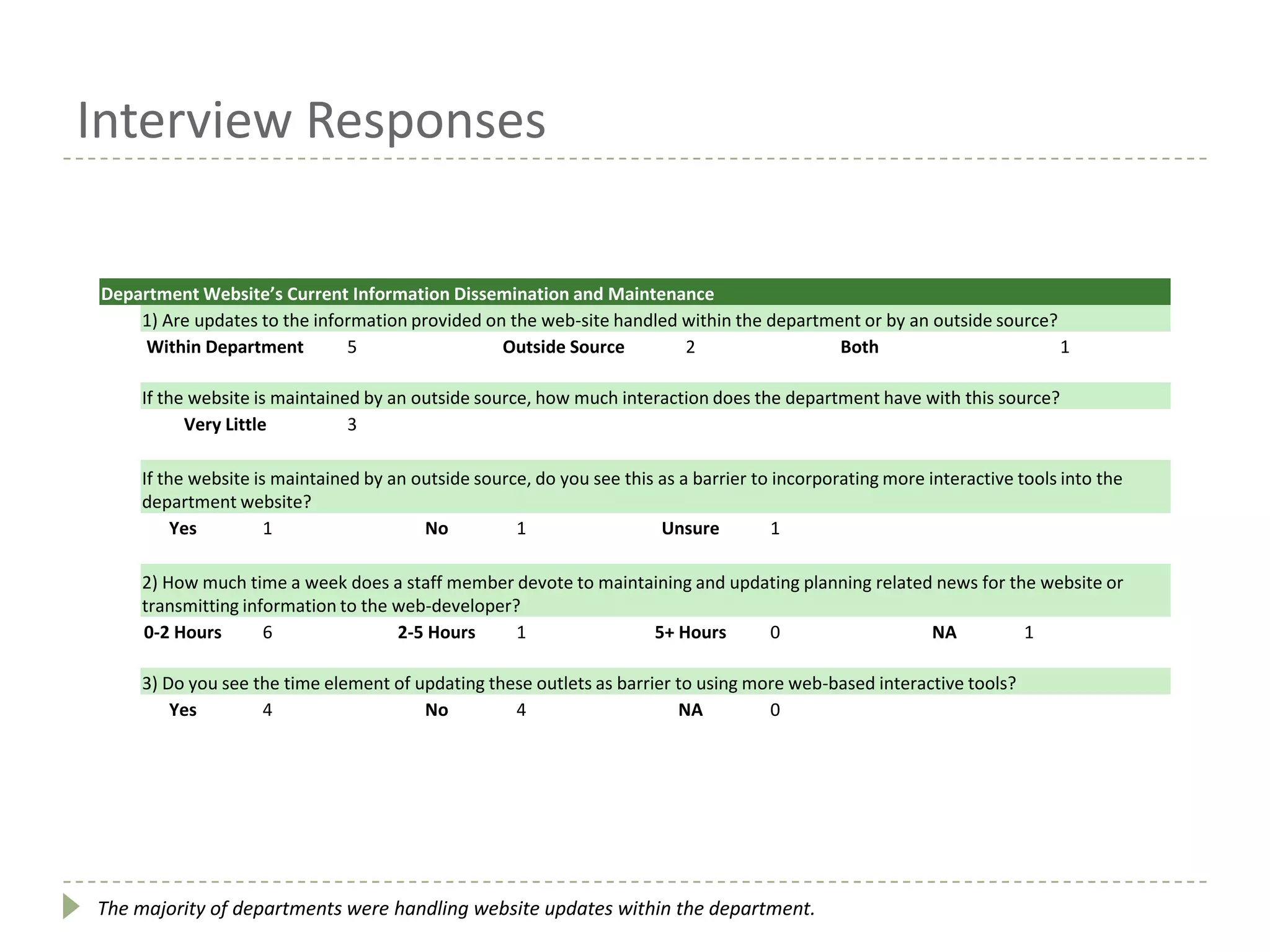
Interview Responses
Department Website’s Current Information Dissemination and Maintenance
1) Are updates to the information provided on the web-site handled within the department or by an outside source?
Within Department 5 Outside Source 2 Both 1
If the website is maintained by an outside source, how much interaction does the department have with this source?
Very Little 3
If the website is maintained by an outside source, do you see this as a barrier to incorporating more interactive tools into the
department website?
Yes 1 No 1 Unsure 1
2) How much time a week does a staff member devote to maintaining and updating planning related news for the website or
transmitting information to the web-developer?
0-2 Hours 6 2-5 Hours 1 5+ Hours 0 NA 1
3) Do you see the time element of updating these outlets as barrier to using more web-based interactive tools?
Yes 4 No 4 NA 0
The majority of departments were handling website updates within the department.
Interview Responses
External Barriers to Web-based Interactive Tools
1) According to the Pew Research Center Study on Online Government conducted in 2009, “Two in five home broadband users
(39%) prefer online contact when trying to reach government, compared with 23% of home dial-up users.”[1] Do you know how
many residents within your community have broadband access?
50% or Greater 2 Less than 50% 3 Do not know 3
Do you see this as a limiting factor for engaging the public through online tools?
Yes 6 No 2
2) Are there language or disability barriers for residents using the tools on the department’s website?
Language Barriers Disability Barriers
Yes 7 No 1 Yes 0 No 4
Do not know 0 Do not know 4
3) Have you encountered learning curve issues for individuals wishing to use available interactive tools?
Yes 6 No 2 Do not know
Note: Most departments made reference to the fact that their population consisted of a large elderly population when
discussing learning curve issues of interactive tools.
Interview Response
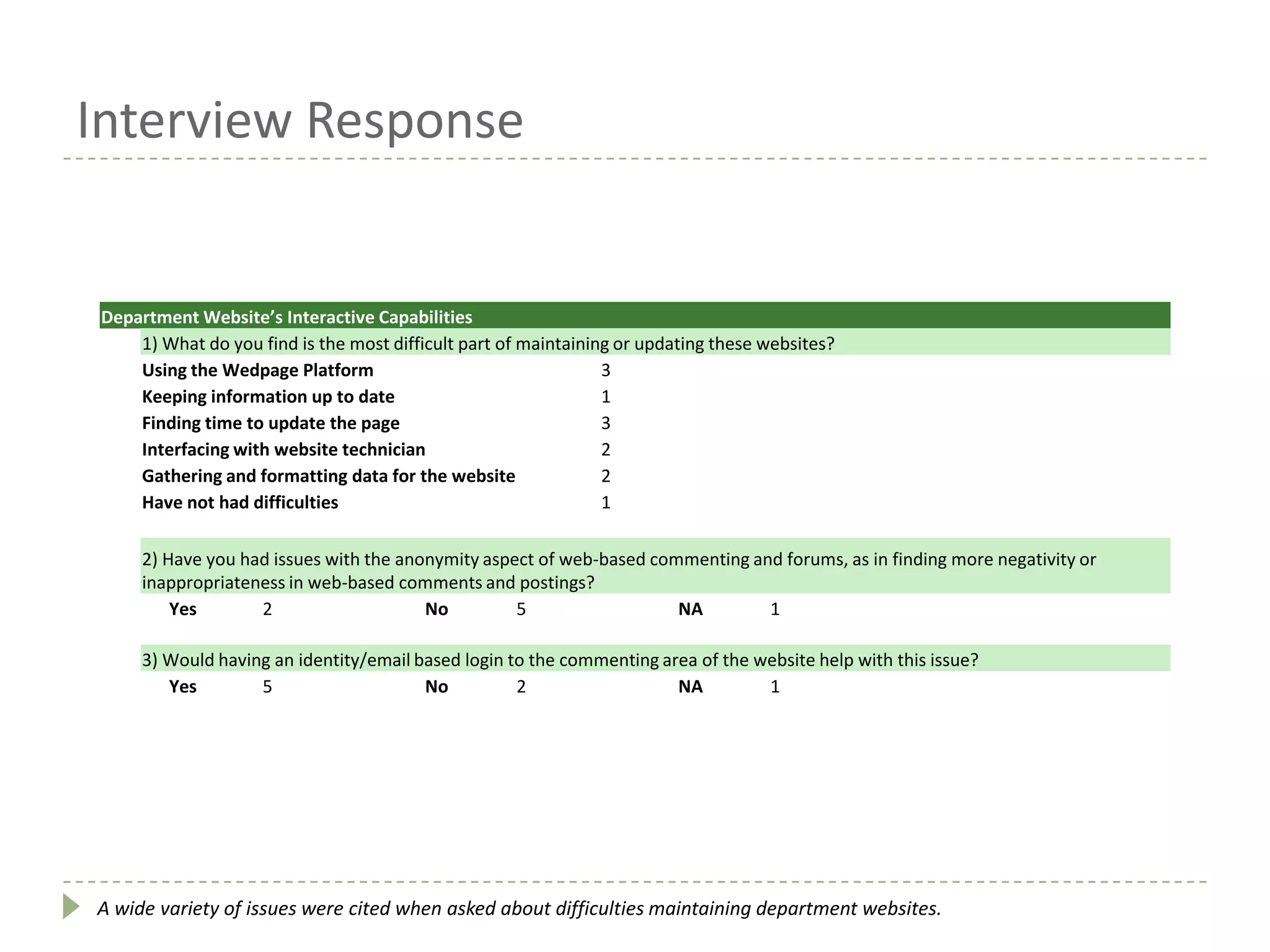
Department Website’s Interactive Capabilities
1) What do you find is the most difficult part of maintaining or updating these websites?
Using the Wedpage Platform 3
Keeping information up to date 1
Finding time to update the page 3
Interfacing with website technician 2
Gathering and formatting data for the website 2
Have not had difficulties 1
2) Have you had issues with the anonymity aspect of web-based commenting and forums, as in finding more negativity or
inappropriateness in web-based comments and postings?
Yes 2 No 5 NA 1
3) Would having an identity/email based login to the commenting area of the website help with this issue?
Yes 5 No 2 NA 1
A wide variety of issues were cited when asked about difficulties maintaining department websites.
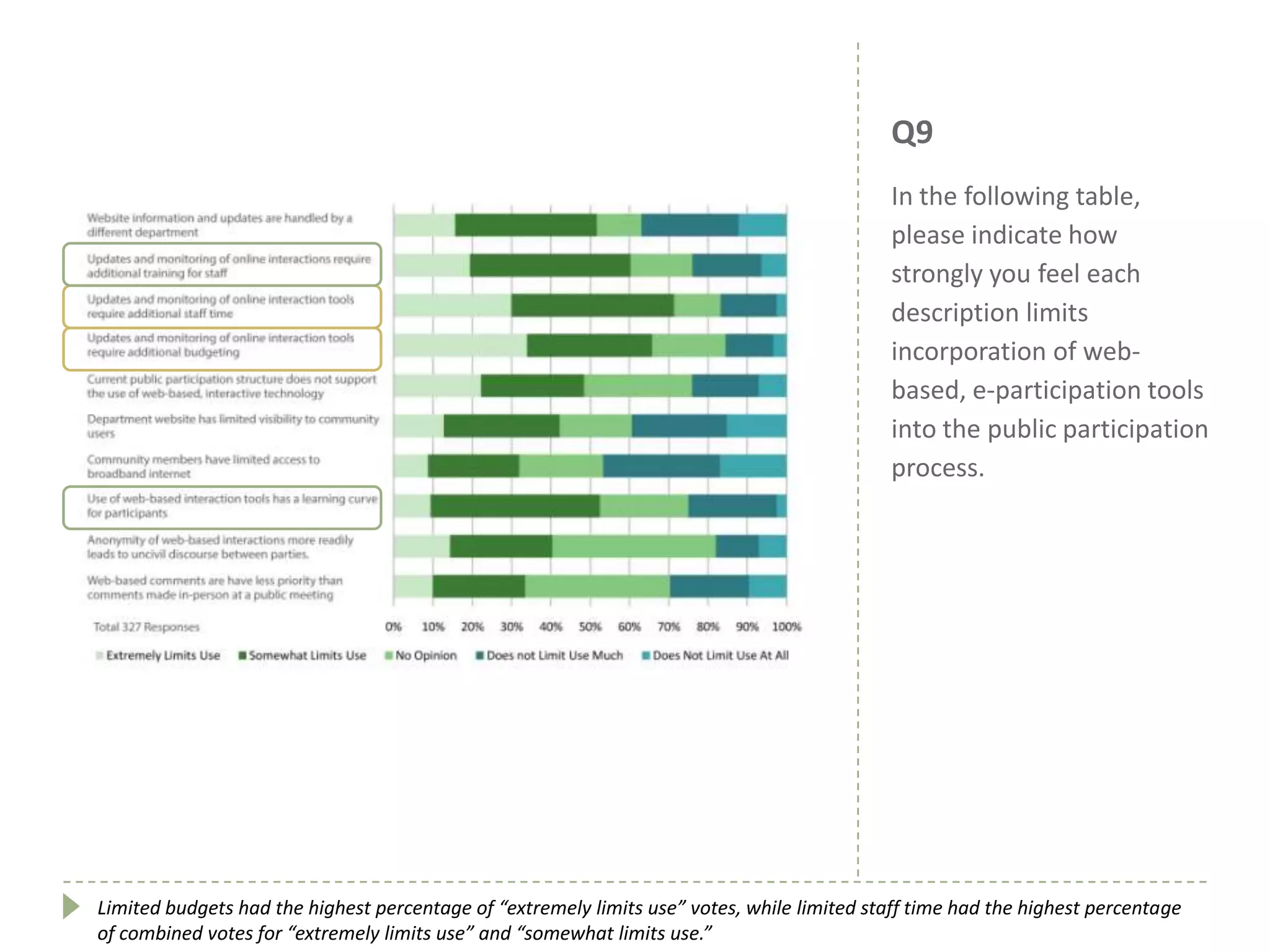
Q9
In the following table,
please indicate how
strongly you feel each
description limits
incorporation of web-
based, e-participation tools
into the public participation
process.
Limited budgets had the highest percentage of “extremely limits use” votes, while limited staff time had the highest percentage
of combined votes for “extremely limits use” and “somewhat limits use.”
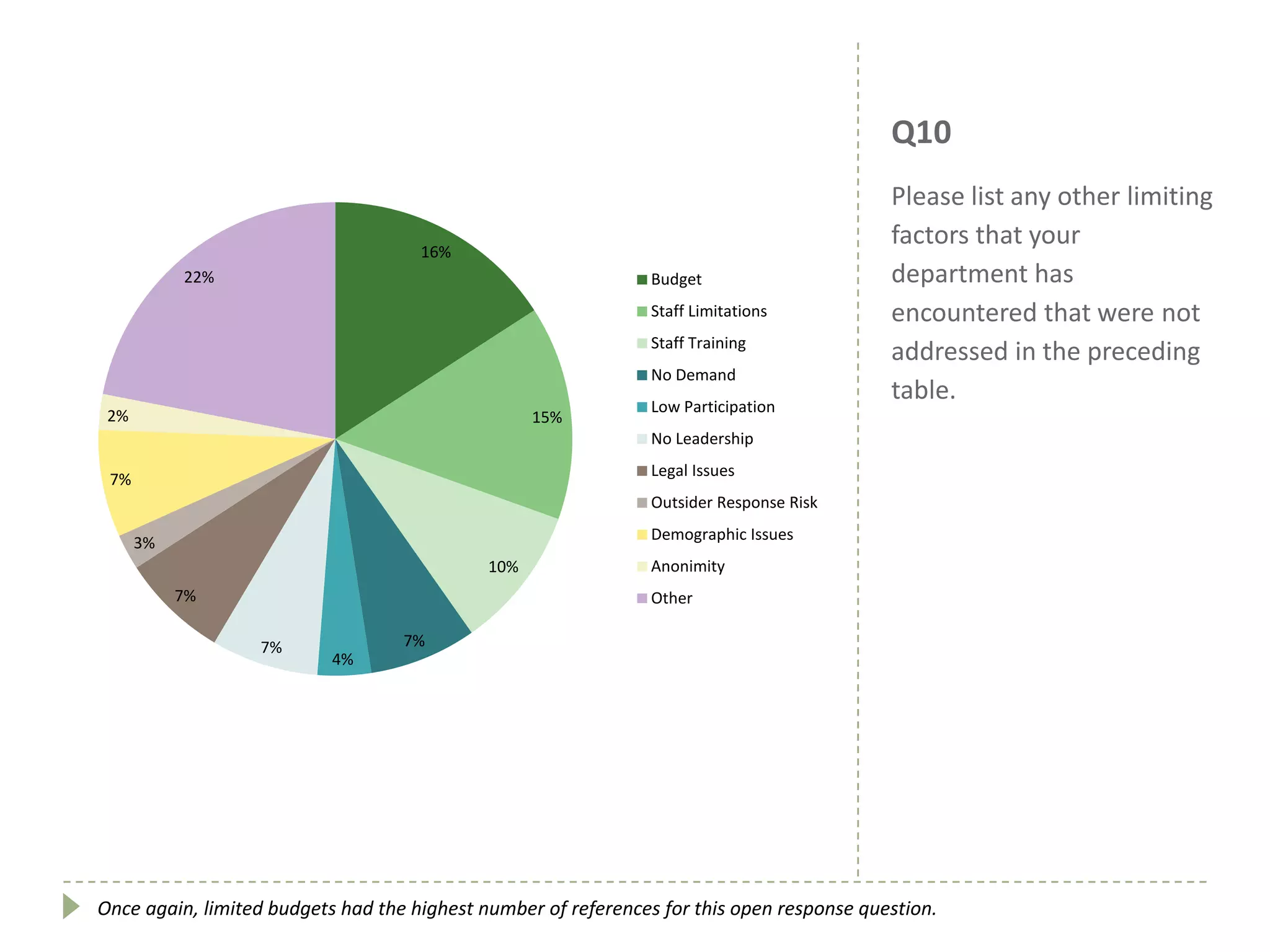
Q10
Please list any other limiting
factors that your
department has
encountered that were not
addressed in the preceding
table.
16%
15%
10%
7%
4%
7%
7%
3%
7%
2%
22% Budget
Staff Limitations
Staff Training
No Demand
Low Participation
No Leadership
Legal Issues
Outsider Response Risk
Demographic Issues
Anonimity
Other
Once again, limited budgets had the highest number of references for this open response question.
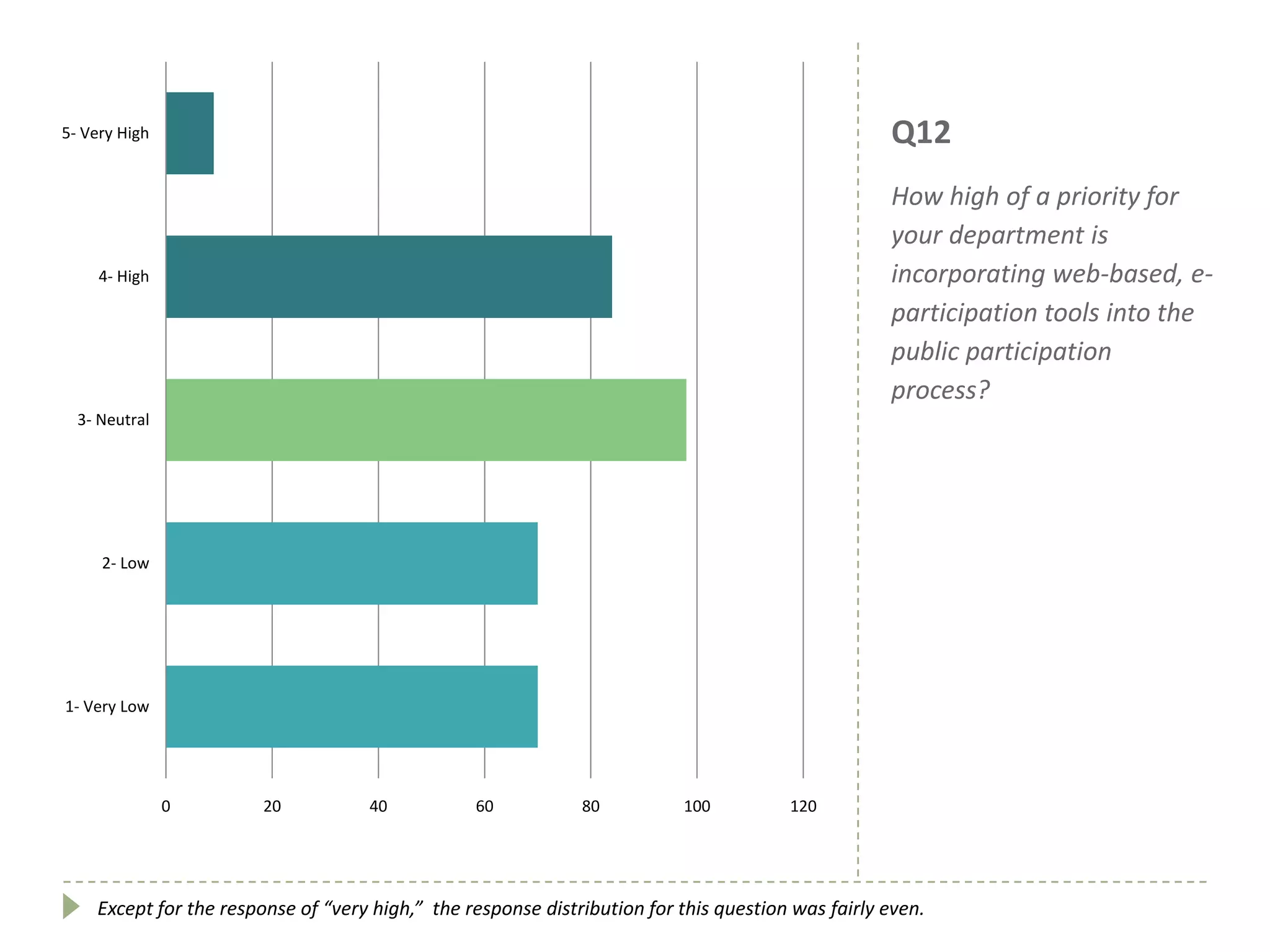
Q12
How high of a priority for
your department is
incorporating web-based, e-
participation tools into the
public participation
process?
0 20 40 60 80 100 120
1- Very Low
2- Low
3- Neutral
4- High
5- Very High
Except for the response of “very high,” the response distribution for this question was fairly even.
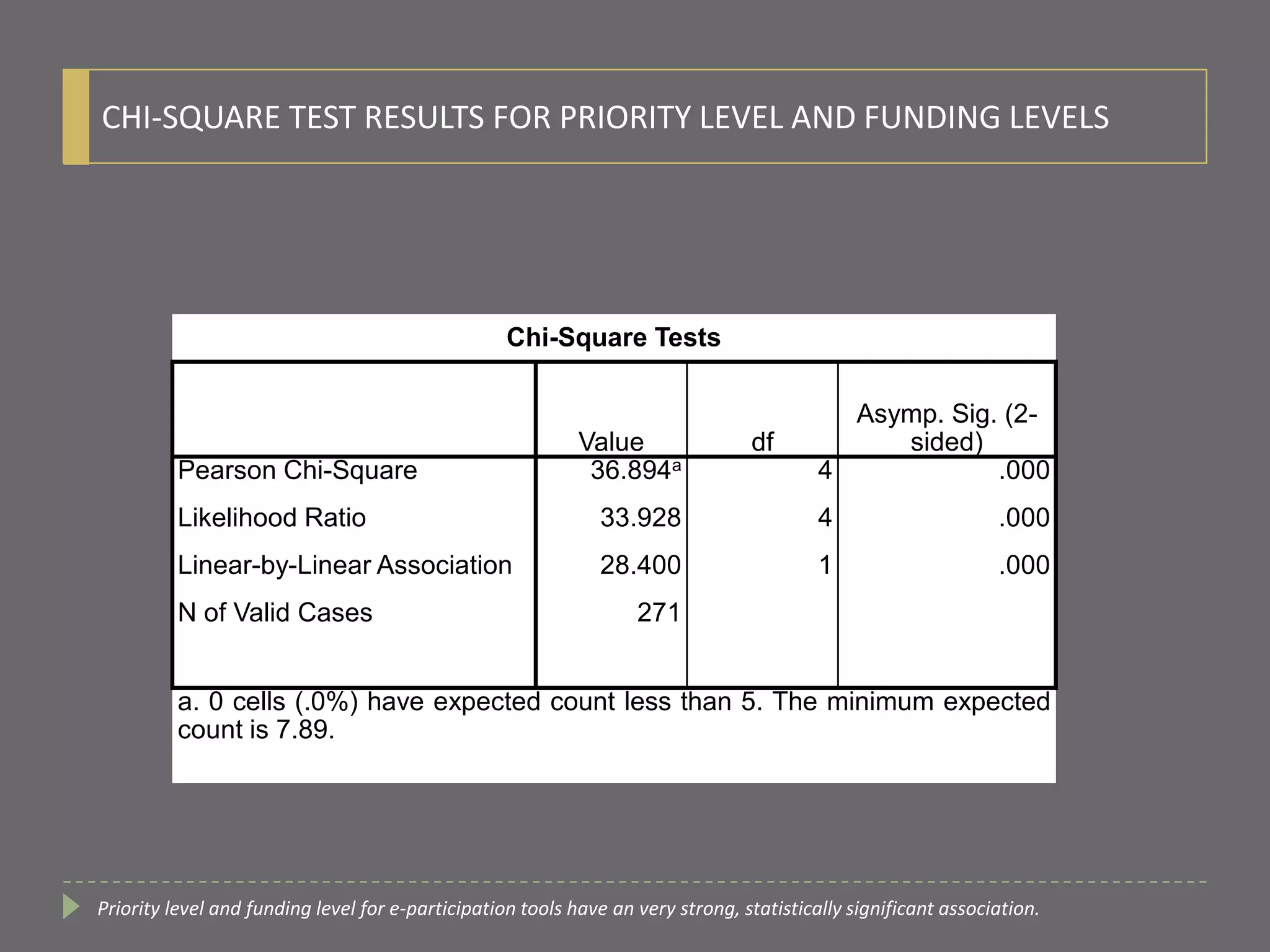
CHI-SQUARE TEST RESULTS FOR PRIORITY LEVEL AND FUNDING LEVELS
Chi-Square Tests
Value df
Asymp. Sig. (2-
sided)
Pearson Chi-Square 36.894a 4 .000
Likelihood Ratio 33.928 4 .000
Linear-by-Linear Association 28.400 1 .000
N of Valid Cases 271
a. 0 cells (.0%) have expected count less than 5. The minimum expected
count is 7.89.
Priority level and funding level for e-participation tools have an very strong, statistically significant association.
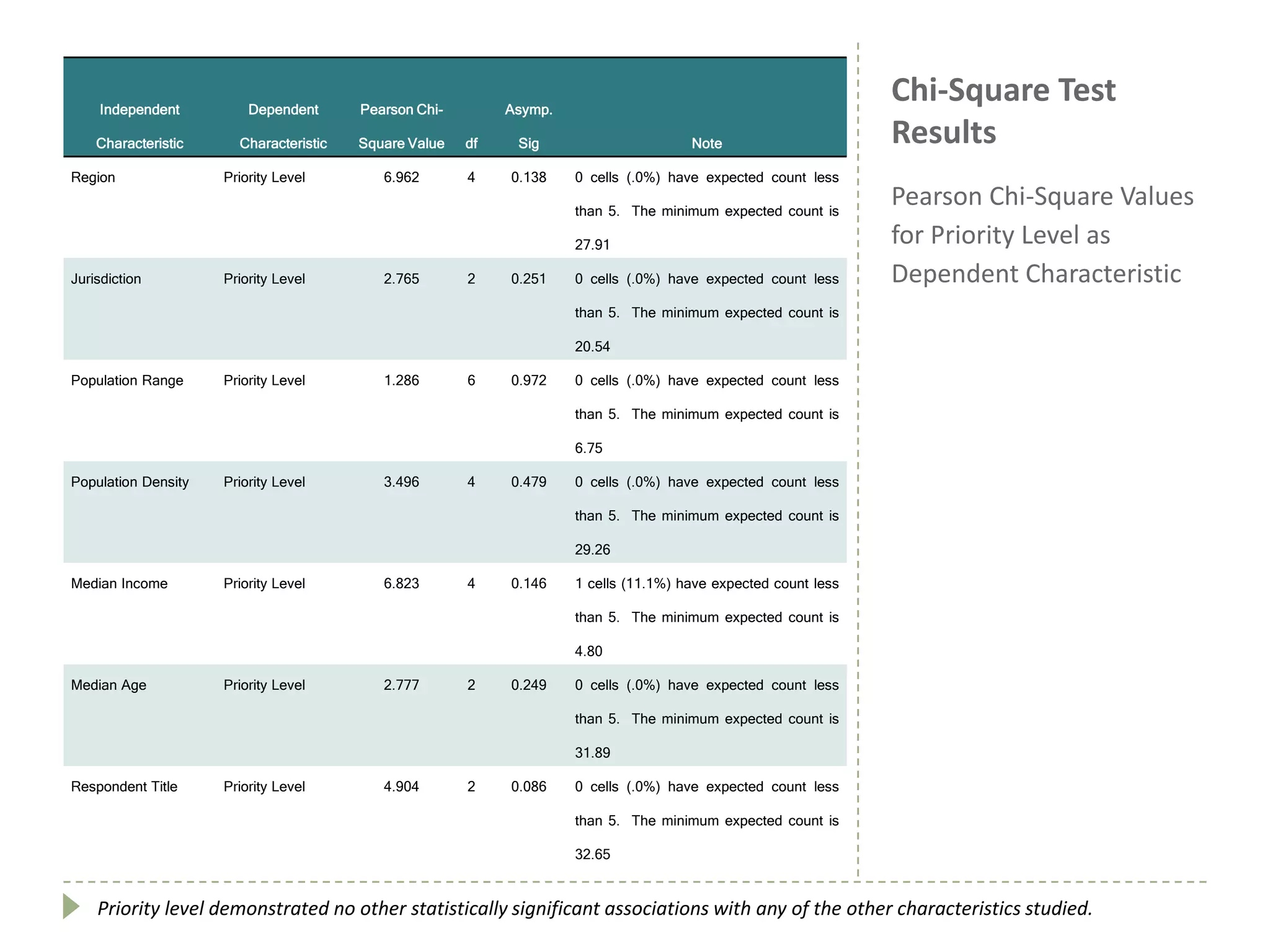
Chi-Square Test
Results
Pearson Chi-Square Values
for Priority Level as
Dependent Characteristic
Independent
Characteristic
Dependent
Characteristic
Pearson Chi-
Square Value df
Asymp.
Sig Note
Region Priority Level 6.962 4 0.138 0 cells (.0%) have expected count less
than 5. The minimum expected count is
27.91
Jurisdiction Priority Level 2.765 2 0.251 0 cells (.0%) have expected count less
than 5. The minimum expected count is
20.54
Population Range Priority Level 1.286 6 0.972 0 cells (.0%) have expected count less
than 5. The minimum expected count is
6.75
Population Density Priority Level 3.496 4 0.479 0 cells (.0%) have expected count less
than 5. The minimum expected count is
29.26
Median Income Priority Level 6.823 4 0.146 1 cells (11.1%) have expected count less
than 5. The minimum expected count is
4.80
Median Age Priority Level 2.777 2 0.249 0 cells (.0%) have expected count less
than 5. The minimum expected count is
31.89
Respondent Title Priority Level 4.904 2 0.086 0 cells (.0%) have expected count less
than 5. The minimum expected count is
32.65
Priority level demonstrated no other statistically significant associations with any of the other characteristics studied.
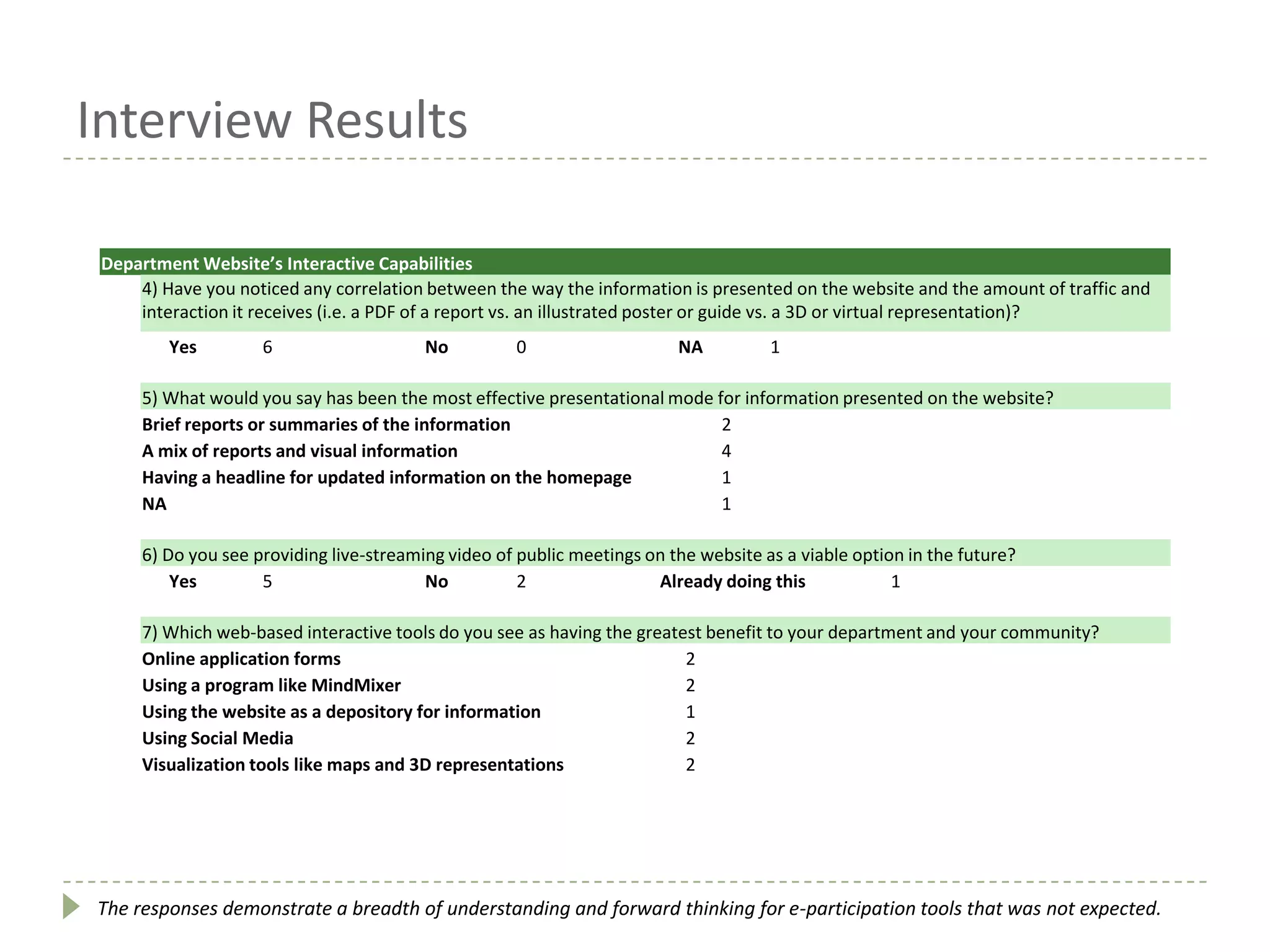
Interview Results
Department Website’s Interactive Capabilities
4) Have you noticed any correlation between the way the information is presented on the website and the amount of traffic and
interaction it receives (i.e. a PDF of a report vs. an illustrated poster or guide vs. a 3D or virtual representation)?
Yes 6 No 0 NA 1
5) What would you say has been the most effective presentational mode for information presented on the website?
Brief reports or summaries of the information 2
A mix of reports and visual information 4
Having a headline for updated information on the homepage 1
NA 1
6) Do you see providing live-streaming video of public meetings on the website as a viable option in the future?
Yes 5 No 2 Already doing this 1
7) Which web-based interactive tools do you see as having the greatest benefit to your department and your community?
Online application forms 2
Using a program like MindMixer 2
Using the website as a depository for information 1
Using Social Media 2
Visualization tools like maps and 3D representations 2
The responses demonstrate a breadth of understanding and forward thinking for e-participation tools that was not expected.
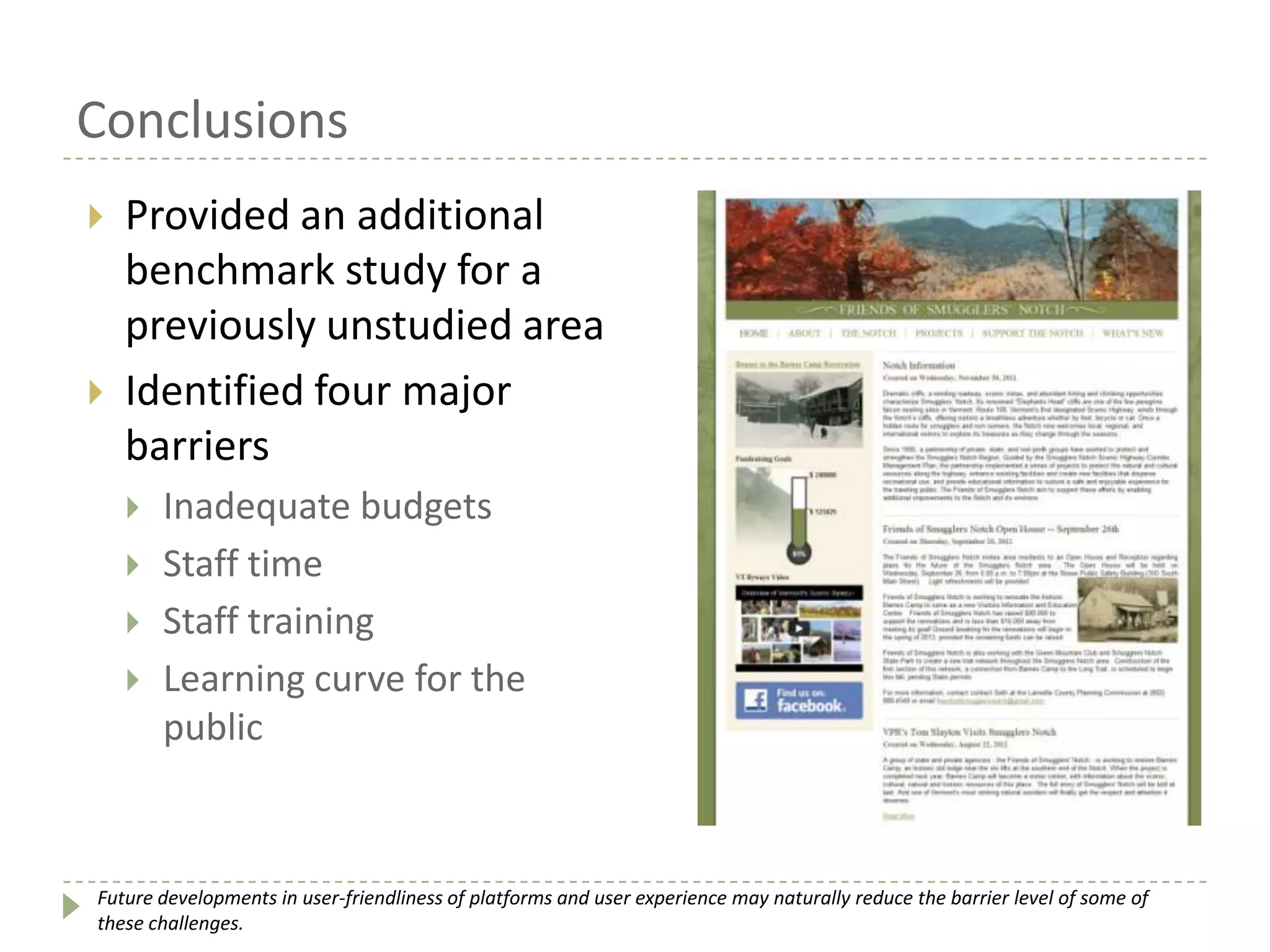
Conclusions
 Provided an additional
benchmark study for a
previously unstudied area
 Identified four major
barriers
 Inadequate budgets
 Staff time
 Staff training
 Learning curve for the
public
Future developments in user-friendliness of platforms and user experience may naturally reduce the barrier level of some of
these challenges.
Conclusions
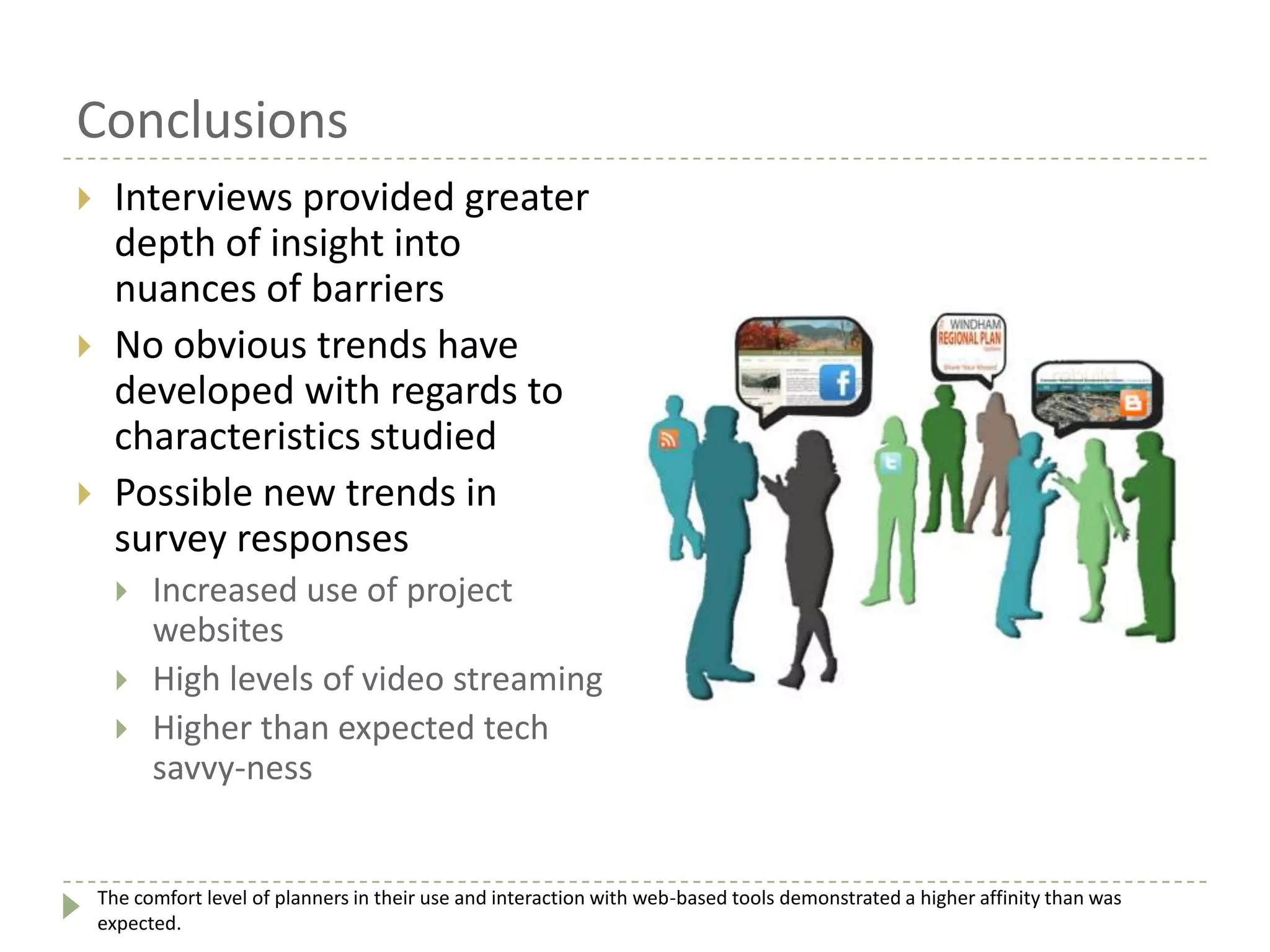
 Interviews provided greater
depth of insight into
nuances of barriers
 No obvious trends have
developed with regards to
characteristics studied
 Possible new trends in
survey responses
 Increased use of project
websites
 High levels of video streaming
 Higher than expected tech
savvy-ness
The comfort level of planners in their use and interaction with web-based tools demonstrated a higher affinity than was
expected.
Where’s the disconnect? Analyzing barriers to web-based e-participation tools for planning

Where’s the disconnect? Analyzing barriers to web-based e-participation tools for planning

  • 1.
    Where’s the Disconnect? Analyzingbarriers to web-based e-participation tools for planning Cullen Meves
  • 2.
    Research Purpose andGoals  Track current use of e-participation tools in planning  Planning & Community Development Departments serving populations of 100,000 or less  Benchmark study of which tools and how often  Identify barriers to further incorporation of e- participation tools  Barriers identified through literature review, personal experience, and survey/interview responses  Solutions suggested based on research, interview response, and personal experience
  • 3.
    Research Purpose andGoals  Identify trends for how e-participation tools are being utilized based on:  Population size  Regional location  Level of government  Population density  Mean age of population  Median age of population
  • 4.
    Research Methods  LiteratureReview  Extensive review of benchmark studies  Online Survey  349 respondents  Phone Interviews  8 respondents  Survey Results Analysis  Included Chi Square Test Analysis Source: Image created by C. Meves
  • 5.
    e-Participation: Information SharingTools Source: http://www.archuletacounty.org/index.aspx?nid=93
  • 6.
    e-Participation: Information GatheringTools Source: http://www.hawaiicountycdp.info/puna-cdp/take-the-pahoa-regional-town-center-plan-online-survey-here
  • 7.
    e-Participation: Collaborative Tools Source:http://speakupaustin.org/ideas
  • 8.
    Information and Servicesavailable on Planning Department Websites Source: (Evans-Cowley et al., 2011)
  • 9.
    Growth Patterns ofSelected Web 2.0 Developments Source: (Pascu et al., 2008)
  • 10.
    GROWTH PATTERNS OFPEER-TO-PEER TECHNOLOGIES Planning Departments need to be involved in the dialogue. Source: (Pascu et al., 2008)
  • 11.
    THE DISCUSSION ISHAPPENING ELSEWHERE Source: http://www.ibrattleboro.com/
  • 12.
    Survey Combined Total ofCounty and Places for each Population Segment in the U.S. and Associated Sample SizePopulation Segment Total % of Previous Segment Sample Size % of Previous Segment Final Response Rate Total 10,840 847 3,000-20,000 7,779 71.76% 500 59.03% 39.60% 20,001-40,000 1,764 22.68% 200 40.00% 41.50% 40,001-60,000 694 39.34% 79 39.50% 45.57% 60,001-80,000 373 53.75% 42 53.16% 35.71% 80,001-100,000 230 61.66% 26 61.90% 42.31% The final response rate was fairly consistent across all population segments
  • 13.
    Characteristics of Survey Respondents StatesRepresented 45 Jurisdiction Breakdown City 220 Region A Breakdown County 76 Alaska/Pacific 4 Town 28 Midwest 101 Village 19 Northeast 33 Southeast 86 Southwest 20 Population Range Breakdown West 99 3,000-20,000 198 20,001-40,000 83 Region B Breakdown 40,001-60,000 36 Central Plaines 18 60,001-80,000 15 Great Lakes 80 80,001-100,000 11 Mid Atlantic 22 Northeast 22 Pacific 33 Other Demographic Ranges Pacific Alaska 37 Population Density (people per sq mi) 2 - 18,229 Rocky Mountain 39 Southeast 73 Median Household Income $20,379 - $203,438 Southwest 19 Median Age 22.7 - 57.2 Excellent representation in across all studied characteristics
  • 14.
    Characteristics of Departments Interviewed Jurisdiction PopulationRange Region Funding Level Priority Level County 3,000-20,000 West $0 Very Low County 3,000-20,000 Southeast $0 High Village 3,000-20,000 Southeast Do not know Very Low City 3,000-20,000 Southeast No response No response City 20,001-40,000 Midwest Do not know High County 20,001-40,000 Northeast $1-$2,000 Neutral City 40,001-60,000 West $2,000-$5,000 Neutral County 60,001-80,000 Midwest Do not know High Selected interviewees to represent a range of reported priority levels
  • 15.
  • 16.
    Q5 How does yourdepartment share electronic output with the public? All examples of information sharing tools. Individual project websites were second after email alerts.
  • 17.
    Q6 How does yourdepartment receive electronic input from the public? Combination of information gathering tools and collaborative tools. Note the significant drop off in use rates.
  • 18.
    Q7 How are yourpublic meetings and presentations available to the public, other than by attending in person? Surprising response rate for departments offering online live-streaming video.
  • 19.
    Q8 In the followingtable, please indicate how often your department uses each web-based method for providing public access to this material. Very low use rates for all collaborative e-participation tools.
  • 20.
    Interview Responses Department Website’sVisibility 1) Have you tried any methods for publicizing web-based participation initiatives? Yes 3 No 4 Planned in the Future 1 Announced a public meetings 2 Included in published information 3 Targeted Mailing 1 Press Release 2 If yes, what avenues have you tried for publicizing web-based participation initiatives, and which have been most effective? Postcard mailings, Providing headline updates on website, Including the URLs in every Press Release, Press Releases about initiatives in general 2) What types of web-based outlets have you used to engage the public? Department Website 7 Online Surveys 1 Project Website 2 Online Video of Meetings 2 Social Media 1 Departments that had publicized their website(s) said they noticed the results of this effort.
  • 21.
    Interview Responses Department Website’sCurrent Information Dissemination and Maintenance 1) Are updates to the information provided on the web-site handled within the department or by an outside source? Within Department 5 Outside Source 2 Both 1 If the website is maintained by an outside source, how much interaction does the department have with this source? Very Little 3 If the website is maintained by an outside source, do you see this as a barrier to incorporating more interactive tools into the department website? Yes 1 No 1 Unsure 1 2) How much time a week does a staff member devote to maintaining and updating planning related news for the website or transmitting information to the web-developer? 0-2 Hours 6 2-5 Hours 1 5+ Hours 0 NA 1 3) Do you see the time element of updating these outlets as barrier to using more web-based interactive tools? Yes 4 No 4 NA 0 The majority of departments were handling website updates within the department.
  • 22.
    Interview Responses External Barriersto Web-based Interactive Tools 1) According to the Pew Research Center Study on Online Government conducted in 2009, “Two in five home broadband users (39%) prefer online contact when trying to reach government, compared with 23% of home dial-up users.”[1] Do you know how many residents within your community have broadband access? 50% or Greater 2 Less than 50% 3 Do not know 3 Do you see this as a limiting factor for engaging the public through online tools? Yes 6 No 2 2) Are there language or disability barriers for residents using the tools on the department’s website? Language Barriers Disability Barriers Yes 7 No 1 Yes 0 No 4 Do not know 0 Do not know 4 3) Have you encountered learning curve issues for individuals wishing to use available interactive tools? Yes 6 No 2 Do not know Note: Most departments made reference to the fact that their population consisted of a large elderly population when discussing learning curve issues of interactive tools.
  • 23.
    Interview Response Department Website’sInteractive Capabilities 1) What do you find is the most difficult part of maintaining or updating these websites? Using the Wedpage Platform 3 Keeping information up to date 1 Finding time to update the page 3 Interfacing with website technician 2 Gathering and formatting data for the website 2 Have not had difficulties 1 2) Have you had issues with the anonymity aspect of web-based commenting and forums, as in finding more negativity or inappropriateness in web-based comments and postings? Yes 2 No 5 NA 1 3) Would having an identity/email based login to the commenting area of the website help with this issue? Yes 5 No 2 NA 1 A wide variety of issues were cited when asked about difficulties maintaining department websites.
  • 24.
    Q9 In the followingtable, please indicate how strongly you feel each description limits incorporation of web- based, e-participation tools into the public participation process. Limited budgets had the highest percentage of “extremely limits use” votes, while limited staff time had the highest percentage of combined votes for “extremely limits use” and “somewhat limits use.”
  • 25.
    Q10 Please list anyother limiting factors that your department has encountered that were not addressed in the preceding table. 16% 15% 10% 7% 4% 7% 7% 3% 7% 2% 22% Budget Staff Limitations Staff Training No Demand Low Participation No Leadership Legal Issues Outsider Response Risk Demographic Issues Anonimity Other Once again, limited budgets had the highest number of references for this open response question.
  • 26.
    Q12 How high ofa priority for your department is incorporating web-based, e- participation tools into the public participation process? 0 20 40 60 80 100 120 1- Very Low 2- Low 3- Neutral 4- High 5- Very High Except for the response of “very high,” the response distribution for this question was fairly even.
  • 27.
    CHI-SQUARE TEST RESULTSFOR PRIORITY LEVEL AND FUNDING LEVELS Chi-Square Tests Value df Asymp. Sig. (2- sided) Pearson Chi-Square 36.894a 4 .000 Likelihood Ratio 33.928 4 .000 Linear-by-Linear Association 28.400 1 .000 N of Valid Cases 271 a. 0 cells (.0%) have expected count less than 5. The minimum expected count is 7.89. Priority level and funding level for e-participation tools have an very strong, statistically significant association.
  • 28.
    Chi-Square Test Results Pearson Chi-SquareValues for Priority Level as Dependent Characteristic Independent Characteristic Dependent Characteristic Pearson Chi- Square Value df Asymp. Sig Note Region Priority Level 6.962 4 0.138 0 cells (.0%) have expected count less than 5. The minimum expected count is 27.91 Jurisdiction Priority Level 2.765 2 0.251 0 cells (.0%) have expected count less than 5. The minimum expected count is 20.54 Population Range Priority Level 1.286 6 0.972 0 cells (.0%) have expected count less than 5. The minimum expected count is 6.75 Population Density Priority Level 3.496 4 0.479 0 cells (.0%) have expected count less than 5. The minimum expected count is 29.26 Median Income Priority Level 6.823 4 0.146 1 cells (11.1%) have expected count less than 5. The minimum expected count is 4.80 Median Age Priority Level 2.777 2 0.249 0 cells (.0%) have expected count less than 5. The minimum expected count is 31.89 Respondent Title Priority Level 4.904 2 0.086 0 cells (.0%) have expected count less than 5. The minimum expected count is 32.65 Priority level demonstrated no other statistically significant associations with any of the other characteristics studied.
  • 29.
    Interview Results Department Website’sInteractive Capabilities 4) Have you noticed any correlation between the way the information is presented on the website and the amount of traffic and interaction it receives (i.e. a PDF of a report vs. an illustrated poster or guide vs. a 3D or virtual representation)? Yes 6 No 0 NA 1 5) What would you say has been the most effective presentational mode for information presented on the website? Brief reports or summaries of the information 2 A mix of reports and visual information 4 Having a headline for updated information on the homepage 1 NA 1 6) Do you see providing live-streaming video of public meetings on the website as a viable option in the future? Yes 5 No 2 Already doing this 1 7) Which web-based interactive tools do you see as having the greatest benefit to your department and your community? Online application forms 2 Using a program like MindMixer 2 Using the website as a depository for information 1 Using Social Media 2 Visualization tools like maps and 3D representations 2 The responses demonstrate a breadth of understanding and forward thinking for e-participation tools that was not expected.
  • 30.
    Conclusions  Provided anadditional benchmark study for a previously unstudied area  Identified four major barriers  Inadequate budgets  Staff time  Staff training  Learning curve for the public Future developments in user-friendliness of platforms and user experience may naturally reduce the barrier level of some of these challenges.
  • 31.
    Conclusions  Interviews providedgreater depth of insight into nuances of barriers  No obvious trends have developed with regards to characteristics studied  Possible new trends in survey responses  Increased use of project websites  High levels of video streaming  Higher than expected tech savvy-ness The comfort level of planners in their use and interaction with web-based tools demonstrated a higher affinity than was expected.

Editor's Notes

  • #3 - You will notice from the tone of my paper, my specific focus and interest is on the current state of collaborative e-participation tools
  • #4 - This was done to help suggest effective tools based on results
  • #6 First things first- definitions
  • #9 Nearly 100% web presence, for larger planning departments, this has been true in 2004
  • #13  Creative apportionment based on skewed divisions Understand why departments study larger population centers Sample ended up accounting for only 7.8% of identified areas, further unknown of how many of these have planning staff or departments Fairly even response rate across population segments, good for comparison
  • #14 - Even distribution across all categories
  • #15  No representative from 80,000-100,000 segment No representative from Southwest
  • #16 Lots of data collected for this report, I will be injecting my observations and conclusions through the analysis presentationShort wrap up at the end
  • #17 - First few questions simple established if/how the department had a web presence, between 82% and 96%, equal to previous studiesThen questions about how the web is used to engage the public Because this is a fairly new topic, the survey was intentionally setup to introduce the respondent to the topic and then asked more involved questions
  • #18 - Similar to previous studies, use drops off for these tools
  • #20 Notice all of the blueLegal requirements seem to make their way fasterUse of independent websites again has an interesting useLive streaming video is either used all of the time or never
  • #27  Almost just as likely to say it’s a low priority as a high priority.
  • #28  Low budgets right now may have an effect on priority level
  • #29 - Ran this analysis on Q8 (tools used) & Q9 (barriers) too, no glaring trends- Population density does seem to have association with some of the factors, but not so consistently that I would feel comfortable drawing a definite conclusion
  • #30 These responses give me hope Sense that respondents have an understanding of how to use the internet to its full advantage Breadth of responses to the last question is refreshing. No correlation to the size of the department. Still looking forward.