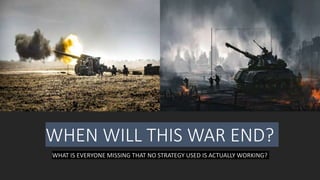
WHEN WILL THIS WAR END?
WHAT IS EVERYONE MISSING THAT NO STRATEGY USED IS ACTUALLY WORKING?
War
• War is a state of armed conflict between two groups of people in
which lethal violence is used to coerce one to do the others will. The
word 'war' comes to English from the old High German language word
Werran (to confuse or to cause confusion) through the Old English Werre
(meaning the same), and is a state of open and usually declared armed
conflict between political entities such as sovereign states or between
rival political or social factions within the same state.
• Military writers usually confine the term to hostilities in which the
contending groups are sufficiently equal in power to render the outcome
uncertain for a time. Armed conflicts of powerful states with isolated and
powerless peoples are usually called pacifications, military expeditions, or
explorations; with small states, they are called interventions or reprisals;
and with internal groups, rebellions or insurrections. Such incidents, if the
resistance is sufficiently strong or protracted, may achieve a magnitude
that entitles them to the name “war.”
• There is a difference between fight and war- it is that fight is an
occasion of fighting while war is (uncountable) organized]], large-scale,
armed conflict between [[country|countries or between national, ethnic,
or other sizeable groups, usually involving the engagement of military
forces.
BRIEF GLIMPSES OF
HISTORY OF WAR
• Throughout history, individuals, states, or political factions have
gained sovereignty over regions through the use of war. The history of one
of the earliest civilizations in the world, that of Mesopotamia, is a
chronicle of nearly constant strife. Even after Sargon the Great of Akkad (r.
2334-2279 BCE) unified the region under the Akkadian Empire, war was
still waged in putting down rebellions or fending off invaders. The Early
Dynastic Period of Egypt (c. 3150-c. 2613 BCE) is thought to have risen
from war when the Pharaoh Manes (or Menes) of the south conquered
the region of northern Egypt (though this claim is disputed).
• In China, the Zhou Dynasty gained ascendancy through battle in 1046
BCE and the conflict of the Warring States Period ((476-221 BCE) was
resolved when the State of Qin defeated the other contending states in
battle and unified China under the rule of emperor Shi Huangdi (r. 221-210
BCE). This same pattern holds for other nations throughout time whether
one cites the success of Scipio Africanus (l. 236-183 BCE) in the defeat of
Carthage (and so the ascendancy of Rome) or that of Philip II of Macedon
(l.382-336 BCE) in uniting the city-states of Greece. Contending armies of
opposing nations have historically settled political disputes on the
battlefield even though, in time, these armies changed in formation and
size.
Soviet
Philosophy
of war
• Soviet theoreticians distinguished three major types
of war:
• between capitalist states, between capitalist and
socialist states, and colonial wars of liberation. The
internecine wars among capitalist states were supposed
to arise from capitalist competition and imperialist
rivalries, such as those that led to the two World Wars.
They were desirable, for they weakened the capitalist
camp.
• A war between capitalist and socialist states was
one that clearly expressed the basic principle of class
struggle and was, therefore, one for which the socialist
states must prepare.
• Finally, wars of colonial liberation could be expected
between subjugated people and their colonial masters.
TYPES OF WARFARE
The
analysis of
war are
genereally
divided
into
several
categories.
Philosophical
political
economic
technological
legal
religious
sociological
psychological
And spiritual warfare
WHY IS THERE SO
MUCH OF
WARFARE IN OUR
HISTORY
• The Old Testament records lots of wars. This is
because it records human history and God’s
interaction with humanity, through the backdrop of
the context of the day.
• Human History is marked with bloodshed.
Human history is marked with desire to control,
greed and envy. Not all wars were evil, but the
backdrop that caused it and the consequence of
that is definitely evil.
• But in OT, God comes through as the Judge, who
uses circumstances to judge people according to
their deeds and redeem the evil choices for the
good of those who love Him.
WAR IN THE
BIBLE
• People of the Biblical times had been ravaged by war nearly 200 times in
150 years; and between the time that Jesus lived and most of the NT was
written the Jews experienced the worst war in their history, leaving
Jerusalem in ruins and the temple destroyed. From the periscope of the
church, physical war was in past and future, in our times, New Testament
focuses on a more difficult form of wars- as demonic and the opposite to the
peace which their Lord had brought.
• IT’S MUCH MORE DIFFICULT
• E.G. COVID
The TRUE REASON for the war
• We have been praying for Russia and Ukraine… but how many of us
remember? DANIEL chapter 10 in the OT
• 12 Then he continued, “Do not be afraid, Daniel. Since the first day that
you set your mind to gain understanding and to humble yourself before
your God, your words were heard, and I have come in response to them.
13 But the prince of the Persian kingdom resisted me twenty-one days.
Then Michael, one of the chief princes, came to help me, because I was
detained there with the king of Persia. 14 Now I have come to explain to
you what will happen to your people in the future, for the vision concerns
a time yet to come.”
• 18 Again the one who looked like a man touched me and gave me
strength. 19 “Do not be afraid, you who are highly esteemed,” he said.
“Peace! Be strong now; be strong.”
• When he spoke to me, I was strengthened and said, “Speak, my lord,
since you have given me strength.”
• 20 So he said, “Do you know why I have come to you? Soon I will return
to fight against the prince of Persia, and when I go, the prince of Greece
will come; 21 but first I will tell you what is written in the Book of Truth.
(No one supports me against them except Michael, your prince.
REALITY
OF THE
EVIL
SPIRITS
• Every religion talks about the concept of evil spirits.
• Hinduism talks about “Shaitan”, “rakshasas”
• Buddhism: “ Mara”, an arch tempter who, with his daughters,
Rati (Desire), Raga (Pleasure), and Tanha (Restlessness)
• Zoroastrianism: Azazel (the demon of the wilderness,
incarnated in the scapegoat), Leviathan and Rahab (demons
of chaos), Lilith (a female night demon)
• Islam: “Hārūt and Mārūt, in Islāmic mythology, two angels
who unwittingly became masters of evil
• Judaism: Jewish legend about the fallen angels Shemḥazaī,
ʿUzza, and ʿAzaʾel
• Japanese religion: demons are the oni, evil spirits with much
power, and the tengu, spirits that possess human beings and
that generally must be exorcised by priests.
What
does the
New
Testament
say about
spiritual
war?
•
•

When Will this War End.pptx

  • 1.
    WHEN WILL THISWAR END? WHAT IS EVERYONE MISSING THAT NO STRATEGY USED IS ACTUALLY WORKING?
  • 2.
    War • War isa state of armed conflict between two groups of people in which lethal violence is used to coerce one to do the others will. The word 'war' comes to English from the old High German language word Werran (to confuse or to cause confusion) through the Old English Werre (meaning the same), and is a state of open and usually declared armed conflict between political entities such as sovereign states or between rival political or social factions within the same state. • Military writers usually confine the term to hostilities in which the contending groups are sufficiently equal in power to render the outcome uncertain for a time. Armed conflicts of powerful states with isolated and powerless peoples are usually called pacifications, military expeditions, or explorations; with small states, they are called interventions or reprisals; and with internal groups, rebellions or insurrections. Such incidents, if the resistance is sufficiently strong or protracted, may achieve a magnitude that entitles them to the name “war.” • There is a difference between fight and war- it is that fight is an occasion of fighting while war is (uncountable) organized]], large-scale, armed conflict between [[country|countries or between national, ethnic, or other sizeable groups, usually involving the engagement of military forces.
  • 3.
    BRIEF GLIMPSES OF HISTORYOF WAR • Throughout history, individuals, states, or political factions have gained sovereignty over regions through the use of war. The history of one of the earliest civilizations in the world, that of Mesopotamia, is a chronicle of nearly constant strife. Even after Sargon the Great of Akkad (r. 2334-2279 BCE) unified the region under the Akkadian Empire, war was still waged in putting down rebellions or fending off invaders. The Early Dynastic Period of Egypt (c. 3150-c. 2613 BCE) is thought to have risen from war when the Pharaoh Manes (or Menes) of the south conquered the region of northern Egypt (though this claim is disputed). • In China, the Zhou Dynasty gained ascendancy through battle in 1046 BCE and the conflict of the Warring States Period ((476-221 BCE) was resolved when the State of Qin defeated the other contending states in battle and unified China under the rule of emperor Shi Huangdi (r. 221-210 BCE). This same pattern holds for other nations throughout time whether one cites the success of Scipio Africanus (l. 236-183 BCE) in the defeat of Carthage (and so the ascendancy of Rome) or that of Philip II of Macedon (l.382-336 BCE) in uniting the city-states of Greece. Contending armies of opposing nations have historically settled political disputes on the battlefield even though, in time, these armies changed in formation and size.
  • 4.
    Soviet Philosophy of war • Soviettheoreticians distinguished three major types of war: • between capitalist states, between capitalist and socialist states, and colonial wars of liberation. The internecine wars among capitalist states were supposed to arise from capitalist competition and imperialist rivalries, such as those that led to the two World Wars. They were desirable, for they weakened the capitalist camp. • A war between capitalist and socialist states was one that clearly expressed the basic principle of class struggle and was, therefore, one for which the socialist states must prepare. • Finally, wars of colonial liberation could be expected between subjugated people and their colonial masters.
  • 5.
    TYPES OF WARFARE The analysisof war are genereally divided into several categories. Philosophical political economic technological legal religious sociological psychological And spiritual warfare
  • 6.
    WHY IS THERESO MUCH OF WARFARE IN OUR HISTORY • The Old Testament records lots of wars. This is because it records human history and God’s interaction with humanity, through the backdrop of the context of the day. • Human History is marked with bloodshed. Human history is marked with desire to control, greed and envy. Not all wars were evil, but the backdrop that caused it and the consequence of that is definitely evil. • But in OT, God comes through as the Judge, who uses circumstances to judge people according to their deeds and redeem the evil choices for the good of those who love Him.
  • 7.
    WAR IN THE BIBLE •People of the Biblical times had been ravaged by war nearly 200 times in 150 years; and between the time that Jesus lived and most of the NT was written the Jews experienced the worst war in their history, leaving Jerusalem in ruins and the temple destroyed. From the periscope of the church, physical war was in past and future, in our times, New Testament focuses on a more difficult form of wars- as demonic and the opposite to the peace which their Lord had brought. • IT’S MUCH MORE DIFFICULT • E.G. COVID
  • 8.
    The TRUE REASONfor the war • We have been praying for Russia and Ukraine… but how many of us remember? DANIEL chapter 10 in the OT • 12 Then he continued, “Do not be afraid, Daniel. Since the first day that you set your mind to gain understanding and to humble yourself before your God, your words were heard, and I have come in response to them. 13 But the prince of the Persian kingdom resisted me twenty-one days. Then Michael, one of the chief princes, came to help me, because I was detained there with the king of Persia. 14 Now I have come to explain to you what will happen to your people in the future, for the vision concerns a time yet to come.” • 18 Again the one who looked like a man touched me and gave me strength. 19 “Do not be afraid, you who are highly esteemed,” he said. “Peace! Be strong now; be strong.” • When he spoke to me, I was strengthened and said, “Speak, my lord, since you have given me strength.” • 20 So he said, “Do you know why I have come to you? Soon I will return to fight against the prince of Persia, and when I go, the prince of Greece will come; 21 but first I will tell you what is written in the Book of Truth. (No one supports me against them except Michael, your prince.
  • 9.
    REALITY OF THE EVIL SPIRITS • Everyreligion talks about the concept of evil spirits. • Hinduism talks about “Shaitan”, “rakshasas” • Buddhism: “ Mara”, an arch tempter who, with his daughters, Rati (Desire), Raga (Pleasure), and Tanha (Restlessness) • Zoroastrianism: Azazel (the demon of the wilderness, incarnated in the scapegoat), Leviathan and Rahab (demons of chaos), Lilith (a female night demon) • Islam: “Hārūt and Mārūt, in Islāmic mythology, two angels who unwittingly became masters of evil • Judaism: Jewish legend about the fallen angels Shemḥazaī, ʿUzza, and ʿAzaʾel • Japanese religion: demons are the oni, evil spirits with much power, and the tengu, spirits that possess human beings and that generally must be exorcised by priests.
  • 10.