When and what is best Early
Intervention?
Olaf Kraus de Camargo
@DevPeds
Early Intervention – Why?
§ UN Convention on the Rights of the Child
§ Article 2: Children must not suffer discrimination irrespective of child or
parents’ race, color, sex, language, religion, political or other opinion, national,
ethnic or social origin, property, disability, birth, or other status.
§ Article 3: The best interests of the child must be a primary consideration in all
actions that affect the child.
§ Article 6: Children have the inherent right to life and the right to survival and
development in all aspects of life.
§ Article 12: Children have the right to express their opinion freely and to have
that opinion taken into account in all matters affecting their lives.
Brown, S. E. and M. J. Guralnick (2012). "International Human Rights to Early Intervention for Infants and Young Children With Disabilities: Tools for Global Advocacy." Infants &
Young Children 25(4): 270-285 210.1097/IYC.1090b1013e318268fa318249
Early Intervention – Who?
https://www.nhm.gov.in/images/pdf/programmes/RBS
K/Operational_Guidelines/Operational%20Guideline
s_RBSK.pdf
Ertem, I. O., et al. (2008). "A guide for monitoring
child development in low- and middle-income
countries." Pediatrics 121(3): e581-589.
Early Intervention – What? Nurturing Care: ”a stable environment that is
sensitive to children’s health and nutritional needs,
with protection from threats, opportunities for
early learning, and interactions that are
responsive, emotionally supportive, and
developmentally stimulating.”
“The single most powerful context for
nurturing care is the immediate home and
care settings of young children often provided
by mothers, but also by fathers and other
family members, as well as by child-care
services.”
Britto, P.R., et al., Nurturing care: promoting early childhood development.
The Lancet, 2017. 389(10064): p. 91-102.
https://doi.org/10.1016/s0140-6736(16)31390-3
Guralnick, M.J., Why Early Intervention Works: A Systems Perspective. Infants Young Child, 2011. 24(1): p. 6-
28. https://doi.org/10.1097/IYC.0b013e3182002cfe
Early Intervention - When?
§ Nurturing Care:
§ Prenatally: preparing parents about nurturing care, responsive parenting
§ Postnatally: monitoring child development at all well-child visits, offer home-
visiting programs, child-care programs and centre-based programs when
needed.
Mukherjee, S.B., et al., Indian Academy of Pediatrics Position Paper on Nurturing Care for Early Childhood Development. Indian Pediatr, 2021,
https://indianpediatrics.net/epub062021/RECOMM-00349.pdf
Nurturing
§ How to promote a nurturing attitude in the doctor’s office?
§ Observe:What is going on?
§ Listen:What have others told you? What is your greatest fear?
§ Describe: How the child engages, moves around etc.
§ Praise: Strengths and efforts of child and parents - “What do you want to boast
(or brag) about concerning your child?” (Peter Rosenbaum)
§ “Translate” the child to their parents
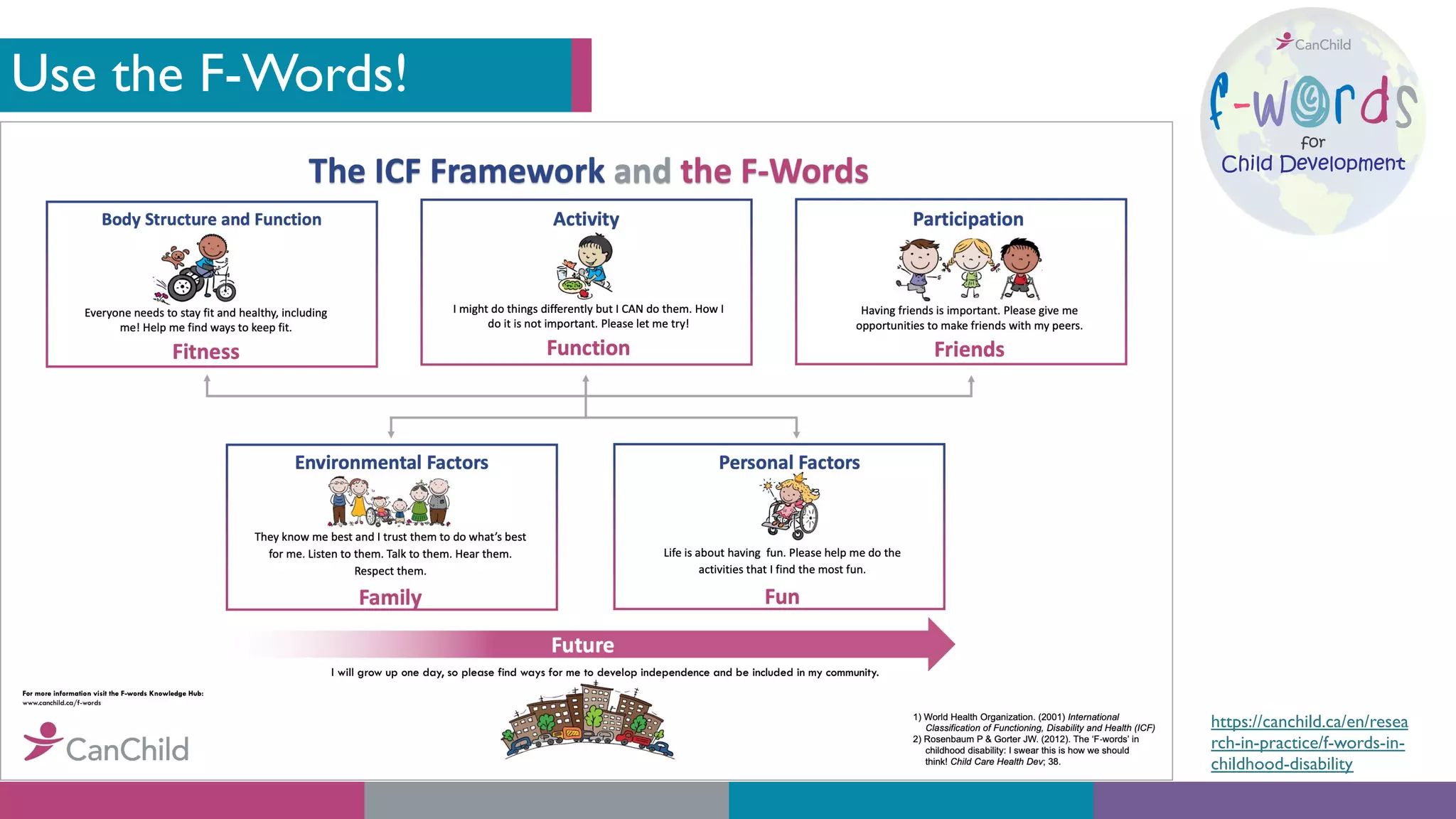
Use the F-Words!
https://canchild.ca/en/resea
rch-in-practice/f-words-in-
childhood-disability
Q & A
“The Grass does not grow faster if you pull on it” African Proverb
Thank you!
https://www.canchild.ca
References
§ Brown, S. E. and M. J. Guralnick (2012). "International Human Rights to Early Intervention for Infants andYoung Children With Disabilities:
Tools for Global Advocacy." Infants &Young Children 25(4): 270-285 210.1097/IYC.1090b1013e318268fa318249
§ Ministry of Health and Family Welfare, Rashtriya Bal Swasthra Karyakram (RBSK) Child Health Screening and Early Intervention Services under
NRHM, in Operational Guidelines. 2013. p. 43,
https://www.nhm.gov.in/images/pdf/programmes/RBSK/Operational_Guidelines/Operational%20Guidelines_RBSK.pdf
§ Ertem, I. O., et al. (2008). "A guide for monitoring child development in low- and middle-income countries." Pediatrics 121(3): e581-589.
§ Guralnick, M.J., Why Early InterventionWorks:A Systems Perspective. InfantsYoung Child, 2011. 24(1): p. 6-28.
https://doi.org/10.1097/IYC.0b013e3182002cfe
§ Britto, P.R., et al., Nurturing care: promoting early childhood development. The Lancet, 2017. 389(10064): p. 91-102. https://doi.org/10.1016/s0140-
6736(16)31390-3
§ Mukherjee, S.B., et al., Indian Academy of Pediatrics Position Paper on Nurturing Care for Early Childhood Development. Indian Pediatr, 2021,
https://indianpediatrics.net/epub062021/RECOMM-00349.pdf
§ World Health Organisation (2001), The International Classification of Functioning, Disability and Health (ICF)
§ Rosenbaum P. & Gorter JW (2012),The F-words in Childhood Disability – I swear this is how we should think! Child Care Health Dev (38)
https://onlinelibrary.wiley.com/doi/full/10.1111/j.1365-2214.2011.01338.x

When and what is best Early Intervention?

  • 1.
    When and whatis best Early Intervention? Olaf Kraus de Camargo @DevPeds
  • 2.
    Early Intervention –Why? § UN Convention on the Rights of the Child § Article 2: Children must not suffer discrimination irrespective of child or parents’ race, color, sex, language, religion, political or other opinion, national, ethnic or social origin, property, disability, birth, or other status. § Article 3: The best interests of the child must be a primary consideration in all actions that affect the child. § Article 6: Children have the inherent right to life and the right to survival and development in all aspects of life. § Article 12: Children have the right to express their opinion freely and to have that opinion taken into account in all matters affecting their lives. Brown, S. E. and M. J. Guralnick (2012). "International Human Rights to Early Intervention for Infants and Young Children With Disabilities: Tools for Global Advocacy." Infants & Young Children 25(4): 270-285 210.1097/IYC.1090b1013e318268fa318249
  • 3.
    Early Intervention –Who? https://www.nhm.gov.in/images/pdf/programmes/RBS K/Operational_Guidelines/Operational%20Guideline s_RBSK.pdf Ertem, I. O., et al. (2008). "A guide for monitoring child development in low- and middle-income countries." Pediatrics 121(3): e581-589.
  • 4.
    Early Intervention –What? Nurturing Care: ”a stable environment that is sensitive to children’s health and nutritional needs, with protection from threats, opportunities for early learning, and interactions that are responsive, emotionally supportive, and developmentally stimulating.” “The single most powerful context for nurturing care is the immediate home and care settings of young children often provided by mothers, but also by fathers and other family members, as well as by child-care services.” Britto, P.R., et al., Nurturing care: promoting early childhood development. The Lancet, 2017. 389(10064): p. 91-102. https://doi.org/10.1016/s0140-6736(16)31390-3 Guralnick, M.J., Why Early Intervention Works: A Systems Perspective. Infants Young Child, 2011. 24(1): p. 6- 28. https://doi.org/10.1097/IYC.0b013e3182002cfe
  • 5.
    Early Intervention -When? § Nurturing Care: § Prenatally: preparing parents about nurturing care, responsive parenting § Postnatally: monitoring child development at all well-child visits, offer home- visiting programs, child-care programs and centre-based programs when needed. Mukherjee, S.B., et al., Indian Academy of Pediatrics Position Paper on Nurturing Care for Early Childhood Development. Indian Pediatr, 2021, https://indianpediatrics.net/epub062021/RECOMM-00349.pdf
  • 6.
    Nurturing § How topromote a nurturing attitude in the doctor’s office? § Observe:What is going on? § Listen:What have others told you? What is your greatest fear? § Describe: How the child engages, moves around etc. § Praise: Strengths and efforts of child and parents - “What do you want to boast (or brag) about concerning your child?” (Peter Rosenbaum) § “Translate” the child to their parents
  • 7.
  • 8.
    Q & A “TheGrass does not grow faster if you pull on it” African Proverb Thank you! https://www.canchild.ca
  • 9.
    References § Brown, S.E. and M. J. Guralnick (2012). "International Human Rights to Early Intervention for Infants andYoung Children With Disabilities: Tools for Global Advocacy." Infants &Young Children 25(4): 270-285 210.1097/IYC.1090b1013e318268fa318249 § Ministry of Health and Family Welfare, Rashtriya Bal Swasthra Karyakram (RBSK) Child Health Screening and Early Intervention Services under NRHM, in Operational Guidelines. 2013. p. 43, https://www.nhm.gov.in/images/pdf/programmes/RBSK/Operational_Guidelines/Operational%20Guidelines_RBSK.pdf § Ertem, I. O., et al. (2008). "A guide for monitoring child development in low- and middle-income countries." Pediatrics 121(3): e581-589. § Guralnick, M.J., Why Early InterventionWorks:A Systems Perspective. InfantsYoung Child, 2011. 24(1): p. 6-28. https://doi.org/10.1097/IYC.0b013e3182002cfe § Britto, P.R., et al., Nurturing care: promoting early childhood development. The Lancet, 2017. 389(10064): p. 91-102. https://doi.org/10.1016/s0140- 6736(16)31390-3 § Mukherjee, S.B., et al., Indian Academy of Pediatrics Position Paper on Nurturing Care for Early Childhood Development. Indian Pediatr, 2021, https://indianpediatrics.net/epub062021/RECOMM-00349.pdf § World Health Organisation (2001), The International Classification of Functioning, Disability and Health (ICF) § Rosenbaum P. & Gorter JW (2012),The F-words in Childhood Disability – I swear this is how we should think! Child Care Health Dev (38) https://onlinelibrary.wiley.com/doi/full/10.1111/j.1365-2214.2011.01338.x