
What's new in the OSGi 4.2 Enterprise Specification
                                   David Bosschaert, 2010
History
●   EEG formed early 2007
    ●   Work areas identified and work started
●   Work areas:
    ●   Distributed Services
    ●   Developer Support / Spring DM
    ●   JEE – related specifications
●   Remote Services & Blueprint specs part of 4.2
    core/compendium release summer 2009
●   Culmination of the work done in
      4.2 Enterprise Release, Q1 2010
4.2 Enterprise
                          Specification
Component Models                Naming, Management
   ●   Blueprint                   ●   JNDI
   ●   Declarative Services        ●   JMX
Distributed Services            Database Access
   ●   Remote Services             ●   JDBC
   ●   Remote Services Admin       ●   JPA
   ●   SCA Configuration Type      ●   JTA
Web Applications                Supporting Technologies
   ●   Http Service Spec           ●   Events, Config Admin, User
   ●   Web Container Spec              Admin, Trackers, ...
Blueprint
Blueprint makes developing for OSGi easier.
●   Create Blueprint Components
    ●   Based on ideas from Spring Dynamic Modules
    ●   Blueprint Component ≈ Spring DM Bean
●   Inversion of Control
●   Dependency on other components or OSGi Services
●   Register components as Services
Blueprint
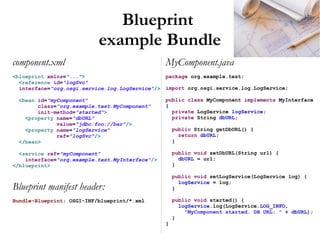
                           example Bundle
component.xml                                     MyComponent.java
<blueprint xmlns="...">                           package org.example.test;
  <reference id="logSvc"
  interface="org.osgi.service.log.LogService"/>   import org.osgi.service.log.LogService;

 <bean id="myComponent"                           public class MyComponent implements MyInterface
       class="org.example.test.MyComponent"       {
       init-method="started">                       private LogService logService;
   <property name="dbURL"                           private String dbURL;
             value="jdbc:foo://bar"/>
   <property name="logService"                        public String getDbURL() {
             ref="logSvc"/>                             return dbURL;
 </bean>                                              }

  <service ref="myComponent"                          public void setDbURL(String url) {
    interface="org.example.test.MyInterface"/>          dbURL = url;
</blueprint>                                          }

                                                      public void setLogService(LogService log) {
                                                        logService = log;
Blueprint manifest header:                            }

Bundle-Blueprint: OSGI-INF/blueprint/*.xml            public void started() {
                                                        logService.log(LogService.LOG_INFO,
                                                          "MyComponent started. DB URL: " + dbURL);
                                                      }
                                                  }
Distributed OSGi
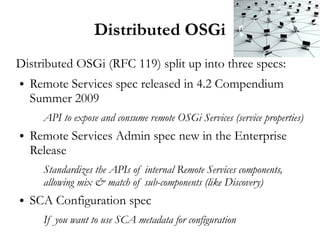
Distributed OSGi (RFC 119) split up into three specs:
●   Remote Services spec released in 4.2 Compendium
    Summer 2009
      API to expose and consume remote OSGi Services (service properties)
●   Remote Services Admin spec new in the Enterprise
    Release
      Standardizes the APIs of internal Remote Services components,
      allowing mix & match of sub-components (like Discovery)
●   SCA Configuration spec
      If you want to use SCA metadata for configuration
Remote Services
                              (in brief)
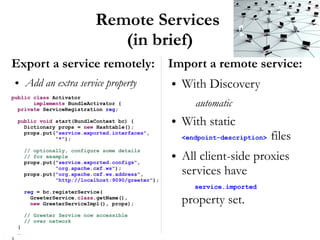
Export a service remotely:                         Import a remote service:
 ●   Add an extra service property                 ●   With Discovery
public class Activator
       implements BundleActivator {
  private ServiceRegistration reg;
                                                          automatic
 public void start(BundleContext bc) {
   Dictionary props = new Hashtable();
                                                   ●   With static
   props.put("service.exported.interfaces",
             "*");                                     <endpoint-description>   files
     // optionally, configure some details
     // for example
     props.put("service.exported.configs",
                                                   ●   All client-side proxies
               "org.apache.cxf.ws");
     props.put("org.apache.cxf.ws.address",            services have
               "http://localhost:9090/greeter");
                                                          service.imported
     reg = bc.registerService(
       GreeterService.class.getName(),
       new GreeterServiceImpl(), props);               property set.
     // Greeter Service now accessible
     // over network
 }
 …
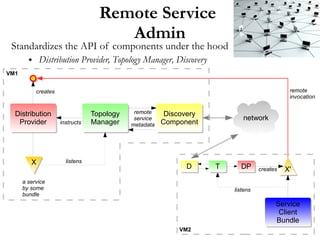
Remote Service
                                       Admin
 Standardizes the API of components under the hood
        ●    Distribution Provider, Topology Manager, Discovery
VM1


            creates                                                                           remote
                                                                                              invocation


  Distribution                    Topology    remote     Discovery
  Distribution                    Topology    service
                                                         Discovery          network
   Provider
   Provider           instructs   Manager
                                  Manager    metadata   Component
                                                        Component


         X              listens
                                                              D
                                                              D      T
                                                                     T     DP
                                                                           DP      creates   X'
                                                                                             X'
      a service
      by some                                                            listens
      bundle
                                                                                         Service
                                                                                         Service
                                                                                          Client
                                                                                          Client
                                                                                         Bundle
                                                                                         Bundle
                                                            VM2
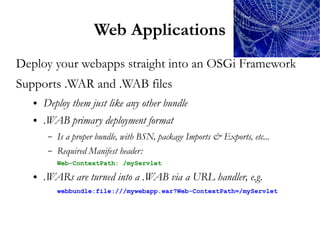
Web Applications
Deploy your webapps straight into an OSGi Framework
Supports .WAR and .WAB files
   ●   Deploy them just like any other bundle
   ●   .WAB primary deployment format
        –   Is a proper bundle, with BSN, package Imports & Exports, etc...
        –   Required Manifest header:
            Web-ContextPath: /myServlet

   ●   .WARs are turned into a .WAB via a URL handler, e.g.
            webbundle:file:///mywebapp.war?Web-ContextPath=/myServlet
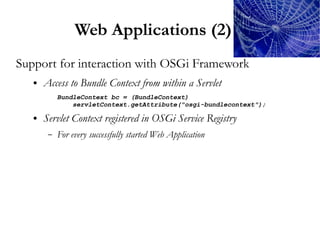
Web Applications (2)
Support for interaction with OSGi Framework
   ●   Access to Bundle Context from within a Servlet
            BundleContext bc = (BundleContext)
                servletContext.getAttribute("osgi-bundlecontext");

   ●   Servlet Context registered in OSGi Service Registry
        –   For every successfully started Web Application
JPA
Proper database persistence for OSGi
●   Don't use static Persistence class to create an
    EntityManager
●   Look up EntityManagerFactory or
    EntityManagerFactoryBuilder in the Service Registry
●   A bundle defining Persistence Units declares this using
    the OSGi/JPA header:
      Meta-Persistence: OSGI-INF/people-persistence.xml

●   Look up Filter
      filter:    (osgi.unit.name=People)
      interface: javax.persistence.EntityManagerFactory
JPA (2)
Small example:
  EntityManagerFactory emf = … // from OSGi Service Registry

  // From here everything is familiar
  EntityManager em = emf.createEntityManager();
  em.getTransaction().begin();
  Person person = new Person();
  person.setName("David");
  em.persist(person);
  em.getTransaction().commit();
  …
JNDI
Access to OSGi from JNDI clients
   ●   Look up OSGi Services and BundleContext through JNDI osgi:
       scheme
  osgi:service/javax.sql.DataSource
  osgi:service/my_service (if service sets the osgi.jndi.service.name property)
  osgi:servicelist/javax.sql.DataSource
  osgi:framework/bundleContext

Access to JNDI for OSGi Bundles
   ●   Look up JNDI in OSGi Service Registry
        –   JNDIContextManager Service provides access JNDI Initial Context
        –   Service registry preferred over calling new InitialContext()
JTA
Provides OSGi services in the registry:
   ●   javax.transaction.UserTransaction
   ●   javax.transaction.TransactionManager
   ●   javax.transaction.TransactionSynchronizationRegistry
Supports XA Resources.
JDBC

Database Drivers registered in the OSGi Service Registry
as DataSourceFactory objects
   ●   With APIs to create
        –   javax.sql.DataSource
        –   javax.sql.ConnectionPoolDataSource
        –   javax.sql.XADataSource
        –   java.sql.Driver
JMX
●   JMX access to the OSGi Framework
    ●   Framework Control (Bundle lifecycle)
    ●   Bundle information
    ●   Service information
●   Services supported
    ●   Package Admin
    ●   Configuration Admin
    ●   Permission Admin
    ●   Initial Provisioning
    ●   User Admin
Examples?
●   Apache Aries Trader
    ●   Leverages
         –   Blueprint
         –   Web
         –   JPA / JDBC
         –   JTA
         –   JNDI
        http://incubator.apache.org/aries/ariestrader.html

●   Besides that lots of more isolated examples can be
    found in the various implementing projects.
Future EEG work
Besides refinements to current specs...
●   Subsystems & Applications
●   OBR
●   Async communications
     ●    JMS
     ●    Message Driven Components
     ●    Asynchronous Services
●   ...
Questions?

What's new in the OSGi 4.2 Enterprise Release

  • 1.
    What's new inthe OSGi 4.2 Enterprise Specification David Bosschaert, 2010
  • 2.
    History ● EEG formed early 2007 ● Work areas identified and work started ● Work areas: ● Distributed Services ● Developer Support / Spring DM ● JEE – related specifications ● Remote Services & Blueprint specs part of 4.2 core/compendium release summer 2009 ● Culmination of the work done in 4.2 Enterprise Release, Q1 2010
  • 3.
    4.2 Enterprise Specification Component Models Naming, Management ● Blueprint ● JNDI ● Declarative Services ● JMX Distributed Services Database Access ● Remote Services ● JDBC ● Remote Services Admin ● JPA ● SCA Configuration Type ● JTA Web Applications Supporting Technologies ● Http Service Spec ● Events, Config Admin, User ● Web Container Spec Admin, Trackers, ...
  • 4.
    Blueprint Blueprint makes developingfor OSGi easier. ● Create Blueprint Components ● Based on ideas from Spring Dynamic Modules ● Blueprint Component ≈ Spring DM Bean ● Inversion of Control ● Dependency on other components or OSGi Services ● Register components as Services
  • 5.
    Blueprint example Bundle component.xml MyComponent.java <blueprint xmlns="..."> package org.example.test; <reference id="logSvc" interface="org.osgi.service.log.LogService"/> import org.osgi.service.log.LogService; <bean id="myComponent" public class MyComponent implements MyInterface class="org.example.test.MyComponent" { init-method="started"> private LogService logService; <property name="dbURL" private String dbURL; value="jdbc:foo://bar"/> <property name="logService" public String getDbURL() { ref="logSvc"/> return dbURL; </bean> } <service ref="myComponent" public void setDbURL(String url) { interface="org.example.test.MyInterface"/> dbURL = url; </blueprint> } public void setLogService(LogService log) { logService = log; Blueprint manifest header: } Bundle-Blueprint: OSGI-INF/blueprint/*.xml public void started() { logService.log(LogService.LOG_INFO, "MyComponent started. DB URL: " + dbURL); } }
  • 6.
    Distributed OSGi Distributed OSGi(RFC 119) split up into three specs: ● Remote Services spec released in 4.2 Compendium Summer 2009 API to expose and consume remote OSGi Services (service properties) ● Remote Services Admin spec new in the Enterprise Release Standardizes the APIs of internal Remote Services components, allowing mix & match of sub-components (like Discovery) ● SCA Configuration spec If you want to use SCA metadata for configuration
  • 7.
    Remote Services (in brief) Export a service remotely: Import a remote service: ● Add an extra service property ● With Discovery public class Activator implements BundleActivator { private ServiceRegistration reg; automatic public void start(BundleContext bc) { Dictionary props = new Hashtable(); ● With static props.put("service.exported.interfaces", "*"); <endpoint-description> files // optionally, configure some details // for example props.put("service.exported.configs", ● All client-side proxies "org.apache.cxf.ws"); props.put("org.apache.cxf.ws.address", services have "http://localhost:9090/greeter"); service.imported reg = bc.registerService( GreeterService.class.getName(), new GreeterServiceImpl(), props); property set. // Greeter Service now accessible // over network } …
  • 8.
    Remote Service Admin Standardizes the API of components under the hood ● Distribution Provider, Topology Manager, Discovery VM1 creates remote invocation Distribution Topology remote Discovery Distribution Topology service Discovery network Provider Provider instructs Manager Manager metadata Component Component X listens D D T T DP DP creates X' X' a service by some listens bundle Service Service Client Client Bundle Bundle VM2
  • 9.
    Web Applications Deploy yourwebapps straight into an OSGi Framework Supports .WAR and .WAB files ● Deploy them just like any other bundle ● .WAB primary deployment format – Is a proper bundle, with BSN, package Imports & Exports, etc... – Required Manifest header: Web-ContextPath: /myServlet ● .WARs are turned into a .WAB via a URL handler, e.g. webbundle:file:///mywebapp.war?Web-ContextPath=/myServlet
  • 10.
    Web Applications (2) Supportfor interaction with OSGi Framework ● Access to Bundle Context from within a Servlet BundleContext bc = (BundleContext) servletContext.getAttribute("osgi-bundlecontext"); ● Servlet Context registered in OSGi Service Registry – For every successfully started Web Application
  • 11.
    JPA Proper database persistencefor OSGi ● Don't use static Persistence class to create an EntityManager ● Look up EntityManagerFactory or EntityManagerFactoryBuilder in the Service Registry ● A bundle defining Persistence Units declares this using the OSGi/JPA header: Meta-Persistence: OSGI-INF/people-persistence.xml ● Look up Filter filter: (osgi.unit.name=People) interface: javax.persistence.EntityManagerFactory
  • 12.
    JPA (2) Small example: EntityManagerFactory emf = … // from OSGi Service Registry // From here everything is familiar EntityManager em = emf.createEntityManager(); em.getTransaction().begin(); Person person = new Person(); person.setName("David"); em.persist(person); em.getTransaction().commit(); …
  • 13.
    JNDI Access to OSGifrom JNDI clients ● Look up OSGi Services and BundleContext through JNDI osgi: scheme osgi:service/javax.sql.DataSource osgi:service/my_service (if service sets the osgi.jndi.service.name property) osgi:servicelist/javax.sql.DataSource osgi:framework/bundleContext Access to JNDI for OSGi Bundles ● Look up JNDI in OSGi Service Registry – JNDIContextManager Service provides access JNDI Initial Context – Service registry preferred over calling new InitialContext()
  • 14.
    JTA Provides OSGi servicesin the registry: ● javax.transaction.UserTransaction ● javax.transaction.TransactionManager ● javax.transaction.TransactionSynchronizationRegistry Supports XA Resources.
  • 15.
    JDBC Database Drivers registeredin the OSGi Service Registry as DataSourceFactory objects ● With APIs to create – javax.sql.DataSource – javax.sql.ConnectionPoolDataSource – javax.sql.XADataSource – java.sql.Driver
  • 16.
    JMX ● JMX access to the OSGi Framework ● Framework Control (Bundle lifecycle) ● Bundle information ● Service information ● Services supported ● Package Admin ● Configuration Admin ● Permission Admin ● Initial Provisioning ● User Admin
  • 17.
    Examples? ● Apache Aries Trader ● Leverages – Blueprint – Web – JPA / JDBC – JTA – JNDI http://incubator.apache.org/aries/ariestrader.html ● Besides that lots of more isolated examples can be found in the various implementing projects.
  • 18.
    Future EEG work Besidesrefinements to current specs... ● Subsystems & Applications ● OBR ● Async communications ● JMS ● Message Driven Components ● Asynchronous Services ● ...
  • 19.