What’s New in GALILEO? 
Georgia COMO 2014
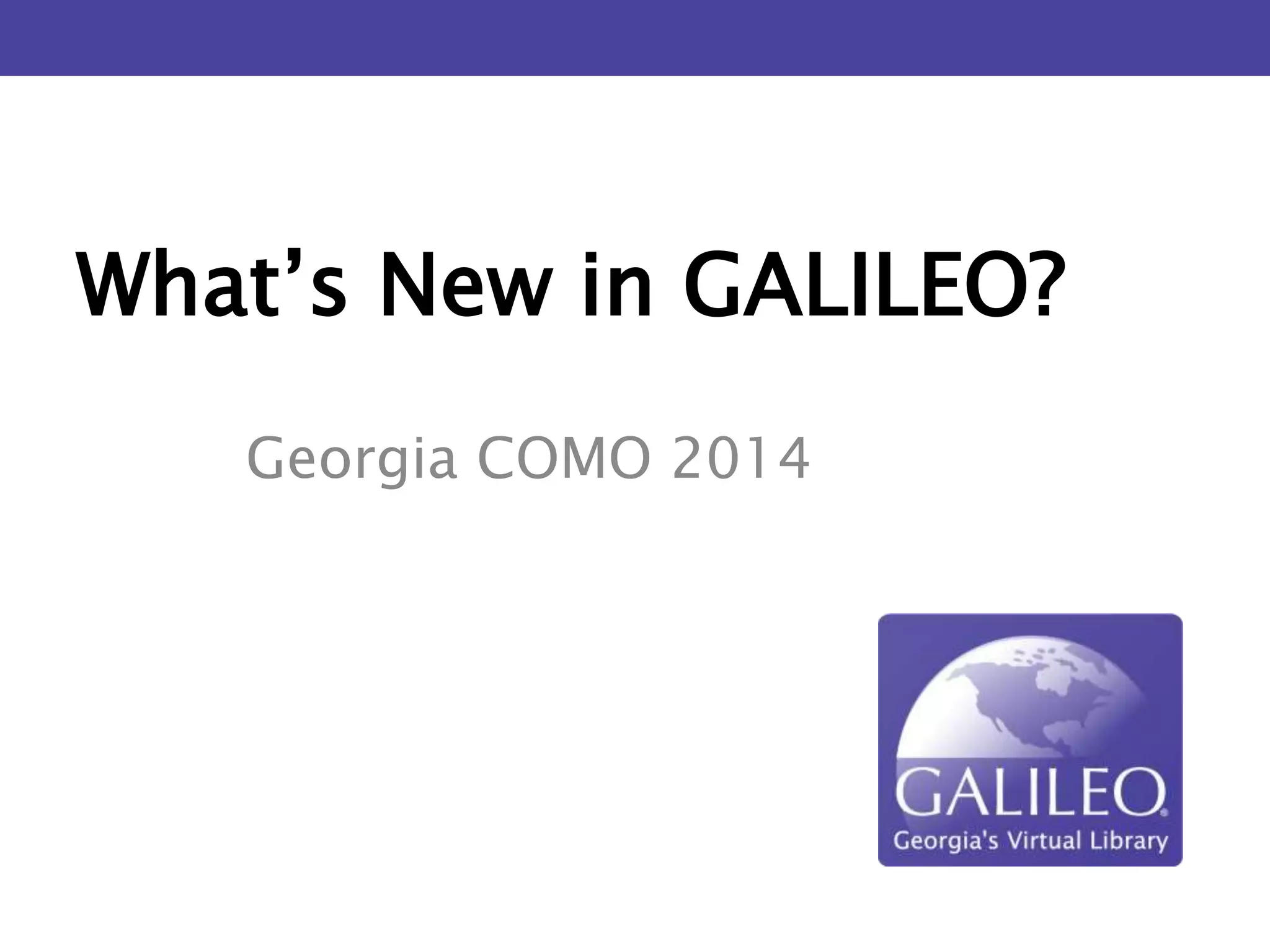
NoveList Plus
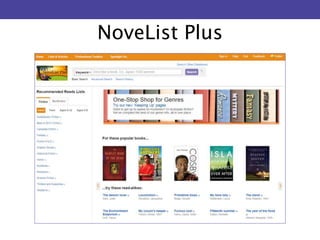
NoveList Plus
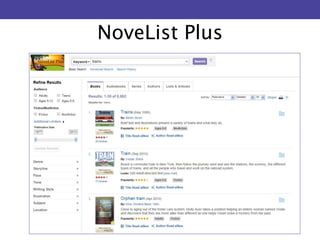
NoveList Plus 
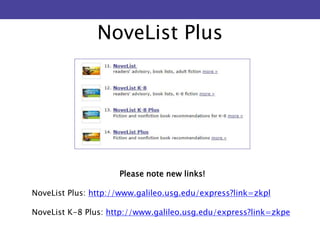
Please note new links! 
NoveList Plus: http://www.galileo.usg.edu/express?link=zkpl 
NoveList K-8 Plus: http://www.galileo.usg.edu/express?link=zkpe
GALILEO Passwords 
• Passwords now change 3 times a year 
in January, May, and August 
• See schedule in About > Policies > 
GALILEO Access Policies > Password 
Notification
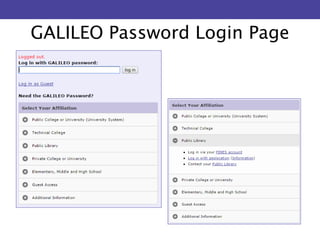
GALILEO Password Login Page
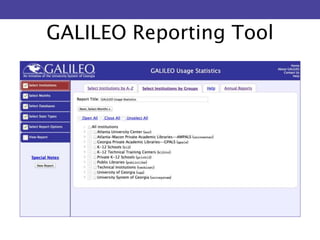
GALILEO Reporting Tool
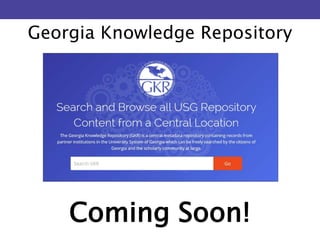
Georgia Knowledge Repository 
Coming Soon!
Discover GALILEO Updates 
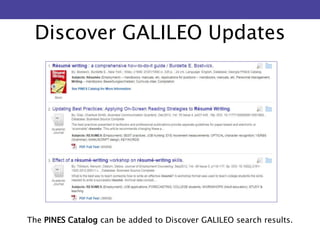
The PINES Catalog can be added to Discover GALILEO search results.
Discover GALILEO Updates 
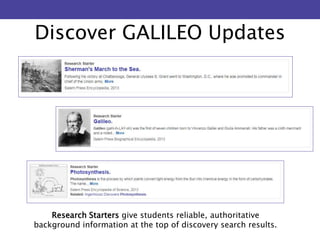
Research Starters give students reliable, authoritative 
background information at the top of discovery search results.
Discover GALILEO Updates 
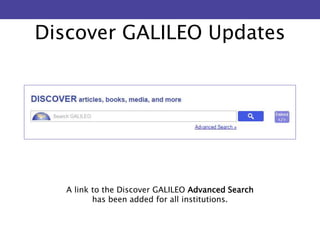
A link to the Discover GALILEO Advanced Search 
has been added for all institutions.
Digital Library of Georgia Updates
Digital Library of Georgia Updates 
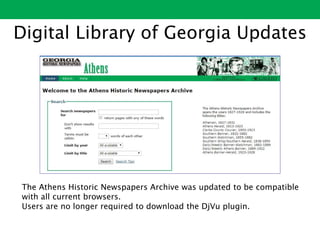
The Athens Historic Newspapers Archive was updated to be compatible 
with all current browsers. 
Users are no longer required to download the DjVu plugin.
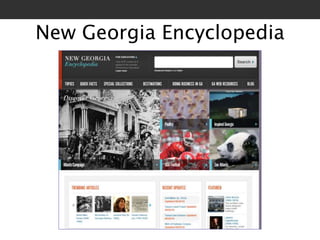
New Georgia Encyclopedia
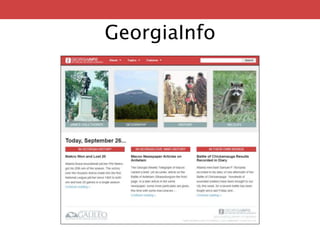
GeorgiaInfo
• A one-stop service to help USG faculty and staff identify lower-cost, 
electronic, free, and open educational resources (OER), building on the 
cost-effective subscription resources provided by GALILEO and the USG 
libraries. www.affordablelearninggeorgia.org 
• Programs to support more affordable learning materials, including campus 
advocacy, faculty development, bookstore collaborations, and grants for 
textbook transformation, including a partnership with eCore, the 
University System’s core curriculum taught completely online. 
• An initiative of the University System of Georgia and 
GALILEO, Georgia’s Virtual Library. www.galileo.usg.edu 
Affordable Learning Georgia Is…
Questions? 
Come visit us at the booth!

What’s New in GALILEO?

  • 1.
    What’s New inGALILEO? Georgia COMO 2014
  • 2.
  • 3.
  • 4.
    NoveList Plus Pleasenote new links! NoveList Plus: http://www.galileo.usg.edu/express?link=zkpl NoveList K-8 Plus: http://www.galileo.usg.edu/express?link=zkpe
  • 5.
    GALILEO Passwords •Passwords now change 3 times a year in January, May, and August • See schedule in About > Policies > GALILEO Access Policies > Password Notification
  • 6.
  • 7.
  • 8.
  • 9.
    Discover GALILEO Updates The PINES Catalog can be added to Discover GALILEO search results.
  • 10.
    Discover GALILEO Updates Research Starters give students reliable, authoritative background information at the top of discovery search results.
  • 11.
    Discover GALILEO Updates A link to the Discover GALILEO Advanced Search has been added for all institutions.
  • 12.
    Digital Library ofGeorgia Updates
  • 13.
    Digital Library ofGeorgia Updates The Athens Historic Newspapers Archive was updated to be compatible with all current browsers. Users are no longer required to download the DjVu plugin.
  • 14.
  • 15.
  • 16.
    • A one-stopservice to help USG faculty and staff identify lower-cost, electronic, free, and open educational resources (OER), building on the cost-effective subscription resources provided by GALILEO and the USG libraries. www.affordablelearninggeorgia.org • Programs to support more affordable learning materials, including campus advocacy, faculty development, bookstore collaborations, and grants for textbook transformation, including a partnership with eCore, the University System’s core curriculum taught completely online. • An initiative of the University System of Georgia and GALILEO, Georgia’s Virtual Library. www.galileo.usg.edu Affordable Learning Georgia Is…
  • 17.
    Questions? Come visitus at the booth!

Editor's Notes

  • #3 All GALILEO institutions have access to NoveList Plus and NoveList K-8 Plus, which include nonfiction and audiobook recommendations along with fiction recommendations. == GALILEO users now have access to NoveList Plus and NoveList K-8 Plus, but what has been added? NoveList has been the premier readers advisory tool for fiction with tools to help users and librarians match fiction titles and authors to readers’ interests and to help educators integrate fiction into the curriculum. Now users will find additional tools and content covering nonfiction titles and audiobooks. The nonfiction included in NoveList Plus is meant to appeal to readers reading for pleasure and includes biographies, narrative nonfiction, real-life adventure, true crime, and other creative nonfiction; not included are text books and how-to books. New features in NoveList Plus and NoveList Plus K-8 - Recommended reading lists on such topics as Adventure Travel, Growing Up Around the World, Animals in Our Lives, Historical Scandals, Scientific Discoveries, Women in Sports, and more - Dewey Number Browse to find recommended titles by Dewey number  - Advanced Search features for audio and nonfiction search refinement Other features still available - Author, title, and series read-alikes - Lexile level assignments - Robust awards and notable books lists - Book discussion guides - Picture book extenders - Common Core resources
  • #4 NoveList Plus example search with fiction and nonfiction recommendations
  • #5 Please note that the NoveList Plus resources have new links that are different from the NoveList (fiction only) links. If you want your users to search NoveList Plus, you will need to update the links on your library or media center site. NoveList Plus: http://www.galileo.usg.edu/express?link=zkpl NoveList K-8 Plus: http://www.galileo.usg.edu/express?link=zkpe
  • #6 As of July 1, 2014, the password will change three times a year (in January, May, and August) for all institutions. Please see the GALILEO Password Notification and Change Schedules page for dates for your community: http://about.galileo.usg.edu/policies/galileo_access_policies_and_information_1.1/#schedule - GALILEO staff will review the password change dates annually for the upcoming calendar year and adjust so that change dates will not fall on a weekend. - Communities (e.g., TCSG, AMPALS, GPALS, public libraries, etc.) are welcome to request a different date for the password to change. Requests should come from the GALILEO Steering Committee representative for that community.
  • #7 The GALILEO password login page that guides users to the best place to get their password has been updated with a new look. Go to http://www.galileo.usg.edu/welcome/ to see it.
  • #8 *New Reporting Tool: Fast response time Report, Graphical and CSV output Bookmarkable Reports Date controlled Institution/Database list Simplified Interface   *Changes in Data: For FY15, a new stats type (Database Sessions) will be available in the new GALILEO Reporting Tool. We will also be reporting EBSCO Discovery Service's (EDS) Searches separately, so there will no longer be an exponential inflation of Search data for the individual EBSCO databases. This will give institutions a more meaningful picture of their usage and is COUNTER compliant.   *New GALILEO Statistics Listserv: This low activity listserv will be used mostly to announce the monthly loading of database vendor (EBSCO, ProQuest, Britannica etc.) usage data into the GALILEO Usage Statistics Reporting Tool, but it will also be used to report potential issues with the data and/or address general questions institutions might have concerning GALILEO Statistics.
  • #10 The PINES catalog can now be added to your Discover GALILEO search, which means that users accessing GALILEO resources through the search box in GALILEO can also see items from PINES.
  • #11 Research Starters is a new feature in Discovery search results that provides citable, authoritative summary articles for thousands of popular topics. Research Starters appear at the top of the results list and include an overview of the topic, links to related information, helpful images, and a bibliography. Content in this feature comes from a variety of reliable sources, both proprietary and encyclopedic, including Salem Press, Encyclopaedia Britannica, Magills, and more. Research Starters articles feature the same Discovery tools as other articles, including tools for citation, translation, Text-to-Speech, and the option to add the article to a personal folder. This enhancement is available to all GALILEO communities. Users can launch a search from the Discover GALILEO search box on the GALILEO website. If there is a Research Starter for the topic, it will appear as the first article in the list of results (outlined in red in the image above). If you’re stumped for a search term to investigate this new feature, try one of these: mythology, cancer, John Steinbeck, pollution, global warming, mitosis, Nelson Mandela, common core, cuisine, Ukraine, brain disorders, girl scouts, Olympics, Korean War, witchcraft, tourism, evolution of the universe, bipolar disorders, net neutrality, exercise physiology, nuclear fusion, or baseball.
  • #12 An Advanced Search link now appears under the main search box. This links the user to the advanced search screen at EBSCO. The Advanced Search option was the change most requested by library staff. In addition to discipline search options, the Advanced Search offers guided Boolean searching and optional field limiting to help users add more precision to their searches. These enhancements were explored with the GALILEO/GIL Discovery Interface Committee prior to implementation.
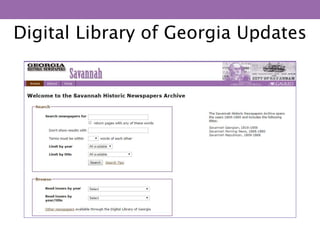
  • #13 The Savannah Historic Newspapers Archive, which includes online access to three newspaper titles published in Savannah from 1809 to 1880, is now available at http://www.galileo.usg.edu/express?link=savn or through the GALILEO website. An announcement from the Digital Library of Georgia describing the resource is available below. ——————- ANNOUNCEMENT ——————- The Digital Library of Georgia is pleased to announce the availability of a new online resource: The Savannah Historic Newspapers Archive. http://dlg.galileo.usg.edu/savnewspapers The Savannah Historic Newspapers Archive provides online access to three newspaper titles published in Savannah from 1809 to 1880. Consisting of over 83,000 newspaper pages, the archive provides historical images that are both full-text searchable and can be browsed by date. The website includes the following Savannah newspaper titles: Savannah Georgian (1819-1856), Savannah Morning News(1868-1880), Savannah Republican (1809-1868). The Savannah Historic Newspapers Archive is a project of the Digital Library of Georgia, as part of the Georgia HomePLACE initiative. The Digital Library of Georgia is a project of Georgia’s Virtual Library GALILEO and is based at the University of Georgia. Georgia HomePLACE is supported with federal LSTA funds administered by the Institute of Museum and Library Services through the Georgia Public Library Service, a unit of the Board of Regents of the University System of Georgia. Other newspaper archives available through the Digital Library of Georgia include the Atlanta Historic Newspapers Archive (1847-1922), the South Georgia Historic Newspapers Archive (1845-1922), theMacon Telegraph Archive (1826-1908), the Columbus Enquirer Archive (1828-1890), the Athens Historic Newspapers Archive (1827-1928), the Milledgeville Historic Newspapers Archive (1808-1920), theSouthern Israelite Archive (1929-1986), and the Red and Black Archive (1893-2006). These archives can be accessed at http://dlg.galileo.usg.edu/MediaTypes/Newspapers.html ———— END ————-
  • #14 The Athens Historic Newspapers Archive is now compatible with all current browsers. Users are no longer required to download the DjVu plugin to view Athens newspaper pages in this archive. GALILEO Express Link: http://www.galileo.usg.edu/express?link=athn The full announcement from the Digital Library of Georgia is below. == The Digital Library of Georgia is pleased to announce the re-release of the enhanced Athens Historic Newspapers Archive: http://dlg.galileo.usg.edu/athnewspapers The Athens Historic Newspapers Archive is now compatible with all current browsers and provides access to nine newspaper titles published in Athens from 1827 to 1928 without the use of plug-ins or additional software downloads. Consisting of over 77,000 newspaper pages, the archive provides historical images that are both full-text searchable and can be browsed by date. The site will provide users with a view into the history of Athens in its early years as the home to the first state-chartered university in the nation and its eventual growth into the largest city in northeast Georgia. The archive includes the following Athens newspaper titles: Athens Herald (1913-1923), Athens Banner-Herald (1923-1928), Southern Whig/Southern Herald (1838-1850), Clarke County Courier (1903-1913), in addition to the titles previously included in the archive: Athenian (1827-1832), Southern Banner (1832-1882), Southern Watchman (1855-1882), Daily/Weekly Banner-Watchman (1882-1889), Daily/Weekly Athens Banner (1889-1922). The Athens Historic Newspapers Archive is a project of the Digital Library of Georgia, as part of the Georgia HomePLACE initiative. The Digital Library of Georgia is a project of Georgia’s Virtual Library GALILEO and is based at the University of Georgia. Georgia HomePLACE is supported with federal LSTA funds administered by the Institute of Museum and Library Services through the Georgia Public Library Service, a unit of the Board of Regents of the University System of Georgia. Digitization is also made possible through a grant provided by the Francis Wood Wilson Foundation, Inc. Other newspaper archives available through the Digital Library of Georgia include the Atlanta Historic Newspapers Archive (1847-1922), the Savannah Historic Newspapers Archive (1819-1880), the South Georgia Historic Newspapers Archive (1845-1922), the Macon Telegraph Archive (1826-1908), the Columbus Enquirer Archive (1828-1890), the Milledgeville Historic Newspapers Archive (1808-1920), the Southern Israelite Archive (1929-1986), and the Red and Black Archive (1893-2006). These archives can be accessed athttp://dlg.galileo.usg.edu/MediaTypes/Newspapers.html ==
  • #15 The redesigned New Georgia Encyclopedia website went live in August 2013. Take a look at the redesigned site of the New Georgia Encyclopedia! More than two years’ worth of researching, planning, designing, and legwork have gone into producing the next generation of the NGE. The technology and design upgrade ensures that the encyclopedia’s 2,000-plus articles and 6,000-plus images remain available and accessible to users. Originally launched in 2004, the NGE is the first state encyclopedia to be conceived and designed exclusively for publication online. This authoritative resource contains original content and helps users understand the rich history and diverse culture of Georgia’s still-unfolding story. The NGE is a project of the Georgia Humanities Council in partnership with the University of Georgia Press, the University System of Georgia/GALILEO, and the Office of the Governor. Express Link: http://www.galileo.usg.edu/express?link=ngen
  • #16 The redesigned GeorgiaInfo went live in January 2014. GeorgiaInfo, the online almanac for the state of Georgia, boasts a graphically rich new interface and new site organization to optimize intuitive navigation. GeorgiaInfo is valuable as a ready reference resource for all things Georgia and is rich in information to support the K-12 Georgia studies curriculum. It provides historical and current information on Georgia’s economy, geography, government, military, people, sports, tourism, wildlife, and other topics. GeorgiaInfo also features current and historical maps, as well as city and county information with statistics, courthouse pictures, historical markers, and more. Popular features Include This Day in Georgia History and This Day in Georgia Civil War History. Please see the redesign announcement from GeorgiaInfo below and visit the new site today. GeorgiaInfo is a part of the Digital Library of Georgia. ANNOUNCEMENT Jan. 15, 2014 GeorgiaInfo, state’s online almanac, launches redesigned website ATHENS, Ga – GeorgiaInfo, the state’s online almanac based at the University of Georgia, is launching a redesigned website Jan. 21. GeorgiaInfo is part of the Digital Library of Georgia, and is hosted by GALILEO and the University of Georgia Libraries. GeorgiaInfo was created in 1996 by the UGA Carl Vinson Institute of Government. In 2008 the site became a part of the Digital Library of Georgia and GALILEO, the state’s virtual library. “GeorgiaInfo is complementary to resources like the award-winning New Georgia Encyclopedia and the millions of primary resources included in our Digital Library of Georgia,” said Merryll Penson, executive director of library services with the University System’s Office of Information and Instructional Technology. Having this information in a new format will be very beneficial to our GALILEO users, particularly those in 8th grade social studies.” The purpose of the makeover is two-fold: “The redesigned site contains the information from the previous site, but in an updated, more visually appealing format. It also is designed to work well with the technology available today – GeorgiaInfo should display equally well on desktop computers, laptops, tablets, or phones,” said Sheila McAlister, director of the Digital Library of Georgia. The new site is highlighted by a revolving photo gallery on the home page; it will feature six rotating images showing the beauty of Georgia. The images will be changed regularly. Navigation throughout the site is by “topics” and “features” listed on drop-down menus at the top of each page – each of these links will take the reader to a page with information about a specific aspect of Georgia – history, maps, counties, wildlife, etc. There are 15 topics and 12 features, plus pages with basic information about Georgia and recent updates to the site. There is also a search function available on the navigation bar at the top of each page. The four columns below the photo gallery on the home page will highlight some of the most heavily used or timely topics. These topics will change occasionally, but all of the site information will remain available at all times – through the navigation bar. “Some of GeorgiaInfo’s most popular features have always been This Day in Georgia History and This Day in Georgia Civil War History. Both of these features – with the same information in a new format – are located at the bottom of the home page, and are also listed under features in the navigation bar,” McAlister said.