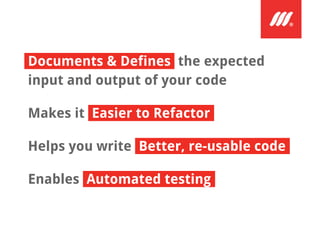
Documents & Defines the expected
input and output of your code
Makes it Easier to Refactor.
Helps you write Better, re-usable code.
Enables Automated testing.
Unit Testing requires you change
the way you write your code.
(But this is good);
JavaScript is interpreted at runtime.
Across a variety of different browsers.
Mutable , Loosely-typed ,, Global scope.
SUDDEN DEATH Mode
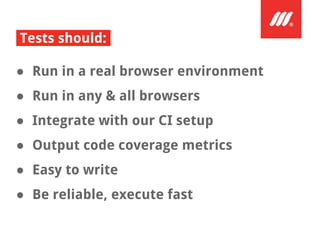
Tests should::
● Run in a real browser environment
● Run in any & all browsers
● Integrate with our CI setup
● Output code coverage metrics
● Easy to write
● Be reliable, execute fast
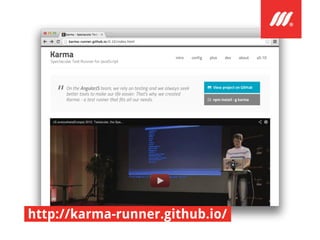
http://karma-runner.github.io/.
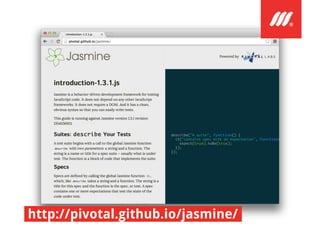
http://pivotal.github.io/jasmine/.
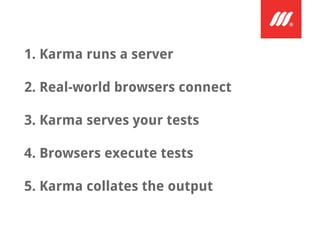
1. Karma runs a server
2. Real-world browsers connect
3. Karma serves your tests
4. Browsers execute tests
5. Karma collates the output
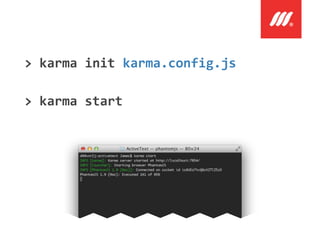
> karma init karma.config.js
> karma start
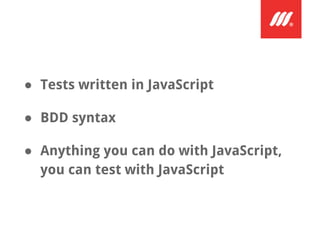
● Tests written in JavaScript
● BDD syntax
● Anything you can do with JavaScript,
you can test with JavaScript
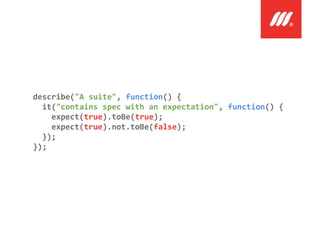
describe("A suite", function() {
it("contains spec with an expectation", function() {
expect(true).toBe(true);
expect(true).not.toBe(false);
});
});
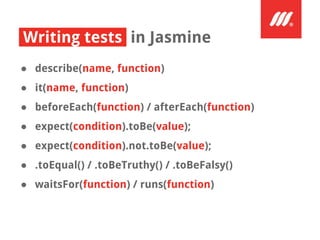
● describe(name, function)
● it(name, function)
● beforeEach(function) / afterEach(function)
● expect(condition).toBe(value);
● expect(condition).not.toBe(value);
● .toEqual() / .toBeTruthy() / .toBeFalsy()
● waitsFor(function) / runs(function)
Writing tests in Jasmine
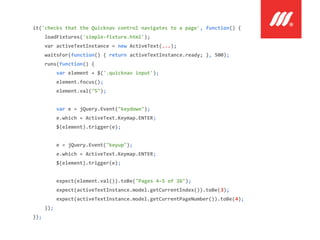
it('checks that the Quicknav control navigates to a page', function() {
loadFixtures('simple-fixture.html');
var activeTextInstance = new ActiveText(...);
waitsFor(function() { return activeTextInstance.ready; }, 500);
runs(function() {
var element = $('.quicknav input');
element.focus();
element.val("5");
var e = jQuery.Event("keydown");
e.which = ActiveText.Keymap.ENTER;
$(element).trigger(e);
e = jQuery.Event("keyup");
e.which = ActiveText.Keymap.ENTER;
$(element).trigger(e);
expect(element.val()).toBe("Pages 4–5 of 26");
expect(activeTextInstance.model.getCurrentIndex()).toBe(3);
expect(activeTextInstance.model.getCurrentPageNumber()).toBe(4);
});
});
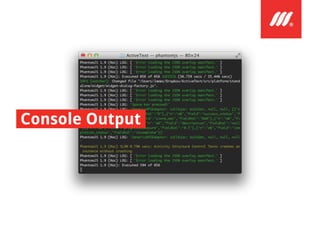
Console Output;
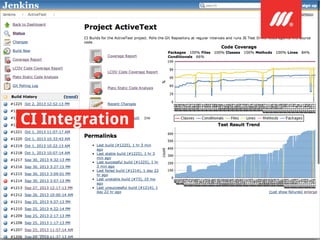
CI Integration;
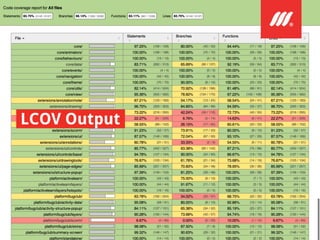
LCOV Output;
What the HTML? - The Holy Grail

What the HTML? - The Holy Grail

  • 5.
    Documents & Definesthe expected input and output of your code Makes it Easier to Refactor. Helps you write Better, re-usable code. Enables Automated testing.
  • 6.
    Unit Testing requiresyou change the way you write your code. (But this is good);
  • 7.
    JavaScript is interpretedat runtime. Across a variety of different browsers. Mutable , Loosely-typed ,, Global scope. SUDDEN DEATH Mode
  • 8.
    Tests should:: ● Runin a real browser environment ● Run in any & all browsers ● Integrate with our CI setup ● Output code coverage metrics ● Easy to write ● Be reliable, execute fast
  • 10.
  • 11.
  • 12.
    1. Karma runsa server 2. Real-world browsers connect 3. Karma serves your tests 4. Browsers execute tests 5. Karma collates the output
  • 13.
    > karma initkarma.config.js > karma start
  • 14.
    ● Tests writtenin JavaScript ● BDD syntax ● Anything you can do with JavaScript, you can test with JavaScript
  • 15.
    describe("A suite", function(){ it("contains spec with an expectation", function() { expect(true).toBe(true); expect(true).not.toBe(false); }); });
  • 16.
    ● describe(name, function) ●it(name, function) ● beforeEach(function) / afterEach(function) ● expect(condition).toBe(value); ● expect(condition).not.toBe(value); ● .toEqual() / .toBeTruthy() / .toBeFalsy() ● waitsFor(function) / runs(function) Writing tests in Jasmine
  • 17.
    it('checks that theQuicknav control navigates to a page', function() { loadFixtures('simple-fixture.html'); var activeTextInstance = new ActiveText(...); waitsFor(function() { return activeTextInstance.ready; }, 500); runs(function() { var element = $('.quicknav input'); element.focus(); element.val("5"); var e = jQuery.Event("keydown"); e.which = ActiveText.Keymap.ENTER; $(element).trigger(e); e = jQuery.Event("keyup"); e.which = ActiveText.Keymap.ENTER; $(element).trigger(e); expect(element.val()).toBe("Pages 4–5 of 26"); expect(activeTextInstance.model.getCurrentIndex()).toBe(3); expect(activeTextInstance.model.getCurrentPageNumber()).toBe(4); }); });
  • 18.
  • 19.
  • 20.