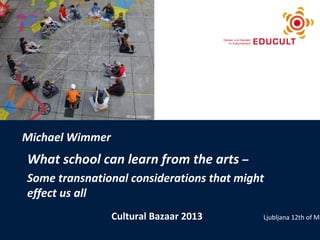
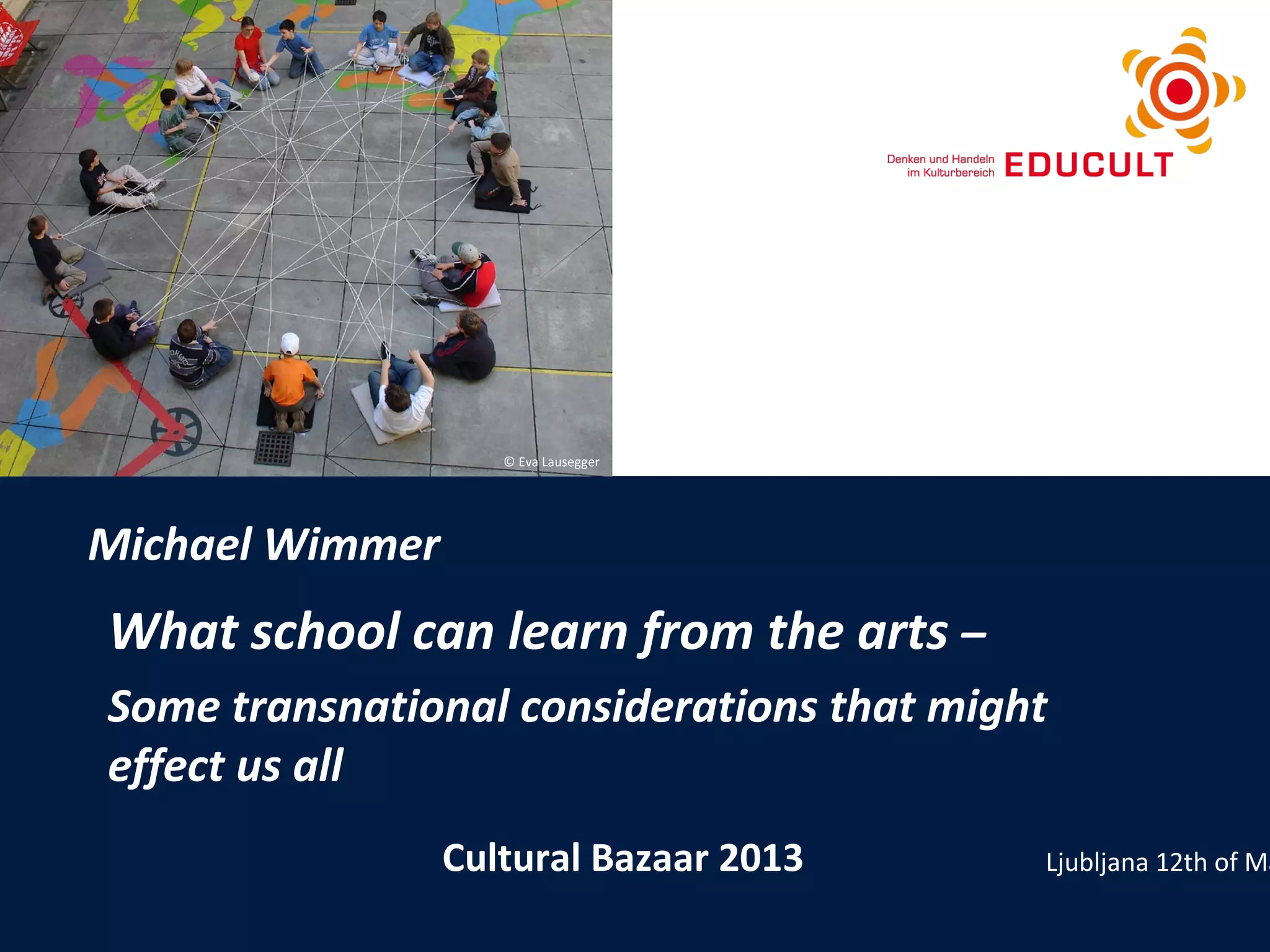
© Eva Lausegger
          © ohneski/Photocase, daniel.schoenen/Photocase


Michael Wimmer
What school can learn from the arts –
Some transnational considerations that might
effect us all
                            Cultural Bazaar 2013           Ljubljana 12th of Ma
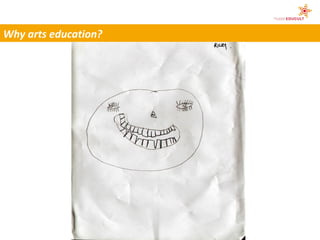
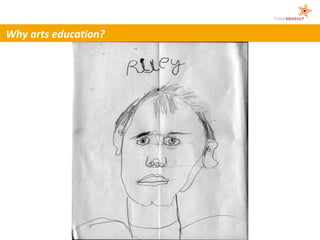
Why arts education?
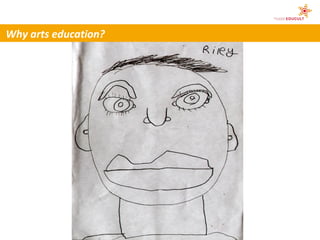
Why arts education?
Why arts education?
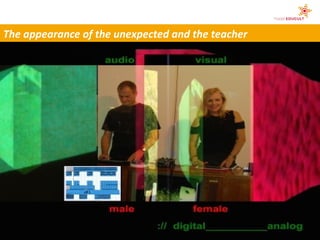
The appearance of the unexpected and the teacher
EDUCULT – A European research institution
                          Acting as critical friend

                          Research and development: EDUCULT as a
                          player in international cultural and education
                          policy research

                          Studies, evaluations, consulting and projects :

                          Diversity and Cooperation
                          Arts Count!
                          European Arts Education Fact Finding Mission
                          Cultural Education in Europe
                          Multilingual rhetoric competition: Sag´s multi!
                          Cultural.Explorers!
UNESCO Initiatives on Arts Education


                                UNESCO World Conferences: Road
                                 Map for Arts Education

                                   Aims
                                   Concepts
                                   Strategies
                                   Research and knowledge sharing
                                   Recommendations for educators,
                                    parents, artists, directors, trainers,
                                    administrators and their institutions
UNESCO Initiatives on Arts Education

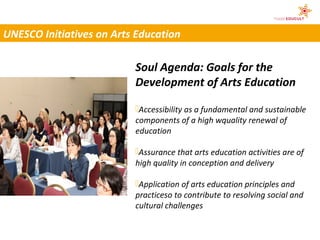
                          Soul Agenda: Goals for the
                          Development of Arts Education

                          Accessibility as a fundamental and sustainable
                          components of a high wquality renewal of
                          education

                          Assurance that arts education activities are of
                          high quality in conception and delivery

                          Application of arts education principles and
                          practiceso to contribute to resolving social and
                          cultural challenges
On the long road of recognizing the power of arts education

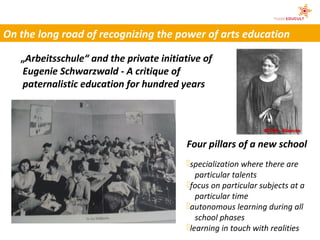
   „Arbeitsschule“ and the private initiative of
   Eugenie Schwarzwald - A critique of
   paternalistic education for hundred years


                                          Four pillars of a new school
                                          specialization where there are
                                             particular talents
                                          focus on particular subjects at a
                                             particular time
                                          autonomous learning during all
                                             school phases
                                          learning in touch with realities
Still on the Agenda: Towards a contemporary concept of learning


                                       Learning is a creative process.
                                       What we learn depends on how
                                         and where and under which
                                           circumstances we learn.
                                      Creativity is an interdisciplinary
                                       guiding principle in education that is
                                       not bound to any specific subject
                                      Unfolding multiple potentials of an
                                       individual’s personality, the
                                       connection of “brain, heart and hand”
                                      Learning by means of art-based
                                       methods opens up specific spheres of
                                       experience and development
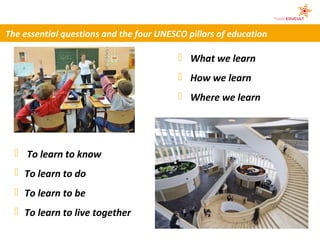
The essential questions and the four UNESCO pillars of education

                                           What we learn
                                           How we learn
                                           Where we learn


   To learn to know
   To learn to do
   To learn to be
   To learn to live together
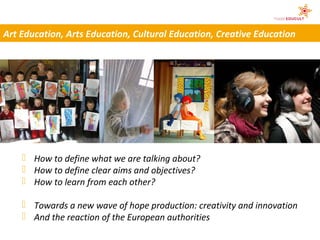
Art Education, Arts Education, Cultural Education, Creative Education


     How to define what we are talking about?
     How to define clear aims and objectives?
     How to learn from each other?

     Towards a new wave of hope production: creativity and innovation
     And the reaction of the European authorities
On EU-level: Cultural competences: cultural awareness and expression


                                               Cultural knowledge includes an
                                               awareness of local, national and
                                               European cultural heritage and
                                               their place in the world …

                                               Cultural Skills relate to both
                                               appreciation and expression …


                          © Elsabe/Photocase
Elliot Eisner: What education can learn from the arts

  There is more than one answer to a
   problem
  Form and content interpenetrate
  The importance of imagination
  The importance of relationships
  The importance of intrinsic satisfaction
  Learning is not just about literal
   language and quantification
  The importance of being flexibly
   purposive
  The importance of a flexible time
   regime to relish the experience that                 © Martina GaiggMartina Gaigg
                                                                    ©

   one seeks
„School Budgets for Federal Schools“ – Organisational aspects


                                       More autonomy for schools

                                       Cultural/creative education
                                        is more than traditional
                                        music or fine art education

                                       Culture for school profiling

                                       The role of „mediators“
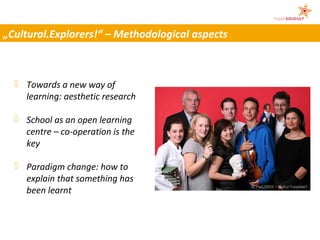
„Cultural.Explorers!“ – Methodological aspects


   Towards a new way of
    learning: aesthetic research

   School as an open learning
    centre – co-operation is the
    key

   Paradigm change: how to
    explain that something has
                                                 © PwC/DKJS – Kultur.Forscher!
    been learnt
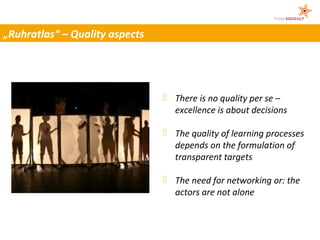
„Ruhratlas“ – Quality aspects


                                 There is no quality per se –
                                  excellence is about decisions

                                 The quality of learning processes
                                  depends on the formulation of
                                  transparent targets

                                 The need for networking or: the
                                  actors are not alone
                                              © Martina Gaigg
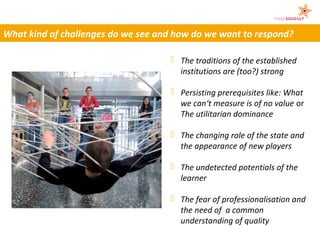
What kind of challenges do we see and how do we want to respond?

                                     The traditions of the established
                                      institutions are (too?) strong

                                     Persisting prerequisites like: What
                                      we can‘t measure is of no value or
                                      The utilitarian dominance

                                     The changing role of the state and
                                      the appearance of new players

                                     The undetected potentials of the
                                      learner

                                     The fear of professionalisation and
                                      the need of a common
                                      understanding of quality
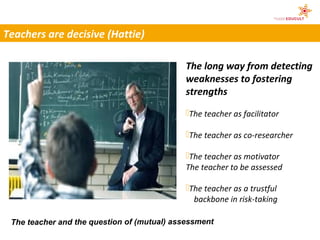
Teachers are decisive (Hattie)

                                             The long way from detecting
                                             weaknesses to fostering
                                             strengths
                                             The teacher as facilitator

                                             The teacher as co-researcher

                                             The teacher as motivator
                                             The teacher to be assessed

                                             The teacher as a trustful
                                               backbone in risk-taking

 The teacher and the question of (mutual) assessment
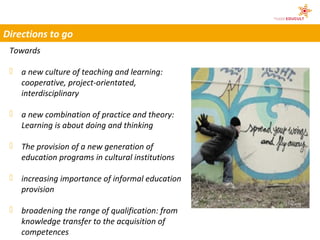
Directions to go
 Towards

  a new culture of teaching and learning:
   cooperative, project-orientated,
   interdisciplinary

  a new combination of practice and theory:
   Learning is about doing and thinking

  The provision of a new generation of
   education programs in cultural institutions

  increasing importance of informal education
                                                 © kallejipp/Photocase
   provision

  broadening the range of qualification: from
   knowledge transfer to the acquisition of
   competences
Let’s keep in mind

  Good solutions do not come from
   above

  Take advantage of the arts

  You are not alone

  Be on a par with each other

  Choose transparent objectives

  Make use of mistakes

  Remain curious

  Be brave and enjoy
                                     © ohneski/Photocase, daniel.schoenen/Photocase
„Talking about creativity means accepting
  instability and taking advantage out of it“


Thank you for your
attention!
                    www.educult.at
         michael.wimmer@educult.at
                                                © Mages/Photocase

What school can learn from the arts

  • 1.
    © Eva Lausegger © ohneski/Photocase, daniel.schoenen/Photocase Michael Wimmer What school can learn from the arts – Some transnational considerations that might effect us all Cultural Bazaar 2013 Ljubljana 12th of Ma
  • 2.
  • 3.
  • 4.
  • 5.
    The appearance ofthe unexpected and the teacher
  • 6.
    EDUCULT – AEuropean research institution Acting as critical friend Research and development: EDUCULT as a player in international cultural and education policy research Studies, evaluations, consulting and projects : Diversity and Cooperation Arts Count! European Arts Education Fact Finding Mission Cultural Education in Europe Multilingual rhetoric competition: Sag´s multi! Cultural.Explorers!
  • 7.
    UNESCO Initiatives onArts Education UNESCO World Conferences: Road Map for Arts Education  Aims  Concepts  Strategies  Research and knowledge sharing  Recommendations for educators, parents, artists, directors, trainers, administrators and their institutions
  • 8.
    UNESCO Initiatives onArts Education Soul Agenda: Goals for the Development of Arts Education Accessibility as a fundamental and sustainable components of a high wquality renewal of education Assurance that arts education activities are of high quality in conception and delivery Application of arts education principles and practiceso to contribute to resolving social and cultural challenges
  • 9.
    On the longroad of recognizing the power of arts education „Arbeitsschule“ and the private initiative of Eugenie Schwarzwald - A critique of paternalistic education for hundred years Four pillars of a new school specialization where there are particular talents focus on particular subjects at a particular time autonomous learning during all school phases learning in touch with realities
  • 10.
    Still on theAgenda: Towards a contemporary concept of learning Learning is a creative process. What we learn depends on how and where and under which circumstances we learn.  Creativity is an interdisciplinary guiding principle in education that is not bound to any specific subject  Unfolding multiple potentials of an individual’s personality, the connection of “brain, heart and hand”  Learning by means of art-based methods opens up specific spheres of experience and development
  • 11.
    The essential questionsand the four UNESCO pillars of education  What we learn  How we learn  Where we learn  To learn to know  To learn to do  To learn to be  To learn to live together
  • 12.
    Art Education, ArtsEducation, Cultural Education, Creative Education  How to define what we are talking about?  How to define clear aims and objectives?  How to learn from each other?  Towards a new wave of hope production: creativity and innovation  And the reaction of the European authorities
  • 13.
    On EU-level: Culturalcompetences: cultural awareness and expression Cultural knowledge includes an awareness of local, national and European cultural heritage and their place in the world … Cultural Skills relate to both appreciation and expression … © Elsabe/Photocase
  • 14.
    Elliot Eisner: Whateducation can learn from the arts  There is more than one answer to a problem  Form and content interpenetrate  The importance of imagination  The importance of relationships  The importance of intrinsic satisfaction  Learning is not just about literal language and quantification  The importance of being flexibly purposive  The importance of a flexible time regime to relish the experience that © Martina GaiggMartina Gaigg © one seeks
  • 15.
    „School Budgets forFederal Schools“ – Organisational aspects  More autonomy for schools  Cultural/creative education is more than traditional music or fine art education  Culture for school profiling  The role of „mediators“
  • 16.
    „Cultural.Explorers!“ – Methodologicalaspects  Towards a new way of learning: aesthetic research  School as an open learning centre – co-operation is the key  Paradigm change: how to explain that something has © PwC/DKJS – Kultur.Forscher! been learnt
  • 17.
    „Ruhratlas“ – Qualityaspects  There is no quality per se – excellence is about decisions  The quality of learning processes depends on the formulation of transparent targets  The need for networking or: the actors are not alone © Martina Gaigg
  • 18.
    What kind ofchallenges do we see and how do we want to respond?  The traditions of the established institutions are (too?) strong  Persisting prerequisites like: What we can‘t measure is of no value or The utilitarian dominance  The changing role of the state and the appearance of new players  The undetected potentials of the learner  The fear of professionalisation and the need of a common understanding of quality
  • 19.
    Teachers are decisive(Hattie) The long way from detecting weaknesses to fostering strengths The teacher as facilitator The teacher as co-researcher The teacher as motivator The teacher to be assessed The teacher as a trustful backbone in risk-taking The teacher and the question of (mutual) assessment
  • 20.
    Directions to go Towards  a new culture of teaching and learning: cooperative, project-orientated, interdisciplinary  a new combination of practice and theory: Learning is about doing and thinking  The provision of a new generation of education programs in cultural institutions  increasing importance of informal education © kallejipp/Photocase provision  broadening the range of qualification: from knowledge transfer to the acquisition of competences
  • 21.
    Let’s keep inmind  Good solutions do not come from above  Take advantage of the arts  You are not alone  Be on a par with each other  Choose transparent objectives  Make use of mistakes  Remain curious  Be brave and enjoy © ohneski/Photocase, daniel.schoenen/Photocase
  • 22.
    „Talking about creativitymeans accepting instability and taking advantage out of it“ Thank you for your attention! www.educult.at michael.wimmer@educult.at © Mages/Photocase

Editor's Notes

  • #10 Response to an unbroken practice of reactionary-monarchist organisational structure of school learning: scholars were Gottfesfurcht and unconditional submission to the given reality: chauvinism and militarism should produce warrriors and subjects willing to sacrifice. The children learn their native country one day as a brave warrior and industrious workers to serve
  • #14 Essential knowledge, skills and attitudes related to this competence: Cultural knowledge includes an awareness of local, national and European cultural heritage and their place in the world. It covers a basic knowledge of major cultural works, including popular contemporary culture. It is essential to understand the cultural and linguistic diversity in Europe and other regions of the world, the need to preserve it and the importance of aesthetic factors in daily life. Skills relate to both appreciation and expression: the appreciation and enjoyment of works of art and performances as well as self-expression through a variety of media using one’s innate capacities. Skills include also the ability to relate one’s own creative and expressive points of view to the opinions of others and to identify and realise social and economic opportunities in cultural activity. Cultural expression is essential to the development of creative skills, which can be transferred to a variety of professional contexts. A solid understanding of one’s own culture and a sense of identity can be the basis for an open attitude towards and respect for diversity of cultural expression. A positive attitude also covers creativity, and the willingness to cultivate aesthetic capacity through artistic selfexpression and participation in cultural life.